EP0430933B1 - Vorrichtung und verfahren zur mechanischen trocknung eines organischen fasermaterials, wie stroh, torf, holzspäne und sonstiges - Google Patents
Vorrichtung und verfahren zur mechanischen trocknung eines organischen fasermaterials, wie stroh, torf, holzspäne und sonstiges Download PDFInfo
- Publication number
- EP0430933B1 EP0430933B1 EP87904876A EP87904876A EP0430933B1 EP 0430933 B1 EP0430933 B1 EP 0430933B1 EP 87904876 A EP87904876 A EP 87904876A EP 87904876 A EP87904876 A EP 87904876A EP 0430933 B1 EP0430933 B1 EP 0430933B1
- Authority
- EP
- European Patent Office
- Prior art keywords
- frame
- drying
- elements
- rick
- drying frame
- Prior art date
- Legal status (The legal status is an assumption and is not a legal conclusion. Google has not performed a legal analysis and makes no representation as to the accuracy of the status listed.)
- Expired - Lifetime
Links
Images


Classifications
-
- F—MECHANICAL ENGINEERING; LIGHTING; HEATING; WEAPONS; BLASTING
- F26—DRYING
- F26B—DRYING SOLID MATERIALS OR OBJECTS BY REMOVING LIQUID THEREFROM
- F26B9/00—Machines or apparatus for drying solid materials or objects at rest or with only local agitation; Domestic airing cupboards
- F26B9/10—Machines or apparatus for drying solid materials or objects at rest or with only local agitation; Domestic airing cupboards in the open air; in pans or tables in rooms; Drying stacks of loose material on floors which may be covered, e.g. by a roof
- F26B9/103—Machines or apparatus for drying solid materials or objects at rest or with only local agitation; Domestic airing cupboards in the open air; in pans or tables in rooms; Drying stacks of loose material on floors which may be covered, e.g. by a roof using fixed or removable drying air channels placed in the stack, e.g. horizontally or vertically
-
- A—HUMAN NECESSITIES
- A01—AGRICULTURE; FORESTRY; ANIMAL HUSBANDRY; HUNTING; TRAPPING; FISHING
- A01F—PROCESSING OF HARVESTED PRODUCE; HAY OR STRAW PRESSES; DEVICES FOR STORING AGRICULTURAL OR HORTICULTURAL PRODUCE
- A01F25/00—Storing agricultural or horticultural produce; Hanging-up harvested fruit
- A01F25/04—Stacks, ricks or the like
- A01F25/08—Ventilating means
-
- A—HUMAN NECESSITIES
- A01—AGRICULTURE; FORESTRY; ANIMAL HUSBANDRY; HUNTING; TRAPPING; FISHING
- A01F—PROCESSING OF HARVESTED PRODUCE; HAY OR STRAW PRESSES; DEVICES FOR STORING AGRICULTURAL OR HORTICULTURAL PRODUCE
- A01F25/00—Storing agricultural or horticultural produce; Hanging-up harvested fruit
- A01F25/12—Racks for drying purposes
-
- C—CHEMISTRY; METALLURGY
- C10—PETROLEUM, GAS OR COKE INDUSTRIES; TECHNICAL GASES CONTAINING CARBON MONOXIDE; FUELS; LUBRICANTS; PEAT
- C10F—DRYING OR WORKING-UP OF PEAT
- C10F5/00—Drying or de-watering peat
-
- A—HUMAN NECESSITIES
- A01—AGRICULTURE; FORESTRY; ANIMAL HUSBANDRY; HUNTING; TRAPPING; FISHING
- A01F—PROCESSING OF HARVESTED PRODUCE; HAY OR STRAW PRESSES; DEVICES FOR STORING AGRICULTURAL OR HORTICULTURAL PRODUCE
- A01F25/00—Storing agricultural or horticultural produce; Hanging-up harvested fruit
- A01F25/14—Containers specially adapted for storing
- A01F2025/147—Containers specially adapted for storing the containers are specially adapted for storing or drying the products in vacuum
-
- Y—GENERAL TAGGING OF NEW TECHNOLOGICAL DEVELOPMENTS; GENERAL TAGGING OF CROSS-SECTIONAL TECHNOLOGIES SPANNING OVER SEVERAL SECTIONS OF THE IPC; TECHNICAL SUBJECTS COVERED BY FORMER USPC CROSS-REFERENCE ART COLLECTIONS [XRACs] AND DIGESTS
- Y02—TECHNOLOGIES OR APPLICATIONS FOR MITIGATION OR ADAPTATION AGAINST CLIMATE CHANGE
- Y02A—TECHNOLOGIES FOR ADAPTATION TO CLIMATE CHANGE
- Y02A40/00—Adaptation technologies in agriculture, forestry, livestock or agroalimentary production
- Y02A40/10—Adaptation technologies in agriculture, forestry, livestock or agroalimentary production in agriculture
- Y02A40/51—Adaptation technologies in agriculture, forestry, livestock or agroalimentary production in agriculture specially adapted for storing agricultural or horticultural products
Definitions
- the primary objective of the invention here presented is to achieve an improved method and equipment for the mechanical drying of loose materials, especially organic fibre-based loose materials, in order that it would be possible to eliminate the characteristic drawbacks and weaknesses observed in earlier drying methods and to ensure the even distribution of a forced drying air flow throughout the material rick without material loss arid the risk of the absorption of ground moisture into the material rick.
- the invention is founded on the ingenious perception, that the thickness of the material rick heaped on top of the drying frame and the alignment relative to the drying frame can be visually determined by external inspection, and using then as part of the drying frame, vertical, e.g., post-like or similar elements as marking aids and horizontal, e.g. bar- or slim pole-like elements for height estimation and preventing compaction, and the edging equipment fitted to the sides of the drying frame composes uniform rick strength with sufficient accuracy and at the same time, with the aid of the longitudinal, supporting edging equipment horizontal to the earth, contact of the rick material with the ground can be prevented. Thanks to the even strength of construction through the rick it can now be ensured that there is an even flow of drying air through all parts of the rick, especially the peripheral zones of the rick near to the ground.
- the drying frame according to the invention and the edge fittings at its periphery are of simple construction and thus favourable for manufacture nor are there fan equipments to be rapidly exchanged, nor indeed any moving parts whatsoever, that the drying method or equipment do not impose any noteworthy limitations on the quantity of material to be dried, that due to the evenly distributed and forced airflow to all the parts of the rick the drying process is rapid, and is accompanied by a really favourable influence on the protein content in fodder intended for drying, and that the method or equipment according to the invention does not at all require monitoring work, naturally discounting the unavoidable protection of the material rick with the cover in the event of rainy weather.
- the loading and unloading of a drier according to the invention can be carried out economically and efficiently.
- a modularly constructed application according to the invention and especially one to be applied to large scale production of chips or peat this is realized so that the vertical bars protruding vertically from the drier frame can be removed and the outer walling edge parts can be taken down and/or removed.
- the covering element By optionnally using the covering element the whole rick surface can be used as a collector of solar thermal energy. In a traditional storage drier an expensive special solution for the collection of solar thermal energy is needed.
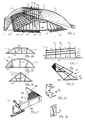
- an equipment according to one favourable mode of application of the invention primarily meant to be used in outside air, i.e. in field conditions and for the mechanical drying of organic fibre-based loose material, such as stalked materials, peat and wood chips etc, is formed of the drying frame 1, which limits the the drying air flow hollow or drying channel 2 on the underside extending to the ground, which channel will in future here be referred to as the air duct, and which together with the drying frame 1 and its edge fittings 15 carries the material to be dried as an even layer heaped into a rick in such manner that the material to be dried and the ground 3 do not come into contact with each other.
- the equipment according to the invention for the mechanical drying and attainment of forced air flow from air dust 2 through the material layer to outside air or conversely, from outer air through the material layer to air duct 2 includes fan unit 4, which is located in the end of duct 2.
- the drying equipment according to the invention optionally includes a covering unit 5, to be used particularly in rainy weather and to be spread over the material layer to be dried to prevent its becoming wet.
- the drying frame 1 includes several vertical, most advantageously post-like, vertical elements 11, favourably located at intervals between 0.5 - 2 m from each other and set into the earth along the same line, the length of each vertical being favourably between 2.0-4.0 m and carrying at a distance from the ground, favourably 2.0-0.3 m, one, most favourably bar-like, horizontal element 12, the length of which is favourably between 2.0-0.5 m and to tile free end of which element 12 is attached through an angle slanting downward from the horizontal a flank-, most favourably a bar-like element 13, the free end of which is supported against the ground.
- a vertical element 11, a horizontal element 12 and two flank elements compose in this mode of application one of the individual support frameworks of the drying frame on top of which the material intended for drying is heaped.
- the base fittings leave openings between both the horizontal elements 12, and located on top of flank elements 13 the longitudinal, favourably bar-like elements 14, favourably of slats, which extend either individually or fitted end to end in the direction of the flank element lengths, the opening size being selected each time depending on the size of the particles of the material to be dried and the length of the drying element frame 1.
- the drying frame includes at least a ground contact prevention edge 15 accompanying the drying frame as an edge fitting that extends to the ground at least on the longitudional side, edge 15 being supported against the ground and on top of it is piled the material to be dried that comes closest to the ground surface.
- the edge part mentioned in the advantageos mode of application according to Fig 1 is formed of several favourably pole-like elements 151, which are fitted parallel to each other at a short distance, favourably 1.0 - 5.0 m and against the ground for their whole length when it can be ensured that no air leakage occurs underneath the rick, but that all the air intended for drying only flows through the material layer to be dried to outside air or into the air duct and the rick is isolated from ground moisture.
- the material can be laid evenly and particularly that its upper parts are fundamentally in an uncompacted layer on top of the drying frame, and also that the air flow and its drying efficiency remain as evenly distribued as possible through the rick material while the drying of the material progresses.
- the free ends of the pole-like vertical elements 11 fundamentally project higher than the bar-like horizontal elements 12 fastened onto them, when the free ends of the aforementioned vertical elements 11 function on the one hand in heaping up the material to be dried onto the drying frame and on the other hand as aids in evaluating the thickness layer of the rick of material to be dried and again as an aid in evaluating the longitudional centre line of the rick to be formed.
- Fig. 3 is illustrated a favourable mode of application of a drying frame according to the invention, tapering towards its rear end.
- a drying frame meant for the drying of hay and stalk-like material in general the height of the air duct reduces, i.e.
- the pressure loss caused by the air flowing through the risk to outside can be compensated for and the pressure prevailing in the air duct is set to optimal for the material quantity at each point of the rick, which makes possible the progress of the drying front in all parts of the risk at fundamentally constant speed.
- the equipment according to the invention includes a covering unit 5 for preventing the stalked material from becoming vet in rainy weather, which when not in use is kept rolled up and when taken into use is spread out over the risk.
- the covering unit in the favourable mode of application of Fig 1 is composed of two covering elements fitted on both the long sides of the drying frame 1, for example of light coverings 5, each of which are rolled up at the lover edge of drying frame 1, favourably close to the drying frame edge fittings 15, from which position they can be drawn out over the risk to be dried and fastened from the free long edge with suitable fastening devices, for example with the aid of straps, ropes or similar means, to the vertical elements 11, so that along the line passing through the vertical elements 11 is left a space between the longitudinal edges of the light coverings 5, the gap 18 extending along the full length of the risk, through which the damp air can escape to the outside air.
- the rotation mechanism 52, 53 of the shaft of the covering roll 51 is used as the removal and setting device of the cover 5, which is fitted to the lower edge of the rick flat, whereupon moving of the cover is carried out by dragging it along the risk material surface.
- the covering roll can naturally be located when not in use close to the vertical elements 11 and that the covering roll can be rolled upwards or downwards along the risk flat, then by setting the direction of rotation of the covering roll the selection of either baring the risk (cover rolling up) or covering the risk (cover spreading over) can be decided.
- the rotation mechanism in formed at the grooved end of covering roll shaft 51 by using e.g.
- the known sprung-loaded, ball-locking, detachably connected power device which includes the lever arm 52 and ratchet mechanism 53.
- the power device in question other power devices, e.g. electrical or hydraulic power devices can naturally be used, the power output shaft of which, with suitable connection and power transmission, e.g. universal joint shaft, is connected to the covering roll shaft for its rotation
- the ends of the drying frame 1 can also be furnished with end elements or slats similar to flank elements 13 and end edging parts similar to the ground moisture prevention edging parts 15.
- the drying frame is then enclosed on all of its sides and also the ends of the drying frame car, be used as a base for the material to be dried. Additionally for the covering of the rick ends, end covers similar to the light covers described above, the gathering and spreading of which can be carried out when necessary in the manner described above.
- FIGs 2a, 2b and 2c some favourable shapes of air duct 2 within the limitations of the drying frame are illustrated.
- the shape in Fig 2a is identical to that of the first favourable mode of application of the invention described in Fig 1 excluding the transverse strengthening or support element 19 in the base of the drying frame, the purpose of which is to stiffen the frame against the transverse direction of loading, and the additional support element 20 between the joining points of flank and horizontal elements 11, 13 and the aforementioned support element 19.
- a curving part favourably of arced shape
- the drying element is formed of vertical element 11 and immediately to it are fastened one end of the straight flank elements 13 and the stiffening or supporting element 19 in the base of frame, a triangular frame being generally stiff.
- drying frame support frames according to these modes of application can be furnished with an additional supporting element 20, such as in the mode of application in Fig 2b link the stiffening or supporting part 19 and the joint of the horizontal element 12' and the flank element 13, such as in Fig 2c link together the strengthening or supporting element 19 and the flank element 13.
- the air duct 2 can also be dimensioned to accurately correspond to the needs in its breadth direction but if the support frames are made with standard, for example industrial, sizes similar fundamentally according to Figs 2a, 2b, 2c or 8 and if the attainment of even air over the whole rick length so requires, the drying frame can be furnished with edge fitting part 26 according to Fig 4, a part widening the edge of the drying area, which to advantage can be affixed steplessly in both breadth or height direction to the flank element of the drying frame support construction, and is thus intended to be located between the drying frame 1 proper and the ground moisture prevention edge part 15.
- the widening edge part 26 is made up of elements 262 in the transverse direction relative to the longitudinal axis of frame 1, which elements can be of any material, most suitable wood or plastic, and in each of which edge parts are at least two pieces each connected to the flank element 13 where it reaches the ground, and the side element 263 running in the same direction relative to the longitudinal axis of the hurdle frame 1, each of which elements 263 are fastened at least from both ends to the transverse elements 262 where their free ends protrude from hurdle frame 1.
- the edge widening part 26 includes in this mode of application a net base 264, in place of which slatting may also be used, and the net opening (or slat spacing) of which is made suitable for each material to be dried, i.e., the net openings that may be used with hay are larger than, for example those for use with wood chips, so that the material cannot spill through the net (or slat) openings inside the edge widening part 26.
- the edge widening part 26 is fastened for an arrangement in the transverse direction to drying frame 1, whereupon the edge widening part 26 can be set suitably for the layer thickness of each rick material, so that the outermost peripheral surface of the rick material layer does not extend to the outermost longitudinal element 151 of the ground moisture prevention part 15 to be fitted beside the edge widening part.
- a really thick rick layer can then be reliably isolated from the ground, and adverse air gaps are not created between ground and rick surfaces.
- FIGs 5a and 5b two favourable fitments for fastening the edge widening part 26 in place are presented.
- the locking fitment according to Figure 5a is formed of a generlly U-shaped metallic piece 6, the waist part of which is dimensioned to correspond to the height of the transverse element 262 of the edge widening part, and inside which the transverse element 262 is intended to fit.
- the forked parts of the U-piece then project beyond the transverse elements and in these forked parts are slots opening in opposite directions to each other and these are dimensioned to fit over the flank elements 13.
- the slots support the flank elements in opposite directions and thus hold the transverse element as well as the whole of the edge widening part firmly in the desired place.
- the whole position of the edge widening part 26 relative to drying frame 1 is changed especially in the lateral direction, but also when needed in the vertical direction.
- the locking fitment 6' is made from a formed plate in which there is a depression made to correspond with the shape of the flank element 13 and the height of which is dimensioned to correspond to the respective height of the transverse element 262.
- the locking fitment 6' according to this mode of application is used so that it is set over the flank element 13 and fastened, e.g., with screws in the desired place, whereupon the locking fitment 6' presses the flank element against the transverse element 262 and keeps it securely in place in the desired position.
- the position of the screw fastening the whole position of the widening edge part 26 relative to the drying frame 1 is changed.
- a third edging part according to one favourable mode of application of the invention is presented, i.e. a wall edging part 27, to be positioned in the direction of the longitudinal axis of drying frame 1, as an outer part of the edging equipment.
- the third edging part 27 according to this mode of this application is formed of a slat frame, which is arranged for folding on its long edge along the side of the drying frame, when it has the first framework part 275 supported on the ground and the second framework 276 that is intended for support by the external surface of the rick.
- this secondary mode of application includes at least one device 277 for the adjustment and locking of the angle of inclination between the first and second frameworks 275 and 276 which is fastened, for example, by pin connection from its first end arm-like to the other framework part 276, and the other end of which is furnished with, for example, a drilled or perforated plate, so that the hole of the drilled or perforated plate is dimensioned to fit onto the pin-like protruding parts 278 set apart at intervals, whereupon by changing the position of the other end of the adjustment and locking element in relation to the edge part of the first framework the angle of inclination of this third mode of edge part can be adjusted.
- the third edging part acccording to this mode of application can, if so desired, be furnished with a net (or with slats), the net opening size of which is selected to suit the material to be dried so that the material cannot spill through the openings in the net (or slats) to the ground.
- the third edging part according to Fig 6 is then favourably an airy wall part, the purpose of which is, especially when there are large quantities of material to he dried, ease in making the rick and ensuring that the rick is correct in relation to the drying frame and the air duct beneath it, and thus making possible an even material layer throughout and the ideal even throughflow of air and also even drying.
- the height of the rick in relation to its width can be greater than any natural spilling angle characteristic to the material would allow.
- the shape of the air duct cross-section can be selected more freely.
- the drying equipment according to the invention is thus formed of drying frame 1 which supports on its upper side the base fittings 14 for the material rick to be dried and limits on its lower side the air duct 2, to which is connected at least one fan device 4 for the creation of a drying air flow through the rick material layer, edge fittings, which consist of at least ground moisture prevention part 15 and wall edging part 27, or alternatively an edge widening part 26, ground moisture prevention part 15 and wall edging part 27, which edging parts keep the lowermost parts of the rick separated from the ground and especially the wall edging part 27 ensures correct location of the rick material relative to air duct 2, and an optionally used covering element, with which wetting of the rick is prevented if it rains.
- the wall edging part 27 being jointed can if need be dropped and/or removed if for example the emptying technique of the dryer so requires.
- Fig 8 a favourable mode of industrially manufactured drying hurdle of modular construction is presented, in which the manufacturing materials are favourably of plastic and metal.
- the supporting framework 1' of the drying frame is formed of the first transverse element 19 against the ground, and in rectangular cross-sectional form, and of the second transverse element 13, of circular arc form and of round cross-section, which is together with another transverse element in the same vertical plane, as well as several intermediate elements 11' connecting the transverse elements and supporting the support framework, round in cross-section, the central of which, i.e.
- the central intermediate element 11' passes through the curved transverse element 13' for the continuation of which, most suitably with a sleeve-like connection, is the vertical additional element 20, which functions as a marking device for the layer thickness and alignment of the rick material layer on top of the drying frame and also as a fastening support for the covering device spread over the material rick and is when necessary, for example when the dryer emptying technique so demands, easily removed from its sleeve or corresponding fastening.
- the drying frame 1' is stiffened in the longitudinal direction by a slanting supporting piece 28, which is fitted to connect the vertical intermediate support 11' and the strong longitudinal support 22 of at the least two successive supporting frameworks.
- Such support frames 1' described above are suited for the formation of a drying frame with spaces between each other in the longitudinal axis direction and then supported at the relevant separation distance by longitudional spacer elements 21, which are joined together most suitably by such a connection as is presented in Fig 9 or by some other easily installed and dismantled connection.
- This connection of the longitudinal elements 21 and the transverse element 19 has been so made that at one end of the longtudinal elements to be joined together there is a pin-like protrusion 23 and in the other end there is a corresponding opening 24 suited to fit around it.
- the projecting end of the transverse element 19 is located in between the longitudinal elements to be joined together and for that reason the opening 25 is made in it through which the aforementioned protrusion 23 is fitted.
- the drying frame includes a net element 14' as the base for the heaped rick material, with which the longitudinal slatting 14 constructed on top of the flank element 13, as described in connection with Fig 1 at the beginning of this patent application, can be substituted.
- Such a net can be extended in one piece over the whole drying frame area or be made up of two net elements, one of which coveres one half of the drying frame and the other correspondingly the other half. Further it is important that the net opening size is selected to correspond to the particle size of the rick material to be dried so that no unnecessary spillage of the material into the air duct occurs.
- the mechanical drying of the organic fibre-based loose material such as stalked materials peat, chips and the like is performed as follows:
- the fan equipment 4 includes a power drive device, favourably an electric motor and its driven rotor, as well as the support frame surrounding the rotor and the inblowing and/or outblowing flow duct that is fitted as the continuation of the support frame, the duct being directly connected to air duct 2 limited by the lower side of drying frame 1, whence the only path to the outside air is through the fan equipment or through the rick' when the path of the forced airflow from the fan duct through air duct 2 to outside air or conversely from outside air through air duct 2 to the fan duct only passes through the rick material to be dried.
- a power drive device favourably an electric motor and its driven rotor, as well as the support frame surrounding the rotor and the inblowing and/or outblowing flow duct that is fitted as the continuation of the support frame, the duct being directly connected to air duct 2 limited by the lower side of drying frame 1, whence the only path to the outside air is through the fan equipment or through the rick' when the path of the forced airflow from the fan
- connection is made as air-tight as possible, whereupon it is advantageous that the air duct projects some distance inside the drying frame 1 and that the end of the drying frame on the fan equipment 4 side is furnished with slanting vertical elements on top of which the material to be dried is set.
- Naturally fully enclosed end elements for example of plastic sheet, can be used, in which there is an opening dimensioned to correspond to the fan duct dimensions.
- the mounting of the fan motor 41 and the electrical installations 43 are so fashioned that the attachment of the support frame 46 to the fan duct casing 42 is performed with bolts 44 or by quickly locking catches, and that the electrical switches 43, i.e. the star-delta safety switch, the switch to change the direction of rotation and the electrical power plug are mounted onto the aforementioned support frame 43, whereupon the fan equipment can be transferred as a complete unit with the aid of support frame 43 to another operational site. It is then possible to manufacture the fan motor/electrical switch combination industrially and thanks to the direction of rotation switch the the fan blowing direction can be changed in order to even out moisture differences and utilize the weather conditions to the optimun so as to speed up the drying.
Landscapes
- Life Sciences & Earth Sciences (AREA)
- Environmental Sciences (AREA)
- Chemical & Material Sciences (AREA)
- Engineering & Computer Science (AREA)
- Oil, Petroleum & Natural Gas (AREA)
- Organic Chemistry (AREA)
- Mechanical Engineering (AREA)
- General Engineering & Computer Science (AREA)
- Drying Of Solid Materials (AREA)
Claims (20)
- Vorrichtung zum Trocknen von losem Material auf der Basis organischer Fasern, wie Strohmaterial , Torf und Holzspänen, an der Luft, welche folgende Elemente umfaßt:
ein langgestrecktes Trockengestell (1), das auf seiner Oberseite das zu trocknende Material in Form einer Miete trägt, wobei das Trockengestell mit dem Boden (3) einen Luftstromkanal (2) bildet;
wobei das Trockengestell (1) wenigstens zwei im allgemeinen plane Stützrahmen (11, 12, 13, 13') aufweist und die Stützrahmen quer zur Längsachse des Trockengestells (1) verlaufen; wobei die Stützrahmen miteinander durch Längselemente verbunden sind, um das langgestreckte Trockengestell und darin den Luftstromkanal zu bilden;
Kantenverbinder (15, 26, 27), die in Richtung der Langsachse des Trockengestells (1) an dessen Längskanten verlaufen;
eine Vielzahl senkrechter Elemente (11, 20), die längs der Längsachse des Trockengestells (1) ausgerichtet sind, so daß Material, das auf das Trockengestell aufzuschütten ist, um diese senkrechten Elemente aufgeschüttet wird;
obere Verbinder (16, 17), die längs der Oberkante des Trockengestells (1) an den senkrechten Elementen (11, 20) verlaufen, um das Verdichten der gebildeten Materialmiete zu verringern;
dadurch gekennzeichnet, daß
die Vorrichtung ein mechanischer Trockner ist, der Gebläsemittel (4) hat, die wenigstens an einem Ende des Luftstromkanals (2) bereitgestellt werden, um in dem Kanal (2) einen erzwungenen Luftstrom zu bilden;
die senkrechten Elemente (11, 20) Anzeigeelemente sind, die längs der Längsachse des Trockengestells ausgerichtet sind und in ausreichendem Abstand über den Stutzrahmen verlaufen, um durch die Stärke der Schicht des auf dem Trockengestell aufzuschüttenden Materials vorzustehen, um auf diese Weise sowohl die Stärke der Schicht als auch die Ausrichtung der zu bildenden Materialmiete im Verhältnis zur Längsachse des Trockengestells (1) anzuzeigen;
wobei die Kantenverbinder so angeordnet sind, daß sie die Materialmiete über der Bodenoberfläche tragen und ein Austreten des Luftstromes durch den Zwischenraum zwischen der Materialmiete und dem Boden verhindern, wodurch der Luftstrom, der durch das Gebläsemittel (4) verursacht wird, vorzugsweise durch das Material der Miete gelenkt wird;
ein Abdeckmittel (5) vorhanden ist, um die Materialmiete abzudecken und einen Luftspalt über der Miete zu bilden, um den Durchgang von feuchter Luft zu ermöglichen. - Vorrichtung nach Anspruch 1, bei welcher die oberen Verbinder (16, 17) aus wenigstens zwei Längselementen gebildet werden, die längs des Trockengestells verlaufen und an den senkrechten Elementen (11, 20) befestigt sind.
- Vorrichtung nach Anspruch 1 oder 2, bei welcher sich der Luftstromkanal (2) in der Längsrichtung des Trockengestells vom Gebläsemittel weg verengt.
- Vorrichtung nach einem der Ansprüche 1 bis 3, bei welcher die Kantenverbinder eine Vielzahl von im wesentlichen parallelen Längselementen (151) aufweisen, die als Mittel zur Verhinderung von Feuchtigkeit dienen, wobei jedes dieser Elemente Kontakt mit dem Boden hat, um den Raum zwischen der Materialmiete und der Bodenoberfläche zu schließen und den erzwungenen Luftstrom durch das Material zu lenken.
- Vorrichtung nach Anspruch 4, bei welcher die Kantenverbinder ein äußerstes Wandkantenelement (27) aufweisen, das sich auf den Boden stützt und unmittelbar neben den Mitteln zur Verhinderung von Feuchtigkeit (15) angebracht ist,
wobei das Wandkantenelement folgende Elemente aufweist:
ein Rahmengestell aus Latten, das einen ersten, unteren Rahmen (275), der sich auf den Boden aufstützt, und einen zweiten, oberen Rahmen hat, der von dem unteren Rahmen ausgeht, um sich gegen die Außenseite der Materialmiete abzustützen, wobei der obere Rahmen ein Netz für den Durchgang von Luft hat, und
ein Feststellelement (277) zur Einstellung und Feststellung des Winkels zwischen dem ersten und dem zweiten Rahmen. - Vorrichtung nach Anspruch 5, bei welcher das Feststellelement (277) drehbar mit dem ersten Rahmen verbunden ist und durch einen Stift mit dem zweiten Rahmen verbunden werden kann.
- Vorrichtung nach einem der Ansprüche 1 bis 6, bei welcher die Kantenverbinder folgende Elemente aufweisen:
Kantenaufweitungsmittel (26), das unmittelbar an den Längskanten des Rahmens gegen den Boden hin angebracht wird, um den Trocknungsraum auszudehnen, wobei das Kantenaufweitungsmittel einen Rahmen aufweist, der zum Luftkanal (2) hin offen ist, und wenigstens ein Rahmenlängselement (263) und wenigstens zwei Rahmenquerelemente (262), die an den Enden der Rahmenlängselemente befestigt sind, hat;
und bei welcher die Rahmenelemente (262, 263) jeweils gegen den Boden gehen und auf ihrer Oberseite ein Basiselement (264) tragen, um den Durchgang des Luftstromes durch die Materialmiete zu ermöglichen. - Vorrichtung nach Anspruch 7, bei welcher das Basiselement (264) durch ein Netz oder eine Vielzahl von Latten gebildet wird.
- Vorrichtung nach einem der Ansprüche 1 bis 8, bei welcher das Abdeckmittel wenigstens zwei Abdeckelemente (5) aufweist, die jeweils aus einer ersten Position an den senkrechten Elementen in eine zweite Position bewegt werden können, wodurch das genannte Abdeckelement einen entsprechenden Stützrahmen (11, 12, 13, 13') bedeckt; und bei welcher die Abdeckelemente längs der angrenzenden Längskanten mit Befestigungsmitteln zur Befestigung der Abdeckelemente an den senkrechten Elementen (11, 20) versehen sind, um einen Spalt (18) zwischen den Abdeckelementen zu bilden, um den Austritt von feuchter Luft zu ermöglichen.
- Vorrichtung nach Anspruch 9, bei welcher die Befestigungsmittel Riemen oder Seile umfassen.
- Vorrichtung nach Anspruch 9 oder 10, bei welcher die Abdeckelemente auf entsprechenden Rollenmitteln gelagert werden und außerdem Antriebsmittel aufweisen, um die Abdeckmittel abzurollen und aufzurollen.
- Vorrichtung nach Anspruch 11, bei welcher die Antriebsmittel einen von Hand zu bedienenden Hebelarm (52) oder einen elektrischen oder hydraulischen Motor umfassen, die abnehmbar mit einer Mittelwelle (51) der Rollenmittel verbunden werden können.
- Vorrichtung nach einem der Ansprüche 1 bis 12, bei welcher das Gebläsemittel einen Rotor-Stützrahmen (46) aufweist, der durch Befestigungsmittel (44) abnehmbar an einem Gebläsekanal (42) befestigt werden kann, der wiederum mit dem Luftstromkanal (2) gekoppelt ist; und bei welcher Zubehörteile und elektrische Verbindungen (43) für das Gebläsemittel im Verhältnis zum Stützrahmen (46) zur Bewegung mit dem Stützrahmen befestigt sind.
- Vorrichtung nach einem der Ansprüche 1 bis 13, bei welcher das Gebläsemittel einen elektrischen Antriebsmotor und Schaltmittel zur Steuerung der Rotationsrichtung des Motors hat, um die Strömungsrichtung der Luft durch den Luftstromkanal (2) ändern zu können.
- Vorrichtung nach einem der Ansprüche 1 bis 14, bei welcher das Trockengestell Stütz-Endrahmen zum Tragen der allgemein planen Stützrahmen hat und bei welcher jeder der Stützrahmen in Modulbauweise ausgeführt ist,
bei welcher jeder der Stütz-Endrahmen ein erstes, allgemein gerades Element (19), das den Kontakt zum Boden herstellt, und ein zweites, generell gebogenes Element (13'), das im wesentlichen in derselben senkrechten Ebene wie das erste Element (19) liegt, und eine Vielzahl von Zwischenelementen (11) hat, welche die ersten und zweiten Elemente; miteinander verbinden;
und bei welcher die Stütz-Endrahmen untereinander durch Längselemente (21, 22) verbunden sind, die im wesentlichen parallel zur Längsachse des Trockengestells verlaufen, wobei eines der Längselemente die ersten Elemente (19) untereinander verbindet und ein zweites der Längselemente die zweiten Elemente (13') im wesentlichen an ihrem höchsten Punkt untereinander verbindet, und außerdem Winkelelemente (28) die Zwischenelemente (11') und das zweite Längselement (22) im wesentlichen längs der Mittellinie des Trockengestells miteinander verbinden. - Vorrichtung nach einem der Ansprüche 1 bis 15, die wenigstens zwei Gebläsemittel (4) aufweist, die sich an den entgegengesetzten Enden des Trockengestells befinden, und bei welcher das Trockengestell zwei Hälften aufweist, die auf den entsprechenden Seiten einer Symmetrieachse angeordnet sind.
- Verfahren zum mechanischen Trocknen eines Materials auf der Basis organischer Fasern, wie Strohmaterial , Torf oder Holzspänen, an der Luft, unter Anwendung eines Trockengestells nach einem der Ansprüche 1 bis 16, wobei die Methode folgende Schritte aufweist:
Aufschütten des zu trocknenden Materials auf die Oberseite des Trockengestells längs des Trockengestells, um eine Miete zu bilden, die einen Abstand gegenüber dem Boden aufweist;
Sicherstellen, daß das Material längs des Trockengestells eine einheitliche Material-Schichtstärke aufweist, durch Vergleich der äußeren Oberfläche der Aufschüttung des losen Materials mit den senkrecht vorstehenden Elementen (11, 11', 20) und den Kantenverbindern (15, 27), und
Erzeugen eines Luftstromes durch das Material auf dem Trockengesteil durch Betätigung des Gebläsemittels. - Verfahren nach Anspruch 17, außerdem dadurch gekennzeichnet, daß das Gebläsemittel abwechselnd in entgegengesetzten Richtungen betrieben wird, um so die Richtung des Luftstromes durch die aufgeschüttete Materialmiete zu ändern.
- Verfahren nach Anspruch 17 oder Anspruch 18, das außerdem das Abdichten des Zwischenraumes zwischen der Mietenunterfläche und der Bodenoberfläche umfaßt, um ein Austreten des Luftstromes über die Kantenverbinder hinaus zu verhindern.
- Verfahren nach einem der Ansprüche 17 bis 19, das außerdem das Abdecken der Miete mit einem Abdeckmittel (5) umfaßt, uni die Miete vor Regen zu schützen, wobei das Abdeckmittel einen Abstand gegenüber dem Mietenmaterial aufweist, um zwischen dem Abdeckmittel und dem Mietenmaterial einen Spalt für den Durchgang von feuchter Luft zu bilden.
Priority Applications (1)
| Application Number | Priority Date | Filing Date | Title |
|---|---|---|---|
| AT87904876T ATE115618T1 (de) | 1987-07-07 | 1987-07-07 | Vorrichtung und verfahren zur mechanischen trocknung eines organischen fasermaterials, wie stroh, torf, holzspäne und sonstiges. |
Applications Claiming Priority (1)
| Application Number | Priority Date | Filing Date | Title |
|---|---|---|---|
| PCT/FI1987/000093 WO1989000185A1 (en) | 1987-07-07 | 1987-07-07 | A method and apparatus for mechanical drying of an organic fibre based material as straw materials, peat, wooden chips and the like |
Publications (2)
| Publication Number | Publication Date |
|---|---|
| EP0430933A1 EP0430933A1 (de) | 1991-06-12 |
| EP0430933B1 true EP0430933B1 (de) | 1994-12-14 |
Family
ID=8556423
Family Applications (1)
| Application Number | Title | Priority Date | Filing Date |
|---|---|---|---|
| EP87904876A Expired - Lifetime EP0430933B1 (de) | 1987-07-07 | 1987-07-07 | Vorrichtung und verfahren zur mechanischen trocknung eines organischen fasermaterials, wie stroh, torf, holzspäne und sonstiges |
Country Status (5)
| Country | Link |
|---|---|
| EP (1) | EP0430933B1 (de) |
| DE (1) | DE3750882T2 (de) |
| FI (1) | FI895794A0 (de) |
| RU (1) | RU1836563C (de) |
| WO (1) | WO1989000185A1 (de) |
Cited By (5)
| Publication number | Priority date | Publication date | Assignee | Title |
|---|---|---|---|---|
| WO2006024463A1 (de) | 2004-08-27 | 2006-03-09 | Technische Universität Dresden | Verfahren zur trocknung von biomasse |
| DE202011105149U1 (de) | 2011-08-30 | 2011-11-24 | Matthias Penkert | Bodenplatte |
| CN106440693A (zh) * | 2016-11-14 | 2017-02-22 | 丹阳正联知识产权运营管理有限公司 | 防雨型室外晾晒装置 |
| CN106440694A (zh) * | 2016-11-15 | 2017-02-22 | 丹阳正联知识产权运营管理有限公司 | 全自动防雨型室外晾晒装置 |
| CN106766738A (zh) * | 2016-11-15 | 2017-05-31 | 丹阳正联知识产权运营管理有限公司 | 可升降调节防雨型室外晾晒装置 |
Families Citing this family (7)
| Publication number | Priority date | Publication date | Assignee | Title |
|---|---|---|---|---|
| FI890041A7 (fi) * | 1989-01-05 | 1990-07-06 | Heikki Kalervo Oinas | Solabsorption. |
| CA2430158A1 (fr) * | 2003-05-30 | 2004-11-30 | Premier Horticulture Ltee | Procede de recolte et de preparation de la tourbe de sphaigne et sechoir pour mener a bien ce procede |
| FR3006859B1 (fr) * | 2013-06-12 | 2016-02-26 | Barre Sas Ets | Chassis de suspension de pied de tabac |
| PL3384220T3 (pl) * | 2015-12-01 | 2021-01-25 | Stora Enso Oyj | Sposób suszenia pryzmy biomasy |
| CN106927157A (zh) * | 2017-04-11 | 2017-07-07 | 合肥富通环保新能源科技有限公司 | 一种粮仓临时储存小麦的方法 |
| CN110425840B (zh) * | 2019-08-27 | 2021-04-16 | 潍坊晨禾信息科技有限公司 | 一种中药光纤磁力晾晒装置 |
| CN116998324A (zh) * | 2023-08-01 | 2023-11-07 | 陈戈 | 折叠地笼组件及折叠地笼 |
Family Cites Families (5)
| Publication number | Priority date | Publication date | Assignee | Title |
|---|---|---|---|---|
| GB245971A (en) * | 1925-03-16 | 1926-01-21 | John Albert Frost | Improvements in or relating to means for ventilating or drying hay or corn stacks |
| GB613162A (en) * | 1946-06-13 | 1948-11-23 | Alexander Proctor | Improvements in or relating to the conditioning of hay and similar cut crops |
| US2859683A (en) * | 1954-12-23 | 1958-11-11 | Nat Steel Corp | Ventilating tunnel |
| DE1079879B (de) * | 1958-07-03 | 1960-04-14 | Voith Gmbh J M | Anlage und Verfahren zum Trocknen und Belueften von Heu od. dgl. |
| DE1143357B (de) * | 1959-03-03 | 1963-02-07 | Franz Lothar Oberhofer | Geruest zum Aufreitern von zu trocknenden landwirtschaftlichen Produkten, wie Heu, Getreide od. dgl. |
-
1987
- 1987-07-07 WO PCT/FI1987/000093 patent/WO1989000185A1/en not_active Ceased
- 1987-07-07 DE DE3750882T patent/DE3750882T2/de not_active Expired - Fee Related
- 1987-07-07 FI FI895794A patent/FI895794A0/fi not_active IP Right Cessation
- 1987-07-07 EP EP87904876A patent/EP0430933B1/de not_active Expired - Lifetime
-
1990
- 1990-01-05 RU SU904742848A patent/RU1836563C/ru active
Cited By (6)
| Publication number | Priority date | Publication date | Assignee | Title |
|---|---|---|---|---|
| WO2006024463A1 (de) | 2004-08-27 | 2006-03-09 | Technische Universität Dresden | Verfahren zur trocknung von biomasse |
| DE202011105149U1 (de) | 2011-08-30 | 2011-11-24 | Matthias Penkert | Bodenplatte |
| CN106440693A (zh) * | 2016-11-14 | 2017-02-22 | 丹阳正联知识产权运营管理有限公司 | 防雨型室外晾晒装置 |
| CN106440694A (zh) * | 2016-11-15 | 2017-02-22 | 丹阳正联知识产权运营管理有限公司 | 全自动防雨型室外晾晒装置 |
| CN106766738A (zh) * | 2016-11-15 | 2017-05-31 | 丹阳正联知识产权运营管理有限公司 | 可升降调节防雨型室外晾晒装置 |
| CN106766738B (zh) * | 2016-11-15 | 2019-02-15 | 丹阳正联知识产权运营管理有限公司 | 可升降调节防雨型室外晾晒装置 |
Also Published As
| Publication number | Publication date |
|---|---|
| DE3750882T2 (de) | 1995-08-17 |
| FI895794A7 (fi) | 1989-12-04 |
| DE3750882D1 (de) | 1995-01-26 |
| EP0430933A1 (de) | 1991-06-12 |
| RU1836563C (ru) | 1993-08-23 |
| FI895794A0 (fi) | 1989-12-04 |
| WO1989000185A1 (en) | 1989-01-12 |
Similar Documents
| Publication | Publication Date | Title |
|---|---|---|
| EP0430933B1 (de) | Vorrichtung und verfahren zur mechanischen trocknung eines organischen fasermaterials, wie stroh, torf, holzspäne und sonstiges | |
| US3765134A (en) | Construction of rigid tensioned frame structure | |
| CN101534634A (zh) | 动物棚房建筑物 | |
| US4915022A (en) | Vent assemblies | |
| MX2014001300A (es) | Techo retractil. | |
| US5410844A (en) | Building vent assembly | |
| US20040049991A1 (en) | Multi-purpose structure | |
| CN104642004A (zh) | 通风型日光温室 | |
| US4222347A (en) | Animal shelter for large-scale feedlot operations | |
| IT202300001320A1 (it) | Impianto per la produzione di energia elettrica comprendente una tensostruttura comprensiva di supporti al terreno. | |
| CN220935882U (zh) | 一种单锯齿式薄膜连栋温室 | |
| CA1148741A (en) | Method and apparatus for retaining heat in greenhouse and similar structures | |
| GB2024588A (en) | Protective enclosure | |
| US5373861A (en) | System and method for casing tobacco | |
| CN204518659U (zh) | 大跨度通风型日光温室 | |
| CN208269536U (zh) | 平仓玉米果穗烘干机 | |
| KR20210034235A (ko) | 연동 비닐하우스용 다단 골조 프레임 결합 구조 | |
| KR20210034234A (ko) | 비닐 하우스용 다단 골조 프레임 결합 구조 | |
| KR200497523Y1 (ko) | 경량온실 조립시공용 일체형 용마루 클램프 | |
| FI79408C (fi) | Foerfarande foer behandling av strao- eller hoegods och container samt tork foer foerfarandets genomfoerande. | |
| JPH0114663Y2 (de) | ||
| RU2017386C1 (ru) | Устройство для сушки сельскохозяйственной продукции | |
| WO1990007685A1 (en) | Method and apparatus for gathering sun radiation energy by driers, both method and apparatus for drying different materials | |
| Shedd | Storage of ear corn on the farm | |
| EP0514998A1 (de) | Gebäude, insbesondere ein Gewächshaus |
Legal Events
| Date | Code | Title | Description |
|---|---|---|---|
| PUAI | Public reference made under article 153(3) epc to a published international application that has entered the european phase |
Free format text: ORIGINAL CODE: 0009012 |
|
| 17P | Request for examination filed |
Effective date: 19891219 |
|
| AK | Designated contracting states |
Kind code of ref document: A1 Designated state(s): AT BE CH DE FR GB IT LI LU NL SE |
|
| 17Q | First examination report despatched |
Effective date: 19911127 |
|
| GRAA | (expected) grant |
Free format text: ORIGINAL CODE: 0009210 |
|
| AK | Designated contracting states |
Kind code of ref document: B1 Designated state(s): AT BE CH DE FR GB IT LI LU NL SE |
|
| PG25 | Lapsed in a contracting state [announced via postgrant information from national office to epo] |
Ref country code: IT Free format text: LAPSE BECAUSE OF FAILURE TO SUBMIT A TRANSLATION OF THE DESCRIPTION OR TO PAY THE FEE WITHIN THE PRESCRIBED TIME-LIMIT;WARNING: LAPSES OF ITALIAN PATENTS WITH EFFECTIVE DATE BEFORE 2007 MAY HAVE OCCURRED AT ANY TIME BEFORE 2007. THE CORRECT EFFECTIVE DATE MAY BE DIFFERENT FROM THE ONE RECORDED. Effective date: 19941214 Ref country code: LI Effective date: 19941214 Ref country code: NL Effective date: 19941214 Ref country code: FR Effective date: 19941214 Ref country code: CH Effective date: 19941214 Ref country code: BE Effective date: 19941214 |
|
| REF | Corresponds to: |
Ref document number: 115618 Country of ref document: AT Date of ref document: 19941215 Kind code of ref document: T |
|
| REF | Corresponds to: |
Ref document number: 3750882 Country of ref document: DE Date of ref document: 19950126 |
|
| REG | Reference to a national code |
Ref country code: CH Ref legal event code: PL |
|
| EN | Fr: translation not filed | ||
| NLV1 | Nl: lapsed or annulled due to failure to fulfill the requirements of art. 29p and 29m of the patents act | ||
| PG25 | Lapsed in a contracting state [announced via postgrant information from national office to epo] |
Ref country code: LU Free format text: LAPSE BECAUSE OF NON-PAYMENT OF DUE FEES Effective date: 19950731 |
|
| PLBE | No opposition filed within time limit |
Free format text: ORIGINAL CODE: 0009261 |
|
| STAA | Information on the status of an ep patent application or granted ep patent |
Free format text: STATUS: NO OPPOSITION FILED WITHIN TIME LIMIT |
|
| 26N | No opposition filed | ||
| PGFP | Annual fee paid to national office [announced via postgrant information from national office to epo] |
Ref country code: DE Payment date: 19990720 Year of fee payment: 13 Ref country code: AT Payment date: 19990720 Year of fee payment: 13 |
|
| PGFP | Annual fee paid to national office [announced via postgrant information from national office to epo] |
Ref country code: GB Payment date: 20000615 Year of fee payment: 14 |
|
| PG25 | Lapsed in a contracting state [announced via postgrant information from national office to epo] |
Ref country code: AT Free format text: LAPSE BECAUSE OF NON-PAYMENT OF DUE FEES Effective date: 20000707 |
|
| PG25 | Lapsed in a contracting state [announced via postgrant information from national office to epo] |
Ref country code: DE Free format text: LAPSE BECAUSE OF NON-PAYMENT OF DUE FEES Effective date: 20010501 |
|
| PG25 | Lapsed in a contracting state [announced via postgrant information from national office to epo] |
Ref country code: GB Free format text: LAPSE BECAUSE OF NON-PAYMENT OF DUE FEES Effective date: 20010707 |
|
| GBPC | Gb: european patent ceased through non-payment of renewal fee |
Effective date: 20010707 |
|
| EUG | Se: european patent has lapsed | ||
| PGFP | Annual fee paid to national office [announced via postgrant information from national office to epo] |
Ref country code: SE Payment date: 20060705 Year of fee payment: 20 |