EP0431302A2 - Verwendung härtbarer Cycloaliphaten-Derivate in Dübelmassen - Google Patents
Verwendung härtbarer Cycloaliphaten-Derivate in Dübelmassen Download PDFInfo
- Publication number
- EP0431302A2 EP0431302A2 EP90120570A EP90120570A EP0431302A2 EP 0431302 A2 EP0431302 A2 EP 0431302A2 EP 90120570 A EP90120570 A EP 90120570A EP 90120570 A EP90120570 A EP 90120570A EP 0431302 A2 EP0431302 A2 EP 0431302A2
- Authority
- EP
- European Patent Office
- Prior art keywords
- compounds
- dowel
- radical
- further development
- cycloaliphatic
- Prior art date
- Legal status (The legal status is an assumption and is not a legal conclusion. Google has not performed a legal analysis and makes no representation as to the accuracy of the status listed.)
- Granted
Links
- 239000000203 mixture Substances 0.000 title description 8
- 150000001875 compounds Chemical class 0.000 claims abstract description 77
- -1 hydroxy, amino Chemical group 0.000 claims description 24
- 125000003903 2-propenyl group Chemical group [H]C([*])([H])C([H])=C([H])[H] 0.000 claims description 14
- CERQOIWHTDAKMF-UHFFFAOYSA-N Methacrylic acid Chemical compound CC(=C)C(O)=O CERQOIWHTDAKMF-UHFFFAOYSA-N 0.000 claims description 14
- 150000001735 carboxylic acids Chemical class 0.000 claims description 13
- 238000006116 polymerization reaction Methods 0.000 claims description 13
- SMZOUWXMTYCWNB-UHFFFAOYSA-N 2-(2-methoxy-5-methylphenyl)ethanamine Chemical compound COC1=CC=C(C)C=C1CCN SMZOUWXMTYCWNB-UHFFFAOYSA-N 0.000 claims description 12
- 239000000463 material Substances 0.000 claims description 12
- 125000004432 carbon atom Chemical group C* 0.000 claims description 8
- 229920000728 polyester Polymers 0.000 claims description 8
- IISBACLAFKSPIT-UHFFFAOYSA-N bisphenol A Chemical compound C=1C=C(O)C=CC=1C(C)(C)C1=CC=C(O)C=C1 IISBACLAFKSPIT-UHFFFAOYSA-N 0.000 claims description 6
- PXKLMJQFEQBVLD-UHFFFAOYSA-N bisphenol F Chemical compound C1=CC(O)=CC=C1CC1=CC=C(O)C=C1 PXKLMJQFEQBVLD-UHFFFAOYSA-N 0.000 claims description 6
- 239000004593 Epoxy Substances 0.000 claims description 5
- 125000005395 methacrylic acid group Chemical group 0.000 claims description 5
- 229920005862 polyol Polymers 0.000 claims description 5
- 125000000391 vinyl group Chemical group [H]C([*])=C([H])[H] 0.000 claims description 5
- 150000001252 acrylic acid derivatives Chemical class 0.000 claims description 4
- NIXOWILDQLNWCW-UHFFFAOYSA-N acrylic acid group Chemical group C(C=C)(=O)O NIXOWILDQLNWCW-UHFFFAOYSA-N 0.000 claims description 4
- LDHQCZJRKDOVOX-NSCUHMNNSA-N crotonic acid Chemical compound C\C=C\C(O)=O LDHQCZJRKDOVOX-NSCUHMNNSA-N 0.000 claims description 4
- LDHQCZJRKDOVOX-UHFFFAOYSA-N trans-crotonic acid Natural products CC=CC(O)=O LDHQCZJRKDOVOX-UHFFFAOYSA-N 0.000 claims description 4
- 239000004215 Carbon black (E152) Substances 0.000 claims description 3
- 239000002253 acid Substances 0.000 claims description 3
- 125000001931 aliphatic group Chemical group 0.000 claims description 3
- 239000003822 epoxy resin Substances 0.000 claims description 3
- 150000002334 glycols Chemical class 0.000 claims description 3
- 229930195733 hydrocarbon Natural products 0.000 claims description 3
- 125000002887 hydroxy group Chemical group [H]O* 0.000 claims description 3
- 229920000647 polyepoxide Polymers 0.000 claims description 3
- 125000004209 (C1-C8) alkyl group Chemical group 0.000 claims description 2
- 125000005393 dicarboximide group Chemical group 0.000 claims description 2
- 229910052736 halogen Inorganic materials 0.000 claims description 2
- 150000002367 halogens Chemical class 0.000 claims description 2
- LNEPOXFFQSENCJ-UHFFFAOYSA-N haloperidol Chemical compound C1CC(O)(C=2C=CC(Cl)=CC=2)CCN1CCCC(=O)C1=CC=C(F)C=C1 LNEPOXFFQSENCJ-UHFFFAOYSA-N 0.000 claims description 2
- 125000005439 maleimidyl group Chemical group C1(C=CC(N1*)=O)=O 0.000 claims description 2
- 150000002825 nitriles Chemical class 0.000 claims description 2
- 229920003986 novolac Polymers 0.000 claims description 2
- 229920001515 polyalkylene glycol Polymers 0.000 claims description 2
- 150000003077 polyols Chemical class 0.000 claims description 2
- 229920006395 saturated elastomer Polymers 0.000 claims description 2
- 125000003545 alkoxy group Chemical group 0.000 claims 1
- 229930195734 saturated hydrocarbon Natural products 0.000 claims 1
- 229930195735 unsaturated hydrocarbon Natural products 0.000 claims 1
- 239000000470 constituent Substances 0.000 abstract description 3
- 229920000642 polymer Polymers 0.000 description 21
- 150000002148 esters Chemical class 0.000 description 18
- 238000006243 chemical reaction Methods 0.000 description 14
- 150000003254 radicals Chemical class 0.000 description 12
- LYCAIKOWRPUZTN-UHFFFAOYSA-N ethylene glycol Natural products OCCO LYCAIKOWRPUZTN-UHFFFAOYSA-N 0.000 description 9
- 239000003999 initiator Substances 0.000 description 8
- VYPSYNLAJGMNEJ-UHFFFAOYSA-N Silicium dioxide Chemical compound O=[Si]=O VYPSYNLAJGMNEJ-UHFFFAOYSA-N 0.000 description 7
- 239000007787 solid Substances 0.000 description 7
- 238000007334 copolymerization reaction Methods 0.000 description 6
- 238000002156 mixing Methods 0.000 description 6
- 239000000178 monomer Substances 0.000 description 6
- 229920005989 resin Polymers 0.000 description 6
- 239000011347 resin Substances 0.000 description 6
- 229920006337 unsaturated polyester resin Polymers 0.000 description 6
- QVGXLLKOCUKJST-UHFFFAOYSA-N atomic oxygen Chemical group [O] QVGXLLKOCUKJST-UHFFFAOYSA-N 0.000 description 5
- 239000002274 desiccant Substances 0.000 description 5
- 230000009977 dual effect Effects 0.000 description 5
- 125000004185 ester group Chemical group 0.000 description 5
- 229910052760 oxygen Inorganic materials 0.000 description 5
- 239000001301 oxygen Substances 0.000 description 5
- 239000000126 substance Substances 0.000 description 5
- OMPJBNCRMGITSC-UHFFFAOYSA-N Benzoylperoxide Chemical compound C=1C=CC=CC=1C(=O)OOC(=O)C1=CC=CC=C1 OMPJBNCRMGITSC-UHFFFAOYSA-N 0.000 description 4
- PPBRXRYQALVLMV-UHFFFAOYSA-N Styrene Chemical compound C=CC1=CC=CC=C1 PPBRXRYQALVLMV-UHFFFAOYSA-N 0.000 description 4
- 238000006701 autoxidation reaction Methods 0.000 description 4
- 235000019400 benzoyl peroxide Nutrition 0.000 description 4
- 150000001732 carboxylic acid derivatives Chemical class 0.000 description 4
- 239000004567 concrete Substances 0.000 description 4
- 238000005516 engineering process Methods 0.000 description 4
- RTZKZFJDLAIYFH-UHFFFAOYSA-N ether Substances CCOCC RTZKZFJDLAIYFH-UHFFFAOYSA-N 0.000 description 4
- 239000000945 filler Substances 0.000 description 4
- 235000013312 flour Nutrition 0.000 description 4
- 229910021485 fumed silica Inorganic materials 0.000 description 4
- 239000004014 plasticizer Substances 0.000 description 4
- 239000013008 thixotropic agent Substances 0.000 description 4
- FRIBMENBGGCKPD-UHFFFAOYSA-N 3-(2,3-dimethoxyphenyl)prop-2-enal Chemical compound COC1=CC=CC(C=CC=O)=C1OC FRIBMENBGGCKPD-UHFFFAOYSA-N 0.000 description 3
- DNIAPMSPPWPWGF-UHFFFAOYSA-N Propylene glycol Chemical compound CC(O)CO DNIAPMSPPWPWGF-UHFFFAOYSA-N 0.000 description 3
- 239000000654 additive Substances 0.000 description 3
- 229910052593 corundum Inorganic materials 0.000 description 3
- 239000010431 corundum Substances 0.000 description 3
- 235000014113 dietary fatty acids Nutrition 0.000 description 3
- GGSUCNLOZRCGPQ-UHFFFAOYSA-N diethylaniline Chemical compound CCN(CC)C1=CC=CC=C1 GGSUCNLOZRCGPQ-UHFFFAOYSA-N 0.000 description 3
- MTHSVFCYNBDYFN-UHFFFAOYSA-N diethylene glycol Chemical compound OCCOCCO MTHSVFCYNBDYFN-UHFFFAOYSA-N 0.000 description 3
- 230000000694 effects Effects 0.000 description 3
- 230000007613 environmental effect Effects 0.000 description 3
- 239000000194 fatty acid Substances 0.000 description 3
- 229930195729 fatty acid Natural products 0.000 description 3
- 239000011521 glass Substances 0.000 description 3
- 125000004029 hydroxymethyl group Chemical group [H]OC([H])([H])* 0.000 description 3
- 239000011256 inorganic filler Substances 0.000 description 3
- 239000007788 liquid Substances 0.000 description 3
- 239000003094 microcapsule Substances 0.000 description 3
- GYVGXEWAOAAJEU-UHFFFAOYSA-N n,n,4-trimethylaniline Chemical compound CN(C)C1=CC=C(C)C=C1 GYVGXEWAOAAJEU-UHFFFAOYSA-N 0.000 description 3
- 239000012766 organic filler Substances 0.000 description 3
- 239000000047 product Substances 0.000 description 3
- 230000009257 reactivity Effects 0.000 description 3
- 239000004575 stone Substances 0.000 description 3
- VZCYOOQTPOCHFL-UHFFFAOYSA-N trans-butenedioic acid Natural products OC(=O)C=CC(O)=O VZCYOOQTPOCHFL-UHFFFAOYSA-N 0.000 description 3
- 229920006305 unsaturated polyester Polymers 0.000 description 3
- DTGKSKDOIYIVQL-WEDXCCLWSA-N (+)-borneol Chemical group C1C[C@@]2(C)[C@@H](O)C[C@@H]1C2(C)C DTGKSKDOIYIVQL-WEDXCCLWSA-N 0.000 description 2
- MMEDJBFVJUFIDD-UHFFFAOYSA-N 2-[2-(carboxymethyl)phenyl]acetic acid Chemical compound OC(=O)CC1=CC=CC=C1CC(O)=O MMEDJBFVJUFIDD-UHFFFAOYSA-N 0.000 description 2
- 0 CCCC1C(*)CC(C)C1C Chemical compound CCCC1C(*)CC(C)C1C 0.000 description 2
- VZCYOOQTPOCHFL-OWOJBTEDSA-N Fumaric acid Chemical compound OC(=O)\C=C\C(O)=O VZCYOOQTPOCHFL-OWOJBTEDSA-N 0.000 description 2
- ZWEHNKRNPOVVGH-UHFFFAOYSA-N Methyl ethyl ketone Natural products CCC(C)=O ZWEHNKRNPOVVGH-UHFFFAOYSA-N 0.000 description 2
- BPQQTUXANYXVAA-UHFFFAOYSA-N Orthosilicate Chemical compound [O-][Si]([O-])([O-])[O-] BPQQTUXANYXVAA-UHFFFAOYSA-N 0.000 description 2
- 239000000853 adhesive Substances 0.000 description 2
- 230000001070 adhesive effect Effects 0.000 description 2
- BJQHLKABXJIVAM-UHFFFAOYSA-N bis(2-ethylhexyl) phthalate Chemical compound CCCCC(CC)COC(=O)C1=CC=CC=C1C(=O)OCC(CC)CCCC BJQHLKABXJIVAM-UHFFFAOYSA-N 0.000 description 2
- 238000009835 boiling Methods 0.000 description 2
- 239000011449 brick Substances 0.000 description 2
- 239000003054 catalyst Substances 0.000 description 2
- 239000004568 cement Substances 0.000 description 2
- 238000004132 cross linking Methods 0.000 description 2
- 239000003431 cross linking reagent Substances 0.000 description 2
- RWGFKTVRMDUZSP-UHFFFAOYSA-N cumene Chemical compound CC(C)C1=CC=CC=C1 RWGFKTVRMDUZSP-UHFFFAOYSA-N 0.000 description 2
- MGNZXYYWBUKAII-UHFFFAOYSA-N cyclohexa-1,3-diene Chemical compound C1CC=CC=C1 MGNZXYYWBUKAII-UHFFFAOYSA-N 0.000 description 2
- ZSWFCLXCOIISFI-UHFFFAOYSA-N cyclopentadiene Chemical compound C1C=CC=C1 ZSWFCLXCOIISFI-UHFFFAOYSA-N 0.000 description 2
- 150000001991 dicarboxylic acids Chemical class 0.000 description 2
- 150000002118 epoxides Chemical class 0.000 description 2
- 150000004665 fatty acids Chemical class 0.000 description 2
- WGCNASOHLSPBMP-UHFFFAOYSA-N hydroxyacetaldehyde Natural products OCC=O WGCNASOHLSPBMP-UHFFFAOYSA-N 0.000 description 2
- QQVIHTHCMHWDBS-UHFFFAOYSA-N isophthalic acid Chemical compound OC(=O)C1=CC=CC(C(O)=O)=C1 QQVIHTHCMHWDBS-UHFFFAOYSA-N 0.000 description 2
- VZCYOOQTPOCHFL-UPHRSURJSA-N maleic acid Chemical compound OC(=O)\C=C/C(O)=O VZCYOOQTPOCHFL-UPHRSURJSA-N 0.000 description 2
- 229910052751 metal Inorganic materials 0.000 description 2
- 239000002184 metal Substances 0.000 description 2
- 210000002500 microbody Anatomy 0.000 description 2
- 125000002524 organometallic group Chemical group 0.000 description 2
- XNGIFLGASWRNHJ-UHFFFAOYSA-N phthalic acid Chemical compound OC(=O)C1=CC=CC=C1C(O)=O XNGIFLGASWRNHJ-UHFFFAOYSA-N 0.000 description 2
- 239000004848 polyfunctional curative Substances 0.000 description 2
- 239000010453 quartz Substances 0.000 description 2
- 238000010526 radical polymerization reaction Methods 0.000 description 2
- CXMXRPHRNRROMY-UHFFFAOYSA-N sebacic acid Chemical compound OC(=O)CCCCCCCCC(O)=O CXMXRPHRNRROMY-UHFFFAOYSA-N 0.000 description 2
- 239000003381 stabilizer Substances 0.000 description 2
- 239000000758 substrate Substances 0.000 description 2
- 150000005846 sugar alcohols Polymers 0.000 description 2
- 235000007586 terpenes Nutrition 0.000 description 2
- ARCGXLSVLAOJQL-UHFFFAOYSA-N trimellitic acid Chemical compound OC(=O)C1=CC=C(C(O)=O)C(C(O)=O)=C1 ARCGXLSVLAOJQL-UHFFFAOYSA-N 0.000 description 2
- 229920002554 vinyl polymer Polymers 0.000 description 2
- XLYOFNOQVPJJNP-UHFFFAOYSA-N water Substances O XLYOFNOQVPJJNP-UHFFFAOYSA-N 0.000 description 2
- PUPZLCDOIYMWBV-UHFFFAOYSA-N (+/-)-1,3-Butanediol Chemical compound CC(O)CCO PUPZLCDOIYMWBV-UHFFFAOYSA-N 0.000 description 1
- OXYKVVLTXXXVRT-UHFFFAOYSA-N (4-chlorobenzoyl) 4-chlorobenzenecarboperoxoate Chemical compound C1=CC(Cl)=CC=C1C(=O)OOC(=O)C1=CC=C(Cl)C=C1 OXYKVVLTXXXVRT-UHFFFAOYSA-N 0.000 description 1
- NDZOISQLWLWLEW-UHFFFAOYSA-N 1,2,3,4,4a,5,6,7,8,8a-decahydronaphthalen-1-ol Chemical compound C1CCCC2C(O)CCCC21 NDZOISQLWLWLEW-UHFFFAOYSA-N 0.000 description 1
- UPMAOXLCTXPPAG-UHFFFAOYSA-N 1,2,3,4,4a,5,6,7,8,8a-decahydronaphthalen-2-ol Chemical compound C1CCCC2CC(O)CCC21 UPMAOXLCTXPPAG-UHFFFAOYSA-N 0.000 description 1
- JMIZWXDKTUGEES-UHFFFAOYSA-N 2,2-di(cyclopenten-1-yloxy)ethyl 2-methylprop-2-enoate Chemical compound C=1CCCC=1OC(COC(=O)C(=C)C)OC1=CCCC1 JMIZWXDKTUGEES-UHFFFAOYSA-N 0.000 description 1
- IJVRPNIWWODHHA-UHFFFAOYSA-N 2-cyanoprop-2-enoic acid Chemical compound OC(=O)C(=C)C#N IJVRPNIWWODHHA-UHFFFAOYSA-N 0.000 description 1
- SGWPKMIGYJYWKM-UHFFFAOYSA-N 2-methylprop-2-enoylperoxysilyl 2-methylprop-2-enoate Chemical compound CC(=C)C(=O)OO[SiH2]OC(=O)C(C)=C SGWPKMIGYJYWKM-UHFFFAOYSA-N 0.000 description 1
- GGKMDDDYCSVHMU-UHFFFAOYSA-N 7-methylidenecyclohepta-1,3,5-triene Chemical compound C=C1C=CC=CC=C1 GGKMDDDYCSVHMU-UHFFFAOYSA-N 0.000 description 1
- 239000005995 Aluminium silicate Substances 0.000 description 1
- LPSXSORODABQKT-UHFFFAOYSA-N C(C1)CC2C1C1CC2CC1 Chemical compound C(C1)CC2C1C1CC2CC1 LPSXSORODABQKT-UHFFFAOYSA-N 0.000 description 1
- 235000008733 Citrus aurantifolia Nutrition 0.000 description 1
- 239000004803 Di-2ethylhexylphthalate Substances 0.000 description 1
- MQIUGAXCHLFZKX-UHFFFAOYSA-N Di-n-octyl phthalate Natural products CCCCCCCCOC(=O)C1=CC=CC=C1C(=O)OCCCCCCCC MQIUGAXCHLFZKX-UHFFFAOYSA-N 0.000 description 1
- MYMOFIZGZYHOMD-UHFFFAOYSA-N Dioxygen Chemical compound O=O MYMOFIZGZYHOMD-UHFFFAOYSA-N 0.000 description 1
- VKOUCJUTMGHNOR-UHFFFAOYSA-N Diphenolic acid Chemical compound C=1C=C(O)C=CC=1C(CCC(O)=O)(C)C1=CC=C(O)C=C1 VKOUCJUTMGHNOR-UHFFFAOYSA-N 0.000 description 1
- PGTKVMVZBBZCKQ-UHFFFAOYSA-N Fulvene Chemical compound C=C1C=CC=C1 PGTKVMVZBBZCKQ-UHFFFAOYSA-N 0.000 description 1
- 206010053317 Hydrophobia Diseases 0.000 description 1
- LGRFSURHDFAFJT-UHFFFAOYSA-N Phthalic anhydride Natural products C1=CC=C2C(=O)OC(=O)C2=C1 LGRFSURHDFAFJT-UHFFFAOYSA-N 0.000 description 1
- 229920002845 Poly(methacrylic acid) Chemical class 0.000 description 1
- 239000004698 Polyethylene Substances 0.000 description 1
- 239000002202 Polyethylene glycol Substances 0.000 description 1
- 239000011398 Portland cement Substances 0.000 description 1
- OFOBLEOULBTSOW-UHFFFAOYSA-N Propanedioic acid Natural products OC(=O)CC(O)=O OFOBLEOULBTSOW-UHFFFAOYSA-N 0.000 description 1
- 239000006004 Quartz sand Substances 0.000 description 1
- 229920002125 Sokalan® Polymers 0.000 description 1
- 235000011941 Tilia x europaea Nutrition 0.000 description 1
- XTXRWKRVRITETP-UHFFFAOYSA-N Vinyl acetate Chemical compound CC(=O)OC=C XTXRWKRVRITETP-UHFFFAOYSA-N 0.000 description 1
- IAXXETNIOYFMLW-COPLHBTASA-N [(1s,3s,4s)-4,7,7-trimethyl-3-bicyclo[2.2.1]heptanyl] 2-methylprop-2-enoate Chemical compound C1C[C@]2(C)[C@@H](OC(=O)C(=C)C)C[C@H]1C2(C)C IAXXETNIOYFMLW-COPLHBTASA-N 0.000 description 1
- YRKCREAYFQTBPV-UHFFFAOYSA-N acetylacetone Natural products CC(=O)CC(C)=O YRKCREAYFQTBPV-UHFFFAOYSA-N 0.000 description 1
- 230000002378 acidificating effect Effects 0.000 description 1
- 230000009471 action Effects 0.000 description 1
- 230000004913 activation Effects 0.000 description 1
- 150000001338 aliphatic hydrocarbons Chemical class 0.000 description 1
- 125000005907 alkyl ester group Chemical group 0.000 description 1
- 125000000217 alkyl group Chemical group 0.000 description 1
- 125000002947 alkylene group Chemical group 0.000 description 1
- PNEYBMLMFCGWSK-UHFFFAOYSA-N aluminium oxide Inorganic materials [O-2].[O-2].[O-2].[Al+3].[Al+3] PNEYBMLMFCGWSK-UHFFFAOYSA-N 0.000 description 1
- 235000012211 aluminium silicate Nutrition 0.000 description 1
- 238000004873 anchoring Methods 0.000 description 1
- 229910052925 anhydrite Inorganic materials 0.000 description 1
- 235000012216 bentonite Nutrition 0.000 description 1
- 239000003124 biologic agent Substances 0.000 description 1
- 239000004566 building material Substances 0.000 description 1
- JHIWVOJDXOSYLW-UHFFFAOYSA-N butyl 2,2-difluorocyclopropane-1-carboxylate Chemical compound CCCCOC(=O)C1CC1(F)F JHIWVOJDXOSYLW-UHFFFAOYSA-N 0.000 description 1
- OSGAYBCDTDRGGQ-UHFFFAOYSA-L calcium sulfate Chemical compound [Ca+2].[O-]S([O-])(=O)=O OSGAYBCDTDRGGQ-UHFFFAOYSA-L 0.000 description 1
- 230000000711 cancerogenic effect Effects 0.000 description 1
- 150000001733 carboxylic acid esters Chemical class 0.000 description 1
- 230000003197 catalytic effect Effects 0.000 description 1
- 239000003795 chemical substances by application Substances 0.000 description 1
- 150000001844 chromium Chemical class 0.000 description 1
- HNEGQIOMVPPMNR-IHWYPQMZSA-N citraconic acid Chemical compound OC(=O)C(/C)=C\C(O)=O HNEGQIOMVPPMNR-IHWYPQMZSA-N 0.000 description 1
- 229940018557 citraconic acid Drugs 0.000 description 1
- 239000011248 coating agent Substances 0.000 description 1
- 238000000576 coating method Methods 0.000 description 1
- FJDJVBXSSLDNJB-LNTINUHCSA-N cobalt;(z)-4-hydroxypent-3-en-2-one Chemical compound [Co].C\C(O)=C\C(C)=O.C\C(O)=C\C(C)=O.C\C(O)=C\C(C)=O FJDJVBXSSLDNJB-LNTINUHCSA-N 0.000 description 1
- 239000002131 composite material Substances 0.000 description 1
- 238000010276 construction Methods 0.000 description 1
- 125000004122 cyclic group Chemical group 0.000 description 1
- CHVJITGCYZJHLR-UHFFFAOYSA-N cyclohepta-1,3,5-triene Chemical class C1C=CC=CC=C1 CHVJITGCYZJHLR-UHFFFAOYSA-N 0.000 description 1
- PDXRQENMIVHKPI-UHFFFAOYSA-N cyclohexane-1,1-diol Chemical compound OC1(O)CCCCC1 PDXRQENMIVHKPI-UHFFFAOYSA-N 0.000 description 1
- 125000001511 cyclopentyl group Chemical group [H]C1([H])C([H])([H])C([H])([H])C([H])(*)C1([H])[H] 0.000 description 1
- 125000004855 decalinyl group Chemical group C1(CCCC2CCCCC12)* 0.000 description 1
- 238000007872 degassing Methods 0.000 description 1
- 125000004386 diacrylate group Chemical group 0.000 description 1
- HPNMFZURTQLUMO-UHFFFAOYSA-N diethylamine Chemical compound CCNCC HPNMFZURTQLUMO-UHFFFAOYSA-N 0.000 description 1
- 229910001882 dioxygen Inorganic materials 0.000 description 1
- 239000000975 dye Substances 0.000 description 1
- 238000010894 electron beam technology Methods 0.000 description 1
- 125000003700 epoxy group Chemical group 0.000 description 1
- 125000005670 ethenylalkyl group Chemical group 0.000 description 1
- 125000001033 ether group Chemical group 0.000 description 1
- STVZJERGLQHEKB-UHFFFAOYSA-N ethylene glycol dimethacrylate Chemical compound CC(=C)C(=O)OCCOC(=O)C(C)=C STVZJERGLQHEKB-UHFFFAOYSA-N 0.000 description 1
- 238000001704 evaporation Methods 0.000 description 1
- 230000008020 evaporation Effects 0.000 description 1
- 238000004880 explosion Methods 0.000 description 1
- 239000000835 fiber Substances 0.000 description 1
- XEOSBIMHSUFHQH-UHFFFAOYSA-N fulvalene Chemical compound C1=CC=CC1=C1C=CC=C1 XEOSBIMHSUFHQH-UHFFFAOYSA-N 0.000 description 1
- 239000001530 fumaric acid Substances 0.000 description 1
- 239000007789 gas Substances 0.000 description 1
- 239000010440 gypsum Substances 0.000 description 1
- 229910052602 gypsum Inorganic materials 0.000 description 1
- 229910001385 heavy metal Inorganic materials 0.000 description 1
- 239000008240 homogeneous mixture Substances 0.000 description 1
- 150000002430 hydrocarbons Chemical group 0.000 description 1
- 230000003301 hydrolyzing effect Effects 0.000 description 1
- 239000003112 inhibitor Substances 0.000 description 1
- 230000005764 inhibitory process Effects 0.000 description 1
- 230000000977 initiatory effect Effects 0.000 description 1
- 229910003475 inorganic filler Inorganic materials 0.000 description 1
- 229910052500 inorganic mineral Inorganic materials 0.000 description 1
- 229910052909 inorganic silicate Inorganic materials 0.000 description 1
- 229940119545 isobornyl methacrylate Drugs 0.000 description 1
- NLYAJNPCOHFWQQ-UHFFFAOYSA-N kaolin Chemical compound O.O.O=[Al]O[Si](=O)O[Si](=O)O[Al]=O NLYAJNPCOHFWQQ-UHFFFAOYSA-N 0.000 description 1
- 239000004922 lacquer Substances 0.000 description 1
- 239000004571 lime Substances 0.000 description 1
- 239000001095 magnesium carbonate Substances 0.000 description 1
- ZLNQQNXFFQJAID-UHFFFAOYSA-L magnesium carbonate Chemical compound [Mg+2].[O-]C([O-])=O ZLNQQNXFFQJAID-UHFFFAOYSA-L 0.000 description 1
- 229910000021 magnesium carbonate Inorganic materials 0.000 description 1
- 235000014380 magnesium carbonate Nutrition 0.000 description 1
- 239000011976 maleic acid Substances 0.000 description 1
- FPYJFEHAWHCUMM-UHFFFAOYSA-N maleic anhydride Chemical compound O=C1OC(=O)C=C1 FPYJFEHAWHCUMM-UHFFFAOYSA-N 0.000 description 1
- 238000004519 manufacturing process Methods 0.000 description 1
- 230000008018 melting Effects 0.000 description 1
- 238000002844 melting Methods 0.000 description 1
- HNEGQIOMVPPMNR-NSCUHMNNSA-N mesaconic acid Chemical compound OC(=O)C(/C)=C/C(O)=O HNEGQIOMVPPMNR-NSCUHMNNSA-N 0.000 description 1
- 150000002734 metacrylic acid derivatives Chemical class 0.000 description 1
- 125000005397 methacrylic acid ester group Chemical group 0.000 description 1
- GOSMMPKSWSOPRZ-UHFFFAOYSA-N methylenecyclopropene Chemical compound C=C1C=C1 GOSMMPKSWSOPRZ-UHFFFAOYSA-N 0.000 description 1
- HNEGQIOMVPPMNR-UHFFFAOYSA-N methylfumaric acid Natural products OC(=O)C(C)=CC(O)=O HNEGQIOMVPPMNR-UHFFFAOYSA-N 0.000 description 1
- 239000011325 microbead Substances 0.000 description 1
- 239000011707 mineral Substances 0.000 description 1
- 235000010755 mineral Nutrition 0.000 description 1
- 238000005065 mining Methods 0.000 description 1
- SLCVBVWXLSEKPL-UHFFFAOYSA-N neopentyl glycol Chemical compound OCC(C)(C)CO SLCVBVWXLSEKPL-UHFFFAOYSA-N 0.000 description 1
- 150000002848 norbornenes Chemical class 0.000 description 1
- 239000003921 oil Substances 0.000 description 1
- 150000007530 organic bases Chemical class 0.000 description 1
- 150000001451 organic peroxides Chemical class 0.000 description 1
- 238000012856 packing Methods 0.000 description 1
- 235000011837 pasties Nutrition 0.000 description 1
- GUVXZFRDPCKWEM-UHFFFAOYSA-N pentalene Chemical compound C1=CC2=CC=CC2=C1 GUVXZFRDPCKWEM-UHFFFAOYSA-N 0.000 description 1
- 125000000864 peroxy group Chemical group O(O*)* 0.000 description 1
- 150000007965 phenolic acids Chemical class 0.000 description 1
- XNGIFLGASWRNHJ-UHFFFAOYSA-L phthalate(2-) Chemical compound [O-]C(=O)C1=CC=CC=C1C([O-])=O XNGIFLGASWRNHJ-UHFFFAOYSA-L 0.000 description 1
- 239000000049 pigment Substances 0.000 description 1
- 229920003023 plastic Polymers 0.000 description 1
- 239000004033 plastic Substances 0.000 description 1
- 239000004584 polyacrylic acid Substances 0.000 description 1
- 229920000573 polyethylene Polymers 0.000 description 1
- 229920001223 polyethylene glycol Polymers 0.000 description 1
- 230000000379 polymerizing effect Effects 0.000 description 1
- 239000011148 porous material Substances 0.000 description 1
- 235000019353 potassium silicate Nutrition 0.000 description 1
- 238000002360 preparation method Methods 0.000 description 1
- 125000002924 primary amino group Chemical group [H]N([H])* 0.000 description 1
- 230000000750 progressive effect Effects 0.000 description 1
- HJWLCRVIBGQPNF-UHFFFAOYSA-N prop-2-enylbenzene Chemical compound C=CCC1=CC=CC=C1 HJWLCRVIBGQPNF-UHFFFAOYSA-N 0.000 description 1
- 238000000275 quality assurance Methods 0.000 description 1
- 230000005855 radiation Effects 0.000 description 1
- 239000007870 radical polymerization initiator Substances 0.000 description 1
- 230000000717 retained effect Effects 0.000 description 1
- 150000003839 salts Chemical class 0.000 description 1
- 238000007127 saponification reaction Methods 0.000 description 1
- 238000007789 sealing Methods 0.000 description 1
- 150000004756 silanes Chemical class 0.000 description 1
- 150000004760 silicates Chemical class 0.000 description 1
- 229910052710 silicon Inorganic materials 0.000 description 1
- 239000010703 silicon Substances 0.000 description 1
- 239000000377 silicon dioxide Substances 0.000 description 1
- NTHWMYGWWRZVTN-UHFFFAOYSA-N sodium silicate Chemical compound [Na+].[Na+].[O-][Si]([O-])=O NTHWMYGWWRZVTN-UHFFFAOYSA-N 0.000 description 1
- 239000012265 solid product Substances 0.000 description 1
- 239000002904 solvent Substances 0.000 description 1
- 238000003860 storage Methods 0.000 description 1
- 239000011269 tar Substances 0.000 description 1
- 150000003505 terpenes Chemical class 0.000 description 1
- 150000003512 tertiary amines Chemical class 0.000 description 1
- 229920001187 thermosetting polymer Polymers 0.000 description 1
- 230000009974 thixotropic effect Effects 0.000 description 1
- 239000010936 titanium Substances 0.000 description 1
- 229910052719 titanium Inorganic materials 0.000 description 1
- 231100000419 toxicity Toxicity 0.000 description 1
- 230000001988 toxicity Effects 0.000 description 1
- 230000002110 toxicologic effect Effects 0.000 description 1
- 231100000027 toxicology Toxicity 0.000 description 1
- 229910052720 vanadium Inorganic materials 0.000 description 1
- LEONUFNNVUYDNQ-UHFFFAOYSA-N vanadium atom Chemical compound [V] LEONUFNNVUYDNQ-UHFFFAOYSA-N 0.000 description 1
- 229920001567 vinyl ester resin Polymers 0.000 description 1
- 239000011800 void material Substances 0.000 description 1
- 239000002699 waste material Substances 0.000 description 1
- 230000003313 weakening effect Effects 0.000 description 1
Classifications
-
- C—CHEMISTRY; METALLURGY
- C04—CEMENTS; CONCRETE; ARTIFICIAL STONE; CERAMICS; REFRACTORIES
- C04B—LIME, MAGNESIA; SLAG; CEMENTS; COMPOSITIONS THEREOF, e.g. MORTARS, CONCRETE OR LIKE BUILDING MATERIALS; ARTIFICIAL STONE; CERAMICS; REFRACTORIES; TREATMENT OF NATURAL STONE
- C04B26/00—Compositions of mortars, concrete or artificial stone, containing only organic binders, e.g. polymer or resin concrete
- C04B26/02—Macromolecular compounds
-
- C—CHEMISTRY; METALLURGY
- C04—CEMENTS; CONCRETE; ARTIFICIAL STONE; CERAMICS; REFRACTORIES
- C04B—LIME, MAGNESIA; SLAG; CEMENTS; COMPOSITIONS THEREOF, e.g. MORTARS, CONCRETE OR LIKE BUILDING MATERIALS; ARTIFICIAL STONE; CERAMICS; REFRACTORIES; TREATMENT OF NATURAL STONE
- C04B20/00—Use of materials as fillers for mortars, concrete or artificial stone according to more than one of groups C04B14/00 - C04B18/00 and characterised by shape or grain distribution; Treatment of materials according to more than one of the groups C04B14/00 - C04B18/00 specially adapted to enhance their filling properties in mortars, concrete or artificial stone; Expanding or defibrillating materials
- C04B20/10—Coating or impregnating
- C04B20/1051—Organo-metallic compounds; Organo-silicon compounds, e.g. bentone
-
- C—CHEMISTRY; METALLURGY
- C09—DYES; PAINTS; POLISHES; NATURAL RESINS; ADHESIVES; COMPOSITIONS NOT OTHERWISE PROVIDED FOR; APPLICATIONS OF MATERIALS NOT OTHERWISE PROVIDED FOR
- C09D—COATING COMPOSITIONS, e.g. PAINTS, VARNISHES OR LACQUERS; FILLING PASTES; CHEMICAL PAINT OR INK REMOVERS; INKS; CORRECTING FLUIDS; WOODSTAINS; PASTES OR SOLIDS FOR COLOURING OR PRINTING; USE OF MATERIALS THEREFOR
- C09D5/00—Coating compositions, e.g. paints, varnishes or lacquers, characterised by their physical nature or the effects produced; Filling pastes
- C09D5/34—Filling pastes
-
- C—CHEMISTRY; METALLURGY
- C04—CEMENTS; CONCRETE; ARTIFICIAL STONE; CERAMICS; REFRACTORIES
- C04B—LIME, MAGNESIA; SLAG; CEMENTS; COMPOSITIONS THEREOF, e.g. MORTARS, CONCRETE OR LIKE BUILDING MATERIALS; ARTIFICIAL STONE; CERAMICS; REFRACTORIES; TREATMENT OF NATURAL STONE
- C04B2111/00—Mortars, concrete or artificial stone or mixtures to prepare them, characterised by specific function, property or use
- C04B2111/00474—Uses not provided for elsewhere in C04B2111/00
- C04B2111/00715—Uses not provided for elsewhere in C04B2111/00 for fixing bolts or the like
Definitions
- dowel H2C C ⁇ Group, such as styrene, vinyl toluene, vinyl acetate, C1 to C18 alkyl esters of acrylic or methacrylic acid.
- these monomers capable of copolymerizing with the unsaturated polyester resins often also referred to as crosslinking agents, are useful reaction partners for curing the dowel mass by free-radical polymerizations, they nevertheless have technical, physiological and toxicological problems which cannot be fully compensated for by their high cost-effectiveness .
- ethylenically unsaturated radicals of the general formula A in or as dowel masses for fastening anchors in receiving materials leads to products or fastenings with superior, advantageous properties.
- the ethylenically unsaturated radicals for example acrylic or methacrylic acid radicals, can be linked to the cycloaliphatics directly or via intermediate elements, for example divalent, optionally substituted, aliphatic hydrocarbon or polyol radicals.
- the curing or polymerization takes place by means of the reaction initiators customary for compounds of this type, for example using radical-forming hardeners, such as peroxy compounds or, for example, also using high-energy radiation.
- the dowel masses can also contain other constituents suitable for dowel masses, such as accelerators, stabilizers, viscosity-influencing agents, fillers, thixotropic agents, and / or further polymerisable compounds or compounds which can be copolymerized with the abovementioned ethylenically unsaturated cycloaliphatics, in particular polyesters, epoxy acrylates and the like.
- constituents suitable for dowel masses such as accelerators, stabilizers, viscosity-influencing agents, fillers, thixotropic agents, and / or further polymerisable compounds or compounds which can be copolymerized with the abovementioned ethylenically unsaturated cycloaliphatics, in particular polyesters, epoxy acrylates and the like.
- Cycloaliphatic compounds of the aforementioned type and their preparation are already known (for example DE-OSen 28 25 737, 29 31 925, 32 15 932; EP-A1 0 047 120 and EP-A2 0 072 127; US Pat. Nos. 4,097,677, 4 299 761 and 4 400 413).
- the subject matter of the present invention could not be derived from the usability of these compounds as coating material and lacquers described there.
- the compounds which are used in the reactive dowel compositions according to the invention are preferably derivatives of esters of unsaturated carboxylic acids with compounds from the group of the cyclic olefins, such as mono-, bi- and polycycloalkenes; the Fulvene, such as Triafulvene, Pentafulvene, Heptafulvene, Pentalene and Hydro-Pentalene and their homologues. This also includes the Fulvalene. They are primarily cyclopentadiene, cyclohexadiene and cycloheptatriene derivatives with or without a semicyclic double bond.
- This group also includes the norbornenes, nobornadienes, decalins, cyclic decanes, terpenes and their homologues, especially those with cyclopentane rings (sometimes also called iridoids).
- R is the hydrocarbon radical of an ethylenically unsaturated, optionally hydroxyl, nitrile, halogen and / or C1-C alkyl-alkyl-substituted carboxylic acid, preferably an acrylic, methacrylic and / or crotonic acid
- X -O-, -N (R2) -, -NH-C (O) - and / or the group RC (O) -X- represents an ethylenically unsaturated dicarboximide residue, preferably maleimide residue
- R1 is an optionally hydroxyl, amino, C1-C8-
- R can be the hydrocarbon residue e.g. methacrylic, chloracrylic, cyanoacrylic acid and the like, with acrylic and methacrylic acid residues being particularly preferred.
- the radical R1 contains at least one RC (O) -X- Group in which R and X can have the above meaning and in several RC (O) -X- Residues within a molecule, the residues R or X can in each case be the same or different.
- Possibly existing bridge members of the group R1 can be arranged both within the group, especially in the case of aliphatic groups R1 and / or at one or both ends as bridge members of the group R1 to X or A.
- R1 is an at least divalent, optionally substituted glycol or polyol radical with 2-6 carbon atoms, the divalent radical of an aliphatic oxyarboxylic acid with 2-18 carbon atoms or the divalent radical of a carboxylic acid -C2-C6-glycol- or C6-C80 polyalkylene glycol ester.
- R1 can, for example, also be a C1-C4 alkylene group which is optionally substituted with lower alkyl groups.
- the radical R 1 is preferably connected to the radical A via an ether bridge or an ester group.
- Another group of usable, highly suitable cycloaliphatic, ethylenically unsaturated substituted compounds have the general formula in which R is an allyl or vinyl group and X, R1, A and n may have the above meanings.
- compounds of the formula (I) are preferably used in which -X-R1- as well as residues of the general formulas and / or - (CH2) m - can be
- R3 can be the same or different and can be branched and unbranched and cyclic alkylene radicals having 1 to 50, preferably 1 to 20 carbon atoms, arylene radicals, aralkylene radicals and / or acyl radicals having 1 to 20 carbon atoms
- R4 is H, Cl, CN, CH, C1 - C4 - alkyl
- Esters of various unsaturated carboxylic acids in particular acrylic and methacrylic acid, with a glycol monodicyclopentenyl ether of the general formulas are particularly preferred: as well as the esters of various unsaturated carboxylic acids, especially acrylic and methacrylic acid, with terpene alcohols of the general formula: wherein R, R1, R4 and m have the above meanings.
- Examples of such compounds are diacrylic and dimethacrylic acid esters of 3,8-di (hydroxymethyl) tricyclo-5.2.1.0. 2.6 -decan or 3,9-di (hydroxymethyl) tricyclo-5.2.1.0. 2.6 -decan or 4,8-di (hydroxymethyl) tricyclo-5.2.10.
- 2.6 -decan and Esters of unsaturated carboxylic acids eg acrylic, methacrylic and crotonic acid of ⁇ - or ⁇ -decalol, such as tricyclo 5.2.1.0 2.6 -decan-8- or -9-ol, tricyclo 5.2.1.0 2.6 -decan-3- or -4-ylmethanol.
- Examples include:
- the compounds with olefinic, allyl group-like unsaturation in the cycloaliphatic system have dual curing functions, i.e. they can be cured both by free radicals and by autoxidation.
- This dual reactivity and the extremely high boiling point of the liquid ester-ether monomers make them particularly suitable for dowel compounds because they give the dowel compounds in particular properties or characteristics that have not been achievable so far.
- Compounds with allyl groups are autoxidizable. If, for example in the case of free-radical polymerization, the hardener, for example organic peroxide, is not mixed homogeneously into a dowel mass containing compounds containing allyl groups according to the invention, the hardening of such a mass is not interrupted if metal catalysts, ie so-called Desiccants or desiccants are available. If a layer of such a dowel mass is exposed to atmospheric oxygen, the compound undergoes autoxidation at the unsaturated position in the ring with subsequent polymerization of the double bond in the ester group. This latter polymerization occurs despite the action of molecular oxygen, which normally inhibits such polymerization.
- the hardener for example organic peroxide
- a backbone polymer for example an unsaturated polyester
- the use of the monomers of the invention results in dense crosslinking. This obviously requires extensive chemical bonding and physical mixing between the backbone polymer and the compound containing allyl groups.
- the autoxidative effect of oxygen with a drying agent is also present when the backbone polymer shows little or no susceptibility to autoxidation.
- the free radical flow generated by the autoxidative effect triggers a subsequent vinyl polymerization of the compound containing allyl groups and of the backbone polymer bearing an ethylenically unsaturated group.
- One of the important properties for suitability as a dowel compound is the shrinking behavior.
- the shrinkage that occurs during hardening, for example when attaching an anchor rod in the borehole, means that no adhesive material bond is formed at the interfaces between the borehole wall and the dowel masses, but predominantly only a positive fit and thus the safety during load application is endangered. These events are also responsible for the fact that a relatively very high safety factor (3 to 4 times) is required by the building authorities when using conventional dowel compounds.
- the relatively high shrinkage value of the known dowel masses is also associated with a high brittleness of the hardened dowel masses, as a result of which critical fastening values occur when dynamic loads are concerned.
- the shrinkage is also the reason why the form fit does not create an absolutely sealing dowel layer, but an annular gap between the fastening element and the borehole wall. This means that water, corrosive media and gases can diffuse into the non-tightly sealed annular gap - especially at the interfaces - and damage the materials and hardened dowel compound.
- the known dowel masses are inhibited by the surrounding atmospheric oxygen - at least on the surfaces - because they are preferably built on free-radical curing systems. Since this atmospheric oxygen is present in the bottom of the borehole on the borehole wall in the case of porous materials, inhibitions of the hardening reactions are also observed beyond the interface area. Because when the setting reaction is inhibited, the dowel mass is not fully hardened and remains soft and "sticky" and is responsible for a marked weakening of the bond strength. Such not hardened Anchoring residues can also pollute the environment and must be disposed of as special waste.
- the dowel compounds obtainable according to the use according to the invention can be constructed on an inorganic, organometallic and / or organic basis.
- the unusual properties, also in combination with backbone polymers and the other usual additives, are fully preserved.
- the dowel masses can be in liquid, pasty, thixotropic, semi-solid and / or solid form.
- Suitable inorganic monomeric, oligomeric or polymeric compounds are, inter alia, hydraulically setting compositions, cements such as Portland cement, alumina cement, gypsum, anhydrite, magnesite, lime, silicates, for example water glass, but also mineral inert materials such as quartz sand, kaolin and the like.
- Organometallic systems include silicon and / or titanium organic compounds, such as vinylsiloxanes, vinyl alkyl titanates.
- Compounds which are amenable to vinyl polyaddition and polymerization and to autoxidative crosslinking are suitable for the reactive dowel compounds based on a monomeric, oligomeric and / or polymeric organic base. This includes unsaturated monomeric, oligomeric and polymeric compounds such as vinyl esters, polyesters, acrylic and methacrylic acid esters, compounds bearing allyl groups and the like.
- the polymerizable and copolymerizable compounds according to the invention are preferably used in conjunction with resins or backbone polymers which have at least one ethylenically unsaturated double bond in the molecule. Since such backbone polymers are predominantly viscous to hard, brittle resins, they must be brought into an application-appropriate form with an appropriate viscosity and reactivity using unsaturated solvents (reactive thinners).
- the liquid unsaturated compounds of this invention can perform this task because, in addition to the advantages described above, they also have good compatibility and solubility parameters compared to such backbone polymers.
- Some compounds according to the invention are viscous, semi-solid or solid products. These curable, polymerizable and copolymerizable compounds can either be brought into a form suitable for the application with the low-viscosity products according to the invention or can be processed as a reactive melting plug.
- polyesters which have ester groupings both within the molecular chain and in the side group.
- the polyesters in which the ester group is a link within the molecular chain include a. those polycondensates which still contain double bonds in the main molecular chain and are prepared from dicarboxylic acids and polyalcohols. Examples of the dicarboxylic acids are maleic acid, fumaric acid, phthalic acid, isophthalic acid, citraconic acid, mesaconic acid, sebacic acid, trimellitic acid, dimeric fatty acids.
- this group also includes phenolic acid resins, for example from 4,4-bis (4-hydroxyphenyl) valeric acid, and also unsaturated polyester resins with a structure similar to epoxy resin.
- polyalcohols of which the glycols, such as ethylene glycol, Propylene glycol, butylene glycol occupy a significant place.
- Suitable further polyols are, for example, cyclohexanediol, bisphenol A, bisphenol F, dialkyl maleate, neopentyl glycol and many more
- polyesters which have the ester group in the side group include. a. Polyacrylic acid esters, polymethacrylic acid esters.
- Unsaturated polyesters obtained by reacting compounds bearing epoxy groups with unsaturated carboxylic acids are particularly suitable. Such backbone polymers are therefore more resistant to water and saponification and, at the same time, have low shrinkage values because the content of ester groups is relatively low compared to conventional polyesters.
- These unsaturated polyester resins are also known in the art as epoxy acrylates or epoxy methacrylates because they are preferably produced by the reaction of epoxides with acrylic and methacrylic acids. Crotonic acid is also suitable for this.
- Particularly suitable backbone polymers in connection with the polymerizable and copolymerizable compounds according to the invention are those acrylic and methacrylic functionalized epoxy resins which are based on bisphenol A and / or F novolaks.
- the curable, polymerizable and copolymerizable cycloaliphatic compounds contained in the dowel compound according to the invention are generally present in amounts of 5 to 95% by weight, preferably 10 to 60% by weight, in particular 30 to 50% by weight. If these curable, polymerizable and copolymerizable compounds according to the invention are used together with one or more of the above or other backbone polymers for the copolymerization of reactive dowel compounds, the weight-based mixing ratios are between 20: 1 and 1:20, preferably 10: 1 to 1:10. These mixing ratios become largely determined by the rheological properties of the backbone polymer and the application conditions of the reactive anchor materials. Other polymerizable compounds may also be present. The above-mentioned dual curing functionality in the case of the compounds bearing allyl groups is retained even if they are contained even in relatively low concentrations.
- the polymerization required for curing can be carried out as a pure homopolymerization of an unsaturated carboxylic acid ester derivative containing the cycloaliphatic radicals, but also by copolymerization of a mixture of such derivatives.
- the copolymerization of one or more such derivatives with oligomeric and / or polymeric compounds or unsaturated carboxylic acid residues containing backbone polymers is very preferred.
- These preferably include the above unsaturated polyester resins, especially the epoxy acrylates.
- the polymerization or copolymerization required for curing is carried out by adding or homogeneously mixing in with the reaction initiators required for systems of this type. These include a. Methyl ethyl ketone peroxides, cyclohexane peroxides, dibenzoyl peroxide, p-chlorobenzoyl peroxide, acetylacetone peroxide, cumene hydroperoxide and other initiators which trigger polymerizations.
- High-energy rays such as UV rays in the presence of a photoinitiator or electron beams, can also initiate the polymerization and copolymerization.
- accelerators are based, inter alia, on the basis of heavy metal salts, such as cobalt acetylacetonate, vanadium naphtenate; tertiary amines, such as diethylaniline, dimethyl-p-toluidine, are suitable.
- heavy metal salts such as cobalt acetylacetonate, vanadium naphtenate
- tertiary amines such as diethylaniline, dimethyl-p-toluidine
- the reaction initiators and accelerators are generally used in amounts of 1 to 10% by weight, preferably between 1 and 5% by weight, based on the ready-to-use dowel compound.
- the dowel compounds assembled according to the use according to the invention can as two-chamber systems, one chamber containing the reaction initiators and the other containing the polymerizable compounds. These dowel compounds can also be produced as one-component systems, in which case the reaction initiator or reaction accelerator or both are used in microencapsulated form.
- the curable compositions according to the invention can be modified by further additives.
- Suitable additives are u. a. Plasticizers, oils, tars, asphalts, bitumens, dyes, pigments, thixotropic agents, inorganic and / or organic fillers and fibers. Stabilizers and / or inhibitors can also be added to them.
- the inorganic and / or organic fillers are important for dowel compounds. Quartz flours and sands, corundum, and stone flours are particularly suitable as inorganic fillers. In addition, hollow microbeads made of inorganic silicates, corundum and the like can be used.
- the organic fillers are u. a. around flours or hollow micro-bodies made of thermosets, such as phenol-aldehyde resins.
- the fillers, hollow micro-bodies, thixotropic agents and / or microcapsules used in the reactive dowel materials according to the invention can additionally be coated with substances which form adhesive bridges, such as silanes, chromium complexes, in order to. a. to achieve reinforced networks at the interfaces. To prevent chemisorption, they can also be coated with substances such as fatty acids, fatty acid esters.
- the reactive dowel compounds with the curable, polymerizable and copolymerizable compounds according to the invention can be used in all areas of fastening technology, be used in particular in construction, civil engineering, mining, mechanical and plant engineering.
- the curable dowel compounds according to the invention are packaged in tubes, cartridges, cartridges, cans, hobbocks and the like and can be stored for several months. Before use, they are mixed homogeneously with the reaction initiators. In the case of pre-portioned packs, for example glass or plastic cartridges as a two-chamber system, or in the case of microencapsulated systems, mixing and activation take place, for example, only in the borehole.
- Table 1 summarizes the compositions of the reactive dowel materials according to the invention.
- the dowel masses are produced in a planetary mixer in such a way that - if necessary - the backbone polymer is first dissolved or diluted with one or more of the cycloaliphatic, unsaturated carboxylic acid derivatives according to the invention and then the accelerators diethylaniline, dimethyl-p-toluidine and / or Cobalt octoate are added and mixed in homogeneously. If necessary, plasticizers and the pyrogenic silica (thixotropic agent) are then incorporated into the pre-accelerated base mixture. A dissolver can also be used to digest the fumed silica.
- the fillers such as quartz flours and sands, corundum and silica are incorporated and stirred in the planetary mixer until a homogeneous mixture has been achieved. After degassing the dowel masses, they can be packaged in packing containers.
- the plasticizers used were dioctyl phthalate and di-2-ethylhexyl phthalate.
- the dowel masses according to Examples 1 to 15 are meterable products for u. a. solid substrates such as concrete, solid brick, stone and the like.
- a M12 composite anchor cartridge was manufactured as follows:
- the inner cartridge described below was inserted into this outer cartridge and the remaining void volume included backfilled.
- This inner tube was filled with dibenzoyl peroxide, 20%, phlegmatized with chalk.
- This meterable dowel mass is particularly suitable for hollow masonry.
- the one-component dowel mass was filled into polyethylene cartridges and was ready for use.
- Example 19 was repeated, but instead of cumene hydroperoxide microcapsules, dibenzoyl peroxide microcapsules and microencapsulated diethylaniline and microencapsulated dimethyl-p-toluidine as accelerators were used in the same proportions.
- the threaded rods used corresponded to M12, 5.8 and M12, 12.9, high strength.
- test data determined are average values for 5 tests and are summarized in Table 2.
Landscapes
- Chemical & Material Sciences (AREA)
- Engineering & Computer Science (AREA)
- Ceramic Engineering (AREA)
- Materials Engineering (AREA)
- Organic Chemistry (AREA)
- Structural Engineering (AREA)
- Life Sciences & Earth Sciences (AREA)
- Wood Science & Technology (AREA)
- Macromonomer-Based Addition Polymer (AREA)
- Adhesives Or Adhesive Processes (AREA)
- Addition Polymer Or Copolymer, Post-Treatments, Or Chemical Modifications (AREA)
- Paints Or Removers (AREA)
- Hydrogenated Pyridines (AREA)
- Plural Heterocyclic Compounds (AREA)
- Organic Low-Molecular-Weight Compounds And Preparation Thereof (AREA)
Abstract
Description
- Als Dübelmassen haben sich in den beiden letzten Jahrzehnten in großem Umfang Gemische, insbesondere Lösungen von ungesättigten Polyestern mit bzw. in niedermolekularen, monoethylenisch ungesättigten Monomeren mit einer endständigen
H₂C = C
<-Gruppe, wie Styrol, Vinyltoluol, Vinylacetat, C₁ bis C₁₈ Alkylester der Acryl- bzw. Methacrylsäure durch-gesetzt. Wenngleich diese zur Copolymerisation mit den ungesättigten Polyesterharzen befähigten Monomere, vielfach auch als Vernetzer bezeichnet, brauchbare Reaktionspartner zur Härtung der Dübelmasse durch freiradikalische Polymerisationen sind, so sind sie doch mit technischen, physiologischen und toxikologischen Problemen behaftet, die durch ihre hohe Wirtschaftlichkeit nicht voll ausgeglichen werden. Zu bedenken sind u. a. die verschärften gesetzlichen arbeitshygienischen Auflagen, wie z.B. beim Styrol. Für den wirtschaftlichen Standardreaktionspartner "Monostyrol" wird z. Zt. im Auftrag der Senatskommission zur Prüfung gesundheitsschädlicher Arbeitsstoffe eine Überprüfung auf krebserzeugende Wirkung vorgenommen. Nachdem der MAK-Wert vor kurzem erneut auf 20 ppm/Nm³ zurückgenommen und der BAT-Wert ¹) auf 2g/ltr festgelegt wurde, treten beim Verarbeiten von monostyrolhaltigen Polyesterdübelmassen nicht nur arbeitshygienische, sondern auch Probleme der Umwelt auf, die nicht allein in einer Geruchsbelastung zu suchen sind.
¹)BAT-Wert = Biologische Arbeitsstofftoleranzwerte - Weiter werden für die, fortschreitende Güte- und Qualitätssicherung, insbesondere im Bereich der tragenden Befestigungstechnik, Dübelmassen gefordert, die bei cer Anwendung der geforderten einfachen und trotzdem sicheren Verarbeitung - die Verarbeitung erfolgt nicht nur durch Fachleute - abgesehen von den arbeitshygienischen und Umweltauflagen technische Eigenschaftsverbesserungen, wie z. B. hohe Lagerstabilität, erhöhte Adhäsion, auch auf feuchten Untergründen, schnelles Abbinden, geringen Schrumpf, erhöhte Auszugswerte mit relativ kleinen Variationskoeffizienten usw. liefern.
- Es wurde nun gefunden, daß die Verwendung von durch Polymerisation härtbaren, einfach oder mehrfach durch ethylenisch ungesättigte Reste substituierten Cycloaliphaten der allgemeinen Formel A

- Cycloaliphatische Verbindungen der vorgenannten Art und deren Herstellung sind bereits bekannt (z.B. DE-OSen 28 25 737, 29 31 925, 32 15 932; EP-A1 0 047 120 und EP-A2 0 072 127; US-PSen 4 097 677, 4 299 761 und 4 400 413). Aus der dort beschriebenen Brauchbarkeit dieser Verbindungen als Beschichtungsmaterial und Lacke ließ sich indessen der Gegenstand vorliegender Erfindung nicht ableiten.
- Überraschenderweise verleihen die für die Dübelmassen bzw. deren Herstellung erfindungsgemäß verwendeten Verbindungen den Dübelmassen eine Reihe von Eigenschaften bzw. Charakteristika, die, zumal in ihrer Kombination, bislang mit den konventionellen und bekannten Verbindungen in Dübelmassen nicht zu erfüllen waren. Dazu gehören insbesondere
- niedrige Viskosität
- extrem niedrige Flüchtigkeit
- extrem hoher Siedepunkt
- hoher Flammpunkt
- niedere Toxizität
- Hydrophobie
- hohe Verträglichkeit mit vielen Polymeren und Harzen
- relativ niedriger Eigenschrumpf auch bei Homopolymerisation
- hohe Adhäsion an den Grenzflächen nach dem Härten
- sehr hohe hydrolytische Stabilität, auch unter alkalischen und sauren Konditionen.
- Bei den zur erfindungsgemäßen Verwendung in den reaktiven Dübelmassen gelangenden Verbindungen handelt es sich vorzugsweise um Derivate von Estern ungesättigter Carbonsäuren mit Verbindungen aus der Gruppe der cyclischen Olefine, wie Mono-, Bi- und Polycycloalkene; der Fulvene, wie Triafulvene, Pentafulvene, Heptafulvene, Pentalene und Hydro-Pentalene und deren Homologen. Hierzu gehören auch die Fulvalene. Es handelt sich vor allem um Cyclopentadien-, Cyclohexadien- und Cycloheptatrien-Derivate mit oder ohne semicyclischer Doppelbindung. Dieser Gruppe zuzuordnen sind auch die Norbornene, Nobornadiene, Decaline, cyclische Decane, Terpene und ihre Homologen, insbesondere solche mit Cyclopentanringen (z.T. auch Iridoide genannt). Besonders bevorzugt in den neuen Dübelmassen ist die erfindungsgemäße Verwendung von cycloaliphatischen Verbindungen der Formel
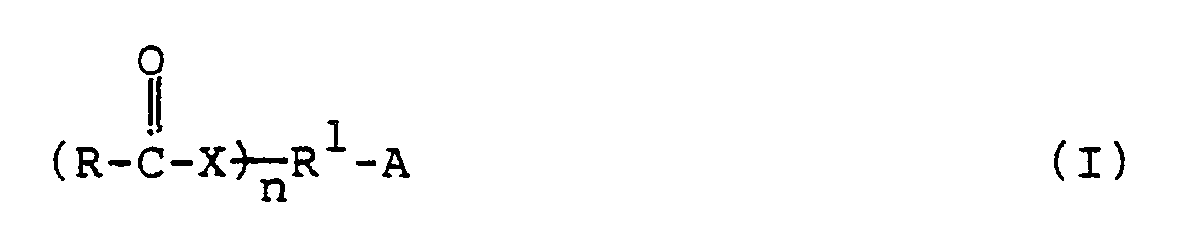
R der Kohlenwasserstoffrest einer ethylenisch ungesättigten, gegebenenfalls Hydroxy-, Nitril-, Halogen- und/oder C₁-C₄-alkylsubstituierten Carbonsäure, vorzugsweise einer Acryl-, Methacryl- und/oder Crotonsäure ist,
X = -O-, -N(R²)-, -NH-C(O)-
und/oder die Gruppe
R-C(O)-X-
für einen ethylenisch ungesättigten Dicarbonsäureimidrest, vorzugsweise Maleinsäureimidrest steht,
R¹ ein, gegebenenfalls Hydroxy-, Amino-, C₁-C₈-Alkyl-, C₁-C₈-Alkoxy-und/oder Oxyalkyl-substituierter, gesättigter oder ungesättigter, mindest zweiwertiger Kohlenwasserstoffrest, vorzugsweise ein aliphatischer Kohlenwasserstoffrest ist und gegebenenfalls
- In den Verbindungen der Formel (I) kann R der Kohlenwasserstoffrest z.B. der Methacryl-, Chloracryl-, Cyanacrylsäure und dergl. sein, wobei der Acryl- und Methacrylsäurerest besonders bevorzugt sind.
- Ganz bevorzugt sind Verbindungen, in denen X Sauerstoff ist.
- Der Rest R¹ enthält mindestens eine
R-C(O)-X-
Gruppe, worin R und X die obige Bedeutung haben können und bei mehreren
R-C(O)-X-
Resten innerhalb eines Moleküls die Reste R bzw. X jeweils gleich oder verschieden sein können. Gegebenenfalls vorhandene Brückenglieder des Rests R¹ können sowohl innerhalb des Rests, namentlich bei aliphatischen Resten R¹ und/oder ein- oder beidseitig endständig als Brückenglieder des Restes R¹ zu X bzw. A angeordnet sein. In einer ganz besonders bevorzugten Ausführungsform ist R¹ ein mindestens zweiwertiger, gegebenenfalls substituierter Glykol- oder Polyol-Rest mit 2 - 6 C-Atomen, der zweiwertige Rest einer aliphatischen Oxicarbonsäure mit 2 - 18 C-Atomen oder der zweiwertige Rest einer Carbonsäure
-C₂-C₆-Glykol-
oder C₆-C₈₀-Polyalkylenglycolesters ist. R¹ kann z.B. auch eine C₁-C₄-Alkylen-Gruppe sein, die gegebenenfalls mit niedrigen Alkylgruppen substituiert ist. Vorzugsweise ist der Rest R¹ mit dem Rest A über eine Ätherbrücke oder eine Estergruppe verbunden. Eine weitere Gruppe verwendbarer, gut geeigneter cycloaliphatischer, ethylenisch ungesättigt substituierter Verbindungen weisen die allgemeine Formel
auf, worin R eine Allyl- oder Vinylgruppe ist und X, R¹ , A und n die obigen Bedeutungen haben können. - Bevorzugt werden insbesondere Verbindungen gemäß der Formel (I) verwendet, in denen -X-R¹-

sowie Reste der allgemeinen Formeln

und/oder - (CH₂)m - sein können, - R³ gleich oder verschieden und verzweigte und unverzweigte sowie cyclische Alkylenreste mit 1 - 50, vorzugsweise 1 - 20 Kohlenstoffatomen, Arylenreste, Aralkylenreste und/oder Acylreste mit 1 - 20 C-Atomen sein können,
R⁴ gleich H, Cl, CN, CH, C₁ - C₄ - Alkyl ,
R⁵ gleich -CH=CH-, -CH₂-CH₂-,

m = 0 - 50
p = 1 - 20 sein können. - Eine weitere bevorzugte Gruppe von Verbindungen sind solche der Formeln

- Besonders bevorzugt sind Ester von verschiedenen ungesättigten Carbonsäuren, insbesondere Acryl- und Methacrylsäure, mit einem Glykolmonodicyclopentenylether der allgemeinen Formeln:


worin R, R¹, R⁴ und m die obigen Bedeutungen haben. - Weiter haben sich bewährt:
- Dihydrodicyclopentadienylester ungesättigter Carbonsäuren, wie z.B. Ester der Acryl- und Methacrylsäure
- Dicyclopentenyloxyalkylester ungesättigter Carbonsäuren, wie z.B. Ester der Acryl- und Methacrylsäure
- Bornyl- und Isobornylester ungesättigter Carbonsäuren, z.B. Isobornylmethacrylat
- Ester ungesättigter Carbonsäuren z.B. Ester der Acryl- und Methacrylsäure mit Ethergruppen enthaltenden tricyclischen Decandiolen der allgemeinen Formel:

- Ester ungesättigter Carbonsäuren z.B. der Acryl- und Methacrylsäure mit tricyclischen Decanolen der allgemeinen Formel:

- Beispiele für solche Verbindungen sind Diacryl- und Dimethacrylsäureester von
3,8-Di(hydroxymethyl)-tricyclo-5.2.1.0.2.6 -decan oder
3,9-Di(hydroxymethyl)-tricyclo-5.2.1.0.2.6 -decan oder
4,8-Di(hydroxymethyl)-tricyclo-5.2.10.2.6 -decan und
Ester von ungesättigten Carbonsäuren, z.B. Acryl-, Methacryl- und Crotonsäure von α- oder β-Decalol, wie z.B. Tricyclo
5.2.1.02.6 -decan-8- oder -9-ol, Tricyclo5.2.1.02.6 -decan-3- oder -4-ylmethanol. - Beispiele hierfür sind u.a.
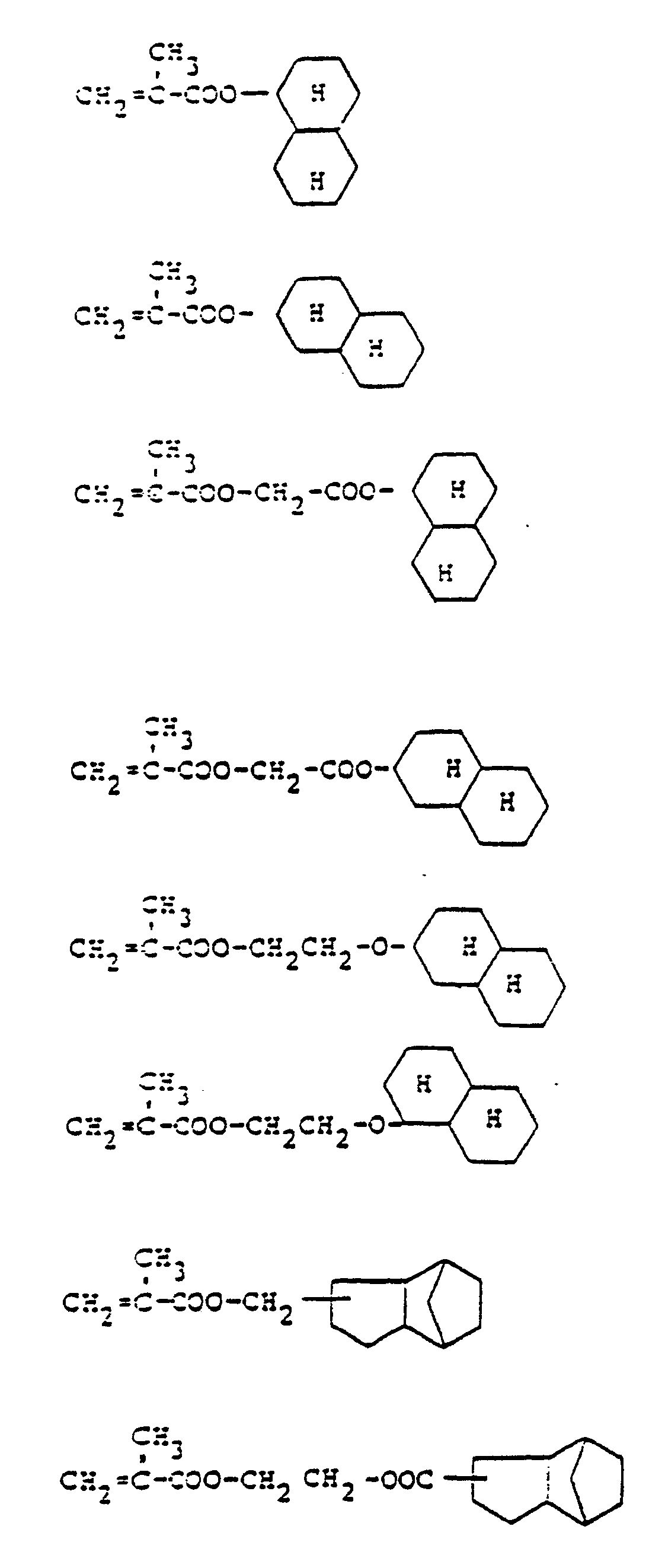
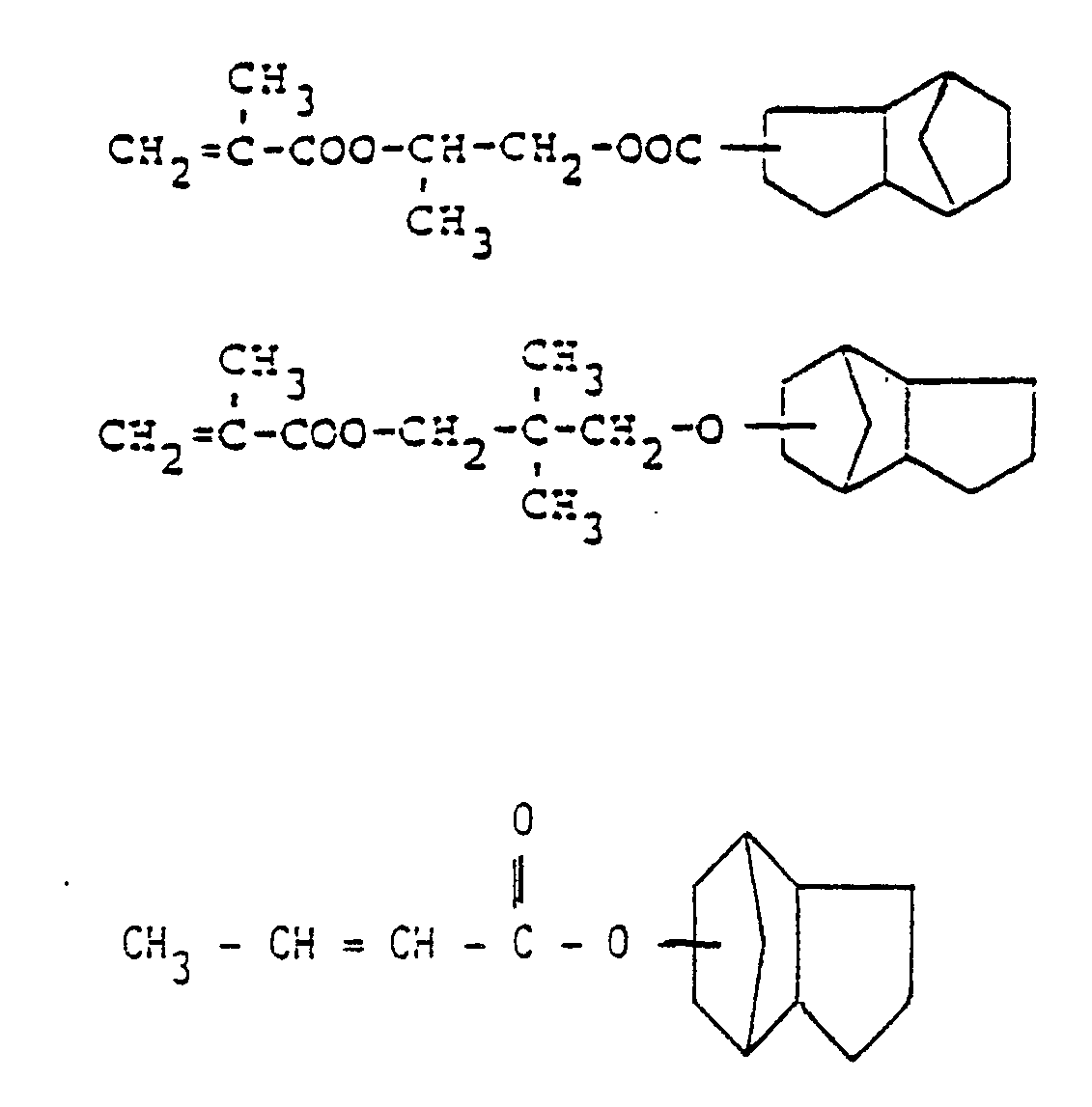
- Besonders gute Ergebnisse ergaben sich mit cycloaliphatischen Verbindungen der Formeln

worin die Reste R⁴ die obigen Bedeutungen haben können. - Auch Verbindungen der Formeln

- Die Verbindungen mit olefinischer, allylgruppen-artiger Ungesättigtheit im cyclo-aliphatischen System, wie dies einige obengenannte Verbindungen zeigen, besitzen duale Härtungsfunktionen, d.h. sie können sowohl freiradikalisch als auch über eine Autoxidation gehärtet werden. Diese duale Reaktivität und der extrem hohe Siedepunkt der flüssigen Ester-Ether-Monomeren machen sie besonders deshalb für Dübelmassen geeignet, weil sie im besonderen bislang nicht erfüllbare Eigenschaften bzw. Charakteristika den Dübelmassen verleihen.
- Verbindungen mit Allylgruppen sind autoxidierbar. Sollte z.B. bei einer freiradikalischen Polymerisation kein homogenes Untermischen des Härters, z.B. organisches Peroxid, in einer Dübelmasse mit einem Gehalt an erfindungsgemäßen allylgruppenhaltigen Verbindungen erfolgen, so wird die Durchhärtung einer solchen Masse nicht unterbrochen, wenn Metallkatalysatoren, d.h. sogenannte Trocknungsmittel bzw. Sikkative vorhanden sind. Wird eine Schicht aus einer derartigen Dübelmasse der Einwirkung atmosphärischen Sauerstoffs ausgesetzt, erfährt die Verbindung eine Autoxidation an der ungesättigten Stelle im Ring mit anschliessender Polymerisation der Doppelbindung in der Estergruppe. Diese letztere Polymerisation erfolgt trotz der Einwirkung von molekularem Sauerstoff, der normalerweise eine derartige Polymerisation hemmt. Vermag nun ein Rückgratpolymer, zB ein ungesättigter Polyester, mit den erfindungsgemäss enthaltenen, allylgruppentragenden Verbindungen eine wirksame Autoxidation aufgrund ihrer chemischen Strukturen zu bewirken, dann hat die Verwendung der Monomeren der Erfindung eine dichte Vernetzung zur Folge. Diese bedingt offensichtlich eine extensive chemische Bindung sowie eine physikalische Vermischung zwischen dem Rückgratpolymer und der allylgruppenhaltigen Verbindung. Die autoxidative Wirkung von Sauerstoff mit einem Trocknungsmittel ist auch dann gegeben, wenn das Rückgratpolymer nur eine geringe oder überhaupt keine Anfälligkeit gegenüber einer Autoxidation zeigt. Denn der durch die autoxidative Wirkung erzeugte Fluss freier Radikale löst eine anschliessende Vinylpolymerisation der allylgruppenhaltigen Verbindung sowie des eine ethylenisch ungesättigte Gruppe tragenden Rückgratpolymers aus. Ueber diese duale Reaktivität der allylgruppenhaltigen Verbindung wird den Dübelmassen auf der Grundlage von Rückgratpolymeren mit mindestens einer ethylenisch ungesättigten Gruppe ein hohes Mass an zusätzlicher Funktionssicherheit gegeben, weil an den Applikationsstellen viele Imponderabile gegeben sind. Da in den wenigsten Anwendungsfällen von Dübelmassen völlig anaerobe Härtungsbedingungen gegeben sind, tragen insbesondere die allylgruppentragenden Verbindungen auch dann zu einer Abbindung und Härtung bei, wenn der freiradikalische Polymerisationsinitiator nicht homogen untergemischt oder gänzlich vergessen wurde. Diese Tatsache liefert einen relativ hohen Sicherheitsbeiwert für die Befestigungstechnik und stellt einen wesentlichen technischen Fortschritt dar.
- Eine der wichtigen Eigenschaften für die Eignung als Dübelmasse ist das Schrumpfverhalten. Hohe Schrumpfwerte, wie sie beim Aushärten der konventionellen Dübelmassen mit monoethylenisch ungesättigten Monomeren gegeben sind, lassen sich auch durch den Zusatz von inerten Füllstoffen nicht optimal kompensieren. Der bei der Härtung entstehende Schrumpf führt zB beim Befestigen einer Ankerstange im Bohrloch dazu, dass sich an den Grenzflächen zwischen Bohrlochwand und Dübelmassen kein adhäsiver Stoffschluss, sondern überwiegend nur ein Formschluss ausbildet und damit die Sicherheit bei Lastaufbringung gefährdet ist. Diese Geschehnisse sind auch dafür verantwortlich, dass beim Einsatz von konventionellen Dübelmassen ein relativ sehr hoher Sicherheitsbeiwert (3- bis 4-fache) bauaufsichtlich vorgeschrieben wird. Der relativ hohe Schrumpfwert der bekannten Dübelmassen ist auch mit einer hohen Sprödigkeit der ausgehärteten Dübelmassen verbunden, wodurch bei dynamischer Belastung bedenklich kritische Befestigungswerte auftreten.
- Die Schrumpfung ist auch Ursache dafür, dass beim Formschluss keine absolut abdichtende Dübelmassenschicht, sondern ein Ringspalt zwischen Befestigungselement und Bohrlochwandung entsteht. Somit können in dem nicht dicht abgeschlossenen Ringspalt - vor allem an den Grenzflächen - Wasser, korrodierende Medien und Gase eindiffundieren und die Werkstoffe und ausgehärtete Dübelmasse schädigen.
- Unabhängig von den vorstehenden Nachteilen werden die bekannten Dübelmassen durch den umgebenden Luftsauerstoff - zumindest an den Oberflächen - inhibiert, weil sie vorzugsweise auf freiradikalisch härtenden Systemen aufgebaut sind. Da dieser Luftsauerstoff bei porösen Werkstoffen im Bohrlochboden an der Bohrlochwandung vorhanden ist, werden Inhibitionen der Härtungsreaktionen auch über den Grenzflächenbereich hinaus beobachtet. Denn bei der Inhibition der Abbindereaktion wird die Dübelmasse nicht durchgehärtet und sie bleibt weich und "klebrig" und ist für eine markante Schwächung der Verbundfestigkeit verantwortlich. Solche nicht durchgehärteten Dübelmassenreste können zusätzlich die Umwelt verschmutzen und müssen über Sondermüll entsorgt werden.
- Weitere Nachteile der konventionellen Monomere (Vernetzer) in Dübelmassen ist der niedrige Flammpunkt und die damit verbundene Deklarationspflicht "brennbar", wie dies bei Monostyrol mit einem Flammpunkt von +30 °C und oberen und unteren Explosionspunkten von +60,8/+29,1 °C gegeben ist. Aber auch die sehr niedrige Verdunstungszahl von 19,5 (DIN 53 170), der stark reizende Geruch und der niedrige MAK-Wert von Monostyrol sind negative arbeitshygienische und Umweltfaktoren, die gerade beim Einsatz von Dübelmassen in Wohnbereichen zusätzlich Anlass zu Ursachenbeseitigungen dieser und anderer Nachteile geben.
- Die nach der erfindungsgemässen Verwendung erhältlichen Dübelmassen können auf anorganischer, metallorganischer und/oder organischer Basis aufgebaut sein. Dabei werden die ungewöhnlichen Eigenschaften, auch in der Kombination mit Rückgratpolymeren und den anderen üblichen Zusatzstoffen, voll gewahrt. Die Dübelmassen können in flüssiger, pastöser, thixotroper, halbfester und/oder fester Form vorliegen. Als anorganische monomere, oligomere bzw. polymere Verbindungen eignen sich u. a. hydraulisch abbindende Massen, Zemente, wie Portland-, Tonerdeschmelzzement, Gips, Anhydrit, Magnesit, Kalk, Silikate, zB Wasserglas aber auch mineralische inerte Materialien wie Quarzsand, Kaolin und dergleichen. Zu den metallorganischen Systemen gehören u. a. Silicium- und/ oder titanorganische Verbindungen, wie Vinylsiloxane, Vinylalkyltitanate. Für die reaktiven Dübelmassen auf monomerer, oligomerer und/oder polymerer organischer Grundlage eignen sich Verbindungen, die der Vinylpolyaddition und -polymerisation, sowie der autoxidativen Vernetzung zugänglich sind. Hierunter fallen ungesättigte monomere, oligomere und polymere Verbindungen, wie zB Vinylester, Polyester, Acryl- und Methacrylsäureester, allylgruppentragende Verbindungen und dergleichen.
- Die erfindungsgemässen polymerisierbaren und copolymerisierbaren Verbindungen werden vorzugsweise in Verbindung mit Harzen bzw Rückgratpolymeren eingesetzt, die mindestens eine ethylenisch ungesättigte Doppelbindung im Molekül besitzen. Da solche Rückgratpolymere überwiegend zähflüssige bis harte, spröde Harze sind, müssen sie mit ungesättigten Lösemitteln (reaktive Verdünner) in eine applikationsgerechte Form mit angepasster Viskosität und Reaktivität gebracht werden. Diese Aufgabe können die flüssigen ungesättigten Verbindungen dieser Erfindung übernehmen, weil sie neben den vorstehend beschriebenen Vorzügen auch gute Verträglichkeits- und Löslichkeitsparameter gegenüber solchen Rückgratpolymeren besitzen.
- Einige Verbindungen gemäss der Erfindung sind zähflüssige, halbfeste oder feste Produkte. Diese härtbaren, polymerisierbaren und copolymerisierbaren Verbindungen können entweder mit den erfindungsgemäss nieder-viskosen Produkten in eine applikationsgerechte Form gebracht werden oder als reaktive Schmelzdübelmasse verarbeitet werden.
- Als Rückgratpolymere sind solche ungesättigten Polyesterharze besonders geeignet, die sowohl innerhalb der Molekülkette als auch in der Seitengruppe Estergruppierungen besitzen. Zu den Polyestern, in denen die Estergruppe ein Glied innerhalb der Molekülkette ist, gehören u. a. solche Polykondensate, die in der Molekülhauptkette noch Doppelbindungen enthalten und aus Dicarbonsäuren und Polyalkoholen hergestellt werden. Als Beispiele für die Dicarbonsäuren sind die Maleinsäure, Fumarsäure, Phthylsäure, Isophtalsäure, Citraconsäure, Mesaconsäure, Sebacinsäure, Trimellithsäure, dimere Fettsäuren zu nennen.
- Zu dieser Gruppe gehören aber auch Phenolsäureharze, zB aus 4,4-Bis(4-hydroxyphenyl)valeriansäure und auch solche ungesättigten Polyesterharze mit epoxidharzähnlicher Struktur.
- Als Polyalkohole kommen sehr zahlreiche Verbindungen in Betracht, von diesen nehmen die Glykole, wie Ethylenglykol, Propylenglykol, Butylenglykol einen bedeutenden Platz ein. Als weitere Polyole eignen sich zB Cyclohexandiol, Bisphenol A, Bisphenol F, Dialkylmaleat, Neopentylglykol u. v. m.
- Zu den Polyestern, die die Estergruppe in der Seitengruppe besitzen, gehören u. a. Polyacrylsäureester, Polymethacrylsäureester.
- Bevorzugt geeignet sind solche ungesättigte Polyester, die über die Umsetzung von epoxidgruppentragenden Verbindungen mit ungesättigten Carbonsäuren erhalten wurden. Solche Rückgratpolymere sind schon deshalb wasser- und verseifungsbeständiger und besitzen zugleich niedere Schrumpfwerte, weil der Gehalt an Estergruppen - im Vergleich zu den konventionellen Polyestern - relativ niedrig ist. Diese ungesättigten Polyesterharze werden in der Fachwelt auch als Epoxidacrylate bzw Epoxidmethacrylate bezeichnet, weil sie vorzugsweise durch die Umsetzung von Epoxiden mit Acryl- und Methacrylsäuren hergestellt werden. Auch Crotonsäure ist hierfür geeignet.
- Als besonders geeignete Rückgratpolymere in Verbindung mit den erfindungsgemässen polymerisierbaren und copolymerisierbaren Verbindungen sind solche acryl- und methacrylfunktionalisierten Epoxidharze, die auf der Grundlage von Bisphenol A und/oder F Novolaken aufgebaut sind. Diese Basisepoxide, die mit ungesättigten Carbonsäuren funktionalisiert werden, entsprechen den allgemeinen Formeln:


und
- Die erfindungsgemäss in der Dübelmasse enthaltenen härtbaren, polymerisierbaren und copolymerisierbaren cycloaliphatischen Verbindungen sind im allgemeinen in Mengen von 5 bis 95 Gew.-%, vorzugsweise 10 bis 60 Gew.-%, insbesondere 30 bis 50 Gew.-% enthalten. Werden diese erfindungsgemässen härtbaren, polymerisierbaren und copolymerisierbaren Verbindungen zusammen mit einem oder mehreren der vorstehenden oder anderen Rückgratpolymeren zur Copolymerisation reaktiver Dübelmassen verwendet, betragen die gwichtsmässigen Mischungsverhältnisse zwischen 20 : 1 und 1 : 20, vorzugsweise 10 : 1 bis 1 : 10. Diese Mischungsverhältnisse werden weitgehendst von den rheologischen Eigenschaften des Rückgratpolymers und den Applikationsbedingungen der reaktiven Dübelmassen bestimmt. Daneben können noch andere polymerisierbare Verbindungen enthalten sein. Die vorstehend erwähnte duale Härtungsfunktionalität bei den allylgruppentragenden Verbindungen bleibt auch dann erhalten, wenn sie auch nur in relativ niederen Konzentrationen enthalten sind.
- Die für die Härtung erforderliche Polymerisation kann als reine Homopolymerisation eines die cycloaliphatischen Reste enthaltenden ungesättigten Carbonsäureester-Derivates aber auch durch Copolymerisation eines Gemisches solcher Derivate erfolgen. Ganz bevorzugt ist indessen die Copolymerisation eines oder mehrerer solcher Derivate mit oligomeren und/oder polymeren, ungesättigter Carbonsäurereste enthaltenden Verbindungen bzw Rückgratpolymere. Hierzu gehören vorzugsweise die vorstehenden ungesättigten Polyesterharze, insbesondere die Epoxidacrylate.
- Die zur Härtung erforderliche Polymerisation bzw Copolymerisation erfolgt durch Zugabe bzw homogenes Untermischen mit den für Systeme dieser Art erforderlichen Reaktionsinitiatoren. Hierzu gehören u. a. Methylethylketonperoxide, Cyclohexanperoxide, Dibenzoylperoxid, p-Chlorbenzoylperoxid, Acetylacetonperoxid, Cumolhydroperoxid und andere Polymerisationen auslösende Initiatoren. Aber auch energiereiche Strahlen, wie zB UV-Strahlen in Gegenwart eines Photoinitiator oder Elektronenstrahlen können die Polymerisation und Copolymerisation starten.
- Ferner können die Polymerisation und Copolymerisation nach Zusatz eines oder mehrerer Reaktionsinitiatoren durch Zusatz eines Beschleunigers beschleunigt werden, um sie auch bei tieferen Temperaturen durchführen zu können. Hierzu sind Beschleuniger u. a. auf der Grundlage von Schwermetallsalzen, wie zB Cobaltacetylacetonat, Vanadiumnaphtenat; tertiäre Amine, wie zB Diethylanilin, Dimethyl-p-toluidin, geeignet. Bei der dualen Härtung mit den allylgruppentragenden Verbindungen ist die Gegenwart von Metallkatalysatoren, wie Trocknungsmittel bzw Sikkative angezeigt, weil sie neben ihrer katalytischen Initiierung der autoxidativen Reaktion zusätzlich die Funktion als Beschleuniger in polymerisierenden Systemen übernehmen. Die Reaktionsinitiatoren und Beschleuniger werden im allgemeinen in Mengen von 1 bis 10 Gew.-% vorzugsweise zwischen 1 und 5 Gew.-% - bezogen auf die gebrauchsfertige Dübelmasse eingesetzt. Die nach der erfindungsgemässen Verwendung zusammengesetzten Dübelmassen können als Zweikammersysteme, wobei die eine Kammer die Reaktionsinitiatoren, die andere die polymerisierbaren Verbindungen enthält, konfektioniert sein. Diese Dübelmassen lassen sich auch als Einkomponentensysteme herstellen, hierbei wird der Reaktionsinitiator oder Reaktionsbeschleuniger oder beide mikroverkapselt eingesetzt.
- Die erfindungsgemässen härtbaren Massen lassen sich durch weitere Zusätze modifizieren. Geeignete Zusatzstoffe sind u. a. Weichmacher, Oele, Teere, Asphalte, Bitumina, Farbstoffe, Pigmente, Thixotropiermittel, anorganische und/oder organische Füllstoffe und Fasern. Ferner können ihnen Stabilisatoren und/oder Inhibitoren zugesetzt werden.
- Von Bedeutung sind bei Dübelmassen die anorganischen und/oder organischen Füllstoffe. Als anorganische Füllstoffe sind Quarzmehle und -sande, Korunde, Gesteinsmehle besonders gut geeignet. Des weiteren können Mikrohohlkörper aus anorganischen Silikaten, Korunden und dgl. eingesetzt werden. Bei den organischen Füllstoffen handelt es sich u. a. um Mehle oder Mikrohohlkörper aus Duromeren, wie zB Phenol-Aldehyd-Harzen.
- Zum Thixotropieren dieser erfindungsgemässen reaktiven Dübelmassen eignen sich u. a. pyrogene Kieselsäuren, Bentonite.
- Die in den erfindungsgemässen reaktiven Dübelmassen eingesetzten Füllstoffe, Mikrohohlkörper, Thixotropiermittel und/oder Mikrokapseln können zusätzlich mit Haftbrücken bildenden Stoffen, wie Silanen, Chromkomplexen, gecoatet sein, um u. a. an den Grenzflächen verstärkte Verbunde zu erreichen. Zur Unterbindung einer Chemisorption können sie aber auch mit Stoffen, wie Fettsäuren, Fettsäureestern, beschichtet sein.
- Die reaktiven Dübelmassen mit den erfindungsgemässen härtbaren, polymerisierbaren und copolymerisierbaren Verbindungen können in allen Bereichen der Befestigungstechnik, insbesondere im Bauwesen, Tiefbau, Bergbau, Maschinen- und Anlagenbau eingesetzt werden.
- Die erfindungsgemässen härtbaren Dübelmassen sind abgepackt in Tuben, Patronen, Kartuschen, Dosen, Hobbocks und dergleichen, über mehrere Monate lagerfähig. Vor der Anwendung werden sie mit den Reaktionsinitiatoren homogen vermischt. Bei vorportionierten Packungen, zB Glas- oder Kunststoffpatronen als Zweikammersystem oder bei mikroverkapselten Systemen erfolgt eine Vermischung und Aktivierung zB erst im Bohrloch.
- Die Erfindung wird durch die folgenden Beispiele näher erläutert, ohne jedoch darauf beschränkt zu sein.
- In der Tabelle 1 sind die Zusammensetzungen der erfindungsgemässen reaktiven Dübelmassen zusammengefasst.
- Die Herstellung der Dübelmassen erfolgt in einem Planetenmischer in der Weise, dass - sofern erforderlich - zunächst das Rückgratpolymer mit einem oder mehreren der erfindungsgemässen cycloaliphatischen, ungesättigten Carbonsäure-Derivaten gelöst bzw verdünnt wird und anschliessend die Beschleuniger Diethylanilin, Dimethyl-p-toluidin und/oder Cobaltoctoat zugesetzt und homogen untermischt werden. In die vorbeschleunigte Basismischung werden dann gegebenenfalls Weichmacher und die pyrogene Kieselsäure (Thixotropiermittel) eingearbeitet. Zum Aufschluss der pyrogenen Kieselsäure kann zusätzlich ein Dissolver eingesetzt werden. Zum Schluss werden die Füllstoffe, wie Quarzmehle und -sande, Korund und Kieselerde eingearbeitet und solange im Planetenmischer gerührt bis eine homogene Mischung erzielt wurde. Nach dem Entgasen der Dübelmassen können sie in Packbehälter konfektioniert werden.
- Molekulargewichte der eingesetzten Rückgratpolymere:

- Die eingesetzten Weichmacher waren Dioctylphtalat und Di-2-ethylhexylphtalat.
- Bei den Dübelmassen nach den Beispielen 1 bis 15 handelt es sich um dosierfähige Produkte für u. a. feste Untergründe, wie Beton, Vollziegel, Gestein und dergleichen.
- Es wurde eine Verbundankerpatrone der Dimension M12 wie folgt hergestellt:
- Die dazu verwendete Glaspatrone hatte folgende Kenndaten:

- In diese Aussenpatrone wurde die nachstehend beschriebene Innenpatrone gesteckt und das verbleibende Hohlraumvolumen mit

verfüllt. - Die Glaspatrone hatte folgende Kenndaten:

- Dieses Innenrohr war mit Dibenzoylperoxid, 20 %, phlegmatisiert mit Kreide, gefüllt.
- 34,5 Gewichtsteile (GT) eines festen ungesättigten Polyesterharzes *) wurden in 28,0 GT Dicyclopentenyloxyethylmethacrylat in einem Planetenmischer gelöst und mit 1,2 GT Diethylamin vorbeschleunigt. Anschliessend wurden 4,2 GT Diotylphthalat und 4,0 GT pyrogene Kieselsäure (spez. Oberfläche ca. 200 m²/g) mit einem Dissolver (3.500 UpM) eingearbeitet. In diese homogene Masse wurden 28,1 GT Mikrohohlkörper aus Silikat (0,02 bis 0,15 mm) mit dem Planetenmischwerkzeug (120 UpM) eingerührt. Zum Schluss wurden 2,2 Dibenzoylperoxidpaste, 50 %ig in Weichmacher, untergemischt.
*) Das UP-Harz besteht aus:
35 % Phthalsäureanhydrid, 24 % Maleinsäureanhydrid
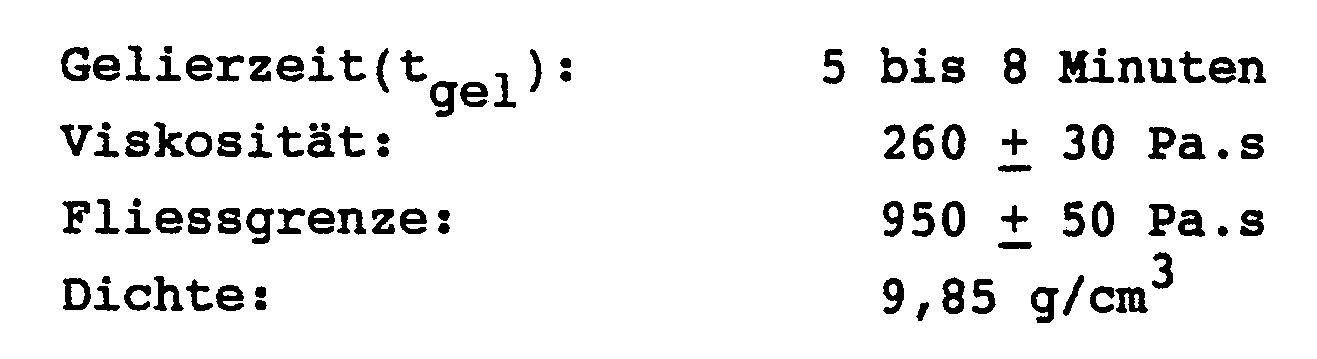
26 % Diethylenglykol und 15 % Ethylenglykol - Die Masse hat folgende Kenndaten:
- Diese dosierfähige Dübelmasse ist besonders für Hohlmauerwerk geeignet.
- 25 GT Siloxandimethacrylat (Molekulargewicht (MG 1200) wurde mit 25 GT Di-(methylacryloyl-maleoyl)-tricyclo-5.2.1.0²,⁶-decan und 1,8 GT Cobaltoctoat (6 % Co) homogen bei einer Temperatur von +50 °C im Planetenmischer gemischt. Anschliessend wurde 4,2 GT pyrogene Kieselsäure (spez. Oberfläche: 200 m²/g) eingetragen und mit einem Dissolver (3.500 UpM) eingearbeitet. Anschliessend erfolgte ein Zusatz von 44 GT Mikrohohlkörper aus Silikat (0,1 bis 0.7 mm). Zum Schluss wurden 4,2 GT Cumolhydroperoxid, 80 % in Cumol, zugesetzt und homogen untermischt.
- Die Masse hatte folgende Kenndaten:

- Es wurde folgende vorbeschleunigte einkomponentige Dübelmasse in einem Planetenmischer hergestellt:

- Die einkomponentige Dübelmasse wurde in Polyethylen-Kartuschen abgefüllt und war gebrauchsfertig.
- Das Beispiel 19 wurde wiederholt, aber anstelle von Cumolhydroperoxid-Mikrokapseln wurden Dibenzoylperoxid-Mikrokapseln und als Beschleuniger mikroverkapseltes Diethylanilin und mikroverkapseltes Dimethyl-p-toluidin in den gleichen Mengenverhältnissen eingesetzt.
- Die erfindungsgemässen reaktiven Dübelmassen der Beispiele 1 bis 20 wurden anwendungstechnisch auf ihre Aushärtung, Auszugswerte und Verbundfestigkeiten geprüft. Folgende Werte wurden ermittelt:
- Als Bau- bzw Werkstoffe wurden Beton, Hohlmauerwerk, Gestein und Vollziegel gewählt. Der eingesetzte Beton entsprach den Qualitäten B15, B25, B35 und B45. Der eingesetzte Beton B35 hatte folgende Werte:
B35 - Istfestigkeit: βw = 48 N/mm² - Die eingesetzten Gewindestangen entsprachen M12, 5.8 und M12, 12.9, hochfest.
- Die Bohrlöcher hatten folgende Kenndaten:

- Die ermittelten Prüfdaten sind Durchschnittswerte auf 5 Prüfungen und in Tabelle 2 zusammengefasst.
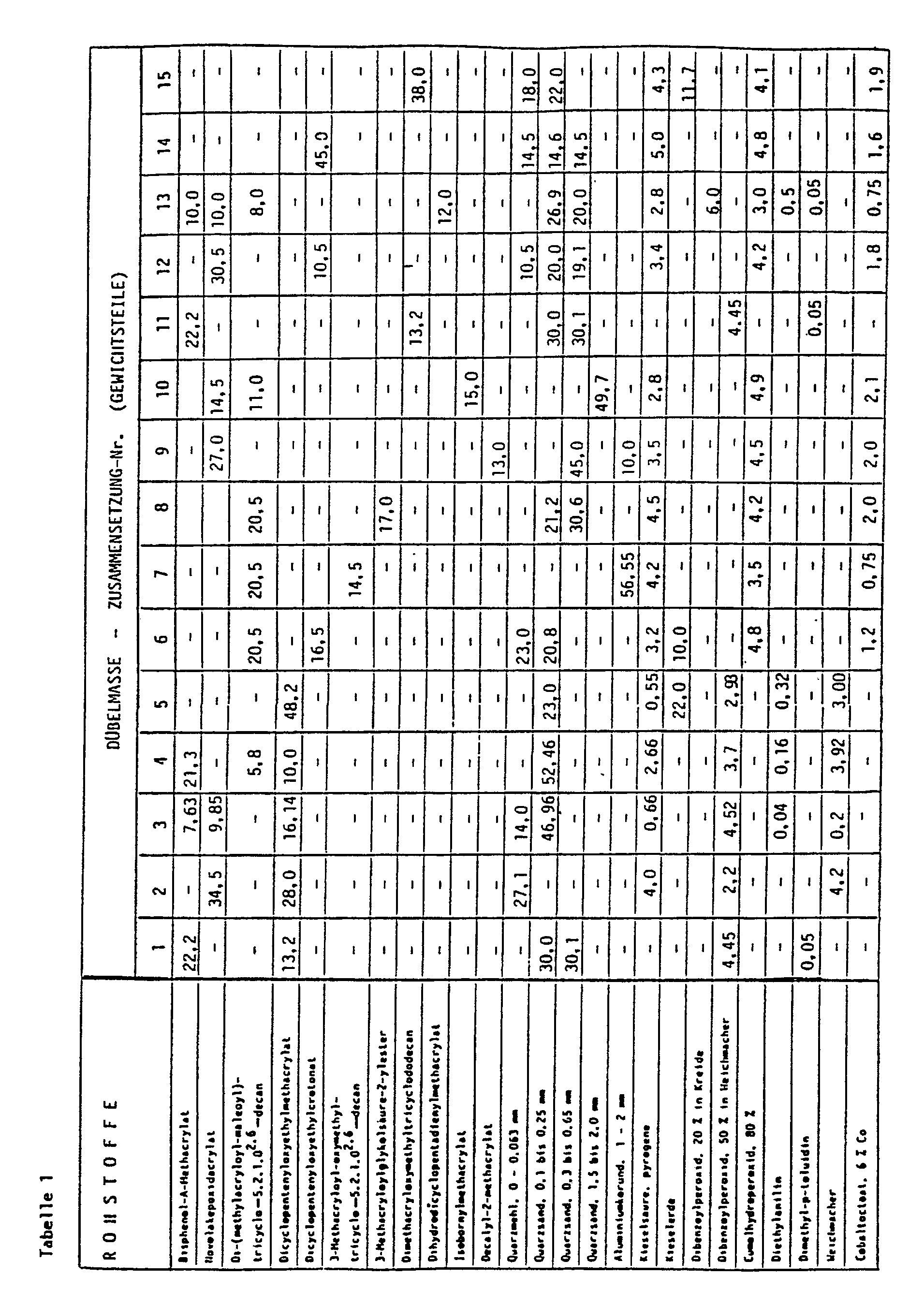

Claims (11)
- Verwendung von durch Polymerisation härtbaren cycloaliphatischen Verbindungen der allgemeinen Formel A

- Weiterbildung des Gegenstands des Patentanspruchs 1, gekennzeichnet durch cycloaliphatische Verbindungen der Formel

R der Kohlenwasserstoffrest einer ethylenisch ungesättigten, gegebenenfalls Hydroxy-, Nitril-, Halogen- und/oder
C₁-C₄-
alkylsubstituierten Carbonsäure
, vorzugsweise einer Acryl-, Methacryl- und/oder Crotonsäure ist,
X = -O-, -N(R²)-, -NH-C(O)-
und/oder die Gruppe
R-C(O)-X-
für einen ethylenisch ungesättigten Dicarbonsäureimidrest, vorzugsweise Maleinsäureimidrest steht,
R¹ ein gegebenenfalls Hydroxy-, Amino-, mehfach
R-C(O)-X-,
C₁-C₈-Alkyl-, C₁-C₈-Alkoxy-
und/oder Oxyalkyl-substituierter, gesättigter oder ungesättigter Kohlenwasserstoffrest, vorzugsweise ein aliphatischer Kohlenwasserstoffrest ist und gegebenenfalls
- Weiterbildung des Gegenstands des Anspruchs 1, gekennzeichnet durch cycloaliphatische Verbindungen der Formel

- Weiterbildung des Gegenstands eines der vorhergehenden Patentansprüche, gekennzeichnet durch cycloaliphatische Verbindungen, in denen -X-R¹-

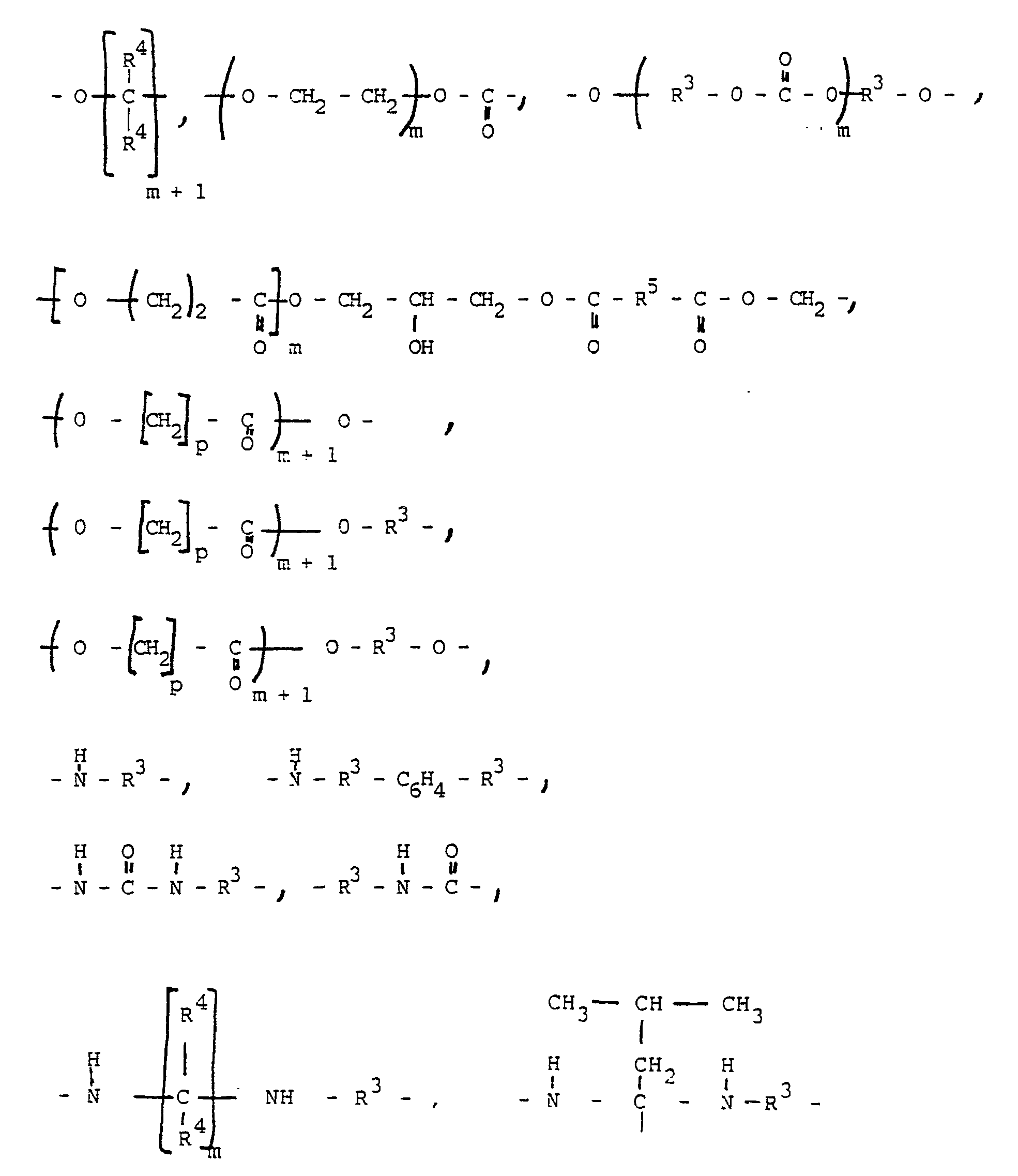
(CH₂)m
- sein können,
R³ gleich oder verschieden und verzweigte und unverzweigte sowie cyclische Alkylenreste mit 1 - 50, vorzugsweise 1 - 20 Kohlenstoffatomen, Arylenreste, Aralkylenreste und/oder Acylreste mit 1 - 20 C-Atomen sein können,
R⁴ gleich H, Cl, CN, OH,
C₁ - C₄ - Alkyl ,

p = 1 - 20 sein können. - Weiterbildung der Gegenstände eines der vorhergehenden Patentansprüche, gekennzeichnet durch Verbindungen der Formeln

- Weiterbildung der Gegenstände eines der vorhergehenden Patentansprüche, dadurch gekennzeichnet, daß der cycloaliphatische Rest eine Allylgruppe enthält.
- Weiterbildung des Gegenstands des Anspruchs 1 oder 2, dadurch gekennzeichnet, daß der Rest R¹ ein mindestens zweiwertiger, gegebenenfalls substituierter aliphatischer Polyolrest mit 2 - 6 C-Atomen, der zweiwertige Rest einer aliphatischen Oxycarbonsäure mit 2 - 18 C-Atomen oder der zweiwertige Rest eines Carbonsäure-
C₂-C₆-polyol-
oder
C₆-C₈₀-polyalkylenglycolesters
ist. - Weiterbildung der Gegenstände eines der vorhergehenden Patentansprüche, dadurch gekennzeichnet, daß die cycloaliphatische Verbindung

- Weiterbildung der Gegenstände eines der vorhergehenden Patentansprüche, dadurch gekennzeichnet,
daß die cycloaliphatische Verbindung
- Weiterbildung des Gegenstands eines der vorhergehenden Patentansprüche, dadurch gekennzeichnet, daß zusätzlich ungesättigte, vorzugsweise copolymerisierbare Polyester in Mengen von 20:1 bis 1:20, vorzugsweise 10:1 bis 1:10, enthalten sind.
- Weiterbildung des Gegenstands der vorhergehenden Patentansprüche, dadurch gekennzeichnet, daß als zusätzliche Polyester acryl- und/oder methacrylfunktionalisierte Epoxidharze (Epoxidacrylate), vorzugsweise auf Basis von Bisphenol A, F und/oder Novolaken, enthalten sind.
Priority Applications (1)
| Application Number | Priority Date | Filing Date | Title |
|---|---|---|---|
| AT90120570T ATE103315T1 (de) | 1989-12-05 | 1990-10-26 | Verwendung haertbarer cycloaliphaten-derivate in duebelmassen. |
Applications Claiming Priority (2)
| Application Number | Priority Date | Filing Date | Title |
|---|---|---|---|
| DE3940138 | 1989-12-05 | ||
| DE3940138A DE3940138A1 (de) | 1989-12-05 | 1989-12-05 | Verwendung haertbarer cycloaliphaten-derivate in duebelmassen |
Publications (3)
| Publication Number | Publication Date |
|---|---|
| EP0431302A2 true EP0431302A2 (de) | 1991-06-12 |
| EP0431302A3 EP0431302A3 (en) | 1992-08-05 |
| EP0431302B1 EP0431302B1 (de) | 1994-03-23 |
Family
ID=6394815
Family Applications (1)
| Application Number | Title | Priority Date | Filing Date |
|---|---|---|---|
| EP90120570A Expired - Lifetime EP0431302B1 (de) | 1989-12-05 | 1990-10-26 | Verwendung härtbarer Cycloaliphaten-Derivate in Dübelmassen |
Country Status (7)
| Country | Link |
|---|---|
| US (1) | US5157072A (de) |
| EP (1) | EP0431302B1 (de) |
| JP (1) | JPH03239775A (de) |
| AT (1) | ATE103315T1 (de) |
| AU (1) | AU636930B2 (de) |
| CA (1) | CA2031449A1 (de) |
| DE (2) | DE3940138A1 (de) |
Cited By (11)
| Publication number | Priority date | Publication date | Assignee | Title |
|---|---|---|---|---|
| EP0663512A1 (de) * | 1993-11-22 | 1995-07-19 | UPAT GMBH & CO | Verankerungspatrone |
| EP1209177A1 (de) * | 2000-11-27 | 2002-05-29 | Sika AG, vorm. Kaspar Winkler & Co. | Radikalisch polymerisierbare Masse mit erhöhter Haftung auf mineralischen Untergründen und deren Verwendung als Klebstoff und Dichtungsmasse |
| EP1762581A1 (de) * | 2005-09-13 | 2007-03-14 | Yoshika Corporation | Vernetzbare Harzzusammensetzung, Auskleidungsmaterial und rohrförmiges Auskleidungsmaterial |
| WO2011072789A1 (de) * | 2009-12-18 | 2011-06-23 | Fischerwerke Gmbh & Co. Kg | Radikalisch polymerisierbarer befestigungsmörtel mit silanzusätzen |
| EP2364961A3 (de) * | 2010-02-24 | 2016-01-13 | HILTI Aktiengesellschaft | Zweikomponenten-Mörtelmasse und deren Verwendung |
| EP3805180A1 (de) | 2019-10-10 | 2021-04-14 | Hilti Aktiengesellschaft | Befestigungsanordnung mit einer gewindeformenden schraube und einer ausgehärteten masse |
| EP3805179A1 (de) | 2019-10-10 | 2021-04-14 | Hilti Aktiengesellschaft | Mehrkomponentiges reaktionsharzsystem und dessen verwendung |
| EP3805178A1 (de) | 2019-10-10 | 2021-04-14 | Hilti Aktiengesellschaft | Lagerstabiles mehrkomponentiges reaktionsharzsystem und dessen verwendung |
| EP3805301A1 (de) | 2019-10-10 | 2021-04-14 | Hilti Aktiengesellschaft | Lagerstabile härterzusammensetzung für ein reaktionsharz |
| EP4116275A1 (de) | 2021-07-08 | 2023-01-11 | Hilti Aktiengesellschaft | Befestigungsanordnung mit einer gewindeformenden schraube und einer ausgehärteten aluminathaltigen anorganischen masse |
| EP4678620A1 (de) | 2024-07-12 | 2026-01-14 | Hilti Aktiengesellschaft | Schnellhärtendes ankersystem mit optimierter härterverteilung |
Families Citing this family (24)
| Publication number | Priority date | Publication date | Assignee | Title |
|---|---|---|---|---|
| DE4121832C1 (de) * | 1991-07-02 | 1992-06-11 | Upat Gmbh & Co, 7830 Emmendingen, De | |
| DE4304620A1 (de) * | 1993-02-16 | 1994-08-18 | Fischer Artur Werke Gmbh | Verankerungspatrone |
| US5498683A (en) * | 1994-03-15 | 1996-03-12 | Kim; Chung S. | Polymer concrete compositions and method of use |
| US5643994A (en) * | 1994-09-21 | 1997-07-01 | Illinois Tool Works Inc. | Anchoring systems and methods utilizing acrylate compositions |
| US5965635A (en) * | 1995-06-07 | 1999-10-12 | Illinois Tool Works Inc. | Alkylacrylate ester composition for anchoring materials in or to concrete or masonry |
| DE4438577A1 (de) | 1994-10-28 | 1996-05-02 | Basf Ag | Selbsttragende Dübelmasse für die chemische Befestigungstechnik |
| DE19852720A1 (de) * | 1998-11-16 | 2000-05-18 | Fischer Artur Werke Gmbh | Zweikomponentenmasse für chemische Befestigungen |
| EP1221449A1 (de) | 2000-12-22 | 2002-07-10 | Dsm N.V. | Peroxidzusammensetzungen mit Reaktivverdünnern |
| EP1217017A1 (de) * | 2000-12-22 | 2002-06-26 | Dsm N.V. | Harzmörtel für die chemische Befestigung |
| EP1225189A1 (de) * | 2000-12-22 | 2002-07-24 | Dsm N.V. | Zwei Komponenten Masse für die chemische Befestigungstechnik |
| US7544739B2 (en) * | 2002-11-08 | 2009-06-09 | Illinois Tool Works Inc. | Curable adhesive compositions containing reactive multi-functional acrylate |
| DE102010013196B4 (de) * | 2010-03-29 | 2015-10-29 | Hilti Aktiengesellschaft | Chemische Zweikomponenten-Mörtelmasse mit verbesserter Haftung an der Oberfläche von halbgereinigten und/oder feuchten Bohrlöchern in mineralischem Untergrund und ihre Verwendung |
| US9416300B2 (en) | 2011-01-16 | 2016-08-16 | Simpson Strong-Tie Company, Inc. | Low temperature curable adhesive compositions |
| US8334346B2 (en) | 2011-01-16 | 2012-12-18 | Quentin Lewis Hibben | Low temperature curable adhesive compositions |
| US9074114B2 (en) | 2011-05-18 | 2015-07-07 | Illinois Tool Works Inc. | Isocyanurate vinyl ester anchoring adhesive composition |
| EP3424968A1 (de) | 2017-07-03 | 2019-01-09 | HILTI Aktiengesellschaft | Urethanmethacrylat-verbindungen und deren verwendung |
| EP3424970A1 (de) | 2017-07-03 | 2019-01-09 | HILTI Aktiengesellschaft | Verzweigte urethanmethacrylat-verbindungen und deren verwendung |
| EP3424971A1 (de) | 2017-07-03 | 2019-01-09 | HILTI Aktiengesellschaft | Urethanmethacrylat-verbindungen enthaltende reaktivharze, reaktivharzkomponenten sowie reaktivharz-systeme und deren verwendung |
| EP3424900A1 (de) | 2017-07-03 | 2019-01-09 | HILTI Aktiengesellschaft | Epoxymethacrylat-verbindungen und deren verwendung |
| EP3424969A1 (de) | 2017-07-03 | 2019-01-09 | HILTI Aktiengesellschaft | Mischung von radikalisch härtbaren verbindungen und deren verwendung |
| US12146009B2 (en) | 2018-06-05 | 2024-11-19 | Resonac Corporation | Radically polymerizable putty-like resin composition, sealing agent and crack repairing method |
| EP3670612A1 (de) | 2018-12-18 | 2020-06-24 | Hilti Aktiengesellschaft | Verwendung von urethanmethacrylat-verbindungen in reaktivharz-zusammensetzungen |
| DE102020107313A1 (de) | 2020-03-17 | 2021-09-23 | Fischerwerke Gmbh & Co. Kg | Kunstharz-Befestigungssysteme mit einem monofunktionellen Reaktivverdünner, deren Herstellung und Verwendungen |
| CN112500821B (zh) * | 2020-12-29 | 2022-07-15 | 烟台信友新材料有限公司 | 一种紫外光固化可变操作时间单组份环氧胶及其制备方法 |
Family Cites Families (8)
| Publication number | Priority date | Publication date | Assignee | Title |
|---|---|---|---|---|
| US3988279A (en) * | 1975-04-23 | 1976-10-26 | Celanese Coatings & Specialties Company | Thermosetting concrete-containing epoxy |
| US4071489A (en) * | 1976-03-08 | 1978-01-31 | Rohm And Haas Company | Coating compositions from dicyclopentenyl acrylate and/or methacrylate |
| DE2714538C3 (de) * | 1977-04-01 | 1979-11-15 | Henkel Kgaa, 4000 Duesseldorf | Methacrylsäureester von auf tricyclischen Decanolen aufgebauten Verbindungen |
| US4387182A (en) * | 1978-10-13 | 1983-06-07 | The Dow Chemical Co. | Cycloaliphatic acrylate compositions |
| US4460625A (en) * | 1981-07-16 | 1984-07-17 | Rohm And Haas Company | Method of coating and impregnating concrete substrates, and products obtained thereby |
| US4416950A (en) * | 1982-04-29 | 1983-11-22 | Andrews Paper & Chemical Co. | Transparent fibrous sheets |
| DE3215932A1 (de) * | 1982-04-29 | 1983-11-03 | Bayer Ag, 5090 Leverkusen | Reaktivverduenner fuer oxidativ vernetzbare alkydharze |
| SG49298A1 (en) * | 1988-09-30 | 1998-05-18 | Mitsui Petrochemical Ind | Cyclo-olefinic random copolymer composition and reaction product thereof |
-
1989
- 1989-12-05 DE DE3940138A patent/DE3940138A1/de not_active Withdrawn
-
1990
- 1990-10-26 AT AT90120570T patent/ATE103315T1/de not_active IP Right Cessation
- 1990-10-26 EP EP90120570A patent/EP0431302B1/de not_active Expired - Lifetime
- 1990-10-26 DE DE90120570T patent/DE59005097D1/de not_active Expired - Fee Related
- 1990-11-28 JP JP2323343A patent/JPH03239775A/ja active Pending
- 1990-12-04 AU AU67730/90A patent/AU636930B2/en not_active Ceased
- 1990-12-04 US US07/623,239 patent/US5157072A/en not_active Expired - Lifetime
- 1990-12-04 CA CA002031449A patent/CA2031449A1/en not_active Abandoned
Cited By (18)
| Publication number | Priority date | Publication date | Assignee | Title |
|---|---|---|---|---|
| EP0663512A1 (de) * | 1993-11-22 | 1995-07-19 | UPAT GMBH & CO | Verankerungspatrone |
| EP1209177A1 (de) * | 2000-11-27 | 2002-05-29 | Sika AG, vorm. Kaspar Winkler & Co. | Radikalisch polymerisierbare Masse mit erhöhter Haftung auf mineralischen Untergründen und deren Verwendung als Klebstoff und Dichtungsmasse |
| WO2002042345A1 (de) * | 2000-11-27 | 2002-05-30 | Sika Ag, Vorm. Kaspar Winkler & Co. | Radikalisch polymerisierbare masse mit erhöhter haftung auf mineralischen untergründen und deren verwendung als klebstoff und dichtungsmasse |
| EP1762581A1 (de) * | 2005-09-13 | 2007-03-14 | Yoshika Corporation | Vernetzbare Harzzusammensetzung, Auskleidungsmaterial und rohrförmiges Auskleidungsmaterial |
| WO2011072789A1 (de) * | 2009-12-18 | 2011-06-23 | Fischerwerke Gmbh & Co. Kg | Radikalisch polymerisierbarer befestigungsmörtel mit silanzusätzen |
| US8828289B2 (en) | 2009-12-18 | 2014-09-09 | Fischerwerke Gmbh & Co. Kg | Free-radical-polymerisable fixing mortar having silane additives |
| AU2010333336B2 (en) * | 2009-12-18 | 2015-01-22 | Fischerwerke Gmbh & Co. Kg | Free-radically polymerisable fastening mortar having silane additives |
| EP2364961A3 (de) * | 2010-02-24 | 2016-01-13 | HILTI Aktiengesellschaft | Zweikomponenten-Mörtelmasse und deren Verwendung |
| EP3805180A1 (de) | 2019-10-10 | 2021-04-14 | Hilti Aktiengesellschaft | Befestigungsanordnung mit einer gewindeformenden schraube und einer ausgehärteten masse |
| EP3805179A1 (de) | 2019-10-10 | 2021-04-14 | Hilti Aktiengesellschaft | Mehrkomponentiges reaktionsharzsystem und dessen verwendung |
| EP3805178A1 (de) | 2019-10-10 | 2021-04-14 | Hilti Aktiengesellschaft | Lagerstabiles mehrkomponentiges reaktionsharzsystem und dessen verwendung |
| EP3805301A1 (de) | 2019-10-10 | 2021-04-14 | Hilti Aktiengesellschaft | Lagerstabile härterzusammensetzung für ein reaktionsharz |
| WO2021069437A1 (de) | 2019-10-10 | 2021-04-15 | Hilti Aktiengesellschaft | Lagerstabiles mehrkomponentiges reaktionsharzsystem und dessen verwendung |
| WO2021069270A1 (de) | 2019-10-10 | 2021-04-15 | Hilti Aktiengesellschaft | Lagerstabile härterzusammensetzung für ein reaktionsharz |
| EP4116275A1 (de) | 2021-07-08 | 2023-01-11 | Hilti Aktiengesellschaft | Befestigungsanordnung mit einer gewindeformenden schraube und einer ausgehärteten aluminathaltigen anorganischen masse |
| WO2023280570A1 (de) | 2021-07-08 | 2023-01-12 | Hilti Aktiengesellschaft | Befestigungsanordnung mit einer gewindeformenden schraube und einer ausgehärteten aluminathaltigen anorganischen masse |
| EP4678620A1 (de) | 2024-07-12 | 2026-01-14 | Hilti Aktiengesellschaft | Schnellhärtendes ankersystem mit optimierter härterverteilung |
| WO2026012914A1 (en) | 2024-07-12 | 2026-01-15 | Hilti Aktiengesellschaft | Fast-curing anchor system with optimized hardener distribution |
Also Published As
| Publication number | Publication date |
|---|---|
| DE3940138A1 (de) | 1991-06-06 |
| CA2031449A1 (en) | 1991-06-06 |
| AU636930B2 (en) | 1993-05-13 |
| AU6773090A (en) | 1991-06-13 |
| DE59005097D1 (de) | 1994-04-28 |
| ATE103315T1 (de) | 1994-04-15 |
| US5157072A (en) | 1992-10-20 |
| EP0431302A3 (en) | 1992-08-05 |
| JPH03239775A (ja) | 1991-10-25 |
| EP0431302B1 (de) | 1994-03-23 |
Similar Documents
| Publication | Publication Date | Title |
|---|---|---|
| EP0431302B1 (de) | Verwendung härtbarer Cycloaliphaten-Derivate in Dübelmassen | |
| DE102011017626B4 (de) | Verfahren zur Stabilisierung eines Reaktionsharzmörtels und dessen Vorläufermischungen, Harzmischung, Reaktionsharzmörtel, Mehrkomponenten - Mörtelsystem, dessen Verwendung sowie Patrone, Kartusche oder Folienbeutel umfassend das Mehrkomponenten - Mörtelsystem | |
| DE102011078785B4 (de) | Härterzusammensetzung, diese enthaltendes Mehrkomponenten-Mörtelsystem, dessen Verwendung sowie Patrone, Kartusche oder Folienbeutel enthaltend ein Mehrkomponenten - Mörtelsystem | |
| DE102011077248B3 (de) | Verwendung eines Inhibitors, Harzmischung, Reaktionsharzmörtel, Zweikomponenten - Mörtelsystem und dessen Verwendung sowie Patrone, Kartusche oder Folienbeutel enthaltend ein Zweikomponenten - Mörtelsystem | |
| EP3129441B1 (de) | Ch-acide verbindungen und metallsalze als härtersystem, entsprechende harzzusammensetzungen unter anderem für die befestigungstechnik | |
| EP2532632B1 (de) | Inhibitorkombination, diese enthaltende Harzmischung und deren Verwendung | |
| WO2015090523A1 (de) | Thiole und/oder thiolester und metallsalze als härtersystem in harzzusammensetzungen unter anderem für die befestigungstechnik | |
| EP3233934B1 (de) | Reaktionsharz-zusammensetzung und deren verwendung | |
| EP2371782A2 (de) | Chemische Zweikomponenten-Mörtelmasse mit verbesserter Haftung an der Oberfläche von halbgereinigten und/oder feuchten Bohrlöchern in mineralischem Untergrund und ihre Verwendung | |
| EP1619174B1 (de) | Zweikomponenten-mörtelmasse und ihre verwendung | |
| EP0592489B1 (de) | Reaktionssatz zum erzeugen von kunstharzkörpern zur klebeverankerung von befestigungselementen in befestigungsgrund | |
| EP2838949B1 (de) | Indolin-nitroxidradikal als stabilisator und inhibitor für reaktionsharze, dieses enthaltende reaktionsharze und deren verwendung | |
| WO2015004175A1 (de) | Reaktionsharz-zusammensetzung und deren verwendung | |
| US5256723A (en) | Cartridge having hardenable cycloaliphatic derivatives for bore hole-filling masses | |
| WO2021122102A1 (de) | Reaktivharzkomponente, diese enthaltendes reaktivharzsystem und deren verwendung | |
| EP3850030B1 (de) | Reaktiver amin-beschleuniger, diesen enthaltendes reaktivharz sowie deren verwendung | |
| EP4090638B1 (de) | Verwendung von reaktionsharzmischungen mit vordefinierter polarität zur einstellung der robustheit einer mörtelmasse | |
| EP3019535A1 (de) | Reaktionsharz-zusammensetzung und deren verwendung | |
| DE4315788A1 (de) | Dübelharze | |
| WO2013156356A2 (de) | ß-PHOSPHORYLIERTE NITROXIDRADIKALE ALS INHIBITOREN FÜR REAKTIONSHARZE, DIESE ENTHALTENDE REAKTIONSHARZE SOWIE DEREN VERWENDUNG | |
| EP4688889A1 (de) | Enamine als initiatoren bei der härtung von radikalisch härtenden reaktivharzen für die chemische befestigung | |
| EP4714926A1 (de) | Reaktivharzzusammensetzung mit einem peroxidfreien initiatorsystem mit einem tertiären amin | |
| EP4574850A1 (de) | Mehrkomponenten-reaktivharz-systeme mit verbesserter feuerbeständigkeit auf der basis von tris-[(methacryloyloxy)-alkyl]-isocyanursäuren und deren verwendung für eine chemische befestigung von verankerungsmitteln in bohrlöchern | |
| EP4615930A1 (de) | Hochleistungsmörtel mit tbx und analogen | |
| EP3708591A1 (de) | Beschleuniger-kombination |
Legal Events
| Date | Code | Title | Description |
|---|---|---|---|
| PUAI | Public reference made under article 153(3) epc to a published international application that has entered the european phase |
Free format text: ORIGINAL CODE: 0009012 |
|
| AK | Designated contracting states |
Kind code of ref document: A2 Designated state(s): AT BE CH DE FR GB IT LI SE |
|
| PUAL | Search report despatched |
Free format text: ORIGINAL CODE: 0009013 |
|
| AK | Designated contracting states |
Kind code of ref document: A3 Designated state(s): AT BE CH DE FR GB IT LI SE |
|
| 17P | Request for examination filed |
Effective date: 19920819 |
|
| 17Q | First examination report despatched |
Effective date: 19930830 |
|
| GRAA | (expected) grant |
Free format text: ORIGINAL CODE: 0009210 |
|
| AK | Designated contracting states |
Kind code of ref document: B1 Designated state(s): AT BE CH DE FR GB IT LI SE |
|
| REF | Corresponds to: |
Ref document number: 103315 Country of ref document: AT Date of ref document: 19940415 Kind code of ref document: T |
|
| REF | Corresponds to: |
Ref document number: 59005097 Country of ref document: DE Date of ref document: 19940428 |
|
| ET | Fr: translation filed | ||
| ITF | It: translation for a ep patent filed | ||
| GBT | Gb: translation of ep patent filed (gb section 77(6)(a)/1977) |
Effective date: 19940506 |
|
| PLBE | No opposition filed within time limit |
Free format text: ORIGINAL CODE: 0009261 |
|
| STAA | Information on the status of an ep patent application or granted ep patent |
Free format text: STATUS: NO OPPOSITION FILED WITHIN TIME LIMIT |
|
| EAL | Se: european patent in force in sweden |
Ref document number: 90120570.8 |
|
| 26N | No opposition filed | ||
| REG | Reference to a national code |
Ref country code: GB Ref legal event code: IF02 |
|
| PGFP | Annual fee paid to national office [announced via postgrant information from national office to epo] |
Ref country code: DE Payment date: 20081002 Year of fee payment: 19 Ref country code: CH Payment date: 20081031 Year of fee payment: 19 |
|
| PGFP | Annual fee paid to national office [announced via postgrant information from national office to epo] |
Ref country code: AT Payment date: 20081013 Year of fee payment: 19 |
|
| PGFP | Annual fee paid to national office [announced via postgrant information from national office to epo] |
Ref country code: SE Payment date: 20081022 Year of fee payment: 19 Ref country code: BE Payment date: 20081009 Year of fee payment: 19 Ref country code: IT Payment date: 20081028 Year of fee payment: 19 |
|
| PGFP | Annual fee paid to national office [announced via postgrant information from national office to epo] |
Ref country code: FR Payment date: 20081014 Year of fee payment: 19 |
|
| PGFP | Annual fee paid to national office [announced via postgrant information from national office to epo] |
Ref country code: GB Payment date: 20081022 Year of fee payment: 19 |
|
| BERE | Be: lapsed |
Owner name: *HILTI A.G. Effective date: 20091031 |
|
| REG | Reference to a national code |
Ref country code: CH Ref legal event code: PL |
|
| EUG | Se: european patent has lapsed | ||
| REG | Reference to a national code |
Ref country code: FR Ref legal event code: ST Effective date: 20100630 |
|
| PG25 | Lapsed in a contracting state [announced via postgrant information from national office to epo] |
Ref country code: DE Free format text: LAPSE BECAUSE OF NON-PAYMENT OF DUE FEES Effective date: 20100501 Ref country code: FR Free format text: LAPSE BECAUSE OF NON-PAYMENT OF DUE FEES Effective date: 20091102 |
|
| PG25 | Lapsed in a contracting state [announced via postgrant information from national office to epo] |
Ref country code: AT Free format text: LAPSE BECAUSE OF NON-PAYMENT OF DUE FEES Effective date: 20091026 |
|
| PG25 | Lapsed in a contracting state [announced via postgrant information from national office to epo] |
Ref country code: BE Free format text: LAPSE BECAUSE OF NON-PAYMENT OF DUE FEES Effective date: 20091031 Ref country code: LI Free format text: LAPSE BECAUSE OF NON-PAYMENT OF DUE FEES Effective date: 20091031 Ref country code: CH Free format text: LAPSE BECAUSE OF NON-PAYMENT OF DUE FEES Effective date: 20091031 |
|
| PG25 | Lapsed in a contracting state [announced via postgrant information from national office to epo] |
Ref country code: GB Free format text: LAPSE BECAUSE OF NON-PAYMENT OF DUE FEES Effective date: 20091026 |
|
| PG25 | Lapsed in a contracting state [announced via postgrant information from national office to epo] |
Ref country code: IT Free format text: LAPSE BECAUSE OF NON-PAYMENT OF DUE FEES Effective date: 20091026 |
|
| PG25 | Lapsed in a contracting state [announced via postgrant information from national office to epo] |
Ref country code: SE Free format text: LAPSE BECAUSE OF NON-PAYMENT OF DUE FEES Effective date: 20091027 |