EP0431448B1 - Catalytic process for manufacture of low pour lubricating oils - Google Patents
Catalytic process for manufacture of low pour lubricating oils Download PDFInfo
- Publication number
- EP0431448B1 EP0431448B1 EP19900122676 EP90122676A EP0431448B1 EP 0431448 B1 EP0431448 B1 EP 0431448B1 EP 19900122676 EP19900122676 EP 19900122676 EP 90122676 A EP90122676 A EP 90122676A EP 0431448 B1 EP0431448 B1 EP 0431448B1
- Authority
- EP
- European Patent Office
- Prior art keywords
- process according
- composite
- catalyst
- dewaxing
- less
- Prior art date
- Legal status (The legal status is an assumption and is not a legal conclusion. Google has not performed a legal analysis and makes no representation as to the accuracy of the status listed.)
- Expired - Lifetime
Links
- 238000000034 method Methods 0.000 title claims description 36
- 230000003197 catalytic effect Effects 0.000 title claims description 10
- 239000010687 lubricating oil Substances 0.000 title description 9
- 238000004519 manufacturing process Methods 0.000 title description 5
- 239000003054 catalyst Substances 0.000 claims description 54
- 239000011148 porous material Substances 0.000 claims description 38
- PNEYBMLMFCGWSK-UHFFFAOYSA-N aluminium oxide Inorganic materials [O-2].[O-2].[O-2].[Al+3].[Al+3] PNEYBMLMFCGWSK-UHFFFAOYSA-N 0.000 claims description 20
- 239000002131 composite material Substances 0.000 claims description 13
- 239000010457 zeolite Substances 0.000 claims description 13
- 229910021536 Zeolite Inorganic materials 0.000 claims description 12
- HNPSIPDUKPIQMN-UHFFFAOYSA-N dioxosilane;oxo(oxoalumanyloxy)alumane Chemical compound O=[Si]=O.O=[Al]O[Al]=O HNPSIPDUKPIQMN-UHFFFAOYSA-N 0.000 claims description 12
- 229910052751 metal Inorganic materials 0.000 claims description 12
- 239000002184 metal Substances 0.000 claims description 12
- 239000011159 matrix material Substances 0.000 claims description 10
- 239000002245 particle Substances 0.000 claims description 10
- 238000009835 boiling Methods 0.000 claims description 9
- 238000002459 porosimetry Methods 0.000 claims description 8
- UFHFLCQGNIYNRP-UHFFFAOYSA-N Hydrogen Chemical compound [H][H] UFHFLCQGNIYNRP-UHFFFAOYSA-N 0.000 claims description 7
- 239000001257 hydrogen Substances 0.000 claims description 7
- 229910052739 hydrogen Inorganic materials 0.000 claims description 7
- PXHVJJICTQNCMI-UHFFFAOYSA-N Nickel Chemical compound [Ni] PXHVJJICTQNCMI-UHFFFAOYSA-N 0.000 claims description 6
- 239000003208 petroleum Substances 0.000 claims description 5
- 239000007788 liquid Substances 0.000 claims description 3
- 229910052759 nickel Inorganic materials 0.000 claims description 3
- 239000013078 crystal Substances 0.000 claims description 2
- 125000004122 cyclic group Chemical group 0.000 claims description 2
- 238000012856 packing Methods 0.000 claims description 2
- 239000000203 mixture Substances 0.000 description 26
- 230000032683 aging Effects 0.000 description 8
- 238000004517 catalytic hydrocracking Methods 0.000 description 8
- XLYOFNOQVPJJNP-UHFFFAOYSA-N water Substances O XLYOFNOQVPJJNP-UHFFFAOYSA-N 0.000 description 8
- 238000009826 distribution Methods 0.000 description 7
- QSHDDOUJBYECFT-UHFFFAOYSA-N mercury Chemical compound [Hg] QSHDDOUJBYECFT-UHFFFAOYSA-N 0.000 description 7
- 229910052753 mercury Inorganic materials 0.000 description 7
- IJGRMHOSHXDMSA-UHFFFAOYSA-N Atomic nitrogen Chemical compound N#N IJGRMHOSHXDMSA-UHFFFAOYSA-N 0.000 description 6
- FAHBNUUHRFUEAI-UHFFFAOYSA-M hydroxidooxidoaluminium Chemical compound O[Al]=O FAHBNUUHRFUEAI-UHFFFAOYSA-M 0.000 description 6
- 239000000314 lubricant Substances 0.000 description 6
- VXAUWWUXCIMFIM-UHFFFAOYSA-M aluminum;oxygen(2-);hydroxide Chemical compound [OH-].[O-2].[Al+3] VXAUWWUXCIMFIM-UHFFFAOYSA-M 0.000 description 5
- 238000006243 chemical reaction Methods 0.000 description 5
- 238000007670 refining Methods 0.000 description 5
- 230000008901 benefit Effects 0.000 description 4
- 239000010779 crude oil Substances 0.000 description 4
- 230000007935 neutral effect Effects 0.000 description 4
- 239000003921 oil Substances 0.000 description 4
- 230000000704 physical effect Effects 0.000 description 4
- 238000005292 vacuum distillation Methods 0.000 description 4
- 238000001354 calcination Methods 0.000 description 3
- 238000007324 demetalation reaction Methods 0.000 description 3
- 238000001125 extrusion Methods 0.000 description 3
- 150000004682 monohydrates Chemical class 0.000 description 3
- AOPCKOPZYFFEDA-UHFFFAOYSA-N nickel(2+);dinitrate;hexahydrate Chemical compound O.O.O.O.O.O.[Ni+2].[O-][N+]([O-])=O.[O-][N+]([O-])=O AOPCKOPZYFFEDA-UHFFFAOYSA-N 0.000 description 3
- 229910052757 nitrogen Inorganic materials 0.000 description 3
- 239000008188 pellet Substances 0.000 description 3
- 238000012545 processing Methods 0.000 description 3
- 239000004215 Carbon black (E152) Substances 0.000 description 2
- ZOKXTWBITQBERF-UHFFFAOYSA-N Molybdenum Chemical compound [Mo] ZOKXTWBITQBERF-UHFFFAOYSA-N 0.000 description 2
- KDLHZDBZIXYQEI-UHFFFAOYSA-N Palladium Chemical compound [Pd] KDLHZDBZIXYQEI-UHFFFAOYSA-N 0.000 description 2
- 239000011230 binding agent Substances 0.000 description 2
- 230000015572 biosynthetic process Effects 0.000 description 2
- 238000013461 design Methods 0.000 description 2
- 238000009792 diffusion process Methods 0.000 description 2
- 230000000694 effects Effects 0.000 description 2
- 229930195733 hydrocarbon Natural products 0.000 description 2
- 150000002430 hydrocarbons Chemical class 0.000 description 2
- 150000002739 metals Chemical class 0.000 description 2
- 229910052750 molybdenum Inorganic materials 0.000 description 2
- 239000011733 molybdenum Substances 0.000 description 2
- BASFCYQUMIYNBI-UHFFFAOYSA-N platinum Chemical compound [Pt] BASFCYQUMIYNBI-UHFFFAOYSA-N 0.000 description 2
- 238000002360 preparation method Methods 0.000 description 2
- 239000011347 resin Substances 0.000 description 2
- 229920005989 resin Polymers 0.000 description 2
- 238000000926 separation method Methods 0.000 description 2
- 239000000126 substance Substances 0.000 description 2
- 238000010977 unit operation Methods 0.000 description 2
- VYZAMTAEIAYCRO-UHFFFAOYSA-N Chromium Chemical compound [Cr] VYZAMTAEIAYCRO-UHFFFAOYSA-N 0.000 description 1
- RYGMFSIKBFXOCR-UHFFFAOYSA-N Copper Chemical compound [Cu] RYGMFSIKBFXOCR-UHFFFAOYSA-N 0.000 description 1
- 239000004372 Polyvinyl alcohol Substances 0.000 description 1
- KJTLSVCANCCWHF-UHFFFAOYSA-N Ruthenium Chemical compound [Ru] KJTLSVCANCCWHF-UHFFFAOYSA-N 0.000 description 1
- 125000003118 aryl group Chemical group 0.000 description 1
- QVGXLLKOCUKJST-UHFFFAOYSA-N atomic oxygen Chemical compound [O] QVGXLLKOCUKJST-UHFFFAOYSA-N 0.000 description 1
- 230000009286 beneficial effect Effects 0.000 description 1
- 229910052804 chromium Inorganic materials 0.000 description 1
- 239000011651 chromium Substances 0.000 description 1
- 229910017052 cobalt Inorganic materials 0.000 description 1
- 239000010941 cobalt Substances 0.000 description 1
- GUTLYIVDDKVIGB-UHFFFAOYSA-N cobalt atom Chemical compound [Co] GUTLYIVDDKVIGB-UHFFFAOYSA-N 0.000 description 1
- 238000010924 continuous production Methods 0.000 description 1
- 239000010949 copper Substances 0.000 description 1
- 229910052802 copper Inorganic materials 0.000 description 1
- 238000004821 distillation Methods 0.000 description 1
- 239000000446 fuel Substances 0.000 description 1
- 239000000295 fuel oil Substances 0.000 description 1
- 239000008240 homogeneous mixture Substances 0.000 description 1
- 229910052741 iridium Inorganic materials 0.000 description 1
- GKOZUEZYRPOHIO-UHFFFAOYSA-N iridium atom Chemical compound [Ir] GKOZUEZYRPOHIO-UHFFFAOYSA-N 0.000 description 1
- 238000012423 maintenance Methods 0.000 description 1
- 239000000463 material Substances 0.000 description 1
- 230000003647 oxidation Effects 0.000 description 1
- 238000007254 oxidation reaction Methods 0.000 description 1
- 239000001301 oxygen Substances 0.000 description 1
- 229910052760 oxygen Inorganic materials 0.000 description 1
- 229910052763 palladium Inorganic materials 0.000 description 1
- 229910052697 platinum Inorganic materials 0.000 description 1
- 229920002451 polyvinyl alcohol Polymers 0.000 description 1
- 150000004032 porphyrins Chemical class 0.000 description 1
- 239000002243 precursor Substances 0.000 description 1
- 230000007420 reactivation Effects 0.000 description 1
- 230000008929 regeneration Effects 0.000 description 1
- 238000011069 regeneration method Methods 0.000 description 1
- 229910052707 ruthenium Inorganic materials 0.000 description 1
- 239000010802 sludge Substances 0.000 description 1
- 239000007787 solid Substances 0.000 description 1
- 239000002904 solvent Substances 0.000 description 1
- 238000012360 testing method Methods 0.000 description 1
- WFKWXMTUELFFGS-UHFFFAOYSA-N tungsten Chemical compound [W] WFKWXMTUELFFGS-UHFFFAOYSA-N 0.000 description 1
- 239000010937 tungsten Substances 0.000 description 1
- 229910052721 tungsten Inorganic materials 0.000 description 1
Images


Classifications
-
- C—CHEMISTRY; METALLURGY
- C10—PETROLEUM, GAS OR COKE INDUSTRIES; TECHNICAL GASES CONTAINING CARBON MONOXIDE; FUELS; LUBRICANTS; PEAT
- C10G—CRACKING HYDROCARBON OILS; PRODUCTION OF LIQUID HYDROCARBON MIXTURES, e.g. BY DESTRUCTIVE HYDROGENATION, OLIGOMERISATION, POLYMERISATION; RECOVERY OF HYDROCARBON OILS FROM OIL-SHALE, OIL-SAND, OR GASES; REFINING MIXTURES MAINLY CONSISTING OF HYDROCARBONS; REFORMING OF NAPHTHA; MINERAL WAXES
- C10G45/00—Refining of hydrocarbon oils using hydrogen or hydrogen-generating compounds
- C10G45/58—Refining of hydrocarbon oils using hydrogen or hydrogen-generating compounds to change the structural skeleton of some of the hydrocarbon content without cracking the other hydrocarbons present, e.g. lowering pour point; Selective hydrocracking of normal paraffins
- C10G45/60—Refining of hydrocarbon oils using hydrogen or hydrogen-generating compounds to change the structural skeleton of some of the hydrocarbon content without cracking the other hydrocarbons present, e.g. lowering pour point; Selective hydrocracking of normal paraffins characterised by the catalyst used
- C10G45/64—Refining of hydrocarbon oils using hydrogen or hydrogen-generating compounds to change the structural skeleton of some of the hydrocarbon content without cracking the other hydrocarbons present, e.g. lowering pour point; Selective hydrocracking of normal paraffins characterised by the catalyst used containing crystalline alumino-silicates, e.g. molecular sieves
-
- C—CHEMISTRY; METALLURGY
- C10—PETROLEUM, GAS OR COKE INDUSTRIES; TECHNICAL GASES CONTAINING CARBON MONOXIDE; FUELS; LUBRICANTS; PEAT
- C10G—CRACKING HYDROCARBON OILS; PRODUCTION OF LIQUID HYDROCARBON MIXTURES, e.g. BY DESTRUCTIVE HYDROGENATION, OLIGOMERISATION, POLYMERISATION; RECOVERY OF HYDROCARBON OILS FROM OIL-SHALE, OIL-SAND, OR GASES; REFINING MIXTURES MAINLY CONSISTING OF HYDROCARBONS; REFORMING OF NAPHTHA; MINERAL WAXES
- C10G2400/00—Products obtained by processes covered by groups C10G9/00 - C10G69/14
- C10G2400/10—Lubricating oil
Definitions
- This invention relates to the processing of higher molecular weight vacuum distillates such as bright stock raffinates to lower their pour point.
- a suitable feedstock for lubricant refining contains a quantity of lubricant stock having a predetermined set of properties such as appropriate viscosity, oxidation stability, and maintenance of fluidity at low temperatures.
- the process of refining to isolate that lubricant stock consists of a set of subtractive unit operations which removes the unwanted components.
- the most important of these unit operations include distillation, solvent refining, and dewaxing, which basically are physical separation processes in that if all the separated functions were recombined one would reconstitute the crude oil.
- the complexity of the molecular makeup of the desired components is reflected by the first step in the lube refining process, vacuum distillation.
- vacuum distillation the feed is separated into four boiling fractions, each of which has a different viscosity and a different mix of aromatics, naphthenes, paraffins, resins and asphaltenes. Separation must be exact because the resulting viscosity and composition cannot be adjusted later in subsequent refining steps.
- the lightest fraction of the vacuum distillation step vacuum tower overhead, has a boiling range up to approximately 700°F (370°C) and is usually consigned to a fuel refinery to be made into light products.
- the remaining three fractions can be used in preparing lube stock.
- the second fraction, light neutral distillate has a boiling range between approximately 700 and 850°F (371 and 454°C), and is used to make low viscosity oils.
- the fourth fraction, vacuum resid will not boil even under vacuum and will result in a lube base called "bright stock". This vacuum resid contains most of the resins and metals in the crude and all of the asphaltines.
- Hydrotreating has been proposed to accomplish such upgrading.
- a suitable fraction of a poor grade crude such as a California crude
- the process is complex in that some of the oil is reduced in molecular weight and made unsuitable for lubes, but concurrently a substantial fraction of the polynuclear aromatics is hydrogenated to form naphthenes and paraffins.
- Process conditions and choice of catalyst are selected to provide an optimal conversion of the polynuclear aromatic content of the stock, since this component degrades the viscosity index and stability of the stock.
- hydrocracking is employed for processes such as the foregoing; by contrast the purpose of “hydrotreating” is to stabilize the lube base stock produced by hydrocracking. Hydrocracking and hydrotreating steps may be distinguished also by the amount of hydrogen consumed, the hydrocracking step typically consuming about 178 to 356 m3/m3 (1000-2000 SCF/bbl) while the hydrotreating step consumes only about a tenth as much.
- hydrocracking process for increasing the availability of lube oils has an attractive feature that is not immediately apparent.
- composition and properties of hydrocracked stocks are generally not particularly affected by the source and nature of the crude, i.e., they tend to be much more alike than fractions prepared from different crudes by conventional means.
- the process therefore promises to free the refiner from dependence on a particular crude, with all of the advantages that this freedom implies.
- Hydrocracked lube stocks tend to be unstable in the presence of air when exposed to sunlight. On such exposure, an unacceptable sludge is formed, sometimes very rapidly and in fairly substantial amount. Additionally, some hydrocracked lube oils tend to darken or to form a haze. Several methods have been proposed to correct this instability, such as those described in US-A-4,031,016, 3,666,657, 3,530,061, 4,162,962, 3,530,061 and 3,852,207.
- Hydrocracked lubricating oils generally have an unacceptably high pour point and require dewaxing.
- Catalytic methods for dewaxing have been proposed, for instance in US-A-3,700,585. Hydrotreating after catalytic dewaxing is disclosed in US-A-4,137,148.
- US-A-4,283,271, 4,283,272, and 4,414,097 disclose processes for producing dewaxed lubricating oil base including hydrocracking a hydrocarbon feedstock, catalytically dewaxing the hydrocrackate and hydrotreating the dewaxed hydrocrackate, and employ catalyst compositions comprising zeolite ZSM-5, ZSM-11 and ZSM-23 for the dewaxing phase.
- This invention provides an energy-efficient continuous process for producing dewaxed hydrocracked lubricating oil stock from a hydrocarbon feedstock effluent boiling over about 288°C (550°F), by passing such an effluent through a catalytic hydrodewaxing process in which the supported catalyst composition comprises a zeolite and matrix and, optionally, a Group VIII metal.
- a cyclic catalytic dewaxing process for improving the pour point of a demetallized petroleum fraction free of components boiling below 371°C, comprises contacting a bright stock raffinate with a dewaxing catalyst at a temperature of 260 to 482°C, a pressure of 14.8 to 242.4 bar, a liquid hourly space velocity of 0.2 to 20 and a hydrogen circulation rate of 89 to 3560 m3/m3, said catalyst comprising a porous composite of a zeolite having a constraint index of 1 to 12 and a matrix whereof the zeolite constitutes 35 to 75 weight percent, at least 60 volume percent of the pores of said composite having a diameter less than 20 nm, the composite having a particle density of at least 1.0 g/cm3.
- the aging rate of dewaxing catalysts in dewaxing has been reduced. Accordingly, the start-of-cycle temperature in the second cycle, and subsequent cycles, of a multicycle dewaxing operation is reduced.
- the capacity to reduce the aging rate of the dewaxing catalyst allows for longer periods between oxygen regeneration and hydrogen reactivation cycles and thus increases overall catalyst lifetime. It is noted that aging rate can be expressed by the daily increase in operating temperature necessary to maintain a product of constant pour point.
- the benefits of the invention apply particularly to bright stock raffinate feedstocks, which induce among the fastest catalyst aging rates.
- pore volume, pore size distribution and particle density can significantly affect catalytic performance.
- a good example of this is in the design of demetallation catalysts, where a majority of the pores must be in the greater than 10 nm range to prevent pore plugging by deposited metals and to allow for diffusion of Ni- and V-containing porphyrins.
- the design of the demetallation catalysts involves a critical balance between the required pore size distribution and the high surface area needed to produce the requisite activity.
- the catalyst is a porous mixture, at least 60 percent of the pores of which, as measured by mercury porosimetry, have diameters less than 20 nm.
- the average pore size of the mixture is preferably lower than 15 nm, more preferably lower than 10 nm, and in certain embodiments is less than 7 nm, and even less than 4 nm.
- the particle density of the porous composite is at least 1.0 g/cm3.
- the zeolite component of the catalyst has a constraint index of 1 to 12.
- the method by which constraint index is determined is described fully in US-A-4,016,218.
- Constraint index (CI) values for some typical materials are:
- test conditions e.g. temperature
- constraint index of a particular zeolite e.g. ZSM-5, ZSM-11 and Beta.
- the crystal size of the zeolite ranges from 0.02 to 0.05 micrometers.
- the catalyst composition will generally, although not necessarily, contain a Group VIII metal, which when present may be exchanged into the composition, impregnated therein or physically and intimately admixed therewith by well known techniques.
- the amount of Group VIII metal in the catalyst composition can range from 0.10 to 10 weight percent, preferably from about 0.1 to about 3 weight percent, most preferably from about 0.2 to about 1 weight percent, based on the total weight of the catalyst composition.
- the Group VIII metal component can be platinum, palladium, iridium, ruthenium, cobalt, nickel, copper, molybdenum and mixtures thereof.
- the preferred metal is nickel.
- the Group VIII metal may be present alone or together with a metal from Group VI, such as chromium, molybdenum, tungsten and mixtures thereof.
- the particle size (effective or hydraulic diameter) of preferred forms of the catalyst ranges from 0.75 to 3.2 mm.
- the binder or matrix is suitably an alumina other than alpha alumina, preferably gamma-alumina. Generally it is a small particle alumina with a packing density of 0.5 to 0.6 g/cm3.
- the matrix is characterized by a particle density of 0.95 to 1.50 g/cm3.
- Alumina monohydrate (pseudoboehmite) is converted into a desirably dense analogue during catalyst formation.
- An alumina source for the matrix used for catalyst preparation preferably has a water content of 20 to 30 weight percent.
- the alumina monohydrate used as the source of matrix material in the Examples has a water content of 28 percent.
- the alumina source is convertible to gamma-alumina.
- Gamma-alumina is a phase of alumina which occurs as a result of calcination at a temperature of no greater than about 538°C (1000°F).
- delta-alumina is a result of calcination at a temperature of about 927°C (1700°F).
- the zeolite, a Group VIII metal and a source of binder or matrix are mulled together to form a homogeneous mixture.
- the important feature of the mulling step is the water content of the mixture.
- the water content can be expressed as ash content of the mixture: the ash content can range from 40 to 60 wt%.
- Water content can also be expressed as solid content, which can range from 45 to 60, preferably from 42 to 55 weight percent.
- Mulling is undertaken at a temperature ranging from 10 to 37.7°C (50 to 100°F).
- the mixture may contain 0.05 to 5 wt% of an extrusion aid such as polyvinyl alcohol.
- Extrusion is undertaken in conventional apparatus to produce a particle with a length to diameter ratio of at least 2.
- the matrix precursor can be alumina monohydrate (.e., pseudoboehmite), which during catalyst formation is converted to a more dense analogue.
- alumina monohydrate .e., pseudoboehmite
- the feed to the dewaxing unit is a fraction produced by vacuum distillation of crude oil which has been demetallized and is free of boiling range components having a boiling range up to about 700°F (371°C), in particular one based on the vacuum resid which as noted above will produce a lube base called bright stock.
- a lube dewaxing catalyst was produced by preparing a mixture of 65 percent ZSM-5, 35 percent of a coarse, high-chemical purity, low density, high-surface-area alpha alumina monohydrate (pseudoboehmite), nickel nitrate hexahydrate, and enough water to form a paste-like mixture, mulling this mixture, and extruding it into 1.6 mm (1/16 inch) cylindrical pellets by conventional means.
- the catalyst was pre-calcined in nitrogen for 3 hours at 482°C (900°F) (2.8°C/min heat-up) and then in air at 538°C (1000°F) for 3 hours. This procedure converts the alpha alumina monohydrate into gamma-alumina.
- the physical properties and pore size distribution are shown in Table 1.
- the catalyst in this example will be referred to as a medium pore diameter catalyst. This catalyst has 60 percent of its pore with diameters less than 20 nm (as measured by mercury porosimetry).
- a lube dewaxing catalyst was produced by preparing a mixture of 65 percent ZSM-5, 21 percent of the same alpha alumina monohydrate (pseudoboehmite) used in Example 1, 14 percent delta alumina, nickel nitrate hexahydrate, and enough water to form a paste-like mixture, mulling this mixture, and extruding it into 1.6 mm (1/16 inch) cylindrical pellets by conventional means.
- the delta alumina was prepared by calcining the alpha alumina monohydrate in air at 927°C (1700°F) for 4 hours.
- the catalyst was pre-calcined in nitrogen for 3 hours at 482°C (900°F) (2.8°C/min heat-up) and then in air at 538°C (1000°F) for 3 hours.
- the physical properties and pore size distribution are shown in Table 1.
- the catalyst in this example will be referred to as a large pore diameter catalyst.
- This catalyst has 44 volume percent of its pores (as measured by mercury porosimetry) with diameters less than 20 nm.
- a lube dewaxing catalyst was produced by preparing a mixture of 65% ZSM-5, 35% of a finely divided, dense, high chemical purity alpha alumina monohydrate, Keith alumina (pseudoboehmite from Keith Corporation), nickel nitrate hexahydrate, and enough water to form a paste-like mixture, mulling this mixture, and extruding it into 1.6 mm (1/16 inch) cylindrical pellets by conventional means.
- the catalyst was precalcined in nitrogen for 3 hours at 482°C (900°F) (2.8°C/min heat-up) and then in air at 538°C (1000°F) for 3 hours. This procedure converts the alpha alumina monohydrate into gamma alumina.
- the physical properties and pore size distribution are shown in the following Table.
- the catalyst in this example will be referred to as a small pore diameter catalyst. It has an average pore diameter of 4 nm, 92 volume percent of its pores (as measured by mercury porosimetry) being of diameter less than 20 nm.
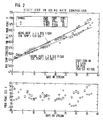
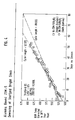
- the catalysts of Examples 1 and 2 were examined for dewaxing of paraffinic North Sea Heavy Neutral and Bright Stock raffinates. Properties of the feedstocks are given in Table 2. Both catalysts were able to produce -6.6°C (20°F) pour point products. The aging rates of the catalysts were tracked by adjusting the reaction temperature to compensate for activity loss so as to maintain a target -6.6°C (20°F) pour point while maintaining all other conditions constant.
Landscapes
- Chemical & Material Sciences (AREA)
- Crystallography & Structural Chemistry (AREA)
- Oil, Petroleum & Natural Gas (AREA)
- Engineering & Computer Science (AREA)
- Chemical Kinetics & Catalysis (AREA)
- General Chemical & Material Sciences (AREA)
- Organic Chemistry (AREA)
- Production Of Liquid Hydrocarbon Mixture For Refining Petroleum (AREA)
- Catalysts (AREA)
Applications Claiming Priority (2)
| Application Number | Priority Date | Filing Date | Title |
|---|---|---|---|
| US44520489A | 1989-12-04 | 1989-12-04 | |
| US445204 | 1989-12-04 |
Publications (2)
| Publication Number | Publication Date |
|---|---|
| EP0431448A1 EP0431448A1 (en) | 1991-06-12 |
| EP0431448B1 true EP0431448B1 (en) | 1993-11-18 |
Family
ID=23767989
Family Applications (1)
| Application Number | Title | Priority Date | Filing Date |
|---|---|---|---|
| EP19900122676 Expired - Lifetime EP0431448B1 (en) | 1989-12-04 | 1990-11-27 | Catalytic process for manufacture of low pour lubricating oils |
Country Status (6)
| Country | Link |
|---|---|
| EP (1) | EP0431448B1 (ja) |
| JP (1) | JPH03212493A (ja) |
| AU (1) | AU629425B2 (ja) |
| CA (1) | CA2029999A1 (ja) |
| DE (1) | DE69004670T2 (ja) |
| ES (1) | ES2045729T3 (ja) |
Families Citing this family (4)
| Publication number | Priority date | Publication date | Assignee | Title |
|---|---|---|---|---|
| FR2765209B1 (fr) * | 1997-06-25 | 1999-10-22 | Inst Francais Du Petrole | Zeolithe eu-1, catalyseur et procede pour l'amelioration du point d'ecoulement de charges contenant des paraffines |
| FR2765206B1 (fr) * | 1997-06-25 | 1999-08-06 | Inst Francais Du Petrole | Zeolithe eu-1, catalyseur et procede pour l'amelioration du point d'ecoulement de charges contenant des paraffines |
| FR2765207B1 (fr) * | 1997-06-25 | 1999-08-06 | Inst Francais Du Petrole | Zeolithe nu-85, catalyseur et procede pour l'amelioration du point d'ecoulement de charges contenant des paraffines |
| FR2765208B1 (fr) * | 1997-06-25 | 1999-09-03 | Inst Francais Du Petrole | Zeolithe nu-85, catalyseur et procede et pour l'amelioration du point d'ecoulement de charges contenant des paraffines |
Family Cites Families (5)
| Publication number | Priority date | Publication date | Assignee | Title |
|---|---|---|---|---|
| US4292166A (en) * | 1980-07-07 | 1981-09-29 | Mobil Oil Corporation | Catalytic process for manufacture of lubricating oils |
| US4510044A (en) * | 1982-02-08 | 1985-04-09 | Mobil Oil Corporation | Process for hydrotreating petroleum residua and catalyst therefor |
| US4440630A (en) * | 1982-02-08 | 1984-04-03 | Mobil Oil Corporation | Process for simultaneous hydrodesulfurization and hydrodewaxing with a catalyst of controlled pore size and metals content |
| US4510043A (en) * | 1984-02-16 | 1985-04-09 | Mobil Oil Corporation | Process for dewaxing of petroleum oils prior to demetalation and desulfurization |
| US4508615A (en) * | 1984-02-16 | 1985-04-02 | Mobil Oil Corporation | Multi-stage process for demetalation, desulfurization and dewaxing of petroleum oils |
-
1990
- 1990-11-13 AU AU66529/90A patent/AU629425B2/en not_active Ceased
- 1990-11-14 CA CA 2029999 patent/CA2029999A1/en not_active Abandoned
- 1990-11-27 ES ES90122676T patent/ES2045729T3/es not_active Expired - Lifetime
- 1990-11-27 EP EP19900122676 patent/EP0431448B1/en not_active Expired - Lifetime
- 1990-11-27 DE DE1990604670 patent/DE69004670T2/de not_active Expired - Fee Related
- 1990-11-30 JP JP34116190A patent/JPH03212493A/ja active Pending
Also Published As
| Publication number | Publication date |
|---|---|
| JPH03212493A (ja) | 1991-09-18 |
| EP0431448A1 (en) | 1991-06-12 |
| DE69004670T2 (de) | 1994-03-10 |
| ES2045729T3 (es) | 1994-01-16 |
| AU6652990A (en) | 1991-06-06 |
| DE69004670D1 (de) | 1993-12-23 |
| CA2029999A1 (en) | 1991-06-05 |
| AU629425B2 (en) | 1992-10-01 |
Similar Documents
| Publication | Publication Date | Title |
|---|---|---|
| EP0464546B1 (en) | Production of high viscosity index lubricants | |
| US6506297B1 (en) | Biodegradable high performance hydrocarbon base oils | |
| US6190532B1 (en) | Production of high viscosity index lubricants | |
| EP0464547B1 (en) | Process for the production of high viscosity index lubricants | |
| CA2230760C (en) | Integrated lubricant upgrading process | |
| US4414097A (en) | Catalytic process for manufacture of low pour lubricating oils | |
| JP3628023B2 (ja) | ロウ水素化異性化法 | |
| US6231749B1 (en) | Production of high viscosity index lubricants | |
| EP0775184B2 (en) | Lubricating oil production with vi-selective catalyst | |
| JP2003522251A (ja) | 向上されたzsm−5触媒を用いる高粘度潤滑油基材油の製造 | |
| ZA200600299B (en) | Fuels and lubricants using layered bed catalysts in hydrotreating waxy feeds, including Fischer-Tropsch wax, plus solvent dewaxing | |
| EA001619B1 (ru) | Способ получения базового компонента смазочного масла | |
| KR20000071874A (ko) | 전환-수소화 이성화 반응후 접촉 탈왁스화 처리에 의한베이스 오일 및 중간 증류물의 융통적인 제조 방법 | |
| US4908120A (en) | Catalytic dewaxing process using binder-free zeolite | |
| EP1054936A1 (en) | A method for upgrading waxy feeds using a catalyst comprising mixed powdered dewaxing catalyst and powdered isomerization catalyst formed into a discrete particle | |
| US4541919A (en) | Shape selective dewaxing using coke modified large pore zeolites | |
| US4744884A (en) | Process for producing lubrication oil of high viscosity index | |
| JP4496647B2 (ja) | 非常に高品質の基油および場合によっては中間留分の適応性のある(フレキシブルな)製造方法 | |
| EP1789187B1 (en) | Improved molecular sieve containing hydrodewaxing catalysts | |
| EP0431448B1 (en) | Catalytic process for manufacture of low pour lubricating oils | |
| US4921593A (en) | Catalytic dewaxing process | |
| EP0155822B1 (en) | Catalytic dewaxing process using zsm-11 zeolite | |
| US5985132A (en) | Process for the simultaneous production of lubricating oil base stocks and motor fuel | |
| EP1720961B1 (en) | Process to continuously prepare two or more base oil grades and middle distillates | |
| US5332490A (en) | Catalytic process for dewaxing hydrocarbon feedstocks |
Legal Events
| Date | Code | Title | Description |
|---|---|---|---|
| PUAI | Public reference made under article 153(3) epc to a published international application that has entered the european phase |
Free format text: ORIGINAL CODE: 0009012 |
|
| 17P | Request for examination filed |
Effective date: 19901210 |
|
| AK | Designated contracting states |
Kind code of ref document: A1 Designated state(s): BE DE ES FR GB IT NL |
|
| 17Q | First examination report despatched |
Effective date: 19911227 |
|
| GRAA | (expected) grant |
Free format text: ORIGINAL CODE: 0009210 |
|
| AK | Designated contracting states |
Kind code of ref document: B1 Designated state(s): BE DE ES FR GB IT NL |
|
| REF | Corresponds to: |
Ref document number: 69004670 Country of ref document: DE Date of ref document: 19931223 |
|
| ET | Fr: translation filed | ||
| REG | Reference to a national code |
Ref country code: ES Ref legal event code: FG2A Ref document number: 2045729 Country of ref document: ES Kind code of ref document: T3 |
|
| ITF | It: translation for a ep patent filed | ||
| PLBE | No opposition filed within time limit |
Free format text: ORIGINAL CODE: 0009261 |
|
| STAA | Information on the status of an ep patent application or granted ep patent |
Free format text: STATUS: NO OPPOSITION FILED WITHIN TIME LIMIT |
|
| 26N | No opposition filed | ||
| PGFP | Annual fee paid to national office [announced via postgrant information from national office to epo] |
Ref country code: DE Payment date: 19960912 Year of fee payment: 7 |
|
| PGFP | Annual fee paid to national office [announced via postgrant information from national office to epo] |
Ref country code: NL Payment date: 19960916 Year of fee payment: 7 |
|
| PGFP | Annual fee paid to national office [announced via postgrant information from national office to epo] |
Ref country code: GB Payment date: 19960925 Year of fee payment: 7 Ref country code: FR Payment date: 19960925 Year of fee payment: 7 |
|
| PGFP | Annual fee paid to national office [announced via postgrant information from national office to epo] |
Ref country code: ES Payment date: 19961112 Year of fee payment: 7 |
|
| PGFP | Annual fee paid to national office [announced via postgrant information from national office to epo] |
Ref country code: BE Payment date: 19961128 Year of fee payment: 7 |
|
| PG25 | Lapsed in a contracting state [announced via postgrant information from national office to epo] |
Ref country code: GB Free format text: LAPSE BECAUSE OF NON-PAYMENT OF DUE FEES Effective date: 19971127 |
|
| PG25 | Lapsed in a contracting state [announced via postgrant information from national office to epo] |
Ref country code: ES Free format text: LAPSE BECAUSE OF EXPIRATION OF PROTECTION Effective date: 19971128 |
|
| PG25 | Lapsed in a contracting state [announced via postgrant information from national office to epo] |
Ref country code: FR Free format text: THE PATENT HAS BEEN ANNULLED BY A DECISION OF A NATIONAL AUTHORITY Effective date: 19971130 Ref country code: BE Free format text: LAPSE BECAUSE OF NON-PAYMENT OF DUE FEES Effective date: 19971130 |
|
| BERE | Be: lapsed |
Owner name: MOBIL OIL CORP. Effective date: 19971130 |
|
| PG25 | Lapsed in a contracting state [announced via postgrant information from national office to epo] |
Ref country code: NL Free format text: LAPSE BECAUSE OF NON-PAYMENT OF DUE FEES Effective date: 19980601 |
|
| GBPC | Gb: european patent ceased through non-payment of renewal fee |
Effective date: 19971127 |
|
| PG25 | Lapsed in a contracting state [announced via postgrant information from national office to epo] |
Ref country code: DE Free format text: LAPSE BECAUSE OF NON-PAYMENT OF DUE FEES Effective date: 19980801 |
|
| NLV4 | Nl: lapsed or anulled due to non-payment of the annual fee |
Effective date: 19980601 |
|
| REG | Reference to a national code |
Ref country code: FR Ref legal event code: ST |
|
| REG | Reference to a national code |
Ref country code: ES Ref legal event code: FD2A Effective date: 20010301 |
|
| PG25 | Lapsed in a contracting state [announced via postgrant information from national office to epo] |
Ref country code: IT Free format text: LAPSE BECAUSE OF NON-PAYMENT OF DUE FEES;WARNING: LAPSES OF ITALIAN PATENTS WITH EFFECTIVE DATE BEFORE 2007 MAY HAVE OCCURRED AT ANY TIME BEFORE 2007. THE CORRECT EFFECTIVE DATE MAY BE DIFFERENT FROM THE ONE RECORDED. Effective date: 20051127 |