EP0437786A1 - Ternäre Mischungen - Google Patents
Ternäre Mischungen Download PDFInfo
- Publication number
- EP0437786A1 EP0437786A1 EP90124844A EP90124844A EP0437786A1 EP 0437786 A1 EP0437786 A1 EP 0437786A1 EP 90124844 A EP90124844 A EP 90124844A EP 90124844 A EP90124844 A EP 90124844A EP 0437786 A1 EP0437786 A1 EP 0437786A1
- Authority
- EP
- European Patent Office
- Prior art keywords
- weight
- mixtures
- gew
- bis
- component
- Prior art date
- Legal status (The legal status is an assumption and is not a legal conclusion. Google has not performed a legal analysis and makes no representation as to the accuracy of the status listed.)
- Withdrawn
Links
- 239000000203 mixture Substances 0.000 title claims abstract description 49
- 229920000515 polycarbonate Polymers 0.000 claims abstract description 39
- 239000004417 polycarbonate Substances 0.000 claims abstract description 39
- 239000004952 Polyamide Substances 0.000 claims abstract description 36
- 229920002647 polyamide Polymers 0.000 claims abstract description 36
- 229920000728 polyester Polymers 0.000 claims abstract description 22
- 229920001971 elastomer Polymers 0.000 claims abstract description 15
- 239000005060 rubber Substances 0.000 claims abstract description 15
- 238000000034 method Methods 0.000 claims abstract description 12
- 238000002360 preparation method Methods 0.000 claims abstract description 10
- 150000004649 carbonic acid derivatives Chemical class 0.000 claims abstract description 9
- 125000004018 acid anhydride group Chemical group 0.000 claims abstract description 8
- 239000000654 additive Substances 0.000 claims abstract description 8
- BVKZGUZCCUSVTD-UHFFFAOYSA-L Carbonate Chemical compound [O-]C([O-])=O BVKZGUZCCUSVTD-UHFFFAOYSA-L 0.000 claims description 15
- 125000003118 aryl group Chemical group 0.000 claims description 13
- 239000002253 acid Substances 0.000 claims description 11
- 150000002148 esters Chemical class 0.000 claims description 10
- 150000007513 acids Chemical class 0.000 claims description 8
- FPYJFEHAWHCUMM-UHFFFAOYSA-N maleic anhydride Chemical compound O=C1OC(=O)C=C1 FPYJFEHAWHCUMM-UHFFFAOYSA-N 0.000 claims description 6
- 239000003381 stabilizer Substances 0.000 claims description 6
- 229920001897 terpolymer Polymers 0.000 claims description 6
- 229920001169 thermoplastic Polymers 0.000 claims description 6
- 239000004416 thermosoftening plastic Substances 0.000 claims description 6
- 239000003795 chemical substances by application Substances 0.000 claims description 5
- 239000003063 flame retardant Substances 0.000 claims description 5
- 239000000049 pigment Substances 0.000 claims description 5
- 239000004014 plasticizer Substances 0.000 claims description 5
- 230000000996 additive effect Effects 0.000 claims description 4
- 150000001336 alkenes Chemical class 0.000 claims description 3
- 229920006114 semi-crystalline semi-aromatic polyamide Polymers 0.000 claims description 2
- -1 polyhexamethylene adipic acid amide Polymers 0.000 description 19
- YMWUJEATGCHHMB-UHFFFAOYSA-N Dichloromethane Chemical compound ClCCl YMWUJEATGCHHMB-UHFFFAOYSA-N 0.000 description 10
- IISBACLAFKSPIT-UHFFFAOYSA-N bisphenol A Chemical compound C=1C=C(O)C=CC=1C(C)(C)C1=CC=C(O)C=C1 IISBACLAFKSPIT-UHFFFAOYSA-N 0.000 description 9
- 125000004432 carbon atom Chemical group C* 0.000 description 8
- 150000001875 compounds Chemical class 0.000 description 7
- 229920000642 polymer Polymers 0.000 description 7
- 238000004519 manufacturing process Methods 0.000 description 6
- 239000000243 solution Substances 0.000 description 6
- 239000008187 granular material Substances 0.000 description 5
- 238000002844 melting Methods 0.000 description 5
- 230000008018 melting Effects 0.000 description 5
- SMZOUWXMTYCWNB-UHFFFAOYSA-N 2-(2-methoxy-5-methylphenyl)ethanamine Chemical compound COC1=CC=C(C)C=C1CCN SMZOUWXMTYCWNB-UHFFFAOYSA-N 0.000 description 4
- NIXOWILDQLNWCW-UHFFFAOYSA-N 2-Propenoic acid Natural products OC(=O)C=C NIXOWILDQLNWCW-UHFFFAOYSA-N 0.000 description 4
- VGGSQFUCUMXWEO-UHFFFAOYSA-N Ethene Chemical compound C=C VGGSQFUCUMXWEO-UHFFFAOYSA-N 0.000 description 4
- OFOBLEOULBTSOW-UHFFFAOYSA-N Malonic acid Chemical compound OC(=O)CC(O)=O OFOBLEOULBTSOW-UHFFFAOYSA-N 0.000 description 4
- 229920002292 Nylon 6 Polymers 0.000 description 4
- 125000002887 hydroxy group Chemical group [H]O* 0.000 description 4
- 238000001746 injection moulding Methods 0.000 description 4
- 238000000465 moulding Methods 0.000 description 4
- 125000004209 (C1-C8) alkyl group Chemical group 0.000 description 3
- UMPGNGRIGSEMTC-UHFFFAOYSA-N 4-[1-(4-hydroxyphenyl)-3,3,5-trimethylcyclohexyl]phenol Chemical compound C1C(C)CC(C)(C)CC1(C=1C=CC(O)=CC=1)C1=CC=C(O)C=C1 UMPGNGRIGSEMTC-UHFFFAOYSA-N 0.000 description 3
- UHOVQNZJYSORNB-UHFFFAOYSA-N Benzene Chemical compound C1=CC=CC=C1 UHOVQNZJYSORNB-UHFFFAOYSA-N 0.000 description 3
- KAKZBPTYRLMSJV-UHFFFAOYSA-N Butadiene Chemical compound C=CC=C KAKZBPTYRLMSJV-UHFFFAOYSA-N 0.000 description 3
- LFQSCWFLJHTTHZ-UHFFFAOYSA-N Ethanol Chemical compound CCO LFQSCWFLJHTTHZ-UHFFFAOYSA-N 0.000 description 3
- UFHFLCQGNIYNRP-UHFFFAOYSA-N Hydrogen Chemical compound [H][H] UFHFLCQGNIYNRP-UHFFFAOYSA-N 0.000 description 3
- RRHGJUQNOFWUDK-UHFFFAOYSA-N Isoprene Chemical compound CC(=C)C=C RRHGJUQNOFWUDK-UHFFFAOYSA-N 0.000 description 3
- OKKJLVBELUTLKV-UHFFFAOYSA-N Methanol Chemical compound OC OKKJLVBELUTLKV-UHFFFAOYSA-N 0.000 description 3
- LRHPLDYGYMQRHN-UHFFFAOYSA-N N-Butanol Chemical compound CCCCO LRHPLDYGYMQRHN-UHFFFAOYSA-N 0.000 description 3
- YXFVVABEGXRONW-UHFFFAOYSA-N Toluene Chemical compound CC1=CC=CC=C1 YXFVVABEGXRONW-UHFFFAOYSA-N 0.000 description 3
- 150000008065 acid anhydrides Chemical group 0.000 description 3
- 239000006085 branching agent Substances 0.000 description 3
- OSGAYBCDTDRGGQ-UHFFFAOYSA-L calcium sulfate Chemical class [Ca+2].[O-]S([O-])(=O)=O OSGAYBCDTDRGGQ-UHFFFAOYSA-L 0.000 description 3
- 125000003178 carboxy group Chemical group [H]OC(*)=O 0.000 description 3
- 230000000052 comparative effect Effects 0.000 description 3
- 229910052739 hydrogen Inorganic materials 0.000 description 3
- 239000001257 hydrogen Substances 0.000 description 3
- 150000003951 lactams Chemical class 0.000 description 3
- 239000000178 monomer Substances 0.000 description 3
- ISWSIDIOOBJBQZ-UHFFFAOYSA-N phenol group Chemical group C1(=CC=CC=C1)O ISWSIDIOOBJBQZ-UHFFFAOYSA-N 0.000 description 3
- 150000002989 phenols Chemical class 0.000 description 3
- 238000006116 polymerization reaction Methods 0.000 description 3
- 125000004169 (C1-C6) alkyl group Chemical group 0.000 description 2
- UIAFKZKHHVMJGS-UHFFFAOYSA-N 2,4-dihydroxybenzoic acid Chemical compound OC(=O)C1=CC=C(O)C=C1O UIAFKZKHHVMJGS-UHFFFAOYSA-N 0.000 description 2
- SDDLEVPIDBLVHC-UHFFFAOYSA-N Bisphenol Z Chemical compound C1=CC(O)=CC=C1C1(C=2C=CC(O)=CC=2)CCCCC1 SDDLEVPIDBLVHC-UHFFFAOYSA-N 0.000 description 2
- WKBOTKDWSSQWDR-UHFFFAOYSA-N Bromine atom Chemical compound [Br] WKBOTKDWSSQWDR-UHFFFAOYSA-N 0.000 description 2
- 125000000041 C6-C10 aryl group Chemical group 0.000 description 2
- OKTJSMMVPCPJKN-UHFFFAOYSA-N Carbon Chemical compound [C] OKTJSMMVPCPJKN-UHFFFAOYSA-N 0.000 description 2
- ZAMOUSCENKQFHK-UHFFFAOYSA-N Chlorine atom Chemical compound [Cl] ZAMOUSCENKQFHK-UHFFFAOYSA-N 0.000 description 2
- YNQLUTRBYVCPMQ-UHFFFAOYSA-N Ethylbenzene Chemical compound CCC1=CC=CC=C1 YNQLUTRBYVCPMQ-UHFFFAOYSA-N 0.000 description 2
- 239000005977 Ethylene Substances 0.000 description 2
- VZCYOOQTPOCHFL-OWOJBTEDSA-N Fumaric acid Chemical compound OC(=O)\C=C\C(O)=O VZCYOOQTPOCHFL-OWOJBTEDSA-N 0.000 description 2
- QIGBRXMKCJKVMJ-UHFFFAOYSA-N Hydroquinone Chemical compound OC1=CC=C(O)C=C1 QIGBRXMKCJKVMJ-UHFFFAOYSA-N 0.000 description 2
- CERQOIWHTDAKMF-UHFFFAOYSA-N Methacrylic acid Chemical compound CC(=C)C(O)=O CERQOIWHTDAKMF-UHFFFAOYSA-N 0.000 description 2
- WNLRTRBMVRJNCN-UHFFFAOYSA-N adipic acid Chemical compound OC(=O)CCCCC(O)=O WNLRTRBMVRJNCN-UHFFFAOYSA-N 0.000 description 2
- 150000001298 alcohols Chemical class 0.000 description 2
- 125000000217 alkyl group Chemical group 0.000 description 2
- 125000004429 atom Chemical group 0.000 description 2
- QMKYBPDZANOJGF-UHFFFAOYSA-N benzene-1,3,5-tricarboxylic acid Chemical compound OC(=O)C1=CC(C(O)=O)=CC(C(O)=O)=C1 QMKYBPDZANOJGF-UHFFFAOYSA-N 0.000 description 2
- FDQSRULYDNDXQB-UHFFFAOYSA-N benzene-1,3-dicarbonyl chloride Chemical compound ClC(=O)C1=CC=CC(C(Cl)=O)=C1 FDQSRULYDNDXQB-UHFFFAOYSA-N 0.000 description 2
- 125000001797 benzyl group Chemical group [H]C1=C([H])C([H])=C(C([H])=C1[H])C([H])([H])* 0.000 description 2
- 230000015572 biosynthetic process Effects 0.000 description 2
- 235000011132 calcium sulphate Nutrition 0.000 description 2
- 229910052799 carbon Inorganic materials 0.000 description 2
- 125000005587 carbonate group Chemical group 0.000 description 2
- YACLQRRMGMJLJV-UHFFFAOYSA-N chloroprene Chemical compound ClC(=C)C=C YACLQRRMGMJLJV-UHFFFAOYSA-N 0.000 description 2
- 238000009833 condensation Methods 0.000 description 2
- 230000005494 condensation Effects 0.000 description 2
- 238000001035 drying Methods 0.000 description 2
- 239000006260 foam Substances 0.000 description 2
- 238000005227 gel permeation chromatography Methods 0.000 description 2
- 229920000578 graft copolymer Polymers 0.000 description 2
- 229910052736 halogen Inorganic materials 0.000 description 2
- 150000002367 halogens Chemical class 0.000 description 2
- 125000005842 heteroatom Chemical group 0.000 description 2
- NAQMVNRVTILPCV-UHFFFAOYSA-N hexane-1,6-diamine Chemical compound NCCCCCCN NAQMVNRVTILPCV-UHFFFAOYSA-N 0.000 description 2
- 229920001519 homopolymer Polymers 0.000 description 2
- 125000004464 hydroxyphenyl group Chemical group 0.000 description 2
- QQVIHTHCMHWDBS-UHFFFAOYSA-N isophthalic acid Chemical compound OC(=O)C1=CC=CC(C(O)=O)=C1 QQVIHTHCMHWDBS-UHFFFAOYSA-N 0.000 description 2
- RLSSMJSEOOYNOY-UHFFFAOYSA-N m-cresol Chemical compound CC1=CC=CC(O)=C1 RLSSMJSEOOYNOY-UHFFFAOYSA-N 0.000 description 2
- 125000001997 phenyl group Chemical group [H]C1=C([H])C([H])=C(*)C([H])=C1[H] 0.000 description 2
- 230000001105 regulatory effect Effects 0.000 description 2
- GHMLBKRAJCXXBS-UHFFFAOYSA-N resorcinol Chemical compound OC1=CC=CC(O)=C1 GHMLBKRAJCXXBS-UHFFFAOYSA-N 0.000 description 2
- LXEJRKJRKIFVNY-UHFFFAOYSA-N terephthaloyl chloride Chemical compound ClC(=O)C1=CC=C(C(Cl)=O)C=C1 LXEJRKJRKIFVNY-UHFFFAOYSA-N 0.000 description 2
- 239000013585 weight reducing agent Substances 0.000 description 2
- 239000001124 (E)-prop-1-ene-1,2,3-tricarboxylic acid Substances 0.000 description 1
- GUOSQNAUYHMCRU-UHFFFAOYSA-N 11-Aminoundecanoic acid Chemical compound NCCCCCCCCCCC(O)=O GUOSQNAUYHMCRU-UHFFFAOYSA-N 0.000 description 1
- YIYBRXKMQFDHSM-UHFFFAOYSA-N 2,2'-Dihydroxybenzophenone Chemical class OC1=CC=CC=C1C(=O)C1=CC=CC=C1O YIYBRXKMQFDHSM-UHFFFAOYSA-N 0.000 description 1
- VXHYVVAUHMGCEX-UHFFFAOYSA-N 2-(2-hydroxyphenoxy)phenol Chemical compound OC1=CC=CC=C1OC1=CC=CC=C1O VXHYVVAUHMGCEX-UHFFFAOYSA-N 0.000 description 1
- BLDLRWQLBOJPEB-UHFFFAOYSA-N 2-(2-hydroxyphenyl)sulfanylphenol Chemical class OC1=CC=CC=C1SC1=CC=CC=C1O BLDLRWQLBOJPEB-UHFFFAOYSA-N 0.000 description 1
- XSVZEASGNTZBRQ-UHFFFAOYSA-N 2-(2-hydroxyphenyl)sulfinylphenol Chemical class OC1=CC=CC=C1S(=O)C1=CC=CC=C1O XSVZEASGNTZBRQ-UHFFFAOYSA-N 0.000 description 1
- QUWAJPZDCZDTJS-UHFFFAOYSA-N 2-(2-hydroxyphenyl)sulfonylphenol Chemical class OC1=CC=CC=C1S(=O)(=O)C1=CC=CC=C1O QUWAJPZDCZDTJS-UHFFFAOYSA-N 0.000 description 1
- JAHNSTQSQJOJLO-UHFFFAOYSA-N 2-(3-fluorophenyl)-1h-imidazole Chemical compound FC1=CC=CC(C=2NC=CN=2)=C1 JAHNSTQSQJOJLO-UHFFFAOYSA-N 0.000 description 1
- XKZQKPRCPNGNFR-UHFFFAOYSA-N 2-(3-hydroxyphenyl)phenol Chemical compound OC1=CC=CC(C=2C(=CC=CC=2)O)=C1 XKZQKPRCPNGNFR-UHFFFAOYSA-N 0.000 description 1
- KYGLCUAXJICESS-UHFFFAOYSA-N 2-[2,3-di(propan-2-yl)phenyl]phenol Chemical class CC(C)C1=CC=CC(C=2C(=CC=CC=2)O)=C1C(C)C KYGLCUAXJICESS-UHFFFAOYSA-N 0.000 description 1
- WJQOZHYUIDYNHM-UHFFFAOYSA-N 2-tert-Butylphenol Chemical class CC(C)(C)C1=CC=CC=C1O WJQOZHYUIDYNHM-UHFFFAOYSA-N 0.000 description 1
- ZEKCYPANSOJWDH-UHFFFAOYSA-N 3,3-bis(4-hydroxy-3-methylphenyl)-1H-indol-2-one Chemical compound C1=C(O)C(C)=CC(C2(C3=CC=CC=C3NC2=O)C=2C=C(C)C(O)=CC=2)=C1 ZEKCYPANSOJWDH-UHFFFAOYSA-N 0.000 description 1
- BRPSWMCDEYMRPE-UHFFFAOYSA-N 4-[1,1-bis(4-hydroxyphenyl)ethyl]phenol Chemical compound C=1C=C(O)C=CC=1C(C=1C=CC(O)=CC=1)(C)C1=CC=C(O)C=C1 BRPSWMCDEYMRPE-UHFFFAOYSA-N 0.000 description 1
- XJGTVJRTDRARGO-UHFFFAOYSA-N 4-[2-(4-hydroxyphenyl)propan-2-yl]benzene-1,3-diol Chemical compound C=1C=C(O)C=C(O)C=1C(C)(C)C1=CC=C(O)C=C1 XJGTVJRTDRARGO-UHFFFAOYSA-N 0.000 description 1
- NIRYBKWMEWFDPM-UHFFFAOYSA-N 4-[3-(4-hydroxyphenyl)-3-methylbutyl]phenol Chemical compound C=1C=C(O)C=CC=1C(C)(C)CCC1=CC=C(O)C=C1 NIRYBKWMEWFDPM-UHFFFAOYSA-N 0.000 description 1
- CIEGINNQDIULCT-UHFFFAOYSA-N 4-[4,6-bis(4-hydroxyphenyl)-4,6-dimethylheptan-2-yl]phenol Chemical compound C=1C=C(O)C=CC=1C(C)CC(C)(C=1C=CC(O)=CC=1)CC(C)(C)C1=CC=C(O)C=C1 CIEGINNQDIULCT-UHFFFAOYSA-N 0.000 description 1
- GIXXQTYGFOHYPT-UHFFFAOYSA-N Bisphenol P Chemical compound C=1C=C(C(C)(C)C=2C=CC(O)=CC=2)C=CC=1C(C)(C)C1=CC=C(O)C=C1 GIXXQTYGFOHYPT-UHFFFAOYSA-N 0.000 description 1
- 0 CC(*)(*)OOO[N+](C)[O-] Chemical compound CC(*)(*)OOO[N+](C)[O-] 0.000 description 1
- 229920001634 Copolyester Polymers 0.000 description 1
- 239000004677 Nylon Substances 0.000 description 1
- 229920000305 Nylon 6,10 Polymers 0.000 description 1
- 229920002302 Nylon 6,6 Polymers 0.000 description 1
- 229920000572 Nylon 6/12 Polymers 0.000 description 1
- CYTYCFOTNPOANT-UHFFFAOYSA-N Perchloroethylene Chemical group ClC(Cl)=C(Cl)Cl CYTYCFOTNPOANT-UHFFFAOYSA-N 0.000 description 1
- YGYAWVDWMABLBF-UHFFFAOYSA-N Phosgene Chemical compound ClC(Cl)=O YGYAWVDWMABLBF-UHFFFAOYSA-N 0.000 description 1
- 239000004721 Polyphenylene oxide Substances 0.000 description 1
- 229940091181 aconitic acid Drugs 0.000 description 1
- 125000005396 acrylic acid ester group Chemical group 0.000 description 1
- 239000012190 activator Substances 0.000 description 1
- 239000001361 adipic acid Substances 0.000 description 1
- 235000011037 adipic acid Nutrition 0.000 description 1
- 150000001335 aliphatic alkanes Chemical class 0.000 description 1
- 150000001408 amides Chemical class 0.000 description 1
- 150000001412 amines Chemical group 0.000 description 1
- 229910052925 anhydrite Inorganic materials 0.000 description 1
- FYXKZNLBZKRYSS-UHFFFAOYSA-N benzene-1,2-dicarbonyl chloride Chemical compound ClC(=O)C1=CC=CC=C1C(Cl)=O FYXKZNLBZKRYSS-UHFFFAOYSA-N 0.000 description 1
- WPYMKLBDIGXBTP-UHFFFAOYSA-N benzoic acid Chemical compound OC(=O)C1=CC=CC=C1 WPYMKLBDIGXBTP-UHFFFAOYSA-N 0.000 description 1
- 229940114055 beta-resorcylic acid Drugs 0.000 description 1
- 230000001588 bifunctional effect Effects 0.000 description 1
- VCCBEIPGXKNHFW-UHFFFAOYSA-N biphenyl-4,4'-diol Chemical group C1=CC(O)=CC=C1C1=CC=C(O)C=C1 VCCBEIPGXKNHFW-UHFFFAOYSA-N 0.000 description 1
- 229920001400 block copolymer Polymers 0.000 description 1
- GDTBXPJZTBHREO-UHFFFAOYSA-N bromine Substances BrBr GDTBXPJZTBHREO-UHFFFAOYSA-N 0.000 description 1
- 229910052794 bromium Inorganic materials 0.000 description 1
- 230000015556 catabolic process Effects 0.000 description 1
- 238000006243 chemical reaction Methods 0.000 description 1
- 229910052801 chlorine Inorganic materials 0.000 description 1
- 239000000460 chlorine Substances 0.000 description 1
- 150000001805 chlorine compounds Chemical class 0.000 description 1
- GTZCVFVGUGFEME-IWQZZHSRSA-N cis-aconitic acid Chemical compound OC(=O)C\C(C(O)=O)=C\C(O)=O GTZCVFVGUGFEME-IWQZZHSRSA-N 0.000 description 1
- 238000013329 compounding Methods 0.000 description 1
- 229920001577 copolymer Polymers 0.000 description 1
- QPJDMGCKMHUXFD-UHFFFAOYSA-N cyanogen chloride Chemical compound ClC#N QPJDMGCKMHUXFD-UHFFFAOYSA-N 0.000 description 1
- 150000001924 cycloalkanes Chemical class 0.000 description 1
- FNIATMYXUPOJRW-UHFFFAOYSA-N cyclohexylidene Chemical compound [C]1CCCCC1 FNIATMYXUPOJRW-UHFFFAOYSA-N 0.000 description 1
- 238000000354 decomposition reaction Methods 0.000 description 1
- 238000007872 degassing Methods 0.000 description 1
- 238000006731 degradation reaction Methods 0.000 description 1
- 150000004985 diamines Chemical class 0.000 description 1
- 150000001990 dicarboxylic acid derivatives Chemical class 0.000 description 1
- 150000001991 dicarboxylic acids Chemical class 0.000 description 1
- 238000004455 differential thermal analysis Methods 0.000 description 1
- 230000000694 effects Effects 0.000 description 1
- 239000000839 emulsion Substances 0.000 description 1
- 239000000835 fiber Substances 0.000 description 1
- 239000001530 fumaric acid Substances 0.000 description 1
- 230000009477 glass transition Effects 0.000 description 1
- 229920006017 homo-polyamide Polymers 0.000 description 1
- 150000002431 hydrogen Chemical class 0.000 description 1
- 239000000155 melt Substances 0.000 description 1
- LVHBHZANLOWSRM-UHFFFAOYSA-N methylenebutanedioic acid Natural products OC(=O)CC(=C)C(O)=O LVHBHZANLOWSRM-UHFFFAOYSA-N 0.000 description 1
- 230000004048 modification Effects 0.000 description 1
- 238000012986 modification Methods 0.000 description 1
- WUQGUKHJXFDUQF-UHFFFAOYSA-N naphthalene-1,2-dicarbonyl chloride Chemical compound C1=CC=CC2=C(C(Cl)=O)C(C(=O)Cl)=CC=C21 WUQGUKHJXFDUQF-UHFFFAOYSA-N 0.000 description 1
- 229920001778 nylon Polymers 0.000 description 1
- 125000002347 octyl group Chemical group [H]C([*])([H])C([H])([H])C([H])([H])C([H])([H])C([H])([H])C([H])([H])C([H])([H])C([H])([H])[H] 0.000 description 1
- QCDYQQDYXPDABM-UHFFFAOYSA-N phloroglucinol Chemical compound OC1=CC(O)=CC(O)=C1 QCDYQQDYXPDABM-UHFFFAOYSA-N 0.000 description 1
- 229960001553 phloroglucinol Drugs 0.000 description 1
- 229920000570 polyether Polymers 0.000 description 1
- 229920000098 polyolefin Polymers 0.000 description 1
- 238000001556 precipitation Methods 0.000 description 1
- 238000007142 ring opening reaction Methods 0.000 description 1
- 239000002904 solvent Substances 0.000 description 1
- 238000003756 stirring Methods 0.000 description 1
- 239000000126 substance Substances 0.000 description 1
- 239000000725 suspension Substances 0.000 description 1
- 238000003786 synthesis reaction Methods 0.000 description 1
- 229950011008 tetrachloroethylene Drugs 0.000 description 1
- GTZCVFVGUGFEME-UHFFFAOYSA-N trans-aconitic acid Natural products OC(=O)CC(C(O)=O)=CC(O)=O GTZCVFVGUGFEME-UHFFFAOYSA-N 0.000 description 1
- VZCYOOQTPOCHFL-UHFFFAOYSA-N trans-butenedioic acid Natural products OC(=O)C=CC(O)=O VZCYOOQTPOCHFL-UHFFFAOYSA-N 0.000 description 1
- 238000001291 vacuum drying Methods 0.000 description 1
Classifications
-
- C—CHEMISTRY; METALLURGY
- C08—ORGANIC MACROMOLECULAR COMPOUNDS; THEIR PREPARATION OR CHEMICAL WORKING-UP; COMPOSITIONS BASED THEREON
- C08L—COMPOSITIONS OF MACROMOLECULAR COMPOUNDS
- C08L69/00—Compositions of polycarbonates; Compositions of derivatives of polycarbonates
-
- C—CHEMISTRY; METALLURGY
- C08—ORGANIC MACROMOLECULAR COMPOUNDS; THEIR PREPARATION OR CHEMICAL WORKING-UP; COMPOSITIONS BASED THEREON
- C08L—COMPOSITIONS OF MACROMOLECULAR COMPOUNDS
- C08L77/00—Compositions of polyamides obtained by reactions forming a carboxylic amide link in the main chain; Compositions of derivatives of such polymers
Definitions
- the polyamide component A) is either a homopolyamide or a copolyamide; mixtures of the polyamides can also be used.
- partially crystalline means that the polyamides show a defined glass transition temperature and a melting temperature in differential thermal analysis.
- Polyamides which can be used according to the invention are known per se and include, for example Polyamides with molecular weights of 5,000 or more, e.g. in U.S. Patents 2,071,250, 2,071,251, 2,130,523, 2,130,948, 2,241,322, 2,312,966, 2,512,906 and 3,393,210.
- the polyamides can be prepared, for example, by condensation of equimolar amounts of a saturated dicarboxylic acid with 4 to 12 carbon atoms, with a diamine which has 4 to 14 carbon atoms, or by condensation of ⁇ -aminocarboxylic acids or by polyaddition of lactams.
- polyamides examples include polyhexamethylene adipic acid amide (nylon 66), polyhexamethylene azelaic acid amide (nylon 69), polyhexamethylene sebacic acid amide (nylon 610), polyhexamethylene dodecanedioic acid amide (Nylon 612), the polyamides obtained by ring opening of lactam, such as polycaprolactam, polylauric acid lactam, distant poly-11-aminoundecanoic acid and di- (p-aminocyclohexyl) methandodecanedioic acid amide.
- polyamides which have been prepared by copolycondensation of two or more of the abovementioned polymers or their components, for example a copolymer of adipic acid, isophthalic acid and hexamethylenediamine.
- the polyamides are preferably linear and have melting points of more than 200 ° C.
- Preferred polyamides are polyhexamethylene adipic acid amide, polyhexamethylene sebacic acid amide and polycaprolactam.
- the polyamides generally have a relative viscosity of 2.5 to 5, determined on a 1% strength solution in m-cresol at 25 ° C., which is a molecular weight M w corresponds to approximately 15,000 - 45,000.
- the polycarbonate component B) is both a homocopolycarbonate and a copolycarbonate, mixtures of polycarbonates of both homopolycarbonates and copolycarbonates also being suitable.
- the polycarbonates according to component B) are intended to be weight-average molecular weights M w (determined, for example, in a known manner via the relative solution viscosity or by gel chromatography after prior calibration) have from 10,000 to 200,000, preferably from 20,000 to 80,000.
- the polycarbonates according to component B) are those based on the diphenols of the formula a) HO-D-OH a) in which D is a divalent aromatic radical of 6 to 50 C atoms, in particular of 12 to 45 C atoms, which may also contain heteroatoms or C-containing hetero segments which are not subsumed under the 6 to 50 C atoms.
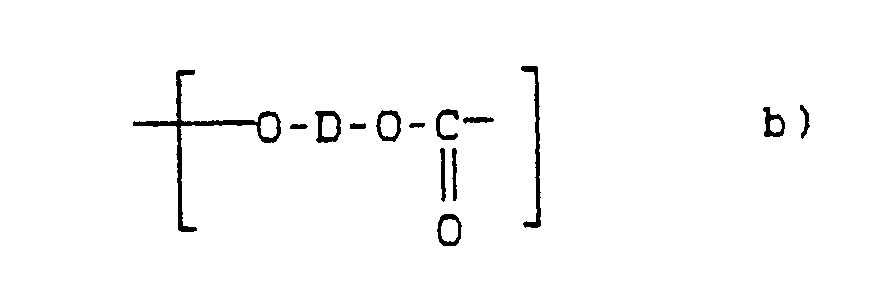
- the polycarbonates thus have bifunctional structural units of the formula b) where D has the meaning given above.
- the polycarbonates of component B) can moreover in a known manner (see for example DE-PS 2 500 092 and US-PS 4 185 009) by incorporating small amounts, preferably between 0.05 and 2 mol%, based on the diphenols used, be branched on three or more than three-functional compounds, for example those with three or more than three OH groups.
- Some of the compounds used with three or more than three phenolic hydroxyl groups are, for example Phloroglucin, 4,6-dimethyl-2,4,6-tri (4-hydroxyphenyl) heptane, 1,3,5-tri- (4-hydroxyphenol) benzene, 1,1,1-tri (-4- hydroxyphenyl) ethane, 2,6-bis (2'-hydroxy-5'-methylbenzyl) -4-methylphenyl, 2- (4-hydroxyphenyl) -2- (2,4-dihydroxyphenyl) propane and 1.4 -Bis- (4,4'-dihydroxytriphenylmethyl) benzene.
- Some of the other three-functional compounds are 2,4-dihydroxybenzoic acid, trimesic acid, cyanochloride and 3,3-bis (4-hydroxy-3-methylphenyl) -2-oxo-2,3-dihydroindole.
- Suitable diphenols of the formula a) are, for example, those of the formula a) 1) wherein Z is a single bond, an alkylene radical with 1 to 8 C atoms, an alkylidene radical with 2 to 12 C atoms, a cyclohexylidene radical, a benzylidene radical, a methylbenzylidene radical, a bis ( phenyl) methylene radical, -S-, -SO2-, -CO- or -O- is.
- polycarbonates of component B for example from the diphenols of the formula a) 1)
- diphenols of the formula a) 1 The preparation of the polycarbonates of component B), for example from the diphenols of the formula a) 1), is known from the literature or can be prepared by processes known from the literature. (See, for example, H. Schnell, Chemistry and Physics of Polycarbonates, Interscience Publishers, New York, 1964 or U.S. Patents 3,028,365 and 3,275,601).
- diphenols of the formula a) are Hydroquinone, Resorcinol, Dihydroxydiphenyls, Bis (hydroxyphenyl) alkanes, Bis (hydroxyphenyl) cycloalkanes, Bis (hydroxyphenyl) sulfides, Bis (hydroxyphenyl) ether, Bis (hydroxyphenyl) ketones, Bis (hydroxyphenyl) sulfones, Bis (hydroxyphenyl) sulfoxides and ⁇ , ⁇ '-bis (hydroxyphenyl) diisopropylbenzenes.
- Preferred diphenols of the formula a) are, for example: 4,4'-dihydroxydiphenyl, 2,2-bis (4-hydroxyphenyl) propane, 2,4-bis (4-hydroxyphenyl) -2-methylbutane, 1,1-bis (4-hydroxyphenyl) cyclohexane, ⁇ , ⁇ '-bis (4-hydroxyphenyl) -p-diisopropylbenzene and 1,1-bis (4-hydroxyphenyl) -3,3,5-trimethylcyclohexane.
- Examples of particularly preferred diphenols of the formula a) are: 2,2-bis (4-hydroxyphenyl) propane, 1,1-bis (4-hydroxyphenyl) cyclohexane and 1,1-bis (4-hydroxyphenyl) -3,3,5-trimethylcyclohexane.
- 2,2-bis (4-hydroxyphenyl) propane and 1,1-bis (4-hydroxyphenyl) -3,3,5-trimethylcyclohexane are preferred.
- the diphenols of the formula a) can be used either individually or in a mixture.
- monofunctional compounds in conventional concentrations serve as chain terminators for regulating the molecular weight.
- Suitable compounds are, for example, phenol, tert-butylphenols or other alkyl-C1-C7-substituted phenols.
- Small amounts of phenols of the formula c) are particularly suitable for regulating the molecular weight wherein R represents a branched C8 and / or C9 alkyl radical.
- R represents a branched C8 and / or C9 alkyl radical.
- the proportion of CH3 protons in the alkyl radical R between 47 and 89% and the proportion of CH and CH2 protons between 53 and 11%; R is also preferably in the o- and / or p-position to the OH group, and particularly preferably the upper limit of the ortho fraction 20%.
- the chain terminators are generally used in amounts of 0.5 to 10, preferably 1.5 to 8 mol%, based on the diphenols used.
- Thermoplastic, aromatic polyester carbonates according to Component B) of the present invention are obtainable in a known manner on diphenols, phosgene, aromatic dicarboxylic acid dichlorides, chain terminators and optionally branching agents.
- Suitable diphenols are those of formula a) already mentioned for polycarbonate production.
- Suitable aromatic dicarboxylic acid dichlorides are terephthalic acid dichloride, isophthalic acid dichloride, o-phthalic acid dichloride, diphenyl-dicarboxylic acid dichloride, naphthalenedicarboxylic acid dichloride and mixtures thereof.
- Preferred mixtures are those of terephthalic acid dichlorides with isophthalic acid dichlorides in a ratio of 20: 1 to 1:20, in particular from 7: 3 to 3: 7.
- Suitable chain terminators are, for example, monophenols, as are also suitable for the production of polycarbonate.
- Suitable branching agents are the three or more than three-functional compounds mentioned above for the production of polycarbonate, it being possible to use aromatic tricarboxylic acid chlorides or aromatic tetracarboxylic acid chlorides or acid chlorides of even higher-quality aromatic carboxylic acids in addition to phenolic compounds.
- the aromatic polyester carbonates for the purposes of the present invention have up to about 80 mol%, preferably up to about 50 mol%, of carbonate groups, based on the molar sum of carbonate groups and aromatic carboxylic acid ester groups.
- Both the ester and the carbonate content of the aromatic polyester carbonates according to the invention can be present in the form of blocks or randomly distributed in the polycondensate.
- the relative solution viscosity ( ⁇ rel) of the aromatic polyester carbonates is in the range 1.18 to 1.4, preferably 1.22 to 1.3 (measured on solutions of 0.5 g polyester carbonate in 100 ml CH2Cl2 solution at 25 ° C).
- the polyester carbonate component B) is both a homopolyester carbonate and a copolyester carbonate, i.e. both a polyester carbonate based on only one diphenol and a polyester carbonate based on several diphenols, both a polyester carbonate based on only one aromatic dicarboxylic acid and also based on several dicarboxylic acids.
- the polyester carbonates of component B) and their preparation are known (see, for example, EP-OS 0 036 080 (Le A 20 203), DE-OS 3 007 934 (Le A 20 203) and US Pat. No. 3 169 121) or the subject of German patent application P 3 903 103.9 (Le A 26 313).
- Suitable alkene carboxylic acids are all such compounds which can be polymerized with the above-mentioned olefins, preferably C3-C6 alkene carboxylic acids. Examples include: acrylic acid, methacrylic acid, itaconic acid, aconitic acid and / or fumaric acid. Acrylic acid and / or methacrylic acid are particularly preferred.
- Suitable esters of the alkenecarboxylic acids are esters of the above-mentioned alkenecarboxylic acids of alcohols having 1 to 8 carbon atoms.
- the esters of acrylic acid with C1-C8 alcohols are particularly suitable.
- the esters of acrylic acid with methanol, ethanol or 1-butanol are particularly distinguished.
- mixtures of different C1-C8 alkyl esters of C3-C Al alkenecarboxylic acids can also be used.
- the maleic anhydride can either be added as a polymer-building block during the synthesis of the rubbers or polymerized onto a pre-formed rubber graft base by a customary grafting reaction.
- the rubbers of component C) can be produced by all known polymerization processes (emulsion, solution, bulk, suspension, precipitation) and by combinations of these processes.
- the monomer to be grafted on is polymerized in the presence of the preformed graft base.
- free homopolymer is also formed. Graft products are thus understood to be the sum of the actual graft copolymers and the free polymers.
- the amount of the grafted-on monomer and the molecular weight of the homopolymer can be influenced within wide limits by varying the polymerization conditions. Above all, this includes: type of polymerization process, temperature, activator system, molecular weight regulator, stirring conditions and type of monomer metering.
- the rubbers to be used according to the invention should be essentially uncrosslinked, i.e. they should be at least 90% in hot solvents such as Toluene, ethylbenzene or tetrachlorethylene may be soluble.
- the rubbers have melting points from 40 to 160 ° C., preferably from 60 to 150 ° C. The melting points were determined by the DSC method (differential scanning calorimeter method).
- the Vicat temperatures of the rubbers to be used according to the invention are in the range between 30 ° C. to 110 ° C., preferably 35 ° C. to 90 ° C., measured in accordance with DIN 53 460.
- Japanese patent application 73/28 350 (priority May 13, 1970) describes polyamide-polycarbonate mixtures, the amount of polycarbonate being 0.5 to 20%, preferably 1.0 to 10%, based on polyamide. Foams are made from these mixtures.
- SU-PS 540 895 discloses mixtures of polyamides (85 to 99% by weight) with polycarbonates (15 to 1% by weight).
- foamable mixtures of polycarbonates with polymers containing carboxyl groups are known in amounts of 1-40% by weight, at least some of the carboxyl groups being neutralized with Na or K.
- the mixtures can also contain polyamides or polyolefins in 0.1 to 100 times the amount based on the total weight of polycarbonate and carboxyl group-containing polymers.
- polycarbonate-polyamide mixtures which contain 1 to 80 parts of polyamide per 100 parts of polycarbonate.
- the blends have improved chemical resistance and melt flow.
- the reduced melt viscosity is likely due to the degradation of the polycarbonate.
- polyamide-polycarbonate mixtures which have a content of 0.1 to 30% by weight of polymers with proton donor groups -OH, which can form hydrogen bonds.
- the molding compositions should have good surface properties and good impact strength, especially in the cold.
- EP-OS 0 270 809 discloses new polycarbonates containing acid anhydride end groups, which are preferably mixed with polyamides.
- Such polycarbonates containing acid anhydride end groups must be synthesized via polycarbonates terminated by OH groups, that is to say without a chain regulator.
- EP-OS 0 270 809, page 13, paragraph 2 states that, despite this end group protection, the polycarbonates in the mixture with the polyamides suffer a molecular weight reduction.
- EP-OS 0 301 234 (priority 27.7.1987) polycarbonate-polyamide mixtures, or polyester carbonate-polyamide mixtures, are known which contain a polyamide-polyether block copolymer as the third component in order to improve the impact resistance.
- the amine end groups of the polyamides must be reduced so that the molecular weight of the polycarbonates or the polyester carbonates and thus the impact strength of the mixtures remains stable (page 7, lines 22 ff of EP-OS 0 301 234).
- Modified polyamides are also suitable as polyamides, reference being made in this connection to US Pat. Nos. 4,174,358, 4,474,927, 4,346,194, 3,884,882 and 4,147,740 (page 9, pages 33 ff. Of EP-A 0 301 234).
- the modification of the polyamides is carried out by the addition of polymers, including polymers containing acid anhydride groups (see US Pat. No. 4,174,358, column 6, lines 18 ff, US Pat. No. 4,346,194, component (b) 1), column 2, lines 18 ff and U.S. Patent 4,147,740, Example 1).
- the mixtures of polycarbonate and polyamide, or of polyester carbonate and polyamide can be present in any quantity ratio (page 9, last paragraph to page 10, first paragraph of EP-A 0 301 234).
- the mixtures according to the invention from components A), B) and C) are prepared by drying dried polyamide of component A) with the rubber of component C) containing acid anhydride groups. is melt compounded. After drying, this blend is melt-compounded with the polycarbonate and / or with the polyester carbonate of component B).
- twin-screw extruders preferably those with degassing
- the usual twin-screw extruders can be used for this production of the mixtures according to the invention.
- the melt compounding in both the first and the second stage is carried out between 250 ° C. and 320 ° C., preferably between 270 ° C. and 300 ° C.
- the present invention thus also relates to a process for the preparation of the mixtures according to the invention from components A), B) and C), which is characterized in that in the first stage dried polyamide according to component A) is used within the quantity range according to the invention with the acid anhydride groups Rubber according to component C) melt-compounded at temperatures between 250 ° C. and 320 ° C., preferably between 270 ° C. and 300 ° C., then the resulting mixture dries, and then in a second step with the polycarbonate and / or with the polyester carbonate according to component B) again melt-compounded at temperatures between 250 ° C. and 320 ° C., preferably between 270 ° C. and 300 ° C. within the quantitative range according to the invention, and the mixture obtained is then cooled and granulated in a known manner.
- the known additives for components A), B) and C) can also be incorporated into the mixtures according to the invention in known amounts before or during or after the preparation of the mixtures according to the invention in the amounts customary for components A), B) or C).
- Suitable additives are plasticizers, flow agents, stabilizers against UV light, heat, moisture and against O2 exposure, pigments and flame retardants.
- Suitable stabilizers are, in particular, calcium sulfates, which can contain either anhydrous, 0.5 mol of H2O or 2 mol of H2O per mol of CaSO4.
- the calcium sulfates are optionally present in amounts of up to 25% by weight, based on 100% by weight of A) + B) + C), preferably in amounts of up to 20% by weight and in particular in amounts of 1% by weight. up to 10 wt .-% used.
- the present invention thus also relates to mixtures consisting of components A), B) and C) according to the invention and at least one additive selected from plasticizers, flow agents, stabilizers, pigments and flame retardants.
- the present invention also relates to a process for the preparation of the mixtures according to the invention, consisting of components A), B) and C) according to the invention and at least one additive selected from Plasticizers, flow agents, stabilizers, pigments and flame retardants, which are characterized in that, before or during or after the preparation of the mixtures according to the invention from components A), B) and C), at least one of the additives mentioned in the components A) , B) or C) usual amounts incorporated in a known manner.
- the mixtures according to the invention can, in a known manner, be processed into moldings, and also into films or fibers, for example by injection molding them into various moldings on injection molding machines.
- mixtures according to the invention are used wherever molded articles made of polyamide are used, but where improved toughness and heat resistance are required, for example in the automotive sector.
- the mixture obtained was spun off and granulated.
- the granules obtained were dried for one day at 120 ° C. in a vacuum drying cabinet.
- the mixture obtained was spun off and granulated. After the granules had dried, white moldings were obtained by injection molding.
- Example 2 was repeated, but instead of 5.74 kg of granules from Example 1, 9 kg of polyamide-6 from Example 1 and 1 kg of polycarbonate from Example 2 were melt-compounded in the twin-screw extruder at 280 ° C. within one hour. The granules obtained are colored yellow.
- Comparative Example 1 3 kg of the polycarbonate were mixed with 2 kg of the polyamide and granulated. This gives a yellow-colored, brittle, cold state which could not be spun as a strand and could not be processed to give molded articles by injection molding.
Landscapes
- Chemical & Material Sciences (AREA)
- Health & Medical Sciences (AREA)
- Chemical Kinetics & Catalysis (AREA)
- Medicinal Chemistry (AREA)
- Polymers & Plastics (AREA)
- Organic Chemistry (AREA)
- Compositions Of Macromolecular Compounds (AREA)
- Processes Of Treating Macromolecular Substances (AREA)
Abstract
Gegenstand der vorliegenden Erfindung sind Mischungen von Polyamiden mit Polycarbonaten und/oder mit Polyestercarbonaten und gegebenenfalls üblichen Additiven, die dadurch gekennzeichnet sind, daß sie säureanhydridgruppenhaltige Kautschuke enthalten, sowie ein Verfahren zur Herstellung der Mischungen.
Description
- Gegenstand der vorliegenden Erfindung sind Mischungen enthaltend
- A) 30 Gew.-% bis 84 Gew.-%, vorzugsweise 40 Gew.-% bis 80 Gew.-% und insbesondere 50 Gew.-% bis 70 Gew.-% an teilkristallinen Polyamiden und
- B) 70 Gew. % bis 16 Gew.-%, vorzugsweise 60 Gew.-% bis 20 Gew.-% und insbesondere 50 Gew.-% bis 25 Gew.-% an thermoplastischen, aromatischen Polycarbonaten und/oder thermoplastischen, aromatischen Polyestercarbonaten, die dadurch gekennzeichnet sind, daß sie, bezogen auf die Gewichtssumme aus A) + B) von 100 Gew.-%,
- C) 0,1 Gew.-% bis 40 Gew.-%, vorzugsweise von 0,2 Gew.-% bis 20 Gew.-%, und besonders bevorzugt von 0,3 Gew.-% bis 15 Gew.-% an säureanhydridgruppenhaltigen Kautschuken enthalten, welche Terpolymere aus C₂-C₈-Olefinen, aus Alkencarbonsäuren oder deren Estern und aus Maleinsäureanhydrid sind.
- Die erfindungsgemäßen Mischungen neigen auch nach mehrmaliger thermoplastischer Verarbeitung weder zum Verschäumen noch zur Verfärbung.
- Die Polyamidkomponente A) ist entweder ein Homopolyamid oder ein Copolyamid; es können auch Mischungen der Polyamide eingesetzt werden.
- Teilkristallin bedeutet in diesen Zusammenhang, daß die Polyamide in der Differentialthermoanalyse eine definierte Glasübergangstemperatur und eine Schmelztemperatur zeigen.
- Erfindungsgemäß einsetzbare Polyamide sind an sich bekannt und umfassen z.B. Polyamide mit Molekulargewichten von 5.000 oder mehr, wie sie z.B. in den US-Patentschriften 2 071 250, 2 071 251, 2 130 523, 2 130 948, 2 241 322, 2 312 966, 2 512 906 und 3 393 210 beschrieben sind.
- Die Polyamide können z.B. durch Kondensation äquimolarer Mengen einer gesättigten Dicarbonsäure mit 4 bis 12 Kohlenstoffatomen, mit einem Diamin, welches 4 bis 14 Kohlenstoffatomen aufweist, hergestellt werden, oder durch Kondensation von ω-Aminocarbonsäuren oder durch Polyaddition von Lactamen. Beispiele für Polyamide sind Polyhexamethylenadipinsäureamid (Nylon 66), Polyhexamethylenazelainsäureamid (Nylon 69), Polyhexamethylensebacinsäureamid (Nylon 610), Polyhexamethylendodecandisäureamid (Nylon 612), die durch Ringöffnung von Lactam erhaltenen Polyamide, wie Polycaprolactam, Polylaurinsäurelactam, ferne Poly-11-aminoundecansäure und Di-(p-aminocyclohexyl)-methandodecandisäureamid. Es ist auch möglich, gemäß der Erfindung Polyamide zu verwenden, die durch Copolykondensation von zwei oder mehr der oben genannten Polymeren oder ihrer Komponenten hergestellt worden sind, z.B. ein Copolymeres aus Adipinsäure, Isophthalsäure und Hexamethylendiamin. Vorzugsweise sind die Polyamide linear und haben Schmelzpunkte von mehr als 200°C.
- Bevorzugte Polyamide sind Polyhexamethylenadipinsäureamid, Polyhexamethylensebacinsäureamid und Polycaprolactam. Die Polyamide weisen im allgemeinen eine relative Viskosität von 2,5 bis 5 auf, bestimmt an einer 1-%igen Lösung in m-Kresol bei 25°C, was einem Molekulargewicht
M w von etwa 15.000 - 45.000 entspricht. - Die Polycarbonatkomponente B) ist sowohl ein Homocopolycarbonat als auch ein Copolycarbonat, wobei auch Mischungen von Polycarbonaten sowohl von Homopolycarbonaten als auch von Copolycarbonaten geeignet sind.
- Die Polycarbonate gemäß Kompoente B) sollen Gewichtsmittelmolekulargewichte
M w (ermittelt beispielsweise in bekannter Weise über die relative Lösungsviskosität oder durch Gelchromatographie nach vorheriger Eichung) von 10.000 bis 200.000, vorzugsweise von 20.000 bis 80.000 haben. - Die Polycarbonate gemäß Komponente B) sind solche auf Basis der Diphenole der Formel a)
HO-D-OH a)
worin D ein zweibindiger aromatischer Rest von 6 bis 50 C-Atomen, insbesondere von 12 bis 45 C-Atomen, ist, der noch Heteroatome oder C-haltige Heterosegmente enthalten kann, welche nicht unter den 6 bis 50 C-Atomen subsummiert sind. - Die Polycarbonate haben somit bifunktionelle Struktureinheiten der Formel b)
worin D die vorstehend genannte Bedeutung hat. - Die Polycarbonate der Komponente B) können darüber hinaus in bekannter Weise (siehe beispielsweise DE-PS 2 500 092 und US-PS 4 185 009) durch den Einbau geringer Mengen, vorzugsweise zwischen 0,05 und 2 Mol%, bezogen auf eingesetzte Diphenole, an drei oder mehr als dreifunktionellen Verbindungen, beispielsweise solchen mit drei oder mehr als drei OH-Gruppen verzweigt sein.
- Einige der verwendeten Verbindungen mit drei oder mehr als drei phenolischen Hydroxygruppen sind beispielsweise Phloroglucin, 4,6-Dimethyl-2,4,6-tri(4-hydroxyphenyl)-heptan, 1,3,5-Tri-(4-hydroxyphenol)-benzol, 1,1,1-Tri(-4-hydroxyphenyl)-ethan, 2,6-Bis-(2'-hydroxy-5'-methylbenzyl)-4-methylphenyl, 2-(4-hydroxyphenyl)-2-(2,4-dihydroxyphenyl)-propan und 1,4-Bis-(4,4'-dihydroxytriphenyl-methyl)-benzol. Einige der sonstigen dreifunktionellen Verbindungen sind 2,4-Dihydroxybenzoesäure, Trimesinsäure, Cyanuchlorid und 3,3-Bis-(4-hydroxy-3-methyl-phenyl )-2-oxo-2,3-dihydroindol.
- Geeignete Diphenole der Formel a) sind beispielsweise solche der Formel a)1)

worin Z eine Einfachbindung, ein Alkylen-Rest mit 1 bis 8 C-Atomen, ein Alkyliden-Rest mit 2 bis 12 C-Atomen, ein Cyclohexyliden-Rest, ein Benzyliden-Rest, ein Methyl-benzyliden-Rest, ein Bis-(phenyl)-methylen-Rest, -S-, -SO₂-, -CO- oder -O- ist. - Die Herstellung der Polycarbonate der Komponente B), beispielsweise aus den Diphenolen der Formel a)1) ist literaturbekannt oder nach literaturbekannten Verfahren herstellbar. (Siehe dazu beispielsweise H. Schnell, Chemistry and Physics of Polycarbonates, Interscience Publishers, New York, 1964 oder US-Patente 3 028 365 und 3 275 601).
- Geeignete Diphenole der Formel a) sind beispielsweise auch solche der Formel a)2)

worin - R¹ und R²
- unabhängig voneinander Wasserstoff, Halogen, bevorzugt Chlor oder Brom, C₁-C₈-Alkyl, C₅-C₆-Cycloalkyl, C₆-C₁₀-Aryl, bevorzugt Phenyl, und C₇-C₁₂-Aralkyl, bevorzugt Phenyl-C₁-C₄-Alkyl, insbesondere Benzyl,
- m
- eine ganze Zahl von 4 is 7, bevorzugt 4 oder 5,
- R³ und R⁴,
- für jedes X individuell wählbar, unabhängig voneinander Wasserstoff oder C₁-C₆-Alkyl
und - x
- Kohlenstoff bedeuten,
mit der Maßgabe, daß an mindestens einem Atom X R³ und R⁴ gleichzeitig Alkyl bedeuten. - Diese Diphenole sowie Polycarbonate daraus sind in der deutschen Patentanmeldung P 3 832 396.6 (Le A 26 344) beschrieben.
- Beispiele für Diphenole der Formel a) sind
Hydrochinon,
Resorcin,
Dihydroxydiphenyle,
Bis-(hydroxyphenyl)-alkane,
Bis-(hydroxyphenyl)-cycloalkane,
Bis-(hydroxyphenyl)-sulfide,
Bis-(hydroxyphenyl)-ether,
Bis-(hydroxyphenyl)-ketone,
Bis-(hydroxyphenyl)-sulfone,
Bis-(hydroxyphenyl)-sulfoxide und
α,α'-Bis(hydroxyphenyl)-diisopropylbenzole. - Diese und weitere geeignete Diphenole der Formel a) sind z.B. in den US-PS 3 028 365, 2 999 835, 3 148 172, 3 275 601, 2 991 273, 3 271 367, 3 062 781, 2 970 131 und 2 999 846, in den deutschen Offenlegungsschriften 1 570 703, 2 063 050, 2 063 052, 2 211 0956, der französischen Patentschrift 1 561 518, in der Monographie "H. Schnell, Chemistry and Physics of Polycarbonates, Interscience Publishers, New York 1964" und in der deutschen Patentanmeldung P 3 832 396.6 (Le A 26 344) beschrieben.
- Bevorzugte Diphenole der Formel a) sind beispielsweise:
4,4'-Dihydroxydiphenyl,
2,2-Bis-(4-hydroxyphenyl)-propan,
2,4-Bis-(4-hydroxyphenyl)-2-methylbutan,
1,1-Bis-(4-hydroxyphenyl)-cyclohexan,
α,α'-Bis-(4-hydroxyphenyl)-p-diisopropylbenzol und
1,1-Bis-(4-hydroxyphenyl)-3,3,5-trimethylcyclohexan. - Besonders bevorzugte Diphenole der Formel a) sind beispielsweise:
2,2-Bis-(4-hydroxyphenyl)-propan,
1,1-Bis-(4-hydroxyphenyl)-cyclohexan und
1,1-Bis-(4-hydroxyphenyl)-3,3,5-trimethylcyclohexan. - Insbesondere sind 2,2-Bis-(4-hydroxyphenyl)-propan und 1,1-Bis-(4-hydroxyphenyl)-3,3,5-trimethylcyclohexan bevorzugt.
- Die Diphenole der Formel a) können sowohl einzeln als auch im Gemisch eingesetzt werden.
- Als Kettenabbrecher zur Regelung des Molekulargewichts dienen in bekannter Weise monofunktionelle Verbindungen in üblichen Konzentrationen. Geeignete Verbindungen sind z.B. Phenol, tert.-Butylphenole oder andere Alkyl-C₁-C₇-substituierte Phenole. Zur Regelung des Molekulargewichts sind insbesondere kleine Mengen Phenole der Formel c) geeignet

worin R einen verzweigten C₈- und/oder C₉-Alkylrest darstellt. Bevorzugt ist im Alkylrest R der Anteil an CH₃-Protonen zwischen 47 und 89 % und der Anteil der CH- und CH₂-Protonen zwischen 53 und 11 %; ebenfalls bevorzugt ist R in o- und/oder p-Stellung zur OH-Gruppe, und besonders bevorzugt die obere Grenze des ortho-Anteils 20%. Die Kettenabbrecher werden im allgemeinen in Mengen von 0,5 bis 10, bevorzugt 1,5 is 8 Mol-%, bezogen auf eingesetzte Diphenole, eingesetzt. - Thermoplastische, aromatische Polyestercarbonate gemäß Komponente B) der vorliegenden Erfindung sind solche erhältlich in bekannter Weise an Diphenolen, Phosgen, aromatischen Dicarbonsäuredichloriden, Kettenabbrechern und gegebenenfalls Verzweigern. Geeignete Diphenole sind die für die Polycarbonatherstellung bereits genannten der Formel a).
- Geeignete aromatische Dicarbonsäuredichloride sind Terephthalsäuredichlorid, Isophthalsäuredichlorid, o-Phthalsäuredichlorid, Diphenyl-dicarbonsäure-dichlorid, Naphthalindicarbonsäure-dichlorid und deren Gemische.
- Bevorzugte Gemische sind solche von Terephthalsäuredichloriden mit Isophthalsäuredichloriden im verhältnis 20:1 bis 1:20, insbesondere von 7:3 bis 3:7.
- Geeignete Kettenabbrecher sind beispielsweise Monophenole, wie sie auch für die Polycarbonat-Herstellung geeignet sind.
- Geeignete Verzweiger sind die vorstehend für die Polycarbonat-Herstellung genannten drei oder mehr als dreifunktionellen Verbindungen, wobei neben phenolischer Verbindung darüber hinaus auch aromatische Tricarbonsäurechloride oder aromatische Tetracarbonsäurechloride oder Säurechloride von noch höherwertigen, aromatischen Carbonsäuren eingesetzt werden können.
- Sie werden in Mengen von 0,01 bis 1 Mol %, bezogen auf eingesetzte aromatische Dicarbonsäuredichloride, eingesetzt, während bei Einsatz von phenolischen Verzweigern deren Menge von 0,01 bis 1 Mol-% sich auf eingesetzte Diphenole zur Herstellung des aromatischen Polyestercarbonats bezieht.
- Die aromatischen Polyestercarbonate im Sinne der vorliegenden Erfindung haben bis etwa 80 Mol-%, vorzugsweise bis etwa 50 Mol-% Carbonatgruppen, bezogen auf die Molsumme an Carbonatgruppen und aromatischen Carbonsäureestergruppen.
- Sowohl der Ester- als auch der Carbonatanteil der erfindungsgemäßen aromatischen Polyestercarbonate kann in Form von Blöcken oder statistisch verteilt im Polykondensat vorliegen.
- Die relative Lösungsviskosität (ηrel) der aromatischen Polyestercarbonate liegt im Bereich 1,18 bis 1,4 vorzugsweise 1,22 bis 1,3 (gemessen an Lösungen von 0,5 g Polyestercarbonat in 100 ml CH₂Cl₂-Lösung bei 25°C).
- Die Polyestercarbonatkomponente B) ist sowohl ein Homopolyestercarbonat als auch ein Copolyestercarbonat, also sowohl ein Polyestercarbonat auf Basis nur eines Diphenols als auch ein Polyestercarbonat auf Basis mehrerer Diphenole, sowohl ein Polyestercarbonat auf Basis nur einer aromatischen Dicarbonsäure als auch auf Basis mehrerer Dicarbonsäuren. Die Polyestercarbonate der Komponente B) sowie ihre Herstellung sind bekannt (siehe beispielsweise EP-OS 0 036 080 (Le A 20 203), DE-OS 3 007 934 (Le A 20 203) und US-PS 3 169 121) oder Gegenstand der deutschan Patentanmeldung P 3 903 103.9 (Le A 26 313).
- Die erfindungsgemäß geeigneten Kautschuke gemäß Komponente C) sind beispielsweise Terpolymere, die aus
- 1) 55 Gew.-% bis 85 Gew.-% Ethylen, Propylen, Hexen, Butadien, Isopren oder/und Chloropren mit
- 2) 5 Gew.-% bis 40 Gew.-% Alkencarbonsäuren oder deren Estern und mit
- 3) 0,1 Gew.-% bis 40 Gew.-%, vorzugsweise 1 Gew.-% bis 20 Gew.-% und besonders bevorzugt 4 Gew.-% bis 17 Gew.-% Maleinsäureanhydrid nach allgemein bekannten Verfahren hergestellt werden können, wobei die Summe der Gew.-% der Komponenten 1) + 2) + 3) jeweils 100 Gew.-% ist.
- Als Alkencarbonsäuren kommen alle derartigen Verbindungen in Frage, die mit den oben genannten Olefinen polymerisiert werden können, vorzugsweise C₃-C₆-Alkencarbonsäuren. Beispielsweise sind zu nennen: Acrylsäure, Methacrylsäure, Itaconsäure, Aconitsäure und/oder Fumarsäure. Besonders bevorzugt sind Acrylsäure und/oder Methacrylsäure.
- Als Ester der Alkencarbonsäuren kommen Ester der oben genannten Alkencarbonsäuren von Alkoholen mit 1 bis 8 Kohlenstoffatomen in Frage. Besonders geeignet sind die Ester der Acrylsäure mit C₁-C₈-Alkoholen. Ganz besonders zeichnen sich die Ester der Acrylsäure mit Methanol, Ethanol oder 1-Butanol aus. Es können aber auch Mischungen aus verschiedenen C₁-C₈-Alkylestern von C₃-C₆-Alkencarbonsäuren verwendet werden.
- Das Maleinsäureanhydrid kann entweder während der Synthese der Kautschuke als polymerbildender Baustein zugesetzt oder durch übliche Pfropfreaktion auf eine vorgebildete Kautschuk-Pfropfgrundlage polymerisiert werden.
- Die Kautschuke der Komponente C) können nach allen bekannten Polymerisationsverfahren (Emulsions-, Lösungs-, Masse-, Suspensions-, Fällungspolmerisation) sowie nach Kombinationen aus diesen Verfahren hergestellt werden.
- Bei der Herstellung der säureanhydridgruppenhaltigen Kautschuke durch Pfropfreaktion wird das aufzupfropfende Monomere in Gegenwart der vorgebildeten Propfgrundlage polymerisiert. Es bildet sich dabei neben dem eigentlichen Pfropfpolymerisat auch freies Homopolymerisat. Als Pfropfprodukte wird somit jeweils die Summe der eigentlichen Pfropfcopolymerisate und der freien Polymerisate verstanden. Die Menge des aufgepfropften Monomeren und das Molekulargewicht des Homopolymerisats kann in weiten Grenzen durch Variation der Polymerisationsbedingungen beeinflußt werden. Hierzu gehören vor allem: Art des Polymerisationsverfahrens, Temperatur, Aktivatorsystem, Molekulargewichtsregler, Rührbedingungen und Art der Monomer-Dosierung.
- Besonders bevorzugte Terpolymerisate gemäß Komponente C) sind solche, die hergestellt sind aus
- 1) 55 Gew.-% bis 85 Gew.-% Ethylen,
- 2) 5 Gew.-% bis 40 Gew.-% eines oder mehrerer C₃-C₆-Alkencarbonsäuren und/oder deren Ester und
- 3) 0,1 Gew.-% bis 40 Gew.-%, vorzugsweise 1 Gew.-% bis 20 Gew.-% und besonders bevorzugt 4 Gew.-% bis 17 Gew.-% Maleinsäureanhydrid, wobei die Summe der Gew.-% der Komponenten 1) + 2) + 3) jeweils 100 Gew.-% ist.
- Die erfindungsgemäß einzusetzenden Kautschuke sollen im wesentlichen unvernetzt sein, d.h. sie sollen zu mindestens 90 % in heißen Lösungsmitteln wie z.B. Toluol, Ethylbenzol oder Tetrachlorethylen löslich sein. Die Kautschuke besitzen Schmelzpunkte von 40 bis 160°C, vorzugsweise von 60 bis 150°C. Die Schmelzpunkte wurden nach der DSC-Methode (Differential-Scanning-Calorimeter-Methode) bestimmt.
- Die Vicat-Temperaturen der erfindungsgemäß einzusetzenden Kautschuke liegen im Bereich zwischen 30°C bis 110°C, vorzugsweise 35°C bis 90°C, gemessen nach DIN 53 460.
- Aus der japanischen Offenlegungsschrift 73/28 350 (Priorität 13.5.1970) sind Polyamid-Polycarbonat-Mischungen beschrieben, wobei die Menge an Polycarbonat 0,5 bis 20 %, vorzugsweise 1,0 bis 10 %, bezogen auf Polyamid beträgt. Aus diesen Mischungen werden Schaumstoffe hergestellt.
- Aus der SU-PS 540 895 sind Mischungen von Polyamiden (85 bis 99 Gew.-%) mit Polycarbonaten (15 bis 1 Gew.-%) bekannt.
- Aus der japanischen Offenlegungschrift 57/016 033 (Priorität 2.7.1980) sind verschäumbare Mischungen von Polycarbonaten mit carboxylgruppenhaltigen Polymeren in Mengen von 1-40 Gew.-% bekannt, wobei mindestens ein Teil der Carboxylgruppen mit Na oder K neutralisiert ist. Die Mischungen können außerdem Polyamide oder Polyolefine in 0,1 bis 100-fachen Menge bezogen auf die Gewichtssumme an Polycarbonat und carboxylgrupppenhaltigen Polymeren enthalten.
- Aus der japanischen Offenlegungsschrift 59/68 368 (Priorität 14.10.1982) sind Polycarbonat-Polyamid-Mischungen bekannt, die pro 100 Teile Polycarbonat 1 bis 80 Teile Polyamid enthalten. Die Mischungen haben verbesserte chemische Resistenz und verbesserten Schmelzfluß.
- Die verringerte Schmelzviskosität ist wahrscheinlich eine Folge des Abbaus des Polycarbonats.
- Aus der deutschen Offenlegungsschrift 3 605 573 (Priorität 21.2.1986) sind Polyamid-Polycarbonat-Mischungen bekannt, die einen Gehalt vonm 0,1 bis 30 Gew.-% an Polymeren mit Protonendonatorgruppen -OH, die Wasserstoffbrückenbindungen ausbilden können, haben. Die Formmassen sollen gute Oberflächenbeschaffenheit und gute Schlagzähigkeit, besonders in der Kälte, besitzen.
- Aus der EP-OS 0 270 809 (Priorität 8.12.1986) sind neue Säureanhydrid-Endgruppen-haltige Polycarbonate bekannt, die vorzugsweise mit Polyamiden abgemischt werden.
- Derartige säureanhydridendgruppenhaltigen Polycarbonate müssen über OH-Gruppen terminierte Polycarbonate, also ohne Kettenregler, synthetisiert werden.
- Somit ist eine technisch nutzbare, reproduzierbare Herstellungsmethode für diese Polycarbonate nicht gegeben.
- Darüber hinaus wird in der EP-OS 0 270 809, Seite 13, Absatz 2 ausgeführt, daß trotz dieses Endgruppenschutzes die Polycarbonate im Gemisch mit den Polyamiden einen Molekulargewichtsabbau erleiden.
- Überraschenderweise wurde gefunden, daß der Molekulargewichtsabbau des Polycarbonats beziehungsweise des Polyestercarbonats und die damit verbundene Zersetzungsreaktion unter CO₂-Bildung dann unterbleibt, wenn ein Polyamid, welches mit einem säureanhydridhaltigem Kautschuk schmelzcompoundiert ist, mit dem Polycarbonat und/oder mit dem Polyestercarbonat verarbeitet wird.
- Der Effekt ist umso überraschender, da hier nur statistisch eingesetzte Säureahydridgruppen vorliegen. Die erfindungsgemäße Vorgehensweise erlaubt außerdem, polyamidreichere Polyamid/Polycarbonat-Gemische als gemäß EP-A 0 270 809 herzustellen.
- Schließlich sind aus der EP-OS 0 301 234 (Priorität 27.7.1987) Polycarbonat-Polyamid-Mischungen, beziehungsweise Polyestercarbonat-Polyamid-Mischungen, bekannt, die als dritte Komponente ein Polyamid-Polyether-Blockcopolymer enthalten, um die Schlagzähigkeit zu verbessern.
- Auch in diesem Fall müssen die Aminendgruppen der Polyamide so reduziert werden, damit das Molekulargewicht der Polycarbonate bzw. der Polyestercarbonate und damit die Schlagzähigkeit der Mischungen stabil bleibt (Seite 7, Zeilen 22 ff der EP-OS 0 301 234).
- Als Polyamide sind auch modifizierte Polyamide geeignet, wobei in diesem Zusammenhang auf die US-Patente 4 174 358, 4 474 927, 4 346 194, 3 884 882 und 4 147 740 verwiesen wird (Seite 9, Seiten 33 ff der EP-A 0 301 234). Die Modifizierung der Polyamide erfolgt hierbei durch den Zusatz von Polymerisaten, worunter auch Säureanhydridgruppen-haltige Polymerisate fallen (siehe US-Patent 4 174 358, Spalte 6, Zeilen 18 ff, US-Patent 4 346 194, Komponente (b)1), Spalte 2, Zeilen 18 ff und US-Patent 4 147 740, Beispiel 1).
- In der EP-A 0 301 234 können die Mischungen aus Polycarbonat und Polyamid, beziehungsweise aus Polyestercarbonat und Polyamid in beliebigen Mengenverhältnissen vorliegen (Seite 9, letzter Absatz bis Seite 10, 1. Absatz der EP-A 0 301 234).
- Die speziellen Terpolymeren gemäß Komponente C) der vorliegenden Erfindung sind unseres Erachtens jedoch in diesem Zusammenhang nicht erwähnt.
- Die Herstellung der erfindungsgemäßen Mischungen aus den Komponenten A), B) und C) erfolgt in der Weise, daß man getrocknetes Polyamid der Komponente A) mit dem säureanhydridgruppenhaltigen Kautschuk der Komponente C) schmelzcompoundiert wird. Dieser Blend wird nach Trocknung mit dem Polycarbonat und/oder mit dem Polyestercarbonat der Komponente B) schmelzcompoundiert.
- Für diese Herstellung der erfindungsgemäßen Mischungen können die üblichen Zweiwellenextruder, vorzugsweise solche mit Entgasung, verwendet werden.
- Die Schmelzcompoundierung sowohl in der ersten als auch in der zweiten Stufe wird zwischen 250°C und 320°C, vorzugsweise zwischen 270°C und 300°C durchgeführt.
- Gegenstand der vorliegenden Erfindung ist somit auch ein Verfahren zur Herstellung der erfindungsgemäßen Mischungen aus den Komponenten A), B) und C), das dadurch gekennzeichnet ist, daß man in der ersten Stufe getrocknetes Polyamid gemäß Komponente A) innerhalb des erfindungsgemäßen Mengenbereichs mit dem säureanhydridgruppenhaltigen Kautschuk gemäß Komponente C) innerhalb des erfindungsgemäßen Mengenbereichs bei Temperaturen zwischen 250°C und 320°C, vorzugsweise zwischen 270°C und 300°C schmelzcompoundiert, danach das erhaltene Gemisch trocknet, und dann in einer zweiten Stufe mit dem Polycarbonat und/oder mit dem Polyestercarbonat gemäß Komponente B) innerhalb des erfindungsgemäßen Mengenbereichs wiederum bei Temperaturen zwischen 250°C und 320°C, vorzugsweise zwischen 270°C und 300°C schmelzcompoundiert und das erhaltene Gemisch anschließend in bekannter Weise abkühlt und granuliert.
- Den erfindungsgemäßen Mischungen können noch die für die Komponenten A), B) und C) bekannten Additive in bekannten Mengen vor oder während oder nach der Herstellung der erfindungsgemäßen Mischungen in den für die Komponenten A), B) oder C) üblichen Mengen eingearbeitet werden.
- Geeignete Additive sind Weichmacher, Fließmittel, Stabilisatoren gegen UV-Licht, Hitze, Feuchtigkeit und gegen O₂-Einwirkung, Pigmente und Flammschutzmittel.
- Geeignete Stabilisatoren sind insbesondere Calciumsulfate, die entweder wasserfrei, 0,5 Mol H₂O oder 2 Mol H₂O pro Mol CaSO₄ enthalten können. Die Calciumsulfate werden gegebenenfalls in Mengen bis zu 25 Gew.-%, bezogen auf 100 Gew.-% aus A) + B) + C), vorzugsweise in Mengen bis zu 20 Gew.-% und insbesondere in Mengen von 1 Gew.% bis 10 Gew.-% eingesetzt.
- Gegenstand der vorliegenden Erfindung sind somit auch Mischungen bestehend aus den erfindungsgemäßen Komponenten A), B) und C) und mindestens einem Zusatz, ausgewählt aus Weichmachern Fließmitteln, Stabilisatoren, Pigmenten und Flammschutzmitteln.
- Gegenstand der vorliegenden Erfindung ist auch ein Verfahren zur Herstellung der erfindungsgemäßen Mischungen, bestehend aus den erfindungsgemäßen Komponenten A), B) und C) und mindestens einem Zusatz, ausgewählt aus Weichmachern, Fließmitteln, Stabilisatoren, Pigmenten und Flammschutzmitteln, das dadurch gekennzeichnet ist, daß man vor oder während oder nach der Herstellung der erfindungsgemäßen Mischungen aus den Komponenten A), B) und C) mindestens einen der genannten Zusätze in den für die Komponenten A), B) oder C) üblichen Mengen in bekannter Weise einarbeitet.
- Die erfindungsgemäßen Mischungen können, in bekannter Weise zu Formkörpern verarbeitet werden, ebenso zu Folien oder Fasern, indem man sie beispielsweise auf Spritzgußmaschinen zu verschiedenen Formkörpern verspritzt.
- Die erfindungsgemäßen Mischungen finden Anwendung überall dort, wo Formkörper aus Polyamid eingesetzt werden, wo jedoch eine verbesserte Zähigkeit und Wärmeformbeständigkeit verlangt wird, also beispielsweise im Automobilbereich.
- In einem Zweiwellen-Extruder wurden
- A) 5,28 kg handelsübliches Polyamid-6,
und - C) 1,32 kg eines bekannten Polyethylen-Acrylsäureester-Maleinsäureanhydrid-Terpolymeren, hergestellt nach bekannten Verfahren im Gewichtsverhältnis 70 Gew.-% Ethylen zu 19 Gew.-% Acrylsäureester zu 11 Gew.-% Maleinsäureanhydrid, das einen Schmelzpunkt von 112°C hat,
- Das erhaltene Gemisch wurde abgesponnen und granuliert. Das erhaltene Granulat wurde einen Tag bei 120°C in einem Vakuum-Trockenschrank getrocknet.
- 5,74 kg des getrockneten Granulats vom Beispiel 1 und
- B) 2,46 kg vorgetrocknetes Homopolycarbonat aus 2,2-Bis-(4-hydroxyphenyl)-propan mit einem ηrel von 1,28, gemessen in CH₂Cl₂ bei 25°C und einer Konzentration von 0,5 g in 100 ml CH₂Cl₂ und mit einem
M w von etwa 28.000, gelchromatographisch ermittelt, wurden bei 280°C schmelzcompoundiert in einem Zweiwellenextruder innerhalb einer Stunde. - Das erhaltene Gemisch wurde abgesponnen und granuliert. Nach dem Trocknen des Granulats wurden weiße Formkörper durch Spritzguß erhalten.
- Beispiel 2 wurde wiederholt, wobei allerdings anstelle von 5,74 kg Granulat des Beispiels 1 9 kg Polyamid-6 des Beispiels 1 und 1 kg Polycarbonat des Beispiels 2 innerhalb einer Stunde bei 280°C in dem Zweiwellen-Extruder schmelzcompoundiert wurden. Das erhaltene Granulat ist gelb gefärbt.
- Entsprechend Vergleichsbeispiel 1 wurden 3 kg des Polycarbonats mit 2 kg des Polyamids vermicht und granuliert. Man erhält eine gelb gefärbte, in kaltem Zustand spröde Masse, die nicht als Strang abgesponnen werden konnte und auch nicht zu Formkörpern im Spritzgußverfahren verarbeitet werden konnte.
bei 235°C innerhalb einer Stunde schmelzcompoundiert.
Claims (4)
- Mischungen enthaltendA) 30 Gew.-% bis 84 Gew.-% an teilkristallinen Polyamiden,B) 70 Gew.-% bis 16 Gew.-% an thermoplastischen, aromatischen Polycarbonaten, und/oder thermoplastischen, aromatischen Polyestercarbonaten, dadurch gekennzeichnet, daß sie, bezogen auf die Gewichtssumme A) + B) von 100 Gew.-%,C) 0,1 Gew.-% bis 40 Gew.-% an säureanhydridgruppenhaltigen Kautschuken enthalten, welche Terpolymere aus C₂-C₈-Olefinen, aus Alkencarbonsäuren oder deren Estern und aus Maleinsäureanhydrid sind.
- Verfahren zur Herstellung der Mischungen des Anspruchs 1, dadurch gekennzeichnet, daß man in der ersten Stufe getrocknetes Polyamid gemäß Komponente A) mit dem säureanhydridgruppenhaltigen Kautschuk gemäß Komponente C) bei Temperaturen zwischen 250°C und 320°C schmelzcompoundiert, danach das erhaltene Gemisch trocknet, und dann in einer zweiten Stufe mit Polycarbonat und/oder mit dem Polyestercarbonat gemäß Komponente B) wiederum bei Temperaturen zwischen 250°C und 320°C schmelzcompoundiert und das erhaltene Gemisch anschließend in bekannter Weise abkühlt und granuliert.
- Mischungen gemäß Anspruch 1, bestehend aus den Komponenten A), B) und C) und mindestens einem Zusatz, ausgewählt aus Weichmachern, Fließmitteln, Stabilisatoren, Pigmenten und Flammschutzmitteln.
- Verfahren zur Herstellung der Mischungen des Anspruchs 3 gemäß Anspruch 2, dadurch gekennzeichnet, daß man vor oder während oder nach der Herstellung der Mischungen aus den Komponenten A), B) und C) mindestens einen Zusatz, ausgewählt aus Weichmachern, Fließmitteln, Stabilisatoren, Pigmenten und Flammschutzmitteln in der für die Komponenten A), B) oder C) üblichen Mengen in bekannter Weise einarbeitet.
Applications Claiming Priority (2)
| Application Number | Priority Date | Filing Date | Title |
|---|---|---|---|
| DE19904000479 DE4000479A1 (de) | 1990-01-10 | 1990-01-10 | Ternaere mischungen |
| DE4000479 | 1990-01-10 |
Publications (1)
| Publication Number | Publication Date |
|---|---|
| EP0437786A1 true EP0437786A1 (de) | 1991-07-24 |
Family
ID=6397798
Family Applications (1)
| Application Number | Title | Priority Date | Filing Date |
|---|---|---|---|
| EP90124844A Withdrawn EP0437786A1 (de) | 1990-01-10 | 1990-12-20 | Ternäre Mischungen |
Country Status (3)
| Country | Link |
|---|---|
| EP (1) | EP0437786A1 (de) |
| JP (1) | JPH07145318A (de) |
| DE (1) | DE4000479A1 (de) |
Cited By (2)
| Publication number | Priority date | Publication date | Assignee | Title |
|---|---|---|---|---|
| WO1995003363A1 (en) * | 1993-07-26 | 1995-02-02 | E.I. Du Pont De Nemours And Company | Blends of polycarbonates with polyamides, having high impact strength and high flexural modulus |
| US7511107B2 (en) | 2002-11-20 | 2009-03-31 | Basf Aktiengesellschaft | Ethylene terpolymer waxes, their preparation and their use |
Families Citing this family (2)
| Publication number | Priority date | Publication date | Assignee | Title |
|---|---|---|---|---|
| DE4221969A1 (de) * | 1992-07-03 | 1994-01-05 | Inst Polymerforschung Dresden | Verfahren zur Herstellung von Polyamid-Polyester-Blends mit verbesserter Phasenverträglichkeit |
| MY190729A (en) * | 2014-01-27 | 2022-05-12 | Basf Se | Polyolefin copolymers as color enhancers in polyamides |
Citations (4)
| Publication number | Priority date | Publication date | Assignee | Title |
|---|---|---|---|---|
| WO1988002387A1 (en) * | 1986-10-03 | 1988-04-07 | Dexter Corporation | Compatibilizing agent for polycarbonate and polyamide polymer blends |
| EP0269984A2 (de) * | 1986-11-29 | 1988-06-08 | BASF Aktiengesellschaft | Thermoplastische Formmassen auf der Basis von Polycarbonaten, Polyestern und Polyamiden |
| EP0285693A1 (de) * | 1987-04-09 | 1988-10-12 | General Electric Company | Thermoplastische Zubereitungen mit endgruppenkontrollierten Polyamidharzen |
| EP0333002A2 (de) * | 1988-03-15 | 1989-09-20 | Idemitsu Petrochemical Co. Ltd. | Hitzebeständige Harzzusammensetzung |
-
1990
- 1990-01-10 DE DE19904000479 patent/DE4000479A1/de not_active Withdrawn
- 1990-12-20 EP EP90124844A patent/EP0437786A1/de not_active Withdrawn
-
1991
- 1991-01-05 JP JP1034191A patent/JPH07145318A/ja active Pending
Patent Citations (4)
| Publication number | Priority date | Publication date | Assignee | Title |
|---|---|---|---|---|
| WO1988002387A1 (en) * | 1986-10-03 | 1988-04-07 | Dexter Corporation | Compatibilizing agent for polycarbonate and polyamide polymer blends |
| EP0269984A2 (de) * | 1986-11-29 | 1988-06-08 | BASF Aktiengesellschaft | Thermoplastische Formmassen auf der Basis von Polycarbonaten, Polyestern und Polyamiden |
| EP0285693A1 (de) * | 1987-04-09 | 1988-10-12 | General Electric Company | Thermoplastische Zubereitungen mit endgruppenkontrollierten Polyamidharzen |
| EP0333002A2 (de) * | 1988-03-15 | 1989-09-20 | Idemitsu Petrochemical Co. Ltd. | Hitzebeständige Harzzusammensetzung |
Non-Patent Citations (1)
| Title |
|---|
| PATENT ABSTRACTS OF JAPAN, Band 14, Nr. 096 (C-692)[4039], 22. Februar 1990; & JP-A-1 304 154 (KANEBO) 07-12-1989 * |
Cited By (2)
| Publication number | Priority date | Publication date | Assignee | Title |
|---|---|---|---|---|
| WO1995003363A1 (en) * | 1993-07-26 | 1995-02-02 | E.I. Du Pont De Nemours And Company | Blends of polycarbonates with polyamides, having high impact strength and high flexural modulus |
| US7511107B2 (en) | 2002-11-20 | 2009-03-31 | Basf Aktiengesellschaft | Ethylene terpolymer waxes, their preparation and their use |
Also Published As
| Publication number | Publication date |
|---|---|
| JPH07145318A (ja) | 1995-06-06 |
| DE4000479A1 (de) | 1991-07-11 |
Similar Documents
| Publication | Publication Date | Title |
|---|---|---|
| DE2310742C2 (de) | Flammwidrige thermoplastische Polyester-Formmasse | |
| DE3640875A1 (de) | Thermoplastische formmassen auf der basis von polycarbonaten, polyestern und polyamiden | |
| EP0840758B1 (de) | Verfahren zur herstellung von verkappten polyarylenethern | |
| DE3903102A1 (de) | Mischungen aus polyalkylenterephthalaten, neuen polycarbonaten und elastomeren | |
| EP0613916B1 (de) | Formmasse auf der Grundlage von Polyarylenethern mit Anhydridendgruppen | |
| EP0019126A2 (de) | Flammwidrige Polycarbonat-Legierungen mit erhöhter Wärmeformbeständigkeit, ihre Herstellung und Verwendung | |
| DE4026475A1 (de) | Ternaere mischungen | |
| DE2446327A1 (de) | Schlagfeste, feuerhemmende harzzusammensetzung | |
| EP0174503B1 (de) | Acrylnitrilfreie Blends aus Polycarbonat, Methylmethacrylat, Pfropfkautschuk und einem Terpolymerisatharz | |
| EP0437786A1 (de) | Ternäre Mischungen | |
| EP0062189A1 (de) | Polycarbonat mit verbesserter Schlagzähigkeit | |
| EP0234434A2 (de) | Thermoplastische Formmassen auf der Basis von Polyamiden und Polycarbonaten | |
| US5212224A (en) | Free flowing moulding materials based on polyamides containing bisphenols | |
| EP0173146A1 (de) | Acrylnitrilfreie polycarbonat blends | |
| EP0700940B1 (de) | Allylphenolterminierte, mit Maleinsäureanhydrid gepfropfte Polycarbonate und ihre Verwendung zur Herstellung von Blends mit Polyamid und die Blends | |
| DE2904832A1 (de) | Thermoplastische massen, verfahren zu ihrer herstellung sowie ihre verwendung | |
| DE4107397A1 (de) | Polymerisate mit sulfonamid-einheiten als vertraeglichkeitsvermittler fuer polyamid/polycarbonat-blends | |
| EP0422441A2 (de) | Thermoplastische Mischungen | |
| DE3786393T2 (de) | Flammhemmendes Polyethylenterephthalat. | |
| DE4114589A1 (de) | Polycarbonat/polyamid-formmassen | |
| EP0177733B1 (de) | Thermoplastische Formassen | |
| EP0507141B1 (de) | Verträgliche Mischungen aus aromatischen Poly-(ester)-carbonaten und Polyamiden | |
| DE4015540A1 (de) | Mischungen von polyamiden mit aromatischen (co)poly(ester)-(carbonaten) auf basis tert.-alkylestergruppen enthaltender bisphenole | |
| EP0450178B1 (de) | Oxidiertes Polyethylen enthaltende glasfaserverstärkte Polycarbonate | |
| US5234982A (en) | Ternary mixtures |
Legal Events
| Date | Code | Title | Description |
|---|---|---|---|
| PUAI | Public reference made under article 153(3) epc to a published international application that has entered the european phase |
Free format text: ORIGINAL CODE: 0009012 |
|
| 17P | Request for examination filed |
Effective date: 19901220 |
|
| AK | Designated contracting states |
Kind code of ref document: A1 Designated state(s): DE ES FR GB IT NL |
|
| STAA | Information on the status of an ep patent application or granted ep patent |
Free format text: STATUS: THE APPLICATION HAS BEEN WITHDRAWN |
|
| 18W | Application withdrawn |
Withdrawal date: 19920121 |