EP0442414B1 - Compound semiconductor substrate and method of manufacturing the same - Google Patents
Compound semiconductor substrate and method of manufacturing the same Download PDFInfo
- Publication number
- EP0442414B1 EP0442414B1 EP91101865A EP91101865A EP0442414B1 EP 0442414 B1 EP0442414 B1 EP 0442414B1 EP 91101865 A EP91101865 A EP 91101865A EP 91101865 A EP91101865 A EP 91101865A EP 0442414 B1 EP0442414 B1 EP 0442414B1
- Authority
- EP
- European Patent Office
- Prior art keywords
- compound semiconductor
- gaas
- crystal layer
- semi
- crystal
- Prior art date
- Legal status (The legal status is an assumption and is not a legal conclusion. Google has not performed a legal analysis and makes no representation as to the accuracy of the status listed.)
- Expired - Lifetime
Links
Images


Classifications
-
- H—ELECTRICITY
- H10—SEMICONDUCTOR DEVICES; ELECTRIC SOLID-STATE DEVICES NOT OTHERWISE PROVIDED FOR
- H10D—INORGANIC ELECTRIC SEMICONDUCTOR DEVICES
- H10D62/00—Semiconductor bodies, or regions thereof, of devices having potential barriers
- H10D62/10—Shapes, relative sizes or dispositions of the regions of the semiconductor bodies; Shapes of the semiconductor bodies
- H10D62/17—Semiconductor regions connected to electrodes not carrying current to be rectified, amplified or switched, e.g. channel regions
-
- H—ELECTRICITY
- H10—SEMICONDUCTOR DEVICES; ELECTRIC SOLID-STATE DEVICES NOT OTHERWISE PROVIDED FOR
- H10P—GENERIC PROCESSES OR APPARATUS FOR THE MANUFACTURE OR TREATMENT OF DEVICES COVERED BY CLASS H10
- H10P14/00—Formation of materials, e.g. in the shape of layers or pillars
- H10P14/20—Formation of materials, e.g. in the shape of layers or pillars of semiconductor materials
- H10P14/29—Formation of materials, e.g. in the shape of layers or pillars of semiconductor materials characterised by the substrates
- H10P14/2901—Materials
- H10P14/2907—Materials being Group IIIA-VA materials
- H10P14/2911—Arsenides
-
- H—ELECTRICITY
- H10—SEMICONDUCTOR DEVICES; ELECTRIC SOLID-STATE DEVICES NOT OTHERWISE PROVIDED FOR
- H10P—GENERIC PROCESSES OR APPARATUS FOR THE MANUFACTURE OR TREATMENT OF DEVICES COVERED BY CLASS H10
- H10P14/00—Formation of materials, e.g. in the shape of layers or pillars
- H10P14/20—Formation of materials, e.g. in the shape of layers or pillars of semiconductor materials
- H10P14/34—Deposited materials, e.g. layers
- H10P14/3402—Deposited materials, e.g. layers characterised by the chemical composition
- H10P14/3414—Deposited materials, e.g. layers characterised by the chemical composition being group IIIA-VIA materials
- H10P14/3418—Phosphides
-
- H—ELECTRICITY
- H10—SEMICONDUCTOR DEVICES; ELECTRIC SOLID-STATE DEVICES NOT OTHERWISE PROVIDED FOR
- H10P—GENERIC PROCESSES OR APPARATUS FOR THE MANUFACTURE OR TREATMENT OF DEVICES COVERED BY CLASS H10
- H10P14/00—Formation of materials, e.g. in the shape of layers or pillars
- H10P14/20—Formation of materials, e.g. in the shape of layers or pillars of semiconductor materials
- H10P14/34—Deposited materials, e.g. layers
- H10P14/3402—Deposited materials, e.g. layers characterised by the chemical composition
- H10P14/3414—Deposited materials, e.g. layers characterised by the chemical composition being group IIIA-VIA materials
- H10P14/3421—Arsenides
Definitions
- the present invention relates to a method of manufacturing a compound semiconductor device.
- GaAs is known well as a type of a compound semiconductor.
- the GaAs is made to have a resistivity of 106 ⁇ cm or more, it has semi-insulating characteristics.
- active elements are formed in a semi-insulating GaAs substrate, they are not advantageously required to be electrically isolated from each other using a field insulating film.
- a semi-insulating GaAs single-crystal is conventionally made using a single-crystal manufacturing technique such as an LEC method, and the single-crystal is sliced to manufacture semi-insulating GaAs substrates.
- the semi-insulating GaAs single-crystal is constituted by bonding two types of atoms, a shearing stress acting inside the Gas single-crystal is stronger than that of a silicon single-crystal, and a dislocation density in the GaAs single-crystal is disadvantageously increased.
- the present invention has been made in consideration of the above problem, and has as its object to provide a method of manufacturing a compound semiconductor device with a substrate having a low dislocation density.
- the above object can be achieved by the following arrangement.
- a dislocation density can be decreased.
- a high-resistance single-crystal layer having a low dislocation density i.e., a single-crystal layer having semi-insulating characteristics can be formed.
- the high-resistance single-crystal layer is formed in a portion where an active element is to be formed, a compound semiconductor substrate having a low dislocation density and even advantageously having a high-resistance, i.e., semi-insulating characteristics can be obtained.
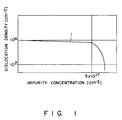
- a curve I in Fig. 1 indicates a decrease in dislocation density when an impurity is doped in GaAs after a crystal is grown. The decrease in dislocation density typically occurs when an n-type impurity is doped.
- a doping concentration of the impurity at a time when the dislocation density is rapidly decreased is 5 ⁇ 1017 cm ⁇ 3 or more. This phenomenon is not limited to the GaAs, and it occurs in a compound semiconductor such as GaP or InP consisting of two elements.
- n-type impurity Silicon or carbon is used as an n-type impurity, and selenium, magnesium or the like is used as a p-type impurity.
- a doping concentration is set to be 5 ⁇ 1017 cm ⁇ 3 or more to obtain a compound semiconductor single-crystal having a low dislocation density.
- the present invention is made on the basis of the above phenomenon, n-type GaAs in which a single-crystal, e.g., a silicon element, having a density of 5 ⁇ 1017 cm-3 or more is doped as an impurity is grown by an LEC method or an HB method, thereby forming an n-type GaAs single-crystal 10 having a low dislocation density (Fig. 2A).
- the single-crystal 10 is cut (Fig. 2B).
- the cut single-crystal 10 is sliced to obtain an n-type GaAs base 12 (Fig. 2C).
- the base 12 sliced as described above is prospectively used as a substrate for epitaxial growth.
- a high-resistance GaAs single-crystal layer 14 having a resistivity of 106 ⁇ cm is epitaxially grown on the surface of the base 12 (Fig. 2E).
- an amount of impurity contained in GaAs is decreased, or the GaAs is undoped.
- the high-resistance GaAs single-crystal layer 14 is prospectively used as a portion where an active element is to be formed.
- a compound semiconductor substrate 16 according to the present invention is finished by the above method.
- a dislocation density of a single-crystal layer which is epitaxially grown is generally lower than that of a substrate on which the single-crystal layer is grown.
- the dislocation density of the n-type GaAs base 12 is decreased by doping an impurity, and the dislocation density of the GaAs single-crystal layer 14 grown on the base 12 is further decreased.
- a dislocation density is about 50,000 cm ⁇ at a portion where an active element is to be formed.
- the dislocation density of the GaAs single-crystal layer 14 where an active element is to be formed can be set to be 100 cm ⁇ or less.
- Fig. 3 is a partially enlarged sectional view showing the GaAs substrate 16 shown in Fig. 2E
- Fig. 4 is a sectional view showing a condition wherein an active element is formed on the GaAs substrate 16.
- the GaAs single-crystal layer 14 which is undoped to have a high-resistance is stacked on the n-type GaAs base 12 by epitaxial growth.
- the high-resistance GaAs single-crystal layer 14 is a layer where an active element 18 is prospectively formed, and an active region 20 prospectively serving as a source, a drain, and a channel of the active element 18 is formed on the single-crystal layer 14.
- the high-resistance GaAs single-crystal layer 14 is formed to have a resistivity of 106 ⁇ cm or more, a field insulating film for isolating the active elements 18 from each other need not be formed (the high-resistance GaAs single-crystal layer 14 has semi-insulating characteristics).
- the high-resistance GaAs single-crystal layer 14 is epitaxially grown on the n-type GaAs base 12 having a low dislocation density, the dislocation density of the single-crystal layer 14 is also low.
- the active elements 18 formed on the GaAs single-crystal layer 14 having a low dislocation density have excellent characteristics, and variations in characteristics of all the active elements 18 can be decreased.
- the variations in characteristics of the active elements 18 can be decreased, in all cases wherein an IC/LSI is formed and wherein an individual semiconductor device is formed, the performance of the IC/LSI and the individual semiconductor device can be improved, and a yield of the products can be improved.
- a thickness t of the high-resistance GaAs single-crystal layer 14 is required to be a minimum thickness required for forming the active region 20.
- the thickness t of the high-resistance GaAs single-crystal layer 14 is set to be about 500 nm or more, it can sufficiently cope with formation of the active region 20.
- a method of growing a crystal at an atomic layer level such as MBE, MOCVD, or MOMBE is preferably used from the viewpoint of improvements of a film quality and controllability of the film thickness t .
- the base 12 contains an impurity to have a low dislocation density.
- the single-crystal layer 14 stacked thereon is undoped to have a high resistance so as to have semi-insulating characteristics.
- an impurity having an effect of decreasing the dislocation density of the base 12 carbon, selenium, magnesium, or the like is used in addition to silicon.
- the dislocation density of the single-crystal can be decreased.
Landscapes
- Recrystallisation Techniques (AREA)
- Physical Deposition Of Substances That Are Components Of Semiconductor Devices (AREA)
- Element Separation (AREA)
Description
- The present invention relates to a method of manufacturing a compound semiconductor device.
- GaAs is known well as a type of a compound semiconductor. When the GaAs is made to have a resistivity of 10⁶ Ω·cm or more, it has semi-insulating characteristics. When active elements are formed in a semi-insulating GaAs substrate, they are not advantageously required to be electrically isolated from each other using a field insulating film. In order to obtain this advantage, a semi-insulating GaAs single-crystal is conventionally made using a single-crystal manufacturing technique such as an LEC method, and the single-crystal is sliced to manufacture semi-insulating GaAs substrates.
- Since the semi-insulating GaAs single-crystal is constituted by bonding two types of atoms, a shearing stress acting inside the Gas single-crystal is stronger than that of a silicon single-crystal, and a dislocation density in the GaAs single-crystal is disadvantageously increased.
- The following documents all show some of the features of the present invention.
- Applied Physics Letters, Vol. 37, No.8, October 1980, New York US, pages 734-737; S. A. Barnett et al.: "Growth of high-quality epitaxial GaAs films by sputter deposition";
- Derwent Publications Ltd., London, GB, database WPI Accession No.79-134188, week 7907 & JP-A-54 004 567 (Nippon Electric KK) 13 January 1979;
- Applied Physics Letters, Vol. 42, No.1, January 1983, New York US, pages 66-68; JCM Hwang et al.: "Growth of high-purity GaAs layers by molecular beam epitaxy";
- Applied Physics Letter, vol. 42, No.2, January 1983, New York US, pages 178-180; H Temkin et at.: "Un-doped, semi-insulating GaAs layers grown by molecular beam epitaxy";
- Patent Abstracts of Japan, Vol. 10, No.258 (E-434) 04 September 1986, & JP-A-61 085 814 (NEC Corp) 01 May 1986;
- Materials Letters, Vol. 5, No.4, March 1987, Amsterdam NL, pages 129-133; S. Ozawa et al: "In-doped GaAs substrate assessment for thin film applications".
- Nevertheless none of the documents suggest forming a semi-insulating epitaxial layer and manufacturing compound semiconductor devices in the layer, on a doped single-crystal substrate.
- The present invention has been made in consideration of the above problem, and has as its object to provide a method of manufacturing a compound semiconductor device with a substrate having a low dislocation density. The above object can be achieved by the following arrangement.
- According to the present invention there is provided a method of manufacturing a compound semiconductor device as set out in claim 1.
- Since a high concentration impurity is contained in the compound semiconductor base, a dislocation density can be decreased. When the same semiconductor as that of the compound semiconductor base is epitaxially grown on the compound semiconductor base having a low dislocation density, a high-resistance single-crystal layer having a low dislocation density, i.e., a single-crystal layer having semi-insulating characteristics can be formed. When the high-resistance single-crystal layer is formed in a portion where an active element is to be formed, a compound semiconductor substrate having a low dislocation density and even advantageously having a high-resistance, i.e., semi-insulating characteristics can be obtained.
- This invention can be more fully understood from the following detailed description when taken in conjunction with the accompanying drawings, in which:
- Fig. 1 is a graph showing a relationship between an impurity concentration and a dislocation density;
- Figs. 2A to 2E are perspective views showing a compound semiconductor substrate according to the embodiment of the present invention in the order of manufacturing steps;
- Fig. 3 is a partially enlarged sectional view showing the compound semiconductor substrate in Fig. 2E; and
- Fig. 4 is a sectional view showing a condition wherein an active element is formed in the compound semiconductor substrate in Fig. 3.
- An embodiment of the present invention will be described below with reference to the accompanying drawings.
- As a method of relieving a shearing stress, a phenomenon wherein an impurity is doped in a single-crystal to decrease a dislocation density in the single-crystal is known. A curve I in Fig. 1 indicates a decrease in dislocation density when an impurity is doped in GaAs after a crystal is grown. The decrease in dislocation density typically occurs when an n-type impurity is doped. As is indicated by the curve I in Fig. 1, a doping concentration of the impurity at a time when the dislocation density is rapidly decreased is 5 × 10¹⁷ cm⁻³ or more. This phenomenon is not limited to the GaAs, and it occurs in a compound semiconductor such as GaP or InP consisting of two elements. Silicon or carbon is used as an n-type impurity, and selenium, magnesium or the like is used as a p-type impurity. When the n- or p-type impurity is used, a doping concentration is set to be 5 × 10¹⁷ cm⁻³ or more to obtain a compound semiconductor single-crystal having a low dislocation density.
- The present invention is made on the basis of the above phenomenon, n-type GaAs in which a single-crystal, e.g., a silicon element, having a density of 5 × 10¹⁷ cm-³ or more is doped as an impurity is grown by an LEC method or an HB method, thereby forming an n-type GaAs single-
crystal 10 having a low dislocation density (Fig. 2A). The single-crystal 10 is cut (Fig. 2B). The cut single-crystal 10 is sliced to obtain an n-type GaAs base 12 (Fig. 2C). Thebase 12 sliced as described above is prospectively used as a substrate for epitaxial growth. Mirror polishing is performed on the surface of thebase 12, and thebase 12 is washed by a chemical treatment to clean its mirror surface (Fig. 2D). A high-resistance GaAs single-crystal layer 14 having a resistivity of 10⁶ Ω·cm is epitaxially grown on the surface of the base 12 (Fig. 2E). In order to form the single-crystal layer 14 having a resistivity of 10⁶ Ω·cm or more, an amount of impurity contained in GaAs is decreased, or the GaAs is undoped. The high-resistance GaAs single-crystal layer 14 is prospectively used as a portion where an active element is to be formed. - A
compound semiconductor substrate 16 according to the present invention is finished by the above method. - A dislocation density of a single-crystal layer which is epitaxially grown is generally lower than that of a substrate on which the single-crystal layer is grown. In the
GaAs substrate 16 with the above arrangement, the dislocation density of the n-type GaAs base 12 is decreased by doping an impurity, and the dislocation density of the GaAs single-crystal layer 14 grown on thebase 12 is further decreased. At present, in a GaAs substrate consisting of an undoped GaAs single-crystal, a dislocation density is about 50,000 cm⁻ at a portion where an active element is to be formed. In the GaAssubstrate 16 according to the present invention, the dislocation density of the GaAs single-crystal layer 14 where an active element is to be formed can be set to be 100 cm⁻ or less. - Fig. 3 is a partially enlarged sectional view showing the
GaAs substrate 16 shown in Fig. 2E, and Fig. 4 is a sectional view showing a condition wherein an active element is formed on theGaAs substrate 16. - As shown in Fig. 3, the GaAs single-
crystal layer 14 which is undoped to have a high-resistance is stacked on the n-type GaAs base 12 by epitaxial growth. The high-resistance GaAs single-crystal layer 14 is a layer where anactive element 18 is prospectively formed, and anactive region 20 prospectively serving as a source, a drain, and a channel of theactive element 18 is formed on the single-crystal layer 14. Since the high-resistance GaAs single-crystal layer 14 is formed to have a resistivity of 10⁶ Ω·cm or more, a field insulating film for isolating theactive elements 18 from each other need not be formed (the high-resistance GaAs single-crystal layer 14 has semi-insulating characteristics). In addition, since the high-resistance GaAs single-crystal layer 14 is epitaxially grown on the n-type GaAs base 12 having a low dislocation density, the dislocation density of the single-crystal layer 14 is also low. Theactive elements 18 formed on the GaAs single-crystal layer 14 having a low dislocation density have excellent characteristics, and variations in characteristics of all theactive elements 18 can be decreased. Since the variations in characteristics of theactive elements 18 can be decreased, in all cases wherein an IC/LSI is formed and wherein an individual semiconductor device is formed, the performance of the IC/LSI and the individual semiconductor device can be improved, and a yield of the products can be improved. - In the
compound semiconductor substrate 16 according to the present invention, a thickness t of the high-resistance GaAs single-crystal layer 14 is required to be a minimum thickness required for forming theactive region 20. For example, at present, when the thickness t of the high-resistance GaAs single-crystal layer 14 is set to be about 500 nm or more, it can sufficiently cope with formation of theactive region 20. When the high-resistance GaAs single-crystal layer 14 is epitaxially grown, a method of growing a crystal at an atomic layer level such as MBE, MOCVD, or MOMBE is preferably used from the viewpoint of improvements of a film quality and controllability of the film thickness t. - This embodiment has been described in the combination of the
GaAs base 12 containing a high-concentration impurity and the GaAs single-crystal layer 14 which is undoped to have a high resistance. However, the same effect as described above can be obtained with the following combinations. - 1) GaP is used as the
base 12, and GaP is used as the single-crystal layer 14. - 2) InP is used as the
base 12, and InP is used as the single-crystal layer 14. - In the above combinations, as in the above embodiment, the base 12 contains an impurity to have a low dislocation density. The single-
crystal layer 14 stacked thereon is undoped to have a high resistance so as to have semi-insulating characteristics. - As an impurity having an effect of decreasing the dislocation density of the
base 12, carbon, selenium, magnesium, or the like is used in addition to silicon. When any of these impurities is doped not only in a GaAs single-crystal but also in a GaP or InP single-crystal, the dislocation density of the single-crystal can be decreased.
Claims (9)
- A method of manufacturing a compound semiconductor device, including a compound semiconductor substrate (16), comprising the step of epitaxially growing the same compound semiconductor as a compound semiconductor base (12) to form a semi-insulating epitaxial single-crystal layer (14) of sufficiently high resistance to give semi-insulating characteristics for electrical isolation of active elements (18) on the substrate, the layer being formed on a major surface of said compound semiconductor base containing an impurity of sufficiently high concentration to give significantly decreased dislocation density; and forming active elements in said semi-insulating epitaxial layer, said semi-insulating epitaxial layer being used as an element-isolating region for isolating said active elements from each other.
- A method according to claim 1, characterised in that a concentration of an impurity of said compound semiconductor base is not less than 5 x 10¹⁷ cm⁻³.
- A method according to claim 1, characterised in that a resistivity of said high-resistance single-crystal layer is not less than 10⁶ Ω·cm.
- A method according to claim 1, characterised in that said high-resistance single-crystal layer is an undoped layer.
- A method according to claim 1, characterised in that said high-resistance single-crystal layer has a thickness of not less than 500 nm.
- A method according to claim 1, characterised in that said impurity is an element selected from the group consisting of silicon, selenium, and magnesium.
- A method according to claim 1, characterised in that said compound semiconductor comprises an element from Group III, IV or V.
- A method according to claim 7, characterised in that said compound semiconductor is selected from the group consisting of GaAs, GaP, and InP.
- A method according to claim 1, characterised in that the step of epitaxially growing the same compound semiconductor as said compound semiconductor base comprises the step of performing one method selected from the group consisting of MBE, MOCVD and MOMBE.
Applications Claiming Priority (2)
| Application Number | Priority Date | Filing Date | Title |
|---|---|---|---|
| JP2032697A JPH0831409B2 (en) | 1990-02-14 | 1990-02-14 | Compound semiconductor device and manufacturing method thereof |
| JP32697/90 | 1990-02-14 |
Publications (3)
| Publication Number | Publication Date |
|---|---|
| EP0442414A2 EP0442414A2 (en) | 1991-08-21 |
| EP0442414A3 EP0442414A3 (en) | 1991-10-23 |
| EP0442414B1 true EP0442414B1 (en) | 1996-04-24 |
Family
ID=12366045
Family Applications (1)
| Application Number | Title | Priority Date | Filing Date |
|---|---|---|---|
| EP91101865A Expired - Lifetime EP0442414B1 (en) | 1990-02-14 | 1991-02-11 | Compound semiconductor substrate and method of manufacturing the same |
Country Status (5)
| Country | Link |
|---|---|
| US (1) | US5599389A (en) |
| EP (1) | EP0442414B1 (en) |
| JP (1) | JPH0831409B2 (en) |
| KR (1) | KR910016060A (en) |
| DE (1) | DE69118941T2 (en) |
Families Citing this family (22)
| Publication number | Priority date | Publication date | Assignee | Title |
|---|---|---|---|---|
| JP3171807B2 (en) * | 1997-01-24 | 2001-06-04 | 東京エレクトロン株式会社 | Cleaning device and cleaning method |
| US6815790B2 (en) * | 2003-01-10 | 2004-11-09 | Rapiscan, Inc. | Position sensing detector for the detection of light within two dimensions |
| US7242069B2 (en) * | 2003-05-05 | 2007-07-10 | Udt Sensors, Inc. | Thin wafer detectors with improved radiation damage and crosstalk characteristics |
| US7655999B2 (en) | 2006-09-15 | 2010-02-02 | Udt Sensors, Inc. | High density photodiodes |
| US8519503B2 (en) * | 2006-06-05 | 2013-08-27 | Osi Optoelectronics, Inc. | High speed backside illuminated, front side contact photodiode array |
| US7256470B2 (en) | 2005-03-16 | 2007-08-14 | Udt Sensors, Inc. | Photodiode with controlled current leakage |
| US7576369B2 (en) * | 2005-10-25 | 2009-08-18 | Udt Sensors, Inc. | Deep diffused thin photodiodes |
| US7057254B2 (en) * | 2003-05-05 | 2006-06-06 | Udt Sensors, Inc. | Front illuminated back side contact thin wafer detectors |
| US8035183B2 (en) * | 2003-05-05 | 2011-10-11 | Udt Sensors, Inc. | Photodiodes with PN junction on both front and back sides |
| US7279731B1 (en) * | 2006-05-15 | 2007-10-09 | Udt Sensors, Inc. | Edge illuminated photodiodes |
| US7709921B2 (en) * | 2008-08-27 | 2010-05-04 | Udt Sensors, Inc. | Photodiode and photodiode array with improved performance characteristics |
| US7656001B2 (en) | 2006-11-01 | 2010-02-02 | Udt Sensors, Inc. | Front-side illuminated, back-side contact double-sided PN-junction photodiode arrays |
| US7880258B2 (en) * | 2003-05-05 | 2011-02-01 | Udt Sensors, Inc. | Thin wafer detectors with improved radiation damage and crosstalk characteristics |
| US8164151B2 (en) * | 2007-05-07 | 2012-04-24 | Osi Optoelectronics, Inc. | Thin active layer fishbone photodiode and method of manufacturing the same |
| US8120023B2 (en) * | 2006-06-05 | 2012-02-21 | Udt Sensors, Inc. | Low crosstalk, front-side illuminated, back-side contact photodiode array |
| US8686529B2 (en) | 2010-01-19 | 2014-04-01 | Osi Optoelectronics, Inc. | Wavelength sensitive sensor photodiodes |
| US9178092B2 (en) | 2006-11-01 | 2015-11-03 | Osi Optoelectronics, Inc. | Front-side illuminated, back-side contact double-sided PN-junction photodiode arrays |
| US20100053802A1 (en) * | 2008-08-27 | 2010-03-04 | Masaki Yamashita | Low Power Disk-Drive Motor Driver |
| CN102217082B (en) | 2008-09-15 | 2013-12-04 | Osi光电子股份有限公司 | Thin active layer fishbone photodiode with a shallow n+ layer and method of manufacturing the same |
| TW201540881A (en) * | 2009-01-20 | 2015-11-01 | Sumitomo Electric Industries | Crystal and substrate of conductive GaAs, and method for forming the same |
| US8399909B2 (en) | 2009-05-12 | 2013-03-19 | Osi Optoelectronics, Inc. | Tetra-lateral position sensing detector |
| US8912615B2 (en) | 2013-01-24 | 2014-12-16 | Osi Optoelectronics, Inc. | Shallow junction photodiode for detecting short wavelength light |
Family Cites Families (14)
| Publication number | Priority date | Publication date | Assignee | Title |
|---|---|---|---|---|
| JPS53110973A (en) * | 1977-03-10 | 1978-09-28 | Futaba Denshi Kogyo Kk | Method and apparatus for manufacturing compounds |
| JPS54106169A (en) * | 1978-02-08 | 1979-08-20 | Nec Corp | Vapor epitaxial growth device |
| GB2030551B (en) * | 1978-09-22 | 1982-08-04 | Philips Electronic Associated | Growing a gaas layer doped with s se or te |
| JPS5591816A (en) * | 1978-12-29 | 1980-07-11 | Fujitsu Ltd | Manufacturing of semiconductor device |
| JPS5627972A (en) * | 1979-08-17 | 1981-03-18 | Oki Electric Ind Co Ltd | Manufacture of compound semiconductor device |
| JPS59184570A (en) * | 1983-04-01 | 1984-10-19 | Matsushita Electric Ind Co Ltd | Field effect transistor |
| US4632710A (en) * | 1983-05-10 | 1986-12-30 | Raytheon Company | Vapor phase epitaxial growth of carbon doped layers of Group III-V materials |
| GB2156579B (en) * | 1984-03-15 | 1987-05-07 | Standard Telephones Cables Ltd | Field effect transistors |
| JPS613465A (en) * | 1984-06-18 | 1986-01-09 | Fujitsu Ltd | Semiconductor device |
| EP0206787B1 (en) * | 1985-06-21 | 1991-12-18 | Matsushita Electric Industrial Co., Ltd. | Heterojunction bipolar transistor and method of manufacturing same |
| JPH0670973B2 (en) * | 1985-09-18 | 1994-09-07 | 住友電気工業株式会社 | Compound semiconductor epitaxial wafer |
| JP2504782B2 (en) * | 1987-09-25 | 1996-06-05 | 住友電気工業株式会社 | Method for manufacturing field effect transistor |
| JPH01179411A (en) * | 1988-01-08 | 1989-07-17 | Nec Corp | Iii-v compound semiconductor vapor growth method |
| US4935381A (en) * | 1988-12-09 | 1990-06-19 | The Aerospace Corporation | Process for growing GaAs epitaxial layers |
-
1990
- 1990-02-14 JP JP2032697A patent/JPH0831409B2/en not_active Expired - Fee Related
-
1991
- 1991-02-07 KR KR1019910002056A patent/KR910016060A/en not_active Ceased
- 1991-02-11 DE DE69118941T patent/DE69118941T2/en not_active Expired - Fee Related
- 1991-02-11 EP EP91101865A patent/EP0442414B1/en not_active Expired - Lifetime
-
1994
- 1994-11-14 US US08/340,478 patent/US5599389A/en not_active Expired - Fee Related
Also Published As
| Publication number | Publication date |
|---|---|
| KR910016060A (en) | 1991-09-30 |
| EP0442414A2 (en) | 1991-08-21 |
| JPH03236218A (en) | 1991-10-22 |
| EP0442414A3 (en) | 1991-10-23 |
| US5599389A (en) | 1997-02-04 |
| DE69118941D1 (en) | 1996-05-30 |
| JPH0831409B2 (en) | 1996-03-27 |
| DE69118941T2 (en) | 1996-09-26 |
Similar Documents
| Publication | Publication Date | Title |
|---|---|---|
| EP0442414B1 (en) | Compound semiconductor substrate and method of manufacturing the same | |
| EP0447327B1 (en) | Heterostructure semiconductor device | |
| EP0097772B1 (en) | Structure comprising a monocrystalline substrate supporting a device layer of semiconductor material | |
| US5311055A (en) | Trenched bipolar transistor structures | |
| US5256550A (en) | Fabricating a semiconductor device with strained Si1-x Gex layer | |
| EP0331467B1 (en) | Method of forming semiconductor thin film | |
| US10825912B2 (en) | Integrated epitaxial metal electrodes | |
| JPH0766366A (en) | Semiconductor laminated structure and semiconductor device using the same | |
| JP3197803B2 (en) | Semiconductor manufacturing method with few dislocation defects | |
| US4837178A (en) | Method for producing a semiconductor integrated circuit having an improved isolation structure | |
| US5696034A (en) | Method for producing semiconductor substrate | |
| US10418457B2 (en) | Metal electrode with tunable work functions | |
| EP0327122B1 (en) | Complementary bipolar semiconductor device | |
| CN215527756U (en) | Substrate structure for preparing InSb functional layer | |
| US4939102A (en) | Method of growing III-V semiconductor layers with high effective hole concentration | |
| EP3915133B1 (en) | Integrated epitaxial metal electrodes | |
| US6036769A (en) | Preparation of semiconductor substrates | |
| JP3227083B2 (en) | Method for manufacturing bipolar transistor | |
| EP0767969A1 (en) | Preparation of semiconductor substrates | |
| US5341006A (en) | Semiconductor device having diffusion-preventing layer between III-V layer and IV layer | |
| TW201115625A (en) | Method for making a semiconductor substrate, and semiconductor substrate | |
| JP2828980B2 (en) | Manufacturing method of semiconductor crystal | |
| JPH04199507A (en) | Solid phase diffusion of n-type impurity to iii-v compound semiconductor | |
| JPS5891631A (en) | Semiconductor device | |
| JP2987967B2 (en) | Epitaxial wafer and its growth method |
Legal Events
| Date | Code | Title | Description |
|---|---|---|---|
| PUAI | Public reference made under article 153(3) epc to a published international application that has entered the european phase |
Free format text: ORIGINAL CODE: 0009012 |
|
| 17P | Request for examination filed |
Effective date: 19910211 |
|
| AK | Designated contracting states |
Kind code of ref document: A2 Designated state(s): DE FR GB |
|
| PUAL | Search report despatched |
Free format text: ORIGINAL CODE: 0009013 |
|
| RHK1 | Main classification (correction) |
Ipc: C30B 29/40 |
|
| AK | Designated contracting states |
Kind code of ref document: A3 Designated state(s): DE FR GB |
|
| 17Q | First examination report despatched |
Effective date: 19940202 |
|
| GRAA | (expected) grant |
Free format text: ORIGINAL CODE: 0009210 |
|
| AK | Designated contracting states |
Kind code of ref document: B1 Designated state(s): DE FR GB |
|
| REF | Corresponds to: |
Ref document number: 69118941 Country of ref document: DE Date of ref document: 19960530 |
|
| ET | Fr: translation filed | ||
| GRAH | Despatch of communication of intention to grant a patent |
Free format text: ORIGINAL CODE: EPIDOS IGRA |
|
| PLBE | No opposition filed within time limit |
Free format text: ORIGINAL CODE: 0009261 |
|
| STAA | Information on the status of an ep patent application or granted ep patent |
Free format text: STATUS: NO OPPOSITION FILED WITHIN TIME LIMIT |
|
| 26N | No opposition filed | ||
| REG | Reference to a national code |
Ref country code: GB Ref legal event code: 746 Effective date: 19981007 |
|
| REG | Reference to a national code |
Ref country code: FR Ref legal event code: D6 |
|
| REG | Reference to a national code |
Ref country code: GB Ref legal event code: IF02 |
|
| PGFP | Annual fee paid to national office [announced via postgrant information from national office to epo] |
Ref country code: GB Payment date: 20060208 Year of fee payment: 16 |
|
| PGFP | Annual fee paid to national office [announced via postgrant information from national office to epo] |
Ref country code: DE Payment date: 20060209 Year of fee payment: 16 |
|
| PGFP | Annual fee paid to national office [announced via postgrant information from national office to epo] |
Ref country code: FR Payment date: 20060220 Year of fee payment: 16 |
|
| GBPC | Gb: european patent ceased through non-payment of renewal fee |
Effective date: 20070211 |
|
| REG | Reference to a national code |
Ref country code: FR Ref legal event code: ST Effective date: 20071030 |
|
| PG25 | Lapsed in a contracting state [announced via postgrant information from national office to epo] |
Ref country code: DE Free format text: LAPSE BECAUSE OF NON-PAYMENT OF DUE FEES Effective date: 20070901 |
|
| PG25 | Lapsed in a contracting state [announced via postgrant information from national office to epo] |
Ref country code: GB Free format text: LAPSE BECAUSE OF NON-PAYMENT OF DUE FEES Effective date: 20070211 Ref country code: FR Free format text: LAPSE BECAUSE OF NON-PAYMENT OF DUE FEES Effective date: 20070228 |