EP0446643A1 - Dispositif pour mettre les cheveux en forme - Google Patents
Dispositif pour mettre les cheveux en forme Download PDFInfo
- Publication number
- EP0446643A1 EP0446643A1 EP91102147A EP91102147A EP0446643A1 EP 0446643 A1 EP0446643 A1 EP 0446643A1 EP 91102147 A EP91102147 A EP 91102147A EP 91102147 A EP91102147 A EP 91102147A EP 0446643 A1 EP0446643 A1 EP 0446643A1
- Authority
- EP
- European Patent Office
- Prior art keywords
- winder
- hair
- connections
- contactor
- rollers
- Prior art date
- Legal status (The legal status is an assumption and is not a legal conclusion. Google has not performed a legal analysis and makes no representation as to the accuracy of the status listed.)
- Withdrawn
Links
- 238000002360 preparation method Methods 0.000 claims abstract description 11
- 239000007788 liquid Substances 0.000 claims abstract description 6
- 238000010438 heat treatment Methods 0.000 claims description 16
- 238000013021 overheating Methods 0.000 claims description 4
- 239000006071 cream Substances 0.000 claims description 2
- 230000001960 triggered effect Effects 0.000 claims description 2
- 238000007493 shaping process Methods 0.000 abstract description 2
- 238000012986 modification Methods 0.000 description 4
- 230000004048 modification Effects 0.000 description 4
- 238000011161 development Methods 0.000 description 3
- 230000018109 developmental process Effects 0.000 description 3
- 239000004922 lacquer Substances 0.000 description 3
- 238000000034 method Methods 0.000 description 3
- ONBQEOIKXPHGMB-VBSBHUPXSA-N 1-[2-[(2s,3r,4s,5r)-3,4-dihydroxy-5-(hydroxymethyl)oxolan-2-yl]oxy-4,6-dihydroxyphenyl]-3-(4-hydroxyphenyl)propan-1-one Chemical compound O[C@@H]1[C@H](O)[C@@H](CO)O[C@H]1OC1=CC(O)=CC(O)=C1C(=O)CCC1=CC=C(O)C=C1 ONBQEOIKXPHGMB-VBSBHUPXSA-N 0.000 description 2
- MHAJPDPJQMAIIY-UHFFFAOYSA-N Hydrogen peroxide Chemical compound OO MHAJPDPJQMAIIY-UHFFFAOYSA-N 0.000 description 2
- 239000003795 chemical substances by application Substances 0.000 description 2
- 229940126142 compound 16 Drugs 0.000 description 2
- 238000005338 heat storage Methods 0.000 description 2
- 239000002184 metal Substances 0.000 description 2
- 102000011782 Keratins Human genes 0.000 description 1
- 108010076876 Keratins Proteins 0.000 description 1
- 238000005266 casting Methods 0.000 description 1
- 230000000295 complement effect Effects 0.000 description 1
- 239000000470 constituent Substances 0.000 description 1
- 238000013461 design Methods 0.000 description 1
- 239000011888 foil Substances 0.000 description 1
- 229910001092 metal group alloy Inorganic materials 0.000 description 1
- 239000007800 oxidant agent Substances 0.000 description 1
- 238000004382 potting Methods 0.000 description 1
Images

Classifications
-
- A—HUMAN NECESSITIES
- A45—HAND OR TRAVELLING ARTICLES
- A45D—HAIRDRESSING OR SHAVING EQUIPMENT; EQUIPMENT FOR COSMETICS OR COSMETIC TREATMENTS, e.g. FOR MANICURING OR PEDICURING
- A45D2/00—Hair-curling or hair-waving appliances ; Appliances for hair dressing treatment not otherwise provided for
- A45D2/36—Hair curlers or hair winders with incorporated heating or drying means, e.g. electric, using chemical reaction
-
- A—HUMAN NECESSITIES
- A45—HAND OR TRAVELLING ARTICLES
- A45D—HAIRDRESSING OR SHAVING EQUIPMENT; EQUIPMENT FOR COSMETICS OR COSMETIC TREATMENTS, e.g. FOR MANICURING OR PEDICURING
- A45D4/00—Separate devices designed for heating hair curlers or hair-wavers
- A45D4/08—Separate devices designed for heating hair curlers or hair-wavers for flat curling, e.g. with means for decreasing the heat
- A45D4/12—Separate devices designed for heating hair curlers or hair-wavers for flat curling, e.g. with means for decreasing the heat heated by electricity
-
- A—HUMAN NECESSITIES
- A45—HAND OR TRAVELLING ARTICLES
- A45D—HAIRDRESSING OR SHAVING EQUIPMENT; EQUIPMENT FOR COSMETICS OR COSMETIC TREATMENTS, e.g. FOR MANICURING OR PEDICURING
- A45D7/00—Processes of waving, straightening or curling hair
- A45D7/06—Processes of waving, straightening or curling hair combined chemical and thermal
Definitions
- the invention relates to a device for reshaping human hair, in which the partially pre-moistened hair is partially wound on curlers, on the hair wrap a liquid or consistent, i.e. cream or gel-shaped permanent wave preparation is applied and the permanent wave preparation is brought into contact with the hair wrap with the application of thermal energy for a predetermined period of time, whereupon the permanent shaping agent is washed out and - if appropriate after additional treatment with a liquid fixing agent and the same is washed out - the curlers are removed from the hair .
- a liquid or consistent, i.e. cream or gel-shaped permanent wave preparation is applied and the permanent wave preparation is brought into contact with the hair wrap with the application of thermal energy for a predetermined period of time, whereupon the permanent shaping agent is washed out and - if appropriate after additional treatment with a liquid fixing agent and the same is washed out - the curlers are removed from the hair .
- the active constituents of the permanent wave preparation e.g. thioglycolates
- the heat supplied reductively cleave disulfide bridges of hair keratin into HS groups e.g. thioglycolates
- fixation then takes place, preferably by means of a liquid oxidizing agent based on hydrogen peroxide, as a result of which the HS groups are crosslinked again to form disulfide bridges.
- the supply of heat which is usually caused by the application of heated air or by the action of radiant heat, accelerates and intensifies the action of the permanent wave preparation, but also means an inconvenience for the person to be treated, and it is clear that the temperature of the hot air or the radiant heat cannot be chosen too high in order not to harm the person treated or to unduly bother him. In any case, the hair is structurally - more or less - damaged by the permanent wave treatment.
- the invention has for its object to provide a possibility for a procedure which is annoying to the treated person to a lesser extent and at the same time to ensure that the structure of the hair is damaged to a lesser extent.
- the device comprises a number of hair curlers, each provided with an electrical resistance heating element and connectable to an electrical power source, with electrical connections leading to the outside of the curler, and one which can be brought into the electrical connection with the curler connections by hand and again removable contactor connected to an electrical power source.
- the hair curlers are heated up after the hair has been rolled up and the permanent wave preparation applied by briefly connecting the contactor to the curlers, which are heated up to the intended temperature range and then - depending on their heat storage capacity - release the thermal energy with a time delay.
- the resistance heating elements provided in the winders are preferably designed as PTC thermistors, i.e. have a positive temperature coefficient. This means that they have a lower electrical resistance at normal ambient temperature, i.e. draw a high electrical current when connecting the contactor and heat up very quickly - in a pulsed manner, so to speak. With increasing temperature, the resistance increases and the temperature increase slows down significantly.
- resistance heating elements with a temperature-resistance characteristic are preferably used in which the sharp rise in electrical resistance occurs at a temperature which is well above the temperature range from 75 ° to 85 ° C, i.e. the desired temperature range is reached very quickly.
- a time control which is triggered when the contactor is connected to a pair of winder connections is provided, which switches off the supply of electrical current to the winder after a predetermined short period of time, wherein this period of time is coordinated so that the winder just adopts the desired temperature.
- an overheating switch can be provided in each winder, which interrupts the power supply from the contactor connected to the winder when a predetermined temperature of the resistance heating element is reached.
- winder connections can be provided on an end face of the winder, in which case the connections on the winder and the associated contacts on the contactor are expediently designed as a two-pole contact connection.
- the winder connections can also each be guided to the opposite end faces of the winder, the contactor then being designed as contact pliers with two pliers arms which can be brought into contact with one of the opposite end faces of the winder and which make contact with the respective winder connection.
- the curler 10 shown in Fig. 1 has the usual elongated cylindrical or spindle-like outer shape of the hair curlers used in the permanent waving and - like the known curlers - can be made in different lengths and diameters.
- a PTC thermistor ie an electrical resistance heating element 12 with a positive temperature coefficient as the heating element, which within the cylindrical or spindle-shaped metal sleeve 13 which determines the outer shape of the winder and is made, for example, from a light metal alloy, by a sufficiently heat-resistant and heat-conductive casting compound 16 is held.
- This potting compound 16 dissipates the heat generated in the resistance heating element 12 to the enveloping body 14 and also has a certain heat storage capacity.
- the outer surface of the metal sleeve 13 is expediently protected by a plastic jacket 14 against the attack of the permanent wave preparations.
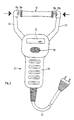
- connection contacts 18a, 18b which appear on the end faces of the winder 10 arranged on the opposite end faces, on which assigned contact connections 20a, 20b of the contactor 22 shown schematically in FIG. 2 in the form a pair of contact pliers can be connected, which in turn is connected to the electrical network via an electrical line 24.
- a power supply unit can be installed in the handle 26 of the contactor 22, in which the mains voltage is transformed down to a harmless voltage value for safety reasons.
- a time control can also be provided in the power supply unit, which is activated in each case when the contactor 22 connected to a winder 10 is switched on by a pushbutton 28.
- the pliers arms 23 of the contactor are guided into contact with the connecting contacts 18a, 18b and, in addition, the duration of the electrical power supply is measured by the time control that can be set and monitored via an LCD display 25 such that when the push button 28 is actuated once the winder 10 is being heated to the desired temperature range between 75 ° to 85 ° C on the outer surface of its envelope 14.
- a PTC thermistor as the resistance heating element 12
- this temperature range is reached within a period of 1 to 2 seconds, so that one can also speak of a "pulse heating" of the winders.
- an overheating switch can also be provided in each winder (or instead of the time control in the power supply unit), which for example has the shape of one between one of the connection contacts 18a or 18b and the resistance heating element Has 12 arranged bimetal switch.
- the outer surface of the enveloping body as a whole or only after end of hair sections are visible can be covered with a support which shows a clear color change when a predetermined temperature is reached - for example a temperature-sensitive lacquer or a film - which reveals at a glance whether the respective winder is already heat-activated or not.
- the support is only a punctiform application of a correspondingly heat-sensitive lacquer, which is provided on the left end cover 11, but which can also be thought of as a circumferential ring.
- FIGS. 3 to 6 illustrate possible modifications in the design and arrangement of the connecting contacts 18a and 18b of the winder 10.
- 3 shows a front cover 11 with a connection contact 18a, which, however, instead of the spherical cap-shaped outer shape provided in the winder according to FIG. 1, has a recess 19 in which the contact terminal 20a of the contactor 22, which is provided with a correspondingly complementary projection, engages appropriately.
- connection contact 18a in the end cover 11, in which the connection contact 18a lies flush in the flat flat side of the end cover 11 and in turn has a recess 19 for receiving a corresponding projection of the contact connection 20a of the contactor 22.
- FIGS. 5 and 6 now illustrate an end cover 11 on which both connection contacts 18a and 18b ' namely in the form of a central metallized connection surface 18a and an outer annular connection surface 18b formed concentrically therewith.
- a correspondingly modified (not shown) contactor must then be developed, which is placed on one side onto the contacted end cover 11 of the winder and is expediently held in contact system on the end cover by a suitably designed latching device .
Landscapes
- Physics & Mathematics (AREA)
- Thermal Sciences (AREA)
- Hair Curling (AREA)
Applications Claiming Priority (2)
| Application Number | Priority Date | Filing Date | Title |
|---|---|---|---|
| DE4007900 | 1990-03-13 | ||
| DE4007900 | 1990-03-13 |
Publications (1)
| Publication Number | Publication Date |
|---|---|
| EP0446643A1 true EP0446643A1 (fr) | 1991-09-18 |
Family
ID=6402051
Family Applications (1)
| Application Number | Title | Priority Date | Filing Date |
|---|---|---|---|
| EP91102147A Withdrawn EP0446643A1 (fr) | 1990-03-13 | 1991-02-15 | Dispositif pour mettre les cheveux en forme |
Country Status (2)
| Country | Link |
|---|---|
| EP (1) | EP0446643A1 (fr) |
| JP (1) | JPH04220203A (fr) |
Citations (8)
| Publication number | Priority date | Publication date | Assignee | Title |
|---|---|---|---|---|
| DE752653C (de) * | 1940-06-18 | 1952-10-20 | Hans Bilz | Stecker fuer elektrisch beheizte Haarwickler mit Kontrollampe |
| DE1557261A1 (de) * | 1966-09-22 | 1970-06-04 | D Elia Anthony N | Elektrischer Lockenwickler |
| US3560704A (en) * | 1969-04-02 | 1971-02-02 | John R Albert | Electrically heated hair curler |
| DE2039937A1 (de) * | 1969-08-11 | 1971-02-25 | Scovill Manufacturing Co | Lockenwickler mit Vorrichtung zu ihrer Aufheizung |
| DE1765528A1 (de) * | 1967-07-26 | 1971-07-29 | Solomon Nathan Lewis | Beheizter Lockenwickler |
| US3665938A (en) * | 1970-01-27 | 1972-05-30 | Bristol Myers Co | Hair roller containing temperature indicator |
| DE2103303B2 (de) * | 1970-01-27 | 1972-12-07 | Texas Instruments Inc., Dallas, Tex. (V.StA.) | Elektrisch beheizbarer lockenwickler |
| US3973100A (en) * | 1972-12-27 | 1976-08-03 | Texas Instruments Incorporated | Self-limiting electric hair curler heater |
-
1991
- 1991-02-15 EP EP91102147A patent/EP0446643A1/fr not_active Withdrawn
- 1991-03-12 JP JP4672191A patent/JPH04220203A/ja active Pending
Patent Citations (8)
| Publication number | Priority date | Publication date | Assignee | Title |
|---|---|---|---|---|
| DE752653C (de) * | 1940-06-18 | 1952-10-20 | Hans Bilz | Stecker fuer elektrisch beheizte Haarwickler mit Kontrollampe |
| DE1557261A1 (de) * | 1966-09-22 | 1970-06-04 | D Elia Anthony N | Elektrischer Lockenwickler |
| DE1765528A1 (de) * | 1967-07-26 | 1971-07-29 | Solomon Nathan Lewis | Beheizter Lockenwickler |
| US3560704A (en) * | 1969-04-02 | 1971-02-02 | John R Albert | Electrically heated hair curler |
| DE2039937A1 (de) * | 1969-08-11 | 1971-02-25 | Scovill Manufacturing Co | Lockenwickler mit Vorrichtung zu ihrer Aufheizung |
| US3665938A (en) * | 1970-01-27 | 1972-05-30 | Bristol Myers Co | Hair roller containing temperature indicator |
| DE2103303B2 (de) * | 1970-01-27 | 1972-12-07 | Texas Instruments Inc., Dallas, Tex. (V.StA.) | Elektrisch beheizbarer lockenwickler |
| US3973100A (en) * | 1972-12-27 | 1976-08-03 | Texas Instruments Incorporated | Self-limiting electric hair curler heater |
Also Published As
| Publication number | Publication date |
|---|---|
| JPH04220203A (ja) | 1992-08-11 |
Similar Documents
| Publication | Publication Date | Title |
|---|---|---|
| DE69110890T2 (de) | Vorrichtung zum haarschneiden und gleichzeitigen kauterisieren der geschnitteten haarenden. | |
| US2417530A (en) | Electrical hair removing instrument | |
| DE3121683A1 (de) | Vorrichtung zur reaktivierung erschlaffter gesichtshaut | |
| US5365953A (en) | Hair setting apparatus | |
| DE1765528A1 (de) | Beheizter Lockenwickler | |
| EP0218797A3 (fr) | Fer à friser à chauffage électrique | |
| EP0446643A1 (fr) | Dispositif pour mettre les cheveux en forme | |
| DE69834223T2 (de) | Vorrichtung zur Hyperthermiebehandlung | |
| DE9017623U1 (de) | Einrichtung zur Verformung von menschlichem Haar | |
| EP0175232B1 (fr) | Dispositif pour le traitement des cheveux | |
| DE2039937A1 (de) | Lockenwickler mit Vorrichtung zu ihrer Aufheizung | |
| US5174311A (en) | Device for the shaping of human hair | |
| DE2806582A1 (de) | Geraet zur waermebehandlung von akupunkturpunkten | |
| DE3315303A1 (de) | Verfahren und vorrichtung zum erzeugen definierter thermischer schaedigungen von biologischem gewebe | |
| US2724765A (en) | Beautician's appliance for heating implements | |
| DE3139848A1 (de) | Buegel-massage-geraet | |
| DE752653C (de) | Stecker fuer elektrisch beheizte Haarwickler mit Kontrollampe | |
| DE4104212C2 (fr) | ||
| DE3333211A1 (de) | Lockenstab | |
| AT145707B (de) | Elektrischer Heizkörper zur Herstellung von Haardauerwellen. | |
| DE1557261A1 (de) | Elektrischer Lockenwickler | |
| DE69009159T2 (de) | Haarpflegegerät. | |
| DE864719C (de) | Elektroden fuer Waermebehandlung des Haares mittels Ultrakurzwellen | |
| DE2462344A1 (de) | Dampffrisierstab | |
| DE9413707U1 (de) | Hitze-Kauter |
Legal Events
| Date | Code | Title | Description |
|---|---|---|---|
| PUAI | Public reference made under article 153(3) epc to a published international application that has entered the european phase |
Free format text: ORIGINAL CODE: 0009012 |
|
| AK | Designated contracting states |
Kind code of ref document: A1 Designated state(s): AT CH DE ES FR GB IT LI NL |
|
| 17P | Request for examination filed |
Effective date: 19911219 |
|
| 17Q | First examination report despatched |
Effective date: 19930705 |
|
| STAA | Information on the status of an ep patent application or granted ep patent |
Free format text: STATUS: THE APPLICATION IS DEEMED TO BE WITHDRAWN |
|
| 18D | Application deemed to be withdrawn |
Effective date: 19940316 |