EP0447889A1 - Verfahren zur Herstellung von 1,1,3,4,4,6-Hexamethyl-1,2,3,4-tetrahydronaphthalin - Google Patents
Verfahren zur Herstellung von 1,1,3,4,4,6-Hexamethyl-1,2,3,4-tetrahydronaphthalin Download PDFInfo
- Publication number
- EP0447889A1 EP0447889A1 EP91103536A EP91103536A EP0447889A1 EP 0447889 A1 EP0447889 A1 EP 0447889A1 EP 91103536 A EP91103536 A EP 91103536A EP 91103536 A EP91103536 A EP 91103536A EP 0447889 A1 EP0447889 A1 EP 0447889A1
- Authority
- EP
- European Patent Office
- Prior art keywords
- cymene
- hexamethyl
- tetrahydronaphthalene
- formula
- aluminum
- Prior art date
- Legal status (The legal status is an assumption and is not a legal conclusion. Google has not performed a legal analysis and makes no representation as to the accuracy of the status listed.)
- Granted
Links
- YYCPSEFQLGXPCO-UHFFFAOYSA-N CC(C)C1=CCC(C)CC1 Chemical compound CC(C)C1=CCC(C)CC1 YYCPSEFQLGXPCO-UHFFFAOYSA-N 0.000 description 1
- 0 CC1C(C)(C)c2cc(*)ccc2C(C)(C)C1 Chemical compound CC1C(C)(C)c2cc(*)ccc2C(C)(C)C1 0.000 description 1
Classifications
-
- C—CHEMISTRY; METALLURGY
- C07—ORGANIC CHEMISTRY
- C07C—ACYCLIC OR CARBOCYCLIC COMPOUNDS
- C07C2/00—Preparation of hydrocarbons from hydrocarbons containing a smaller number of carbon atoms
- C07C2/54—Preparation of hydrocarbons from hydrocarbons containing a smaller number of carbon atoms by addition of unsaturated hydrocarbons to saturated hydrocarbons or to hydrocarbons containing a six-membered aromatic ring with no unsaturation outside the aromatic ring
- C07C2/72—Addition to a non-aromatic carbon atom of hydrocarbons containing a six-membered aromatic ring
-
- C—CHEMISTRY; METALLURGY
- C07—ORGANIC CHEMISTRY
- C07C—ACYCLIC OR CARBOCYCLIC COMPOUNDS
- C07C2602/00—Systems containing two condensed rings
- C07C2602/02—Systems containing two condensed rings the rings having only two atoms in common
- C07C2602/04—One of the condensed rings being a six-membered aromatic ring
- C07C2602/10—One of the condensed rings being a six-membered aromatic ring the other ring being six-membered, e.g. tetraline
Definitions
- the present invention relates to a new and improved process for the preparation of 1,1,3,4,4,6-hexamethyl-1,2,3,4-tetrahydronaphthalene (1,1,3,4,4,6-hexamethyltetralin) by reacting p-cymene with certain hexene isomers in the presence of catalytically effective amounts of an aluminum halide and catalytically effective amounts of a triphenylmethyl compound.
- Acetylation of 1,1,3,4,4,6-hexamethyl-1,2,3,4-tetrahydronaphthalene gives an extremely valuable musk perfume from the tetralin series, the 7-acetyl-1,1,3,4,4, 6-hexamethyl-1,2,3,4-tetrahydronaphthalene (Tonalid®). 7-Acetyl-1,1,3,4,4,6-hexamethyl-1,2,3,4-tetrahydronaphthalene is particularly important as an artificial musk perfume because of its high quality and long-lasting fragrance.
- 7-acetyl-1,1,3,4,4,6-hexamethyl-1,2,3,4-tetrahydronaphthalene can be used as a substitute for the nitro musk compounds presumably to be replaced for toxicological reasons due to its sweet smell.
- the object of the present invention was therefore to remedy the disadvantages mentioned above.
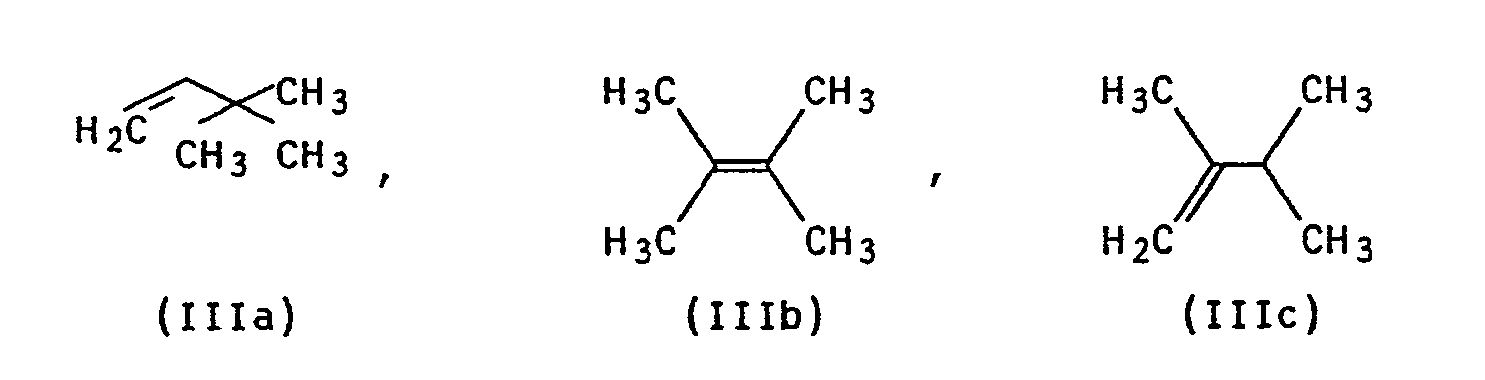
- 1,1,3,4,4,6-hexamethyl-1,2,3,4-tetrahydronaphthalene I can be carried out as follows: p-Cymol (II) and the two catalysts aluminum halide and triphenylmethyl compound (IV) are introduced and the hexene (IIIa, IIIb, IIIc) is added.
- p-Cymol (II) and the hexene (IIIa, IIIb, IIIc) are in a molar ratio of 0.5: 1 to 5: 1, preferably 0.8: 1 to 4: 1, particularly preferably 1: 1 to 3 : 1 implemented.
- the reaction is carried out at a temperature between (-10) and 50 ° C., preferably between 10 and 40 ° C., particularly preferably between 15 and 30 ° C.
- the reaction can be carried out in the presence of a solvent such as C5-C20 alkane e.g. Pentane, hexane, cyclohexane or in the absence of a solvent, preferably solvent-free.
- a solvent such as C5-C20 alkane e.g. Pentane, hexane, cyclohexane or in the absence of a solvent, preferably solvent-free.
- suitable aluminum halides are aluminum trichloride, aluminum tribromide and aluminum triiodide.
- Anhydrous aluminum trichloride, aluminum tribromide and aluminum triiodide are preferably used, particularly preferably anhydrous aluminum trichloride.
- Suitable triphenylmethyl compounds IV are, for example, triphenylmethyl chloride, 3,3 ', 3' '- trichlorotriphenylmethyl chloride, 4,4', 4 '' - trichlorotriphenylmethyl chloride, preferably 3,3 ', 3' '- trichlorotriphenylmethyl chloride, particularly preferably triphenylmethyl chloride.
- the production e.g. of triphenylmethyl chloride can be found, for example, in Beilstein, Vol. 5, p. 700 or in the Organikum, VEB Verlag 1977, p. 399.
- aluminum halide and p-cymene are used in a molar ratio of 0.001: 1 to 0.5: 1, preferably 0.005: 1 to 0.2: 1, particularly preferably 0.05: 1 to 0.1: 1 and triphenylmethyl compound and p- Cymol in a molar ratio of 0.001: 1 to 0.1: 1, preferably 0.005: 1 to 0.04: 1, particularly preferably 0.05: 1 to 0.02: 1.
- the 1,1,3,4,4,6-hexamethyl-1,2,3,4-tetrahydronaphthalene obtained by the process of the invention can be added in a conventional manner (US Pat. No. 3,246,044, Ex. II) to what is known as the musk perfume of the tetralin series Acetylate 7-acetyl-1,1,3,4,4,6-hexamethyl-1,2,3,4-tetrahydronaphthalene.
Landscapes
- Chemical & Material Sciences (AREA)
- Organic Chemistry (AREA)
- Organic Low-Molecular-Weight Compounds And Preparation Thereof (AREA)
- Low-Molecular Organic Synthesis Reactions Using Catalysts (AREA)
- Catalysts (AREA)
Abstract
Description
- Die vorliegende Erfindung betrifft ein neues und verbessertes Verfahren zur Herstellung von 1,1,3,4,4,6-Hexamethyl-1,2,3,4-tetrahydronaphthalin (1,1,3,4,4,6-Hexamethyltetralin) durch Umsetzung von p-Cymol mit bestimmten Hexenisomeren in Gegenwart katalytisch wirksamer Mengen eines Aluminiumhalogenids und katalytisch wirksamer Mengen einer Triphenylmethylverbindung.
- Durch Acetylierung von 1,1,3,4,4,6-Hexamethyl-1,2,3,4-tetrahydronaphthalin erhält man ein äußerst wertvolles Moschusparfüm der Tetralinreihe, das 7-Acetyl-1,1,3,4,4,6-hexamethyl-1,2,3,4-tetrahydronaphthalin (Tonalid®). 7-Acetyl-1,1,3,4,4,6-hexamethyl-1,2,3,4-tetrahydronaphthalin kommt insbesondere wegen seiner hohen Qualität und lang anhaftenden Duftnote als künstliches Moschusparfüm eine große Bedeutung zu. Darüberhinaus kommt 7-Acetyl-1,1,3,4,4,6-hexamethyl-1,2,3,4-tetrahydronaphthalin in aufgrund seiner süßlichen Geruchsnote als Ersatzstoff für die aus toxikologischen Gründen vermutlich zu ersetzenden Nitromoschusverbindungen in Betracht.
- Aus der US-A-2,759,022 ist die Umsetzung von p-Cymol mit Methyl-tert.-butylcarbinol in Gegenwart eines Schwefelsäurekatalysators bekannt. Das erhaltene Reaktionsprodukt wird weder hinsichtlich seiner Strukturformel näher charakterisiert, noch werden Angaben über die Ausbeute gemacht.
- Aus der US-A-2,851,501, US-A-3,246,044, US-A-3,278,621, US-A-3,379,785 und der NL-A-66 12 053 können 1,1,3,4,4,6-Hexamethyl-1,2,3,4-tetrahydronaphthalin als auch 7-Acetyl-1,1,3,4,4,6-hexamethyl-1,2,3,4-tetrahydronaphthalin über das α,p-Dimethylstyrol V

hergestellt werden. Der Nachteil dieses Verfahrens besteht darin, daß das notwendige α,p-Dimethylstyrol aus p-Cymol hergestellt werden muß. - Aus der US-A-3,856,875 und der DE-A-29 10 493 ist bekannt, 1,1,3,4,4,6-Hexamethyl-1,2,3,4-tetrahydronaphthalin durch Umsetzen von p-Cymol und Neohexen oder 2,3-Dimethyl-but-1-en und eines tert.-Alkylhalogenids in Gegenwart eines Aluminiumhalogenidkatalysators zu erhalten. Nachteilig an diesen Verfahren ist insbesondere der molare Einsatz halogenhaltiger Verbindungen wie tert.-Butylchlorid oder Ethylendichlorid. Darüberhinaus entstehen während der Cycloalkylierung molare Mengen gasförmigen Chlorwasserstoffes, die besondere Vorsichtsmaßnahmen erforderlich machen.
- Aus der US-A-4,551,573 ist ein Verfahren bekannt, bei dem man, ausgehend von p-Cymol und Neohexen, befriedigende Ausbeuten an 1,1,3,4,4,6-Hexamethyl-1,2,3,4-tetrahydronaphthalin erhält, wenn man in Gegenwart katalytischer Mengen Jod arbeitet. Allerdings ist auch dieses Verfahren für eine technische Anwendung ungeeignet, da die Verwendung von Jod sehr problematisch ist (Jod-Toxizität, Korrosion von Anlagen, unerwünschte Produktfärbungen und umständliche Aufarbeitung).
- Der vorliegenden Erfindung lag daher die Aufgabe zugrunde, den zuvor genannten Nachteilen abzuhelfen.
- Demgemäß wurde ein neues und verbessertes Verfahren zur Herstellung von 1,1,3,4,4,6-Hexamethyl-1,2,3,4-tetrahydronaphthalin der Formel I

gefunden, welches dadurch gekennzeichnet ist, daß man p-Cymol der Formel II
mit einem Hexen der Formel IIIa, IIIb und/oder IIIc
in Gegenwart einer katalytischen Menge Aluminiumhalogenid und einer katalytischen Menge einer Triphenylmethylverbindung der allgemeinen Formel IV
in der R¹, R², R³ unabhängig voneinander für Wasserstoff, C₁-C₄-Alkyl, Nitro oder Halogen und X für Wasserstoff oder Halogen, stehen, umsetzt. - Das Verfahren zur Herstellung von 1,1,3,4,4,6-Hexamethyl-1,2,3,4-tetrahydronaphthalin I kann wie folgt durchgeführt werden:
p-Cymol (II) und die beiden Katalysatoren Aluminiumhalogenid und Triphenylmethylverbindung (IV) werden vorgelegt und das Hexen (IIIa, IIIb, IIIc) zugegeben. - p-Cymol (II) und das Hexen (IIIa, IIIb, IIIc) werden im Molverhältnis von 0,5:1 bis 5:1, vorzugsweise von 0,8:1 bis 4:1, besonders bevorzugt von 1:1 bis 3:1 umgesetzt.
- Die Umsetzung wird bei einer Temperatur zwischen (-10) und 50°C, vorzugsweise zwischen 10 und 40°C, besonders bevorgzugt zwischen 15 und 30°C, durchgeführt. Die Reaktion kann in Gegenwart eines Lösungsmittels wie C₅-C₂₀-Alkan, z.B. Pentan, Hexan, Cyclohexan oder in Abwesenheit eines Lösungsmittels, bevorzugt lösungsmittelfrei durchgeführt werden.
- Als Aluminiumhalogenide eignen sich beispielsweise Aluminiumtrichlorid, Aluminiumtribromid und Aluminiumtrijodid. Bevorzugt verwendet man wasserfreies Aluminiumtrichlorid, Aluminiumtribromid und Aluminiumtrijodid, besonders bevorzugt wasserfreies Aluminiumtrichlorid.
- Als Triphenylmethylverbindungen IV eignen sich beispielsweise Triphenylmethylchlorid, 3,3',3''-Trichlortriphenylmethylchlorid, 4,4',4''-Trichlortriphenylmethylchlorid, bevorzugt 3,3',3''-Trichlortriphenylmethylchlorid, besonders bevorzugt Triphenylmethylchlorid. Die Herstellung z.B. von Triphenylmethylchlorid findet sich beispielsweise im Beilstein, Bd. 5, S. 700 oder im Organikum, VEB Verlag 1977, S. 399.
- Im allgemeinen werden Aluminiumhalogenid und p-Cymol im Molverhältnis von 0,001:1 bis 0,5:1, vorzugsweise 0,005:1 bis 0,2:1, besonders bevorzugt 0,05:1 bis 0,1:1 und Triphenylmethylverbindung und p-Cymol im Molverhältnis von 0,001:1 bis 0,1:1, vorzugsweise 0,005:1 bis 0,04:1, besonders bevorzugt 0,05:1 bis 0,02:1.
- Das nach dem Verfahren der Erfindung angefallene 1,1,3,4,4,6-Hexamethyl-1,2,3,4-tetrahydronaphthalin läßt sich in üblicher Weise (US 3,246,044, Bsp. II) zu dem als Moschusparfüm der Tetralinreihe bekannten 7-Acetyl-1,1,3,4,4,6-hexamethyl-1,2,3,4-tetrahydronaphthalin acetylieren.
-

- Zu 90 g (0,67 Mol) p-Cymol werden bei Raumtemperatur (20 bis 25°C) 7 g (0,052 Mol) wasserfreies Aluminiumtrichlorid und 2,78 g (0,01 Mol) Triphenylmethylchlorid hinzugefügt. Anschließend werden in 9 Minuten 85 g (1,01 Mol) Neohexen so zugetropft, daß die Reaktionstemperatur zwischen 30 und 35°C gehalten wird. Direkt nach Zulaufende wird eine Probe zur gaschromatographischen Analyse entnommen. Nach jeweils 10 Minuten werden 6 weitere Proben gaschromatographisch untersucht. Die Ergebnisse sind in Tabelle 1 zusammengestellt.

- Zu 335 g p-Cymol (2,5 Mol) werden bei Raumtemperatur (20 bis 25°C) 17,5 g (0,13 Mol) Aluminiumtrichlorid und 8,4 g (0,03 Mol) Triphenylmethylchlorid hinzugefügt. Anschließend werden innerhalb von 45 min 420 g (5,0 Mol) Neohexen so zugetropft, daß die Reaktionstemperatur maximal ca. 35°C beträgt. Nach Zulaufende wird direkt hydrolysiert, die organische Phase abgetrennt, mit Wasser gewaschen, mit Na₂SO₄ getrocknet und anschließend p-Cymol-Reste und Niedersieder vom Wertprodukt abdestilliert. Im Rückstand verbleiben 520 g 1,1,3,4,4,6-Hexamethyl-1,2,3,4-tetrahydronaphthalin (61%ig). Dies entspricht einer Ausbeute von 59% bezogen auf p-Cymol.
- Zu 40,2 g p-Cymol (0,3 Mol) werden bei Raumtemperatur 2,1 g (0,016 Mol) AlCl₃ und 1,0 g (3,6 mmol) Triphenylmethylchlorid hinzugefügt. Anschließend werden innerhalb von 5 Minuten 50,4 g (0,6 Mol) 2,3-Dimethylbuten-1 zugetropft (exotherme Reaktion) und direkt nach Zulaufende hydrolysiert. Nach der Aufarbeitung analog Beispiel 1 verbleiben im Rückstand 59 g (61%) 1,1,3,4,4,6-Hexamethyl-1,2,3,4-tetrahydronaphthalin.
Claims (6)
- Verfahren zur Herstellung von 1,1,3,4,4,6-Hexamethyl-1,2,3,4-tetrahydronaphthalin der Formel I



- Verfahren nach Anspruch 1, dadurch gekennzeichnet, daß man die Umsetzung bei einer Temperatur von -10°C bis 50°C durchführt.
- Verfahren nach Anspruch 1, dadurch gekennzeichnet, daß man p-Cymol II und ein Hexen IIIa, IIIb und/oder IIIc in einem Molverhältnis von 0,5:1 bis 5:1 verwendet.
- Verfahren nach Anspruch 1, dadurch gekennzeichnet, daß man als Aluminiumhalogenid Aluminiumtrichlorid oder Aluminiumtribromid verwendet.
- Verfahren nach Anspruch 1, dadurch gekennzeichnet, daß man Aluminiumtrichlorid oder Aluminiumtribromid zu p-Cymol im Molverhältnis von 0,001:1 bis 0,5:1 verwendet.
- Verfahren nach Anspruch 1, dadurch gekennzeichnet, daß man Triphenylverbindungen IV zu p-Cymol im Molverhältnis von 0,001:1 bis 0,1:1 verwendet.
Applications Claiming Priority (2)
| Application Number | Priority Date | Filing Date | Title |
|---|---|---|---|
| DE4008694A DE4008694A1 (de) | 1990-03-17 | 1990-03-17 | Verfahren zur herstellung von 1,1,3,4,4,6-hexamethyl-1,2,3,4- tetrahydronaphthalin |
| DE4008694 | 1990-03-17 |
Publications (2)
| Publication Number | Publication Date |
|---|---|
| EP0447889A1 true EP0447889A1 (de) | 1991-09-25 |
| EP0447889B1 EP0447889B1 (de) | 1994-05-04 |
Family
ID=6402505
Family Applications (1)
| Application Number | Title | Priority Date | Filing Date |
|---|---|---|---|
| EP91103536A Expired - Lifetime EP0447889B1 (de) | 1990-03-17 | 1991-03-08 | Verfahren zur Herstellung von 1,1,3,4,4,6-Hexamethyl-1,2,3,4-tetrahydronaphthalin |
Country Status (5)
| Country | Link |
|---|---|
| US (1) | US5068479A (de) |
| EP (1) | EP0447889B1 (de) |
| JP (1) | JPH0656708A (de) |
| DE (2) | DE4008694A1 (de) |
| ES (1) | ES2052295T3 (de) |
Families Citing this family (2)
| Publication number | Priority date | Publication date | Assignee | Title |
|---|---|---|---|---|
| JP3687896B2 (ja) | 2000-09-27 | 2005-08-24 | 富士重工業株式会社 | 無段変速機用プーリの計測装置 |
| WO2014073367A1 (ja) | 2012-11-09 | 2014-05-15 | 本田技研工業株式会社 | バックラッシュ測定装置及びバックラッシュ測定方法 |
Citations (3)
| Publication number | Priority date | Publication date | Assignee | Title |
|---|---|---|---|---|
| US3856875A (en) * | 1973-12-05 | 1974-12-24 | Givaudan Corp | Process for producing 1,1,3,4,4,6-hexamethyl-1,2,3,4-tetrahydronapthalene (hmt) |
| US4551573A (en) * | 1984-10-01 | 1985-11-05 | Phillips Petroleum Company | Alkylation of aromatic compounds |
| US4877915A (en) * | 1989-01-27 | 1989-10-31 | Union Camp Corporation | Process for preparing polyalkyl tetrahydronaphthalenes |
Family Cites Families (9)
| Publication number | Priority date | Publication date | Assignee | Title |
|---|---|---|---|---|
| US2551573A (en) * | 1945-11-30 | 1951-05-08 | Du Pont | Pyrolysis of chloro-fluoro alkanes |
| US2759022A (en) * | 1951-08-27 | 1956-08-14 | Polak Frutal Works | Musk odorant |
| US2851501A (en) * | 1954-10-05 | 1958-09-09 | Polak Frutal Works | Production of poly alkyl indanes from styrene compounds |
| US3278622A (en) * | 1963-03-21 | 1966-10-11 | Polak Frutal Works | Process for preparing polyalkylindans |
| NL123427C (de) * | 1963-06-10 | |||
| US3379782A (en) * | 1965-08-27 | 1968-04-23 | Universal Oil Prod Co | Process for preparing polyalkyltetrahydronaphthalenes |
| JPS6033368B2 (ja) * | 1978-03-30 | 1985-08-02 | 住友化学工業株式会社 | ヘキサメチルテトラリンの製造方法 |
| US4877910A (en) * | 1989-01-27 | 1989-10-31 | Union Camp Corporation | Process for preparing polyalkyl tetrahydronaphthalenes |
| US4877916A (en) * | 1989-01-27 | 1989-10-31 | Union Camp Corporation | Process for preparing polyalkyl tetrahydronaphthalenes |
-
1990
- 1990-03-17 DE DE4008694A patent/DE4008694A1/de not_active Withdrawn
-
1991
- 1991-03-08 ES ES91103536T patent/ES2052295T3/es not_active Expired - Lifetime
- 1991-03-08 EP EP91103536A patent/EP0447889B1/de not_active Expired - Lifetime
- 1991-03-08 DE DE59101533T patent/DE59101533D1/de not_active Expired - Lifetime
- 1991-03-11 JP JP3044848A patent/JPH0656708A/ja not_active Withdrawn
- 1991-03-13 US US07/668,484 patent/US5068479A/en not_active Expired - Fee Related
Patent Citations (3)
| Publication number | Priority date | Publication date | Assignee | Title |
|---|---|---|---|---|
| US3856875A (en) * | 1973-12-05 | 1974-12-24 | Givaudan Corp | Process for producing 1,1,3,4,4,6-hexamethyl-1,2,3,4-tetrahydronapthalene (hmt) |
| US4551573A (en) * | 1984-10-01 | 1985-11-05 | Phillips Petroleum Company | Alkylation of aromatic compounds |
| US4877915A (en) * | 1989-01-27 | 1989-10-31 | Union Camp Corporation | Process for preparing polyalkyl tetrahydronaphthalenes |
Non-Patent Citations (2)
| Title |
|---|
| PATENT ABSTRACTS OF JAPAN, unexamined applications, C field, Band 5, Nr. 102, 2. Juli 1981 THE PATENT OFFICE JAPANESE GOVERNMENT Seite 19 C 61 * |
| PATENT ABSTRACTS OF JAPAN, unexamined applications, C field, Band 6, Nr. 110, 22. Juni 1982 THE PATENT OFFICE JAPANESE GOVERNMENT Seite 131 C 109 * |
Also Published As
| Publication number | Publication date |
|---|---|
| JPH0656708A (ja) | 1994-03-01 |
| EP0447889B1 (de) | 1994-05-04 |
| DE4008694A1 (de) | 1991-09-19 |
| US5068479A (en) | 1991-11-26 |
| ES2052295T3 (es) | 1994-07-01 |
| DE59101533D1 (de) | 1994-06-09 |
Similar Documents
| Publication | Publication Date | Title |
|---|---|---|
| DE2457550C3 (de) | Verfahren zur Herstellung von 1,1,3,4,4,6-Hexamethyl-1,2,3,4-tetrahydronaphthalin | |
| CH639357A5 (de) | Verfahren zur herstellung von hexamethyltetrahydronaphthalin. | |
| EP0015436B1 (de) | Verfahren zur stereospezifischen Herstellung von Verbindungen der Vitamin K1- und K2-Reihe sowie neue Ausgangsprodukte in diesem Verfahren | |
| DE1266754B (de) | Verfahren zur Herstellung von 1, 1, 3, 4, 4, 6-Hexamethyl-1, 2, 3, 4-tetrahydronaphthalin | |
| DE3633033A1 (de) | Verfahren und katalysatorsystem zur trimerisierung von acetylen und acetylenverbindungen | |
| EP0330058B1 (de) | Verfahren zur Herstellung von Perfluoralkylgruppen enthaltenden Silyläthern und Alkoholen | |
| EP0032576B1 (de) | Verfahren zur Herstellung von p-substituierten Phenylpropanolen und deren Estern sowie von p-substituierten 3-Phenyl-2-methyl-propanalen | |
| EP0007520B1 (de) | Verfahren zur Herstellung von cis-2,6-dimethylmorpholin | |
| EP0447889B1 (de) | Verfahren zur Herstellung von 1,1,3,4,4,6-Hexamethyl-1,2,3,4-tetrahydronaphthalin | |
| CH631146A5 (de) | Verfahren zur herstellung von 2,6-dimethoxy-4-(quaternaeren-alkyl)phenolen. | |
| EP0226152B1 (de) | Verfahren zur Herstellung von gegebenenfalls substituierten 2-Benzyl-toluolen | |
| EP0512348B1 (de) | Derivate cyclischer Lactone, Verfahren zu ihrer Herstellung und Verfahren zur Herstellung von 15-Pentadecanolid und seinen Homologen | |
| DE2548187A1 (de) | Verfahren zur herstellung von 2-substituierten oder nicht-substituierten geranylessigsaeuren und deren estern | |
| EP0009159B1 (de) | Verfahren zur Herstellung von Carbonsäureestern des Beta-Formyl-Crotylalkohols mittels einer Allylumlagerung | |
| EP0564979B1 (de) | Verfahren zur Herstellung von Dixylylpropan | |
| DE1618782A1 (de) | Neue tricyclische Verbindungen und Verfahren zur Herstellung von tricyclischen Verbindungen | |
| DE3616363C2 (de) | ||
| DE69031469T2 (de) | Verfahren zur Herstellung von Polyalkyltetranaphtalenen | |
| EP0044440B1 (de) | Verfahren zur Herstellung von alpha- und beta-Cyclocitral sowie die N-Methylaldimine dieser Verbindungen | |
| DE69014659T2 (de) | Verfahren zur Herstellung von Polyalkyltetrahydronaphthalenen. | |
| DE1902051A1 (de) | Verfahren zur Herstellung alpha-substituierter Benzoine und Benzoinäther | |
| EP0639561B1 (de) | Verfahren zur Herstellung von Alkyl-(3-chlorphenyl)-sulfonen | |
| DE2517377A1 (de) | Verfahren zur isomerisierung von heptadiensaeureestern | |
| CH632730A5 (en) | Process for the preparation of branched olefins | |
| EP0294557A2 (de) | Verfahren zur Herstellung von 3-Phenyl-2-methylpropanol und seinen p-substituierten Alkylderivaten |
Legal Events
| Date | Code | Title | Description |
|---|---|---|---|
| PUAI | Public reference made under article 153(3) epc to a published international application that has entered the european phase |
Free format text: ORIGINAL CODE: 0009012 |
|
| 17P | Request for examination filed |
Effective date: 19910712 |
|
| AK | Designated contracting states |
Kind code of ref document: A1 Designated state(s): CH DE ES FR GB LI NL |
|
| 17Q | First examination report despatched |
Effective date: 19930707 |
|
| GRAA | (expected) grant |
Free format text: ORIGINAL CODE: 0009210 |
|
| AK | Designated contracting states |
Kind code of ref document: B1 Designated state(s): CH DE ES FR GB LI NL |
|
| REF | Corresponds to: |
Ref document number: 59101533 Country of ref document: DE Date of ref document: 19940609 |
|
| GBT | Gb: translation of ep patent filed (gb section 77(6)(a)/1977) |
Effective date: 19940523 |
|
| REG | Reference to a national code |
Ref country code: ES Ref legal event code: FG2A Ref document number: 2052295 Country of ref document: ES Kind code of ref document: T3 |
|
| ET | Fr: translation filed | ||
| PGFP | Annual fee paid to national office [announced via postgrant information from national office to epo] |
Ref country code: FR Payment date: 19950224 Year of fee payment: 5 |
|
| PGFP | Annual fee paid to national office [announced via postgrant information from national office to epo] |
Ref country code: CH Payment date: 19950227 Year of fee payment: 5 |
|
| PGFP | Annual fee paid to national office [announced via postgrant information from national office to epo] |
Ref country code: GB Payment date: 19950301 Year of fee payment: 5 |
|
| PLBE | No opposition filed within time limit |
Free format text: ORIGINAL CODE: 0009261 |
|
| STAA | Information on the status of an ep patent application or granted ep patent |
Free format text: STATUS: NO OPPOSITION FILED WITHIN TIME LIMIT |
|
| PGFP | Annual fee paid to national office [announced via postgrant information from national office to epo] |
Ref country code: ES Payment date: 19950316 Year of fee payment: 5 |
|
| PGFP | Annual fee paid to national office [announced via postgrant information from national office to epo] |
Ref country code: NL Payment date: 19950331 Year of fee payment: 5 Ref country code: DE Payment date: 19950331 Year of fee payment: 5 |
|
| 26N | No opposition filed | ||
| PG25 | Lapsed in a contracting state [announced via postgrant information from national office to epo] |
Ref country code: GB Effective date: 19960308 |
|
| PG25 | Lapsed in a contracting state [announced via postgrant information from national office to epo] |
Ref country code: ES Free format text: LAPSE BECAUSE OF NON-PAYMENT OF DUE FEES Effective date: 19960309 |
|
| PG25 | Lapsed in a contracting state [announced via postgrant information from national office to epo] |
Ref country code: DE Effective date: 19960325 |
|
| PG25 | Lapsed in a contracting state [announced via postgrant information from national office to epo] |
Ref country code: LI Effective date: 19960331 Ref country code: CH Effective date: 19960331 |
|
| PG25 | Lapsed in a contracting state [announced via postgrant information from national office to epo] |
Ref country code: NL Effective date: 19961001 |
|
| GBPC | Gb: european patent ceased through non-payment of renewal fee |
Effective date: 19960308 |
|
| REG | Reference to a national code |
Ref country code: CH Ref legal event code: PL |
|
| PG25 | Lapsed in a contracting state [announced via postgrant information from national office to epo] |
Ref country code: FR Effective date: 19961129 |
|
| NLV4 | Nl: lapsed or anulled due to non-payment of the annual fee |
Effective date: 19961001 |
|
| REG | Reference to a national code |
Ref country code: FR Ref legal event code: ST |
|
| REG | Reference to a national code |
Ref country code: ES Ref legal event code: FD2A Effective date: 19990405 |