EP0450907A2 - Sludge-discharging cast molding method - Google Patents
Sludge-discharging cast molding method Download PDFInfo
- Publication number
- EP0450907A2 EP0450907A2 EP91302866A EP91302866A EP0450907A2 EP 0450907 A2 EP0450907 A2 EP 0450907A2 EP 91302866 A EP91302866 A EP 91302866A EP 91302866 A EP91302866 A EP 91302866A EP 0450907 A2 EP0450907 A2 EP 0450907A2
- Authority
- EP
- European Patent Office
- Prior art keywords
- die
- sludge
- molding
- steam
- product
- Prior art date
- Legal status (The legal status is an assumption and is not a legal conclusion. Google has not performed a legal analysis and makes no representation as to the accuracy of the status listed.)
- Granted
Links
- 238000000465 moulding Methods 0.000 title claims abstract description 67
- 238000007599 discharging Methods 0.000 title claims abstract description 22
- 238000000034 method Methods 0.000 title claims abstract description 22
- 239000010802 sludge Substances 0.000 claims abstract description 32
- 230000008021 deposition Effects 0.000 claims abstract description 22
- XLYOFNOQVPJJNP-UHFFFAOYSA-N water Substances O XLYOFNOQVPJJNP-UHFFFAOYSA-N 0.000 claims abstract description 20
- 229910052602 gypsum Inorganic materials 0.000 claims description 10
- 239000010440 gypsum Substances 0.000 claims description 10
- 239000002002 slurry Substances 0.000 claims description 4
- 238000010521 absorption reaction Methods 0.000 abstract description 3
- 230000001351 cycling effect Effects 0.000 abstract description 2
- 238000000151 deposition Methods 0.000 description 16
- 238000005406 washing Methods 0.000 description 6
- 230000000052 comparative effect Effects 0.000 description 5
- 239000004927 clay Substances 0.000 description 4
- 238000004519 manufacturing process Methods 0.000 description 4
- 238000002474 experimental method Methods 0.000 description 2
- 238000012546 transfer Methods 0.000 description 2
- 238000005266 casting Methods 0.000 description 1
- 238000007796 conventional method Methods 0.000 description 1
- 230000007423 decrease Effects 0.000 description 1
- 238000001035 drying Methods 0.000 description 1
- 238000003780 insertion Methods 0.000 description 1
- 230000037431 insertion Effects 0.000 description 1
- 229920003002 synthetic resin Polymers 0.000 description 1
- 239000000057 synthetic resin Substances 0.000 description 1
Images


Classifications
-
- B—PERFORMING OPERATIONS; TRANSPORTING
- B28—WORKING CEMENT, CLAY, OR STONE
- B28B—SHAPING CLAY OR OTHER CERAMIC COMPOSITIONS; SHAPING SLAG; SHAPING MIXTURES CONTAINING CEMENTITIOUS MATERIAL, e.g. PLASTER
- B28B1/00—Producing shaped prefabricated articles from the material
- B28B1/26—Producing shaped prefabricated articles from the material by slip-casting, i.e. by casting a suspension or dispersion of the material in a liquid-absorbent or porous mould, the liquid being allowed to soak into or pass through the walls of the mould; Moulds therefor ; specially for manufacturing articles starting from a ceramic slip; Moulds therefor
-
- B—PERFORMING OPERATIONS; TRANSPORTING
- B28—WORKING CEMENT, CLAY, OR STONE
- B28B—SHAPING CLAY OR OTHER CERAMIC COMPOSITIONS; SHAPING SLAG; SHAPING MIXTURES CONTAINING CEMENTITIOUS MATERIAL, e.g. PLASTER
- B28B7/00—Moulds; Cores; Mandrels
- B28B7/40—Moulds; Cores; Mandrels characterised by means for modifying the properties of the moulding material
- B28B7/42—Moulds; Cores; Mandrels characterised by means for modifying the properties of the moulding material for heating or cooling, e.g. steam jackets, by means of treating agents acting directly on the moulding material
Definitions
- the present invention relates to a sludge-discharging cast molding method, and in particular to a sludge-discharging cast molding method capable of substantially reducing the molding time.
- a sludge-discharging cast molding method comprises charging an absorbing molding die, for example made of gypsum, with a sludge (slurried granular raw clay), allowing the water contained in the sludge to penetrate into the molding die thereby depositing the remaining granular raw clay onto the inner surface of the molding die, thereafter discharging any excess sludge, opening the molding die after a predetermined period of time has elapsed and removing the deposited product.
- This molding method is employed generally as a method of manufacturing various kinds of sanitary potteries and the like.
- the conventional method described above has a problem in that the water content of the deposition product does not transfer into the molding die until a considerable period of time has passed following discharge of the excess sludge. Thus each molding cycle takes a long time.
- an object of the present invention is to provide a sludge-discharging cast molding method capable of substantially reducing the standing time following discharge of the excess sludge and, accordingly, capable of reducing the molding time thereby increasing the cycling rate of the molding operation using the molding die and improving production efficiency.
- the invention provides a sludge-discharging cast molding method comprising charging a water absorbing molding die with sludge, permitting sludge to deposit therein to form a deposition product, discharging excess undeposited sludge from said die, and introducing steam into said molding die to heat the deposition product. After steam is introduced into the die and the deposition product is thereby heated the die is preferably flushed with air or another substantially dry gas. Thereafter the die may be released (opened) and the molding product taken out.
- the invention also provides a molding die having a water absorbing inner surface, means for receiving an aqueous slurry and means for discharging excess slurry, said die also being provided with steam inlet means arranged to permit flow of steam over the surface of a deposition product formed on a said water absorbing surface.
- the molding die used in the present invention may be gypsum, but a die made of a porous synthetic resin having water absorbing property may also be used.
- the molding die can be used for various kinds of sanitary pottery such as western toilets, Japanese toilets and washing basins, as well as for various other kinds of pottery.
- the sludge charged into the molding die may be of the type conventionally used.
- sludge is injected and then deposited for about 10 to 80 min., preferably, 15 to 60 min and then discharged. After discharging the sludge, steam is introduced into a molding space of the molding die (the space previously occupied by the excess sludge) to heat the deposition product.
- this state is maintained for about 10 to 30 min., thereby causing the water content in the deposition product to be absorbed into the molding die. After maintaining this state till the deposition product attains a predetermined strength, the mold is released to take out the molding product.
- the molding product may then be finished into a pottery product using the steps of drying, glazing and baking.
- a western toilet was molded by the sludge-discharging cast molding method of the invention using a gypsum die 1 as shown in Fig. 1.
- sludge concentration of starting clay at 1250 g/l
- sludge concentration of starting clay at 1250 g/l
- steam at a pressure of 0.2 kg/cm2 was introduced into the gypsum die 1 and this state was maintained for 50 sec in order to heat the deposition product.
- air at ambient temperature was introduced and, after maintaining this state for 20 min. the molding die was released.
- a molding product, in the form of a western toilet, having a required molding strength was obtained.
- a molding product was manufactured analogously to Example 1 except that no steam or air was introduced into the molding die after discharging the excess sludge. However, it was necessary to allow the deposition product to stand for about 40 min after discharging the excess sludge in order to obtain a molding product having a molding strength capable of allowing the mold to be released.
- Example 1 It is apparent from a comparison of Example 1 and Comparative Example 1, that the standing time (for water absorption) after discharging the excess sludge can be reduced to one half according to the method of the present invention.
- a hand wash basin was molded by a sludge-discharging cast molding method using the gypsum die 2 as shown in Fig. 2.
- Fig. 2 illustrates an introduction hole 3 for air and steam, sludge discharging holes 4, a casting hole 5 and temperature measuring holes A and B (temperature sensor insertion holes).
- the clay starting content of the sludge used was 1250 g/l and the temperature was 34°C.
- the sludge was introduced into the gypsum die 2, left to deposit for the time shown in Table 1, and then discharged. Subsequently, steam at a pressure of 0.2 kg/cm2 was introduced for 12 min in Example 2 and for 6 min in Example 3. Then the steam was discharged and, air at ambient temperature was introduced and the die was left in this state for 35 min in Example 2 and 40 min in Example 3. Thereafter the molding products were released from the molds.
- Comparative Example 2 air at ambient temperature was introduced into the gypsum die 2 following discharge of the excess sludge and the die was maintained in this state for 35 min. Thereafter the molding product was released from the mold.
- the hardness was measured using a rubber hardness gauge at positions a to 1 as shown in Fig. 3 (bottom view for a washing basin 6) and Fig. 4 (plan view thereof). The results are shown in Table 2. Of the positions a to 1, k and 1 indicate positions at the inner surface of a side (a side wall) of the washing basin, and j indicates a position at the back of an overflow port 7.
- Table 2 also shows the weight of the deposition product (molding product) and the water content therein.
- Example 3 the change of temperature with time in the gypsum die 2 was measured following the introduction of the steam. The results are shown in Fig. 5. It can be seen that the die temperature is elevated by the introduction of the steam.
- Example 3 molding was conducted whilst varying the steam introduction time from 0 to 12 min and the hardness and water content of the resultant molding products were measured. The results are shown in Figs. 6 and 7.
- the standing time after discharging the excess sludge can be substantially reduced by the method according to the present invention. Therefore, it is possible to shorten the molding time and increase the number of operation cycles of the molding die within a given time to improve the production efficiency.
Landscapes
- Engineering & Computer Science (AREA)
- Chemical & Material Sciences (AREA)
- Ceramic Engineering (AREA)
- Manufacturing & Machinery (AREA)
- Mechanical Engineering (AREA)
- Dispersion Chemistry (AREA)
- Producing Shaped Articles From Materials (AREA)
- Buffer Packaging (AREA)
- Treatment Of Sludge (AREA)
Abstract
Description
- The present invention relates to a sludge-discharging cast molding method, and in particular to a sludge-discharging cast molding method capable of substantially reducing the molding time.
- A sludge-discharging cast molding method comprises charging an absorbing molding die, for example made of gypsum, with a sludge (slurried granular raw clay), allowing the water contained in the sludge to penetrate into the molding die thereby depositing the remaining granular raw clay onto the inner surface of the molding die, thereafter discharging any excess sludge, opening the molding die after a predetermined period of time has elapsed and removing the deposited product. This molding method is employed generally as a method of manufacturing various kinds of sanitary potteries and the like.
- However, the conventional method described above has a problem in that the water content of the deposition product does not transfer into the molding die until a considerable period of time has passed following discharge of the excess sludge. Thus each molding cycle takes a long time.
- Accordingly, an object of the present invention is to provide a sludge-discharging cast molding method capable of substantially reducing the standing time following discharge of the excess sludge and, accordingly, capable of reducing the molding time thereby increasing the cycling rate of the molding operation using the molding die and improving production efficiency.
- Thus viewed from one aspect the invention provides a sludge-discharging cast molding method comprising charging a water absorbing molding die with sludge, permitting sludge to deposit therein to form a deposition product, discharging excess undeposited sludge from said die, and introducing steam into said molding die to heat the deposition product. After steam is introduced into the die and the deposition product is thereby heated the die is preferably flushed with air or another substantially dry gas. Thereafter the die may be released (opened) and the molding product taken out.
- When the deposition product is heated following discharge of the excess sludge, the viscosity of the water in the deposition product is lowered, thereby increasing the rate of transfer of water from the deposition product into the molding die. This enables the mold to be released within a shorter period of time following discharge of the excess sludge.
- Viewed from a further aspect the invention also provides a molding die having a water absorbing inner surface, means for receiving an aqueous slurry and means for discharging excess slurry, said die also being provided with steam inlet means arranged to permit flow of steam over the surface of a deposition product formed on a said water absorbing surface.
- The molding die used in the present invention may be gypsum, but a die made of a porous synthetic resin having water absorbing property may also be used. The molding die can be used for various kinds of sanitary pottery such as western toilets, Japanese toilets and washing basins, as well as for various other kinds of pottery.
- The sludge charged into the molding die may be of the type conventionally used.
- In the case of the manufacture of a washing basin, sludge is injected and then deposited for about 10 to 80 min., preferably, 15 to 60 min and then discharged. After discharging the sludge, steam is introduced into a molding space of the molding die (the space previously occupied by the excess sludge) to heat the deposition product.
- It is apparent from the results of the experiments described below that the water contained in the deposition product is absorbed faster into the molding die as the introduction time of the steam is increased. However, if the absorption occurs too rapidly, cracks may result in the final molding product. In view of the above, after introducing the steam into the molding die, this state is maintained, preferably, for about 30 sec to 3 min., more preferably for about 40 sec to 100 sec and, subsequently, air at ambient temperature is introduced into the molding die to discharge the steam.
- Following the introduction of air into the molding die, this state is maintained for about 10 to 30 min., thereby causing the water content in the deposition product to be absorbed into the molding die. After maintaining this state till the deposition product attains a predetermined strength, the mold is released to take out the molding product.
- The molding product may then be finished into a pottery product using the steps of drying, glazing and baking.
- Preferred embodiments of the invention will now be described by way of example and with reference to the accompanying drawings in which:
- Fig. 1 is a cross sectional view of the die of Example 1;
- Fig. 2 is a perspective view of the die of Example 1;
- Fig. 3 is a bottom view of the washing basin of Example 2;
- Fig. 4 is a plan view of the washing basin of Example 2; and
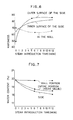
- Figs. 5, 6 and 7 are graphs illustrating the results of the experiments of Example 3.
- A western toilet was molded by the sludge-discharging cast molding method of the invention using a
gypsum die 1 as shown in Fig. 1. - At first, sludge (concentration of starting clay at 1250 g/l) at a temperature of 30°C was charged into the gypsum die and then allowed to deposit for 100 min. The excess sludge was then discharged and steam at a pressure of 0.2 kg/cm² was introduced into the
gypsum die 1 and this state was maintained for 50 sec in order to heat the deposition product. Then, air at ambient temperature was introduced and, after maintaining this state for 20 min. the molding die was released. A molding product, in the form of a western toilet, having a required molding strength was obtained. - A molding product was manufactured analogously to Example 1 except that no steam or air was introduced into the molding die after discharging the excess sludge. However, it was necessary to allow the deposition product to stand for about 40 min after discharging the excess sludge in order to obtain a molding product having a molding strength capable of allowing the mold to be released.
- It is apparent from a comparison of Example 1 and Comparative Example 1, that the standing time (for water absorption) after discharging the excess sludge can be reduced to one half according to the method of the present invention.
- A hand wash basin was molded by a sludge-discharging cast molding method using the
gypsum die 2 as shown in Fig. 2. - Fig. 2 illustrates an
introduction hole 3 for air and steam, sludgedischarging holes 4, acasting hole 5 and temperature measuring holes A and B (temperature sensor insertion holes). - The clay starting content of the sludge used was 1250 g/l and the temperature was 34°C.
- The sludge was introduced into the
gypsum die 2, left to deposit for the time shown in Table 1, and then discharged. Subsequently, steam at a pressure of 0.2 kg/cm² was introduced for 12 min in Example 2 and for 6 min in Example 3. Then the steam was discharged and, air at ambient temperature was introduced and the die was left in this state for 35 min in Example 2 and 40 min in Example 3. Thereafter the molding products were released from the molds. - In Comparative Example 2, air at ambient temperature was introduced into the
gypsum die 2 following discharge of the excess sludge and the die was maintained in this state for 35 min. Thereafter the molding product was released from the mold.
- For the molding products so obtained, the hardness was measured using a rubber hardness gauge at positions a to 1 as shown in Fig. 3 (bottom view for a washing basin 6) and Fig. 4 (plan view thereof). The results are shown in Table 2. Of the positions a to 1, k and 1 indicate positions at the inner surface of a side (a side wall) of the washing basin, and j indicates a position at the back of an
overflow port 7. - Table 2 also shows the weight of the deposition product (molding product) and the water content therein.
- It is apparent from Table 2 that the water content in the molding product is reduced and the hardness is substantially increased by the method according to the present invention, as compared with the comparative examples.

- In Example 3, the change of temperature with time in the
gypsum die 2 was measured following the introduction of the steam. The results are shown in Fig. 5. It can be seen that the die temperature is elevated by the introduction of the steam. - In Example 3, molding was conducted whilst varying the steam introduction time from 0 to 12 min and the hardness and water content of the resultant molding products were measured. The results are shown in Figs. 6 and 7.
- It is apparent from Figs. 6 and 7, that the hardness of the molding product increases and the water content in the molding product decreases with a corresponding increase in the steam introduction time.
- As apparent from the foregoing Examples, the standing time after discharging the excess sludge can be substantially reduced by the method according to the present invention. Therefore, it is possible to shorten the molding time and increase the number of operation cycles of the molding die within a given time to improve the production efficiency.
Claims (10)
- A sludge-discharging cast molding method comprising charging a water absorbing molding die with sludge, permitting sludge to deposit therein to form a deposition product, discharging excess undeposited sludge from said die, and introducing steam into said molding die to heat the deposition product.
- A method as claimed in claim 1 wherein following the introduction of steam the die is flushed with air.
- A method as claimed in either of claims 1 and 2, wherein the die is subsequently released and the molding product removed.
- A method as claimed in any one of claims 1 to 3, wherein said molding die is a gypsum die.
- A method as claimed in any one of claims 1 to 4, wherein the deposition product is maintained in contact with the introduced steam for a predetermined period of time whereafter air at ambient temperature is introduced to discharge the steam.
- A method as claimed in claim 5, wherein said predetermined time is in the range 30 seconds to 3 minutes.
- A method as claimed in either of claims 5 and 6, wherein the molding die is released 10 to 30 minutes after said introduction of air.
- A method as claimed in any one of the preceding claims, wherein said molding die is charged with sludge and said excess sludge is discharged 10 to 80 minutes thereafter.
- A molding product produced by a method as claimed in any preceding claim.
- A molding die (2) having a water absorbing inner surface, means for receiving an aqueous slurry (5) and means for discharging excess slurry (4), said die also being provided with steam inlet means (3) arranged to permit flow of steam over the surface of a deposition product formed on a said water absorbing surface.
Applications Claiming Priority (2)
| Application Number | Priority Date | Filing Date | Title |
|---|---|---|---|
| JP88887/90 | 1990-04-03 | ||
| JP2088887A JPH03286805A (en) | 1990-04-03 | 1990-04-03 | Discharged slurry cast molding method |
Publications (3)
| Publication Number | Publication Date |
|---|---|
| EP0450907A2 true EP0450907A2 (en) | 1991-10-09 |
| EP0450907A3 EP0450907A3 (en) | 1991-11-27 |
| EP0450907B1 EP0450907B1 (en) | 1993-07-21 |
Family
ID=13955489
Family Applications (1)
| Application Number | Title | Priority Date | Filing Date |
|---|---|---|---|
| EP91302866A Expired - Lifetime EP0450907B1 (en) | 1990-04-03 | 1991-04-02 | Sludge-discharging cast molding method |
Country Status (5)
| Country | Link |
|---|---|
| EP (1) | EP0450907B1 (en) |
| JP (1) | JPH03286805A (en) |
| KR (1) | KR910018142A (en) |
| DE (1) | DE69100178T2 (en) |
| ES (1) | ES2042339T3 (en) |
Families Citing this family (1)
| Publication number | Priority date | Publication date | Assignee | Title |
|---|---|---|---|---|
| CN104890104B (en) * | 2015-06-24 | 2017-03-29 | 唐山贺祥机电股份有限公司 | Toilet lifts the automatic pneumatic locking device of forming machine |
Family Cites Families (5)
| Publication number | Priority date | Publication date | Assignee | Title |
|---|---|---|---|---|
| GB1053250A (en) * | 1900-01-01 | |||
| US2517001A (en) * | 1947-10-31 | 1950-08-01 | Paraffine Co Inc | Molding apparatus |
| US3034192A (en) * | 1957-07-11 | 1962-05-15 | Ind Dev Co | Method for producing molded articles of concrete and the like material |
| GB1337492A (en) * | 1971-03-05 | 1973-11-14 | Hayek Partners Ltd Ag | Casting of sanitary ware |
| FR2583675A1 (en) * | 1985-06-25 | 1986-12-26 | Coumont Serge | Process for manufacturing snail shells made of ceramic, sandstone, porcelain |
-
1990
- 1990-04-03 JP JP2088887A patent/JPH03286805A/en active Pending
-
1991
- 1991-04-02 ES ES199191302866T patent/ES2042339T3/en not_active Expired - Lifetime
- 1991-04-02 DE DE91302866T patent/DE69100178T2/en not_active Expired - Fee Related
- 1991-04-02 EP EP91302866A patent/EP0450907B1/en not_active Expired - Lifetime
- 1991-04-03 KR KR1019910005364A patent/KR910018142A/en not_active Ceased
Also Published As
| Publication number | Publication date |
|---|---|
| DE69100178T2 (en) | 1994-03-17 |
| EP0450907A3 (en) | 1991-11-27 |
| KR910018142A (en) | 1991-11-30 |
| EP0450907B1 (en) | 1993-07-21 |
| DE69100178D1 (en) | 1993-08-26 |
| ES2042339T3 (en) | 1993-12-01 |
| JPH03286805A (en) | 1991-12-17 |
Similar Documents
| Publication | Publication Date | Title |
|---|---|---|
| JP2649630B2 (en) | Casting method for ceramics | |
| JPH0146283B2 (en) | ||
| EP0450907B1 (en) | Sludge-discharging cast molding method | |
| US3218376A (en) | Casting toilet bowls and like ceramic ware | |
| US1289151A (en) | Process of constructing closet-bowls. | |
| JPH078484B2 (en) | Manufacturing method of tightly closed toilet by pressure casting | |
| JP2001047415A (en) | Sanitary ware, manufacture thereof and cast-molding device | |
| GB1371015A (en) | Fabrication of foundry casting moulds and cores | |
| CN112157783A (en) | Method for firing ceramic product by N-time intermittent slurry discharging and forming | |
| CN216760243U (en) | Be used for fashioned mould of pottery bathroom product slip casting | |
| US3392221A (en) | Method for producing hollow ceramic articles | |
| SU1549777A1 (en) | Mould for making articles from foamed materials | |
| Hauswurz | Die casting in the fine ceramic industry | |
| SU1595644A1 (en) | Method of slip casting of ceramic articles | |
| Leach | Slurry Solutions for Sanitaryware | |
| JP2518573B2 (en) | Casting mold | |
| JPS6195902A (en) | Casting molding method of pottery and molding die thereof | |
| JP2534966B2 (en) | Ceramic plate manufacturing method and molding die used for the same | |
| JP2558779B2 (en) | Pressure casting method for ceramics | |
| EP2263842B1 (en) | Method and installation for making a ceramic product. | |
| JPH0426283B2 (en) | ||
| JPH0199802A (en) | Method for cast molding of ceramic product | |
| CA1142332A (en) | Apparatus for casting ceramic ware | |
| Piccina | STATE OF THE ART OF SANITARYWARE PRESSURE CASTING TECHNOLOGY | |
| CN120735221A (en) | Manufacturing method of vacuum casting polyurethane product |
Legal Events
| Date | Code | Title | Description |
|---|---|---|---|
| PUAI | Public reference made under article 153(3) epc to a published international application that has entered the european phase |
Free format text: ORIGINAL CODE: 0009012 |
|
| AK | Designated contracting states |
Kind code of ref document: A2 Designated state(s): DE ES FR GB IT SE |
|
| PUAL | Search report despatched |
Free format text: ORIGINAL CODE: 0009013 |
|
| AK | Designated contracting states |
Kind code of ref document: A3 Designated state(s): DE ES FR GB IT SE |
|
| 17P | Request for examination filed |
Effective date: 19911204 |
|
| 17Q | First examination report despatched |
Effective date: 19920812 |
|
| GRAA | (expected) grant |
Free format text: ORIGINAL CODE: 0009210 |
|
| AK | Designated contracting states |
Kind code of ref document: B1 Designated state(s): DE ES FR GB IT SE |
|
| REF | Corresponds to: |
Ref document number: 69100178 Country of ref document: DE Date of ref document: 19930826 |
|
| ET | Fr: translation filed | ||
| ITF | It: translation for a ep patent filed | ||
| REG | Reference to a national code |
Ref country code: ES Ref legal event code: FG2A Ref document number: 2042339 Country of ref document: ES Kind code of ref document: T3 |
|
| ITTA | It: last paid annual fee | ||
| PLBE | No opposition filed within time limit |
Free format text: ORIGINAL CODE: 0009261 |
|
| STAA | Information on the status of an ep patent application or granted ep patent |
Free format text: STATUS: NO OPPOSITION FILED WITHIN TIME LIMIT |
|
| 26N | No opposition filed | ||
| EAL | Se: european patent in force in sweden |
Ref document number: 91302866.8 |
|
| PGFP | Annual fee paid to national office [announced via postgrant information from national office to epo] |
Ref country code: FR Payment date: 19980318 Year of fee payment: 8 |
|
| PGFP | Annual fee paid to national office [announced via postgrant information from national office to epo] |
Ref country code: GB Payment date: 19980326 Year of fee payment: 8 |
|
| PGFP | Annual fee paid to national office [announced via postgrant information from national office to epo] |
Ref country code: ES Payment date: 19980408 Year of fee payment: 8 |
|
| PGFP | Annual fee paid to national office [announced via postgrant information from national office to epo] |
Ref country code: SE Payment date: 19980416 Year of fee payment: 8 |
|
| PGFP | Annual fee paid to national office [announced via postgrant information from national office to epo] |
Ref country code: DE Payment date: 19980427 Year of fee payment: 8 |
|
| PG25 | Lapsed in a contracting state [announced via postgrant information from national office to epo] |
Ref country code: GB Free format text: LAPSE BECAUSE OF NON-PAYMENT OF DUE FEES Effective date: 19990402 |
|
| PG25 | Lapsed in a contracting state [announced via postgrant information from national office to epo] |
Ref country code: SE Free format text: LAPSE BECAUSE OF NON-PAYMENT OF DUE FEES Effective date: 19990403 |
|
| PG25 | Lapsed in a contracting state [announced via postgrant information from national office to epo] |
Ref country code: ES Free format text: LAPSE BECAUSE OF EXPIRATION OF PROTECTION Effective date: 19990405 |
|
| GBPC | Gb: european patent ceased through non-payment of renewal fee |
Effective date: 19990402 |
|
| PG25 | Lapsed in a contracting state [announced via postgrant information from national office to epo] |
Ref country code: FR Free format text: LAPSE BECAUSE OF NON-PAYMENT OF DUE FEES Effective date: 19991231 |
|
| EUG | Se: european patent has lapsed |
Ref document number: 91302866.8 |
|
| REG | Reference to a national code |
Ref country code: FR Ref legal event code: ST |
|
| PG25 | Lapsed in a contracting state [announced via postgrant information from national office to epo] |
Ref country code: DE Free format text: LAPSE BECAUSE OF NON-PAYMENT OF DUE FEES Effective date: 20000201 |
|
| REG | Reference to a national code |
Ref country code: ES Ref legal event code: FD2A Effective date: 20010601 |
|
| PG25 | Lapsed in a contracting state [announced via postgrant information from national office to epo] |
Ref country code: IT Free format text: LAPSE BECAUSE OF NON-PAYMENT OF DUE FEES Effective date: 20050402 |