EP0457435A2 - Biocide composition and use - Google Patents
Biocide composition and use Download PDFInfo
- Publication number
- EP0457435A2 EP0457435A2 EP91303276A EP91303276A EP0457435A2 EP 0457435 A2 EP0457435 A2 EP 0457435A2 EP 91303276 A EP91303276 A EP 91303276A EP 91303276 A EP91303276 A EP 91303276A EP 0457435 A2 EP0457435 A2 EP 0457435A2
- Authority
- EP
- European Patent Office
- Prior art keywords
- component
- composition
- isothiazolin
- carbon atoms
- medium
- Prior art date
- Legal status (The legal status is an assumption and is not a legal conclusion. Google has not performed a legal analysis and makes no representation as to the accuracy of the status listed.)
- Granted
Links
Classifications
-
- A—HUMAN NECESSITIES
- A01—AGRICULTURE; FORESTRY; ANIMAL HUSBANDRY; HUNTING; TRAPPING; FISHING
- A01N—PRESERVATION OF BODIES OF HUMANS OR ANIMALS OR PLANTS OR PARTS THEREOF; BIOCIDES, e.g. AS DISINFECTANTS, AS PESTICIDES OR AS HERBICIDES; PEST REPELLANTS OR ATTRACTANTS; PLANT GROWTH REGULATORS
- A01N43/00—Biocides, pest repellants or attractants, or plant growth regulators containing heterocyclic compounds
- A01N43/72—Biocides, pest repellants or attractants, or plant growth regulators containing heterocyclic compounds having rings with nitrogen atoms and oxygen or sulfur atoms as ring hetero atoms
- A01N43/80—Biocides, pest repellants or attractants, or plant growth regulators containing heterocyclic compounds having rings with nitrogen atoms and oxygen or sulfur atoms as ring hetero atoms five-membered rings with one nitrogen atom and either one oxygen atom or one sulfur atom in positions 1,2
Definitions
- the present invention relates to compositions which are useful as industrial biocides.
- Industrial biocides are useful to prevent industrial spoilage, in particular that caused by bacteria and fungi. Industrial biocides find application in the preservation of paints, latices, adhesives, leather, wood, metal working fluids and cooling water.
- US Patent 4165318 discloses a solution of an isothiazolin-3-one in a polar organic solvent, wherein the solution also contains a stabilising amount of formaldehyde. Stabilisation of similar compounds is also claimed in US Patent 4,067,878 where the stabilising compound is a nitrite or nitrate of a metal cation.
- British Patent Specification 2087388 discloses 4,5-polymethylene-4-isothiazolin-3-ones and derivatives thereof in which the polymethylene chain has three or four carbon atoms.
- a further class of compounds which have found a use as industrial biocides are the 2-halo-2-halomethyl glutaronitriles. Such compounds have been disclosed and claimed in USP 3,833,731 inter alia.
- compositions which contain more than one compound which has antimicrobial properties.
- such compositions show an aggregate of the properties of the compounds present in the composition.
- Such compositions contain one compound which exhibits useful antibacterial properties together with a different compound which exhibits useful antifungal properties.
- compositions possess surprisingly useful antimicrobial especially anti-bacterial properties.
- the 4,5 polymethylene-4-isothiazolin-3-one derivative which is component a) of the composition is typically a compound of the general formula I.
- R1 and R2 taken together represent a polymethylene chain, having 3 or 4 carbon atoms or a polymethylene chain having 3 or 4 carbon atoms substituted by at least one lower alkyl radical having from 1 to 4 carbon atoms
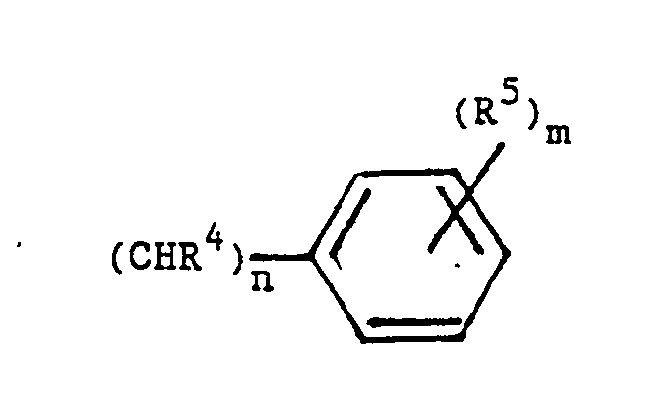
- R3 represents hydrogen; a linear or branched alkyl group having from 1 to 12 carbon atoms; a linear or branched alkyl group having from 1 to 3 carbon atoms substituted by one or more hydroxyl groups; an alkenyl group having from 3 to 6 carbon atoms; a radical of the formula wherein: n is 0 or 1; m is 1 or 2; R4 represents hydrogen or a lower alkyl group; and R5 represents hydrogen, lower alkyl, nitro, trifluoromethyl or halogen, preferably chlorine, bromine or iodine; cyclo alkyl having
- the 4,5-polymethylene-4-isothiazolin-3-one can be represented by the general formula II wherein t is 1 or 2 and R3 is as defined above. These compounds are, thus, derivatives of 4,5-trimethylene or 4,5-tetramethylene-4-isothiazolin-3-ones.
- R3 represents alkyl substituted by one or more hydroxyl groups, this includes, for instance, hydroxymethyl, 2-hydroxyethyl, 2-hydroxypropyl and 1,2 dihydroxy propyl.
- alkenyl as represented by R3, there may be mentioned allyl.
- R3 represents a radical of formula this can be, for example, phenyl, chlorophenyl, 2,4-dichlorophenyl, benzyl, 4-chlorobenzyl or 2,4-dichlorobenzyl.
- R3 represents cycloalkyl having from 3 to 6 carbon atoms, this can be, for example, cyclopropyl, cyclobutyl, cyclopentyl or cyclohexyl.
- R3 represents a radical of formula it can be carbomoyl, N-methyl carbamoyl, N-ethylcarbamoyl, N-isopropyl carbamoyl, N-propyl carbamoyl, N-phenyl carbamoyl, N-cyclohexyl carbamoyl, N-butyl carbamoyl or N-octyl carbamoyl.
- R3 is a cation.
- This cation may have a valency of more than one, but is particularly a monovalent cation such as an alkali metal, an amine or quaternary ammonium cation.
- the salts formed between the compound of formula I and a mineral or organic acid, and the complexes formed between the compound of formula I and a base are generally water soluble and hence can be used in aqueous solution.
- lower alkyl represented by R4 above includes linear or branched alkyl chains containing up to 4 carbon atoms such as methyl, ethyl, isopropyl, butyl and tertiary butyl.
- Component (b) of the composition of the present invention is at least one compound of general formula wherein each X, which may be the same or different, is a halogen atom, especially chlorine or bromine.
- both substituents X are the same halogen, and are especially bromine atoms.
- 2-chloro-2-chloromethyl glutaronitrile and particularly 2-bromo-2-bromomethyl glutaronitrile.
- Component c) of the composition is an isothiazolin-3-one of general formula III wherein Y is a hydrogen atom, an alkyl, substituted alkyl, alkenyl, alkynyl, cycloalkyl, aralkyl or aryl group; R7 is hydrogen, halogen or an alkyl group; and R8 is hydrogen, halogen or an alkyl group.
- Y is alkyl, it is preferably an alkyl group containing from 1 to 18 carbon atoms and especially from 1 to 4 carbon atoms and particularly a methyl group.
- Y is cycloalkyl
- it is preferably a cycloalkyl group containing from 3 to 12 carbon atoms and especially from 3 to 8 carbon atoms and particularly a cyclohexyl group.
- Y is alkyl or aralkyl, it preferably contains up to 10 carbon atoms.
- the aryl groups themselves, may also carry substituents such as halogen, particularly chlorine, or alkyl or alkoxy groups containing up to 4 carbon atoms such as methyl and methoxy.
- R7 and/or R8 is halogen, it is particularly chlorine or bromine, and when R7 and/or R8 is alkyl it is particularly an alkyl group containing from 1 to 4 carbon atoms and especially methyl.
- Y represents a linear or branched alkyl group containing up to 8 carbon atoms and where R7 and R8 represent independently hydrogen or chlorine.
- R7 and R8 represent independently hydrogen or chlorine.
- 2-methyl isothiazolin-3-one formula III, in which Y is methyl, R7 and R8 are both hydrogen
- 5-chloro-2-methyl -isothiazolin-3-one formula III, in which Y is methyl, R7 is chlorine and R8 is hydrogen
- 4,5 dichloro-2-methyl -isothiazolin-3-one formula III, in which Y is methyl, R7 and R8 are both chlorine.
- Such compounds may represent component c) in the composition of the present invention as individual chemical compounds or they may be present in combination.
- composition comprising 2-methyl-4,5-trimethylene-4-isothiazoline-3-one and 2-bromo-2-bromomethyl glutaronitrile.
- a further particularly useful combination has been found to be one comprising 2-methyl-4,5-trimethylene-4-isothiazolin-3-one together with at least one of 2-methyl isothiazolin-3-one, 5-chloro-2-methyl isothiazolin-3-one and 4,5-dichloro-2-methyl isothiazolin-3-one.
- isothizolin-3-ones of the afore-mentioned structures as represented by formulae I and III are used in aqueous solution, their solubility may be improved by forming their salts with strong organic and/or inorganic acids such as hydrochloric acid, sulphuric acid, succinic and citric acids.
- compositions having useful properties can vary and compositions having useful properties can be obtained which contain from 1 part by weight of component (a) or of component (b) or component (c) and correspondingly up to 2000 parts by weight of component (b) or component (c) or component (a).
- compositions having useful properties can be obtained which contain from 1 part by weight of component (a) or of component (b) or component (c) and correspondingly up to 2000 parts by weight of component (b) or component (c) or component (a).
- the preferred proportions on dependent on the compounds used as component (a) and component (b) or component (c) and also the particular system in which the mixture is to be used.
- the composition comprising components (a) and (b) contains one part of component (a) and at least 20 parts by weight of component (b) and in particular one part of component (a) and at least 100 parts by weight of component (b).
- the composition containing component (a) and component (b) contains 1 part by weight of component (a) and not more than 800 parts by weight of component (b).
- Particularly useful effects have been obtained with compositions containing one part of component (a) and not more than 600 parts by weight of component (b).
- compositions containing component (a) and component (c) contain at least 1 part by weight of one component and not more than 100 parts by weight of the other component.
- compositions comprising component (a) and component (c) are those where the ratio of component (a) to component (c) is between 1:10 and 10:1 and preferably between 1:5 and 5:1 such as, for example, 1:1.
- compositions of the present invention have antimicrobial properties. We have found that compositions in accordance with the present invention are active against both bacteria and fungi, and are especially active against bacteria. Furthermore, compositions in accordance with the present invention are such that the sum of the fractional inhibitory concentration (FIC) for all the components of the composition is less than one and, with preferred compositions is less than 0.9. Especially preferred compositions are those compositions containing component (a) and component (b) in which the sum of the FIC for all the components of the composition is not more than 0.7. The FIC is the ratio of the concentration of an individual component to the minimum inhibitory concentration of that component.
- FIC fractional inhibitory concentration
- compositions in accordance with the present invention are such that the sum of the FIC is less than 0.7.
- compositions containing component (a) and component (c) especially preferred are those compositions in which the sum of the FIC is less than 0.6.
- compositions of the present invention have antimicrobial properties and are suitable for use as industrial biocides. They exhibit good wet state preservation and hence map be used as a cutting fluid preservative and also in cooling water applications. They map also be used in paper mill liquors. Furthermore, the composition may be used to preserve industrially important formulations, especially aqueous based formulations, which are used for coloration, such as dyuestuffs and printing inks. They may also be used in the agrochemical industries to preserve formulations such as herbicide and pesticide flowables.
- compositions of the present invention include their use in hydrocarbon fluids such as diesel fuels. They may also be incorporated into adhesives in order to inhibit microbial spoilage.
- composition of the present invention in paints, particularly in aqueous based latices.
- compositions of the present invention is the preservation of polyvinyl acrylate and particularly acrylic latices, especially those whose pH is above 7, and especially those containing ammonia or amines.
- component (a) and component (b) of the composition of the present invention are soluble in many polar solvents, although the solubility is dependent on the nature of the particular compounds which are present in the composition. However, many of the compounds are soluble in water, alcohols, ethers, ketones and other polar solvents or mixtures thereof.
- compositions of the present invention map be used alone as an antimicrobial material but map also be used in, or on, a suitable carrier material.
- biocide composition comprising a carrier and an effective amount of a composition of components (a) and component (b) or component (c) in accordance with the invention.
- the carrier is typically a material which shows little, if any, antimicrobial activity and may be, or include, a material which is susceptible to the growth of micro-organisms, particularly bacteria.
- the carrier is preferably a liquid medium and the biocide composition may be a solution, suspension or emulsion of the composition of components (a) and (b) in a liquid carrier.
- the carrier may be water, in which one or all of components (a), (b) and (c) are soluble, or may be a liquid such as acetic acid, N,N-dimethyl-formamide, propylene glycol, dimethyl sulphoxide or N-methyl-2-pyrrolidone in which at least one, and preferably all, of components (a), (b) and (c) are soluble.
- a mixture of liquids may be used, one being a solvent for component (a), (b) and (c) and the other being a non-solvent for all components, and using such a mixture the composition typically comprises an emulsion or droplets of a solution of components (a), (b) and (c) in the solvent therefor dispersed in the non-solvent.
- a suspension or emulsion this conveniently contains a surface active agent which is effective to maintain the non-continuous phase as a suspension or emulsion.
- Any surface active agent known for use in biocide compositions may be used in such a system, for example alkylene oxide adducts of fatty alcohols, alkyl phenols and amines such as ethylene diamine.
- the amount of the composition which is present in the biocide composition map be just sufficient to have an antimicrobial effect or the composition map be present in a substantially greater proportion.
- the biocide composition may be provided as a concentrated solution which is subsequently diluted for use as an antimicrobial material.
- the higher concentrations of the biocide composition are useful, for example, in the bulk transportation of the composition.
- the amount of the composition of components (a) and (b) or (c) which is present in the biocide composition is typically in the range from 0.0001% up to 30% by weight of the biocide composition.
- composition of the present invention is especially effective in providing anti-bacterial activity.
- compositions can be used for the treatment of various media to inhibit the growth of micro-organisms.
- a method for inhibiting the growth of micro-organisms on, or in, a medium which comprises treating the medium with a composition of components (a) and (b) or (c) as hereinbefore defined.
- the composition can be used in conditions in which micro-organisms grow and cause problems.
- Systems in which micro-organisms cause problems include liquid, particularly aqueous, systems such as cooling water liquors, paper mill liquors, metal working fluids, geological drilling lubricants, polymer emulsions and surface coating compositions such as paints, varnishes and lacquers and also solid materials such as wood and leather.
- the composition of the present invention can be included in such materials to provide an anti-microbial effect.
- the amount of the composition is typically in the range from 0.0001 up to 10%, preferably 0.001 up to 5% and especially 0.002 to 1% by weight of the composition relative to the system to which it is added. In many cases, microbial inhibition has been obtained with between 0.005% and 0.1% by weight of the composition.
- Components (a) and (b) or (c) of the composition of the present invention may be the only antimicrobial compounds or may be used together with further compounds having antimicrobial characteristics.
- the composition map contain more than one compound which is component (a) together with one or more compounds which is either component (b) or component (c).
- a composition of components (a) and (b) or (c) in accordance with the present invention map be used together with one or more known antimicrobial compounds.
- the use of a mixture of anti-microbial compounds can provide a composition having a broader anti-microbial spectrum and hence one which is more generally effective than the components thereof.
- the known antimicrobial may be one possessing anti-bacterial, anti-fungal, anti-algal or other antimicrobial characteristic.
- the mixture of the composition of the present invention with other antimicrobial compounds typically contains from 1 to 99% by weight, relative to the weight of total antimicrobially active compounds, of the composition of components (a) and (b) or (c), and particularly from 40 to 60% by weight of the composition of components (a) and (b) or (c).
- quaternary ammonium compounds such as diethyldodecylbenzyl ammonium chloride; dimethyloctadecyl(dimethylbenzyl)ammonium chloride; dimethyldidecylammonium chloride; dimethyldidodecylammonium chloride; trimethy-tetradecylammonium chloride; benzyldimethyl(C12-C18 alkyl)ammonium chloride; dichlorobenzyldimethyldodecylammonium chloride; hexadecylpyridinium chloride; hexadecylpyridinium bromide; hexadecyltrimethylammonium bromide; dodecylpyridinium chloride; dodecylpyridinium bisulphate; benzyldodecyl-bis(bet)
- compositions in accordance with the present invention were subjected to evaluation of the antimicrobial properties of the compositions.
- the evaluation was effected, under sterile conditions throughout, as follows:
- compositions were tested for anti-microbial activity against bacteria and fungi.
- the bacterium used was Escherichia coli and the fungus used was Aspergillus niger.
- the materials, or mixture of materials, to be tested were added to a nutrient broth in amounts to give a desired concentration of the added material.
- the added materials were added at concentrations from zero to above the minimum inhibitory concentration of the particular material.
- the concentrations of each material were varied in a systematic fashion to give a matrix of mixtures of different relative proportions and different total concentrations.
- the effect on the inhibition of growth of bacteria was investigated by inoculating each sample of broth with sufficient of the test bacterium to give about 105 cells cm ⁇ 3. The mixture was incubated at 30°C for 48 hours. At the end of the test period the presence of turbidity in the broth indicated that growth of the test bacterium had occurred. A lack of turbidity was indicative that no growth had occurred. The results were used to draw an isobologram from which the sum of the fractional inhibitory concentration for a mixture can be determined.
- the microbiological evaluation as described was carried out using the bacterium, Escherichia coli.
- the composition tested was a mixture of 2-methyl-4,5-trimethylene-4-isothiazolin-3-one and 2-bromo-2-bromomethyl glutaronitrile.
- An isobologram was drawn utilising concentrations of 0, 110, 221, 332, 444, 555, 665, 777, 888 and 1000 microgram cm ⁇ 3 of the glutaronitrile and 0, 0.2, 0.5, 0.7, 0.9, 1.1, 1.4, 1.6, 1.8 and 2 microgram cm ⁇ 3 of the isothiazolinone.
- Example 1 was repeated, except the bacterium used was replaced by the fungus, Aspergillus niger.
- an isobologram was drawn utilising concentrations of 0, 166, 333, 500, 666, 833, 1000, 1166, 1333 and 1500 microgram cm ⁇ 3 of the glutaronitrile and 0, 55, 111, 166, 221, 277, 332, 388, 444 and 500 microgram cm ⁇ 3 of the isothiazolinone.
- the effect on the inhibition of growth of bacteria was investigated by inoculating each sample of broth with sufficient of the test micro-organism to give about 105 cells cm ⁇ 3. The mixture was incubated at 30°C for 48 hours. At the end of the test period the presence of turbidity in the broth indicated that growth of the test micro-organism had occurred. A lack of turbidity was indicative that no growth had occurred. The results were used to draw an isobologram from which the sum of the fractional inhibitory concentration for a mixture can be determined.
- the microbiological evaluation as described was carried out using the bacterium, Escherichia coli.
- the composition tested was a mixture of 2-methyl-4,5-trimethylene-4-isothiazolin-3-one and 5-chloro-2-methyl-isothiazolin-3-one.
- An isobologram was drawn using concentrations of 0, 0.2, 0.5, 0.7, 0.9, 1.1, 1.4, 1,6, 1.8 and 2 microgram cm ⁇ 3 of the trimethylene-isothiazolinone and 0, 0.2, 0.5, 0.7, 0.9, 1.1, 1.4, 1.6, 1.8 and 2 microgram cm ⁇ 3 of the chloro isothiazolinone.
Landscapes
- Life Sciences & Earth Sciences (AREA)
- Wood Science & Technology (AREA)
- Environmental Sciences (AREA)
- Plant Pathology (AREA)
- Health & Medical Sciences (AREA)
- Engineering & Computer Science (AREA)
- Dentistry (AREA)
- Pest Control & Pesticides (AREA)
- General Health & Medical Sciences (AREA)
- Zoology (AREA)
- Agronomy & Crop Science (AREA)
- Agricultural Chemicals And Associated Chemicals (AREA)
- Materials For Medical Uses (AREA)
- Pharmaceuticals Containing Other Organic And Inorganic Compounds (AREA)
- Compositions Of Macromolecular Compounds (AREA)
- Paints Or Removers (AREA)
- Inks, Pencil-Leads, Or Crayons (AREA)
Abstract
Description
- The present invention relates to compositions which are useful as industrial biocides.
- Industrial biocides are useful to prevent industrial spoilage, in particular that caused by bacteria and fungi. Industrial biocides find application in the preservation of paints, latices, adhesives, leather, wood, metal working fluids and cooling water.
- One class of compound which can be used as an industrial biocide is based on the isothiazolinone structure. There are many disclosures of isothiazolinone derivatives which are stated to have useful biocidal properties. US Patent 3761488 discloses isothiazolinone derivatives in which alkyl, alkenyl, alkynyl, cycloalkyl, aralkyl or aryl groups, which may optionally be substituted, are attached to the nitrogen atom and the 4 and 5 positions are unsubstituted or are substituted with halogen or lower alkyl groups. US Patent 4165318 discloses a solution of an isothiazolin-3-one in a polar organic solvent, wherein the solution also contains a stabilising amount of formaldehyde. Stabilisation of similar compounds is also claimed in US Patent 4,067,878 where the stabilising compound is a nitrite or nitrate of a metal cation. British Patent Specification 2087388 discloses 4,5-polymethylene-4-isothiazolin-3-ones and derivatives thereof in which the polymethylene chain has three or four carbon atoms.
- A further class of compounds which have found a use as industrial biocides are the 2-halo-2-halomethyl glutaronitriles. Such compounds have been disclosed and claimed in USP 3,833,731 inter alia.
- Compounds and compositions of the foregoing types, and related compounds of the same general type, are effective to a varying degree, depending on the particular compound or composition, against a range of bacteria and/or fungi. However, to reduce the cost of using these compounds it is desirable to improve their effectiveness as antimicrobial materials.
- Compositions have been proposed which contain more than one compound which has antimicrobial properties. In general such compositions show an aggregate of the properties of the compounds present in the composition. Typically such compositions contain one compound which exhibits useful antibacterial properties together with a different compound which exhibits useful antifungal properties.
- We have now found that certain compositions possess surprisingly useful antimicrobial especially anti-bacterial properties.
- Thus, according to the present invention there is provided a composition which comprises
- (a) at least one 4,5-polymethylene-4-isothiazolin-3-one or a derivative thereof, and
- (b) at least one 2-halo-2-halomethyl glutaronitrile, or
- (c) at least one isothiazolin-3-one derivative which does not contain a fused ring attached to the isothiazole ring.
- The 4,5 polymethylene-4-isothiazolin-3-one derivative which is component a) of the composition is typically a compound of the general formula I.

wherein:
R¹ and R² taken together represent a polymethylene chain, having 3 or 4 carbon atoms or a polymethylene chain having 3 or 4 carbon atoms substituted by at least one lower alkyl radical having from 1 to 4 carbon atoms;
R³ represents hydrogen; a linear or branched alkyl group having from 1 to 12 carbon atoms; a linear or branched alkyl group having from 1 to 3 carbon atoms substituted by one or more hydroxyl groups; an alkenyl group having from 3 to 6 carbon atoms; a radical of the formula
wherein:
n is 0 or 1;
m is 1 or 2;
R⁴ represents hydrogen or a lower alkyl group; and
R⁵ represents hydrogen, lower alkyl, nitro, trifluoromethyl or halogen, preferably chlorine, bromine or iodine; cyclo alkyl having from 3 to 6 carbon atoms; and a radical of formula
wherein
R⁶ represents hydrogen, linear or branched alkyl having from 1 to 12 carbon atoms or a radical of the formula
as defined above, and their salts or complex with a mineral or organic acid, or with a base. - In a preferred embodiment of the invention the 4,5-polymethylene-4-isothiazolin-3-one can be represented by the general formula II

wherein t is 1 or 2 and R³ is as defined above. These compounds are, thus, derivatives of 4,5-trimethylene or 4,5-tetramethylene-4-isothiazolin-3-ones. - R³, in formulae I and II, map be a linear or branched alkyl group, such as methyl, ethyl, propyl, isopropyl, butyl, isobutyl, tert-butyl, hexyl, octyl or dodecyl.
- When R³ represents alkyl substituted by one or more hydroxyl groups, this includes, for instance, hydroxymethyl, 2-hydroxyethyl, 2-hydroxypropyl and 1,2 dihydroxy propyl.
- As an example of alkenyl as represented by R³, there may be mentioned allyl.
- When R³ represents a radical of formula

this can be, for example, phenyl, chlorophenyl, 2,4-dichlorophenyl, benzyl, 4-chlorobenzyl or 2,4-dichlorobenzyl. - When R³ represents cycloalkyl having from 3 to 6 carbon atoms, this can be, for example, cyclopropyl, cyclobutyl, cyclopentyl or cyclohexyl.
- When R³ represents a radical of formula

it can be carbomoyl, N-methyl carbamoyl, N-ethylcarbamoyl, N-isopropyl carbamoyl, N-propyl carbamoyl, N-phenyl carbamoyl, N-cyclohexyl carbamoyl, N-butyl carbamoyl or N-octyl carbamoyl. - Finally, when the compound of formula I forms a complex with a base, R³ is a cation. This cation may have a valency of more than one, but is particularly a monovalent cation such as an alkali metal, an amine or quaternary ammonium cation.
- The salts formed between the compound of formula I and a mineral or organic acid, and the complexes formed between the compound of formula I and a base are generally water soluble and hence can be used in aqueous solution.
- The term lower alkyl represented by R⁴ above includes linear or branched alkyl chains containing up to 4 carbon atoms such as methyl, ethyl, isopropyl, butyl and tertiary butyl.
- As specific examples of compounds which may be used as component (a) of the composition of the present invention, there may be mentioned 2-methyl-4,5-trimethylene isothiazolin-3-one (formula II, in which t is 1 and R³ is methyl), and 4,5-trimethylene isothiazolin-3-one (formula II, in which t is 1 and R³ is hydrogen).
- Component (b) of the composition of the present invention is at least one compound of general formula

wherein
each X, which may be the same or different, is a halogen atom, especially chlorine or bromine. - Preferably, both substituents X are the same halogen, and are especially bromine atoms.
- By way of examples, there may be mentioned 2-chloro-2-chloromethyl glutaronitrile and particularly 2-bromo-2-bromomethyl glutaronitrile.
- Component c) of the composition is an isothiazolin-3-one of general formula III

wherein
Y is a hydrogen atom, an alkyl, substituted alkyl, alkenyl, alkynyl, cycloalkyl, aralkyl or aryl group;
R⁷ is hydrogen, halogen or an alkyl group; and
R⁸ is hydrogen, halogen or an alkyl group. - When Y is alkyl, it is preferably an alkyl group containing from 1 to 18 carbon atoms and especially from 1 to 4 carbon atoms and particularly a methyl group.
- When Y is cycloalkyl, it is preferably a cycloalkyl group containing from 3 to 12 carbon atoms and especially from 3 to 8 carbon atoms and particularly a cyclohexyl group.
- When Y is alkyl or aralkyl, it preferably contains up to 10 carbon atoms. The aryl groups, themselves, may also carry substituents such as halogen, particularly chlorine, or alkyl or alkoxy groups containing up to 4 carbon atoms such as methyl and methoxy.
- When R⁷ and/or R⁸ is halogen, it is particularly chlorine or bromine, and when R⁷ and/or R⁸ is alkyl it is particularly an alkyl group containing from 1 to 4 carbon atoms and especially methyl.
- Particularly important within this group of compounds are those in which Y represents a linear or branched alkyl group containing up to 8 carbon atoms and where R⁷ and R⁸ represent independently hydrogen or chlorine. Thus, as specific examples of compounds which may be used as component (c) of the composition of the present invention, there may be mentioned 2-methyl isothiazolin-3-one (formula III, in which Y is methyl, R⁷ and R⁸ are both hydrogen), 5-chloro-2-methyl -isothiazolin-3-one (formula III, in which Y is methyl, R⁷ is chlorine and R⁸ is hydrogen) and 4,5 dichloro-2-methyl -isothiazolin-3-one (formula III, in which Y is methyl, R⁷ and R⁸ are both chlorine). Such compounds may represent component c) in the composition of the present invention as individual chemical compounds or they may be present in combination.
- As a particular embodiment of the present invention there is provided a composition comprising 2-methyl-4,5-trimethylene-4-isothiazoline-3-one and 2-bromo-2-bromomethyl glutaronitrile.
- A further particularly useful combination has been found to be one comprising 2-methyl-4,5-trimethylene-4-isothiazolin-3-one together with at least one of 2-methyl isothiazolin-3-one, 5-chloro-2-methyl isothiazolin-3-one and 4,5-dichloro-2-methyl isothiazolin-3-one.
- In various types of applications, it is frequently necessary or convenient to formulate the isothiazolin-3-one as represented by formula I or formula III in solution, especially using water or polar organic solvents such as alcohols. While such formulation has no effect on the stability or function of isothiazolin-3-ones as anti-microbial agents if used relatively quickly, extended storage of the formulated solutions, especially at elevated temperature, map result in chemical decomposition of the isothiazolin-3-one, thus leading to reduced biocidal effectiveness. Consequently, it is common to stabilise such formulations by incorporating nitrite or nitrate salts of metals. It is also possible to stabilise such compounds in the presence of formaldehyde or compounds which release formaldehyde.
- When isothizolin-3-ones of the afore-mentioned structures as represented by formulae I and III are used in aqueous solution, their solubility may be improved by forming their salts with strong organic and/or inorganic acids such as hydrochloric acid, sulphuric acid, succinic and citric acids.
- The relative proportions of the components of the composition can vary and compositions having useful properties can be obtained which contain from 1 part by weight of component (a) or of component (b) or component (c) and correspondingly up to 2000 parts by weight of component (b) or component (c) or component (a). The preferred proportions on dependent on the compounds used as component (a) and component (b) or component (c) and also the particular system in which the mixture is to be used.
- In general the composition comprising components (a) and (b) contains one part of component (a) and at least 20 parts by weight of component (b) and in particular one part of component (a) and at least 100 parts by weight of component (b). Typically, the composition containing component (a) and component (b) contains 1 part by weight of component (a) and not more than 800 parts by weight of component (b). Particularly useful effects have been obtained with compositions containing one part of component (a) and not more than 600 parts by weight of component (b).
- Generally, those compositions containing component (a) and component (c) contain at least 1 part by weight of one component and not more than 100 parts by weight of the other component.
- Particularly preferred compositions comprising component (a) and component (c) are those where the ratio of component (a) to component (c) is between 1:10 and 10:1 and preferably between 1:5 and 5:1 such as, for example, 1:1.
- The compositions of the present invention have antimicrobial properties. We have found that compositions in accordance with the present invention are active against both bacteria and fungi, and are especially active against bacteria. Furthermore, compositions in accordance with the present invention are such that the sum of the fractional inhibitory concentration (FIC) for all the components of the composition is less than one and, with preferred compositions is less than 0.9. Especially preferred compositions are those compositions containing component (a) and component (b) in which the sum of the FIC for all the components of the composition is not more than 0.7. The FIC is the ratio of the concentration of an individual component to the minimum inhibitory concentration of that component. It will be appreciated that if the value of the sum of the FIC for all the components of the composition is less than one, the composition is synergistic, the extent of synergy being indicated by the amount by which the sum of the FIC is below one. We have found that some compositions in accordance with the present invention are such that the sum of the FIC is less than 0.7.
- In the case of compositions containing component (a) and component (c), especially preferred are those compositions in which the sum of the FIC is less than 0.6.
- The compositions of the present invention have antimicrobial properties and are suitable for use as industrial biocides. They exhibit good wet state preservation and hence map be used as a cutting fluid preservative and also in cooling water applications. They map also be used in paper mill liquors. Furthermore, the composition may be used to preserve industrially important formulations, especially aqueous based formulations, which are used for coloration, such as dyuestuffs and printing inks. They may also be used in the agrochemical industries to preserve formulations such as herbicide and pesticide flowables.
- Still further important applications of the compositions of the present invention include their use in hydrocarbon fluids such as diesel fuels. They may also be incorporated into adhesives in order to inhibit microbial spoilage.
- The preservation of wood and leather is yet another important application of the compositions.
- Especially important is the use of the composition of the present invention in paints, particularly in aqueous based latices.
- A particularly preferred use of the compositions of the present invention is the preservation of polyvinyl acrylate and particularly acrylic latices, especially those whose pH is above 7, and especially those containing ammonia or amines.
- The materials which are component (a) and component (b) of the composition of the present invention are soluble in many polar solvents, although the solubility is dependent on the nature of the particular compounds which are present in the composition. However, many of the compounds are soluble in water, alcohols, ethers, ketones and other polar solvents or mixtures thereof.
- The compositions of the present invention map be used alone as an antimicrobial material but map also be used in, or on, a suitable carrier material.
- Thus, as a further aspect of the present invention there is provided a biocide composition comprising a carrier and an effective amount of a composition of components (a) and component (b) or component (c) in accordance with the invention.
- The carrier is typically a material which shows little, if any, antimicrobial activity and may be, or include, a material which is susceptible to the growth of micro-organisms, particularly bacteria. The carrier is preferably a liquid medium and the biocide composition may be a solution, suspension or emulsion of the composition of components (a) and (b) in a liquid carrier. The carrier may be water, in which one or all of components (a), (b) and (c) are soluble, or may be a liquid such as acetic acid, N,N-dimethyl-formamide, propylene glycol, dimethyl sulphoxide or N-methyl-2-pyrrolidone in which at least one, and preferably all, of components (a), (b) and (c) are soluble. Alternatively, a mixture of liquids may be used, one being a solvent for component (a), (b) and (c) and the other being a non-solvent for all components, and using such a mixture the composition typically comprises an emulsion or droplets of a solution of components (a), (b) and (c) in the solvent therefor dispersed in the non-solvent. If a suspension or emulsion is used, this conveniently contains a surface active agent which is effective to maintain the non-continuous phase as a suspension or emulsion. Any surface active agent known for use in biocide compositions may be used in such a system, for example alkylene oxide adducts of fatty alcohols, alkyl phenols and amines such as ethylene diamine.
- Whereas it is advantageous in using the composition of the present invention to add component (a) and component (b) or component (c) simultaneously, it will be appreciated that in certain circumstances it may be beneficial to add component (a) and component (b) or component (c) sequentially.
- The amount of the composition which is present in the biocide composition map be just sufficient to have an antimicrobial effect or the composition map be present in a substantially greater proportion. It will be appreciated that the biocide composition may be provided as a concentrated solution which is subsequently diluted for use as an antimicrobial material. The higher concentrations of the biocide composition are useful, for example, in the bulk transportation of the composition. Thus, the amount of the composition of components (a) and (b) or (c) which is present in the biocide composition is typically in the range from 0.0001% up to 30% by weight of the biocide composition.
- The composition of the present invention is especially effective in providing anti-bacterial activity. Thus, the compositions can be used for the treatment of various media to inhibit the growth of micro-organisms.
- As a further aspect of the present invention there is provided a method for inhibiting the growth of micro-organisms on, or in, a medium which comprises treating the medium with a composition of components (a) and (b) or (c) as hereinbefore defined.
- The composition can be used in conditions in which micro-organisms grow and cause problems. Systems in which micro-organisms cause problems include liquid, particularly aqueous, systems such as cooling water liquors, paper mill liquors, metal working fluids, geological drilling lubricants, polymer emulsions and surface coating compositions such as paints, varnishes and lacquers and also solid materials such as wood and leather. The composition of the present invention can be included in such materials to provide an anti-microbial effect. The amount of the composition is typically in the range from 0.0001 up to 10%, preferably 0.001 up to 5% and especially 0.002 to 1% by weight of the composition relative to the system to which it is added. In many cases, microbial inhibition has been obtained with between 0.005% and 0.1% by weight of the composition.
- Components (a) and (b) or (c) of the composition of the present invention may be the only antimicrobial compounds or may be used together with further compounds having antimicrobial characteristics. The composition map contain more than one compound which is component (a) together with one or more compounds which is either component (b) or component (c). Alternatively, a composition of components (a) and (b) or (c) in accordance with the present invention map be used together with one or more known antimicrobial compounds. The use of a mixture of anti-microbial compounds can provide a composition having a broader anti-microbial spectrum and hence one which is more generally effective than the components thereof. The known antimicrobial may be one possessing anti-bacterial, anti-fungal, anti-algal or other antimicrobial characteristic. The mixture of the composition of the present invention with other antimicrobial compounds typically contains from 1 to 99% by weight, relative to the weight of total antimicrobially active compounds, of the composition of components (a) and (b) or (c), and particularly from 40 to 60% by weight of the composition of components (a) and (b) or (c).
- As examples of known antimicrobial compounds which may be used, together with the composition of the present invention, there map be mentioned quaternary ammonium compounds such as diethyldodecylbenzyl ammonium chloride; dimethyloctadecyl(dimethylbenzyl)ammonium chloride; dimethyldidecylammonium chloride; dimethyldidodecylammonium chloride; trimethy-tetradecylammonium chloride; benzyldimethyl(C₁₂-C₁₈ alkyl)ammonium chloride; dichlorobenzyldimethyldodecylammonium chloride; hexadecylpyridinium chloride; hexadecylpyridinium bromide; hexadecyltrimethylammonium bromide; dodecylpyridinium chloride; dodecylpyridinium bisulphate; benzyldodecyl-bis(beta-hydroxyethyl)ammonium chloride; dodecylbenzyltrimethylammonium chloride; benzyldimethyl(C₁₂-C₁₈ alkyl) ammonium chloride; dodecyldimethylethyl ammonium ethylsulphate; dodecyldimethyl-(1-naphthylmethyl)ammonium chloride; hexadecyldimethylbenzyl ammonium chloride; dodecyldimethylbenzyl ammonium chloride and 1-(3-chloroallyl)-3,5,7-triaza-1-azonia-adamantane chloride; urea derivatives such as 1,3-bis(hydroxymethyl)-5,5-dimethylhydantoin; bis(hydroxymethyl)urea; tetrakis(hydroxymethyl)acetylene diurea; 1-(hydroxymethyl)-5,5-dimethylhydantoin and imidazolidinyl urea; amino compounds such as 1,3-bis(2-ethylhexyl)-5-methyl-5-aminohexahydropyrimidine; hexamethylene tetra amine; 1,3-bis(4-aminophenoxy)propane; and 2-[(hydroxymethyl)-amino]ethanol; imidazole derivatives such as 1[2-(2,4-dichlorophenpl)-2-(2-propenyloxy)ethyl]-1H-imidazole; 2-(methoxycarbonylamino)-benzimidazole; nitrile compounds such as 2,4,5,6-tetrachloroisophthalodinitrile; thiocyanate derivatives such as methylene bis thiocyanate; tin compounds or complexes such as tributyltin-oxide, chloride, naphthoate, benzoate or 2-hydroxybenzoate; thiazole derivatives such as 2-(thiocyanomethylthio)-benzthiazole; and mercaptobenzthiazole; nitro compounds such as tris(hydroxymethyl)nitromethane; 5-bromo-5-nitro-1,3-dioxane and 2-bromo-2-nitropropane-1,3-diol; aldehydes and derivatives such as gluteraldehyde (pentanedial) p-chlorophenyl-3-iodopropargyl formaldehyde and glyoxal; amides such as chloracetamide; N,N-bis(hydroxymethyl)chloracetamide; N-hydroxymethyl-chloracetamide and dithio-2,2-bis(benzmethyl amide); guanidine derivatives such as poly hexamethylene biguanide and 1,6-hexamethylene-bis[5-(4-chlorophenyl)biguanide]; thiones such as 3,5-dimethyltetrahydro-1,3,5-2H-thiodiazine-2-thione; triazine derivatives such as hexahydrotriazine and 1,3,5-tri-(hydroxyethyl)-1,3,5-hexahydrotriazine; oxazolidine and derivatives thereof such as bis-oxazolidine; furan and derivatives thereof such as 2,5-dihydro-2,5-dialkoxy-2,5-dialkylfuran; carboxylic acids and the salts and esters thereof such as sorbic acid and the salts thereof and 4-hydroxybenzoic acid and the salts and esters thereof; phenol and derivatives thereof such as 5-chloro-2-(2,4-dichlorophenoxy)phenol; thio-bis(4-chlorophenol) and 2-phenylphenol; sulphone derivatives such as diiodomethyl-paratolyl sulphone, 2,3,5,6-tetrachloro-4-(methylsulphonyl) pyridine and hexachlorodimethyl sulphone.
- Further aspects of the present invention are described in the following illustrative examples.
- In the following examples, compositions in accordance with the present invention were subjected to evaluation of the antimicrobial properties of the compositions. The evaluation was effected, under sterile conditions throughout, as follows:
- In the microbiological evaluation, various compositions were tested for anti-microbial activity against bacteria and fungi. The bacterium used was Escherichia coli and the fungus used was Aspergillus niger.
- The materials, or mixture of materials, to be tested were added to a nutrient broth in amounts to give a desired concentration of the added material. The added materials were added at concentrations from zero to above the minimum inhibitory concentration of the particular material. In the mixtures, the concentrations of each material were varied in a systematic fashion to give a matrix of mixtures of different relative proportions and different total concentrations.
- The effect on the inhibition of growth of bacteria was investigated by inoculating each sample of broth with sufficient of the test bacterium to give about 10⁵ cells cm⁻³. The mixture was incubated at 30°C for 48 hours. At the end of the test period the presence of turbidity in the broth indicated that growth of the test bacterium had occurred. A lack of turbidity was indicative that no growth had occurred. The results were used to draw an isobologram from which the sum of the fractional inhibitory concentration for a mixture can be determined.
- The microbiological evaluation as described was carried out using the bacterium, Escherichia coli. The composition tested was a mixture of 2-methyl-4,5-trimethylene-4-isothiazolin-3-one and 2-bromo-2-bromomethyl glutaronitrile.
- An isobologram was drawn utilising concentrations of 0, 110, 221, 332, 444, 555, 665, 777, 888 and 1000 microgram cm⁻³ of the glutaronitrile and 0, 0.2, 0.5, 0.7, 0.9, 1.1, 1.4, 1.6, 1.8 and 2 microgram cm⁻³ of the isothiazolinone.
- From the results obtained, it was found that the lowest sum of the fractional inhibitory concentration (FIC) was 0.61 which was achieved with a mixture containing 110 microgram cm⁻³ of the 2-bromo-2-bromomethyl glutaronitrile and 0.2 microgram cm⁻³ of the 2-methyl-4,5-trimethylene-4-isothiazolin-3-one. This may be contrasted with the minimum inhibitory concentrations (MIC) of the two individual components against the same micro-organism, which were found to be 221 microgram cm⁻³ and 1.8 microgram cm⁻³, respectively.
- Example 1 was repeated, except the bacterium used was replaced by the fungus, Aspergillus niger.
- Again, an isobologram was drawn utilising concentrations of 0, 166, 333, 500, 666, 833, 1000, 1166, 1333 and 1500 microgram cm⁻³ of the glutaronitrile and 0, 55, 111, 166, 221, 277, 332, 388, 444 and 500 microgram cm⁻³ of the isothiazolinone.
- From the results obtained, it was found that the lowest sum of the FIC was 0.67 which was achieved with a mixture containing 500 microgram cm⁻³ of the 2-bromo-2-bromomethyl glutaronitrile and 111 microgram cm⁻³ of the 2-methyl-4,5-trimethylene-4-isothiazolin -3-one. Again, this may be contrasted with the two MIC values against the same micro-organism which were found to be 1500 and 332 microgram cm⁻³, respectively.
- The effect on the inhibition of growth of bacteria was investigated by inoculating each sample of broth with sufficient of the test micro-organism to give about 10⁵ cells cm⁻³. The mixture was incubated at 30°C for 48 hours. At the end of the test period the presence of turbidity in the broth indicated that growth of the test micro-organism had occurred. A lack of turbidity was indicative that no growth had occurred. The results were used to draw an isobologram from which the sum of the fractional inhibitory concentration for a mixture can be determined.
- The microbiological evaluation as described was carried out using the bacterium, Escherichia coli. The composition tested was a mixture of 2-methyl-4,5-trimethylene-4-isothiazolin-3-one and 5-chloro-2-methyl-isothiazolin-3-one.
- An isobologram was drawn using concentrations of 0, 0.2, 0.5, 0.7, 0.9, 1.1, 1.4, 1,6, 1.8 and 2 microgram cm⁻³ of the trimethylene-isothiazolinone and 0, 0.2, 0.5, 0.7, 0.9, 1.1, 1.4, 1.6, 1.8 and 2 microgram cm⁻³ of the chloro isothiazolinone.
- From the results obtained, it was found that the lowest sum of the fractional inhibitory concentration was 0.54 which was obtained with a mixture of 0.2 microgram cm⁻³ of the 2-methyl-4,5-trimethylene-4-isothiazolin-3-one and 0.2 microgram cm⁻³ of the 5-chloro-2-methyl-isothiazolin-3-one. This may be contrasted with the minimum inhibitory concentrations (MIC) for the two individual compounds against the same micro-organism which were found to be 1.4 microgram cm⁻³ and 0.5 microgram cm⁻³ respectively.
Claims (18)
- A composition which comprisesa) at least one 4,5-polymethylene-4-isothiazolin-3-one or a derivative thereof, andb) at least one 2-halo-2-halomethyl glutaronitrile, orc) at least one isothiazolin-3-one derivative which does not contain a fused ring attached to the isothiazole ring.
- A composition as claimed in claim 1 wherein a) is at least one compound of the general formula:

R¹ and R² together represent a polymethylene chain having 3 or 4 carbon atoms, or a polymethylene chain having 3 or 4 carbon atoms substituted by at least one lower alkyl radical having from 1 to 4 carbon atoms;
R³ represents hydrogen, linear or branched alkyl having up to 12 carbon atoms, linear or branched alkyl having up to 3 carbon atoms substituted by at least one hydroxyl group, an alkenyl group having from 3 to 6 carbon atoms, a radical of the formula
n is 0 or 1;
m is 1 or 2;
R⁴ represents hydrogen or alkyl having from 1 to 4 carbon atoms; and
R⁵ represents hydrogen, alkyl having from 1 to 4 carbon atoms, nitro, trifluoromethyl or halogen, cycloalkyl having from 3 to 6 carbon atoms, a radical of formula
- A composition as claimed in either claim 1 or claim 2 wherein component a) is either 4,5-trimethylene-4-isothiazolin-3-one or 2-methyl-4,5-trimethylene-4-isothiazolin-3-one.
- A composition as claimed in any one of claims 1 to 3 where component b) is at least one compound of general formula

each X, which may be the same or different, is a halogen atom. - A composition as claimed in any one of claims 1 to 4 wherein component b) is either 2-chloro-2-chloromethyl glutaronitrile or 2-bromo-2-bromomethyl glutaronitrile.
- A composition as claimed in any one of claims 1 to 5 which comprises 2-methyl-4,5-trimethylene-4-isothiazolin-3-one and 2-bromo-2-bromomethyl glutaronitrile.
- A composition as claimed in any one of claims 1 to 3 where component (c) is at least one compound of general formula

Y is a hydrogen atom, an alkyl, substituted alkyl, alkenyl, alkynyl, cycloalkyl, aralkyl or aryl; and
R⁷ is hydrogen, halogen or an alkyl group; and
R⁸ is hydrogen, halogen or an alkyl group. - A composition as claimed in claim 7 wherein component (c) is selected from 2-methylisothiazolin-3-one, 5-chloro-2-methylisothiazolin-3-one and 4,5-dichloro-2-methylisothiazolin-3-one either alone or in combination.
- A composition as claimed in claim 8 which comprises 2-methyl-4,5-trimethylene-4-isothiazolin-3-one together with at least one of 2-methylisothiazolin-3-one, 5-chloro-2-methylisothiazolin-3-one and 4,5-dichloro-2-methylisothiazolin-3-one.
- A composition as claimed in any one of claims 1 to 9 which contains from one part by weight of component (a) or of component (b) or component (c) and up to 2000 parts by weight of component (b) or component (c) or component (a).
- A composition as claimed in any one of claims 1 to 10 wherein the sum of the fractional inhibitory concentration of the components is less than 0.7.
- A composition as claimed in any one of claims 1 to 11 which additionally includes a carrier.
- A medium which is susceptible to attack by micro-organisms and which contains from 0.00001 to 10% by weight of the medium of a composition as claimed in any one of claims 1 to 12.
- A medium as claimed in claim 13 which is selected from a cooling water system, a paper mill liquor, a metal working fluid, a geological drilling lubricant, a polymer emulsion, a paint, a lacquer, a varnish, a hydrocarbon fluid, an adhesive, a dyestuff or ink formulation, an agrochemical formulation, leather or wood.
- A method for inhibiting the growth of micro-organisms on, or in, a medium, which comprises treating the medium with a composition as claimed in any one of claims 1 to 12.
- A method for inhibiting the growth of micro-organisms on, or in, a medium, which comprises treating the medium with component (a) and component (b) sequentially, whereina) is at least one 4,5-polymethylene-4-isothiazolin-3-one or a derivative thereof, andb) is at least one 2-halo-2-halomethyl glutaronitrile.
- A method for inhibiting the growth of micro-organisms on, or in, a medium which comprises treating the medium with component (a) and component (c) sequentially, whereina) is at least one 4,5-polymethylene-4-isothiazolin-3-one or a derivative thereof, andc) is at least one isothiazolin-3-one which does not contain a fused ring attached to the isothiazole ring.
- A method as claimed in any one of claims 15 to 17 wherein the medium which is treated is a cooling water system, a paper mill liquor, a metal working fluid, a geological drilling lubricant, a polymer emulsion, a paint, a lacquer, a varnish, a hydrocarbon fluid, an adhesive, a dyestuff or ink formulation, an agrochemical formulation, leather or wood.
Applications Claiming Priority (4)
| Application Number | Priority Date | Filing Date | Title |
|---|---|---|---|
| GB909009530A GB9009530D0 (en) | 1990-04-27 | 1990-04-27 | Composition and use |
| GB9009529 | 1990-04-27 | ||
| GB909009529A GB9009529D0 (en) | 1990-04-27 | 1990-04-27 | Biocide composition and use |
| GB9009530 | 1990-04-27 |
Related Child Applications (1)
| Application Number | Title | Priority Date | Filing Date |
|---|---|---|---|
| EP93100989.8 Division-Into | 1993-01-22 |
Publications (3)
| Publication Number | Publication Date |
|---|---|
| EP0457435A2 true EP0457435A2 (en) | 1991-11-21 |
| EP0457435A3 EP0457435A3 (en) | 1992-03-04 |
| EP0457435B1 EP0457435B1 (en) | 1994-06-01 |
Family
ID=26297005
Family Applications (2)
| Application Number | Title | Priority Date | Filing Date |
|---|---|---|---|
| EP19930100989 Withdrawn EP0542721A3 (en) | 1990-04-27 | 1991-04-12 | Biocide composition and its use |
| EP91303276A Expired - Lifetime EP0457435B1 (en) | 1990-04-27 | 1991-04-12 | Biocide composition and use |
Family Applications Before (1)
| Application Number | Title | Priority Date | Filing Date |
|---|---|---|---|
| EP19930100989 Withdrawn EP0542721A3 (en) | 1990-04-27 | 1991-04-12 | Biocide composition and its use |
Country Status (16)
| Country | Link |
|---|---|
| EP (2) | EP0542721A3 (en) |
| JP (1) | JPH0769817A (en) |
| KR (1) | KR910017936A (en) |
| AT (1) | ATE106183T1 (en) |
| AU (1) | AU630288B2 (en) |
| BR (1) | BR9101624A (en) |
| DE (1) | DE69102203T2 (en) |
| DK (1) | DK0457435T3 (en) |
| ES (1) | ES2056577T3 (en) |
| FI (1) | FI97678C (en) |
| GB (1) | GB9108095D0 (en) |
| IE (1) | IE64991B1 (en) |
| NO (1) | NO179992C (en) |
| NZ (1) | NZ237856A (en) |
| PT (1) | PT97492B (en) |
| ZA (1) | ZA912856B (en) |
Cited By (7)
| Publication number | Priority date | Publication date | Assignee | Title |
|---|---|---|---|---|
| EP0606986A1 (en) * | 1993-01-15 | 1994-07-20 | Rohm And Haas Company | Iron stabilizers for 3-isothiazolones |
| WO2000011949A1 (en) * | 1998-08-28 | 2000-03-09 | Crosfield Limited | Particulate carrier for biocide formulations |
| DE102006061890A1 (en) | 2006-12-28 | 2008-07-03 | Thor Gmbh | Adhesive and sealants with antimicrobial finish |
| US7700502B2 (en) | 2006-06-30 | 2010-04-20 | Thor Gmbh | Antimicrobial textile |
| WO2011147558A1 (en) | 2010-05-26 | 2011-12-01 | Thor Gmbh | Synergistic biocide composition containing at least three biocide components |
| CN105916380A (en) * | 2014-01-15 | 2016-08-31 | 隆萨有限公司 | Preservative composition |
| CN106028818A (en) * | 2014-02-14 | 2016-10-12 | 隆萨有限公司 | Synergistic bactericidal/antibacterial and antifungal composition |
Families Citing this family (7)
| Publication number | Priority date | Publication date | Assignee | Title |
|---|---|---|---|---|
| EP0900525A1 (en) * | 1997-08-20 | 1999-03-10 | Thor Chemie Gmbh | Synergistic biocidal composition |
| DE10008507A1 (en) * | 2000-02-24 | 2001-08-30 | Bayer Ag | Microbicidal agent containing o-phenylphenol and bronopol, MIT and/or tektamer 38, is useful for control of fungi and algae on industrial materials |
| EP2424353A2 (en) * | 2009-04-27 | 2012-03-07 | Basf Se | Composition containing pesticide, preservative agent and unbranched 1,2-alkanodiol |
| JP6130494B2 (en) * | 2013-04-26 | 2017-05-17 | 日本曹達株式会社 | Disinfectant composition |
| JP6078170B2 (en) * | 2013-12-20 | 2017-02-08 | 日本曹達株式会社 | Disinfectant composition |
| JP2019178068A (en) * | 2015-07-14 | 2019-10-17 | ロンザジャパン株式会社 | Preservative composition |
| JP6352507B1 (en) * | 2017-07-27 | 2018-07-04 | 第一工業製薬株式会社 | Hydrogen gas barrier film composition and hydrogen gas barrier film using the same |
Family Cites Families (6)
| Publication number | Priority date | Publication date | Assignee | Title |
|---|---|---|---|---|
| FR2492376A1 (en) * | 1980-10-17 | 1982-04-23 | Cird | POLYMETHYLENE-4,5-ISOTHIAZOLIN-4-ONES-3, PROCESS FOR THEIR PREPARATION AND THEIR USE AS BACTERICIDES AND FUNGICIDES |
| DE3361289D1 (en) * | 1982-06-21 | 1986-01-02 | Merck & Co Inc | Synergistic antimicrobial combination |
| CA1272001A (en) * | 1985-03-04 | 1990-07-31 | John A. Jakubowski | Synergistic admixtures containing 2-bromo-2- bromomethylglutaronitrile |
| GB8715191D0 (en) * | 1987-06-29 | 1987-08-05 | Ici Plc | Composition |
| US4822511A (en) * | 1988-05-06 | 1989-04-18 | Rohm And Haas Company | Preservative compositions comprising a synergistic mixture of isothiagolones |
| US5028620A (en) * | 1988-09-15 | 1991-07-02 | Rohm And Haas Company | Biocide composition |
-
1991
- 1991-04-12 EP EP19930100989 patent/EP0542721A3/en not_active Withdrawn
- 1991-04-12 EP EP91303276A patent/EP0457435B1/en not_active Expired - Lifetime
- 1991-04-12 DK DK91303276.9T patent/DK0457435T3/en active
- 1991-04-12 DE DE69102203T patent/DE69102203T2/en not_active Expired - Fee Related
- 1991-04-12 ES ES91303276T patent/ES2056577T3/en not_active Expired - Lifetime
- 1991-04-12 AT AT91303276T patent/ATE106183T1/en active
- 1991-04-15 GB GB919108095A patent/GB9108095D0/en active Pending
- 1991-04-16 IE IE127591A patent/IE64991B1/en not_active IP Right Cessation
- 1991-04-16 ZA ZA912856A patent/ZA912856B/en unknown
- 1991-04-17 NZ NZ237856A patent/NZ237856A/en unknown
- 1991-04-19 AU AU75169/91A patent/AU630288B2/en not_active Ceased
- 1991-04-22 BR BR919101624A patent/BR9101624A/en not_active Application Discontinuation
- 1991-04-26 NO NO911674A patent/NO179992C/en unknown
- 1991-04-26 KR KR1019910006783A patent/KR910017936A/en not_active Abandoned
- 1991-04-26 PT PT97492A patent/PT97492B/en not_active IP Right Cessation
- 1991-04-26 FI FI912038A patent/FI97678C/en not_active IP Right Cessation
- 1991-04-30 JP JP3098831A patent/JPH0769817A/en active Pending
Cited By (9)
| Publication number | Priority date | Publication date | Assignee | Title |
|---|---|---|---|---|
| EP0606986A1 (en) * | 1993-01-15 | 1994-07-20 | Rohm And Haas Company | Iron stabilizers for 3-isothiazolones |
| US5869510A (en) * | 1993-01-15 | 1999-02-09 | Rohm And Haas Company | Iron stabilizers for 3-isothiazolones |
| WO2000011949A1 (en) * | 1998-08-28 | 2000-03-09 | Crosfield Limited | Particulate carrier for biocide formulations |
| US6905698B1 (en) | 1998-08-28 | 2005-06-14 | Ineos Silicas Limited | Particulate carrier for biocide formulations |
| US7700502B2 (en) | 2006-06-30 | 2010-04-20 | Thor Gmbh | Antimicrobial textile |
| DE102006061890A1 (en) | 2006-12-28 | 2008-07-03 | Thor Gmbh | Adhesive and sealants with antimicrobial finish |
| WO2011147558A1 (en) | 2010-05-26 | 2011-12-01 | Thor Gmbh | Synergistic biocide composition containing at least three biocide components |
| CN105916380A (en) * | 2014-01-15 | 2016-08-31 | 隆萨有限公司 | Preservative composition |
| CN106028818A (en) * | 2014-02-14 | 2016-10-12 | 隆萨有限公司 | Synergistic bactericidal/antibacterial and antifungal composition |
Also Published As
| Publication number | Publication date |
|---|---|
| DE69102203T2 (en) | 1994-09-15 |
| JPH0769817A (en) | 1995-03-14 |
| EP0542721A2 (en) | 1993-05-19 |
| NO179992C (en) | 1997-01-29 |
| NZ237856A (en) | 1993-05-26 |
| ZA912856B (en) | 1992-04-29 |
| FI912038A0 (en) | 1991-04-26 |
| BR9101624A (en) | 1991-12-10 |
| FI912038L (en) | 1991-10-28 |
| EP0542721A3 (en) | 1993-08-25 |
| NO911674D0 (en) | 1991-04-26 |
| ATE106183T1 (en) | 1994-06-15 |
| NO179992B (en) | 1996-10-21 |
| AU7516991A (en) | 1991-11-21 |
| EP0457435B1 (en) | 1994-06-01 |
| GB9108095D0 (en) | 1991-06-05 |
| PT97492B (en) | 1998-08-31 |
| ES2056577T3 (en) | 1994-10-01 |
| FI97678B (en) | 1996-10-31 |
| AU630288B2 (en) | 1992-10-22 |
| KR910017936A (en) | 1991-11-30 |
| PT97492A (en) | 1992-01-31 |
| EP0457435A3 (en) | 1992-03-04 |
| IE911275A1 (en) | 1991-11-06 |
| IE64991B1 (en) | 1995-09-20 |
| NO911674L (en) | 1991-10-28 |
| DE69102203D1 (en) | 1994-07-07 |
| DK0457435T3 (en) | 1994-06-27 |
| FI97678C (en) | 1997-02-10 |
Similar Documents
| Publication | Publication Date | Title |
|---|---|---|
| US5464851A (en) | Biocide composition and use | |
| US5125967A (en) | Biocidal composition comprising an isothiazolinone derivative and a substituted urea or halogenated aromatic alkyl sulphoxide or sulphone | |
| GB2230190A (en) | Compositions containing an isothiazolin(thi)one derivative and a 2-mercaptopyridine-1-oxide derivative | |
| EP0457435B1 (en) | Biocide composition and use | |
| US5451577A (en) | Antimicrobial composition and use | |
| US5594018A (en) | 2-(B-branched alkyl)-benziosothiazolin-3-ones | |
| US5451564A (en) | Antimicrobial composition comprising N-hydroxy heterocyclic thiones | |
| EP0478173A1 (en) | Derivatives of 4,5-polymethylene-4-isothiazoline-3 ones and their use as biocides | |
| CA2041348A1 (en) | Composition and use | |
| EP0392648A1 (en) | Metal complexes, the preparation thereof and use as biocides | |
| AU2020327938A1 (en) | Synergistic wood preservative composition comprising polymeric betaine and carbamate | |
| GB2278278A (en) | Heterocyclic biocides | |
| WO2017010505A1 (en) | Preservative composition |
Legal Events
| Date | Code | Title | Description |
|---|---|---|---|
| PUAI | Public reference made under article 153(3) epc to a published international application that has entered the european phase |
Free format text: ORIGINAL CODE: 0009012 |
|
| AK | Designated contracting states |
Kind code of ref document: A2 Designated state(s): AT BE CH DE DK ES FR GB GR IT LI LU NL SE |
|
| PUAL | Search report despatched |
Free format text: ORIGINAL CODE: 0009013 |
|
| AK | Designated contracting states |
Kind code of ref document: A3 Designated state(s): AT BE CH DE DK ES FR GB GR IT LI LU NL SE |
|
| 17P | Request for examination filed |
Effective date: 19920505 |
|
| 17Q | First examination report despatched |
Effective date: 19921208 |
|
| RAP1 | Party data changed (applicant data changed or rights of an application transferred) |
Owner name: ZENECA LIMITED |
|
| GRAA | (expected) grant |
Free format text: ORIGINAL CODE: 0009210 |
|
| AK | Designated contracting states |
Kind code of ref document: B1 Designated state(s): AT BE CH DE DK ES FR GB GR IT LI LU NL SE |
|
| REF | Corresponds to: |
Ref document number: 106183 Country of ref document: AT Date of ref document: 19940615 Kind code of ref document: T |
|
| ITF | It: translation for a ep patent filed | ||
| REG | Reference to a national code |
Ref country code: DK Ref legal event code: T3 |
|
| REF | Corresponds to: |
Ref document number: 69102203 Country of ref document: DE Date of ref document: 19940707 |
|
| ET | Fr: translation filed | ||
| REG | Reference to a national code |
Ref country code: GR Ref legal event code: FG4A Free format text: 3011982 |
|
| REG | Reference to a national code |
Ref country code: ES Ref legal event code: FG2A Ref document number: 2056577 Country of ref document: ES Kind code of ref document: T3 |
|
| EAL | Se: european patent in force in sweden |
Ref document number: 91303276.9 |
|
| PLBE | No opposition filed within time limit |
Free format text: ORIGINAL CODE: 0009261 |
|
| STAA | Information on the status of an ep patent application or granted ep patent |
Free format text: STATUS: NO OPPOSITION FILED WITHIN TIME LIMIT |
|
| 26N | No opposition filed | ||
| PGFP | Annual fee paid to national office [announced via postgrant information from national office to epo] |
Ref country code: GB Payment date: 19970403 Year of fee payment: 7 |
|
| PGFP | Annual fee paid to national office [announced via postgrant information from national office to epo] |
Ref country code: FR Payment date: 19970409 Year of fee payment: 7 |
|
| PGFP | Annual fee paid to national office [announced via postgrant information from national office to epo] |
Ref country code: DK Payment date: 19970414 Year of fee payment: 7 Ref country code: AT Payment date: 19970414 Year of fee payment: 7 |
|
| PGFP | Annual fee paid to national office [announced via postgrant information from national office to epo] |
Ref country code: SE Payment date: 19970418 Year of fee payment: 7 Ref country code: DE Payment date: 19970418 Year of fee payment: 7 |
|
| PGFP | Annual fee paid to national office [announced via postgrant information from national office to epo] |
Ref country code: GR Payment date: 19970422 Year of fee payment: 7 Ref country code: CH Payment date: 19970422 Year of fee payment: 7 |
|
| PGFP | Annual fee paid to national office [announced via postgrant information from national office to epo] |
Ref country code: NL Payment date: 19970428 Year of fee payment: 7 Ref country code: LU Payment date: 19970428 Year of fee payment: 7 Ref country code: ES Payment date: 19970428 Year of fee payment: 7 |
|
| PGFP | Annual fee paid to national office [announced via postgrant information from national office to epo] |
Ref country code: BE Payment date: 19970529 Year of fee payment: 7 |
|
| PG25 | Lapsed in a contracting state [announced via postgrant information from national office to epo] |
Ref country code: LU Free format text: LAPSE BECAUSE OF NON-PAYMENT OF DUE FEES Effective date: 19980412 Ref country code: GB Free format text: LAPSE BECAUSE OF NON-PAYMENT OF DUE FEES Effective date: 19980412 Ref country code: AT Free format text: LAPSE BECAUSE OF NON-PAYMENT OF DUE FEES Effective date: 19980412 |
|
| PG25 | Lapsed in a contracting state [announced via postgrant information from national office to epo] |
Ref country code: SE Free format text: LAPSE BECAUSE OF NON-PAYMENT OF DUE FEES Effective date: 19980413 Ref country code: ES Free format text: LAPSE BECAUSE OF NON-PAYMENT OF DUE FEES Effective date: 19980413 |
|
| PG25 | Lapsed in a contracting state [announced via postgrant information from national office to epo] |
Ref country code: LI Free format text: LAPSE BECAUSE OF NON-PAYMENT OF DUE FEES Effective date: 19980430 Ref country code: GR Free format text: LAPSE BECAUSE OF NON-PAYMENT OF DUE FEES Effective date: 19980430 Ref country code: FR Free format text: THE PATENT HAS BEEN ANNULLED BY A DECISION OF A NATIONAL AUTHORITY Effective date: 19980430 Ref country code: DK Free format text: LAPSE BECAUSE OF NON-PAYMENT OF DUE FEES Effective date: 19980430 Ref country code: CH Free format text: LAPSE BECAUSE OF NON-PAYMENT OF DUE FEES Effective date: 19980430 Ref country code: BE Free format text: LAPSE BECAUSE OF NON-PAYMENT OF DUE FEES Effective date: 19980430 |
|
| BERE | Be: lapsed |
Owner name: ZENECA LTD Effective date: 19980430 |
|
| PG25 | Lapsed in a contracting state [announced via postgrant information from national office to epo] |
Ref country code: NL Free format text: LAPSE BECAUSE OF NON-PAYMENT OF DUE FEES Effective date: 19981101 |
|
| GBPC | Gb: european patent ceased through non-payment of renewal fee |
Effective date: 19980412 |
|
| REG | Reference to a national code |
Ref country code: CH Ref legal event code: PL |
|
| NLV4 | Nl: lapsed or anulled due to non-payment of the annual fee |
Effective date: 19981101 |
|
| EUG | Se: european patent has lapsed |
Ref document number: 91303276.9 |
|
| PG25 | Lapsed in a contracting state [announced via postgrant information from national office to epo] |
Ref country code: DE Free format text: LAPSE BECAUSE OF NON-PAYMENT OF DUE FEES Effective date: 19990202 |
|
| REG | Reference to a national code |
Ref country code: FR Ref legal event code: ST |
|
| REG | Reference to a national code |
Ref country code: DK Ref legal event code: EBP |
|
| REG | Reference to a national code |
Ref country code: ES Ref legal event code: FD2A Effective date: 20000403 |
|
| PG25 | Lapsed in a contracting state [announced via postgrant information from national office to epo] |
Ref country code: IT Free format text: LAPSE BECAUSE OF NON-PAYMENT OF DUE FEES;WARNING: LAPSES OF ITALIAN PATENTS WITH EFFECTIVE DATE BEFORE 2007 MAY HAVE OCCURRED AT ANY TIME BEFORE 2007. THE CORRECT EFFECTIVE DATE MAY BE DIFFERENT FROM THE ONE RECORDED. Effective date: 20050412 |