EP0457735A1 - Biocatalytic process for the production of L-(-)-carnitine from crotonobetaine and strains of Proteeae for use in said process - Google Patents
Biocatalytic process for the production of L-(-)-carnitine from crotonobetaine and strains of Proteeae for use in said process Download PDFInfo
- Publication number
- EP0457735A1 EP0457735A1 EP91830195A EP91830195A EP0457735A1 EP 0457735 A1 EP0457735 A1 EP 0457735A1 EP 91830195 A EP91830195 A EP 91830195A EP 91830195 A EP91830195 A EP 91830195A EP 0457735 A1 EP0457735 A1 EP 0457735A1
- Authority
- EP
- European Patent Office
- Prior art keywords
- nrrl
- crotonobetaine
- negative
- proteus mirabilis
- carnitine
- Prior art date
- Legal status (The legal status is an assumption and is not a legal conclusion. Google has not performed a legal analysis and makes no representation as to the accuracy of the status listed.)
- Granted
Links
Classifications
-
- C—CHEMISTRY; METALLURGY
- C12—BIOCHEMISTRY; BEER; SPIRITS; WINE; VINEGAR; MICROBIOLOGY; ENZYMOLOGY; MUTATION OR GENETIC ENGINEERING
- C12N—MICROORGANISMS OR ENZYMES; COMPOSITIONS THEREOF; PROPAGATING, PRESERVING, OR MAINTAINING MICROORGANISMS; MUTATION OR GENETIC ENGINEERING; CULTURE MEDIA
- C12N1/00—Microorganisms; Compositions thereof; Processes of propagating, maintaining or preserving microorganisms or compositions thereof; Processes of preparing or isolating a composition containing a microorganism; Culture media therefor
- C12N1/20—Bacteria; Culture media therefor
-
- C—CHEMISTRY; METALLURGY
- C12—BIOCHEMISTRY; BEER; SPIRITS; WINE; VINEGAR; MICROBIOLOGY; ENZYMOLOGY; MUTATION OR GENETIC ENGINEERING
- C12P—FERMENTATION OR ENZYME-USING PROCESSES TO SYNTHESISE A DESIRED CHEMICAL COMPOUND OR COMPOSITION OR TO SEPARATE OPTICAL ISOMERS FROM A RACEMIC MIXTURE
- C12P13/00—Preparation of nitrogen-containing organic compounds
- C12P13/007—Carnitine; Butyrobetaine; Crotonobetaine
-
- C—CHEMISTRY; METALLURGY
- C12—BIOCHEMISTRY; BEER; SPIRITS; WINE; VINEGAR; MICROBIOLOGY; ENZYMOLOGY; MUTATION OR GENETIC ENGINEERING
- C12N—MICROORGANISMS OR ENZYMES; COMPOSITIONS THEREOF; PROPAGATING, PRESERVING, OR MAINTAINING MICROORGANISMS; MUTATION OR GENETIC ENGINEERING; CULTURE MEDIA
- C12N9/00—Enzymes; Proenzymes; Compositions thereof; Processes for preparing, activating, inhibiting, separating or purifying enzymes
- C12N9/14—Hydrolases (3)
- C12N9/24—Hydrolases (3) acting on glycosyl compounds (3.2)
- C12N9/2402—Hydrolases (3) acting on glycosyl compounds (3.2) hydrolysing O- and S- glycosyl compounds (3.2.1)
- C12N9/2405—Glucanases
- C12N9/2408—Glucanases acting on alpha -1,4-glucosidic bonds
- C12N9/2411—Amylases
- C12N9/2414—Alpha-amylase (3.2.1.1.)
- C12N9/2417—Alpha-amylase (3.2.1.1.) from microbiological source
-
- C—CHEMISTRY; METALLURGY
- C12—BIOCHEMISTRY; BEER; SPIRITS; WINE; VINEGAR; MICROBIOLOGY; ENZYMOLOGY; MUTATION OR GENETIC ENGINEERING
- C12N—MICROORGANISMS OR ENZYMES; COMPOSITIONS THEREOF; PROPAGATING, PRESERVING, OR MAINTAINING MICROORGANISMS; MUTATION OR GENETIC ENGINEERING; CULTURE MEDIA
- C12N9/00—Enzymes; Proenzymes; Compositions thereof; Processes for preparing, activating, inhibiting, separating or purifying enzymes
- C12N9/88—Lyases (4.)
-
- Y—GENERAL TAGGING OF NEW TECHNOLOGICAL DEVELOPMENTS; GENERAL TAGGING OF CROSS-SECTIONAL TECHNOLOGIES SPANNING OVER SEVERAL SECTIONS OF THE IPC; TECHNICAL SUBJECTS COVERED BY FORMER USPC CROSS-REFERENCE ART COLLECTIONS [XRACs] AND DIGESTS
- Y10—TECHNICAL SUBJECTS COVERED BY FORMER USPC
- Y10S—TECHNICAL SUBJECTS COVERED BY FORMER USPC CROSS-REFERENCE ART COLLECTIONS [XRACs] AND DIGESTS
- Y10S435/00—Chemistry: molecular biology and microbiology
- Y10S435/8215—Microorganisms
- Y10S435/822—Microorganisms using bacteria or actinomycetales
- Y10S435/873—Proteus
Definitions
- the present invention relates to a process for manufacturing L-(-)-carnitine (2) from crotonobetaine (1) via the action of an enzyme produced by a microorganism, this enzyme catalyzing the stereospecific hydration of crotonobetaine to L-(-)-carnitine.
- the present invention also relates to novel Proteeae strains suitable for use in this process.
- carnitine contains a single centre of asymmetry and therefore exists as two enantiomorphs, designated D-(+)-carnitine and L-(-)-carnitine.
- L-(-)-carnitine is found in living organisms, where it functions as a vehicle for transporting fatty acids across mitochondrial membranes.
- L-(-)-carnitine is the physiologically-active enantiomer, for some years racemic DL-carnitine had been used as a therapeutic agent. It is now recognised, however, that D-(+)-carnitine is a competitive inhibitor of carnitine acyltransferases, and that it can diminish the level of L-(-)-carnitine in myocardium and skeletal muscle.
- L-(-)-carnitine be administered to patients undergoing haemodialysis treatment or treatment for cardiac or lipid metabolism disorders.
- Substances other than crotonobetaine that have been tried as precursors for the microbial production of L-(-)-carnitine include 3-deydrocarnitine (e.g., JP 272086/1987 (AJINOMOTO)] and carnitine nitrile [EP 319,344 (KYOWA HAKKO KOGYO)].
- crotonobetaine used in the procedures described below consisted of ca . 89% ( w / w ) crotonobetaine inner salt (desalinated crotonobetaine) + ca . 11% ( w / w ) water (determined using Karl Fischer reagent), corresponding to approximately one molecule of water per molecule of crotonobetaine. Consequently, this substrate shall henceforth be referred to as "crotonobetaine monohydrate", although "monohydrate” is not intended to imply a definitive structural relationship between crotonobetaine and water.
- crotonobetaine inner salt refers to 100% pure crotonobetaine inner salt (anhydrous desalinated crotonobetaine).
- the four P. mirabilis isolates (designated in-house as Sigma-Tau SP237 subclone NACit I1, Sigma-Tau BT 1IV, Sigma-Tau GP 1AVI, and Sigma-Tau R 2AIX) were deposited on 21 April 1989 with the Agricultural Research Service Culture Collection, Northern Regional Research Centre, United States Department of Agriculture, 1815 North University Street, Peoria, Illinois 61604 U.S.A., and were assigned the codes NRRL B-18480, NRRL B-18481, NRRL B-18482, and NRRL B-18483, respectively, by the Agricultural Research Service. The isolation method and morphological, and physiological/biochemical properties of the four strains are described below.
- the organism was originally recognised morphologically as a contaminant on a plate of Acinetobacter lwoffii .
- the organism was subsequentlyfile using a medium (hence-forth referred to as NACit + cb) consisting of nutrient broth + 0.8% ( w / v ) sodium chloride + 0.5% ( w / v ) citric acid monohydrate + 1.5% ( w / v ) crotonobetaine monohydrate + 2% agar, pH adjusted to 6.8 with potassium hydroxide.
- NACit + cb a medium consisting of nutrient broth + 0.8% ( w / v ) sodium chloride + 0.5% ( w / v ) citric acid monohydrate + 1.5% ( w / v ) crotonobetaine monohydrate + 2% agar, pH adjusted to 6.8 with potassium hydroxide.
- the organism was maintained by daily transfer (37°C) on NACit + cb; it was typed by the American Type Culture Collection (ATCC) (Rockville, Maryland, U. S. A.), and by the Industrial Microbiology Laboratories at Sigma-Tau Industrie Farmaceutiche Riunite S. p. A. (Pomezia, Italy) using morphological examination in conjunction with API 20 E (version C), API ZYM (version B), and API 50 CHE (version D) strips (API System S. A., Montalieu-Vercieu, France), and other biochemical/physiological tests as deemed necessary.
- ATCC American Type Culture Collection
- API ZYM version B
- API 50 CHE version D strips
- Motility present, with swarming
- Acid phosphatase (naphthol AS-BI phosphate, pH 5.4): negative
- Acid phosphatase ( ⁇ -naphthyl phosphate, pH 5.4): positive
- Alkine phosphatase ( ⁇ -naphthyl phosphate, pH 8.5): positive
- Antibiogrammes were obtained on Mueller-Hinton agar [Mueller, J. H., and Hinton, J., "A protein-free medium for primary isolation of the gonococcus and meningococcus", Proc. Soc. Exp. Biol. Med., 48: 330 (1941)] supplemented with 0.15% starch [Olsen, M. A., and Scott, W. J., "Influence of starch in media used for the detection of heated bacterial spores", Nature, 157: 337 (1946)] (14 h, 37°C), using Oxoid antibiotic susceptibility discs in accordance with the Kirby-Bauer procedure [Bauer, A.
- the isolate corresponds to a strain of Proteus mirabilis according to the classification scheme of the ATCC; moreover, according to the ATCC, Proteus mirabilis NRRL B-18480 (Sigma-Tau SP237 subclone NACit I1) is unique and does not correspond to any other organism in their culture collection.
- the organism was isolated from faeces obtained from a guinea-pig in the animal collection of Sigma-Tau Industrie Farmaceutiche Riunite S.p.A.
- Fresh faecal matter (0.5-1.0 g) was incubated for 24 h without agitation in 4 mL of sterile brain-heart infusion (BHI) (Difco) + 1.5% ( w / v ) crotonobetaine monohydrate (pH 6.8, 37°C). Loopfuls of broth were taken from just below the meniscus and streaked onto plates of the medium described by Xilinas, M. E., Papavissiliou, J. T., and Legakis, N.J. ["Selective medium for growth of Proteus, J. Clin. Microbiol., 2: 459 (1975)], hereafter referred to as "Greek agar".
- the organism was maintained by daily transfer (37°C) on Greek agar + 1.5% ( w / v ) crotonobetaine monohydrate. It was typed in the Industrial Microbiology Laboratories at Sigma-Tau Industrie Farmaceutiche Riunite S.p.A. using morphological examination in conjunction with the API 20 E, API ZYM, and API 50 CHE strips, and other biochemical/physiological tests as deemed necessary.
- Acid phosphatase (naphthol AS-BI phosphate, pH 5.4): positive (weak)
- Acid phosphatase ( ⁇ -naphthyl phosphate, pH 5.4): positive
- Alkaline phosphatase ( ⁇ -naphthyl phosphate, pH 8.5): positive
- Antibiogrammes were obtained exactly as described for P. mirabilis NRRL B-18480 (Sigma-Tau SP237 subclone NACit I1 ).
- the isolated organism corresponds to a strain of Proteus mirabilis according to the classification scheme of the API system.
- the organism was isolated from faeces obtained from a rabbit in the animal collection of Sigma-Tau Industrie Farmaceutiche Riunite S. p. A. exactly as described for Proteus mirabilis NRRL B -18482(Sigma-Tau GP 1AVI). The organism was maintained by daily transfer (37°C) on Greek agar + 1.5% ( w / v ) crotonobetaine monohydrate. It was typed in the Indusaial Microbiology Laboratories of Sigma-Tau Industrie Farmaceutiche Riunite S. p. A. using morphologicale examination in conjunction with the API 20 E, API ZYM, and API 50 CHE strips, and other biochemical/physiological tests as deemed necessary.
- Acid phosphatase (naphthol AS-BI phosphate, pH 5.4): positive (weak)
- Acid phosphatase ( ⁇ -naphthyl phosphate, pH 5.4): positive
- Alkaline phosphatase ( ⁇ -naphthyl phosphate, pH 8.5): positive
- Antibiogrammes were obtained exactly as described for P . mirabilis NRRL B-18480 (Sigma-Tau SP237 subclone NACit I1).
- the isolated organism corresponds to a strain of Proteus mirabilis according to the classification scheme of the API system.
- the organism was isolated from faeces obtained from a rat in the animal collection of Sigma-Tau Industrie Farmaceutiche Riunite S. p. A. exactly as described for Proteus mirabilis NRRL B -18482 (Sigma-Tau GP 1AVI). The organism was maintained by daily transfer (37°C) on Greek agar + 1.5% ( w / v ) crotonobetaine monohydrate. It was typed in the Industrial Microbiology Laboratories of Sigma-Tau Industrie Farmaceutiche Riunite S. p. A. using morphological examination in conjunction with the API 20 E, API ZYM, and API 50 CHE strips, and other biochemical/physiological tests as deemed necessary.
- Acid phosphatase (naphthol AS-BI phosphate, pH 5.4): negative
- Acid phosphatase ( ⁇ -naphthyl phosphate, pH 5.4): positive
- Alkaline phosphatase ( ⁇ -naphthyl phosphate, pH 8.5): positive
- Antibiogrammes were obtained exactly as described for P . mirabilis NRRL B-18480 (Sigma-Tau SP237 subclone NACit I1).
- the isolated organism corresponds to a strain of Proteus mirabilis according to the classification scheme of the API system.
- Proteus mirabilis NRRL B-18480 (Sigma-Tau SP237 subclone NACit I1) was maintained by daily transfer on plates of NACit + cb; incubation temperature, 37°C.
- Proteus mirabilis NRRL B-18481 (Sigma-Tau BT 1IV), P. mirabilis NRRL B-18482 (Sigma-Tau GP 1AVI), and P. mirabilis NRRL B-18483 (Sigma-Tau R 2AIX) were maintained by daily transfer on plates of Greek agar + 1.5% ( w / v ) crotonobetaine monohydrate, pH 6.8; incubation temperature, 37°C.
- Loopfuls of the foregoing strains were inoculated into 250-mL Erlenmeyer flasks, each containing 50 mL of brain-heart infusion + 1.5% ( w / v ) crotonobetaine monohydrate, pH 6.8.
- the flasks were shaken (200 rpm, 1-inch orbital eccentricity, 37°C) for 17 h, then the cells were collected by centrifugation (10 min, 12,000 xg, 4°C), and washed once with cold physiological saline (50 mL).
- Washed cell pellets were resuspended in non-sterile biotransformation medium (50 mL) consisting of 25 m M potassium phosphate + 1% ( w / v ) glycerol + 12% w / v ) crotonobetaine monohydrate, pH 6.0. Biotransformation reactions were sheen as above at 33°C for 96 h; diring this period aliquots (100 ⁇ L) were withdrawn and assayed enzymically for L-(-)-carnitine by the method of Pearson, D. J., Chase, J. F. A., and Tubbs, P. K. ["The assay of (-)-carnitine and its O -acyl derivatives", Meth. Enzymol., 9: 612 (1966)].
- Proteus mirabilis NRRL B-18480 (Sigma-Tau SP237 subclone NACit I1 ) was maintained by daily transfer on plates of NACit + cb; incubation temperature, 37°C. Loopfuls of this strain were inoculated into a 250-mL Erlenmeyer flask containing 50 mL of diverse media:
- the flasks were sheen (200 rpm, 1 -inch orbital eccentricity, 37°C) for 17 h, then the cells from each flask were harvested separately by centrifugation (10 min, 12,000 xg, 4°C), and washed once with cold physiological saline (50 mL). Washed cell pellets were resuspended in non-sterile biotransformation medium (50 mL) consisting of 25 m M potassium phosphate + 1% ( w / v ) glycerol + 12% ( w / v ) crotonobetaine monohydrate, pH 6.0. Biotransformation reaction mixtures were shaken as above at 33°C for 96 h; during this period aliquots (100 ⁇ L) were withdrawn and assayed enzymically for L-(-)-carnitine as previously described.
- the bacterium was maintained by daily transfer on slants of brain-heart infusion agar (Difco) + 1.5% ( w / v ) crotonobetaine inner salt; incubation temperature, 37°C.
- the contents of a 24-h slant were inoculated into a baffled 1000-mL Elenmeyer flask containing 250 mL of brain-heart infusion (Difco) + 1.5% ( w / v ) crotonobetaine inner salt.
- the flask was continuously shaken ( 170 rpm, 2-inch orbital eccentricity, 37°C) for 6 h, after which time the broth was used to inoculate six second-stage cultures, each containing 250 mL of brain-heart infusion + 1.5% ( w / v ) crotonobetaine inner salt, in baffled 1000-mL Enlenmeyer flasks. These flask were shaken as described above for ca .
- a biotransformation medium (1 L) consisting of 25 m M potassium phosphate + 0.5% ( w / v ) glycerol + 10% ( w / v ) crotonobetaine inner salt.
- a 2-L Biolafitte fermentor was charged with the cell-containing biotransformation medium and operated for 24 h under the following conditions: agitation rate: 150 rpm air flow rate: 1v/v/m initial pH: ⁇ 6. 8 working volume: 1 L temperature: 35°C.
- a 10% ( w / v ) glycerol solution was continuously pumped into the fermentor at a rate of 5 mL/h.
- the biotransformation medium was collected and filtered.
- the filtrate analyzed enzymically for L -(-)-carnitine as prewiously described, was found to contain 48.0 mg/mL L -(-)-carnitine and 57.3 mg/mL unreacted crotonobetaine.
- the filtered biotransformation fluid was successively passed through columns of Amberlite R ion-exchange resins, viz . IRA-402 basic resin (OH-form) and IRC-50 acid resin (H+ form), to remove inorganic cations and anions.
- the eluate was concentrated in vacuo (50°C), and the concentrate treated with iso butanol three times to azeotropically lower the water content to 5-10% ( w / w ).
Landscapes
- Chemical & Material Sciences (AREA)
- Life Sciences & Earth Sciences (AREA)
- Health & Medical Sciences (AREA)
- Engineering & Computer Science (AREA)
- Organic Chemistry (AREA)
- Wood Science & Technology (AREA)
- Zoology (AREA)
- Genetics & Genomics (AREA)
- Bioinformatics & Cheminformatics (AREA)
- Biotechnology (AREA)
- Microbiology (AREA)
- Biochemistry (AREA)
- General Engineering & Computer Science (AREA)
- General Health & Medical Sciences (AREA)
- Biomedical Technology (AREA)
- Molecular Biology (AREA)
- Medicinal Chemistry (AREA)
- Chemical Kinetics & Catalysis (AREA)
- General Chemical & Material Sciences (AREA)
- Tropical Medicine & Parasitology (AREA)
- Virology (AREA)
- Preparation Of Compounds By Using Micro-Organisms (AREA)
- Enzymes And Modification Thereof (AREA)
- Micro-Organisms Or Cultivation Processes Thereof (AREA)
Abstract
Description
- The present invention relates to a process for manufacturing L-(-)-carnitine (2) from crotonobetaine (1) via the action of an enzyme produced by a microorganism, this enzyme catalyzing the stereospecific hydration of crotonobetaine to L-(-)-carnitine.
- The present invention also relates to novel Proteeae strains suitable for use in this process.
- As known, carnitine contains a single centre of asymmetry and therefore exists as two enantiomorphs, designated D-(+)-carnitine and L-(-)-carnitine. Of these, only L-(-)-carnitine is found in living organisms, where it functions as a vehicle for transporting fatty acids across mitochondrial membranes. Whilst L-(-)-carnitine is the physiologically-active enantiomer, for some years racemic DL-carnitine had been used as a therapeutic agent. It is now recognised, however, that D-(+)-carnitine is a competitive inhibitor of carnitine acyltransferases, and that it can diminish the level of L-(-)-carnitine in myocardium and skeletal muscle.
- It is therefore essential that only L-(-)-carnitine be administered to patients undergoing haemodialysis treatment or treatment for cardiac or lipid metabolism disorders.
- Various chemical procedures have been proposed for the industrial-scale production of carnitine. These procedures are not stereospecific, leading to racemic mixtures of D-(+)- and L-(-)-isomers. It thus becomes necessary to apply methods of resolution in order to separate the enantiomeric constituents of the racemate. The aforementioned synthetic chemical procedures are complex and costly, and in all cases result in the production of eqimolar quantities of D-(+)-carnitine and L-(-)-carnitine.
- Several microbiological methods have recently been proposed for producing L-(-)-carnitine, either de novo from common fermentation ingredients or via a stereospecific transformation of achiral betaine derivatives. Regarding the former methods, Japanese patent 71567/1984 (TAKEDA) describes the elaboration of L-(-)-carnitine by the mould Emericella quadrilineata when the organism is cultivated in a complex medium. Most of the latter procedures are predicated upon the stereospecific hydration of crotonobetaine to L-(-)-carnitine, and differ principally by virtue of the particular microorganism employed to accomplish the biotransformation of interest.
- Most of the organism described in the relevant patent literature belong to the family Enterobacteriaceae (e.g., EP 121,444 (HAMARI), EP 122,799 (AJINOMOTO), DDRP 221,905 (KARL-MARX-UNIVERSITAT), JP Application 61 /234788 (SEITETSU)], although non-enterobacteria have also been employed (e.g., EP 158,194 and EP 195,944 (LONZA) which utilise strains of Achromobacter xylosoxydans, and JP Application 60/275181 (Biol K.K. & CHO KASEHIN K. K.) for which optimal results were reported using the mould Penicillium citrinum ].
- Substances other than crotonobetaine that have been tried as precursors for the microbial production of L-(-)-carnitine include 3-deydrocarnitine (e.g., JP 272086/1987 (AJINOMOTO)] and carnitine nitrile [EP 319,344 (KYOWA HAKKO KOGYO)].
- However, the microbiological procedures proposed to date have not proven practicable for manufacturing L-(-)-carnitine on an industrial scale for one or more of the following reasons:
- (i) the yield of L-(-)-carnitine is extremely low;
- (ii) the precursor substrate is extremely unstable;
- (iii) the microorganisms must be cultivated in a costly nutritive medium;
- (iv) the micoorganisms can only tolerate low concentrations [up to 2-3% (w/v)] of crotonobetaine;
- (v) side reactions, such as the reduction of crotonobetaine to gammabutyrobetaine or the oxidation of L-(-)-carnitine to 3-dehydrocarnitine, reduce the final yield of L-(-)-carnitine.
- The crotonobetaine used in the procedures described below consisted of ca. 89% (w/w) crotonobetaine inner salt (desalinated crotonobetaine) + ca. 11% (w/w) water (determined using Karl Fischer reagent), corresponding to approximately one molecule of water per molecule of crotonobetaine. Consequently, this substrate shall henceforth be referred to as "crotonobetaine monohydrate", although "monohydrate" is not intended to imply a definitive structural relationship between crotonobetaine and water.
- Elsewhere, when the term "crotonobetaine inner salt" is used, it refers to 100% pure crotonobetaine inner salt (anhydrous desalinated crotonobetaine).
- Four new strains of Proteus mirabilis, capable of hydrating crotonobetaine to L-(-)-carnitine on biotransformation media wherein the concentration of crotonobetaine inner salt is about 10-12% (w/v), were isolated and biotyped (see below). These new strains do not require expensive nutrients or additives for either growth or biotransformation; rather, both cell growth and biotransformation can be achieved using simple, inexpensive media. Within the limits of detectability of the analytical methods employed the new strains of P. mirabilis of the present invention do not catalyse side reactions, such as those indicated in the aforecited point (v), that reduce the final output of L-(-)-carnitine.
- Four P. mirabilis isolates were found capable of converting 12% (w/v) crotonobetaine monohydrate (744.4 mM) to L-(-)-carnitine in molar yields exceeding 40%.
- The four P. mirabilis isolates (designated in-house as Sigma-Tau SP237 subclone NACit I1, Sigma-Tau BT 1IV, Sigma-Tau GP 1AVI, and Sigma-Tau R 2AIX) were deposited on 21 April 1989 with the Agricultural Research Service Culture Collection, Northern Regional Research Centre, United States Department of Agriculture, 1815 North University Street, Peoria, Illinois 61604 U.S.A., and were assigned the codes NRRL B-18480, NRRL B-18481, NRRL B-18482, and NRRL B-18483, respectively, by the Agricultural Research Service. The isolation method and morphological, and physiological/biochemical properties of the four strains are described below.
- The organism was originally recognised morphologically as a contaminant on a plate of Acinetobacter lwoffii. The organism was subsequently pied using a medium (hence-forth referred to as NACit + cb) consisting of nutrient broth + 0.8% (w/v) sodium chloride + 0.5% (w/v) citric acid monohydrate + 1.5% (w/v) crotonobetaine monohydrate + 2% agar, pH adjusted to 6.8 with potassium hydroxide.
- The organism was maintained by daily transfer (37°C) on NACit + cb; it was typed by the American Type Culture Collection (ATCC) (Rockville, Maryland, U. S. A.), and by the Industrial Microbiology Laboratories at Sigma-Tau Industrie Farmaceutiche Riunite S. p. A. (Pomezia, Italy) using morphological examination in conjunction with API 20 E (version C), API ZYM (version B), and API 50 CHE (version D) strips (API System S. A., Montalieu-Vercieu, France), and other biochemical/physiological tests as deemed necessary.
- Gram stain: negative
- Shape: bacillus
- Dimensions: 0.9 x 4 µ
- Flagella: peritrichous
- Motility: present, with swarming
- Chromogensis: negative
- Sporulation: negative
- Requirement for >CO₂: negative
- Requirement for ≧0.5% NaCl: negative
- Voges-Proskauer (room temperature): weak
- Voges-Proskauer (37°C): doubtful
- Methyl red: positive
- Production of H₂S (triple sugar iron agar): negative
- Growth in Simmons citrate medium: negative
- Utilisation of citrate: negative
- Utilisation of L-tartrate: negative
- Utilisation of mucate: negative
- Growth on acetate as sole carbon source: negative
- Growth on malonate as sole carbon source: negative
- Growth on MacConkey agar: positive
- Liquefaction of gelatine: negative
- Amino acid auxotrophy: L-histidine
- Pectin hydrolysis: negative
- Acid phosphatase (naphthol AS-BI phosphate, pH 5.4): negative
- Acid phosphatase (β-naphthyl phosphate, pH 5.4): positive
- Alkine phosphatase (β-naphthyl phosphate, pH 8.5): positive
- Esterase (β-naphthyl butyrate): negative
- Esterase (β-naphthyl caprylate): negative
- Lipase (β-naphthyl myristate): negative
- Hydrolysis of Tween® 20: positive
- Hydrolysis of Tween® 80: negative
- Arginine dihydrolase: negative
- Arginine utilisation (Møller's medium): negative
- Ornithine decarboxylase: negative
- Lysine decarboxylase: negative
- Production of indole: negative
- Tryptophane deaminase: positive (weak)
- Phenylalanine deaminase: positive
- Urease: positive
- Trypsin: negative
- Chymotrypsin: negative
- Cystine arylamidase: negative
- Leucine arylamidase: positive
- Valine arylamidase: negative
- Catalase: positive
- Oxidase: negative
- Reduction of nitrate to nitrite: positive
- Growth in the presence of KCN: positive
- O-F Glucose, oxidative: positive
- O-F Glucose, fermentative: positive
- α-Galactosidase: negative
- β-Galactosidase: negative
- β-Glucuronidase: negative
- α-Glucosidase: negative
- β-Glucosidase: negative
- N-Acetyl-β-glucosaminidase: negative
- α-Fucosidase: negative
- α-Mannosidase: negative
-


- Antibiogrammes were obtained on Mueller-Hinton agar [Mueller, J. H., and Hinton, J., "A protein-free medium for primary isolation of the gonococcus and meningococcus", Proc. Soc. Exp. Biol. Med., 48: 330 (1941)] supplemented with 0.15% starch [Olsen, M. A., and Scott, W. J., "Influence of starch in media used for the detection of heated bacterial spores", Nature, 157: 337 (1946)] (14 h, 37°C), using Oxoid antibiotic susceptibility discs in accordance with the Kirby-Bauer procedure [Bauer, A. W., Kirby, W.M.M., Sherris, K. C., and Turck, M., "Antibiotic susceptibility testing by a standardized single disk method", Amer. J. Clin. Pathol., 45: 493 (1966)].

- One the basis of these results, the isolate corresponds to a strain of Proteus mirabilis according to the classification scheme of the ATCC; moreover, according to the ATCC, Proteus mirabilis NRRL B-18480 (Sigma-Tau SP237 subclone NACit I1) is unique and does not correspond to any other organism in their culture collection.
- It has been observed that extensively-purified single clones of P. mirabilis NRRL B-18480 that are urease-positive (ure⁺) can give rise to wease-negative (ure⁻) clones at a low frequency; the morphological-physiological/biochemical profile and the antibiogramme of these ure⁻ variants are otherwise identical to those of their ure⁺ progenitors [cf. Farmer, J. J., III, Hickman, F. W., Brenner, D. J., Schreiber, M., and Rickenbach, D. G., "Unusual Enterobacteriaceae: 'Proteus rettgeri' that 'change'into Providencia stuartii",J. Clin. Microbiol., 6: 373 (1977); Collins, C. M., and Falkow, S., "Genetic analysis of an Escherichia coli urease locus: evidence of DNA rearrangement", J. Bacteriol., 170: 1041 (1988)]. Moreover, the capacity of the ure⁻ variants to convert crotonobetaine to L-(-)-cartine is unchanged. The reverse phenotypic transformation, i.e., the spontaneous appearance of a ure⁺ strain of P. mirabilis NRRL B-18480 from a ure⁻ antecedent, has not been observed by us (cf. Lewis, A. D., and Rosen, I. G., "Characterization of a Proteus rettgeri that transfers genes for wease production and lactose fermentation", American Society for Microbiology Annual Meeting, 1973, Abstract G 218).
- The organism was isolated from faeces obtained from a guinea-pig in the animal collection of Sigma-Tau Industrie Farmaceutiche Riunite S.p.A.
- Fresh faecal matter (0.5-1.0 g) was incubated for 24 h without agitation in 4 mL of sterile brain-heart infusion (BHI) (Difco) + 1.5% (w/v) crotonobetaine monohydrate (pH 6.8, 37°C). Loopfuls of broth were taken from just below the meniscus and streaked onto plates of the medium described by Xilinas, M. E., Papavissiliou, J. T., and Legakis, N.J. ["Selective medium for growth of Proteus, J. Clin. Microbiol., 2: 459 (1975)], hereafter referred to as "Greek agar". After 48 h at 37°C, single colonies were picked and purified by repeated restreaking of single clones on plates of Greek agar + 1.5% (w /v) crotonobetaine monohydrate (pH 6.8, 37°C, 48 h) and MacConkey agar CS (Difco) + 1.5% (w/v) crotonobetaine monohydrate (pH 6.8, 37°C, 24 h).
- The organism was maintained by daily transfer (37°C) on Greek agar + 1.5% (w/v) crotonobetaine monohydrate. It was typed in the Industrial Microbiology Laboratories at Sigma-Tau Industrie Farmaceutiche Riunite S.p.A. using morphological examination in conjunction with the API 20 E, API ZYM, and API 50 CHE strips, and other biochemical/physiological tests as deemed necessary.
- Gram stain: negative
- Shape: bacillus
- Dimensions: 0.8 x 2 µ
- Motility (NACit + cb; BHI + 1.5% (w/v) crotonobetaine monohydrate + 2% agar, pH 6.8): present, with swarming
- Chromogenesis: negative
- Sporulation: negative
- Requirement for >CO₂: negative
- Voges-Proskauer: weak
- Production of H₂S (triple sugar iron agar): positive
- Growth in Simmons citrate medium: negative
- Growth on MacConkey agar: positive
- Liquefaction of gelatine: negative
- Amino acid auxotrophy: none
- Acid phosphatase (naphthol AS-BI phosphate, pH 5.4): positive (weak)
- Acid phosphatase (β-naphthyl phosphate, pH 5.4): positive
- Alkaline phosphatase (β-naphthyl phosphate, pH 8.5): positive
- Esterase (β-naphthyl butyrate): positive (weak)
- Esterase (β-naphthyl caprylate): negative
- Lipase (β-naphthyl myristate): negative
- Arginine dihydrolase: negative
- Ornitine decarboxylase: positive
- Lysine decarboxylase: negative
- Production of indole: negative
- Tryptophane: positive
- Phenylalanine deaminase: positive
- Urease: positive
- Tryspin: negative
- Chymotrypsin: negative
- Cystine arylamidase: negative
- Leucine arylamidase: positive
- Valine arylamidase: negative
- Oxidase: negative
- O-F glucose, oxidative: positive
- O-F glucose, fermentative: positive
- α-Galactosidase: negative
- β-Galactosidase: negative
- β-Glucuronidase: negative
- α-Glucosidase: negative
- β-Glucosidase: negative
- N-Acetyl-β-glucosaminidase: negative
- α-Fucosidase: negative
- α-Mannosidase: negative
-


- Antibiogrammes were obtained exactly as described for P. mirabilis NRRL B-18480 (Sigma-Tau SP237 subclone NACit I1 ).

- On the basis of these results, the isolated organism corresponds to a strain of Proteus mirabilis according to the classification scheme of the API system.
- The organism was isolated from faeces obtained from a rabbit in the animal collection of Sigma-Tau Industrie Farmaceutiche Riunite S. p. A. exactly as described for Proteus mirabilis NRRL B -18482(Sigma-Tau GP 1AVI). The organism was maintained by daily transfer (37°C) on Greek agar + 1.5% (w/v) crotonobetaine monohydrate. It was typed in the Indusaial Microbiology Laboratories of Sigma-Tau Industrie Farmaceutiche Riunite S. p. A. using morphologicale examination in conjunction with the API 20 E, API ZYM, and API 50 CHE strips, and other biochemical/physiological tests as deemed necessary.
- Gram stain: negative
- Sham: bacillus
- Dimensions: 0.8 x 2 µ
- Motility (NACit + cb; BHI + 1.5% (w/v) crotonobetaine monohydrate + 2% agar, pH 6.8): present, with swarming
- Chromogenesis: negative
- Sporulation: negative
- Requirement for >CO₂: negative
- Voges-Proskauer: negative
- Production of H₂S (triple sugar iron agar): positive
- Growth in Simmons citrate medium: negative
- Growth on MacConkey agar: positive
- Liquefaction of gelatine: positive
- Amino acid auxotrophy: none
- Acid phosphatase (naphthol AS-BI phosphate, pH 5.4): positive (weak)
- Acid phosphatase (β-naphthyl phosphate, pH 5.4): positive
- Alkaline phosphatase (β-naphthyl phosphate, pH 8.5): positive
- Esterase (β-naphthyl butyrate): positive (weak)
- Esterase (β-naphthyl caprylate): negative
- Lipase (β-naphthyl myristate): negative
- Arginine dihydrolase: negative
- Ornithine decarboxylase: positive
- Lysine decarboxylase: negative
- Production of indole: negative
- Tryptophane deaminase: positive
- Phenylalanine deaminase: positive
- Urease: positive
- Trypsin: positive
- Chymotrypsin: negative
- Cystine arylamidase: negative
- Leucine arylamidase: positive
- Valine arylamidase: negative
- Oxidase: negative
- O-F Glucose, oxidative: positive
- O-F Glucose, fermentive: positive
- α-Galactosidase: negative
- β-Galactosidase: negative
- β-Glucuronidase: negative
- α-Glucosidase: negative
- β-Glucosidase: negative
- N-Acetyl-β-glucosamidase: negative
- α-Fucosidase: negative
- α-Mannosidase: negative
-


- Antibiogrammes were obtained exactly as described for P. mirabilis NRRL B-18480 (Sigma-Tau SP237 subclone NACit I1).

- On the basis of these results, the isolated organism corresponds to a strain of Proteus mirabilis according to the classification scheme of the API system.
- The organism was isolated from faeces obtained from a rat in the animal collection of Sigma-Tau Industrie Farmaceutiche Riunite S. p. A. exactly as described for Proteus mirabilis NRRL B -18482 (Sigma-Tau GP 1AVI). The organism was maintained by daily transfer (37°C) on Greek agar + 1.5% (w/v) crotonobetaine monohydrate. It was typed in the Industrial Microbiology Laboratories of Sigma-Tau Industrie Farmaceutiche Riunite S. p. A. using morphological examination in conjunction with the API 20 E, API ZYM, and API 50 CHE strips, and other biochemical/physiological tests as deemed necessary.
- Gram stain: negative
- Shape: bacillus
- Dimensions: 0.8 x 3 µ
- Motility (NACit + cb; BHI + 1.5% (w/v ) crotonobetaine monohydrate + 2% agar, pH 6.8): present, with swarming
- Chromogenesis: negative
- Sporulation: negative
- Requirement for >CO₂: negative
- Voges-Proskauer: negative
- Production of H₂S (triple sugar iron agar): positive
- Growth in Simmons citrate medium: negative
- Growth on MacConkey agar: positive
- Liquefaction of gelatine: positive
- Amino acid auxotrophy: none
- Acid phosphatase (naphthol AS-BI phosphate, pH 5.4): negative
- Acid phosphatase (β-naphthyl phosphate, pH 5.4): positive
- Alkaline phosphatase (β-naphthyl phosphate, pH 8.5): positive
- Esterase (β-naphthyl butyrate): posituve (weak)
- Esterase (β-naphthyl caprylate): negative
- Lipase (β-naphthyl myristate): negative
- Arginine dihydrolase: negative
- Ornithine decarboxylase: positive
- Lysine decarboxylase: negative
- Production of indole: negative
- Tryptophane deaminase: positive
- Phenylalanine deaminase: positive
- Urease: positive
- Trypsin:negative
- Chymotrypsin: negative
- Cystine arylamidase: negative
- Leucine arylamidase: positive
- Valine arylamidase: negative
- Oxidase: negative
- O-F Glucose, oxidative: positive
- O-F Glucose, fermentative: positive
- α-Galactosidase: negative
- β-Galactosidase: negative
- β-Glucuronidase: negative
- α-Glucosidase: negative
- β-Glucosidase: negative
- N-Acetyl-β-glucosaminidase: negative
- α-Fucosidase: negative
- α-Mannosidasr: negative
-


- Antibiogrammes were obtained exactly as described for P. mirabilis NRRL B-18480 (Sigma-Tau SP237 subclone NACit I1).

- On the basis of these results, the isolated organism corresponds to a strain of Proteus mirabilis according to the classification scheme of the API system.
- Proteus mirabilis NRRL B-18480 (Sigma-Tau SP237 subclone NACit I1) was maintained by daily transfer on plates of NACit + cb; incubation temperature, 37°C. Proteus mirabilis NRRL B-18481 (Sigma-Tau BT 1IV), P. mirabilis NRRL B-18482 (Sigma-Tau GP 1AVI), and P. mirabilis NRRL B-18483 (Sigma-Tau R 2AIX) were maintained by daily transfer on plates of Greek agar + 1.5% (w/v) crotonobetaine monohydrate, pH 6.8; incubation temperature, 37°C.
- Loopfuls of the foregoing strains were inoculated into 250-mL Erlenmeyer flasks, each containing 50 mL of brain-heart infusion + 1.5% (w/v) crotonobetaine monohydrate, pH 6.8. The flasks were shaken (200 rpm, 1-inch orbital eccentricity, 37°C) for 17 h, then the cells were collected by centrifugation (10 min, 12,000 xg, 4°C), and washed once with cold physiological saline (50 mL). Washed cell pellets were resuspended in non-sterile biotransformation medium (50 mL) consisting of 25 mM potassium phosphate + 1% (w/v) glycerol + 12% w/v) crotonobetaine monohydrate, pH 6.0. Biotransformation reactions were sheen as above at 33°C for 96 h; diring this period aliquots (100 µL) were withdrawn and assayed enzymically for L-(-)-carnitine by the method of Pearson, D. J., Chase, J. F. A., and Tubbs, P. K. ["The assay of (-)-carnitine and its O-acyl derivatives", Meth. Enzymol., 9: 612 (1966)].
- The following results were obtained (corrected for evaporation over the period 0-96 h):


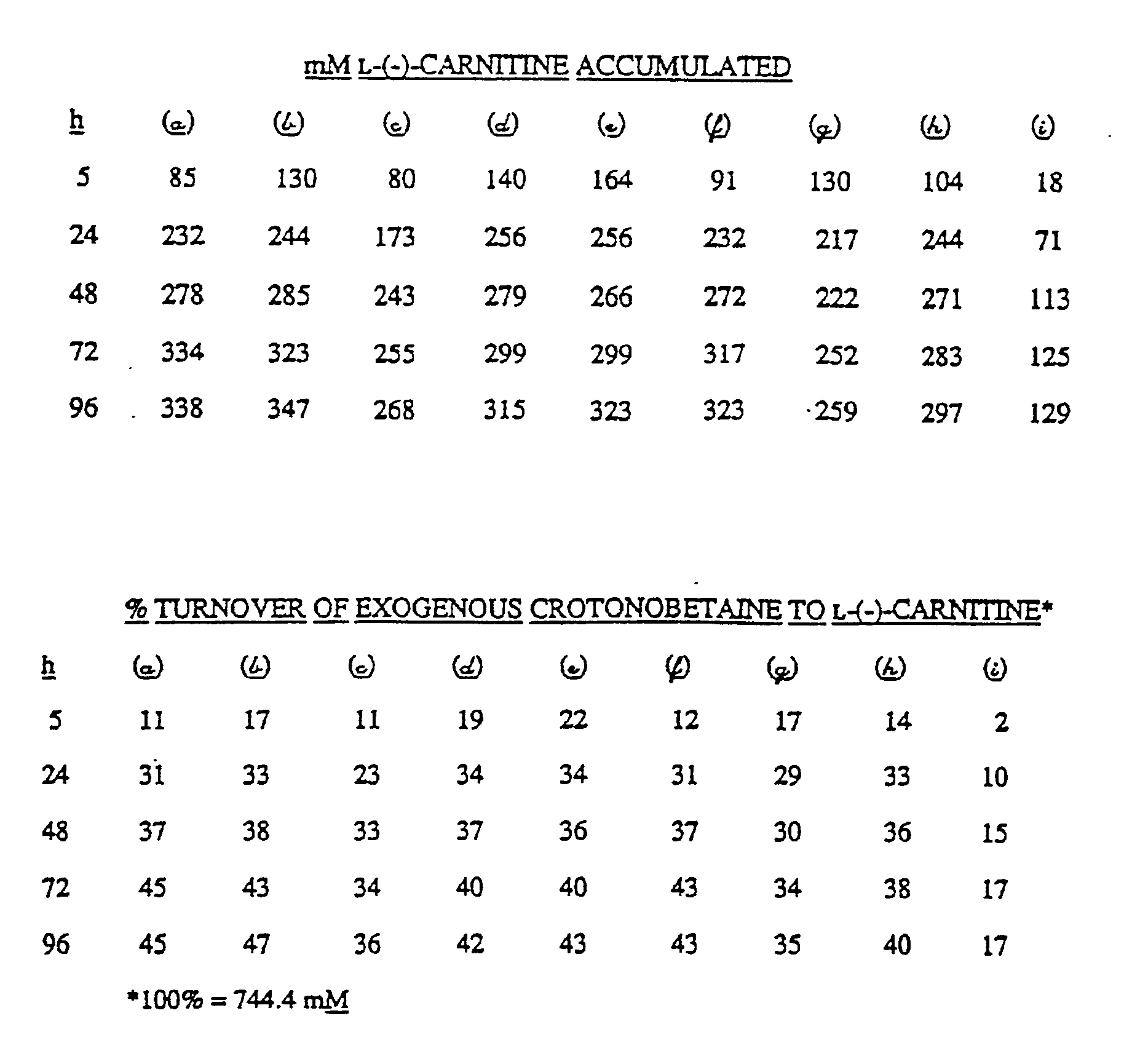
- Proteus mirabilis NRRL B-18480 (Sigma-Tau SP237 subclone NACit I1 ) was maintained by daily transfer on plates of NACit + cb; incubation temperature, 37°C. Loopfuls of this strain were inoculated into a 250-mL Erlenmeyer flask containing 50 mL of diverse media:
- ( a ) Brain-heart infusion (Difco) + 1.5% (w/v) crotonobetaine monohydrate, pH 6.8.
- ( b ) 0.9% Nutrient broth (Difco) + 0.9% yeast extract (Difco) + 0.9% Soytone (Difco) + 0.2% glucose + 0.5% sodium chloride + 0.25% dibasic sodium phosphate (anhydrous) + 1.5% (w/v) crotonobetaine monohydrate, pH 6.8.
- ( c ) 1.35% Nutrient broth + 1.35% Soytone + 0.2% glucose + 0.5% sodium chloride + 0.25% dibasic sodium phosphate (anhydrous) + 1.5% (w/v) crotonobetaine monohydrate, pH 6.8.
- ( d ) 1.35% Soytone + 1.35% yeast extract + 0.2% glucose + 0.5% sodium chloride + 0.25% dibasic sodium phosphate (anhydrous) + 1.5% (w/v) crotonobetaine monohydrate, pH 6.8.
- ( e ) 1.35% Nutrient broth + 1.35% yeast extract + 0.2% glucose + 0.25% sodium chloride + 0.25% dibasic sodium phosphate (anhydrous) + 1.5% (w /v) crotonobetaine monohydrate, pH 6.8.
- ( f ) 0.9% Nutrient broth + 0.9% Soytone + 0.9% yeast extract + 0.5% sodium chloride + 0.25% dibasic sodium phosphate (anhydrous) + 1.5% (w/v) crotonobetaine monohydrate, pH 6.8.
- ( g ) 0.9% Nutrient broth + 0.9% Soytone + 0.9% yeast extract + 0.2% glucose + 0.25% dibasic sodium phosphate (anhydrous) + 1.5% (w/v) crotonobetaine monohydrate, pH 6.8.
- ( h ) 0.9% Nutrient broth + 0.9% Soytone + 0.9% yeast extract + 0.2% glucose + 0.5% sodium chloride + 1.5% (w/v) crotonobetaine monohydrate, pH 6.8.
- ( i ) Brain-heart infusion, pH 6.8.
- The flasks were sheen (200 rpm, 1 -inch orbital eccentricity, 37°C) for 17 h, then the cells from each flask were harvested separately by centrifugation (10 min, 12,000 xg, 4°C), and washed once with cold physiological saline (50 mL). Washed cell pellets were resuspended in non-sterile biotransformation medium (50 mL) consisting of 25 mM potassium phosphate + 1% (w/v) glycerol + 12% (w/v) crotonobetaine monohydrate, pH 6.0. Biotransformation reaction mixtures were shaken as above at 33°C for 96 h; during this period aliquots (100 µL) were withdrawn and assayed enzymically for L-(-)-carnitine as previously described.
- The following results were obtained (corrected for evaporation over the period 0-96 h):
- The biotransformation of crotonobetaine inner salt to L(-)-carnitine was accomplished using cells of P. mirabilis NRRL B-18480 in a 2-L benchtop fermentor, as follows:
- The bacterium was maintained by daily transfer on slants of brain-heart infusion agar (Difco) + 1.5% (w/v) crotonobetaine inner salt; incubation temperature, 37°C.
- The contents of a 24-h slant were inoculated into a baffled 1000-mL Elenmeyer flask containing 250 mL of brain-heart infusion (Difco) + 1.5% (w/v) crotonobetaine inner salt. The flask was continuously shaken ( 170 rpm, 2-inch orbital eccentricity, 37°C) for 6 h, after which time the broth was used to inoculate six second-stage cultures, each containing 250 mL of brain-heart infusion + 1.5% (w/v) crotonobetaine inner salt, in baffled 1000-mL Enlenmeyer flasks. These flask were shaken as described above for ca. 15 h; the cells were then recovered by centrifugation (20 min, 8,500 xg, 4°C) and resuspended in a biotransformation medium (1 L) consisting of 25 mM potassium phosphate + 0.5% (w/v) glycerol + 10% (w/v) crotonobetaine inner salt. A 2-L Biolafitte fermentor was charged with the cell-containing biotransformation medium and operated for 24 h under the following conditions:
agitation rate: 150 rpm
air flow rate: 1v/v/m
initial pH: ∼6. 8
working volume: 1 L
temperature: 35°C. - A 10% (w/v) glycerol solution was continuously pumped into the fermentor at a rate of 5 mL/h.
- Unreacted crotonobetaine and L-(-)-carnitine concentrations were monitored by high-pressure liquid chromatography (HPLC):
column: 10-µ Partisil SCX, 4 mm x 250 mm (PoliConsult Scientifica s.r.l., Rome, Italy)
column temperature: 35°C
injection volume: 10 µL
mobile phase: 75 mM KH₂PO₄-CH₃CN (4:6), pH unadjusted detector: refractive index
retention times (min): L-(-)-carnitine, 8.52
crotonobetaine, 9.81
gamma-butyrobetaine, 12.08. - At 22 h, the biotransformation medium was collected and filtered.
- The filtrate, analyzed enzymically for L-(-)-carnitine as prewiously described, was found to contain 48.0 mg/mL L-(-)-carnitine and 57.3 mg/mL unreacted crotonobetaine.
- Molar turnover of crotonobetaine to L-(-)-carnitine: 43%. Yield of L-(-)-carnitine: 100%.
- The filtered biotransformation fluid was successively passed through columns of AmberliteR ion-exchange resins, viz. IRA-402 basic resin (OH-form) and IRC-50 acid resin (H⁺ form), to remove inorganic cations and anions. The eluate was concentrated in vacuo (50°C), and the concentrate treated with isobutanol three times to azeotropically lower the water content to 5-10% (w/w).
- The resulting mixture was crystallised using 3 parts (w/v) of iso butanol, to yield a precipitate containing 4 parts of L-(-)-carnitine and 1 part of crotonobetaine (w/v) [HPLC]. After three successive crystallisations, a solid consisting of L-(-)-carnitine with <0.5% (w/w) of crotonobetaine (HPLC) was obtained.
- By this procedure, ca. 50% (w/w) of the L-(-)-carnitine present in the biotransformation medium was recovered [ ]²⁵ = -31.5°. The mother liquors were collected and recycled in succeeding biotransformation.
Claims (17)
- Proteus mirabilis NRRL B-18480 and its descendents, mutants, and derivatives.
- Proteus mirabilis NRRL B-18481 and its descendents, mutants, and derivatives.
- Proteus mirabilis NRRL B-18482 and its descendents, mutants, and derivatives.
- Proteus mirabilis NRRL B-18483 and its descendents, mutants, and derivatives.
- Descendents, mutants, and derivatives of Proteus mirabilis NRRL B-18480 that retain the progenitor's capacity to transform crotonobetaine to L-(-)-carnitine.
- Descendents, mutants, and derivatives of Proteus mirabilis NRRL B-18481 that retain the progenitor's capacity to transform crotonobetaine to L-(-)-carnitine.
- Descendents, mutants, and derivatives of Proteus mirabilis NRRL B-18482 that retain the progenitor's capacity to transform crotonobetaine to L-(-)-carnitine.
- Descendents, mutants, and derivatives of Proteus mirabilis NRRL B-18483 that retain the progenitor's capacity to transform crotonobetaine to L-(-)-carnitine.
- Descendents, mutants, and derivatives of Proteus mirabilis NRRL B-18480, NRRL B-18481, NRRL B-18482, and NRRL B-18483 that retain their capacity to transform crotonobetaine to L-(-)-carnitine either as free cells or as immobilised cells.
- A microbiological process for producing L-(-)-carnitine that comprises:(a) preparing a surface culture on a solid medium of a microorganism capable of stereoselectively hydrating crotonobetaine to L-(-)-carnitine;(b) preparing a catalytically-active biomass by inoculating a liquid medium containing crotonobetaine with the culture obtained in step (a);(c) separating the biomass from the liquid medium;(d) suspending the separated biomass in a biotransformation medium containing at least 10% (w/v) of crotonobetaine inner salt;(e) recovering L-(-)-carnitine from the biotransformation fluid;
wherein said microorganism is selected from the group consisting of Proteus mirabilis NRRL B-18480, Proteus mirabilis NRRL B-18481, Proteus mirabilis NRRL B 18482, or Proteus mirabilis NRRL B-18483. - The process of claim 10, wherein the biotransformation medium contains 10-12% (w/v) crotonobetaine inner salt.
- The process of claim 10, wherein the solid medium of step (a) contains crotonobetaine.
- The process of claim 10, wherein the separation step (c) is accomplished by centrifugation.
- The process of claim 10, wherein the separation step (c) is accomplished by ultrafiltration.
- The enzyme crotonobetaine hydratase isolated from Proteus mirabilis NRRL B-18480, Proteus mirabilis NRRL B-18481, Proteus mirabilis NRRL B-18482, or Proteus mirabilis NRRL B-18483, or their descendents, mutants, or derivatives.
- The enzyme crotonobetaine hydratase of claim 15, either as free enzyme or as immobilised enzyme.
- Vectors and microorganisms containing the enzyme crotonobetaine hydratase of claim 15.
Applications Claiming Priority (2)
| Application Number | Priority Date | Filing Date | Title |
|---|---|---|---|
| IT4795390 | 1990-05-14 | ||
| IT47953A IT1240833B (en) | 1990-05-14 | 1990-05-14 | BIOCATALYTIC PROCEDURE FOR THE PRODUCTION OF L - (-) - CARNITINE FROM CROTONILBETAIN AND PROTEEAE STRAINS FOR USE IN SUCH PROCEDURE |
Publications (2)
| Publication Number | Publication Date |
|---|---|
| EP0457735A1 true EP0457735A1 (en) | 1991-11-21 |
| EP0457735B1 EP0457735B1 (en) | 1995-07-26 |
Family
ID=11263576
Family Applications (1)
| Application Number | Title | Priority Date | Filing Date |
|---|---|---|---|
| EP91830195A Expired - Lifetime EP0457735B1 (en) | 1990-05-14 | 1991-05-13 | Biocatalytic process for the production of L-(-)-carnitine from crotonobetaine and strains of Proteeae for use in said process |
Country Status (13)
| Country | Link |
|---|---|
| US (1) | US5300430A (en) |
| EP (1) | EP0457735B1 (en) |
| JP (1) | JP3167739B2 (en) |
| KR (1) | KR0135116B1 (en) |
| AT (1) | ATE125570T1 (en) |
| CA (1) | CA2042425C (en) |
| DE (1) | DE69111511T2 (en) |
| DK (1) | DK0457735T3 (en) |
| ES (1) | ES2075408T3 (en) |
| IE (1) | IE62149B1 (en) |
| IT (1) | IT1240833B (en) |
| PT (1) | PT97659B (en) |
| ZA (1) | ZA913530B (en) |
Cited By (3)
| Publication number | Priority date | Publication date | Assignee | Title |
|---|---|---|---|---|
| WO1995010613A1 (en) * | 1993-10-08 | 1995-04-20 | Lonza Ag | Genes for butyrobetaine/crotonobetaine-l-carnitine metabolism and their use for the microbiological production of l-carine |
| US5491260A (en) * | 1993-04-08 | 1996-02-13 | Sigma-Tau Industrie Farmaceutiche Riunite S.P.A. | Process for manufacturing L-(-)-carnitine from derivatives having a configuration opposite to that of L-(-)-carnitine |
| US6342034B1 (en) | 1997-07-28 | 2002-01-29 | Samsung Fine Chemicals Co., Ltd. | Process for the preparation of L-carnitine |
Families Citing this family (9)
| Publication number | Priority date | Publication date | Assignee | Title |
|---|---|---|---|---|
| IT1240833B (en) * | 1990-05-14 | 1993-12-17 | Sigma Tau Ind Farmaceuti | BIOCATALYTIC PROCEDURE FOR THE PRODUCTION OF L - (-) - CARNITINE FROM CROTONILBETAIN AND PROTEEAE STRAINS FOR USE IN SUCH PROCEDURE |
| DE69600978T2 (en) * | 1995-03-28 | 1999-04-15 | Tanabe Seiyaku Co., Ltd., Osaka | Process for the preparation of D-amino acids |
| ATE290096T1 (en) | 1998-10-27 | 2005-03-15 | Sigma Tau Ind Farmaceuti | COENZYME FOR THE PRODUCTION OF L-CARNITINE |
| US6337197B2 (en) * | 1998-10-27 | 2002-01-08 | Sigma-Tau Industrie Farmaceutiche Riunite S.P.A. | Coenzymes useful for the synthesis of L-carnitine |
| US6623662B2 (en) | 2001-05-23 | 2003-09-23 | Chunghwa Picture Tubes, Ltd. | Carbon black coating for CRT display screen with uniform light absorption |
| US6746530B2 (en) | 2001-08-02 | 2004-06-08 | Chunghwa Pictures Tubes, Ltd. | High contrast, moisture resistant antistatic/antireflective coating for CRT display screen |
| US6521346B1 (en) | 2001-09-27 | 2003-02-18 | Chunghwa Picture Tubes, Ltd. | Antistatic/antireflective coating for video display screen with improved refractivity |
| WO2006109322A1 (en) * | 2005-04-15 | 2006-10-19 | Council Of Scientific And Industrial Research | A chemoenzymatic process for the stereoselective preparation of (r)-gamma-amino-beta-hydroxybutyric acid ((r) -gabob) and (r)-carnitine |
| CN119120398B (en) * | 2024-07-22 | 2025-09-09 | 华南师范大学 | Enzyme mutant, enzyme composition or immobilized enzyme thereof, and application and method for preparing L-carnitine by using enzyme mutant and enzyme composition or immobilized enzyme |
Citations (2)
| Publication number | Priority date | Publication date | Assignee | Title |
|---|---|---|---|---|
| EP0122794A2 (en) * | 1983-04-13 | 1984-10-24 | Ajinomoto Co., Inc. | Method for producing L-carnitine |
| EP0148132A2 (en) * | 1983-11-03 | 1985-07-10 | Sigma-Tau Industrie Farmaceutiche Riunite S.p.A. | Microbiological process for stereoselectively synthesizing L(-)-carnitine |
Family Cites Families (2)
| Publication number | Priority date | Publication date | Assignee | Title |
|---|---|---|---|---|
| ES2051890T3 (en) * | 1987-10-26 | 1994-07-01 | Sigma Tau Ind Farmaceuti | PROCEDURE TO ISOLATE THE CARNITINHIDROLIASA ENZYME OF STRAINS BELONGING TO THE ENTEROBACTERIACEAE FAMILY AND USE OF THE IMMOBILIZED ENZYME TO PRODUCE L (-) - CARNITINA. |
| IT1240833B (en) * | 1990-05-14 | 1993-12-17 | Sigma Tau Ind Farmaceuti | BIOCATALYTIC PROCEDURE FOR THE PRODUCTION OF L - (-) - CARNITINE FROM CROTONILBETAIN AND PROTEEAE STRAINS FOR USE IN SUCH PROCEDURE |
-
1990
- 1990-05-14 IT IT47953A patent/IT1240833B/en active IP Right Grant
-
1991
- 1991-05-10 ZA ZA913530A patent/ZA913530B/en unknown
- 1991-05-13 DK DK91830195.3T patent/DK0457735T3/en active
- 1991-05-13 DE DE69111511T patent/DE69111511T2/en not_active Expired - Fee Related
- 1991-05-13 ES ES91830195T patent/ES2075408T3/en not_active Expired - Lifetime
- 1991-05-13 IE IE163791A patent/IE62149B1/en unknown
- 1991-05-13 EP EP91830195A patent/EP0457735B1/en not_active Expired - Lifetime
- 1991-05-13 AT AT91830195T patent/ATE125570T1/en not_active IP Right Cessation
- 1991-05-13 JP JP10748591A patent/JP3167739B2/en not_active Expired - Fee Related
- 1991-05-13 CA CA002042425A patent/CA2042425C/en not_active Expired - Fee Related
- 1991-05-14 PT PT97659A patent/PT97659B/en not_active IP Right Cessation
- 1991-05-14 KR KR1019910007786A patent/KR0135116B1/en not_active Expired - Fee Related
-
1993
- 1993-01-07 US US08/001,403 patent/US5300430A/en not_active Expired - Lifetime
Patent Citations (2)
| Publication number | Priority date | Publication date | Assignee | Title |
|---|---|---|---|---|
| EP0122794A2 (en) * | 1983-04-13 | 1984-10-24 | Ajinomoto Co., Inc. | Method for producing L-carnitine |
| EP0148132A2 (en) * | 1983-11-03 | 1985-07-10 | Sigma-Tau Industrie Farmaceutiche Riunite S.p.A. | Microbiological process for stereoselectively synthesizing L(-)-carnitine |
Non-Patent Citations (3)
| Title |
|---|
| PATENT ABSTRACTS OF JAPAN, unexamined applications, C field, vol. 10, No. 226, August 7, 1986 THE PATENT OFFICE JAPANESE GOVERNMENT page 3 C 366 * |
| PATENT ABSTRACTS OF JAPAN, unexamined applications, C field, vol. 11, No. 136, April 30, 1987 THE PATENT OFFICE JAPANESE GOVERNMENT page 34 C 419 * |
| PATENT ABSTRACTS OF JAPAN, unexamined applications, C field, vol. 11, No. 80, March 11, 1987 THE PATENT OFFICE JAPANESE GOVERNMENT page 46 C 409 * |
Cited By (5)
| Publication number | Priority date | Publication date | Assignee | Title |
|---|---|---|---|---|
| US5491260A (en) * | 1993-04-08 | 1996-02-13 | Sigma-Tau Industrie Farmaceutiche Riunite S.P.A. | Process for manufacturing L-(-)-carnitine from derivatives having a configuration opposite to that of L-(-)-carnitine |
| WO1995010613A1 (en) * | 1993-10-08 | 1995-04-20 | Lonza Ag | Genes for butyrobetaine/crotonobetaine-l-carnitine metabolism and their use for the microbiological production of l-carine |
| US5759824A (en) * | 1993-10-08 | 1998-06-02 | Lonza, A.G. | Genes for butyrobetaine/crotonobetaine-l-carnitine metabolism and their use for the microbiological production of l-carnitine |
| CN1058523C (en) * | 1993-10-08 | 2000-11-15 | 瑞士隆萨股份公司 | Butyrolactone/croton betaine-L-carnitine metabolism gene and its use in producing L-carnitine by microbial method |
| US6342034B1 (en) | 1997-07-28 | 2002-01-29 | Samsung Fine Chemicals Co., Ltd. | Process for the preparation of L-carnitine |
Also Published As
| Publication number | Publication date |
|---|---|
| ATE125570T1 (en) | 1995-08-15 |
| KR0135116B1 (en) | 1998-04-15 |
| PT97659A (en) | 1992-05-29 |
| ZA913530B (en) | 1992-02-26 |
| IE911637A1 (en) | 1991-11-20 |
| DE69111511T2 (en) | 1996-01-04 |
| DE69111511D1 (en) | 1995-08-31 |
| JPH04228065A (en) | 1992-08-18 |
| IT9047953A1 (en) | 1991-11-14 |
| KR910020171A (en) | 1991-12-19 |
| DK0457735T3 (en) | 1995-09-11 |
| CA2042425A1 (en) | 1991-11-15 |
| IT1240833B (en) | 1993-12-17 |
| PT97659B (en) | 1998-09-30 |
| JP3167739B2 (en) | 2001-05-21 |
| HK1005888A1 (en) | 1999-01-29 |
| CA2042425C (en) | 2000-07-11 |
| IT9047953A0 (en) | 1990-05-14 |
| IE62149B1 (en) | 1994-12-14 |
| US5300430A (en) | 1994-04-05 |
| EP0457735B1 (en) | 1995-07-26 |
| ES2075408T3 (en) | 1995-10-01 |
Similar Documents
| Publication | Publication Date | Title |
|---|---|---|
| JP2942574B2 (en) | Glycosidase inhibitor salbostatin and its preparation | |
| EP0148132B1 (en) | Microbiological process for stereoselectively synthesizing l(-)-carnitine | |
| EP0457735B1 (en) | Biocatalytic process for the production of L-(-)-carnitine from crotonobetaine and strains of Proteeae for use in said process | |
| JPH0523191A (en) | Method for producing D-pantothenic acid | |
| EP0610048A2 (en) | Process for producing optically active alpha-hydrocarboxylic acid having phenyl group | |
| EP0335386B1 (en) | Ks-506 compounds and process for the production thereof | |
| JP2993767B2 (en) | FO-1289A substance and method for producing the same | |
| JPS59113896A (en) | Preparation of pyrroloquinolinequinone | |
| HK1005888B (en) | Biocatalytic process for the production of l-(-)-carnitine from crotonobetaine and strains of proteeae for use in said process | |
| EP0819761B1 (en) | Process for producing l-2-aminoadipic acid | |
| JPH022589B2 (en) | ||
| US3963579A (en) | Microbiological process for the production of pepstatins | |
| JP3030916B2 (en) | Method for producing β-glucooligosaccharide | |
| JPS58201992A (en) | Preparation of beta-substituted propionic acid or amide thereof by microorganism | |
| JP2002281993A (en) | Method for producing shikimic acid | |
| US5223637A (en) | KS-506 compounds | |
| KR830002916B1 (en) | Cephalosporin preparation by fermentation | |
| JP2899071B2 (en) | Method for producing L-α-alanine | |
| JPS6219095A (en) | Racemization of 2-oxo-oxazolidine-4-carboxylic acid | |
| Miall | Fermentation—the last ten years and the next ten years | |
| JPH0545235B2 (en) | ||
| JPS59173089A (en) | Preparation of l-threo-beta-hydroxyaspartic acid | |
| JPS615793A (en) | Production of d-aspartic acid | |
| JP2000300249A (en) | Microorganism that secretes shikimic acid outside of cells and method for producing shikimic acid using the same | |
| JPS61152292A (en) | Production of l-serine |
Legal Events
| Date | Code | Title | Description |
|---|---|---|---|
| PUAI | Public reference made under article 153(3) epc to a published international application that has entered the european phase |
Free format text: ORIGINAL CODE: 0009012 |
|
| AK | Designated contracting states |
Kind code of ref document: A1 Designated state(s): AT BE CH DE DK ES FR GB GR IT LI LU NL SE |
|
| 17P | Request for examination filed |
Effective date: 19920118 |
|
| 17Q | First examination report despatched |
Effective date: 19940411 |
|
| GRAA | (expected) grant |
Free format text: ORIGINAL CODE: 0009210 |
|
| AK | Designated contracting states |
Kind code of ref document: B1 Designated state(s): AT BE CH DE DK ES FR GB GR IT LI LU NL SE |
|
| REF | Corresponds to: |
Ref document number: 125570 Country of ref document: AT Date of ref document: 19950815 Kind code of ref document: T |
|
| REF | Corresponds to: |
Ref document number: 69111511 Country of ref document: DE Date of ref document: 19950831 |
|
| ET | Fr: translation filed | ||
| REG | Reference to a national code |
Ref country code: DK Ref legal event code: T3 |
|
| ITF | It: translation for a ep patent filed | ||
| REG | Reference to a national code |
Ref country code: GR Ref legal event code: FG4A Free format text: 3016961 |
|
| REG | Reference to a national code |
Ref country code: ES Ref legal event code: FG2A Ref document number: 2075408 Country of ref document: ES Kind code of ref document: T3 |
|
| PLBE | No opposition filed within time limit |
Free format text: ORIGINAL CODE: 0009261 |
|
| STAA | Information on the status of an ep patent application or granted ep patent |
Free format text: STATUS: NO OPPOSITION FILED WITHIN TIME LIMIT |
|
| 26N | No opposition filed | ||
| REG | Reference to a national code |
Ref country code: GB Ref legal event code: IF02 |
|
| PGFP | Annual fee paid to national office [announced via postgrant information from national office to epo] |
Ref country code: NL Payment date: 20050416 Year of fee payment: 15 |
|
| PGFP | Annual fee paid to national office [announced via postgrant information from national office to epo] |
Ref country code: AT Payment date: 20050420 Year of fee payment: 15 |
|
| PGFP | Annual fee paid to national office [announced via postgrant information from national office to epo] |
Ref country code: GB Payment date: 20050504 Year of fee payment: 15 |
|
| PGFP | Annual fee paid to national office [announced via postgrant information from national office to epo] |
Ref country code: FR Payment date: 20050517 Year of fee payment: 15 |
|
| PGFP | Annual fee paid to national office [announced via postgrant information from national office to epo] |
Ref country code: SE Payment date: 20050519 Year of fee payment: 15 |
|
| PGFP | Annual fee paid to national office [announced via postgrant information from national office to epo] |
Ref country code: CH Payment date: 20050520 Year of fee payment: 15 |
|
| PGFP | Annual fee paid to national office [announced via postgrant information from national office to epo] |
Ref country code: GR Payment date: 20050524 Year of fee payment: 15 Ref country code: DK Payment date: 20050524 Year of fee payment: 15 |
|
| PGFP | Annual fee paid to national office [announced via postgrant information from national office to epo] |
Ref country code: LU Payment date: 20050525 Year of fee payment: 15 |
|
| PGFP | Annual fee paid to national office [announced via postgrant information from national office to epo] |
Ref country code: ES Payment date: 20050609 Year of fee payment: 15 |
|
| PGFP | Annual fee paid to national office [announced via postgrant information from national office to epo] |
Ref country code: BE Payment date: 20050624 Year of fee payment: 15 |
|
| PGFP | Annual fee paid to national office [announced via postgrant information from national office to epo] |
Ref country code: DE Payment date: 20050630 Year of fee payment: 15 |
|
| PG25 | Lapsed in a contracting state [announced via postgrant information from national office to epo] |
Ref country code: GB Free format text: LAPSE BECAUSE OF NON-PAYMENT OF DUE FEES Effective date: 20060513 Ref country code: AT Free format text: LAPSE BECAUSE OF NON-PAYMENT OF DUE FEES Effective date: 20060513 |
|
| PG25 | Lapsed in a contracting state [announced via postgrant information from national office to epo] |
Ref country code: SE Free format text: LAPSE BECAUSE OF NON-PAYMENT OF DUE FEES Effective date: 20060514 |
|
| PG25 | Lapsed in a contracting state [announced via postgrant information from national office to epo] |
Ref country code: ES Free format text: LAPSE BECAUSE OF NON-PAYMENT OF DUE FEES Effective date: 20060516 |
|
| PG25 | Lapsed in a contracting state [announced via postgrant information from national office to epo] |
Ref country code: LI Free format text: LAPSE BECAUSE OF NON-PAYMENT OF DUE FEES Effective date: 20060531 Ref country code: DK Free format text: LAPSE BECAUSE OF NON-PAYMENT OF DUE FEES Effective date: 20060531 Ref country code: CH Free format text: LAPSE BECAUSE OF NON-PAYMENT OF DUE FEES Effective date: 20060531 Ref country code: BE Free format text: LAPSE BECAUSE OF NON-PAYMENT OF DUE FEES Effective date: 20060531 |
|
| PGFP | Annual fee paid to national office [announced via postgrant information from national office to epo] |
Ref country code: IT Payment date: 20060531 Year of fee payment: 16 |
|
| PG25 | Lapsed in a contracting state [announced via postgrant information from national office to epo] |
Ref country code: NL Free format text: LAPSE BECAUSE OF NON-PAYMENT OF DUE FEES Effective date: 20061201 Ref country code: DE Free format text: LAPSE BECAUSE OF NON-PAYMENT OF DUE FEES Effective date: 20061201 |
|
| REG | Reference to a national code |
Ref country code: CH Ref legal event code: PL Ref country code: DK Ref legal event code: EBP |
|
| EUG | Se: european patent has lapsed | ||
| GBPC | Gb: european patent ceased through non-payment of renewal fee |
Effective date: 20060513 |
|
| NLV4 | Nl: lapsed or anulled due to non-payment of the annual fee |
Effective date: 20061201 |
|
| REG | Reference to a national code |
Ref country code: FR Ref legal event code: ST Effective date: 20070131 |
|
| REG | Reference to a national code |
Ref country code: ES Ref legal event code: FD2A Effective date: 20060516 |
|
| BERE | Be: lapsed |
Owner name: *SIGMA-TAU INDUSTRIE FARMACEUTICHE RIUNITE S.P.A. Effective date: 20060531 |
|
| PG25 | Lapsed in a contracting state [announced via postgrant information from national office to epo] |
Ref country code: FR Free format text: LAPSE BECAUSE OF NON-PAYMENT OF DUE FEES Effective date: 20060531 |
|
| PG25 | Lapsed in a contracting state [announced via postgrant information from national office to epo] |
Ref country code: LU Free format text: LAPSE BECAUSE OF NON-PAYMENT OF DUE FEES Effective date: 20060513 |
|
| PG25 | Lapsed in a contracting state [announced via postgrant information from national office to epo] |
Ref country code: GR Free format text: LAPSE BECAUSE OF NON-PAYMENT OF DUE FEES Effective date: 20061205 |
|
| PG25 | Lapsed in a contracting state [announced via postgrant information from national office to epo] |
Ref country code: IT Free format text: LAPSE BECAUSE OF NON-PAYMENT OF DUE FEES Effective date: 20070513 |