EP0463560A1 - Neuartige Antiepileptika - Google Patents
Neuartige Antiepileptika Download PDFInfo
- Publication number
- EP0463560A1 EP0463560A1 EP91110074A EP91110074A EP0463560A1 EP 0463560 A1 EP0463560 A1 EP 0463560A1 EP 91110074 A EP91110074 A EP 91110074A EP 91110074 A EP91110074 A EP 91110074A EP 0463560 A1 EP0463560 A1 EP 0463560A1
- Authority
- EP
- European Patent Office
- Prior art keywords
- hydroxy
- alkyl
- hydrogen
- phosphinic acid
- propyl
- Prior art date
- Legal status (The legal status is an assumption and is not a legal conclusion. Google has not performed a legal analysis and makes no representation as to the accuracy of the status listed.)
- Granted
Links
- 239000001961 anticonvulsive agent Substances 0.000 title claims description 48
- 125000000217 alkyl group Chemical group 0.000 claims abstract description 222
- 229910052739 hydrogen Inorganic materials 0.000 claims abstract description 205
- 239000001257 hydrogen Substances 0.000 claims abstract description 205
- UFHFLCQGNIYNRP-UHFFFAOYSA-N Hydrogen Chemical compound [H][H] UFHFLCQGNIYNRP-UHFFFAOYSA-N 0.000 claims abstract description 161
- 125000002887 hydroxy group Chemical group [H]O* 0.000 claims abstract description 158
- 150000003839 salts Chemical class 0.000 claims abstract description 141
- 150000001875 compounds Chemical class 0.000 claims abstract description 126
- 229910052736 halogen Inorganic materials 0.000 claims abstract description 98
- 150000002367 halogens Chemical class 0.000 claims abstract description 90
- 150000002431 hydrogen Chemical class 0.000 claims abstract description 87
- 238000002360 preparation method Methods 0.000 claims abstract description 56
- 238000011282 treatment Methods 0.000 claims abstract description 53
- 238000000034 method Methods 0.000 claims abstract description 51
- 206010034759 Petit mal epilepsy Diseases 0.000 claims abstract description 46
- 125000002496 methyl group Chemical group [H]C([H])([H])* 0.000 claims abstract description 39
- 125000001931 aliphatic group Chemical group 0.000 claims abstract description 38
- 230000008569 process Effects 0.000 claims abstract description 38
- 125000004432 carbon atom Chemical group C* 0.000 claims abstract description 23
- BTCSSZJGUNDROE-UHFFFAOYSA-N gamma-aminobutyric acid Chemical compound NCCCC(O)=O BTCSSZJGUNDROE-UHFFFAOYSA-N 0.000 claims abstract description 21
- 229960003692 gamma aminobutyric acid Drugs 0.000 claims abstract description 19
- 206010015037 epilepsy Diseases 0.000 claims abstract description 18
- 239000008186 active pharmaceutical agent Substances 0.000 claims abstract description 5
- -1 tri-substituted phenyl Chemical group 0.000 claims description 167
- 238000004519 manufacturing process Methods 0.000 claims description 60
- 239000004480 active ingredient Substances 0.000 claims description 48
- 239000000203 mixture Substances 0.000 claims description 47
- 230000003556 anti-epileptic effect Effects 0.000 claims description 46
- 239000000825 pharmaceutical preparation Substances 0.000 claims description 46
- 125000003545 alkoxy group Chemical group 0.000 claims description 41
- 125000003342 alkenyl group Chemical group 0.000 claims description 32
- 125000001997 phenyl group Chemical group [H]C1=C([H])C([H])=C(*)C([H])=C1[H] 0.000 claims description 30
- 125000001624 naphthyl group Chemical group 0.000 claims description 29
- 229960003965 antiepileptics Drugs 0.000 claims description 28
- 125000001797 benzyl group Chemical group [H]C1=C([H])C([H])=C(C([H])=C1[H])C([H])([H])* 0.000 claims description 27
- 239000002253 acid Substances 0.000 claims description 26
- 125000002023 trifluoromethyl group Chemical group FC(F)(F)* 0.000 claims description 25
- 125000000753 cycloalkyl group Chemical group 0.000 claims description 24
- 125000001544 thienyl group Chemical group 0.000 claims description 22
- 125000005913 (C3-C6) cycloalkyl group Chemical group 0.000 claims description 20
- 239000003814 drug Substances 0.000 claims description 19
- 125000002541 furyl group Chemical group 0.000 claims description 19
- 125000004043 oxo group Chemical group O=* 0.000 claims description 17
- 125000006239 protecting group Chemical group 0.000 claims description 17
- 241000282414 Homo sapiens Species 0.000 claims description 16
- 125000000304 alkynyl group Chemical group 0.000 claims description 13
- QIIVUOWTHWIXFO-UHFFFAOYSA-N cgp-35348 Chemical compound CCOC(OCC)P(O)(=O)CCCN QIIVUOWTHWIXFO-UHFFFAOYSA-N 0.000 claims description 12
- 125000004414 alkyl thio group Chemical group 0.000 claims description 11
- 125000002924 primary amino group Chemical group [H]N([H])* 0.000 claims description 11
- XOESDNIUAWGCLU-UHFFFAOYSA-N 3-aminopropyl(cyclohexylmethyl)phosphinic acid Chemical compound NCCCP(O)(=O)CC1CCCCC1 XOESDNIUAWGCLU-UHFFFAOYSA-N 0.000 claims description 10
- 241001465754 Metazoa Species 0.000 claims description 10
- 125000005843 halogen group Chemical group 0.000 claims description 9
- 229910052740 iodine Inorganic materials 0.000 claims description 9
- 125000004076 pyridyl group Chemical group 0.000 claims description 9
- SNOOUWRIMMFWNE-UHFFFAOYSA-M sodium;6-[(3,4,5-trimethoxybenzoyl)amino]hexanoate Chemical compound [Na+].COC1=CC(C(=O)NCCCCCC([O-])=O)=CC(OC)=C1OC SNOOUWRIMMFWNE-UHFFFAOYSA-M 0.000 claims description 9
- 230000001629 suppression Effects 0.000 claims description 8
- CRAAKYFLEJCQFU-UHFFFAOYSA-N 3-[(4-chlorophenyl)methylamino]propyl-(cyclohexylmethyl)phosphinic acid Chemical compound C1CCCCC1CP(=O)(O)CCCNCC1=CC=C(Cl)C=C1 CRAAKYFLEJCQFU-UHFFFAOYSA-N 0.000 claims description 7
- ZJYHZJCEUAXPDE-UHFFFAOYSA-N 3-aminopropyl(1,1-difluorobutyl)phosphinic acid Chemical compound CCCC(F)(F)P(O)(=O)CCCN ZJYHZJCEUAXPDE-UHFFFAOYSA-N 0.000 claims description 7
- RBLRLMBKEMYMCN-UHFFFAOYSA-N 3-aminopropyl(benzyl)phosphinic acid Chemical compound NCCCP(O)(=O)CC1=CC=CC=C1 RBLRLMBKEMYMCN-UHFFFAOYSA-N 0.000 claims description 7
- ONNMDRQRSGKZCN-UHFFFAOYSA-N 3-aminopropyl(butyl)phosphinic acid Chemical compound CCCCP(O)(=O)CCCN ONNMDRQRSGKZCN-UHFFFAOYSA-N 0.000 claims description 7
- 150000007513 acids Chemical class 0.000 claims description 7
- 125000005059 halophenyl group Chemical group 0.000 claims description 7
- 125000005350 hydroxycycloalkyl group Chemical group 0.000 claims description 7
- SAPDSGPBMRLHFV-UHFFFAOYSA-N (3-amino-2-hydroxypropyl)-(cyclohexylmethyl)phosphinic acid Chemical compound NCC(O)CP(O)(=O)CC1CCCCC1 SAPDSGPBMRLHFV-UHFFFAOYSA-N 0.000 claims description 6
- JJFYYCBNGQCREI-KRWDZBQOSA-N benzyl-[(2s)-3-[(4-chlorophenyl)methylamino]-2-hydroxypropyl]phosphinic acid Chemical compound C([C@H](O)CP(O)(=O)CC=1C=CC=CC=1)NCC1=CC=C(Cl)C=C1 JJFYYCBNGQCREI-KRWDZBQOSA-N 0.000 claims description 6
- ACVYVLVWPXVTIT-UHFFFAOYSA-N phosphinic acid Chemical compound O[PH2]=O ACVYVLVWPXVTIT-UHFFFAOYSA-N 0.000 claims description 6
- INZLCQIVKAUPBT-UHFFFAOYSA-N 3-[(4-chlorophenyl)methylamino]propyl-(diethoxymethyl)phosphinic acid Chemical compound CCOC(OCC)P(O)(=O)CCCNCC1=CC=C(Cl)C=C1 INZLCQIVKAUPBT-UHFFFAOYSA-N 0.000 claims description 5
- IBVCNRUWDCKLKX-LBPRGKRZSA-N [(2s)-3-[(3,4-dichlorophenyl)methylamino]-2-hydroxypropyl]-(diethoxymethyl)phosphinic acid Chemical compound CCOC(OCC)P(O)(=O)C[C@@H](O)CNCC1=CC=C(Cl)C(Cl)=C1 IBVCNRUWDCKLKX-LBPRGKRZSA-N 0.000 claims description 5
- SAPDSGPBMRLHFV-JTQLQIEISA-N [(2s)-3-amino-2-hydroxypropyl]-(cyclohexylmethyl)phosphinic acid Chemical compound NC[C@H](O)CP(O)(=O)CC1CCCCC1 SAPDSGPBMRLHFV-JTQLQIEISA-N 0.000 claims description 5
- XLEZOJURISRRBU-JTQLQIEISA-N [(2s)-3-amino-2-hydroxypropyl]-benzylphosphinic acid Chemical compound NC[C@H](O)CP(O)(=O)CC1=CC=CC=C1 XLEZOJURISRRBU-JTQLQIEISA-N 0.000 claims description 5
- 239000013543 active substance Substances 0.000 claims description 5
- BHYCJPNHRKOLBK-HNNXBMFYSA-N benzyl-[(2s)-3-[(3,4-dichlorophenyl)methylamino]-2-hydroxypropyl]phosphinic acid Chemical compound C([C@H](O)CP(O)(=O)CC=1C=CC=CC=1)NCC1=CC=C(Cl)C(Cl)=C1 BHYCJPNHRKOLBK-HNNXBMFYSA-N 0.000 claims description 5
- RTLYEDFJQRQDSQ-UHFFFAOYSA-N butyl-[3-[(4-chlorophenyl)methylamino]-2-hydroxypropyl]phosphinic acid Chemical compound CCCCP(O)(=O)CC(O)CNCC1=CC=C(Cl)C=C1 RTLYEDFJQRQDSQ-UHFFFAOYSA-N 0.000 claims description 5
- 125000004429 atom Chemical group 0.000 claims description 4
- GJZVQXWEIYRHBE-UHFFFAOYSA-N 3-[(3,4-dichlorophenyl)methylamino]propyl-(diethoxymethyl)phosphinic acid Chemical compound CCOC(OCC)P(O)(=O)CCCNCC1=CC=C(Cl)C(Cl)=C1 GJZVQXWEIYRHBE-UHFFFAOYSA-N 0.000 claims description 3
- SAPDSGPBMRLHFV-SNVBAGLBSA-N [(2r)-3-amino-2-hydroxypropyl]-(cyclohexylmethyl)phosphinic acid Chemical compound NC[C@@H](O)CP(O)(=O)CC1CCCCC1 SAPDSGPBMRLHFV-SNVBAGLBSA-N 0.000 claims description 3
- UXMROGDTILTXQF-MTHONSCTSA-N [(2s)-3-[(3,4-dichlorophenyl)methylamino]-2-hydroxypropyl]-[(3,4,5-trihydroxycyclohexyl)methyl]phosphinic acid Chemical compound C([C@H](O)CP(O)(=O)CC1CC(O)C(O)C(O)C1)NCC1=CC=C(Cl)C(Cl)=C1 UXMROGDTILTXQF-MTHONSCTSA-N 0.000 claims description 3
- VEPDLZVVQZPWQJ-HNNXBMFYSA-N [(2s)-3-[(3,4-dichlorophenyl)methylamino]-2-hydroxypropyl]-[(3,4-dimethoxyphenyl)methyl]phosphinic acid Chemical compound C1=C(OC)C(OC)=CC=C1CP(O)(=O)C[C@@H](O)CNCC1=CC=C(Cl)C(Cl)=C1 VEPDLZVVQZPWQJ-HNNXBMFYSA-N 0.000 claims description 3
- WFTNLWMVNFEQAX-KRWDZBQOSA-N [(2s)-3-[(4-chlorophenyl)methylamino]-2-hydroxypropyl]-[(3,4-dimethoxyphenyl)methyl]phosphinic acid Chemical compound C1=C(OC)C(OC)=CC=C1CP(O)(=O)C[C@@H](O)CNCC1=CC=C(Cl)C=C1 WFTNLWMVNFEQAX-KRWDZBQOSA-N 0.000 claims description 3
- QPABBRWIPSHTLG-KRWDZBQOSA-N [(2s)-3-[(4-chlorophenyl)methylamino]-2-hydroxypropyl]-[(4-methoxyphenyl)methyl]phosphinic acid Chemical compound C1=CC(OC)=CC=C1CP(O)(=O)C[C@@H](O)CNCC1=CC=C(Cl)C=C1 QPABBRWIPSHTLG-KRWDZBQOSA-N 0.000 claims description 3
- FPSHIRLRKJJOJC-UHFFFAOYSA-N [3-amino-2-(4-chlorophenyl)propyl]-methylphosphinic acid Chemical compound CP(O)(=O)CC(CN)C1=CC=C(Cl)C=C1 FPSHIRLRKJJOJC-UHFFFAOYSA-N 0.000 claims description 3
- JJFYYCBNGQCREI-QGZVFWFLSA-N benzyl-[(2r)-3-[(4-chlorophenyl)methylamino]-2-hydroxypropyl]phosphinic acid Chemical compound C([C@@H](O)CP(O)(=O)CC=1C=CC=CC=1)NCC1=CC=C(Cl)C=C1 JJFYYCBNGQCREI-QGZVFWFLSA-N 0.000 claims description 3
- NQNSMMBTNHUINE-INIZCTEOSA-N benzyl-[(2s)-3-[(4-chloro-3-methoxyphenyl)methylamino]-2-hydroxypropyl]phosphinic acid Chemical compound C1=C(Cl)C(OC)=CC(CNC[C@H](O)CP(O)(=O)CC=2C=CC=CC=2)=C1 NQNSMMBTNHUINE-INIZCTEOSA-N 0.000 claims description 3
- AXPONUGUDAUHMD-SFHVURJKSA-N benzyl-[(2s)-3-[(4-chlorophenyl)methyl-methylamino]-2-hydroxypropyl]phosphinic acid Chemical compound C([C@@H](O)CN(C)CC=1C=CC(Cl)=CC=1)P(O)(=O)CC1=CC=CC=C1 AXPONUGUDAUHMD-SFHVURJKSA-N 0.000 claims description 3
- GJTMIYHQMPMTGW-SFHVURJKSA-N benzyl-[(2s)-3-[2-(4-chlorophenyl)propan-2-ylamino]-2-hydroxypropyl]phosphinic acid Chemical compound C([C@@H](O)CNC(C)(C)C=1C=CC(Cl)=CC=1)P(O)(=O)CC1=CC=CC=C1 GJTMIYHQMPMTGW-SFHVURJKSA-N 0.000 claims description 3
- ZSWKCGLIENVNON-UHFFFAOYSA-N 3-[(2,4-dichlorophenyl)methylamino]propyl-(diethoxymethyl)phosphinic acid Chemical compound CCOC(OCC)P(O)(=O)CCCNCC1=CC=C(Cl)C=C1Cl ZSWKCGLIENVNON-UHFFFAOYSA-N 0.000 claims description 2
- PWJPVWNGRGJWGS-UHFFFAOYSA-N 3-[(2-chlorophenyl)methylamino]propyl-(diethoxymethyl)phosphinic acid Chemical compound CCOC(OCC)P(O)(=O)CCCNCC1=CC=CC=C1Cl PWJPVWNGRGJWGS-UHFFFAOYSA-N 0.000 claims description 2
- GKQYUKHULDZHJN-UHFFFAOYSA-N 3-[(3-chloro-4-iodophenyl)methylamino]propyl-(diethoxymethyl)phosphinic acid Chemical compound CCOC(OCC)P(O)(=O)CCCNCC1=CC=C(I)C(Cl)=C1 GKQYUKHULDZHJN-UHFFFAOYSA-N 0.000 claims description 2
- IEUYIKWNRLIURQ-UHFFFAOYSA-N 3-[(3-chlorophenyl)methylamino]propyl-(diethoxymethyl)phosphinic acid Chemical compound CCOC(OCC)P(O)(=O)CCCNCC1=CC=CC(Cl)=C1 IEUYIKWNRLIURQ-UHFFFAOYSA-N 0.000 claims description 2
- LBXVZGXNSBJLIP-UHFFFAOYSA-N 3-[(4,5-dichloro-2-iodophenyl)methylamino]propyl-(diethoxymethyl)phosphinic acid Chemical compound CCOC(OCC)P(O)(=O)CCCNCC1=CC(Cl)=C(Cl)C=C1I LBXVZGXNSBJLIP-UHFFFAOYSA-N 0.000 claims description 2
- PCYWOXATQLNRFU-UHFFFAOYSA-N 3-[(4-chloro-3-iodophenyl)methylamino]propyl-(diethoxymethyl)phosphinic acid Chemical compound CCOC(OCC)P(O)(=O)CCCNCC1=CC=C(Cl)C(I)=C1 PCYWOXATQLNRFU-UHFFFAOYSA-N 0.000 claims description 2
- ASFRWBJAZIEYAH-UHFFFAOYSA-N 3-[(4-chloro-3-methoxyphenyl)methylamino]propyl-(diethoxymethyl)phosphinic acid Chemical compound CCOC(OCC)P(O)(=O)CCCNCC1=CC=C(Cl)C(OC)=C1 ASFRWBJAZIEYAH-UHFFFAOYSA-N 0.000 claims description 2
- GVWYUGDBZPZCCA-UHFFFAOYSA-N 3-[(4-chlorophenyl)methyl-methylamino]propyl-(diethoxymethyl)phosphinic acid Chemical compound CCOC(OCC)P(O)(=O)CCCN(C)CC1=CC=C(Cl)C=C1 GVWYUGDBZPZCCA-UHFFFAOYSA-N 0.000 claims description 2
- GLKKTGWXWNOWPJ-UHFFFAOYSA-N 3-[1-(3,4-dichlorophenyl)ethylamino]propyl-(diethoxymethyl)phosphinic acid Chemical compound CCOC(OCC)P(O)(=O)CCCNC(C)C1=CC=C(Cl)C(Cl)=C1 GLKKTGWXWNOWPJ-UHFFFAOYSA-N 0.000 claims description 2
- MYKIJSRPIOTISR-UHFFFAOYSA-N 3-[1-(4-chlorophenyl)ethylamino]propyl-(diethoxymethyl)phosphinic acid Chemical compound CCOC(OCC)P(O)(=O)CCCNC(C)C1=CC=C(Cl)C=C1 MYKIJSRPIOTISR-UHFFFAOYSA-N 0.000 claims description 2
- BCGYCROYRLTHEB-UHFFFAOYSA-N 3-[2-(3,4-dichlorophenyl)propan-2-ylamino]propyl-(diethoxymethyl)phosphinic acid Chemical compound CCOC(OCC)P(O)(=O)CCCNC(C)(C)C1=CC=C(Cl)C(Cl)=C1 BCGYCROYRLTHEB-UHFFFAOYSA-N 0.000 claims description 2
- WADIZJWDRSWOTQ-UHFFFAOYSA-N 3-[2-(4-chlorophenyl)propan-2-ylamino]propyl-(diethoxymethyl)phosphinic acid Chemical compound CCOC(OCC)P(O)(=O)CCCNC(C)(C)C1=CC=C(Cl)C=C1 WADIZJWDRSWOTQ-UHFFFAOYSA-N 0.000 claims description 2
- VQRHRSMPRJHFHK-UHFFFAOYSA-N ClC1=CC=C(CC(CCP(O)(=O)C(OCC)OCC)N)C=C1 Chemical compound ClC1=CC=C(CC(CCP(O)(=O)C(OCC)OCC)N)C=C1 VQRHRSMPRJHFHK-UHFFFAOYSA-N 0.000 claims description 2
- QCVOBEJOTPOQKW-ZYMOGRSISA-N ClC=1C=C(CC([C@@H](CP(O)(=O)CC2=CC=CC=C2)O)N)C=CC1Cl Chemical compound ClC=1C=C(CC([C@@H](CP(O)(=O)CC2=CC=CC=C2)O)N)C=CC1Cl QCVOBEJOTPOQKW-ZYMOGRSISA-N 0.000 claims description 2
- VJPSXQDGJKPAQK-UAIPMZCESA-N ClC=1C=C(CC([C@@H](CP(O)(=O)CC2CC=CCC2)O)N)C=CC1Cl Chemical compound ClC=1C=C(CC([C@@H](CP(O)(=O)CC2CC=CCC2)O)N)C=CC1Cl VJPSXQDGJKPAQK-UAIPMZCESA-N 0.000 claims description 2
- DKLQVPIATJRCFL-INIZCTEOSA-N [(2s)-3-[(3,4-dichlorophenyl)methylamino]-2-hydroxypropyl]-[(4-methylphenyl)methyl]phosphinic acid Chemical compound C1=CC(C)=CC=C1CP(O)(=O)C[C@@H](O)CNCC1=CC=C(Cl)C(Cl)=C1 DKLQVPIATJRCFL-INIZCTEOSA-N 0.000 claims description 2
- VRGHVPQSXPNRLT-AWEZNQCLSA-N [(2s)-3-[(4-chlorophenyl)methylamino]-2-hydroxypropyl]-(diethoxymethyl)phosphinic acid Chemical compound CCOC(OCC)P(O)(=O)C[C@@H](O)CNCC1=CC=C(Cl)C=C1 VRGHVPQSXPNRLT-AWEZNQCLSA-N 0.000 claims description 2
- WPHULXBMTBGVSX-YUZLPWPTSA-N [(2s)-3-[1-(3,4-dichlorophenyl)ethylamino]-2-hydroxypropyl]-(diethoxymethyl)phosphinic acid Chemical compound CCOC(OCC)P(O)(=O)C[C@@H](O)CNC(C)C1=CC=C(Cl)C(Cl)=C1 WPHULXBMTBGVSX-YUZLPWPTSA-N 0.000 claims description 2
- QECMPNGTQBEPHA-CVRLYYSRSA-N [(2s)-3-[1-(4-chlorophenyl)ethylamino]-2-hydroxypropyl]-(diethoxymethyl)phosphinic acid Chemical compound CCOC(OCC)P(O)(=O)C[C@@H](O)CNC(C)C1=CC=C(Cl)C=C1 QECMPNGTQBEPHA-CVRLYYSRSA-N 0.000 claims description 2
- ODENYXJMEKJPGA-HNNXBMFYSA-N benzyl-[(2s)-3-[(3-chloro-4-iodophenyl)methylamino]-2-hydroxypropyl]phosphinic acid Chemical compound C([C@H](O)CP(O)(=O)CC=1C=CC=CC=1)NCC1=CC=C(I)C(Cl)=C1 ODENYXJMEKJPGA-HNNXBMFYSA-N 0.000 claims description 2
- SSGBEFVGPPFQMY-KRWDZBQOSA-N benzyl-[(2s)-3-[(3-chlorophenyl)methylamino]-2-hydroxypropyl]phosphinic acid Chemical compound C([C@H](O)CP(O)(=O)CC=1C=CC=CC=1)NCC1=CC=CC(Cl)=C1 SSGBEFVGPPFQMY-KRWDZBQOSA-N 0.000 claims description 2
- JUOVCPHAFXJVKX-AWEZNQCLSA-N benzyl-[(2s)-3-[(4,5-dichloro-2-iodophenyl)methylamino]-2-hydroxypropyl]phosphinic acid Chemical compound C([C@H](O)CP(O)(=O)CC=1C=CC=CC=1)NCC1=CC(Cl)=C(Cl)C=C1I JUOVCPHAFXJVKX-AWEZNQCLSA-N 0.000 claims description 2
- CYEXRUNXQBAIFH-HNNXBMFYSA-N benzyl-[(2s)-3-[(4-chloro-3-iodophenyl)methylamino]-2-hydroxypropyl]phosphinic acid Chemical compound C([C@H](O)CP(O)(=O)CC=1C=CC=CC=1)NCC1=CC=C(Cl)C(I)=C1 CYEXRUNXQBAIFH-HNNXBMFYSA-N 0.000 claims description 2
- 239000004305 biphenyl Substances 0.000 claims description 2
- 235000010290 biphenyl Nutrition 0.000 claims description 2
- 125000006267 biphenyl group Chemical group 0.000 claims description 2
- DGJHLAULRJZSHW-XUJLQICISA-N cyclohex-3-en-1-ylmethyl-[(2s)-3-[1-(3,4-dichlorophenyl)ethylamino]-2-hydroxypropyl]phosphinic acid Chemical compound C([C@@H](O)CNC(C)C=1C=C(Cl)C(Cl)=CC=1)P(O)(=O)CC1CCC=CC1 DGJHLAULRJZSHW-XUJLQICISA-N 0.000 claims description 2
- VGEXYWCEAOBBPU-UHFFFAOYSA-N cyclopropylmethyl-[3-[(3,4-dichlorophenyl)methylamino]propyl]phosphinic acid Chemical compound C1CC1CP(=O)(O)CCCNCC1=CC=C(Cl)C(Cl)=C1 VGEXYWCEAOBBPU-UHFFFAOYSA-N 0.000 claims description 2
- WOFMXLHACUSRKL-HNNXBMFYSA-N diethoxymethyl-[(2s)-2-hydroxy-3-(2-phenylethylamino)propyl]phosphinic acid Chemical compound CCOC(OCC)P(O)(=O)C[C@@H](O)CNCCC1=CC=CC=C1 WOFMXLHACUSRKL-HNNXBMFYSA-N 0.000 claims description 2
- ZAUYNZDEMRYOMJ-UHFFFAOYSA-N diethoxymethyl-[3-(2-phenylethylamino)propyl]phosphinic acid Chemical compound CCOC(OCC)P(O)(=O)CCCNCCC1=CC=CC=C1 ZAUYNZDEMRYOMJ-UHFFFAOYSA-N 0.000 claims description 2
- KLCOFMAFXDCDDG-UHFFFAOYSA-N diethoxymethyl-[3-[(4-fluorophenyl)methylamino]propyl]phosphinic acid Chemical compound CCOC(OCC)P(O)(=O)CCCNCC1=CC=C(F)C=C1 KLCOFMAFXDCDDG-UHFFFAOYSA-N 0.000 claims description 2
- LPGPXOSLKPLYBS-UHFFFAOYSA-N diethoxymethyl-[3-[(4-iodophenyl)methylamino]propyl]phosphinic acid Chemical compound CCOC(OCC)P(O)(=O)CCCNCC1=CC=C(I)C=C1 LPGPXOSLKPLYBS-UHFFFAOYSA-N 0.000 claims description 2
- SYSQUGFVNFXIIT-UHFFFAOYSA-N n-[4-(1,3-benzoxazol-2-yl)phenyl]-4-nitrobenzenesulfonamide Chemical class C1=CC([N+](=O)[O-])=CC=C1S(=O)(=O)NC1=CC=C(C=2OC3=CC=CC=C3N=2)C=C1 SYSQUGFVNFXIIT-UHFFFAOYSA-N 0.000 claims description 2
- ZUOUZKKEUPVFJK-UHFFFAOYSA-N phenylbenzene Natural products C1=CC=CC=C1C1=CC=CC=C1 ZUOUZKKEUPVFJK-UHFFFAOYSA-N 0.000 claims description 2
- LMBFAGIMSUYTBN-MPZNNTNKSA-N teixobactin Chemical compound C([C@H](C(=O)N[C@@H]([C@@H](C)CC)C(=O)N[C@@H](CO)C(=O)N[C@H](CCC(N)=O)C(=O)N[C@H]([C@@H](C)CC)C(=O)N[C@@H]([C@@H](C)CC)C(=O)N[C@@H](CO)C(=O)N[C@H]1C(N[C@@H](C)C(=O)N[C@@H](C[C@@H]2NC(=N)NC2)C(=O)N[C@H](C(=O)O[C@H]1C)[C@@H](C)CC)=O)NC)C1=CC=CC=C1 LMBFAGIMSUYTBN-MPZNNTNKSA-N 0.000 claims description 2
- 230000001225 therapeutic effect Effects 0.000 claims 3
- SKPCXBBLVIIRSY-HNNXBMFYSA-N (4-chlorophenyl)methyl-[(2s)-3-[(3,4-dichlorophenyl)methylamino]-2-hydroxypropyl]phosphinic acid Chemical compound C([C@H](O)CP(O)(=O)CC=1C=CC(Cl)=CC=1)NCC1=CC=C(Cl)C(Cl)=C1 SKPCXBBLVIIRSY-HNNXBMFYSA-N 0.000 claims 1
- MLEZXJMWOIHWDM-KRWDZBQOSA-N (4-chlorophenyl)methyl-[(2s)-3-[(4-chlorophenyl)methylamino]-2-hydroxypropyl]phosphinic acid Chemical compound C([C@H](O)CP(O)(=O)CC=1C=CC(Cl)=CC=1)NCC1=CC=C(Cl)C=C1 MLEZXJMWOIHWDM-KRWDZBQOSA-N 0.000 claims 1
- SYPFVXRPVVKMRI-UHFFFAOYSA-N 3-[(4-chlorophenyl)methylamino]propyl-(oxolan-2-yl)phosphinic acid Chemical compound C1CCOC1P(=O)(O)CCCNCC1=CC=C(Cl)C=C1 SYPFVXRPVVKMRI-UHFFFAOYSA-N 0.000 claims 1
- GICALOVXORNCTL-UHFFFAOYSA-N 3-[[4-chloro-3-(trifluoromethyl)phenyl]methylamino]propyl-(diethoxymethyl)phosphinic acid Chemical compound CCOC(OCC)P(O)(=O)CCCNCC1=CC=C(Cl)C(C(F)(F)F)=C1 GICALOVXORNCTL-UHFFFAOYSA-N 0.000 claims 1
- WTQAUFMHCSXPKQ-GTPINHCMSA-N [(2s)-3-[(4-chlorophenyl)methylamino]-2-hydroxypropyl]-(4-methoxycyclohexyl)phosphinic acid Chemical compound C1CC(OC)CCC1P(O)(=O)C[C@@H](O)CNCC1=CC=C(Cl)C=C1 WTQAUFMHCSXPKQ-GTPINHCMSA-N 0.000 claims 1
- FBLVZVJFTCBCSV-SFHVURJKSA-N [(2s)-3-[(4-chlorophenyl)methylamino]-2-hydroxypropyl]-[(4-methylphenyl)methyl]phosphinic acid Chemical compound C1=CC(C)=CC=C1CP(O)(=O)C[C@@H](O)CNCC1=CC=C(Cl)C=C1 FBLVZVJFTCBCSV-SFHVURJKSA-N 0.000 claims 1
- DQTXREZQTSRRTI-INIZCTEOSA-N benzyl-[(2s)-2-hydroxy-3-(pyridin-2-ylmethylamino)propyl]phosphinic acid Chemical compound C([C@H](O)CP(O)(=O)CC=1C=CC=CC=1)NCC1=CC=CC=N1 DQTXREZQTSRRTI-INIZCTEOSA-N 0.000 claims 1
- XXJMQVQNRWJANC-IBYPIGCZSA-N benzyl-[(2s)-3-[1-(4-chlorophenyl)ethylamino]-2-hydroxypropyl]phosphinic acid Chemical compound C([C@@H](O)CNC(C)C=1C=CC(Cl)=CC=1)P(O)(=O)CC1=CC=CC=C1 XXJMQVQNRWJANC-IBYPIGCZSA-N 0.000 claims 1
- RAGWAGJHCBJGIV-UHFFFAOYSA-N butyl-[3-[(4-chlorophenyl)methylamino]propyl]phosphinic acid Chemical compound CCCCP(O)(=O)CCCNCC1=CC=C(Cl)C=C1 RAGWAGJHCBJGIV-UHFFFAOYSA-N 0.000 claims 1
- MBDYVJOTAGXSHX-HNNXBMFYSA-N cyclohexylmethyl-[(2s)-3-[(3,4-dichlorophenyl)methylamino]-2-hydroxypropyl]phosphinic acid Chemical compound C([C@H](O)CP(O)(=O)CC1CCCCC1)NCC1=CC=C(Cl)C(Cl)=C1 MBDYVJOTAGXSHX-HNNXBMFYSA-N 0.000 claims 1
- CQYJDQPPTXXOTE-UHFFFAOYSA-N cyclohexylmethyl-[3-[(3,4-dichlorophenyl)methylamino]propyl]phosphinic acid Chemical compound C1CCCCC1CP(=O)(O)CCCNCC1=CC=C(Cl)C(Cl)=C1 CQYJDQPPTXXOTE-UHFFFAOYSA-N 0.000 claims 1
- LLPFZBXIVPKSPF-UHFFFAOYSA-N diethoxymethyl(propyl)phosphinic acid Chemical compound CCCP(O)(=O)C(OCC)OCC LLPFZBXIVPKSPF-UHFFFAOYSA-N 0.000 claims 1
- 230000002441 reversible effect Effects 0.000 claims 1
- 230000003042 antagnostic effect Effects 0.000 abstract description 5
- 235000002639 sodium chloride Nutrition 0.000 description 68
- YMWUJEATGCHHMB-UHFFFAOYSA-N Dichloromethane Chemical compound ClCCl YMWUJEATGCHHMB-UHFFFAOYSA-N 0.000 description 57
- LFQSCWFLJHTTHZ-UHFFFAOYSA-N Ethanol Chemical compound CCO LFQSCWFLJHTTHZ-UHFFFAOYSA-N 0.000 description 39
- OKKJLVBELUTLKV-UHFFFAOYSA-N Methanol Chemical compound OC OKKJLVBELUTLKV-UHFFFAOYSA-N 0.000 description 39
- 150000003254 radicals Chemical class 0.000 description 32
- XLYOFNOQVPJJNP-UHFFFAOYSA-N water Substances O XLYOFNOQVPJJNP-UHFFFAOYSA-N 0.000 description 31
- 239000000243 solution Substances 0.000 description 30
- 238000006243 chemical reaction Methods 0.000 description 27
- VEXZGXHMUGYJMC-UHFFFAOYSA-N Hydrochloric acid Chemical compound Cl VEXZGXHMUGYJMC-UHFFFAOYSA-N 0.000 description 20
- 241000700159 Rattus Species 0.000 description 20
- ZAMOUSCENKQFHK-UHFFFAOYSA-N Chlorine atom Chemical compound [Cl] ZAMOUSCENKQFHK-UHFFFAOYSA-N 0.000 description 18
- ZMANZCXQSJIPKH-UHFFFAOYSA-N Triethylamine Chemical compound CCN(CC)CC ZMANZCXQSJIPKH-UHFFFAOYSA-N 0.000 description 18
- 125000000484 butyl group Chemical group [H]C([*])([H])C([H])([H])C([H])([H])C([H])([H])[H] 0.000 description 18
- 230000002829 reductive effect Effects 0.000 description 18
- 125000001436 propyl group Chemical group [H]C([*])([H])C([H])([H])C([H])([H])[H] 0.000 description 17
- XKRFYHLGVUSROY-UHFFFAOYSA-N Argon Chemical compound [Ar] XKRFYHLGVUSROY-UHFFFAOYSA-N 0.000 description 16
- 239000002585 base Substances 0.000 description 15
- 239000000460 chlorine Substances 0.000 description 15
- 229910052801 chlorine Inorganic materials 0.000 description 15
- WYURNTSHIVDZCO-UHFFFAOYSA-N Tetrahydrofuran Chemical compound C1CCOC1 WYURNTSHIVDZCO-UHFFFAOYSA-N 0.000 description 14
- 230000001037 epileptic effect Effects 0.000 description 14
- PMZURENOXWZQFD-UHFFFAOYSA-L Sodium Sulfate Chemical compound [Na+].[Na+].[O-]S([O-])(=O)=O PMZURENOXWZQFD-UHFFFAOYSA-L 0.000 description 13
- 239000002904 solvent Substances 0.000 description 13
- 238000012360 testing method Methods 0.000 description 13
- IJOOHPMOJXWVHK-UHFFFAOYSA-N chlorotrimethylsilane Chemical compound C[Si](C)(C)Cl IJOOHPMOJXWVHK-UHFFFAOYSA-N 0.000 description 12
- 239000000725 suspension Substances 0.000 description 12
- QTBSBXVTEAMEQO-UHFFFAOYSA-N Acetic acid Chemical compound CC(O)=O QTBSBXVTEAMEQO-UHFFFAOYSA-N 0.000 description 11
- 239000007858 starting material Substances 0.000 description 11
- 239000005557 antagonist Substances 0.000 description 10
- KPYSYYIEGFHWSV-UHFFFAOYSA-N Baclofen Chemical compound OC(=O)CC(CN)C1=CC=C(Cl)C=C1 KPYSYYIEGFHWSV-UHFFFAOYSA-N 0.000 description 9
- RTZKZFJDLAIYFH-UHFFFAOYSA-N Diethyl ether Chemical compound CCOCC RTZKZFJDLAIYFH-UHFFFAOYSA-N 0.000 description 9
- 230000008485 antagonism Effects 0.000 description 9
- 229960000794 baclofen Drugs 0.000 description 9
- 201000010099 disease Diseases 0.000 description 9
- 208000037265 diseases, disorders, signs and symptoms Diseases 0.000 description 9
- 230000000694 effects Effects 0.000 description 9
- 238000010992 reflux Methods 0.000 description 9
- 229910052938 sodium sulfate Inorganic materials 0.000 description 9
- 235000011152 sodium sulphate Nutrition 0.000 description 9
- 239000003412 4 aminobutyric acid B receptor blocking agent Substances 0.000 description 8
- GPMQXJDQROOYBJ-UHFFFAOYSA-N P(=O)(OCC)(OCCCN)OC(OCC)OCC Chemical compound P(=O)(OCC)(OCCCN)OC(OCC)OCC GPMQXJDQROOYBJ-UHFFFAOYSA-N 0.000 description 8
- VYPSYNLAJGMNEJ-UHFFFAOYSA-N Silicium dioxide Chemical compound O=[Si]=O VYPSYNLAJGMNEJ-UHFFFAOYSA-N 0.000 description 8
- FAPWRFPIFSIZLT-UHFFFAOYSA-M Sodium chloride Chemical compound [Na+].[Cl-] FAPWRFPIFSIZLT-UHFFFAOYSA-M 0.000 description 8
- 229910052786 argon Inorganic materials 0.000 description 8
- 125000004210 cyclohexylmethyl group Chemical group [H]C([H])(*)C1([H])C([H])([H])C([H])([H])C([H])([H])C([H])([H])C1([H])[H] 0.000 description 8
- 229940079593 drug Drugs 0.000 description 8
- 238000009472 formulation Methods 0.000 description 8
- HEMHJVSKTPXQMS-UHFFFAOYSA-M Sodium hydroxide Chemical compound [OH-].[Na+] HEMHJVSKTPXQMS-UHFFFAOYSA-M 0.000 description 7
- HQKMJHAJHXVSDF-UHFFFAOYSA-L magnesium stearate Substances [Mg+2].CCCCCCCCCCCCCCCCCC([O-])=O.CCCCCCCCCCCCCCCCCC([O-])=O HQKMJHAJHXVSDF-UHFFFAOYSA-L 0.000 description 7
- 125000000956 methoxy group Chemical group [H]C([H])([H])O* 0.000 description 7
- VLKZOEOYAKHREP-UHFFFAOYSA-N n-Hexane Chemical compound CCCCCC VLKZOEOYAKHREP-UHFFFAOYSA-N 0.000 description 7
- 239000000126 substance Substances 0.000 description 7
- YLQBMQCUIZJEEH-UHFFFAOYSA-N tetrahydrofuran Natural products C=1C=COC=1 YLQBMQCUIZJEEH-UHFFFAOYSA-N 0.000 description 7
- QGZKDVFQNNGYKY-UHFFFAOYSA-N Ammonia Chemical compound N QGZKDVFQNNGYKY-UHFFFAOYSA-N 0.000 description 6
- NBIIXXVUZAFLBC-UHFFFAOYSA-N Phosphoric acid Chemical compound OP(O)(O)=O NBIIXXVUZAFLBC-UHFFFAOYSA-N 0.000 description 6
- YXFVVABEGXRONW-UHFFFAOYSA-N Toluene Chemical compound CC1=CC=CC=C1 YXFVVABEGXRONW-UHFFFAOYSA-N 0.000 description 6
- 150000003973 alkyl amines Chemical class 0.000 description 6
- 239000002775 capsule Substances 0.000 description 6
- 238000001704 evaporation Methods 0.000 description 6
- 230000008020 evaporation Effects 0.000 description 6
- 229920001223 polyethylene glycol Polymers 0.000 description 6
- WGYKZJWCGVVSQN-UHFFFAOYSA-N propylamine Chemical group CCCN WGYKZJWCGVVSQN-UHFFFAOYSA-N 0.000 description 6
- 125000005344 pyridylmethyl group Chemical group [H]C1=C([H])C([H])=C([H])C(=N1)C([H])([H])* 0.000 description 6
- 229960001866 silicon dioxide Drugs 0.000 description 6
- 125000004178 (C1-C4) alkyl group Chemical group 0.000 description 5
- GUBGYTABKSRVRQ-XLOQQCSPSA-N Alpha-Lactose Chemical compound O[C@@H]1[C@@H](O)[C@@H](O)[C@@H](CO)O[C@H]1O[C@@H]1[C@@H](CO)O[C@H](O)[C@H](O)[C@H]1O GUBGYTABKSRVRQ-XLOQQCSPSA-N 0.000 description 5
- WKBOTKDWSSQWDR-UHFFFAOYSA-N Bromine atom Chemical compound [Br] WKBOTKDWSSQWDR-UHFFFAOYSA-N 0.000 description 5
- 108010010803 Gelatin Proteins 0.000 description 5
- DGAQECJNVWCQMB-PUAWFVPOSA-M Ilexoside XXIX Chemical compound C[C@@H]1CC[C@@]2(CC[C@@]3(C(=CC[C@H]4[C@]3(CC[C@@H]5[C@@]4(CC[C@@H](C5(C)C)OS(=O)(=O)[O-])C)C)[C@@H]2[C@]1(C)O)C)C(=O)O[C@H]6[C@@H]([C@H]([C@@H]([C@H](O6)CO)O)O)O.[Na+] DGAQECJNVWCQMB-PUAWFVPOSA-M 0.000 description 5
- GUBGYTABKSRVRQ-QKKXKWKRSA-N Lactose Natural products OC[C@H]1O[C@@H](O[C@H]2[C@H](O)[C@@H](O)C(O)O[C@@H]2CO)[C@H](O)[C@@H](O)[C@H]1O GUBGYTABKSRVRQ-QKKXKWKRSA-N 0.000 description 5
- 239000002202 Polyethylene glycol Substances 0.000 description 5
- 229960000583 acetic acid Drugs 0.000 description 5
- 150000001412 amines Chemical class 0.000 description 5
- 239000000935 antidepressant agent Substances 0.000 description 5
- 229940005513 antidepressants Drugs 0.000 description 5
- GDTBXPJZTBHREO-UHFFFAOYSA-N bromine Substances BrBr GDTBXPJZTBHREO-UHFFFAOYSA-N 0.000 description 5
- 229910052794 bromium Inorganic materials 0.000 description 5
- 239000003795 chemical substances by application Substances 0.000 description 5
- 239000008273 gelatin Substances 0.000 description 5
- 229920000159 gelatin Polymers 0.000 description 5
- 229940014259 gelatin Drugs 0.000 description 5
- 235000019322 gelatine Nutrition 0.000 description 5
- 235000011852 gelatine desserts Nutrition 0.000 description 5
- FFUAGWLWBBFQJT-UHFFFAOYSA-N hexamethyldisilazane Chemical compound C[Si](C)(C)N[Si](C)(C)C FFUAGWLWBBFQJT-UHFFFAOYSA-N 0.000 description 5
- 238000002347 injection Methods 0.000 description 5
- 239000007924 injection Substances 0.000 description 5
- 229910052500 inorganic mineral Inorganic materials 0.000 description 5
- 125000000959 isobutyl group Chemical group [H]C([H])([H])C([H])(C([H])([H])[H])C([H])([H])* 0.000 description 5
- 125000001449 isopropyl group Chemical group [H]C([H])([H])C([H])(*)C([H])([H])[H] 0.000 description 5
- 239000008101 lactose Substances 0.000 description 5
- 239000007788 liquid Substances 0.000 description 5
- 229910052751 metal Inorganic materials 0.000 description 5
- 239000002184 metal Substances 0.000 description 5
- 235000010755 mineral Nutrition 0.000 description 5
- 239000011707 mineral Substances 0.000 description 5
- 239000003921 oil Substances 0.000 description 5
- 235000019198 oils Nutrition 0.000 description 5
- 239000012074 organic phase Substances 0.000 description 5
- 239000003960 organic solvent Substances 0.000 description 5
- 125000001147 pentyl group Chemical group C(CCCC)* 0.000 description 5
- 239000002244 precipitate Substances 0.000 description 5
- 238000000425 proton nuclear magnetic resonance spectrum Methods 0.000 description 5
- 239000000741 silica gel Substances 0.000 description 5
- 229910002027 silica gel Inorganic materials 0.000 description 5
- 229910052708 sodium Inorganic materials 0.000 description 5
- 239000011734 sodium Substances 0.000 description 5
- 239000007787 solid Substances 0.000 description 5
- 239000000454 talc Substances 0.000 description 5
- 235000012222 talc Nutrition 0.000 description 5
- 229910052623 talc Inorganic materials 0.000 description 5
- 239000005051 trimethylchlorosilane Substances 0.000 description 5
- BEUJIYDGMCASAZ-WHUIICBVSA-N (2r)-1-[benzyl(ethoxy)phosphoryl]-3-chloropropan-2-ol Chemical compound ClC[C@H](O)CP(=O)(OCC)CC1=CC=CC=C1 BEUJIYDGMCASAZ-WHUIICBVSA-N 0.000 description 4
- 125000004343 1-phenylethyl group Chemical group [H]C1=C([H])C([H])=C(C([H])=C1[H])C([H])(*)C([H])([H])[H] 0.000 description 4
- AVPYQKSLYISFPO-UHFFFAOYSA-N 4-chlorobenzaldehyde Chemical compound ClC1=CC=C(C=O)C=C1 AVPYQKSLYISFPO-UHFFFAOYSA-N 0.000 description 4
- WEVYAHXRMPXWCK-UHFFFAOYSA-N Acetonitrile Chemical compound CC#N WEVYAHXRMPXWCK-UHFFFAOYSA-N 0.000 description 4
- QMMFVYPAHWMCMS-UHFFFAOYSA-N Dimethyl sulfide Chemical compound CSC QMMFVYPAHWMCMS-UHFFFAOYSA-N 0.000 description 4
- CXOFVDLJLONNDW-UHFFFAOYSA-N Phenytoin Chemical compound N1C(=O)NC(=O)C1(C=1C=CC=CC=1)C1=CC=CC=C1 CXOFVDLJLONNDW-UHFFFAOYSA-N 0.000 description 4
- GOOHAUXETOMSMM-UHFFFAOYSA-N Propylene oxide Chemical compound CC1CO1 GOOHAUXETOMSMM-UHFFFAOYSA-N 0.000 description 4
- 229920002472 Starch Polymers 0.000 description 4
- 208000003554 absence epilepsy Diseases 0.000 description 4
- 229910052783 alkali metal Inorganic materials 0.000 description 4
- 150000001340 alkali metals Chemical class 0.000 description 4
- 239000002249 anxiolytic agent Substances 0.000 description 4
- 230000000949 anxiolytic effect Effects 0.000 description 4
- IYYIVELXUANFED-UHFFFAOYSA-N bromo(trimethyl)silane Chemical compound C[Si](C)(C)Br IYYIVELXUANFED-UHFFFAOYSA-N 0.000 description 4
- 229960000623 carbamazepine Drugs 0.000 description 4
- FFGPTBGBLSHEPO-UHFFFAOYSA-N carbamazepine Chemical compound C1=CC2=CC=CC=C2N(C(=O)N)C2=CC=CC=C21 FFGPTBGBLSHEPO-UHFFFAOYSA-N 0.000 description 4
- 238000001035 drying Methods 0.000 description 4
- 150000002148 esters Chemical class 0.000 description 4
- 239000007789 gas Substances 0.000 description 4
- 239000012362 glacial acetic acid Substances 0.000 description 4
- 239000008187 granular material Substances 0.000 description 4
- 239000000543 intermediate Substances 0.000 description 4
- PNDPGZBMCMUPRI-UHFFFAOYSA-N iodine Chemical compound II PNDPGZBMCMUPRI-UHFFFAOYSA-N 0.000 description 4
- 235000019359 magnesium stearate Nutrition 0.000 description 4
- 230000001777 nootropic effect Effects 0.000 description 4
- 125000001181 organosilyl group Chemical group [SiH3]* 0.000 description 4
- 238000007911 parenteral administration Methods 0.000 description 4
- 230000000144 pharmacologic effect Effects 0.000 description 4
- 239000012071 phase Substances 0.000 description 4
- 229960002036 phenytoin Drugs 0.000 description 4
- 238000001394 phosphorus-31 nuclear magnetic resonance spectrum Methods 0.000 description 4
- 238000001953 recrystallisation Methods 0.000 description 4
- 239000011780 sodium chloride Substances 0.000 description 4
- BEOOHQFXGBMRKU-UHFFFAOYSA-N sodium cyanoborohydride Chemical compound [Na+].[B-]C#N BEOOHQFXGBMRKU-UHFFFAOYSA-N 0.000 description 4
- 230000002269 spontaneous effect Effects 0.000 description 4
- 239000003381 stabilizer Substances 0.000 description 4
- 235000019698 starch Nutrition 0.000 description 4
- JIAARYAFYJHUJI-UHFFFAOYSA-L zinc dichloride Chemical compound [Cl-].[Cl-].[Zn+2] JIAARYAFYJHUJI-UHFFFAOYSA-L 0.000 description 4
- ZWUSBSHBFFPRNE-UHFFFAOYSA-N 3,4-dichlorobenzaldehyde Chemical compound ClC1=CC=C(C=O)C=C1Cl ZWUSBSHBFFPRNE-UHFFFAOYSA-N 0.000 description 3
- WJOMGDVVBPDSRV-UHFFFAOYSA-N 3-[diethoxymethyl(ethoxy)phosphoryl]propan-1-amine Chemical compound CCOC(OCC)P(=O)(OCC)CCCN WJOMGDVVBPDSRV-UHFFFAOYSA-N 0.000 description 3
- ZCYVEMRRCGMTRW-UHFFFAOYSA-N 7553-56-2 Chemical compound [I] ZCYVEMRRCGMTRW-UHFFFAOYSA-N 0.000 description 3
- CPELXLSAUQHCOX-UHFFFAOYSA-M Bromide Chemical compound [Br-] CPELXLSAUQHCOX-UHFFFAOYSA-M 0.000 description 3
- 229920002261 Corn starch Polymers 0.000 description 3
- FBPFZTCFMRRESA-FSIIMWSLSA-N D-Glucitol Natural products OC[C@H](O)[C@H](O)[C@@H](O)[C@H](O)CO FBPFZTCFMRRESA-FSIIMWSLSA-N 0.000 description 3
- FBPFZTCFMRRESA-JGWLITMVSA-N D-glucitol Chemical compound OC[C@H](O)[C@@H](O)[C@H](O)[C@H](O)CO FBPFZTCFMRRESA-JGWLITMVSA-N 0.000 description 3
- 239000004593 Epoxy Substances 0.000 description 3
- PXGOKWXKJXAPGV-UHFFFAOYSA-N Fluorine Chemical compound FF PXGOKWXKJXAPGV-UHFFFAOYSA-N 0.000 description 3
- 239000002841 Lewis acid Substances 0.000 description 3
- WMFOQBRAJBCJND-UHFFFAOYSA-M Lithium hydroxide Chemical compound [Li+].[OH-] WMFOQBRAJBCJND-UHFFFAOYSA-M 0.000 description 3
- QAOWNCQODCNURD-UHFFFAOYSA-N Sulfuric acid Chemical compound OS(O)(=O)=O QAOWNCQODCNURD-UHFFFAOYSA-N 0.000 description 3
- 238000007792 addition Methods 0.000 description 3
- 125000005103 alkyl silyl group Chemical group 0.000 description 3
- 229910000147 aluminium phosphate Inorganic materials 0.000 description 3
- 229910021529 ammonia Inorganic materials 0.000 description 3
- 238000010171 animal model Methods 0.000 description 3
- 230000001430 anti-depressive effect Effects 0.000 description 3
- 230000006399 behavior Effects 0.000 description 3
- WTEOIRVLGSZEPR-UHFFFAOYSA-N boron trifluoride Chemical compound FB(F)F WTEOIRVLGSZEPR-UHFFFAOYSA-N 0.000 description 3
- 239000000969 carrier Substances 0.000 description 3
- 238000000576 coating method Methods 0.000 description 3
- 239000000470 constituent Substances 0.000 description 3
- 239000008120 corn starch Substances 0.000 description 3
- 125000000113 cyclohexyl group Chemical group [H]C1([H])C([H])([H])C([H])([H])C([H])(*)C([H])([H])C1([H])[H] 0.000 description 3
- 125000001559 cyclopropyl group Chemical group [H]C1([H])C([H])([H])C1([H])* 0.000 description 3
- 125000004186 cyclopropylmethyl group Chemical group [H]C([H])(*)C1([H])C([H])([H])C1([H])[H] 0.000 description 3
- 125000000118 dimethyl group Chemical group [H]C([H])([H])* 0.000 description 3
- XKPLUCXVCCINCP-UHFFFAOYSA-N ethoxyphosphonoylmethylbenzene Chemical compound CCOP(=O)CC1=CC=CC=C1 XKPLUCXVCCINCP-UHFFFAOYSA-N 0.000 description 3
- RIFGWPKJUGCATF-UHFFFAOYSA-N ethyl chloroformate Chemical compound CCOC(Cl)=O RIFGWPKJUGCATF-UHFFFAOYSA-N 0.000 description 3
- 125000001495 ethyl group Chemical group [H]C([H])([H])C([H])([H])* 0.000 description 3
- 229910052731 fluorine Inorganic materials 0.000 description 3
- 239000011737 fluorine Substances 0.000 description 3
- 229930195733 hydrocarbon Natural products 0.000 description 3
- 150000002430 hydrocarbons Chemical class 0.000 description 3
- 230000005764 inhibitory process Effects 0.000 description 3
- 239000011630 iodine Substances 0.000 description 3
- 150000007517 lewis acids Chemical class 0.000 description 3
- 238000002844 melting Methods 0.000 description 3
- 230000008018 melting Effects 0.000 description 3
- 150000002924 oxiranes Chemical class 0.000 description 3
- 239000001267 polyvinylpyrrolidone Substances 0.000 description 3
- 235000013855 polyvinylpyrrolidone Nutrition 0.000 description 3
- 229920000036 polyvinylpyrrolidone Polymers 0.000 description 3
- 229920001592 potato starch Polymers 0.000 description 3
- SQGYOTSLMSWVJD-UHFFFAOYSA-N silver(1+) nitrate Chemical compound [Ag+].[O-]N(=O)=O SQGYOTSLMSWVJD-UHFFFAOYSA-N 0.000 description 3
- FVAUCKIRQBBSSJ-UHFFFAOYSA-M sodium iodide Chemical compound [Na+].[I-] FVAUCKIRQBBSSJ-UHFFFAOYSA-M 0.000 description 3
- 239000000600 sorbitol Substances 0.000 description 3
- 235000010356 sorbitol Nutrition 0.000 description 3
- 150000003626 triacylglycerols Chemical class 0.000 description 3
- 125000000026 trimethylsilyl group Chemical group [H]C([H])([H])[Si]([*])(C([H])([H])[H])C([H])([H])[H] 0.000 description 3
- 229960005318 vigabatrin Drugs 0.000 description 3
- KWGRBVOPPLSCSI-WPRPVWTQSA-N (-)-ephedrine Chemical compound CN[C@@H](C)[C@H](O)C1=CC=CC=C1 KWGRBVOPPLSCSI-WPRPVWTQSA-N 0.000 description 2
- AFUCUFHJRIFCMP-WHUIICBVSA-N (2r)-1-chloro-3-[cyclohexylmethyl(ethoxy)phosphoryl]propan-2-ol Chemical compound ClC[C@H](O)CP(=O)(OCC)CC1CCCCC1 AFUCUFHJRIFCMP-WHUIICBVSA-N 0.000 description 2
- BBXYZOZXERBQRZ-UBDBMELISA-N (2s)-1-[benzyl(ethoxy)phosphoryl]-3-[(4-chlorophenyl)methylamino]propan-2-ol Chemical compound C([C@H](O)CP(=O)(OCC)CC=1C=CC=CC=1)NCC1=CC=C(Cl)C=C1 BBXYZOZXERBQRZ-UBDBMELISA-N 0.000 description 2
- YMVFJGSXZNNUDW-UHFFFAOYSA-N (4-chlorophenyl)methanamine Chemical compound NCC1=CC=C(Cl)C=C1 YMVFJGSXZNNUDW-UHFFFAOYSA-N 0.000 description 2
- 125000000229 (C1-C4)alkoxy group Chemical group 0.000 description 2
- BJEPYKJPYRNKOW-REOHCLBHSA-N (S)-malic acid Chemical compound OC(=O)[C@@H](O)CC(O)=O BJEPYKJPYRNKOW-REOHCLBHSA-N 0.000 description 2
- 0 *C(C(*)(*)C(*)P(*)(O)=O)N(*)* Chemical compound *C(C(*)(*)C(*)P(*)(O)=O)N(*)* 0.000 description 2
- ALTSBFPZEOLXOY-UHFFFAOYSA-N 1-[diethoxymethyl(ethoxy)phosphoryl]butane Chemical compound CCCCP(=O)(OCC)C(OCC)OCC ALTSBFPZEOLXOY-UHFFFAOYSA-N 0.000 description 2
- MPPPKRYCTPRNTB-UHFFFAOYSA-N 1-bromobutane Chemical compound CCCCBr MPPPKRYCTPRNTB-UHFFFAOYSA-N 0.000 description 2
- VHFXTWLRIPRLKX-UHFFFAOYSA-N 1-ethoxyphosphonoylbutane Chemical compound CCCCP(=O)OCC VHFXTWLRIPRLKX-UHFFFAOYSA-N 0.000 description 2
- 125000001637 1-naphthyl group Chemical group [H]C1=C([H])C([H])=C2C(*)=C([H])C([H])=C([H])C2=C1[H] 0.000 description 2
- 125000001622 2-naphthyl group Chemical group [H]C1=C([H])C([H])=C2C([H])=C(*)C([H])=C([H])C2=C1[H] 0.000 description 2
- 125000000094 2-phenylethyl group Chemical group [H]C1=C([H])C([H])=C(C([H])=C1[H])C([H])([H])C([H])([H])* 0.000 description 2
- 125000001494 2-propynyl group Chemical group [H]C#CC([H])([H])* 0.000 description 2
- QBIGZUJYFZQPBX-UHFFFAOYSA-N 3-[butyl(ethoxy)phosphoryl]propan-1-amine Chemical compound CCCCP(=O)(OCC)CCCN QBIGZUJYFZQPBX-UHFFFAOYSA-N 0.000 description 2
- LROKTSPBNJOQMP-UHFFFAOYSA-N 3-[butyl(ethoxy)phosphoryl]propanenitrile Chemical compound CCCCP(=O)(OCC)CCC#N LROKTSPBNJOQMP-UHFFFAOYSA-N 0.000 description 2
- QGZKDVFQNNGYKY-UHFFFAOYSA-O Ammonium Chemical compound [NH4+] QGZKDVFQNNGYKY-UHFFFAOYSA-O 0.000 description 2
- 208000019901 Anxiety disease Diseases 0.000 description 2
- MTWVYGIIHVUGNL-UHFFFAOYSA-N CCCCP(O)=O Chemical compound CCCCP(O)=O MTWVYGIIHVUGNL-UHFFFAOYSA-N 0.000 description 2
- IAZDPXIOMUYVGZ-UHFFFAOYSA-N Dimethylsulphoxide Chemical compound CS(C)=O IAZDPXIOMUYVGZ-UHFFFAOYSA-N 0.000 description 2
- QUSNBJAOOMFDIB-UHFFFAOYSA-N Ethylamine Chemical compound CCN QUSNBJAOOMFDIB-UHFFFAOYSA-N 0.000 description 2
- PEDCQBHIVMGVHV-UHFFFAOYSA-N Glycerine Chemical compound OCC(O)CO PEDCQBHIVMGVHV-UHFFFAOYSA-N 0.000 description 2
- 208000034308 Grand mal convulsion Diseases 0.000 description 2
- OAKJQQAXSVQMHS-UHFFFAOYSA-N Hydrazine Chemical compound NN OAKJQQAXSVQMHS-UHFFFAOYSA-N 0.000 description 2
- LRHPLDYGYMQRHN-UHFFFAOYSA-N N-Butanol Chemical compound CCCCO LRHPLDYGYMQRHN-UHFFFAOYSA-N 0.000 description 2
- UEEJHVSXFDXPFK-UHFFFAOYSA-N N-dimethylaminoethanol Chemical compound CN(C)CCO UEEJHVSXFDXPFK-UHFFFAOYSA-N 0.000 description 2
- ZTNYTDZJHRVNSW-UHFFFAOYSA-N OP(=O)CC1CCCCC1 Chemical compound OP(=O)CC1CCCCC1 ZTNYTDZJHRVNSW-UHFFFAOYSA-N 0.000 description 2
- LLUNZAFODDNUAO-UHFFFAOYSA-N P(=O)(OCC)(OCCCN)OCC1CCCCC1 Chemical compound P(=O)(OCC)(OCCCN)OCC1CCCCC1 LLUNZAFODDNUAO-UHFFFAOYSA-N 0.000 description 2
- 229910019142 PO4 Inorganic materials 0.000 description 2
- JUJWROOIHBZHMG-UHFFFAOYSA-N Pyridine Chemical compound C1=CC=NC=C1 JUJWROOIHBZHMG-UHFFFAOYSA-N 0.000 description 2
- 241000700157 Rattus norvegicus Species 0.000 description 2
- KEAYESYHFKHZAL-UHFFFAOYSA-N Sodium Chemical compound [Na] KEAYESYHFKHZAL-UHFFFAOYSA-N 0.000 description 2
- UIIMBOGNXHQVGW-UHFFFAOYSA-M Sodium bicarbonate Chemical compound [Na+].OC([O-])=O UIIMBOGNXHQVGW-UHFFFAOYSA-M 0.000 description 2
- GWEVSGVZZGPLCZ-UHFFFAOYSA-N Titan oxide Chemical compound O=[Ti]=O GWEVSGVZZGPLCZ-UHFFFAOYSA-N 0.000 description 2
- DTQVDTLACAAQTR-UHFFFAOYSA-N Trifluoroacetic acid Chemical compound OC(=O)C(F)(F)F DTQVDTLACAAQTR-UHFFFAOYSA-N 0.000 description 2
- 238000001793 Wilcoxon signed-rank test Methods 0.000 description 2
- FNAYWOPVPCSAIA-UHFFFAOYSA-N [diethoxymethyl(ethoxy)phosphoryl]methylbenzene Chemical compound CCOC(OCC)P(=O)(OCC)CC1=CC=CC=C1 FNAYWOPVPCSAIA-UHFFFAOYSA-N 0.000 description 2
- PJXJOBPJYXVTDE-UHFFFAOYSA-N [ethoxy-[ethoxy(oxido)phosphaniumyl]methoxy]ethane Chemical compound CCOC(OCC)P(=O)OCC PJXJOBPJYXVTDE-UHFFFAOYSA-N 0.000 description 2
- 230000002378 acidificating effect Effects 0.000 description 2
- 150000001298 alcohols Chemical class 0.000 description 2
- 150000001299 aldehydes Chemical class 0.000 description 2
- 150000008044 alkali metal hydroxides Chemical class 0.000 description 2
- 229910052784 alkaline earth metal Inorganic materials 0.000 description 2
- 150000001342 alkaline earth metals Chemical class 0.000 description 2
- 230000036506 anxiety Effects 0.000 description 2
- 229940005530 anxiolytics Drugs 0.000 description 2
- 239000012298 atmosphere Substances 0.000 description 2
- AGEZXYOZHKGVCM-UHFFFAOYSA-N benzyl bromide Chemical compound BrCC1=CC=CC=C1 AGEZXYOZHKGVCM-UHFFFAOYSA-N 0.000 description 2
- GPGJARDJNJPKAC-INIZCTEOSA-N benzyl-[(2s)-3-[(3-chloro-4-methoxyphenyl)methylamino]-2-hydroxypropyl]phosphinic acid Chemical compound C1=C(Cl)C(OC)=CC=C1CNC[C@H](O)CP(O)(=O)CC1=CC=CC=C1 GPGJARDJNJPKAC-INIZCTEOSA-N 0.000 description 2
- PHIBEYMUALDAQI-UHFFFAOYSA-N benzylphosphinic acid Chemical compound OP(=O)CC1=CC=CC=C1 PHIBEYMUALDAQI-UHFFFAOYSA-N 0.000 description 2
- NDKBVBUGCNGSJJ-UHFFFAOYSA-M benzyltrimethylammonium hydroxide Chemical compound [OH-].C[N+](C)(C)CC1=CC=CC=C1 NDKBVBUGCNGSJJ-UHFFFAOYSA-M 0.000 description 2
- 239000011230 binding agent Substances 0.000 description 2
- 210000004556 brain Anatomy 0.000 description 2
- 239000001506 calcium phosphate Substances 0.000 description 2
- CJZGTCYPCWQAJB-UHFFFAOYSA-L calcium stearate Chemical compound [Ca+2].CCCCCCCCCCCCCCCCCC([O-])=O.CCCCCCCCCCCCCCCCCC([O-])=O CJZGTCYPCWQAJB-UHFFFAOYSA-L 0.000 description 2
- 235000013539 calcium stearate Nutrition 0.000 description 2
- 239000008116 calcium stearate Substances 0.000 description 2
- 239000003054 catalyst Substances 0.000 description 2
- 235000010980 cellulose Nutrition 0.000 description 2
- 229920002678 cellulose Polymers 0.000 description 2
- 239000001913 cellulose Substances 0.000 description 2
- 210000003710 cerebral cortex Anatomy 0.000 description 2
- 238000004587 chromatography analysis Methods 0.000 description 2
- 230000001684 chronic effect Effects 0.000 description 2
- 238000009833 condensation Methods 0.000 description 2
- 230000005494 condensation Effects 0.000 description 2
- 239000012043 crude product Substances 0.000 description 2
- 238000002425 crystallisation Methods 0.000 description 2
- 230000008025 crystallization Effects 0.000 description 2
- NIJJYAXOARWZEE-UHFFFAOYSA-N di-n-propyl-acetic acid Natural products CCCC(C(O)=O)CCC NIJJYAXOARWZEE-UHFFFAOYSA-N 0.000 description 2
- 229960003529 diazepam Drugs 0.000 description 2
- AAOVKJBEBIDNHE-UHFFFAOYSA-N diazepam Chemical compound N=1CC(=O)N(C)C2=CC=C(Cl)C=C2C=1C1=CC=CC=C1 AAOVKJBEBIDNHE-UHFFFAOYSA-N 0.000 description 2
- 125000001891 dimethoxy group Chemical group [H]C([H])([H])O* 0.000 description 2
- 238000004821 distillation Methods 0.000 description 2
- 231100000673 dose–response relationship Toxicity 0.000 description 2
- 229960002767 ethosuximide Drugs 0.000 description 2
- HAPOVYFOVVWLRS-UHFFFAOYSA-N ethosuximide Chemical compound CCC1(C)CC(=O)NC1=O HAPOVYFOVVWLRS-UHFFFAOYSA-N 0.000 description 2
- PQVSTLUFSYVLTO-UHFFFAOYSA-N ethyl n-ethoxycarbonylcarbamate Chemical compound CCOC(=O)NC(=O)OCC PQVSTLUFSYVLTO-UHFFFAOYSA-N 0.000 description 2
- 239000010685 fatty oil Substances 0.000 description 2
- 239000000945 filler Substances 0.000 description 2
- 239000000706 filtrate Substances 0.000 description 2
- 210000004051 gastric juice Anatomy 0.000 description 2
- 239000007903 gelatin capsule Substances 0.000 description 2
- 238000010438 heat treatment Methods 0.000 description 2
- 125000003187 heptyl group Chemical group [H]C([*])([H])C([H])([H])C([H])([H])C([H])([H])C([H])([H])C([H])([H])C([H])([H])[H] 0.000 description 2
- 125000004051 hexyl group Chemical group [H]C([H])([H])C([H])([H])C([H])([H])C([H])([H])C([H])([H])C([H])([H])* 0.000 description 2
- 150000003840 hydrochlorides Chemical class 0.000 description 2
- 230000007062 hydrolysis Effects 0.000 description 2
- 238000006460 hydrolysis reaction Methods 0.000 description 2
- 230000003301 hydrolyzing effect Effects 0.000 description 2
- 238000001727 in vivo Methods 0.000 description 2
- 239000011261 inert gas Substances 0.000 description 2
- AMXOYNBUYSYVKV-UHFFFAOYSA-M lithium bromide Chemical compound [Li+].[Br-] AMXOYNBUYSYVKV-UHFFFAOYSA-M 0.000 description 2
- 229940040692 lithium hydroxide monohydrate Drugs 0.000 description 2
- GLXDVVHUTZTUQK-UHFFFAOYSA-M lithium hydroxide monohydrate Substances [Li+].O.[OH-] GLXDVVHUTZTUQK-UHFFFAOYSA-M 0.000 description 2
- 239000000314 lubricant Substances 0.000 description 2
- 239000000463 material Substances 0.000 description 2
- 238000002156 mixing Methods 0.000 description 2
- WIUCNQVVMHMLOU-UHFFFAOYSA-N n-[(4-chlorophenyl)methyl]-3-[diethoxymethyl(ethoxy)phosphoryl]propan-1-amine Chemical compound CCOC(OCC)P(=O)(OCC)CCCNCC1=CC=C(Cl)C=C1 WIUCNQVVMHMLOU-UHFFFAOYSA-N 0.000 description 2
- WSXMPEHEFPRRNW-UHFFFAOYSA-N n-[(4-chlorophenyl)methyl]-3-[ethoxy(oxolan-2-yl)phosphoryl]propan-1-amine Chemical compound C1CCOC1P(=O)(OCC)CCCNCC1=CC=C(Cl)C=C1 WSXMPEHEFPRRNW-UHFFFAOYSA-N 0.000 description 2
- 239000002664 nootropic agent Substances 0.000 description 2
- 230000003287 optical effect Effects 0.000 description 2
- 150000007530 organic bases Chemical group 0.000 description 2
- 125000003854 p-chlorophenyl group Chemical group [H]C1=C([H])C(*)=C([H])C([H])=C1Cl 0.000 description 2
- 239000012188 paraffin wax Substances 0.000 description 2
- WEXRUCMBJFQVBZ-UHFFFAOYSA-N pentobarbital Chemical compound CCCC(C)C1(CC)C(=O)NC(=O)NC1=O WEXRUCMBJFQVBZ-UHFFFAOYSA-N 0.000 description 2
- 239000000546 pharmaceutical excipient Substances 0.000 description 2
- 235000021317 phosphate Nutrition 0.000 description 2
- 239000000047 product Substances 0.000 description 2
- 239000011541 reaction mixture Substances 0.000 description 2
- 230000001105 regulatory effect Effects 0.000 description 2
- 235000012239 silicon dioxide Nutrition 0.000 description 2
- 125000003808 silyl group Chemical group [H][Si]([H])([H])[*] 0.000 description 2
- 239000012312 sodium hydride Substances 0.000 description 2
- 229910000104 sodium hydride Inorganic materials 0.000 description 2
- AEQFSUDEHCCHBT-UHFFFAOYSA-M sodium valproate Chemical compound [Na+].CCCC(C([O-])=O)CCC AEQFSUDEHCCHBT-UHFFFAOYSA-M 0.000 description 2
- 229940084026 sodium valproate Drugs 0.000 description 2
- 239000008107 starch Substances 0.000 description 2
- 238000003756 stirring Methods 0.000 description 2
- 239000000829 suppository Substances 0.000 description 2
- 239000002511 suppository base Substances 0.000 description 2
- 239000003826 tablet Substances 0.000 description 2
- VDZOOKBUILJEDG-UHFFFAOYSA-M tetrabutylammonium hydroxide Chemical compound [OH-].CCCC[N+](CCCC)(CCCC)CCCC VDZOOKBUILJEDG-UHFFFAOYSA-M 0.000 description 2
- 125000005301 thienylmethyl group Chemical group [H]C1=C([H])C([H])=C(S1)C([H])([H])* 0.000 description 2
- UMGDCJDMYOKAJW-UHFFFAOYSA-N thiourea Chemical compound NC(N)=S UMGDCJDMYOKAJW-UHFFFAOYSA-N 0.000 description 2
- 229910052723 transition metal Inorganic materials 0.000 description 2
- QORWJWZARLRLPR-UHFFFAOYSA-H tricalcium bis(phosphate) Chemical class [Ca+2].[Ca+2].[Ca+2].[O-]P([O-])([O-])=O.[O-]P([O-])([O-])=O QORWJWZARLRLPR-UHFFFAOYSA-H 0.000 description 2
- RKBCYCFRFCNLTO-UHFFFAOYSA-N triisopropylamine Chemical compound CC(C)N(C(C)C)C(C)C RKBCYCFRFCNLTO-UHFFFAOYSA-N 0.000 description 2
- IRYJRGCIQBGHIV-UHFFFAOYSA-N trimethadione Chemical compound CN1C(=O)OC(C)(C)C1=O IRYJRGCIQBGHIV-UHFFFAOYSA-N 0.000 description 2
- 229960004453 trimethadione Drugs 0.000 description 2
- PJDFLNIOAUIZSL-UHFFFAOYSA-N vigabatrin Chemical compound C=CC(N)CCC(O)=O PJDFLNIOAUIZSL-UHFFFAOYSA-N 0.000 description 2
- 239000011592 zinc chloride Substances 0.000 description 2
- 235000005074 zinc chloride Nutrition 0.000 description 2
- BRLQWZUYTZBJKN-GSVOUGTGSA-N (+)-Epichlorohydrin Chemical compound ClC[C@@H]1CO1 BRLQWZUYTZBJKN-GSVOUGTGSA-N 0.000 description 1
- DTGKSKDOIYIVQL-WEDXCCLWSA-N (+)-borneol Chemical compound C1C[C@@]2(C)[C@@H](O)C[C@@H]1C2(C)C DTGKSKDOIYIVQL-WEDXCCLWSA-N 0.000 description 1
- BRLQWZUYTZBJKN-VKHMYHEASA-N (-)-Epichlorohydrin Chemical compound ClC[C@H]1CO1 BRLQWZUYTZBJKN-VKHMYHEASA-N 0.000 description 1
- REPVLJRCJUVQFA-UHFFFAOYSA-N (-)-isopinocampheol Natural products C1C(O)C(C)C2C(C)(C)C1C2 REPVLJRCJUVQFA-UHFFFAOYSA-N 0.000 description 1
- SFLSHLFXELFNJZ-QMMMGPOBSA-N (-)-norepinephrine Chemical compound NC[C@H](O)C1=CC=C(O)C(O)=C1 SFLSHLFXELFNJZ-QMMMGPOBSA-N 0.000 description 1
- SDOFMBGMRVAJNF-SLPGGIOYSA-N (2r,3r,4r,5s)-6-aminohexane-1,2,3,4,5-pentol Chemical compound NC[C@H](O)[C@@H](O)[C@H](O)[C@H](O)CO SDOFMBGMRVAJNF-SLPGGIOYSA-N 0.000 description 1
- IXHNFOOSLAWRBQ-UHFFFAOYSA-N (3,4-dichlorophenyl)methanamine Chemical compound NCC1=CC=C(Cl)C(Cl)=C1 IXHNFOOSLAWRBQ-UHFFFAOYSA-N 0.000 description 1
- AAWZDTNXLSGCEK-LNVDRNJUSA-N (3r,5r)-1,3,4,5-tetrahydroxycyclohexane-1-carboxylic acid Chemical compound O[C@@H]1CC(O)(C(O)=O)C[C@@H](O)C1O AAWZDTNXLSGCEK-LNVDRNJUSA-N 0.000 description 1
- PYFRGEQNFIGFPE-LMOVPXPDSA-N (4-chlorophenyl)methyl-[(2s)-3-[(4-chlorophenyl)methylamino]-2-hydroxypropyl]phosphinic acid;hydrochloride Chemical compound Cl.C([C@H](O)CP(O)(=O)CC=1C=CC(Cl)=CC=1)NCC1=CC=C(Cl)C=C1 PYFRGEQNFIGFPE-LMOVPXPDSA-N 0.000 description 1
- 125000006656 (C2-C4) alkenyl group Chemical group 0.000 description 1
- 125000006552 (C3-C8) cycloalkyl group Chemical group 0.000 description 1
- MIOPJNTWMNEORI-XVKPBYJWSA-N (R)-camphorsulfonic acid Chemical compound C1C[C@]2(CS(O)(=O)=O)C(=O)C[C@H]1C2(C)C MIOPJNTWMNEORI-XVKPBYJWSA-N 0.000 description 1
- KWTSXDURSIMDCE-QMMMGPOBSA-N (S)-amphetamine Chemical compound C[C@H](N)CC1=CC=CC=C1 KWTSXDURSIMDCE-QMMMGPOBSA-N 0.000 description 1
- IWYDHOAUDWTVEP-ZETCQYMHSA-N (S)-mandelic acid Chemical compound OC(=O)[C@@H](O)C1=CC=CC=C1 IWYDHOAUDWTVEP-ZETCQYMHSA-N 0.000 description 1
- NDQXKKFRNOPRDW-UHFFFAOYSA-N 1,1,1-triethoxyethane Chemical compound CCOC(C)(OCC)OCC NDQXKKFRNOPRDW-UHFFFAOYSA-N 0.000 description 1
- HTSGKJQDMSTCGS-UHFFFAOYSA-N 1,4-bis(4-chlorophenyl)-2-(4-methylphenyl)sulfonylbutane-1,4-dione Chemical compound C1=CC(C)=CC=C1S(=O)(=O)C(C(=O)C=1C=CC(Cl)=CC=1)CC(=O)C1=CC=C(Cl)C=C1 HTSGKJQDMSTCGS-UHFFFAOYSA-N 0.000 description 1
- WBPAOUHWPONFEQ-UHFFFAOYSA-N 1-(3,4-dichlorophenyl)ethanone Chemical compound CC(=O)C1=CC=C(Cl)C(Cl)=C1 WBPAOUHWPONFEQ-UHFFFAOYSA-N 0.000 description 1
- BUZYGTVTZYSBCU-UHFFFAOYSA-N 1-(4-chlorophenyl)ethanone Chemical compound CC(=O)C1=CC=C(Cl)C=C1 BUZYGTVTZYSBCU-UHFFFAOYSA-N 0.000 description 1
- VRRDWMNBSGRZEG-UHFFFAOYSA-N 1-[diethoxymethyl(ethoxy)phosphoryl]propane Chemical compound CCCP(=O)(OCC)C(OCC)OCC VRRDWMNBSGRZEG-UHFFFAOYSA-N 0.000 description 1
- 125000004066 1-hydroxyethyl group Chemical group [H]OC([H])([*])C([H])([H])[H] 0.000 description 1
- IXPNQXFRVYWDDI-UHFFFAOYSA-N 1-methyl-2,4-dioxo-1,3-diazinane-5-carboximidamide Chemical compound CN1CC(C(N)=N)C(=O)NC1=O IXPNQXFRVYWDDI-UHFFFAOYSA-N 0.000 description 1
- SQAINHDHICKHLX-UHFFFAOYSA-N 1-naphthaldehyde Chemical compound C1=CC=C2C(C=O)=CC=CC2=C1 SQAINHDHICKHLX-UHFFFAOYSA-N 0.000 description 1
- OGOPVNZBIWLOIJ-UHFFFAOYSA-N 1-phenylethyl radical Chemical compound C[CH]C1=CC=CC=C1 OGOPVNZBIWLOIJ-UHFFFAOYSA-N 0.000 description 1
- YSFBEAASFUWWHU-UHFFFAOYSA-N 2,4-dichlorobenzaldehyde Chemical compound ClC1=CC=C(C=O)C(Cl)=C1 YSFBEAASFUWWHU-UHFFFAOYSA-N 0.000 description 1
- WOXFMYVTSLAQMO-UHFFFAOYSA-N 2-Pyridinemethanamine Chemical compound NCC1=CC=CC=N1 WOXFMYVTSLAQMO-UHFFFAOYSA-N 0.000 description 1
- 125000004974 2-butenyl group Chemical group C(C=CC)* 0.000 description 1
- FPYUJUBAXZAQNL-UHFFFAOYSA-N 2-chlorobenzaldehyde Chemical compound ClC1=CC=CC=C1C=O FPYUJUBAXZAQNL-UHFFFAOYSA-N 0.000 description 1
- 125000004200 2-methoxyethyl group Chemical group [H]C([H])([H])OC([H])([H])C([H])([H])* 0.000 description 1
- 125000003903 2-propenyl group Chemical group [H]C([*])([H])C([H])=C([H])[H] 0.000 description 1
- SLRMQYXOBQWXCR-UHFFFAOYSA-N 2154-56-5 Chemical compound [CH2]C1=CC=CC=C1 SLRMQYXOBQWXCR-UHFFFAOYSA-N 0.000 description 1
- XFBPWVQBIQLCKF-UHFFFAOYSA-N 3-[(4-chlorophenyl)methylamino]propyl-(oxolan-2-yl)phosphinic acid;hydrochloride Chemical compound Cl.C1CCOC1P(=O)(O)CCCNCC1=CC=C(Cl)C=C1 XFBPWVQBIQLCKF-UHFFFAOYSA-N 0.000 description 1
- DEHOQEQZJUTGCU-UHFFFAOYSA-N 3-[butyl(ethoxy)phosphoryl]-n-[(4-chlorophenyl)methyl]propan-1-amine Chemical compound CCCCP(=O)(OCC)CCCNCC1=CC=C(Cl)C=C1 DEHOQEQZJUTGCU-UHFFFAOYSA-N 0.000 description 1
- HQSBHQANKBKJRB-UHFFFAOYSA-N 3-aminopropyl(cyclopropylmethyl)phosphinic acid Chemical compound NCCCP(O)(=O)CC1CC1 HQSBHQANKBKJRB-UHFFFAOYSA-N 0.000 description 1
- 125000000474 3-butynyl group Chemical group [H]C#CC([H])([H])C([H])([H])* 0.000 description 1
- SRWILAKSARHZPR-UHFFFAOYSA-N 3-chlorobenzaldehyde Chemical compound ClC1=CC=CC(C=O)=C1 SRWILAKSARHZPR-UHFFFAOYSA-N 0.000 description 1
- RXXCIBALSKQCAE-UHFFFAOYSA-N 3-methylbutoxymethylbenzene Chemical compound CC(C)CCOCC1=CC=CC=C1 RXXCIBALSKQCAE-UHFFFAOYSA-N 0.000 description 1
- 239000003185 4 aminobutyric acid B receptor stimulating agent Substances 0.000 description 1
- 125000006283 4-chlorobenzyl group Chemical group [H]C1=C([H])C(=C([H])C([H])=C1Cl)C([H])([H])* 0.000 description 1
- UOQXIWFBQSVDPP-UHFFFAOYSA-N 4-fluorobenzaldehyde Chemical compound FC1=CC=C(C=O)C=C1 UOQXIWFBQSVDPP-UHFFFAOYSA-N 0.000 description 1
- NIEBHDXUIJSHSL-UHFFFAOYSA-N 4-iodobenzaldehyde Chemical compound IC1=CC=C(C=O)C=C1 NIEBHDXUIJSHSL-UHFFFAOYSA-N 0.000 description 1
- HBAQYPYDRFILMT-UHFFFAOYSA-N 8-[3-(1-cyclopropylpyrazol-4-yl)-1H-pyrazolo[4,3-d]pyrimidin-5-yl]-3-methyl-3,8-diazabicyclo[3.2.1]octan-2-one Chemical class C1(CC1)N1N=CC(=C1)C1=NNC2=C1N=C(N=C2)N1C2C(N(CC1CC2)C)=O HBAQYPYDRFILMT-UHFFFAOYSA-N 0.000 description 1
- NLHHRLWOUZZQLW-UHFFFAOYSA-N Acrylonitrile Chemical compound C=CC#N NLHHRLWOUZZQLW-UHFFFAOYSA-N 0.000 description 1
- 229920001817 Agar Polymers 0.000 description 1
- 241000416162 Astragalus gummifer Species 0.000 description 1
- 229910015900 BF3 Inorganic materials 0.000 description 1
- WVDDGKGOMKODPV-UHFFFAOYSA-N Benzyl alcohol Chemical compound OCC1=CC=CC=C1 WVDDGKGOMKODPV-UHFFFAOYSA-N 0.000 description 1
- BVKZGUZCCUSVTD-UHFFFAOYSA-M Bicarbonate Chemical compound OC([O-])=O BVKZGUZCCUSVTD-UHFFFAOYSA-M 0.000 description 1
- OYPRJOBELJOOCE-UHFFFAOYSA-N Calcium Chemical compound [Ca] OYPRJOBELJOOCE-UHFFFAOYSA-N 0.000 description 1
- OKTJSMMVPCPJKN-UHFFFAOYSA-N Carbon Chemical compound [C] OKTJSMMVPCPJKN-UHFFFAOYSA-N 0.000 description 1
- 239000004215 Carbon black (E152) Substances 0.000 description 1
- BVKZGUZCCUSVTD-UHFFFAOYSA-L Carbonate Chemical compound [O-]C([O-])=O BVKZGUZCCUSVTD-UHFFFAOYSA-L 0.000 description 1
- IUIUJBGQMZXZQG-NXYGQSRBSA-N ClC1=CC=C(CNC[C@@H](CP(O)(=O)CC2CCC(CC2)OC)O)C=C1 Chemical compound ClC1=CC=C(CNC[C@@H](CP(O)(=O)CC2CCC(CC2)OC)O)C=C1 IUIUJBGQMZXZQG-NXYGQSRBSA-N 0.000 description 1
- 206010010904 Convulsion Diseases 0.000 description 1
- AAWZDTNXLSGCEK-UHFFFAOYSA-N Cordycepinsaeure Natural products OC1CC(O)(C(O)=O)CC(O)C1O AAWZDTNXLSGCEK-UHFFFAOYSA-N 0.000 description 1
- FBPFZTCFMRRESA-KVTDHHQDSA-N D-Mannitol Chemical compound OC[C@@H](O)[C@@H](O)[C@H](O)[C@H](O)CO FBPFZTCFMRRESA-KVTDHHQDSA-N 0.000 description 1
- 206010012374 Depressed mood Diseases 0.000 description 1
- 229920002307 Dextran Polymers 0.000 description 1
- FEWJPZIEWOKRBE-JCYAYHJZSA-N Dextrotartaric acid Chemical compound OC(=O)[C@H](O)[C@@H](O)C(O)=O FEWJPZIEWOKRBE-JCYAYHJZSA-N 0.000 description 1
- LVGKNOAMLMIIKO-UHFFFAOYSA-N Elaidinsaeure-aethylester Natural products CCCCCCCCC=CCCCCCCCC(=O)OCC LVGKNOAMLMIIKO-UHFFFAOYSA-N 0.000 description 1
- WSFSSNUMVMOOMR-UHFFFAOYSA-N Formaldehyde Chemical compound O=C WSFSSNUMVMOOMR-UHFFFAOYSA-N 0.000 description 1
- 238000001135 Friedman test Methods 0.000 description 1
- 241000282412 Homo Species 0.000 description 1
- 101000952234 Homo sapiens Sphingolipid delta(4)-desaturase DES1 Proteins 0.000 description 1
- CPELXLSAUQHCOX-UHFFFAOYSA-N Hydrogen bromide Chemical class Br CPELXLSAUQHCOX-UHFFFAOYSA-N 0.000 description 1
- CKLJMWTZIZZHCS-REOHCLBHSA-N L-aspartic acid Chemical compound OC(=O)[C@@H](N)CC(O)=O CKLJMWTZIZZHCS-REOHCLBHSA-N 0.000 description 1
- WHUUTDBJXJRKMK-VKHMYHEASA-N L-glutamic acid Chemical compound OC(=O)[C@@H](N)CCC(O)=O WHUUTDBJXJRKMK-VKHMYHEASA-N 0.000 description 1
- 201000006792 Lennox-Gastaut syndrome Diseases 0.000 description 1
- WHXSMMKQMYFTQS-UHFFFAOYSA-N Lithium Chemical compound [Li] WHXSMMKQMYFTQS-UHFFFAOYSA-N 0.000 description 1
- 241000282560 Macaca mulatta Species 0.000 description 1
- FYYHWMGAXLPEAU-UHFFFAOYSA-N Magnesium Chemical compound [Mg] FYYHWMGAXLPEAU-UHFFFAOYSA-N 0.000 description 1
- 229930195725 Mannitol Natural products 0.000 description 1
- VVQNEPGJFQJSBK-UHFFFAOYSA-N Methyl methacrylate Chemical compound COC(=O)C(C)=C VVQNEPGJFQJSBK-UHFFFAOYSA-N 0.000 description 1
- 229920000168 Microcrystalline cellulose Polymers 0.000 description 1
- JGFZNNIVVJXRND-UHFFFAOYSA-N N,N-Diisopropylethylamine (DIPEA) Chemical compound CCN(C(C)C)C(C)C JGFZNNIVVJXRND-UHFFFAOYSA-N 0.000 description 1
- 238000005481 NMR spectroscopy Methods 0.000 description 1
- PXHVJJICTQNCMI-UHFFFAOYSA-N Nickel Chemical compound [Ni] PXHVJJICTQNCMI-UHFFFAOYSA-N 0.000 description 1
- QMGVPVSNSZLJIA-UHFFFAOYSA-N Nux Vomica Natural products C1C2C3C4N(C=5C6=CC=CC=5)C(=O)CC3OCC=C2CN2C1C46CC2 QMGVPVSNSZLJIA-UHFFFAOYSA-N 0.000 description 1
- QWTVBXUBMHSELI-UHFFFAOYSA-N OP(CC1=CC=CC=C1)=O.Cl Chemical compound OP(CC1=CC=CC=C1)=O.Cl QWTVBXUBMHSELI-UHFFFAOYSA-N 0.000 description 1
- 240000007594 Oryza sativa Species 0.000 description 1
- 235000007164 Oryza sativa Nutrition 0.000 description 1
- GDXNQEOLOAAQHE-UHFFFAOYSA-N P(=O)(OCC)(OCCCN)OCC1CC1 Chemical compound P(=O)(OCC)(OCCCN)OCC1CC1 GDXNQEOLOAAQHE-UHFFFAOYSA-N 0.000 description 1
- 239000005662 Paraffin oil Substances 0.000 description 1
- 229930182555 Penicillin Natural products 0.000 description 1
- JGSARLDLIJGVTE-MBNYWOFBSA-N Penicillin G Chemical compound N([C@H]1[C@H]2SC([C@@H](N2C1=O)C(O)=O)(C)C)C(=O)CC1=CC=CC=C1 JGSARLDLIJGVTE-MBNYWOFBSA-N 0.000 description 1
- 229920005372 Plexiglas® Polymers 0.000 description 1
- AAWZDTNXLSGCEK-ZHQZDSKASA-N Quinic acid Natural products O[C@H]1CC(O)(C(O)=O)C[C@H](O)C1O AAWZDTNXLSGCEK-ZHQZDSKASA-N 0.000 description 1
- 239000007868 Raney catalyst Substances 0.000 description 1
- 229910000564 Raney nickel Inorganic materials 0.000 description 1
- 229920001800 Shellac Polymers 0.000 description 1
- 102100037416 Sphingolipid delta(4)-desaturase DES1 Human genes 0.000 description 1
- 235000021355 Stearic acid Nutrition 0.000 description 1
- CZMRCDWAGMRECN-UGDNZRGBSA-N Sucrose Chemical compound O[C@H]1[C@H](O)[C@@H](CO)O[C@@]1(CO)O[C@@H]1[C@H](O)[C@@H](O)[C@H](O)[C@@H](CO)O1 CZMRCDWAGMRECN-UGDNZRGBSA-N 0.000 description 1
- 229930006000 Sucrose Natural products 0.000 description 1
- DKGAVHZHDRPRBM-UHFFFAOYSA-N Tert-Butanol Chemical compound CC(C)(C)O DKGAVHZHDRPRBM-UHFFFAOYSA-N 0.000 description 1
- 229920001615 Tragacanth Polymers 0.000 description 1
- GSEJCLTVZPLZKY-UHFFFAOYSA-N Triethanolamine Chemical compound OCCN(CCO)CCO GSEJCLTVZPLZKY-UHFFFAOYSA-N 0.000 description 1
- 235000021307 Triticum Nutrition 0.000 description 1
- 244000098338 Triticum aestivum Species 0.000 description 1
- XSQUKJJJFZCRTK-UHFFFAOYSA-N Urea Natural products NC(N)=O XSQUKJJJFZCRTK-UHFFFAOYSA-N 0.000 description 1
- 240000008042 Zea mays Species 0.000 description 1
- 235000005824 Zea mays ssp. parviglumis Nutrition 0.000 description 1
- 235000002017 Zea mays subsp mays Nutrition 0.000 description 1
- SMEGJBVQLJJKKX-HOTMZDKISA-N [(2R,3S,4S,5R,6R)-5-acetyloxy-3,4,6-trihydroxyoxan-2-yl]methyl acetate Chemical compound CC(=O)OC[C@@H]1[C@H]([C@@H]([C@H]([C@@H](O1)O)OC(=O)C)O)O SMEGJBVQLJJKKX-HOTMZDKISA-N 0.000 description 1
- UIPYSMKVNQEVDC-NTISSMGPSA-N [(2s)-3-[(3,4-dichlorophenyl)methylamino]-2-hydroxypropyl]-[(4-methylphenyl)methyl]phosphinic acid;hydrochloride Chemical compound Cl.C1=CC(C)=CC=C1CP(O)(=O)C[C@@H](O)CNCC1=CC=C(Cl)C(Cl)=C1 UIPYSMKVNQEVDC-NTISSMGPSA-N 0.000 description 1
- NLAXWSNMGGISRF-FERBBOLQSA-N [(2s)-3-[(4-chlorophenyl)methylamino]-2-hydroxypropyl]-[(4-methylphenyl)methyl]phosphinic acid;hydrochloride Chemical compound Cl.C1=CC(C)=CC=C1CP(O)(=O)C[C@@H](O)CNCC1=CC=C(Cl)C=C1 NLAXWSNMGGISRF-FERBBOLQSA-N 0.000 description 1
- 235000010489 acacia gum Nutrition 0.000 description 1
- 239000001785 acacia senegal l. willd gum Substances 0.000 description 1
- DPXJVFZANSGRMM-UHFFFAOYSA-N acetic acid;2,3,4,5,6-pentahydroxyhexanal;sodium Chemical compound [Na].CC(O)=O.OCC(O)C(O)C(O)C(O)C=O DPXJVFZANSGRMM-UHFFFAOYSA-N 0.000 description 1
- 125000001539 acetonyl group Chemical group [H]C([H])([H])C(=O)C([H])([H])* 0.000 description 1
- 229940081735 acetylcellulose Drugs 0.000 description 1
- 230000006978 adaptation Effects 0.000 description 1
- 239000008272 agar Substances 0.000 description 1
- 235000010419 agar Nutrition 0.000 description 1
- 235000010443 alginic acid Nutrition 0.000 description 1
- 239000000783 alginic acid Substances 0.000 description 1
- 229920000615 alginic acid Polymers 0.000 description 1
- 229960001126 alginic acid Drugs 0.000 description 1
- 150000004781 alginic acids Chemical class 0.000 description 1
- 229910001508 alkali metal halide Inorganic materials 0.000 description 1
- 150000008045 alkali metal halides Chemical class 0.000 description 1
- 229930013930 alkaloid Natural products 0.000 description 1
- 150000003797 alkaloid derivatives Chemical class 0.000 description 1
- 125000003302 alkenyloxy group Chemical group 0.000 description 1
- BJEPYKJPYRNKOW-UHFFFAOYSA-N alpha-hydroxysuccinic acid Natural products OC(=O)C(O)CC(O)=O BJEPYKJPYRNKOW-UHFFFAOYSA-N 0.000 description 1
- 150000001413 amino acids Chemical class 0.000 description 1
- 235000011114 ammonium hydroxide Nutrition 0.000 description 1
- 150000003863 ammonium salts Chemical class 0.000 description 1
- 229940025084 amphetamine Drugs 0.000 description 1
- 238000004458 analytical method Methods 0.000 description 1
- 230000001849 anti-absence effect Effects 0.000 description 1
- 239000000010 aprotic solvent Substances 0.000 description 1
- 239000007864 aqueous solution Substances 0.000 description 1
- 238000010533 azeotropic distillation Methods 0.000 description 1
- 229910052788 barium Inorganic materials 0.000 description 1
- DSAJWYNOEDNPEQ-UHFFFAOYSA-N barium atom Chemical compound [Ba] DSAJWYNOEDNPEQ-UHFFFAOYSA-N 0.000 description 1
- 230000003542 behavioural effect Effects 0.000 description 1
- SRSXLGNVWSONIS-UHFFFAOYSA-N benzenesulfonic acid Chemical class OS(=O)(=O)C1=CC=CC=C1 SRSXLGNVWSONIS-UHFFFAOYSA-N 0.000 description 1
- ZUVMXTFSGRYPSM-UNTBIKODSA-N benzyl-[(2r)-3-[(4-chlorophenyl)methylamino]-2-hydroxypropyl]phosphinic acid;4-chlorobenzaldehyde Chemical compound ClC1=CC=C(C=O)C=C1.C([C@@H](O)CP(O)(=O)CC=1C=CC=CC=1)NCC1=CC=C(Cl)C=C1 ZUVMXTFSGRYPSM-UNTBIKODSA-N 0.000 description 1
- UUAODJVRASKJJZ-LMOVPXPDSA-N benzyl-[(2s)-3-[(4-chlorophenyl)methylamino]-2-hydroxypropyl]phosphinic acid;hydrochloride Chemical compound Cl.C([C@H](O)CP(O)(=O)CC=1C=CC=CC=1)NCC1=CC=C(Cl)C=C1 UUAODJVRASKJJZ-LMOVPXPDSA-N 0.000 description 1
- BESXZCZANZBNCT-FQEVSTJZSA-N benzyl-[(2s)-3-[bis[(3,4-dichlorophenyl)methyl]amino]-2-hydroxypropyl]phosphinic acid Chemical compound C([C@H](O)CP(O)(=O)CC=1C=CC=CC=1)N(CC=1C=C(Cl)C(Cl)=CC=1)CC1=CC=C(Cl)C(Cl)=C1 BESXZCZANZBNCT-FQEVSTJZSA-N 0.000 description 1
- 125000000051 benzyloxy group Chemical group [H]C1=C([H])C([H])=C(C([H])=C1[H])C([H])([H])O* 0.000 description 1
- 230000037396 body weight Effects 0.000 description 1
- 229940116229 borneol Drugs 0.000 description 1
- CKDOCTFBFTVPSN-UHFFFAOYSA-N borneol Natural products C1CC2(C)C(C)CC1C2(C)C CKDOCTFBFTVPSN-UHFFFAOYSA-N 0.000 description 1
- RRKTZKIUPZVBMF-IBTVXLQLSA-N brucine Chemical compound O([C@@H]1[C@H]([C@H]2C3)[C@@H]4N(C(C1)=O)C=1C=C(C(=CC=11)OC)OC)CC=C2CN2[C@@H]3[C@]41CC2 RRKTZKIUPZVBMF-IBTVXLQLSA-N 0.000 description 1
- RRKTZKIUPZVBMF-UHFFFAOYSA-N brucine Natural products C1=2C=C(OC)C(OC)=CC=2N(C(C2)=O)C3C(C4C5)C2OCC=C4CN2C5C31CC2 RRKTZKIUPZVBMF-UHFFFAOYSA-N 0.000 description 1
- 239000000872 buffer Substances 0.000 description 1
- 239000007853 buffer solution Substances 0.000 description 1
- 125000004106 butoxy group Chemical group [*]OC([H])([H])C([H])([H])C(C([H])([H])[H])([H])[H] 0.000 description 1
- CLUGHZLGZROETN-UHFFFAOYSA-N butyl-[3-[(4-chlorophenyl)methylamino]propyl]phosphinic acid;hydrochloride Chemical compound Cl.CCCCP(O)(=O)CCCNCC1=CC=C(Cl)C=C1 CLUGHZLGZROETN-UHFFFAOYSA-N 0.000 description 1
- 125000004744 butyloxycarbonyl group Chemical group 0.000 description 1
- 239000011575 calcium Substances 0.000 description 1
- 229910052791 calcium Inorganic materials 0.000 description 1
- FUFJGUQYACFECW-UHFFFAOYSA-L calcium hydrogenphosphate Chemical compound [Ca+2].OP([O-])([O-])=O FUFJGUQYACFECW-UHFFFAOYSA-L 0.000 description 1
- 235000011010 calcium phosphates Nutrition 0.000 description 1
- 229910052799 carbon Inorganic materials 0.000 description 1
- 239000001768 carboxy methyl cellulose Substances 0.000 description 1
- 125000002057 carboxymethyl group Chemical group [H]OC(=O)C([H])([H])[*] 0.000 description 1
- 229920002301 cellulose acetate Polymers 0.000 description 1
- 230000002490 cerebral effect Effects 0.000 description 1
- 239000003153 chemical reaction reagent Substances 0.000 description 1
- KMPWYEUPVWOPIM-UHFFFAOYSA-N cinchonidine Natural products C1=CC=C2C(C(C3N4CCC(C(C4)C=C)C3)O)=CC=NC2=C1 KMPWYEUPVWOPIM-UHFFFAOYSA-N 0.000 description 1
- KMPWYEUPVWOPIM-LSOMNZGLSA-N cinchonine Chemical compound C1=CC=C2C([C@@H]([C@H]3N4CC[C@H]([C@H](C4)C=C)C3)O)=CC=NC2=C1 KMPWYEUPVWOPIM-LSOMNZGLSA-N 0.000 description 1
- LOUPRKONTZGTKE-UHFFFAOYSA-N cinchonine Natural products C1C(C(C2)C=C)CCN2C1C(O)C1=CC=NC2=CC=C(OC)C=C21 LOUPRKONTZGTKE-UHFFFAOYSA-N 0.000 description 1
- 239000011248 coating agent Substances 0.000 description 1
- 239000003086 colorant Substances 0.000 description 1
- 239000012230 colorless oil Substances 0.000 description 1
- 238000001816 cooling Methods 0.000 description 1
- 235000005822 corn Nutrition 0.000 description 1
- 239000013078 crystal Substances 0.000 description 1
- 125000001995 cyclobutyl group Chemical group [H]C1([H])C([H])([H])C([H])(*)C1([H])[H] 0.000 description 1
- 125000004850 cyclobutylmethyl group Chemical group C1(CCC1)C* 0.000 description 1
- KWXRVVVMGDZMDS-WUJWULDRSA-N cyclohex-3-en-1-ylmethyl-[(2s)-3-[(3,4-dichlorophenyl)methylamino]-2-hydroxypropyl]phosphinic acid Chemical compound C([C@H](O)CP(O)(=O)CC1CC=CCC1)NCC1=CC=C(Cl)C(Cl)=C1 KWXRVVVMGDZMDS-WUJWULDRSA-N 0.000 description 1
- AOCCUIKKRKXIDV-UHFFFAOYSA-N cyclohexylmethyl(propyl)phosphinic acid hydrochloride Chemical compound Cl.C(CC)P(O)(=O)CC1CCCCC1 AOCCUIKKRKXIDV-UHFFFAOYSA-N 0.000 description 1
- ATTRRZISYBFCDH-CKUXDGONSA-N cyclohexylmethyl-[(2s)-3-[(3,4-dichlorophenyl)methylamino]-2-hydroxypropyl]phosphinic acid;(3,4-dichlorophenyl)methanamine;hydrochloride Chemical compound Cl.NCC1=CC=C(Cl)C(Cl)=C1.C([C@H](O)CP(O)(=O)CC1CCCCC1)NCC1=CC=C(Cl)C(Cl)=C1 ATTRRZISYBFCDH-CKUXDGONSA-N 0.000 description 1
- XZCYJVDQYUENKZ-UHFFFAOYSA-N cyclohexylmethyl-[3-[(3,4-dichlorophenyl)methylamino]propyl]phosphinic acid hydrochloride Chemical compound Cl.C1CCCCC1CP(=O)(O)CCCNCC1=CC=C(Cl)C(Cl)=C1 XZCYJVDQYUENKZ-UHFFFAOYSA-N 0.000 description 1
- HCAJEUSONLESMK-UHFFFAOYSA-N cyclohexylsulfamic acid Chemical class OS(=O)(=O)NC1CCCCC1 HCAJEUSONLESMK-UHFFFAOYSA-N 0.000 description 1
- 125000001511 cyclopentyl group Chemical group [H]C1([H])C([H])([H])C([H])([H])C([H])(*)C1([H])[H] 0.000 description 1
- 125000004851 cyclopentylmethyl group Chemical group C1(CCCC1)C* 0.000 description 1
- KWGRBVOPPLSCSI-UHFFFAOYSA-N d-ephedrine Natural products CNC(C)C(O)C1=CC=CC=C1 KWGRBVOPPLSCSI-UHFFFAOYSA-N 0.000 description 1
- 230000003111 delayed effect Effects 0.000 description 1
- 235000019700 dicalcium phosphate Nutrition 0.000 description 1
- 235000014113 dietary fatty acids Nutrition 0.000 description 1
- ZBCBWPMODOFKDW-UHFFFAOYSA-N diethanolamine Chemical compound OCCNCCO ZBCBWPMODOFKDW-UHFFFAOYSA-N 0.000 description 1
- HPNMFZURTQLUMO-UHFFFAOYSA-N diethylamine Chemical compound CCNCC HPNMFZURTQLUMO-UHFFFAOYSA-N 0.000 description 1
- 239000003085 diluting agent Substances 0.000 description 1
- 125000005982 diphenylmethyl group Chemical group [H]C1=C([H])C([H])=C(C([H])=C1[H])C([H])(*)C1=C([H])C([H])=C([H])C([H])=C1[H] 0.000 description 1
- 239000007884 disintegrant Substances 0.000 description 1
- DTGKSKDOIYIVQL-UHFFFAOYSA-N dl-isoborneol Natural products C1CC2(C)C(O)CC1C2(C)C DTGKSKDOIYIVQL-UHFFFAOYSA-N 0.000 description 1
- 239000002552 dosage form Substances 0.000 description 1
- 239000008298 dragée Substances 0.000 description 1
- 239000003995 emulsifying agent Substances 0.000 description 1
- 229960002179 ephedrine Drugs 0.000 description 1
- 125000005745 ethoxymethyl group Chemical group [H]C([H])([H])C([H])([H])OC([H])([H])* 0.000 description 1
- BQBKYSPXQYHTIP-UHFFFAOYSA-N ethyl n-butylcarbamate Chemical group CCCCNC(=O)OCC BQBKYSPXQYHTIP-UHFFFAOYSA-N 0.000 description 1
- LVGKNOAMLMIIKO-QXMHVHEDSA-N ethyl oleate Chemical compound CCCCCCCC\C=C/CCCCCCCC(=O)OCC LVGKNOAMLMIIKO-QXMHVHEDSA-N 0.000 description 1
- 229940093471 ethyl oleate Drugs 0.000 description 1
- 125000000031 ethylamino group Chemical group [H]C([H])([H])C([H])([H])N([H])[*] 0.000 description 1
- 125000006351 ethylthiomethyl group Chemical group [H]C([H])([H])C([H])([H])SC([H])([H])* 0.000 description 1
- 238000011156 evaluation Methods 0.000 description 1
- 238000002474 experimental method Methods 0.000 description 1
- 239000000194 fatty acid Substances 0.000 description 1
- 229930195729 fatty acid Natural products 0.000 description 1
- 235000013305 food Nutrition 0.000 description 1
- 239000008098 formaldehyde solution Substances 0.000 description 1
- 238000001640 fractional crystallisation Methods 0.000 description 1
- 230000002496 gastric effect Effects 0.000 description 1
- 239000011521 glass Substances 0.000 description 1
- 229930195712 glutamate Natural products 0.000 description 1
- 235000011187 glycerol Nutrition 0.000 description 1
- 150000004820 halides Chemical class 0.000 description 1
- 238000003306 harvesting Methods 0.000 description 1
- 125000005446 heptyloxy group Chemical group [H]C([H])([H])C([H])([H])C([H])([H])C([H])([H])C([H])([H])C([H])([H])C([H])([H])O* 0.000 description 1
- 125000006038 hexenyl group Chemical group 0.000 description 1
- 230000000971 hippocampal effect Effects 0.000 description 1
- 210000001320 hippocampus Anatomy 0.000 description 1
- 150000004677 hydrates Chemical class 0.000 description 1
- IXCSERBJSXMMFS-UHFFFAOYSA-N hydrogen chloride Substances Cl.Cl IXCSERBJSXMMFS-UHFFFAOYSA-N 0.000 description 1
- 229910000041 hydrogen chloride Inorganic materials 0.000 description 1
- XMBWDFGMSWQBCA-UHFFFAOYSA-N hydrogen iodide Chemical compound I XMBWDFGMSWQBCA-UHFFFAOYSA-N 0.000 description 1
- 238000005984 hydrogenation reaction Methods 0.000 description 1
- 238000007327 hydrogenolysis reaction Methods 0.000 description 1
- 239000001866 hydroxypropyl methyl cellulose Substances 0.000 description 1
- 235000010979 hydroxypropyl methyl cellulose Nutrition 0.000 description 1
- 229920003088 hydroxypropyl methyl cellulose Polymers 0.000 description 1
- UFVKGYZPFZQRLF-UHFFFAOYSA-N hydroxypropyl methyl cellulose Chemical compound OC1C(O)C(OC)OC(CO)C1OC1C(O)C(O)C(OC2C(C(O)C(OC3C(C(O)C(O)C(CO)O3)O)C(CO)O2)O)C(CO)O1 UFVKGYZPFZQRLF-UHFFFAOYSA-N 0.000 description 1
- 229940031704 hydroxypropyl methylcellulose phthalate Drugs 0.000 description 1
- 229920003132 hydroxypropyl methylcellulose phthalate Polymers 0.000 description 1
- 230000036540 impulse transmission Effects 0.000 description 1
- 238000000338 in vitro Methods 0.000 description 1
- 230000010365 information processing Effects 0.000 description 1
- 238000001802 infusion Methods 0.000 description 1
- 239000003978 infusion fluid Substances 0.000 description 1
- 230000002401 inhibitory effect Effects 0.000 description 1
- 229910017053 inorganic salt Inorganic materials 0.000 description 1
- 125000002510 isobutoxy group Chemical group [H]C([H])([H])C([H])(C([H])([H])[H])C([H])([H])O* 0.000 description 1
- 150000002576 ketones Chemical class 0.000 description 1
- 229940116298 l- malic acid Drugs 0.000 description 1
- 238000002372 labelling Methods 0.000 description 1
- 239000004922 lacquer Substances 0.000 description 1
- 229910052744 lithium Inorganic materials 0.000 description 1
- 229910052749 magnesium Inorganic materials 0.000 description 1
- 159000000003 magnesium salts Chemical class 0.000 description 1
- 235000011090 malic acid Nutrition 0.000 description 1
- 239000000594 mannitol Substances 0.000 description 1
- 235000010355 mannitol Nutrition 0.000 description 1
- 230000007246 mechanism Effects 0.000 description 1
- 239000012528 membrane Substances 0.000 description 1
- 150000002739 metals Chemical class 0.000 description 1
- AFVFQIVMOAPDHO-UHFFFAOYSA-M methanesulfonate group Chemical class CS(=O)(=O)[O-] AFVFQIVMOAPDHO-UHFFFAOYSA-M 0.000 description 1
- 125000005948 methanesulfonyloxy group Chemical group 0.000 description 1
- 125000004184 methoxymethyl group Chemical group [H]C([H])([H])OC([H])([H])* 0.000 description 1
- 229920000609 methyl cellulose Polymers 0.000 description 1
- 239000001923 methylcellulose Substances 0.000 description 1
- 235000010981 methylcellulose Nutrition 0.000 description 1
- 229960002900 methylcellulose Drugs 0.000 description 1
- 125000004092 methylthiomethyl group Chemical group [H]C([H])([H])SC([H])([H])* 0.000 description 1
- 244000005700 microbiome Species 0.000 description 1
- 229940016286 microcrystalline cellulose Drugs 0.000 description 1
- 235000019813 microcrystalline cellulose Nutrition 0.000 description 1
- 239000008108 microcrystalline cellulose Substances 0.000 description 1
- 239000002480 mineral oil Substances 0.000 description 1
- 235000010446 mineral oil Nutrition 0.000 description 1
- 238000012986 modification Methods 0.000 description 1
- 230000004048 modification Effects 0.000 description 1
- 210000005036 nerve Anatomy 0.000 description 1
- 231100000252 nontoxic Toxicity 0.000 description 1
- 230000003000 nontoxic effect Effects 0.000 description 1
- 229960002748 norepinephrine Drugs 0.000 description 1
- SFLSHLFXELFNJZ-UHFFFAOYSA-N norepinephrine Natural products NCC(O)C1=CC=C(O)C(O)=C1 SFLSHLFXELFNJZ-UHFFFAOYSA-N 0.000 description 1
- QIQXTHQIDYTFRH-UHFFFAOYSA-N octadecanoic acid Chemical compound CCCCCCCCCCCCCCCCCC(O)=O QIQXTHQIDYTFRH-UHFFFAOYSA-N 0.000 description 1
- OQCDKBAXFALNLD-UHFFFAOYSA-N octadecanoic acid Natural products CCCCCCCC(C)CCCCCCCCC(O)=O OQCDKBAXFALNLD-UHFFFAOYSA-N 0.000 description 1
- 238000005580 one pot reaction Methods 0.000 description 1
- 239000008183 oral pharmaceutical preparation Substances 0.000 description 1
- 239000003791 organic solvent mixture Substances 0.000 description 1
- 238000010653 organometallic reaction Methods 0.000 description 1
- 239000012285 osmium tetroxide Substances 0.000 description 1
- 229910000489 osmium tetroxide Inorganic materials 0.000 description 1
- 230000003204 osmotic effect Effects 0.000 description 1
- 125000000466 oxiranyl group Chemical group 0.000 description 1
- 230000001936 parietal effect Effects 0.000 description 1
- 230000036961 partial effect Effects 0.000 description 1
- 238000011302 passive avoidance test Methods 0.000 description 1
- 229940049954 penicillin Drugs 0.000 description 1
- 125000002255 pentenyl group Chemical group C(=CCCC)* 0.000 description 1
- 229960001412 pentobarbital Drugs 0.000 description 1
- DDBREPKUVSBGFI-UHFFFAOYSA-N phenobarbital Chemical compound C=1C=CC=CC=1C1(CC)C(=O)NC(=O)NC1=O DDBREPKUVSBGFI-UHFFFAOYSA-N 0.000 description 1
- 229960002695 phenobarbital Drugs 0.000 description 1
- 239000010452 phosphate Substances 0.000 description 1
- 150000003013 phosphoric acid derivatives Chemical class 0.000 description 1
- XNGIFLGASWRNHJ-UHFFFAOYSA-L phthalate(2-) Chemical compound [O-]C(=O)C1=CC=CC=C1C([O-])=O XNGIFLGASWRNHJ-UHFFFAOYSA-L 0.000 description 1
- 239000000049 pigment Substances 0.000 description 1
- 239000004014 plasticizer Substances 0.000 description 1
- 229920000136 polysorbate Polymers 0.000 description 1
- 230000001242 postsynaptic effect Effects 0.000 description 1
- 229910052700 potassium Inorganic materials 0.000 description 1
- 239000011591 potassium Substances 0.000 description 1
- 159000000001 potassium salts Chemical class 0.000 description 1
- 229940116317 potato starch Drugs 0.000 description 1
- 230000003389 potentiating effect Effects 0.000 description 1
- 239000003755 preservative agent Substances 0.000 description 1
- BDERNNFJNOPAEC-UHFFFAOYSA-N propan-1-ol Chemical compound CCCO BDERNNFJNOPAEC-UHFFFAOYSA-N 0.000 description 1
- 210000002763 pyramidal cell Anatomy 0.000 description 1
- UMJSCPRVCHMLSP-UHFFFAOYSA-N pyridine Natural products COC1=CC=CN=C1 UMJSCPRVCHMLSP-UHFFFAOYSA-N 0.000 description 1
- 125000001453 quaternary ammonium group Chemical group 0.000 description 1
- 230000009467 reduction Effects 0.000 description 1
- 230000000717 retained effect Effects 0.000 description 1
- 235000009566 rice Nutrition 0.000 description 1
- 229940100486 rice starch Drugs 0.000 description 1
- 238000009394 selective breeding Methods 0.000 description 1
- 238000000926 separation method Methods 0.000 description 1
- 239000008159 sesame oil Substances 0.000 description 1
- 235000011803 sesame oil Nutrition 0.000 description 1
- 239000004208 shellac Substances 0.000 description 1
- 229940113147 shellac Drugs 0.000 description 1
- 235000013874 shellac Nutrition 0.000 description 1
- ZLGIYFNHBLSMPS-ATJNOEHPSA-N shellac Chemical compound OCCCCCC(O)C(O)CCCCCCCC(O)=O.C1C23[C@H](C(O)=O)CCC2[C@](C)(CO)[C@@H]1C(C(O)=O)=C[C@@H]3O ZLGIYFNHBLSMPS-ATJNOEHPSA-N 0.000 description 1
- SCPYDCQAZCOKTP-UHFFFAOYSA-N silanol Chemical compound [SiH3]O SCPYDCQAZCOKTP-UHFFFAOYSA-N 0.000 description 1
- RMAQACBXLXPBSY-UHFFFAOYSA-N silicic acid Chemical compound O[Si](O)(O)O RMAQACBXLXPBSY-UHFFFAOYSA-N 0.000 description 1
- 239000000377 silicon dioxide Substances 0.000 description 1
- 125000004469 siloxy group Chemical group [SiH3]O* 0.000 description 1
- 229910001961 silver nitrate Inorganic materials 0.000 description 1
- 235000010413 sodium alginate Nutrition 0.000 description 1
- 239000000661 sodium alginate Substances 0.000 description 1
- 229940005550 sodium alginate Drugs 0.000 description 1
- 235000017557 sodium bicarbonate Nutrition 0.000 description 1
- 229910000030 sodium bicarbonate Inorganic materials 0.000 description 1
- 235000019812 sodium carboxymethyl cellulose Nutrition 0.000 description 1
- 229920001027 sodium carboxymethylcellulose Polymers 0.000 description 1
- 235000009518 sodium iodide Nutrition 0.000 description 1
- GGCZERPQGJTIQP-UHFFFAOYSA-N sodium;9,10-dioxoanthracene-2-sulfonic acid Chemical compound [Na+].C1=CC=C2C(=O)C3=CC(S(=O)(=O)O)=CC=C3C(=O)C2=C1 GGCZERPQGJTIQP-UHFFFAOYSA-N 0.000 description 1
- RZWQDAUIUBVCDD-UHFFFAOYSA-M sodium;benzenethiolate Chemical compound [Na+].[S-]C1=CC=CC=C1 RZWQDAUIUBVCDD-UHFFFAOYSA-M 0.000 description 1
- 239000007901 soft capsule Substances 0.000 description 1
- 241000894007 species Species 0.000 description 1
- 229910001220 stainless steel Inorganic materials 0.000 description 1
- 239000010935 stainless steel Substances 0.000 description 1
- 239000008117 stearic acid Substances 0.000 description 1
- 230000001300 stimulation of adenylate cyclase Effects 0.000 description 1
- 125000001424 substituent group Chemical group 0.000 description 1
- 239000005720 sucrose Substances 0.000 description 1
- 150000003460 sulfonic acids Chemical class 0.000 description 1
- 150000003467 sulfuric acid derivatives Chemical class 0.000 description 1
- 208000024891 symptom Diseases 0.000 description 1
- 230000001360 synchronised effect Effects 0.000 description 1
- 230000009885 systemic effect Effects 0.000 description 1
- IXZDIALLLMRYOU-UHFFFAOYSA-N tert-butyl hypochlorite Chemical compound CC(C)(C)OCl IXZDIALLLMRYOU-UHFFFAOYSA-N 0.000 description 1
- 125000004192 tetrahydrofuran-2-yl group Chemical group [H]C1([H])OC([H])(*)C([H])([H])C1([H])[H] 0.000 description 1
- 125000003718 tetrahydrofuranyl group Chemical group 0.000 description 1
- 125000001412 tetrahydropyranyl group Chemical group 0.000 description 1
- 125000002053 thietanyl group Chemical group 0.000 description 1
- 239000004408 titanium dioxide Substances 0.000 description 1
- JOXIMZWYDAKGHI-UHFFFAOYSA-N toluene-4-sulfonic acid Chemical class CC1=CC=C(S(O)(=O)=O)C=C1 JOXIMZWYDAKGHI-UHFFFAOYSA-N 0.000 description 1
- 235000010487 tragacanth Nutrition 0.000 description 1
- 239000000196 tragacanth Substances 0.000 description 1
- 229940116362 tragacanth Drugs 0.000 description 1
- ODLHGICHYURWBS-LKONHMLTSA-N trappsol cyclo Chemical compound CC(O)COC[C@H]([C@H]([C@@H]([C@H]1O)O)O[C@H]2O[C@@H]([C@@H](O[C@H]3O[C@H](COCC(C)O)[C@H]([C@@H]([C@H]3O)O)O[C@H]3O[C@H](COCC(C)O)[C@H]([C@@H]([C@H]3O)O)O[C@H]3O[C@H](COCC(C)O)[C@H]([C@@H]([C@H]3O)O)O[C@H]3O[C@H](COCC(C)O)[C@H]([C@@H]([C@H]3O)O)O3)[C@H](O)[C@H]2O)COCC(O)C)O[C@@H]1O[C@H]1[C@H](O)[C@@H](O)[C@@H]3O[C@@H]1COCC(C)O ODLHGICHYURWBS-LKONHMLTSA-N 0.000 description 1
- 229940078499 tricalcium phosphate Drugs 0.000 description 1
- 235000019731 tricalcium phosphate Nutrition 0.000 description 1
- 229910000391 tricalcium phosphate Inorganic materials 0.000 description 1
- CSRZQMIRAZTJOY-UHFFFAOYSA-N trimethylsilyl iodide Chemical compound C[Si](C)(C)I CSRZQMIRAZTJOY-UHFFFAOYSA-N 0.000 description 1
- LENZDBCJOHFCAS-UHFFFAOYSA-N tris Chemical compound OCC(N)(CO)CO LENZDBCJOHFCAS-UHFFFAOYSA-N 0.000 description 1
- 238000002604 ultrasonography Methods 0.000 description 1
- 229910052720 vanadium Inorganic materials 0.000 description 1
- 239000003981 vehicle Substances 0.000 description 1
- 125000000391 vinyl group Chemical group [H]C([*])=C([H])[H] 0.000 description 1
- 229920002554 vinyl polymer Polymers 0.000 description 1
- 238000005303 weighing Methods 0.000 description 1
- 239000000080 wetting agent Substances 0.000 description 1
- 229940100445 wheat starch Drugs 0.000 description 1
Classifications
-
- C—CHEMISTRY; METALLURGY
- C07—ORGANIC CHEMISTRY
- C07F—ACYCLIC, CARBOCYCLIC OR HETEROCYCLIC COMPOUNDS CONTAINING ELEMENTS OTHER THAN CARBON, HYDROGEN, HALOGEN, OXYGEN, NITROGEN, SULFUR, SELENIUM OR TELLURIUM
- C07F9/00—Compounds containing elements of Groups 5 or 15 of the Periodic Table
- C07F9/02—Phosphorus compounds
- C07F9/28—Phosphorus compounds with one or more P—C bonds
- C07F9/30—Phosphinic acids [R2P(=O)(OH)]; Thiophosphinic acids ; [R2P(=X1)(X2H) (X1, X2 are each independently O, S or Se)]
- C07F9/36—Amides thereof
-
- C—CHEMISTRY; METALLURGY
- C07—ORGANIC CHEMISTRY
- C07F—ACYCLIC, CARBOCYCLIC OR HETEROCYCLIC COMPOUNDS CONTAINING ELEMENTS OTHER THAN CARBON, HYDROGEN, HALOGEN, OXYGEN, NITROGEN, SULFUR, SELENIUM OR TELLURIUM
- C07F9/00—Compounds containing elements of Groups 5 or 15 of the Periodic Table
- C07F9/02—Phosphorus compounds
- C07F9/28—Phosphorus compounds with one or more P—C bonds
- C07F9/30—Phosphinic acids [R2P(=O)(OH)]; Thiophosphinic acids ; [R2P(=X1)(X2H) (X1, X2 are each independently O, S or Se)]
- C07F9/301—Acyclic saturated acids which can have further substituents on alkyl
-
- A—HUMAN NECESSITIES
- A61—MEDICAL OR VETERINARY SCIENCE; HYGIENE
- A61K—PREPARATIONS FOR MEDICAL, DENTAL OR TOILETRY PURPOSES
- A61K31/00—Medicinal preparations containing organic active ingredients
- A61K31/66—Phosphorus compounds
- A61K31/675—Phosphorus compounds having nitrogen as a ring hetero atom, e.g. pyridoxal phosphate
-
- A—HUMAN NECESSITIES
- A61—MEDICAL OR VETERINARY SCIENCE; HYGIENE
- A61P—SPECIFIC THERAPEUTIC ACTIVITY OF CHEMICAL COMPOUNDS OR MEDICINAL PREPARATIONS
- A61P25/00—Drugs for disorders of the nervous system
- A61P25/08—Antiepileptics; Anticonvulsants
-
- A—HUMAN NECESSITIES
- A61—MEDICAL OR VETERINARY SCIENCE; HYGIENE
- A61P—SPECIFIC THERAPEUTIC ACTIVITY OF CHEMICAL COMPOUNDS OR MEDICINAL PREPARATIONS
- A61P25/00—Drugs for disorders of the nervous system
- A61P25/08—Antiepileptics; Anticonvulsants
- A61P25/10—Antiepileptics; Anticonvulsants for petit-mal
-
- C—CHEMISTRY; METALLURGY
- C07—ORGANIC CHEMISTRY
- C07F—ACYCLIC, CARBOCYCLIC OR HETEROCYCLIC COMPOUNDS CONTAINING ELEMENTS OTHER THAN CARBON, HYDROGEN, HALOGEN, OXYGEN, NITROGEN, SULFUR, SELENIUM OR TELLURIUM
- C07F9/00—Compounds containing elements of Groups 5 or 15 of the Periodic Table
- C07F9/02—Phosphorus compounds
- C07F9/547—Heterocyclic compounds, e.g. containing phosphorus as a ring hetero atom
- C07F9/553—Heterocyclic compounds, e.g. containing phosphorus as a ring hetero atom having one nitrogen atom as the only ring hetero atom
- C07F9/576—Six-membered rings
- C07F9/58—Pyridine rings
-
- Y—GENERAL TAGGING OF NEW TECHNOLOGICAL DEVELOPMENTS; GENERAL TAGGING OF CROSS-SECTIONAL TECHNOLOGIES SPANNING OVER SEVERAL SECTIONS OF THE IPC; TECHNICAL SUBJECTS COVERED BY FORMER USPC CROSS-REFERENCE ART COLLECTIONS [XRACs] AND DIGESTS
- Y02—TECHNOLOGIES OR APPLICATIONS FOR MITIGATION OR ADAPTATION AGAINST CLIMATE CHANGE
- Y02P—CLIMATE CHANGE MITIGATION TECHNOLOGIES IN THE PRODUCTION OR PROCESSING OF GOODS
- Y02P20/00—Technologies relating to chemical industry
- Y02P20/50—Improvements relating to the production of bulk chemicals
- Y02P20/55—Design of synthesis routes, e.g. reducing the use of auxiliary or protecting groups
Definitions
- the invention relates to the use of compounds with GABA B -antagonistic properties as antiepileptics for the treatment of epilepsy of the "petit mal” type and for the suppression of "petit mal” -like conditions which can occur in the treatment with known antiepileptics, or for the production of an antiepileptic for the treatment of epilepsy of the "petit mal” group of forms, antiepileptic medicaments containing them or a process for the production of such medicaments and a method characterized by administration of such a treatment for the treatment of epileptic diseases of the "petit mal” group of forms and for suppression of "petit mal” -like conditions which can occur when treated with known antiepileptics, as well as new compounds with GABA B - antagonistic properties, processes for their preparation and pharmaceutical preparations containing them.
- Compounds with GABA B antagonistic properties are to be understood as meaning compounds which are able to bind to GABA B receptors and act on them as antagonists of GABA (y-aminobutyric acid).
- they are compounds of the formula I. wherein one of the radicals R i , R 2 and R 3 is hydrogen or an aliphatic, cycloaliphatic, araliphatic or aromatic radical, another hydrogen or in the case of R 1 or R 2 hydroxy or in the case of R 1 halogen or in the case of R 2 together with R 2 'represents oxo and the remaining hydrogen represents, Ri' is hydrogen or halogen, R 2 'represents hydrogen, hydroxy or together with R 2 represents oxo, R 4 and R 5 represent hydrogen or R 4 represents an araliphatic or heteroarylaliphatic radical and R 5 represents hydrogen, an aliphatic radical or a group R 4 and R represents an aliphatic, cycloaliphatic, cycloaliphatic-aliphatic,
- New compounds with GABA B -antagonistic properties are preferably araliphatic N-substituted aminoalkanephosphinic acids of the formula I in which R 1, R 1 ', R 2 ' and R 3 are hydrogen, R 2 is hydrogen or hydroxy, R 4 is an araliphatic radical other than unsubstituted 1- Phenyl-lower alkyl or a heteroarylaliphatic radical, R 5 represents hydrogen, lower alkyl or a group R 4 and R represents an aliphatic, cycloaliphatic, cycloaliphatic-aliphatic or araliphatic radical with at least 2 C atoms, and their pharmaceutically usable salts.
- Aliphatic radicals R are, for example, lower alkyl with at least 2 carbon atoms, lower alkenyl, lower alkynyl, oxo-lower alkyl, hydroxy- or dihydroxy-lower alkyl, hydroxy-lower alkenyl, mono-, di- or polyhalogen-lower alkyl, mono-, di- or polyhalogen-lower alkenyl, mono-, di- or polyhalogen ( hydroxy) lower alkyl, mono-, di- or polyhalogen (hydroxy) lower alkenyl, lower alkoxy lower alkyl, di-lower alkoxy lower alkyl, lower alkoxy (hydroxy) lower alkyl, lower alkoxy (halogen) lower alkyl, lower alkylthione lower alkyl and di-lower alkylthio lower alkyl.
- Aliphatic radicals R i , R 2 and R 3 are in particular lower alkyl, including and in particular methyl, lower alkenyl or lower alkyny
- Cycloaliphatic radicals are, for example, cycloalkyl, in the case of a cycloaliphatic radical R furthermore hydroxycycloalkyl, oxa-, dioxa-, thia- and dithiacycloalkyl.
- Cycloaliphatic-aliphatic radicals are, for example, cycloalkyl-lower alkyl, cycloalkenyl-lower alkyl, mono-, di- or trihydroxycycloalkyl-lower alkyl, cycloalkyl (hydroxy) lower alkyl and (lower alkylthio) -cycloalkyl (hydroxy) lower alkyl.
- Araliphatic radicals are, for example, unsubstituted or substituted by lower alkyl, lower alkoxy, hydroxy, halogen and / or trifluoromethyl mono-, di- or tri-substituted mono- or diphenyl-lower alkyl or naphthyl-lower alkyl, preferably as indicated substituted a-phenyl- or unsubstituted a, a-diphenyl- or a -Naphthyl-lower alkyl.
- Heteroarylaliphatic radicals are, for example, halogen-substituted, in particular mono- or disubstituted, thienyl, furyl or pyridyl-lower alkyl, preferably unsubstituted a-thienyl, a-furyl or a-pyridyl-lower alkyl.
- Aromatic radicals are, for example, phenyl, which in the case of aromatic radicals R i , R 2 or R 3 is preferably substituted, for example by halogen, lower alkyl, lower alkoxy and / or trifluoromethyl, in particular monosubstituted by halogen, and naphthyl.
- lower radicals and compounds are to be understood, for example, as those which have up to and with 7, preferably up to and with 4, carbon atoms (C atoms).
- Lower alkyl R is, for example, C 2 -C 7 alkyl, preferably C 3 -C 5 alkyl, such as propyl, isopropyl, butyl, isobutyl, secondary butyl, tertiary butyl or pentyl, but can also or a C 6 -C 7 alkyl, such as hexyl or heptyl group.
- Lower alkyl R 5 is, for example, C 1 -C 7 alkyl, preferably C 1 -C 4 alkyl, such as methyl, ethyl, propyl, isopropyl or butyl, but can also be isobutyl, secondary butyl, tertiary butyl or a C 5 -C 7 alkyl -, such as pentyl, hexyl or heptyl group.
- Lower alkenyl is, for example, C 2 -C 4 alkenyl, such as vinyl, allyl or but-2-enyl, but can also be a C 5 -C 7 alkenyl, such as pentenyl, hexenyl or heptenyl.
- Lower alkynyl means, for example, C 2 -C 7 -alkynyl, preferably C 3 -C 5 -alkynyl, which bears the double bond in a position higher than the a, ⁇ -position, for example 2-propynyl (propargyl), but-3-yn-1- yl, but-2-in-1-yl or pent-3-in-1-yl.
- Oxo-lower alkyl preferably carries the oxo group in a position higher than the a position and means, for example, oxo-C 2 -C 7 -alkyl, in particular oxo-C 3 -C 6 -alkyl, such as 2-oxopropyl, 2- or 3-oxobutyl or 3- Oxopentyl.
- Hydroxy-lower alkyl preferably bears the hydroxyl groups in the a- or ⁇ -position and means, for example, corresponding hydroxy-C 2 -C 7 -alkyl, such as 1-hydroxyethyl, 1- or 2-hydroxypropyl, 2-hydroxyprop-2-yl, 1-or 2 -Hydroxybutyl, 1-hydroxyisobutyl or 2-hydroxy-3-methyl-butyl.
- Dihydroxy-lower alkyl carries the hydroxyl groups in particular in the a, ⁇ -position and is, for example, a, ß-dihydroxy-C 3 -C 7 -alkyl, such as 1,2-dihydroxyprop-2-yl.
- Hydroxy-lower alkenyl preferably carries the hydroxyl groups in the a- and the double bond preferably in the higher than the a, ⁇ -position and means, for example, corresponding a-hydroxy-C 3 -C 5 -alkenyl, for example 1-hydroxybut-2-enyl.
- Mono-, di- or polyhalogen-lower alkenyl is, for example - mono- di- or trifluoro-C 2 -Cs-alkenyl, such as 1-fluorobut-2-enyl.
- Mono-, di- or trihalo (hydroxy) lower alkyl and preferably carries the hydroxy group in the a-position and the halogen atoms preferably in the higher position than the a-position and stands for example for corresponding mono-, di- or trifluoro-a-hydroxy-C 2 - C 7 alkyl, such as 4,4,4-trifluoro-1-hydroxybutyl.
- Mono-, di- or polyhalo-lower alkyl is, for example - mono- di- or trifluoro-C 2 -Cs-alkyl, such as 3,3,3-trifluoropropyl, 4,4,4-trifluorobutyl, 1- or 2-fluorobutyl or 1, 1-difluorobutyl, lower alkoxy, for example, C l -C 7 alkoxy, C 1 -C 4 alkoxy, preferably, such as methoxy, ethoxy, propyloxy, isopropyloxy or butyloxy, but may also be isobutyloxy, Sekundärbutyloxy, Tertiärbutyloxy or a C 5 -C 7 -Alkoxy, such as pentyloxy, hexyloxy or heptyloxy group.
- Mono-, di- or trihalo (hydroxy) lower alkenyl preferably carries the hydroxy group in the a-position and the halogen atoms preferably in the higher position than the a-position and stands for example for corresponding mono-, di- or trifluoro-a-hydroxy-C 2 -C s- alkenyl, such as 2-fluoro-1-hydroxy-buten-2-yl.
- Lower alkoxy-lower alkyl is, for example, C 1 -C 4 -alkoxy-C 1 -C 4 -alkyl, such as methoxy- or ethoxymethyl, 2-methoxyethyl, 2-ethoxyethyl, 3-methoxy- or 3-ethoxypropyl or 1- or 2-methoxybutyl.
- the lower alkoxy lower alkyl is, for example, di-C 1 -C 4 -alkoxy-C 1 -C 4 -alkyl, for example dimethoxymethyl, dipropyloxymethyl, 1,1- or 2,2-diethoxyethyl, diisopropyloxymethyl, dibutyloxymethyl or 3,3-dimethoxypropyl.
- Lower alkoxy (hydroxy) lower alkyl is, for example, C 1 -C 4 alkoxy-C 2 -C 7 - (hydroxy) alkyl, such as 2-hydroxy-3-methoxy-prop-2-yl.
- Lower alkoxy (halogen) lower alkyl is, for example, C 1 -C 4 alkoxy-C 2 -C 5 - (halo) lower alkyl, such as 2-fluoro-3-methoxy-butyl.
- Lower alkylthio-lower alkyl is, for example, C 1 -C 4 -alkylthio-C 1 -C 4 -alkyl, such as methylthio- or ethylthiomethyl, 2-methylthioethyl, 2-ethylthioethyl, 3-methylthio- or 3-ethylthiopropyl or 1-or 2-methylthiobutyl.
- the lower alkylthio lower alkyl is, for example, di-C 1 -C 4 -alkylthio-C 1 -C 4 -alkyl, for example dimethylthiomethyl, dipropylthiomethyl, 1,1- or 2,2-diethylthioethyl, diisopropylthiomethyl, dibutylthiomethyl or 3,3-dimethylthiopropyl.
- Mono- or diphenyl-lower alkyl is, for example, mono- or diphenyl-C i -C 4 -alkyl, such as benzyl, 1- or 2-phenylethyl or 2-phenylprop-2-yl, diphenylmethyl or secondarily 2-phenylethyl, 2-phenylprop- 1-yl or 3-phenylprop-1-yl.
- Naphthyl-lower alkyl is, for example, naphthyl-C 1 -C 4 -alkyl, such as 1- or 2-naphthylmethyl.
- Thienyl, furyl or pyridyl lower alkyl is, for example, thienyl, furyl or pyridylmethyl, 1-thienyl, 1-furyl or 1-pyridylethyl, 2-thienyl-, 2-furyl- or 2-pyridylprop-2-yl, or in second line 2-thienyl-, 2-furyl- or 2-pyridylethyl, 2-thienyl-, 2-furyl- or 2-pyridylprop-1-yl or 3-thienyl-, 3-furyl- or 3- Pyridylprop-1-yl.
- Halogen is, for example, halogen of atomic number up to and including 53, such as chlorine, iodine or fluorine, and also bromine.
- Cycloalkyl is, for example, C 3 -C 8 cycloalkyl, in particular C 3 -C 6 cycloalkyl, such as cyclopropyl, cyclobutyl, cyclopentyl or cyclohexyl.
- Hydroxycycloalkyl is, for example, a-hydroxy-C 3 -C 6 -cycloalkyl, such as 1-hydroxycyclopropyl, 1-hydroxycyclobutyl or 1-hydroxycyclohexyl.
- Oxa- or thiacycloalkyl is, for example, oxa- or thia-C 3 -C 8 -cycloalkyl, in particular oxa- or thia-C 3 -C 6 -cycloalkyl, such as 2-oxacyclopropyl (oxiranyl), 2- or 3-oxacyclobutyl (oxetanyl) , 2- or 3-thiacyclobutyl (thietanyl), 2- or 3-oxacyclopentyl (tetrahydrofuranyl), 2- or 3-thiacyclopentyl (thiolanyl) or 2-oxacyclohexyl (tetrahydropyranyl).
- 2-oxacyclopropyl oxiranyl
- 2- or 3-oxacyclobutyl oxetanyl
- 2- or 3-thiacyclobutyl thietanyl
- 2- or 3-oxacyclopentyl tetrahydro
- Dioxacycloalkyl is, for example, 1,3-dioxa-C 3 -C 8 -cycloalkyl, such as 1,3-dioxolan-2-yl or 1,3-dioxan-2-yl.
- Dithiacycloalkyl is, for example, 1,3-dithia-C 3 -C 8 -cycloalkyl, such as 1,3-dithiolan-2-yl or 1,3-dithian-2-yl.
- Cycloalkyl-lower alkyl is, for example, C 3 -C 8 -, in particular C 3 -C 6 -cycloalkyl-C 1 -C 4 -alkyl such as a- (C 3 -C 6 -cycloalkyl) -C 1 -C 4 -alkyl, for example cyclopropylmethyl, Cyclobutylmethyl, Cyclopentylmethyl or Cyclohexylmethyl.
- Cycloalkenyl-lower alkyl is, for example, C 3 -C 8 -, in particular C 3 -C 6 -cycloalkenyl-C 1 -C 4 -alkyl, such as a- (C 3 -C 6 -cycloalkenyl) -C 1 -C 4 -alkyl, for example cyclohex -3-enyl.
- Mono-, di- or trihydroxycycloalkyl-lower alkyl is, for example, mono-, di- or trihydroxy-C 3 -C 8 -, in particular mono-, di- or trihydroxy-C 3 -C 6 -cycloalkyl-C 1 -C 4 -alkyl, such as a- (Mono-, di- or trihydroxy-C 3 -C 6 -cycloalkyl) -C 1 -C 4 -alkyl, for example 3,4-dihydroxycyclohexylmethyl or 3,4,5-trihydroxycyclohexylmethyl.
- Cycloalkyl (hydroxy) lower alkyl is, for example, C 3 -C 6 -cycloalkyl-C 1 -C 4 - (hydroxy) alkyl, such as a- (C 3 -C 6 -cycloalkyl) -a-hydroxy-C 1 -C 4 alkyl , for example cyclopropyl (hydroxy) methyl, cyclobutyl (hydroxy) methyl, or cyclohexyl (hydroxy) methyl.
- (Lower alkylthiocycloalkyl) (hydroxy) lower alkyl is, for example, 1- (C 1 -C 4 alkylthio-C 3 -C 6 cycloalkyl) -1-hydroxy-C i -C 4 alkyl, such as (2-methylthiocycloprop-1-yl ) hydroxymethyl.
- the compounds of formula 1 are in the form of internal salts and can form both acid addition salts and salts with bases.
- Acid addition salts of compounds of the formula are, for example, their pharmaceutically usable salts with suitable mineral acids, such as hydrohalic acids, sulfuric acid or phosphoric acid, for example.
- suitable mineral acids such as hydrohalic acids, sulfuric acid or phosphoric acid, for example.
- Salts of compounds of the formula with bases are, for example, their salts with pharmaceutically usable bases, such as non-toxic metal salts derived from metals of groups la, Ib, Ila and Ilb, e.g. Alkali metal, especially sodium or potassium salts, alkaline earth metal, especially calcium or magnesium salts, as well as ammonium salts with ammonia or organic amines or quaternary ammonium bases, such as optionally C-hydroxylated aliphatic amines, especially mono-, di- or tri-lower alkylamines, e.g.
- pharmaceutically usable bases such as non-toxic metal salts derived from metals of groups la, Ib, Ila and Ilb, e.g. Alkali metal, especially sodium or potassium salts, alkaline earth metal, especially calcium or magnesium salts, as well as ammonium salts with ammonia or organic amines or quaternary ammonium bases, such as optionally C-hydroxylated aliphatic amines, especially
- Methyl, ethyl or diethylamine mono-, di- or tri- (hydroxy-lower alkyl) amines, such as ethanol, diethanol or triethanolamine, tris (hydroxymethyl) methylamine or 2-hydroxy tertiary butylamine, or N- (hydroxy-lower alkyl) -N, N-di-lower alkyl amines or N- (polyhydroxy-lower alkyl) lower alkyl amines, such as 2- (dimethylamino) ethanol or D-glucamine, or quaternary aliphatic ammonium hydroxides, for example Tetrabutylammonium hydroxide.
- mono-, di- or tri- (hydroxy-lower alkyl) amines such as ethanol, diethanol or triethanolamine, tris (hydroxymethyl) methylamine or 2-hydroxy tertiary butylamine, or N- (hydroxy-lower alkyl) -N, N-di-lower alkyl
- the compounds according to the invention can be in the form of isomer mixtures, especially as racemates, or in the form of pure isomers, especially optical antipodes.
- the new compound of formula 1 and its pharmaceutically usable salts also have valuable GABA B antagonistic properties.
- they show an effective binding to the GABA B receptor and prove to be antagonists of GABA (y-aminobutyric acid) on this receptor.
- GABA y-aminobutyric acid
- antagonism at GABA B receptors can release fast stimuli. Increase amino acid transmitters, ie glutamate and asparagate, and thus improve information processing in the brain. This is consistent with the finding that the late post-synaptic inhibition potential in the hippocampus, which is ascribed to a GABA B mechanism, is broken down by the antagonists and thus enables a faster nerve impulse transmission sequence.
- GABA B antagonists can act as antidepressants.
- the inventive new GABA B antagonists interact at the GABA B receptor with ICso values of from about 10 8 M (mol / I) on rats cortex membranes.
- GABA B agonists such as baclofen
- they do not potentiate the stimulation of adenylate cyclase on rat brain cortex sections by norepinephrine, but act as an antagonist of the baclofen effect.
- Antagonism to baclofen can also be demonstrated on electrophysiological models in vitro, for example on penicillin-induced "epileptic" hippocampal section, where baclofen inhibits "epilepsy-like" discharges of pyramidal cells at a concentration of 6 ⁇ M (micromol / liter).
- the compounds according to the invention act as an antagonist of the baclofen effect at concentrations of approximately 10 to approximately 100 ⁇ M (micromol / liter).
- the antagonism can be demonstrated in vivo by lontophoresis of baclofen on the cerebral cortex and by systemic use of antagonists in doses of 10-100 mg / kg. At doses of approximately 30 mg / kg, antagonism occurs against the muscle-relaxing effect of baclofen, which is measured in the Rotarod model.
- the new GABA B antagonists not only show antagonism against baclofen, but also have an independent effect as an antagonist of endogenous GABA.
- the antagonists are thus active in conventional behavioral models which are characteristic of antidepressant, anxiolytic and / or nootropic properties.
- the new compounds of formula 1 and their pharmaceutically usable salts are therefore particularly suitable as nootropics, antidepressants and anxiolytics, e.g. for the treatment of cerebral insufficiency, mood depression and anxiety.
- GABA B antagonists like compounds of the formula I, have no antiepileptic active component.
- GABA B antagonists in particular compounds of the formula I, have pronounced anti-absence properties in vivo.
- the clinically used antiepileptics ethosuximide, diazepam, trimethadione and sodium valproate in doses of 25 mg / kg (ethosuximide,), 0.5 mg / kg (diazepam) and 50 mg / kg (trimethadione and sodium valproate) reduce the spike and Wave discharges are dose-dependent.
- Carbamazepine and phenytoin are ineffective or aggravate the seizures at high doses.
- Phenobarbital is effective at 2.5 to 10 mg / kg and is ineffective at 20 mg / kg.
- This animal model is a pharmacological model for absence epilepsy. Its predictive value appears to be at least as good as that of other common animal models.
- the compounds of formula 1 and their pharmaceutically usable salts are therefore, in addition to their suitability as nootropics, antidepressants and anxiolytics, excellently suitable as active pharmaceutical ingredients in antiepileptics for the treatment of epilepsy of the "petit mal” type, both spontaneous absence epilepsy and spontaneous absence epilepsy in children and Adolescents as well as atypical absences, such as absences from Lennox-Gastaut syndrome, as well as those that are undesirable when treated with the usual "grand mal” antiepileptics, such as phenytoin, carbamazepine or vigabatrin @ and antiepileptics with the same or similar activity profile Side effects occur.
- the invention relates primarily to the use of compounds of the formula I in which one of the radicals R i , R 2 and R 3 is hydrogen, lower alkyl, lower alkenyl, lower alkynyl, cycloalkyl, unsubstituted or in the phenyl or naphthyl part by lower alkyl, lower alkoxy, halogen and / or trifluoromethyl mono- or polysubstituted phenyl-lower alkyl, diphenyl-lower alkyl or naphthyl-lower alkyl, phenyl or naphthyl which is unsubstituted or substituted by halogen, lower alkyl, lower alkoxy and / or trifluoromethyl, another hydrogen or in the case of R 1 or R 2 hydroxyl or in the case of R 1 is halogen or, in the case of R 2, together with R 2 'is oxo and the remaining hydrogen is, R 1 ' is hydrogen or halogen, R
- the invention relates in particular to the use of compounds of the formula I in which one of the radicals R 1 , R 2 and R 3 is hydrogen, C 1 -C 4 -alkyl, C 3 -C 6 -cycloalkyl, unsubstituted or phenyl- or Naphtyl part by C 1 -C 4 alkyl, C 1 -C 4 alkoxy, halogen and / or trifluoromethyl mono- or polysubstituted phenyl or naphthyl-C i -C 4 alkyl, unsubstituted or in the phenyl or naphthyl part C 1 -C 4 alkyl, C 1 -C 4 alkoxy, halogen and / or trifluoromethyl mono- or polysubstituted phenyl or naphthyl, another hydrogen or in the case of R 1 or R 2 hydroxy and the remaining hydrogen is R 1 'Is hydrogen, R 2 ' represents hydrogen or together with R 2
- the invention relates in particular to the use of compounds of the formula I in which R 1 , R 1 ', R 2 ' and R 3 are hydrogen, R 2 is hydrogen or hydroxyl, R 4 and R 5 are hydrogen or R 4 is an unsubstituted or im Phenyl part by C 1 -C 4 alkyl, such as methyl, C 1 -C 4 alkoxy, such as methoxy, halogen, such as chlorine, and / or trifluoromethyl mono- or polysubstituted phenyl-C 1 -C 4 alkyl, such as Benzyl radical and R 5 is hydrogen or C 1 -C 4 alkyl, such as methyl or ethyl, and RC 2 -C 7 alkyl, such as butyl, a, a-di-Ci-C 4 -alkoxy-Ci-C 4- alkyl, such as diethoxymethyl, a, a-dihalo-C 2 -C 7 alkyl, such as
- the invention particularly relates, for example, to the use of compounds of the formula I in which R 1 , R 1 ', R 2 ', R 3 , R 4 and R 5 are hydrogen, R 2 is hydrogen or hydroxyl and RC 2 -C 7 alkyl , ⁇ , ⁇ -di-C 1 -C 4 -alkoxy-C 1 -C 4 -alkyl, such as diethoxymethyl, a, a-dihalo-C 2 -C 7 -alkyl, such as 1,1-difluorobutyl, C 3 - C 6 -cycloalkyl, such as cyclohexyl, C 3 -C 6 -cycloalkyl-C 1 -C 4 -alkyl, such as cyclohexylmethyl, or benzyl, and their pharmaceutically usable salts as antiepileptics or for the preparation of an antiepileptic for the treatment of epilepsy of the " petit mal "group of forms,
- the process for the preparation of the new, araliphatic N-substituted aminoalkanephosphinic acids of the formula 1 provided according to the invention is characterized in that in a compound of the formula II wherein R 1 ', R 2 ' and R 3 are hydrogen, R 6 is a hydroxy protecting group, R 8 is a group R 5 or an amino protecting group and R 10 is hydrogen or protected hydroxy, where R, Ri, R 4 and R 5 have the meaning given, or in a salt thereof releases the hydroxyl groups by replacing the hydroxyl protective group R 6 with hydrogen and optionally cleaves the amino protective group R 8 and, if appropriate, releases the hydroxyl groups R 2 from the protected hydroxyl group R 10 and, if desired, a compound obtained in another Conveying compound of formula I, separating a mixture of isomers obtainable according to the process into the components and separating the particular preferred isomer and / or converting a free compound obtainable according to the process into a salt or a salt obtainable according to the process into
- Protected hydroxyl groups R 6 0 are, for example, etherified hydroxyl groups, preferably hydroxyl groups etherified with an aliphatic, cycloaliphatic, araliphatic or aromatic alcohol or with a silanol, such as, in particular, lower alkoxy, lower alkenyloxy, phenyloxy optionally substituted, for example, by lower alkyl, lower alkoxy, halogen and / or nitro Phenylalkoxy, such as benzyloxy, or tri-lower alkylsilyloxy, such as trimethylsilyloxy, tributylsilyloxy or tertiary butyl (dimethyl) silyloxy.
- etherified hydroxyl groups preferably hydroxyl groups etherified with an aliphatic, cycloaliphatic, araliphatic or aromatic alcohol or with a silanol, such as, in particular, lower alkoxy, lower alkenyloxy, phenyloxy optional
- the protective group R 6 in the compounds of the formula 11 can be replaced by hydrogen by treatment with a suitable basic or acidic agent such as an alkali metal hydroxide, for example sodium hydroxide or lithium hydroxide, an alkali metal halide, in particular bromide or iodide such as lithium bromide or sodium iodide, thiourea, an alkali metal thiophenolate such as sodium thiophenolate or a protonic or Lewis acid such as a mineral acid, for example hydrochloric acid or a tri-lower alkyl halosilane, for example trimethylchlorosilane.
- the exchange reaction can be carried out in the absence or presence of a solvent and, if necessary, with heating or cooling in a closed vessel and / or under an inert gas atmosphere.
- the replacement of the R 6 protective group, for example a silyl or alkyl group, in compounds of the formula 11 by hydrogen can also be effected by treatment with an acid under hydrolytic conditions, in particular with a mineral acid, such as a hydrohalic acid, for example hydrochloric acid, in the dilute state or concentrated aqueous form is used, or by treatment with an organic silyl halide such as trimethyl iodosilane or bromide and, if necessary, subsequent hydrolysis.
- the reaction is preferably carried out at elevated temperature, for example by holding the reaction mixture under reflux and, if appropriate, using an organic diluent in a closed vessel and / or under an inert gas atmosphere.
- the manner in which the protective group R 6 is replaced depends, for example, on the substituent R which is present in the compound of the formula 11 and must be retained when the compound II is converted into a compound of the formula 1.
- the conversion mentioned can take place, for example, as described in the production examples.
- Amino protecting groups R 8 in compounds of the formula II can be split off by known processes, which are selected depending on the type of amino protecting group, for example by solvolytic or hydrogenolytic processes, for example hydrolysis in the presence of an acid or base, acidolysis, for example treatment with trifluoroacetic acid, treatment with hydrazine or hydrogenolysis in the presence of a metallic hydrogenation catalyst, or by any other suitable method.
- solvolytic or hydrogenolytic processes for example hydrolysis in the presence of an acid or base, acidolysis, for example treatment with trifluoroacetic acid, treatment with hydrazine or hydrogenolysis in the presence of a metallic hydrogenation catalyst, or by any other suitable method.
- All protective groups, hydroxy protective groups R 6 or Rio, and amino protective groups R 8 are preferably replaced by hydrogen in a single stage by treatment with a tri-lower alkylsilyl halide, such as trimethylbromosilane, or with an acid, preferably a hydrohalic acid, especially hydrochloric acid, under hydrolytic conditions.
- a tri-lower alkylsilyl halide such as trimethylbromosilane
- an acid preferably a hydrohalic acid, especially hydrochloric acid
- a radical R 5 other than hydrogen can be introduced into a compound of formula 11 in which R 5 is hydrogen, which is primarily obtained.
- the radical R 4 and optionally the radical R 5 according to process variant a) are introduced in a customary manner, for example by reaction with a compound of the formula XR 2 (Illa), in which X is a reactive esterified hydroxyl group, in particular in the presence of a basic condensing agent , such as a tertiary organic base, for example a tri-lower alkylamine, for example of triethylamine, triisopropylamine or tertiary butyl (dimethyl) amine, or of pyridyl, or a quaternary organic ammonium base, for example of benzyl (trimethyl) ammonium hydroxide.
- Suitable reactive hydroxyl groups are preferably hydroxyl groups esterified with a mineral acid, such as halogen, in particular bromine, chlorine or iodine, or groups of the formula R 4 -O-SO 4 -O-.
- R 4 " stands for a divalent araliphatic or heteroarylaliphatic radical, the free valences of which originate from the same C atom, under reductive conditions, in particular in the presence of an alkali metal borohydride, for example sodium cyanoborohydride, preferably in a lower alkanol, such as ethanol, methanol or butanol.
- reactive esterified hydroxy preferably denotes halogen, such as bromine, iodine or chlorine, or sulfonyloxy, such as lower alkanesulfonyloxy, for example methanesulfonyloxy, or optionally substituted benzenesulfonyloxy, for example benzene-, p-toluene- or p-bromobenzenesulfonyloxy .
- Amino protecting groups are in particular silyl groups, for example of the formula -Si (R 7 ) 3 , such as tri-lower alkylsilyl, for example trimethylsilyl.
- reaction of compounds of the formulas VI and reactive esters VII can be carried out in a manner known per se, preferably under the conditions of the Arbusow reaction, advantageously in the temperature range from about 60 ° C. to about 180 ° C., for example at about 120 ° C. to about 160 ° C.
- the reaction is preferably carried out in the presence of a mild Lewis acid, in particular zinc chloride, advantageously in an aprotic solvent.
- Silylating agents which can be used according to process variant d) are in particular tri-lower alkylhalosilanes of the formula (R 7 ) 3 Si-Hal (Vllla), in which R 7 is lower alkyl and Hal is halogen, such as chlorine, bromine or iodine, such as trimethylchlorosilane or bromide, or hexane-lower alkyl disilazanes Formula (R 7 ) 3 Si-NH-Si (R 7 ) 3 (VIIIb), in which R 7 denotes lower alkyl, such as hexamethyldisilazane.
- the silyl-activated intermediate is preferably a compound of formula IXa
- the reaction of the intermediate of formula IX or IXa with the component introducing the radical R is preferably carried out in the presence of a basic condensing agent, such as a tertiary organic base, for example a tri-lower alkylamine, e.g. of triethylamine, triisopropylamine or tertiary butyl (dimethyl) amine, or of pyridine, or a quaternary organic ammonium base, e.g. of benzyl (trimethyl) ammonium hydroxide.
- a basic condensing agent such as a tertiary organic base, for example a tri-lower alkylamine, e.g. of triethylamine, triisopropylamine or tertiary butyl (dimethyl) amine, or of pyridine, or a quaternary organic ammonium base, e.g. of benzyl (trimethyl) ammonium hydroxide.
- transition metal cations for example lithium, sodium or potassium cations or groups of the formula -Mg-Hal or -Zn-Hal, where Hal is chlorine, bromine or iodine.
- Hal chlorine, bromine or iodine.
- a radical R 5 other than hydrogen is introduced in a customary manner, in particular as indicated in process variant a).
- Salts obtained can be converted into the free compounds in a manner known per se, e.g. by treatment with a base, such as an alkali metal hydroxide, a metal carbonate or hydrogen carbonate, or ammonia, or another salt-forming base mentioned at the beginning, or with an acid, such as a mineral acid, e.g. with hydrogen chloride, or another salt-forming acid mentioned at the beginning.
- a base such as an alkali metal hydroxide, a metal carbonate or hydrogen carbonate, or ammonia, or another salt-forming base mentioned at the beginning
- an acid such as a mineral acid, e.g. with hydrogen chloride, or another salt-forming acid mentioned at the beginning.
- Salts obtained can be converted into other salts in a manner known per se, acid additions salts, for example, by treatment with a suitable metal salt, such as a sodium, barium or silver salt, another acid in a suitable solvent in which an inorganic salt which is formed is insoluble and therefore is eliminated from the reaction equilibrium, and base salts by releasing the free acid and resalting.
- a suitable metal salt such as a sodium, barium or silver salt
- a suitable solvent in which an inorganic salt which is formed is insoluble and therefore is eliminated from the reaction equilibrium
- base salts by releasing the free acid and resalting.
- the compounds of formula I can also be obtained in the form of hydrates or include the solvent used for the crystallization.
- the free compounds and their salts are also to be understood as meaningful and appropriate, if appropriate, the corresponding salts or free compounds.
- Diastereomer mixtures and racemate mixtures obtained can be separated in a known manner into the pure diastereomers or racemates, for example by chromatography and / or fractional crystallization, on account of the physico-chemical differences in the constituents.
- Racemates obtained can furthermore be broken down into the optical antipodes by known methods, for example by recrystallization from an optically active solvent, with the aid of microorganisms or by reaction of the diastereomer mixture or racemate obtained with an optically active auxiliary compound, e.g. corresponding to the acidic, basic or functionally changeable groups contained in compounds of formula 1 with an optically active acid, base or an optically active alcohol, in mixtures of diastereomeric salts or functional derivatives, such as esters, separation of the same into the diastereomers from which each Desired enantiomers can be released in the usual manner.
- an optically active auxiliary compound e.g. corresponding to the acidic, basic or functionally changeable groups contained in compounds of formula 1 with an optically active acid, base or an optically active alcohol, in mixtures of diastereomeric salts or functional derivatives, such as esters, separation of the same into the diastereomers from which each Desired enantiomers can be released in the usual
- Suitable bases, acids or alcohols are, for example, optically active alkaloid bases, such as strychnine, cinchonine or brucine, or D- or L- (1-phenyl) ethylamine, 3-pipecolin, ephedrine, amphetamine and similar synthetically accessible bases, optically active carbon - or sulfonic acids, such as quinic acid or D- or L-tartaric acid, D- or L-di-o-toluyltartaric acid, D- or L-malic acid, D- or L-mandelic acid, or D- or L-camphorsulfonic acid, or optically active alcohols, such as borneol or D- or L- (1-phenyl) ethanol.
- optically active alkaloid bases such as strychnine, cinchonine or brucine, or D- or L- (1-phenyl) ethylamine, 3-pipecolin, ephedrine, amphetamine and similar
- the invention also relates to those embodiments of the process according to which one starts from a compound obtainable as an intermediate at any stage of the process and carries out the missing steps or uses a starting material in the form of a salt or in particular forms under the reaction conditions.
- the invention also relates to the new starting materials which have been developed specifically for the preparation of the compounds according to the invention, in particular the starting material selection leading to the compounds of the formula identified as preferred at the outset, the processes for their preparation and their use as intermediates.
- the new compounds of the formula can e.g. in the form of pharmaceutical preparations are used which contain a therapeutically effective amount of the active substance, optionally together with inorganic or organic, solid or liquid, pharmaceutically usable excipients which are suitable for enteral, e.g. oral, or parenteral administration are suitable.
- compositions which contain known GABA B antagonists are preferably determined as antiepileptics.
- the pharmaceutical preparations according to the invention are each in a unit dose form which contain a therapeutically effective amount of the active substance, alone or together with a pharmaceutically usable carrier, in particular with inorganic or organic, solid or liquid, pharmaceutically usable carriers, so that they form the enteral, such as oral, also rectal, and parenteral administration to warm-blooded animals.
- compositions provided according to the invention contain, for example, from about 10% to about 80%, preferably from about 20% to about 60%, of the active ingredient.
- Pharmaceutical preparations according to the invention for enteral or parenteral administration are, for example, those in unit dosage forms, such as coated tablets, tablets, capsules or suppositories, and also injection or infusion solutions, preferably in ampoules. These formulations are produced in a manner known per se, for example by means of conventional mixing, granulating, coating, dissolving or lyophilizing processes.
- pharmaceutical preparations for oral use can be obtained by combining the active ingredient with solid carriers, optionally granulating a mixture obtained and, if desired or necessary, adding suitable excipients to tablets or coated tablets if the mixture or granules Cores processed.
- Suitable carriers are in particular fillers such as sugar, e.g. Lactose, sucrose, mannitol or sorbitol, cellulose preparations and / or calcium phosphates, e.g. Tricalcium phosphate or calcium hydrogen phosphate, further binders such as starch paste, using e.g.
- disintegrants such as the starches mentioned above, carboxymethyl starch, crosslinked polyvinylpyrrolidone, agar, alginic acid or a salt thereof, such as sodium alginate, auxiliaries are primarily flow, flow regulating and lubricants, e.g. Silicic acid, talc, stearic acid or salts thereof, such as magnesium or calcium stearate, and / or polyethylene glycol.
- Dragee cores are provided with suitable, possibly gastric juice-resistant coatings, whereby, among other things, Concentrated sugar solutions, which optionally contain arabic gum, talc, polyvinylpyrrolidone, polyethylene glycol and / or titanium dioxide, lacquer solutions in suitable organic solvents or solvent mixtures or, for the production of gastric juice-resistant coatings, solutions of suitable cellulose preparations, such as acetyl cellulose phthalate or hydroxypropylmethyl cellulose phthalate. Colorants or pigments, e.g. for identification or for labeling different doses of active ingredient.
- capsules made of gelatin as well as soft, closed capsules made of gelatin and a plasticizer, such as glycerin or sorbitol.
- the capsules can contain the active ingredient in the form of granules, e.g. in a mixture with fillers, such as lactose, binders, such as starches, and / or lubricants, such as talc or magnesium stearate, and optionally stabilizers.
- the active ingredient is preferably dissolved or suspended in suitable liquids, such as fatty oils, paraffin oil or liquid polyethylene glycol, with stabilizers also being able to be added.
- suppositories into consideration consist of a combination of the active ingredient with a suppository base.
- Suitable suppository bases are e.g. natural or synthetic triglycerides, paraffin hydrocarbons, polyethylene glycol or higher alkanols.
- Gelatin rectal capsules can also be used, which contain a combination of the active ingredient with a base material.
- the basic materials are e.g. liquid triglycerides polyethylene glycols or paraffin hydrocarbons in question.
- aqueous solutions of an active ingredient in water-soluble form e.g. a water-soluble salt
- further suspensions of the active ingredient such as corresponding oily injection suspensions
- suitable lipophilic solvents or vehicles such as fatty oils, e.g. Sesame oil, or synthetic fatty acid esters, e.g. Ethyl oleate or triglycerides, or aqueous injection suspensions containing viscosity-increasing substances, e.g. Sodium carboxymethyl cellulose, sorbitol and / or dextran, and optionally also contain stabilizers.
- the pharmaceutical preparations can be sterilized and, if desired, further pharmacologically active substances and / or auxiliary substances, e.g. Preservatives, stabilizers, wetting agents and / or emulsifiers, solubilizers, salts for regulating the osmotic pressure and / or buffers.
- pharmacologically active substances and / or auxiliary substances e.g. Preservatives, stabilizers, wetting agents and / or emulsifiers, solubilizers, salts for regulating the osmotic pressure and / or buffers.
- the dosage can depend on various factors, such as the mode of administration, species, age and / or individual condition.
- the daily doses for oral administration are between about 5 and about 60 mg / kg, in particular 10 and about 40 mg / kg, and for warm-blooded animals with a body weight of about 40 kg, preferably between about 200 mg and about 2400 mg, in particular about 400 to about 1600 mg, which is expedient to 2 to 6, for example 3 or 4 single doses is divided.
- a suspension of 128 g of diethoxymethyl (benzyl) phosphinic acid ethyl ester in 400 ml of hydrochloric acid is heated to reflux for 20 hours, cooled to room temperature, washed with diethyl ether / hexane (1: 1) and evaporated to dryness. The residue is taken up in dichloromethane, dried over sodium sulfate and evaporated again. The remaining, viscous benzylphosphinic acid is then dried in a high vacuum.
- the organic phase is separated off, dried over sodium sulfate and evaporated.
- the oily residue is taken up in 1% methanolic acetic acid, left to stand at room temperature for 20 hours and evaporated.
- the residue is purified chromatographically on silica gel.
- Production Example 3 A solution of 1.86 g of ethyl 3- (p-chlorobenzylamino) propyl (n-butyl) phosphate in 30 ml of half-concentrated hydrochloric acid is heated to reflux overnight, a clear solution being formed after only 10 minutes. The mixture is then cooled to 0 °, whereupon a white precipitate forms. This is filtered off, washed with water and dried at 60 under reduced pressure. Recrystallization from water provides 3- (p-chlorobenzylamino) propyl (n-butyl) phosphinic acid hydrochloride, mp 212-214 °, after drying.
- a solution of 109 g of diethoxymethyl (n-butyl) phosphinic acid ethyl ester in 160 ml of 4N hydrochloric acid is heated to reflux for 24 hours, washed to room temperature, washed with diethyl ether and evaporated to dryness. The residue is subjected to azeotropic distillation with ethanol and evaporated again. The remaining n-butylphosphinic acid is dried at 50 ° for 20 hours in a high vacuum.
- Preparation example 4 In a manner analogous to that described in preparation example 1, starting from ethyl 3-aminopropyl (cyclohexylmethyl) phosphate and p-chlorobenzaldehyde, 3- (p-chlorobenzylamino) propyl (cyclohexylmethyl) phosphinic acid with a mp of 218-219 ° can be prepared.
- Preparation example 6 Starting from 3-aminopropyl (diethoxymethyl) phosphinic acid ethyl ester and 3,4-dichlorobenzaldehyde, 3- (3,4-dichlorobenzylamino) propyl (diethoxymethyl) phosphinic acid, mp 175-176, can be prepared in an analogous manner to that described in preparation example 1 produce.
- Preparation example 8 In an analogous manner to that described in preparation example 1, starting from ethyl 3-aminopropyl (diethoxymethyl) phosphate and 1-formylnaphthalene, 3- (naphth-1-yl-methylamino) propyl (diethoxymethyl) phosphinic acid, mp. 222-225 °, produce.
- Production Example 9 In an analogous manner to that described in Production Example 3, starting from ethyl 3-aminopropyl (cyclohexylmethyl) phosphate and 3,4-dichlorobenzaldehyde, 3- (3,4-dichlorobenzylamino) propyl (cyclohexylmethyl) phosphinic acid hydrochloride, mp. 115 -226 °.
- Preparation example 11 Starting from 3-chloro-2 (R) -hydroxy-propyl (cyclohexylmethyl) phosphinic acid ethyl ester and p-chlorobenzylamine 3- (p-chlorobenzylaminoyl) -2 (S) -hydroxy- Prepare propyl (cyclohexylmethyl) phosphinic acid hydrochloride with a melting point of 206-210 °.
- Preparation example 12 Starting from 3-chloro-2 (R) -hydroxy-propyl (benzyl) phosphinic acid ethyl ester and 3,4-dichlorobenzylamine 3- (3,4-dichlorobenzylaminoyl) -2 (S ) -Hydroxy-propyl (benzyl) phosphinic acid hydrochloride of mp. 186-187.
- Preparation example 13 In a manner analogous to that described in preparation example 1, starting from ethyl 3-aminopropyl (diethoxymethyl) phosphate and p-fluorobenzaldehyde, 3- (p-fluorobenzylamino) propyl (diethoxymethyl) phosphinic acid with a melting point of 128-129 can be prepared.
- Preparation example 14 Starting from 3-aminopropyl (diethoxymethyl) phosphinic acid ethyl ester and 4-chloro-3-trifluoromethyl-benzaldehyde 3- (4-chloro-3-trifluoromethyl-benzylamino) propyl (diethoxymethyl) can be prepared in an analogous manner to that described in preparation example 1 ) Produce phosphinic acid with a mp.
- Preparation Example 15 In a manner analogous to that described in Preparation Example 1, starting from ethyl 3-aminopropyl (diethoxymethyl) phosphate and m-chlorobenzaldehyde, 3- (m-chlorobenzylamino) propyl (diethoxymethyl) phosphinic acid, mp 158-160.
- Preparation example 16 Starting from 3-chloro-2 (R) -hydroxy-propyl (cyclohexylmethyl) phosphinic acid ethyl ester and 3,4-dichlorobenzylamine 3- (3,4-dichlorobenzylamino) -2 (S ) -hydroxy-propyl (cyclohexylmethyl) phosphinic acid hydrochloride from mp. 193-196.
- Preparation Example 17 In an analogous manner to that described in Preparation Example 1, starting from ethyl 3-aminopropyl (diethoxymethyl) phosphate and 3,4-dichloroacetophenone, 3- [1- (3,4-dichlorophenyl) ethylamino] propyl (diethoxymethyl) phosphinic acid of mp. Make 85-90.
- Preparation example 19 In a manner analogous to that described in preparation example 1, starting from ethyl 3-aminopropyl (diethoxymethyl) phosphate and p-iodobenzaldehyde, 3- (p-iodobenzylamino) propyl (diethoxymethyl) phosphinic acid of mp 108-110 can be prepared.
- Preparation example 20 In an analogous manner to that described in preparation example 1, starting from ethyl 3-aminopropyl (diethoxymethyl) phosphate and 2,4-dichlorobenzaldehyde, 3- (2,4-dichlorobenzylamino) propyl (diethoxymethyl) phosphinic acid, mp 173-175, can be prepared.
- Preparation example 21 In a manner analogous to that described in preparation example 1, starting from ethyl 3-aminopropyl (diethoxymethyl) phosphate and o-chlorobenzaldehyde, 3- (o-chlorobenzylamino) propyl (diethoxymethyl) phosphinic acid, mp 162-163, can be prepared.
- Preparation Example 22 In an analogous manner to that described in Preparation Example 1, starting from ethyl 3-aminopropyl (cyclopropylmethyl) phosphate and 3,4-dichlorobenzaldehyde, 3- (3,4-dichlorobenzylamino) propyl (cyclopropylmethyl) phosphinic acid with a melting point of 214-215 ° can be prepared .
- Preparation Example 25 In a manner analogous to that described in Preparation Example 2, 3- (p-chlorobenzylamino) -2 (S) -hydroxy-propyl (p-chlorobenzyl) phosphinic acid hydrochloride of mp 226-228 ° can be prepared.
- Preparation example 26 3- (3,4-dichlorobenzlaimino) -2 (S) -hydroxy-propyl (p-chlorobenzyl) phosphinic acid hydrochloride can be prepared in an analogous manner to that described in preparation example 2.
- Preparation Example 27 In a manner analogous to that described in Preparation Example 2, 3- (p-chlorobenzylamino) -2 (S) -hydroxy-propyl (p-methylbenzyl) phosphinic acid hydrochloride of mp 209-210 can be prepared. Dissolving the same in ethanol and treatment with propylene oxide gives 3- (p-chlorobenzylamino) -2 (S) -hydroxy-propyl (p-methylbenzyl) phospinsic acid, mp 239.5-241 ⁇ .
- Preparation example 28 3- (3,4-dichlorobenzylamino) -2 (S) -hydroxy-propyl (p-methylbenzyl) phosphinic acid hydrochloride can be prepared in an analogous manner to that described in preparation example 2. Dissolving the same in ethanol and treatment with propylene oxide gives 3- (3,4-dichlorobenzylamino) -2 (S) -hydroxypropyl (p-methylbenzyl) phosphinic acid, mp. 222.5-224
- Production Example 29 In an analogous manner to that described in Production Example 2, 3- (m-chlorobenzylamino) -2 (S) -hydroxy-propyl (benzyl) phosphinic acid of mp. 222.5-224 ° can be produced.
- Formulation example 1 Tablets each containing 200 mg of 3-aminopropyl (cyclohexylmethyl) phosphinic acid or a salt, for example the hydrochloride, of which can be prepared as follows:
- the active ingredient is mixed with the lactose and 292 g of potato starch, the mixture is moistened with an ethanolic solution of the gelatin and granulated through a sieve. After drying, the rest of the potato starch, the magnesium stearate, the talc and the silicon dioxide are mixed in and the mixture is pressed into tablets each weighing 295.0 mg and 200.0 mg of active substance, which, if desired, are provided with partial notches for finer adjustment of the dosage can.
- Formulation example 2 coated tablets, each containing 400 mg of 3-aminopropyl (cyclohexylmethyl) phosphinic acid or a salt, for example the hydrochloride, of which can be prepared as follows:
- the active ingredient, the lactose and 40 g of the corn starch are mixed and moistened with a paste made from 15 g of corn starch and water (with heating) and granulated.
- the granules are dried, the rest of the corn starch, the talc and the calcium stearate are added and mixed with the granules.
- the mixture is pressed into tablets mg) and these with a solution of hydroxypropyl methyl cellulose and shellac lacquered in methylene chloride; Final weight of the coated tablet: 580 mg.
- the sodium laurysulfate is sieved through a sieve with a mesh size of 0.2 mm to the lyophilized active ingredient. Both components are mixed intimately. Then the lactose is first fed through a sieve with a mesh size of 0.6 mm and then the microcrystalline cellulose through a sieve with a mesh size of 0.9 mm. The mixture is then mixed again intimately for 10 minutes. Finally, the magnesium stearate is sieved in through a sieve with a mesh size of 0.8 mm. After further mixing for 3 minutes, 790 mg of the formulation obtained are filled into gelatin capsules of a suitable size.
- Formulation Example 4 A 5% solution for injection or infusion of 3-aminopropyl (cyclohexylmethyl) phosphinic acid or a salt, e.g. of the hydrochloride, of which can be produced, for example, as follows:
- composition for 1000 or 400 ampoules
- the active ingredient and sodium chloride are dissolved in 1000 ml of water and filtered through a microfilter.
- the buffer solution is added and the volume is made up to 2500 ml with water.
- To produce unit dose forms 1.0 or 2.5 ml are filled into glass ampoules, which then contain 50 or 125 mg of active ingredient.
- the free-moving rats were housed in a plexiglass cage (17x17x28 cm) (one rat per cage) and the EEG was recorded after 15 minutes of adaptation to the new environment for 20 minutes (reference period). This gives the baseline for the respective test series.
- a GABAB antagonist was then administered and the EEG registered for 120 to 180 minutes. The rats were observed continuously during this period and prevented from falling asleep by gentle manual touch.
- the respective test substance was dissolved in 0.9% sodium chloride solution and in doses of 50, 100, 200 and 400 mg / kg i.p. injected.
- the respective test substance can also be a polyethylene glycol, such as Tween @ 80, (2 drops / 10 ml suspension of the test substance in 0.9% sodium chloride solution; the suspension is homogenized at 40 for 10 min using ultrasound, injection volume: 2 ml / kg ) ip or by gastric tube p.o. be applied.
- Poorly soluble test substances are advantageously applied in a mixture of dimethyl sulfoxide (not more than 10% by volume) and 0.9% sodium chloride solution or in 45% aqueous hydroxypropyl- ⁇ -cyclodextrin solution.
- Each animal is treated with all doses in a randomized order. The time between two treatments should be at least 5 days.
- the mean values ⁇ SEM of the total duration of the "spike and wave" discharges of 6 rats over 20 minutes are recorded.
- the total duration of the spike and wave discharges (in seconds) is measured for each 20-minute period of the EEG registration. Comparisons between treatment and reference periods are made using the nonparametric variance analysis of the groups concerned (Friedman test). Control and treated groups are only compared using the Wilcoxon test if a significant difference between the two groups is found using the Friedmann test. The dose-dependent decrease in the "spike and wave" discharges is shown in the following tables. The significance of the differences between the values marked with an asterisk and the dose 0 in the Wilcoxon test corresponds to at least p ⁇ 0.005.
- 3-aminopropyl (diethoxymethyl) phosphinic acid antagonism of the spike and wave discharges induced by carbamazepine.
- 3-aminopropyl (diethoxymethyl) phosphinic acid was administered i.p. at time 0 and 20 mg / kg carbamazepine at time 40. applied.
- 3-aminopropyl (diethoxymethyl) phosphinic acid antagonism of the "spike and wave” discharges induced by phenytoin.
- 3-aminopropyl (diethoxymethyl) phosphinic acid was i.p. at 0 and 20 mg / kg phenytoin at 40 each. applied.
- 3-aminopropyl (diethoxymethyl) phosphinic acid antagonism of the "spike and wave” discharges induced by Vigabatrin®. 3-Aminopropyl (diethoxymethyl) phosphinic acid was applied ip at time 0 and 20 mg / kg Vigabatrin® at time 160.
Landscapes
- Chemical & Material Sciences (AREA)
- Health & Medical Sciences (AREA)
- Organic Chemistry (AREA)
- Life Sciences & Earth Sciences (AREA)
- General Health & Medical Sciences (AREA)
- Molecular Biology (AREA)
- Biochemistry (AREA)
- Medicinal Chemistry (AREA)
- Veterinary Medicine (AREA)
- Public Health (AREA)
- Animal Behavior & Ethology (AREA)
- Pharmacology & Pharmacy (AREA)
- Neurology (AREA)
- Engineering & Computer Science (AREA)
- Pain & Pain Management (AREA)
- Biomedical Technology (AREA)
- Bioinformatics & Cheminformatics (AREA)
- General Chemical & Material Sciences (AREA)
- Chemical Kinetics & Catalysis (AREA)
- Neurosurgery (AREA)
- Nuclear Medicine, Radiotherapy & Molecular Imaging (AREA)
- Epidemiology (AREA)
- Pharmaceuticals Containing Other Organic And Inorganic Compounds (AREA)
- Organic Low-Molecular-Weight Compounds And Preparation Thereof (AREA)
- Acyclic And Carbocyclic Compounds In Medicinal Compositions (AREA)
- Medicinal Preparation (AREA)
- Treating Waste Gases (AREA)
- Ultra Sonic Daignosis Equipment (AREA)
- Catalysts (AREA)
Abstract

worin einer der Reste Ri, R2 und R3 Wasserstoff oder einen aliphatischen, cycloaliphatischen, araliphatischen oder aromatischen Rest, ein anderer Wasserstoff oder im Falle von R1 oder R2 Hydroxy oder im Falle von R1 Halogen oder im Falle von R2 gemeinsam mit R2' Oxo bedeutet und der verbleibende Wasserstoff darstellt, R1' Wasserstoff oder Halogen ist, R2' Wasserstoff, Hydroxy oder gemeinsam mit R2 Oxo darstellt, R4 und R5 Wasserstoff darstellen oder R4 einen araliphatischen oder heteroarylaliphatischen Rest bedeutet und R5 Wasserstoff, Niederalkyl oder eine Gruppe R4 darstellt und R einen aliphatischen, cycloaliphatischen, cycloaliphatisch-aliphatischen, araliphatischen, heteroarylaliphatischenoder aromatischen Rest mit mindestens 2 C-Atomen oder, sofern R1 Wasserstoff oder Hydroxy, R2 einen aromatischen Rest und Ri', R2' sowie R3 Wasserstoff darstellen, für Methyl steht, und ihre pharmazeutisch verwendbaren Salze können als Arzneimittelwirkstoffe zur Behandlung von Epilepsien des "petit mal"-Formenkreises verwendet werden. Die Erfindung betrifft auch neue Verbindungen der Formel I und Verfahren zu Ihrer Herstellung.
Description
- Die Erfindung betrifft die Verwendung von Verbindungen mit GABAB-antagonistischen Eigenschaften als Antiepileptika zur Behandlung von Epilepsien des "petit mal"-Formenkreises sowie zur Unterdrückung von "petit mal"-ähnlichen Zuständen, die bei der Behandlung mit bekannten Antiepileptika auftreten können, bzw. zur Herstellung eines Antiepileptikums zur Behandlung von Epilepsien des "petit mal"-Formenkreises, diese enthaltende antiepileptische Arzneimittel bzw. ein Verfahren zur Herstellung solcher Arzneimittel sowie ein durch Verabreichung eines solchen gekennzeichnetes Verfahren zur Behandlung epileptischer Erkrankungen des "petit mal"-Formenkreises sowie zur Unterdrückung von "petit mal"-ähnlichen Zuständen, die bei der Behandlung mit bekannten Antiepileptika auftreten können, ebenso neue Verbindungen mit GABAB- antagonistischen Eigenschaften, Verfahren zu ihrer Herstellung und diese enthaltende pharmazeutische Präparate.
- Unter Verbindungen mit GABAB-antagonistischen Eigenschaften sind Verbindungen zu verstehen, die eine Bindung an GABAB-Rezeptoren einzugehen vermögen und an diesen als Antagonisten von GABA (y-aminobutyric acid) wirken. Beispielsweise handelt es sich um Verbindungen der Formel I

worin einer der Reste Ri, R2 und R3 Wasserstoff oder einen aliphatischen, cycloaliphatischen, araliphatischen oder aromatischen Rest, ein anderer Wasserstoff oder im Falle von R1 oder R2 Hydroxy oder im Falle von R1 Halogen oder im Falle von R2 gemeinsam mit R2'Oxo bedeutet und der verbleibende Wasserstoff darstellt, Ri' Wasserstoff oder Halogen ist, R2' Wasserstoff, Hydroxy oder gemeinsam mit R2 Oxo darstellt, R4 und R5 Wasserstoff darstellen oder R4 einen araliphatischen oder heteroarylaliphatischen Rest bedeutet und R5 für Wasserstoff, einen aliphatischen Rest oder eine Gruppe R4 steht und R einen aliphatischen, cycloaliphatischen, cycloaliphatisch-aliphatischen, araliphatischen, heteroarylaliphatischen oder aromatischen Rest mit mindestens 2 C-Atomen oder, sofern R1 Wasserstoff oder Hydroxy, R2 einen aromatischen Rest und Ri', R2' sowie R3 Wasserstoff darstellen, für Methyl steht, und ihre pharmazeutisch verwendbaren Salze. - Neue Verbindungen mit GABAB-antagonistischen Eigenschaften sind vorzugsweise araliphatisch N-substituierte Aminoalkanphosphinsäuren der Formel I, worin Ri, Ri', R2' und R3 Wasserstoff bedeuten, R2 Wasserstoff oder Hydroxy darstellt, R4 einen araliphatischen Rest ausser unsubstituiertem 1-Phenylniederalkyl oder einen heteroarylaliphatischen Rest bedeutet, R5 Wasserstoff, Niederalkyl oder eine Gruppe R4 darstellt und R einen aliphatischen, cycloaliphatischen, cycloaliphatisch-aliphatischen oder araliphatischen Rest mit mindestens 2 C-Atomen bedeutet, und ihre pharmazeutisch verwendbaren Salze.
- Aliphatische Reste R sind beispielsweise Niederalkyl mit mindestens 2 C-Atomen, Niederalkenyl, Niederalkinyl, Oxoniederalkyl, Hydroxy- oder Dihydroxyniederalkyl, Hydroxyniederalkenyl, Mono-, Di- oder Polyhalogenniederalkyl, Mono-, Di- oder Polyhalogenniederalkenyl, Mono-, Di- oder Polyhalogen(hydroxy)-niederalkyl, Mono-, Di- oder Polyhalogen(hydroxy)niederalkenyl, Niederalkoxyniederalkyl, Diniederalkoxyniederalkyl, Niederalkoxy(hydroxy)niederalkyl, Niederalkoxy(halogen)niederalkyl, Niederalkylthioniederalkyl und Diniederalkylthioniederalkyl. Aliphatische Reste Ri, R2 bzw. R3 sind insbesondere Niederalkyl, einschliesslich und insbesondere Methyl, Niederalkenyl oder Niederalkinyl.
- Cycloaliphatische Reste sind beispielsweise Cycloalkyl, im Falle eines cycloaliphatischen Restes R ferner Hydroxycycloalkyl, Oxa-, Dioxa-, Thia- und Dithiacycloalkyl.
- Cycloaliphatisch-aliphatische Reste sind beispielsweise Cycloalkylniederalkyl, Cycloalkenylniederalkyl, Mono-, Di- oder Trihydroxycycloalkylniederalkyl Cycloalkyl(hydroxy)niederalkyl und (Niederalkylthio)-cycloalkyl(hydroxy)niederalkyl.
- Araliphatische Reste sind beispielsweise unsubstitiuiertes oder durch Niederalkyl, Niederalkoxy, Hydroxy, Halogen und/oder Trifluormethyl mono-, di- oder trisubstituiertes Mono- oder Diphenylniederalkyl oder Naphthylniederalkyl, vorzugsweise wie angegeben substituiertes a-Phenyl- oder unsubstituiertes a,a-Diphenyl- oder a-Naphthylniederalkyl. Heteroarylaliphatische Reste sind beispielsweise gegebenenfalls durch Halogen substituiertes, insbesondere mono- oder disubstituiertes Thienyl-, Furyl- oder Pyridylniederalkyl, vorzugsweise unsubstituiertes a-Thienyl-, a-Furyl- oder a-Pyridylniederalkyl.
- Aromatische Reste sind beispielsweise Phenyl, welches im Falle von aromatischen Resten Ri, R2 bzw. R3 vorzugsweise, beispielsweise durch Halogen, Niederalkyl, Niederalkoxy und/oder Trifluormethyl, substituiert, insbesondere durch Halogen monosubstituiert ist, sowie Naphthyl.
- Vor- und nachstehend sind unter niederen Resten und Verbindungen beispielweise solche zu verstehen, die bis und mit 7, vorzugsweise bis und mit 4, Kohlenstoffatome (C-Atome) aufweisen.
- Niederalkyl R ist beispielsweise C2-C7-Alkyl, vorzugsweise C3-C5-Alkyl, wie Propyl, Isopropyl, Butyl, Isobutyl, Sekundärbutyl, Tertiärbutyl oder Pentyl, kann aber auch oder eine C6-C7-Alkyl-, wie Hexyl- oder Heptylgruppe sein.
- Niederalkyl R5 ist beispielsweise C1-C7-Alkyl, vorzugsweise C1-C4-Alkyl, wie Methyl, Äthyl, Propyl, Isopropyl oder Butyl, kann aber auch Isobutyl, Sekundärbutyl, Tertiärbutyl oder eine C5-C7-Alkyl-, wie Pentyl-, Hexyl- oder Heptylgruppe sein.
- Niederalkenyl ist beispielsweise C2-C4-Alkenyl, wie Vinyl, Allyl oder But-2-enyl, kann aber auch eine C5-C7-Alkenyl-, wie Pentenyl, Hexenyl oder Heptenyl sein.
- Niederalkinyl bedeutet beispielsweise C2-C7-Alkinyl, vorzugsweise C3-C5-Alkinyl, welches die Doppelbindung in höherer als der a,ß-Stellung trägt, z.B. 2-Propinyl (Propargyl), But-3-in-1-yl, But-2-in-1-yl oder pent-3-in-1-yl.
- Oxoniederalkyl trägt die Oxogruppe vorzugsweise in höherer als der a-Stellung und bedeutet beispielsweise Oxo-C2-C7-alkyl, insbesondere Oxo-C3-C6-alkyl, wie 2-Oxopropyl, 2- oder 3-Oxobutyl oder 3-Oxopentyl.
- Hydroxyniederalkyl trägt die Hydroxygruppen vorzugsweise in a- oder ß-Stellung und bedeutet beispielsweise entsprechendes Hydroxy-C2-C7-alkyl, wie 1-Hydroxyäthyl, 1- oder 2-Hydroxypropyl, 2-Hydroxyprop-2-yl, 1-oder 2-Hydroxybutyl, 1-Hydroxyisobutyl oder 2-Hydroxy-3-methyl-butyl.
- Dihydroxyniederalkyl trägt die Hydroxygruppen insbesondere in a,ß-Stellung und ist beispielsweise a,ß-Dihydroxy-C3-C7-alkyl, wie 1,2-Dihydroxyprop-2-yl.
- Hydroxyniederalkenyl trägt die Hydroxygruppen vorzugsweise in a- und die Doppelbindung vorzugsweise in höherer als der a,ß-Stellung und bedeutet beispielsweise entsprechendes a-Hydroxy-C3-C5-alkenyl, z.B. 1-Hydroxybut-2-enyl.
- Mono-, Di- oder Polyhalogenniederalkenyl ist beispielsweise - Mono- Di- oder Trifluor-C2-Cs-alkenyl, wie 1-Fluorbut-2-enyl.
- Mono-, Di- oder Trihalogen(hydroxy)niederalkyl und trägt die Hydroxygruppe vorzugsweise in a-Stellung und die Halogenatome vorzugsweise in höherer als der a-Stellung und steht beispielsweise für entsprechendes Mono- Di- oder Trifluor-a-hydroxy-C2-C7-alkyl, wie 4,4,4-Trifluor-1-hydroxy-butyl.
- Mono-, Di- oder Polyhalogenniederalkyl ist beispielsweise - Mono- Di- oder Trifluor-C2-Cs-alkyl, wie 3,3,3-Trifluorpropyl, 4,4,4-Trifluorbutyl, 1-oder 2-Fluorbutyl oder 1,1-Difluorbutyl, Niederalkoxy ist beispielsweise Cl-C7-Alkoxy, vorzugsweise C1-C4-Alkoxy, wie Methoxy, Äthoxy, Propyloxy, Isopropyloxy oder Butyloxy, kann aber auch Isobutyloxy, Sekundärbutyloxy, Tertiärbutyloxy oder eine C5-C7-Alkoxy-, wie Pentyloxy-, Hexyloxy- oder Heptyloxygruppe sein.
- Mono-, Di- oder Trihalogen(hydroxy)niederalkenyl trägt die Hydroxygruppe vorzugweise in a-Stellung und die Halogenatome vorzugsweise in höherer als der a-Stellung und steht beispielsweise für entsprechendes Mono- Di- oder Trifluor-a-hydroxy-C2-Cs-alkenyl, wie 2-Fluor-1-hydroxy-buten-2-yl.
- Niederalkoxyniederalkyl ist beispielsweise C1-C4-Alkoxy-C1-C4-alkyl, wie Methoxy- oder Äthoxymethyl, 2-Methoxyäthyl, 2-Äthoxyäthyl, 3-Methoxy- oder 3-Äthoxypropyl oder 1-oder 2-Methoxybutyl.
- Diniederalkoxyniederalkyl ist beispielsweise Di-C1-C4-alkoxy-C1-C4-alkyl, z.B. Dimethoxymethyl, Dipropyloxymethyl, 1,1- oder 2,2-Diäthoxyäthyl, Diisopropyloxymethyl, Dibutyloxymethyl oder 3,3-Dimethoxypropyl.
- Niederalkoxy(hydroxy)niederalkyl ist beispielsweise C1-C4-Alkoxy-C2-C7-(hydroxy)-alkyl, wie 2-Hydroxy-3-methoxy-prop-2-yl.
- Niederalkoxy(halogen)niederalkyl ist beispielsweise C1-C4-Alkoxy-C2-C5-(halo)niederalkyl, wie 2-Fluor-3-methoxy-butyl.
- Niederalkylthioniederalkyl ist beispielsweise C1-C4-Alkylthio-C1-C4-alkyl, wie Methylthio- oder Äthylthiomethyl, 2-Methylthioäthyl, 2-Äthylthioäthyl, 3-Methylthio- oder 3-Äthylthiopropyl oder 1-oder 2-Methylthiobutyl.
- Diniederalkylthioniederalkyl ist beispielsweise Di-C1-C4-alkylthio-C1-C4-alkyl, z.B. Dimethylthiomethyl, Dipropylthiomethyl, 1,1- oder 2,2-Diäthylthioäthyl, Diisopropylthiomethyl, Dibutylthiomethyl oder 3,3-Dimethylthiopropyl.
- Mono- oder Diphenylniederalkyl ist beispielsweise Mono- oder Diphenyl-Ci-C4-alkyl, wie Benzyl, 1-oder 2-Phenyläthyl oder 2-Phenylprop-2-yl, Diphenylmethyl oder in zweiter Linie 2-Phenyläthyl, 2-Phenylprop-1-yl oder 3-Phenylprop-1-yl.
- Naphthylniederalkyl ist beispielweise Naphthyl-C1-C4-alkyl, wie 1- oder 2-Naphthylmethyl.
- Thienyl-, Furyl- oder Pyridylniederalkyl ist beispielsweise Thienyl-, Furyl- oder Pyridylmethyl, 1-Thienyl, 1-Furyl- oder 1-Pyridyläthyl, 2-Thienyl-, 2-Furyl- oder 2-Pyridylprop-2-yl, oder in zweiter Linie 2-Thienyl-, 2-Furyl- oder 2-Pyridyläthyl, 2-Thienyl-, 2-Furyl- oder 2-Pyridylprop-1-yl oder 3-Thienyl-, 3-Furyl- oder 3-Pyridylprop-1-yl.
- Halogen ist beispielweise Halogen der Atomnummer bis und mit 53, wie Chlor, Jod oder Fluor, ferner Brom.
- Cycloalkyl ist beispielsweise C3-C8-Cycloalkyl, insbesondere C3-C6-Cycloalkyl, wie Cyclopropyl, Cyclobutyl, Cyclopentyl oder Cyclohexyl.
- Hydroxycycloalkyl ist beispielsweise a-Hydroxy-C3-C6-Cycloalkyl, wie 1-Hydroxycyclopropyl, 1-Hydroxycyclobutyl oder 1-Hydroxycyclohexyl.
- Oxa- oder Thiacycloalkyl ist beispielweise Oxa- oder Thia-C3-C8-cycloalkyl, insbesondere Oxa- oder Thia-C3-C6-cycloalkyl, wie 2-Oxacyclopropyl (Oxiranyl), 2- oder 3-Oxacyclobutyl (Oxetanyl), 2- oder 3-Thiacyclobutyl (Thietanyl), 2- oder 3-Oxacyclopentyl (Tetrahydrofuranyl), 2- oder 3-Thiacyclopentyl (Thiolanyl) oder 2-Oxacyclohexyl (Tetrahydropyranyl).
- Dioxacycloalkyl ist beispielsweise 1,3-Dioxa-C3-C8-cycloalkyl, wie 1,3-Dioxolan-2-yl oder 1,3-Dioxan-2-yl.
- Dithiacycloalkyl ist beispielsweise 1,3-Dithia-C3-C8-cycloalkyl, wie 1,3-Dithiolan-2-yl oder 1,3-Dithian-2-yl.
- Cycloalkylniederalkyl ist beispielsweise C3-C8-, insbesondere C3-C6-Cycloalkyl-C1-C4-alkyl wie a-(C3-C6-Cycloalkyl)-C1-C4-alkyl, z.B. Cyclopropylmethyl, Cyclobutylmethyl, Cyclopentylmethyl oder Cyclohexylmethyl.
- Cycloalkenylniederalkyl ist beispielsweise C3-C8-, insbesondere C3-C6-Cycloalkenyl-C1-C4-alkyl, wie a-(C3-C6-Cycloalkenyl)-C1-C4-alkyl, z.B. Cyclohex-3-enyl.
- Mono-, Di- oder Trihydroxycycloalkylniederalkyl ist beispielsweise Mono-, Di- oder Trihydroxy-C3-C8-, insbesondere Mono-, Di- oder Trihydroxy-C3-C6-cycloalkyl-C1-C4-alkyl, wie a-(Mono-, Di- oder Trihydroxy-C3-C6-cycloalkyl)-C1-C4-alkyl, z.B. 3,4-Dihydroxycyclohexylmethyl oder 3,4,5-Trihydroxycyclohexylmethyl.
- Cycloalkyl(hydroxy)niederalkyl ist beispielsweise C3-C6-Cycloalkyl-C1-C4-(hydroxy)alkyl, wie a-(C3-C6-Cycloalkyl)-a-hydroxy-C1-C4-alkyl, z.B. Cyclopropyl(hydroxy)methyl, Cyclobutyl(hydroxy)methyl, oder Cyclohexyl(hydroxy)methyl.
- (Niederalkylthiocycloalkyl)(hydroxy)niederalkyl ist beispielsweise 1-(C1-C4-Alkylthio-C3-C6-cycloalkyl)-1-hydroxy-Ci-C4-alkyl, wie (2-Methylthiocycloprop-1-yl)hydroxymethyl.
- Die Verbindungen der Formel 1 liegen auf Grund ihres amphoteren Charakters in Form innerer Salze vor und können sowohl Säureadditionssalze als auch Salze mit Basen bilden.
- Säureadditionssalze von Verbindungen der Formel sind beispielsweise deren pharmazeutisch verwendbare Salze mit geeigneten Mineralsäuren, wie Halogenwasserstoffsäuren Schwefelsäure oder Phosphorsäure z.B. Hydrochloride, Hydrobromide, Sulfate, Hydrogensulfate oder Phosphate, oder Salze mit geeigneten aliphatischen oder aromatischen Sulfonsäuren oder N-substituierten Sulfaminsäuren, z.B. Methansulfonate, Benzolsulfonate, p-Toluolsulfonate oder N-Cyclohexylsulfaminate (Cyclamate).
- Salze von Verbindungen der Formel mit Basen sind beispielsweise deren Salze mit pharmazeutisch verwendbaren Basen, wie nicht-toxische, von Metallen der Gruppen la, Ib, Ila und Ilb abgeleitete Metallsalze, z.B. Alkalimetall-, insbesondere Natrium- oder Kaliumsalze, Erdalkalimetall-, insbesondere Calcium- oder Magnesiumsalze, ebenso Ammoniumsalze mit Ammoniak oder organischen Aminen oder quaternären Ammoniumbasen, wie gegebenenfalls C-hydroxylierten aliphatischen Aminen, insbesondere Mono-, Di- oder Triniederalkylaminen, z.B. Methyl-, Äthyl- oder Diäthylamin, Mono-, Di- oder Tri-(hydroxyniederalkyl)aminen, wie Äthanol-, Diäthanol- oder Triäthanolamin, Tris-(hydroxymethyl)methylamin oder 2-Hydroxytertiärbutylamin, oder N-(Hydroxyniederalkyl)-N,N-diniederalkyl-aminen bzw. N-(Polyhydroxyniederalkyl)-niederalkylami- nen, wie 2-(Dimethylamino)äthanol oder D-Glucamin, oder quaternären aliphatischen Ammoniumhydroxiden, z.B. Tetrabutylammoniumhydroxid.
- Abhängig von, Vorhandensein asymmetrischer Kohlenstoffatome können die erfindungsgemässen Verbindungen in Form von Isomerengemischen, speziell als Racemate, oder in Form reiner Isomere, speziell von optischen Antipoden vorliegen.
- Verbindungen, der Formell, worin einer der Reste R1, R2 und R3 Wasserstoff oder einen aliphatischen, cycloaliphatischen, araliphatischen oder aromatischen Rest, ein anderer Wasserstoff oder im Falle von R1 oder R2 Hydroxy und der verbleibende Wasserstoff darstellt, und worin R1', R2', R4 und R5 Wasserstoff bedeuten, und ihre pharmazeutisch verwendbaren Salze sowie ihre GABAB-antagonistischen Eigenschaften sind bekannt und wurden bereits als nootropische, anxiolytische bzw. antidepressive Arzneimittelwirkstoffe vorgeschlagen.
- Die neuen Verbindung der Formel 1 und ihre pharmazeutisch verwendbaren Salze weisen ebenfalls wertvolle GABAB-antgonistische Eigenschaften auf. Insbesondere zeigen sie eine wirksame Bindung an den GABAB-Rezeptor und erweisen sich als Antagonisten von GABA (y-aminobutyric acid) an diesem Rezeptor. Mechanistisch gesehen kann Antagonismus an GABAB-Rezeptoren die Freisetzung von schnellen Reiz-Aminosäuren-Transmittern, d.h. Glutamat und Aspargat, steigern und so die Informationsverarbeitung im Gehirn verbessern. Damit stimmt die Erkenntnis überein, dass das späte postsynaptische Inhibitionspotential im Hippocampus, das einem GABAB-Mechanismus zugeschrieben wird, durch die Antagonisten abgebaut wird und damit eine schnellere Nervenimpulsübertragungsfolge ermöglicht.
- Andererseits wurde gefunden, dass die chronische Behandlung mit Antidepressiva und wiederholte Elektroschocks die Zahl der GABAB-Rezeptoren in der Hirnrinde bei Ratten erhöht. In Übereinstimmung mit Rezeptortheorien sollte die chronische Behandlung mit GABAB-Antagonisten zu derselben Wirkung führen. Aus diesem und anderen Gründen können daher GABAB-Antagonisten als Antidepressiva wirken.
- Die erfindungsgemässen neuen GABAB-Antagonisten wechselwirken am GABAB-Rezeptor mit ICso-Werten ab etwa 10-8 M (Mol/I) an Rattenhirnrindenmembranen. Im Gegensatz zu GABAB-Agonisten wie Baclofen potenzieren sie nicht die Stimulierung von Adenylatcyclase an Rattenhirnrindenschnitten durch Noradrenalin, sondern wirken als Antagonist der Baclofen-Wirkung. Der Antagonismus gegenüber Baclofen kann auch an elektrophysiologischen Modellen in vitro gezeigt werden, z.B. am Penicillin-induzierten "epileptischen" Hippocampus-Schnittpäparat, wo Baclofen bei einer Konzentration von 6 µM (Mikromol/Liter) "epilepsieartige" Entladungen von Pyramidenzellen inhibiert. Die erfindungsgemässen Verbindungen wirken als Antagonist der Baclofen-Wirkung bei Konzentrationen von etwa 10 bis etwa 100 µM (Mikromol/Liter). In vivo kann der Antagonismus durch lontophorese von Baclofen an Rattenhirnrinde und durch systemische Anwendung von Antagonisten in Dosen von 10 - 100 mg/kg bewiesen werden. Bei Dosen von etwa 30 mg/kg tritt Antagonismus gegen die muskelrelaxierende Wirkung von Baclofen ein, die im Rotarod-Modell gemessen wird.
- Die neuen GABAB-Antagonisten zeigen nicht nur Antagonismus gegen Baclofen, sondern weisen auch eine eigenständige Wirkung als Antagonisten von endogenem GABA auf. Somit sind die Antagonisten aktiv bei herkömmlichen Verhaltensmodellen, die charakteristisch sind für antidepressive, anxiolytische und/oder nootrope Eigenschaften.
- Verbindungen der Formel (I), so wurde gefunden, sind bei oraler Anwendung aktiv im Schwimmtest nach Porsolt, im Geller-Test, dem verzögerten passiven Meidungstest (Einversuchs-Modifizierung) in Vorversuchs- und Nachversuchs-Situationen, im Zweikammertest und im komplexen Labyrinth. Ausserdem wurde bei Untersuchungen an Rhesusaffen ein gesteigerter Spieltrieb, Neugierde, soziales Pflegeverhalten und eine Verminderung von Angstmerkmalen beobachtet.
- Die neuen Verbindungen der Formel 1 und ihre pharmazeutisch verwendbaren Salze sind deshalb vorzüglich geeignet als Nootropika, Antidepressiva und Anxiolytika, z.B. zur Behandlung von cerebralen Insuffizienzerscheinungen, Gemütsdepressionen und von Angstzuständen.
- Auf Grund des Antagonismus der bereits bekannten GABAB-Antagonisten gegenüber Baclofen wurde bislang davon ausgegangen, dass GABAB-Antagonisten, wie Verbindungen der Formel I, keine antiepileptische Wirkungskomponente besitzen.
- Es wurde nun überraschend festgestellt, dass GABAB-Antagonisten, insbesondere Verbindungen der Formel I, in vivo ausgeprägte Antiabsenz-Eigenschaften aufweisen.
- Diese können an einem bestimmten Rattenstamm anhand ihrer ausgeprägten Hemmwirkung auf spontane "Spike and Wave"-Entladungen in folgendem Tiermodell für Absenz-Epilepsie dokumentiert werden.
- Etwa 30% der im Centre de Neurochimie in Strasbourg gezüchteten Wistar-Ratten zeigen spontane Verhaltensveränderungen, unter denen Elektro-Enzephalogramm (EEG) und Symptome den menschlichen Absenzen (Petit mal) vergleichbar sind. Synchrone "Spike and Wave"-Entladungen (SWE; Frontoparietal-Cortex; 7-8 Hz; 300-1000 µV, Dauer 0,5 bis 40 s, Mittelwert = 6,0±3,4 s) und öfters Myoclonia facialis begleiten einen Verhaltensstillstand. Diese Absenz-ähnliche Zustände treten spontan und wiederholt auf. Durch selektive Züchtung dieser Ratten war es, möglich einen Stamm zu erhalten, bei welchem 100% der Ratten diese SWE zeigen (epileptische Ratten). Umgekehrt konnte ein Stamm gezüchtet werden, bei welchem 100% der Ratten SWE-frei sind (Kontroll-Ratten). Dieses pharmakologische Modell ist beschrieben in Vergnes M., Marescaux C., Micheletti G., Reis J., Depaulis A., Rumbach L. und Warter J.M., Neurosci. Lett. 33, 97-101 (1982).
- In diesem Modell vermindern beispielsweise die klinisch verwendeten Antiepileptika Ethosuximid, Diazepam, Trimethadion und Natriumvalproat in Dosen 25 mg/kg (Ethosuximid,), 0,5 mg/kg (Diazepam) bzw. 50 mg/kg (Trimethadion und Natriumvalproat) die Spike and Wave-Entladungen dosisabhängig. Carbamazepin und Phenytoin sind unwirksam oder verschlimmern bei hoher Dosierung die Anfälle. Phenobarbital ist wirksam bei 2,5 bis 10 mg/kg und ist unwirksam bei 20 mg/kg. Die Wirkung dieser Antiepileptika auf die Krisen bei der Ratte und Absenzen beim Menschen unterstützen die Hypothese, dass dieses Tiermodell ein pharmakologisches Modell für Absenz-Epilepsie darstellt. Sein prädiktiver Wert scheint mindestens so gut zu sein wie derjenige anderer gebräuchlicher Tiermodelle.
- Die Verbindungen der Formel 1 und ihre pharmazeutisch verwendbaren Salze sind deshalb neben ihrer Eignung als Nootropika, Antidepressiva und Anxiolytika vorzüglich geeignet als Arzneimittelwirkstoffe in Antiepileptika zur Behandlung von Epilepsien des "petit mal"- Formenkreises, sowohl der spontanen Absenzepilepsien, wie spontanen Absenzepilepsien bei Kindern und Jugendlichen sowie von atypischen Absenzen, wie Absenzen des Lennox-Gastaut-Syndroms, als auch von solchen, die bei der Behandlung mit üblichen "grand mal"-Antiepileptika, wie Phenytoin, Carbamazepin oder Vigabatrin@ und Antiepileptika mit gleichem oder ähnlichem Wirkungsprofil, als unerwünschte Nebenwirkungen auftreten.
- Die Erfindung betrifft beispielsweise die Verwendung von Verbindungen der Formel I, worin
- a) R1 und Ri' für Wasserstoff stehen, wobei R2 einen aliphatischen, cycloaliphatischen, araliphatischen oder aromatischen Rest, R2' Wasserstoff oder Hydroxy oder R2 Hydroxy und R2' Wasserstoff bzw. R2 und R2' gemeinsam eine Oxogruppe bedeuten und R3, R4 und R5 Wasserstoff darstellen oder
- b) R1 für Hydroxy oder einen aliphatischen, cycloaliphatischen, araliphatischen oder aromatischen Rest steht und Ri', R2', R2', R3, R4 und R5 Wasserstoff bedeuten oder
- c) R1 für Halogen steht, wobei Ri' Wasserstoff oder Halogen und R2, R2', R3, R4 und R5 Wasserstoff bedeuten,
- Die Erfindung betrifft in erster Linie die Verwendung von Verbindungen der Formel I, worin einer der Reste Ri, R2 und R3 Wasserstoff, Niederalkyl, Niederalkenyl, Niederalkinyl, Cycloalkyl, unsubstituiertes oder im Phenyl- bzw. Naphthylteil durch Niederalkyl, Niederalkoxy, Halogen und/oder Trifluormethyl ein-oder mehrfach substituiertes Phenylniederalkyl, Diphenylniederalkyl oder Naphthylniederalkyl, unsubstituiertes oder durch Halogen, Niederalkyl, Niederalkoxy und/oder Trifluormethyl substituiertes Phenyl oder Naphthyl, ein anderer Wasserstoff oder im Falle von R1 oder R2 Hydroxy oder im Falle von R1 Halogen oder im Falle von R2 gemeinsam mit R2' Oxo bedeutet und der verbleibende Wasserstoff bedeutet, R1' Wasserstoff oder Halogen ist, R2' Wasserstoff, Hydroxy oder gemeinsam mit R2 Oxo darstellt, R4 und R5 Wasserstoff darstellen oder R4 unsubstituiertes oder im Phenyl-, Naphthyl-, Thienyl-, Furyl- oder Pyridylteil durch Niederalkyl, Niederalkoxy, Halogen und/oder Trifluormethyl ein- oder mehrfach substituiertes Phenylniederalkyl, Diphenylniederalkyl, Naphthylniederalkyl, Thienylniederalkyl, Furylniederalkyl oder Pyridylniederalkyl bedeutet und R5 für Wasserstoff, Niederalkyl, Niederalkenyl, Niederalkinyl oder eine Gruppe R4 steht und R Niederalkyl mit mindestens 2 C-Atomen, Niederalkenyl, Niederalkinyl, Cycloalkyl, Cycloalkylniederalkyl, Cycloalkenylniederalkyl, Mono-, Di- oder Trihydroxycycloalkylniederalkyl, Cycloalkyl(hydroxy)-niederalkyl, (Niederalkylthio)cycloalkyl(hydroxy)niederalkyl, unsubstituiertes oder im Phenyl- bzw. Naphthylteil durch Niederalkyl, Niederalkoxy, Halogen und/oder Trifluormethyl ein- oder mehrfach substituiertes Phenyl- oder Naphthylniederalkyl, unsubstituiertes oder durch Halogen, Niederalkyl, Niederalkoxy und/oder Trifluormethyl substituiertes Phenyl oder Naphthyl oder, sofern R1 Wasserstoff oder Hydroxy, R2 einen aromatischen Rest und Ri', R2' sowie R3 Wasserstoff darstellen, Methyl bedeutet, und jeweils ihre pharmazeutisch verwenbaren Salze als Antiepileptika zur Behandlung von Epilepsien des "petit mal"-Formenkreises sowie zur Unterdrückung von "petit mal"-ähnlichen Zustände, herrührend von bekannten Antiepileptika bzw. zur Herstellung eines Antiepileptikums zur Behandlung von Epilepsien des "petit mal"-Formenkreises, diese enthaltende antiepileptische Arzneimittel bzw. ein Verfahren zur Herstellung solcher Arzneimittel sowie ein durch Verabreichung eines solchen gekennzeichnetes Verfahren zur Behandlung epileptischer Erkrankungen des "petit mal"-Formenkreises sowie zur Unterdrückung der erwähnten "petit mal"-ähnlichen Zustände, herrührend von bekannten Antiepileptika, sowie Verbindungen der Formel I, worin Ri, R1', R2' und R3 Wasserstoff bedeuten, R2 Wasserstoff oder Hydroxy darstellt, R4 einen unsubstituierten oder im Phenyl- bzw. Naphthylteil durch Niederalkyl, Niederalkoxy, Hydroxy und/oder Halogen mono-, di-oder trisubstituierten Phenyl-, Diphenyl- oder Naphthylniederalkylrest oder einen unsubstituierten oder im Thienyl-, Furyl- bzw. Pyridylteil durch Halogen substituierten Thienyl-, Furyl- oder Pyridylniederalkylrest bedeutet, R5 Wasserstoff, Niederalkyl oder eine Gruppe R4 darstellt und R Niederalkyl mit mindestens 2 C-Atomen, Niederalkenyl, Niederalkinyl, Oxoniederalkyl, Hydroxy- oder Dihydroxyniederalkyl, Hydroxyniederalkenyl, Mono-, Di- oder Polyhalogenniederalkyl, Mono-, Di- oder Polyhalogenniederalkenyl,Mono-, Di- oder Polyhalogen(hydroxy)niederalkyl, Mono-, Di- oder Polyhalogen(hydroxy)niederalkenyl, Niederalkoxyniederalkyl, Diniederalkoxyniederalkyl, Niederalkoxy(hydroxy)niederalkyl, Niederalkoxy(halogen)niederalkyl, Niederalkylthioniederalkyl, Diniederalkylthioniederalkyl, Cycloalkyl, Hydroxycycloalkyl, Oxa-, Dioxa-, Thia- und Dithiacycloalkyl, Cycloalkylniederalkyl, Cycloalkenylniederalkyl, Mono-, Di- oder Trihydroxycycloalkylniederalkyl, Cycloalkyl(hydroxy)niederalkyl, (Niederalkylthio)cycloalkyl(hydroxy)niederalkyl oder unsubstituiertes oder durch Niederalkyl, Niederalkoxy, Halogen, Hydroxy und/oder Trifluormethyl mono-, di- oder trisubstituiertes Mono- oder Diphenylniederalkyl, Naphthylniederalkyl oder unsubstituiertes oder durch Halogen substituiertes Thienyl-, Furyl- oder Pyridylniederalkyl bedeutet, und Salze, insbesondere ihre pharmazeutisch verwendbaren Salze, als solche.
- Die Erfindung betrifft in erster Linie beispielsweise die Verwendung von Verbindungen der Formel I, worin
- a) R1 und R1' für Wasserstoff stehen, wobei R2 einen aliphatischen, cycloaliphatischen, araliphatischen oder aromatischen Rest, R2' Wasserstoff oder Hydroxy oder R2 Hydroxy und R2' Wasserstoff bzw. R2 und R2' gemeinsam eine Oxogruppe bedeuten und R3, R4 und R5 Wasserstoff darstellen oder
- b) R1 für Hydroxy oder einen aliphatischen, cycloaliphatischen, araliphatischen oder aromatischen Rest steht und R1', R2', R2', R3, R4 und R5 Wasserstoff bedeuten oder
- c) R1 für Halogen steht, wobei Ri' Wasserstoff oder Halogen und R2, R2', R3, R4 und R5 Wasserstoff bedeuten,
- Die Erfindung betrifft vor allem die Verwendung von Verbindungen der Formel I, worin einer der Reste R1, R2 und R3 Wasserstoff, C1-C4-Alkyl, C3-C6-Cycloalkyl, unsubstituiertes oder im Phenyl- bzw. Naphtylteil durch C1-C4-Alkyl, C1-C4-Alkoxy, Halogen und/oder Trifluormethyl ein- oder mehrfach substituiertes Phenyl-oder Naphthyl-Ci-C4-alkyl, unsubstituiertes oder im Phenyl- bzw. Naphthylteil durch C1-C4-Alkyl, C1-C4-Alkoxy, Halogen und/oder Trifluormethyl ein- oder mehrfach substituiertes Phenyl oder Naphthyl, ein anderer Wasserstoff oder im Falle von R1 oder R2 Hydroxy und der verbleibende Wasserstoff bedeutet R1' Wasserstoff ist, R2' Wasserstoff Hydroxy oder gemeinsam mit R2 Oxo darstellt, R4 und R5 Wasserstoff bedeuten oder R4 einen unsubstituiertes oder im Phenylteil durch C1-C4-Alkyl, C1-C4-Alkoxy, Halogen und/oder Trifluormethyl ein- oder mehrfach substituierten Phenyl-Ci-C4-alkylrest bedeutet und R5 für Wasserstoff, C1-C4-Alkyl oder eine Gruppe R4 steht und R C2-C7-Alkyl, α,α-Di-C1-C4-alkoxy-C2-C7--alkyl, a,a-Dihalogen-C2-C7-alkyl, C3-C6-Cycloalkyl, C3-C6-Cycloalkyl-C1-C4-alkyl, C3-C8-Cycloalkenyl-C1-C4-alkyl, wie a-(C3-C6-Cycloalkenyl)C1-C4-alkyl, z.B. Cyclohex-3-enyl, Mono-, Di- oder Trihydroxy-C3-C8-cycloalkyl-C1-C4-alkyl, wie a-(Mono-, Di- oder Trihydroxy-C3-C6-cycloalkyl)-C1-C4-alkyl, z.B. 3,4-Dihydroxycyclohexylmethyl oder 3,4,5-Trihydroxycyclohexylmethyl, Benzyl oder, sofern R2 Halogenphenyl und Ri, Ri', R2' sowie R3 Wasserstoff darstellen, Methyl bedeutet, und ihre pharmazeutisch verwendbaren Salze als Antiepileptika zur Behandlung von Epilepsien des "petit mal"-Formenkreises sowie zur Unterdrückung von "petit mal"-ähnlichen Zustände, herrührend von bekannten Antiepileptika bzw. zur Herstellung eines Antiepileptikums zur Behandlung von Epilepsien des "petit mal"-Formenkreises, diese enthaltende antiepileptische Arzneimittel bzw. ein Verfahren zur Herstellung solcher Arzneimittel sowie ein durch Verabreichung eines solchen gekennzeichnetes Verfahren zur Behandlung epileptischer Erkrankungen des "petit mal"-Formenkreises sowie zur Unterdrückung der erwähnten "petit mal"-ähnlichen Zustände, herrührend von bekannten Antiepileptika, sowie Verbindungen der Formel I, worin R C3-C7-Alkyl, wie Propyl, Isopropyl, Butyl, Isobutyl oder Pentyl, α,α-Di-C1-C4-alkoxy-C1-C4-alkyl, insbesondere a,a-D-Ci-C4-alkoxymethyl, wie Dimethoxy- oder Diäthoxymethyl, C3-C6-Cycloalkyl-C1-C4-alkyl, wie Cyclopropyl- oder Cyclohexylmethyl, C3-C6-Cycloalkenyl-C1-C4-alkyl, wie a-(C3-C6-Cycloalkenyl)-C1-C4-alkyl, z.B. Cyclohex-3-enyl, Mono-, Di-oder Trihydroxy-C3-C6-cycloalkyl-C1-C4-alkyl, wie a-(Mono-, Di- oder Trihydroxy-C3-C6-cycloalkyl)-C1-C4- alkyl, z.B. 3,4-Dihydroxycyclohexylmethyl oder 3,4,5-Trihydroxycyclohexylmethyl, oder unsubstituiertes oder durch C1-C4-Alkyl, wie Methyl, C1-C4-Alkoxy, wie Methoxy, Hydroxy und/oder Halogen, wie Fluor, Chlor oder Jod, mono-, di- oder trisubstituiertes Benzyl bedeutet, R2 Wasserstoff oder Hydroxy darstellt, R1, R1', R2' und R3 Wasserstoff bedeuten, R4 unsubstituiertes oder durch C1-C4-Alkyl, wie Methyl, C1-C4-Alkoxy, wie Methoxy, und/oder Halogen, wie Fluor, Chlor oder Jod, mono-, di- oder trisubstituiertes Phenyl- oder Diphenyl-Ci-C4-alkyl, wie Benzyl 1-Phenyläthyl oder 2-Phenylprop-2-yl, oder unsubstituiertes oder durch Halogen der Atomnummer bis und mit 35, wie Chlor, monosubstituiertes Naphthyl-C1-C4-alkyl, wie 1-oder 2-Naphthylmethyl, Thienyl-C1-C4-alkyl, wie Thienylmethyl, Furyl-C1-C4-alkyl, wie Furylmethyl, oder Pyridyl-C1-C4-alkyl, wie Pyridylmethyl, darstellt und R5 Wasserstoff, C1-C4-Alkyl, wie Methyl, oder eine Gruppe R4 bedeutet, und ihre Salze, insbesondere ihre pharmazeutisch verwendbaren Salze als solche.
- Die Erfindung betrifft vor allem die Verwendung beispielsweise von Verbindungen der Formel I, worin
- a) R1, Ri', R2', R3, R4 und R5 für Wasserstoff stehen, R2 C1-C4-Alkyl, C3-C6-Cycloalkyl, Benzyl, Phenyl, Halogenphenyl oder Naphthyl und R2' Wasserstoff oder Hydroxy oder R2 Hydroxy und R2' Wasserstoff bzw. R2 und R2' gemeinsam eine Oxogruppe bedeuten, oder
- b) R1 für Hydroxy, C1-C4-Alkyl, C3-C6-Cycloalkyl, Benzyl, Phenyl, Halogenphenyl oder Naphthyl steht und R1', R2, R2', R3, R4 und R5 Wasserstoff bedeuten oder
- c) R1 für Halogen steht, wobei Ri' Wasserstoff oder Halogen und R2, R2', R3, R4 und R5 Wasserstoff bedeuten und
- Die Erfindung betrifft insbesondere die Verwendung von Verbindungen der Formel I, worin Ri, R1', R2' und R3 Wasserstoff bedeuten, R2 für Wasserstoff oder Hydroxy steht, R4 und R5 Wasserstoff darstellen oder R4 einen unsubstituierten oder im Phenylteil durch C1-C4-alkyl, wie Methyl, C1-C4-Alkoxy, wie Methoxy, Halogen, wie Chlor, und/oder Trifluormethyl ein- oder mehrfach substituierten Phenyl-C1-C4-alkyl-, wie Benzylrest bedeutet und R5 für Wasserstoff oder C1-C4-Alkyl, wie Methyl oder Äthyl, steht und R C2-C7-Alkyl, wie Butyl, a,a-Di-Ci-C4-alkoxy-Ci-C4-alkyl, wie Diäthoxymethyl, a,a-Dihalogen-C2-C7-alkyl, wie 1,1-Difluorbutyl, C3-C6-Cycloalkyl, wie Cyclohexyl, C3-C6-Cycloalkyl-C1-C4-alkyl, wie Cyclohexylmethyl, a-(C3-C6-Cycloalkenyl)-C1-C4-alkyl, z.B. Cyclohex-3-enyl, a-(Mono-, Di- oder Trihydroxy-C3-C6-cycloalkyl)-C1-C4-alkyl, z.B. 3,4-Dihydroxycyclohexylmethyl oder 3,4,5-Trihydroxycyclohexylmethyl, oder einen unsubstitierten oder im Phenylteil durch C1-C4-Alkyl, wie Methyl, C1-C4-Alkoxy, wie Methoxy, Halogen, wie Chlor, und/oder Trifluormethyl ein- oder mehrfach substituierten Phenyl-C1-C4-alkyl-, wie Benzyl- oder 1-Phenyl- äthylrest bedeutet, und ihrer pharmazeutisch verwendbaren Salze als Antiepileptika zur Behandlung von Epilepsien des "petit mal"-Formenkreises sowie zur Unterdrückung von "petit mal"-ähnlichen Zustände, herrührend von bekannten Antiepileptika bzw. zur Herstellung eines Antiepileptikums zur Behandlung von Epilepsien des "petit mal"-Formenkreises, diese enthaltende antiepileptische Arzneimittel bzw. ein Verfahren zur Herstellung solcher Arzneimittel sowie ein durch Verabreichung eines solchen gekennzeichnetes Verfahren zur Behandlung epileptischer Erkrankungen des "petit mal"-Formenkreises sowie zur Unterdrükkung der erwähnten "petit mal"-ähnlichen Zustände, herrührend von bekannten Antiepileptika, sowie Verbindungen der Formel I, worin Ri, R1', R2' und R3 Wasserstoff bedeuten, R2 Wasserstoff oder Hydroxy darstellt, R4 unsubstituiertes oder durch Halogen der Atomnummer bis und mit 35, wie Chlor, mono- oder disubstituiertes a-Phenyl-C1-C4-alkyl, wie Benzyl, 1-Phenyläthyl oder 2-Phenylprop-2-yl, oder unsubstituiertes a-Naphthyl-Ci-C4-alkyl, wie 1- oder 2-Naphthylmethyl, a-Thienyl-Ci-C4-alkyl, wie Thienylmethyl, a-Furyl-C1-C4-alkyl, wie Furylmethyl, oder a-Pyridyl-C1-C4-alkyl, wie Pyridylmethyl, darstellt, R5 Wasserstoff, C1-C4-Alkyl, wie Methyl, oder eine Gruppe R4 bedeutet und R C3-C5-Alkyl, wie Butyl, a,a-Di-Ci-C4- alkoxymethyl, wie Diäthoxymethyl, C3-C6-Cycloalkyl-C1-C4-alkyl, wie Cyclopropyl- oder Cyclohexylmethyl, a-(C3-C6-Cycloalkenyl)-C1-C4-alkyl, z.B. Cyclohex-3-enyl, a-(Mono-, Di- oder Trihydroxy-C3-C6-cycloalkyl)-C1-C4-alkyl, z.B. 3,4-Dihydroxycyclohexylmethyl oder 3,4,5-Trihydroxycyclohexylmethyl, oder Benzyl bedeutet, und ihre Salze, insbesondere ihre pharmazeutisch verwendbaren Salze als solche.
- Die Erfindung betrifft insbesondere beispielsweise die Verwendung von Verbindungen der Formel I, worin Ri, R1', R2', R3, R4 und R5 Wasserstoff bedeuten, R2 für Wasserstoff oder Hydroxy steht und R C2-C7-Alkyl, α,α-Di-C1-C4-alkoxy-C1-C4-alkyl, wie Diäthoxymethyl, a,a-Dihalogen-C2-C7-alkyl, wie 1,1-Difluorbutyl, C3-C6-Cycloalkyl, wie Cyclohexyl, C3-C6-Cycloalkyl-C1-C4-alkyl, wie Cyclohexylmethyl, oder Benzyl bedeutet, und ihrer pharmazeutisch verwendbaren Salze als Antiepileptika bzw. zur Herstellung eines Antiepileptikums zur Behandlung von Epilepsien des "petit mal"-Formenkreises, diese enthaltende antiepileptische Arzneimittel bzw. ein Verfahren zur Herstellung solcher Arzneimittel sowie ein durch Verabreichung eines solchen gekennzeichnetes Verfahren zur Behandlung epileptischer Erkrankungen des "petit mal"-Formenkreises sowie Verbindungen der Formel I, worin R1, R1', R2' und R3 Wasserstoff bedeuten, R2 Wasserstoff oder Hydroxy darstellt, R4 unsubstituiertes oder durch Halogen der Atomnummer bis und mit 35, wie Chlor, mono- oder disubstituiertes Phenyl-Ci-C4-alkyl, wie Benzyl, 1-Phenyläthyl oder 2-Phenylprop-2-yl, oder unsubstituiertes Naphthyl-, Thienyl-, Furyl- oder Pyridyl-C1-C4-alkyl, wie 1 - oder 2-Naphthyl-, Thienyl-, Furyl- oder Pyridylmethyl, darstellt, R5 Wasserstoff, C1-C4-Alkyl, wie Methyl, oder eine Gruppe R4 bedeutet und R C3-C5-Alkyl, wie Butyl, α,α-Di-C1-C4-alkoxymethyl, wie Diäthoxymethyl, C3-C6-Cycloalkyl-C1-C4-alkyl, wie Cyclopropyl- oder Cyclohexylmethyl, oder Benzyl bedeutet, und ihre Salze, insbesondere ihre pharmazeutisch verwendbaren Salze, als solche.
- Die Erfindung betrifft namentlich die Verwendung der nachstehend aufgeführten bekannten Verbindungen
- 3-Aminopropyl(cyclohexylmethyl)phosphinsäure,
- 3-Aminopropyl(n-butyl)phophinsäure,
- 3-Aminopropyl(diäthoxymethyl)phosphinsäure,
- 3-Aminopropyl-(benzyl)phosphinsäure,
- 3-Aminopropyl(1,1-difluorbutyl)phosphinsäure,
- 3-Amino-2-(p-chlorphenyl)-propyl(methyl)phosphinsäure
- 3-Amino-2-hydroxy-propyl(cyclohexylmethyl)phosphinsäure,
- 3-Amino-2(S)-hydroxy-propyl(cyclohexylmethyl)phosphinsäure,
- 3-Amino-2(R)-hydroxy-propyl(cyclohexylmethyl)phosphinsäure und
- 3-Amino-2(S)-hydroxy-propyl(benzyl)phosphinsäure
- und ihrer pharmazeutisch verwendbaren Salze als Antiepileptika bzw. zur Herstellung eines Antiepileptikums zur Behandlung von Epilepsien des "petit mal"-Formenkreises, diese enthaltende antiepileptische Arzneimittel bzw. ein Verfahren zur Herstellung solcher Arzneimittel sowie ein durch Verabreichung eines solchen gekennzeichnetes Verfahren zur Behandlung epileptischer Erkrankungen des "petit mal"-Formenkreises sowie die in den Herstellungsbeispielen genannten Verbindungen, namentlich 3-(p-Chlorbenzylamino)propyl(diäthoxymethyl)phosphinsäure,
- 3-(p-Chlorbenzylamino)-2(S)-hydroxy-propyl(benzyl)phosphinsäure,
- 3-(p-Chlorbenzylamino)-2-hydroxy-propyl(n-butyl)phosphinsäure,
- 3-(3,4-Dichlorbenzylamino)-2(S)-hydroxy-propyl(benzyl)phosphinsäure,
- 3-(3,4-Dichlorbenzylamino)-2(S)-hydroxy-propyl(diäthoxymethyl)phosphinsäure und 3-(p-Chlorbenzylamino)propyl(cyclohexylmethyl)phosphinsäure
- und ihrer pharmazeutisch verwendbaren Salze als solche.
- Das Verfahren zur Herstellung der erfindungsgemäss bereitgestellten neuen, araliphatisch N-substituierte Aminoalkanphosphinsäuren der Formel 1 ist dadurch gekennzeichnet, dass man in einer Verbindung der Formel II

worin R1', R2' und R3 Wasserstoff bedeuten, R6 für eine Hydroxyschutzgruppe, R8 für eine Gruppe R5 oder für eine Aminoschutzgruppe und R10 für Wasserstoff oder geschütztes Hydroxy steht, wobei R, Ri, R4 und R5 die angegebene Bedeutung haben, oder in einem Salz davon die Hydroxygruppen durch Ersatz der Hydroxyschutzgruppe R6 durch Wasserstoff freisetzt und gegebenenfalls die Aminoschutzgruppe R8 abspaltet und gegebenenfalls die Hydroxygruppen R2 aus der geschützten Hydroxygruppe R10 freisetzt und gewünschtenfalls eine erhaltene Verbindung in eine andere Verbindung der Formel I überführt, ein verfahrensgemäss erhältliches Isomerengemisch in die Komponenten auftrennt und das jeweilige bevorzugte Isomere abtrennt und/oder eine verfahrensgemäss erhältliche freie Verbindung in ein Salz oder eine verfahrensgemäss erhältliches Salz in die entsprechende freie Verbindung überführt.. - Geschützte Hydroxygruppen R60 sind beispielsweise verätherte Hydroxygruppen, vorzugsweise mit einem aliphatischen, cycloaliphatischen, araliphatischen oder aromatischen Alkohol oder mit einem Silanol verätherte Hydroxygruppen, wie insbesondere Niederalkoxy, Niederalkenyloxy, gegebenenfalls, beispielsweise durch Niederalkyl, Niederalkoxy, Halogen und/oder Nitro substituiertes Phenyloxy oder Phenylalkoxy, wie Benzyloxy, oder Triniederalkylsilyloxy, wie Trimethylsilyloxy, Tributylsilyloxy oder Tertiärbutyl(dimethyl)-silyloxy.
- Der Ersatz der Schutzgruppe R6 in den Verbindungen der Formel 11 durch Wasserstoff kann erfolgen durch Behandlung mit einem geeigneten basischen oder sauren Mittel wie einem Alkalimetallhydroxid, z.B. Natriumhydroxid oder Lithiumhydroxid, einem Alkalimetallhalogenid, insbesondere -bromid oder -jodid wie Lithiumbromid oder Natriumjodid, Thioharnstoff, einem Alkalimetallthiophenolat wie Natriumthiophenolat oder einer protonischen oder Lewis-Säure wie einer Mineralsäure, z.B. Salzsäure oder einem Tri- Niederalkylhalosilan, z.B. Trimethylchlorsilan. Die Austauschreaktion kann in Abwesenheit oder Gegenwart eines Lösungsmittels und erforderlichenfalls unter Erhitzen oder unter Kühlung in einem geschlossenen Gefäss und/oder unter Inertgasatmosphäre durchgeführt werden.
- Andererseits kann der Ersatz der R6-Schutzgruppe z.B. einer Silyl- oder Alkylgruppe, in Verbindungen der Formel 11 durch Wasserstoff auch durch Behandeln mit einer Säure unter hydrolytischen Bedingungen bewirkt werden, insbesondere mit einer Mineralsäure, wie einer Halogenwasserstoffsäure, z.B. Salzsäure, die in verdünnter oder konzentrierter wässriger Form verwendet wird, oder durch Behandlung mit einem organischen Silylhalogenid, wie Trimethyljodsilan oder -bromid und erforderlichenfalls anschliessende Hydrolyse. Die Reaktion wird vorzugsweise bei erhöhter Temperatur durchgeführt, z.B. durch Halten des Reaktiongemisches am Rückfluss und gegebenenfalls unter Verwendung eines organischen Verdünnungsmittels in einem geschlossenen Gefäss und/oder unter einer Inertgasatmosphäre. Die Art und Weise des Ersatzes der Schutzgruppe R6 hängt beispielsweise von den Substituenten R ab, der in der Verbindung der Formel 11 enthalten ist und bei der Umwandlung der Verbindung II in eine Verbindung der Formel 1 erhalten bleiben muss. Die genannte Umwandlung kann z.B. erfolgen, wie in den Herstellungsbeispielen beschrieben.
- Aminoschutzgruppen R8 in Verbindungen der Formel II können nach bekannten Verfahren, die je nach der Art der Aminoschutzgruppe ausgewählt werden, abgespalten werden, z.B. durch solvolytische oder hydrogenolytische Verfahren, z.B. Hydrolyse in Gegenwart einer Säure oder Base, Acidolyse, z.B. Behandlung mit Trifluoressigsäure, Behandlung mit Hydrazin oder Hydrogenolyse in Gegenwart eines metallischen Hydrierungskatalysators, oder durch irgendein anderes geeignetes Verfahren.
- Je nach den beteiligten Gruppen kann der Austausch und die Umwandlung nacheinander oder gleichzeitig nach an sich bekannten Methoden erfolgen.
- Vorzugsweise werden alle Schutzgruppen, Hydroxy-Schutzgruppen R6 bzw. Rio, und Aminoschtuzgruppen R8 in einer einzigen Stufe durch Behandlung mit einem Triniederalkylsilylhalogenid, wie Trimethylbromsilan, oder mit einer Säure, vorzugsweise einer Halogenwasserstoffsäure, speziell Salzsäure unter hydrolytischen Bedingungen, durch Wasserstoff ersetzt.
- Die Ausgangsstoffe der Formel II können auf verschiedenen Wegen hergestellt werden, beispielsweise indem man
- a) in eine Verbindung der Formel III

worin R1, Ri', R2' und R3 Wasserstoff bedeuten, R6 die angegebene Bedeutung hat und R10 für Wasserstoff oder geschütztes Hydroxy steht, die Gruppe R4 und gewünschtenfalls einen von Wasserstoff verschiedenen Rest R5 einführt oder - b) eine Verbindung der Formel IV

- worin Ri, Ri', R2' und R3 Wasserstoff bedeuten, X eine reaktionsfähige veresterte Hydroxygruppen bedeutet und R10 für Wasserstoff oder geschütztes Hydroxy steht, oder ein Salz davon mit einer Verbindung der Formel

- worin R4 und R8 die angegebenen Bedeutungen haben, umsetzt oder
- worin Ri, Ri', R2' und R3 Wasserstoff bedeuten, X eine reaktionsfähige veresterte Hydroxygruppen bedeutet und R10 für Wasserstoff oder geschütztes Hydroxy steht, oder ein Salz davon mit einer Verbindung der Formel
- c) eine Verbindung der Formel VI

- worin R11 eine Gruppe R6 oder -Si(R7)3, R1 einen an einer gegebenenfalls vorhandenen Hydroxygruppe durch eine Gruppe -Si(R7)3 geschützten Rest R und die Reste R7 gleiche oder verschiedene aliphatische Kohlenwasserstoffreste, beispielsweise Niederalkyl, insbesondere Methyl und/oder Tertiärbutyl, bedeuten, mit einer Verbindung der Formel VII
-

- d) eine Verbindung der Formel VIII

worin Ri, Ri', R2' und R3 Wasserstoff bedeuten, R9 Wasserstoff oder eine Gruppe R6 darstellt und R10 für Wasserstoff oder geschütztes Hydroxy steht, mit einem Silyierungsmittel umsetzt und die erhaltene silylaktivierte Verbindung der Formel IX
in der R8 für eine von Wasserstoff verschiedene Gruppe R5 oder eine Gruppe der Formel -Si(R7)3 steht, R11 eine Gruppe R6 oder eine Gruppe -Si(R7)3 bedeutet und R10 Wasserstoff oder eine Gruppe der Formel -OSi(R7)3 darstellt, wobei die Reste R7 gleiche oder verschiedene aliphatische Kohlenwasserstoffreste, beispielsweise Niederalkyl, insbesondere Methyl und/oder Tertiärbutyl, bedeuten, mit einem reaktionsfähigen Ester eines aliphatischen, cycloaliphatischen, cyloaliphatisch-aliphatischen oder araliphatischen Alkohols, mit einem in a,ß-Stellung eine gegebenenfalls zusätzlich Doppelbindung aufweisenden aliphatischen, cycloaliphatischen, cyloaliphatisch-aliphatischen, araliphatischen oder heteroarylaliphatischen Kohlenwasserstoff, mit einem aliphatischen, cycloaliphatischen, cycloaliphatisch-aliphatischen, araliphatischen oder heteroarylaliphatischen Aldehyd oder Keton oder mit einem aliphatischen Epoxid umsetzt oder - e) zur Herstelltung einer Verbindung der Formel II, in der R2 Hydroxy bedeutet, eine Verbindung der Formel X

in der Form eines Metallsalzes der Formel XI
worin R11 eine Gruppe R6 oder -Si(R7)3 und R12 einen an einer gegebenenfalls vorhandenen Hydroxygruppe durch eine Gruppe -Si(R7)3 geschützten Rest R bedeutet, in dem die Reste R7 gleiche oder verschiedene aliphatische Kohlenwasserstoffreste, beispielsweise Niederalkyl, insbesondere Methyl und/oder Tertiärbutyl, bedeuten, und M+ ein Alkali-, Erdalkali- oder Übergangsmetall-Kation darstellt, mit einem Aldehyd der Formel XII
- Gewünschtenfalls kann man jeweils in eine primär erhaltene Verbindung der Formel 11, worin R5 Wasserstoff darstellt, einen von Wasserstoff verschiedenen Rest R5 einführen.
- Die Einführung des Restes R4 und gegebenenenfalls des Restes R5 gemäss der Verfahrensvariante a) erfolgt in üblicher Weise, beispielsweise durch Umsetzung mit einer Verbindung der Formel X-R2 (Illa), worin X eine reaktionsfähige veresterte Hydroxygruppen bedeutet, insbesondere in Gegenwart eines basischen Kondensationsmittels, wie einer tertiären organischen Base, beispielsweise eines Triniederalkylamin, z.B. von Triäthylamin, Triisopropylamin oder Tertiärbutyl(dimethyl)amin, oder von Pyridyl, oder einer quaternären organischen Ammoniumbase, z.B. von Benzyl(trimethyl)ammoniumhydroxid. Als reaktionsfähige Hydroxygruppen kommen dabei vorzugsweise mit einer Mineralsäure veresterte Hydroxygruppen, wie Halogen, insbesondere Brom, Chlor oder Jod, oder Gruppen der Formel R4-O-SO4-O- in Betracht.
- Der Rest R4 kann aber auch durch Umsetzung mit einer Verbindung der Formel O = R4" (Illb), worin R4" für einen zweiwertigen araliphatischen oder heteroarylaliphatischen Rest steht, dessen freie Valenzen vom gleichen C-Atom ausgehen, unter reduktiven Bedingungen, insbesondere in Gegenwart eines Alkalimetallborhydrides, z.B. von Natriumcyanoborhydrid vorzugsweise in einem Niederalkanol, wie Äthanol, Methanol oder Butanol, erfolgen.
- Die Kondensation von Verbindung der Formel IV mit Aminen der Formel V gemäss der Verfahrensvariante b) erfolgt in analoger Weise wie vorstehend für die Umsetzung von Verbindungen der Formeln III beschrieben.
- In Verbindungen der Formel VII gemäss der Verfahrensvariante c) bedeutet reaktionsfähiges verestertes Hydroxy vorzugsweise Halogen, wie Brom, Jod oder Chlor, oder Sulfonyloxy, wie Niederalkansulfonyloxy, z.B. Methansulfonyloxy, oder gegebenenfalls substituiertes Benzolsulfonyloxy, z.B. Benzol-, p-Toluol- oder p-Brombenzolsulfonyloxy. Aminoschutzgruppen sind insbesondere Silylgruppen, beispielsweise der Formel -Si(R7)3, wie Triniederalkylsilyl, z.B. Trimethylsilyl. Die Umsetzung von Verbindungen der Formeln VI und reaktionsfähigen Estern VII kann in an sich bekannter Weise erfolgen, vorzugsweise unter den Bedingungen der Arbusow-Reaktion, vorteilhaft im Temperaturbereich von etwa 60° C bis etwa 180° C, z.B. bei etwa 120° C bis etwa 160° C. Bei der Umsetzung von Verbindungen der Formel VI mit Epoxiden (VII: X1 +X2 = Epoxy) arbeitet man hingegen vorzugsweise in Gegenwart einer milden Lewissäure, insbesondere von Zinkchlorid, vorteilhaft in einem aprotischen Lösungmittels.
- Gemäss der Verfahrensvariante d) verwendbare Silylierungsmittel sind insbesondere Triniederalkylhalogensilane der Formel (R7)3Si-Hal (Vllla), worin R7 Niederalkyl und Hal Halogen, wie Chlor, Brom oder Jod, bedeutet, wie Trimethylchlorsilan oder -bromid, oder Hexaniederalkyldisilazane der Formel (R7)3Si-NH-Si-(R7)3 (Vlllb), worin R7 Niederalkyl bedeutet, wie Hexamethyldisilazan. Das silylaktivierte Zwischenprodukte ist vorzugsweise eine Verbindung der Formel IXa

- Die Umsetzung des Zwischenproduktes der Formel IX beziehungsweise IXa mit der den Rest R einführenden Komponente erfolgt vorzugsweise in Gegenwart eines basischen Kondensationsmittels, wie einer tertiären organischen Base, beispielsweise eines Triniederalkylamin, z.B. von Triäthylamin, Triisopropylamin oder Tertiärbutyl(dimethyl)amin, oder von Pyridin, oder einer quaternären organischen Ammoniumbase, z.B. von Benzyl(trimethyl)ammoniumhydroxid.
- In Ausgangsstoffen der Formel X für die Verfahrensvariante e) sind Übergangsmetall-Kationen beispielsweise Lithium-, Natrium- oder Kalium-Kationen oder Gruppen der Formel -Mg-Hal oder -Zn-Hal, wobei Hal für Chlor, Brom oder Jod steht. Die Kondensation von Verbindungen der Formeln XI und XII erfolgt in der für derartige metallorganischen Reaktionen üblichen Weise.
- Die Einführung eines von Wasserstoff verschiedenen Restes R5 erfolgt in üblicher Weise, insbesondere wie unter der Verfahrensvariante a) angegebenen Weise.
- Erhaltene Salze können in an sich bekannter Weise in die freien Verbindungen umgewandelt werden, z.B. durch Behandeln mit einer Base, wie einem Alkalimetallhydroxid, einem Metallcarbonat oder - hydrogencarbonat, oder Ammoniak, oder einer anderen eingangs genannten salzbildenden Base bzw. mit einer Säure, wie einer Mineralsäure, z.B. mit Chlorwasserstoff, oder einer anderen eingangs genannten salzbildenden Säure.
- Erhaltene Salze können in an sich bekannter Weise in andere Salze überführt werden, Säureadditionssalze z.B. durch Behandeln mit einem geeigneten Metallsalz, wie einem Natrium-, Barium- oder Silbersalz, einer anderen Säure in einem geeigneten Lösungsmittel, in welchem ein sich bildendes anorganisches Salz unlöslich ist und damit aus dem Reaktionsgleichgewicht ausscheidet, und Basesalze durch Freisetzung der freien Säure und erneute Versalzung.
- Die Verbindungen der Formel I, einschliesslich ihrer Salze, können auch in Form von Hydraten erhalten werden oder das zur Kristallisation verwendete Lösungsmittel einschliessen.
- Infolge der engen Beziehung zwischen den neuen Verbindungen in freier Form und in Form ihrer Salze sind vorstehend und nachfolgend unter den freien Verbindungen und ihren Salzen sinn- und zweckgemäss gegebenenfalls auch die entsprechenden Salze bzw. freien Verbindungen zu verstehen.
- Erhaltene Diastereomerengemische und Racematgemische können auf Grund der physikalisch-chemischen Unterschiede der Bestandteile in bekannter Weise in die reinen Diastereomeren bzw. Racemate aufgetrennt werden, beispielsweise durch Chromatographie und/oder fraktionierte Kristallisation.
- Erhaltene Racemate lassen sich ferner nach bekannten Methoden in die optischen Antipoden zerlegen, beispielsweise durch Umkristallisation aus einem optisch aktiven Lösungsmittel, mit Hilfe von Mikroorganismen oder durch Umsetzung des erhaltenen Diastereomerengemisches bzw. Racemates mit einer optisch aktiven Hilfsverbindung, z.B. entsprechend der in Verbindungen der Formel 1 enthaltenen sauren, basischen oder funktionell abwandelbaren Gruppen mit einer optisch aktiven Säure, Base oder einem optisch aktiven Alkohol, in Gemische diastereomerer Salze bzw. funktioneller Derivate, wie Ester, Trennung derselben in die Diastereomeren, aus denen das jeweils gewünschte Enantiomere in der jeweils üblichen Weise freigesetzt werden kann. Dafür geeignete Basen, Säuren bzw. Alkohole sind beispielsweise optisch aktive Alkaloidbasen, wie Strychnin, Cinchonin oder Brucin, oder D- oder L-(1-Phenyl)äthylamin, 3-Pipecolin, Ephedrin, Amphetamin und ähnliche synthetisch zugängliche Basen, optisch aktive Carbon- oder Sulfonsäuren, wie Chinasäure oder D- oder L-Weinsäure, D- oder L-Di-o-toluylweinsäure, D- oder L-Äpfelsäure, D- oder L-Mandelsäure, oder D- oder L-Camphersulfonsäure, bzw. optisch aktive Alkohole, wie Borneol oder D- oder L-(1 -Phenyl)äthanol.
- Die Erfindung betrifft auch diejenigen Ausführungsformen des Verfahrens, nach denen man von einer auf irgendeiner Stufe des Verfahrens als Zwischenprodukt erhältlichen Verbindung ausgeht und die fehlenden Schritte durchführt oder einen Ausgangsstoff in Form eines Salzes verwendet oder insbesondere unter den Reaktionsbedingungen bildet.
- Die neuen Ausgangsstoffe, die speziell für die Herstellung der erfindungsgemässen Verbindungen entwickelt wurden, insbesondere die zu den eingangs als bevorzugt gekennzeicheten Verbindungen der Formel führende Ausgangsstoffauswahl, die Verfahren zu ihrer Herstellung und ihre Verwendung als Zwischenprodukte bilden ebenfalls einen Gegenstand der Erfindung.
- Verbindungen der Formel I, worin R4 und R5 Wasserstoff bedeutet, welche auch als Ausgangsstoffe für die Verfahrensvariante a) dienen, können beispielsweise hergestellt werden, indem man eine an der gegebenenfalls vorhandenen Hydroxygruppe geschützte Verbindung der Formel XIII

- worin R1, R1', R2, R2' und R3 die angegebene Bedeutung haben, mit einem Triniederalkylhalogensilan, wie Trimethylchlorsilan, oder einem Hexaniederalkyldisilazan, z.B. mit Hexamethyldisilazan, umsetzt und die erhaltene silylaktivierte Verbindung der Formel XIV
-


- Verbindungen der Formel I, worin R1 und Ri' Wasserstoff, R2 einen aromatischen Rest, R2' Hydroxy und R3, R4 und R5 Wasserstoff darstellen, welche ebenfalls als Ausgangstoffe für die Verfahrensvariante a) dienen, können insbesondere hergestellt werden, indem man Verbindungen der Formeln XIX und XX

in einem araliphatischen Lösungsmittel, wie Toluol, zur entsprechenden Verbindung der Formel XXI
- umsetzt und diese durch Umsetzung zunächst mit einem Halogenameisensäureniederalkylester, wie Chlorameisensäureäthylester, in Gegenwart eines Triniederalkylamins, wie Triäthylamin, und nachfolgend mit einem Orthoessigsäuretriniederalkylester, wie Orthoessigsäuretriäthylester, in Gegenwart einer Lewissäure, wie Bortrifluorid, in eine Verbindung der Formel XXII

überführt. Diese wird dann in Gegenwart des 1:1-Komplexes aus Kupfer-l-bromid und Dimethylsulfid mit einer Verbindung der Formel R2-M (XXIII), worin M einen metallischen Rest, insbesondere eine Halogenmagnesiumgruppe, bedeutet, zu der entsprechenden Verbindung der Formel XXIV -


- Die neuen Verbindungen der Formel können z.B. in Form pharmazeutischer Präparate Verwendung finden, welche eine therapeutisch wirksame Menge der Aktivsubstanz, gegebenenfalls zusammen mit anorganischen oder organischen, festen oder flüssigen, pharmazeutisch verwendbaren Trägerstoffen enthalten, die sich zur enteralen, z.B. oralen, oder parenteralen Verabreichung eignen.
- Pharmazeutische Präparate, die bekannte GABAB-Antagonisten, z.B. bekannte Verbindungen der Formel I enthalten, sind vorzugsweise bestimmt als Antiepileptika bestimmt.
- Bei den erfindungsgemässen pharmazeutischen Präparaten handelt es sich jeweils solche in einer Dosiseinheitsform, welche eine therapeutisch wirksame Menge der Aktivsubstanz, allein oder zusammen mit einem pharmazeutisch anwendbaren Träger, insbesondere mit anorganischen oder organischen, festen oder flüssigen, pharmazeutisch verwendbaren Trägerstoffen enthalten, sodass sie sich zur enteralen, wie oralen, ferner rektalen, und parenteralen Verabreichung an Warmblüter eigen.
- Die erfindungsgemäss bereitgestellten pharmazeutischen Präparate, wie Antiepileptika, enthalten z.B. von etwa 10 % bis etwa 80 %, vorzugsweise von etwa 20 % bis etwa 60 %, des Wirkstoffs. Erfindungsgemässe pharmazeutische Präparate zur enteralen bzw. parenteralen Verabreichung sind z.B. solche in Dosiseinheitsformen, wie Dragees, Tabletten, Kapseln oder Suppositorien, ferner Injektions- oder Infusionslösungen, vorzugsweise in Ampullen. Diese Formulierungen werden in an sich bekannter Weise, z.B. mittels konventioneller Misch-, Granulier-, Dragier-, Lösungs- oder Lyophilisierungsverfahren hergestellt. So kann man pharmazeutische Präparate zur oralen Anwendung erhalten, indem man den Wirkstoff mit festen Trägerstoffen kombiniert, ein erhaltenes Gemisch gegebenenfalls granuliert, und das Gemisch bzw. Granulat, wenn erwünscht oder notwendig, nach Zugabe von geeigneten Hilfsstoffen zu Tabletten oder Dragee-Kernen verarbeitet.
- Geeignete Trägerstoffe sind insbesondere Füllstoffe, wie Zucker, z.B. Lactose, Saccharose, Mannit oder Sorbit, Cellulosepräparate und/oder Calciumphosphate, z.B. Tricalciumphosphat oder Calciumhydrogenphosphat, ferner Bindemittel, wie Stärkekleister, unter Verwendung z.B. von Mais-, Weizen-, Reis- oder Kartoffelstärke, Gelatine, Tragakanth, Methylcellulose und/oder Polyvinylpyrrolidon, wenn erwünscht, Sprengmittel, wie die obengenannten Stärken, ferner Carboxymethylstärke, quervernetztes Polyvinylpyrrolidon, Agar, Alginsäure oder ein Salz davon, wie Natriumalginat, Hilfsmittel sind in erster Linie Fliess-, Fliessregulier- und Schmiermittel, z.B. Kieselsäure, Talk, Stearinsäure oder Salze davon, wie Magnesium-oder Calciumstearat, und/oder Polyäthylenglykol. Dragee-Kerne werden mit geeigneten, gegebenenfalls Magensaftresistenten Überzügen versehen, wobei man u.a. konzentrierte Zuckerlösungen, welche gegebenenfalls arabischen Gummi, Talk, Polyvinylpyrrolidon, Polyäthylenglykol und/oder Titandioxid enthalten, Lacklösungen in geeigneten organischen Lösungsmitteln oder Lösungsmittelgemische oder, zur Herstellung von Magensaft-resistenten Überzügen, Lösungen von geeigneten Cellulosepräparaten, wie Acetylcellulosephthalat oder Hydroxypropylmethylcellulosephthalat, verwendet. Den Tabletten oder Dragee-Überzügen können Farbstoffe oder Pigmente, z.B. zur Identifizierung oder zur Kennzeichnung verschiedener Wirkstoffdosen, beigefügt werden.
- Weitere oral anwendbare pharmazeutische Präparate sind Steckkapseln aus Gelatine, sowie weiche, geschlossene Kapseln aus Gelatine und einem Weichmacher, wie Glycerin oder Sorbit. Die Steckkapseln können den Wirkstoff in Form eines Granulates, z.B. im Gemisch mit Füllstoffen, wie Lactose, Bindemitteln, wie Stärken, und/oder Gleitmitteln, wie Talk oder Magnesiumstearat, und gegebenenfalls Stabilisatoren, enthalten. In weichen Kapseln ist der Wirkstoff vorzugsweise in geeigneten Flüssigkeiten, wie fetten Ölen, Parrafinöl oder flüssigen Polyäthylenglykol, gelöst oder suspendiert, wobei ebenfalls Stabilisatoren zugefügt sein können.
- Als rektal anwendbare pharmazeutische Präparate kommen z.B. Suppositorien in Betracht, welche aus einer Kombination des Wirkstoffs mit einer Suppositoriengrundmasse bestehen. Als Suppositoriengrundmasse eignen sich z.B. natürliche oder synthetisch Triglyceride, Paraffinkohlenwasserstoffe, Polyäthylenglykol oder höhere Alkanole. Ferner können auch Gelatine-Rektalkapseln verwendet werden, die eine Kombination des Wirkstoffs mit einem Grundmassenstoff enthalten. Als Grundmassenstoffe kommen z.B. flüssige Triglyceride Polyäthylenglykole oder Paraffinkohlenwasserstoffe in Frage.
- Zur parenteralen Verabreichung eignen sich in erster Linie wässrige Lösungen eines Wirkstoffs in wasserlöslicher Form, z.B. eines wasserlöslichen Salzes, ferner Suspensionen des Wirkstoffs, wie entsprechende ölige Injektionssuspensionen, wobei man geeignete lipophile Lösungsmittel oder Vehikel, wie fette Öle, z.B. Sesamöl, oder synthetische Fettsäureester, z.B. Äthyloleat oder Triglyceride, verwendet oder wässrige Injektionssuspensionen, welche viskositätserhöhende Stoffe, z.B. Natrium-carboxymethylcellulose, Sorbit und/oder Dextran, und gegebenenfalls auch Stabilisatoren enthalten.
- Die pharmazeutischen Präparate können sterilisiert sein und, wenn erwünscht, weitere pharmakologisch wirksame Stoffe und/oder Hilfsstoffe, z.B. Konservierungs-, Stabilisier-, Netz- und/oder Emulgiermiittel, Löslichkeitsvermittler, Salze zur Regulierung des osmotischen Druckes und/oder Puffer enthalten.
- Die Dosierung kann von verschiedenen Faktoren, wie Applikationsweise, Spezies, Alter und/oder individuellem Zustand abhängen. Die täglich zu verabreichenden Dosen liegen bei oraler Applikation zwischen etwa 5 und etwa 60 mg/kg, insbesondere 10 und etwa 40 mg/kg und für Warmblüter mit einem Körpergewicht von etwa 40 kg vorzugsweise zwischen etwa 200 mg und etwa 2400 mg, insbesondere etwa 400 bis etwa 1600 mg, die zweckmässigerweise auf 2 bis 6, z.B. 3 oder 4 Einzeldosen aufgeteilt wird.
- Die nachfolgenden Beispiele dienen zur Illustration der Erfindung; Temperaturen sind in Celsiusgraden, Drucke in mbar angegeben.
- Herstellungsbeispiel 1: Zu einer Lösung von 1,61 g 3-(p-Chlorbenzylamino)propyl(diäthoxymethyl)-phosphinsäureäthylester in 3 ml Äthanol fügt man eine Lösung von 0,36 g Lithiumhydroxid-Monohydrat in 7 ml Wasser hinzu und erwärmt 24 Stunden auf 60°. Dann kühlt man auf Raumtemperatur und zieht unter vermindertem Druck das Lösungsmittel ab. Der Eindampfrückstand wird in Wasser aufgenommen und mit Phosphorsäure neutral gestellt. Es bildet sich eine weisser Niederschlag. Dieser wird abfiltriert und das Filtrat zur Trockne eingedampft. Der weisse Eindampfrückstand wird unter vermindertem Druck getrocknet und aus Toluol/Diäthyläther kristallisiert. Nach Alsaugen und Trocknen erhält man 3-(p-Chlorbenzylamino)-propyl(diäthoxymethyl)phosphinsäure vom Smp. 177-179
- Das Ausgangsmaterial kann z.B. folgendermassen hergestellt werden:
- Eine Lösung von 2,53 g 3-Aminopropyl(diäthoxymethyl)phosphinsäureäthylester in 10 ml wasserfreiem Methanol wird mit 1,41 g p-Chlorbenzaldehyd versetzt und die erhaltene klare Lösung 30 Minuten bei Raumtemperatur gerührt. Dann fügt man zunächst 0,6 g Eisessig und dann tropfenweise 0,21 g Natriumcyanoborhydrid, gelöst in 5 ml Methanol hinzu. Es setzt eine exotherme Reaktion ein. Man rührt 3 Stunden bei 20°, stellt auf pH 8 ein und zieht das Lösungsmittel ab. Der Rückstand wird in Dichlormethan gelöst und mit Wasser gewaschen. Die organische Phase wird abgetrennt, über Natriumsulfat getrocknet und zur Trockne eingedampft. Das zurückbleibende Öl wird an Kieselgel chromatographisch gereinigt. Man erhält 3-(p-Chlorbenzylamino)propyl(diäthoxymethyl)phosphinsäureäthylester als fahlgelbes Öl.
- Herstellungsbeispiel 2: Eine Lösung von 1,80 g 3-(p-Chlorbenzylamino)-2(S)-hydroxy-propyl(benzyl)-phosphinsäureäthylester in 30 ml halbkonzentrierter Salzsäure wird zum Rückfluss erhitzt, wobei sich nach 30 Minuten eine eine weissliche Suspension bildet. Man erhitzt weitere 20 Stunden zum Rückfluss, kühlt auf 00, filtriert den Feststoffanteil ab, wäscht mit Wasser und trocknet unter vermindertem Druck bei 60°. Umkristallisation aus wässrigem Methanol liefert nach dem Trocknen 3-(p-Chlorbenzylamino)-2(S)-hydroxy-propyl(benzyl)phosphinsäure-hydrochlorid vom Smp. 211,5-212°.
- Das Ausgangsmaterial kann wie folgt hergestellt werden:
- Eine Suspension von 13,2 g 99 %-igem Natriumhydrid in 500 ml Tetrahydrofuran wird innerhalb von 90 Minuten unter Argon mit einer Lösung von Diäthoxymethylphosphinsäureäthylester versetzt, wobei die Temperatur bei 20 gehalten wird. Die Reaktion ist exotherm und mit Gasentwicklung verbunden. Man lässt 90 Minuten nachrühren und fügt dann innerhalb von 20 Minuten 85,5 g Benzylbromid hinzu. Man lässt 24 Stunden bei Raumtemperatur nachrühren, kühlt auf 0° und gibt vorsichtig 100 ml Wasser hinzu. Die organische Lösungsmittel werden unter vermindertem Druck abgezogen, der Rückstand wird zwischen Wasser und Dichlormethan verteilt. Die organische Phase wird abgetrennt, mit Wasser gewaschen, über Natriumsulfat getrocknet und eingedampft. Destillation des Rückstandes unter vermindertem Druck ergibt Diäthoxymethyl(benzyl)phosphinsäureäthylester vom Kp = 103-110 (3x10⁻⁴ bar).
- Eine Suspension von 128 g Diäthoxymethyl(benzyl)phosphinsäureäthylester in 400 ml Salzsäure wird 20 Stunden zum Rückfluss erhitzt, auf Raumtemperatur abgekühlt mit Diäthyläther/Hexan (1:1) gewaschen und zur Trockne eingedampft. Der Rückstand wird in Dichlormethan aufgenommen, über Natriumsulfat getrocknet und erneut eingedampft. Die zurückbleibende, viskose Benzylphosphinsäure wird im Hochvakuum nachgetrocknet.
- 13.34 g Benzylphosphinsäure werden in 150 ml Dichlormethan gelöst, auf 5 gekühlt und tropfenweise mit 8,64 g Triäthylamin versetzt. Es erfolgt exotherme Reaktion. Man kühlt erneut auf 5° und fügt innerhalb von 30 Minuten tropfenweise 9,3 g Chlorameisensäureäthylester hinzu. Unter exothermer Reaktion und Gasentwicklung bildet sich ein Niederschlag. Man lässt auf Raumtemperatur erwärmen und 3 Stunden bei Raumtemperatur nachrühren, nimmt in Dichlormethan auf, wäscht mit Wasser und zieht das organische Lösungsmittel ab. Das Rohprodukt wird im Hochvakuum destilliert. Man erhält Benzylphosphinsäureäthylester vom Kp = 96-100° (5x10⁻⁶ bar).
- 26,7 g Benzylphosphinsäureäthylester und 16,0 g Triäthylamin werden in 250 ml Tetrahydrofuran gelöst, mit 17,33 g Trimethylchlorsilan versetzt und über Nacht bei Raumtemperatur gerührt. Der gebildete weisse Niederschlag wird unter Argon abfiltriert und das Filtrat unter vermindertem Druck eingedampft. Der Rückstand wird mit 14,71 g (R)-Epichlorhydrin und 2,5 g Zinkchlorid versetzt. Nach Abklingen der exothermen Reaktion wird 7,5 Stunden bei 60° zum Rückfluss erhitzt. Man lässt auf Raumtemperatur abkühlen, verdünnt mit Dichlormethan und wäscht mit Wasser. Die organische Phase wird abgetrennt, über Nariumsulfat getrocknet und eingedampft. Der ölige Rückstand wird mit 1 %-iger methanolischer Essigsäure aufgenommen, 20 Stunden bei Raumtemperatur stehengelassen und eingedampft. Der Rückstand wird an Silicagel chromatographisch gereinigt. Man erhält 3-Chlor-2(R)-hydroxy-propyl(benzyl)-phosphinsäureäthylester; 1H-NMR-Spektrum (in CDCl3): 0 = 7,3 (5H,m); 2,19-3,92 (3H,m); 3,6-3,42 (2H,m); 3,21 (2H,d; J= 15,0 Hz); 2,16-1,81 (2H,m); 1,30 (3H,t); 31P-NMR-Spektrum (in CDCl3): δ = 52,1.
- Eine Mischung von 2,76 g 3-Chlor-2(R)-hydroxy-propyl(benzyl)phosphinsäureäthylester, 3,54 g p-Chlorbenzylamin, 3,25 g N-Äthyl-N,N-diisopropylamin und 20 ml Äthanol werden 48 Stunden zum Rückfluss erhitzt. Nach Abziehen des Lösungsmittels und Chromatographie erhält man 3-(p-Chlorbenzylamino)-2(S)-hydroxy-propyl(benzyl)phosphinsäureäthylester; 1H-NMR-Spektrum (in CDCl3): δ = 7,4-7,17 (9H,m); 4,14-3,83 (3H,m); 3,71 (2H,ABq); 3,20 (2H,d); 2,6-2,5 (2H,m); 1,96-1,62 (2H,m); 1,25 (3H,t); 31 P-NMR-Spektrum (in CDCl3): δ = 53,9; 52,7.
- Herstellungsbeispiel 3: Eine Lösung von 1,86 g 3-(p-Chlorbenzylamino)propyl(n-butyl)-phosphinsäureäthylester in 30 ml halbkonzentrierter Salzsäure wird über Nacht zum Rückfluss erhitzt , wobei sich bereits nach 10 Minuten eine klare Lösung bildet. Anschliessend kühlt man auf 0°, woraufhin sich eine weisser Niederschlag bildet. Dieser wir abfiltriert, mit Wasser gewaschen und unter vermindertem Druck bei 60 getrocknet. Umkristallisation aus Wasser liefert nach dem Trocknen 3-(p-Chlorbenzylamino)-propyl(n-butyl)phosphinsäure-hydrochlorid vom Smp. 212-214°.
- Das Ausgangsmaterial kann wie folgt hergestellt werden:
- 24 g einer 55 %-igen Suspension von Natriumhydrid in Mineralöl werden unter Argon mit Hexan gewaschen und dann in 100 ml Tetrahydrofuran aufgenommen. Man kühlt auf 0° und gibt unter Argon tropfenweise eine Lösung von 104,4 g Diäthoxymethylphosphinsäureäthylester in 100 ml Tetrahydrofuran hinzu, wobei die Temperatur bei 20° gehalten wird. Die Reaktion ist exotherm und mit Gasentwicklung verbunden. Man lässt 90 Minuten nachrühren und fügt dann bei 20° 209,7 g n-Butylbromid hinzu. Man lässt 2,5 Stunden bei Raumtemperatur nachrühren, kühlt auf 0° und gibt vorsichtig 100 ml Wasser hinzu. Die organische Lösungsmittel werden unter vermindertem Druck abgezogen, der Rückstand wird zwischen Wasser und Dichlormethan verteilt. Die organische Phase wird abgetrennt, mit Wasser gewaschen, über Natriumsulfat getrocknet und eingedampft. Destillation des Rückstandes unter vermindertem Druck ergibt Diäthoxymethyl(n-butyl)phosphinsäureäthylester vom Kp = 71,5-74 (10-6 bar).
- Eine Lösung von 109 g Diäthoxymethyl(n-butyl)phosphinsäureäthylester in 160 ml 4n-Salzsäure wird 24 Stunden zum Rückfluss erhitzt, auf Raumtemperatur abgekühlt mit Diäthyläther gewaschen und zur Trockne eingedampft. Der Rückstand wird einer azeotropen Destillation mit Äthanol unterworfen und erneut eingedampft. Die zurückbleibende n-Butylphosphinsäure wird bei 50° 20 Stunden im Hochvakuum getrocknet. Man erhält ein Öl; 1H-NMR-Spektrum (in CDCl3): δ = 11,13 (1H,s); 7,11 (1H,dt; J = 52,0 und 0,2 Hz); 1,77 (2H,m); 1,58 (2H,m); 0,3 (3H,t).
- 51 g n-Butylphosphinsäure werden in 200 ml Dichlormethan gelöst, auf 10° gekühlt und tropfenweise mit 42,3 g Triäthylamin versetzt. Es erfolgt exotherme Reaktion. Man kühlt erneut auf 10° und fügt innerhalb von 75 Minuten tropfenweise 45,3 g Chlorameisensäureäthylester hinzu. Unter exothermer Reaktion und Gasentwicklung bildet sich ein Niederschlag. Dann gibt man weitere 200 ml Dichlormethan hinzu, lässt lässt auf Raumtemperatur erwärmen, 2 Stunden bei Raumtemperatur nachrühren, wäscht mit Wasser, trocknet über Natriumsulfat und zieht das organische Lösungsmittel ab. Das Rohprodukt wird im Hochvakuum destilliert. Man erhält n-Butylphosphinsäureäthylester vom Kp = 95 (5x10⁻⁵ bar).
- 15,0 g n-Butylphosphinsäureäthylester und 5,3 g Acrylnitril werden unter Argon in 25 ml Äthanol gelöst. Man kühlt auf 10°, und versetzt tropfenweise mit einer Lösung von 1,15g Natrium in 50 ml Äthanol, wobei exotherme Reaktion erfolgt. Dann erhitzt man 1 Stunde zum Rückfluss, kühlt auf Raumtemperatur und versetzt mit 3,3 g Eisessig. Das Lösungsmittel wird abgezogen und der Rückstand wird in Dichlormethan aufgenommen. Die erhaltene Lösung wird mit Wasser gewaschen, über Natriumsulfat getrocknet und eingedampft. Das zurückbleibende Öl wird destilliert. Man erhält 2-Cyanäthyl(n-butyl)-phosphinsäureäthylester vom Kp = 120 (10-1 bar).
- 16,46 g 2-Cyanäthyl(n-butyl)phosphinsäureäthylester werden in 165 ml Äthanol gelöst, mit 16,5 g Ammoniak und 3,0 g Raney-Nickel vermischt und bei 70-75° und einem Anfangsdruck von 100 bar 2 Stunden hydriert. Man lässt auf Raumtemperatur abkühlen, filtriert vom Katalysator ab, zieht das Lösungsmittel ab und destilliert den Rückstand. Man erhält 3-Aminopropyl(n-butyl)phosphinsäureäthylester vom Kp = 100° (10-5 bar).
- 4,14 g 3-Aminopropyl(n-butyl)phosphinsäureäthylester werden mit 2,51 g p-Chlorbenzaldehyd vermischt und zunächst mit 1,2 g Eisessig und dann mit einer Lösung von 0,42 g Natriumcyanoborhydrid in 5 ml Methanol versetzt, woraufhin exotherme Reaktion erfolgt. Man lässt 2,5 Stunden bei Raumtemperatur nachrühren, stellt auf pH = 8 ein und zieht die flüchtigen Bestandteile unter vermindertem Druck ab. Der Rückstand wird in Dichlormethan gelöst, mit Wasser gewaschen, über Natriumsulfat getrocknet und eingedampft. Der Eindampfrückstand wird an Silicagel chromatographisch gereinigt. Man erhält 3-(p-Chlorbenzylamino)propyl(n-butyl)phosphinsäureäthylester; 1H-NMR-Spektrum (in CDCl3): δ = 7.30-7,32 (4H,m); 4,02 (2H,q); 3,74 (2H,s); 2,67 (2H,t); 2,5-2,22 (1 H,S); 1,79-1,64 (6H,m); 1,53 (2H,m); 1,42 (2H,m); 1,31 (3H,t); 0,81 (3H,t); 31P-NMR-Spektrum (in CDCl3): δ = 58,16.
- Herstellungsbeispiel 4: In analoger Weise wie in Herstellungsbeispiel 1 beschrieben kann man ausgehend von 3-Aminopropyl(cyclohexylmethyl)phosphinsäureäthylester und p-Chlorbenzaldehyd 3-(p-Chlorben- zylamino)propyl(cyclohexylmethyl)phosphinsäure vom Smp. 218-219° herstellen.
- Herstellungsbeispiel 5: In analoger Weise wie in Herstellungsbeispiel 2 beschrieben kann man ausgehend von Benzylphosphinsäureäthylester, (S)-Epichlorhydrin und p-Chlorbenzaldehyd 3-(p-Chlorbenzylami- no)-2(R)-hydroxy-propyl(benzyl)phosphinsäure vom Smp. 218-222° herstellen.
- Herstellungsbeispiel 6: In analoger Weise wie in Herstellungsbeispiel 1 beschrieben kann man ausgehend von 3-Aminopropyl(diäthoxymethyl)phosphinsäureäthylester und 3,4-Dichlorbenzaldehyd 3-(3,4-Di- chlorbenzylamino)propyl(diäthoxymethyl)phosphinsäure vom Smp. 175-176 herstellen.
- Herstellungsbeispiel 7: In analoger Weise wie in Herstellungsbeispiel 1 beschrieben kann man ausgehend von 3-Aminopropyl(diäthoxymethyl)phosphinsäureäthylester und p-Chloracetophenon 3-[1-(p-Chlorphenyl)äthylamino]propyl(diäthoxymethyl)phosphinsäure, hygroskopische Kristalle, 31P-NMR (CD30D): δ = 47,1 ppm, herstellen.
- Herstellungsbeispiel 8: In analoger Weise wie in Herstellungsbeispiel 1 beschrieben kann man ausgehend von 3-Aminopropyl(diäthoxymethyl)phosphinsäureäthylester und 1-Formylnaphthalin 3-(Naphth-1-yl- methylamino)propyl(diäthoxymethyl)phosphinsäure vom Smp. 222-225°, herstellen.
- Herstellungsbeispiel 9: In analoger Weise wie in Herstellungsbeispiel 3 beschrieben kann man ausgehend von 3-Aminopropyl(cyclohexylmethyl)phosphinsäureäthylester und 3,4-Dichlorbenzaldehyd 3-(3,4-Di- chlorbenzylamino)propyl(cyclohexylmethyl)phosphinsäure-hydrochlorid, Smp. 115-226°, herstellen.
- Herstellungsbeispiel 10: In analoger Weise wie in Herstellungsbeispiel 3 beschrieben kann man ausgehend von 3-Chlor-2(R)-hydroxy-propyl(benzyl)phosphinsäureäthylester und 2-Aminomethylpyridin 3-(Pyrid-2-ylmethylamino)-2(S)-hydroxy-propyl(benzyl)phosphinsäure-hydrochlorid, [α] D 20 = 10,2±0,2 (c = 1 % in CH30H), herstellen.
- Herstellungsbeispiel 11: In analoger Weise wie in Herstellungsbeispiel 2 beschrieben kann man ausgehend von 3-Chlor-2(R)-hydroxy-propyl(cyclohexylmethyl)phosphinsäureäthylester und p-Chlorbenzylamin 3-(p-Chlorbenzylaminoyl)-2(S)-hydroxy-propyl(cyclohexylmethyl)phosphinsäure-hydrochlorid vom Smp. 206-210° herstellen.
- Herstellungsbeispiel 12: In analoger Weise wie in Herstellungsbeispiel 2 beschrieben kann man ausgehend von 3-Chlor-2(R)-hydroxy-propyl(benzyl)phosphinsäureäthylester und 3,4-Dichlorbenzylamin 3-(3,4-Dichlorbenzylaminoyl)-2(S)-hydroxy-propyl(benzyl)phosphinsäure-hydrochlorid vom Smp. 186-187 herstellen.
- Herstellungsbeispiel 13: In analoger Weise wie in Herstellungsbeispiel 1 beschrieben kann man ausgehend von 3-Aminopropyl(diäthoxymethyl)phosphinsäureäthylester und p-Fluorbenzaldehyd 3-(p-Fluor- benzylamino)propyl(diäthoxymethyl)phosphinsäure vom Smp. 128-129 herstellen.
- Herstellungsbeispiel 14: In analoger Weise wie in Herstellungsbeispiel 1 beschrieben kann man ausgehend von 3-Aminopropyl(diäthoxymethyl)phosphinsäureäthylester und 4-Chlor-3-trifluormethyl-benzal- dehyd 3-(4-Chlor-3-trifluormethyl-benzylamino)propyl(diäthoxymethyl)phosphinsäure vom Smp. 138-139° herstellen.
- Herstellungsbeispiel 15: In analoger Weise wie in Herstellungsbeispiel 1 beschrieben kann man ausgehend von 3-Aminopropyl(diäthoxymethyl)phosphinsäureäthylester und m-Chlorbenzaldehyd 3-(m-Chlorbenzylamino)propyl(diäthoxymethyl)phosphinsäure vom Smp. 158-160 herstellen.
- Herstellungsbeispiel 16: In analoger Weise wie in Herstellungsbeispiel 2 beschrieben kann man ausgehend von 3-Chlor-2(R)-hydroxy-propyl(cyclohexylmethyl)phosphinsäureäthylester und 3,4-Dichlorbenzylamin 3-(3,4-Dichlorbenzylamino)-2(S)-hydroxy-propyl(cyclohexylmethyl)phosphinsäure-hydrochlorid vom Smp. 193-196 herstellen.
- Herstellungsbeispiel 17: In analoger Weise wie in Herstellungsbeispiel 1 beschrieben kann man ausgehend von 3-Aminopropyl(diäthoxymethyl)phosphinsäureäthylester und 3,4-Dichloracetophenon 3-[1-(3,4-Dichlorphenyl)äthylamino]propyl(diäthoxymethyl)phosphinsäure vom Smp. 85-90 herstellen.
- Herstellungsbeispiel 18: In analoger Weise wie in Herstellungsbeispiel 2 beschrieben kann man ausgehend von 3-Chlor-2(R)-hydroxy-propyl(benzyl)phosphinsäureäthylester und 1-(p-Chlorphenyl)-äthylamin 3-[1-(p-Chlorphenyl)äthylamino]-2(S)-hydroxypropyl(benzyl)phosphinsäure-hydrochlorid vom Smp. 93-95° herstellen.
- Herstellungsbeispiel 19: In analoger Weise wie in Herstellungsbeispiel 1 beschrieben kann man ausgehend von 3-Aminopropyl(diäthoxymethyl)phosphinsäureäthylester und p-Jodbenzaldehyd 3-(p-Jod- benzylamino)propyl(diäthoxymethyl)phosphinsäure vom Smp. 108-110 herstellen.
- Herstellungsbeispiel 20: In analoger Weise wie in Herstellungsbeispiel 1 beschrieben kann man ausgehend von 3-Aminopropyl(diäthoxymethyl)phosphinsäureäthylester und 2,4-Dichlorbenzaldehyd 3-(2,4-Dichlorbenzylamino)propyl(diäthoxymethyl)phosphinsäure vom Smp. 173-175 herstellen.
- Herstellungsbeispiel 21: In analoger Weise wie in Herstellungsbeispiel 1 beschrieben kann man ausgehend von 3-Aminopropyl(diäthoxymethyl)phosphinsäureäthylester und o-Chlorbenzaldehyd 3-(o-Chlor- benzylamino)propyl(diäthoxymethyl)phosphinsäure vom Smp. 162-163 herstellen.
- Herstellungsbeispiel 22: In analoger Weise wie in Herstellungsbeispiel 1 beschrieben kann man ausgehend von 3-Aminopropyl(cyclopropylmethyl)phosphinsäureäthylester und 3,4-Dichlorbenzaldehyd 3-(3,4-Dichlorbenzylamino)propyl(cyclopropylmethyl)phosphinsäure vom Smp. 214-215° herstellen.
- Herstellungsbeispiel 23: Zu einer Lösung von 0,41 g von 3-(p-Chlorbenzylamino)propyl(tetrahydrofuran-2-yl)phosphinsäureäthylester fügt man 0,38 g Trimethylbromsilan hinzu, lässt 24 Stunden bei Raumtemperatur rühren und zieht die flüchtigen Bestandteile unter verminderten Drück ab. Das zurückbleibende Öl wird in 99 %igem Methanol aufgenommen, 30 Minuten bei Raumtemperatur gerührt und erneut unter vermindertem Druck eingedampft. Umkristallisation des festen, gelblichen Rückstandes ergibt 3-(p-Chlorbenzylamino)-propyl(tetrahydrofuran-2-yl)phosphinsäure-hydrochlorid vom Smp. 212-213°: 1H-NMR-Spektrum (in CD30D): δ = 7,5 (4H,m), 4,21 (2H,s), 4,03 (1H, ABq), 3,84 (2H,t,d), 3,17 (2H,t), 2,30-1,83 (8H,m); 31P-NMR-Spektrum (in CD30D): δ = 49,4.
- Herstellungsbeispiel 24: Eine Lösung von 2,0 g 3-[N-(p-Chlorbenzyl)-N-methylamino])propyl-(diäthoxymethyl)phosphinsäureäthylester in 5,5 ml Äthanol wird mit 0,43 g Lithiumhydroxid-Monohydrat in 6 ml Wasser versetzt und 25 Stunden auf 60° erhitzt. Das Reaktionsgemisch wird auf Raumtemperatur abgekühlt, das Lösungsmittel wird unter vermindertem Druck abgezogen und der Eindampfrückstand wird in Wasser aufgenommen und mit Phosphorsäure neutralisiert. Die gebildete Suspension wird zur Trockne eingedampft, der Eindampfrückstand wird in heissem Methanol aufgenommen, filtriert und erneut eingedampft. Kristallisation des Eindampfrückstandes aus Propanol ergibt 3-[N-(p-Chlorbenzyl)-N-methyl-amino]-propyl(diäthoxymethyl)phosphinsäure vom Smp. 170-171,5
- Das Ausgangsmaterial kann beispielsweise wie folgt hergestellt werden:
- 2,5 g 3-(p-Chlorbenzylamino)propyl(diäthoxymethyl)phosphinsäureäthylester werden in 10 ml Methanol gelöst, mit 0,36 g (0,53 ml) einer 35 %-igen wässrigen Formaldehydlösung versetzt und 1 Stunde bei Raumtemperatur gerührt. Man fügt 0,4 g Eisessig und 0,40 g Natriumcyanoborhydrid hinzu, lässt 2 Stunden bei Raumtemperatur rühren, dampft unter vermindertem Druck ein, nimmt in Dichlormethan auf und wäscht mit 5 %-iger wässriger Natriumhydrogencarbonatlösung. Die organische Phase wird abgetrennt, über Natriumsulfat getrocknet und unter vermindertem Druck eingedampft. Der ölige Rückstand wird an Silicagel chromatographisch gereinigt. Man erhält 3-(p-Chlorbenzylamino)propyl(tetrahydrofuran-2-yl)-phosphinsäureäthylester als farbloses Öl.
- Herstellungsbeispiel 25: In analoger Weise wie in Herstellungsbeispiel 2 beschrieben kann man 3-(p-Chlorbenzylamino)-2(S)-hydroxy-propyl(p-chlorbenzyl)phosphinsäurehydrochlorid vom Smp. 226-228° herstellen.
- Herstellungsbeispiel 26: In analoger Weise wie in Herstellungsbeispiel 2 beschrieben kann man 3-(3,4-Dichlorbenzylaimino)-2(S)-hydroxy-propyl(p-chlorbenzyl)phosphinsäurehydrochlorid herstellen.
- Herstellungsbeispiel 27: In analoger Weise wie in Herstellungsbeispiel 2 beschrieben kann man 3-(p-Chlorbenzylamino)-2(S)-hydroxy-propyl(p-methylbenzyl)phosphinsäurehydrochlorid vom Smp. 209-210 herstellen. Auflösen desselben in Äthanol und Behandlung mit Propylenoxid ergibt 3-(p-Chlorbenzylamino)-2(S)-hydroxy-propyl(p-methylbenzyl)pho sphinsäure vom Smp. 239,5-241` .
- Herstellungsbeispiel 28: In analoger Weise wie in Herstellungsbeispiel 2 beschrieben kann man 3-(3,4-Dichlorbenzylamino)-2(S)-hydroxy-propyl(p-methylbenzyl)phosphinsäure-hydrochlorid herstellen. Auflösen desselben in Äthanol und Behandlung mit Propylenoxid ergibt 3-(3,4-Dichlorbenzylamino)-2(S)-hydroxypropyl(p-methylbenzyl)phosphinsäure vom Smp. 222,5-224
- Herstellungsbeispiel 29: In analoger Weise wie in Herstellungsbeispiel 2 beschrieben kann man 3-(m-Chlorbenzylamino)-2(S)-hydroxy-propyl(benzyl)phosphinsäure vom Smp. 222,5-224° herstellen.
- Herstellungsbeispiel 30: In analoger Weise wie in den Herstellungsbeispielen 1 bis 24 beschrieben kann man ferner herstellen:
- 3-(p-Chlorbenzylamino)-2(S)-hydroxy-propyl(diäthoxymethyl)phosphinsäure;
- 3-[1-(p-Chlorphenyl)äthylamino]-2(S)-hydroxy-propyl(diäthoxymethyl)phosphinsäure;
- 3-(3,4-Dichlorbenzylamino)-2(S)-hydroxy-propyl(diäthoxymethyl)phosphinsäure;
- 3-[1-(3,4-Dichlorphenyl)äthylamino]-2(S)-hydroxy-propyl(diäthoxymethyl)phosphinsäure;
- 3-[N-(p-Chlorbenzyl)-N-methyl-amino]-2(S)-hydroxy-propyl(benzyl)phosphinsäure;
- 3-(p-Chlorbenzylamino)-2(S)-hydroxy-propyl(p-methoxybenzyl)phosphinsäure;
- 3-(p-Chlorbenzylamino)-2(S)-hydroxy-propyl(3,4-dimethoxybenzyl)phosphinsäure;
- 3-(3,4-Dichlorbenzylamino)-2(S)-hydroxy-propyl(3,4-dimethoxybenzyl)phosphinsäure;
- 3-[2-(p-Chlorphenyl)prop-2-ylamino]propyl(diäthoxymethyl)phosphinsäure;
- 3-[2-(3,4-Dichlorphenyl)prop-2-ylamino]propyl(diäthoxymethyl)phosphinsäure;
- 3-[2-(p-Chlorphenyl)prop-2-ylamino]-2(S)-hydroxy-propyl(benzyl)phosphinsäure;
- 3-[2-(3,4-Dichlorphenyl)prop-2-ylamino)-2(S)-hydroxy-propyl(benzyl)phosphinsäure;
- 3-(3,4-Dichlorbenzylamino)-2(S)-hydroxy-propyl(3,4,5-trihydroxycyclohexylmethyl)phosphinsäure;
- 3-(4-Chlor-3-methoxy-benzylamino)propyl(diäthoxymethyl)phosphinsäure;
- 3-(4-Chlor-3-methoxy-benzylamino)-2(S)-hydroxy-propyl(benzyl)phosphinsäure;
- 3-(3-Chlor-4-methoxy-benzylamino)-2(S)-hydroxy-propyl(benzyl)phosphinsäure;
- 3-(2-Phenyläthylamino)propyl(diäthoxymethyl)phosphinsäure;
- 3-(2-Phenyläthylamino)-2(S)-hydroxy-propyl(diäthoxymethyl)phosphinsäure;
- 3-(p-Chlorbenzylamino-2(S)-hydroxy-propyl(4-methoxycyclohexylmethyl)phosphinsäure;
- 3-(3,4-Dichlor-6-jod-benzylamino)-2(S)-hydroxy-propyl(benzyl)phosphinsäure;
- 3-(3,4-Dichlor-6-jod-benzylamino)propyl(diäthoxymethyl)phosphinsäure;
- 3-(4-Chlor-3-jod-benzylamino)propyl(diäthoxymethyl)phosphinsäure;
- 3-(3-Chlor-4-jod-benzylamino)propyl(diäthoxymethyl)phosphinsäure;
- 3-(4-Chlor-3-jod-benzylamino)-2(S)-hydroxy-propyl(benzyl)phosphinsäure;
- 3-(3-Chlor-4-jod-benzylamino)-2(S)-hydroxy-propyl(benzyl)phosphinsäure;
- 3-Di(p-chlorbenzyl)aminopropyl(diäthoxymethyl)phosphinsäure;
- 3-Di(3,4-dichlorbenzyl)amino-2(S)-hydroxy-propyl(benzyl)phosphinsäure;
- 3-(3,4-Dichlorbenzyl)amino-2(S)-hydroxy-propyl(cyclohex-3-enylmethyl)phosphinsäure
- 3-[1-(3,4-Dichlorphenyl)äthylamino]-2(S)-hydroxy-propyl(cyclohex-3-enylmethyl)phosphinsäure;
- 3-(3,4-Dichlorbenzyl)amino-2(S)-hydroxy-propyl(cis-4,5-dihydroxycyclohexylmethyl)phosphinsäure und
- 3-[1-(3,4-Dichlorphenyl)äthylamino]-2(S)-hydroxy-propyl(cis-4,5-dihydroxycyclohexylmethyl)phosphinsäure
- sowie ihre pharmazeutisch verwendbaren Salze, z.B. ihre Hydrochloride.
- Formulierungsbeispiel 1: Tabletten, enthaltend je 200 mg 3-Aminopropyl(cyclohexylmethyl)-phosphinsäure oder ein Salz, z.B. das Hydrochlorid, davon können wie folgt hergestellt werden:

- Der Wirkstoff wird mit der Lactose und 292 g Kartoffelstärke vermischt, die Mischung mit einer äthanolischen Lösung der Gelatine befeuchtet und durch ein Sieb granuliert. Nach dem Trocknen mischt man den Rest der Kartoffelstärke, das Magnesiumstearat, das Talk und das Siliciumdioxid zu und presst das Gemisch zu Tabletten von je 295,0 mg Gewicht und 200,0 mg Wirkstoffgehalt, die gewünschtenfalls mit Teilkerben zur feineren Anpassung der Dosierung versehen sein können.
- Formulierungsbeispiel 2: Lacktabletten, enthaltend je 400 mg 3-Aminopropyl(cyclohexylmethyl)-phosphinsäure oder ein Salz, z.B. das Hydrochlorid, davon können wie folgt hergestellt werden:

- Der Wirkstoff, die Lactose und 40 g der Maisstärke werden gemischt und mit einem Kleister, hergestellt aus 15 g Maisstärke und Wasser (unter Erwärmen), befeuchtet und granuliert. Das Granulat wird getrocknet, der Rest der Maisstärke, der Talk und das Calciumstearat zugegeben und mit dem Granulat vermischt. Das Gemisch wird zu Tabletten mg) verpresst und diese mit einer Lösung der Hydroxypropyl- methylcellulose und des Schellacks in Methylenchlorid lackiert; Endgewicht der Lacktablette: 580 mg.
- Formulierungsbeispiel 3: Gelatinesteckkapseln, enthaltend 500 mg Wirkstoff, z.B. 3-Aminopropyl-(cyclohexylmethyl)phosphinsäure oder ein Salz, z.B. das Hydrochlorid, davon, können z.B. folgendermassen hergestellt werden:
- Zusammensetzuns (für 1000 Kapseln)
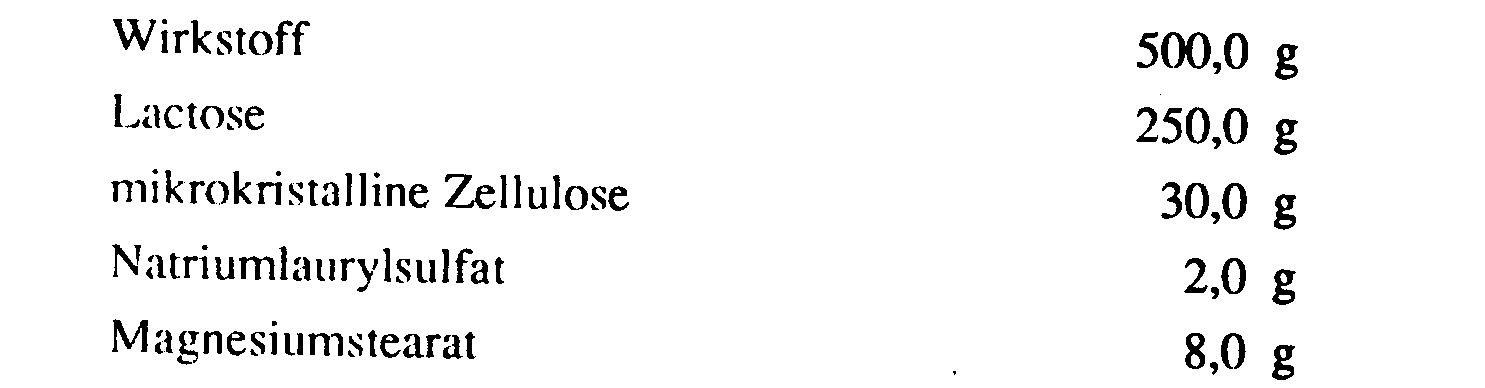
- Das Natriumlaurysulfat wird durch ein Sieb mit einer Maschenweite von 0,2 mm zu dem lyophilisierten Wirkstoff hinzugesiebt. Beide Komponenten werden innig vermischt. Dann wird zunächst die Lactose durch ein Sieb mit einer Maschenweite von 0,6 mm und dann die mikrokristalline Zellulose durch ein Sieb mit einer Maschenweite von 0,9 mm hinzuliebt. Daraufhin wird erneut 10 Minuten innig gemischt. Zuletzt wird das Magnesiumstearat durch ein Sieb mit einer Maschenweite Von 0,8 mm hinzugesiebt. Nach 3- minütigem weiteren Mischen werden je 790 mg der erhaltenen Formulierung in Gelatinesteckkapseln passender Grösse abgefüllt.
- Formulierungsbeispiel 4: Eine 5%-ige Injektions- oder Infusionslösung von 3-Aminopropyl-(cyclohexylmethyl)phosphinsäure oder eines Salzes, z.B. des Hydrochlorides, davon, kann beispielsweise folgendermassen hergestellt werden:
-

- Der Wirkstoff und das Natriumchlorid werden in 1000 ml Wasser gelöst und durch ein Mikrofilter filtriert. Man versetzt mit der Pufferlösung und füllt mit Wasser auf 2500 ml auf. Zur Herstellung von Dosiseinheitsformen werden je 1,0 oder 2,5 ml in Glasampullen abgefüllt, die dann je 50 bzw. 125 mg Wirkstoff enthalten.
- Formulierungsbeispiel 5: In analoger Weise wie in den vorstehenden Formulierungsbeispielen 1 bis 4 beschrieben kann man auch pharmazeutische Präparate, enthaltend eine Verbindung gemäss einem der Herstellungsbeispiele 1 bis 25 oder eine an sich bekannte Verbindung mit GABAB-antagonistischen Eigenschaften, beispielsweise eine der erfindungsgemäss zur Verwendung als antiepileptischen Arzneimittelwirkstoff vorgeschlagene Verbindung der Formel I, insbesondere
- 3-Aminopropyl(n-butyl)phosphinsaure,
- 3-Aminopropyl(diäthoxymethyl)phosphinsäure,
- 3-Aminopropyl(benzyl)phosphinsäure,
- 3-Aminopropyl(1,1 -difluorbutyl)phosphinsäure,
- 3-Amino-2-hydroxy-propyl(cyclohexylmethyl)phosphinsäure,
- 3-(p-Chlorbenzylamino)-2(R)-hydroxy-propyl(benzyl)phosphinsäure,
- 3-Amino-2(S)-hydroxy-propyl(cyclohexylmethyl)phosphinsäure,
- 3-Amino-2(S)-hydroxy-propyl(benzyl)phosphinsäure,
- 3-(p-Chlorbenzylamino)propyl(diäthoxymethyl)phosphinsäure,
- 3-(p-Chlorbenzylamino)-2(S)-hydroxy-propyl(benzyl)phosphinsäure,
- 3-(p-Chlorbenzylamino)-2-hydroxy-propyl(n-butyl)phosphinsäure,
- 3-(3,4-Dichlorbenzylamino)-2(S)-hydroxy-propyl(benzyl)phosphinsäure,
- 3-(3,4-Dichlorbenzylamino)-2(S)-hydroxy-propyl(diäthoxymethyl)phosphinsäure und
- 3-(p-Chlorbenzylamino)propyl(cyclohexylmethyl)phosphinsäure
- Hemmung der "Spike and Wave"-Entladungen an epileptischen Ratten
- Methode: Die Wirkung von GABAB-Antagonisten wurde an männlichen Wistar-Ratten (300-400 g) der Strasbourg-Kolonie geprüft. Tiere der 16. oder 17. Generation des Stammes, in dem 100% der Versuchstiere "Spike and Wave"-Entladungen zeigen (epileptischen Ratten) bzw. Tiere der 16. oder 17. Generation des Stammes, in dem 0% der Versuchstiere "Spike and Wave"-Entladungen zeigen (Kontrollstamm) wurden verwendet. Die Ratten erhielten Wasser und Nahrung ad libidum und der Hell/Dunkel Zyklus betrug 12/12 h. Die Ratten wurden mit Pentobarbital (40 mg/kg i.p.) anaesthesiert und mit 4 rostfreien Stahlelektroden (je zwei im Frontal- und Parietal-Cortex) bilateral implantiert. Die Ratten wurden frühestens eine Woche nach der Operation für Experimente verwendet.
- Die freibeweglichen Ratten wurden in einem Plexiglaskäfig (17x17x28 cm) untergebracht (eine Ratte pro Käfig) und das EEG nach 15-minütiger Anpassung an die neue Umgebung während 20 Minuten registriert (Referenzperiode). Man erhält so die Basislinie für die jeweilige Versuchsreihe. Anschliessend wurde ein GABAB-Antagonist verabreichet und das EEG während 120 bis 180 Minuten registiert. Die Ratten wurden während dieser Periode andauernd beobachtet und durch sanfte manuelle Berührung vom Einschlafen abgehalten.
- Versuchsanordnung: Die jeweilige Testsubstanz wurde in 0,9%-iger Natriumchloridlösung gelöst und in Dosen von 50, 100, 200 und 400 mg/kg i.p. injiziert. Alternativ kann man die jeweilige Testsubstanz auch einem Polyäthylenglykol, wie Tween@ 80, (2 Tropfen/ 10 ml Suspension der Testsubstanz in 0,9%-iger Natriumchloridlösung; die Suspension wird bei 40 10 min mittels Ultraschall homogenisiert, Injektionsvolumen: 2 ml/kg) i.p. oder per Magensonde p.o. appliziert werden. Schwerlösliche Testsubstanzen werden vorteilhaft in einem Gemisch von Dimethylsulfoxid (nicht mehr als 10 Vol-%) und 0,9%-iger Natriumchloridlösung oder in 45 %-iger wässriger Hydroxypropyl-ß-cyclodextrinlösung gelöst appliziert. Jedes Tier wird mit allen Dosen in einer randomisierten Reihenfolge behandelt. Die Zeit zwischen 2 Behandlungen soll mindestens 5 Tage betragen. Erfasst werden die Mittelwerte ± SEM der aufsummierten Gesamtdauer der "Spike and Wave"-Entladungen von 6 Ratten über 20 Minuten.
- Die aufsummierte Gesamtdauer der Spike and Wave-Entladungen (in Sekunden) wird für jede 20-Minutenperiode der EEG- Registrierung gemessen. Vergleiche zwischen Behandlungs- und Referenzperiode werden mit Hilfe der nonparametrischen Varianzanalyze der betreffenden Gruppen durchgeführt (Friedman Test). Kontrolle und behandelte Gruppen werden erst dann mit Hilfe des Wilcoxon-Test verglichen, wenn mit Hilfe des Friedmann-Testes ein signifikanter Unterschied zwischen beiden Gruppen gefunden wird. Die dosisabhängige Abnahme der "Spike and Wave"-Entladungen ist in den folgenden Tabellen gezeigt. Die Signifikanz der Unterschiede der mit Sternchen markierten Werte zur Dosis 0 im Wilcoxon-Test entspricht mindestens p<0,005.
-

-


-

-

-
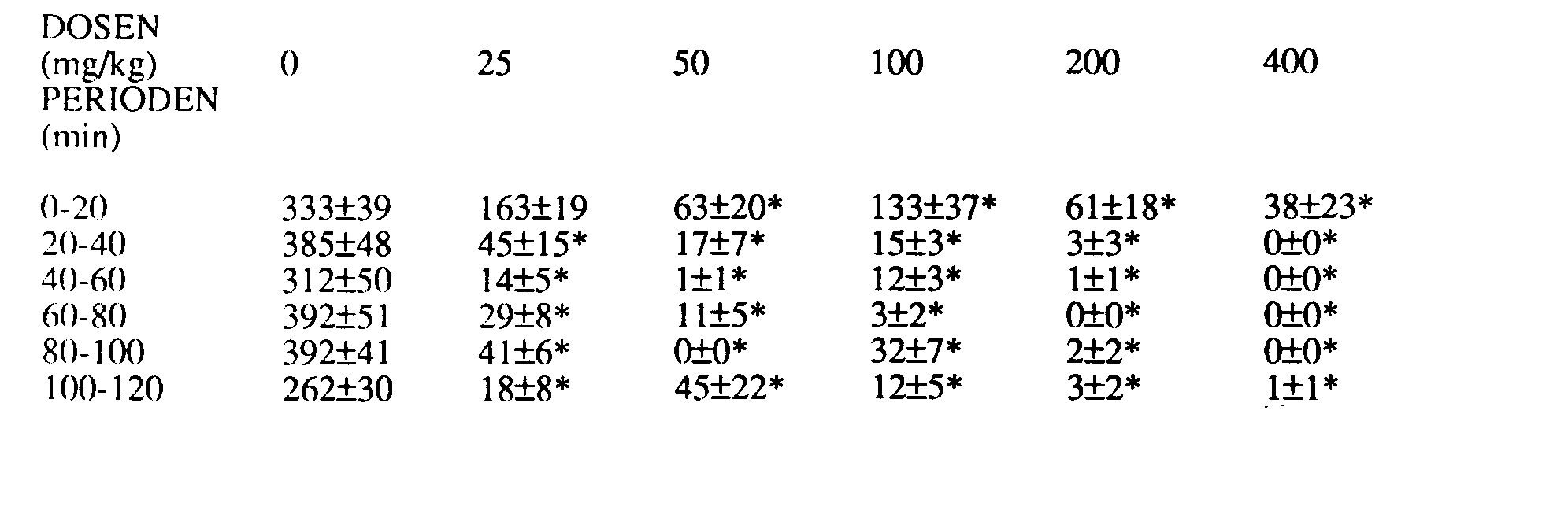

-

-
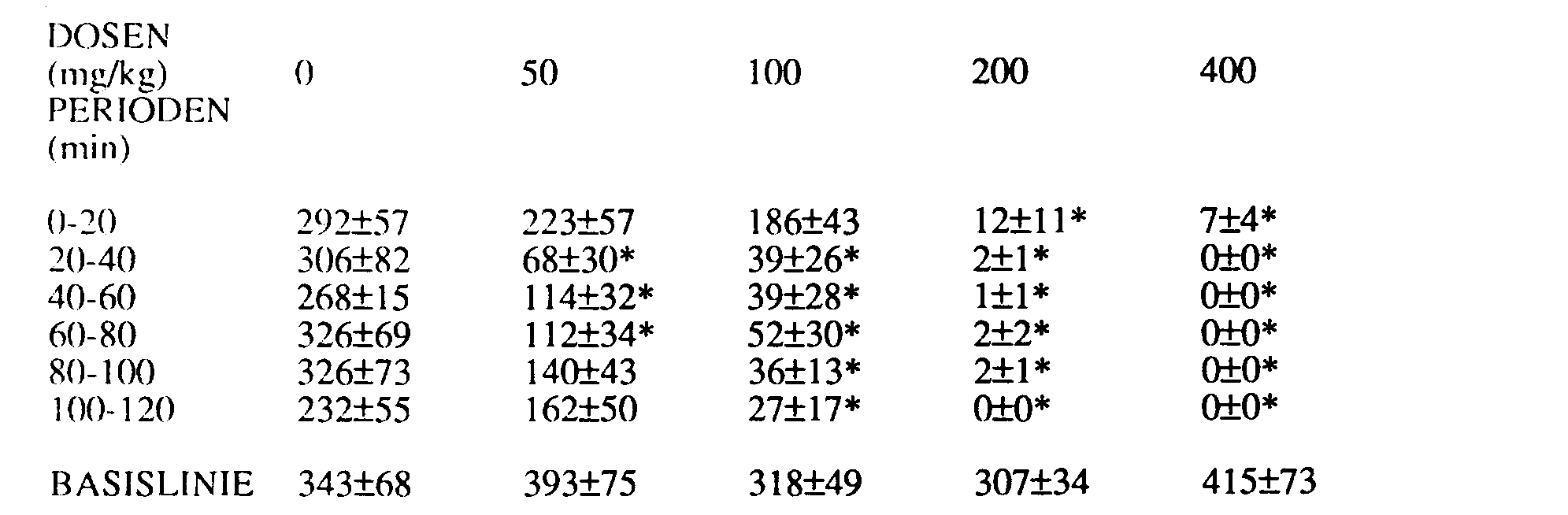
-

-


-
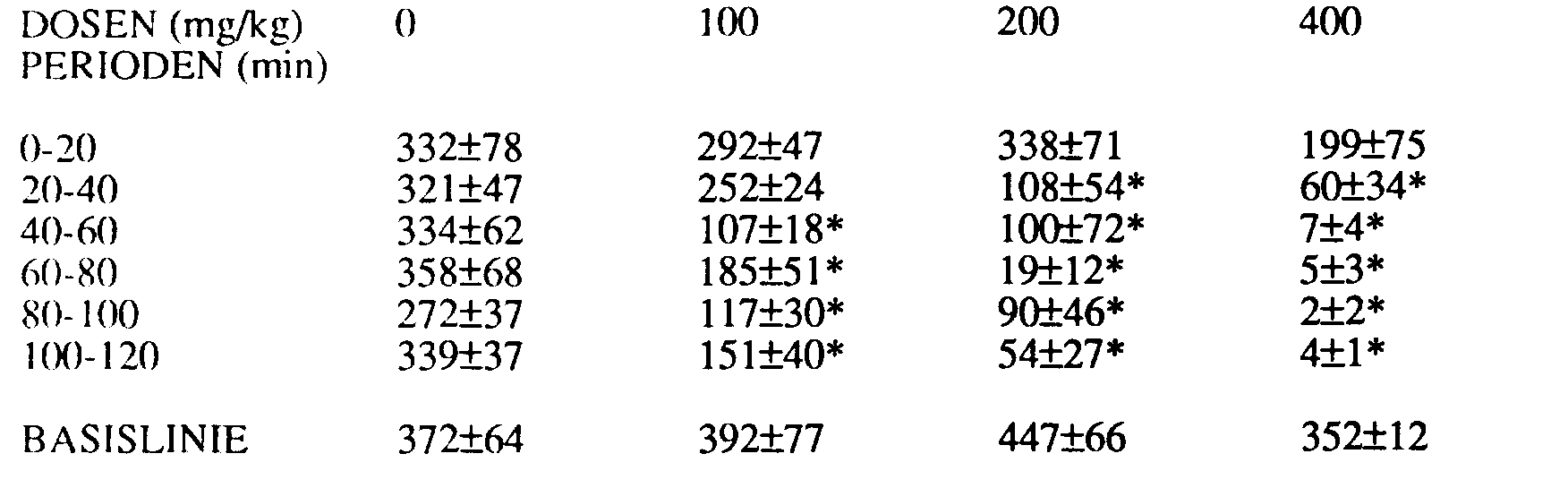
-

-

-

-

- Hemmung der durch "grand mal"-Antiepileptika induzierten "Spike and Wave"-Entladungen an epileptischen Ratten
- Methode und Versuchsanordnung entsprechen derjenigen des pharmakologischen Beispiels 1.
- 3-Aminopropyl(diäthoxymethyl)phosphinsäure: Antagonismus der durch Carbamazepin induzierten "Spike and Wave"-Entladungen.
- 3-Aminopropyl(diäthoxymethyl)phosphinsäure wurde zum Zeitpunkt 0 und 20 mg/kg Carbamazepin zum Zeitpunkt 40 jeweils i.p. appliziert.
-


- 3-Aminopropyl(diäthoxymethyl)phosphinsäure: Antagonismus der durch Phenytoin induzierten "Spike and Wave"-Entladungen.
- 3-Aminopropyl(diäthoxymethyl)phosphinsäure wurde zum Zeitpunkt 0 und 20 mg/kg Phenytoin zum Zeitpunkt 40 jeweils i.p. appliziert.
-


wobei R einen aliphatischen, cycloaliphatischen, cycloaliphatisch-aliphatischen, araliphatischen oder aromatischen Rest mit mindestens 2 C-Atomen oder, sofern R1 Wasserstoff oder Hydroxy, R2 einen aromatischen Rest und Ri', R2' sowie R3 Wasserstoff darstellen, für Methyl steht, und jeweils ihre pharmazeutisch verwendbaren Salze als Antiepileptika bzw. zur Herstellung eines Antiepileptikums zur Behandlung von Epilepsien des "petit mal"-Formenkreises, diese enthaltende antiepileptische Arzneimittel bzw. ein Verfahren zur Herstellung solcher Arzneimittel sowie ein durch Verabreichung eines solchen gekennzeichnetes Verfahren zur Behandlung epileptischer Erkrankungen des "petit mal"-Formenkreises.
wobei R einen aliphatischen cycloaliphatischen, cycloaliphatisch-aliphatischen, araliphatischen oder aromatischen Rest mit mindestens 2 C-Atomen oder, sofern R1 Wasserstoff oder Hydroxy, R2 einen aromatischen Rest und R1', R2' sowie R3 Wasserstoff darstellen, für Methyl steht, und ihrer pharmazeutisch verwendbaren Salze als Antiepileptika bzw. zur Herstellung eines Antiepileptikums zur Behandlung von Epilepsein des "petit mal"-Formenkreises, diese enthaltende antiepileptische Arzneimittel bzw. ein Verfahren zur Herstellung solcher Arzneimittel sowie ein durch Verabreichung eines solchen gekennzeichnetes Verfahren zur Behandlung epileptischer Erkrankungen des "petit mal"-Formenkreises sowie Verbindungen der Formel I, worin Ri, Ri', R2' und R3 Wasserstoff bedeuten, R2 Wasserstoff oder Hydroxy darstellt, R4 einen unsubstituierten oder durch Niederalkyl, Niederalkoxy und/oder Halogen substituierten Phenyl- oder Naphthylniederalkylrest oder einen unsubstituierten oder durch durch Halogen substituierten Thienyl-, Furyl- oder Pyridylniederalkylrest bedeutet, R5 Wasserstoff, Niederalkyl oder eine Gruppe R4 darstellt und R Niederalkyl mit mindestens 2 C-Atomen, Niederalkenyl, Niederalkinyl, Oxoniederalkyl, Hydroxy- oder Dihydroxyniederalkyl, Hydroxyniederalkenyl, Mono-, Di- oder Polyhalogenniederalkyl, Mono, Di- oder Polyhalogenniederalkenyl, Mono-, Di- oder Polyhalogen(hydroxy)niederalkyl, Mono-, Di- oder Polyhalogen(hydroxy)-niederalkenyl, Niederalkoxyniederalkyl, Diniederalkoxyniederalkyl, Niederalkoxy(hydroxy)niederalkyl, Niederalkoxy(halogen)niederalkyl, Niederalkylthioniederalkyl, Diniederalkylthioniederalkyl, Cycloalkyl, Hydroxycycloalkyl, Oxa-, Dioxa-, Thia- und Dithiacycloalkyl, Cycloalkyl(hydroxy)niederalkyl, (Niederalkylthio)-cycloalkyl(hydroxy)niederalkyl oder unsubstituiertes oder durch Niederalkyl, Niederalkoxy, Halogen und/oder Trifluormethyl mono- oder disubstituiertes Phenylniederalkyl oder Naphthylniederalkyl bedeutet, und ihre Salze, insbesondere ihre pharmazeutisch verwendbaren Salze.
R C2-C7-Alkyl, α,α-Di-C1-C4-alkoxy-C2-C7-alkyl, a,a-Dihalogen-C2-C7-alkyl, C3-C6-Cycloalkyl, C3-C6-Cycloalkyl-C1-C4-alkyl, Benzyl oder, sofern R2 Halogenphenyl oder Naphthyl und R1, R1', R2' sowie R3 Wasserstoff darstellen, Methyl bedeutet, und ihre pharmazeutisch verwendbaren Salze und ihrer pharmazeutisch verwendbaren Salze als Antiepileptika bzw. zur Herstellung eines Antiepileptikums zur Behandlung von Epilepsien des "petit mal"-Formenkreises, diese enthaltende antiepileptische Arzneimittel bzw. ein Verfahren zur Herstellung solcher Arzneimittel sowie ein durch Verabreichung eines solchen gekennzeichnetes Verfahren zur Behandlung epileptischer Erkrankungen des "petit mal"-Formenkreises sowie Verbindungen der Formel I, worin Ri, R1', R2' und R3 Wasserstoff bedeuten, R2 Wasserstoff oder Hydroxy darstellt, R4 unsubstituiertes oder durch C1-C4-Alkyl, wie Methyl, oder C1-C4-Alkoxy, wie Methoxy, monosubstituiertes oder durch Halogen der Atomnummer bis und mit 35, wie Chlor, mono- oder disubstituiertes Phenyl-C1-C4-alkyl, wie Benzyl, 1-Phenyläthyl oder 2-Phenylprop-2-yl, oder unsubstituiertes oder durch Halogen der Atomnummer bis und mit 35, wie Chlor, monosubstituiertes Naphthyl-, Thienyl-, Furyl- oder Pyridyl-C1-C4- alkyl, wie 1- oder 2-Naphthyl-, Thienyl-, Furyl- oder Pyridylmethyl darstellt, R5 Wasserstoff, C1-C4-Alkyl, wie Methyl, oder eine Gruppe R4 bedeutet und R C3-C7-Alkyl, wie Propyl, Isopropyl, Butyl, Isobutyl oder Pentyl, α,α-Di-C1-C4-alkoxy-C1-C4-alkyl, insbesondere a,a-Di-Ci-C4-alkoxymethyl, wie Dimethoxy- oder Diäthoxymethyl, C3-C6-CycloalkylC1-C4-alkyl, wie Cyclopropyl- oder Cyclohexylmethyl, oder unsubstituiertes oder durch C1-C4-Alkyl, wie Methyl, C1-C4-Alkoxy, wie Methoxy, oder Halogen der Atomnummer bis und mit 35, wie Chlor, substituiertes Benzyl bedeutet, und ihre Salze, insbesondere ihre pharmazeutisch verwendbaren Salze als solche.
kondensiert, worin R einen aliphatischen, cycloaliphatisch-aliphatischen, oder araliphatischen Rest oder eine Gruppe der Formel R-CH(OH)- darstellt, bzw. die Verbindung der Formel XIV mit einem aliphatischen, cycloaliphatischen, cycloaliphatisch-aliphatischen oder araliphatischen Keton der Formel R"-C(=O)-R''' (XVIII), worin R" eine aliphatischen, cycloaliphatischen oder aromatischen Rest und R'" einen aliphatischen Rest darstellt, zur entsprechenden Verbindung der Formel V, worin R einen Rest der Formel R"-C(R"')(OH)-bedeutet, oder mit einer entsprechenden aliphatischen, cycloaliphatisch-aliphatischen oder araliphatischen Epoxid oder einem entsprechenden, mindestens eine zusätzliche olefinische Doppelbindung aufweisenden aliphatischen, cycloaliphatischen, cycloaliphatisch-aliphatischen oder araliphatischen Verbindung weiterumsetzt und jeweils das Primärprodukt, beispielsweise der Formel XVII, hydrolytisch aufarbeitet.
wird dann in einen, Acetonitril/Tertiärbutanol/Wasser-Gemisch in Gegenwart von Silbernitrat und Osmiumtetroxid mit einem Reagenz umgesetzt, das man durch Umsetzung von Tertiärbutylurethan mit Tertiärbutoxychlorid in einem Niederalkanol in Gegenwart von Natriumhydroxid erhält. Das so erhaltene Primärprodukt wird schliesslich mit Trimethylbromsilan in Dichlormethan behandelt und ergibt eine Verbindung der Formel XXVI

in der Ro eine Silylgruppe und Zo' Tertiärbutyloxycarbonyl bedeutet. Behandlung mit wässrigem Methanol und anschliessend mit Propylenoxid ergibt die gewünschte Verbindung der Formel I.
oder jeweils ein pharmazeutisch verwendbares Salz davon herstellen.
Claims (78)

worin Ri, R1', R2' und R3 Wasserstoff bedeuten, R2 Wasserstoff oder Hydroxy darstellt, R4 einen araliphatischen Rest ausser unsubstituiertem 1-Phenylniederalkyl oder einen heteroarylaliphatischen Rest bedeutet, R5 Wasserstoff, Niederalkyl oder eine Gruppe R4 darstellt und R einen aliphatischen, cycloaliphatischen, cycloaliphatisch-aliphatischen oder araliphatischen Rest mit mindestens 2 C-Atomen bedeutet, und ihre Salze.
oder jeweils ein Salz davon.

worin Ri, Ri', R2' und R3 Wasserstoff bedeuten, R2 Wasserstoff oder Hydroxy darstellt, R4 einen araliphatischen Rest oder einen heteroarylaliphatischen Rest bedeutet, R5 Wasserstoff, Niederalkyl oder eine Gruppe R4 darstellt und R einen aliphatischen, cycloaliphatischen, cycloaliphatisch-aliphatischen oder araliphatischen Rest mit mindestens 2 C-Atomen bedeutet, in freier Form oder in pharmazeutisch verwendbarer Salzform zum Anwendung in einen Verfahren zur therapeutischen Behandlung des menschlichen oder tierischen Körpers.

worin Ri, R1', R2' und R3 Wasserstoff bedeuten, R2 Wasserstoff oder Hydroxy darstellt, R4 einen araliphatischen Rest oder einen heteroarylaliphatischen Rest bedeutet, R3 Wasserstoff, Niederalkyl oder eine Gruppe R4 darstellt und R einen aliphatischen, cycloaliphatischen, cycloaliphatisch-aliphatischen oder araliphatischen Rest mit mindestens 2 C-Atomen bedeutet, in freier Form oder in pharmazeutisch verwendbarer Salzform.


worin einer der Reste Ri, R2 und R3 Wasserstoff oder einen aliphatischen, cycloaliphatischen, araliphatischen oder aromatischen Rest, ein anderer Wasserstoff oder im Falle von R1 oder R2 Hydroxy oder im Falle von R1 Halogen oder im Falle von R2 gemeinsam mit R2' Oxo bedeutet und der verbleibende Wasserstoff darstellt, Ri' Wasserstoff oder Halogen ist, R2' Wasserstoff, Hydroxy oder gemeinsam mit R2 Oxo darstellt, R4 und R5 Wasserstoff darstellen oder R4 einen araliphatischen oder heteroarylaliphatischen Rest bedeutet und R5 für Wasserstoff, einen aliphatischen Rest oder eine Gruppe R4 steht und R einen aliphatischen, cycloaliphatischen, cycloaliphatisch-aliphatischen, araliphatischen, heteroarylaliphatischen oder aromatischen Rest mit mindestens 2 C-Atomen oder, sofern R1 Wasserstoff oder Hydroxy, R2 einen aromatischen Rest und R1', R2' sowie R3 Wasserstoff darstellen, für Methyl steht, oder ein pharmazeutisch verwendbares Salz davon.
wobei R einen aliphatischen cycloaliphatischen, cycloaliphatisch-aliphatischen, araliphatischen oder aromatischen Rest mit mindestens 2 C-Atomen oder, sofern R1 Waserstoff oder Hydroxy, R2 einen aromatischen Rest und Ri', R2' sowie R3 Wasserstoff darstellen, für Methyl steht, oder ein pharmazeutisch verwendbares Salz davon.
(Niederalkylthio)cycloalkyl(hydroxy)niederalkyl, unsubstituiertes oder im Phenyl- bzw. Naphthylteil durch Niederalkyl, Niederalkoxy, Halogen und/oder Trifluormethyl ein- oder mehrfach substituiertes Phenyl-oder Naphthylniederalkyl, unsubstituiertes oder durch Halogen, Niederalkyl, Niederalkoxy und/oder Trifluormethyl substituiertes Phenyl oder Naphthyl oder, sofern R1 Wasserstoff oder Hydroxy, R2 einen aromatischen Rest und R1', R2' sowie R3 Wasserstoff darstellen, Methyl bedeutet, oder ein pharmazeutisch verwendbares Salz davon.
wobei R einen aliphatischen cycloaliphatischen, cycloaliphatisch-aliphatischen, araliphatischen oder aromatischen Rest mit mindestens 2 C-Atomen oder, sofern R1 Wasserstoff oder Hydroxy, R2 einen aromatischen Rest und Ri', R2' sowie R3 Wasserstoff darstellen, für Methyl steht, oder ein pharmazeutisch verwendbares Salz davon.
R C2-C7-Alkyl, α,α-Di-C1-C4-alkoxy-C2-C7-alkyl, a,a-Dihalogen-C2-C7-alkyl, C3-C6-Cycloalkyl, C3-C6-Cycloalkyl-C1-C4-alkyl, Benzyl oder, sofern oder, sofern R2 Halogenphenyl oder Naphthyl und R1, R1', R2' sowie R3 Wasserstoff darstellen, Methyl bedeutet, oder ein pharmazeutisch verwendbares Salz davon.
Applications Claiming Priority (6)
| Application Number | Priority Date | Filing Date | Title |
|---|---|---|---|
| CH209290 | 1990-06-22 | ||
| CH2092/90 | 1990-06-22 | ||
| CH44091 | 1991-02-13 | ||
| CH440/91 | 1991-02-13 | ||
| CH119991 | 1991-04-22 | ||
| CH1199/91 | 1991-04-22 |
Publications (2)
| Publication Number | Publication Date |
|---|---|
| EP0463560A1 true EP0463560A1 (de) | 1992-01-02 |
| EP0463560B1 EP0463560B1 (de) | 1995-10-25 |
Family
ID=27172107
Family Applications (1)
| Application Number | Title | Priority Date | Filing Date |
|---|---|---|---|
| EP91110074A Expired - Lifetime EP0463560B1 (de) | 1990-06-22 | 1991-06-19 | Neuartige Antiepileptika |
Country Status (21)
| Country | Link |
|---|---|
| US (3) | US5229379A (de) |
| EP (1) | EP0463560B1 (de) |
| JP (1) | JP3222487B2 (de) |
| KR (1) | KR100219315B1 (de) |
| AT (1) | ATE129500T1 (de) |
| AU (1) | AU641772B2 (de) |
| CA (1) | CA2045077C (de) |
| DE (1) | DE59106756D1 (de) |
| DK (1) | DK0463560T3 (de) |
| ES (1) | ES2079520T3 (de) |
| FI (1) | FI101705B1 (de) |
| GR (1) | GR3017895T3 (de) |
| HR (1) | HRP940512A2 (de) |
| HU (1) | HUT59148A (de) |
| IE (1) | IE69314B1 (de) |
| IL (3) | IL114631A (de) |
| NO (1) | NO302476B1 (de) |
| NZ (2) | NZ247934A (de) |
| PT (1) | PT98064B (de) |
| SI (1) | SI9111099B (de) |
| YU (1) | YU109991A (de) |
Cited By (26)
| Publication number | Priority date | Publication date | Assignee | Title |
|---|---|---|---|---|
| WO1993011138A1 (en) * | 1991-12-02 | 1993-06-10 | John Wyeth & Brother Limited | Amine derivatives containing a phosphonic, phosphonous or phosphinic acid moiety |
| EP0543780A3 (en) * | 1991-11-21 | 1993-09-01 | Ciba-Geigy Ag | Novel aminoalkanephosphinic acids and their salts |
| EP0569333A3 (de) * | 1992-05-08 | 1994-04-06 | Ciba Geigy Ag | |
| WO1997011953A1 (en) * | 1995-09-28 | 1997-04-03 | Novartis Ag | Novel hydroxylated and alkoxylated n- and/or p-aralkylphosphinic acid derivatives |
| EP0826690A1 (de) * | 1996-08-28 | 1998-03-04 | Hoechst Aktiengesellschaft | Verfahren zur Herstellung von 2-Cyanoethyl-phosphinsäureestern |
| WO2005054259A1 (en) * | 2003-11-21 | 2005-06-16 | Novartis Ag | Phosphinic acid derivatives |
| WO2010051892A1 (de) * | 2008-11-07 | 2010-05-14 | Clariant International Ltd | Verfahren zur herstellung von mono-aminofunktionalisierten dialkylphosphinsäuren, -estern und -salzen mittels acrylnitrilen und ihre verwendung |
| WO2010051894A1 (de) * | 2008-11-07 | 2010-05-14 | Clariant International Ltd | Verfahren zur herstellung von mono-aminofunktionalisierten dialkylphophinsäuren, -estern und -salzen und ihre verwendung |
| WO2010051886A1 (de) * | 2008-11-06 | 2010-05-14 | Clariant International Ltd | Verfahren zur herstellung von mono-aminofunktionalisierten dialkylphosphinsäuren, deren salze und ester und ihre verwendung |
| WO2010051888A1 (de) * | 2008-11-06 | 2010-05-14 | Clariant International Ltd | Verfahren zur herstellung von mono-carboxyfunktionalisierten dialkylphosphinsäuren, -estern und -salzen mittels vinylen/nitrilen und ihre verwendung |
| WO2010069419A1 (de) * | 2008-12-18 | 2010-06-24 | Clariant International Ltd | Verfahren zur herstellung von gemischtsubstituierten dialkylphosphinsäuren, -estern und -salzen und ihre verwendung |
| US8592505B2 (en) | 2008-12-19 | 2013-11-26 | Clariant Finance (Bvi) Limited | Hydrophosphorylation of phosphonous acid derivatives for flame retardants |
| US8604108B2 (en) | 2008-11-05 | 2013-12-10 | Clariant Finance (Bvi) Limited | Method for producing mono-hydroxyfunctionalized dialkylphosphinic acids and esters and salts thereof by means of acroleins and use thereof |
| US8614267B2 (en) | 2008-11-05 | 2013-12-24 | Clariant Finance (Bvi) Limited | Method for producing mono-hydroxyfunctionalized dialkylphosphinic acids and esters and salts thereof by means of allyl alcohols and use thereof |
| US8664418B2 (en) | 2008-11-07 | 2014-03-04 | Clariant Finance (Bvi) Limited | Method for producing dialkylphosphinic acids and esters and salts thereof by means of acrylic acid derivatives and use thereof |
| US8735476B2 (en) | 2008-12-02 | 2014-05-27 | Clariant Finance (Bvi) Limited | Method for producing mono-carboxy-functionalized dialkylphosphinic acids, esters and salts using a vinyl ester of a carboxylic acid and the use thereof |
| US8735477B2 (en) | 2008-11-07 | 2014-05-27 | Clariant Finance (Bvi) Limited | Method for producing dialkylphosphinic acids and esters and salts thereof by means of acrylnitriles and use thereof |
| US8772519B2 (en) | 2008-11-11 | 2014-07-08 | Clariant Finance (Bvi) Limited | Process for preparing mono-allyl-functionalized dialkylphosphinic acids, salts and esters thereof with allylic compounds, and the use thereof |
| US8987490B2 (en) | 2008-12-18 | 2015-03-24 | Clariant Finance (Bvi) Limited | Method for the production of monohydroxy-functionalized dialkylphosphinic acids, esters, and salts using ethylene oxide, and use thereof |
| US8987489B2 (en) | 2008-12-04 | 2015-03-24 | Clariant Finance (Bvi) Limited | Method for producing mono-carboxy-functionalized dialkylphosphinic acids, esters and salts using a vinyl ether and the use thereof |
| US9018413B2 (en) | 2008-12-18 | 2015-04-28 | Clariant Finance (Bvi) Limited | Method for the production of alkylphosphonic acids, esters, and salts by oxidizing alkylphosphonous acids, and use thereof |
| US9068119B2 (en) | 2008-12-02 | 2015-06-30 | Clariant Finance (Bvi) Limited | Method for producing mono-hydroxy-functionalized dialkylphosphinic acids, esters and salts using a vinyl ester of a carobxylic acid and the use thereof |
| US9085734B2 (en) | 2008-12-18 | 2015-07-21 | Clariant Finance (Bvi) Limited | Process for preparing mono-carboxy-functionalized dialkylphosphinic acids, esters and salts by means of alkylene oxides and use thereof |
| US9139714B2 (en) | 2008-11-05 | 2015-09-22 | Clariant Finance (Bvi) Limited | Method for producing dialkylphosphinic acids and esters and salts thereof by means of allyl alcohols-acroleins and use thereof |
| US9181487B2 (en) | 2008-12-18 | 2015-11-10 | Clariant Finance (Bvi) Limited | Process for preparing ethylenedialkylphosphinic acids, esters and salts by means of acetylene and use thereof |
| US9279085B2 (en) | 2008-12-19 | 2016-03-08 | Clariant Finance (Bvi) Limited | Method for the production of monofunctionalized dialkylphosphinic acids, esters and salts, and use thereof |
Families Citing this family (14)
| Publication number | Priority date | Publication date | Assignee | Title |
|---|---|---|---|---|
| US5457095A (en) * | 1984-10-12 | 1995-10-10 | Ciba-Geigy Corporation | Substituted propane-phosponous acid compounds |
| US5567840A (en) * | 1989-05-13 | 1996-10-22 | Ciba-Geigy Corporation | Substituted aminoalkylphosphinic acids |
| US5281747A (en) * | 1989-05-13 | 1994-01-25 | Ciba-Geigy Corporation | Substituted aminoalkylphosphinic acids |
| DE4407197A1 (de) * | 1994-03-04 | 1995-09-07 | Hoechst Schering Agrevo Gmbh | Verfahren zur Herstellung von /L/-Homoalanin-4-yl-(methyl)phosphinsäure und deren Salze durch Racematspaltung |
| AU744189B2 (en) | 1997-06-23 | 2002-02-14 | Neuro Therapeutics Limited | Neurologically-active compounds |
| JP3382159B2 (ja) * | 1998-08-05 | 2003-03-04 | 株式会社東芝 | 情報記録媒体とその再生方法及び記録方法 |
| US7319095B2 (en) * | 1999-12-09 | 2008-01-15 | Astrazeneca Ab | Use of GABAB receptor agonists |
| SE9904508D0 (sv) * | 1999-12-09 | 1999-12-09 | Astra Ab | New compounds |
| WO2004083855A1 (en) * | 2003-03-19 | 2004-09-30 | Solvo Biotechnology, Inc. | Method for the identification of cells specifically modulating slow inhibition in the neocortex |
| AR045794A1 (es) * | 2003-09-23 | 2005-11-16 | Aventis Pharma Inc | Procedimiento para preparar derivados de acido 3- amino-2- hidroxipropilfosfinico |
| KR20060108692A (ko) * | 2003-10-31 | 2006-10-18 | 알자 코포레이션 | 메트포르민의 개선된 흡수를 위한 조성물 및 제형 |
| US7494985B2 (en) * | 2004-11-03 | 2009-02-24 | Xenoport, Inc. | Acyloxyalkyl carbamate prodrugs, methods of synthesis, and use |
| US7566738B2 (en) * | 2004-11-03 | 2009-07-28 | Xenoport, Inc. | Acyloxyalkyl carbamate prodrugs of sulfinic acids, methods of synthesis, and use |
| US7585996B2 (en) * | 2006-09-15 | 2009-09-08 | Xenoport, Inc. | Acyloxyalkyl carbamate prodrugs, methods of synthesis and use |
Citations (3)
| Publication number | Priority date | Publication date | Assignee | Title |
|---|---|---|---|---|
| FR2282431A1 (fr) * | 1974-08-22 | 1976-03-19 | Hoechst Ag | Sels d'ammonium internes de l'acide phosphinique |
| EP0181833A1 (de) * | 1984-10-12 | 1986-05-21 | Ciba-Geigy Ag | Substituierte Propanphosphonigsäure-Verbindungen |
| EP0319479A2 (de) * | 1987-12-04 | 1989-06-07 | Ciba-Geigy Ag | Substituierte Propanphosphinsäure-Verbindungen |
Family Cites Families (28)
| Publication number | Priority date | Publication date | Assignee | Title |
|---|---|---|---|---|
| US2535175A (en) * | 1949-05-11 | 1950-12-26 | Us Rubber Co | Nitroalkanephosphonates |
| US3184496A (en) * | 1961-02-27 | 1965-05-18 | Hooker Chemical Corp | Process for the preparation and recovery of triethyl phosphite and derivatives thereof |
| US3374288A (en) * | 1965-09-03 | 1968-03-19 | Du Pont | Polycarbonamide filaments containing polyalkylene oxide, sodium phenyl phosphinate and sodium aminoalkylphosphinate |
| US3493639A (en) * | 1965-10-27 | 1970-02-03 | Shell Oil Co | Process for producing pentavalent phosphorus derivatives |
| US3385822A (en) * | 1967-07-03 | 1968-05-28 | Gen Electric | Moisture curable polysiloxane phosphate composition |
| US3784590A (en) * | 1969-01-02 | 1974-01-08 | Merck & Co Inc | Hydroxy and imino containing phosphonic acid diesters |
| US3637763A (en) * | 1969-01-02 | 1972-01-25 | Merck & Co Inc | Preparation of (cis-1 2-epoxypropyl) phosphonates from substituted imino compounds |
| DE2032712C3 (de) * | 1970-07-02 | 1978-10-19 | Bayer Ag, 5090 Leverkusen | Verfahren zur Herstellung von w-Amino-alkanphosphonsäure bzw.- phosphinsäurederivaten |
| SU463675A1 (ru) * | 1973-12-04 | 1975-03-15 | Казанский Химико-Технологический Институт Им.С.М.Кирова | Способ получени -фосфорилированных нитроалканолов |
| DE2424243A1 (de) * | 1974-05-18 | 1975-11-27 | Bayer Ag | Perfluoralkansulfonamidoalkanphosphonsaeure- bzw. -phosphinsaeurederivate |
| US4064163A (en) * | 1976-12-30 | 1977-12-20 | Amchem Products, Inc. | Process for the manufacture of aliphatic phosphonic acids |
| US4339443A (en) * | 1978-09-22 | 1982-07-13 | Fbc Limited | Compounds and compositions |
| DE3060427D1 (en) * | 1979-02-06 | 1982-07-08 | Ciba Geigy Ag | 2-substituted 5-phenoxy-phenylphosphonic acid derivatives, process for preparing them and their use as herbicides |
| US4390690A (en) * | 1979-07-24 | 1983-06-28 | Occidental Research Corp. | Layered organophosphorous inorganic polymers containing oxygen bonded to carbon |
| ATE11918T1 (de) * | 1979-12-08 | 1985-03-15 | Fbc Ltd | 4-(methylphosphinyl)-2-oxobuttersaeure-derivate, sie enthaltende herbizide zusammensetzungen und zwischenprodukte und verfahren zu ihrer herstellung. |
| US4466913A (en) * | 1981-06-30 | 1984-08-21 | Maiji Seika Kaisha Ltd. | Phosphorus-containing compounds and process for producing the same |
| DE3362581D1 (en) * | 1982-04-23 | 1986-04-24 | Ciba Geigy Ag | Herbicide and plant-growth regulator product |
| US4536355A (en) * | 1982-10-08 | 1985-08-20 | Zoecon Corporation | Phenoxyphenylaminoalkylphosphinates useful in weed control |
| SU1174438A1 (ru) * | 1984-05-21 | 1985-08-23 | МГУ им.М.В.Ломоносова | Способ получени алкокси-(триметилсилокси)фосфинов |
| US5243062A (en) * | 1984-10-12 | 1993-09-07 | Ciba-Geigy Corporation | Substituted propane-phosphonous acid compounds |
| US4740322A (en) * | 1985-07-29 | 1988-04-26 | The Lubrizol Corporation | Sulfur-containing compositions, and additive concentrates, lubricating oils, metal working lubricants and asphalt compositions containing same |
| US4657899A (en) * | 1986-04-09 | 1987-04-14 | Nova Pharmaceutical Corporation | Antagonists of specific excitatory amino acid neurotransmitter receptors |
| US4740332A (en) * | 1986-05-12 | 1988-04-26 | E. R. Squibb & Sons, Inc. | Process for preparing phosphonous acids |
| US5300679A (en) * | 1987-12-04 | 1994-04-05 | Ciba-Geigy Corporation | Substituted propane-phosphinic acid compounds |
| JPH0651709B2 (ja) * | 1987-12-09 | 1994-07-06 | 明治製菓株式会社 | 新規ホスフィン酸誘導体およびそれを有効成分とする脳循環代謝改善剤 |
| GB8820266D0 (en) * | 1988-08-26 | 1988-09-28 | Smith Kline French Lab | Compounds |
| EP0543780A3 (en) * | 1991-11-21 | 1993-09-01 | Ciba-Geigy Ag | Novel aminoalkanephosphinic acids and their salts |
| AU662404B2 (en) * | 1992-05-08 | 1995-08-31 | Novartis Ag | Novel N-aralkyl- and N-heteroaralkyl-aminoalkanephosphinic acids |
-
1991
- 1991-06-14 IL IL11463191A patent/IL114631A/en not_active IP Right Cessation
- 1991-06-14 IL IL98502A patent/IL98502A/en not_active IP Right Cessation
- 1991-06-19 ES ES91110074T patent/ES2079520T3/es not_active Expired - Lifetime
- 1991-06-19 FI FI912998A patent/FI101705B1/fi active
- 1991-06-19 DE DE59106756T patent/DE59106756D1/de not_active Expired - Fee Related
- 1991-06-19 AT AT91110074T patent/ATE129500T1/de not_active IP Right Cessation
- 1991-06-19 EP EP91110074A patent/EP0463560B1/de not_active Expired - Lifetime
- 1991-06-19 DK DK91110074.1T patent/DK0463560T3/da not_active Application Discontinuation
- 1991-06-20 NZ NZ247934A patent/NZ247934A/en unknown
- 1991-06-20 HU HU912064A patent/HUT59148A/hu unknown
- 1991-06-20 US US07/718,503 patent/US5229379A/en not_active Expired - Lifetime
- 1991-06-20 NZ NZ238636A patent/NZ238636A/en unknown
- 1991-06-20 CA CA002045077A patent/CA2045077C/en not_active Expired - Fee Related
- 1991-06-21 NO NO912429A patent/NO302476B1/no not_active IP Right Cessation
- 1991-06-21 PT PT98064A patent/PT98064B/pt not_active IP Right Cessation
- 1991-06-21 YU YU109991A patent/YU109991A/sh unknown
- 1991-06-21 SI SI9111099A patent/SI9111099B/sl unknown
- 1991-06-21 IE IE215891A patent/IE69314B1/en unknown
- 1991-06-21 AU AU79220/91A patent/AU641772B2/en not_active Ceased
- 1991-06-21 JP JP15064791A patent/JP3222487B2/ja not_active Expired - Fee Related
- 1991-06-21 KR KR1019910010289A patent/KR100219315B1/ko not_active Expired - Fee Related
-
1993
- 1993-05-03 US US08/056,726 patent/US5407922A/en not_active Expired - Lifetime
-
1994
- 1994-09-08 HR HR940512A patent/HRP940512A2/xx not_active Application Discontinuation
-
1995
- 1995-01-20 US US08/375,878 patent/US5545631A/en not_active Expired - Lifetime
- 1995-07-17 IL IL11463195A patent/IL114631A0/xx unknown
- 1995-10-26 GR GR950402941T patent/GR3017895T3/el unknown
Patent Citations (3)
| Publication number | Priority date | Publication date | Assignee | Title |
|---|---|---|---|---|
| FR2282431A1 (fr) * | 1974-08-22 | 1976-03-19 | Hoechst Ag | Sels d'ammonium internes de l'acide phosphinique |
| EP0181833A1 (de) * | 1984-10-12 | 1986-05-21 | Ciba-Geigy Ag | Substituierte Propanphosphonigsäure-Verbindungen |
| EP0319479A2 (de) * | 1987-12-04 | 1989-06-07 | Ciba-Geigy Ag | Substituierte Propanphosphinsäure-Verbindungen |
Cited By (36)
| Publication number | Priority date | Publication date | Assignee | Title |
|---|---|---|---|---|
| EP0543780A3 (en) * | 1991-11-21 | 1993-09-01 | Ciba-Geigy Ag | Novel aminoalkanephosphinic acids and their salts |
| EP0767174A1 (de) * | 1991-11-21 | 1997-04-09 | Ciba-Geigy Ag | Neue Aminoalkanphosphinsäuren und ihre Salze |
| WO1993011138A1 (en) * | 1991-12-02 | 1993-06-10 | John Wyeth & Brother Limited | Amine derivatives containing a phosphonic, phosphonous or phosphinic acid moiety |
| GB2276168A (en) * | 1991-12-02 | 1994-09-21 | Wyeth John & Brother Ltd | Amine derivatives containing a phosphonic,phosphonous or phosphinic acid moiety |
| GB2276168B (en) * | 1991-12-02 | 1995-09-20 | Wyeth John & Brother Ltd | Amine derivatives containing a phosphonic,phosphonous or phosphinic acid moiety |
| EP0569333A3 (de) * | 1992-05-08 | 1994-04-06 | Ciba Geigy Ag | |
| US5332729A (en) * | 1992-05-08 | 1994-07-26 | Ciba-Geigy Corporation | N-aralkyl- and N-heteroaralkyl-aminoalkanephosphinic acids |
| WO1997011953A1 (en) * | 1995-09-28 | 1997-04-03 | Novartis Ag | Novel hydroxylated and alkoxylated n- and/or p-aralkylphosphinic acid derivatives |
| EP0826690A1 (de) * | 1996-08-28 | 1998-03-04 | Hoechst Aktiengesellschaft | Verfahren zur Herstellung von 2-Cyanoethyl-phosphinsäureestern |
| US5990337A (en) * | 1996-08-28 | 1999-11-23 | Ticona Gmbh | Process for the preparation of 2-cyanoethylphosphinic esters |
| WO2005054259A1 (en) * | 2003-11-21 | 2005-06-16 | Novartis Ag | Phosphinic acid derivatives |
| AU2004295060B2 (en) * | 2003-11-21 | 2007-08-30 | Novartis Ag | Phosphinic acid derivatives |
| US7498319B2 (en) | 2003-11-21 | 2009-03-03 | Novartis Ag | Phosphinic acid derivatives |
| US9139714B2 (en) | 2008-11-05 | 2015-09-22 | Clariant Finance (Bvi) Limited | Method for producing dialkylphosphinic acids and esters and salts thereof by means of allyl alcohols-acroleins and use thereof |
| US8614267B2 (en) | 2008-11-05 | 2013-12-24 | Clariant Finance (Bvi) Limited | Method for producing mono-hydroxyfunctionalized dialkylphosphinic acids and esters and salts thereof by means of allyl alcohols and use thereof |
| US8604108B2 (en) | 2008-11-05 | 2013-12-10 | Clariant Finance (Bvi) Limited | Method for producing mono-hydroxyfunctionalized dialkylphosphinic acids and esters and salts thereof by means of acroleins and use thereof |
| WO2010051886A1 (de) * | 2008-11-06 | 2010-05-14 | Clariant International Ltd | Verfahren zur herstellung von mono-aminofunktionalisierten dialkylphosphinsäuren, deren salze und ester und ihre verwendung |
| WO2010051888A1 (de) * | 2008-11-06 | 2010-05-14 | Clariant International Ltd | Verfahren zur herstellung von mono-carboxyfunktionalisierten dialkylphosphinsäuren, -estern und -salzen mittels vinylen/nitrilen und ihre verwendung |
| CN102186867A (zh) * | 2008-11-07 | 2011-09-14 | 科莱恩金融(Bvi)有限公司 | 借助丙烯腈类制备单氨基官能化的二烷基次膦酸、二烷基次膦酸酯和二烷基次膦酸盐的方法和它们的用途 |
| US8604232B2 (en) | 2008-11-07 | 2013-12-10 | Clariant Finance (Bvi) Limited | Method for producing monoamino-functionalised dialkylphosphinite acids esters and salts and use thereof |
| WO2010051892A1 (de) * | 2008-11-07 | 2010-05-14 | Clariant International Ltd | Verfahren zur herstellung von mono-aminofunktionalisierten dialkylphosphinsäuren, -estern und -salzen mittels acrylnitrilen und ihre verwendung |
| WO2010051894A1 (de) * | 2008-11-07 | 2010-05-14 | Clariant International Ltd | Verfahren zur herstellung von mono-aminofunktionalisierten dialkylphophinsäuren, -estern und -salzen und ihre verwendung |
| US8664418B2 (en) | 2008-11-07 | 2014-03-04 | Clariant Finance (Bvi) Limited | Method for producing dialkylphosphinic acids and esters and salts thereof by means of acrylic acid derivatives and use thereof |
| US9035088B2 (en) | 2008-11-07 | 2015-05-19 | Clariant Finance (Bvi) Limited | Method for producing mono-aminofunctionalized dialkylphosphinic acids and esters and salts thereof by means of acrylnitriles and use thereof |
| US8735477B2 (en) | 2008-11-07 | 2014-05-27 | Clariant Finance (Bvi) Limited | Method for producing dialkylphosphinic acids and esters and salts thereof by means of acrylnitriles and use thereof |
| US8772519B2 (en) | 2008-11-11 | 2014-07-08 | Clariant Finance (Bvi) Limited | Process for preparing mono-allyl-functionalized dialkylphosphinic acids, salts and esters thereof with allylic compounds, and the use thereof |
| US9068119B2 (en) | 2008-12-02 | 2015-06-30 | Clariant Finance (Bvi) Limited | Method for producing mono-hydroxy-functionalized dialkylphosphinic acids, esters and salts using a vinyl ester of a carobxylic acid and the use thereof |
| US8735476B2 (en) | 2008-12-02 | 2014-05-27 | Clariant Finance (Bvi) Limited | Method for producing mono-carboxy-functionalized dialkylphosphinic acids, esters and salts using a vinyl ester of a carboxylic acid and the use thereof |
| US8987489B2 (en) | 2008-12-04 | 2015-03-24 | Clariant Finance (Bvi) Limited | Method for producing mono-carboxy-functionalized dialkylphosphinic acids, esters and salts using a vinyl ether and the use thereof |
| US8987490B2 (en) | 2008-12-18 | 2015-03-24 | Clariant Finance (Bvi) Limited | Method for the production of monohydroxy-functionalized dialkylphosphinic acids, esters, and salts using ethylene oxide, and use thereof |
| US9018413B2 (en) | 2008-12-18 | 2015-04-28 | Clariant Finance (Bvi) Limited | Method for the production of alkylphosphonic acids, esters, and salts by oxidizing alkylphosphonous acids, and use thereof |
| US9085734B2 (en) | 2008-12-18 | 2015-07-21 | Clariant Finance (Bvi) Limited | Process for preparing mono-carboxy-functionalized dialkylphosphinic acids, esters and salts by means of alkylene oxides and use thereof |
| WO2010069419A1 (de) * | 2008-12-18 | 2010-06-24 | Clariant International Ltd | Verfahren zur herstellung von gemischtsubstituierten dialkylphosphinsäuren, -estern und -salzen und ihre verwendung |
| US9181487B2 (en) | 2008-12-18 | 2015-11-10 | Clariant Finance (Bvi) Limited | Process for preparing ethylenedialkylphosphinic acids, esters and salts by means of acetylene and use thereof |
| US8592505B2 (en) | 2008-12-19 | 2013-11-26 | Clariant Finance (Bvi) Limited | Hydrophosphorylation of phosphonous acid derivatives for flame retardants |
| US9279085B2 (en) | 2008-12-19 | 2016-03-08 | Clariant Finance (Bvi) Limited | Method for the production of monofunctionalized dialkylphosphinic acids, esters and salts, and use thereof |
Also Published As
Similar Documents
| Publication | Publication Date | Title |
|---|---|---|
| EP0463560B1 (de) | Neuartige Antiepileptika | |
| DE3889638T2 (de) | Substituierte Propanphosphinsäure-Verbindungen. | |
| DE3736016C2 (de) | Substituierte alpha-Aminosäuren, ihre Herstellung und diese enthaltende Arzneimittel | |
| DE68925240T2 (de) | Phosphinsäure-Derivate | |
| WO1998017672A1 (de) | Substituierte aminoalkanphosphonsäuren | |
| EP0569333B1 (de) | Neue N-Aralkyl- und N-Heteroaralkylaminoalkanphosphinsäuren | |
| DE602004011255T2 (de) | Phosphinsäurederivate, inhibitoren von beta-sekretase zur behandlung von alzheimer-krankheit | |
| DE69018514T2 (de) | Substituierte Aminoalkylphosphinsäure. | |
| EP0451790A1 (de) | 3,5-disubstituierte 2-Isoxazoline und Isoxazole, Verfahren zu deren Herstellung, diese enthaltende Mittel und ihre Verwendung | |
| WO2009018811A1 (de) | Neue pharmazeutika, verfahren zu ihrer herstellung und ihre verwendung in der medizinischen therapie | |
| EP0767174A1 (de) | Neue Aminoalkanphosphinsäuren und ihre Salze | |
| DD289276A5 (de) | Verfahren zur herstellung von aromatisch substituierten alkylaminoalkandiphosphonsaeuren | |
| WO1993011138A1 (en) | Amine derivatives containing a phosphonic, phosphonous or phosphinic acid moiety | |
| DE4011777A1 (de) | N-trisubstituierte aminoalkandiphosphonsaeuren | |
| DE69016270T2 (de) | P-substituierte Propanphosphinsäureverbindungen. | |
| DE68912822T2 (de) | 2-Amino-4,5-methylenadipinsäure-Verbindungen für die Behandlung von CNS-Erkrankungen. | |
| EP0420806B1 (de) | Phosphonsäure, Verfahren zur Herstellung und Verwendung als Arzneimittelwirkstoff | |
| EP0058373A1 (de) | Substituierte aliphatische Sekundäramine und ihre Salze, diese enthaltende pharmazeutische Präparate und ihre Verwendung | |
| EP0391850B1 (de) | Ungesättigte Aminodicarbonsäurederivate | |
| DE69302889T2 (de) | p-[Di(2-Chloroethyl)amino]phenylalanin-Derivate, Verfahren zu ihrer Herstellung und diese enthaltende pharmazeutische Zusammensetzungen | |
| AT392783B (de) | Neue n-substituierte 3-piperidin- oder 3-tetrahydropyridincarbonsaeuren und derivate | |
| DE10045831A1 (de) | Thio-Aminosäuren |
Legal Events
| Date | Code | Title | Description |
|---|---|---|---|
| PUAI | Public reference made under article 153(3) epc to a published international application that has entered the european phase |
Free format text: ORIGINAL CODE: 0009012 |
|
| 17P | Request for examination filed |
Effective date: 19910619 |
|
| AK | Designated contracting states |
Kind code of ref document: A1 Designated state(s): AT BE CH DE DK ES FR GB GR IT LI LU NL SE |
|
| 17Q | First examination report despatched |
Effective date: 19940506 |
|
| GRAA | (expected) grant |
Free format text: ORIGINAL CODE: 0009210 |
|
| AK | Designated contracting states |
Kind code of ref document: B1 Designated state(s): AT BE CH DE DK ES FR GB GR IT LI LU NL SE |
|
| REF | Corresponds to: |
Ref document number: 129500 Country of ref document: AT Date of ref document: 19951115 Kind code of ref document: T |
|
| REF | Corresponds to: |
Ref document number: 59106756 Country of ref document: DE Date of ref document: 19951130 |
|
| REG | Reference to a national code |
Ref country code: DK Ref legal event code: T3 |
|
| REG | Reference to a national code |
Ref country code: GR Ref legal event code: FG4A Free format text: 3017895 |
|
| ITF | It: translation for a ep patent filed | ||
| ET | Fr: translation filed | ||
| REG | Reference to a national code |
Ref country code: ES Ref legal event code: FG2A Ref document number: 2079520 Country of ref document: ES Kind code of ref document: T3 |
|
| GBT | Gb: translation of ep patent filed (gb section 77(6)(a)/1977) |
Effective date: 19960130 |
|
| PLBE | No opposition filed within time limit |
Free format text: ORIGINAL CODE: 0009261 |
|
| STAA | Information on the status of an ep patent application or granted ep patent |
Free format text: STATUS: NO OPPOSITION FILED WITHIN TIME LIMIT |
|
| 26N | No opposition filed | ||
| NLR4 | Nl: receipt of corrected translation in the netherlands language at the initiative of the proprietor of the patent | ||
| REG | Reference to a national code |
Ref country code: CH Ref legal event code: PFA Free format text: CIBA-GEIGY AG TRANSFER- NOVARTIS AG |
|
| REG | Reference to a national code |
Ref country code: GB Ref legal event code: 732E |
|
| NLS | Nl: assignments of ep-patents |
Owner name: NOVARTIS AG |
|
| REG | Reference to a national code |
Ref country code: ES Ref legal event code: PC2A |
|
| REG | Reference to a national code |
Ref country code: FR Ref legal event code: TP |
|
| PGFP | Annual fee paid to national office [announced via postgrant information from national office to epo] |
Ref country code: LU Payment date: 20000524 Year of fee payment: 10 |
|
| PGFP | Annual fee paid to national office [announced via postgrant information from national office to epo] |
Ref country code: DK Payment date: 20000609 Year of fee payment: 10 |
|
| PG25 | Lapsed in a contracting state [announced via postgrant information from national office to epo] |
Ref country code: DK Free format text: LAPSE BECAUSE OF NON-PAYMENT OF DUE FEES Effective date: 20010619 Ref country code: LU Free format text: LAPSE BECAUSE OF NON-PAYMENT OF DUE FEES Effective date: 20010619 |
|
| REG | Reference to a national code |
Ref country code: GB Ref legal event code: IF02 |
|
| REG | Reference to a national code |
Ref country code: DK Ref legal event code: EBP |
|
| PGFP | Annual fee paid to national office [announced via postgrant information from national office to epo] |
Ref country code: CH Payment date: 20070614 Year of fee payment: 17 Ref country code: DE Payment date: 20070614 Year of fee payment: 17 |
|
| PGFP | Annual fee paid to national office [announced via postgrant information from national office to epo] |
Ref country code: GB Payment date: 20070613 Year of fee payment: 17 |
|
| PGFP | Annual fee paid to national office [announced via postgrant information from national office to epo] |
Ref country code: AT Payment date: 20080612 Year of fee payment: 18 |
|
| PGFP | Annual fee paid to national office [announced via postgrant information from national office to epo] |
Ref country code: IT Payment date: 20080625 Year of fee payment: 18 |
|
| PGFP | Annual fee paid to national office [announced via postgrant information from national office to epo] |
Ref country code: NL Payment date: 20080603 Year of fee payment: 18 Ref country code: SE Payment date: 20080609 Year of fee payment: 18 Ref country code: ES Payment date: 20080717 Year of fee payment: 18 |
|
| PGFP | Annual fee paid to national office [announced via postgrant information from national office to epo] |
Ref country code: FR Payment date: 20080617 Year of fee payment: 18 |
|
| REG | Reference to a national code |
Ref country code: CH Ref legal event code: PL |
|
| GBPC | Gb: european patent ceased through non-payment of renewal fee |
Effective date: 20080619 |
|
| PGFP | Annual fee paid to national office [announced via postgrant information from national office to epo] |
Ref country code: BE Payment date: 20081204 Year of fee payment: 18 |
|
| PG25 | Lapsed in a contracting state [announced via postgrant information from national office to epo] |
Ref country code: DE Free format text: LAPSE BECAUSE OF NON-PAYMENT OF DUE FEES Effective date: 20090101 |
|
| PGFP | Annual fee paid to national office [announced via postgrant information from national office to epo] |
Ref country code: GR Payment date: 20080515 Year of fee payment: 18 |
|
| PG25 | Lapsed in a contracting state [announced via postgrant information from national office to epo] |
Ref country code: CH Free format text: LAPSE BECAUSE OF NON-PAYMENT OF DUE FEES Effective date: 20080630 Ref country code: LI Free format text: LAPSE BECAUSE OF NON-PAYMENT OF DUE FEES Effective date: 20080630 Ref country code: GB Free format text: LAPSE BECAUSE OF NON-PAYMENT OF DUE FEES Effective date: 20080619 |
|
| BERE | Be: lapsed |
Owner name: *NOVARTIS A.G. Effective date: 20090630 |
|
| NLV4 | Nl: lapsed or anulled due to non-payment of the annual fee |
Effective date: 20100101 |
|
| REG | Reference to a national code |
Ref country code: FR Ref legal event code: ST Effective date: 20100226 |
|
| PG25 | Lapsed in a contracting state [announced via postgrant information from national office to epo] |
Ref country code: FR Free format text: LAPSE BECAUSE OF NON-PAYMENT OF DUE FEES Effective date: 20090630 |
|
| PG25 | Lapsed in a contracting state [announced via postgrant information from national office to epo] |
Ref country code: BE Free format text: LAPSE BECAUSE OF NON-PAYMENT OF DUE FEES Effective date: 20090630 Ref country code: AT Free format text: LAPSE BECAUSE OF NON-PAYMENT OF DUE FEES Effective date: 20090619 |
|
| PG25 | Lapsed in a contracting state [announced via postgrant information from national office to epo] |
Ref country code: NL Free format text: LAPSE BECAUSE OF NON-PAYMENT OF DUE FEES Effective date: 20100101 |
|
| REG | Reference to a national code |
Ref country code: ES Ref legal event code: FD2A Effective date: 20090620 |
|
| PG25 | Lapsed in a contracting state [announced via postgrant information from national office to epo] |
Ref country code: GR Free format text: LAPSE BECAUSE OF NON-PAYMENT OF DUE FEES Effective date: 20100107 Ref country code: ES Free format text: LAPSE BECAUSE OF NON-PAYMENT OF DUE FEES Effective date: 20090620 |
|
| PG25 | Lapsed in a contracting state [announced via postgrant information from national office to epo] |
Ref country code: IT Free format text: LAPSE BECAUSE OF NON-PAYMENT OF DUE FEES Effective date: 20090619 |
|
| PG25 | Lapsed in a contracting state [announced via postgrant information from national office to epo] |
Ref country code: SE Free format text: LAPSE BECAUSE OF NON-PAYMENT OF DUE FEES Effective date: 20090620 |