EP0467529A2 - Herbicidal compositions - Google Patents
Herbicidal compositions Download PDFInfo
- Publication number
- EP0467529A2 EP0467529A2 EP91305458A EP91305458A EP0467529A2 EP 0467529 A2 EP0467529 A2 EP 0467529A2 EP 91305458 A EP91305458 A EP 91305458A EP 91305458 A EP91305458 A EP 91305458A EP 0467529 A2 EP0467529 A2 EP 0467529A2
- Authority
- EP
- European Patent Office
- Prior art keywords
- composition
- emetic
- paraquat
- diquat
- purgative
- Prior art date
- Legal status (The legal status is an assumption and is not a legal conclusion. Google has not performed a legal analysis and makes no representation as to the accuracy of the status listed.)
- Granted
Links
Classifications
-
- A—HUMAN NECESSITIES
- A01—AGRICULTURE; FORESTRY; ANIMAL HUSBANDRY; HUNTING; TRAPPING; FISHING
- A01N—PRESERVATION OF BODIES OF HUMANS OR ANIMALS OR PLANTS OR PARTS THEREOF; BIOCIDES, e.g. AS DISINFECTANTS, AS PESTICIDES OR AS HERBICIDES; PEST REPELLANTS OR ATTRACTANTS; PLANT GROWTH REGULATORS
- A01N43/00—Biocides, pest repellants or attractants, or plant growth regulators containing heterocyclic compounds
- A01N43/34—Biocides, pest repellants or attractants, or plant growth regulators containing heterocyclic compounds having rings with one nitrogen atom as the only ring hetero atom
- A01N43/40—Biocides, pest repellants or attractants, or plant growth regulators containing heterocyclic compounds having rings with one nitrogen atom as the only ring hetero atom six-membered rings
-
- A—HUMAN NECESSITIES
- A01—AGRICULTURE; FORESTRY; ANIMAL HUSBANDRY; HUNTING; TRAPPING; FISHING
- A01N—PRESERVATION OF BODIES OF HUMANS OR ANIMALS OR PLANTS OR PARTS THEREOF; BIOCIDES, e.g. AS DISINFECTANTS, AS PESTICIDES OR AS HERBICIDES; PEST REPELLANTS OR ATTRACTANTS; PLANT GROWTH REGULATORS
- A01N25/00—Biocides, pest repellants or attractants, or plant growth regulators, characterised by their forms, or by their non-active ingredients or by their methods of application, e.g. seed treatment or sequential application; Substances for reducing the noxious effect of the active ingredients to organisms other than pests
- A01N25/32—Ingredients for reducing the noxious effect of the active substances to organisms other than pests, e.g. toxicity reducing compositions, self-destructing compositions
-
- A—HUMAN NECESSITIES
- A01—AGRICULTURE; FORESTRY; ANIMAL HUSBANDRY; HUNTING; TRAPPING; FISHING
- A01N—PRESERVATION OF BODIES OF HUMANS OR ANIMALS OR PLANTS OR PARTS THEREOF; BIOCIDES, e.g. AS DISINFECTANTS, AS PESTICIDES OR AS HERBICIDES; PEST REPELLANTS OR ATTRACTANTS; PLANT GROWTH REGULATORS
- A01N43/00—Biocides, pest repellants or attractants, or plant growth regulators containing heterocyclic compounds
- A01N43/90—Biocides, pest repellants or attractants, or plant growth regulators containing heterocyclic compounds having two or more relevant hetero rings, condensed among themselves or with a common carbocyclic ring system
Definitions
- This invention relates to herbicidal compositions containing a herbicidal bipyridylium diquaternary salt as an active ingredient.
- bipyridylium salt concentrate Another approach to reducing the possibility of harmful effects following the ingestion of a bipyridylium salt concentrate has been to include an emetic in the concentrate, so that the concentrate will be removed by vomiting shortly after its ingestion (see UK Patent 1507407).
- a further approach has been to formulate the bipyridylium diquaternary salt as a multiple emulsion, as proposed in published European Patent Application No. 276911.
- a variety of methods has been proposed for formulating bipyridylium herbicides so as to improve their suitability for particular applications.
- a herbicidal composition comprising a salt of paraquat or diquat, or a mixture thereof, in admixture with a gelling agent that will gel at the pH of human gastric juice, and further comprising (1) an emetic, or (2) a purgative, or (3) both an emetic and a purgative.
- compositions may be solid or liquid.
- a herbicidal composition comprising an aqueous solution of a salt of paraquat or diquat, or a mixture thereof, in admixture with a gelling agent that will gel at the pH of human gastric juice, and an emetic.
- the aqueous compositions contain 50, and more preferably, 100 grams per litre or more of paraquat or diquat, or a mixture thereof.
- the aqueous compositions may contain, for example, 200 grams or more per litre of paraquat or diquat or a mixture thereof.
- aqueous compositions of the invention may further comprise a purgative. They may also comprise a suspending agent to assist in keeping the gelling agent evenly dispersed throughout the composition during storage and transport.
- the acidity of the gastric juice (which ranges from pH1.5 to pH3.5) will cause the composition to gel in the stomach.
- Increasing the viscosity of the gastric contents slows down the rate of gastric emptying.
- the bipyridylium herbicide will consequently be trapped in the gel, and its movement from the stomach and into the absorptive small intestine will be impeded.
- the gelling agent is one which will also reduce gastric acidity and therefore reduce local irritation of the gastric mucosal lining.
- the emetic present in the composition is absorbed rapidly and will in a short time cause expulsion of the gel containing the bipyridylium herbicide by vomiting, thereby preventing the ingested herbicide from moving further down the gastrointestinal tract, where absorption of the bipyridylium compound would otherwise take place.
- a purgative is present in the composition, to assist in removing any non- absorbed bipyridylium herbicide which has passed from the stomach into the small intestine despite the action of the emetic.
- the combined effects of the gelling agent, emetic, and when included, the purgative will be to substantially reduce the absorption of the bipyridylium compound from the gastrointestinal tract into the bloodstream, and thereby to reduce the oral toxicity of the concentrate.
- Paraquat is the common name of the 1,1'-dimethyl-4,4'-bipyridylium cation, having the structure (I) (see formula sheet).
- Diquat is the common name of the 1,1'-ethylene-2,2'-bipyridylium cation, having the structure (II) (see formula sheet).
- Salts of paraquat and diquat necessarily contain anions carrying sufficient negative charges to balance the two positive charges on the bipyridylium nucleus.
- the choice of the anion is a matter of convenience, depending, for example, on cost.
- the anion is one which gives rise to a salt of convenient water solubility.
- anions which may be mono- or poly-valent, include acetate, benzenesulphonate, benzoate, bromide, butyrate, chloride, citrate, fluorosilicate, fumarate, fluoroborate, iodide, lactate, malate, maleate, methylsul- phate, nitrate, propionate, phosphate, salicylate, succinate, sulphate, thiocyanate, tartrate, and p-toluenesulphonate.
- the salt of the herbicidal bipyridylium cation may be formed from a number of similar anions or mixtures of different ones.
- a salt having any particular desired anion may be prepared either by direct synthesis from reactants which include the desired anion, or by exchanging the anion of a previously prepared salt of the preferred anion by methods well known in the art, for example by passage of a solution of the previously prepared salt through an ion-exchange resin.
- reactants which include the desired anion
- exchanging the anion of a previously prepared salt of the preferred anion by methods well known in the art, for example by passage of a solution of the previously prepared salt through an ion-exchange resin.
- paraquat is normally manufactured and sold as paraquat dichloride while diquat is manufactured and sold as diquat dibromide.
- aqueous compositions according to the invention contain at least 50 grams per litre of paraquat or diquat or mixtures thereof.
- the compositions may contain 100 grams per litre or more of paraquat or diquat or mixtures thereof.
- Compositions containing 200 grams or more per litre, for example 300 grams per litre, may be prepared.
- the gelling agent is preferably magnesium silicate, although other gelling agents may be used.
- magnesium silicate As commercially manufactured, (e.g. by reaction of sodium silicate with magnesium sulphate), magnesium silicate has a somewhat variable composition; thus, the ratio of silica (Si0 2 ) to magnesium oxide (MgO) in commercial technical grades of this material may range for example from about 3.3 to 1.5.
- Typical chemical analyses for two commercial technical grades of magnesium silicate are given below.
- magnesium silicate which has a relatively high magnesium oxide content
- Magnesium silicate of this composition is often designated as magnesium silicate, and is so designated throughout this specification.
- Suitably purified and sterilised grades of this material are used pharmaceutically as an antacid.
- Magnesium trisilicate is also known as magnesium mesotrisilicate. It is described in the Merck Index (Ninth Edition, published in 1976 by Merck and Co., Inc, Rahway, New Jersey, USA; see entry No. 5514 on pages 738-739) as an odourless, tasteless, slightly hygroscopic powder, having the chemical formula M 92 Si 3 O 8 . It is usually hydrated to some extent. According to the British Pharmacopoeia, 1988, volume 1, page 348 (published by H M Stationery Office, London), magnesium trisilicate is a hydrated magnesium silicate of the approximate composition 2MgO.3SiO 2 containing water of crystallisation.
- the pharmaceutical grade contains not less than the equivalent of 29.0% of MgO, and not less than the equivalent of 65.0% of Si0 2 , both calculated with reference to the substance after ignition at 900 C.
- the use of magnesium trisilicate as a gelling agent in the compositions of the present invention has the advantage that it reduces gastric acidity, and thereby, as mentioned above, reduces local irritation of the gastric mucosal lining.
- Magnesium trisilicate and the silicon dioxide gel produced in the stomach both both have adsorbent properties. This reduces the bioavailability of bipyridylium salts when they are in concentrated solution.
- the magnesium trisilicate is preferably present in a concentration of from 10 to 400 grams per litre of the composition, and more preferably in a concentration of from 10 - 100 grams per litre. Since magnesium trisilicate is insoluble in water, it may tend to settle to the bottom of the container in which the composition is stored.
- Liquid compositions of the invention containing magnesium trisilicate therefore preferably also comprise a suspending agent, to assist in keeping the magnesium trisilicate dispersed homogeneously throughout the composition.
- suitable suspending agents include bacterial polysaccharides, for example the material known as xanthan gum, and in particular the xanthan gum sold under the trade name "KELZAN".
- Other suitable suspending agents include alginates.
- the suspending agents may be present in a concentration of for example from 0.01 gram to 100 grams per litre of the composition.
- emetics may be used in the compositions of the invention.
- preferred emetics are those compounds disclosed in UK Patent No. 1507407 for use in formulations of bipyridylium herbicides, and a particularly preferred emetic is 2-amino-6-methyl-5- oxo-4-n-propyl-4, 5-dihydro-5-triazolo-[1,5-a]-pyrimidine, having the structural formula (A) (see formula sheet).
- the amount of emetic used in the composition will vary depending upon the particular type of emetic used, but when an emetic of the class disclosed in UK Patent No. 1507407 is used, the concentration of emetic is preferably from 0.1 to 5 grams per litre of the composition.
- compositions containing 200 grams per litre of bipyridylium compound a concentration of 1.5 to 2.0 grams per litre of emetic is preferred.
- composition of the invention contain a purgative, this is preferably magnesium sulphate.
- concentration of magnesium sulphate is preferably from 10 to 400 grams per litre of the composition, and more preferably from 10 to 100 grams per litre.
- compositions of the invention may also contain further ingredients for example one or more surface-active agents.
- Surface-active agents may be cationic, non-ionic or anionic. Generally speaking cationic and non-ionic surface-agents are preferred to anionic surface-active agents for use in the compositions of the invention, since the latter may interact undesirably with the bipyridylium quaternary salt in the compositions, but anionic surface-active agents may be used where such interactions do not occur.
- Other non-ionic agents are the partial esters derived from long chain fatty acids and hexitol anhydrides, for example sorbitan monolaurate; the condensation products of the said partial esters with ethylene oxide; and the lecithins.
- cationic surface-active agents examples include quaternary salts and condensates of ethylene oxide with amines, for example the substances sold under the Trade Mark “Ethomeen”, “Ethoduomeen”, “Duoquad” and “Arquad”.
- a particular example comprises the condensate of a C13 to C15 mixture of synthetic primary amines with 15 molar proportions of ethylene oxide sold under the trade name "Synprolam" 35x15.
- the proportion of surface-active agent present in the aqueous compositions of the invention is not highly critical and a suitable proportion may readily be decided upon by a person skilled in the formulation art without excessive experimentation.
- composition of the invention may also contain an odourant, such as a pyridine derivative, as described in UK Patent No. 1406881, or n-valeric acid.
- odourant such as a pyridine derivative, as described in UK Patent No. 1406881, or n-valeric acid.
- compositions may also comprise a pigment or a dye to give them a distinctive colour.
- compositions according to the invention containing paraquat have been found to be equivalent in herbicidal effect to commercial aqueous formulations of paraquat, the two types of composition being applied at the same rate of application of active ingredient.
- Aqueous compositions according to the invention are readily prepared by adding the various constituents of the formulation to an aqueous solution of a salt of paraquat or diquat or a mixture thereof, with suitable agitation.
- Solid compositions according to the invention include compositions of the kind disclosed in UK Patent Specification No. 1,086,939, which describes a process of mixing a hydrate-forming salt (e.g. magnesium sulphate) with an aqueous solution of a bipyridylium herbicide in proportions such that the hydrate-forming salt combines with sufficient of the water present to give a solid composition.
- Solid compositions according to the present invention may be prepared by additionally including in the mixing process a gelling agent (e.g. magnesium trisilicate) and an emetic, in proportions in similar to those used in the aqueous composition of the present invention, relative to the paraquat or diquat.
- herbicidal compositions comprising an aqueous solution of a salt of paraquat or diquat, or a mixture thereof, in admixture with a gelling agent that will gel at the pH of human gastric juice, and a purgative. While the compositions contain at least 50 or 100 grams per litre of paraquat or diquat or a mixture thereof, compositions containing 200 grams or more per litre may be prepared.
- the gelling agent is magnesium trisilicate and the purgative is magnesium sulphate.
- the proportions of gelling agent and purgative present in the composition are similar to those used in the emetic-containing compositions described above.
- compositions of this kind are given below by way of example: Other ingredients may be included in the compositions as described above for the emetic-containing compositions. Further examples of this type of composition include the compositions described in Examples 1 to 7, but without the inclusion of the Compound A.
- the composition will gel in the stomach.
- the bipyridylium herbicide will be trapped in the gel, and the purgative will bring about movement of the gel through the gastro-intestinal tract with increased speed, thereby reducing absorption.
- herbicidal compositions comprising an aqueous solution of a salt of paraquat or diquat or a mixture thereof, the compositions comprising 100 grams or more per litre of paraquat or diquat or a mixture thereof, and further comprising (1) an emetic and (2) a purgative.
- the emetic is the compound of formula (A) below, and preferably the purgative is magnesium sulphate.
- the proportions of these ingredients will be similar to those quoted above for the compositions previously described, (i.e. 0.1 to 5 grams per litre of Compound A and 10 to 400 grams per litre of composition of magnesium sulphate).
- This Example illustrates an aqueous composition according to the invention.
- This Example illustrates an aqueous composition according to the invention.
- the above composition was prepared by simple admixture of the constituents or aqueous solutions thereof.
- compositions of the constituents indicated by the various trade names are as follows:-
- a surface-active agent comprising a condensate of p-nonylphenol with eight molar proportions of ethylene oxide.
- a surface-active agent comprising an aqueous solution of sodium dodecylbenzenesulphonate in a concentration of 30%.
- Xanthan gum comprising a bacterial polysaccharide, present as a suspending agent.
- An odourant comprising a mixture of alkyl pyridines, typically comprising methyl ethyl pyridines (40-60%), propylpyridine (20-30%), ethylpyridine (2.5%)picolines (less than 5%) and other alkyl pyridines, most of the mixture distilling in the range 180-220 C.
- a silicone-based antifoaming agent A silicone-based antifoaming agent
- This Example illustrates an aqueous composition according to the invention.
- This Example illustrates an aqueous composition according to the invention.
- This Example illustrates an aqueous composition according to the invention.
Landscapes
- Life Sciences & Earth Sciences (AREA)
- Health & Medical Sciences (AREA)
- General Health & Medical Sciences (AREA)
- Wood Science & Technology (AREA)
- Environmental Sciences (AREA)
- Engineering & Computer Science (AREA)
- Dentistry (AREA)
- Pest Control & Pesticides (AREA)
- Agronomy & Crop Science (AREA)
- Zoology (AREA)
- Plant Pathology (AREA)
- Toxicology (AREA)
- Agricultural Chemicals And Associated Chemicals (AREA)
- Medicines Containing Plant Substances (AREA)
- Organic Low-Molecular-Weight Compounds And Preparation Thereof (AREA)
- Cosmetics (AREA)
- Pharmaceuticals Containing Other Organic And Inorganic Compounds (AREA)
Abstract
Description
- This invention relates to herbicidal compositions containing a herbicidal bipyridylium diquaternary salt as an active ingredient.
- Various herbicidal bipyridylium diquaternary salts are described in United Kingdom Patent Specification No. 785732, 813531 and 813532. Certain of these compounds (e.g. salts of paraquat and diquat; the chemical identity of these compounds is given later in this specification) are in widespread use in agriculture, and are manufactured for sale in the form of concentrated aqueous solutions. When required for use, these concentrated solutions are diluted with water to form a solution which is then sprayed upon unwanted plants. When used with due care, and in accordance with recommended procedures, the concentrated aqueous solutions present no hazard. However, hazards may develop if adherence to the recommended handling practices is not maintained. Thus it may happen that an operator may decant some of the concentrate into a domestic container such as a beverage bottle for subsequent use in his own garden at home. The hazard associated with such a practice is of course that a child or incautious adult coming upon the bottle may swallow some of the contents, with possible serious consequences.
- Various methods have been proposed to reduce the likelihood of accidental swallowing of concentrated solutions of bipyridylium diquaternary salts in the circumstances described above. These include the inclusion of an odourant in the concentrate as a warning (see UK Patents 1406881 and 1570981), the inclusion of a water-soluble blue dye, and the inclusion of a substance to convert the concentrate into a thixotropic gel (see UK Patent 1395502).
- Another approach to reducing the possibility of harmful effects following the ingestion of a bipyridylium salt concentrate has been to include an emetic in the concentrate, so that the concentrate will be removed by vomiting shortly after its ingestion (see UK Patent 1507407). A further approach has been to formulate the bipyridylium diquaternary salt as a multiple emulsion, as proposed in published European Patent Application No. 276911. In addition to methods of formulating bipyridylium herbicides so as to reduce the likelihood of accidental ingestion, a variety of methods has been proposed for formulating bipyridylium herbicides so as to improve their suitability for particular applications. Thus, it has been proposed to formulate an aqueous solution of paraquat as an invert emulsion in oil (see United States Patent 4115098) in order to reduce drift and evaporation of the droplets of spray when the paraquat is applied as a herbicide.
- According to the present invention, there is provided a herbicidal composition comprising a salt of paraquat or diquat, or a mixture thereof, in admixture with a gelling agent that will gel at the pH of human gastric juice, and further comprising (1) an emetic, or (2) a purgative, or (3) both an emetic and a purgative.
- The compositions may be solid or liquid.
- According to a preferred aspect of the present invention, there is provided a herbicidal composition comprising an aqueous solution of a salt of paraquat or diquat, or a mixture thereof, in admixture with a gelling agent that will gel at the pH of human gastric juice, and an emetic.
- Preferably the aqueous compositions contain 50, and more preferably, 100 grams per litre or more of paraquat or diquat, or a mixture thereof.
- The aqueous compositions may contain, for example, 200 grams or more per litre of paraquat or diquat or a mixture thereof.
- The aqueous compositions of the invention may further comprise a purgative. They may also comprise a suspending agent to assist in keeping the gelling agent evenly dispersed throughout the composition during storage and transport.
- If a quantity of a composition according to the invention is ingested, the acidity of the gastric juice (which ranges from pH1.5 to pH3.5) will cause the composition to gel in the stomach. Increasing the viscosity of the gastric contents slows down the rate of gastric emptying. The bipyridylium herbicide will consequently be trapped in the gel, and its movement from the stomach and into the absorptive small intestine will be impeded. Ideally, the gelling agent is one which will also reduce gastric acidity and therefore reduce local irritation of the gastric mucosal lining. The emetic present in the composition is absorbed rapidly and will in a short time cause expulsion of the gel containing the bipyridylium herbicide by vomiting, thereby preventing the ingested herbicide from moving further down the gastrointestinal tract, where absorption of the bipyridylium compound would otherwise take place. In preferred compositions according to the invention, a purgative is present in the composition, to assist in removing any non- absorbed bipyridylium herbicide which has passed from the stomach into the small intestine despite the action of the emetic. In the event of a bipyidylium composition according to the invention being ingested, the combined effects of the gelling agent, emetic, and when included, the purgative, will be to substantially reduce the absorption of the bipyridylium compound from the gastrointestinal tract into the bloodstream, and thereby to reduce the oral toxicity of the concentrate.
- Paraquat is the common name of the 1,1'-dimethyl-4,4'-bipyridylium cation, having the structure (I) (see formula sheet).
- Diquat is the common name of the 1,1'-ethylene-2,2'-bipyridylium cation, having the structure (II) (see formula sheet).
- Salts of paraquat and diquat necessarily contain anions carrying sufficient negative charges to balance the two positive charges on the bipyridylium nucleus.
- Since the characteristic herbicidal effect of a bipyridylium quaternary cation is independent of the nature of the associated anion, the choice of the anion is a matter of convenience, depending, for example, on cost. Preferably the anion is one which gives rise to a salt of convenient water solubility. Examples of anions, which may be mono- or poly-valent, include acetate, benzenesulphonate, benzoate, bromide, butyrate, chloride, citrate, fluorosilicate, fumarate, fluoroborate, iodide, lactate, malate, maleate, methylsul- phate, nitrate, propionate, phosphate, salicylate, succinate, sulphate, thiocyanate, tartrate, and p-toluenesulphonate. The salt of the herbicidal bipyridylium cation may be formed from a number of similar anions or mixtures of different ones. A salt having any particular desired anion may be prepared either by direct synthesis from reactants which include the desired anion, or by exchanging the anion of a previously prepared salt of the preferred anion by methods well known in the art, for example by passage of a solution of the previously prepared salt through an ion-exchange resin. For reasons of convenience and economy, paraquat is normally manufactured and sold as paraquat dichloride while diquat is manufactured and sold as diquat dibromide.
- Since the characteristic herbicidal activity of a salt of a herbicidal bipyridylium quaternary cation resides in the cation only, it is customary to quote concentrations of active ingredient and rates of application in terms of the amount of bipyridylium quaternary cation used. Application rates and concentrations quoted in this specification therefore relate to the amount of bipyridylium quaternary cation unless otherwise stated.
- Preferably, aqueous compositions according to the invention contain at least 50 grams per litre of paraquat or diquat or mixtures thereof. The compositions may contain 100 grams per litre or more of paraquat or diquat or mixtures thereof. Compositions containing 200 grams or more per litre, for example 300 grams per litre, may be prepared.
- The gelling agent is preferably magnesium silicate, although other gelling agents may be used.
- As commercially manufactured, (e.g. by reaction of sodium silicate with magnesium sulphate), magnesium silicate has a somewhat variable composition; thus, the ratio of silica (Si02) to magnesium oxide (MgO) in commercial technical grades of this material may range for example from about 3.3 to 1.5. Typical chemical analyses for two commercial technical grades of magnesium silicate (designated PDM15 and PDM 33) are given below.

- In preparing herbicidal compositions according to the present invention, it is preferred to use a grade of magnesium silicate which has a relatively high magnesium oxide content, for example magnesium silicate approximating to the composition 2MgO.3SiO2. Magnesium silicate of this composition is often designated as magnesium silicate, and is so designated throughout this specification. Suitably purified and sterilised grades of this material are used pharmaceutically as an antacid.
- Magnesium trisilicate is also known as magnesium mesotrisilicate. It is described in the Merck Index (Ninth Edition, published in 1976 by Merck and Co., Inc, Rahway, New Jersey, USA; see entry No. 5514 on pages 738-739) as an odourless, tasteless, slightly hygroscopic powder, having the chemical formula M92Si3O8. It is usually hydrated to some extent. According to the British Pharmacopoeia, 1988, volume 1, page 348 (published by H M Stationery Office, London), magnesium trisilicate is a hydrated magnesium silicate of the approximate composition 2MgO.3SiO2 containing water of crystallisation. The pharmaceutical grade contains not less than the equivalent of 29.0% of MgO, and not less than the equivalent of 65.0% of Si02, both calculated with reference to the substance after ignition at 900 C. The use of magnesium trisilicate as a gelling agent in the compositions of the present invention has the advantage that it reduces gastric acidity, and thereby, as mentioned above, reduces local irritation of the gastric mucosal lining. Magnesium trisilicate and the silicon dioxide gel produced in the stomach both have adsorbent properties. This reduces the bioavailability of bipyridylium salts when they are in concentrated solution. The magnesium trisilicate is preferably present in a concentration of from 10 to 400 grams per litre of the composition, and more preferably in a concentration of from 10 - 100 grams per litre. Since magnesium trisilicate is insoluble in water, it may tend to settle to the bottom of the container in which the composition is stored. Liquid compositions of the invention containing magnesium trisilicate therefore preferably also comprise a suspending agent, to assist in keeping the magnesium trisilicate dispersed homogeneously throughout the composition. Examples of suitable suspending agents include bacterial polysaccharides, for example the material known as xanthan gum, and in particular the xanthan gum sold under the trade name "KELZAN". Other suitable suspending agents include alginates. The suspending agents may be present in a concentration of for example from 0.01 gram to 100 grams per litre of the composition.
- A variety of known emetics may be used in the compositions of the invention. However, preferred emetics are those compounds disclosed in UK Patent No. 1507407 for use in formulations of bipyridylium herbicides, and a particularly preferred emetic is 2-amino-6-methyl-5- oxo-4-n-propyl-4, 5-dihydro-5-triazolo-[1,5-a]-pyrimidine, having the structural formula (A) (see formula sheet).
- The amount of emetic used in the composition will vary depending upon the particular type of emetic used, but when an emetic of the class disclosed in UK Patent No. 1507407 is used, the concentration of emetic is preferably from 0.1 to 5 grams per litre of the composition.
- For a composition containing 200 grams per litre of bipyridylium compound, a concentration of 1.5 to 2.0 grams per litre of emetic is preferred.
- When the composition of the invention contain a purgative, this is preferably magnesium sulphate. The concentration of magnesium sulphate is preferably from 10 to 400 grams per litre of the composition, and more preferably from 10 to 100 grams per litre.
- The compositions of the invention may also contain further ingredients for example one or more surface-active agents.
- Surface-active agents may be cationic, non-ionic or anionic. Generally speaking cationic and non-ionic surface-agents are preferred to anionic surface-active agents for use in the compositions of the invention, since the latter may interact undesirably with the bipyridylium quaternary salt in the compositions, but anionic surface-active agents may be used where such interactions do not occur. Examples of non-ionic surface-active agents for use in the compositions of the invention include the condensation products of ethylene oxide with alkyl phenols such as octylphenol, nonylphenol and octylcresol for example the condensation product of p-nonylphenol with 8 molar proportions with of ethylene oxide sold under the trade name of Synperonic NP8. Other non-ionic agents are the partial esters derived from long chain fatty acids and hexitol anhydrides, for example sorbitan monolaurate; the condensation products of the said partial esters with ethylene oxide; and the lecithins. Examples of cationic surface-active agents include quaternary salts and condensates of ethylene oxide with amines, for example the substances sold under the Trade Mark "Ethomeen", "Ethoduomeen", "Duoquad" and "Arquad". A particular example comprises the condensate of a C13 to C15 mixture of synthetic primary amines with 15 molar proportions of ethylene oxide sold under the trade name "Synprolam" 35x15. The proportion of surface-active agent present in the aqueous compositions of the invention is not highly critical and a suitable proportion may readily be decided upon by a person skilled in the formulation art without excessive experimentation. However by way of illustration an amount of 50 to 100 grams per litre of the composition is usually suitable; although more or less may be used depending upon the particular composition. The composition of the invention may also contain an odourant, such as a pyridine derivative, as described in UK Patent No. 1406881, or n-valeric acid. The compositions may also comprise a pigment or a dye to give them a distinctive colour.
- In greenhouse tests, compositions according to the invention containing paraquat have been found to be equivalent in herbicidal effect to commercial aqueous formulations of paraquat, the two types of composition being applied at the same rate of application of active ingredient.
- Aqueous compositions according to the invention are readily prepared by adding the various constituents of the formulation to an aqueous solution of a salt of paraquat or diquat or a mixture thereof, with suitable agitation.
- Solid compositions according to the invention include compositions of the kind disclosed in UK Patent Specification No. 1,086,939, which describes a process of mixing a hydrate-forming salt (e.g. magnesium sulphate) with an aqueous solution of a bipyridylium herbicide in proportions such that the hydrate-forming salt combines with sufficient of the water present to give a solid composition. Solid compositions according to the present invention may be prepared by additionally including in the mixing process a gelling agent (e.g. magnesium trisilicate) and an emetic, in proportions in similar to those used in the aqueous composition of the present invention, relative to the paraquat or diquat.
- In a variation of the invention, there are further provided herbicidal compositions comprising an aqueous solution of a salt of paraquat or diquat, or a mixture thereof, in admixture with a gelling agent that will gel at the pH of human gastric juice, and a purgative. While the compositions contain at least 50 or 100 grams per litre of paraquat or diquat or a mixture thereof, compositions containing 200 grams or more per litre may be prepared.
- Preferably the gelling agent is magnesium trisilicate and the purgative is magnesium sulphate. The proportions of gelling agent and purgative present in the composition are similar to those used in the emetic-containing compositions described above.
- The constituents and proportions of a composition of this kind are given below by way of example:
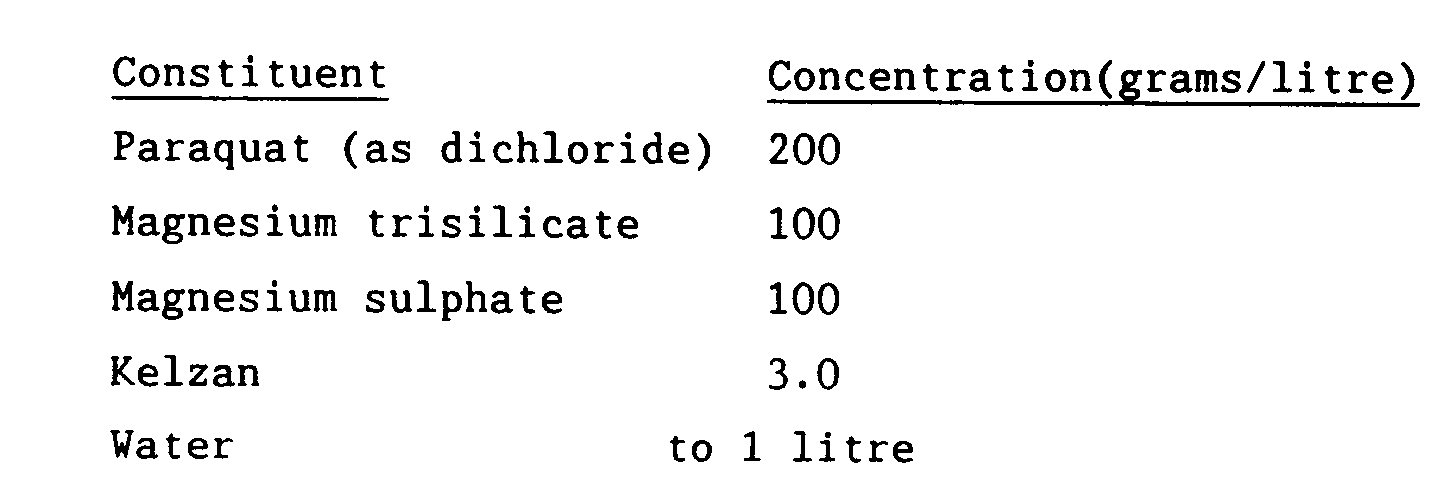
- If a quantity of the composition containing bipyridylium herbicide, gelling agent, and purgative is inadvertently swallowed, the composition will gel in the stomach. The bipyridylium herbicide will be trapped in the gel, and the purgative will bring about movement of the gel through the gastro-intestinal tract with increased speed, thereby reducing absorption.
- In a further variation of the invention, there are further provided herbicidal compositions comprising an aqueous solution of a salt of paraquat or diquat or a mixture thereof, the compositions comprising 100 grams or more per litre of paraquat or diquat or a mixture thereof, and further comprising (1) an emetic and (2) a purgative. Preferably the emetic is the compound of formula (A) below, and preferably the purgative is magnesium sulphate. The proportions of these ingredients will be similar to those quoted above for the compositions previously described, (i.e. 0.1 to 5 grams per litre of Compound A and 10 to 400 grams per litre of composition of magnesium sulphate).
- The constituents and proportions of a composition of this kind are given below by way of example:

- If a quantity of such a composition is inadvertently swallowed, the combined action of the emetic and purgative will reduce absorption of the bipyridylium herbicide.
- The following Examples illustrate the invention.
- This Example illustrates an aqueous composition according to the invention.
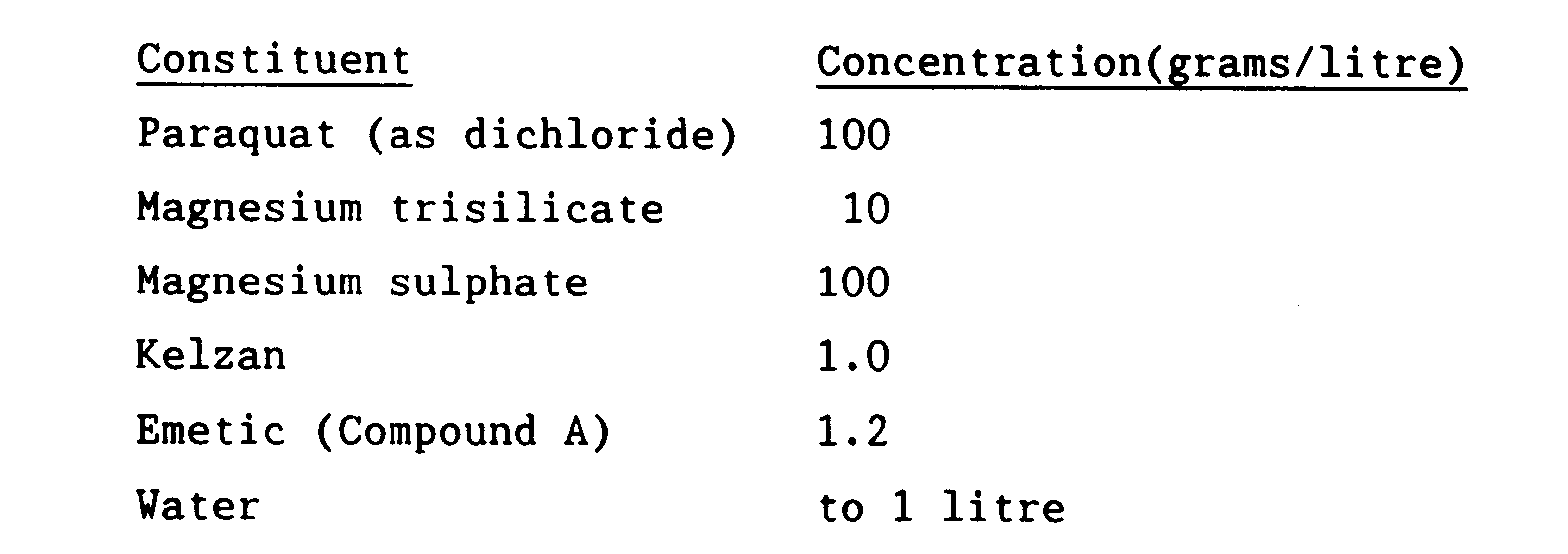
- This Example illustrates an aqueous composition according to the invention.

- This Example illustrates an aqueous composition according to the inventi

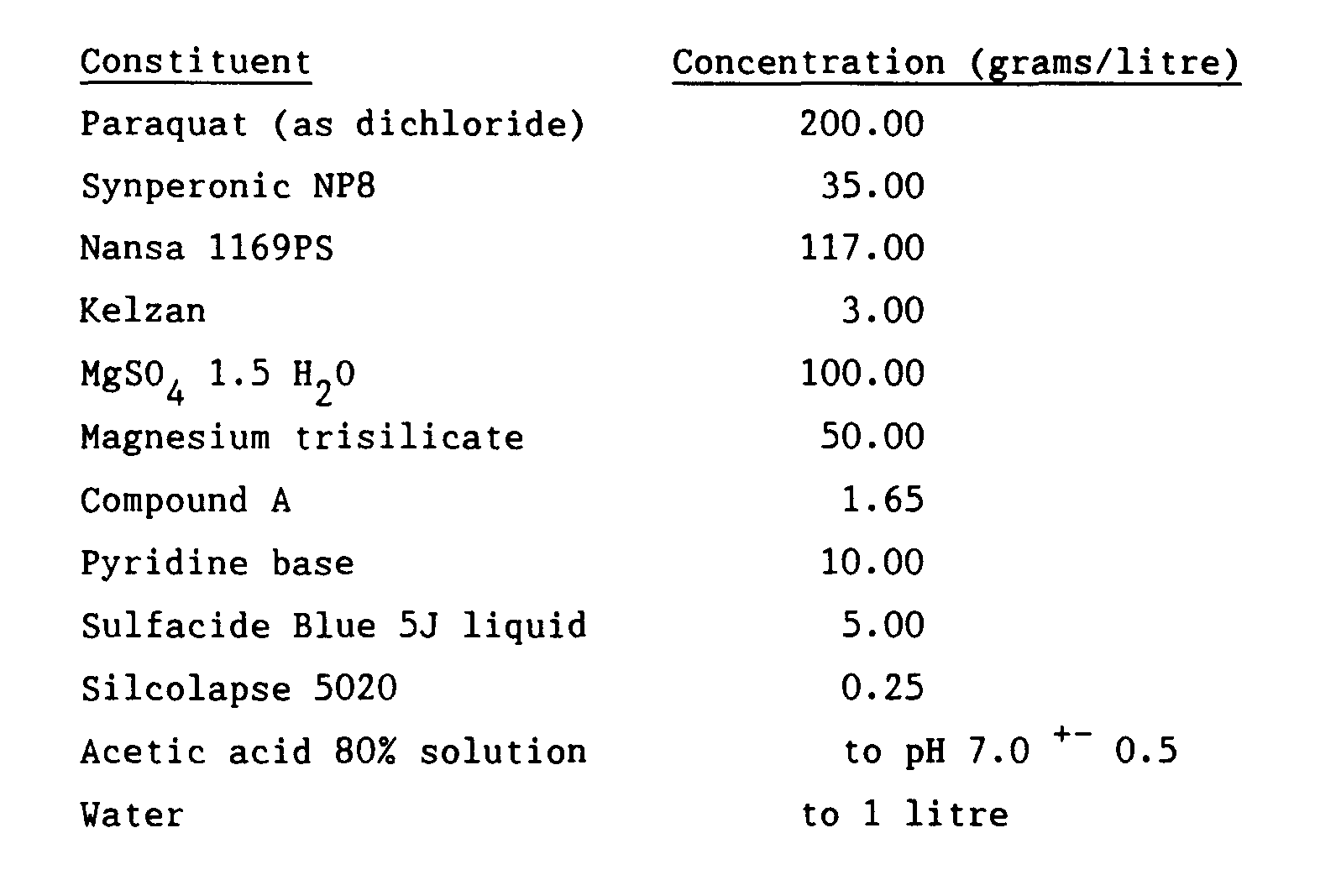
- The above composition was prepared by simple admixture of the constituents or aqueous solutions thereof.
- The compositions of the constituents indicated by the various trade names are as follows:-
- A surface-active agent comprising a condensate of p-nonylphenol with eight molar proportions of ethylene oxide.
- A surface-active agent comprising an aqueous solution of sodium dodecylbenzenesulphonate in a concentration of 30%.
- Xanthan gum, comprising a bacterial polysaccharide, present as a suspending agent.
- An odourant comprising a mixture of alkyl pyridines, typically comprising methyl ethyl pyridines (40-60%), propylpyridine (20-30%), ethylpyridine (2.5%)picolines (less than 5%) and other alkyl pyridines, most of the mixture distilling in the range 180-220 C.
- A water-soluble blue dye.
- A silicone-based antifoaming agent
- This Example illustrates an aqueous composition according to the invention.

- This Example illustrates an aqueous composition according to the invention.

- This Example illustrates an aqueous composition according to the invention.

- This Example illustrates an aqueous composition according to the invention.


Claims (11)
Applications Claiming Priority (2)
| Application Number | Priority Date | Filing Date | Title |
|---|---|---|---|
| GB909015134A GB9015134D0 (en) | 1990-07-10 | 1990-07-10 | Herbicidal compositions |
| GB9015134 | 1990-07-10 |
Publications (3)
| Publication Number | Publication Date |
|---|---|
| EP0467529A2 true EP0467529A2 (en) | 1992-01-22 |
| EP0467529A3 EP0467529A3 (en) | 1992-11-04 |
| EP0467529B1 EP0467529B1 (en) | 1996-12-04 |
Family
ID=10678863
Family Applications (1)
| Application Number | Title | Priority Date | Filing Date |
|---|---|---|---|
| EP91305458A Expired - Lifetime EP0467529B1 (en) | 1990-07-10 | 1991-06-17 | Herbicidal compositions |
Country Status (32)
| Country | Link |
|---|---|
| EP (1) | EP0467529B1 (en) |
| JP (1) | JP2894869B2 (en) |
| KR (1) | KR0180547B1 (en) |
| CN (1) | CN1062710C (en) |
| AT (1) | ATE145788T1 (en) |
| AU (1) | AU637507B2 (en) |
| BG (1) | BG61022B1 (en) |
| CA (1) | CA2045709C (en) |
| CZ (1) | CZ282434B6 (en) |
| DE (1) | DE69123398T2 (en) |
| DK (1) | DK0467529T3 (en) |
| ES (1) | ES2094200T3 (en) |
| FI (1) | FI102939B (en) |
| GB (2) | GB9015134D0 (en) |
| GR (1) | GR3021917T3 (en) |
| HR (1) | HRP940704A2 (en) |
| HU (1) | HU212984B (en) |
| IE (1) | IE912111A1 (en) |
| IL (1) | IL98575A (en) |
| MA (1) | MA22209A1 (en) |
| MY (1) | MY124306A (en) |
| NO (1) | NO180662C (en) |
| NZ (1) | NZ238704A (en) |
| PL (1) | PL168132B1 (en) |
| PT (1) | PT98260B (en) |
| RU (1) | RU2043024C1 (en) |
| SI (1) | SI9111202B (en) |
| SK (1) | SK280126B6 (en) |
| YU (1) | YU48341B (en) |
| ZA (1) | ZA914762B (en) |
| ZM (1) | ZM2891A1 (en) |
| ZW (1) | ZW7691A1 (en) |
Cited By (5)
| Publication number | Priority date | Publication date | Assignee | Title |
|---|---|---|---|---|
| GB2263067A (en) * | 1992-01-08 | 1993-07-14 | Zeneca Ltd | Herbicidal composition with reduced acute oral toxicity |
| CN1073856C (en) * | 1996-09-26 | 2001-10-31 | 宋鑫博 | Injection for emetic action anc clearing stomach |
| WO2002076212A1 (en) * | 2001-03-27 | 2002-10-03 | Syngenta Limited | Composition containing paraquat and/or diquat an alginate and an emetic and/or purgative |
| WO2005055722A1 (en) * | 2003-12-09 | 2005-06-23 | Syngenta Limited | Agrochemical compositions |
| CN102293204A (en) * | 2011-09-26 | 2011-12-28 | 中化化工科学技术研究总院 | Paraquat water-soluble gel and preparation method thereof |
Families Citing this family (2)
| Publication number | Priority date | Publication date | Assignee | Title |
|---|---|---|---|---|
| KR100330927B1 (en) * | 1999-07-22 | 2002-04-03 | 윤지현 | Solid or semi-solid paraquat preparations and production method thereof |
| RU2339223C2 (en) * | 2002-04-04 | 2008-11-27 | Вэйлент Байосайенсиз Копэрейшн | Herbicidal composition, method of agricultural crops protection from herbicidal activity of phyto system i inhibitor and method of herbicidal composition selectivity increase |
Family Cites Families (6)
| Publication number | Priority date | Publication date | Assignee | Title |
|---|---|---|---|---|
| BE786491A (en) * | 1971-07-22 | 1973-01-19 | Ici Ltd | IMPROVED HERBICIDE COMPOSITIONS |
| US4046552A (en) * | 1976-04-15 | 1977-09-06 | Imperial Chemical Industries Limited | Herbicidal compositions of bipyridylium quaternary salts and emetic amounts of s-triazolo pyrimidine derivatives |
| GB1507407A (en) * | 1976-04-15 | 1978-04-12 | Ici Ltd | Herbicidal compositions |
| IE50142B1 (en) * | 1979-07-11 | 1986-02-19 | Sampson Michael James | Improved method of using a plant-growth regulator |
| US4764206A (en) * | 1985-10-10 | 1988-08-16 | S D S Bioteck K.K. | Contradeglutitious solid herbicidal composition |
| JPS62201803A (en) * | 1986-02-28 | 1987-09-05 | Teijin Agurokemikaru Kk | Herbicide composition |
-
1990
- 1990-07-10 GB GB909015134A patent/GB9015134D0/en active Pending
-
1991
- 1991-06-17 DK DK91305458.1T patent/DK0467529T3/en active
- 1991-06-17 GB GB919113055A patent/GB9113055D0/en active Pending
- 1991-06-17 EP EP91305458A patent/EP0467529B1/en not_active Expired - Lifetime
- 1991-06-17 ES ES91305458T patent/ES2094200T3/en not_active Expired - Lifetime
- 1991-06-17 AT AT91305458T patent/ATE145788T1/en not_active IP Right Cessation
- 1991-06-17 DE DE69123398T patent/DE69123398T2/en not_active Expired - Lifetime
- 1991-06-19 HU HU912045A patent/HU212984B/en unknown
- 1991-06-19 IE IE211191A patent/IE912111A1/en not_active IP Right Cessation
- 1991-06-20 AU AU79141/91A patent/AU637507B2/en not_active Expired
- 1991-06-20 ZA ZA914762A patent/ZA914762B/en unknown
- 1991-06-20 IL IL9857591A patent/IL98575A/en not_active IP Right Cessation
- 1991-06-24 CZ CS911923A patent/CZ282434B6/en not_active IP Right Cessation
- 1991-06-24 SK SK1923-91A patent/SK280126B6/en unknown
- 1991-06-24 ZW ZW76/91A patent/ZW7691A1/en unknown
- 1991-06-26 CA CA002045709A patent/CA2045709C/en not_active Expired - Lifetime
- 1991-06-26 NZ NZ238704A patent/NZ238704A/en not_active IP Right Cessation
- 1991-06-27 MY MYPI91001171A patent/MY124306A/en unknown
- 1991-07-03 CN CN91105294A patent/CN1062710C/en not_active Expired - Lifetime
- 1991-07-08 RU SU915001056A patent/RU2043024C1/en active
- 1991-07-08 BG BG94778A patent/BG61022B1/en unknown
- 1991-07-08 SI SI9111202A patent/SI9111202B/en unknown
- 1991-07-08 MA MA22482A patent/MA22209A1/en unknown
- 1991-07-08 YU YU120291A patent/YU48341B/en unknown
- 1991-07-09 PT PT98260A patent/PT98260B/en not_active IP Right Cessation
- 1991-07-09 ZM ZM28/91A patent/ZM2891A1/en unknown
- 1991-07-09 JP JP3168128A patent/JP2894869B2/en not_active Expired - Lifetime
- 1991-07-09 NO NO912697A patent/NO180662C/en not_active IP Right Cessation
- 1991-07-09 PL PL91290989A patent/PL168132B1/en unknown
- 1991-07-09 FI FI913326A patent/FI102939B/en not_active IP Right Cessation
- 1991-07-09 KR KR1019910011591A patent/KR0180547B1/en not_active Expired - Lifetime
-
1994
- 1994-10-19 HR HRP-1202/91A patent/HRP940704A2/en not_active Application Discontinuation
-
1996
- 1996-12-05 GR GR960403229T patent/GR3021917T3/en unknown
Cited By (10)
| Publication number | Priority date | Publication date | Assignee | Title |
|---|---|---|---|---|
| GB2263067A (en) * | 1992-01-08 | 1993-07-14 | Zeneca Ltd | Herbicidal composition with reduced acute oral toxicity |
| CN1073856C (en) * | 1996-09-26 | 2001-10-31 | 宋鑫博 | Injection for emetic action anc clearing stomach |
| WO2002076212A1 (en) * | 2001-03-27 | 2002-10-03 | Syngenta Limited | Composition containing paraquat and/or diquat an alginate and an emetic and/or purgative |
| KR100552377B1 (en) * | 2001-03-27 | 2006-02-16 | 신젠타 리미티드 | Composition |
| AU2002242833B2 (en) * | 2001-03-27 | 2007-07-05 | Syngenta Limited | Composition containing paraquat and/or diquat an alginate and an emetic and/or purgative |
| AP1790A (en) * | 2001-03-27 | 2007-10-06 | Syngenta Ltd | Composition containing paraquat and/or diquat an alginate and an emetic and/or purgative. |
| WO2005055722A1 (en) * | 2003-12-09 | 2005-06-23 | Syngenta Limited | Agrochemical compositions |
| EA011571B1 (en) * | 2003-12-09 | 2009-04-28 | Зингента Лимитед | Agrochemical compositions |
| AP2231A (en) * | 2003-12-09 | 2011-05-04 | Syngenta Ltd | Agrochemical compositions. |
| CN102293204A (en) * | 2011-09-26 | 2011-12-28 | 中化化工科学技术研究总院 | Paraquat water-soluble gel and preparation method thereof |
Also Published As
Similar Documents
| Publication | Publication Date | Title |
|---|---|---|
| AU600545B2 (en) | Formulation process | |
| CA2045709C (en) | Herbicidal composition | |
| US3920443A (en) | Herbicidal compositions | |
| US4160017A (en) | Herbicidal compositions | |
| MXPA03008621A (en) | Composition containing paraquat and/or diquat an alginate and an emetic and/or purgative. | |
| GB2263067A (en) | Herbicidal composition with reduced acute oral toxicity | |
| CA1097096A (en) | Herbicidal compositions | |
| KR790001657B1 (en) | Concentrated herbicidal compositions | |
| EP0012525A1 (en) | Herbicidal compositions containing a herbicidal bipyridylium quaternary salt and an alerting agent | |
| GB1577317A (en) | Herbicidal compositions | |
| JPS6135964B2 (en) | ||
| JP2703973B2 (en) | Herbicide composition | |
| KR810000277B1 (en) | Herbicide composition | |
| JPH082766B2 (en) | Herbicide composition | |
| JPH03112901A (en) | Water-soluble agricultural chemical |
Legal Events
| Date | Code | Title | Description |
|---|---|---|---|
| PUAI | Public reference made under article 153(3) epc to a published international application that has entered the european phase |
Free format text: ORIGINAL CODE: 0009012 |
|
| AK | Designated contracting states |
Kind code of ref document: A2 Designated state(s): AT BE CH DE DK ES FR GB GR IT LI LU NL SE |
|
| 17P | Request for examination filed |
Effective date: 19920612 |
|
| PUAL | Search report despatched |
Free format text: ORIGINAL CODE: 0009013 |
|
| AK | Designated contracting states |
Kind code of ref document: A3 Designated state(s): AT BE CH DE DK ES FR GB GR IT LI LU NL SE |
|
| RAP1 | Party data changed (applicant data changed or rights of an application transferred) |
Owner name: ZENECA LIMITED |
|
| 17Q | First examination report despatched |
Effective date: 19941115 |
|
| GRAG | Despatch of communication of intention to grant |
Free format text: ORIGINAL CODE: EPIDOS AGRA |
|
| GRAH | Despatch of communication of intention to grant a patent |
Free format text: ORIGINAL CODE: EPIDOS IGRA |
|
| GRAH | Despatch of communication of intention to grant a patent |
Free format text: ORIGINAL CODE: EPIDOS IGRA |
|
| GRAA | (expected) grant |
Free format text: ORIGINAL CODE: 0009210 |
|
| AK | Designated contracting states |
Kind code of ref document: B1 Designated state(s): AT BE CH DE DK ES FR GB GR IT LI LU NL SE |
|
| REF | Corresponds to: |
Ref document number: 145788 Country of ref document: AT Date of ref document: 19961215 Kind code of ref document: T |
|
| REG | Reference to a national code |
Ref country code: CH Ref legal event code: NV Representative=s name: BOVARD AG PATENTANWAELTE |
|
| REF | Corresponds to: |
Ref document number: 69123398 Country of ref document: DE Date of ref document: 19970116 |
|
| REG | Reference to a national code |
Ref country code: ES Ref legal event code: FG2A Ref document number: 2094200 Country of ref document: ES Kind code of ref document: T3 |
|
| ET | Fr: translation filed | ||
| ITF | It: translation for a ep patent filed | ||
| REG | Reference to a national code |
Ref country code: GR Ref legal event code: FG4A Free format text: 3021917 |
|
| REG | Reference to a national code |
Ref country code: DK Ref legal event code: T3 |
|
| PLBE | No opposition filed within time limit |
Free format text: ORIGINAL CODE: 0009261 |
|
| STAA | Information on the status of an ep patent application or granted ep patent |
Free format text: STATUS: NO OPPOSITION FILED WITHIN TIME LIMIT |
|
| 26N | No opposition filed | ||
| REG | Reference to a national code |
Ref country code: GB Ref legal event code: IF02 |
|
| REG | Reference to a national code |
Ref country code: ES Ref legal event code: PC2A |
|
| NLT1 | Nl: modifications of names registered in virtue of documents presented to the patent office pursuant to art. 16 a, paragraph 1 |
Owner name: SYNGENTA LIMITED |
|
| REG | Reference to a national code |
Ref country code: CH Ref legal event code: PFA Owner name: SYNGENTA LIMITED SYNGENTA EUROPEAN REGIONAL CENTR Free format text: ZENECA LIMITED#15, STANHOPE GATE#LONDON W1Y 6LN (GB) -TRANSFER TO- SYNGENTA LIMITED SYNGENTA EUROPEAN REGIONAL CENTRE#PRIESTLEY ROAD, SURREY RESEARCH PARK,#GUILDFORD, SURREY GU2 7YH (GB) |
|
| REG | Reference to a national code |
Ref country code: FR Ref legal event code: CD Ref country code: FR Ref legal event code: CA |
|
| PGFP | Annual fee paid to national office [announced via postgrant information from national office to epo] |
Ref country code: LU Payment date: 20100616 Year of fee payment: 20 Ref country code: DK Payment date: 20100610 Year of fee payment: 20 Ref country code: FR Payment date: 20100709 Year of fee payment: 20 |
|
| PGFP | Annual fee paid to national office [announced via postgrant information from national office to epo] |
Ref country code: AT Payment date: 20100610 Year of fee payment: 20 Ref country code: IT Payment date: 20100616 Year of fee payment: 20 |
|
| PGFP | Annual fee paid to national office [announced via postgrant information from national office to epo] |
Ref country code: CH Payment date: 20100614 Year of fee payment: 20 Ref country code: ES Payment date: 20100713 Year of fee payment: 20 Ref country code: NL Payment date: 20100603 Year of fee payment: 20 Ref country code: BE Payment date: 20100615 Year of fee payment: 20 |
|
| PGFP | Annual fee paid to national office [announced via postgrant information from national office to epo] |
Ref country code: GB Payment date: 20100616 Year of fee payment: 20 Ref country code: DE Payment date: 20100610 Year of fee payment: 20 Ref country code: SE Payment date: 20100609 Year of fee payment: 20 |
|
| PGFP | Annual fee paid to national office [announced via postgrant information from national office to epo] |
Ref country code: GR Payment date: 20100514 Year of fee payment: 20 |
|
| REG | Reference to a national code |
Ref country code: CH Ref legal event code: PFA Owner name: SYNGENTA LIMITED SYNGENTA EUROPEAN REGIONAL CENTR Free format text: SYNGENTA LIMITED SYNGENTA EUROPEAN REGIONAL CENTRE#PRIESTLEY ROAD, SURREY RESEARCH PARK,#GUILDFORD, SURREY GU2 7YH (GB) -TRANSFER TO- SYNGENTA LIMITED SYNGENTA EUROPEAN REGIONAL CENTRE#PRIESTLEY ROAD, SURREY RESEARCH PARK,#GUILDFORD, SURREY GU2 7YH (GB) |
|
| REG | Reference to a national code |
Ref country code: DE Ref legal event code: R071 Ref document number: 69123398 Country of ref document: DE |
|
| REG | Reference to a national code |
Ref country code: DE Ref legal event code: R071 Ref document number: 69123398 Country of ref document: DE |
|
| REG | Reference to a national code |
Ref country code: NL Ref legal event code: V4 Effective date: 20110617 |
|
| BE20 | Be: patent expired |
Owner name: *SYNGENTA LTD Effective date: 20110617 |
|
| REG | Reference to a national code |
Ref country code: CH Ref legal event code: PL |
|
| REG | Reference to a national code |
Ref country code: DK Ref legal event code: EUP |
|
| REG | Reference to a national code |
Ref country code: GB Ref legal event code: PE20 Expiry date: 20110616 |
|
| PG25 | Lapsed in a contracting state [announced via postgrant information from national office to epo] |
Ref country code: NL Free format text: LAPSE BECAUSE OF EXPIRATION OF PROTECTION Effective date: 20110617 Ref country code: GB Free format text: LAPSE BECAUSE OF EXPIRATION OF PROTECTION Effective date: 20110616 |
|
| REG | Reference to a national code |
Ref country code: SE Ref legal event code: EUG |
|
| REG | Reference to a national code |
Ref country code: ES Ref legal event code: FD2A Effective date: 20120411 |
|
| PG25 | Lapsed in a contracting state [announced via postgrant information from national office to epo] |
Ref country code: ES Free format text: LAPSE BECAUSE OF EXPIRATION OF PROTECTION Effective date: 20110618 |
|
| PG25 | Lapsed in a contracting state [announced via postgrant information from national office to epo] |
Ref country code: DE Free format text: LAPSE BECAUSE OF EXPIRATION OF PROTECTION Effective date: 20110618 |