EP0469974B1 - Drucker, der verschiedene Druckersteuerungssprachen auswertet - Google Patents
Drucker, der verschiedene Druckersteuerungssprachen auswertet Download PDFInfo
- Publication number
- EP0469974B1 EP0469974B1 EP91402092A EP91402092A EP0469974B1 EP 0469974 B1 EP0469974 B1 EP 0469974B1 EP 91402092 A EP91402092 A EP 91402092A EP 91402092 A EP91402092 A EP 91402092A EP 0469974 B1 EP0469974 B1 EP 0469974B1
- Authority
- EP
- European Patent Office
- Prior art keywords
- printer
- language
- printer control
- grams
- print job
- Prior art date
- Legal status (The legal status is an assumption and is not a legal conclusion. Google has not performed a legal analysis and makes no representation as to the accuracy of the status listed.)
- Expired - Lifetime
Links
Images

Classifications
-
- G—PHYSICS
- G06—COMPUTING OR CALCULATING; COUNTING
- G06F—ELECTRIC DIGITAL DATA PROCESSING
- G06F3/00—Input arrangements for transferring data to be processed into a form capable of being handled by the computer; Output arrangements for transferring data from processing unit to output unit, e.g. interface arrangements
- G06F3/12—Digital output to print unit, e.g. line printer, chain printer
- G06F3/1201—Dedicated interfaces to print systems
- G06F3/1202—Dedicated interfaces to print systems specifically adapted to achieve a particular effect
- G06F3/1203—Improving or facilitating administration, e.g. print management
- G06F3/1206—Improving or facilitating administration, e.g. print management resulting in increased flexibility in input data format or job format or job type
-
- G—PHYSICS
- G06—COMPUTING OR CALCULATING; COUNTING
- G06F—ELECTRIC DIGITAL DATA PROCESSING
- G06F3/00—Input arrangements for transferring data to be processed into a form capable of being handled by the computer; Output arrangements for transferring data from processing unit to output unit, e.g. interface arrangements
- G06F3/12—Digital output to print unit, e.g. line printer, chain printer
- G06F3/1201—Dedicated interfaces to print systems
- G06F3/1223—Dedicated interfaces to print systems specifically adapted to use a particular technique
- G06F3/1237—Print job management
- G06F3/1244—Job translation or job parsing, e.g. page banding
- G06F3/1248—Job translation or job parsing, e.g. page banding by printer language recognition, e.g. PDL, PCL, PDF
-
- G—PHYSICS
- G06—COMPUTING OR CALCULATING; COUNTING
- G06F—ELECTRIC DIGITAL DATA PROCESSING
- G06F3/00—Input arrangements for transferring data to be processed into a form capable of being handled by the computer; Output arrangements for transferring data from processing unit to output unit, e.g. interface arrangements
- G06F3/12—Digital output to print unit, e.g. line printer, chain printer
- G06F3/1201—Dedicated interfaces to print systems
- G06F3/1278—Dedicated interfaces to print systems specifically adapted to adopt a particular infrastructure
- G06F3/1279—Controller construction, e.g. aspects of the interface hardware
Definitions
- This invention relates to computer printers and more specifically to computer printers capable of printing jobs which may be encoded in one or another printer command language.
- Printers associated with computers receive print jobs transmitted from the computers.
- the print jobs comprise data (character codes and graphic elements encoded in bit maps, etc.) and, usually, instructions encoded in a specific printer command language.
- data character codes and graphic elements encoded in bit maps, etc.
- instructions encoded in a specific printer command language.
- the print jobs are said to be in the form of "pure" text.
- a printer command language is a set of instructions understood by a printer. It may include information about positioning of text and/or graphics and options to control the attributes (e.g., font style, font size, color, density) of the printed information. Examples of such languages are Postscript (registered trademark of Adobe Systems, Inc.), HP PCL and HP GL (registered trademarks of Hewlett-Packard Corporation).
- a printer command language is considered to consist only of the defined command sequences and the specified number of parameters associated therewith. In a print job, the printer command sequences are interspersed with data.
- the printer In order for a printer to process a print job encoded in a particular printer command language, it must have a combination of hardware and software capable of understanding and processing the printer command language.
- the printer has a controller which itself is a digital computer programmed with interpreters or emulations for processing more than one command language. For example, the printer controller may first generate a bit map stored in its page memory from the print job. Other apparatus, with reference to the bit map, produces a hard copy. Examples of computer printers that are capable of converting bit maps to hard copy are laser printers, thermal printers and dot matrix printers.
- Applications programs that run on host computers are end-user programs (or frequently used utility programs) which generate print jobs. Applications programs generate print jobs using a printer command language or in the form of pure text. It is likely that different applications programs used with a given host computer use different printer command languages and/or pure text output.
- a print job must be transmitted to a printer that can interpret the language in which the job is encoded and, if the printer can handle more than one printer command language, the correct interpreter or emulation must be selected.
- the prior methods of directing a print job to a printer prepared to receive it have shortcomings. Multiple printers each dedicated to one printer command language can be an expensive solution. A printer must be purchased for each language. Moreover, some printers may be heavily used while others sit idle. The use of configuration switches to select a printer command language may lead to resource contention as the users of one printer command language may inhibit the use by others. The user closest to the printer can dominate use of the printer because, to assure that a printer is configured to receive a print job, a trip to the printer is required.
- job headers involves non-standard command sequences across printers made by different manufacturers. It also involves modification of existing application software to generate the headers for each print job.
- JP-A-1314177 discloses a method of analyzing a page of stored data received by the printer for determining the best matching printer control language but with no consideration of the statistical likelihood with which control command codes or combinations thereof are indicative of a particular control language.
- the print jobs may be encoded by a specific computer application in any one of a plurality of printer control languages.
- the printer has the capability for interpreting each of said plurality of printer control languages to define a bit mapped image.
- the printer further comprises suitable apparatus for converting the bit mapped image into a visual display of said image.
- the printer is provided with a buffer means for capturing a portion of the start of any print job, and means for identifying the printer control language in which the captured portion of the input stream is coded. In accordance with the identified control language, the printer processes the print job in the appropriate control language.
- the printer is characterized in that the identifying means comprise a microprocessor which has stored therein an algorithm and a plurality of statistically derived characterizing data sets for analyzing the captured portion of the input stream. Data sets are provided for each printer control language which the printer can interpret.
- the characterizing data sets comprise statistical data reflecting the likelihood of selected n-grams (short sequences of characters) occurring individually or in combination in print jobs encoded in a given printer control language.
- the data sets comprise lists of selected n-grams and weighted pattern vectors (ordered lists) of real numbers corresponding to the selected n-grams for each printer control language.
- the values in the weighted pattern vectors are indicative of the likelihood of n-grams occurring or co-occurring in a given language and the diagnostic value of the n-grams.
- the data sets comprise a plurality of pattern vectors for each printer control language and a threshold value corresponding to each weighted pattern vector.
- the data within the data sets are weighted by the ability of n-grams to distinguish a given printer control language from other printer control languages.
- An aspect of this invention is the selection of the particular n-grams to be used to characterize a particular printer control language.
- the n-grams for which data is included in the printer control language data sets do not include sequences of signals representing device dependent characteristics or parameters, sequences of signals which are application dependent, and subsets of longer n-grams.
- the n-grams included in the data sets comprise command sequences which have correlation with a printer control language.
- the captured portion of the input stream is analyzed to develop a sample vector indicative of the presence and frequency of certain n-grams in the captured or sampled portion of the input stream.
- This sample vector is used with the weighted pattern vectors associated with each printer control language to calculate scores which can be used to select the correct interpreter for processing the input stream.
- the values in the sample vectors correspond to the same n-grams for which data is included in the weighted pattern vectors.
- a score is computed for each language and the language receiving an extreme score (highest or lowest, depending upon the details of the calculation) is selected.
- a procedure is provided to handle tie scores.
- a procedure is also provided to handle an inability to select a language according to the n-gram patterns found in the sample vector.
- a score is computed based upon the number of occurrences and/or co-occurrences of selected n-grams in the sampled portion of the print job as represented by a sample vector with each weighted pattern vector of data sets for each printer command language until the score computed with a given weighted pattern vector when compared to a threshold associated with the given weighted pattern vector indicates the print job is encoded in the printer command language to which that weighted pattern vector corresponds.
- a computer printer 10 connected to a host computer 11 for receiving print jobs through the port 12.
- the printer may be considered to comprise a printer controller 13 and a print engine 14.
- the printer controller receives the print job and controls the print engine to generate the hard copy 15 of the print job.
- a number of types of print engines are known including thermal printers, laser printers and dot matrix printers. This invention is not specific to any particular printer or type of print engine.
- Printer controllers are electronic circuits usually including a local microcomputer, including digital processor, memory for storing control programs and a page memory for storing all or a portion of the bit mapped definition of the text and graphics to be printed.
- a portion of the control programs for the printer controllers are standard interpreters of established printer control languages or emulations thereof.
- the details of the printer controller or the interpreters for the various printer command languages are not a part of this invention.
- the printer controller may have stored therein the interpreter or emulator for more than one printer control language. In this case, there must be means to select the correct interpreter for an incoming print job.
- the controller has a buffered input so that a short initial portion of the input data stream comprising a new print job, say 64 to 512 bytes, can be captured and analyzed to determine the printer control language in which it is encoded. Also, stored in the controller memory, is an algorithm or algorithms and characterizing data sets that permit the determination of the correct interpreter or emulation to be used with the print job.
- Off-line training comprises the development of the characterizing data sets using statistical methods to be stored in the printer controller.
- On-line application comprises the run-time use of the data sets and a suitable algorithm to identify the control language of new print jobs. Practically speaking, the data sets must be developed and tested on a computer prior to being installed in and used by a printer.
- Off-line training comprises determining the identifying characteristics of each printer command language and appropriate weights to be given those characteristics.
- Print jobs at the most primitive level consist of data comprising sequences of data (character codes and graphic elements) and command sequences (instructions) in the printer control language. Some command sequences are unique to a given printer control language and others are not.
- n-grams a representative sample of print jobs encoded in each printer control language of interest and jobs in pure text form are analyzed using statistical methods to empirically derive characteristic sequences of each printer command languages referred to herein as n-grams.
- the analysis of the samples may be automated by use of a computer program, performed by simple examination or both. Practically speaking, the automation is required for off-line analysis and generation of printer control language data sets. Characteristic sequences or n-grams are chosen such that each occurs in a significant portion of the samples for a given control language or where the n-gram is expected to occur in a previously not considered subset of the samples. To reduce the potential combinatorial explosion in the number of n-grams found, analysis may be limited to subsets of the initial set of characters in the sampled print jobs, for example, the first 64, 128, 256 or 512 bytes, of the print jobs.
- n-grams are one or more distinct character codes (perhaps ASCII character codes) concatenated in a fixed order to produce a string of length one or more.
- Some desirable attributes of the characteristic n-grams include the following:
- a computer program may be used for extracting and identifying a set of n-grams from the print job samples and producing frequency vectors the elements of which are the frequency of each n-gram across the sample set for that printer control language.
- the program is written to examine a number of sample files containing the initial snapshot of print jobs. Given a set of print job samples for a specific printer command language and a set of options to indicate the useful characteristics of desirable command sequences, a set of n-grams is derived from the snapshots.
- the n-grams are selected according to the frequency of occurrence across a number of print job samples or based upon patterns of co-occurrence and their ability to diagnose previously unrecognized subsets of the samples. So, for example, in a fast method of analysis, n-grams may only be selected if found in a minimum percent of samples examined. Typically, the minimum percent chosen is between 50 and 80.
- An alternative correlation algorithm would select n-grams which are highly diagnostic of large subsets of samples but which do not represent a duplication of information (low co-occurrence with previously selected n-grams). Minimum percent requirements do not apply as each candidate n-gram is evaluated in the context of sample subsets which are not appropriately represented by the previously selected n-grams.
- an n-gram is highly diagnostic of a particular but rarely used subset of samples that are difficult to classify, it may be included even though it is rarely seen.
- Co-occurrence probability or conditional probability is defined to be the probability that a given string A can be found in a sample given that another string B also occurs.
- the probability is defined as occ(A&B) / occ(B) where occ(X) is the integer number of samples where the event X is true. This information is gathered by cycling through the current set of samples, and computing all frequencies of occ(B) and occ(A&B).
- a computer program may be written to select the n-grams from samples of a given command language. This program examines the beginning of sample data files in order to locate commonly used data patterns and counts the number of occurrences. A number of options may be provided to control how much effort the program will exert to find character patterns. The program seeks to select diagnostic sets of n-grams based either a) upon frequency of occurrence, co-occurrence probabilities of the n-grams and string lengths or b) according to the frequency of occurrence across samples.
- Patterns are found by moving a variable length "window" of length l to k bytes across the sample. Each time a pattern is found it is recorded, either a new entry is added or an old entry is incremented.
- kinds of characters e.g. numerics
- control characters and numerics e.g. control characters and numerics
- Selections are made from among the mass of string patterns and words to try to determine which ones are most diagnostic of the samples. As few strings as possible will be selected as characteristic of portions of the samples. This is done by evaluating the co-occurrence properties of the strings. First the set of strings is initialized with a "popular" string. A portion of the sample group in which the preceding string occurs frequently is “removed”. Next, a string which is "popular” or common in the reduced group of samples, but which is least correlated with the preceding "popular” string is found. This is added to the set and the sample group is reduced again. This process continues until all samples are adequately represented by string patterns.
- n-grams described features which are unique command sequences for each candidate printer control language. Unfortunately, this is not always possible. Hence, it is necessary to assign weights to n-grams or combinations of n-grams to designate their ability to distinguish one language from all others. The set of n-grams and weights attached to each enable the differentiation between print jobs encoded in a given language from all others.
- Two methods of assigning weights are herein disclosed. The method used depends upon the confidence in the set of n-grams derived and the strictness of the requirement to make the correct selection. The method of assigning weights is directly related to the run-time method of selecting the correct interpreter to be used by the printer.
- a single pattern vector is generated which uses the relative observed occurrences of n-grams and other features to compute a single weight for each n-gram.
- the above weighting equation was determined by empirical evaluation of a number of sample printer command languages and example print jobs as providing a reasonable way to balance the frequency of occurrence of useful n-grams against the diagnostic importance of longer strings. It is not the only possibility as improvements in performance observed may be an artifact of the language studied. In other words, certain command sequences may be recognized as unique to one printer command language and may be assigned added weight.
- the results of applying this calculation for a printer command language is a single weight pattern vector (ordered list) of real numbers containing one value for each of the n-grams diagnostic of that language. This vector may be used in a single vector statistical frequency method to identify print jobs.
- a single linear discriminant i.e., a mathematical function based upon a single vector of weighted values
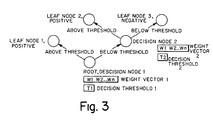
- a second method involving a more complex weighting scheme which produces multiple weighted pattern vectors for each printer command language has been implemented. Essentially, a tree of weighted pattern vectors is provided for each command language which will determine that the candidate language should be selected because all other languages are eliminated or that the determination cannot be made. This process continues until a select or reject decision is determined for the current language. An algorithm to handle ties may also be provided.
- a procedure is provided to handle the inability to select a language based on the n-gram patterns in evidence.
- the process is illustrated schematically in Fig. 3 for the current language.
- the training set may be developed from the original samples for n-gram analysis and other samples provided for this specific purpose.
- Each training set consists of a set of positive samples (samples known to be encoded in the command language) and a set of negative samples (samples known to be encoded in other command languages or as pure text).
- Each sample is mapped or represented as a vector of the frequency of occurrences of each of the n-grams selected for the language for which the vector tree is to be produced and a "similarity measure" or 1.0 for a positive sample and 0.0 for a negative sample.
- a linear discriminant in effect, an equation defining a hyperplane in multidimensional space
- hyperplane which best separates a subset of the positive samples from the remainder of the samples in the training set is computed (defined by a vector with values or weights for each n-gram and a threshold value).
- the process of choosing hyperplane is shown schematically with reference to Fig. 2 which, of course, can only show the trivial two-dimensional case. If the first found hyperplane separates all positive and negative samples, no further separation is required. If not, a further hyperplane is found that separates the remaining subsets of positive and negative examples. This process is repeated until all subsets bounded by hyperplanes contain only one set of positive or negative samples. This process results in a plurality of numeric decision vectors and thresholds.
- the result of the weighting process is a prototype for each language.
- Computer programs to be run off-line assist in the calculation of the weighted vectors.
- the computer program for weighting the single weighted vector is straight forward.
- the computer program for the second (multiple vector) weighting scheme is, of course, more complicated. In an implementation of this weighting process, three separate computer programs are useful.
- the first program determines the mapping between selected n-grams of the languages and sets of positive and negative print jobs.
- the next program implements a version of the Athena classifier algorithm of C. Koutsougeras. (See Israel, P. and Koutsougeras, C.
- a tree of weight vectors Given a set of sample vectors representing positive and negative samples, a tree of weight vectors is derived. The tree allows evaluation of combinations of n-grams or "higher-order" attributes and their relations to the positive and negative samples. A final program assembles the list of n-grams selected for a given language and the tree of weighted vectors into a "language prototype" for use in the run-time environment. Using the tree of weights and a sample vector from a new print job, it is possible to infer whether the new print job is encoded in a print language represented by a weighted pattern vector tree.
- One set of n-grams and corresponding weighted vectors may be insufficient to characterize all (or most) of the print jobs encoded in a given language. It is possible that several alternative sets of n-grams and weighted pattern vectors may be necessary or desirable to accurately identify the printer command language of print jobs encoded in a given language for the following reasons: 1) A single set of n-grams may be too large and unwieldy for "efficient" on-line application. 2) Some n-grams may be useful diagnostic factors but are not sufficiently unique to a single language. These sequences may be encoded but the degree to which they contribute to the certainty of the identification of the language is limited. 3) Different subsets of the command sequences may be used in different environments.
- n-gram Specialization of the set of diagnostic n-grams may improve performance in making decisions. 4) An n-gram may be added after encountering valid, but rare examples of command sequences. For these reasons and others, it is occasionally necessary to build more than one language prototype for a single printer command language.
- this information may be used to make a selection of the language which is the nearest match to a new print job. This is an iterative process. For each available language prototype and with a sample vector derived from the snapshot of a new print job, a similarity score is calculated. The language with an extreme score is said to "win” and the interpreter or emulator for that language is used to interpret the new print job. In more technical terms, a pointer to the interpreter for the winning language is returned by the iterative procedure that calculates the scores. It may be necessary to handle "ties" when two languages receive the same or a very similar score.
- the ties can be resolved by reference to an auxiliary priority assigned to each language ordering their priorities (stored with the language prototype).
- Other strategies for resolving ties might comprise selecting the language with the "highest wins”, “most recently used”, “most frequently used”, “first-come-first-served”, or other method specified by the user.
- the language prototypes may not provide coverage of all distinguishing n-grams of the languages considered. In such a case, it may not be possible to make a choice between languages.
- An error value must be returned by the iterative procedure that calculates the scores instead of a pointer to an interpreter.
- the procedure that uses this language inference procedure will have to detect the error value and initiate alternative processing, such as using an alternative algorithm to select an interpreter (e.g., default value) or it may elect to reject and ignore the print job (possibly after issuing a warning message).
- the new language is important because a major insurance company desired as a customer uses word processing and database software based upon this new language.
- the source code for the new language interpreter is acquired from the owner.
- three printer control languages had already been acquired and had been used; namely HP GL, HP PCL, and Postscript.
- Copies of applications software with the printer drivers for the new language are acquired.
- Test documents and toy databases are included with the packages.
- Appropriate data capture utilities are used to capture and store snapshots of print jobs produced with the applications software.
- Commands consist of a standard preamble, a variable number of arguments, and a non-numeric suffix.
- the arguments to commands consist of numerics separated by semicolons.
- the analysis and weighting programs are then run on the samples of print jobs in the four printer control languages and samples in pure text form to create preliminary language prototypes.
- the single vector statistical frequency method is chosen. Thereafter each print job was evaluated and the results were printed in a table form.
- the expected index for each language and pure text files was as follows: HP GL 1 HP PCL 2 Postscript 3 New Language 4 Pure Text -1
- the Table showing the effectiveness of the first weight method is as follows:
- the evaluation set forth in the Table above indicates the unsuitability of the single vector statistical frequency method for distinguishing the print job samples for the case at hand.
- the single linear discriminant cannot select significantly better than half the samples for correct language, effort should be expended to extend (re-perform the analysis stage) or refine (remove highly "common" n-grams) the n-gram sets for each language prototype. More stringent requirements may be used at the discretion of the prototype developer.
- the single discriminant method yielded about an 80 or 90 percent success rate.
- n-grams additional string attributes
- the additional attributes may include the following: 1) Command sequences which are observed infrequently, but which occur in the failed samples. 2) Punctuation for arguments to command sequences which may have been left out previously because they were deemed unimportant or could lead to confusion. 3) Special case arguments to command sequences which are unique to a printer command language. With these changes all samples are again tested and the Table is printed showing complete success as follows:
- the method for the partially hypothetical example is now 100% diagnostic.
- the multiple vector method has been found to be over 99% diagnostic (effective in identifying new print jobs on the basis of a short snapshot of the print job).
Landscapes
- Engineering & Computer Science (AREA)
- Theoretical Computer Science (AREA)
- Human Computer Interaction (AREA)
- Physics & Mathematics (AREA)
- General Engineering & Computer Science (AREA)
- General Physics & Mathematics (AREA)
- Accessory Devices And Overall Control Thereof (AREA)
- Record Information Processing For Printing (AREA)
Claims (10)
- Drucker zum Empfangen eines Eingangsflusses elektrischer Signale, der einen durch eine Rechneranwendung in einer beliebigen Druckersteuersprache aus einer Mehrzahl von Druckersteuersprachen codierten Druckauftrag von einem Wirtsrechner festlegt, wobei die Druckersteuersprachen durch n-Tupel charakterisiert sind, welche aus einem Zeichencode oder aus mehreren einzelnen Zeichencodes bestehen, die miteinander in einer festen Reihenfolge verkettet sind, wobei der Drucker aufweist: eine Einrichtung zum Interpretieren jeder Druckersteuersprache aus der Mehrzahl von Druckersteuersprachen zum Bestimmen eines bitweise festgelegten Bildes, eine Einrichtung zum Umwandeln des bitweise festgelegten Bildes in eine visuelle Darstellung des Bildes, eine Abtastschaltung zum Aufnehmen eines Teils eines beliebigen Eingangsflusses, eine Einrichtung zum Identifizieren der Druckersteuersprache, in welcher der aufgenommene Teil des Eingangsflusses codiert ist, und eine Schaltung zum Ansteuern der Interpretereinrichtung zum Interpretieren des Eingangsflusses gemäß der identifizierten Druckersteuersprache, dadurch gekennzeichnet, daß die Identifizierungseinrichtung einen Mikroprozessor mit einem darin abgespeicherten residenten Algorithmus und mit einer Anzahl von darin abgespeicherten Datensätzen aufweist, wobei die Datensätze durch statistische Techniken zum Analysieren des aufgenommenen Teiles des Eingangsflusses erlangt werden, wobei es für jede Druckersteuersprache mindestens einen Datensatz gibt.
- Drucker nach Anspruch 1, wobei die Datensätze statistische Daten umfassen, die ein Maß für die Wahrscheinlichkeit in den Druckaufträgen auftretender Kombinationen ausgewählter n-Tupel darstellen, und wobei die statistischen Daten in einer gegebenen Druckersteuersprache codierte Druckaufträge anzeigen.
- Drucker nach Anspruch 1, wobei die Datensätze statistische Daten umfassen, die ein Maß der Wahrscheinlichkeit in den in einer Druckersteuersprache oder in einer anderen Druckersteuersprache codierten Druckaufträgen auftretender Kombinationen ausgewählter n-Tupel darstellen.
- Drucker nach Anspruch 2, wobei die Datensätze für jede Druckersteuersprache Vektoren von reellen Zahlen entsprechend den ausgewählten n-Tupeln aufweisen.
- Drucker nach Anspruch 3, wobei die Datensätze für jede Druckersteuersprache eine Anzahl von Vektoren von reellen Zahlen entsprechend den ausgewählten n-Tupeln sowie einen Schwellenwert für jeden Vektor aufweisen.
- Drucker nach Anspruch 1, wobei die Datensätze statistische Daten umfassen, die ein Maß für die Wahrscheinlichkeit von in Druckaufträgen auftretenden ausgewählten n-Tupeln darstellen, wobei die statistischen Daten durch eine gegebene Anwendung in einer gegebenen Druckersteuersprache codierte Druckaufträge anzeigen.
- Drucker nach Anspruch 1, wobei die Datensätze statistische Daten aufweisen, die ein Maß für die Wahrscheinlichkeit von in Druckaufträgen auftretenden Kombinationen ausgewählter n-Tupel darstellen, wobei die statistischen Daten durch eine gegebene Anwendung oder durch eine andere Anwendung in einer Druckersteuersprache codierte Druckaufträge anzeigen.
- Drucker nach Anspruch 1, wobei die Datensätze statistische Daten aufweisen, die ein Maß für die Wahrscheinlichkeit von in den Druckaufträgen auftretenden ausgewählten n-Tupeln darstellen, wobei die statistischen Daten durch eine gegebene Anwendung in einer gegebenen Druckersteuersprache codierte Druckaufträge anzeigen, wobei die Daten durch die Fähigkeit der n-Tupel gewichtet sind, eine gegebene Druckersteuersprache von anderen Druckersteuersprachen zu unterscheiden.
- Drucker nach Anspruch 1, wobei für jede Druckersteuersprache auf der Grundlage der Häufigkeit des Auftretens jedes n-Tupels in dem abgetasteten Teil des Druckjobs und der Datensätze für jede Druckersteuersprache eine Punktzahl berechnet wird, wobei die Punktzahlen jeweils die Wahrscheinlichkeit dafür anzeigen, daß der Druckauftrag in einer der Steuersprachen codiert ist, und wobei die Interpretereinrichtung angewiesen wird, den Druckauftrag in Übereinstimmung mit derjenigen Druckersteuersprache zu interpretieren, die die Punktzahl hat, die anzeigt, daß es die wahrscheinlichste Sprache ist, in welcher der Druckauftrag codiert ist.
- Drucker nach Anspruch 1, wobei für jede Druckersteuersprache auf der Grundlage der Häufigkeit des Auftretens jedes n-Tupels in dem abgetasteten Teil des Druckauftrages und jedes Vektors von Datensätzen für jede Druckersteuersprache eine Punktzahl berechnet wird, bis die für einen gegebenen Vektor berechnete Punktezahl verglichen mit dem dazugehörigen Schwellenwert anzeigt, daß der Druckauftrag in der Druckersteuersprache codiert ist, der dieser Vektor entspricht, und wobei die Interpretereinrichtung angewiesen wird, den Druckauftrag in Übereinstimmung mit dieser Druckersteuersprache zu interpretieren.
Applications Claiming Priority (2)
| Application Number | Priority Date | Filing Date | Title |
|---|---|---|---|
| US07/562,371 US5293466A (en) | 1990-08-03 | 1990-08-03 | Method and apparatus for selecting interpreter for printer command language based upon sample of print job transmitted to printer |
| US562371 | 1990-08-03 |
Publications (3)
| Publication Number | Publication Date |
|---|---|
| EP0469974A2 EP0469974A2 (de) | 1992-02-05 |
| EP0469974A3 EP0469974A3 (en) | 1992-04-01 |
| EP0469974B1 true EP0469974B1 (de) | 1998-10-07 |
Family
ID=24246015
Family Applications (1)
| Application Number | Title | Priority Date | Filing Date |
|---|---|---|---|
| EP91402092A Expired - Lifetime EP0469974B1 (de) | 1990-08-03 | 1991-07-25 | Drucker, der verschiedene Druckersteuerungssprachen auswertet |
Country Status (4)
| Country | Link |
|---|---|
| US (1) | US5293466A (de) |
| EP (1) | EP0469974B1 (de) |
| AT (1) | ATE172037T1 (de) |
| DE (1) | DE69130315T2 (de) |
Families Citing this family (75)
| Publication number | Priority date | Publication date | Assignee | Title |
|---|---|---|---|---|
| JPH04192030A (ja) * | 1990-11-27 | 1992-07-10 | Canon Inc | プリンタバッファ装置 |
| DE69229650T2 (de) * | 1991-03-12 | 1999-12-16 | Canon K.K., Tokio/Tokyo | Verfahren und Anordnung zur Datenausgabe |
| JP3084807B2 (ja) * | 1991-07-10 | 2000-09-04 | ブラザー工業株式会社 | 印字装置 |
| JP2875670B2 (ja) * | 1991-12-02 | 1999-03-31 | キヤノン株式会社 | 出力制御装置およびその出力制御方法 |
| JP2821296B2 (ja) * | 1991-12-06 | 1998-11-05 | キヤノン株式会社 | 印刷方法及び装置 |
| US5392419A (en) * | 1992-01-24 | 1995-02-21 | Hewlett-Packard Company | Language identification system and method for a peripheral unit |
| WO1993017875A1 (fr) * | 1992-03-02 | 1993-09-16 | Seiko Epson Corporation | Dispositif de commande supplementaire, et appareil et methode de traitement des informations relatives a ce dispositif |
| JP2956343B2 (ja) * | 1992-03-13 | 1999-10-04 | ブラザー工業株式会社 | 印字装置の制御装置 |
| JP2871275B2 (ja) * | 1992-03-30 | 1999-03-17 | キヤノン株式会社 | 印刷制御装置及び該装置におけるエミュレーションプログラム選択方法 |
| JP2860204B2 (ja) * | 1992-05-18 | 1999-02-24 | キヤノン株式会社 | 出力装置及び当該装置における解釈プログラムの選択方法 |
| US5825989A (en) * | 1992-06-12 | 1998-10-20 | Xerox Corporation | System for diagnosing a source of malfunction resulting from the execution of a print job in a network printing system |
| JP2871956B2 (ja) * | 1992-07-01 | 1999-03-17 | キヤノン株式会社 | 印刷制御装置及びそのインタフェースの設定方法 |
| GB9220404D0 (en) * | 1992-08-20 | 1992-11-11 | Nat Security Agency | Method of identifying,retrieving and sorting documents |
| DE69322457T2 (de) * | 1992-09-03 | 1999-07-15 | Hewlett-Packard Co., Palo Alto, Calif. | Automatische Sprachgrenzerkennung für ein Peripheriegerät, das eine Vielzahl von Steuersprachen unterstützt |
| DE69323283T2 (de) * | 1992-10-14 | 1999-08-12 | Bayer Corp., Agfa Division, Wilmington, Ma. | Verfahren und Anordnung zur Erkennung von Bit-Sequenzen in Datenströmen |
| US5459818A (en) * | 1992-11-02 | 1995-10-17 | Hewlett-Packard Company | Display list with crossing queues |
| US5613160A (en) * | 1992-11-18 | 1997-03-18 | Canon Kabushiki Kaisha | In an interactive network board, method and apparatus for placing a network peripheral in a default configuration |
| US5638497A (en) * | 1992-12-18 | 1997-06-10 | Dataproducts Corporation | Virtual printer |
| US5604843A (en) * | 1992-12-23 | 1997-02-18 | Microsoft Corporation | Method and system for interfacing with a computer output device |
| JP2871370B2 (ja) * | 1993-01-20 | 1999-03-17 | キヤノン株式会社 | 出力制御方法及び装置 |
| US5483653A (en) * | 1993-04-02 | 1996-01-09 | Xerox Corporation | Printing system with file specification parsing capability |
| US5402527A (en) * | 1993-04-23 | 1995-03-28 | Xerox Corporation | Apparatus and method for determining the page description language in which a print job is written |
| JP3215224B2 (ja) * | 1993-05-18 | 2001-10-02 | キヤノン株式会社 | データ処理システム及びデータ処理方法 |
| US5594840A (en) * | 1993-05-26 | 1997-01-14 | Xerox Corporation | Apparatus and method for diagnosing the operation of a printing system |
| US5524184A (en) * | 1993-08-04 | 1996-06-04 | Monarch Marking Systems, Inc. | On-line barcode printer with automatic communication parameter determining system |
| US5560026A (en) * | 1993-08-10 | 1996-09-24 | International Business Machines Corporation | Method and system for corrective re-installation of an object on a data processing system |
| US6433884B1 (en) * | 1993-10-29 | 2002-08-13 | Ricoh Company, Ltd. | Apparatus for determining priority of print jobs in a printer system |
| JP3919238B2 (ja) * | 1994-05-31 | 2007-05-23 | キヤノン株式会社 | 印刷システムおよび印刷システムの印刷制御方法および印刷制御装置 |
| JP3201141B2 (ja) * | 1994-06-02 | 2001-08-20 | セイコーエプソン株式会社 | データ受信方式 |
| US5493635A (en) * | 1994-06-14 | 1996-02-20 | Xerox Corporation | System for combining heterogeneous image processing jobs into a single job |
| US5469534A (en) * | 1994-06-14 | 1995-11-21 | Xerox Corporation | Method for translating image processing data |
| US6002843A (en) * | 1994-06-15 | 1999-12-14 | Canon Kabushiki Kaisha | Printing apparatus and its control method |
| US5535311A (en) * | 1994-07-28 | 1996-07-09 | Hewlett-Packard Company | Method and apparatus for image-type determination to enable choice of an optimum data compression procedure |
| FR2723457B1 (fr) * | 1994-08-08 | 1997-01-31 | Oce Graphics France | Procede de reconnaissance automatique d'un langage dans lequel des donnees numeriques sont recues |
| US5778371A (en) * | 1994-09-13 | 1998-07-07 | Kabushiki Kaisha Toshiba | Code string processing system and method using intervals |
| US5555350A (en) * | 1995-04-05 | 1996-09-10 | Xionics Document Technologies, Inc. | Multi-interpreter printer and process including recognition of out-of-bank characters |
| KR100199430B1 (ko) * | 1995-04-24 | 1999-06-15 | 사까모도 마사모도 | 출력제어장치 |
| US5754747A (en) * | 1995-06-06 | 1998-05-19 | Apple Computer, Inc. | Architecture for network printing systems |
| US5671345A (en) * | 1995-06-06 | 1997-09-23 | Apple Computer, Inc. | System and method for intercepting and reconstructing graphics management tool marking instructions |
| US5828817A (en) * | 1995-06-29 | 1998-10-27 | Digital Equipment Corporation | Neural network recognizer for PDLs |
| US5825991A (en) * | 1995-10-30 | 1998-10-20 | Xerox Corporation | System for balancing CPU demands in a high-volume print server |
| US5715379A (en) * | 1995-10-30 | 1998-02-03 | Xerox Corporation | Architecture for a digital printer with multiple independent decomposers |
| US6098116A (en) * | 1996-04-12 | 2000-08-01 | Fisher-Rosemont Systems, Inc. | Process control system including a method and apparatus for automatically sensing the connection of devices to a network |
| US5909368A (en) | 1996-04-12 | 1999-06-01 | Fisher-Rosemount Systems, Inc. | Process control system using a process control strategy distributed among multiple control elements |
| US5828851A (en) | 1996-04-12 | 1998-10-27 | Fisher-Rosemount Systems, Inc. | Process control system using standard protocol control of standard devices and nonstandard devices |
| WO1997043720A1 (en) * | 1996-05-14 | 1997-11-20 | Ricoh Company, Ltd. | Java printer |
| KR100228793B1 (ko) | 1996-06-30 | 1999-11-01 | 윤종용 | 프린트 데이타 처리방법 |
| US5784544A (en) * | 1996-08-30 | 1998-07-21 | International Business Machines Corporation | Method and system for determining the data type of a stream of data |
| US5754748A (en) * | 1996-09-13 | 1998-05-19 | Lexmark International, Inc. | Download of interpreter to a printer |
| US6226398B1 (en) | 1996-12-04 | 2001-05-01 | Minolta-Qms, Inc. | Method and apparatus for reformatting a high resolution image file for printing on a lower resolution printer |
| US5980078A (en) * | 1997-02-14 | 1999-11-09 | Fisher-Rosemount Systems, Inc. | Process control system including automatic sensing and automatic configuration of devices |
| US6097496A (en) * | 1997-04-21 | 2000-08-01 | Hewlett-Packard Company | Integrated display list and building tool for multiple personalities |
| US6954278B1 (en) | 1998-02-13 | 2005-10-11 | Lexmark International, Inc. | Dynamic printer operating system |
| US7126703B1 (en) * | 1998-08-04 | 2006-10-24 | Sharp Laboratories Of America, Inc. | Printer controller with error recovery for multiple language capability |
| US6594026B2 (en) | 1998-09-14 | 2003-07-15 | Macdonald Alaster | Software-controlled printer/perforator unit |
| US6525831B1 (en) * | 1998-12-02 | 2003-02-25 | Xerox Corporation | Non-format violating PDL guessing technique to determine the page description language in which a print job is written |
| EP1006431A1 (de) * | 1998-12-02 | 2000-06-07 | Xerox Corporation | Drucksystem und Druckverfahren |
| US6657740B1 (en) | 1999-09-10 | 2003-12-02 | The United States Of America As Represented By The National Security Agency | Method of printing portion of document with accountability and error detection |
| US6711629B1 (en) | 1999-10-18 | 2004-03-23 | Fisher-Rosemount Systems, Inc. | Transparent support of remote I/O in a process control system |
| US6581066B1 (en) | 1999-11-29 | 2003-06-17 | Xerox Corporation | Technique enabling end users to create secure command-language-based services dynamically |
| GB2380277B (en) * | 2001-09-28 | 2005-12-14 | Hewlett Packard Co | A solid state memory device and a method of document reproduction |
| KR100490412B1 (ko) * | 2002-10-11 | 2005-05-17 | 삼성전자주식회사 | 인쇄작업 순서 제어방법 및 이를 위한 프린트 시스템 |
| JP4360084B2 (ja) * | 2002-12-20 | 2009-11-11 | 富士ゼロックス株式会社 | 画像形成装置 |
| US6839509B2 (en) * | 2003-02-28 | 2005-01-04 | Valeo Electrical Systems, Inc. | Fluid heater control apparatus and method with overtemperature protection |
| US7340597B1 (en) * | 2003-09-19 | 2008-03-04 | Cisco Technology, Inc. | Method and apparatus for securing a communications device using a logging module |
| US7590657B1 (en) * | 2005-06-10 | 2009-09-15 | At&T Corp. | System and method for identifying hierarchical heavy hitters in a multidimensional environment |
| WO2007087394A2 (en) * | 2006-01-24 | 2007-08-02 | Zih Corp. | Global printing system and method of using same |
| JP4983235B2 (ja) * | 2006-12-04 | 2012-07-25 | 富士ゼロックス株式会社 | 画像処理装置、画像処理システム及び画像処理プログラム |
| US7973954B2 (en) * | 2006-08-28 | 2011-07-05 | Sharp Laboratories Of America, Inc. | Method and apparatus for automatic language switching for an imaging device |
| JP4438011B2 (ja) * | 2007-09-25 | 2010-03-24 | 株式会社沖データ | インストール方法、インストーラプログラム、及びコンピュータ読み取り可能な記録媒体 |
| JP2009116402A (ja) * | 2007-11-01 | 2009-05-28 | Canon Inc | 印刷制御装置、印刷制御方法、及び、印刷制御プログラム |
| US8441670B2 (en) | 2010-04-02 | 2013-05-14 | Xerox Corporation | In-line system for the validation of a page description language within a print data stream |
| JP2015179505A (ja) * | 2014-02-26 | 2015-10-08 | 株式会社リコー | 情報処理装置、プログラム |
| US20180253270A1 (en) | 2017-03-01 | 2018-09-06 | Datamax-O'neil Corporation | Automatic printing language detection algorithm |
| CN109799963B (zh) * | 2019-01-24 | 2022-06-07 | 南京沁恒微电子股份有限公司 | 微型打印机点阵指令解析方法 |
Family Cites Families (3)
| Publication number | Priority date | Publication date | Assignee | Title |
|---|---|---|---|---|
| US4992957A (en) * | 1988-03-17 | 1991-02-12 | Seiko Epson Corporation | Printer and method for utilizing character codes and control codes within a printer |
| US5075874A (en) * | 1989-04-10 | 1991-12-24 | Eastman Kodak Company | Communications interface for computer output printer |
| JPH0345076A (ja) * | 1989-07-12 | 1991-02-26 | Minolta Camera Co Ltd | 画像データの処理方式 |
-
1990
- 1990-08-03 US US07/562,371 patent/US5293466A/en not_active Expired - Lifetime
-
1991
- 1991-07-25 AT AT91402092T patent/ATE172037T1/de not_active IP Right Cessation
- 1991-07-25 DE DE69130315T patent/DE69130315T2/de not_active Expired - Lifetime
- 1991-07-25 EP EP91402092A patent/EP0469974B1/de not_active Expired - Lifetime
Also Published As
| Publication number | Publication date |
|---|---|
| EP0469974A2 (de) | 1992-02-05 |
| ATE172037T1 (de) | 1998-10-15 |
| DE69130315T2 (de) | 1999-05-27 |
| EP0469974A3 (en) | 1992-04-01 |
| US5293466A (en) | 1994-03-08 |
| DE69130315D1 (de) | 1998-11-12 |
Similar Documents
| Publication | Publication Date | Title |
|---|---|---|
| EP0469974B1 (de) | Drucker, der verschiedene Druckersteuerungssprachen auswertet | |
| US5828817A (en) | Neural network recognizer for PDLs | |
| US5590317A (en) | Document information compression and retrieval system and document information registration and retrieval method | |
| US6940617B2 (en) | Printing control interface system and method with handwriting discrimination capability | |
| EP0558804B1 (de) | System und Verfahren zur Spracherkennung für ein Peripheriegerät | |
| KR100243733B1 (ko) | 프린트 제어장치, 프린트 제어방법, 정보 처리장치, 정보 처리방법 및 제어프로그램을 기억하고 있는 기억매체 | |
| US9460196B2 (en) | Conditional string search | |
| JP3577095B2 (ja) | 周辺装置のための制御言語の境界判定方法 | |
| KR20010072353A (ko) | 정규식을 사용한 트랜잭션 인지 및 예측 | |
| EP2393043B1 (de) | Verfahren und Vorrichtung für einen dynamische Druckerleistung-Feineinstellung mithilfe der Bayes-Analyse | |
| JPH06348900A (ja) | 文字認識方法及び装置 | |
| EP0702289B1 (de) | Verfahren zur automatischen Erkennung einer Sprache, in der digitale Daten empfangen werden | |
| US5854940A (en) | Output control system for interpreting input data according to a specific control language based upon outputs from a plurality of control language determining devices | |
| JPH09114610A (ja) | 印刷処理装置および方法 | |
| JP2017105175A (ja) | ページ記述言語文書からの直接文字認識 | |
| CN117171331B (zh) | 基于大型语言模型的专业领域信息交互方法、装置及设备 | |
| US20030184807A1 (en) | Printing control apparatus and method, and printing system | |
| CN113988226A (zh) | 数据脱敏有效性验证方法、装置、计算机设备及存储介质 | |
| JP4143234B2 (ja) | 文書分類装置、文書分類方法及び記憶媒体 | |
| US7084992B1 (en) | Method and device for determining a printer pilot configuration for a printing processing | |
| Junker et al. | Evaluating ocr and non-ocr text representations for learning document classifiers | |
| US8131176B2 (en) | Automatic initiation of print job preprocessing before release of print job | |
| JP2785742B2 (ja) | プリンタ装置 | |
| Bowman et al. | Calculation of multi-category minimum distance classifier recognition error for binomial measurement distributions | |
| JPH09305347A (ja) | 描画処理装置 |
Legal Events
| Date | Code | Title | Description |
|---|---|---|---|
| PUAI | Public reference made under article 153(3) epc to a published international application that has entered the european phase |
Free format text: ORIGINAL CODE: 0009012 |
|
| AK | Designated contracting states |
Kind code of ref document: A2 Designated state(s): AT BE CH DE DK ES FR GB GR IT LI NL SE |
|
| PUAL | Search report despatched |
Free format text: ORIGINAL CODE: 0009013 |
|
| AK | Designated contracting states |
Kind code of ref document: A3 Designated state(s): AT BE CH DE DK ES FR GB GR IT LI NL SE |
|
| 17P | Request for examination filed |
Effective date: 19920917 |
|
| 17Q | First examination report despatched |
Effective date: 19961219 |
|
| GRAG | Despatch of communication of intention to grant |
Free format text: ORIGINAL CODE: EPIDOS AGRA |
|
| GRAG | Despatch of communication of intention to grant |
Free format text: ORIGINAL CODE: EPIDOS AGRA |
|
| GRAG | Despatch of communication of intention to grant |
Free format text: ORIGINAL CODE: EPIDOS AGRA |
|
| GRAH | Despatch of communication of intention to grant a patent |
Free format text: ORIGINAL CODE: EPIDOS IGRA |
|
| GRAH | Despatch of communication of intention to grant a patent |
Free format text: ORIGINAL CODE: EPIDOS IGRA |
|
| GRAH | Despatch of communication of intention to grant a patent |
Free format text: ORIGINAL CODE: EPIDOS IGRA |
|
| GRAA | (expected) grant |
Free format text: ORIGINAL CODE: 0009210 |
|
| AK | Designated contracting states |
Kind code of ref document: B1 Designated state(s): AT BE CH DE DK ES FR GB GR IT LI NL SE |
|
| PG25 | Lapsed in a contracting state [announced via postgrant information from national office to epo] |
Ref country code: IT Free format text: LAPSE BECAUSE OF FAILURE TO SUBMIT A TRANSLATION OF THE DESCRIPTION OR TO PAY THE FEE WITHIN THE PRESCRIBED TIME-LIMIT;WARNING: LAPSES OF ITALIAN PATENTS WITH EFFECTIVE DATE BEFORE 2007 MAY HAVE OCCURRED AT ANY TIME BEFORE 2007. THE CORRECT EFFECTIVE DATE MAY BE DIFFERENT FROM THE ONE RECORDED. Effective date: 19981007 Ref country code: GR Free format text: LAPSE BECAUSE OF NON-PAYMENT OF DUE FEES Effective date: 19981007 Ref country code: AT Free format text: LAPSE BECAUSE OF FAILURE TO SUBMIT A TRANSLATION OF THE DESCRIPTION OR TO PAY THE FEE WITHIN THE PRESCRIBED TIME-LIMIT Effective date: 19981007 Ref country code: BE Free format text: LAPSE BECAUSE OF FAILURE TO SUBMIT A TRANSLATION OF THE DESCRIPTION OR TO PAY THE FEE WITHIN THE PRESCRIBED TIME-LIMIT Effective date: 19981007 Ref country code: LI Free format text: LAPSE BECAUSE OF FAILURE TO SUBMIT A TRANSLATION OF THE DESCRIPTION OR TO PAY THE FEE WITHIN THE PRESCRIBED TIME-LIMIT Effective date: 19981007 Ref country code: ES Free format text: THE PATENT HAS BEEN ANNULLED BY A DECISION OF A NATIONAL AUTHORITY Effective date: 19981007 Ref country code: FR Free format text: LAPSE BECAUSE OF FAILURE TO SUBMIT A TRANSLATION OF THE DESCRIPTION OR TO PAY THE FEE WITHIN THE PRESCRIBED TIME-LIMIT Effective date: 19981007 Ref country code: CH Free format text: LAPSE BECAUSE OF FAILURE TO SUBMIT A TRANSLATION OF THE DESCRIPTION OR TO PAY THE FEE WITHIN THE PRESCRIBED TIME-LIMIT Effective date: 19981007 |
|
| REF | Corresponds to: |
Ref document number: 172037 Country of ref document: AT Date of ref document: 19981015 Kind code of ref document: T |
|
| REG | Reference to a national code |
Ref country code: CH Ref legal event code: EP |
|
| REF | Corresponds to: |
Ref document number: 69130315 Country of ref document: DE Date of ref document: 19981112 |
|
| PG25 | Lapsed in a contracting state [announced via postgrant information from national office to epo] |
Ref country code: SE Free format text: LAPSE BECAUSE OF FAILURE TO SUBMIT A TRANSLATION OF THE DESCRIPTION OR TO PAY THE FEE WITHIN THE PRESCRIBED TIME-LIMIT Effective date: 19990107 Ref country code: DK Free format text: LAPSE BECAUSE OF FAILURE TO SUBMIT A TRANSLATION OF THE DESCRIPTION OR TO PAY THE FEE WITHIN THE PRESCRIBED TIME-LIMIT Effective date: 19990107 |
|
| EN | Fr: translation not filed | ||
| REG | Reference to a national code |
Ref country code: CH Ref legal event code: PL |
|
| PLBE | No opposition filed within time limit |
Free format text: ORIGINAL CODE: 0009261 |
|
| 26N | No opposition filed | ||
| REG | Reference to a national code |
Ref country code: GB Ref legal event code: IF02 |
|
| PGFP | Annual fee paid to national office [announced via postgrant information from national office to epo] |
Ref country code: NL Payment date: 20100707 Year of fee payment: 20 |
|
| PGFP | Annual fee paid to national office [announced via postgrant information from national office to epo] |
Ref country code: DE Payment date: 20100721 Year of fee payment: 20 |
|
| PGFP | Annual fee paid to national office [announced via postgrant information from national office to epo] |
Ref country code: GB Payment date: 20100721 Year of fee payment: 20 |
|
| REG | Reference to a national code |
Ref country code: DE Ref legal event code: R071 Ref document number: 69130315 Country of ref document: DE |
|
| REG | Reference to a national code |
Ref country code: DE Ref legal event code: R071 Ref document number: 69130315 Country of ref document: DE |
|
| REG | Reference to a national code |
Ref country code: NL Ref legal event code: V4 Effective date: 20110725 |
|
| REG | Reference to a national code |
Ref country code: GB Ref legal event code: PE20 Expiry date: 20110724 |
|
| PG25 | Lapsed in a contracting state [announced via postgrant information from national office to epo] |
Ref country code: GB Free format text: LAPSE BECAUSE OF EXPIRATION OF PROTECTION Effective date: 20110724 |
|
| PG25 | Lapsed in a contracting state [announced via postgrant information from national office to epo] |
Ref country code: NL Free format text: LAPSE BECAUSE OF EXPIRATION OF PROTECTION Effective date: 20110725 |
|
| PG25 | Lapsed in a contracting state [announced via postgrant information from national office to epo] |
Ref country code: DE Free format text: LAPSE BECAUSE OF EXPIRATION OF PROTECTION Effective date: 20110726 |