EP0475686A1 - Gerät und Verfahren zum Nullabgleich eines in vivo Druckmessfühlers - Google Patents
Gerät und Verfahren zum Nullabgleich eines in vivo Druckmessfühlers Download PDFInfo
- Publication number
- EP0475686A1 EP0475686A1 EP91308149A EP91308149A EP0475686A1 EP 0475686 A1 EP0475686 A1 EP 0475686A1 EP 91308149 A EP91308149 A EP 91308149A EP 91308149 A EP91308149 A EP 91308149A EP 0475686 A1 EP0475686 A1 EP 0475686A1
- Authority
- EP
- European Patent Office
- Prior art keywords
- pressure
- sensor
- vivo
- catheter
- lumen
- Prior art date
- Legal status (The legal status is an assumption and is not a legal conclusion. Google has not performed a legal analysis and makes no representation as to the accuracy of the status listed.)
- Granted
Links
- 238000001727 in vivo Methods 0.000 title claims abstract description 66
- 238000000034 method Methods 0.000 title claims abstract description 24
- 238000004891 communication Methods 0.000 claims abstract description 34
- 239000012530 fluid Substances 0.000 claims abstract description 17
- 238000009530 blood pressure measurement Methods 0.000 claims abstract description 3
- 238000007789 sealing Methods 0.000 claims abstract description 3
- 239000007788 liquid Substances 0.000 claims description 29
- 230000002401 inhibitory effect Effects 0.000 claims description 12
- 239000004065 semiconductor Substances 0.000 claims description 8
- 241001465754 Metazoa Species 0.000 description 7
- 239000000523 sample Substances 0.000 description 5
- 210000005166 vasculature Anatomy 0.000 description 5
- 230000004888 barrier function Effects 0.000 description 4
- 230000033001 locomotion Effects 0.000 description 4
- 239000012528 membrane Substances 0.000 description 4
- 208000015181 infectious disease Diseases 0.000 description 3
- 238000012544 monitoring process Methods 0.000 description 3
- 230000036772 blood pressure Effects 0.000 description 2
- 230000021615 conjugation Effects 0.000 description 2
- 238000010276 construction Methods 0.000 description 2
- 238000003745 diagnosis Methods 0.000 description 2
- 239000003814 drug Substances 0.000 description 2
- 229940079593 drug Drugs 0.000 description 2
- 230000007794 irritation Effects 0.000 description 2
- 238000002955 isolation Methods 0.000 description 2
- 239000011347 resin Substances 0.000 description 2
- 229920005989 resin Polymers 0.000 description 2
- HRANPRDGABOKNQ-ORGXEYTDSA-N (1r,3r,3as,3br,7ar,8as,8bs,8cs,10as)-1-acetyl-5-chloro-3-hydroxy-8b,10a-dimethyl-7-oxo-1,2,3,3a,3b,7,7a,8,8a,8b,8c,9,10,10a-tetradecahydrocyclopenta[a]cyclopropa[g]phenanthren-1-yl acetate Chemical compound C1=C(Cl)C2=CC(=O)[C@@H]3C[C@@H]3[C@]2(C)[C@@H]2[C@@H]1[C@@H]1[C@H](O)C[C@@](C(C)=O)(OC(=O)C)[C@@]1(C)CC2 HRANPRDGABOKNQ-ORGXEYTDSA-N 0.000 description 1
- JOYRKODLDBILNP-UHFFFAOYSA-N Ethyl urethane Chemical compound CCOC(N)=O JOYRKODLDBILNP-UHFFFAOYSA-N 0.000 description 1
- 241000282412 Homo Species 0.000 description 1
- -1 RF welding Substances 0.000 description 1
- FAPWRFPIFSIZLT-UHFFFAOYSA-M Sodium chloride Chemical compound [Na+].[Cl-] FAPWRFPIFSIZLT-UHFFFAOYSA-M 0.000 description 1
- 208000007536 Thrombosis Diseases 0.000 description 1
- 208000027418 Wounds and injury Diseases 0.000 description 1
- 239000002390 adhesive tape Substances 0.000 description 1
- 238000013459 approach Methods 0.000 description 1
- 239000004568 cement Substances 0.000 description 1
- 239000004020 conductor Substances 0.000 description 1
- 230000001268 conjugating effect Effects 0.000 description 1
- 238000012937 correction Methods 0.000 description 1
- 230000006378 damage Effects 0.000 description 1
- 238000013461 design Methods 0.000 description 1
- 238000006073 displacement reaction Methods 0.000 description 1
- 238000005516 engineering process Methods 0.000 description 1
- 239000003292 glue Substances 0.000 description 1
- 238000002347 injection Methods 0.000 description 1
- 239000007924 injection Substances 0.000 description 1
- 208000014674 injury Diseases 0.000 description 1
- 239000000463 material Substances 0.000 description 1
- 230000013011 mating Effects 0.000 description 1
- 238000005259 measurement Methods 0.000 description 1
- 238000002483 medication Methods 0.000 description 1
- 238000013508 migration Methods 0.000 description 1
- 230000005012 migration Effects 0.000 description 1
- 230000003287 optical effect Effects 0.000 description 1
- 230000002093 peripheral effect Effects 0.000 description 1
- 229920001296 polysiloxane Polymers 0.000 description 1
- 238000004382 potting Methods 0.000 description 1
- 230000033458 reproduction Effects 0.000 description 1
- 238000005070 sampling Methods 0.000 description 1
- 239000000565 sealant Substances 0.000 description 1
- 230000035945 sensitivity Effects 0.000 description 1
- 239000011780 sodium chloride Substances 0.000 description 1
- 239000002904 solvent Substances 0.000 description 1
- 230000003068 static effect Effects 0.000 description 1
- 238000002560 therapeutic procedure Methods 0.000 description 1
- 238000011282 treatment Methods 0.000 description 1
- 238000003466 welding Methods 0.000 description 1
Images


Classifications
-
- A—HUMAN NECESSITIES
- A61—MEDICAL OR VETERINARY SCIENCE; HYGIENE
- A61B—DIAGNOSIS; SURGERY; IDENTIFICATION
- A61B5/00—Measuring for diagnostic purposes; Identification of persons
- A61B5/02—Detecting, measuring or recording for evaluating the cardiovascular system, e.g. pulse, heart rate, blood pressure or blood flow
- A61B5/021—Measuring pressure in heart or blood vessels
- A61B5/0215—Measuring pressure in heart or blood vessels by means inserted into the body
- A61B5/02156—Calibration means
-
- G—PHYSICS
- G01—MEASURING; TESTING
- G01L—MEASURING FORCE, STRESS, TORQUE, WORK, MECHANICAL POWER, MECHANICAL EFFICIENCY, OR FLUID PRESSURE
- G01L27/00—Testing or calibrating of apparatus for measuring fluid pressure
- G01L27/002—Calibrating, i.e. establishing true relation between transducer output value and value to be measured, zeroing, linearising or span error determination
- G01L27/005—Apparatus for calibrating pressure sensors
Definitions
- This invention relates to a catheter or probe with a sensor for placement within a human or animal to allow direct monitoring within the body, and more particularly, relates to rezeroing of the pressure sensor in vivo and a method of rezeroing the sensor in vivo.
- Catheters have been inserted into humans and animals for diagnosis, monitoring and treatment purposes and such catheters have to be small and flexible in size and structure in order to function without irritating the body part into which they are placed.
- catheters are used to infuse medications or remove samples for purposes of analysis.
- Multilumen catheters are sometimes used to infuse medication and remove samples at the same time.
- a catheter for transmitting pressure readings to an eternal sensor.
- the hydraulic column has problems of air bubbles, kink in the tubing of the column and blood clots, each of which tend to affect the reliability, waveform fidelity, the accuracy and precision of the readings.
- the sensor may include a semiconductor with a pressure responsive circuit located on the tip of a catheter.
- U.S. Patent 3,710,781 shows a catheter tip pressure sensor wherein a pair of elongate pressure sensor elements are mounted on opposite sides of a support. This is done to permit as large a sensor area as practical for purposes of providing accurate reproductions of blood pressure waveforms.
- U.S. Patent 3,545,275 shows a device responsive to impedance used for measuring pressure with a miniaturized sensor. The sensor is responsive to diaphragm fluctuations where the diaphragm is mounted in the distal end of a small diameter tube. A small probe is disclosed in U.S.
- Patent 3,811,427 wherein a pair of electrodes are mounted in a liquid filled chamber and are sensitive to fluctuations in a diaphragm mounted at the distal end of a catheter tube.
- the probe is said to be smaller than one millimeter.
- Two embodiments are shown. Each has a diaphragm in the distal end of the catheter and a longitudinal separator which carries the pressure responsive means and isolates the liquid from the remainder of the catheter such that fluctuations in the diaphragm are transmitted to the separator which is generally longitudinally disposed.
- U.S. Patent 4,722,348 shows a semiconductor mounted within a tubular housing in the end of the catheter tube and having a pressure inlet. Sealant protects the semiconductor which is held to the support by the double face adhesive tape which also carries the electrical conductors.
- U.S. Patent 4, 809, 704 discloses catheters with the sensor mounted in the tip of the catheter supported on a base by a potting resin carried within the catheter tube. The resin is a urethane or silicone material about the sensor with appropriate openings for sampling. Assembly of the sensors within the catheters has been slow and labor intensive.
- U.S. Patent 4, 672, 974 has an apparatus with a port for a substitute reference pressure and an external pressure gauge for measuring the mean pressure through an auxiliary lumen of the catheter. Thus, a known pressure can be substituted for atmospheric pressure in the process of rezeroing the offset pressure.
- U.S. Patent 4,712,566 has a sensor carried on a guide which is moveable in and out of the catheter tube so that the in vivo side of the sensor may be brought into the catheter removed from blood pressure and subjected to a generated pressure during calibration. The guide and catheter cooperate with one another to seal off the sensor during rezeroing.
- U.S. Patent 4,854,326 has an impedance variable transducer with a technique for zeroing the in vivo transducer by varying the static pressure in a reservoir connected to the transducer.
- changes in the height of the reservoir can be used to adjust the zero point of the transducer.
- This approach although feasible, introduces another variable into the system.
- a gas retaining flexible membrane has to be located in the liquid filled lumen to the reservoir. The membrane is to separate the liquid from the gas filled lumen. The flexible membrane is said to prevent oscillating movement of the liquid in the lumen as a result of the interchange of energy by the liquid, the displacement of the diaphragm in the transducer and the compliance of the lumen about the liquid. Isolation is not the purpose of the flexible membrane.
- the preferred catheter sensor assembly for in vivo rezeroing and physiological pressure measurement has a member with a distal end to ease placement of the catheter sensor assembly into an in vivo site.
- the sensor assembly having an intermediate part extending to a proximal end for fluid connection of the member with a lumen of a tube which extends from the proximal end.
- a passage is preferably in the intermediate part and is opened in a first direction. The passage extends through the proximal end and across the intermediate part.
- a pressure responsive sensor covers and seals the passage; the sensor having a first side facing the first direction away from the section for exposure to in vivo physiological pressure.
- the sensor has a second side opposite the first side; the second side is in fluid communication with the passage, the lumen and the tube.
- a pressure correcting means for inhibiting liquid communication is preferably located between the in vivo physiological pressure obtained from a catheter and the tube to substantially isolate the second side of the sensor from liquid communication with the physiological pressure when the first and second sides of the sensor are subject to the in vivo pressure.
- the in vivo pressure on the sides of the sensor may be used for the determination of a datum value of a signal from the sensor.
- a control may be associated with the catheter and the pressure connecting means for inhibiting liquid communication has a portion positioned ex vivo so that the selective connection of the second side of the pressure sensor and the physiological pressure can be made ex vivo.
- the portion may be located next to the pressure connecting means for inhibiting liquid communication and remote relative to the sensor. It is preferred to have a pressure sensing device sealed to the intermediate part and responsive to the pressure differential between the in vivo physiological pressure on the first side and the pressure in the passage.
- the preferred datum value is the zero offset of the semiconductor chip.
- the member is positioned in vivo and the portion ex vivo so that the selective operation of the control takes place ex vivo.
- a circuit connected to the semiconductor chip adjusts the value of signals of the pressure differential to account for the datum value so that precise readings of the vivo physiological pressure may be made.
- the sensor may be capacitive, half bridge, optical or ultrasonic.
- the semiconductor chip most preferably has a Wheatstone bridge circuit to provide signals that vary with the pressure differential across the sensor.
- the pressure connecting means for inhibiting liquid communication may include a circuitous path as a barrier to liquid flow but not to pressure between the first and second sides.
- the tube extends from a connector and the adapter may have a port in fluid communication with the lumen and may also extend from the connector.
- the in vivo pressure applicable to the passage and the second side of the sensor may be arranged for selective application by a control most preferably including a multiposition valve for connecting the catheter to the circuitous path or atmosphere. To rezero the tube is connected to the circuitous path so that pressure from the catheter through the control passes through the circuitous path before reaching the tube.
- the multiposition valve is used to apply the physiological pressure to both sides of the sensor diaphragm. The time average of the output signal of the sensor will be the zero datum value.
- the control may have a portion ex vivo so that a selection may be made from a location remote relative to the sensor for determination of a datum value of the pressure signal while the sensor remains in vivo.
- the in vivo physiological pressure is most preferably and selectively provided through the circuitous path via the control.
- the circuitous path acts as a liquid barrier between the in vivo pressure and the second side of the sensor.
- a method for rezeroing an in vivo pressure sensor is also a part of the preferred invention.
- the method comprises the steps of obtaining a signal from an in vivo sensor exposed on a first side to in vivo pressure.
- the next step of the method is selecting a pressure substantially equal to the in vivo pressure.
- the method may also have the step of selecting the pressure by the step of connecting the second side to the in vivo pressure.
- This preferred method adds to the connecting step the added step of preventing liquid flow between the first and second sides of the sensor.
- the preferred method also may use the step of connecting by controlling the connection ex vivo.
- the step of controlling the connection is preferably performed by operating a valve. After determining a datum value of the zero offset and using the sensitivity of the sensor, then these values can be applied to signals measured to obtain a precise in vivo pressure.
- Figure 1 is a perspective view of the catheter tip pressure sensor about to be connected to the preferred embodiment of an in vivo rezeroing assembly, the sensor is shown inserted into a patient and a circuitous path of the in vivo rezeroing assembly is shown maintained at the level of the in vivo sensor.
- Figure 2 is an enlarged plan view of the catheter tip pressure sensor and in vivo rezeroing assembly of Figure 1 with parts in cross section including a catheter adapter, a multiposition valve and the circuitous path which is shown separated from the multiposition valve for illustrative purposes.
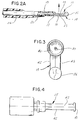
- Figure 2A is an enlarged view partially in cross section of the catheter tip pressure sensor.
- Figure 3 is an end view in cross section of the circuitous path taken along line 4-4 of Figure 2.
- Figure 4 is a side view in cross section of the circuitous path taken along line 3-3 of Figure 2.
- FIG. 1 Shown in Figure 1 is a perspective view of the catheter tip pressure sensor 10 and the preferred embodiment of an in vivo rezeroing assembly 11.
- the catheter tip pressure sensor 10 is shown inserted into a patient's arm but may be inserted into any appropriate part of the vasculature of a human or animal.
- the inserted catheter tip pressure sensor 10 is when in vivo is maintained at the level "Z" of the in vivo rezeroing assembly 11 such that no additional pressure component is added because of any difference in elevation between the sensor 10 and the assembly 11.
- Figure 2 has an enlarged plan view of the catheter tip pressure sensor 10 and the in vivo rezeroing assembly 11 showing the relationship between a control or multipositioned valve 12 and a circuitous path 13.
- the valve 12 and the circuitous path 13 are parts of the in vivo rezeroing assembly 11.
- the valve 12 is arranged in fluid communication with the catheter tip pressure sensor 10 so that the in vivo physiological pressure can communicate with both sides of the sensor 10 or can be restricted to one side thereof whereby the zero offset may be determined and accounted for in connection with signals obtained from the sensor 10.
- the catheter tip pressure sensor 10 is shown and described in detail in a pending European patent application entitled, "Apparatus for a Catheter Sensor Support and Method for Using the Suppnrt," Application No. 90310397.6, filed on September 21, 1990.
- the catheter tip pressure sensor described in that application is incorporated herein and made a part of this specification.
- the catheter tip pressure sensor includes a member 14 with a distal end 15 to ease placement of the catheter tip sensor 10 into an in vivo site in the vasculature of a human or animal.
- An intermediate part 16 and a proximal end 17 on the member 14 are used to provide fluid connection with a lumen 18 of a the 19 which extends from the proximal end 17.
- a passage 20 is provided through the intermediate part and opens in a first direction. The passage 20 extends through the proximal end 18 and across the intermediate part 16.
- a pressure responsive sensor 24 such as a Wheatstone bridge is carried upon for covering and sealing the passage 20. While a Wheatstone bridge is preferred, it is recognized that miniaturized pressure sensing elements currently unavailable may in the future be used with the in vivo rezeroing assembly 11 herein described.
- the pressure responsive sensor 21 has a first side 22 facing a first direction "A", that is, away from the intermediate part 16 so as to be exposed to in vivo physiological pressure when positioned in the vasculature of a human or animal as shown in Figure 1.
- the pressure responsive sensor 21 has a second side 23 opposite the first side 22. The second side 23 is in fluid communication with the passage 20 and the lumen 18.
- a pressure connecting means 24 for inhibiting liquid communication is part of the in vivo rezeroing assembly 11 and may be selectively connected to the lumen 18 to bring the first and second sides 22 and 23 of the pressure responsive sensor 21 into pressure communication with the in vivo physiological pressure. That is to say that the first side 22 of the pressure responsive sensor 21 is exposed to the in vivo conditions directly and the second side 23 may, by means of the valve 12, be connected to the in vivo physiological pressure by moving valve 12. The aforesaid connection is indirect in the sense that liquid is not permitted to reach the second side 23 of the sensor 21.
- the in vivo rezeroing assembly as herein set forth includes any isolation arrangement which will allow indirect pressure communication but inhibit liquid migration to the second side 23 of the pressure responsive sensor 21.
- the pressure connecting means 24 for inhibiting liquid communication is in the preferred embodiment, circuitous path 13, however, an elongate tube, capillary or other means (not shown) which would act as a barrier to liquid communication such as a diaphragm or gas permeable liquid impermeable filter (also not shown) may be used as the circuituous path 13.
- the pressures on the first and second sides 22 and 23 of the sensor 21 can be substantially equalized by application of in vivo physiological pressure to both the first and second sides 22 and 23 while limiting the liquid communication to the second side 23.
- the objective is the determination of a datum value, indicative of the equalized pressure of the in vivo sensor 21, for zeroing the signals from the pressure responsive sensor 21 by moving valve 12.
- the valve 12 shown in Figures 1 and 2 is positioned ex vivo in association with the catheter tip pressure sensor 10.
- the valve 12 has a portion 25 to operatively connect with the pressure connecting means 24 for inhibiting liquid communication whereby selective communication of the second side 23 of the pressure sensor and the physiological pressure can be arranged as needed.
- the preferred selective control is with the multipositioned valve 12 which is a common accessory familiar to practitioners for use with other medical applications, such as thermodilution, eternal pressure monitoring or the like.
- the multiposition valve 12 is for convenience and clarity shown in Figure 2 wherein the valve is in a first position such that in vivo pressure communication is permitted. Liquid flow through the circuitous path 13 is inhibited.
- the valve 12 may be rotated to in its second position wherein flow is not permitted to communicate with the circuitous path 13.
- the positioning of valve 12 when in its second position closes communication to circuituous path 13.
- a housing 28 of the multiposition valve includes a connector port 29, an inlet 30 from the lumen 18 and an outlet 31 covered by a pierceable septum 32.
- Carried on the housing 28 is a well 33 with a hollow needle 34 extending from the bottom 35 thereof and aligned for piercing a septum 36 on the circuitous path 13 as will be explained.
- the pierceable septum 32, the well 33 and needle 34 are positioned parallel to one another so that alignment and unidirectional movement is all that is required to conjugate the circuitous path 13 and the housing 28.
- the needle 34 passes through the bottom 35 of the well 33 and is in fluid communication with the lumen 18 so that pressure in the catheter lumen 18 is available to a bore 37 through the needle 34.
- the circuitous path 13 is simply a labyrinth 38 between the pierceable septum 32 of the circuitous path 13 and a needle 39 in the well 40. That is to say that the circuitous path 13 has the fittings identical to those of the housing 28 such that the needle (either 34 or 39) on one may pierce the septum 32 or 36 on the other when the circuitous path 13 is aligned and the moved unidirectionally to conjugate with the housing 28. It is preferred that needle 34 pierce septum 32 before needle 39 pierce septum 36 to prevent circuituous path 13 from filling with fluid. After mating engagement, the catheter 26 is in fluid communication with the housing 28 and the labyrinth 38 of the valve is in the first position as shown in Figure 2.
- circuitous path 13 acts as a barrier to the transmittal of liquid to the lumen 18.
- the preferred embodiment of the circuitous path 13 is shown in Figures 2, 3 and 4 as a combination 41 of an upper component 42 and a lower component 43 which are shaped to fit to each other and capture the hollow needle 39 at one end of the circuitous path 13 and retain the pierceable septum 36 at the other end of the circuitous path 13.
- the preferred components 42 and 43 are injection molded and designed and shaped to fit and be secured to one another by,cement, glue, RF welding, solvent bonding or any other method that holds the components 42 and 43 together to make a leak free labyrinth 38 therethrough.
- the circuitous path 13 may be made in accordance with the design shown and described in U.S. Patent No. 4,919,131, Issued on April 24, 1990, and entitled, "Thermoelectric Chiller and Automatic Syringe" which is incorporated herein and made a part of this specification. Although this construction is not the preferred embodiment, it is believed that the labyrinth 38 of that thermal formed plastic structure would work successfully. While a valve 12 is shown and described, the circuitous path 13 may be used without any valve to connect the first and second sides 22 and 23 of the sensor to physiological pressure. If there were no multi position valve 12 then the needle 34 on the housing 28 would exit to atmospheric pressure and the second side 23 would be subject to atmospheric pressure.
- valve 12 can be used to eliminate these artifacts connecting and allowing only physiological pressure to reach the first and second sides by changing valve 13 from its first position to its second position.
- Figure 3 is an enlarged view seen from lines 3-3 of Figure 2 of the needle 39 and well 40 and the pierceable septum 36 as would be seen by one positioned at the housing 28 just prior to engagement of the circuitous path 13 with and the housing 28.
- Apparent from this view is the parallel positioning of the respective wells, needles and the septums. While the well and needle are concentric that is not essential just preferred as that arrangement centers the needles with respect to the septums.
- the preferred parallel arrangement allows the attachment of the circuitous path and housing by the simple application of unidirectional movement and pressure therebetween once alignment is made.
- the well 33 on the housing 28 and the well 40 on the circuitous path 13 each guide the opposing septums 36 and 32 onto the needles 34 and 39 during conjugation.
- the needles 34 and 39 are recessed slightly into their respective wells 33 and 40 whereby when each septum 32 and 36 first engages with its well 33 and 40, the contact therebetween centers the septum 36 and 32 so each is pierced through its middle by either needle 34 or 39.
- the recessing of the needles 34 and 39 protects the user and prevents accidental sticking. While circular cross sections for the wells and septums are shown, any shapes which are convenient to make and which fit during conjugation would be acceptable. Circular septums are common and therefore preferred.
- Figure 4 is an enlarged side view of the circuitous path 13 as seen from line 4-4 of Figure 2. Apparent from Figure 4 is the manner in which the upper component 42 and the lower component 43 fit together to provide a leak ,free labyrinth 38.
- the well 40 on the circuitous path 13 and its relationship to the labyrinth 38 are shown in the side view of Figure 4.
- Figure 3 has the end view of the circuitous path 13 and illustrates the parallel arrangement of the needle 39, well 40 and the septum 36.
- a proximal side port 45 is on connector 44.
- Connector 44 has a pair 46 of generally parallel passages through a central body connecting the proximal side port 45 with the catheter 26 to one passage through the central body 47 and the lumen 18 to the other passage through the central body 47.
- a female luer nut 49 Surrounding the central body 47 is a female luer nut 49 with an internal thread 50 arranged to rotate about the central body 47.
- a male luer taper 51 on the distal inlet of the central body 47 is secured to a catheter adapter 52 having a female luer taper by the rotation of the luer nut 49.
- catheter adapter 52 having a female luer taper by the rotation of the luer nut 49.
- Locking lugs 53 thread to the luer nut 49.
- the luer nut 49 is supported by a circular groove 54 on the central body 47 so that the luer nut 49 may turn freely without axial motion relative to the central body 47.
- the in vivo rezeroing assembly 11 shown and described herein provides freedom from infection due to handling and convenience of use. It is merely a simple matter of rotating the multi position valve 12 from position one to position two in order to connect the physiological pressure to both sides of the sensor and disconnect the vent to the second side 33 of the sensor 21.
- a method for rezeroing the in vivo pressure sensor 11 is a part of the preferred embodiment and the method has the steps of obtaining a signal from the first side 22 the catheter tip pressure sensor 10 exposed to an in vivo physiological pressure.
- the next step of the preferred method requires transmitting a pressure substantially equal to the physiological pressure through the catheter 26 to and through the circuitous path 13.
- the step of applying the pressure in the circuitous path 13 to the lumen 18 to equalize the pressure on the second side 23 of the sensor 21 follows.
- the last step determines the signal with balanced pressure applied to the first and second sides 22 and 23 of the in vivo sensor 21 for use in correcting for zero offset.
- the method may have the step of selecting the pressure including the step of removably and selectively connecting the catheter 26 to the circuitous path or to atmospheric pressure.
- the method could have the step of connecting wherein an additional step of inhibiting fluid communication between the catheter 26 and the lumen 18 is used.
- the method can include the added step of selectively connecting by controlling the connection ex vivo.
Landscapes
- Health & Medical Sciences (AREA)
- Life Sciences & Earth Sciences (AREA)
- Physics & Mathematics (AREA)
- Cardiology (AREA)
- Molecular Biology (AREA)
- General Health & Medical Sciences (AREA)
- Biophysics (AREA)
- Pathology (AREA)
- Engineering & Computer Science (AREA)
- Biomedical Technology (AREA)
- Heart & Thoracic Surgery (AREA)
- Medical Informatics (AREA)
- Vascular Medicine (AREA)
- Surgery (AREA)
- Animal Behavior & Ethology (AREA)
- Physiology (AREA)
- Public Health (AREA)
- Veterinary Medicine (AREA)
- Chemical & Material Sciences (AREA)
- Analytical Chemistry (AREA)
- General Physics & Mathematics (AREA)
- Measuring Pulse, Heart Rate, Blood Pressure Or Blood Flow (AREA)
- Measuring And Recording Apparatus For Diagnosis (AREA)
- Measuring Fluid Pressure (AREA)
- Media Introduction/Drainage Providing Device (AREA)
Applications Claiming Priority (2)
| Application Number | Priority Date | Filing Date | Title |
|---|---|---|---|
| US578712 | 1990-09-07 | ||
| US07/578,712 US5133358A (en) | 1990-09-07 | 1990-09-07 | Apparatus for rezeroing an in vivo pressure sensor and method for rezeroing |
Publications (2)
| Publication Number | Publication Date |
|---|---|
| EP0475686A1 true EP0475686A1 (de) | 1992-03-18 |
| EP0475686B1 EP0475686B1 (de) | 1996-01-31 |
Family
ID=24313983
Family Applications (1)
| Application Number | Title | Priority Date | Filing Date |
|---|---|---|---|
| EP91308149A Expired - Lifetime EP0475686B1 (de) | 1990-09-07 | 1991-09-05 | Gerät und Verfahren zum Nullabgleich eines in vivo Druckmessfühlers |
Country Status (9)
| Country | Link |
|---|---|
| US (1) | US5133358A (de) |
| EP (1) | EP0475686B1 (de) |
| JP (1) | JP2514757B2 (de) |
| AT (1) | ATE133546T1 (de) |
| CA (1) | CA2046404C (de) |
| DE (1) | DE69116775T2 (de) |
| ES (1) | ES2085433T3 (de) |
| IE (1) | IE74687B1 (de) |
| MX (1) | MX9100087A (de) |
Cited By (2)
| Publication number | Priority date | Publication date | Assignee | Title |
|---|---|---|---|---|
| US5437284A (en) * | 1993-12-30 | 1995-08-01 | Camino Laboratories, Inc. | System and method for in vivo calibration of a sensor |
| EP0749721A1 (de) * | 1995-06-19 | 1996-12-27 | Becton, Dickinson and Company | Gerät zum Nullabgleich eines In-vivo-Druckmessers |
Families Citing this family (38)
| Publication number | Priority date | Publication date | Assignee | Title |
|---|---|---|---|---|
| US5691478A (en) * | 1995-06-07 | 1997-11-25 | Schneider/Namic | Device and method for remote zeroing of a biological fluid pressure measurement device |
| IL116685A (en) * | 1996-01-05 | 2000-07-16 | Vascular Technologies Ltd | Blood vessel entry indicator |
| JP3737554B2 (ja) * | 1996-01-09 | 2006-01-18 | 株式会社東海理化電機製作所 | センサ機能を備えたカテーテル |
| US6120457A (en) * | 1997-07-02 | 2000-09-19 | Johnson & Johnson Professional, Inc. | In vivo zeroing of catheter pressure sensor |
| EP1141671A1 (de) | 1999-01-11 | 2001-10-10 | Becton, Dickinson and Company | Isolierter kalibrier-adapter für sterile druckwandler |
| US7455666B2 (en) | 2001-07-13 | 2008-11-25 | Board Of Regents, The University Of Texas System | Methods and apparatuses for navigating the subarachnoid space |
| US7775966B2 (en) | 2005-02-24 | 2010-08-17 | Ethicon Endo-Surgery, Inc. | Non-invasive pressure measurement in a fluid adjustable restrictive device |
| US7775215B2 (en) | 2005-02-24 | 2010-08-17 | Ethicon Endo-Surgery, Inc. | System and method for determining implanted device positioning and obtaining pressure data |
| US8066629B2 (en) | 2005-02-24 | 2011-11-29 | Ethicon Endo-Surgery, Inc. | Apparatus for adjustment and sensing of gastric band pressure |
| US7699770B2 (en) | 2005-02-24 | 2010-04-20 | Ethicon Endo-Surgery, Inc. | Device for non-invasive measurement of fluid pressure in an adjustable restriction device |
| US8016744B2 (en) | 2005-02-24 | 2011-09-13 | Ethicon Endo-Surgery, Inc. | External pressure-based gastric band adjustment system and method |
| US7658196B2 (en) | 2005-02-24 | 2010-02-09 | Ethicon Endo-Surgery, Inc. | System and method for determining implanted device orientation |
| US7927270B2 (en) | 2005-02-24 | 2011-04-19 | Ethicon Endo-Surgery, Inc. | External mechanical pressure sensor for gastric band pressure measurements |
| US7771362B2 (en) * | 2005-08-01 | 2010-08-10 | Datascope Investment Corp. | Calibration of in vivo blood pressure sensors |
| US8870742B2 (en) | 2006-04-06 | 2014-10-28 | Ethicon Endo-Surgery, Inc. | GUI for an implantable restriction device and a data logger |
| US8152710B2 (en) | 2006-04-06 | 2012-04-10 | Ethicon Endo-Surgery, Inc. | Physiological parameter analysis for an implantable restriction device and a data logger |
| US8187163B2 (en) | 2007-12-10 | 2012-05-29 | Ethicon Endo-Surgery, Inc. | Methods for implanting a gastric restriction device |
| US8100870B2 (en) | 2007-12-14 | 2012-01-24 | Ethicon Endo-Surgery, Inc. | Adjustable height gastric restriction devices and methods |
| US8377079B2 (en) | 2007-12-27 | 2013-02-19 | Ethicon Endo-Surgery, Inc. | Constant force mechanisms for regulating restriction devices |
| US8142452B2 (en) | 2007-12-27 | 2012-03-27 | Ethicon Endo-Surgery, Inc. | Controlling pressure in adjustable restriction devices |
| US8337389B2 (en) | 2008-01-28 | 2012-12-25 | Ethicon Endo-Surgery, Inc. | Methods and devices for diagnosing performance of a gastric restriction system |
| US8591395B2 (en) | 2008-01-28 | 2013-11-26 | Ethicon Endo-Surgery, Inc. | Gastric restriction device data handling devices and methods |
| US8192350B2 (en) | 2008-01-28 | 2012-06-05 | Ethicon Endo-Surgery, Inc. | Methods and devices for measuring impedance in a gastric restriction system |
| US8221439B2 (en) | 2008-02-07 | 2012-07-17 | Ethicon Endo-Surgery, Inc. | Powering implantable restriction systems using kinetic motion |
| US7844342B2 (en) | 2008-02-07 | 2010-11-30 | Ethicon Endo-Surgery, Inc. | Powering implantable restriction systems using light |
| US8114345B2 (en) | 2008-02-08 | 2012-02-14 | Ethicon Endo-Surgery, Inc. | System and method of sterilizing an implantable medical device |
| US8057492B2 (en) | 2008-02-12 | 2011-11-15 | Ethicon Endo-Surgery, Inc. | Automatically adjusting band system with MEMS pump |
| US8591532B2 (en) | 2008-02-12 | 2013-11-26 | Ethicon Endo-Sugery, Inc. | Automatically adjusting band system |
| US8034065B2 (en) | 2008-02-26 | 2011-10-11 | Ethicon Endo-Surgery, Inc. | Controlling pressure in adjustable restriction devices |
| US8233995B2 (en) | 2008-03-06 | 2012-07-31 | Ethicon Endo-Surgery, Inc. | System and method of aligning an implantable antenna |
| US8187162B2 (en) | 2008-03-06 | 2012-05-29 | Ethicon Endo-Surgery, Inc. | Reorientation port |
| WO2012122267A1 (en) | 2011-03-07 | 2012-09-13 | Theranova, Llc | Sensing foley catheter |
| US20100114063A1 (en) * | 2008-11-04 | 2010-05-06 | Angiodynamics, Inc. | Catheter injection monitoring device |
| EP2485638B1 (de) | 2009-10-07 | 2016-11-30 | Endophys Holdings, LLC | Medizinische druckerfassungsvorrichtungen |
| JP6100705B2 (ja) | 2014-01-22 | 2017-03-22 | 日本光電工業株式会社 | 血圧測定システム |
| JP6235943B2 (ja) | 2014-03-18 | 2017-11-22 | 日本光電工業株式会社 | 血圧測定システム |
| ES2879981T3 (es) * | 2015-05-29 | 2021-11-23 | Carag Ag | Catéter para la medición del flujo sanguíneo en un tejido corporal |
| TWI653031B (zh) | 2016-03-28 | 2019-03-11 | 鉅旺生技股份有限公司 | 無線壓力檢測儀 |
Citations (4)
| Publication number | Priority date | Publication date | Assignee | Title |
|---|---|---|---|---|
| US3831588A (en) * | 1972-10-16 | 1974-08-27 | Device Res Inc | Pressure sensing device |
| EP0074114A1 (de) * | 1981-09-08 | 1983-03-16 | Brown University Research Foundation | Katheter |
| EP0328105A2 (de) * | 1988-02-12 | 1989-08-16 | Terumo Kabushiki Kaisha | Vorrichtung zur Korrektur der Blutdruckwellenform |
| EP0362824A1 (de) * | 1988-10-04 | 1990-04-11 | pvb medizintechnik gmbh | Druckmesskatheter |
Family Cites Families (14)
| Publication number | Priority date | Publication date | Assignee | Title |
|---|---|---|---|---|
| US3122136A (en) * | 1961-06-16 | 1964-02-25 | Cordis Corp | Catheter pressure standard |
| US3703099A (en) * | 1969-11-12 | 1972-11-21 | Ici Ltd | Pressure transducer |
| DE2145198C3 (de) * | 1971-09-09 | 1979-04-12 | Siemens Ag, 1000 Berlin Und 8000 Muenchen | Druckrezeptor |
| US4499903A (en) * | 1979-05-03 | 1985-02-19 | University Of Arizona Foundation | Methods and apparatus for testing a blood pressure monitoring system of the hydraulic type |
| US4342218A (en) * | 1980-01-16 | 1982-08-03 | Forrest Fox | Method and apparatus for zeroing and calibrating an invasive blood pressure monitoring system |
| US4384470A (en) * | 1981-04-13 | 1983-05-24 | Joseph Fiore | Method and apparatus for testing blood vessel catheters |
| US4603699A (en) * | 1984-11-20 | 1986-08-05 | Himpens Jacques M | Apparatus and method for measuring osmotic pressure in situ |
| SE441725B (sv) * | 1985-01-10 | 1985-11-04 | Bertil Hok | System for fysiologiska tryckregistreringar |
| US4672974A (en) * | 1985-06-14 | 1987-06-16 | Lee Arnold St J | Method and apparatus for "zeroing" and calibrating a catheter-tip gauge-pressure transducer |
| NL8502543A (nl) * | 1985-09-17 | 1987-04-16 | Sentron V O F | Langwerpig drukgevoelig element, vervaardigd uit halfgeleidermateriaal. |
| US4658829A (en) * | 1985-10-10 | 1987-04-21 | Utah Medical Products, Inc. | Method and apparatus for pressure transducer calibration and simulation |
| US4901731A (en) * | 1988-04-27 | 1990-02-20 | Millar Instruments, Inc. | Single sensor pressure differential device |
| US4886070A (en) * | 1988-05-11 | 1989-12-12 | Thermometrics, Inc. | Method of in vivo calibration of a pressure sensor |
| US5050297A (en) * | 1989-09-21 | 1991-09-24 | Becton, Dickinson And Company | Method for assembly of a directly exposed catheter sensor on a support tip |
-
1990
- 1990-09-07 US US07/578,712 patent/US5133358A/en not_active Expired - Fee Related
-
1991
- 1991-06-21 IE IE216891A patent/IE74687B1/en not_active IP Right Cessation
- 1991-07-04 MX MX9100087A patent/MX9100087A/es not_active IP Right Cessation
- 1991-07-05 CA CA002046404A patent/CA2046404C/en not_active Expired - Fee Related
- 1991-09-05 AT AT91308149T patent/ATE133546T1/de not_active IP Right Cessation
- 1991-09-05 ES ES91308149T patent/ES2085433T3/es not_active Expired - Lifetime
- 1991-09-05 DE DE69116775T patent/DE69116775T2/de not_active Expired - Fee Related
- 1991-09-05 EP EP91308149A patent/EP0475686B1/de not_active Expired - Lifetime
- 1991-09-06 JP JP3227307A patent/JP2514757B2/ja not_active Expired - Fee Related
Patent Citations (4)
| Publication number | Priority date | Publication date | Assignee | Title |
|---|---|---|---|---|
| US3831588A (en) * | 1972-10-16 | 1974-08-27 | Device Res Inc | Pressure sensing device |
| EP0074114A1 (de) * | 1981-09-08 | 1983-03-16 | Brown University Research Foundation | Katheter |
| EP0328105A2 (de) * | 1988-02-12 | 1989-08-16 | Terumo Kabushiki Kaisha | Vorrichtung zur Korrektur der Blutdruckwellenform |
| EP0362824A1 (de) * | 1988-10-04 | 1990-04-11 | pvb medizintechnik gmbh | Druckmesskatheter |
Cited By (2)
| Publication number | Priority date | Publication date | Assignee | Title |
|---|---|---|---|---|
| US5437284A (en) * | 1993-12-30 | 1995-08-01 | Camino Laboratories, Inc. | System and method for in vivo calibration of a sensor |
| EP0749721A1 (de) * | 1995-06-19 | 1996-12-27 | Becton, Dickinson and Company | Gerät zum Nullabgleich eines In-vivo-Druckmessers |
Also Published As
| Publication number | Publication date |
|---|---|
| JP2514757B2 (ja) | 1996-07-10 |
| CA2046404A1 (en) | 1992-03-08 |
| ATE133546T1 (de) | 1996-02-15 |
| DE69116775D1 (de) | 1996-03-14 |
| DE69116775T2 (de) | 1996-08-08 |
| EP0475686B1 (de) | 1996-01-31 |
| MX9100087A (es) | 1992-06-05 |
| US5133358A (en) | 1992-07-28 |
| IE912168A1 (en) | 1992-03-11 |
| IE74687B1 (en) | 1997-07-30 |
| ES2085433T3 (es) | 1996-06-01 |
| JPH04269938A (ja) | 1992-09-25 |
| CA2046404C (en) | 1995-08-22 |
Similar Documents
| Publication | Publication Date | Title |
|---|---|---|
| EP0475686B1 (de) | Gerät und Verfahren zum Nullabgleich eines in vivo Druckmessfühlers | |
| US5218965A (en) | Apparatus for carrying a sensor in a connector for a catheter adapter | |
| US5050297A (en) | Method for assembly of a directly exposed catheter sensor on a support tip | |
| US5993395A (en) | Pressure transducer apparatus with disposable dome | |
| US4610256A (en) | Pressure transducer | |
| AU697232B2 (en) | In situ calibration system for sensors located in a physiologic line | |
| EP0580592B1 (de) | Druckkompensierte vorrichtung zur flüssigkeitsverabreichung | |
| US5193545A (en) | Device for determining at least one medical variable | |
| US4263808A (en) | Noninvasive pressure monitor | |
| US5203340A (en) | Apparatus for rezeroing an in vivo pressure sensor and method for rezeroing | |
| JP3157834B2 (ja) | 較正ポートを有するトランスデューサ・ハウジング | |
| CA2682474A1 (en) | Multifunction valve | |
| US5691478A (en) | Device and method for remote zeroing of a biological fluid pressure measurement device | |
| JP3062386B2 (ja) | 圧力センサー付ダブルルーメンカテーテル |
Legal Events
| Date | Code | Title | Description |
|---|---|---|---|
| PUAI | Public reference made under article 153(3) epc to a published international application that has entered the european phase |
Free format text: ORIGINAL CODE: 0009012 |
|
| AK | Designated contracting states |
Kind code of ref document: A1 Designated state(s): AT BE CH DE DK ES FR GB GR IT LI LU NL SE |
|
| 17P | Request for examination filed |
Effective date: 19920508 |
|
| 17Q | First examination report despatched |
Effective date: 19940705 |
|
| GRAA | (expected) grant |
Free format text: ORIGINAL CODE: 0009210 |
|
| AK | Designated contracting states |
Kind code of ref document: B1 Designated state(s): AT BE CH DE DK ES FR GB GR IT LI LU NL SE |
|
| PG25 | Lapsed in a contracting state [announced via postgrant information from national office to epo] |
Ref country code: NL Free format text: LAPSE BECAUSE OF FAILURE TO SUBMIT A TRANSLATION OF THE DESCRIPTION OR TO PAY THE FEE WITHIN THE PRESCRIBED TIME-LIMIT Effective date: 19960131 Ref country code: LI Effective date: 19960131 Ref country code: GR Free format text: LAPSE BECAUSE OF FAILURE TO SUBMIT A TRANSLATION OF THE DESCRIPTION OR TO PAY THE FEE WITHIN THE PRESCRIBED TIME-LIMIT Effective date: 19960131 Ref country code: DK Effective date: 19960131 Ref country code: CH Effective date: 19960131 Ref country code: BE Effective date: 19960131 Ref country code: AT Effective date: 19960131 |
|
| REF | Corresponds to: |
Ref document number: 133546 Country of ref document: AT Date of ref document: 19960215 Kind code of ref document: T |
|
| ITF | It: translation for a ep patent filed | ||
| REF | Corresponds to: |
Ref document number: 69116775 Country of ref document: DE Date of ref document: 19960314 |
|
| ET | Fr: translation filed | ||
| PG25 | Lapsed in a contracting state [announced via postgrant information from national office to epo] |
Ref country code: SE Effective date: 19960430 |
|
| REG | Reference to a national code |
Ref country code: ES Ref legal event code: FG2A Ref document number: 2085433 Country of ref document: ES Kind code of ref document: T3 |
|
| NLV1 | Nl: lapsed or annulled due to failure to fulfill the requirements of art. 29p and 29m of the patents act | ||
| REG | Reference to a national code |
Ref country code: CH Ref legal event code: PL |
|
| PG25 | Lapsed in a contracting state [announced via postgrant information from national office to epo] |
Ref country code: LU Free format text: LAPSE BECAUSE OF NON-PAYMENT OF DUE FEES Effective date: 19960930 |
|
| PLBE | No opposition filed within time limit |
Free format text: ORIGINAL CODE: 0009261 |
|
| STAA | Information on the status of an ep patent application or granted ep patent |
Free format text: STATUS: NO OPPOSITION FILED WITHIN TIME LIMIT |
|
| 26N | No opposition filed | ||
| PGFP | Annual fee paid to national office [announced via postgrant information from national office to epo] |
Ref country code: ES Payment date: 19980921 Year of fee payment: 8 |
|
| PGFP | Annual fee paid to national office [announced via postgrant information from national office to epo] |
Ref country code: GB Payment date: 19990901 Year of fee payment: 9 |
|
| PG25 | Lapsed in a contracting state [announced via postgrant information from national office to epo] |
Ref country code: ES Free format text: LAPSE BECAUSE OF NON-PAYMENT OF DUE FEES Effective date: 19990906 |
|
| PGFP | Annual fee paid to national office [announced via postgrant information from national office to epo] |
Ref country code: DE Payment date: 19990906 Year of fee payment: 9 |
|
| PGFP | Annual fee paid to national office [announced via postgrant information from national office to epo] |
Ref country code: FR Payment date: 19990909 Year of fee payment: 9 |
|
| PG25 | Lapsed in a contracting state [announced via postgrant information from national office to epo] |
Ref country code: GB Free format text: LAPSE BECAUSE OF NON-PAYMENT OF DUE FEES Effective date: 20000905 |
|
| GBPC | Gb: european patent ceased through non-payment of renewal fee |
Effective date: 20000905 |
|
| PG25 | Lapsed in a contracting state [announced via postgrant information from national office to epo] |
Ref country code: FR Free format text: LAPSE BECAUSE OF NON-PAYMENT OF DUE FEES Effective date: 20010531 |
|
| PG25 | Lapsed in a contracting state [announced via postgrant information from national office to epo] |
Ref country code: DE Free format text: LAPSE BECAUSE OF NON-PAYMENT OF DUE FEES Effective date: 20010601 |
|
| REG | Reference to a national code |
Ref country code: FR Ref legal event code: ST |
|
| REG | Reference to a national code |
Ref country code: ES Ref legal event code: FD2A Effective date: 20001013 |
|
| PG25 | Lapsed in a contracting state [announced via postgrant information from national office to epo] |
Ref country code: IT Free format text: LAPSE BECAUSE OF NON-PAYMENT OF DUE FEES;WARNING: LAPSES OF ITALIAN PATENTS WITH EFFECTIVE DATE BEFORE 2007 MAY HAVE OCCURRED AT ANY TIME BEFORE 2007. THE CORRECT EFFECTIVE DATE MAY BE DIFFERENT FROM THE ONE RECORDED. Effective date: 20050905 |