EP0491277B1 - Bauelement für einen wabenförmigen Kern und eine Plattenstruktur mit diesem Wabenkern - Google Patents
Bauelement für einen wabenförmigen Kern und eine Plattenstruktur mit diesem Wabenkern Download PDFInfo
- Publication number
- EP0491277B1 EP0491277B1 EP91121290A EP91121290A EP0491277B1 EP 0491277 B1 EP0491277 B1 EP 0491277B1 EP 91121290 A EP91121290 A EP 91121290A EP 91121290 A EP91121290 A EP 91121290A EP 0491277 B1 EP0491277 B1 EP 0491277B1
- Authority
- EP
- European Patent Office
- Prior art keywords
- honeycomb
- honeycomb member
- cells
- faces
- panel
- Prior art date
- Legal status (The legal status is an assumption and is not a legal conclusion. Google has not performed a legal analysis and makes no representation as to the accuracy of the status listed.)
- Expired - Lifetime
Links
Images





Classifications
-
- B—PERFORMING OPERATIONS; TRANSPORTING
- B32—LAYERED PRODUCTS
- B32B—LAYERED PRODUCTS, i.e. PRODUCTS BUILT-UP OF STRATA OF FLAT OR NON-FLAT, e.g. CELLULAR OR HONEYCOMB, FORM
- B32B3/00—Layered products comprising a layer with external or internal discontinuities or unevennesses, or a layer of non-planar shape; Layered products comprising a layer having particular features of form
- B32B3/10—Layered products comprising a layer with external or internal discontinuities or unevennesses, or a layer of non-planar shape; Layered products comprising a layer having particular features of form characterised by a discontinuous layer, i.e. formed of separate pieces of material
- B32B3/12—Layered products comprising a layer with external or internal discontinuities or unevennesses, or a layer of non-planar shape; Layered products comprising a layer having particular features of form characterised by a discontinuous layer, i.e. formed of separate pieces of material characterised by a layer of regularly- arranged cells, e.g. a honeycomb structure
-
- B—PERFORMING OPERATIONS; TRANSPORTING
- B21—MECHANICAL METAL-WORKING WITHOUT ESSENTIALLY REMOVING MATERIAL; PUNCHING METAL
- B21D—WORKING OR PROCESSING OF SHEET METAL OR METAL TUBES, RODS OR PROFILES WITHOUT ESSENTIALLY REMOVING MATERIAL; PUNCHING METAL
- B21D47/00—Making rigid structural elements or units, e.g. honeycomb structures
-
- B—PERFORMING OPERATIONS; TRANSPORTING
- B29—WORKING OF PLASTICS; WORKING OF SUBSTANCES IN A PLASTIC STATE IN GENERAL
- B29D—PRODUCING PARTICULAR ARTICLES FROM PLASTICS OR FROM SUBSTANCES IN A PLASTIC STATE
- B29D24/00—Producing articles with hollow walls
- B29D24/002—Producing articles with hollow walls formed with structures, e.g. cores placed between two plates or sheets, e.g. partially filled
- B29D24/005—Producing articles with hollow walls formed with structures, e.g. cores placed between two plates or sheets, e.g. partially filled the structure having joined ribs, e.g. honeycomb
-
- B—PERFORMING OPERATIONS; TRANSPORTING
- B31—MAKING ARTICLES OF PAPER, CARDBOARD OR MATERIAL WORKED IN A MANNER ANALOGOUS TO PAPER; WORKING PAPER, CARDBOARD OR MATERIAL WORKED IN A MANNER ANALOGOUS TO PAPER
- B31D—MAKING ARTICLES OF PAPER, CARDBOARD OR MATERIAL WORKED IN A MANNER ANALOGOUS TO PAPER, NOT PROVIDED FOR IN SUBCLASSES B31B OR B31C
- B31D3/00—Making articles of cellular structure, e.g. insulating board
- B31D3/02—Making articles of cellular structure, e.g. insulating board honeycombed structures, i.e. the cells having an essentially hexagonal section
-
- E—FIXED CONSTRUCTIONS
- E04—BUILDING
- E04C—STRUCTURAL ELEMENTS; BUILDING MATERIALS
- E04C2/00—Building elements of relatively thin form for the construction of parts of buildings, e.g. sheet materials, slabs, or panels
- E04C2/30—Building elements of relatively thin form for the construction of parts of buildings, e.g. sheet materials, slabs, or panels characterised by the shape or structure
- E04C2/34—Building elements of relatively thin form for the construction of parts of buildings, e.g. sheet materials, slabs, or panels characterised by the shape or structure composed of two or more spaced sheet-like parts
- E04C2/36—Building elements of relatively thin form for the construction of parts of buildings, e.g. sheet materials, slabs, or panels characterised by the shape or structure composed of two or more spaced sheet-like parts spaced apart by transversely-placed strip material, e.g. honeycomb panels
-
- B—PERFORMING OPERATIONS; TRANSPORTING
- B32—LAYERED PRODUCTS
- B32B—LAYERED PRODUCTS, i.e. PRODUCTS BUILT-UP OF STRATA OF FLAT OR NON-FLAT, e.g. CELLULAR OR HONEYCOMB, FORM
- B32B2305/00—Condition, form or state of the layers or laminate
- B32B2305/02—Cellular or porous
- B32B2305/024—Honeycomb
-
- B—PERFORMING OPERATIONS; TRANSPORTING
- B32—LAYERED PRODUCTS
- B32B—LAYERED PRODUCTS, i.e. PRODUCTS BUILT-UP OF STRATA OF FLAT OR NON-FLAT, e.g. CELLULAR OR HONEYCOMB, FORM
- B32B2311/00—Metals, their alloys or their compounds
- B32B2311/24—Aluminium
-
- Y—GENERAL TAGGING OF NEW TECHNOLOGICAL DEVELOPMENTS; GENERAL TAGGING OF CROSS-SECTIONAL TECHNOLOGIES SPANNING OVER SEVERAL SECTIONS OF THE IPC; TECHNICAL SUBJECTS COVERED BY FORMER USPC CROSS-REFERENCE ART COLLECTIONS [XRACs] AND DIGESTS
- Y10—TECHNICAL SUBJECTS COVERED BY FORMER USPC
- Y10T—TECHNICAL SUBJECTS COVERED BY FORMER US CLASSIFICATION
- Y10T156/00—Adhesive bonding and miscellaneous chemical manufacture
- Y10T156/10—Methods of surface bonding and/or assembly therefor
- Y10T156/1002—Methods of surface bonding and/or assembly therefor with permanent bending or reshaping or surface deformation of self sustaining lamina
-
- Y—GENERAL TAGGING OF NEW TECHNOLOGICAL DEVELOPMENTS; GENERAL TAGGING OF CROSS-SECTIONAL TECHNOLOGIES SPANNING OVER SEVERAL SECTIONS OF THE IPC; TECHNICAL SUBJECTS COVERED BY FORMER USPC CROSS-REFERENCE ART COLLECTIONS [XRACs] AND DIGESTS
- Y10—TECHNICAL SUBJECTS COVERED BY FORMER USPC
- Y10T—TECHNICAL SUBJECTS COVERED BY FORMER US CLASSIFICATION
- Y10T156/00—Adhesive bonding and miscellaneous chemical manufacture
- Y10T156/10—Methods of surface bonding and/or assembly therefor
- Y10T156/1002—Methods of surface bonding and/or assembly therefor with permanent bending or reshaping or surface deformation of self sustaining lamina
- Y10T156/1003—Methods of surface bonding and/or assembly therefor with permanent bending or reshaping or surface deformation of self sustaining lamina by separating laminae between spaced secured areas [e.g., honeycomb expanding]
-
- Y—GENERAL TAGGING OF NEW TECHNOLOGICAL DEVELOPMENTS; GENERAL TAGGING OF CROSS-SECTIONAL TECHNOLOGIES SPANNING OVER SEVERAL SECTIONS OF THE IPC; TECHNICAL SUBJECTS COVERED BY FORMER USPC CROSS-REFERENCE ART COLLECTIONS [XRACs] AND DIGESTS
- Y10—TECHNICAL SUBJECTS COVERED BY FORMER USPC
- Y10T—TECHNICAL SUBJECTS COVERED BY FORMER US CLASSIFICATION
- Y10T156/00—Adhesive bonding and miscellaneous chemical manufacture
- Y10T156/10—Methods of surface bonding and/or assembly therefor
- Y10T156/1002—Methods of surface bonding and/or assembly therefor with permanent bending or reshaping or surface deformation of self sustaining lamina
- Y10T156/1007—Running or continuous length work
- Y10T156/1023—Surface deformation only [e.g., embossing]
-
- Y—GENERAL TAGGING OF NEW TECHNOLOGICAL DEVELOPMENTS; GENERAL TAGGING OF CROSS-SECTIONAL TECHNOLOGIES SPANNING OVER SEVERAL SECTIONS OF THE IPC; TECHNICAL SUBJECTS COVERED BY FORMER USPC CROSS-REFERENCE ART COLLECTIONS [XRACs] AND DIGESTS
- Y10—TECHNICAL SUBJECTS COVERED BY FORMER USPC
- Y10T—TECHNICAL SUBJECTS COVERED BY FORMER US CLASSIFICATION
- Y10T428/00—Stock material or miscellaneous articles
- Y10T428/12—All metal or with adjacent metals
- Y10T428/1234—Honeycomb, or with grain orientation or elongated elements in defined angular relationship in respective components [e.g., parallel, inter- secting, etc.]
-
- Y—GENERAL TAGGING OF NEW TECHNOLOGICAL DEVELOPMENTS; GENERAL TAGGING OF CROSS-SECTIONAL TECHNOLOGIES SPANNING OVER SEVERAL SECTIONS OF THE IPC; TECHNICAL SUBJECTS COVERED BY FORMER USPC CROSS-REFERENCE ART COLLECTIONS [XRACs] AND DIGESTS
- Y10—TECHNICAL SUBJECTS COVERED BY FORMER USPC
- Y10T—TECHNICAL SUBJECTS COVERED BY FORMER US CLASSIFICATION
- Y10T428/00—Stock material or miscellaneous articles
- Y10T428/24—Structurally defined web or sheet [e.g., overall dimension, etc.]
- Y10T428/24033—Structurally defined web or sheet [e.g., overall dimension, etc.] including stitching and discrete fastener[s], coating or bond
-
- Y—GENERAL TAGGING OF NEW TECHNOLOGICAL DEVELOPMENTS; GENERAL TAGGING OF CROSS-SECTIONAL TECHNOLOGIES SPANNING OVER SEVERAL SECTIONS OF THE IPC; TECHNICAL SUBJECTS COVERED BY FORMER USPC CROSS-REFERENCE ART COLLECTIONS [XRACs] AND DIGESTS
- Y10—TECHNICAL SUBJECTS COVERED BY FORMER USPC
- Y10T—TECHNICAL SUBJECTS COVERED BY FORMER US CLASSIFICATION
- Y10T428/00—Stock material or miscellaneous articles
- Y10T428/24—Structurally defined web or sheet [e.g., overall dimension, etc.]
- Y10T428/24149—Honeycomb-like
-
- Y—GENERAL TAGGING OF NEW TECHNOLOGICAL DEVELOPMENTS; GENERAL TAGGING OF CROSS-SECTIONAL TECHNOLOGIES SPANNING OVER SEVERAL SECTIONS OF THE IPC; TECHNICAL SUBJECTS COVERED BY FORMER USPC CROSS-REFERENCE ART COLLECTIONS [XRACs] AND DIGESTS
- Y10—TECHNICAL SUBJECTS COVERED BY FORMER USPC
- Y10T—TECHNICAL SUBJECTS COVERED BY FORMER US CLASSIFICATION
- Y10T428/00—Stock material or miscellaneous articles
- Y10T428/24—Structurally defined web or sheet [e.g., overall dimension, etc.]
- Y10T428/24628—Nonplanar uniform thickness material
- Y10T428/24661—Forming, or cooperating to form cells
-
- Y—GENERAL TAGGING OF NEW TECHNOLOGICAL DEVELOPMENTS; GENERAL TAGGING OF CROSS-SECTIONAL TECHNOLOGIES SPANNING OVER SEVERAL SECTIONS OF THE IPC; TECHNICAL SUBJECTS COVERED BY FORMER USPC CROSS-REFERENCE ART COLLECTIONS [XRACs] AND DIGESTS
- Y10—TECHNICAL SUBJECTS COVERED BY FORMER USPC
- Y10T—TECHNICAL SUBJECTS COVERED BY FORMER US CLASSIFICATION
- Y10T428/00—Stock material or miscellaneous articles
- Y10T428/24—Structurally defined web or sheet [e.g., overall dimension, etc.]
- Y10T428/24942—Structurally defined web or sheet [e.g., overall dimension, etc.] including components having same physical characteristic in differing degree
Definitions
- This invention relates to a honeycomb member and a honeycomb panel.
- the honeycomb panel can be formed.
- a honeycomb core is composed of a plurality of dense close ended cells and can be used as core for a flat honeycomb panel.
- the cells typically have a hexagonal or square cross section.
- curved configurations are often required.
- a curved honeycomb core or panel is generally manufactured by merely bending plate material, but other known methods for manufacturing a curved honeycomb core or panel also exist and are now explained.
- honeycomb members composed of cells defined by curved faces are manufactured.
- the honeycomb members are then adhered, soldered or welded to one another along a desired curvature to form a honeycomb core.
- a second known method depicts a plurality of strip materials 101 which are bonded together by applying adhesive onto hatched portions 102 and then formed into a lamination 103. After a crosshatched portion 104 is removed from the lamination 103, the lamination 103 is extended to form a curved honeycomb core 105. The curved honeycomb core 105 is then sandwiched and bonded between face plates 106 and 107 to produce a curved honeycomb panel.
- Document JP-58-25531-A discloses another method as shown in Figures 11A through 11D.
- a strip material 111 is folded along folding lines 112 and 113.
- the folding lines 112 are perpendicular to a center line CL, and the folding lines 113 are slanted in relation to the center line CL.
- the strip material 111 is then folded along the folding lines 112 and 113 to form a corrugated sheet 116.
- the corrugated sheet 116 has inclined ridges 114 and grooves 115.
- the aforementioned related-art methods for manufacturing curved honeycomb cores or panels have many problems.
- the honeycomb core when a curved honeycomb core is manufactured by bending the plate material, the honeycomb core resists against the force required to bend it, thus permitting only large radii of curvature. Small radii of curvature cannot be obtained, using this method.
- the materials of the honeycomb cores have such a special configuration that positioning of the materials for forming cells is troublesome when the honeycomb cores are laminated onto one another.
- the production time is thereby significantly increased, moreover, the desired honeycomb core becomes more difficult to form as its height increases, due to the required curvature.
- the third related-art method involves multiple process steps, which increase production time. Furthermore, the honeycomb core 105 is not adequately supported perpendicular to its defined curvature, therefore the honeycomb panel produced has insufficient strength.
- a honeycomb member comprising the features of the pre-characterizing clause of claim 1 is known from document US-A-3068565, and in particular from figure 5 thereof. Adjoining side edges of two adjoining faces of this known honeycomb member define a comparatively wide opening. This opening is only closed when a plurality of the honeycomb members are arranged in the manner shown in figure 5 of this document. To provide sufficient strength to a honeycomb core made from a plurality of the known honeycomb members, the members are brazed to each other at contacting portions thereof. However, the inherent strength of a single one of the known honeycomb members is comparatively small.
- honeycomb member comprising the features of the pre-characterizing clause of claim 1 which has an improved inherent stability. It is desired that the honeycomb member can be contoured into complicated configurations such as compound curvatures, composed of multiple continuous curves. Further, it is an object of the invention to provide a honeycomb panel according to the pre-characterizing clause of claim 9 whose strength is improved by an increased stability of the at least one honeycomb member.
- honeycomb member according to claim 1 and by the honeycomb panel according to claim 9.
- the honeycomb member according to the invention is characterized by the feature that the honeycomb member is bent such that the adjoining side edges of two adjoining first faces contact each other at least at a portion thereof. This results in that the side edges of each interconnecting wall surrounding a cell contact each other at least at one point so that the individual cell has an increased resistance against external forces. Thereby, the inherent stability of the individual honeycomb member is increased.
- honeycomb members must be laminated and bonded onto one another to form cells. Therefore, to form a honeycomb panel, multiple honeycomb members need to be specifically arranged.
- the honeycomb member according to the present invention, however, utilizes individual cells each of which can independently resist external forces. Consequently, multiple honeycomb members need not to be specifically ordered to form a honeycomb core.
- Figures 1A and 1B are explanatory views of an intermediate product used for producing a honeycomb member according to this invention.
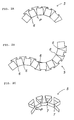
- Figures 2A through 2C are explanatory views of a final honeycomb member bent for use.
- Figures 3A and 3B are explanatory views showing inner and outer radii formed when the honeycomb member is bent.
- FIGS 4A through 4C are explanatory views explaining the flexibility of the honeycomb member according to this invention.
- Figures 5A through 5D are cross-sectional views illustrating the configuration of the cells of further embodiments of the intermediate honeycomb member.
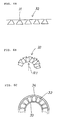
- Figures 6A through 6C are explanatory views of a first embodiment of a honeycomb panel.
- Figures 7A and 7B are explanatory views of a second embodiment of a honeycomb panel.
- Figure 8 is an explanatory view of a further application of the honeycomb member.
- Figure 9 is a perspective view of a related-art honeycomb member.
- Figure 10 is an explanatory view showing the formation of the curvature from a related-art honeycomb member.
- Figures 11A through 11D are explanatory views illustrating a related-art honeycomb member.
- Figures 1A and 1B show a honeycomb member of an intermediate stage of the production of the final honeycomb member according to the invention.
- each cell 4 in a honeycomb member 5 is defined by a series of bottom first faces 1, a series of top faces 2, and interconnecting walls 3.
- Each of the first and second faces 1,2 and of the walls 3 has a rectangular surface and creates an equilateral triangular cross section for each cell 4.
- a connecting angle ⁇ between each first face 1 and each wall 3 is about 60 degrees.
- each cell 4 is rowed such that the first faces 1 are arranged with corners or side edges 1a and 1b between adjacent cells 4 and having a slight clearance and such that the second faces 2 are arranged with corners or side edges 2a and 2b between adjacent cells 4 with a slight clearance.
- the interval between adjoining side edges 1a and 1b is narrow and the cell 4 has a slight clearance therein.
- the honeycomb member 5 can be bent in such a direction that the adjoining side edges 1a and 1b will contact each other. Therefore, the bend direction of the entire honeycomb member 5 is settled.
- the honeycomb member 5 can bend flexibly along support points 6 and lines 7. When the honeycomb member 5 is bent, the first faces 1 define an inner bend radius.
- the honeycomb member 5 can be bent as shown in Figures 2A and 2B. Before the honeycomb member 5 is soldered to a face plate to form a honeycomb panel, the honeycomb member 5 can also be bent as follows.
- a honeycomb member can also be twisted about the axis defining its length.
- the hatched portion of the strip material for a honeycomb member can be cut out.
- the strip material is then folded along folding lines a through i to form a honeycomb member as shown in Figure 4C.
- This honeycomb member can contact a face plate with only slight clearance therebetween. Therefore, as long as the folding lines a through i are perpendicular to the length of the honeycomb member 5, the first faces 1, the second faces 2 and the walls 3 are not limited to a strictly rectangular shape.
- the honeycomb member according to this invention can be bent or twisted to various radii of curvature.
- the load-bearing force acts perpendicularly to the curved surface of the honeycomb core.
- honeycomb panel When a honeycomb panel is manufactured, a panel is first pressed to a desired curvature; the honeycomb member of this invention is then arranged onto a panel, and a face plate is fit onto the honeycomb member.
- the honeycomb member can be bent or twisted as desired. Consequently, a honeycomb panel having a complicated set of curvatures can be easily manufactured. Since the sizes of the cells composing the honeycomb member are easily adjusted, the material thickness, the cell heights and the curvature of the honeycomb core as well as other parameters can each be easily adjusted. Therefore, a honeycomb core or panel having desired strength can be easily manufactured.
- a honeycomb member can also be manufactured by folding a strip member along a series of parallel folding lines.
- the cells of the intermediate honeycomb member can alternately have an isosceles triangular or other shaped cross section.
- cells 23 can have a circular cross section composing a honeycomb member 24.
- cells 25 can have a square cross section and form a honeycomb member 26.
- curved first faces and second faces can also define cells.
- the first faces, walls and second faces of cells can include folded reinforcement ribs 28 for strengthening the honeycomb member 29.
- the honeycomb members, 24, 26, 27 and 29 the connecting angle ⁇ between each interconnecting wall and each first face of each cell is acute. Therefore, the honeycomb members, 24, 26, 27 and 29 offer the same effects as those of the honeycomb member 5 composed of the cells 4.
- honeycomb panel A first embodiment of a honeycomb panel will now be explained with reference to Figures 6A through 6C.
- cells 31 having an equilateral triangular cross section compose a honeycomb member 32, in the same way as the honeycomb member 5 composed of the cells 4 explained above and shown in Figures 1A and 1B.
- the honeycomb member 32 can be used in honeycomb panels having a variety of curvatures.
- aluminum strip material is folded to form the honeycomb member 32, such that three 11mm long sides define the cells 31.
- the aluminum strip material has a thickness of 0.2mm and a width of 13mm.
- the honeycomb member 32 is first bent in the same way as explained with reference to Figure 2A such that an inner radius Ri is 50mm.
- face plates 33 and 34 are then soldered to the inner and outer peripheries of the honeycomb member 32, respectively, thereby forming a honeycomb panel.
- the honeycomb member 32 can be bent flexibly and then soldered in place to follow the curvature of the face plates 33 and 34.
- the load-bearing force of the honeycomb member 32 acts perpendicularly to the radius of curvature of the face plates 33 and 34, thereby providing adequate strength.
- the honeycomb member 32 of the above first embodiment is formed in the same way as explained with reference to Figure 2B.
- the honeycomb member 32 is then assembled and soldered between face plates 35 and 36.
- the face plates 35 and 36 are pressed in advance to have a compound curvature.
- the compound curvature consists of a convex curvature followed by a concave curvature.
- the convex curvature has an inner radius R1 of 70mm and the concave curvature has an inner radius R2 of 45mm.
- the honeycomb member 32 follows the compound curvature of the honeycomb panel.
- the honeycomb member 32 is securely soldered between the face plates 35 and 36.
- the load-bearing force of the honeycomb member 32 acts perpendicularly to the compound radii of curvature, thereby offering adequate strength, for example a compressive strength of about 0.7kgf/mm 2 to the honeycomb panel.
- honeycomb member 32 is bent as shown in Figure 2C to form a spacer between a honeycomb core 41 and an aluminum block 42 in a honeycomb panel.
- the honeycomb core 41 is composed of known cells having a hexagonal cross section.
- a screw thread (not shown) is provided in the aluminum block 42.
- a bore 43 is made in the honeycomb core 41 to receive the aluminum block 42.
- the honeycomb member 32 is bent and wound around the aluminum block 42.
- the aluminum block 42 is then inserted into the bore 43.
- the honeycomb member 32 secures the aluminum block 42 in the honeycomb panel and strengthens the portion between the aluminum block 42 and the honeycomb core 41.
- the honeycomb member 32 can thus be used as an individual reinforcement due to its rigidity.
- the honeycomb member 32 can contour any curve of the panel.
- honeycomb member 32 fills the portion between the aluminum block 42 and the honeycomb core 41, this portion has the same strength as the other portions of the honeycomb panel and is more resistant to breakage.
- the honeycomb member 32 could also be wound around the aluminum block 42 in several layers without having to bond the layers to one another.
- Figures 5A through 5D show the cross sections of various configurations the honeycomb cells have.
- the cross section of the cells is not restricted to these configurations.
- the connecting angle between the cell walls and first faces is preferably acute. Since the cross section of the cells is not limited to that of an equilateral triangle, the cells can have an orifice therein.
- the material of the honeycomb member is not limited to the specified material.
Landscapes
- Engineering & Computer Science (AREA)
- Mechanical Engineering (AREA)
- Architecture (AREA)
- Civil Engineering (AREA)
- Structural Engineering (AREA)
- Laminated Bodies (AREA)
- Bending Of Plates, Rods, And Pipes (AREA)
Claims (9)
- Wabenförmiges Element für einen wabenförmigen Kern oder ein wabenförmiges Paneel, das länglich ist und eine Vielzahl von rechteckigen ersten Flächen (1), die hintereinander angeordnet sind und sich in Axialrichtung des Elementes (5, 24, 26, 27, 29, 32) erstrecken, sowie des weiteren Verbindungswände (2, 3) umfaßt, die jeweils im wesentlichen senkrecht zur Länge des Elementes (5, 24, 26, 27, 29, 32) verlaufen und mit benachbarten Seitenrändern (1a, 1b) und zwei benachbarten der ersten Flächen (1) verbunden sind, wobei die Verbindungswände (1, 2) eine Vielzahl von axial beabstandeten Zellen (4, 23, 25, 31) definieren, dadurch gekennzeichnet, daß das Element (5, 24, 26, 27, 29, 32) derart gebogen ist, daß die benachbarten Seitenränder (1a, 1b) der beiden benachbarten ersten Flächen (1) mindestens an einem Abschnitt (6, 7) hiervon miteinander in Kontakt stehen.
- Wabenförmiges Element nach Anspruch 1, bei dem der zwischen den Verbindungswänden (2, 3) und den axial beabstandeten ersten Flächen (1) gebildete Verbindungswinkel geringer ist als 90°.
- Wabenförmiges Element nach Anspruch 2, bei dem der Verbindungswinkel etwa 60° beträgt.
- Wabenförmiges Element nach Anspruch 1, bei dem die benachbarten Seitenränder (1a, 1b) entlang einer Linie (7) miteinander in Kontakt stehen, um eine kontinuierliche Lastaufnahmefläche senkrecht zu einem Krümmungsradius, mit dem das Element (5, 24, 26, 27, 29, 32) gebogen ist, zu bilden.
- Wabenförmiges Element nach Anspruch 1, bei dem die Zellen (4) einen im wesentlichen dreieckförmigen Querschnitt besitzen.
- Wabenförmiges Element nach Anspruch 1, bei dem die Zellen (25) einen im wesentlichen rechteckigen Querschnitt besitzen.
- Wabenförmiges Element nach Anspruch 1, bei dem die Zellen (23) einen im wesentlichen kreisförmigen Querschnitt besitzen.
- Wabenförmiges Element nach Anspruch 1, bei dem das Element (5, 24, 26, 27, 29, 32) aus Aluminium besteht.
- Wabenförmiges Paneel mit zwei Stirnplatten (33, 34, 35, 36) und mindestens einem wabenförmigen Element (5, 24, 26, 27, 29, 32), das zwischen den beiden Stirnplatten angeordnet und hieran befestigt ist, dadurch gekennzeichnet, daß das mindestens eine wabenförmige Element (5, 24, 26, 27, 29, 32) in der in einem der Ansprüche 1 bis 8 definierten Art und Weise angeordnet ist.
Applications Claiming Priority (2)
| Application Number | Priority Date | Filing Date | Title |
|---|---|---|---|
| JP403324/90 | 1990-12-18 | ||
| JP2403324A JP2532167B2 (ja) | 1990-12-18 | 1990-12-18 | ハニカム構造単位体及びハニカムパネル |
Publications (2)
| Publication Number | Publication Date |
|---|---|
| EP0491277A1 EP0491277A1 (de) | 1992-06-24 |
| EP0491277B1 true EP0491277B1 (de) | 1996-09-04 |
Family
ID=18513070
Family Applications (1)
| Application Number | Title | Priority Date | Filing Date |
|---|---|---|---|
| EP91121290A Expired - Lifetime EP0491277B1 (de) | 1990-12-18 | 1991-12-11 | Bauelement für einen wabenförmigen Kern und eine Plattenstruktur mit diesem Wabenkern |
Country Status (4)
| Country | Link |
|---|---|
| US (1) | US5270095A (de) |
| EP (1) | EP0491277B1 (de) |
| JP (1) | JP2532167B2 (de) |
| DE (1) | DE69121862T2 (de) |
Families Citing this family (27)
| Publication number | Priority date | Publication date | Assignee | Title |
|---|---|---|---|---|
| JPH08158863A (ja) * | 1994-12-02 | 1996-06-18 | Usui Internatl Ind Co Ltd | メタルハニカム体 |
| US7051489B1 (en) | 1999-08-12 | 2006-05-30 | Hunter Douglas Inc. | Ceiling system with replacement panels |
| US7377084B2 (en) | 2000-04-24 | 2008-05-27 | Hunter Douglas Inc. | Compressible structural panel |
| US7303641B2 (en) | 2002-12-03 | 2007-12-04 | Hunter Douglas Inc. | Method for fabricating cellular structural panels |
| CA2508616C (en) * | 2002-12-09 | 2014-05-13 | Cascade Designs, Inc. | Film-based cellular matrix |
| DE102004025667A1 (de) * | 2004-05-26 | 2005-12-22 | Wintermantel, Erich, Dipl.-Volksw. | Kernmaterial für Leichtbaukonstruktionen in Mehrschichtbauweise |
| US20070022672A1 (en) * | 2005-07-11 | 2007-02-01 | Bachynski Michael R | Hurricane protection harness |
| US7762938B2 (en) | 2006-07-24 | 2010-07-27 | Tessellated Group, Llc | Three-dimensional support structure |
| FR2913137B1 (fr) * | 2007-02-28 | 2009-04-03 | Aircelle Sa | Procede de fabrication d'un panneau d'absorption acoustique notamment pour nacelle d'aeronef |
| GB0804487D0 (en) | 2008-03-11 | 2008-04-16 | Terram Ltd | Cellular structures |
| US20090235608A1 (en) * | 2008-03-19 | 2009-09-24 | Jan Kosny | Support structures formed from triangular elements |
| US20090250675A1 (en) * | 2008-03-24 | 2009-10-08 | Arthur Henry Cashin | Vehicle Barrier |
| US20090235814A1 (en) * | 2008-03-24 | 2009-09-24 | Cashin Arthur H | Mobile Reconfigurable Barricade |
| US20090235507A1 (en) * | 2008-03-24 | 2009-09-24 | Arthur Henry Cashin | Method Of Repairing A Ballistics Barrier |
| US20090235813A1 (en) * | 2008-03-24 | 2009-09-24 | Arthur Henry Cashin | Ballistics Barrier |
| GB2493007B (en) | 2011-07-21 | 2017-08-30 | Fiberweb Holdings Ltd | Confinement structures for particulate fill materials |
| US9221230B2 (en) * | 2011-08-22 | 2015-12-29 | The Boeing Company | Honeycomb structure |
| US8481143B2 (en) | 2011-08-22 | 2013-07-09 | The Boeing Company | Thick curved honeycomb core with minimal forming |
| RU2650364C2 (ru) * | 2012-08-17 | 2018-04-11 | Зе Боинг Компани | Сотовая структура и способ ее образования |
| ITBG20150020A1 (it) * | 2015-04-14 | 2016-10-14 | Milano Politecnico | Pannello flessibile |
| CN105599416B (zh) * | 2015-09-02 | 2018-03-02 | 哈尔滨飞机工业集团有限责任公司 | 一种大曲度金属面板夹层件成型凹痕预防方法 |
| GB201617840D0 (en) * | 2016-10-21 | 2016-12-07 | Rolls Royce Plc | Complementary structure |
| CN115217264B (zh) * | 2021-04-15 | 2025-09-19 | 广东江南金工科技股份有限公司 | 圆弧形网状截面钢制楼板 |
| CN115217265B (zh) * | 2021-04-15 | 2025-11-25 | 广东江南金工科技股份有限公司 | 多边形网状截面钢制楼板 |
| CN120659746A (zh) * | 2023-02-09 | 2025-09-16 | 特里·赫曼森 | 包装材料及形成包装材料的方法 |
| WO2025059505A1 (en) | 2023-09-15 | 2025-03-20 | Terry Hermanson | Packing material and method of manufacturing the packing material |
| CN117900347B (zh) * | 2024-03-15 | 2024-05-24 | 常州弘建新材料有限公司 | 一种蜂窝铝板边角压型设备 |
Family Cites Families (8)
| Publication number | Priority date | Publication date | Assignee | Title |
|---|---|---|---|---|
| US2050074A (en) * | 1933-06-20 | 1936-08-04 | Merriam H Trytten | Folded metal section |
| US3068565A (en) * | 1958-10-16 | 1962-12-18 | Nat Distillers Chem Corp | Method of making honeycomb laminate |
| US3432379A (en) * | 1965-10-22 | 1969-03-11 | Atomic Energy Commission | Three dimensional flexible dovetail honeycomb |
| GB1390968A (en) * | 1971-07-28 | 1975-04-16 | Nissan Motor | Honeycomb structures |
| JPS5825531A (ja) * | 1981-08-10 | 1983-02-15 | Nippon Denso Co Ltd | 燃料噴射パルス幅制限付燃料噴射装置 |
| US4411381A (en) * | 1982-04-02 | 1983-10-25 | Nelson C. Ittner | Honeycomb manufacturing method |
| JPS599332A (ja) * | 1982-07-06 | 1984-01-18 | Bridgestone Corp | 制振材 |
| JPS6393435A (ja) * | 1986-10-06 | 1988-04-23 | チバ−ガイギ− アクチエンゲゼルシヤフト | 積層パネルコア用三層折りシ−ト |
-
1990
- 1990-12-18 JP JP2403324A patent/JP2532167B2/ja not_active Expired - Lifetime
-
1991
- 1991-12-05 US US07/803,099 patent/US5270095A/en not_active Expired - Fee Related
- 1991-12-11 DE DE69121862T patent/DE69121862T2/de not_active Expired - Fee Related
- 1991-12-11 EP EP91121290A patent/EP0491277B1/de not_active Expired - Lifetime
Also Published As
| Publication number | Publication date |
|---|---|
| US5270095A (en) | 1993-12-14 |
| JPH04210829A (ja) | 1992-07-31 |
| JP2532167B2 (ja) | 1996-09-11 |
| DE69121862T2 (de) | 1997-02-13 |
| DE69121862D1 (de) | 1996-10-10 |
| EP0491277A1 (de) | 1992-06-24 |
Similar Documents
| Publication | Publication Date | Title |
|---|---|---|
| EP0491277B1 (de) | Bauelement für einen wabenförmigen Kern und eine Plattenstruktur mit diesem Wabenkern | |
| US5431980A (en) | Formable cellular material with synclastic behavior | |
| AU2006313679B2 (en) | Method for manufacturing of cellular board, cellular board, method for producing cellular board element of steel plate strip, and production line | |
| US3227600A (en) | Formable honeycomb | |
| US4291515A (en) | Structural elements | |
| US5380579A (en) | Honeycomb panel with interlocking core strips | |
| US5126183A (en) | Curved paneling including honeycomb core material having crimps in one edge | |
| CA2431217C (en) | Flanged honeycomb core and method of making same | |
| US5064493A (en) | Method of producing curved honeycomb core material having crimps in one edge | |
| JPH0622957B2 (ja) | 曲面を被覆するためのハネカム構造物およびその作製方法 | |
| US3205109A (en) | Method of making a honeycomb type structure | |
| JP3479587B2 (ja) | 曲面成形用ハニカムコアの製造方法 | |
| JP2842751B2 (ja) | 剛性ボード | |
| JP2587165B2 (ja) | 曲面ハニカムパネルおよび曲面ハニカムパネルの製造方法 | |
| US4491265A (en) | Method of aligning honeycomb cells | |
| AU2011253543B2 (en) | System and Method for Manufacturing Cellular Board | |
| RU2083373C1 (ru) | Способ изготовления сотовых заполнителей для трехслойных конструкций | |
| RU2084349C1 (ru) | Объемный элемент для сотовых конструкций и способ изготовления трехслойных сотовых конструкций с его участием | |
| EP0543636B1 (de) | Plattenstruktur und Verfahren zur dessen Herstellung | |
| JPS6115223B2 (de) | ||
| AU2011253738B2 (en) | Method for Manufacturing Cellular Board and a Cellular Board | |
| JPS6138307B2 (de) | ||
| JPH0486252A (ja) | ハニカム材 | |
| JPH0622955B2 (ja) | ハニカムパネル構造体の製造法 | |
| JP2579503B2 (ja) | ハニカムコア |
Legal Events
| Date | Code | Title | Description |
|---|---|---|---|
| PUAI | Public reference made under article 153(3) epc to a published international application that has entered the european phase |
Free format text: ORIGINAL CODE: 0009012 |
|
| AK | Designated contracting states |
Kind code of ref document: A1 Designated state(s): DE FR GB IT |
|
| 17P | Request for examination filed |
Effective date: 19921214 |
|
| 17Q | First examination report despatched |
Effective date: 19940628 |
|
| GRAH | Despatch of communication of intention to grant a patent |
Free format text: ORIGINAL CODE: EPIDOS IGRA |
|
| GRAA | (expected) grant |
Free format text: ORIGINAL CODE: 0009210 |
|
| GRAH | Despatch of communication of intention to grant a patent |
Free format text: ORIGINAL CODE: EPIDOS IGRA |
|
| AK | Designated contracting states |
Kind code of ref document: B1 Designated state(s): DE FR GB IT |
|
| REF | Corresponds to: |
Ref document number: 69121862 Country of ref document: DE Date of ref document: 19961010 |
|
| ET | Fr: translation filed | ||
| ITF | It: translation for a ep patent filed | ||
| PLBE | No opposition filed within time limit |
Free format text: ORIGINAL CODE: 0009261 |
|
| STAA | Information on the status of an ep patent application or granted ep patent |
Free format text: STATUS: NO OPPOSITION FILED WITHIN TIME LIMIT |
|
| 26N | No opposition filed | ||
| PGFP | Annual fee paid to national office [announced via postgrant information from national office to epo] |
Ref country code: GB Payment date: 19991126 Year of fee payment: 9 |
|
| PGFP | Annual fee paid to national office [announced via postgrant information from national office to epo] |
Ref country code: FR Payment date: 19991217 Year of fee payment: 9 |
|
| PGFP | Annual fee paid to national office [announced via postgrant information from national office to epo] |
Ref country code: DE Payment date: 20000131 Year of fee payment: 9 |
|
| PG25 | Lapsed in a contracting state [announced via postgrant information from national office to epo] |
Ref country code: GB Free format text: LAPSE BECAUSE OF NON-PAYMENT OF DUE FEES Effective date: 20001211 |
|
| GBPC | Gb: european patent ceased through non-payment of renewal fee |
Effective date: 20001211 |
|
| PG25 | Lapsed in a contracting state [announced via postgrant information from national office to epo] |
Ref country code: FR Free format text: LAPSE BECAUSE OF NON-PAYMENT OF DUE FEES Effective date: 20010831 |
|
| REG | Reference to a national code |
Ref country code: FR Ref legal event code: ST |
|
| PG25 | Lapsed in a contracting state [announced via postgrant information from national office to epo] |
Ref country code: DE Free format text: LAPSE BECAUSE OF NON-PAYMENT OF DUE FEES Effective date: 20011002 |
|
| PG25 | Lapsed in a contracting state [announced via postgrant information from national office to epo] |
Ref country code: IT Free format text: LAPSE BECAUSE OF NON-PAYMENT OF DUE FEES;WARNING: LAPSES OF ITALIAN PATENTS WITH EFFECTIVE DATE BEFORE 2007 MAY HAVE OCCURRED AT ANY TIME BEFORE 2007. THE CORRECT EFFECTIVE DATE MAY BE DIFFERENT FROM THE ONE RECORDED. Effective date: 20051211 |