EP0494368A2 - Supertwist-Flüssigkristallanzeige - Google Patents
Supertwist-Flüssigkristallanzeige Download PDFInfo
- Publication number
- EP0494368A2 EP0494368A2 EP91120211A EP91120211A EP0494368A2 EP 0494368 A2 EP0494368 A2 EP 0494368A2 EP 91120211 A EP91120211 A EP 91120211A EP 91120211 A EP91120211 A EP 91120211A EP 0494368 A2 EP0494368 A2 EP 0494368A2
- Authority
- EP
- European Patent Office
- Prior art keywords
- trans
- compounds
- component
- liquid crystal
- crystal mixture
- Prior art date
- Legal status (The legal status is an assumption and is not a legal conclusion. Google has not performed a legal analysis and makes no representation as to the accuracy of the status listed.)
- Granted
Links
- 239000004973 liquid crystal related substance Substances 0.000 title claims abstract description 46
- 150000001875 compounds Chemical class 0.000 claims abstract description 92
- 239000000203 mixture Substances 0.000 claims abstract description 76
- 239000004988 Nematic liquid crystal Substances 0.000 claims abstract description 13
- 125000004432 carbon atom Chemical group C* 0.000 claims description 32
- 229910052731 fluorine Inorganic materials 0.000 claims description 21
- 230000003287 optical effect Effects 0.000 claims description 11
- 125000000217 alkyl group Chemical group 0.000 claims description 9
- 125000001140 1,4-phenylene group Chemical group [H]C1=C([H])C([*:2])=C([H])C([H])=C1[*:1] 0.000 claims description 8
- PXGOKWXKJXAPGV-UHFFFAOYSA-N Fluorine Chemical compound FF PXGOKWXKJXAPGV-UHFFFAOYSA-N 0.000 claims description 7
- 239000011737 fluorine Substances 0.000 claims description 6
- 125000005449 2-fluoro-1,4-phenylene group Chemical group [H]C1=C([*:2])C([H])=C(F)C([*:1])=C1[H] 0.000 claims description 4
- 125000005451 3-fluoro-1,4-phenylene group Chemical group [H]C1=C([*:1])C([H])=C(F)C([*:2])=C1[H] 0.000 claims description 4
- 239000004986 Cholesteric liquid crystals (ChLC) Substances 0.000 claims description 3
- 239000011306 natural pitch Substances 0.000 claims description 3
- 125000005407 trans-1,4-cyclohexylene group Chemical group [H]C1([H])C([H])([H])[C@]([H])([*:2])C([H])([H])C([H])([H])[C@@]1([H])[*:1] 0.000 claims description 3
- 0 *C1CNC(c2ccc(*)cc2)NC1 Chemical compound *C1CNC(c2ccc(*)cc2)NC1 0.000 description 14
- -1 1,4-Phenylen Chemical class 0.000 description 13
- JFDZBHWFFUWGJE-UHFFFAOYSA-N benzonitrile Substances N#CC1=CC=CC=C1 JFDZBHWFFUWGJE-UHFFFAOYSA-N 0.000 description 6
- 230000002349 favourable effect Effects 0.000 description 6
- 235000021391 short chain fatty acids Nutrition 0.000 description 6
- 125000003545 alkoxy group Chemical group 0.000 description 5
- 125000000876 trifluoromethoxy group Chemical group FC(F)(F)O* 0.000 description 5
- LUCHFKBTWHPREI-UHFFFAOYSA-N 1-(4-propylcyclohexyl)-4-[4-(4-propylcyclohexyl)phenyl]benzene Chemical compound C1CC(CCC)CCC1C1=CC=C(C=2C=CC(=CC=2)C2CCC(CCC)CC2)C=C1 LUCHFKBTWHPREI-UHFFFAOYSA-N 0.000 description 4
- CTXAFVNTZWVKNC-UHFFFAOYSA-N 2-(4-fluorophenyl)-5-propylpyrimidine Chemical compound N1=CC(CCC)=CN=C1C1=CC=C(F)C=C1 CTXAFVNTZWVKNC-UHFFFAOYSA-N 0.000 description 4
- AFYCKFRCGVCPME-XGAFWQRZSA-N C(CC)[C@@H]1CC[C@H](CC1)C1=CC=C(C=C1)C#CC1=CC=C(C=C1)OC(F)(F)F Chemical compound C(CC)[C@@H]1CC[C@H](CC1)C1=CC=C(C=C1)C#CC1=CC=C(C=C1)OC(F)(F)F AFYCKFRCGVCPME-XGAFWQRZSA-N 0.000 description 4
- MDUQZBFHDPNORI-HDJSIYSDSA-N CCC[C@H]1CC[C@@H](CC1)c1ccc(OC)cc1 Chemical compound CCC[C@H]1CC[C@@H](CC1)c1ccc(OC)cc1 MDUQZBFHDPNORI-HDJSIYSDSA-N 0.000 description 4
- RUFWMDOHSPTHMM-HDJSIYSDSA-N C(CC)[C@@H]1CC[C@H](CC1)C1(CCCCC1)C(=O)O Chemical compound C(CC)[C@@H]1CC[C@H](CC1)C1(CCCCC1)C(=O)O RUFWMDOHSPTHMM-HDJSIYSDSA-N 0.000 description 3
- JXPGQFKJNKWDKP-KTSLABGISA-N C1C[C@@H](CCC)CC[C@@H]1[C@@H]1CC[C@@H](C(O)=O)CC1 Chemical compound C1C[C@@H](CCC)CC[C@@H]1[C@@H]1CC[C@@H](C(O)=O)CC1 JXPGQFKJNKWDKP-KTSLABGISA-N 0.000 description 3
- 102100031237 Cystatin-A Human genes 0.000 description 3
- 101000921786 Homo sapiens Cystatin-A Proteins 0.000 description 3
- OKKJLVBELUTLKV-UHFFFAOYSA-N Methanol Chemical compound OC OKKJLVBELUTLKV-UHFFFAOYSA-N 0.000 description 3
- 102100025342 Voltage-dependent N-type calcium channel subunit alpha-1B Human genes 0.000 description 3
- 101710088658 Voltage-dependent N-type calcium channel subunit alpha-1B Proteins 0.000 description 3
- 125000002023 trifluoromethyl group Chemical group FC(F)(F)* 0.000 description 3
- WQEOBOLNUAJZQI-UHFFFAOYSA-N 1-butoxy-4-[2-(4-fluorophenyl)ethynyl]benzene Chemical compound C1=CC(OCCCC)=CC=C1C#CC1=CC=C(F)C=C1 WQEOBOLNUAJZQI-UHFFFAOYSA-N 0.000 description 2
- XCYAZBDFNGFCHG-UHFFFAOYSA-N 1-butyl-4-[2-(4-pentylphenyl)ethynyl]benzene Chemical compound C1=CC(CCCCC)=CC=C1C#CC1=CC=C(CCCC)C=C1 XCYAZBDFNGFCHG-UHFFFAOYSA-N 0.000 description 2
- OXBRRUNAAVNTOZ-UHFFFAOYSA-N 1-ethoxy-4-(4-propylcyclohexyl)benzene Chemical compound C1CC(CCC)CCC1C1=CC=C(OCC)C=C1 OXBRRUNAAVNTOZ-UHFFFAOYSA-N 0.000 description 2
- SPWWAWOPYSOPDE-UHFFFAOYSA-N 1-ethoxy-4-[2-(4-fluorophenyl)ethynyl]benzene Chemical compound C1=CC(OCC)=CC=C1C#CC1=CC=C(F)C=C1 SPWWAWOPYSOPDE-UHFFFAOYSA-N 0.000 description 2
- DURDZFYGFXPFAV-UHFFFAOYSA-N 1-ethoxy-4-[2-(4-methylphenyl)ethynyl]benzene Chemical compound C1=CC(OCC)=CC=C1C#CC1=CC=C(C)C=C1 DURDZFYGFXPFAV-UHFFFAOYSA-N 0.000 description 2
- YWDALJMLXXWXFP-UHFFFAOYSA-N 1-ethyl-4-[2-(4-methoxyphenyl)ethynyl]benzene Chemical compound C1=CC(CC)=CC=C1C#CC1=CC=C(OC)C=C1 YWDALJMLXXWXFP-UHFFFAOYSA-N 0.000 description 2
- JOLGXBQYTARJLD-UHFFFAOYSA-N 1-ethyl-4-[4-(4-pentylcyclohexyl)phenyl]benzene Chemical compound C1CC(CCCCC)CCC1C1=CC=C(C=2C=CC(CC)=CC=2)C=C1 JOLGXBQYTARJLD-UHFFFAOYSA-N 0.000 description 2
- DOALOUQODWWGEZ-UHFFFAOYSA-N 1-ethyl-4-[4-(4-propylcyclohexyl)phenyl]benzene Chemical group C1CC(CCC)CCC1C1=CC=C(C=2C=CC(CC)=CC=2)C=C1 DOALOUQODWWGEZ-UHFFFAOYSA-N 0.000 description 2
- QEZNXFQJURYHSI-UHFFFAOYSA-N 1-fluoro-4-[2-(4-pentoxyphenyl)ethynyl]benzene Chemical compound C1=CC(OCCCCC)=CC=C1C#CC1=CC=C(F)C=C1 QEZNXFQJURYHSI-UHFFFAOYSA-N 0.000 description 2
- PQNVCWDQMMEKNA-UHFFFAOYSA-N 1-pentyl-4-[2-(4-propylphenyl)ethynyl]benzene Chemical compound C1=CC(CCCCC)=CC=C1C#CC1=CC=C(CCC)C=C1 PQNVCWDQMMEKNA-UHFFFAOYSA-N 0.000 description 2
- OJTZWJNIJQJOEW-UHFFFAOYSA-N 2-(4-butylphenyl)-5-propylpyrimidine Chemical compound C1=CC(CCCC)=CC=C1C1=NC=C(CCC)C=N1 OJTZWJNIJQJOEW-UHFFFAOYSA-N 0.000 description 2
- BGEYOSFUJVDPRV-UHFFFAOYSA-N 2-(4-ethylphenyl)-5-propylpyrimidine Chemical compound N1=CC(CCC)=CN=C1C1=CC=C(CC)C=C1 BGEYOSFUJVDPRV-UHFFFAOYSA-N 0.000 description 2
- BLTZCTNAXQCLKH-UHFFFAOYSA-N 2-(4-fluorophenyl)-5-heptylpyrimidine Chemical compound N1=CC(CCCCCCC)=CN=C1C1=CC=C(F)C=C1 BLTZCTNAXQCLKH-UHFFFAOYSA-N 0.000 description 2
- BPQLTKIPUYRZQV-UHFFFAOYSA-N 2-(4-fluorophenyl)-5-hexylpyrimidine Chemical compound N1=CC(CCCCCC)=CN=C1C1=CC=C(F)C=C1 BPQLTKIPUYRZQV-UHFFFAOYSA-N 0.000 description 2
- RWLYKSJIUZMCNQ-UHFFFAOYSA-N 2-(4-fluorophenyl)-5-pentylpyrimidine Chemical compound N1=CC(CCCCC)=CN=C1C1=CC=C(F)C=C1 RWLYKSJIUZMCNQ-UHFFFAOYSA-N 0.000 description 2
- VBFVNDYRMSGCNK-UHFFFAOYSA-N 2-(4-methylphenyl)-5-propylpyrimidine Chemical compound N1=CC(CCC)=CN=C1C1=CC=C(C)C=C1 VBFVNDYRMSGCNK-UHFFFAOYSA-N 0.000 description 2
- DLLIPJSMDJCZRF-UHFFFAOYSA-N 4-(4-ethylphenyl)benzonitrile Chemical group C1=CC(CC)=CC=C1C1=CC=C(C#N)C=C1 DLLIPJSMDJCZRF-UHFFFAOYSA-N 0.000 description 2
- FURZYCFZFBYJBT-UHFFFAOYSA-N 4-(4-pentylcyclohexyl)benzonitrile Chemical compound C1CC(CCCCC)CCC1C1=CC=C(C#N)C=C1 FURZYCFZFBYJBT-UHFFFAOYSA-N 0.000 description 2
- XFMPTZWVMVMELB-UHFFFAOYSA-N 4-(4-propylphenyl)benzonitrile Chemical group C1=CC(CCC)=CC=C1C1=CC=C(C#N)C=C1 XFMPTZWVMVMELB-UHFFFAOYSA-N 0.000 description 2
- 239000005247 4-Ethyl-4'-(trans-4-propylcyclohexyl)biphenyl Substances 0.000 description 2
- WCZDOHPVLUUHBJ-UHFFFAOYSA-N 5-ethyl-2-(4-fluorophenyl)pyrimidine Chemical compound N1=CC(CC)=CN=C1C1=CC=C(F)C=C1 WCZDOHPVLUUHBJ-UHFFFAOYSA-N 0.000 description 2
- XWIJHTNJZNSLHB-UHFFFAOYSA-N 5-propyl-2-(4-propylphenyl)pyrimidine Chemical compound C1=CC(CCC)=CC=C1C1=NC=C(CCC)C=N1 XWIJHTNJZNSLHB-UHFFFAOYSA-N 0.000 description 2
- CSCPPACGZOOCGX-UHFFFAOYSA-N Acetone Chemical compound CC(C)=O CSCPPACGZOOCGX-UHFFFAOYSA-N 0.000 description 2
- JQKHCVKNAJSAIX-XYWHTSSQSA-N C(CC)[C@@H]1CC[C@H](CC1)C1=CC=C(C=C1)C#CC1=CC=C(C=C1)OC Chemical compound C(CC)[C@@H]1CC[C@H](CC1)C1=CC=C(C=C1)C#CC1=CC=C(C=C1)OC JQKHCVKNAJSAIX-XYWHTSSQSA-N 0.000 description 2
- ADQFOQFNQXFZLH-JKIUYZKVSA-N C(CC)[C@@H]1CC[C@H](CC1)C1=CC=C(C=C1)C#CC1=CC=C(C=C1)OCC Chemical compound C(CC)[C@@H]1CC[C@H](CC1)C1=CC=C(C=C1)C#CC1=CC=C(C=C1)OCC ADQFOQFNQXFZLH-JKIUYZKVSA-N 0.000 description 2
- KPRYWLQZHXTLHW-SAIGFBBZSA-N C(CC)[C@@H]1CC[C@H](CC1)C1=CC=C(C=C1)C#CC1=CC=C(C=C1)OCCC Chemical compound C(CC)[C@@H]1CC[C@H](CC1)C1=CC=C(C=C1)C#CC1=CC=C(C=C1)OCCC KPRYWLQZHXTLHW-SAIGFBBZSA-N 0.000 description 2
- IKODGORUTZMKPL-VVPTUSLJSA-N C(CC)[C@@H]1CC[C@H](CC1)[C@@H]1CC[C@H](CC1)C1=CC=C(C=C1)F Chemical compound C(CC)[C@@H]1CC[C@H](CC1)[C@@H]1CC[C@H](CC1)C1=CC=C(C=C1)F IKODGORUTZMKPL-VVPTUSLJSA-N 0.000 description 2
- RZTKFRNATFGMIZ-MLRKGSHFSA-N C(CC)[C@@H]1CC[C@H](CC1)[C@@H]1CC[C@H](CC1)CCC1=CC=C(C=C1)C Chemical compound C(CC)[C@@H]1CC[C@H](CC1)[C@@H]1CC[C@H](CC1)CCC1=CC=C(C=C1)C RZTKFRNATFGMIZ-MLRKGSHFSA-N 0.000 description 2
- YZCCJRXJJVFAMB-QWZLJSJVSA-N C(CC)[C@@H]1CC[C@H](CC1)[C@@H]1CC[C@H](CC1)CCC1=CC=C(C=C1)CC Chemical compound C(CC)[C@@H]1CC[C@H](CC1)[C@@H]1CC[C@H](CC1)CCC1=CC=C(C=C1)CC YZCCJRXJJVFAMB-QWZLJSJVSA-N 0.000 description 2
- VRDNRAMDWPJGBD-MVBYDDMTSA-N C(CC)[C@@H]1CC[C@H](CC1)[C@@H]1CC[C@H](CC1)CCC1=CC=C(C=C1)CCC Chemical compound C(CC)[C@@H]1CC[C@H](CC1)[C@@H]1CC[C@H](CC1)CCC1=CC=C(C=C1)CCC VRDNRAMDWPJGBD-MVBYDDMTSA-N 0.000 description 2
- PZUUMRKZMNIXKL-CYWFSMGFSA-N C(CC)[C@@H]1CC[C@H](CC1)[C@@H]1CC[C@H](CC1)CCC1=CC=C(C=C1)CCCCC Chemical compound C(CC)[C@@H]1CC[C@H](CC1)[C@@H]1CC[C@H](CC1)CCC1=CC=C(C=C1)CCCCC PZUUMRKZMNIXKL-CYWFSMGFSA-N 0.000 description 2
- FNIPGBFUEZMVHZ-JOLHVKOESA-N C(CC)[C@@H]1CC[C@H](CC1)[C@@H]1CC[C@H](CC1)CCC1=CC=C(C=C1)F Chemical compound C(CC)[C@@H]1CC[C@H](CC1)[C@@H]1CC[C@H](CC1)CCC1=CC=C(C=C1)F FNIPGBFUEZMVHZ-JOLHVKOESA-N 0.000 description 2
- VVSFWVJTRCDPCX-JOLHVKOESA-N C(CC)[C@@H]1CC[C@H](CC1)[C@@H]1CC[C@H](CC1)CCC1=CC=C(C=C1)OC(F)(F)F Chemical compound C(CC)[C@@H]1CC[C@H](CC1)[C@@H]1CC[C@H](CC1)CCC1=CC=C(C=C1)OC(F)(F)F VVSFWVJTRCDPCX-JOLHVKOESA-N 0.000 description 2
- XKRNUBKDEPFDCX-DVAIQPOTSA-N C(CCCC)[C@@H]1CC[C@H](CC1)[C@@H]1CC[C@H](CC1)CCC1=CC=C(C=C1)F Chemical compound C(CCCC)[C@@H]1CC[C@H](CC1)[C@@H]1CC[C@H](CC1)CCC1=CC=C(C=C1)F XKRNUBKDEPFDCX-DVAIQPOTSA-N 0.000 description 2
- RYMLZGLQIFOCLA-DVAIQPOTSA-N C(CCCC)[C@@H]1CC[C@H](CC1)[C@@H]1CC[C@H](CC1)CCC1=CC=C(C=C1)OC(F)(F)F Chemical compound C(CCCC)[C@@H]1CC[C@H](CC1)[C@@H]1CC[C@H](CC1)CCC1=CC=C(C=C1)OC(F)(F)F RYMLZGLQIFOCLA-DVAIQPOTSA-N 0.000 description 2
- OXBRRUNAAVNTOZ-SHTZXODSSA-N C1C[C@@H](CCC)CC[C@@H]1C1=CC=C(OCC)C=C1 Chemical compound C1C[C@@H](CCC)CC[C@@H]1C1=CC=C(OCC)C=C1 OXBRRUNAAVNTOZ-SHTZXODSSA-N 0.000 description 2
- FQZFDALKYRQQTE-VYUAXZJKSA-N C1C[C@@H](CCC)CC[C@@H]1[C@@H]1CC[C@@H](CCC=2C=C(F)C(F)=CC=2)CC1 Chemical compound C1C[C@@H](CCC)CC[C@@H]1[C@@H]1CC[C@@H](CCC=2C=C(F)C(F)=CC=2)CC1 FQZFDALKYRQQTE-VYUAXZJKSA-N 0.000 description 2
- PJBOOKMLDPERRS-PCYFZWJMSA-N C1C[C@@H](CCCCC)CC[C@@H]1C1=CC=C(C=2C=CC(=CC=2)[C@@H]2CC[C@@H](CCC)CC2)C=C1 Chemical group C1C[C@@H](CCCCC)CC[C@@H]1C1=CC=C(C=2C=CC(=CC=2)[C@@H]2CC[C@@H](CCC)CC2)C=C1 PJBOOKMLDPERRS-PCYFZWJMSA-N 0.000 description 2
- RXBBPIPXHBOXOU-KESTWPANSA-N C1C[C@@H](CCCCC)CC[C@@H]1C1=CC=C(CCC)C=C1 Chemical compound C1C[C@@H](CCCCC)CC[C@@H]1C1=CC=C(CCC)C=C1 RXBBPIPXHBOXOU-KESTWPANSA-N 0.000 description 2
- VCIVJVKSOMDCMN-SHTZXODSSA-N C1C[C@@H](CCCCC)CC[C@@H]1C1=CC=C(F)C=C1 Chemical compound C1C[C@@H](CCCCC)CC[C@@H]1C1=CC=C(F)C=C1 VCIVJVKSOMDCMN-SHTZXODSSA-N 0.000 description 2
- GJHKWLSRHNWTAN-QAQDUYKDSA-N C1C[C@@H](CCCCC)CC[C@@H]1C1=CC=C(OCC)C=C1 Chemical compound C1C[C@@H](CCCCC)CC[C@@H]1C1=CC=C(OCC)C=C1 GJHKWLSRHNWTAN-QAQDUYKDSA-N 0.000 description 2
- SROHDLSTGUIPHS-FNNYLQCESA-N C1C[C@@H](CCCCC)CC[C@@H]1[C@@H]1CC[C@@H](CCC=2C=C(F)C(F)=CC=2)CC1 Chemical compound C1C[C@@H](CCCCC)CC[C@@H]1[C@@H]1CC[C@@H](CCC=2C=C(F)C(F)=CC=2)CC1 SROHDLSTGUIPHS-FNNYLQCESA-N 0.000 description 2
- ZPNZXIUICNXXNC-QAQDUYKDSA-N C1C[C@@H](CCCCCCC)CC[C@@H]1C1=CC=C(F)C=C1 Chemical compound C1C[C@@H](CCCCCCC)CC[C@@H]1C1=CC=C(F)C=C1 ZPNZXIUICNXXNC-QAQDUYKDSA-N 0.000 description 2
- IRFASHBBYFQLFY-WGSAOQKQSA-N CCCCCCC[C@H]1CC[C@H](CCc2ccc(OC(F)(F)F)cc2)CC1 Chemical compound CCCCCCC[C@H]1CC[C@H](CCc2ccc(OC(F)(F)F)cc2)CC1 IRFASHBBYFQLFY-WGSAOQKQSA-N 0.000 description 2
- LCQAFSNKNAGTOR-WKILWMFISA-N CCCCCC[C@H]1CC[C@@H](CC1)c1ccc(F)cc1 Chemical compound CCCCCC[C@H]1CC[C@@H](CC1)c1ccc(F)cc1 LCQAFSNKNAGTOR-WKILWMFISA-N 0.000 description 2
- CEYKVAXXLKVHOH-IFSQOONMSA-N CCCCC[C@H]1CC[C@@H](CC1)[C@H]1CC[C@@H](CC1)c1ccc(OC(F)(F)F)cc1 Chemical compound CCCCC[C@H]1CC[C@@H](CC1)[C@H]1CC[C@@H](CC1)c1ccc(OC(F)(F)F)cc1 CEYKVAXXLKVHOH-IFSQOONMSA-N 0.000 description 2
- YZEXUPSVZPXFON-WKILWMFISA-N CCCCC[C@H]1CC[C@@H](CC1)c1ccc(OC)cc1 Chemical compound CCCCC[C@H]1CC[C@@H](CC1)c1ccc(OC)cc1 YZEXUPSVZPXFON-WKILWMFISA-N 0.000 description 2
- QVFBANOSNYADEV-MEMLXQNLSA-N CCCCC[C@H]1CC[C@@H](CC1)c1ccc(c(F)c1)-c1ccc(CC)cc1 Chemical group CCCCC[C@H]1CC[C@@H](CC1)c1ccc(c(F)c1)-c1ccc(CC)cc1 QVFBANOSNYADEV-MEMLXQNLSA-N 0.000 description 2
- NBOMAZVNDYECTP-DANJKSSVSA-N CCCCC[C@H]1CC[C@@H](CC1)c1ccc(cc1)-c1ccc(cc1)[C@H]1CC[C@H](CCCCC)CC1 Chemical group CCCCC[C@H]1CC[C@@H](CC1)c1ccc(cc1)-c1ccc(cc1)[C@H]1CC[C@H](CCCCC)CC1 NBOMAZVNDYECTP-DANJKSSVSA-N 0.000 description 2
- TYXZVPMEKLRAGX-OEOGMAASSA-N CCCCC[C@H]1CC[C@@H](CC1)c1ccc(cc1)-c1ccc(cc1F)[C@H]1CC[C@H](CCCCC)CC1 Chemical group CCCCC[C@H]1CC[C@@H](CC1)c1ccc(cc1)-c1ccc(cc1F)[C@H]1CC[C@H](CCCCC)CC1 TYXZVPMEKLRAGX-OEOGMAASSA-N 0.000 description 2
- YVXWCQAAWLFDEC-QAQDUYKDSA-N CCCCC[C@H]1CC[C@H](CCc2ccc(OC(F)(F)F)cc2)CC1 Chemical compound CCCCC[C@H]1CC[C@H](CCc2ccc(OC(F)(F)F)cc2)CC1 YVXWCQAAWLFDEC-QAQDUYKDSA-N 0.000 description 2
- ZXMBUYORWIDMEI-YHBQERECSA-N CCCCCc1ccc(c(F)c1)-c1ccc(CC[C@H]2CC[C@H](CCC)CC2)cc1 Chemical compound CCCCCc1ccc(c(F)c1)-c1ccc(CC[C@H]2CC[C@H](CCC)CC2)cc1 ZXMBUYORWIDMEI-YHBQERECSA-N 0.000 description 2
- BPVJENLMEMWFBW-QAQDUYKDSA-N CCCCOc1ccc(cc1)[C@H]1CC[C@H](CCC)CC1 Chemical compound CCCCOc1ccc(cc1)[C@H]1CC[C@H](CCC)CC1 BPVJENLMEMWFBW-QAQDUYKDSA-N 0.000 description 2
- CBZNJTPIKWQADV-UBBSCCEASA-N CCCC[C@H]1CC[C@@H](CC1)[C@H]1CC[C@@H](CC1)c1ccc(OC(F)(F)F)cc1 Chemical compound CCCC[C@H]1CC[C@@H](CC1)[C@H]1CC[C@@H](CC1)c1ccc(OC(F)(F)F)cc1 CBZNJTPIKWQADV-UBBSCCEASA-N 0.000 description 2
- YFCWBGCZOXXKBO-SHTZXODSSA-N CCCC[C@H]1CC[C@@H](CC1)c1ccc(OC)cc1 Chemical compound CCCC[C@H]1CC[C@@H](CC1)c1ccc(OC)cc1 YFCWBGCZOXXKBO-SHTZXODSSA-N 0.000 description 2
- SANUSGHFKCWLHZ-WKILWMFISA-N CCCOc1ccc(cc1)[C@H]1CC[C@H](CCC)CC1 Chemical compound CCCOc1ccc(cc1)[C@H]1CC[C@H](CCC)CC1 SANUSGHFKCWLHZ-WKILWMFISA-N 0.000 description 2
- AJQMFUYBFQQAKA-VVPTUSLJSA-N CCC[C@H]1CC[C@@H](CC1)[C@H]1CC[C@@H](CC1)c1ccc(OC(F)(F)F)cc1 Chemical compound CCC[C@H]1CC[C@@H](CC1)[C@H]1CC[C@@H](CC1)c1ccc(OC(F)(F)F)cc1 AJQMFUYBFQQAKA-VVPTUSLJSA-N 0.000 description 2
- YAGVCMSXMAEADV-QAQDUYKDSA-N CCC[C@H]1CC[C@@H](CC1)c1ccc(cc1)-c1ccc(OC(F)(F)F)cc1 Chemical group CCC[C@H]1CC[C@@H](CC1)c1ccc(cc1)-c1ccc(OC(F)(F)F)cc1 YAGVCMSXMAEADV-QAQDUYKDSA-N 0.000 description 2
- QGRDPDOOFBEFCY-SHTZXODSSA-N CCC[C@H]1CC[C@H](CCc2ccc(OC(F)(F)F)cc2)CC1 Chemical compound CCC[C@H]1CC[C@H](CCc2ccc(OC(F)(F)F)cc2)CC1 QGRDPDOOFBEFCY-SHTZXODSSA-N 0.000 description 2
- IXLSKMDPICPLDF-MEMLXQNLSA-N CCC[C@H]1CC[C@H](CCc2ccc(cc2)-c2ccc(CC)cc2F)CC1 Chemical compound CCC[C@H]1CC[C@H](CCc2ccc(cc2)-c2ccc(CC)cc2F)CC1 IXLSKMDPICPLDF-MEMLXQNLSA-N 0.000 description 2
- QEFQOQPPCZCKQE-HDJSIYSDSA-N CC[C@H]1CC[C@H](CCc2ccc(OC(F)(F)F)cc2)CC1 Chemical compound CC[C@H]1CC[C@H](CCc2ccc(OC(F)(F)F)cc2)CC1 QEFQOQPPCZCKQE-HDJSIYSDSA-N 0.000 description 2
- 101100135744 Caenorhabditis elegans pch-2 gene Proteins 0.000 description 2
- HEDRZPFGACZZDS-UHFFFAOYSA-N Chloroform Chemical compound ClC(Cl)Cl HEDRZPFGACZZDS-UHFFFAOYSA-N 0.000 description 2
- 101100085226 Mus musculus Ptprn gene Proteins 0.000 description 2
- 239000000654 additive Substances 0.000 description 2
- 239000004305 biphenyl Substances 0.000 description 2
- ZUOUZKKEUPVFJK-UHFFFAOYSA-N diphenyl Chemical compound C1=CC=CC=C1C1=CC=CC=C1 ZUOUZKKEUPVFJK-UHFFFAOYSA-N 0.000 description 2
- 239000000463 material Substances 0.000 description 2
- 238000012986 modification Methods 0.000 description 2
- 230000004048 modification Effects 0.000 description 2
- 230000007704 transition Effects 0.000 description 2
- JAYBMJPZPJBTQZ-UHFFFAOYSA-N (4-ethoxyphenyl) 4-butylcyclohexane-1-carboxylate Chemical compound C1CC(CCCC)CCC1C(=O)OC1=CC=C(OCC)C=C1 JAYBMJPZPJBTQZ-UHFFFAOYSA-N 0.000 description 1
- DCCOHKNJQHHEHV-UHFFFAOYSA-N (4-ethoxyphenyl) 4-propylcyclohexane-1-carboxylate Chemical compound C1CC(CCC)CCC1C(=O)OC1=CC=C(OCC)C=C1 DCCOHKNJQHHEHV-UHFFFAOYSA-N 0.000 description 1
- YDVUSMRUBCJGAV-UHFFFAOYSA-N 1,2-difluoro-4-[4-(4-pentylcyclohexyl)cyclohexyl]benzene Chemical compound C1CC(CCCCC)CCC1C1CCC(C=2C=C(F)C(F)=CC=2)CC1 YDVUSMRUBCJGAV-UHFFFAOYSA-N 0.000 description 1
- FSWZOZXLWVWJAH-UHFFFAOYSA-N 1,2-difluoro-4-[4-(4-propylcyclohexyl)cyclohexyl]benzene Chemical compound C1CC(CCC)CCC1C1CCC(C=2C=C(F)C(F)=CC=2)CC1 FSWZOZXLWVWJAH-UHFFFAOYSA-N 0.000 description 1
- 125000004955 1,4-cyclohexylene group Chemical group [H]C1([H])C([H])([H])C([H])([*:1])C([H])([H])C([H])([H])C1([H])[*:2] 0.000 description 1
- JMOYCPSDEMHCFG-UHFFFAOYSA-N 1-methoxy-4-(4-propylcyclohexyl)cyclohexane Chemical compound C1CC(CCC)CCC1C1CCC(OC)CC1 JMOYCPSDEMHCFG-UHFFFAOYSA-N 0.000 description 1
- 125000005450 2,3-difluoro-1,4-phenylene group Chemical group [H]C1=C([*:2])C(F)=C(F)C([*:1])=C1[H] 0.000 description 1
- SRJLZDPWUSOULH-UHFFFAOYSA-N 2-fluoro-4-(4-propylcyclohexyl)-1-[4-(4-propylcyclohexyl)phenyl]benzene Chemical group C1CC(CCC)CCC1C1=CC=C(C=2C(=CC(=CC=2)C2CCC(CCC)CC2)F)C=C1 SRJLZDPWUSOULH-UHFFFAOYSA-N 0.000 description 1
- OXPDQFOKSZYEMJ-UHFFFAOYSA-N 2-phenylpyrimidine Chemical class C1=CC=CC=C1C1=NC=CC=N1 OXPDQFOKSZYEMJ-UHFFFAOYSA-N 0.000 description 1
- MPAIWVOBMLSHQA-UHFFFAOYSA-N 3,6-dihydroxybenzene-1,2-dicarbonitrile Chemical class OC1=CC=C(O)C(C#N)=C1C#N MPAIWVOBMLSHQA-UHFFFAOYSA-N 0.000 description 1
- FSWZOZXLWVWJAH-OPMHRUBESA-N C1C[C@@H](CCC)CC[C@@H]1[C@@H]1CC[C@@H](C=2C=C(F)C(F)=CC=2)CC1 Chemical compound C1C[C@@H](CCC)CC[C@@H]1[C@@H]1CC[C@@H](C=2C=C(F)C(F)=CC=2)CC1 FSWZOZXLWVWJAH-OPMHRUBESA-N 0.000 description 1
- YDVUSMRUBCJGAV-UBBSCCEASA-N C1C[C@@H](CCCCC)CC[C@@H]1[C@@H]1CC[C@@H](C=2C=C(F)C(F)=CC=2)CC1 Chemical compound C1C[C@@H](CCCCC)CC[C@@H]1[C@@H]1CC[C@@H](C=2C=C(F)C(F)=CC=2)CC1 YDVUSMRUBCJGAV-UBBSCCEASA-N 0.000 description 1
- OVVPSRGDRUHPGV-YROJFRDXSA-N CCCCC[C@H]1CC[C@@H](CC1)OC(=O)C1(CCCCC1)[C@H]1CC[C@H](CCC)CC1 Chemical compound CCCCC[C@H]1CC[C@@H](CC1)OC(=O)C1(CCCCC1)[C@H]1CC[C@H](CCC)CC1 OVVPSRGDRUHPGV-YROJFRDXSA-N 0.000 description 1
- JSXRQDJELYGCNK-KKLUKGEUSA-N CCCCC[C@H]1CC[C@@H](CC1)OC(=O)C1(CCCCC1)[C@H]1CC[C@H](CCCC)CC1 Chemical compound CCCCC[C@H]1CC[C@@H](CC1)OC(=O)C1(CCCCC1)[C@H]1CC[C@H](CCCC)CC1 JSXRQDJELYGCNK-KKLUKGEUSA-N 0.000 description 1
- FAKFWRMPRNHNGL-HCGLCNNCSA-N CCCCCc1ccc(OC(=O)C2(CCCCC2)[C@H]2CC[C@H](CCC)CC2)cc1 Chemical compound CCCCCc1ccc(OC(=O)C2(CCCCC2)[C@H]2CC[C@H](CCC)CC2)cc1 FAKFWRMPRNHNGL-HCGLCNNCSA-N 0.000 description 1
- JWRKYAMSPQSZLU-ALOJWSFFSA-N CCCCCc1ccc(OC(=O)C2(CCCCC2)[C@H]2CC[C@H](CCCC)CC2)cc1 Chemical compound CCCCCc1ccc(OC(=O)C2(CCCCC2)[C@H]2CC[C@H](CCCC)CC2)cc1 JWRKYAMSPQSZLU-ALOJWSFFSA-N 0.000 description 1
- RMIOYLLMMVNZBI-ZWGSZDQZSA-N CCCC[C@H]1CC[C@@H](CC1)C1(CCCCC1)C(=O)O[C@H]1CC[C@H](CCC)CC1 Chemical compound CCCC[C@H]1CC[C@@H](CC1)C1(CCCCC1)C(=O)O[C@H]1CC[C@H](CCC)CC1 RMIOYLLMMVNZBI-ZWGSZDQZSA-N 0.000 description 1
- XAGUHILJRCTLKV-YHBQERECSA-N CCCC[C@H]1CC[C@@H](CC1)C1(CCCCC1)C(=O)Oc1ccc(CCC)cc1 Chemical compound CCCC[C@H]1CC[C@@H](CC1)C1(CCCCC1)C(=O)Oc1ccc(CCC)cc1 XAGUHILJRCTLKV-YHBQERECSA-N 0.000 description 1
- MHIOZDWZNQNCTH-AQYVVDRMSA-N CCC[C@H]1CC[C@@H](CC1)C1(CCCCC1)C(=O)Oc1ccc(CCC)cc1 Chemical compound CCC[C@H]1CC[C@@H](CC1)C1(CCCCC1)C(=O)Oc1ccc(CCC)cc1 MHIOZDWZNQNCTH-AQYVVDRMSA-N 0.000 description 1
- SRJLZDPWUSOULH-LWPGTKICSA-N CCC[C@H]1CC[C@@H](CC1)c1ccc(cc1)-c1ccc(cc1F)[C@H]1CC[C@H](CCC)CC1 Chemical group CCC[C@H]1CC[C@@H](CC1)c1ccc(cc1)-c1ccc(cc1F)[C@H]1CC[C@H](CCC)CC1 SRJLZDPWUSOULH-LWPGTKICSA-N 0.000 description 1
- DTLAVYDDZKCCOF-UHFFFAOYSA-N FCC(CC1)CCC1C1CC[IH]CC1 Chemical compound FCC(CC1)CCC1C1CC[IH]CC1 DTLAVYDDZKCCOF-UHFFFAOYSA-N 0.000 description 1
- JNCMHMUGTWEVOZ-UHFFFAOYSA-N F[CH]F Chemical compound F[CH]F JNCMHMUGTWEVOZ-UHFFFAOYSA-N 0.000 description 1
- 125000003342 alkenyl group Chemical group 0.000 description 1
- 125000003302 alkenyloxy group Chemical group 0.000 description 1
- 235000010290 biphenyl Nutrition 0.000 description 1
- JRXXLCKWQFKACW-UHFFFAOYSA-N biphenylacetylene Chemical class C1=CC=CC=C1C#CC1=CC=CC=C1 JRXXLCKWQFKACW-UHFFFAOYSA-N 0.000 description 1
- 150000007942 carboxylates Chemical class 0.000 description 1
- 239000000470 constituent Substances 0.000 description 1
- 238000010276 construction Methods 0.000 description 1
- 150000001934 cyclohexanes Chemical class 0.000 description 1
- 125000000113 cyclohexyl group Chemical group [H]C1([H])C([H])([H])C([H])([H])C([H])(*)C([H])([H])C1([H])[H] 0.000 description 1
- 239000003989 dielectric material Substances 0.000 description 1
- 125000004786 difluoromethoxy group Chemical group [H]C(F)(F)O* 0.000 description 1
- 238000004821 distillation Methods 0.000 description 1
- 239000002019 doping agent Substances 0.000 description 1
- 239000000975 dye Substances 0.000 description 1
- 125000001153 fluoro group Chemical group F* 0.000 description 1
- 125000000623 heterocyclic group Chemical group 0.000 description 1
- 150000002540 isothiocyanates Chemical class 0.000 description 1
- 239000011159 matrix material Substances 0.000 description 1
- WARXKCSTKHDFFE-UHFFFAOYSA-N octan-2-yl benzoate Chemical compound CCCCCCC(C)OC(=O)C1=CC=CC=C1 WARXKCSTKHDFFE-UHFFFAOYSA-N 0.000 description 1
- 239000003960 organic solvent Substances 0.000 description 1
- 150000003254 radicals Chemical class 0.000 description 1
- 239000002904 solvent Substances 0.000 description 1
- 239000000126 substance Substances 0.000 description 1
- 238000004381 surface treatment Methods 0.000 description 1
- GQHWSLKNULCZGI-UHFFFAOYSA-N trifluoromethoxybenzene Chemical compound FC(F)(F)OC1=CC=CC=C1 GQHWSLKNULCZGI-UHFFFAOYSA-N 0.000 description 1
Classifications
-
- C—CHEMISTRY; METALLURGY
- C09—DYES; PAINTS; POLISHES; NATURAL RESINS; ADHESIVES; COMPOSITIONS NOT OTHERWISE PROVIDED FOR; APPLICATIONS OF MATERIALS NOT OTHERWISE PROVIDED FOR
- C09K—MATERIALS FOR MISCELLANEOUS APPLICATIONS, NOT PROVIDED FOR ELSEWHERE
- C09K19/00—Liquid crystal materials
- C09K19/02—Liquid crystal materials characterised by optical, electrical or physical properties of the components, in general
- C09K19/0208—Twisted Nematic (T.N.); Super Twisted Nematic (S.T.N.); Optical Mode Interference (O.M.I.)
-
- C—CHEMISTRY; METALLURGY
- C09—DYES; PAINTS; POLISHES; NATURAL RESINS; ADHESIVES; COMPOSITIONS NOT OTHERWISE PROVIDED FOR; APPLICATIONS OF MATERIALS NOT OTHERWISE PROVIDED FOR
- C09K—MATERIALS FOR MISCELLANEOUS APPLICATIONS, NOT PROVIDED FOR ELSEWHERE
- C09K19/00—Liquid crystal materials
- C09K19/04—Liquid crystal materials characterised by the chemical structure of the liquid crystal components, e.g. by a specific unit
- C09K19/42—Mixtures of liquid crystal compounds covered by two or more of the preceding groups C09K19/06 - C09K19/40
-
- C—CHEMISTRY; METALLURGY
- C09—DYES; PAINTS; POLISHES; NATURAL RESINS; ADHESIVES; COMPOSITIONS NOT OTHERWISE PROVIDED FOR; APPLICATIONS OF MATERIALS NOT OTHERWISE PROVIDED FOR
- C09K—MATERIALS FOR MISCELLANEOUS APPLICATIONS, NOT PROVIDED FOR ELSEWHERE
- C09K19/00—Liquid crystal materials
- C09K19/04—Liquid crystal materials characterised by the chemical structure of the liquid crystal components, e.g. by a specific unit
- C09K19/42—Mixtures of liquid crystal compounds covered by two or more of the preceding groups C09K19/06 - C09K19/40
- C09K19/46—Mixtures of liquid crystal compounds covered by two or more of the preceding groups C09K19/06 - C09K19/40 containing esters
Definitions
- the invention relates to supertwist liquid crystal displays (SFA) with very short switching times and good steepness and angle dependencies, and to the new nematic liquid crystal mixtures used therein.
- SFA supertwist liquid crystal displays
- SFA according to the preamble are known, e.g. from EP 0 131 216 B1; DE 34 23 993 A1; EP 0 098 070 A2; M. Schadt and F. Leenhouts, 17th Koch Working Conference on Liquid Crystals (April 8-10, 1987); K. Kawasaki et al., SID 87 Digest 391 (20.6); M. Schadt and F. Leenhouts, SID 87 Digest 372 (20.1); K. Katoh et al., Japanese Journal of Applied Physics, vol. 26, no. 11, L 1784-L 1786 (1987); F. Leenhouts et al., Appl. Phys. Lett.
- SFA encompasses any higher-twisted display element with a twist angle between 160 and 3600, such as the display elements according to Waters et al.
- SFAs of this type are distinguished by significantly better slopes of the electro-optical characteristic curve and the associated better contrast values, and by a significantly lower angle dependence of the contrast.
- SFAs with very short switching times especially at lower temperatures.
- the viscosities of the liquid crystal mixtures in particular have been optimized using mostly monotropic additives with a relatively high vapor pressure.
- the switching times achieved were not sufficient for every application.
- the liquid crystal mixtures should have relatively large values for K3 / K1 and relatively small values for LlE / El.
- the invention has for its object to provide SFA that do not have the disadvantages indicated above or only to a lesser extent and at the same time have very short switching times.
- the invention also relates to corresponding liquid crystal mixtures for use in SFA.
- the proportion of these compounds, or of the compounds of the formula BIV, is preferably approximately 5% to 40%, particularly preferably approximately 10% to 35%.
- the mixtures preferably contain compounds of the formula III, in particular those of the sub-formula
- the mixtures simultaneously contain compounds of the formulas BIII and BIV, the total proportion for components of group B1 being preserved.
- R 1 and R 2 are each, independently of one another, n-alkyl with 1 to 7 C atoms or (trans) -n-alkenyl with 3 to 7 C atoms.
- Z 2 is preferably a single bond. BI is particularly preferred.
- Mixtures according to the invention which contain one or more compounds of the formula BIV in which or means and R 1 and R 2 have one of the preferred meanings given above, particularly preferably n-alkyl having 1 to 7 carbon atoms.
- Total BVI and BVII approx. 5% to 25%, preferably approx. 10% to 20%.
- R 1 is preferably n-alkyl with 1 to 7 C atoms or (trans) -n-alkenyl with 3 to 7 C atoms.
- Z O is preferably a single bond.
- R preferably has the preferred meaning given above for R 1 or is fluorine.
- Y is preferably fluorine.
- the mixtures according to the invention preferably contain one or more compounds selected from the group consisting of BV3, BV2 and BV1 in a total proportion of approximately 5 to 35%.
- the total proportion of all terminally fluorinated compounds is preferably approximately 5% to 65%, in particular approximately 15% to 40%.
- the proportion of the compounds from group B3 is preferably approximately 5% to 30%, particularly preferably approximately 10% to 20%.
- R 1 is preferably n-alkyl or n-alkoxy, each having 1 to 9 carbon atoms.
- R 2 is preferably n-alkyl having 1 to 9 carbon atoms.
- analogous compounds with alkenyl or alkenyloxy groups can also be used.
- Compounds of formula BVIII are preferred. is preferably 1,4-phenylene.
- the mixtures according to the invention contain compounds from at least one of groups B1, B2 and B3. They preferably contain one or more compounds from group B1 and one or more compounds from group B2 and / or B3.
- Isothiocyanates for example of the formula, are also preferred wherein R 1 is n-alkyl having 1 to 7 carbon atoms or n-alkenyl having 3 to 7 carbon atoms.
- the mixtures according to the invention preferably contain approximately 5% to 20% of one or more compounds with a dielectric anisotropy of less than -1.5 (component C).
- Such compounds are known, for example derivatives of 2,3-dicyanohydroquinones or cyclohexane derivatives with the structural element according to DE-OS 32 31 707 or DE-OS 34 07 013.
- compounds with the structural element 2,3-difluoro-1,4-phenylene are preferably selected, for example compounds according to DE-OS 38 07 801, 38 07 861, 38 07 863, 38 07 864 or 38 07 908.
- Tolanes are particularly preferred with this structural element according to the international patent application PCE / DE 88/00133, in particular those of the formulas, wherein R 1 and R 2 each independently of one another preferably denote n-alkyl having 1 to 7 carbon atoms or n-alkenyl having 3 to 7 carbon atoms and Z O is -CH 2 CH 2 - or a single bond, and phenylpyrimidines of the formula according to DE-OS 38 07 871.
- Component A furthermore contains one or more, preferably 2, 3 or 4, compounds of the formula Ild, in particular in which L is H and R is n-alkyl having 1 to 8, preferably 1 to 5, carbon atoms.
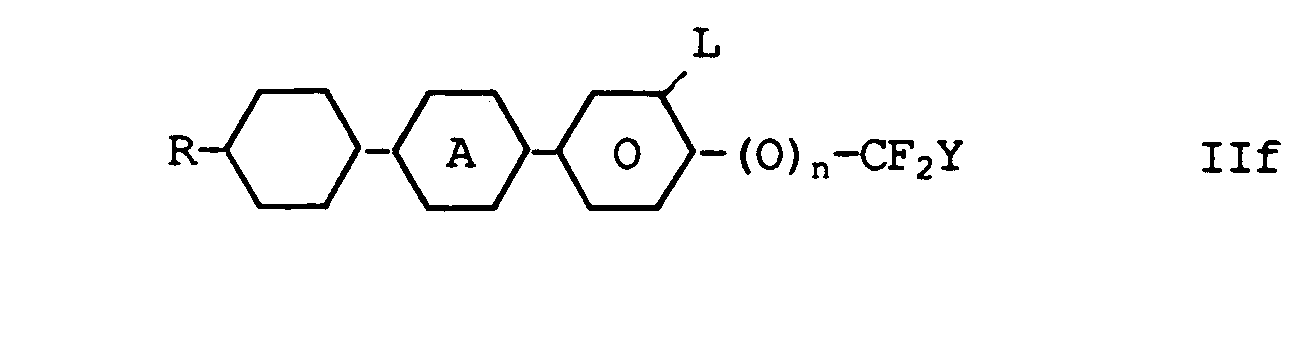
- Component A furthermore contains one or more, preferably 2, 3 or 4, compounds of the formula IIf, in particular in which L denotes H, n 1 Y F and R n-alkyl having 1 to 8, preferably 1 to 5, carbon atoms.
- Component A also preferably contains, in addition to one or more compounds of the formula IIf, one or more, preferably 1, 2 or 3, compounds of the formula IIg, in particular in which L is H and XF or OCF 3 or in which L and XF are.
- the proportion of the compounds of the formulas Ila and Ilb, based on component A, is 10 to 40%, preferably 15 to 30, in particular 20 to 25% by weight.
- the proportion of the compounds of the formula IId based on component A is 20 to 60, preferably 25 to 45, in particular 30 to 35,% by weight.
- the proportion of the compounds of the formulas Ilf and Ilg 25 to 70, preferably 35 to 60, in particular 40 to 50% by weight.
- Mixtures which contain exclusively compounds of the formulas Ila to IIh (group A) and components C and D are preferred, i.e. no connections of component B.
- liquid crystal mixtures used in the SFAs according to the invention are dielectrically positive with ⁇ 1. Particularly preferred are liquid crystal mixtures with ⁇ 3 and very particularly those with ⁇ ⁇ 5.
- the liquid crystal mixtures according to the invention have favorable values for the threshold voltage V 10/0/20 and for the flow viscosity. If the value for the optical path difference d.An is specified, the value for the layer thickness d is determined by the optical anisotropy An. In particular, in the case of relatively high values for d.An, the use of liquid crystal mixtures according to the invention with a relatively high value for the optical anisotropy is generally preferred, since the value for d can then be chosen to be relatively small, which leads to more favorable values for the switching times. However, such liquid crystal displays according to the invention which contain liquid crystal mixtures according to the invention with smaller values for An are also characterized by advantageous values for the switching times.
- the liquid crystal mixtures according to the invention are further characterized by advantageous values for the steepness of the electro-optical characteristic curve and can be operated at high multiplex rates.
- the liquid crystal mixtures according to the invention have high stability and favorable values for the electrical resistance and the frequency dependence of the threshold voltage.
- the liquid crystal displays according to the invention have a large working temperature range and a good angle dependence of the contrast.
- the term conventional construction is broad here and also includes all modifications and modifications of the super twist cell, in particular also matrix display elements and the display elements containing additional magnets according to DE-OS 2 748 738.
- the surface tilt angle on the two carrier plates can be the same or different be. The same tilt angles are preferred.
- liquid crystal mixtures which can be used according to the invention are prepared in a manner which is conventional per se.
- the desired amount of the components used in smaller amounts is dissolved in the components which make up the main constituent, advantageously at elevated temperature. It is also possible to use solutions of the components in an organic solvent, e.g. in acetone, chloroform or methanol, and to remove the solvent after thorough mixing, for example by distillation.
- an organic solvent e.g. in acetone, chloroform or methanol
- the dielectrics can also contain further additives known to the person skilled in the art and described in the literature. For example, 0-15% pleochroic dyes can be added.
- the media according to the invention are produced by mixing so-called “multi-bottle systems” to adapt the material parameters to the respective display parameters.
- a "two or multi-bottle system” usually allows the required optical anisotropy to be set in accordance with the layer thickness of the SFA displays.
- the “multi-bottle system” allows the slope and the switching behavior to be set at a predetermined threshold voltage by adjusting the elastic constants, in particular K 3 / K 1 .
- the invention furthermore relates to a liquid-crystalline medium based on component A comprising one or more compounds of the formulas Ila or Ilb, one or more compounds of the formulas Ilc to Ile and one or more compounds of the formulas Ilf to Ilh, in the form of a ready-to-use product Sets of two or more, preferably four components with the same threshold voltage are present, one component having an optical anisotropy of 0.100-0.110 and the other having an optical anisotropy of 0.170 to 0.180.
- component A comprising one or more compounds of the formulas Ila or Ilb, one or more compounds of the formulas Ilc to Ile and one or more compounds of the formulas Ilf to Ilh, in the form of a ready-to-use product Sets of two or more, preferably four components with the same threshold voltage are present, one component having an optical anisotropy of 0.100-0.110 and the other having an optical anisotropy of 0.170 to 0.180.
- a 4-component set is particularly preferred, with all 4 components having approximately the same threshold voltage and two components each having the same optical anisotropy but different K 3 / K 1 values.
- mixtures with all parameters, ie with the same threshold voltage, optical anisotropy between 0.100 and 0.180 and K 3 / K 1 values between 1.0 and 1.6 can be produced in a targeted manner.
- the SFA is controlled in multiplex mode (multiplex ratio 1: 240, bias 1:16, operating voltage 18.5 volts).
- a liquid crystal mixture consisting of: and a chiral component results in a SFA of the STN type (parameters cf. Example 1) a threshold voltage of 1.89 V.
- a liquid crystal mixture consisting of: and a chiral component results in a SFA of the STN type (parameters cf. Example 1) a threshold voltage of 1.89 V.
- a liquid crystal mixture consisting of: and a chiral component results in a SFA of the STN type (parameters cf. Example 1) a threshold voltage of 1.91 V.
- a liquid crystal mixture consisting of and a chiral component results in a STN type SFA (parameter cf. Example 1) a threshold voltage of 2.13 V.
- a liquid crystal mixture consisting of and a chiral component results in a STFA type SFA (parameter cf. example 1) a threshold voltage of 2.06 V.
- a liquid crystal mixture consisting of and a chiral component results in a STFA type SFA (parameter see example 1) a threshold voltage of 2.19 V.
- a liquid crystal mixture consisting of and a chiral component results in a STN type SFA (parameters cf. Example 1) a threshold voltage of 2.15 V.
- a liquid crystal mixture consisting of and a chiral component (see Example 1).
- a liquid crystal mixture consisting of and a chiral component (see Example 1).
- a liquid crystal mixture consisting of and a chiral component results in a STFA type SFA (parameter see example 1) which has a threshold voltage of 2.01 V.
- Mixing component A with B gives mixtures with the following parameters (measured in a 240 ° STN cell / layer thickness 6.5 ⁇ m).
- the new "4-bottle system” results in SFA with total switching times ⁇ 250 ms at a layer thickness of 6 ⁇ m ⁇ 200 ms at 5 ⁇ m, ⁇ 400 ms at 7 ⁇ m and ⁇ 600 ms at 8 ⁇ m, as well as wide d / p windows even at high twist angles.
Landscapes
- Chemical & Material Sciences (AREA)
- Crystallography & Structural Chemistry (AREA)
- Engineering & Computer Science (AREA)
- Materials Engineering (AREA)
- Organic Chemistry (AREA)
- Liquid Crystal Substances (AREA)
- Liquid Crystal (AREA)
Abstract
Description
- Die Erfindung betrifft Supertwist-Flüssigkristallanzeigen (SFA) mit sehr kurzen Schaltzeiten und guten Steilheiten und Winkelabhängigkeiten sowie die darin verwendeten neuen nematischen Flüssigkristallmischungen.
- SFA gemäß des Oberbegriffs sind bekannt, z.B. aus EP 0 131 216 B1; DE 34 23 993 A1; EP 0 098 070 A2; M. Schadt und F. Leenhouts, 17. Freiburger Arbeitstagung Flüssigkristalle (8.-10.04.87); K. Kawasaki et al., SID 87 Digest 391 (20.6); M. Schadt und F. Leenhouts, SID 87 Digest 372 (20.1); K. Katoh et al., Japanese Journal of Applied Physics, Vol. 26, No. 11, L 1784-L 1786 (1987); F. Leenhouts et al., Appl. Phys. Lett. 50 (21), 1468 (1987); H.A. van Sprang und H.G. Koopman, J. Appl. Phys. 62 (5), 1734 (1987); T.J. Scheffer und J. Nehring, Appl. Phys. Lett. 45 (10), 1021 (1984), M. Schadt und F. Leenhouts, Appl. Phys. Lett. 50 (5), 236 (1987) und E.P. Raynes, Mol. Cryst. Liq. Cryst. Letters Vol. 4 (1), pp. 1-8 (1986). Der Begriff SFA umfaßt hier jedes höher verdrillte Anzeigeelement mit einem Verdrillungswinkel dem Betrage nach zwischen 160 und 3600, wie beispielsweise die Anzeigeelemente nach Waters et al. (C.M. Waters et al., Proc. Soc. Inf. Disp. (New York) (1985) (3rd Intern. Display Conference, Kobe, Japan), die STN-LCD's (DE OS 35 03 259), SBE-LCD's (T.J. Scheffer und J. Nehring, Appl. Phys. Lett. 45 (1984) 1021), OMI-LCD's (M. Schadt und F. Leenhouts, Appl. Phys. Lett. 50 (1987), 236, DST-LCD's EP OS 0 246 842) oder BW-STN-LCD's (K. Kawasaki et al., SID 87 Digest 391 (20.6)).
- Derartige SFA zeichnen sich im Vergleich zu Standard-TN-Anzeigen durch wesentlich bessere Steilheiten der elektrooptischen Kennlinie und damit verbundenen besseren Kontrastwerten sowie durch eine wesentlich geringere Winkelabhängigkeit des Kontrastes aus. Von besonderem Interesse sind SFA mit sehr kurzen Schaltzeiten insbesondere auch bei tieferen Temperaturen. Zur Erzielung von kurzen Schaltzeiten wurden bisher insbesondere die Viskositäten der Flüssigkristallmischungen optimiert unter Verwendung von meist monotropen Zusätzen mit relativ hohem Dampfdruck. Die erzielten Schaltzeiten waren jedoch nicht für jede Anwendung ausreichend.
- Ähnliche Flüssigkristallmischungen sind beschrieben (z. B. JP 60 51 778 und EP-0 232 052), jedoch sind diese Mischungen für SFA's aufgrund der geringen Steilheit ihrer elektrooptischen Kennlinie weniger geeignet.
- Zur Erzielung einer steilen elektrooptischen Kennlinie sollen die Flüssigkristallmischungen relativ große Werte für K3/K1 und relativ kleine Werte für LlE/El aufweisen.
- Über die Optimierung des Kontrastes und der Schaltzeiten hinaus werden an derartige Mischungen weitere wichtige Anforderungen gestellt:
- 1. Breites d/p-Fenster
- 2. Hohe chemische Dauerstabilität
- 3. Hoher elektrischer Widerstand
- 4. Geringe Frequenzabhängigkeit der Schwellenspannung.
- Die erzielten Parameterkombinationen sind bei weitem noch nicht ausreichend, insbesondere für Hochmultiplex-STN (1/400). Zum Teil ist dies darauf zurückzuführen, daß die verschiedenen Anforderungen durch Materialparameter gegenläufig beeinflußt werden.
- Es besteht somit immer noch ein großer Bedarf nach SFA mit sehr kurzen Schaltzeiten bei gleichzeitig großem Arbeitstemperaturbereich, hoher Kennliniensteilheit, guter Winkelabhängigkeit des Kontrastes und niedriger Schwellenspannung, die den oben angegebenen Anforderungen gerecht werden.
- Der Erfindung liegt die Aufgabe zugrunde, SFA bereitzustellen, die die oben angegebenen Nachteile nicht oder nur in geringerem Maße und gleichzeitig sehr kurze Schaltzeiten aufweisen.
- Es wurde nun gefunden, daß diese Aufgabe gelöst werden kann, wenn die nematische Flüssigkristallmischung
- a) auf Komponente A basiert, welche
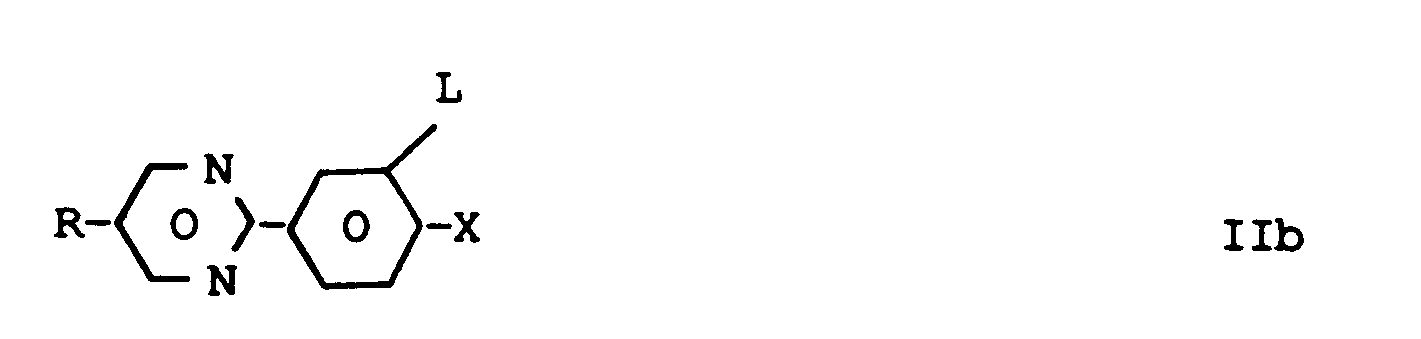
- - eine oder mehrere Verbindungen der Formeln Ila oder Ilb:

- - eine oder mehrere Verbindungen der Formeln IIc bis Ile:


- - und eine oder mehrere Verbindungen der Formeln Ilf bis IIh:

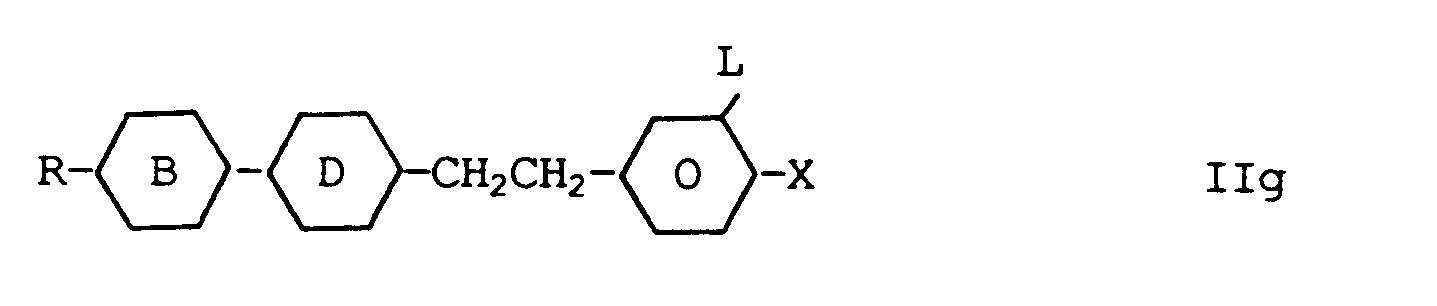

- R n-Alkyl, Alkoxy oder n-Alkenyl mit bis zu 9 C-Atomen, R1 und R2 jeweils die für R angegebene Bedeutung besitzen,

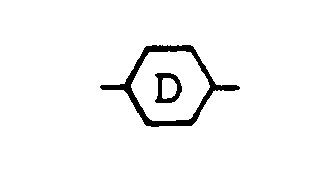


- L und Y jeweils H oder F,
- X F, Cl, -CF3, -CHF2, -OCF3, -OCHF2, -OCF2CF2H oder -OC2F5, und
- n 0 oder 1
bedeuten. - R n-Alkyl, Alkoxy oder n-Alkenyl mit bis zu 9 C-Atomen, R1 und R2 jeweils die für R angegebene Bedeutung besitzen,
- - eine oder mehrere Verbindungen der Formeln Ila oder Ilb:
- b) 0-40 Gew.% einer flüssigkristallinen Komponente B, bestehend aus einer oder mehreren Verbindungen mit einer dielektrischen Anisotropie von -1,5 bis + 1,5 der allgemeinen Formel I,

enthält, worin- R1 und R2 jeweils unabhängig voneinander n-Alkyl, n-Alkoxy, n-Oxaalkyl, ω-Fluoralkyl oder n-Alkenyl mit bis zu 9 C-Atomen,
- A1, A2 und A3 jeweils unabhängig voneinander 1,4-Phenylen, 2- oder 3-Fluor-1,4-phenylen, trans-1,4-Cyclohexylen oder 1,4-Cyclohexenylen,
- Z1 und Z2 jeweils unabhängig voneinander -CH2CH2-, -C=C-oder eine Einfachbindung, und
- m 0, 1 oder 2,
bedeuten. - c) 0-20 Gew.% einer flüssigkristallinen Komponente C, bestehend aus einer oder mehreren Verbindungen mit einer dielektrischen Anisotropie von unter -1,5, enthält, und
- d) eine optisch aktive Komponente D in einer Menge enthält, daß das Verhältnis zwischen Schichtdicke (Abstand der planparallelen Trägerplatten) und natürlicher Ganghöhe der chiralen nematischen Flüssigkristallmischung etwa 0,2 bis 1,7 und insbesondere etwa 0,2 - 1,3 beträgt, und daß die nematische Flüssigkristallmischung einen nematischen Phasenbereich von mindestens 60 ° C, eine Viskosität von nicht mehr als 35 mPa.s und eine dielektrische Anisotropie von mindestens + 1 aufweist, wobei die dielektrischen Anisotropien der Verbindungen und die auf die nematische Flüssigkristallmischung bezogenen Parameter auf eine Temperatur von 20 °C bezogen sind.
- Gegenstand der Erfindung ist somit ein SFA mit
- - zwei planparallelen Trägerplatten, die mit einer Umrandung eine Zelle bilden,
- - einer in der Zelle befindlichen nematischen Flüssigkristallmischung mit positiver dielektrischer Anisotropie,
- - Elektrodenschichten mit darüberliegenden Orientierungsschichten auf den Innenseiten der Trägerplatten,
- - einem Anstellwinkel zwischen der Längsachse der Moleküle an der Oberfläche der Trägerplatten und den Trägerplatten von etwa 1 Grad bis 30 Grad, und
- - einem Verdrillungswinkel der Flüssigkristallmischung in der Zelle von Orientierungsschicht zu Orientierungsschicht dem Betrag nach zwischen 100 und 600°, dadurch gekennzeichnet, daß die nematische Flüssigkristallmischung
- a) auf Komponente A basiert, welche
- - eine oder mehrere Verbindungen der Formeln Ila oder Ilb:


- - eine oder mehrere Verbindungen der Formeln IIc bis Ile:


- - und eine oder mehrere Verbindungen der Formeln Ilf bis IIh


- R n-Alkyl, Alkoxy oder n-Alkenyl mit bis zu 9 C-Atomen, R1 und R2 jeweils die für R angegebene Bedeutung besitzen,


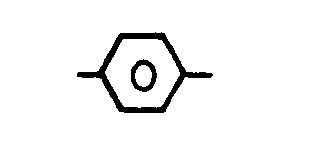
- L und Y jeweils H oder F,
- X F, Cl, -CF3, -CHF2, -OCF3, -OCHF2, -OCF2CF2H oder -OC2F5, und
- n 0 oder 1
bedeuten, - - eine oder mehrere Verbindungen der Formeln Ila oder Ilb:
- b) 0-40 Gew.% einer flüssigkristallinen Komponente B, bestehend aus einer oder mehreren Verbindungen mit einer dielektrischen Anisotropie von -1,5 bis + 1,5 der allgemeinen Formel I,

- R1 und R2 jeweils unabhängig voneinander n-Alkyl, n-Alkoxy, n-Oxaalkyl, ω-Fluoralkyl oder n-Alkenyl mit bis zu 9 C-Atomen, A1, A2 und A3 jeweils unabhängig voneinander 1,4-Phenylen, 2- oder 3-Fluor-1,4-phenylen, trans-1,4-Cyclohexylen oder 1,4-Cyclohexenylen,
- Z1 und Z2 jeweils unabhängig voneinander -CH2CH2-, -C=C-oder eine Einfachbindung, und
- m 0, 1 oder 2,
- bedeuten,
- c) 0-20 Gew.% einer flüssigkristallinen Komponente C, bestehend aus einer oder mehreren Verbindungen mit einer dielektrischen Anisotropie von unter -1,5, enthält, und d) eine optisch aktive Komponente D in einer Menge enthält, daß das Verhältnis zwischen Schichtdicke (Abstand der planparallelen Trägerplatten) und natürlicher Ganghöhe der chiralen nematischen Flüssigkristallmischung etwa 0,2 bis 1,7 und insbesondere etwa 0,2 - 1,3 beträgt, und daß die nematische Flüssigkristallmischung einen nematischen Phasenbereich von mindestens 60 ° C, eine Viskosität von nicht mehr als 35 mPa.s und eine dielektrische Anisotropie von mindestens + 1 aufweist, wobei die dielektrischen Anisotropien der Verbindungen und die auf die nematische Flüssigkristallmischung bezogenen Parameter auf eine Temperatur von 20 °C bezogen sind.
- Gegenstand der Erfindung sind auch entsprechende Flüssigkristallmischungen zur Verwendung in SFA.
- Die einzelnen Verbindungen z.B. der Formeln I und Ila bis Ilh oder auch andere Verbindungen, die in den erfindungsgemäßen SFA verwendet werden können, sind entweder bekannt, oder sie können analog zu den bekannten Verbindungen hergestellt werden.
- Bevorzugte Flüssigkristallmischungen enthalten
- a) mindestens eine Komponente, ausgewählt aus der Gruppe B4, bestehend aus Verbindungen der Formeln AI bis AVI,





- R Alkyl mit 1-12 C-Atomen ist, worin auch eine oder zwei nicht benachbarte CH2-Gruppen durch -O-, -CH = CH-, -CO-, -O-CO- oder -CO-O- ersetzt sein können,
- b) und/oder mindestens eine Komponente, ausgewählt aus der Gruppe B1, bestehend aus den Verbindungen der Formeln BI bis BIV,




- R1 die für R angegebene Bedeutung hat,
- Z0 -CH2CH2- oder eine Einfachbindung ist, und Q


- worin R1 und R2 jeweils unabhängig voneinander die für R angegebene Bedeutung haben, und


- Besonders bevorzugte Verbindungen der Formel BIII sind diejenigen der folgenden Teilformeln,


- R1 CH3-(CH2)n-O-, CH3-(CH2)t-, trans-H-(CH2)r-CH=CH-(CH2CH2)s-CH2O- oder trans-H-(CH2)r-CH = CH-(CH2CH2)s-,
- R2 CH3-(CH2)t-
- n 1, 2, 3 oder 4
- r 0, 1, 2 oder 3
- s 0 oder 1, und
- t 1, 2, 3 oder 4 ist.
- Ferner bevorzugt sind diejenigen der Teilformel,

- Der Anteil der Verbindungen der Formel Blll der oben angegebenen Teilformeln ist vorzugsweise ca. 5 % bis 45 %, insbesondere bevorzugt ca. 10 % bis 35 %. Besonders bevorzugte Verbindungen der Formel BIV sind diejenigen der folgenden Teilformel,

- R1 CH3-(CH2)n-O- oder trans-H-(CH2)rO-CH=CH-(CH2CH2)s-CH2O- und R2 CH3-(CH2)t- ist, wobei
- n 1, 2, 3 oder 4,
- r 0, 1, 2 oder 3,
- s 0 oder 1, und
- t 1, 2, 3 oder 4 ist.
- Der Anteil dieser Verbindungen, bzw. der Verbindungen der Formel BIV, ist vorzugsweise ca. 5 % bis 40 %, insbesondere bevorzugt ca. 10 % bis 35 %.
- Vorzugsweise enthalten die Mischungen Verbindungen der Formel Blll, insbesondere solche der Teilformel

- In einer besonders bevorzugten Ausführungsform enthalten die Mischungen gleichzeitig Verbindungen der Formeln BIII und BIV, wobei der Gesamtanteil für Komponenten der Gruppe B1 gewahrt bleibt.
- Falls Verbindungen der Formeln BI und/oder BIII vorhanden sind, bedeuten R1 und R2 vorzugsweise jeweils unabhängig voneinander n-Alkyl mit 1 bis 7 C-Atomen oder (trans)-n-Alkenyl mit 3 bis 7 C-Atomen. Z2 ist vorzugsweise eine Einfachbindung. BI ist besonders bevorzugt.
- Ferner bevorzugt sind erfindungsgemäße Mischungen, die einer oder mehrere Verbindungen der Formel BIV enthalten, worin


- In jedem Fall bleibt der Gesamtanteil für Komponenten der Gruppe B1 gewahrt.
- Der Anteil der Verbindungen der Gruppe B2 beträgt vorzugsweise ca. 5 % bis 45 %, insbesondere bevorzugt 5 % bis 20 %. Der Anteil (bevorzugte Bereiche) für BV bis BVII ist wie folgt:
- BV ca. 5 % bis 30 %, vorzugsweise ca. 5 % bis 15 %
- Summe BVI und BVII: ca. 5 % bis 25 %, vorzugsweise ca. 10 % bis 20 %.
- Bevorzugte Verbindungen der Gruppe B2 sind im folgenden angegeben:


- Vorzugsweise enthalten die erfindungsgemäßen Mischungen eine oder mehrere Verbindungen ausgewählt aus der Gruppe bestehend aus BV3, BV2 und BV1 in einem Gesamtanteil von ca. 5 bis 35 %.
- In einer besonders bevorzugten Ausführungsform enthalten die erfindungsgemäßen Mischungen neben BV3 und BV2 (R = A) weitere terminal fluorierte Verbindungen zum Beispiel ausgewählt aus der Gruppe bestehend aus,


- Der Gesamtanteil aller terminal fluorierter Verbindungen beträgt vorzugsweise ca. 5 % bis 65 %, insbesondere ca. 15 % bis 40 %..
- Der Anteil der Verbindungen aus Gruppe B3 beträgt vorzugsweise ca. 5 % bis 30 %, insbesondere bevorzugt ca. 10 % bis 20 %. R1 ist vorzugsweise n-Alkyl oder n-Alkoxy mit jeweils 1 bis 9 C-Atomen. R2 ist vorzugsweise n-Alkyl mit 1 bis 9 C-Atomen. Es können jedoch auch analoge Verbindungen mit Alkenyl- bzw. Alkenyloxy-Gruppen eingesetzt werden. Verbindungen der Formel BVIII sind bevorzugt.

- Die erfindungsgemäßen Mischungen enthalten Verbindungen aus mindestens einer der Gruppen B1, B2 und B3. Vorzugsweise enthalten sie eine oder mehrere Verbindungen aus Gruppe B1 und eine oder mehrere Verbindungen aus Gruppe B2 und/oder B3.
- Ferner bevorzugt sind Isothiocyanate, z.B. der Formel

- In einer besonders bevorzugten Ausführungsform enthalten die erfindungsgemäßen Mischungen vorzugsweise ca. 5 % bis 20 % einer oder mehrerer Verbindungen mit einer dielektrischen Anisotropie von unter -1,5 (Komponente C). Derartige Verbindungen sind bekannt, z.B. Derivate der 2,3-Dicyanhydrochinone oder Cyclohexanderivate mit dem Strukturelement

- Vorzugsweise werden jedoch Verbindungen mit dem Strukturelement 2,3-Difluor-1,4-phenylen gewählt, z.B. Verbindungen gemäß DE-OS 38 07 801, 38 07 861, 38 07 863, 38 07 864 oder 38 07 908. Besonders bevorzugt sind Tolane mit diesem Strukturelement gemäß der Internationalen Patentanmeldung PCE/DE 88/00133, insbesondere solche der Formeln,
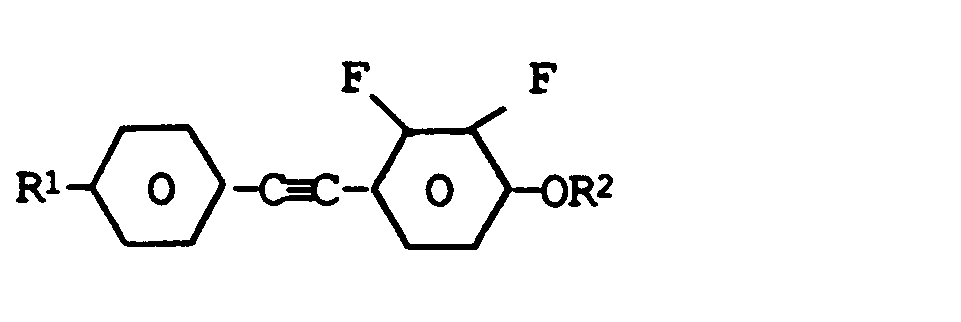
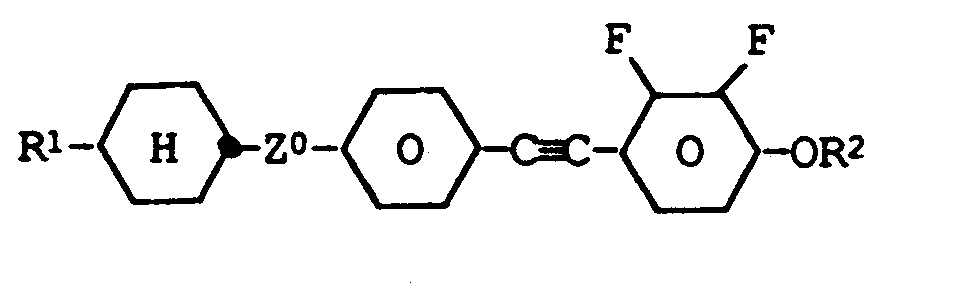

- In einer besonders bevorzugten Ausführungsform enthalten die Mischungen ca. 5 % bis 35 %, insbesondere bevorzugt ca. 10 % bis 20 % an flüssigkristallinen Tolan-Verbindungen. Hierdurch kann bei geringeren Schichtdicken (ca. 5-6 um) gearbeitet werden, wodurch die Schaltzeiten deutlich kürzer werden. Besonders bevorzugte Tolane der Formeln T1 und T2 sind im folgenden angegeben:


- R1 ist vorzugsweise n-Alkyl oder n-Alkoxy mit 1 bis 7 C-Atomen,
- Z0 ist -CH2CH2- oder eine Einfachbindung,
- Q ist


- X ist F, CI oder OCF3, wobei
- R2 n-Alkyl oder n-Alkoxy mit jeweils 1 bis 7 C-Atomen oder n-Alkenyl oder n-Alkenyloxy mit jeweils 3 bis 7 C-Atomen bedeutet.
- Im folgenden weitere besonders bevorzugten Ausführungsformen:
- Die Komponente A enthält eine oder mehrere, vorzugsweise 2, 3 oder 4, Verbindungen der Formel Ila, insbesondere worin R1 und R2 n-Alkyl mit 1 bis 8, vorzugsweise 1 bis 5 C-Atomen bedeutet insbesondere worin die Summe der C-Atomen der beiden Reste R1 und R2 4 bis 8, insbesondere 4 bis 7, beträgt und/oder eine oder mehrere, vorzugsweise 1, 2 oder 3 Verbindungen der Formel Ilb, insbesondere worin L H und X F bedeutet, insbesondere worin R1 Alkyl mit 1 bis 5 C-Atomen bedeutet.
- Weiterhin enthält die Komponente A eine oder mehrere, vorzugsweise 2, 3 oder 4, Verbindungen der Formel Ild, insbesondere worin L H und R n-Alkyl mit 1 bis 8, vorzugsweise 1 bis 5 C-Atomen bedeutet.
- Weiterhin enthält die Komponente A eine oder mehrere, vorzugsweise 2, 3 oder 4 Verbindungen der Formel Ilf, insbesondere worin L H, n 1 Y F und R n-Alkyl mit 1 bis 8, vorzugsweise 1 bis 5 C-Atomen bedeutet.
- Weiterhin enthält die Komponente A vorzugsweise neben einer oder mehreren Verbindungen der Formel Ilf eine oder mehrere, vorzugsweise 1, 2 oder 3, Verbidnungen der Formel IIg, insbesondere worin L H bedeutet und X F oder OCF3 bedeutet oder worin L und X F bedeuten.
- Der Anteil der Verbindungen der Formeln Ila und Ilb bezogen auf die Komponente A beträgt 10 bis 40 %, vorzugsweise 15 bis 30, insbesondere 20 bis 25 Gew.%.
- Der Anteil der Verbindungen der Formel Ild bezogen auf die Komponente A beträgt 20 bis 60, vorzugsweise 25 bis 45, insbesondere 30 bis 35, Gew.%.
- Der Anteil der Verbindungen der Formeln Ilf und Ilg 25 bis 70, vorzugsweise 35 bis 60, insbesondere 40 bis 50 Gew.%.
- Insbesondere bevorzugt sind solche Flüssigkristallmischungen, die neben den bevorzugten Verbindungen der Komponente A eine oder mehrere Verbindungen ausgewählt aus den Verbindungen der folgenden Formeln enthalten,


- - Komponente A enthält eine oder mehrere Verbindungen der Formeln IIa1-IIa2, IIb1-IIb2, IId1-IId2, IIf1-IIf5 und/oder IIg1-IIg5,










- - Komponente A enthält neben den Verbindungen der Formeln Ila bis IIh eine oder mehrere Verbindungen der Formel

- R n-Alkyl, n-Alkoxy oder n-Alkenyl mit 1-9 C-Atomen,
- Z -CH2CH2- oder eine Einfachbindung, und
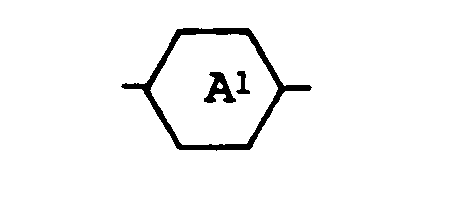
- 1,4-Phenylen, 2- oder 3-Fluor-1,4-phenylen oder 1,4-Cyclohexylen bedeutet.
- - X bedeutet F, Cl, CF3, -OCF3, OCHF2 oder CHF2.
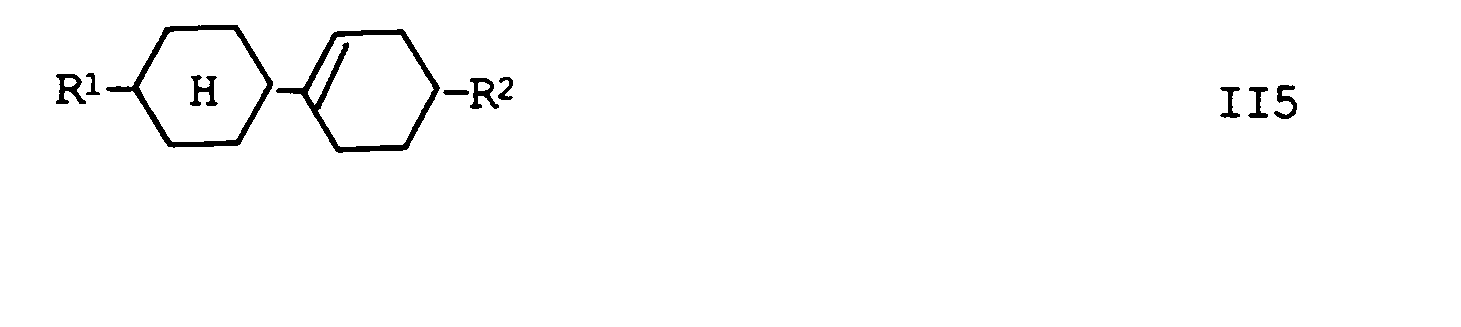
- - Komponente B enthält eine oder mehrere Verbindungen ausgewählt aus der Gruppe bestehend aus 111 bis 117,




- - Komponente B enthält zusätzlich eine oder mehrere Verbindungen ausgewählt aus der Gruppe bestehend aus 118 bis 1121,







- - Komponente B enthält zusätzlich eine oder mehrere Verbindungen ausgewählt aus der Gruppe bestehend aus 1122 bis 1127,


- - Komponente B enthält eine oder mehrere Verbindungen ausgewählt aus der Gruppe bestehend aus 1128 und 1129:


- - Die Flüssigkristallmischung enthält neben den Komponenten A, B, C und D zusätzlich eine oder mehrere Verbindungen ausgewählt aus der Gruppe bestehend aus III und IV,


- - Die Flüssigkristallmischung enthält neben den Komponenten A, B, C und D zusätzlich eine oder mehrere Verbindungen ausgewählt aus der Gruppe bestehend aus V und VI,


- - Die Komponente C enthält eine oder mehrere Verbindungen ausgewählt aus der Gruppe bestehend aus VII bis XI,



- - Die Komponente B enthält eine oder mehrere Verbindungen ausgewählt aus der Gruppe bestehend aus XII bis XIV,


- Bevorzugt sind Mischungen, welche ausschließlich Verbindungen der Formeln Ila bis IIh (Gruppe A) und Komponenten C und D enthalten, d.h. keine Verbindungen der Komponente B.
- Die bevorzugten Mischungen enthaltend terminal halogenisierte Verbindungen der Formeln Ila bis Ilk (X = F, Cl, -CF3, -CHF2, -OCF3 oder -OCHF3) weist besonders günstige Parameterkombinationen und gleichzeitig ein breites d/p-Fenster auf.
- Erfindungsgemäße Flüssigkristallmischungen, deren Komponente A mindestens eine Verbindung der Formel T3


- n eine ganze Zahl von 1-15, und
- L1 und L2 jeweils unabhängig voneinander H oder F, und
- X F, Cl oder OCF3
- Die erfindungsgemäßgen Mischungen zeichnen sich insbesondere beim Einsatz in SFA's mit hohen Schichtdicken durch sehr niedrige Summenschaltzeiten aus (= ton + toff).
- Niedrige Summenschaltzeiten sind insbesondere ein wichtiges Kriterium für SFA's beim Einsatz als Anzeigen von Laptops, um Cursorbewegungen störungsfrei darstellen zu können.
- Für die Komponente D stehen dem Fachmann eine Vielzahl, zum Teil kommerziell erhältlicher chiraler Dotierstoffe zur Verfügung. Deren Wahl ist an sich nicht kritisch.
- Die in den erfindungsgemäßen SFA's verwendeten Flüssigkristallmischungen sind dielektrisch positiv mit Δ∈ 1. Besonders bevorzugt sind Flüssigkristallmischungen mit Δ∈ 3 und ganz besonders solche mit Δ∈ ≧ 5.
- Die erfindungsgemäßen Flüssigkristallmischungen weisen günstige Werte für die Schwellenspannung V10/0/20 und für die Fließviskosität auf. Ist der Wert für den optischen Wegunterschied d.An vorgegeben, wird der Wert für die Schichtdicke d durch die optische Anisotropie An bestimmt. Insbesondere bei relativ hohen Werten für d.An ist i.a. die Verwendung erfindungsgemäßer Flüssigkristallmischungen mit einem relativ hohen Wert für die optische Anisotropie bevorzugt, da dann der Wert für d relativ klein gewählt werden kann, was zu günstigeren Werten für die Schaltzeiten führt. Aber auch solche erfindungsgemäßen Flüssigkristallanzeigen, die erfindungsgemäße Flüssigkristallmischungen mit kleineren Werten für An enthalten, sind durch vorteilhafte Werte für die Schaltzeiten gekennzeichnet. Die erfindungsgemäßen Flüssigkristallmischungen sind weiter durch vorteilhafte Werte für die Steilheit der elektrooptischen Kennlinie gekennzeichnet und können mit hohen Multiplexraten betrieben werden. Darüberhinaus weisen die erfindungsgemäßen Flüssigkristallmischungen eine hohe Stabilität und günstige Werte für den elektrischen Widerstand und die Frequenzabhängigkeit der Schwellenspannung auf. Die erfindungsgemäßen Flüssigkristallanzeigen weisen einen großen Arbeitstemperaturbereich und eine gute Winkelabhängigkeit des Kontrastes auf.
- Der Aufbau der erfindungsgemäßen Flüssigkristall-Anzeigeelemente aus Polarisatoren, Elektrodengrundplatten und Elektroden mit einer solchen Oberflächenbehandlung, daß die Vorzugsorientierung (Direktor) der jeweils daran angrenzenden Flüssigkristall-Moleküle von der einen zur anderen Elektrode gewöhnlich um betragsmäßig 160° bis 360° gegeneinander verdreht ist, entspricht der für derartige Anzeigeelemente üblichen Bauweise. Dabei ist der Begriff der üblichen Bauweise hier weit gefaßt und umfaßt auch alle Abwandlungen und Modifikationen der Supertwistzelle, insbesondere auch Matrix-Anzeigeelemente sowie die zusätzliche Magnete enthaltenden Anzeigeelemente nach der DE-OS 2 748 738. Der Oberflächentiltwinkel an den beiden Trägerplatten kann gleich oder verschieden sein. Gleiche Tiltwinkel sind bevorzugt.
- Ein wesentlicher Unterschied der erfindungsgemäßen Anzeigeelemente zu den bisher üblichen auf der Basis der verdrillten nematischen Zelle besteht jedoch in der Wahl der Flüssigkristallkomponenten der Flüssigkristallschicht.
- Die Herstellung der erfindungsgemäß verwendbaren Flüssigkristallmischungen erfolgt in an sich üblicher Weise.
- In der Regel wird die gewünschte Menge der in geringerer Menge verwendeten Komponenten in der den Hauptbestandteil ausmachenden Komponenten gelöst, zweckmäßig bei erhöhter Temperatur. Es ist auch möglich, Lösungen der Komponenten in einem organischen Lösungsmittel, z.B. in Aceton, Chloroform oder Methanol, zu mischen und das Lösungsmittel nach Durchmischung wieder zu entfernen, beispielsweise durch Destillation.
- Die Dielektrika können auch weitere, dem Fachmann bekannte und in der Literatur beschriebene Zusätze enthalten. Beispielsweise können 0-15 % pleochroitische Farbstoffe zugesetzt werden.
- Zur Anpassung der Materialparameter an die jweiligen Anzeigenparameter werden die erfindungsgemäßen Medien in einer besonders bevorzugten Ausführungsform durch Mischen von sogenannten "Multi-Bottle-Systemen" hergestellt. Gewöhnlich erlaubt ein "Zwei- oder Multi-Bottle-System" das Einstellen der erforderlichen optischen Anisotropie entsprechend der Schichtdicke der SFA-Anzeigen.
- Darüber hinaus erlaubt das erfindungsgemäße "Multi-Bottle-System" die Einstellung der Steilheit und des Schaltverhaltens bei vorgegebener Schwellenspannung durch Adjustierung der elastischen Konstanten, insbesondere von K3/K1.
- Demzufolge ist weiterhin Gegenstand der Erfindung ein flüssigkristallines Medium basierend auf Komponente A enthaltend eine oder mehrere Verbindungen der Formel Ila oder Ilb, eine oder mehrere Verbindungen der Formel Ilc bis Ile und eine oder mehrere Verbindungen der Formeln Ilf bis Ilh, wobei es in Form eines gebrauchsfertigen Sets aus zwei oder mehreren, vorzugsweise vier Komponenten mit gleicher Schwellenspannung vorliegt, dessen eine Komponente eine optische Anisotropie von 0,100-0,110 aufweist, und die andere eine optische Anisotropie von 0,170 bis 0,180 aufweist.
- Besonders bevorzugt ist ein 4-Komponeten-Set, wobei alle 4 Komponenten etwa die gleiche Schwellenspannung aufweisen und jeweils zwei Komponenten gleiche optische Anisotropie aber unterschiedliche K3/K1-Werten aufweisen. Mit diesem "4-Bottle-System" lassen sich gezielt Mischungen mit allen Parametern, d.h. mit gleicher Schwellenspannung, optischer Anisotropie zwischen 0,100 und 0,180 und K3/K1-Werten zwischen 1,0 und 1,6 herstellen.
- Die folgenden Beispiele sollen die Erfindung erläutern, ohne sie zu begrenzen.
- Es bedeutet:
- S-N Phasenübergangs-Temperatur smektisch-nematisch,
- N-I Phasenübergangs-Temperatur nematisch-isotrop,
- Klp. Klärpunkt,
- Visk. Viskosität (m Pa.s),
- Ton Zeit vom Einschalten bis zur Erreichung von 90 % des maximalen Kontrastes
- Toff Zeit vom Ausschalten bis zur Erreichung von 10 % des maximalen Kontrastes
- Die SFA wird im Multiplexbetrieb angesteuert (Multiplexverhältnis 1:240, Bias 1:16, Betriebsspannung 18,5 Volt).
- Vor- und nachstehend sind alle Temperaturen in ° C angegeben. Die Prozentzahlen sind Gewichtsprozente. Die Werte für die Schaltzeiten und Viskositäten beziehen sich auf 20 °C.
- Ein SFA vom Typ STN mit folgenden Parametern,


- Ein SFA vom Typ STN mit folgenden Parametern,


- Ein SFA vom Typ STN mit folgenden Parametern:


- Eine Flüssigkristallmischung bestehend aus:


- Eine Flüssigkristallmischung bestehend aus:

- Eine Flüssigkristallmischung bestehend aus:

- Eine Flüssigkristallmischung bestehend aus

- Eine Flüssigkristallmischung bestehend aus

- Eine Flüssigkristallmischung bestehend aus

- Eine Flüssigkristallmischung bestehend aus

- Eine Flüssigkristallmischung bestehend aus
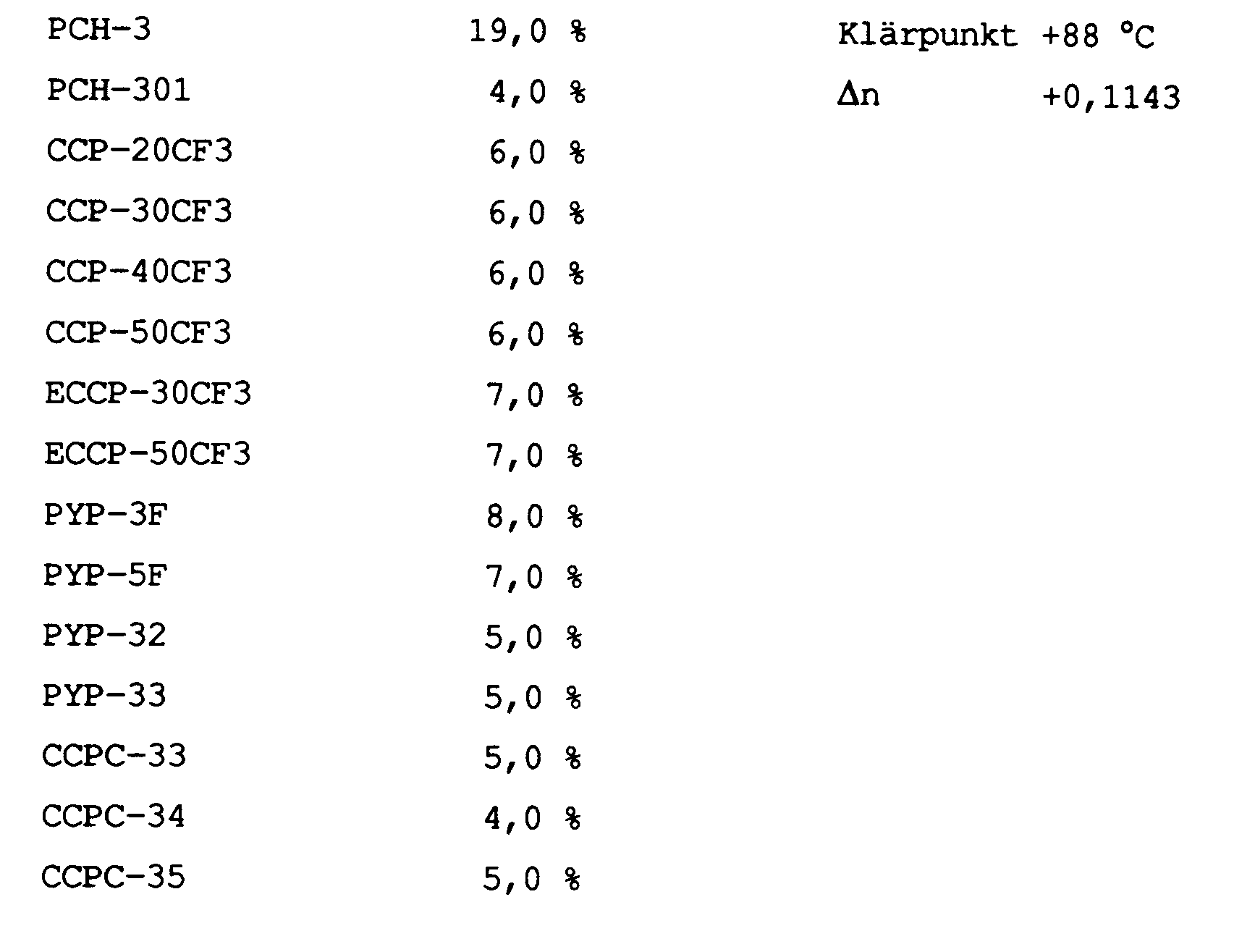
- Eine Flüssigkristallmischung bestehend aus

- Eine Flüssigkristallmischung bestehend aus

- Man stellt ein "4-Bottle-System" her bestehend aus den Komponenten A, B, C und D


- Komponente A weist folgende Parameter auf: S < -40 K 73 I

- Komponente B weist folgende Parameter auf: S < -30 K 73 I

- Komponente C weist folgende Parameter auf: S < -40 K 74 I

- Komponente D weist folgende Parameter auf: S < -20 K 73 I

- Durch Mischen von Komponente B und D erhält man Mischungen mit folgenden Parametern (gemessen in einer 240° STN-Zelle, d = 6 um):

- Durch Mischen von Komponente A mit B erhält man Mischungen mit folgenden Parametern (gemessen in einer 240° STN-Zelle/Schichtdicke 6,5 um).

- Das neue "4-Bottle-System" ergibt SFA mit Summenschaltzeiten < 250 ms bei einer Schichtdicke von 6 um < 200 ms bei 5 um, < 400 ms bei 7 um und < 600 ms bei 8 um, sowie breite d/p-Festern selbst bei hohen Twist-Winkeln.
- Man stellt ein "4-Bottle-System" her bestehend aus den Komponenten E, F, G und H:


- Komponente E weist folgende Parameter auf:

- Komponente F weist folgende Parameter auf:

- Komponente G weist folgende Parameter auf:

- Komponente H weist folgende Parameter auf:

- Durch Mischen von Komponente E und F erhält man Mischungen mit folgenden Parametern:

- Durch Mischen von Komponente F mit H erhält man Mischungen mit folgenden Parametern:

- PCH-53: trans-1-p-Propylphenyl-4-pentylcyclohexan
- 1-32: 1-(trans-4-Propylcyclohexyl)-2-(4'-ethyl-2'-fluorbiphenyl-4-yl)-ethan
- 1-35: 1-(trans-4-Propylcyclohexyl)-2-(4'-pentyl-2'-fluorbiphenyl-4-yl)-ethan
- BCH-32: 4-Ethyl-4'-(trans-4-propylcyclohexyl)-biphenyl
- BCH-52: 4-Ethyl-4'-(trans-4-pentylcylcohexyl)-biphenyl
- CCH-303: trans,trans-4-Propoxy-4'-propylcyclohexylcyclohexan
- CCH-501: trans,trans-4-Methoxy-4'-pentylclyclohexylcyclohexan
- CH-35: trans,trans-4-Propylcyclohexylcyclohexancarbonsäure-trans-4-pentylcyclohexylester
- CH-43: trans,trans-4-Butylcyclohexylcyclohexancarbonsäure-trans-4-propylcyclohexylester
- CH-45: trans,trans-4-Butylcyclohexylcyclohexancarbonsäure-trans-4-pentylcyclohexylester
- PCH-302: trans-1-p-Ethoxyphenyl-4-propylcyclohexan
- PCH-303: trans-1-p-Propoxyphenyl-4-propylcyclohexan
- PCH-30: trans-1-p-Butoxyphenyl-4-propylcyclohexan
- CCH-502: trans,trans-4-Ethoxy-4'-pentylcyclohexylcyclohexan
- ECCP-32: 1-[trans-4-(trans-4-Propylcyclohexyl)-cyclohexyl]-2-(p-ethylphenyl)-ethan
- ECCP-31: 1-[trans-4-(trans-4-Propylcyclohexyl)-cyclohexyl]-2-(p-methylphenyl)-ethan
- ECCP-35: 1-[trans-4-(trans-4-Propylcyclohexyl)-cyclohexyl]-2-(p-pentylphenyl)-ethan
- PCH-501: trans-1-p-Methoxyphenyl-4-pentylcyclohexan
- PCH-502: trans-1-p-Ethoxyphenyl-4-pentylcyclohexan
- CP-33: trans,trans-4-Propylcyclohexylcyclohexancarbonsäure-p-propylphenylester
- CP-35: trans,trans-4-Propylcyclohexylcyclohexancarbonsäure-p-pentylphenylester
- CP-43: trans,trans-4-Butylcyclohexylcyclohexancarbonsäure-p-propylphenylester
- CP-45: trans,trans-4-Butylcyclohexylcyclohexancarbonsäure-p-pentylphenylester
- PTP-40F: 4-Butoxy-4'-fluortolan
- PTP-50F: 4-Pentoxy-4'-fluortolan
- PTP-20F: 4-Ethoxy-4'-fluortolan
- PCH-301: trans-1-p-Methoxyphenyl-4-propylcyclohexan
- CCH-301: trans,trans-4-Methoxy-4'-propylcyclohexylcyclohexan
- CBC-33F: 4,4'-Bis-(trans-4-propylcyclohexyl)-2-fluorbiphenyl
- CBC-55F: 4,4'-Bis-(trans-4-pentylcyclohexyl)-2-fluorbiphenyl
- CBC-53F: 4-(trans-4-Pentylcyclohexyl)-4'-(trans-4-propylcyclcohexyl)-2-fluorbiphenyl
- CBC-33: 4,4'-Bis-(trans-4-propylcyclohexyl)-biphenyl
- CBC-55: 4,4'-Bis-(trans-4-pentylcyclohexyl)-biphenyl
- CBC-53: 4-(trans-4-Pentylcyclohexyl)-4'-(trans-4-propylcyclohexyl)-biphenyl
- ECCP-33: 1-[trans-4-(trans-4-Propylcyclohexyl)-cyclohexyl]-2-(p-propylphenyl)-ethan
- CCH-51 F: trans,trans-4-Fluormethyl-4'-pentylcyclohexylcyclohexan
- CCH-31 F: trans,trans-4-Fluormethyl-4'-propylcyclohexylcyclohexan
- PTP-102: 4-Methyl-4'-ethoxy-tolan
- PTP-201: 4-Methoxy-4'-ethyl-tolan
- CPTP-301: 4-(trans-4-Propylcyclohexyl)-4'-methoxy-tolan
- CPTP-302: 4-(trans-4-Propylcyclohexyl)-4'-ethoxy-tolan
- CPTP-303: 4-(trans-4-Propylcyclohexyl)-4'-propoxy-tolan
- CPTP-30CF3: 4-(trans-4-Propylcyclohexyl)-4'-trifluormethoxy-tolan
- CPTP-50CF3: 4-(trans-4-Propylcyclohexyl)-4'-trifluormethoxy-tolan
- PCH-5F: trans-1-p-Fluorphenyl-4-pentylcyclohexan
- PCH-6F: trans-1-p-Fluorphenyl-4-hexylcyclohexan
- PCH-7F: trans-1-p-Fluorphenyl-4-heptylcyclohexan
- EPCH-20CF3: 1-(trans-4-Ethylcyclohexyl)-2-(p-tri-fluormethoxyphenyl)-ethan
- EPCH-30CF3: 1-(trans-4-Propylcyclohexyl)-2-(p-tri-fluormethoxyphenyl)-ethan
- EPCH-50CF3: 1-(trans-4-Pentylcyclohexyl)-2-(p-tri-fluormethoxyphenyl)-ethan
- EPCH-70CF3: 1-(trans-4-Heptylcyclohexyl)-2-(p-tri-fluormethoxyphenyl)-ethan
- PCH-30CF3: trans-1-p-Trifluormethoxyphenyl-4-propylcyclohexan
- PCH-50CF3: trans-1-p-Trifluormethoxyphenyl-4-pentylcyclohexan
- ECCP-30CF3: 1-[trans-4-(trans-4-Propylcyclohexyl)-cyclohexyl]-2-(p-trifluormethoxyphenyl)-ethan
- ECCP-50CF3: 1-[trans-4-(trans-4-Pentylcyclohexyl)-cyclohexyl]-2-(p-trifluormethoxyphenyl)-ethan
- CCP-20CF3: p-trans-4-(trans-4-Ethylcyclohexyl)-cyclohexyl]-trifluormethoxybenzol
- CCP-30CF3: p-[trans-4-(trans-4-Propylcyclohexyl)-cyclohexyl]-trifluormethoxybenzol
- CCP-40CF3: p-[trans-4-(trans-4-Butylcyclohexyl)-cyclohexyl]-trifluormethoxybenzol
- CCP-50CF3: p-[trans-4-(trans-4-Pentylcyclohexyl)-cyclohexyl]-trifluormethoxybenzol
- BCH-30CF3: 4-Trifluormethoxy-4'-(trans-4-propylcyclohexyl)-biphenyl
- ECCP-3F.F: 1-[trans-4-(trans-4-Propylcyclohexyl)-cyclohexyl]-2-(3,4-difluorphenyl)-ethan
- ECCP-5F.F: 1-[trans-4-(trans-4-Pentylcyclohexyl)-cyclohexyl]-2-(3,4-difluorphenyl)-ethan
- CCP-3F.F: 4-[trans-4-(trans-4-Propylcyclohexyl)-cyclohexyl]-1,2-difluorbenzol
- CCP-5F.F: 4-[trans-4-(trans-4-Pentylcyclohexyl)-cyclohexyl]-1,2-difluorbenzol
- D-302FF: 2,3-Difluor-4-ethoxyphenyl-trans-4-propylcyclohexyl-carboxylat
- D-502FF: 2,3-Difluor-4-ethoxyphenyl-trans-4-pentylcyclohexyl-carboxylat
- CCP-3F: 4-[trans-4-(trans-4-Propylcyclohexyl)-cyclohexyl]-fluorbenzol
- ECCP-3F: 1-[trans-4-(trans-4-Propylcyclohexyl)-cyclohexyl]-2-(p-fluorphenyl)-ethan
- ECCP-5F: 1-[trans-4-(trans-4-Pentylcyclohexyl)-cyclohexyl]-2-(p-fluorphenyl)-ethan
- CP-3F: trans-4-(trans-4-Propylcyclohexyl)-cyclohexancarbonsäure-(p-fluorphenylester)
- CP-5F: trans-4-(trans-4-Propylcyclohexyl)-cyclohexancarbonsäure-(p-fluorphenylester)
- PYP-3: 2-p-Fluorphenyl-5-propylpyrimidin
- PYP-31: 2-p-Methylphenyl-5-propylpyrimidin
- PYP-32: 2-p-Ethylphenyl-5-propylpyrimidin
- PYP-33: 2-p-Propylphenyl-5-propylpyrimidin
- PYP-34: 2-p-Butylphenyl-5-propylpyrimidin
- PYP-2F: 2-p-Fluorphenyl-5-ethylpyrimidin
- PYP-3F: 2-p-Fluorphenyl-5-propylpyrimidin
- PYP-5F: 2-p-Fluorphenyl-5-pentylpyrimidin
- PYP-6F: 2-p-Fluorphenyl-5-hexylpyrimidin
- PYP-7F: 2-p-Fluorphenyl-5-heptylpyrimidin
- PYP-30CF3: 2-p-Trifluormethoxyphenyl-5-propylpyrimidin
- PYP-50CF3: 2-p-Trifluormethoxyphenyl-5-pentylpyrimidin
- PYP-70CF3: 2-p-Trifluormethoxyphenyl-5-heptylpyrimidin
- PCH-3: p-trans-4-Propylcyclohexyl-benzonitril
- PCH-2: p-trans-4-Ethylcyxclohexyl-benzonitril
- PCH-4: p-trans-4-Butylcyclohexyl-benzonitril
- PCH-5: p-trans-4-Pentylcyclohexyl-benzonitril
- ECCP-3: 1-trans-4-(trans-4-Propylcyclohexyl)-cyclohexyl-2-(p-cyanphenyl)-ethan
- ECCP-3CF3: 1-trans-4-(trans-4-Propylcyclohexyl)-cyclohexyl-2-(p-trifluormethylphenyl)-ethan
- PTP35: 4-Propyl-4'-pentyltolan
- PTP45: 4-Butyl-4'-pentyltolan
- BCH-52F: 4-(trans-4-Pentylcyclohexyl)-2-fluor-4'-ethylbiphenyl
- CP-302FF: trans-4-(trans-4-Propylcyclohexyl)-cyclohexancarbonsäure-(2,3-difluor-4- ethoxyphenylester)
- PCH-301: trans-1-p-Methoxyphenyl-4-propylcyclohexan
- PCH-401: trans-1-p-Methoxyphenyl-4-butylcyclohexan
- D-302: 4-Ethoxyphenyl-trans-4-propylcyclohexylcarboxylat
- D-402: 4-Ethoxyphenyl-trans-4-butylcyclohexylcarboxylat
- CCPC-33: trans,trans-4-Propylcyclohexylcyclohexancarbonsäure(4-(4-trans-propylcyclohexy1)-phenylester)
- CCPC-34: trans,trans-4-Propylcyclohexylcyclohexancarbonsäure(4-(4-trans-butylcyclohexyl)-phenylester)
- CCPC-35: trans,trans-4-Propylcyclohexylcyclohexancarbonsäure(4-(4-trans-pentylcyclohexyl)-phenylester)
- K6: 4'-Ethyl-4-cyanobiphenyl
- K9: 4'-Propyl-4-cyanobiphenyl
bedeuten,
sind bevorzugt. Insbesondere solche Mischungen die eine Verbindung der Formel T3 und eine Verbindung der Formeln Id1-IId2, IIa1-IIa3 und IIf1-IIf3 enthalten, weisen günstige Werte für die Schwellenspannung V10/0/20 und die Fließviskosität η auf und sind durch relativ hohe oder hohe Werte für die optische Anisotropie gekennzeichnet. Da wegen des relativ hohen Wertes für An die Schichtdicke d relativ klein gewählt werden kann, sind mit diesen besonders bevorzugten Mischungen betriebene Displays i.a. durch günstige Werte für die Ein- und/oder Ausschaltzeiten ton und/ oder toff gekennzeichnet. Diese Mischungen sind bevorzugt.
Claims (13)


















Applications Claiming Priority (6)
| Application Number | Priority Date | Filing Date | Title |
|---|---|---|---|
| DE4039052 | 1990-12-07 | ||
| DE4039052 | 1990-12-07 | ||
| DE4111964 | 1991-04-12 | ||
| DE4111964 | 1991-04-12 | ||
| DE4119292A DE4119292A1 (de) | 1991-04-12 | 1991-06-12 | Supertwist-fluessigkristallanzeige |
| DE4119292 | 1991-06-12 |
Publications (3)
| Publication Number | Publication Date |
|---|---|
| EP0494368A2 true EP0494368A2 (de) | 1992-07-15 |
| EP0494368A3 EP0494368A3 (en) | 1992-08-05 |
| EP0494368B1 EP0494368B1 (de) | 1999-01-20 |
Family
ID=27201954
Family Applications (1)
| Application Number | Title | Priority Date | Filing Date |
|---|---|---|---|
| EP91120211A Expired - Lifetime EP0494368B1 (de) | 1990-12-07 | 1991-11-26 | Supertwist-Flüssigkristallanzeige |
Country Status (5)
| Country | Link |
|---|---|
| US (1) | US5308538A (de) |
| EP (1) | EP0494368B1 (de) |
| JP (1) | JP3439776B2 (de) |
| KR (1) | KR100221092B1 (de) |
| DE (1) | DE59109091D1 (de) |
Cited By (4)
| Publication number | Priority date | Publication date | Assignee | Title |
|---|---|---|---|---|
| WO1995004789A1 (en) * | 1993-08-11 | 1995-02-16 | Merck Patent Gmbh | Supertwist liquid-crystal display |
| DE4337439B4 (de) * | 1992-11-18 | 2006-03-23 | Merck Patent Gmbh | Flüssigkristallgemisch |
| DE4333837B4 (de) * | 1993-10-05 | 2007-03-01 | Merck Patent Gmbh | 4-Fluorbenzole und ihre Verwendung in Flüssigkristallmischungen |
| CN102177000A (zh) * | 2008-10-10 | 2011-09-07 | 研磨剂与耐火品研究与开发中心C.A.R.R.D.有限公司 | 磨粒聚集体,其制备方法及其用于制备磨料的用途 |
Families Citing this family (28)
| Publication number | Priority date | Publication date | Assignee | Title |
|---|---|---|---|---|
| US5387369A (en) * | 1988-10-20 | 1995-02-07 | Merck Patent Gesellschaft Mit Beschrankter Haftung | Supertwist liquid crystal display |
| DE3835804B4 (de) | 1988-10-20 | 2006-12-28 | Merck Patent Gmbh | Nematische Flüssigkristallmischung |
| WO1990008757A1 (de) * | 1989-01-27 | 1990-08-09 | MERCK Patent Gesellschaft mit beschränkter Haftung | Biphenylylethane und flüssigkristalline phase |
| US5516454A (en) * | 1989-07-13 | 1996-05-14 | Merck Patent Gesellschaft Mit Beschrankter Haftung | Supertwist liquid crystal display |
| DE69111539T2 (de) * | 1990-04-02 | 1996-01-18 | Merck Patent Gmbh | Nematische flüssigkristallmischungen und matrix-flüssigkristallanzeige. |
| DE4032579A1 (de) * | 1990-10-13 | 1992-04-16 | Merck Patent Gmbh | Supertwist-fluessigkristallanzeige |
| JP3487613B2 (ja) * | 1992-07-24 | 2004-01-19 | メルク パテント ゲゼルシャフト ミット ベシュレンクテル ハフトング | キラル2,6−ジフルオロベンゼン誘導体 |
| JP2605249B2 (ja) * | 1993-07-23 | 1997-04-30 | 大日本インキ化学工業株式会社 | 液晶組成物及び液晶表示装置 |
| KR100311921B1 (ko) * | 1993-10-13 | 2002-10-31 | 스미또모 가가꾸 고오교오 가부시끼가이샤 | 톨란화합물,그의제조방법,이화합물을유효성분으로하는액정조성물및이액정조성물을사용하여이루어진액정소자 |
| US5702640A (en) * | 1993-11-25 | 1997-12-30 | Merck Patent Gesellschaft Mit Beschrankter Haftung | High-multiplexed supertwist liquid-crystal display |
| JP3579698B2 (ja) * | 1994-09-06 | 2004-10-20 | チッソ株式会社 | 液晶組成物およびこれを用いた液晶表示素子 |
| JPH08199168A (ja) * | 1995-01-19 | 1996-08-06 | Chisso Corp | 液晶組成物および液晶表示素子 |
| CN1136067A (zh) * | 1995-02-22 | 1996-11-20 | 智索公司 | 酯衍生物、液晶组合物和液晶显示元件 |
| WO1997029167A1 (en) * | 1996-02-09 | 1997-08-14 | Chisso Corporation | Liquid crystal composition and liquid crystal display element |
| JP3537265B2 (ja) * | 1996-05-08 | 2004-06-14 | チッソ株式会社 | 液晶組成物および液晶表示素子 |
| DE19758941B4 (de) * | 1996-10-31 | 2009-07-16 | Merck Patent Gmbh | Flüssigkristallmischung und ihre Verwendung in TN- und STN-Flüssigkristallanzeigen |
| DE19750957A1 (de) * | 1996-11-30 | 1998-06-04 | Merck Patent Gmbh | Supertwist-Flüssigkristallanzeige |
| DE19707941B4 (de) * | 1997-02-27 | 2007-04-26 | Merck Patent Gmbh | Flüssigkristallines Medium |
| DE19707956A1 (de) * | 1997-02-27 | 1998-09-03 | Merck Patent Gmbh | TN- und STN-Flüssigkristallanzeige |
| DE19732502A1 (de) * | 1997-07-29 | 1999-02-04 | Merck Patent Gmbh | STN-Flüssigkristallanzeige |
| KR100544104B1 (ko) * | 1998-05-26 | 2006-03-23 | 삼성에스디아이 주식회사 | 네마틱 액정조성물 및 이를 이용한 액정표시소자 |
| KR100544105B1 (ko) * | 1998-05-26 | 2006-03-24 | 삼성에스디아이 주식회사 | 네마틱 액정조성물 및 이를 이용한 액정표시소자 |
| DE10020059A1 (de) * | 1999-05-04 | 2001-01-11 | Merck Patent Gmbh | STN-Flüssigkristallanzeige |
| DE10056323A1 (de) | 1999-12-14 | 2001-06-21 | Merck Patent Gmbh | STN-Flüssigkristallanzeige |
| DE10114983B4 (de) * | 2000-06-23 | 2011-05-12 | Merck Patent Gmbh | Nematische Flüssigkristallmischungen und ihre Verwendung in TN-und STN-Flüssigkristallanzeigen |
| EP2700697A4 (de) * | 2011-04-18 | 2014-10-01 | Jnc Corp | Flüssigkristallzusammensetzung und flüssigkristallanzeigeelement |
| JP6319315B2 (ja) * | 2013-08-28 | 2018-05-09 | Jnc株式会社 | 液晶組成物および液晶表示素子 |
| CN113234448B (zh) * | 2021-03-31 | 2024-10-01 | 石家庄诚志永华显示材料有限公司 | 液晶组合物、液晶显示元件及液晶显示器 |
Family Cites Families (8)
| Publication number | Priority date | Publication date | Assignee | Title |
|---|---|---|---|---|
| JPS63167331A (ja) * | 1986-12-29 | 1988-07-11 | Sharp Corp | ツイステツド・ネマチツク型液晶表示素子 |
| DE3710069A1 (de) * | 1987-03-27 | 1988-10-06 | Merck Patent Gmbh | Ethinderivate |
| DE3835803A1 (de) * | 1988-03-10 | 1990-04-26 | Merck Patent Gmbh | Supertwist-fluessigkristallanzeigeelement und fluessigkristallmischung |
| DE3835804B4 (de) * | 1988-10-20 | 2006-12-28 | Merck Patent Gmbh | Nematische Flüssigkristallmischung |
| ES2058433T3 (es) * | 1988-10-20 | 1994-11-01 | Merck Patent Gmbh | Indicador matriz de cristal liquido. |
| EP0393443B1 (de) * | 1989-04-19 | 1999-12-15 | MERCK PATENT GmbH | Supertwist-Flüssigkristallanzeige |
| DE3923064B4 (de) * | 1989-07-13 | 2004-08-05 | Merck Patent Gmbh | Flüssigkristallmischung und sie enthaltende Supertwist-Flüssigkristallanzeige |
| US5171469A (en) * | 1989-08-22 | 1992-12-15 | Merck Patent Gesellschaft Mit Beschraenkter Haftung | Liquid-crystal matrix display |
-
1991
- 1991-11-26 EP EP91120211A patent/EP0494368B1/de not_active Expired - Lifetime
- 1991-11-26 DE DE59109091T patent/DE59109091D1/de not_active Expired - Lifetime
- 1991-12-05 JP JP34843391A patent/JP3439776B2/ja not_active Expired - Lifetime
- 1991-12-06 US US07/802,903 patent/US5308538A/en not_active Expired - Lifetime
- 1991-12-07 KR KR1019910022402A patent/KR100221092B1/ko not_active Expired - Lifetime
Cited By (5)
| Publication number | Priority date | Publication date | Assignee | Title |
|---|---|---|---|---|
| DE4337439B4 (de) * | 1992-11-18 | 2006-03-23 | Merck Patent Gmbh | Flüssigkristallgemisch |
| WO1995004789A1 (en) * | 1993-08-11 | 1995-02-16 | Merck Patent Gmbh | Supertwist liquid-crystal display |
| DE4333837B4 (de) * | 1993-10-05 | 2007-03-01 | Merck Patent Gmbh | 4-Fluorbenzole und ihre Verwendung in Flüssigkristallmischungen |
| CN102177000A (zh) * | 2008-10-10 | 2011-09-07 | 研磨剂与耐火品研究与开发中心C.A.R.R.D.有限公司 | 磨粒聚集体,其制备方法及其用于制备磨料的用途 |
| CN102177000B (zh) * | 2008-10-10 | 2014-09-17 | 研磨剂与耐火品研究与开发中心C.A.R.R.D.有限公司 | 磨粒聚集体,其制备方法及其用于制备磨料的用途 |
Also Published As
| Publication number | Publication date |
|---|---|
| JP3439776B2 (ja) | 2003-08-25 |
| KR100221092B1 (ko) | 1999-09-15 |
| EP0494368B1 (de) | 1999-01-20 |
| KR930000652A (ko) | 1993-01-15 |
| US5308538A (en) | 1994-05-03 |
| JPH0570777A (ja) | 1993-03-23 |
| EP0494368A3 (en) | 1992-08-05 |
| DE59109091D1 (de) | 1999-03-04 |
Similar Documents
| Publication | Publication Date | Title |
|---|---|---|
| EP0494368B1 (de) | Supertwist-Flüssigkristallanzeige | |
| EP0332005B1 (de) | Supertwist-Flüssigkristallanzeige | |
| DE69407050T2 (de) | Supertwist-flüssigkristallanzeige | |
| EP0394419B1 (de) | Matrixanzeigeanordnung mit flüssigkristallen | |
| EP0481293B1 (de) | Supertwist-Flüssigkristallanzeige | |
| EP0366985B1 (de) | Supertwist-Flüssigkristallanzeige | |
| DE3923064B4 (de) | Flüssigkristallmischung und sie enthaltende Supertwist-Flüssigkristallanzeige | |
| EP0363451B1 (de) | Supertwist-flüssigkristallanzeige | |
| DE69125055T2 (de) | Supertwist Flüssigkristallanzeige | |
| EP0562051B1 (de) | Supertwist-flüssigkristallanzeige | |
| EP0393443B1 (de) | Supertwist-Flüssigkristallanzeige | |
| EP0393442A2 (de) | Supertwist-Flüssigkristallanzeige | |
| DE4119292A1 (de) | Supertwist-fluessigkristallanzeige | |
| DE4219283A1 (de) | Supertwist-Flüssigkristallanzeige | |
| DE4010684A1 (de) | Supertwist-fluessigkristallanzeige | |
| DE4100288A1 (de) | Supertwist-fluessigkristallanzeige | |
| DD279327A5 (de) | Supertwist-fluessigkristallanzeige | |
| DE4100287A1 (de) | Supertwist-fluessigkristallanzeigeelement | |
| DE4010668A1 (de) | Supertwist-fluessigkristallanzeige | |
| DE10000870A1 (de) | TN- und STN-Flüssigkristallanzeigen |
Legal Events
| Date | Code | Title | Description |
|---|---|---|---|
| PUAI | Public reference made under article 153(3) epc to a published international application that has entered the european phase |
Free format text: ORIGINAL CODE: 0009012 |
|
| PUAL | Search report despatched |
Free format text: ORIGINAL CODE: 0009013 |
|
| AK | Designated contracting states |
Kind code of ref document: A2 Designated state(s): DE GB IT |
|
| AK | Designated contracting states |
Kind code of ref document: A3 Designated state(s): DE GB IT |
|
| 17P | Request for examination filed |
Effective date: 19921221 |
|
| 17Q | First examination report despatched |
Effective date: 19941130 |
|
| GRAG | Despatch of communication of intention to grant |
Free format text: ORIGINAL CODE: EPIDOS AGRA |
|
| GRAG | Despatch of communication of intention to grant |
Free format text: ORIGINAL CODE: EPIDOS AGRA |
|
| GRAH | Despatch of communication of intention to grant a patent |
Free format text: ORIGINAL CODE: EPIDOS IGRA |
|
| GRAH | Despatch of communication of intention to grant a patent |
Free format text: ORIGINAL CODE: EPIDOS IGRA |
|
| GRAA | (expected) grant |
Free format text: ORIGINAL CODE: 0009210 |
|
| AK | Designated contracting states |
Kind code of ref document: B1 Designated state(s): DE GB IT |
|
| REF | Corresponds to: |
Ref document number: 59109091 Country of ref document: DE Date of ref document: 19990304 |
|
| ITF | It: translation for a ep patent filed | ||
| GBT | Gb: translation of ep patent filed (gb section 77(6)(a)/1977) |
Effective date: 19990409 |
|
| PLBE | No opposition filed within time limit |
Free format text: ORIGINAL CODE: 0009261 |
|
| STAA | Information on the status of an ep patent application or granted ep patent |
Free format text: STATUS: NO OPPOSITION FILED WITHIN TIME LIMIT |
|
| 26N | No opposition filed | ||
| REG | Reference to a national code |
Ref country code: GB Ref legal event code: IF02 |
|
| PGFP | Annual fee paid to national office [announced via postgrant information from national office to epo] |
Ref country code: GB Payment date: 20041124 Year of fee payment: 14 |
|
| PG25 | Lapsed in a contracting state [announced via postgrant information from national office to epo] |
Ref country code: IT Free format text: LAPSE BECAUSE OF NON-PAYMENT OF DUE FEES;WARNING: LAPSES OF ITALIAN PATENTS WITH EFFECTIVE DATE BEFORE 2007 MAY HAVE OCCURRED AT ANY TIME BEFORE 2007. THE CORRECT EFFECTIVE DATE MAY BE DIFFERENT FROM THE ONE RECORDED. Effective date: 20051126 Ref country code: GB Free format text: LAPSE BECAUSE OF NON-PAYMENT OF DUE FEES Effective date: 20051126 |
|
| GBPC | Gb: european patent ceased through non-payment of renewal fee |
Effective date: 20051126 |
|
| PGFP | Annual fee paid to national office [announced via postgrant information from national office to epo] |
Ref country code: DE Payment date: 20101124 Year of fee payment: 20 |
|
| REG | Reference to a national code |
Ref country code: DE Ref legal event code: R071 Ref document number: 59109091 Country of ref document: DE |
|
| REG | Reference to a national code |
Ref country code: DE Ref legal event code: R071 Ref document number: 59109091 Country of ref document: DE |
|
| PG25 | Lapsed in a contracting state [announced via postgrant information from national office to epo] |
Ref country code: DE Free format text: LAPSE BECAUSE OF EXPIRATION OF PROTECTION Effective date: 20111127 |