EP0503161A2 - Wickelwelle mit Rutschkupplung - Google Patents
Wickelwelle mit Rutschkupplung Download PDFInfo
- Publication number
- EP0503161A2 EP0503161A2 EP91122350A EP91122350A EP0503161A2 EP 0503161 A2 EP0503161 A2 EP 0503161A2 EP 91122350 A EP91122350 A EP 91122350A EP 91122350 A EP91122350 A EP 91122350A EP 0503161 A2 EP0503161 A2 EP 0503161A2
- Authority
- EP
- European Patent Office
- Prior art keywords
- roller shutter
- shutter according
- spring
- ring gear
- designed
- Prior art date
- Legal status (The legal status is an assumption and is not a legal conclusion. Google has not performed a legal analysis and makes no representation as to the accuracy of the status listed.)
- Granted
Links
- 238000004804 winding Methods 0.000 claims abstract description 15
- 210000002105 tongue Anatomy 0.000 claims description 44
- 238000005452 bending Methods 0.000 claims description 5
- 230000008878 coupling Effects 0.000 claims description 5
- 238000010168 coupling process Methods 0.000 claims description 5
- 238000005859 coupling reaction Methods 0.000 claims description 5
- 239000002184 metal Substances 0.000 claims description 4
- 230000005540 biological transmission Effects 0.000 description 8
- 230000006378 damage Effects 0.000 description 4
- 239000011295 pitch Substances 0.000 description 4
- 230000001419 dependent effect Effects 0.000 description 2
- 238000005553 drilling Methods 0.000 description 2
- 229910000831 Steel Inorganic materials 0.000 description 1
- 230000006978 adaptation Effects 0.000 description 1
- 230000006835 compression Effects 0.000 description 1
- 238000007906 compression Methods 0.000 description 1
- 230000000694 effects Effects 0.000 description 1
- 238000009434 installation Methods 0.000 description 1
- 238000012423 maintenance Methods 0.000 description 1
- 238000004519 manufacturing process Methods 0.000 description 1
- 238000000034 method Methods 0.000 description 1
- 239000010959 steel Substances 0.000 description 1
Images

Classifications
-
- E—FIXED CONSTRUCTIONS
- E06—DOORS, WINDOWS, SHUTTERS, OR ROLLER BLINDS IN GENERAL; LADDERS
- E06B—FIXED OR MOVABLE CLOSURES FOR OPENINGS IN BUILDINGS, VEHICLES, FENCES OR LIKE ENCLOSURES IN GENERAL, e.g. DOORS, WINDOWS, BLINDS, GATES
- E06B9/00—Screening or protective devices for wall or similar openings, with or without operating or securing mechanisms; Closures of similar construction
- E06B9/56—Operating, guiding or securing devices or arrangements for roll-type closures; Spring drums; Tape drums; Counterweighting arrangements therefor
- E06B9/80—Safety measures against dropping or unauthorised opening; Braking or immobilising devices; Devices for limiting unrolling
- E06B9/82—Safety measures against dropping or unauthorised opening; Braking or immobilising devices; Devices for limiting unrolling automatic
- E06B9/88—Safety measures against dropping or unauthorised opening; Braking or immobilising devices; Devices for limiting unrolling automatic for limiting unrolling
-
- E—FIXED CONSTRUCTIONS
- E06—DOORS, WINDOWS, SHUTTERS, OR ROLLER BLINDS IN GENERAL; LADDERS
- E06B—FIXED OR MOVABLE CLOSURES FOR OPENINGS IN BUILDINGS, VEHICLES, FENCES OR LIKE ENCLOSURES IN GENERAL, e.g. DOORS, WINDOWS, BLINDS, GATES
- E06B9/00—Screening or protective devices for wall or similar openings, with or without operating or securing mechanisms; Closures of similar construction
- E06B9/56—Operating, guiding or securing devices or arrangements for roll-type closures; Spring drums; Tape drums; Counterweighting arrangements therefor
- E06B9/68—Operating devices or mechanisms, e.g. with electric drive
- E06B9/70—Operating devices or mechanisms, e.g. with electric drive comprising an electric motor positioned outside the roller
-
- E—FIXED CONSTRUCTIONS
- E06—DOORS, WINDOWS, SHUTTERS, OR ROLLER BLINDS IN GENERAL; LADDERS
- E06B—FIXED OR MOVABLE CLOSURES FOR OPENINGS IN BUILDINGS, VEHICLES, FENCES OR LIKE ENCLOSURES IN GENERAL, e.g. DOORS, WINDOWS, BLINDS, GATES
- E06B9/00—Screening or protective devices for wall or similar openings, with or without operating or securing mechanisms; Closures of similar construction
- E06B9/56—Operating, guiding or securing devices or arrangements for roll-type closures; Spring drums; Tape drums; Counterweighting arrangements therefor
- E06B9/80—Safety measures against dropping or unauthorised opening; Braking or immobilising devices; Devices for limiting unrolling
-
- E—FIXED CONSTRUCTIONS
- E06—DOORS, WINDOWS, SHUTTERS, OR ROLLER BLINDS IN GENERAL; LADDERS
- E06B—FIXED OR MOVABLE CLOSURES FOR OPENINGS IN BUILDINGS, VEHICLES, FENCES OR LIKE ENCLOSURES IN GENERAL, e.g. DOORS, WINDOWS, BLINDS, GATES
- E06B9/00—Screening or protective devices for wall or similar openings, with or without operating or securing mechanisms; Closures of similar construction
- E06B9/56—Operating, guiding or securing devices or arrangements for roll-type closures; Spring drums; Tape drums; Counterweighting arrangements therefor
- E06B9/80—Safety measures against dropping or unauthorised opening; Braking or immobilising devices; Devices for limiting unrolling
- E06B9/82—Safety measures against dropping or unauthorised opening; Braking or immobilising devices; Devices for limiting unrolling automatic
-
- E—FIXED CONSTRUCTIONS
- E06—DOORS, WINDOWS, SHUTTERS, OR ROLLER BLINDS IN GENERAL; LADDERS
- E06B—FIXED OR MOVABLE CLOSURES FOR OPENINGS IN BUILDINGS, VEHICLES, FENCES OR LIKE ENCLOSURES IN GENERAL, e.g. DOORS, WINDOWS, BLINDS, GATES
- E06B9/00—Screening or protective devices for wall or similar openings, with or without operating or securing mechanisms; Closures of similar construction
- E06B9/56—Operating, guiding or securing devices or arrangements for roll-type closures; Spring drums; Tape drums; Counterweighting arrangements therefor
- E06B9/92—Means allowing the closures to be shifted out of the plane of the opening
Definitions
- the invention relates to a roller shutter, in particular for skylights, with a winding shaft preferably arranged at the top, which is designed to be driven by a motor via a slip clutch.
- Window shutters are increasingly driven by a motor to enable remote control or automatic control of the opening and closing process.
- automatic closing of the roller shutters controlled by suitable sensors is often necessary in order to prevent the interior from being excessively heated when exposed to sunlight.
- the electric drives are arranged on the winding shaft, which is usually arranged at the top.
- roller shutter drives for slipping clutches. This protects the electric motor from overloads that occur, for example, when the shutter slats are frozen in the closed state.
- the drive cannot be disengaged by a slip clutch when the roller shutter is closed. If the roller shutter bars become jammed or blocked when the roller shutter is closed, the electric motor can be overloaded or damage to the roller shutter or roller shutter drive can be caused.
- the object of the invention is to provide an overload protection for roller shutter drives, which are located in the roller shutter box when the roller shutter is closed Shutter bars protect.
- the slip clutch has release moments which are designed differently for both directions of rotation. It can thus be taken into account that the drive torques required to close or open the roller shutter are different.
- the roller shutter is closed, the rotational movement of the winding shaft is supported by the weight of the unwound roller shutter slats.
- the slipping clutch consists of two partial clutches, each part only having a release torque in one direction of rotation and the coupled parts being designed to be non-rotatably connected in the opposite direction. This enables the release torque for each direction of rotation to be set independently of one another to adjust. Adaptation to different installation conditions, for example different roof pitches, can be carried out easily and quickly on the two partial couplings.
- the slip clutch is arranged within the winding shaft, preferably in connection with a raw motor, an advantageously small-sized roller shutter results.
- the roller shutter box can be made extremely slim.
- roller shutter it is provided that several, in particular four, spring tongues are arranged engaging in the teeth of the gear wheel. This further improves the functional reliability of the slip clutch. Furthermore, a compensation of the radial forces acting between the spring tongue and the rest wheel is achieved, so that decentration does not occur.
- the spring tongue is inexpensively designed as a sheet metal strip.
- a molded sliding profile supports the function as a bending or buckling bar.
- Spring tongues arranged symmetrically to one another compensate for the radial forces generated by the spring tongues.
- the desired release moments can be generated by spring tongues from sheet metal strips of different thicknesses.
- the free bending length of the spring tongues corresponds approximately to 0.7 times the radius of the pitch circle of the ring gear, mutual interference between the spring tongues is avoided in the event of buckling and bending loads, and at the same time sufficient flexibility of the spring tongues is ensured.
- the spring tongue has a tangential direction to an intended concentric circle around the spring element with a radius of about 0.7 times the pitch circle, the spring tongue is held in a pretensioned position from which it is only slightly compressed when subjected to buckling until the spring tongue partially abuts the internal toothing of the ring gear and a rotationally fixed connection is established.
- the spring tongue has a clamping point which is approximately on an imaginary semicircle above the pitch circle radius of the Ring gear is arranged at the point of engagement of the spring tongue in the toothing of the ring gear.
- the clamping point of the spring tongue is thus aligned with respect to the point of engagement of the free spring tongue end in such a way that a non-positive connection with a particularly high holding torque is created when the spring tongue is loaded.
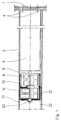
- FIG. 1 shows a winding shaft 2 which is arranged on an end cover 1 of a roller shutter box and can be driven by a tubular motor 3 fastened to the end cover 1 by screws 4.
- the first spring element 6 On a motor shaft 5, a first spring element 6 shown in Figures 2 and 3 is rotatably connected.
- the first spring element 6 has a plate-shaped base body 7 and thereon a spring tongue 9 held in the holder 8.
- the first spring element 6 is arranged centrally in a first ring gear 11 of a transmission element 10. Depending on the direction of rotation of the motor shaft 5, the spring tongues 9 engage in an internal toothing 12 of the first ring gear 11 in a rotationally fixed manner or in a load-dependent manner when a predetermined release torque is exceeded.
- the transmission element 10 is freely rotatable in a bore 13 on the motor shaft 5.
- the transmission element 10 consists of the first ring gear 11 and a second spring element 14 with holders 15 and spring tongues 16 held therein, as shown in FIGS. 4, 5 and 6.
- the spring tongues 16 are oriented opposite to the spring tongues 9 of the first spring element 6.
- the second spring element 14 is in turn arranged concentrically in a second ring gear 17 shown in FIGS. 7 and 8.
- the second ring gear 17 has an internal toothing 18 and a nose 21 formed on the outer circumference.
- the second ring gear 17 is in a concentric bore 19 on the motor shaft 5 mounted non-rotatably, a nut 20 screwed onto the outer end of the motor shaft 5 holding the partial couplings together.
- the two spring elements 6, 14 each have four spring tongues 9, 16 distributed symmetrically in the holders 8, 15.
- the spring tongues 9, 16 are fastened to the holders 8, 15 at clamping points 23.
- the spring tongues 9, 16 consist of 0.2-0.5 mm thick steel sheet strips, at the ends of which a semi-arc-shaped slide-on profile 24 is formed. This slide-on profile 24 engages in the internal toothing 12, 18 of the associated ring gears 11, 17.
- the rotational movement transmitted to the transmission element 10 is transmitted to the second ring gear 17 by means of a second spring element 14.
- the spring tongues 16 of the second spring element 14 engage in the internal toothing 18 of the second ring gear 17.
- the spring tongues 16, which are oriented opposite to the spring tongues 9 of the first spring element 6, thus also effect a load-dependent coupling of the second direction of rotation, wherein different release moments can be preselected by different design of the spring tongues 9 or 16.
- the rotational movement of the second ring gear 17 is transmitted via the nose 21, which engages in a groove 22 in the winding shaft 2, to the winding shaft 2 in the roller shutter box. The winding shaft 2 rolls up and down the roller shutters.
- the coupling can also be provided particularly advantageously manually, for example by means of a crank, moving roller shutters. This prevents damage caused by incorrect operation.
Landscapes
- Engineering & Computer Science (AREA)
- Structural Engineering (AREA)
- Architecture (AREA)
- Civil Engineering (AREA)
- Operating, Guiding And Securing Of Roll- Type Closing Members (AREA)
- One-Way And Automatic Clutches, And Combinations Of Different Clutches (AREA)
- Harvester Elements (AREA)
- Mechanical Operated Clutches (AREA)
- Catching Or Destruction (AREA)
- Blinds (AREA)
- Ticket-Dispensing Machines (AREA)
- Pulleys (AREA)
- Friction Gearing (AREA)
Abstract
Description
- Die Erfindung betrifft einen Rolladen, insbesondere für Dachfenster, mit einer vorzugsweise oben angeordneten Wickelwelle, die von einem Motor über eine Rutschkupplung angetrieben ausgebildet ist.
- Fensterrolladen werden zunehmend motorisch angetrieben, um eine Fernbedienung oder automatische Steuerung des Öffnungs- und des Schließvorgangs zu ermöglichen. Besonders bei Dachfenstern ist häufig ein über geeignete Sensoren gesteuertes automatisches Schließen der Rolladen nötig, um ein übermäßiges Erwärmen des Innenraumes bei Sonneneinstrahlung zu verhindern. Die elektrischen Antriebe werden an der meist oben angeordneten Wickelwelle angeordnet.
- Seit einigen Jahren ist es bekannt, Rolladenantriebe für das Aufwickeln mit Rutschkupplungen auszustatten. Damit wird der elektrische Motor vor Überlastungen geschützt, die beispielsweise bei in geschlossenem Zustand eingefrorenen Rolladenstäben auftreten.
- Es ist jedoch nachteilig, daß der Antrieb beim Schließen des Rolladens nicht durch eine Rutschkupplung auskuppelbar ist. Bei Verklemmen oder Blockieren der Rolladenstäbe beim Schließen des Rolladens kann folglich der elektrische Motor überlastet werden oder Beschädigungen am Rolladen oder Rolladenantrieb verursacht werden.
- Aufgabe der Erfindung ist es, einen Überlastschutz für Rolladenantriebe anzugeben, der beim Schließen des Rolladens die im Rolladenkasten befindlichen Rolladenstäbe schützt.
- Die mit der im Hauptanspruch angegebenen Erfindung erzielten Vorteile bestehen insbesondere darin, daß bei einer in beiden Drehrichtungen wirkenden Rutschkupplung eine übermäßige Stauchung und eventuelle Zerstörung der Rolladenlamellen vermieden wird. Sind beispielsweise die Führungsschienen des Rolladens vereist, wird bei Schließen des Rolladens bei einem vorgegebenen Auslösemoment die Drehverbindung zwischen Motor und Wickelwelle gelöst. Die Rolladenlamellen werden keiner übermäßigen Belastung ausgesetzt. Ferner ist der Antriebsmotor vor Überlastung geschützt. Ein Stehenbleiben des Motors unter Last und eine damit zusammenhängende Zerstörung des Motors wird sicher vermieden.
- In Ausgestaltung des Rolladens ist vorgesehen, daß die Rutschkupplung Freigabemomente aufweist, die für beide Drehrichtungen unterschiedlich ausgebildet sind. Damit läßt sich berücksichtigen, daß die zum Schließen bzw. Öffnen des Rolladen benötigten Antriebsmomente unterschiedlich sind. Beim Schließen des Rolladens wird die Drehbewegung der Wickelwelle durch die Gewichtskraft der abgewickelten Rolladenlamellen unterstützt.
- In weiterer Ausgestaltung der Erfindung ist vorgesehen, daß die Rutschkupplung aus zwei Teilkupplungen besteht, wobei jeder Teil nur in einer Drehrichtung einen Freigabemoment aufweist und in der Gegenrichtung die gekuppelten Teile drehfest verbindend ausgebildet sind. Damit läßt sich das Freigabemoment für jede Drehrichtung unabhängig voneinander individuell einstellen. Eine Anpassung an verschiedene Einbaubedingungen, beispielsweise unterschiedliche Dachneigungen, läßt sich einfach und schnell an den beiden Teilkupplungen durchführen.
- Wird die Rutschkupplung innerhalb der Wickelwelle, vorzugsweise in Verbindung mit einem Rohmotor, angeordnet, ergibt sich ein vorteilhaft kleinbauender Rolladen. Insbesondere kann der Rolladenkasten äußerst schlank ausgeführt werden.
- Mit der Ausgestaltung nach Anspruch 5 ist eine einfach aufgebaute aber wirkungsvoll arbeitende Rutschkupplung angegeben. Durch Austausch der Federzunge oder durch Veränderung der Vorspannung der Federzunge können unterschiedliche, den Gegebenheiten angepaßte Freigabemomente der Rutschkupplung gewählt werden.
- In weiterer Ausgestaltung des Rolladens ist vorgesehen, daß mehrere, insbesondere vier, Federzungen in die Zähne des Zahnrades eingreifend angeordnet sind. Damit wird die Funktionssicherheit der Rutschkupplung weiter verbessert. Ferner wird ein Ausgleich der zwischen Federzunge und Ruherad wirkenden radialen Kräfte erreicht, so daß eine Dezentrierung nicht auftritt.
- Mit der Ausgestaltung nach Anspruch 7 wird eine vorteilhafte Standardisierung der Bauteile erreicht. Dies führt zu günstigen Herstellungskosten und verringert die Wartungskosten.
- Vorteilhafte Ausgestaltungen der Federzungen werden in den Unteransprüchen 8 bis 13 angegeben.
- Kostengünstig wird die Federzunge als Blechstreifen ausgebildet. Ein eingeformtes Aufgleitprofil stützt die Funktion als Biege- bzw. Knickstab. Symmetrisch zueinander angeordnete Federzungen gleichen die durch die Federzungen entstehenden radialen Kräfte aus. Die gewünschten Freigabemomente können durch Federzungen aus unterschiedlich dicken Blechstreifen erzeugt werden.
- Mit den in den Unteransprüchen 11 bis 13 beschriebenen Abmessungen und Anordnungen der Federzunge läßt sich die Betriebssicherheit der Rutschkupplung weiter verbessern.
- Entspricht die freie Biegelänge der Federzungen etwa dem 0,7-fachen Teilkreisradius des Hohlrades, wird bei Knick- und Biegebelastung eine gegenseitige Behinderung der Federzungen vermieden und gleichzeitig eine ausreichende Beweglichkeit der Federzungen gewährleistet.
- Dadurch, daß die Federzunge eine tangentiale Richtung zu einem um das Federelement gedachten konzentrischen Kreis mit einem Radius von etwa dem 0,7-fachen des Teilkreises aufweist, wird die Federzunge in einer vorgespannten Stellung gehalten, aus der heraus sie bei Knickbelastung nur geringfügig gestaucht wird, bis die Federzunge teilweise an der Innenverzahnung des Hohlrades anliegt und eine drehfeste Verbindung hergestellt ist.
- In weiterer Ausgestaltung ist vorgesehen, daß die Federzunge eine Einspannstelle aufweist, die etwa auf einem gedachten Halbkreis über dem Teilkreisradius des Hohlrades am Eingriffsort der Federzunge in die Verzahnung des Hohlrades angeordnet ist. Damit wird die Einspannstelle der Federzunge in Bezug zum Eingriffsort des freien Federzungenendes so ausgerichtet, daß bei Knickbelastung der Federzunge eine kraftschlüssige Verbindung mit einem besonders hohen Haltemoment entsteht.
- Im folgenden wird ein Ausführungsbeispiel der Erfindung anhand der Zeichnung beschrieben. Es zeigen:
- Figur 1
- einen Teil eines Längsschnitts einer Wickelwelle eines erfindungsgemäßen Rolladens,
- Figur 2
- eine Seitenansicht eines ersten Federelements,
- Figur 3
- eine Draufsicht des in Figur 2 dargestellten Federelements,
- Figur 4
- einen Längsschnitt eines Übertragungselements mit einem zweiten Federelement,
- Figur 5
- eine Rückansicht des in Figur 4 dargestellten Übertragungselements,
- Figur 6
- eine Draufsicht des in Figur 4 dargestellten Übertragungselements,
- Figur 7
- einen Längsschnitt eines Hohlrades und
- Figur 8
- eine Rückansicht des in Figur 7 dargestellten Hohlrades.
- Figur 1 zeigt eine an einem Enddeckel 1 eines Rolladenkastens angeordnete Wickelwelle 2, die von einem durch Schrauben 4 am Enddeckel 1 befestigten Rohrmotor 3 antreibbar ist.
- Auf einer Motorwelle 5 ist ein in den Figuren 2 und 3 dargestelltes erstes Federelement 6 drehfest verbunden. Das erste Federelement 6 weist einen tellerförmigen Grundkörper 7 und daran eine in Halter 8 gehaltene Federzunge 9 auf.
- Das erste Federelement 6 ist zentrisch in einem ersten Hohlrad 11 eines Übertragungselementes 10 angeordnet. Dabei greifen die Federzungen 9 je nach Drehrichtung der Motorwelle 5 drehfest rastend oder bei Überschreitung eines vorbestimmten Freigabemoments lastabhängig rastend in eine Innenverzahnung 12 des ersten Hohlrades 11 ein.
- Das Übertragungselement 10 ist frei drehbar in einer Bohrung 13 auf der Motorwelle 5 gelagert. Das Übertragungselement 10 besteht aus dem ersten Hohlrad 11 und einem zweiten Federelement 14 mit Haltern 15 und darin gehaltenen Federzungen 16, wie in Fig. 4, 5, und 6 gezeigt. Die Federzungen 16 sind entgegengesetzt zu den Federzungen 9 des ersten Federelements 6 ausgerichtet.
- Das zweite Federelement 14 ist wiederum konzentrisch in einem in Figur 7 und 8 dargestellten zweiten Hohlrad 17 angeordnet. Das zweite Hohlrad 17 weist eine Innenverzahnung 18 und eine am äußeren Umfang angeformte Nase 21 auf. Das zweite Hohlrad 17 ist in einer konzentrischen Bohrung 19 auf der Motorwelle 5 drehfrei gelagert, wobei eine am äußeren Ende der Motorwelle 5 aufgeschraubte Mutter 20 die Teilkupplungen zusammenhält.
- Die beiden Federelemente 6, 14 weisen jeweils vier symmetrisch in den Haltern 8, 15 verteilte Federzungen 9, 16 auf. Die Federzungen 9, 16 sind an Einspannstellen 23 an den Haltern 8, 15 befestigt. Die Federzungen 9, 16 bestehen aus 0,2 - 0,5 mm starken Stahlblechstreifen, an deren Enden ein halbbogenförmiges Aufgleitprofil 24 eingeformt ist. Dieses Aufgleitprofil 24 greift in die Innenverzahnung 12, 18 der zugeordneten Hohlräder 11, 17 ein.
- Die auf das Übertragungselement 10 übertragene Drehbewegung wird mittels zweitem Federelement 14 auf das zweite Hohlrad 17 übertragen. Dabei greifen die Federzungen 16 des zweiten Federelements 14 in die Innenverzahnung 18 des zweiten Hohlrades 17 ein. Die entgegengesetzt zu den Federzungen 9 des ersten Federelements 6 ausgerichteten Federzungen 16 bewirken so auch eine lastabhängige Kupplung der zweiten Drehrichtung, wobei durch verschiedene Ausbildung der Federzungen 9 bzw. 16 unterschiedliche Freigabemomente vorwählbar sind. Die Drehbewegung des zweiten Hohlrades 17 wird über die Nase 21, die in einer Nut 22 in der Wickelwelle 2 eingreift, auf die Wickelwelle 2 im Rolladenkasten übertragen. Die Wickelwelle 2 rollt den Rolladen auf bzw. ab.
- Besonders vorteilhaft läßt sich die Kupplung auch manuell, beispielsweise mittel einer Kurbel, bewegten Rolladen vorsehen. Schäden durch Fehlbedienung werden so vermieden.
-
- 1
- Enddeckel
- 2
- Wickelwelle
- 3
- Rohrmotor
- 4
- Schraube
- 5
- Motorwelle
- 6
- erstes Federelement
- 7
- Grundkörper
- 8
- Halter
- 9
- Federzunge
- 10
- Übertragungselement
- 11
- erstes Hohlrad
- 12
- Innenverzahnung
- 13
- Bohrung
- 14
- zweites Federelement
- 15
- Mutter
- 16
- Federzunge
- 17
- zweites Hohlrad
- 18
- Innenverzahnung
- 19
- Bohrung
- 20
- Halter
- 21
- Nase
- 22
- Nut
- 23
- Einspannstelle
- 24
- Aufgleitprofil
Claims (13)
- Rolladen, insbesondere für Dachfenster, mit einer vorzugsweise oben angeordneten Wickelwelle, die von einem Motor über eine Rutschkupplung angetrieben ausgebildet ist, dadurch gekennzeichnet, daß die Rutschkupplung in beide Drehrichtungen wirkend ausgebildet ist.
- Rolladen nach Anspruch 1, dadurch gekennzeichnet, daß die Rutschkupplung Freigabemomente aufweist, die für beide Drehrichtungen unterschiedlich ausgebildet sind.
- Rolladen nach Anspruch 1 oder 2, dadurch gekennzeichnet, daß die Rutschkupplung aus zwei Teilkupplungen besteht, wobei jeder Teil nur in einer Drehrichtung ein Freigabemoment aufweist und in der Gegenrichtung die gekuppelten Teile drehfest verbindend ausgebildet sind.
- Rolladen nach Anspruch 1, 2 oder 3 , dadurch gekennzeichnet, daß die Rutschkupplung innerhalb der Wickelwelle (2), vorzugsweise in Verbindung mit einem Rohrmotor (3), angeordnet ist.
- Rolladen nach Anspruch 1, 2, 3 oder 4, dadurch gekennzeichnet, daß die Rutschkupplung ein, vorzugsweise als Hohlrad (11, 17) ausgebildetes, Zahnrad aufweist, in dessen Zähne eine Federzunge (9, 16) eingreifend angeordnet ist, die in einer Drehrichtung einen Biegestab und in entgegengesetzter Richtung einen Knickstab bildet.
- Rolladen nach Anspruch 5, dadurch gekennzeichnet, daß mehrere, insbesondere vier, Federzungen (9, 16) in die Zähne des Zahnrades eingreifend angeordnet sind.
- Rolladen nach Anspruch 3, 4, 5 oder 6, dadurch gekennzeichnet, daß jeder Teilkupplung ein als Hohlrad ausgebildetes Zahnrad und ein zentrisch dazu angeordnetes Federelement zugeordnet sind, wobei ein Hohlrad (17) drehfest mit der Wickelwelle (2) und ein Federelement (6) drehfest mit der Motorwelle (5) und das andere Federelement (14) und Hohlrad (11) drehfest miteinander ausgebildet sind.
- Rolladen nach Anspruch 5, 6 oder 7, dadurch gekennzeichnet, daß die Federzunge (9, 16) als Blechstreifen mit vorzugsweise eingeformtem Aufgleitprofil ausgebildet ist.
- Rolladen nach Anspruch 5, 6, 7 oder 8, dadurch gekennzeichnet, daß die Federzungen (9, 16)zueinander symmetrisch angeordnet sind.
- Rolladen nach Anspruch 5, 6, 7, 8 oder 9, dadurch gekennzeichnet, daß die Federzungen (9, 16) ihrem Freigabemoment entsprechend aus unterschiedlich dicken Blechstreifen geformt sind.
- Rolladen nach Anspruch 5, 6, 7, 8, 9 oder 10, dadurch gekennzeichnet, daß die Federzunge (9, 16) eine freie Biegelänge aufweist, die dem halben bis ganzen Teilkreisradius, insbesondere etwa dem 0,7-fachen Teilkreisradius, des Hohlrades (11, 17) entspricht.
- Rolladen nach Anspruch 5, 6, 7, 8, 9, 10 oder 11, dadurch gekennzeichnet, daß die Federzunge (9, 16) eine tangentiale Richtung zu einem um das Federelement (6, 14) gedachten konzentrischen Kreis mit einem Radius von etwa dem 0,7-fachen des Teilkreises aufweist.
- Rolladen nach Anspruch 5, 6, 7, 8, 9, 10, 11 oder 12, dadurch gekennzeichnet, daß die Federzunge (9, 16) eine Einspannstelle (23) aufweist, die etwa auf einem gedachten Halbkreis über dem Teilkreisradius des Hohlrades (11, 17) am Eingriffort der Federzunge in die Verzahnung des Hohlrades angeordnet ist.
Applications Claiming Priority (2)
| Application Number | Priority Date | Filing Date | Title |
|---|---|---|---|
| DE4107611A DE4107611A1 (de) | 1991-03-09 | 1991-03-09 | Wickelwelle mit rutschkupplung |
| DE4107611 | 1991-03-09 |
Publications (3)
| Publication Number | Publication Date |
|---|---|
| EP0503161A2 true EP0503161A2 (de) | 1992-09-16 |
| EP0503161A3 EP0503161A3 (en) | 1993-04-14 |
| EP0503161B1 EP0503161B1 (de) | 1995-07-19 |
Family
ID=6426882
Family Applications (1)
| Application Number | Title | Priority Date | Filing Date |
|---|---|---|---|
| EP91122350A Expired - Lifetime EP0503161B1 (de) | 1991-03-09 | 1992-01-01 | Wickelwelle mit Rutschkupplung |
Country Status (5)
| Country | Link |
|---|---|
| EP (1) | EP0503161B1 (de) |
| JP (1) | JPH0565785A (de) |
| AT (1) | ATE125330T1 (de) |
| DE (2) | DE4107611A1 (de) |
| ES (1) | ES2075319T3 (de) |
Cited By (3)
| Publication number | Priority date | Publication date | Assignee | Title |
|---|---|---|---|---|
| FR2785274A1 (fr) * | 1998-11-02 | 2000-05-05 | Fermetures Henri Peyrichou | Dispositif d'arret automatique de la manoeuvre d'un element enroulable motorise |
| AT503139B1 (de) * | 2006-02-08 | 2009-02-15 | Blum Gmbh Julius | Ausstosser mit rutschkupplung |
| EP2085564A2 (de) | 2008-01-30 | 2009-08-05 | Gerhard Geiger GmbH & Co. | Antriebsvorrichtung mit einer Rutschkupplung oder Bremse |
Families Citing this family (2)
| Publication number | Priority date | Publication date | Assignee | Title |
|---|---|---|---|---|
| DE19519440A1 (de) * | 1995-05-26 | 1996-11-28 | Theodor Kuhlmann | Rolladen für Fenster und Fenstertüren |
| KR100522357B1 (ko) | 2003-09-26 | 2005-11-09 | 주식회사 윈스피아 | 내장형 전동 블라인드 장치 |
Family Cites Families (4)
| Publication number | Priority date | Publication date | Assignee | Title |
|---|---|---|---|---|
| DE7809535U1 (de) * | 1978-03-31 | 1978-09-21 | Emil Und Adolf Becker Kg, 6349 Sinn | Antriebswelle fuer einen rolladen, eine markise o.dgl. |
| CH662868A5 (en) * | 1982-05-10 | 1987-10-30 | Baumann Rolladen | Torque-limiting coupling |
| CH662859A5 (en) * | 1984-03-21 | 1987-10-30 | Griesser Ag | Overload safety device for a roller shutter, blind or awning drive |
| DE8412842U1 (de) * | 1984-04-26 | 1984-07-19 | Baier, Paul, 7592 Renchen | Rolladen fuer dachfenster |
-
1991
- 1991-03-09 DE DE4107611A patent/DE4107611A1/de active Granted
-
1992
- 1992-01-01 DE DE59202890T patent/DE59202890D1/de not_active Expired - Fee Related
- 1992-01-01 ES ES91122350T patent/ES2075319T3/es not_active Expired - Lifetime
- 1992-01-01 AT AT91122350T patent/ATE125330T1/de not_active IP Right Cessation
- 1992-01-01 EP EP91122350A patent/EP0503161B1/de not_active Expired - Lifetime
- 1992-03-06 JP JP4048960A patent/JPH0565785A/ja active Pending
Cited By (5)
| Publication number | Priority date | Publication date | Assignee | Title |
|---|---|---|---|---|
| FR2785274A1 (fr) * | 1998-11-02 | 2000-05-05 | Fermetures Henri Peyrichou | Dispositif d'arret automatique de la manoeuvre d'un element enroulable motorise |
| EP0999336A1 (de) * | 1998-11-02 | 2000-05-10 | S.A. Fermetures Henri Peyrichou (société Anonyme) | Vorrichtung zum automatischen Anhalten der Betätigung eines motorisierten aufwickelbaren Elementes |
| AT503139B1 (de) * | 2006-02-08 | 2009-02-15 | Blum Gmbh Julius | Ausstosser mit rutschkupplung |
| US8220883B2 (en) | 2006-02-08 | 2012-07-17 | Julius Blum Gmbh | Ejection device with slipping clutch |
| EP2085564A2 (de) | 2008-01-30 | 2009-08-05 | Gerhard Geiger GmbH & Co. | Antriebsvorrichtung mit einer Rutschkupplung oder Bremse |
Also Published As
| Publication number | Publication date |
|---|---|
| JPH0565785A (ja) | 1993-03-19 |
| ATE125330T1 (de) | 1995-08-15 |
| DE59202890D1 (de) | 1995-08-24 |
| ES2075319T3 (es) | 1995-10-01 |
| EP0503161B1 (de) | 1995-07-19 |
| DE4107611A1 (de) | 1992-09-17 |
| DE4107611C2 (de) | 1993-06-03 |
| EP0503161A3 (en) | 1993-04-14 |
Similar Documents
| Publication | Publication Date | Title |
|---|---|---|
| DE102018131844B4 (de) | Parksperreinrichtung in einem Fahrzeug | |
| DE2915669C2 (de) | ||
| DE3125249C2 (de) | ||
| EP3708753A1 (de) | Deckelbeschlag zum schwenkbaren befestigen eines deckels an einen möbelkorpus | |
| DE19632917B4 (de) | Bremsenjustiermechanismus | |
| WO2010012610A1 (de) | Wellentorantrieb sowie damit versehenes tor | |
| EP0151427A2 (de) | Federüberwachungsgerät | |
| EP2326783B1 (de) | Antriebsvorrichtung für ein-/ausstiegsvorrichtungen mit kupplung | |
| WO2011012571A1 (de) | Torantriebsvorrichtung mit zugmitellüberwachungseinrichtung sowie damit versehenes tor | |
| EP2085564A2 (de) | Antriebsvorrichtung mit einer Rutschkupplung oder Bremse | |
| DE69421361T2 (de) | Seilfensterheber mit vereinfachter, kinematischer Kette und elektrischem oder manuellem Antrieb | |
| DE4407265A1 (de) | Hebevorrichtung | |
| DE19734815C1 (de) | Antriebsvorrichtung für ein verstellbares Fahrzeugteil | |
| EP0503161B1 (de) | Wickelwelle mit Rutschkupplung | |
| EP0208979A1 (de) | Überlastsicherung | |
| EP2144838B1 (de) | Hebezeug | |
| DE60315402T2 (de) | Motorischer Stellantrieb einer Abschlussvorrichtung für eine Offnung in einem Fahrzeug und entsprechende Tür und Fahrzeug | |
| DE102009039623A1 (de) | Torantriebsvorrichtung mit Zugmittelüberwachungseinrichtung sowie damit versehenes Tor | |
| EP2248958B1 (de) | Dachschiebefenster | |
| DE3448351C2 (de) | Antriebseinrichtung f}r einen Fensterheber | |
| CH669636A5 (de) | ||
| DE3433562A1 (de) | Fangvorrichtung | |
| DE3433561C1 (de) | Fangvorrichtung | |
| DE19819251B4 (de) | Handnietgerät zum Setzen von Blindnietmuttern | |
| DE19854993C2 (de) | Antriebseinheit für Verstelleinrichtungen in Kraftfahrzeugen |
Legal Events
| Date | Code | Title | Description |
|---|---|---|---|
| PUAI | Public reference made under article 153(3) epc to a published international application that has entered the european phase |
Free format text: ORIGINAL CODE: 0009012 |
|
| AK | Designated contracting states |
Kind code of ref document: A2 Designated state(s): AT BE CH DE DK ES FR GB GR IT LI LU NL PT SE |
|
| PUAL | Search report despatched |
Free format text: ORIGINAL CODE: 0009013 |
|
| AK | Designated contracting states |
Kind code of ref document: A3 Designated state(s): AT BE CH DE DK ES FR GB GR IT LI LU NL PT SE |
|
| 17P | Request for examination filed |
Effective date: 19930309 |
|
| 17Q | First examination report despatched |
Effective date: 19940228 |
|
| GRAA | (expected) grant |
Free format text: ORIGINAL CODE: 0009210 |
|
| ITF | It: translation for a ep patent filed | ||
| AK | Designated contracting states |
Kind code of ref document: B1 Designated state(s): AT BE CH DE DK ES FR GB GR IT LI LU NL PT SE |
|
| PG25 | Lapsed in a contracting state [announced via postgrant information from national office to epo] |
Ref country code: DK Effective date: 19950719 Ref country code: GR Free format text: LAPSE BECAUSE OF FAILURE TO SUBMIT A TRANSLATION OF THE DESCRIPTION OR TO PAY THE FEE WITHIN THE PRESCRIBED TIME-LIMIT Effective date: 19950719 |
|
| REF | Corresponds to: |
Ref document number: 125330 Country of ref document: AT Date of ref document: 19950815 Kind code of ref document: T |
|
| ET | Fr: translation filed | ||
| REF | Corresponds to: |
Ref document number: 59202890 Country of ref document: DE Date of ref document: 19950824 |
|
| GBT | Gb: translation of ep patent filed (gb section 77(6)(a)/1977) |
Effective date: 19950807 |
|
| REG | Reference to a national code |
Ref country code: ES Ref legal event code: FG2A Ref document number: 2075319 Country of ref document: ES Kind code of ref document: T3 |
|
| PG25 | Lapsed in a contracting state [announced via postgrant information from national office to epo] |
Ref country code: PT Effective date: 19951019 Ref country code: SE Effective date: 19951019 |
|
| PG25 | Lapsed in a contracting state [announced via postgrant information from national office to epo] |
Ref country code: LU Free format text: LAPSE BECAUSE OF NON-PAYMENT OF DUE FEES Effective date: 19960131 |
|
| PLBE | No opposition filed within time limit |
Free format text: ORIGINAL CODE: 0009261 |
|
| STAA | Information on the status of an ep patent application or granted ep patent |
Free format text: STATUS: NO OPPOSITION FILED WITHIN TIME LIMIT |
|
| 26N | No opposition filed | ||
| PGFP | Annual fee paid to national office [announced via postgrant information from national office to epo] |
Ref country code: DE Payment date: 20010320 Year of fee payment: 10 |
|
| REG | Reference to a national code |
Ref country code: GB Ref legal event code: IF02 |
|
| PG25 | Lapsed in a contracting state [announced via postgrant information from national office to epo] |
Ref country code: DE Free format text: LAPSE BECAUSE OF NON-PAYMENT OF DUE FEES Effective date: 20020801 |
|
| BECN | Be: change of holder's name |
Owner name: *VKR HOLDING A/S Effective date: 20041116 |
|
| NLT1 | Nl: modifications of names registered in virtue of documents presented to the patent office pursuant to art. 16 a, paragraph 1 |
Owner name: VKR HOLDING A/S Owner name: VELUX INDUSTRI A/S |
|
| REG | Reference to a national code |
Ref country code: FR Ref legal event code: CA Ref country code: FR Ref legal event code: CD |
|
| REG | Reference to a national code |
Ref country code: ES Ref legal event code: PC2A |
|
| REG | Reference to a national code |
Ref country code: CH Ref legal event code: PFA Owner name: VKR HOLDING A/S Free format text: V. KANN RASMUSSEN INDUSTRI A/S#10 TOBAKSVEJEN#SOBORG (DK) -TRANSFER TO- VKR HOLDING A/S#TOBAKSVEJEN 10#2860 SOBORG (DK) |
|
| REG | Reference to a national code |
Ref country code: CH Ref legal event code: PFA Owner name: VKR HOLDING A/S Free format text: VKR HOLDING A/S#TOBAKSVEJEN 10#2860 SOBORG (DK) -TRANSFER TO- VKR HOLDING A/S#BREELTEVEJ 18#2970 HOERSHOLM (DK) |
|
| PGFP | Annual fee paid to national office [announced via postgrant information from national office to epo] |
Ref country code: CH Payment date: 20080130 Year of fee payment: 17 Ref country code: ES Payment date: 20080125 Year of fee payment: 17 |
|
| PGFP | Annual fee paid to national office [announced via postgrant information from national office to epo] |
Ref country code: GB Payment date: 20080123 Year of fee payment: 17 Ref country code: IT Payment date: 20080124 Year of fee payment: 17 Ref country code: NL Payment date: 20080124 Year of fee payment: 17 |
|
| PGFP | Annual fee paid to national office [announced via postgrant information from national office to epo] |
Ref country code: AT Payment date: 20080123 Year of fee payment: 17 |
|
| PGFP | Annual fee paid to national office [announced via postgrant information from national office to epo] |
Ref country code: FR Payment date: 20080118 Year of fee payment: 17 |
|
| PGFP | Annual fee paid to national office [announced via postgrant information from national office to epo] |
Ref country code: BE Payment date: 20080123 Year of fee payment: 17 |
|
| REG | Reference to a national code |
Ref country code: CH Ref legal event code: PL |
|
| GBPC | Gb: european patent ceased through non-payment of renewal fee |
Effective date: 20090101 |
|
| NLV4 | Nl: lapsed or anulled due to non-payment of the annual fee |
Effective date: 20090801 |
|
| PG25 | Lapsed in a contracting state [announced via postgrant information from national office to epo] |
Ref country code: CH Free format text: LAPSE BECAUSE OF NON-PAYMENT OF DUE FEES Effective date: 20090131 Ref country code: AT Free format text: LAPSE BECAUSE OF NON-PAYMENT OF DUE FEES Effective date: 20090101 Ref country code: LI Free format text: LAPSE BECAUSE OF NON-PAYMENT OF DUE FEES Effective date: 20090131 |
|
| REG | Reference to a national code |
Ref country code: FR Ref legal event code: ST Effective date: 20091030 |
|
| PG25 | Lapsed in a contracting state [announced via postgrant information from national office to epo] |
Ref country code: GB Free format text: LAPSE BECAUSE OF NON-PAYMENT OF DUE FEES Effective date: 20090101 Ref country code: NL Free format text: LAPSE BECAUSE OF NON-PAYMENT OF DUE FEES Effective date: 20090801 |
|
| PG25 | Lapsed in a contracting state [announced via postgrant information from national office to epo] |
Ref country code: BE Free format text: LAPSE BECAUSE OF NON-PAYMENT OF DUE FEES Effective date: 20090131 |
|
| REG | Reference to a national code |
Ref country code: ES Ref legal event code: FD2A Effective date: 20090102 |
|
| PG25 | Lapsed in a contracting state [announced via postgrant information from national office to epo] |
Ref country code: ES Free format text: LAPSE BECAUSE OF NON-PAYMENT OF DUE FEES Effective date: 20090102 Ref country code: FR Free format text: LAPSE BECAUSE OF NON-PAYMENT OF DUE FEES Effective date: 20090202 |
|
| PG25 | Lapsed in a contracting state [announced via postgrant information from national office to epo] |
Ref country code: IT Free format text: LAPSE BECAUSE OF NON-PAYMENT OF DUE FEES Effective date: 20090101 |