EP0506455A1 - Creping aids - Google Patents
Creping aids Download PDFInfo
- Publication number
- EP0506455A1 EP0506455A1 EP92302710A EP92302710A EP0506455A1 EP 0506455 A1 EP0506455 A1 EP 0506455A1 EP 92302710 A EP92302710 A EP 92302710A EP 92302710 A EP92302710 A EP 92302710A EP 0506455 A1 EP0506455 A1 EP 0506455A1
- Authority
- EP
- European Patent Office
- Prior art keywords
- creping
- polymer
- polymers
- anionic polymer
- acrylate
- Prior art date
- Legal status (The legal status is an assumption and is not a legal conclusion. Google has not performed a legal analysis and makes no representation as to the accuracy of the status listed.)
- Granted
Links
- 238000000034 method Methods 0.000 claims abstract description 17
- 229920006318 anionic polymer Polymers 0.000 claims abstract description 8
- 229920000642 polymer Polymers 0.000 claims description 29
- 239000003795 chemical substances by application Substances 0.000 claims description 13
- CERQOIWHTDAKMF-UHFFFAOYSA-N Methacrylic acid Chemical compound CC(=C)C(O)=O CERQOIWHTDAKMF-UHFFFAOYSA-N 0.000 claims description 7
- 229920001577 copolymer Polymers 0.000 claims description 7
- SMZOUWXMTYCWNB-UHFFFAOYSA-N 2-(2-methoxy-5-methylphenyl)ethanamine Chemical compound COC1=CC=C(C)C=C1CCN SMZOUWXMTYCWNB-UHFFFAOYSA-N 0.000 claims description 6
- HRPVXLWXLXDGHG-UHFFFAOYSA-N Acrylamide Chemical compound NC(=O)C=C HRPVXLWXLXDGHG-UHFFFAOYSA-N 0.000 claims description 5
- 125000004209 (C1-C8) alkyl group Chemical group 0.000 claims description 4
- 238000005227 gel permeation chromatography Methods 0.000 claims description 4
- 229920005604 random copolymer Polymers 0.000 claims description 3
- -1 acrylate ester Chemical class 0.000 claims description 2
- 229910052783 alkali metal Inorganic materials 0.000 claims description 2
- 150000001340 alkali metals Chemical class 0.000 claims description 2
- 125000005250 alkyl acrylate group Chemical group 0.000 claims description 2
- FQPSGWSUVKBHSU-UHFFFAOYSA-N methacrylamide Chemical compound CC(=C)C(N)=O FQPSGWSUVKBHSU-UHFFFAOYSA-N 0.000 claims description 2
- 239000002480 mineral oil Substances 0.000 claims description 2
- 235000010446 mineral oil Nutrition 0.000 claims description 2
- 239000000178 monomer Substances 0.000 claims description 2
- CERQOIWHTDAKMF-UHFFFAOYSA-M Methacrylate Chemical compound CC(=C)C([O-])=O CERQOIWHTDAKMF-UHFFFAOYSA-M 0.000 claims 1
- 239000002253 acid Substances 0.000 claims 1
- NIXOWILDQLNWCW-UHFFFAOYSA-M acrylate group Chemical group C(C=C)(=O)[O-] NIXOWILDQLNWCW-UHFFFAOYSA-M 0.000 claims 1
- 150000001408 amides Chemical class 0.000 claims 1
- 239000013530 defoamer Substances 0.000 claims 1
- 125000002636 imidazolinyl group Chemical group 0.000 claims 1
- 239000000203 mixture Substances 0.000 description 8
- 239000004744 fabric Substances 0.000 description 5
- BAPJBEWLBFYGME-UHFFFAOYSA-N Methyl acrylate Chemical compound COC(=O)C=C BAPJBEWLBFYGME-UHFFFAOYSA-N 0.000 description 4
- 239000000853 adhesive Substances 0.000 description 4
- 230000001070 adhesive effect Effects 0.000 description 4
- NIXOWILDQLNWCW-UHFFFAOYSA-N 2-Propenoic acid Natural products OC(=O)C=C NIXOWILDQLNWCW-UHFFFAOYSA-N 0.000 description 3
- 239000007864 aqueous solution Substances 0.000 description 3
- 229920000058 polyacrylate Polymers 0.000 description 3
- XLYOFNOQVPJJNP-UHFFFAOYSA-N water Substances O XLYOFNOQVPJJNP-UHFFFAOYSA-N 0.000 description 3
- 229920000742 Cotton Polymers 0.000 description 2
- 230000007062 hydrolysis Effects 0.000 description 2
- 238000006460 hydrolysis reaction Methods 0.000 description 2
- 239000003921 oil Substances 0.000 description 2
- 229920002401 polyacrylamide Polymers 0.000 description 2
- 229920002689 polyvinyl acetate Polymers 0.000 description 2
- 239000011118 polyvinyl acetate Substances 0.000 description 2
- 239000007921 spray Substances 0.000 description 2
- 229910001220 stainless steel Inorganic materials 0.000 description 2
- 239000010935 stainless steel Substances 0.000 description 2
- WNEODWDFDXWOLU-QHCPKHFHSA-N 3-[3-(hydroxymethyl)-4-[1-methyl-5-[[5-[(2s)-2-methyl-4-(oxetan-3-yl)piperazin-1-yl]pyridin-2-yl]amino]-6-oxopyridin-3-yl]pyridin-2-yl]-7,7-dimethyl-1,2,6,8-tetrahydrocyclopenta[3,4]pyrrolo[3,5-b]pyrazin-4-one Chemical compound C([C@@H](N(CC1)C=2C=NC(NC=3C(N(C)C=C(C=3)C=3C(=C(N4C(C5=CC=6CC(C)(C)CC=6N5CC4)=O)N=CC=3)CO)=O)=CC=2)C)N1C1COC1 WNEODWDFDXWOLU-QHCPKHFHSA-N 0.000 description 1
- 229920002126 Acrylic acid copolymer Polymers 0.000 description 1
- 239000004372 Polyvinyl alcohol Substances 0.000 description 1
- 239000000654 additive Substances 0.000 description 1
- 125000000217 alkyl group Chemical group 0.000 description 1
- 239000002518 antifoaming agent Substances 0.000 description 1
- 239000012736 aqueous medium Substances 0.000 description 1
- 230000015572 biosynthetic process Effects 0.000 description 1
- 125000002091 cationic group Chemical group 0.000 description 1
- 229920006317 cationic polymer Polymers 0.000 description 1
- 238000001035 drying Methods 0.000 description 1
- 230000000694 effects Effects 0.000 description 1
- 239000000839 emulsion Substances 0.000 description 1
- 230000002708 enhancing effect Effects 0.000 description 1
- 230000001815 facial effect Effects 0.000 description 1
- 239000003292 glue Substances 0.000 description 1
- 230000003301 hydrolyzing effect Effects 0.000 description 1
- MTNDZQHUAFNZQY-UHFFFAOYSA-N imidazoline Chemical compound C1CN=CN1 MTNDZQHUAFNZQY-UHFFFAOYSA-N 0.000 description 1
- 150000002462 imidazolines Chemical class 0.000 description 1
- 238000004519 manufacturing process Methods 0.000 description 1
- 239000002609 medium Substances 0.000 description 1
- 230000000704 physical effect Effects 0.000 description 1
- 229920001200 poly(ethylene-vinyl acetate) Polymers 0.000 description 1
- 229920002451 polyvinyl alcohol Polymers 0.000 description 1
- 235000019422 polyvinyl alcohol Nutrition 0.000 description 1
- 229920005989 resin Polymers 0.000 description 1
- 239000011347 resin Substances 0.000 description 1
- 238000005096 rolling process Methods 0.000 description 1
- 239000000126 substance Substances 0.000 description 1
- 239000004094 surface-active agent Substances 0.000 description 1
- 229920001187 thermosetting polymer Polymers 0.000 description 1
Classifications
-
- D—TEXTILES; PAPER
- D21—PAPER-MAKING; PRODUCTION OF CELLULOSE
- D21H—PULP COMPOSITIONS; PREPARATION THEREOF NOT COVERED BY SUBCLASSES D21C OR D21D; IMPREGNATING OR COATING OF PAPER; TREATMENT OF FINISHED PAPER NOT COVERED BY CLASS B31 OR SUBCLASS D21G; PAPER NOT OTHERWISE PROVIDED FOR
- D21H5/00—Special paper or cardboard not otherwise provided for
- D21H5/12—Special paper or cardboard not otherwise provided for characterised by the use of special fibrous materials
- D21H5/1218—Special paper or cardboard not otherwise provided for characterised by the use of special fibrous materials of crimped or crimpable fibres
-
- B—PERFORMING OPERATIONS; TRANSPORTING
- B31—MAKING ARTICLES OF PAPER, CARDBOARD OR MATERIAL WORKED IN A MANNER ANALOGOUS TO PAPER; WORKING PAPER, CARDBOARD OR MATERIAL WORKED IN A MANNER ANALOGOUS TO PAPER
- B31F—MECHANICAL WORKING OR DEFORMATION OF PAPER, CARDBOARD OR MATERIAL WORKED IN A MANNER ANALOGOUS TO PAPER
- B31F1/00—Mechanical deformation without removing material, e.g. in combination with laminating
- B31F1/12—Crêping
-
- C—CHEMISTRY; METALLURGY
- C08—ORGANIC MACROMOLECULAR COMPOUNDS; THEIR PREPARATION OR CHEMICAL WORKING-UP; COMPOSITIONS BASED THEREON
- C08G—MACROMOLECULAR COMPOUNDS OBTAINED OTHERWISE THAN BY REACTIONS ONLY INVOLVING UNSATURATED CARBON-TO-CARBON BONDS
- C08G69/00—Macromolecular compounds obtained by reactions forming a carboxylic amide link in the main chain of the macromolecule
- C08G69/48—Polymers modified by chemical after-treatment
-
- C—CHEMISTRY; METALLURGY
- C08—ORGANIC MACROMOLECULAR COMPOUNDS; THEIR PREPARATION OR CHEMICAL WORKING-UP; COMPOSITIONS BASED THEREON
- C08G—MACROMOLECULAR COMPOUNDS OBTAINED OTHERWISE THAN BY REACTIONS ONLY INVOLVING UNSATURATED CARBON-TO-CARBON BONDS
- C08G73/00—Macromolecular compounds obtained by reactions forming a linkage containing nitrogen with or without oxygen or carbon in the main chain of the macromolecule, not provided for in groups C08G12/00 - C08G71/00
- C08G73/02—Polyamines
- C08G73/028—Polyamidoamines
- C08G73/0286—Preparatory process from polyamidoamines and epihalohydrins
-
- D—TEXTILES; PAPER
- D21—PAPER-MAKING; PRODUCTION OF CELLULOSE
- D21H—PULP COMPOSITIONS; PREPARATION THEREOF NOT COVERED BY SUBCLASSES D21C OR D21D; IMPREGNATING OR COATING OF PAPER; TREATMENT OF FINISHED PAPER NOT COVERED BY CLASS B31 OR SUBCLASS D21G; PAPER NOT OTHERWISE PROVIDED FOR
- D21H17/00—Non-fibrous material added to the pulp, characterised by its constitution; Paper-impregnating material characterised by its constitution
- D21H17/20—Macromolecular organic compounds
- D21H17/33—Synthetic macromolecular compounds
- D21H17/34—Synthetic macromolecular compounds obtained by reactions only involving carbon-to-carbon unsaturated bonds
-
- D—TEXTILES; PAPER
- D21—PAPER-MAKING; PRODUCTION OF CELLULOSE
- D21H—PULP COMPOSITIONS; PREPARATION THEREOF NOT COVERED BY SUBCLASSES D21C OR D21D; IMPREGNATING OR COATING OF PAPER; TREATMENT OF FINISHED PAPER NOT COVERED BY CLASS B31 OR SUBCLASS D21G; PAPER NOT OTHERWISE PROVIDED FOR
- D21H21/00—Non-fibrous material added to the pulp, characterised by its function, form or properties; Paper-impregnating or coating material, characterised by its function, form or properties
- D21H21/14—Non-fibrous material added to the pulp, characterised by its function, form or properties; Paper-impregnating or coating material, characterised by its function, form or properties characterised by function or properties in or on the paper
- D21H21/146—Crêping adhesives
-
- D—TEXTILES; PAPER
- D21—PAPER-MAKING; PRODUCTION OF CELLULOSE
- D21H—PULP COMPOSITIONS; PREPARATION THEREOF NOT COVERED BY SUBCLASSES D21C OR D21D; IMPREGNATING OR COATING OF PAPER; TREATMENT OF FINISHED PAPER NOT COVERED BY CLASS B31 OR SUBCLASS D21G; PAPER NOT OTHERWISE PROVIDED FOR
- D21H17/00—Non-fibrous material added to the pulp, characterised by its constitution; Paper-impregnating material characterised by its constitution
- D21H17/20—Macromolecular organic compounds
- D21H17/33—Synthetic macromolecular compounds
- D21H17/46—Synthetic macromolecular compounds obtained otherwise than by reactions only involving carbon-to-carbon unsaturated bonds
- D21H17/54—Synthetic macromolecular compounds obtained otherwise than by reactions only involving carbon-to-carbon unsaturated bonds obtained by reactions forming in the main chain of the macromolecule a linkage containing nitrogen
- D21H17/56—Polyamines; Polyimines; Polyester-imides
Definitions
- the present invention relates to a creping aid composition and, in particular, a creping aid composition for application to a creping drum (also known as a Yankee or MG cylinder) in an apparatus for producing soft, lightweight paper web suitable for making sanitary paper products such as bathroom and facial tissue, papers towels and napkins.
- a creping aid composition for application to a creping drum (also known as a Yankee or MG cylinder) in an apparatus for producing soft, lightweight paper web suitable for making sanitary paper products such as bathroom and facial tissue, papers towels and napkins.
- the creping aids which are widely used include polyvinylalcohol, ethylene-vinyl acetate copolymers, animal glues, polyvinylacetate and cationic polyaminoamide wet strength resins. These nonionic and cationic polymers may be used alone or in combination with each other. However they are generally all used with a release agent, typically an imidazoline. In practice it is normal to vary the composition of the blend which is applied to the creping cylinder in order to control the adhesion of the web to the cylinder surface. While release agents are generally needed, there is a problem when the creping cylinder is at elevated temperature, for example 130° to 140°, since the agents tend to destroy the surface film.
- the use of synthetic anionic polymers give superior controlled adhesion properties.
- these polymers when these polymers are applied to the creping cylinder the web adheres better to the cylinder with the result that improved creping takes place.
- concentration of release agent employed can be significantly reduced and even eliminated compared to the levels currently used with conventional creping aids. Indeed it has been found that these polymers work satisfactorily at elevated temperatures where a release agent cannot normally be used. Further there is no need for a chemical debonding agent in the method of this invention.
- the present invention provides a method of creping a paper which comprises applying to the creping drum (prior to the application of the paper web to be creped) a synthetic anionic polymer and, preferably also, a release agent.
- the polymers used in the present invention are preferably (meth) acrylate polymers and especially polymers of acrylic or methacrylic acid.
- Preferred polymers are generally random copolymers, for example those which can be represented by the following formula: wherein:- each R1 individually represents H or a C1 to C8 alkyl group R2 represents H, -CO2X or -CH2CO2X and R3 represents -CO2X, or R2 and R3 together represent -CO-O-CO-, R4, represents -CONH2 or -CON(CH3)2
- R5 represents a C1 to C8 alkyl group
- X represents H or NH4 or an alkali metal
- m is an integer from 3 to about 100 x, y, z individually represent the relative mole ratios of each monomer such that x and y are from 1 to 9 and z can be from 0 to 5.
- Preferred copolymers for use in the present invention are random copolymers of
- the mole ratios of A to B is generally from 1:9 to 9:1 but preferably from 1:5 to 5:1. Up to, say, 50 mole percent of A to B may be replaced by C.
- the molecular weight range of the polymers used in the present invention is generally 1,000 to 500,000 but preferably 5,000 to 200,000 and especially 5,000 to 150,000 (Mw as determined by gel permeation chromatography).
- particularly preferred polymers for use in the present invention include copolymers of (meth)acrylic acid and acrylamide, especially those with a mole ratio (respectively) of 1:5 to 5:1 as well as such colymers which are also derived from methyl acrylate with a mole ratio of acrylic acid to methyl acrylate of 10:1 to 1:1, especially 5:1 to 1:1.
- copolymers used in the present invention can generally be prepared by the usual free-radical type polymerisation conditions in aqueous media. Although it is possible to obtain certain acrylic acid copolymers by hydrolysing polyacrylamide, it will be appreciated that the copolymers used in the present invention derived from methacrylic acid cannot be prepared by partial hydrolysis in this way because, of course, hydrolysis of acrylamide will yield only acrylic acid and not methacrylic acid.
- the second polymer although it is desirably an acrylate polymer need not necessarily be derived from an acrylamide. Typical such polymers are those having the general formula set out above as defined above except that x is from 1 to 10 and y and z are each independently from 0 to 5. It is believed, although this forms no part of the present invention, that this second acrylate polymer cross-links with the acrylamide polymer thus enhancing the strength of the film and thereby further improving adhesion of the web to the creping cylinder.
- the relative proportions of the two polymers is not particularly critical although, typically, they will be used in a weight ratio from 1:5 to 5:1.
- the usual release agents can be employed with the anionic polymers. These include imidazolines as well as oils such as mineral oil defoamers and other defoaming agents including quaternary surfactants which have a softening effect on the paper web. It will be appreciated that, for greater control, the polymer and release agent will normally be applied separately.
- the amounts used will, of course, depend very much on the nature of the paper and the degree of softness to be obtained. But, in general, from 0.1 to 0.3 grams of polymer is required per square metre of surface of the creping drum.
- the polymers are applied as aqueous solutions containing, say, 5 to 50, generally 5 to 10, for example about 10, % by weight.
- the molecular weights of the copolymers were determined by gel permeation chromatography.
- the molecular weight (Mw) as determined by gel permeation chromatography is 127,000 for polymer 1 and 38,000 for polymer J.
- the machine in question has a creping cylinder with a surface temperature in the range of 130-140°C.
- the creping process can be controlled using conventional polymeric additives (a polyvinyl acetate emulsion and a thermosetting polyaminoamide) via a spray bar to the cylinder surface. These were dosed into the header tank (as 10% by weight aqueous solutions) at rates of 12 and 8 millilitres per minute. No release oil was used.
- Polymers I an J were dosed (as 10% by weight aqueous solutions) via the spray bar at rates of 1.8 and 3.6 millilitres per minute respectively. Despite the considerably lower dose rates the rate of film formation on the cylinder surface was found to be much faster than with conventional technology: 1-2 minutes compared to 10-20 minutes.
Landscapes
- Chemical & Material Sciences (AREA)
- Chemical Kinetics & Catalysis (AREA)
- Health & Medical Sciences (AREA)
- Medicinal Chemistry (AREA)
- Polymers & Plastics (AREA)
- Organic Chemistry (AREA)
- Engineering & Computer Science (AREA)
- Mechanical Engineering (AREA)
- General Chemical & Material Sciences (AREA)
- Paper (AREA)
- Machines For Manufacturing Corrugated Board In Mechanical Paper-Making Processes (AREA)
- Shaping Of Tube Ends By Bending Or Straightening (AREA)
- Treatments Of Macromolecular Shaped Articles (AREA)
- Sanitary Thin Papers (AREA)
Abstract
Description
- The present invention relates to a creping aid composition and, in particular, a creping aid composition for application to a creping drum (also known as a Yankee or MG cylinder) in an apparatus for producing soft, lightweight paper web suitable for making sanitary paper products such as bathroom and facial tissue, papers towels and napkins.
- It is conventional practice to produce soft paper web by mechanically or chemically disrupting interfibre bonds in the paper web. Such practices include the use of a creping or doctor blade to crepe paper from a drying surface. This procedure usually involves the application of a creping aid composition to the surface of the creping cylinder immediately prior to the web contacting the cylinder. The creping aid composition causes substantial adherence of the web to the creping cylinder at the point of contact with the creping blade. Under these conditions, a high bulked and internally delaminated web is produced.
- The creping aids which are widely used include polyvinylalcohol, ethylene-vinyl acetate copolymers, animal glues, polyvinylacetate and cationic polyaminoamide wet strength resins. These nonionic and cationic polymers may be used alone or in combination with each other. However they are generally all used with a release agent, typically an imidazoline. In practice it is normal to vary the composition of the blend which is applied to the creping cylinder in order to control the adhesion of the web to the cylinder surface. While release agents are generally needed, there is a problem when the creping cylinder is at elevated temperature, for example 130° to 140°, since the agents tend to destroy the surface film.
- It has now surprisingly been found, according to the present invention, that the use of synthetic anionic polymers give superior controlled adhesion properties. In other words when these polymers are applied to the creping cylinder the web adheres better to the cylinder with the result that improved creping takes place. Also, while it is desirable to use such polymers in combination with a release agent it has been found that the concentration of release agent employed can be significantly reduced and even eliminated compared to the levels currently used with conventional creping aids. Indeed it has been found that these polymers work satisfactorily at elevated temperatures where a release agent cannot normally be used. Further there is no need for a chemical debonding agent in the method of this invention. Accordingly, the present invention provides a method of creping a paper which comprises applying to the creping drum (prior to the application of the paper web to be creped) a synthetic anionic polymer and, preferably also, a release agent.
- It has been found that the resulting paper sheet is of superior bulk and softness even though significantly lower amounts of the polymer and release agent (if at all) are employed as compared with the amounts conventionally used with convention creping aids.
- The polymers used in the present invention are preferably (meth) acrylate polymers and especially polymers of acrylic or methacrylic acid. Preferred polymers are generally random copolymers, for example those which can be represented by the following formula:
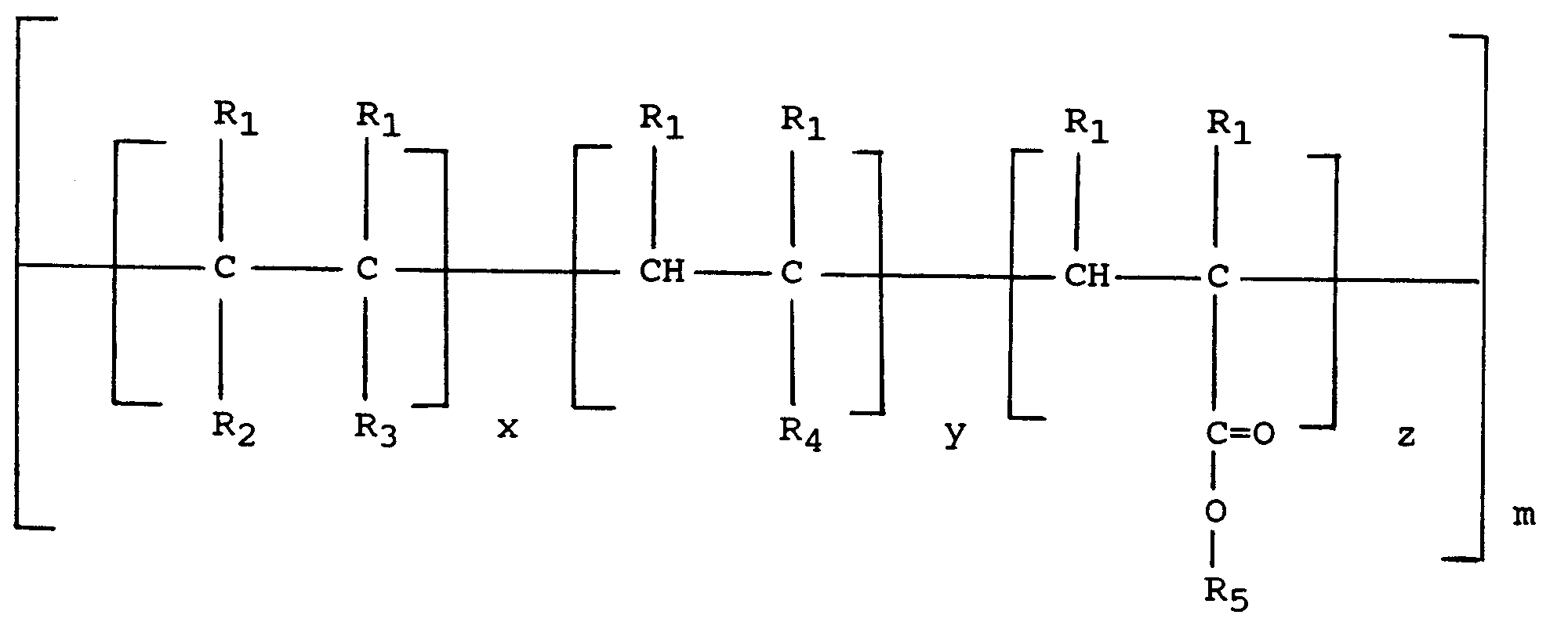
wherein:-
each R₁ individually represents H or a C₁ to C₈ alkyl group
R₂ represents H, -CO₂X or -CH₂CO₂X and
R₃ represents -CO₂X,
or R₂ and R₃ together represent -CO-O-CO-,
R₄, represents -CONH₂ or -CON(CH₃)₂
R₅ represents a C₁ to C₈ alkyl group
X represents H or NH₄ or an alkali metal
m is an integer from 3 to about 100
x, y, z individually represent the relative mole ratios of each monomer such that x and y are from 1 to 9 and z can be from 0 to 5. - It will be appreciated that the formula does not mean that the first recurring unit is in a block of x units etc ..
- Preferred copolymers for use in the present invention are random copolymers of
- A acrylic acid and/or methacrylic acid with
- B acrylamide and/or methacrylamide with, optionally,
- C an alkyl acrylate or alkyl (meth) acrylate ester, present in the specified proportions so as to impart water solubility to the copolymer.
- The mole ratios of A to B is generally from 1:9 to 9:1 but preferably from 1:5 to 5:1. Up to, say, 50 mole percent of A to B may be replaced by C.
- The molecular weight range of the polymers used in the present invention is generally 1,000 to 500,000 but preferably 5,000 to 200,000 and especially 5,000 to 150,000 (Mw as determined by gel permeation chromatography). Thus particularly preferred polymers for use in the present invention include copolymers of (meth)acrylic acid and acrylamide, especially those with a mole ratio (respectively) of 1:5 to 5:1 as well as such colymers which are also derived from methyl acrylate with a mole ratio of acrylic acid to methyl acrylate of 10:1 to 1:1, especially 5:1 to 1:1.
- The copolymers used in the present invention can generally be prepared by the usual free-radical type polymerisation conditions in aqueous media. Although it is possible to obtain certain acrylic acid copolymers by hydrolysing polyacrylamide, it will be appreciated that the copolymers used in the present invention derived from methacrylic acid cannot be prepared by partial hydrolysis in this way because, of course, hydrolysis of acrylamide will yield only acrylic acid and not methacrylic acid.
- Although a single polymer can be used it has been found that greater control to deal with varying conditions can be achieved by a using a mixture of polymers. The selection of a one or two product approach will be determined by the machine conditions. It is likely that those mills producing a wide range of tissue grades from variable furnish will view the two product approach to be more flexible in terms of having greater control over the creping process. The polymers can be applied together or, for greater flexibility, separately. It has also been found that the second polymer although it is desirably an acrylate polymer need not necessarily be derived from an acrylamide. Typical such polymers are those having the general formula set out above as defined above except that x is from 1 to 10 and y and z are each independently from 0 to 5. It is believed, although this forms no part of the present invention, that this second acrylate polymer cross-links with the acrylamide polymer thus enhancing the strength of the film and thereby further improving adhesion of the web to the creping cylinder.
- The relative proportions of the two polymers is not particularly critical although, typically, they will be used in a weight ratio from 1:5 to 5:1.
- The usual release agents can be employed with the anionic polymers. These include imidazolines as well as oils such as mineral oil defoamers and other defoaming agents including quaternary surfactants which have a softening effect on the paper web. It will be appreciated that, for greater control, the polymer and release agent will normally be applied separately.
- The amounts used will, of course, depend very much on the nature of the paper and the degree of softness to be obtained. But, in general, from 0.1 to 0.3 grams of polymer is required per square metre of surface of the creping drum. Typically the polymers are applied as aqueous solutions containing, say, 5 to 50, generally 5 to 10, for example about 10, % by weight.
- The present invention will now be illustrated by the following Examples:
-
- a) The sample was applied at 10% ds to a stainless steel panel (dimensions 2˝ x 5˝). The sample was spread as evenly as possible across the surface.
- b) The sample was air dried in a fan oven without heat.
- c) The panel was placed onto a laboratory hot plate (DATAPLATE, digital hotplate and stirrer) and heated to a surface temperature of 93°C.
- d) A wet cotton cloth (dimensions 2˝ x 8˝) containing approximately three times its weight of water was applied to the hot panel to cover the surface and pressed onto the panel by rolling over it a 2kg cylinder.
- e) While the cloth dried on the hot plate the surface temperature was raised to 99°C.
- f) When the cloth was dry it was peeled off by hand at an angle of 180 degrees. The degree of adhesiveness was noted on a scale from 1 to 5 (1 being very adhesive and 5 being not adhesive at all).
-

The molecular weights of the copolymers were determined by gel permeation chromatography. -
- a) The samples were applied to a 2˝ x 5˝ stainless steel panel as evenly as possible.
- b) The panel was placed onto a laboratory hot plate (DATAPLATE, digital hotplate, stirrer) and heated to a surface temperature of 85°C.
- c) Before the creping aid dried a wet cotton cloth (2˝ x 8˝) containing approximately three times its weight of water was applied to the hot panel to cover the surface and rolled down with a 2 kg cylinder.
- d) When the cloth was dry it was peeled off by hand at an angle of 180 degrees. The degree of adhesiveness was noted on a scale from 1 to 5 (1 being very adhesive and 5 being not adhesive at all).
-

- Two polymers were evaluated for the production of medium weight (25 grammes per square metre) tissue. The composition of the polymers is as follows:-

- The molecular weight (Mw) as determined by gel permeation chromatography is 127,000 for polymer 1 and 38,000 for polymer J.
- The machine in question has a creping cylinder with a surface temperature in the range of 130-140°C. The creping process can be controlled using conventional polymeric additives (a polyvinyl acetate emulsion and a thermosetting polyaminoamide) via a spray bar to the cylinder surface. These were dosed into the header tank (as 10% by weight aqueous solutions) at rates of 12 and 8 millilitres per minute. No release oil was used.
- Polymers I an J were dosed (as 10% by weight aqueous solutions) via the spray bar at rates of 1.8 and 3.6 millilitres per minute respectively. Despite the considerably lower dose rates the rate of film formation on the cylinder surface was found to be much faster than with conventional technology: 1-2 minutes compared to 10-20 minutes.
- The physical properties of the sheet were unchanged using the Polymers I and J. For such grades of crepe paper softness is not vitally important. However, the softness of the sheet produced with these polymers was at least as good as if not better than with the established polymers.
Claims (9)
- A method of creping a paper which comprises applying to the creping drum prior to the application of the paper web to be creped, a synthetic anionic polymer.
- A method according to claim 1 in which a release agent is also applied to the creping drum.
- A method according to claim 1 or 2 in which the anionic polymer is an acrylate or methacrylate polymer.
- A method according to claim 3 in which the anionic polymer is derived from acrylic or methacrylic acid.
- A method according to any one of claims 1 to 4 in which the anionic polymer is a random copolymer represented by the following formula:wherein:-

each R₁ individually represents H or a C₁ to C₈ alkyl group
R₂ represents H, -CO₂X or -CH₂CO₂X and
R₃ represents -CO₂X,
or R₂ and R₃ together represent -CO-O-CO-,
R₄ represents -CONH₂ or -CON(CH₃)₂
R₅ represents a C₁ to C₈ alkyl group
X represents H or NH₄ or an alkali metal
m is an integer from 3 to about 100
x, y, z individually represent the relative mole ratio of each monomer such that x and y are from 1 to 9 and z can be from 0 to 5. - A method according to claim 5 in which the polymer is a copolymer of acrylic and/or methacrylic acid with acrylamide and/or methacrylamide and, optionally, an alkyl acrylate or alky(meth)acrylate ester.
- A method according to claim 6 in which the mole ratio of acid to amide is from 1:5 to 5:1.
- A method according to any one of the preceding claims in which the polymer has a molecular weight from 5,000 to 150,000, as determined by gel permiation chromatography.
- A method according to any one of claims 2 to 8 in which the release agent is an imidazoline or a mineral oil defoamer.
Applications Claiming Priority (3)
| Application Number | Priority Date | Filing Date | Title |
|---|---|---|---|
| GB9106626A GB2254345B (en) | 1991-03-28 | 1991-03-28 | Creping aid |
| GB9106626 | 1991-03-28 | ||
| DE19532908A DE19532908C2 (en) | 1991-03-28 | 1995-09-07 | Process for creping paper |
Publications (2)
| Publication Number | Publication Date |
|---|---|
| EP0506455A1 true EP0506455A1 (en) | 1992-09-30 |
| EP0506455B1 EP0506455B1 (en) | 1998-01-14 |
Family
ID=39563465
Family Applications (2)
| Application Number | Title | Priority Date | Filing Date |
|---|---|---|---|
| EP92302710A Expired - Lifetime EP0506455B1 (en) | 1991-03-28 | 1992-03-27 | Method of creping |
| EP96929933A Expired - Lifetime EP0856083B1 (en) | 1991-03-28 | 1996-09-06 | Method of creping a paper |
Family Applications After (1)
| Application Number | Title | Priority Date | Filing Date |
|---|---|---|---|
| EP96929933A Expired - Lifetime EP0856083B1 (en) | 1991-03-28 | 1996-09-06 | Method of creping a paper |
Country Status (19)
| Country | Link |
|---|---|
| US (1) | US5234547A (en) |
| EP (2) | EP0506455B1 (en) |
| JP (2) | JP3320443B2 (en) |
| KR (1) | KR100208037B1 (en) |
| AR (1) | AR245964A1 (en) |
| AT (2) | ATE162248T1 (en) |
| AU (2) | AU650105B2 (en) |
| BR (1) | BR9201056A (en) |
| CA (2) | CA2063927C (en) |
| DE (2) | DE69224006T2 (en) |
| DK (2) | DK0506455T3 (en) |
| ES (2) | ES2111044T3 (en) |
| GB (1) | GB2254345B (en) |
| GR (1) | GR3026035T3 (en) |
| HK (1) | HK22596A (en) |
| MX (1) | MX9201375A (en) |
| NO (1) | NO980892L (en) |
| NZ (1) | NZ316833A (en) |
| WO (1) | WO1997011223A2 (en) |
Cited By (2)
| Publication number | Priority date | Publication date | Assignee | Title |
|---|---|---|---|---|
| CN1957141B (en) * | 2004-05-24 | 2012-01-18 | 巴斯福股份公司 | Method for producing creped paper |
| WO2012027253A1 (en) * | 2010-08-23 | 2012-03-01 | Hercules Incorporated | Papermaking additives for roll release improvement |
Families Citing this family (43)
| Publication number | Priority date | Publication date | Assignee | Title |
|---|---|---|---|---|
| GB2254345B (en) * | 1991-03-28 | 1995-06-14 | Grace W R & Co | Creping aid |
| US5695607A (en) * | 1994-04-01 | 1997-12-09 | James River Corporation Of Virginia | Soft-single ply tissue having very low sidedness |
| US5468796A (en) * | 1994-08-17 | 1995-11-21 | Kimberly-Clark Corporation | Creeping chemical composition and method of use |
| US5858171A (en) * | 1994-12-08 | 1999-01-12 | Hercules Incorporated | Methods for manufacturing paper using creping adhesives containing oxazoline polymers |
| US5730839A (en) * | 1995-07-21 | 1998-03-24 | Kimberly-Clark Worldwide, Inc. | Method of creping tissue webs containing a softener using a closed creping pocket |
| KR100520246B1 (en) * | 1995-09-07 | 2006-01-12 | 허큘레스 인코포레이티드 | How to Crepe Paper |
| US5993602A (en) * | 1997-07-21 | 1999-11-30 | Kimberly-Clark Worldwide, Inc. | Method of applying permanent wet strength agents to impart temporary wet strength in absorbent tissue structures |
| US6547925B1 (en) | 1997-07-21 | 2003-04-15 | Kimberly-Clark Worldwide, Inc. | Method of applying chemical softening agents for making soft tissue |
| US5942085A (en) * | 1997-12-22 | 1999-08-24 | The Procter & Gamble Company | Process for producing creped paper products |
| US6187138B1 (en) | 1998-03-17 | 2001-02-13 | The Procter & Gamble Company | Method for creping paper |
| KR100863382B1 (en) * | 1999-11-24 | 2008-10-13 | 허큘레스 인코포레이티드 | Creping adhesive |
| US6488812B2 (en) * | 2000-12-14 | 2002-12-03 | Kimberly-Clark Worldwide, Inc. | Soft tissue with improved lint and slough properties |
| ATE480666T1 (en) * | 2001-06-05 | 2010-09-15 | Buckman Labor Inc | POLYMERIC CREPE ADHESIVES AND CREPE METHODS |
| US7959761B2 (en) * | 2002-04-12 | 2011-06-14 | Georgia-Pacific Consumer Products Lp | Creping adhesive modifier and process for producing paper products |
| DE10244847A1 (en) | 2002-09-20 | 2004-04-01 | Ulrich Prof. Dr. Speck | Medical device for drug delivery |
| US6964725B2 (en) | 2002-11-06 | 2005-11-15 | Kimberly-Clark Worldwide, Inc. | Soft tissue products containing selectively treated fibers |
| US6951598B2 (en) * | 2002-11-06 | 2005-10-04 | Kimberly-Clark Worldwide, Inc. | Hydrophobically modified cationic acrylate copolymer/polysiloxane blends and use in tissue |
| US7029756B2 (en) | 2002-11-06 | 2006-04-18 | Kimberly-Clark Worldwide, Inc. | Soft tissue hydrophilic tissue products containing polysiloxane and having unique absorbent properties |
| US20040084164A1 (en) * | 2002-11-06 | 2004-05-06 | Shannon Thomas Gerard | Soft tissue products containing polysiloxane having a high z-directional gradient |
| US20040084162A1 (en) | 2002-11-06 | 2004-05-06 | Shannon Thomas Gerard | Low slough tissue products and method for making same |
| MXPA06001293A (en) * | 2003-08-05 | 2006-04-11 | Procter & Gamble | Improved creping aid composition and methods for producing paper products using that system. |
| US20050092450A1 (en) * | 2003-10-30 | 2005-05-05 | Hill Walter B.Jr. | PVP creping adhesives and creping methods using same |
| DE102004052957A1 (en) * | 2004-10-29 | 2006-05-04 | Basf Ag | Process for producing creped paper |
| WO2007008945A1 (en) * | 2005-07-11 | 2007-01-18 | Hercules Incorporated | Use of non-thermosetting polyamidoamines as dry-strength resins |
| US8066847B2 (en) * | 2005-12-29 | 2011-11-29 | Nalco Corporation | Creping adhesives comprising blends of polyaminoamide epihalolhydrin resins and polyamides |
| US20080097588A1 (en) * | 2006-10-18 | 2008-04-24 | Conor Medsystems, Inc. | Systems and Methods for Producing a Medical Device |
| AU2008206098B2 (en) * | 2007-01-19 | 2013-01-17 | Solenis Technologies Cayman, L.P. | Creping adhesives made from amine-terminated polyamidoamines |
| JP5447753B2 (en) * | 2007-09-07 | 2014-03-19 | 星光Pmc株式会社 | Release agent for crepe, paper manufacturing method and crepe paper |
| WO2010033536A2 (en) | 2008-09-16 | 2010-03-25 | Dixie Consumer Products Llc | Food wrap basesheet with regenerated cellulose microfiber |
| RU2011119498A (en) | 2008-10-16 | 2012-11-27 | Мэйнтек Ко., Лтд. | COMPOSITION OF FASTENING PRODUCTS AND METHOD FOR PRODUCING FASTENED PAPER |
| CA2798789C (en) | 2010-05-20 | 2017-02-07 | Georgia Pacific Chemicals Llc | Thermosetting creping adhesive with reactive modifiers |
| US8679295B2 (en) * | 2011-04-08 | 2014-03-25 | Kimberly-Clark Worldwide, Inc. | Soft creped tissue |
| US8834678B2 (en) * | 2011-04-08 | 2014-09-16 | Kimberly-Clark Worldwide, Inc. | Soft creped tissue having slow wet out time |
| MX2014001212A (en) | 2011-08-01 | 2014-03-21 | Buckman Labor Inc | Creping methods using ph-modified creping adhesive compositions. |
| EP2748374A2 (en) | 2011-08-22 | 2014-07-02 | Buckman Laboratories International, Inc | Oil-based creping release aid formulation |
| US20130180677A1 (en) | 2012-01-12 | 2013-07-18 | Buckman Laboratories International, Inc. | Methods To Control Organic Contaminants In Fibers |
| WO2015026507A1 (en) | 2013-08-20 | 2015-02-26 | Buckman Laboratories International, Inc. | Methods to control organic contaminants in fibers using zeolites |
| CA2929961C (en) | 2013-11-07 | 2020-08-18 | Georgia Pacific Chemicals Llc | Creping adhesives and methods for making and using same |
| EP3080224B1 (en) | 2013-12-10 | 2021-06-23 | Buckman Laboratories International, Inc | Adhesive formulation and creping methods using same |
| JP6612099B2 (en) * | 2015-09-30 | 2019-11-27 | 日本製紙株式会社 | Crepe paper manufacturing method and external coating agent for crepe processing |
| JP2021516295A (en) | 2018-03-22 | 2021-07-01 | バックマン ラボラトリーズ インターナショナル,インコーポレイティド | Modified crepe adhesive formulation and crepe processing method using it |
| WO2021050339A1 (en) | 2019-09-11 | 2021-03-18 | Buckman Laboratories International,Inc. | Grafted polyvinyl alcohol polymer, formulations containing the same and creping methods |
| WO2021092363A1 (en) | 2019-11-07 | 2021-05-14 | Ecolab Usa Inc. | Creping adhesives and processes for making and using same |
Citations (3)
| Publication number | Priority date | Publication date | Assignee | Title |
|---|---|---|---|---|
| EP0340020A2 (en) * | 1988-04-29 | 1989-11-02 | Scott Paper Company | Method of creping a fibrous web |
| US4994146A (en) * | 1988-10-28 | 1991-02-19 | Kimberly-Clark Corporation | Creping adhesive utilizing polymer-polymer complex formation |
| US5025046A (en) * | 1989-12-15 | 1991-06-18 | Kimberly-Clark Corporation | Creping adhesive composition |
Family Cites Families (15)
| Publication number | Priority date | Publication date | Assignee | Title |
|---|---|---|---|---|
| BE787371A (en) * | 1971-08-12 | 1973-02-09 | Hercules Inc | IMPROVEMENTS IN WATER-SOLUBLE RESINS USED TO MAKE CREPE PAPER, AND IN PROCESSES FOR THEIR PRODUCTION |
| US3926716A (en) * | 1974-03-19 | 1975-12-16 | Procter & Gamble | Transfer and adherence of relatively dry paper web to a rotating cylindrical surface |
| US4064213A (en) * | 1976-02-09 | 1977-12-20 | Scott Paper Company | Creping process using two-position adhesive application |
| US4406737A (en) * | 1976-05-07 | 1983-09-27 | Rohm And Haas Company | Creping paper using cationic water soluble addition polymer |
| CA1074602A (en) * | 1977-01-24 | 1980-04-01 | Imants Reba | Process for making soft, high bulk, low density, finely creped sheets |
| US4176107A (en) * | 1978-01-20 | 1979-11-27 | Buckman Laboratories, Inc. | Water-soluble dispersions of high molecular water-soluble polymers containing a surfactant and a water-soluble organic carrier which is a hydroxy compound containing repeating alkylene oxide units |
| DE3115547A1 (en) * | 1981-04-16 | 1982-11-11 | Bayer Ag, 5090 Leverkusen | NEW WATER-SOLUBLE POLYMERS, METHOD FOR THE PRODUCTION THEREOF AND THEIR USE IN THE PRODUCTION OF CREP PAPER |
| GB2141130B (en) * | 1983-06-09 | 1986-11-12 | Grace W R & Co | Polyamidoaminepolyamines |
| US4528316A (en) * | 1983-10-18 | 1985-07-09 | Kimberly-Clark Corporation | Creping adhesives containing polyvinyl alcohol and cationic polyamide resins |
| US4883564A (en) * | 1988-06-01 | 1989-11-28 | Scott Paper Company | Creping device adhesive formulation |
| US5094717A (en) * | 1990-11-15 | 1992-03-10 | James River Corporation Of Virginia | Synthetic fiber paper having a permanent crepe |
| GB2254345B (en) * | 1991-03-28 | 1995-06-14 | Grace W R & Co | Creping aid |
| US5382323A (en) * | 1993-01-08 | 1995-01-17 | Nalco Chemical Company | Cross-linked poly(aminoamides) as yankee dryer adhesives |
| NZ286384A (en) * | 1995-04-25 | 1998-05-27 | Hercules Inc | Process and composition for creping paper to give desired texture, where the composition comprises polyamine/epihalohydrin resin adhesive and a plasticizer |
| US5786429A (en) * | 1996-04-18 | 1998-07-28 | Hercules Incorporated | Highly branched polyamidoamines and their preparation |
-
1991
- 1991-03-28 GB GB9106626A patent/GB2254345B/en not_active Revoked
-
1992
- 1992-03-15 AR AR92322006A patent/AR245964A1/en active
- 1992-03-23 US US07/855,808 patent/US5234547A/en not_active Expired - Lifetime
- 1992-03-25 AU AU13167/92A patent/AU650105B2/en not_active Ceased
- 1992-03-26 CA CA002063927A patent/CA2063927C/en not_active Expired - Fee Related
- 1992-03-26 BR BR929201056A patent/BR9201056A/en not_active IP Right Cessation
- 1992-03-26 KR KR1019920005147A patent/KR100208037B1/en not_active Expired - Fee Related
- 1992-03-26 JP JP09856792A patent/JP3320443B2/en not_active Expired - Fee Related
- 1992-03-27 ES ES92302710T patent/ES2111044T3/en not_active Expired - Lifetime
- 1992-03-27 DK DK92302710.6T patent/DK0506455T3/en active
- 1992-03-27 DE DE69224006T patent/DE69224006T2/en not_active Expired - Fee Related
- 1992-03-27 MX MX9201375A patent/MX9201375A/en not_active IP Right Cessation
- 1992-03-27 EP EP92302710A patent/EP0506455B1/en not_active Expired - Lifetime
- 1992-03-27 AT AT92302710T patent/ATE162248T1/en not_active IP Right Cessation
-
1995
- 1995-09-07 DE DE19532908A patent/DE19532908C2/en not_active Expired - Fee Related
-
1996
- 1996-02-08 HK HK22596A patent/HK22596A/en not_active IP Right Cessation
- 1996-09-06 WO PCT/US1996/014305 patent/WO1997011223A2/en not_active Ceased
- 1996-09-06 AU AU69160/96A patent/AU700148B2/en not_active Ceased
- 1996-09-06 AT AT96929933T patent/ATE197616T1/en not_active IP Right Cessation
- 1996-09-06 CA CA002226959A patent/CA2226959C/en not_active Expired - Fee Related
- 1996-09-06 EP EP96929933A patent/EP0856083B1/en not_active Expired - Lifetime
- 1996-09-06 NZ NZ316833A patent/NZ316833A/en unknown
- 1996-09-06 ES ES96929933T patent/ES2152559T3/en not_active Expired - Lifetime
- 1996-09-06 JP JP51274297A patent/JP3940168B2/en not_active Expired - Fee Related
- 1996-09-06 DK DK96929933T patent/DK0856083T3/en active
-
1998
- 1998-01-30 GR GR980400203T patent/GR3026035T3/en unknown
- 1998-03-02 NO NO980892A patent/NO980892L/en not_active Application Discontinuation
Patent Citations (3)
| Publication number | Priority date | Publication date | Assignee | Title |
|---|---|---|---|---|
| EP0340020A2 (en) * | 1988-04-29 | 1989-11-02 | Scott Paper Company | Method of creping a fibrous web |
| US4994146A (en) * | 1988-10-28 | 1991-02-19 | Kimberly-Clark Corporation | Creping adhesive utilizing polymer-polymer complex formation |
| US5025046A (en) * | 1989-12-15 | 1991-06-18 | Kimberly-Clark Corporation | Creping adhesive composition |
Cited By (4)
| Publication number | Priority date | Publication date | Assignee | Title |
|---|---|---|---|---|
| CN1957141B (en) * | 2004-05-24 | 2012-01-18 | 巴斯福股份公司 | Method for producing creped paper |
| WO2012027253A1 (en) * | 2010-08-23 | 2012-03-01 | Hercules Incorporated | Papermaking additives for roll release improvement |
| AU2011293576B2 (en) * | 2010-08-23 | 2014-05-15 | Solenis Technologies Cayman, L.P. | Papermaking additives for roll release improvement |
| US8865263B2 (en) | 2010-08-23 | 2014-10-21 | Solenis Technologies, L.P. | Papermaking additives for roll release improvement |
Also Published As
Similar Documents
| Publication | Publication Date | Title |
|---|---|---|
| CA2063927C (en) | Creping aid | |
| US4063995A (en) | Fibrous webs with improved bonder and creping adhesive | |
| US4501640A (en) | Creping adhesives containing polyvinyl alcohol and cationic polyamide resins | |
| US4528316A (en) | Creping adhesives containing polyvinyl alcohol and cationic polyamide resins | |
| US5382323A (en) | Cross-linked poly(aminoamides) as yankee dryer adhesives | |
| US5374334A (en) | Class of polymeric adhesives for yankee dryer applications | |
| US4406737A (en) | Creping paper using cationic water soluble addition polymer | |
| JP2596593B2 (en) | Process for producing paper, cardboard or paperboard with high drying strength | |
| US4308092A (en) | Creping paper using cationic water soluble addition | |
| JPH0770232A (en) | Method for producing water-soluble copolymer containing copolymerized vinylamine unit | |
| EP0541232A1 (en) | Polyvinyl alcohol in combination with glyoxylated vinyl-amide polymers as creping adhesive compositions | |
| KR101946221B1 (en) | Surface application of polymers to improve paper strength | |
| US4115331A (en) | Surface sizing compositions for paper | |
| JP2011503271A (en) | Glyoxalated N-vinylamine | |
| JP2008520844A (en) | Method for producing paper, cardboard and cardboard with high dry strength | |
| FI66663B (en) | FOERFARANDE FOER FRAMSTAELLNING AV LIMNINGSMEDEL FOER PAPPER | |
| MXPA04012890A (en) | Strong and dispersible paper products. | |
| CN110268114B (en) | High Molecular Weight Temporary Wet Strength Resins for Paper | |
| NO157186B (en) | PROCEDURE FOR THE PREPARATION OF PAPERS WITH HIGH-DRY AND LOW DRAWN. | |
| JPH06299494A (en) | Sizing composition for papermaking and method for producing paper using the same | |
| US5393380A (en) | Polydiallyl dimethyl ammonium chloride/3-acrylamido-3-methylbutanoic acid copolymers and their use for pitch control in paper mill systems | |
| US5115065A (en) | Polymeric papermaking additive | |
| JP3351084B2 (en) | How to size paper | |
| EP0000921B1 (en) | A method for preparing a high strength composite and fibrous web comprising a dried composite | |
| WO2004074573A2 (en) | Alkanolamine polymer salt additives for creping of fibrous webs |
Legal Events
| Date | Code | Title | Description |
|---|---|---|---|
| PUAI | Public reference made under article 153(3) epc to a published international application that has entered the european phase |
Free format text: ORIGINAL CODE: 0009012 |
|
| AK | Designated contracting states |
Kind code of ref document: A1 Designated state(s): AT BE CH DE DK ES FR GB GR IT LI LU MC NL PT SE |
|
| 17P | Request for examination filed |
Effective date: 19921222 |
|
| 17Q | First examination report despatched |
Effective date: 19940413 |
|
| GRAG | Despatch of communication of intention to grant |
Free format text: ORIGINAL CODE: EPIDOS AGRA |
|
| GRAG | Despatch of communication of intention to grant |
Free format text: ORIGINAL CODE: EPIDOS AGRA |
|
| GRAG | Despatch of communication of intention to grant |
Free format text: ORIGINAL CODE: EPIDOS AGRA |
|
| GRAH | Despatch of communication of intention to grant a patent |
Free format text: ORIGINAL CODE: EPIDOS IGRA |
|
| RAP1 | Party data changed (applicant data changed or rights of an application transferred) |
Owner name: BETZDEARBORN INC |
|
| GRAH | Despatch of communication of intention to grant a patent |
Free format text: ORIGINAL CODE: EPIDOS IGRA |
|
| GRAA | (expected) grant |
Free format text: ORIGINAL CODE: 0009210 |
|
| ITF | It: translation for a ep patent filed | ||
| AK | Designated contracting states |
Kind code of ref document: B1 Designated state(s): AT BE CH DE DK ES FR GB GR IT LI LU MC NL PT SE |
|
| REF | Corresponds to: |
Ref document number: 162248 Country of ref document: AT Date of ref document: 19980115 Kind code of ref document: T |
|
| REG | Reference to a national code |
Ref country code: CH Ref legal event code: EP Ref country code: CH Ref legal event code: NV Representative=s name: R. A. EGLI & CO. PATENTANWAELTE |
|
| REF | Corresponds to: |
Ref document number: 69224006 Country of ref document: DE Date of ref document: 19980219 |
|
| REG | Reference to a national code |
Ref country code: ES Ref legal event code: FG2A Ref document number: 2111044 Country of ref document: ES Kind code of ref document: T3 |
|
| ET | Fr: translation filed | ||
| PG25 | Lapsed in a contracting state [announced via postgrant information from national office to epo] |
Ref country code: LU Free format text: LAPSE BECAUSE OF NON-PAYMENT OF DUE FEES Effective date: 19980327 |
|
| REG | Reference to a national code |
Ref country code: DK Ref legal event code: T3 |
|
| REG | Reference to a national code |
Ref country code: PT Ref legal event code: SC4A Free format text: AVAILABILITY OF NATIONAL TRANSLATION Effective date: 19980212 |
|
| PG25 | Lapsed in a contracting state [announced via postgrant information from national office to epo] |
Ref country code: MC Free format text: LAPSE BECAUSE OF NON-PAYMENT OF DUE FEES Effective date: 19980930 |
|
| PLBE | No opposition filed within time limit |
Free format text: ORIGINAL CODE: 0009261 |
|
| STAA | Information on the status of an ep patent application or granted ep patent |
Free format text: STATUS: NO OPPOSITION FILED WITHIN TIME LIMIT |
|
| 26N | No opposition filed | ||
| PGFP | Annual fee paid to national office [announced via postgrant information from national office to epo] |
Ref country code: DK Payment date: 20011213 Year of fee payment: 11 |
|
| REG | Reference to a national code |
Ref country code: GB Ref legal event code: IF02 |
|
| PGFP | Annual fee paid to national office [announced via postgrant information from national office to epo] |
Ref country code: GR Payment date: 20020124 Year of fee payment: 11 |
|
| PG25 | Lapsed in a contracting state [announced via postgrant information from national office to epo] |
Ref country code: DK Free format text: LAPSE BECAUSE OF NON-PAYMENT OF DUE FEES Effective date: 20030331 |
|
| PG25 | Lapsed in a contracting state [announced via postgrant information from national office to epo] |
Ref country code: GR Free format text: LAPSE BECAUSE OF NON-PAYMENT OF DUE FEES Effective date: 20031002 |
|
| PGFP | Annual fee paid to national office [announced via postgrant information from national office to epo] |
Ref country code: AT Payment date: 20090206 Year of fee payment: 18 Ref country code: ES Payment date: 20090316 Year of fee payment: 18 |
|
| PGFP | Annual fee paid to national office [announced via postgrant information from national office to epo] |
Ref country code: NL Payment date: 20090310 Year of fee payment: 18 Ref country code: PT Payment date: 20090105 Year of fee payment: 18 |
|
| PGFP | Annual fee paid to national office [announced via postgrant information from national office to epo] |
Ref country code: CH Payment date: 20090122 Year of fee payment: 18 Ref country code: GB Payment date: 20090206 Year of fee payment: 18 |
|
| PGFP | Annual fee paid to national office [announced via postgrant information from national office to epo] |
Ref country code: SE Payment date: 20090306 Year of fee payment: 18 Ref country code: IT Payment date: 20090318 Year of fee payment: 18 Ref country code: DE Payment date: 20090331 Year of fee payment: 18 |
|
| PGFP | Annual fee paid to national office [announced via postgrant information from national office to epo] |
Ref country code: BE Payment date: 20090429 Year of fee payment: 18 |
|
| PGFP | Annual fee paid to national office [announced via postgrant information from national office to epo] |
Ref country code: FR Payment date: 20090306 Year of fee payment: 18 |
|
| BERE | Be: lapsed |
Owner name: *BETZDEARBORN INC. Effective date: 20100331 |
|
| REG | Reference to a national code |
Ref country code: NL Ref legal event code: V1 Effective date: 20101001 |
|
| REG | Reference to a national code |
Ref country code: CH Ref legal event code: PL |
|
| EUG | Se: european patent has lapsed | ||
| GBPC | Gb: european patent ceased through non-payment of renewal fee |
Effective date: 20100327 |
|
| PG25 | Lapsed in a contracting state [announced via postgrant information from national office to epo] |
Ref country code: AT Free format text: LAPSE BECAUSE OF NON-PAYMENT OF DUE FEES Effective date: 20100327 |
|
| REG | Reference to a national code |
Ref country code: FR Ref legal event code: ST Effective date: 20101130 |
|
| PG25 | Lapsed in a contracting state [announced via postgrant information from national office to epo] |
Ref country code: NL Free format text: LAPSE BECAUSE OF NON-PAYMENT OF DUE FEES Effective date: 20101001 Ref country code: PT Free format text: LAPSE BECAUSE OF NON-PAYMENT OF DUE FEES Effective date: 20100927 Ref country code: FR Free format text: LAPSE BECAUSE OF NON-PAYMENT OF DUE FEES Effective date: 20100331 |
|
| PG25 | Lapsed in a contracting state [announced via postgrant information from national office to epo] |
Ref country code: CH Free format text: LAPSE BECAUSE OF NON-PAYMENT OF DUE FEES Effective date: 20100331 Ref country code: LI Free format text: LAPSE BECAUSE OF NON-PAYMENT OF DUE FEES Effective date: 20100331 Ref country code: DE Free format text: LAPSE BECAUSE OF NON-PAYMENT OF DUE FEES Effective date: 20101001 Ref country code: BE Free format text: LAPSE BECAUSE OF NON-PAYMENT OF DUE FEES Effective date: 20100331 |
|
| PG25 | Lapsed in a contracting state [announced via postgrant information from national office to epo] |
Ref country code: IT Free format text: LAPSE BECAUSE OF NON-PAYMENT OF DUE FEES Effective date: 20100327 Ref country code: GB Free format text: LAPSE BECAUSE OF NON-PAYMENT OF DUE FEES Effective date: 20100327 |
|
| REG | Reference to a national code |
Ref country code: ES Ref legal event code: FD2A Effective date: 20110418 |
|
| PG25 | Lapsed in a contracting state [announced via postgrant information from national office to epo] |
Ref country code: ES Free format text: LAPSE BECAUSE OF NON-PAYMENT OF DUE FEES Effective date: 20110404 |
|
| PG25 | Lapsed in a contracting state [announced via postgrant information from national office to epo] |
Ref country code: ES Free format text: LAPSE BECAUSE OF NON-PAYMENT OF DUE FEES Effective date: 20100328 |
|
| PG25 | Lapsed in a contracting state [announced via postgrant information from national office to epo] |
Ref country code: SE Free format text: LAPSE BECAUSE OF NON-PAYMENT OF DUE FEES Effective date: 20100328 |