EP0509878A1 - Composition aqueuse pour couchage de papier comportant un latex alcaligonflant sensiblement insoluble - Google Patents
Composition aqueuse pour couchage de papier comportant un latex alcaligonflant sensiblement insoluble Download PDFInfo
- Publication number
- EP0509878A1 EP0509878A1 EP92400961A EP92400961A EP0509878A1 EP 0509878 A1 EP0509878 A1 EP 0509878A1 EP 92400961 A EP92400961 A EP 92400961A EP 92400961 A EP92400961 A EP 92400961A EP 0509878 A1 EP0509878 A1 EP 0509878A1
- Authority
- EP
- European Patent Office
- Prior art keywords
- latex
- weight
- composition according
- acid
- carboxylic acid
- Prior art date
- Legal status (The legal status is an assumption and is not a legal conclusion. Google has not performed a legal analysis and makes no representation as to the accuracy of the status listed.)
- Granted
Links
- 239000004816 latex Substances 0.000 title claims abstract description 75
- 229920000126 latex Polymers 0.000 title claims abstract description 73
- 239000000203 mixture Substances 0.000 title claims description 45
- 239000011248 coating agent Substances 0.000 title claims description 14
- 238000000576 coating method Methods 0.000 title claims description 14
- VTYYLEPIZMXCLO-UHFFFAOYSA-L Calcium carbonate Chemical compound [Ca+2].[O-]C([O-])=O VTYYLEPIZMXCLO-UHFFFAOYSA-L 0.000 claims abstract description 28
- 239000002245 particle Substances 0.000 claims abstract description 28
- 235000010216 calcium carbonate Nutrition 0.000 claims abstract description 14
- 229910000019 calcium carbonate Inorganic materials 0.000 claims abstract description 13
- 229920000642 polymer Polymers 0.000 claims abstract description 10
- 230000008961 swelling Effects 0.000 claims abstract description 7
- GLLRIXZGBQOFLM-UHFFFAOYSA-N Xanthorin Natural products C1=C(C)C=C2C(=O)C3=C(O)C(OC)=CC(O)=C3C(=O)C2=C1O GLLRIXZGBQOFLM-UHFFFAOYSA-N 0.000 claims abstract description 3
- 239000000178 monomer Substances 0.000 claims description 25
- PPBRXRYQALVLMV-UHFFFAOYSA-N Styrene Chemical compound C=CC1=CC=CC=C1 PPBRXRYQALVLMV-UHFFFAOYSA-N 0.000 claims description 21
- 239000000049 pigment Substances 0.000 claims description 18
- 150000001732 carboxylic acid derivatives Chemical group 0.000 claims description 13
- 239000000284 extract Substances 0.000 claims description 11
- KAKZBPTYRLMSJV-UHFFFAOYSA-N Butadiene Chemical compound C=CC=C KAKZBPTYRLMSJV-UHFFFAOYSA-N 0.000 claims description 10
- 229920001577 copolymer Polymers 0.000 claims description 9
- MYRTYDVEIRVNKP-UHFFFAOYSA-N 1,2-Divinylbenzene Chemical compound C=CC1=CC=CC=C1C=C MYRTYDVEIRVNKP-UHFFFAOYSA-N 0.000 claims description 8
- 239000003431 cross linking reagent Substances 0.000 claims description 8
- -1 vinyl nitrile Chemical class 0.000 claims description 7
- NIXOWILDQLNWCW-UHFFFAOYSA-N 2-Propenoic acid Natural products OC(=O)C=C NIXOWILDQLNWCW-UHFFFAOYSA-N 0.000 claims description 6
- VZCYOOQTPOCHFL-OWOJBTEDSA-N Fumaric acid Chemical compound OC(=O)\C=C\C(O)=O VZCYOOQTPOCHFL-OWOJBTEDSA-N 0.000 claims description 6
- CERQOIWHTDAKMF-UHFFFAOYSA-N Methacrylic acid Chemical compound CC(=C)C(O)=O CERQOIWHTDAKMF-UHFFFAOYSA-N 0.000 claims description 6
- VZCYOOQTPOCHFL-UHFFFAOYSA-N trans-butenedioic acid Natural products OC(=O)C=CC(O)=O VZCYOOQTPOCHFL-UHFFFAOYSA-N 0.000 claims description 6
- SMZOUWXMTYCWNB-UHFFFAOYSA-N 2-(2-methoxy-5-methylphenyl)ethanamine Chemical compound COC1=CC=C(C)C=C1CCN SMZOUWXMTYCWNB-UHFFFAOYSA-N 0.000 claims description 5
- 229920002554 vinyl polymer Polymers 0.000 claims description 5
- JAHNSTQSQJOJLO-UHFFFAOYSA-N 2-(3-fluorophenyl)-1h-imidazole Chemical compound FC1=CC=CC(C=2NC=CN=2)=C1 JAHNSTQSQJOJLO-UHFFFAOYSA-N 0.000 claims description 4
- JIGUQPWFLRLWPJ-UHFFFAOYSA-N Ethyl acrylate Chemical compound CCOC(=O)C=C JIGUQPWFLRLWPJ-UHFFFAOYSA-N 0.000 claims description 4
- LVHBHZANLOWSRM-UHFFFAOYSA-N methylenebutanedioic acid Natural products OC(=O)CC(=C)C(O)=O LVHBHZANLOWSRM-UHFFFAOYSA-N 0.000 claims description 4
- PNJWIWWMYCMZRO-UHFFFAOYSA-N pent‐4‐en‐2‐one Natural products CC(=O)CC=C PNJWIWWMYCMZRO-UHFFFAOYSA-N 0.000 claims description 4
- OFOBLEOULBTSOW-UHFFFAOYSA-N Propanedioic acid Natural products OC(=O)CC(O)=O OFOBLEOULBTSOW-UHFFFAOYSA-N 0.000 claims description 3
- 239000001530 fumaric acid Substances 0.000 claims description 3
- 229910052500 inorganic mineral Inorganic materials 0.000 claims description 3
- VZCYOOQTPOCHFL-UPHRSURJSA-N maleic acid Chemical compound OC(=O)\C=C/C(O)=O VZCYOOQTPOCHFL-UPHRSURJSA-N 0.000 claims description 3
- 239000011976 maleic acid Substances 0.000 claims description 3
- 235000010755 mineral Nutrition 0.000 claims description 3
- 239000011707 mineral Substances 0.000 claims description 3
- DBCAQXHNJOFNGC-UHFFFAOYSA-N 4-bromo-1,1,1-trifluorobutane Chemical compound FC(F)(F)CCCBr DBCAQXHNJOFNGC-UHFFFAOYSA-N 0.000 claims description 2
- 239000000539 dimer Substances 0.000 claims description 2
- 150000002148 esters Chemical class 0.000 claims description 2
- STVZJERGLQHEKB-UHFFFAOYSA-N ethylene glycol dimethacrylate Substances CC(=C)C(=O)OCCOC(=O)C(C)=C STVZJERGLQHEKB-UHFFFAOYSA-N 0.000 claims description 2
- 239000008199 coating composition Substances 0.000 abstract description 23
- 239000001023 inorganic pigment Substances 0.000 abstract description 2
- XLYOFNOQVPJJNP-UHFFFAOYSA-N water Substances O XLYOFNOQVPJJNP-UHFFFAOYSA-N 0.000 description 12
- 206010016807 Fluid retention Diseases 0.000 description 9
- 238000006116 polymerization reaction Methods 0.000 description 9
- LYCAIKOWRPUZTN-UHFFFAOYSA-N Ethylene glycol Chemical compound OCCO LYCAIKOWRPUZTN-UHFFFAOYSA-N 0.000 description 8
- QGZKDVFQNNGYKY-UHFFFAOYSA-N Ammonia Chemical compound N QGZKDVFQNNGYKY-UHFFFAOYSA-N 0.000 description 7
- 239000000839 emulsion Substances 0.000 description 7
- NIXOWILDQLNWCW-UHFFFAOYSA-M Acrylate Chemical compound [O-]C(=O)C=C NIXOWILDQLNWCW-UHFFFAOYSA-M 0.000 description 6
- 229920002134 Carboxymethyl cellulose Polymers 0.000 description 6
- 235000010948 carboxy methyl cellulose Nutrition 0.000 description 6
- TZCXTZWJZNENPQ-UHFFFAOYSA-L barium sulfate Chemical compound [Ba+2].[O-]S([O-])(=O)=O TZCXTZWJZNENPQ-UHFFFAOYSA-L 0.000 description 5
- 239000011230 binding agent Substances 0.000 description 5
- 238000007639 printing Methods 0.000 description 5
- 239000002253 acid Substances 0.000 description 4
- 230000000052 comparative effect Effects 0.000 description 4
- 239000003995 emulsifying agent Substances 0.000 description 4
- 230000003287 optical effect Effects 0.000 description 4
- VHUUQVKOLVNVRT-UHFFFAOYSA-N Ammonium hydroxide Chemical compound [NH4+].[OH-] VHUUQVKOLVNVRT-UHFFFAOYSA-N 0.000 description 3
- HEMHJVSKTPXQMS-UHFFFAOYSA-M Sodium hydroxide Chemical compound [OH-].[Na+] HEMHJVSKTPXQMS-UHFFFAOYSA-M 0.000 description 3
- 230000002378 acidificating effect Effects 0.000 description 3
- 229910021529 ammonia Inorganic materials 0.000 description 3
- ROOXNKNUYICQNP-UHFFFAOYSA-N ammonium persulfate Chemical compound [NH4+].[NH4+].[O-]S(=O)(=O)OOS([O-])(=O)=O ROOXNKNUYICQNP-UHFFFAOYSA-N 0.000 description 3
- 239000001768 carboxy methyl cellulose Substances 0.000 description 3
- 239000008112 carboxymethyl-cellulose Substances 0.000 description 3
- 238000001035 drying Methods 0.000 description 3
- 239000004615 ingredient Substances 0.000 description 3
- 239000000243 solution Substances 0.000 description 3
- 239000002562 thickening agent Substances 0.000 description 3
- YAJYJWXEWKRTPO-UHFFFAOYSA-N 2,3,3,4,4,5-hexamethylhexane-2-thiol Chemical compound CC(C)C(C)(C)C(C)(C)C(C)(C)S YAJYJWXEWKRTPO-UHFFFAOYSA-N 0.000 description 2
- BJELTSYBAHKXRW-UHFFFAOYSA-N 2,4,6-triallyloxy-1,3,5-triazine Chemical compound C=CCOC1=NC(OCC=C)=NC(OCC=C)=N1 BJELTSYBAHKXRW-UHFFFAOYSA-N 0.000 description 2
- OZAIFHULBGXAKX-UHFFFAOYSA-N 2-(2-cyanopropan-2-yldiazenyl)-2-methylpropanenitrile Chemical compound N#CC(C)(C)N=NC(C)(C)C#N OZAIFHULBGXAKX-UHFFFAOYSA-N 0.000 description 2
- 125000003903 2-propenyl group Chemical group [H]C([*])([H])C([H])=C([H])[H] 0.000 description 2
- 239000005995 Aluminium silicate Substances 0.000 description 2
- SOGAXMICEFXMKE-UHFFFAOYSA-N Butylmethacrylate Chemical compound CCCCOC(=O)C(C)=C SOGAXMICEFXMKE-UHFFFAOYSA-N 0.000 description 2
- BVKZGUZCCUSVTD-UHFFFAOYSA-L Carbonate Chemical compound [O-]C([O-])=O BVKZGUZCCUSVTD-UHFFFAOYSA-L 0.000 description 2
- MHAJPDPJQMAIIY-UHFFFAOYSA-N Hydrogen peroxide Chemical compound OO MHAJPDPJQMAIIY-UHFFFAOYSA-N 0.000 description 2
- XEEYBQQBJWHFJM-UHFFFAOYSA-N Iron Chemical compound [Fe] XEEYBQQBJWHFJM-UHFFFAOYSA-N 0.000 description 2
- BAPJBEWLBFYGME-UHFFFAOYSA-N Methyl acrylate Chemical compound COC(=O)C=C BAPJBEWLBFYGME-UHFFFAOYSA-N 0.000 description 2
- 239000004372 Polyvinyl alcohol Substances 0.000 description 2
- ZJCCRDAZUWHFQH-UHFFFAOYSA-N Trimethylolpropane Chemical compound CCC(CO)(CO)CO ZJCCRDAZUWHFQH-UHFFFAOYSA-N 0.000 description 2
- 150000007513 acids Chemical class 0.000 description 2
- 239000003513 alkali Substances 0.000 description 2
- PNEYBMLMFCGWSK-UHFFFAOYSA-N aluminium oxide Inorganic materials [O-2].[O-2].[O-2].[Al+3].[Al+3] PNEYBMLMFCGWSK-UHFFFAOYSA-N 0.000 description 2
- 235000012211 aluminium silicate Nutrition 0.000 description 2
- 150000001412 amines Chemical class 0.000 description 2
- 235000011114 ammonium hydroxide Nutrition 0.000 description 2
- ZPOLOEWJWXZUSP-WAYWQWQTSA-N bis(prop-2-enyl) (z)-but-2-enedioate Chemical compound C=CCOC(=O)\C=C/C(=O)OCC=C ZPOLOEWJWXZUSP-WAYWQWQTSA-N 0.000 description 2
- 239000007853 buffer solution Substances 0.000 description 2
- 239000003054 catalyst Substances 0.000 description 2
- 239000004927 clay Substances 0.000 description 2
- 230000000593 degrading effect Effects 0.000 description 2
- 235000014113 dietary fatty acids Nutrition 0.000 description 2
- 239000006185 dispersion Substances 0.000 description 2
- 239000000194 fatty acid Substances 0.000 description 2
- 229930195729 fatty acid Natural products 0.000 description 2
- WGCNASOHLSPBMP-UHFFFAOYSA-N hydroxyacetaldehyde Natural products OCC=O WGCNASOHLSPBMP-UHFFFAOYSA-N 0.000 description 2
- NLYAJNPCOHFWQQ-UHFFFAOYSA-N kaolin Chemical compound O.O.O=[Al]O[Si](=O)O[Si](=O)O[Al]=O NLYAJNPCOHFWQQ-UHFFFAOYSA-N 0.000 description 2
- 238000000034 method Methods 0.000 description 2
- ZIUHHBKFKCYYJD-UHFFFAOYSA-N n,n'-methylenebisacrylamide Chemical compound C=CC(=O)NCNC(=O)C=C ZIUHHBKFKCYYJD-UHFFFAOYSA-N 0.000 description 2
- 230000007935 neutral effect Effects 0.000 description 2
- 229920002451 polyvinyl alcohol Polymers 0.000 description 2
- 238000001556 precipitation Methods 0.000 description 2
- 238000002360 preparation method Methods 0.000 description 2
- 150000003254 radicals Chemical class 0.000 description 2
- 239000002002 slurry Substances 0.000 description 2
- CIHOLLKRGTVIJN-UHFFFAOYSA-N tert‐butyl hydroperoxide Chemical compound CC(C)(C)OO CIHOLLKRGTVIJN-UHFFFAOYSA-N 0.000 description 2
- 238000012360 testing method Methods 0.000 description 2
- VDZOOKBUILJEDG-UHFFFAOYSA-M tetrabutylammonium hydroxide Chemical compound [OH-].CCCC[N+](CCCC)(CCCC)CCCC VDZOOKBUILJEDG-UHFFFAOYSA-M 0.000 description 2
- VZGDMQKNWNREIO-UHFFFAOYSA-N tetrachloromethane Chemical compound ClC(Cl)(Cl)Cl VZGDMQKNWNREIO-UHFFFAOYSA-N 0.000 description 2
- 238000012546 transfer Methods 0.000 description 2
- GOXQRTZXKQZDDN-UHFFFAOYSA-N 2-Ethylhexyl acrylate Chemical compound CCCCC(CC)COC(=O)C=C GOXQRTZXKQZDDN-UHFFFAOYSA-N 0.000 description 1
- BFSVOASYOCHEOV-UHFFFAOYSA-N 2-diethylaminoethanol Chemical compound CCN(CC)CCO BFSVOASYOCHEOV-UHFFFAOYSA-N 0.000 description 1
- YIWUKEYIRIRTPP-UHFFFAOYSA-N 2-ethylhexan-1-ol Chemical compound CCCCC(CC)CO YIWUKEYIRIRTPP-UHFFFAOYSA-N 0.000 description 1
- FRIBMENBGGCKPD-UHFFFAOYSA-N 3-(2,3-dimethoxyphenyl)prop-2-enal Chemical compound COC1=CC=CC(C=CC=O)=C1OC FRIBMENBGGCKPD-UHFFFAOYSA-N 0.000 description 1
- VFXXTYGQYWRHJP-UHFFFAOYSA-N 4,4'-azobis(4-cyanopentanoic acid) Chemical compound OC(=O)CCC(C)(C#N)N=NC(C)(CCC(O)=O)C#N VFXXTYGQYWRHJP-UHFFFAOYSA-N 0.000 description 1
- JLBJTVDPSNHSKJ-UHFFFAOYSA-N 4-Methylstyrene Chemical compound CC1=CC=C(C=C)C=C1 JLBJTVDPSNHSKJ-UHFFFAOYSA-N 0.000 description 1
- 229920002126 Acrylic acid copolymer Polymers 0.000 description 1
- NLHHRLWOUZZQLW-UHFFFAOYSA-N Acrylonitrile Chemical compound C=CC#N NLHHRLWOUZZQLW-UHFFFAOYSA-N 0.000 description 1
- QGZKDVFQNNGYKY-UHFFFAOYSA-O Ammonium Chemical compound [NH4+] QGZKDVFQNNGYKY-UHFFFAOYSA-O 0.000 description 1
- NLXLAEXVIDQMFP-UHFFFAOYSA-N Ammonium chloride Substances [NH4+].[Cl-] NLXLAEXVIDQMFP-UHFFFAOYSA-N 0.000 description 1
- OYPRJOBELJOOCE-UHFFFAOYSA-N Calcium Chemical compound [Ca] OYPRJOBELJOOCE-UHFFFAOYSA-N 0.000 description 1
- RYGMFSIKBFXOCR-UHFFFAOYSA-N Copper Chemical compound [Cu] RYGMFSIKBFXOCR-UHFFFAOYSA-N 0.000 description 1
- 239000004971 Cross linker Substances 0.000 description 1
- GYCMBHHDWRMZGG-UHFFFAOYSA-N Methylacrylonitrile Chemical compound CC(=C)C#N GYCMBHHDWRMZGG-UHFFFAOYSA-N 0.000 description 1
- 229910019142 PO4 Inorganic materials 0.000 description 1
- ABLZXFCXXLZCGV-UHFFFAOYSA-N Phosphorous acid Chemical class OP(O)=O ABLZXFCXXLZCGV-UHFFFAOYSA-N 0.000 description 1
- 239000004721 Polyphenylene oxide Substances 0.000 description 1
- KWYUFKZDYYNOTN-UHFFFAOYSA-M Potassium hydroxide Chemical compound [OH-].[K+] KWYUFKZDYYNOTN-UHFFFAOYSA-M 0.000 description 1
- CDBYLPFSWZWCQE-UHFFFAOYSA-L Sodium Carbonate Chemical compound [Na+].[Na+].[O-]C([O-])=O CDBYLPFSWZWCQE-UHFFFAOYSA-L 0.000 description 1
- 229920002472 Starch Polymers 0.000 description 1
- QAOWNCQODCNURD-UHFFFAOYSA-L Sulfate Chemical compound [O-]S([O-])(=O)=O QAOWNCQODCNURD-UHFFFAOYSA-L 0.000 description 1
- GWEVSGVZZGPLCZ-UHFFFAOYSA-N Titan oxide Chemical compound O=[Ti]=O GWEVSGVZZGPLCZ-UHFFFAOYSA-N 0.000 description 1
- 150000001252 acrylic acid derivatives Chemical class 0.000 description 1
- 239000002671 adjuvant Substances 0.000 description 1
- 150000001298 alcohols Chemical class 0.000 description 1
- 229910001854 alkali hydroxide Inorganic materials 0.000 description 1
- 229910052783 alkali metal Inorganic materials 0.000 description 1
- 150000008044 alkali metal hydroxides Chemical class 0.000 description 1
- 150000001340 alkali metals Chemical class 0.000 description 1
- 239000012670 alkaline solution Substances 0.000 description 1
- 125000002877 alkyl aryl group Chemical group 0.000 description 1
- 125000000217 alkyl group Chemical class 0.000 description 1
- 150000001408 amides Chemical class 0.000 description 1
- CBTVGIZVANVGBH-UHFFFAOYSA-N aminomethyl propanol Chemical compound CC(C)(N)CO CBTVGIZVANVGBH-UHFFFAOYSA-N 0.000 description 1
- 239000000908 ammonium hydroxide Substances 0.000 description 1
- 229910001870 ammonium persulfate Inorganic materials 0.000 description 1
- 150000003863 ammonium salts Chemical class 0.000 description 1
- 125000000129 anionic group Chemical group 0.000 description 1
- 239000008346 aqueous phase Substances 0.000 description 1
- 239000007864 aqueous solution Substances 0.000 description 1
- 125000003710 aryl alkyl group Chemical group 0.000 description 1
- 239000010428 baryte Substances 0.000 description 1
- 229910052601 baryte Inorganic materials 0.000 description 1
- 239000002585 base Substances 0.000 description 1
- 239000000440 bentonite Substances 0.000 description 1
- 229910000278 bentonite Inorganic materials 0.000 description 1
- SVPXDRXYRYOSEX-UHFFFAOYSA-N bentoquatam Chemical compound O.O=[Si]=O.O=[Al]O[Al]=O SVPXDRXYRYOSEX-UHFFFAOYSA-N 0.000 description 1
- 230000015572 biosynthetic process Effects 0.000 description 1
- MTAZNLWOLGHBHU-UHFFFAOYSA-N butadiene-styrene rubber Chemical compound C=CC=C.C=CC1=CC=CC=C1 MTAZNLWOLGHBHU-UHFFFAOYSA-N 0.000 description 1
- CQEYYJKEWSMYFG-UHFFFAOYSA-N butyl acrylate Chemical compound CCCCOC(=O)C=C CQEYYJKEWSMYFG-UHFFFAOYSA-N 0.000 description 1
- 239000011575 calcium Substances 0.000 description 1
- 229910052791 calcium Inorganic materials 0.000 description 1
- CJZGTCYPCWQAJB-UHFFFAOYSA-L calcium stearate Chemical compound [Ca+2].CCCCCCCCCCCCCCCCCC([O-])=O.CCCCCCCCCCCCCCCCCC([O-])=O CJZGTCYPCWQAJB-UHFFFAOYSA-L 0.000 description 1
- 235000013539 calcium stearate Nutrition 0.000 description 1
- 239000008116 calcium stearate Substances 0.000 description 1
- 150000001733 carboxylic acid esters Chemical class 0.000 description 1
- 150000001735 carboxylic acids Chemical class 0.000 description 1
- 239000005018 casein Substances 0.000 description 1
- BECPQYXYKAMYBN-UHFFFAOYSA-N casein, tech. Chemical compound NCCCCC(C(O)=O)N=C(O)C(CC(O)=O)N=C(O)C(CCC(O)=N)N=C(O)C(CC(C)C)N=C(O)C(CCC(O)=O)N=C(O)C(CC(O)=O)N=C(O)C(CCC(O)=O)N=C(O)C(C(C)O)N=C(O)C(CCC(O)=N)N=C(O)C(CCC(O)=N)N=C(O)C(CCC(O)=N)N=C(O)C(CCC(O)=O)N=C(O)C(CCC(O)=O)N=C(O)C(COP(O)(O)=O)N=C(O)C(CCC(O)=N)N=C(O)C(N)CC1=CC=CC=C1 BECPQYXYKAMYBN-UHFFFAOYSA-N 0.000 description 1
- 235000021240 caseins Nutrition 0.000 description 1
- 230000008859 change Effects 0.000 description 1
- 238000012512 characterization method Methods 0.000 description 1
- 239000003638 chemical reducing agent Substances 0.000 description 1
- 239000003795 chemical substances by application Substances 0.000 description 1
- 239000010941 cobalt Substances 0.000 description 1
- 229910017052 cobalt Inorganic materials 0.000 description 1
- GUTLYIVDDKVIGB-UHFFFAOYSA-N cobalt atom Chemical compound [Co] GUTLYIVDDKVIGB-UHFFFAOYSA-N 0.000 description 1
- 150000001875 compounds Chemical class 0.000 description 1
- 229910052802 copper Inorganic materials 0.000 description 1
- 239000010949 copper Substances 0.000 description 1
- LDHQCZJRKDOVOX-NSCUHMNNSA-N crotonic acid Chemical compound C\C=C\C(O)=O LDHQCZJRKDOVOX-NSCUHMNNSA-N 0.000 description 1
- 238000009792 diffusion process Methods 0.000 description 1
- 239000002270 dispersing agent Substances 0.000 description 1
- 238000012674 dispersion polymerization Methods 0.000 description 1
- 238000007606 doctor blade method Methods 0.000 description 1
- WNAHIZMDSQCWRP-UHFFFAOYSA-N dodecane-1-thiol Chemical compound CCCCCCCCCCCCS WNAHIZMDSQCWRP-UHFFFAOYSA-N 0.000 description 1
- SUPCQIBBMFXVTL-UHFFFAOYSA-N ethyl 2-methylprop-2-enoate Chemical compound CCOC(=O)C(C)=C SUPCQIBBMFXVTL-UHFFFAOYSA-N 0.000 description 1
- 125000001495 ethyl group Chemical group [H]C([H])([H])C([H])([H])* 0.000 description 1
- 230000001747 exhibiting effect Effects 0.000 description 1
- 238000002474 experimental method Methods 0.000 description 1
- 150000004665 fatty acids Chemical class 0.000 description 1
- 239000000945 filler Substances 0.000 description 1
- VZCYOOQTPOCHFL-OWOJBTEDSA-L fumarate(2-) Chemical class [O-]C(=O)\C=C\C([O-])=O VZCYOOQTPOCHFL-OWOJBTEDSA-L 0.000 description 1
- 239000000416 hydrocolloid Substances 0.000 description 1
- 230000002209 hydrophobic effect Effects 0.000 description 1
- 239000003999 initiator Substances 0.000 description 1
- 229910052742 iron Inorganic materials 0.000 description 1
- 125000000959 isobutyl group Chemical group [H]C([H])([H])C([H])(C([H])([H])[H])C([H])([H])* 0.000 description 1
- 238000001459 lithography Methods 0.000 description 1
- 230000014759 maintenance of location Effects 0.000 description 1
- 150000002688 maleic acid derivatives Chemical class 0.000 description 1
- 238000005259 measurement Methods 0.000 description 1
- 150000002734 metacrylic acid derivatives Chemical class 0.000 description 1
- 229910021645 metal ion Inorganic materials 0.000 description 1
- 125000002496 methyl group Chemical group [H]C([H])([H])* 0.000 description 1
- 238000002156 mixing Methods 0.000 description 1
- 238000012986 modification Methods 0.000 description 1
- 230000004048 modification Effects 0.000 description 1
- 125000004108 n-butyl group Chemical group [H]C([H])([H])C([H])([H])C([H])([H])C([H])([H])* 0.000 description 1
- 238000007645 offset printing Methods 0.000 description 1
- 229920000620 organic polymer Polymers 0.000 description 1
- 150000002978 peroxides Chemical class 0.000 description 1
- 235000021317 phosphate Nutrition 0.000 description 1
- 150000003013 phosphoric acid derivatives Chemical class 0.000 description 1
- 229920003023 plastic Polymers 0.000 description 1
- 239000004033 plastic Substances 0.000 description 1
- 229920000058 polyacrylate Polymers 0.000 description 1
- 229920001515 polyalkylene glycol Polymers 0.000 description 1
- 229920000570 polyether Polymers 0.000 description 1
- 239000003505 polymerization initiator Substances 0.000 description 1
- 229940072033 potash Drugs 0.000 description 1
- BWHMMNNQKKPAPP-UHFFFAOYSA-L potassium carbonate Substances [K+].[K+].[O-]C([O-])=O BWHMMNNQKKPAPP-UHFFFAOYSA-L 0.000 description 1
- 235000015320 potassium carbonate Nutrition 0.000 description 1
- USHAGKDGDHPEEY-UHFFFAOYSA-L potassium persulfate Chemical compound [K+].[K+].[O-]S(=O)(=O)OOS([O-])(=O)=O USHAGKDGDHPEEY-UHFFFAOYSA-L 0.000 description 1
- PNXMTCDJUBJHQJ-UHFFFAOYSA-N propyl prop-2-enoate Chemical compound CCCOC(=O)C=C PNXMTCDJUBJHQJ-UHFFFAOYSA-N 0.000 description 1
- 125000001453 quaternary ammonium group Chemical group 0.000 description 1
- 239000012429 reaction media Substances 0.000 description 1
- 230000009467 reduction Effects 0.000 description 1
- 230000001105 regulatory effect Effects 0.000 description 1
- 238000012552 review Methods 0.000 description 1
- 239000002356 single layer Substances 0.000 description 1
- HRZFUMHJMZEROT-UHFFFAOYSA-L sodium disulfite Chemical compound [Na+].[Na+].[O-]S(=O)S([O-])(=O)=O HRZFUMHJMZEROT-UHFFFAOYSA-L 0.000 description 1
- VYGBQXDNOUHIBZ-UHFFFAOYSA-L sodium formaldehyde sulphoxylate Chemical compound [Na+].[Na+].O=C.[O-]S[O-] VYGBQXDNOUHIBZ-UHFFFAOYSA-L 0.000 description 1
- 229940001584 sodium metabisulfite Drugs 0.000 description 1
- 235000010262 sodium metabisulphite Nutrition 0.000 description 1
- 159000000000 sodium salts Chemical class 0.000 description 1
- AKHNMLFCWUSKQB-UHFFFAOYSA-L sodium thiosulfate Chemical compound [Na+].[Na+].[O-]S([O-])(=O)=S AKHNMLFCWUSKQB-UHFFFAOYSA-L 0.000 description 1
- 235000019345 sodium thiosulphate Nutrition 0.000 description 1
- 239000007787 solid Substances 0.000 description 1
- 239000011343 solid material Substances 0.000 description 1
- 238000005063 solubilization Methods 0.000 description 1
- 230000007928 solubilization Effects 0.000 description 1
- 229910001220 stainless steel Inorganic materials 0.000 description 1
- 239000010935 stainless steel Substances 0.000 description 1
- 239000008107 starch Substances 0.000 description 1
- 235000019698 starch Nutrition 0.000 description 1
- 238000003756 stirring Methods 0.000 description 1
- 239000000758 substrate Substances 0.000 description 1
- BDHFUVZGWQCTTF-UHFFFAOYSA-M sulfonate Chemical compound [O-]S(=O)=O BDHFUVZGWQCTTF-UHFFFAOYSA-M 0.000 description 1
- 150000003467 sulfuric acid derivatives Chemical class 0.000 description 1
- 238000003786 synthesis reaction Methods 0.000 description 1
- 229920005613 synthetic organic polymer Polymers 0.000 description 1
- 239000000454 talc Substances 0.000 description 1
- 229910052623 talc Inorganic materials 0.000 description 1
- 125000000999 tert-butyl group Chemical group [H]C([H])([H])C(*)(C([H])([H])[H])C([H])([H])[H] 0.000 description 1
- OGIDPMRJRNCKJF-UHFFFAOYSA-N titanium oxide Inorganic materials [Ti]=O OGIDPMRJRNCKJF-UHFFFAOYSA-N 0.000 description 1
- LDHQCZJRKDOVOX-UHFFFAOYSA-N trans-crotonic acid Natural products CC=CC(O)=O LDHQCZJRKDOVOX-UHFFFAOYSA-N 0.000 description 1
- 238000004627 transmission electron microscopy Methods 0.000 description 1
- 238000001238 wet grinding Methods 0.000 description 1
- 238000009736 wetting Methods 0.000 description 1
Classifications
-
- D—TEXTILES; PAPER
- D21—PAPER-MAKING; PRODUCTION OF CELLULOSE
- D21H—PULP COMPOSITIONS; PREPARATION THEREOF NOT COVERED BY SUBCLASSES D21C OR D21D; IMPREGNATING OR COATING OF PAPER; TREATMENT OF FINISHED PAPER NOT COVERED BY CLASS B31 OR SUBCLASS D21G; PAPER NOT OTHERWISE PROVIDED FOR
- D21H19/00—Coated paper; Coating material
- D21H19/36—Coatings with pigments
- D21H19/44—Coatings with pigments characterised by the other ingredients, e.g. the binder or dispersing agent
- D21H19/56—Macromolecular organic compounds or oligomers thereof obtained by reactions only involving carbon-to-carbon unsaturated bonds
- D21H19/58—Polymers or oligomers of diolefins, aromatic vinyl monomers or unsaturated acids or derivatives thereof
Definitions
- the present invention relates to an aqueous composition for coating paper comprising an alkalinating latex substantially insoluble in water.
- composition for coating of paper one generally indicates an aqueous coating composition essentially containing a filler (pigment), a binder and possibly various adjuvants.
- Such a composition is applied to paper in order to modify the surface properties, in particular the whiteness, the gloss, the printability, etc.
- a hydrocolloid or a natural thickening agent such as carboxymethylcellulose, or synthetic such as polyvinyl alcohol and alkali-soluble latexes is usually used.
- Water retention of a paper coating composition is defined as the ability of the composition to resist this transfer of water.
- alkaline swelling latex is meant according to the invention, a swelling latex with alkalis (in particular, soda, potash, ammonia) contained or added in the aqueous emulsion.
- alkalis in particular, soda, potash, ammonia
- These latexes allow producing coating compositions whose viscosities increase with the pH in the alkaline range.
- alkalinating latex improves the water retention and the rheological properties of the coating composition.
- Such insoluble alkali-swelling latexes are for example described by FR-A 2,444,114 from a styrene / butadiene / acrylic acid copolymer whose viscosity of the coating bath is stabilized by addition of a polyalkylene glycol as well as in the patent.
- US-A 3,793,244 where acrylic acid is replaced by itaconic acid.
- 1,3-butadiene is very hydrophobic, which requires the use of large quantities of acidic monomers which are the cause of the passage into polymer solution, which has the consequence of greatly increasing the viscosity of the bath and of degrading. the binding power.
- this patent teaches neither the size of the latex particles nor the fact that the pigment must necessarily contain at least 40% CaCO3.
- the present invention aims to provide a coating composition for paper having better water retention and better machinability.
- composition of the above type the pigment of which comprises at least 40% CaCO3, having acceptable gloss while exhibiting suitable water retention and a high dry extract.
- composition of the above type the binder part of which is a mixture of two water-insoluble latexes, one of which is alkaline, said mixture being stable on storage at a neutral or slightly acidic pH.
- the ratio ⁇ A / ⁇ B measured at a pH between 2 and 4 is between 1.4 and 6, preferably between 1.8 and 3.0 even more preferably this ratio is close to 2.
- Latex A is a film-forming latex which is substantially insoluble and non-alkalinizing in alkaline solutions with a pH greater than 8, preferably greater than 9 and less than 13.
- Latex A can in fact be an organic polymer latex used usually for coating paper, insofar as it is a film-forming latex, substantially insoluble and non-alkalinizing, the diameter ⁇ A of the polymer particles of which is between 60 and 300 nm.
- Latex A is preferably a copolymer based on styrene / 1,3-butadiene. More particularly suitable are copolymers based on 25 to 60% by weight of butadiene, 40 to 75% by weight of styrene and 0 to 6% of ethylenically unsaturated monomers comprising at least one carboxylic acid function and their monoesters with an alkanol in C1 - C8.
- Examples of monomeric carboxylic acids which can be used are acrylic acid, methacrylic acid or its dimer, fumaric acid, crotonic acid, itaconic acid, maleic acid and also the monoesters of the above acids. with C1 -C8 alkanols, such as methyl acrylate, ethyl acrylate, propyl acrylate, n-butyl acrylate, 2-ethyl hexyl acrylate, methacrylate methyl, ethyl methacrylate and n-butyl methacrylate.
- C1 -C8 alkanols such as methyl acrylate, ethyl acrylate, propyl acrylate, n-butyl acrylate, 2-ethyl hexyl acrylate, methacrylate methyl, ethyl methacrylate and n-butyl methacrylate.
- Latex B is preferably a copolymer: monoester of ethylenically unsaturated carboxylic acid / ethylenically unsaturated carboxylic acid / vinylaromatic and / or vinyl nitrile.
- ethylenically unsaturated carboxylic acid monoester it is recommended to use the acrylates, methacrylates, fumarates and maleates of methyl, ethyl, isopropionic, propionic, isobutyl, n-butyl, tert-butyl and 2-ethylhexyl alcohol. .
- an acid or a mixture of acids mentioned above can be used for latex A, namely preferably acrylic acid, methacrylic acid, itaconic acid, fumaric acid and maleic acid.
- Latex B further comprises a third monomer chosen from a vinyl aromatic monomer such as styrene and methylstyrene and / or a vinyl nitrile such as acrylonitrile and methacrylonitrile.
- a vinyl aromatic monomer such as styrene and methylstyrene
- a vinyl nitrile such as acrylonitrile and methacrylonitrile.
- Latex B also comprises a monomer comprising at least 2 ethylenic unsaturations and playing the role of crosslinking agent incorporated during the polymerization of the monomers.
- This crosslinking agent can in particular be chosen from ethylene glycol di (meth) acrylate, tripolypropylene glycol diacrylate, trimethylolpropane tri (meth) acrylate, allyl (meth) acrylate, diallyl maleate, triallyl cyanurate, divinylbenzene and methylene-bis acrylamide.
- crosslinking agents are used, preferably in an amount of 0.1 to 5%, preferably from 0.2 to 1% by weight relative to the total weight of monomer, the preferred crosslinking agents being ethylene glycol dimethacrylate and divinylbenzene .
- a latex B which is more particularly suitable is a copolymer comprising 55 to 65% by weight of unsaturated carboxylic acid ester, preferably ethyl acrylate, 10 to 20% by weight of unsaturated carboxylic acid, preferably methacrylic acid, 20 to 32% by weight of styrene and 0.1 to 5% by weight of crosslinking agent.
- a particularly suitable monomer mixture comprises 58 to 60% by weight of ethyl acrylate, 14 to 16% by weight of methacrylic acid and 25 to 27% by weight of styrene and 0.2% to 1% by weight of crosslinking agent.
- the polymerization of latex B is carried out, in a manner known per se, in one or more stages.
- the monomers can be preemulsified with water in the presence of an anionic or nonionic emulsifying agent, which usually uses about 0.01 to 10%, calculated based on the weight of total monomers.
- a free radical generator type polymerization initiator such as ammonium or potassium persulfate, can be used alone or in combination with an accelerator, such as sodium metabisulfite or sodium thiosulfate, sodium formaldehyde sulphoxylate as well as metal ions (iron, cobalt, copper ).
- free radical generators such as azo (2,2'-azobisisobutyronitrile, 4,4'-azobis (4-cyanopentanoic acid) ...) or peroxides such as hydrogen peroxide or tert-butyl hydroperoxide or cumene hydroperoxide in combination with a reducing agent.
- the initiator and the accelerator constituting jointly what is usually called catalyst, can be used in an amount of 0.1 to 2% each based on the weight of monomers to be copolymerized.
- the polymerization temperature can be between 30 ° C and 100 ° C, more favorably between 50 ° C and 90 ° C.
- cross-linking agents which are monomers having several, that is to say at least 2 ethylenic unsaturations, are incorporated during the polymerization, in an amount ranging from 0.1 to 5%.
- monomers include ethylene glycol di (meth) acrylate, tripopylene glycol diacrylate, trimethylolpropane tri (meth) acrylate, allyl (meth) acrylate, diallyl maleate, triallylcyanurate, divinylbenzene, methylene-bis acrylamide.
- latex B can be adjusted to a neutral or slightly acidic pH of between 4 and 7 using one or more bases such as alkali hydroxides, ammonia or water-soluble organic amines such as 2-amino 2-methylpropanol, diethylaminoethanol or alternatively quaternary ammoniums such as tetrabutylammonium hydroxide.
- bases such as alkali hydroxides, ammonia or water-soluble organic amines such as 2-amino 2-methylpropanol, diethylaminoethanol or alternatively quaternary ammoniums such as tetrabutylammonium hydroxide.
- the aqueous coating composition has a concentration of dry extracts, that is to say of solid materials (pigment plus latex particles A and B) preferably between 60 and 80% by weight, preferably between 65 and 75%.
- Latex A can have a dry extract of 40 to 60% by weight, preferably between 50 and 55%.
- Latex B advantageously has a dry extract of between 30 and 50% and preferably between 40 and 45% by weight.
- pigment for 100 parts by weight of pigment, there are 5 to 20 parts of dry extracts of latex A and 8, preferably between 7 and 15 parts.
- At least 40% by weight of the pigment consists of CaCO3, the rest being chosen from the mineral pigments usually chosen for coating paper such as natural or calcined clay, kaolin, barium sulphate, titanium oxide , talc, hydrated alumina, bentonite and calcium sulfoaluminate (satin white).
- the pigment is constituted by ground CaCO3 and / or precipitation optionally treated with a fatty acid ester such as calcium stearate.
- At least 50% by weight of the pigment has a particle size of less than 2 ⁇ m, preferably less than 1 ⁇ m, the rest having a particle size between 2 and 10 ⁇ m.
- the fine-grained pigments can advantageously consist of precipitation CaCO3, kaolin, calcined clay or hydrated alumina, the coarser particle-size pigments generally consist of CaCO3 and baryte (crushed natural barium sulfate) .
- the coating compositions according to the invention have, before the addition of alkali (preferably NH4 OH or NaOH so as to reach a pH between 8 and 13 preferably between 9 and 10), have an apparent viscosity between 50 and 1000 mPa.s at 25 ° C.
- alkali preferably NH4 OH or NaOH
- compositions after addition of alkali have an apparent viscosity generally between 4000 and 25000 mPas at 25 ° C. preferably between 5000 and 10000 mPa.s. (Brookfield 10 rpm).
- the latex emulsion A the latex emulsion B are prepared and it is recommended to add, by homogenizing the latex emulsion B into the latex emulsion A, having first adjusted the pH of the latex A between 4 and 7, preferably between 5.5 and 6.5.
- the mixture of latexes A and B is stable on storage at a pH preferably between 5 and 7 for at least several months.
- stable on storage means mainly according to the invention that no appreciable change in the viscosity, the particle size of the emulsions and the pH of the mixture is observed.
- a pigment mixture based on CaCO3 defined above is incorporated into this latex mixture by simple mixing and without particular precautions.
- the pH is adjusted between 8 and 13 and preferably between 9 and 10 and the coating composition is ready for use.
- the coating compositions according to the invention can be used as such without the addition of conventional natural binders such as casein, starch, carboxymethylcellulose or synthetic thickeners such as polyvinyl alcohol and alkali-soluble latexes as for example described by US-A 4,397,984; they are more particularly recommended for coated papers and are used more particularly for printing in roto offset, offset and lithography.
- conventional natural binders such as casein, starch, carboxymethylcellulose or synthetic thickeners such as polyvinyl alcohol and alkali-soluble latexes as for example described by US-A 4,397,984; they are more particularly recommended for coated papers and are used more particularly for printing in roto offset, offset and lithography.
- compositions according to the invention can be used in an amount of 5 to 30 g, preferably 10 to 20 g of composition per m2 (1 side) of paper.
- the viscosities are Brookfield viscosities measured at 23 ° C. In addition, unless otherwise indicated, all% and parts are by weight.
- the temperature of the reaction medium is kept constant at 82 ° C throughout the duration of the polymerization.
- the latex B obtained in Example 1 is neutralized with dilute ammonia (2%).
- the evolution of the particle size as a function of the pH is measured by diffusion of quasielastic light using a NANO-SIZER® from the company COULTER.
- buffer solutions In order to keep the pH of the latex constant, it is diluted in buffer solutions whose pH is identical to that of the latex. Buffer solutions are prepared according to the HANDBOOK OF CHEMISTRY AND PHYSICS Section D.
- C1 and C2 are used in aqueous slip at 70% by weight of carbonate.
- C1 has 90% of particles having a particle size less than 2 ⁇ m and 60% of particles having a particle size less than 1 ⁇ m.
- C2 has 95% of particles having a particle size less than 2 ⁇ m and 78% of particles having a particle size less than 1 ⁇ m.
- Carboxymethylcellulose : CMC is used in Comparative Examples 4 and 6 in place of latex B.
- Dispex N40® sodium salt of a low molecular weight polyacrylate.
- Example 3 To produce the coating composition of Example 3, the ingredients below are mixed, the parts by weight of which are calculated on a dry basis.
- C1 is dispersed in water in a high speed mixer in the presence of D1 which serves as a dispersing agent for C1 and the mixture of latex A and latex B is added having previously adjusted the pH of latex A between 6 and 6.5.
- the solid content is adjusted to 73.50% by weight, then the pH of the mixture is brought to 9-10 by addition of an ammonia solution and the viscosity and water retention of the mixture are measured.
- Water retention is evaluated by conductimetric measurement of the speed of passage of a blotting paper by the water released by the coating bath. This test known as the Warren test is described in the review TAPPI, Volume 41, No. 2, page 77 of February 1958.
- Paper is coated on a Bachofen® pilot machine which is a high speed doctor blade coating machine; the angle of the blade is 45 ° C; the coating speed is 300 m / min, the speed of the ink roller is 70 m / min, drying in dry air is carried out at 185 ° C; 11 g / m2 of dry matter are deposited.
- the humidity relative to the coated paper is 4.5%.
- the gloss of the paper (75 °) and the gloss of the ink (75 °) are measured using an ERICHSEN® glossmeter and a PRUFBAU® press, the printing force is set to 800 N.
- LORILLEUX® 3805 or 3808 ink is used for this using an electric IGT press, the final speed of which is set at 2 m / s.
- Resistance to wet peeling is done with LORILLEUX® 3801 ink on a PRUFBAU® press under a printing force of 800N at a speed of 0.5 m / s.
- the optical density (OD) of the wet black inked area and the optical density (OD) of the torn off wet area are measured.
- the wet tearing score is given by the ratio of the DO of the wet part to the OD of the dry part.
- the ink refusal makes it possible to appreciate the repulsion of the ink by water during the offset printing of a wet coated paper.
- a PRUFBAU® press fitted with a wetting device and HUBER® n ° 1 ink at a printing force of 800 N.
- the OD of the inked non-wet area and the OD of the wet area are measured.
- the ink refusal is then the ratio of the average optical density of the dry part to the average of the optical density of the wet part.
- Example 5 To produce the coating compositions of Comparative Examples 4 and and of Example 5, the procedure is exactly as in Example 3 except that the coating composition is modified in accordance with the indications in Table 2. The results obtained are collated in the table 2 below.
- a gain in gloss of the paper and ink is also obtained, in particular in the case of C1. Furthermore, the binding power of the coating composition is, in the case of Examples 3 and 5 at least equivalent if not greater (dry stripping) than that of the compositions of Comparative Examples 4 and 6 comprising CMC instead latex B.
Landscapes
- Chemical & Material Sciences (AREA)
- Chemical Kinetics & Catalysis (AREA)
- Paper (AREA)
- Glass Compositions (AREA)
- Polymers With Sulfur, Phosphorus Or Metals In The Main Chain (AREA)
- Silicates, Zeolites, And Molecular Sieves (AREA)
Abstract
- un latex polymère A insoluble et non alcaligonflant ayant un diamètre moyen de particules ΦA compris entre 60 et 300 nm.
- un latex polymère B alcaligonflant insoluble ayant un diamètre de particules ΦB compris entre 20 et 150 nm mesuré à pH compris entre 2 et 4 et capable de gonfler au moins 1,5 fois en diamètre, en milieu alcalin.
- un pigment minéral C comprenant au moins 40 % en poids de CaCO₃.
Description
- La présente invention concerne une composition aqueuse pour couchage de papier comportant un latex alcaligonflant sensiblement insoluble dans l'eau.
- Par composition pour couchage de papier, on designe généralement une composition aqueuse d'enduction renfermant essentiellement une charge (pigment), un liant et éventuellement divers adjuvants.
- Une telle composition est appliquée sur le papier en vue de modifier les propriétés de surface notamment la blancheur, la brillance, l'imprimabilité, etc...
- Il est maintenant d'un usage courant dans l'industrie du papier, d'utiliser comme liant essentiellement un latex de polymère organique synthétique, filmogène, sous forme d'une émulsion aqueuse.
- Il est important, notamment pour contrôler le séchage et améliorer l'imprimabilité, que l'eau de la composition de couchage et les composés hydrosolubles contenus dans cette eau, ne soient pas transférés rapidement de la composition de couchage à l'intérieur du substrat papier. Pour ce faire, on utilise habituellement un hydrocolloïde ou un agent épaississant naturel tel que la carboxyméthylcellulose, ou synthétique tels que l'alcool polyvinylique et les latex alcalisolubles.
- On définit la rétention d'eau d'une composition de couchage de papier, comme étant la capacité de la composition à résister à ce transfert d'eau.
- Il est nécessaire que cette rétention d'eau soit importante et bien réglée, car, dans le cas contraire, la composition centésimale de la composition de couchage varie très rapidement au moment de l'enduction, entraînant une modification complète des propriétés rhéologiques de celle-ci, en dégradant sa machinabilité (runnability).
- Par latex alcaligonflant, on entend selon l'invention, un latex gonflant aux alcalis (en particulier, soude, potasse, ammoniaque) contenus ou ajoutés dans l'émulsion aqueuse. Ces latex permettent de réaliser des compositions de couchage dont les viscosités augmentent avec le pH dans la plage alcaline.
- L'utilisation de latex alcaligonflant améliore la rétention de l'eau et les propriétés rhéologiques de la composition de couchage.
- De tels latex alcaligonflants insolubles sont par exemple décrits par FR-A 2.444.114 à partir d'un copolymère styrène/butadiène/acide acrylique dont la viscosité du bain de couchage est stabilisée par addition d'un polyalkylène-glycol ainsi que dans le brevet US-A 3.793.244 où l'acide acrylique est remplacé par l'acide itaconique.
- FR-A 2.006.324 décrit une composition aqueuse de couchage pour papier comportant un melange de latex constitue de :
- 80 à 99 % en poids d'un latex insoluble et non alcaligonflant, et
- 1 à 20 % en poids d'un latex insoluble et alcaligonflant rendu insoluble par la présence de butadiène-1,3.
- Cependant, le butadiène-1,3 est très hydrophobe ce qui nécessite l'utilisation de quantités importantes de monomères acides qui sont la cause du passage en solution de polymère, ce qui a pour conséquence d'augmenter fortement la viscosité du bain et de dégrader le pouvoir liant.
- En outre, ce brevet n'enseigne ni la taille des particules de latex ni le fait que le pigment doit nécessairement comporter au moins 40 % de CaCO₃.
- La présente invention a pour but de proposer une composition de couchage pour papier présentant une meilleure rétention d'eau et une meilleure machinabilité.
- Elle a également pour but de proposer une composition de couchage présentant une machinabilité améliorée c'est-à-dire présentant un extrait sec de couchage élevé associé à une viscosité convenable c'est-à-dire faible et ne variant que faiblement durant l'enduction.
- Elle a également pour but de proposer une composition de couchage du type ci-dessus qui présente une brillance améliorée, malgré l'utilisation de carbonate, aussi bien en ce qui concerne le papier et l'encre d'imprimerie.
- Elle a également pour but de proposer une composition de couchage du type ci-dessus présentant une réduction sensible du refus d'encre et du moutonnement à l'état humide.
- Elle a également pour but de proposer une composition du type ci-dessus dont le pigment comporte au moins 40 % de CaCO₃ en ayant la brillance acceptable tout en présentant une rétention d'eau convenable et un extrait sec élevé.
- Elle a également pour but de proposer une composition du type ci-dessus pouvant être totalement exempte d'épaississants naturels ou synthétiques.
- Elle a également pour but de proposer une composition du type ci-dessus dont la partie liante est un melange de deux latex insolubles dans l'eau dont l'un est alcaligonflant, ledit mélange étant stable au stockage à un pH neutre ou légèrement acide.
- Elle a également pour but de proposer une composition du type ci-dessus présentant une rétention d'eau élevée sans augmentation concomittante de viscosité de la phase aqueuse due à une solubilisation partielle significative du latex alcaligonflant carboxylé.
- Ces buts et d'autres sont atteints par la présente invention qui concerne en effet une composition aqueuse pour le couchage du papier à pH alcalin comportant :
- un latex polymère vinylique A insoluble et non alcaligonflant ayant un diamètre moyen de particules φA compris entre 60 et 300 nm.
- un latex polymère B alcaligonflant ayant un diamètre moyen de particules φB compris entre 20 et 150 nm mesuré à un pH compris entre 2 et 4 et capable de gonfler au moins 1,5 fois en diamètre, en milieu alcalin.
- un pigment minéral C comprenant au moins 40 % en poids de CaCO₃.
- De préférence, le rapport φA/φB mesuré à un pH compris entre 2 et 4 est compris entre 1,4 et 6, de préférence entre 1,8 et 3,0 de façon encore plus préférée ce rapport est voisin de 2.
- Le latex A est un latex filmogène sensiblement insoluble et non alcaligonflant dans les solutions alcalines de pH supérieur à 8, de préférence supérieur à 9 et inférieur à 13.
- Le latex A peut être en fait un latex de polymère organique utilisé habituellement pour le couchage du papier, dans la mesure où c'est un latex filmogène, sensiblement insoluble et non alcaligonflant dont le diamètre φA des particules de polymère est compris entre 60 et 300 nm.
- Le latex A est, de préférence un copolymère à base de styrène/butadiène-1,3. Sont plus particulièrement appropriés les copolymères à base de 25 à 60 % en poids de butadiène, 40 à 75 % en poids de styrène et de 0 à 6 % de monomères à insaturation éthylénique comportant au moins une fonction acide carboxylique et leurs monoesters avec un alcanol en C₁ - C₈.
- Des exemples d'acides carboxyliques monomères utilisables sont l'acide acrylique, l'acide methacrylique ou son dimère, l'acide fumarique, l'acide crotonique, l'acide itaconique, l'acide maléique ainsi que les monoesters des acides ci-dessus avec des alcanols en C₁ -C₈, tels que l'acrylate de méthyle, l'acrylate d'éthyle, l'acrylate de propyle, l'acrylate de n-butyle, l'acrylate d'éthyl-2 hexyle, le méthacrylate de méthyle, le méthacrylate d'éthyle et le méthacrylate de n-butyle.
- Ces latex et leur procédé de préparation sont bien connus de l'homme du métier et sont décrits dans de nombreux documents brevets. Il est ainsi connu que, lors de la préparation de ces latex, il est recommandé d'ajouter entre 0,1 et 2 % en poids par rapport au poids total des monomères, d'agent de transfert (limiteurs de chaîne) tels que le tert-dodécylmercaptan ou le laurylmercaptan ou des dérivés halogénés tels que le tétrachlorure de carbone.
- Le latex B est de préférence un copolymère : monoester d'acide carboxylique à insaturation éthylenique/acide carboxylique à insaturation éthylénique/vinylaromatique et/ou nitrile vinylique.
- Comme monoester d'acide carboxylique à insaturation éthylénique, on recommande d'utiliser les acrylates, les méthacrylates, les fumarates et les maléates des alcools méthylique, éthylique, isopropionique, propionique, isobutylique, n-butylique, tert-butylique et éthyl-2 hexylique.
- Comme acide carboxylique à 'insaturation éthylénique, on peut utiliser un acide ou un mélange d'acides ci-dessus cites pour le latex A, à savoir de préférence, l'acide acrylique, l'acide méthacrylique, l'acide itaconique, l'acide fumarique et l'acide maléique.
- Le latex B comporte en outre un troisième monomère choisi parmi un monomère vinylaromatique tel que le styrène et le méthylstyrène et/ou un nitrile vinylique tel que l'acrylonitrile et le méthacrylonitrile.
- Le latex B comporte également un monomère comportant au moins 2 insaturations éthyléniques et jouant le rôle d'agent de réticulation incorpore lors de la polymérisation des monomères. Cet agent de réticulation peut être notamment choisi parmi le di(méth)acrylate d'éthylène glycol, le diacrylate de tripolypropylèneglycol, le tri(méth)acrylate de triméthylolpropane, le (méth)acrylate d'allyle, le diallylmaléate, le triallylcyanurate, le divinylbenzène et le méthylène-bis acrylamide.
- Les agents de réticulation sont utilisés, de préférence à raison de 0,1 à 5 % de préférence de 0,2 à 1 % en poids par rapport au poids total de monomère, les agents réticulants préférés étant le diméthacrylate d'éthylèneglycol et le divinylbenzène.
- L'homme de l'art, par des expériences de routine n'aura aucune difficulté à adapter le pourcentage de réticulant en fonction plus particulièrement de la teneur en monomère carboxylé et du gonflement souhaité du latex B.
- Un latex B convenant plus particulièrement est un copolymère comprenant 55 à 65 % en poids d'ester d'acide carboxylique insaturé, de préférence l'acrylate d'éthyle, 10 à 20 % en poids d'acide carboxylique insaturé, de préférence l'acide méthacrylique, 20 à 32 % en poids de styrène et 0,1 à 5 % en poids d'agent de réticulation.
- Un mélange de monomère particulièrement adapté comporte 58 à 60 % en poids d'acrylate d'éthyle, 14 à 16 % en poids d'acide méthacrylique et 25 à 27 % en poids de styrène et 0,2 % à 1 % en poids d'agent de réticulation.
- La polymérisation du latex B est réalisée, de manière connue en soi, en une ou plusieurs étapes.
- Toutes les techniques classiques de polymérisation en dispersion peuvent être utilisées.
- Ainsi, les monomères peuvent être préémulsionnés avec de l'eau en présence d'un agent émulsifiant anionique ou non ionique, dont on utilise habituellement environ de 0,01 à 10 %, calculés sur la base du poids de monomères totaux. Un initiateur de polymérisation du type générateur de radicaux libres, tel que du persulfate d'ammonium ou de potassium, peut être utilise seul ou en combinaison avec un accélérateur, tel que du métabisulfite de sodium ou du thiosulfate de sodium, du formaldéhyde sulphoxylate de sodium ainsi que des ions métalliques (fer, cobalt, cuivre...). Peuvent également être utilisés des générateurs de radicaux libres tels les azoiques (2,2'-azobisisobutyronitrile, 4,4'-azobis (4-cyanopentanoïque acide)...) ou les peroxydes tel l'eau oxygénée ou l'hydroperoxyde de tertiobutyle ou l'hydroperoxyde de cumène en association avec un réducteur.
- L'initiateur et l'accélérateur, constituant conjointement ce qui est habituellement dénommé catalyseur, sont utilisables à raison de 0,1 à 2 % chacun sur la base du poids de monomères à copolymériser. La température de polymérisation peut être comprise entre 30°C et 100°C, plus favorablement entre 50°C et 90°C.
- Comme exemples d'agents émulsifiants, on peut notamment citer des sels de métal alcalin et d'ammonium d'alkyl-, aryl-, alkylaryl et arylalkyl sulfonates et sulfates, ou de polyéther-sulfate ; les phosphates et phosphonates correspondants ; et des acides gras, esters, alcools, amines, amides et alkylphénols éthoxylés.
- Il est également nécessaire de réticuler le polymère en cours de polymérisation. Pour cela, on incorpore en cours de polymérisation des agents réticulants qui sont des monomères ayant plusieurs, c'est-à-dire au moins 2 insaturations éthyleniques, en quantité allant de 0,1 à 5 %. Des exemples de tels monomères comprennent le di(meth)acrylate d'éthylène glycol, le diacrylate de tripopylèneglycol, le tri(meth)-acrylate de triméthylolpropane, le (méth)acrylate d'allyle, le diallylmaléate, le triallylcyanurate, le divinylbenzène, le méthylène-bis acrylamide.
- Il est possible de polymériser un monomère ou une partie des monomères, dans une première étape, puis d'ajouter par la suite les autres monomères de manière à former des particules hétérogènes. C'est ainsi qu'une partie ou la totalité des monomères à base d'acide carboxylique peut être ajoutée en continu ou par fractions après le départ de la polymérisation afin d'assurer qu'une quantité suffisante de groupes acides se situe à la surface des particules de polymère formées au cours de la polymérisation.
- Après polymérisation, le latex B peut être ajusté à un pH neutre ou légèrement acide compris entre 4 et 7 à l'aide d'une ou plusieurs bases telles que les hydroxydes alcalins, l'ammoniaque ou des amines organiques hydrosolubles comme la 2-amino 2-méthylpropanol, le diéthylaminoéthanol ou encore des ammoniums quaternaires comme l'hydroxyde de tétrabutylammonium.
- On utilise de préférence de 5 à 25 %, de préférence 10 à 15 % en poids de latex B par rapport au total des extraits secs des latex A et B. Si la teneur en latex B est inférieure à 5 %, la rétention sera insuffisante et si elle est supérieure à 25 %, la viscosité de la composition de couchage sera trop élevée. Par ailleurs, la composition aqueuse de couchage a une concentration en extraits secs c'est-à-dire en matières solides (pigment plus particules de latex A et B) comprise de préférence entre 60 et 80 % en poids, de préférence entre 65 et 75 %.
- Le latex A peut présenter un extrait sec compris en 40 et 60 % en poids de préférence entre 50 et 55 %. Le latex B présente avantageusement un extrait sec compris entre 30 et 50 % et de préférence entre 40 et 45% en poids.
- Par ailleurs pour 100 parties en poids de pigment, il y a de 5 à 20 parties d'extraits secs de latex A et 8, de préférence entre 7 et 15 parties.
- Au moins 40 % en poids du pigment est constitué de CaCO₃, le reste étant choisi parmi les pigments minéraux choisis habituellement pour le couchage du papier tel que l'argile naturelle ou calcinée, le kaolin, le sulfate de baryum, l'oxyde de titane, le talc, l'alumine hydratée, la bentonite et le sulfoaluminate de calcium (blanc satin). De préférence tout le pigment est constitue par du CaCO₃ broyé et/ou de précipitation éventuellement traite par un ester d'acide gras tel que le stearate de calcium.
- Selon un mode de réalisation préféré, en particulier pour un précouchage, au moins 50 % en poids du pigment présente une granulométrie inférieure à 2 µm de préférence inférieure à 1 µm, le reste ayant une granulométrie comprise entre 2 et 10 µm.
- Les pigments de granulométrie fine peuvent être avantageusement constitués de CaCO₃ de précipitation, du kaolin, de l'argile calcinée ou de l'alumine hydratée, les pigments de granulométrie plus grossiers sont généralement constitués de CaCO₃ et de baryte (sulfate de baryum naturel broyé).
- Les compositions de couchage selon l'invention ont, avant l'addition d'alcali (de préférence NH₄ OH ou NaOH de façon à atteindre un pH compris entre 8 et 13 de préférence entre 9 et 10), ont une viscosité apparente comprise entre 50 et 1000 mPa.s à 25°C.
- Ces mêmes compositions après addition d'alcali ont une viscosité apparente comprise généralement entre 4000 et 25000 mPas à 25°C de préférence entre 5000 et 10000 mPa.s. (Brookfield 10 t/mn).
- On peut également remplacer tout ou partie du pigment minéral, tout en conservant au moins 40 % de pigment en CaCO₃, par des pigments polymère plastiques dont la granulometrie est comprise entre 0,05 et 1 /um tels que décrits dans FR-A 2.009.372 et US-A 4.069.188 cités comme référence.
- Pour préparer le liant, on prépare l'émulsion de latex A, l'émulsion de latex B et on recommande d'ajouter en homogénéisant l'émulsion de latex B dans l'émulsion de latex A, en ayant au préalable régler le pH du latex A entre 4 et 7, de préférence entre 5,5 et 6,5.
- Le mélange des latex A et B, de préférence préparés comme ci-dessus, est stable au stockage à un pH compris de préférence entre 5 et 7 pendant au moins plusieurs mois. Par stable au stockage, on entend principalement selon l'invention que l'on ne constate aucune évolution sensible de la viscosité, de la granulométrie des émulsions et du pH du mélange. A ce mélange de latex est incoporé, par simple mélange et sans précautions particulières, à la dispersion pigmentaire à base de CaCO₃ définie ci-dessus. On règle le pH entre 8 et 13 et de préférence entre 9 et 10 et la composition de couchage est prête à l'emploi.
- Les compositions de couchage selon l'invention peuvent être utilisées telles quelles sans addition de liants naturels classiques tels que la caséine, l'amidon, la carboxyméthylcellulose ou d'épaississants synthétiques tels que l'alcool polyvinylique et les latex alcalisolubles comme par exemple décrit par US-A 4.397.984 ; elles sont plus particulièrement recommandées pour les papiers couchés et sont utilisées plus particulièrement pour l'impression en roto offset, en offset et en lithographie.
- Les compositions selon l'invention peuvent être utilisées à raison de 5 à 30 g, de préférence 10 à 20 g de composition par m2 (1 face) de papier.
- On peut utiliser une seule couche ou plusieurs, on peut également utiliser un papier précouché.
- Dans ce qui suit ou ce qui précède sauf indications contraires les viscosités sont des viscosités Brookfield mesurées à 23°C. Par ailleurs sauf indications contraires tous les % et parties sont en poids.
- On prépare le latex B dans un réacteur en inox muni d'une double enveloppe et d'une agitation type "impeller". Dans le réacteur à froid on charge les ingredients suivants :
- Eau
- : 164 parties en poids,
- Alkylbenzène sulfonate
- : 0,5 parties en poids.
- Cette solution d'émulsifiant est portée à 82°C puis on introduit successivement :
- Persulfate d'ammonium
- : 0,2 parties en poids,
- Eau
- : 1 partie en poid.
- Après 15 minutes d'introduction du melange monomère on ajoute également une solution aqueuse sur une durée de 4 h 45 mn d'un melange suivant :

- La température du milieu réactionnel est maintenue constante à 82°C pendant toute la durée de la polymérisation.
- Deux heures après la fin de l'introduction de la solution contenant le catalyseur ainsi que l'émulsifiant, ce latex est refroidi à température ambiante.
Caractéristiques du latex B :
ES = 40,2 %. (extrait sec)
Viscosité BROOKFIELD (50 t/mn) : 400 mPa.s
pH = 2,3,
Granulométrie ∼ 60 nm (microscopie électronique à transmission). - Le latex B obtenu à l'exemple 1 est neutralisé avec de l'ammoniaque diluée (2 %).
- On mesure l'évolution de la taille de particules en fonction du pH par diffusion de la lumière quasiélastique à l'aide d'un NANO-SIZER® de la Société COULTER.
- De façon à conserver le pH du latex constant, on le dilue dans des solutions tampons dont le pH est identique à celui du latex. Les solutions tampons sont préparées d'après le HANDBOOK OF CHEMISTRY AND PHYSICS Section D.
- Les résultats obtenus sont rassemblés dans le tableau 1 ci-après.

- Pour préparer une composition de couchage, on part des ingredients ci-après :
- On part d'un latex A ayant la composition suivante :
- styrène
- : 59,5 % en poids,
- butadiène-1,3
- :37,0% en poids
- acide acrylique
- :3,5 % en poids,
- Le polymère contient en outre 1 % en poids de tert-dodécylmercaptan par rapport au poids total des 3 monomères ci-dessus.
- Granulométrie moyenne
- : 130 nm,
- pH
- : 5,5
- Viscosité
- : (50 t/mn) : 300 mPa.s.
- On utilise 2 carbonates de calcium différents C₁ et C₂ en barbotine aqueuse à 70 % en poids de carbonate.
C₁ présente 90 % de particules ayant une granulométrie inférieure à 2 µm et 60 % de particules ayant une granulométrie inférieure à 1 µm.
C₂ présente 95 % de particules ayant une granulométrie inférieure à 2 µm et 78 % de particules ayant une granulometrie inférieure à 1 µm. - Pour réaliser la composition de couchage de l'exemple 3, on mélange les ingredients ci-après dont les parties en poids sont calculées sur une base sèche.

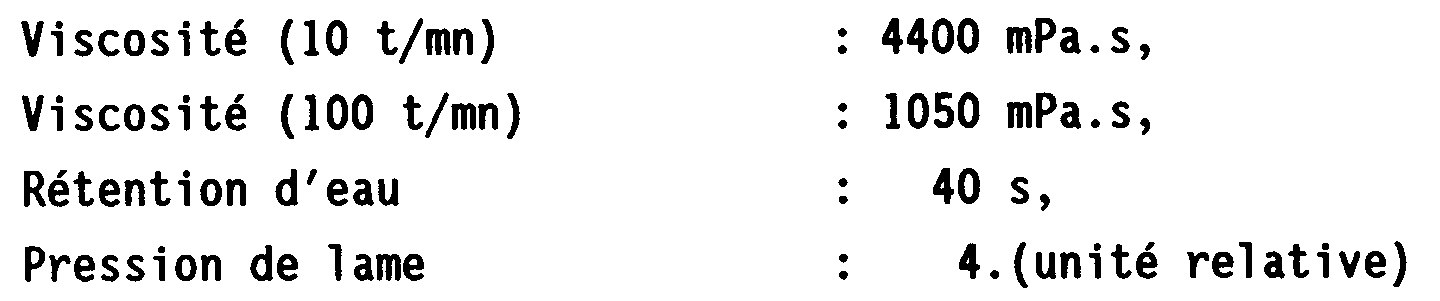
- On disperse C₁ dans de l'eau dans un mélangeur à grande vitesse en présence de D₁ qui sert d'agent dispersant pour C₁ et on ajoute le mélange de latex A et de latex B en ayant réglé au préalable le pH du latex A entre 6 et 6,5.
- On règle la teneur en matière solide à 73,50 % en poids, puis on porte le pH du mélange à 9-10 par addition d'une solution d'ammoniaque et on mesure la viscosité et la rétention d'eau du mélange.
- On évalue la rétention d'eau par mesure conductimétrique de la vitesse de traversée d'un papier buvard par l'eau relarguée par le bain de couchage. Ce test connu sous le nom de test Warren est décrit dans la revue TAPPI, Volume 41, N° 2, page 77 de février 1958.
- On couche du papier sur une machine pilote Bachofen® qui est une machine de couchage à râcle à grande vitesse ; l'angle de la lame est de 45°C ; la vitesse de couchage est de 300 m/mn, la vitesse du rouleau encreur est de 70 m/mn, le séchage à l'air sec se fait à 185°C ; on dépose 11 g/m2 de matière sèche. L'humidité relativement au papier couché est de 4,5 %.
- Sur le papier couché et imprimé on mesure après 24 h de séchage la brillance du papier (75°) et la brillance de l'encre (75°) à l'aide d'un brillancemètre ERICHSEN® et d'une presse PRUFBAU® dont la force d'impression est réglée a 800 N.
- Sur le papier couché, on apprécie également la résistance à l'arrachage sec selon la norme TAPPI Standard T-499. On utilise pour cela une encre LORILLEUX® 3805 ou 3808 en utilisant une presse IGT électrique dont la vitesse finale est réglée à 2 m/s.
- La résistance à l'arrachage humide se fait avec une encre LORILLEUX® 3801 sur une presse PRUFBAU® sous une force d'impression de 800N à une vitesse de 0,5 m/s.
- On mesure la densité optique (DO) de la plage encrée noir humide et la densité optique (DO) de la plage humide arrachée. La note d'arrachage humide est donnée par le rapport de la DO de la partie humide sur la DO de la partie sèche.
- Le refus d'encre permet d'apprécier la répulsion de l'encre par l'eau lors de l'impression offset d'un papier couché humide. On utilise pour cela une presse PRUFBAU® munie d'un dispositif de mouillage et de l'encre HUBER® n°1 à une force d'impression de 800 N.
- On mesure la DO de la plage encrée non humide et la DO de la plage humide.
- Le refus d'encre est alors le rapport de la moyenne de la densité optique de la partie sèche sur la moyenne de la densité optique de la partie humide.
- Les résultats obtenus sont rassemblés dans le tableau 2 ci-après.
- Pour réaliser les compositions de couchage des exemples comparatifs 4 et et de l'exemple 5, on procède exactement comme à l'exemple 3 sauf qu'on modifie la composition de couchage conformément aux indications du tableau 2. Les résultats obtenus sont rassemblés dans le tableau 2 ci-après.
- Du tableau 2, il apparaît que le remplacement de la CMC par le latex B permet un léger gain en extrait sec et surtout d'obtenir une rétention d'eau 2 fois plus élevée.
- On obtient également un gain de brillance du papier et d'encre en particulier dans le cas de C₁. Par ailleurs le pouvoir liant de la composition de couchage est, dans le cas des exemples 3 et 5 au moins équivalent si ce n'est supérieur (arrachage sec) à celui des compositions des exemples comparatifs 4 et 6 comportant de la CMC à la place du latex B.

puis un mélange monomère avec un débit constant sur une durée de 4 h 30 composé de :

Ce latex A est sensiblement insoluble et non-gonflant dans une dispersion aqueuse (slurry) d'hydroxyde d'ammonium à pH 9.
Claims (13)
- Composition aqueuse pour le couchage du papier à pH alcalin comportant :- un latex polymère A insoluble et non alcaligonflant ayant un diamètre moyen de particules ΦA compris entre 60 et 300 nm.- un latex polymère B alcaligonflant insoluble ayant un diamètre de particules ΦB compris entre 20 et 150 nm mesure à un pH compris entre 2 et 4 et capable de gonfler au moins 1,5 fois en diamètre, en milieu alcalin.- un pigment minéral C comprenant au moins 40 % en poids de CaCO₃.
- Composition selon la revendication 1, caractérisé en ce que le rapport ΦA/ΦB , mesuré à un pH compris entre 2 et 5, est compris entre 1,8 et 3,0.
- Composition selon la revendication 2, caractérisé en ce que le rapport ΦA/ΦB est voisin de 2.
- Composition selon l'une quelconque des revendications précédentes, caracterisée en ce que le latex A est un copolymère styrène/butadiène-1,3.
- Composition selon la revendication 4, caractérisée en ce que le latex A est un copolymère à base de 25 à 60 % en poids de butadiène-1,3, 40 à 75 % de styrène et 0 à 6 % de monomères à insaturation éthylénique comportant au moins une fonction acide carboxylique et leurs monoesters avec un alcanol en C₁-C₈.
- Composition selon la revendication 5, caractérisée en ce que le latex A contient 0 à 6 % d'un acide carboxylique choisi parmi l'acide acrylique, l'acide méthacrylique ou son dimère, l'acide itaconique, l'acide fumarique et l'acide maléique.
- Composition selon l'une quelconque des revendications précédentes, caractérisée en ce que le latex B est un copolymère : monoester d'acide carboxylique à insaturation éthylénique/acide carboxylique à insaturation éthylenique/vinylaromatique et/ou nitrile vinylique/monomère comportant au moins 2 insaturations éthyleniques.
- Composition selon l'une quelconque des revendications précédentes, caractérisée en ce que le latex B est un copolymère à base de 55 à 65 % de mono ester d'acide carboxylique à insaturation éthylenique, 10 à 20 % d'acide carboxylique à insaturation éthylenique, 20 à 32 % de styrène et 0,1 à 5 % en poids d'agent de réticulation qui st un monomère comportant au moins 2 insaturations éthyléniques.
- Composition selon la revendication 8, caractérisée en ce que le latex B est un copolymère à base de 58 à 60 % d'acrylate d'éthyle ; 14 à 16 % d'acide méthacrylique et 25 à 27 % de styrène et 0,2 à 1 % de diméthacrylate d'éthylène glycol ou de divinylbenzène.
- Composition selon l'une quelconque des revendications précédentes, caractérisée en ce qu'on utilise 5 à 25 % en poids, de préférence 10 à 15 % de latex B par rapport au poids total des extraits secs des latex A et B.
- Composition selon la revendication 10, caractérisée en ce qu'elle présente un extrait sec compris entre 60 et 80 % en poids de préférence entre 65 et 75 % en poids.
- Composition selon la revendication 11, caractérisée en ce que pour 100 parties en poids de pigment, il y a de 5 à 20 parties en poids de particules de latex A et B, de préférence entre 7 et 15 parties.
- Composition selon l'une quelconque des revendications précédentes, caractérisée en ce qu'au moins 50 % en poids du pigment à une granulométrie inférieure à 2 µm le reste ayant une granulométrie comprise entre 2 et 10 µm.
Applications Claiming Priority (2)
| Application Number | Priority Date | Filing Date | Title |
|---|---|---|---|
| FR9104565 | 1991-04-15 | ||
| FR9104565A FR2675165B1 (fr) | 1991-04-15 | 1991-04-15 | Composition aqueuse pour couchage de papier comportant un latex alcaligonflant sensiblement insoluble. |
Publications (2)
| Publication Number | Publication Date |
|---|---|
| EP0509878A1 true EP0509878A1 (fr) | 1992-10-21 |
| EP0509878B1 EP0509878B1 (fr) | 1998-07-01 |
Family
ID=9411825
Family Applications (1)
| Application Number | Title | Priority Date | Filing Date |
|---|---|---|---|
| EP92400961A Expired - Lifetime EP0509878B1 (fr) | 1991-04-15 | 1992-04-07 | Composition aqueuse pour couchage de papier comportant un latex alcaligonflant sensiblement insoluble |
Country Status (7)
| Country | Link |
|---|---|
| US (1) | US5563201A (fr) |
| EP (1) | EP0509878B1 (fr) |
| AT (1) | ATE167909T1 (fr) |
| BR (1) | BR9201346A (fr) |
| ES (1) | ES2121831T3 (fr) |
| FI (1) | FI110386B (fr) |
| FR (1) | FR2675165B1 (fr) |
Cited By (10)
| Publication number | Priority date | Publication date | Assignee | Title |
|---|---|---|---|---|
| FR2700329A1 (fr) * | 1993-01-13 | 1994-07-13 | Rhone Poulenc Chimie | Compositions pour ciment comprenant un latex alcaligonflant et ciments obtenus à partir de ces compositions. |
| EP0724663B1 (fr) * | 1993-10-19 | 1998-09-23 | Basf Aktiengesellschaft | Utilisation de papier enduits avec certains melanges de liants pour l'impression offset |
| WO2002044471A1 (fr) * | 2000-11-24 | 2002-06-06 | Metso Paper, Inc. | Procede de couchage de papier |
| US6521701B2 (en) | 1998-11-10 | 2003-02-18 | Coatex S.A.S. | Water-retaining and optical-brightener-activating polymer composition, paper coating colors and sheets of coated paper thus obtained |
| WO2007069037A1 (fr) | 2005-12-16 | 2007-06-21 | Coatex S.A.S. | Procede de fabrication de sauces de couchage a la retention d'eau et a la viscosite brookfieldtm ameliorees mettant en oeuvre un polymere peigne avec au moins une fonction greffee oxyde de polyalkylene |
| EP2075374A1 (fr) | 2007-12-17 | 2009-07-01 | Omya Development AG | Procédé de fabrication d'une sauce de couchage avec mise en oeuvre d'un epaississant acrylique à chaine hydrophobe ramifiée et sauce obtenue |
| US7972386B2 (en) | 2005-10-12 | 2011-07-05 | Conopco, Inc. | Bleaching of substrates |
| US7976582B2 (en) | 2007-01-16 | 2011-07-12 | Conopco, Inc. | Bleaching of substrates |
| US8455423B2 (en) | 2005-05-27 | 2013-06-04 | Conopco, Inc. | Process of bleaching |
| US9469666B2 (en) | 2010-03-03 | 2016-10-18 | Catexel Limited | Preparation of bleaching catalysts |
Families Citing this family (16)
| Publication number | Priority date | Publication date | Assignee | Title |
|---|---|---|---|---|
| US5981668A (en) * | 1996-10-31 | 1999-11-09 | Sanyo Chemical Industries, Ltd. | Anti-bacterial water absorbing agent and anti-bacterial water absorbent material |
| DE10008276A1 (de) * | 2000-02-23 | 2001-08-30 | Basf Ag | Papierstreichmassen auf Basis von gering vernetzten Bindemitteln |
| US6547929B2 (en) * | 2000-04-12 | 2003-04-15 | Rohm And Haas Company | Paper having improved print quality and method of making the same |
| US6951250B2 (en) * | 2003-05-13 | 2005-10-04 | Halliburton Energy Services, Inc. | Sealant compositions and methods of using the same to isolate a subterranean zone from a disposal well |
| US6884468B1 (en) | 2003-10-27 | 2005-04-26 | Basf Ag | Method of making a paper coating using a blend of a vinyl aromatic-acrylic polymer dispersion with a vinyl aromatic-diene polymer dispersion |
| US7607483B2 (en) * | 2004-04-19 | 2009-10-27 | Halliburton Energy Services, Inc. | Sealant compositions comprising colloidally stabilized latex and methods of using the same |
| US7488705B2 (en) * | 2004-12-08 | 2009-02-10 | Halliburton Energy Services, Inc. | Oilwell sealant compositions comprising alkali swellable latex |
| US20070111900A1 (en) * | 2005-11-11 | 2007-05-17 | Reddy B R | Sealant compositions comprising solid latex |
| US20070111901A1 (en) * | 2005-11-11 | 2007-05-17 | Reddy B R | Method of servicing a wellbore with a sealant composition comprising solid latex |
| US7267174B2 (en) * | 2005-01-24 | 2007-09-11 | Halliburton Energy Services, Inc. | Methods of plugging a permeable zone downhole using a sealant composition comprising a crosslinkable material and a reduced amount of cement |
| US8703659B2 (en) | 2005-01-24 | 2014-04-22 | Halliburton Energy Services, Inc. | Sealant composition comprising a gel system and a reduced amount of cement for a permeable zone downhole |
| US20060167133A1 (en) * | 2005-01-24 | 2006-07-27 | Jan Gromsveld | Sealant composition comprising a crosslinkable material and a reduced amount of cement for a permeable zone downhole |
| US7576042B2 (en) * | 2006-02-28 | 2009-08-18 | Halliburton Energy Services, Inc. | Salt water stable latex cement slurries |
| HUE039539T2 (hu) | 2011-09-08 | 2019-01-28 | Catexel Tech Limited | Katalizátorok |
| US20140162910A1 (en) | 2012-12-10 | 2014-06-12 | Halliburton Energy Services, Inc. | Wellbore Servicing Compositions and Methods of Making and Using Same |
| US10066146B2 (en) | 2013-06-21 | 2018-09-04 | Halliburton Energy Services, Inc. | Wellbore servicing compositions and methods of making and using same |
Citations (4)
| Publication number | Priority date | Publication date | Assignee | Title |
|---|---|---|---|---|
| DE1919379A1 (de) * | 1968-04-16 | 1969-10-23 | Ici Ltd | Waessrige UEberzugsmasse |
| US3963843A (en) * | 1972-12-20 | 1976-06-15 | Domtar Limited | Production of coated paper |
| FR2444114A1 (fr) * | 1978-12-14 | 1980-07-11 | Polysar Ltd | Procede pour elever la viscosite d'une composition de couchage de papier, composition obtenue par ce procede et papier couche au moyen de cette composition |
| EP0244250A1 (fr) * | 1986-05-02 | 1987-11-04 | The Dow Chemical Company | Latex d'un polymère synthétique et procédé pour fabriquer, avec ce latex, un papier revêtu faiblement lustré |
Family Cites Families (3)
| Publication number | Priority date | Publication date | Assignee | Title |
|---|---|---|---|---|
| DD117688A1 (fr) * | 1975-01-09 | 1976-01-20 | ||
| DE3720859A1 (de) * | 1987-06-24 | 1989-01-05 | Basf Ag | Lagerstabile waessrige polymerdispersionen |
| US5093449A (en) * | 1988-07-18 | 1992-03-03 | Reichhold Chemicals, Inc. | Styrene-butadiene latex compositions |
-
1991
- 1991-04-15 FR FR9104565A patent/FR2675165B1/fr not_active Expired - Lifetime
-
1992
- 1992-04-07 AT AT92400961T patent/ATE167909T1/de not_active IP Right Cessation
- 1992-04-07 EP EP92400961A patent/EP0509878B1/fr not_active Expired - Lifetime
- 1992-04-07 ES ES92400961T patent/ES2121831T3/es not_active Expired - Lifetime
- 1992-04-13 BR BR929201346A patent/BR9201346A/pt not_active IP Right Cessation
- 1992-04-14 FI FI921674A patent/FI110386B/fi active
-
1994
- 1994-08-18 US US08/292,313 patent/US5563201A/en not_active Expired - Fee Related
Patent Citations (4)
| Publication number | Priority date | Publication date | Assignee | Title |
|---|---|---|---|---|
| DE1919379A1 (de) * | 1968-04-16 | 1969-10-23 | Ici Ltd | Waessrige UEberzugsmasse |
| US3963843A (en) * | 1972-12-20 | 1976-06-15 | Domtar Limited | Production of coated paper |
| FR2444114A1 (fr) * | 1978-12-14 | 1980-07-11 | Polysar Ltd | Procede pour elever la viscosite d'une composition de couchage de papier, composition obtenue par ce procede et papier couche au moyen de cette composition |
| EP0244250A1 (fr) * | 1986-05-02 | 1987-11-04 | The Dow Chemical Company | Latex d'un polymère synthétique et procédé pour fabriquer, avec ce latex, un papier revêtu faiblement lustré |
Non-Patent Citations (1)
| Title |
|---|
| WORLD PATENTS INDEX Week 7614, Derwent Publications Ltd., London, GB; AN 76-24612X & DD-A-117 688 (STEFFERS) 20 Janvier 1976 * |
Cited By (13)
| Publication number | Priority date | Publication date | Assignee | Title |
|---|---|---|---|---|
| FR2700329A1 (fr) * | 1993-01-13 | 1994-07-13 | Rhone Poulenc Chimie | Compositions pour ciment comprenant un latex alcaligonflant et ciments obtenus à partir de ces compositions. |
| EP0607074A1 (fr) * | 1993-01-13 | 1994-07-20 | Rhone-Poulenc Chimie | Compositions pour ciment comprenant un latex alcaligonflant et ciments obtenus à partir de ces compositions |
| EP0724663B1 (fr) * | 1993-10-19 | 1998-09-23 | Basf Aktiengesellschaft | Utilisation de papier enduits avec certains melanges de liants pour l'impression offset |
| US6521701B2 (en) | 1998-11-10 | 2003-02-18 | Coatex S.A.S. | Water-retaining and optical-brightener-activating polymer composition, paper coating colors and sheets of coated paper thus obtained |
| WO2002044471A1 (fr) * | 2000-11-24 | 2002-06-06 | Metso Paper, Inc. | Procede de couchage de papier |
| US8455423B2 (en) | 2005-05-27 | 2013-06-04 | Conopco, Inc. | Process of bleaching |
| US8722608B2 (en) | 2005-05-27 | 2014-05-13 | Conopco, Inc. | Process of bleaching |
| US7972386B2 (en) | 2005-10-12 | 2011-07-05 | Conopco, Inc. | Bleaching of substrates |
| WO2007069037A1 (fr) | 2005-12-16 | 2007-06-21 | Coatex S.A.S. | Procede de fabrication de sauces de couchage a la retention d'eau et a la viscosite brookfieldtm ameliorees mettant en oeuvre un polymere peigne avec au moins une fonction greffee oxyde de polyalkylene |
| US7976582B2 (en) | 2007-01-16 | 2011-07-12 | Conopco, Inc. | Bleaching of substrates |
| EP2075374A1 (fr) | 2007-12-17 | 2009-07-01 | Omya Development AG | Procédé de fabrication d'une sauce de couchage avec mise en oeuvre d'un epaississant acrylique à chaine hydrophobe ramifiée et sauce obtenue |
| US8563643B2 (en) | 2007-12-17 | 2013-10-22 | Omya International Ag | Method for manufacturing a coating slip, using an acrylic thickener with a branched hydrophobic chain, and the slip obtained |
| US9469666B2 (en) | 2010-03-03 | 2016-10-18 | Catexel Limited | Preparation of bleaching catalysts |
Also Published As
| Publication number | Publication date |
|---|---|
| US5563201A (en) | 1996-10-08 |
| FI921674L (fi) | 1992-10-16 |
| FI921674A0 (fi) | 1992-04-14 |
| BR9201346A (pt) | 1992-12-01 |
| FI110386B (fi) | 2003-01-15 |
| FR2675165B1 (fr) | 1993-08-06 |
| EP0509878B1 (fr) | 1998-07-01 |
| ES2121831T3 (es) | 1998-12-16 |
| ATE167909T1 (de) | 1998-07-15 |
| FR2675165A1 (fr) | 1992-10-16 |
Similar Documents
| Publication | Publication Date | Title |
|---|---|---|
| EP0509878B1 (fr) | Composition aqueuse pour couchage de papier comportant un latex alcaligonflant sensiblement insoluble | |
| EP0892111A1 (fr) | Suspensions aqueuses de matières minérales et leurs utilisations | |
| CA1167990A (fr) | Emploi d'un copolymere en emulsion a base d'acrylate comme unique liant d'une substance pour enduire du papier | |
| EP0093206B1 (fr) | Compositions polymères utilisables comme liants dans des compositions de couchage du papier et compositions de couchages ainsi préparées | |
| JPH05310855A (ja) | 水に不溶の新規カチオンコポリマー、及び新規分散液 | |
| JP4560756B2 (ja) | 表面サイズ剤及びその製造方法 | |
| JP5457923B2 (ja) | 共重合体ラテックス組成物、紙塗工用組成物及び塗工紙 | |
| JP3047144B2 (ja) | 紙被覆用組成物 | |
| JP2009068129A (ja) | 高炭酸カルシウム含有紙塗工用組成物 | |
| EP0109463B2 (fr) | Compositions polymères utilisables comme liants dans des compositions de couchage du papier et compositions de couchage ainsi préparées | |
| JP3106292B2 (ja) | 共重合体ラテックスの製造方法 | |
| EP0600801B1 (fr) | Liant latex pour composition pour couchage de papier | |
| US4631312A (en) | Polymeric compositions useful as binders in coating colors and coating colors prepared therefrom | |
| JPH04240297A (ja) | 紙塗工用共重合体ラテックスの製造方法 | |
| JP4776341B2 (ja) | 共重合体ラテックスの製造方法、共重合体ラテックスおよび紙塗工用組成物 | |
| JP2003306887A (ja) | エコインキ用印刷適性向上剤、新聞用紙、及びその製造方法 | |
| DE19522399A1 (de) | Verwendung von Papierstreichmassen mit hohem Butadiengehalt im Offsetdruck | |
| JP5535460B2 (ja) | 紙塗工用共重合体ラテックスおよび高炭酸カルシウム含有紙塗工用組成物 | |
| JP2008144058A (ja) | 共重合体ラテックスおよび紙塗工剤 | |
| JP2011506795A (ja) | 保水性に優れた紙−コーテング用スリップのための分岐した疎水性鎖を有するアクリル増粘剤 | |
| JP2008150736A (ja) | 表面サイズ剤及びそれを用いた塗工紙の製造方法 | |
| JPH10280295A (ja) | 顔料塗被紙 | |
| JP2001234495A (ja) | 紙裁断適性向上剤及びそれを用いた塗工紙の製造方法 | |
| JPH05331797A (ja) | 被覆用着色剤のバインダーとして有用な重合体組成物およびそれから製造した被覆用着色剤 | |
| JP2001172546A (ja) | 紙塗被用共重合体ラテックス |
Legal Events
| Date | Code | Title | Description |
|---|---|---|---|
| PUAI | Public reference made under article 153(3) epc to a published international application that has entered the european phase |
Free format text: ORIGINAL CODE: 0009012 |
|
| AK | Designated contracting states |
Kind code of ref document: A1 Designated state(s): AT DK ES FR GB IT NL SE |
|
| 17P | Request for examination filed |
Effective date: 19930204 |
|
| 17Q | First examination report despatched |
Effective date: 19940808 |
|
| GRAG | Despatch of communication of intention to grant |
Free format text: ORIGINAL CODE: EPIDOS AGRA |
|
| GRAG | Despatch of communication of intention to grant |
Free format text: ORIGINAL CODE: EPIDOS AGRA |
|
| GRAH | Despatch of communication of intention to grant a patent |
Free format text: ORIGINAL CODE: EPIDOS IGRA |
|
| GRAH | Despatch of communication of intention to grant a patent |
Free format text: ORIGINAL CODE: EPIDOS IGRA |
|
| ITF | It: translation for a ep patent filed | ||
| RAP1 | Party data changed (applicant data changed or rights of an application transferred) |
Owner name: RHODIA CHIMIE |
|
| GRAA | (expected) grant |
Free format text: ORIGINAL CODE: 0009210 |
|
| AK | Designated contracting states |
Kind code of ref document: B1 Designated state(s): AT DK ES FR GB IT NL SE |
|
| REF | Corresponds to: |
Ref document number: 167909 Country of ref document: AT Date of ref document: 19980715 Kind code of ref document: T |
|
| GBT | Gb: translation of ep patent filed (gb section 77(6)(a)/1977) |
Effective date: 19980810 |
|
| PG25 | Lapsed in a contracting state [announced via postgrant information from national office to epo] |
Ref country code: DK Free format text: LAPSE BECAUSE OF FAILURE TO SUBMIT A TRANSLATION OF THE DESCRIPTION OR TO PAY THE FEE WITHIN THE PRESCRIBED TIME-LIMIT Effective date: 19981001 |
|
| REG | Reference to a national code |
Ref country code: ES Ref legal event code: FG2A Ref document number: 2121831 Country of ref document: ES Kind code of ref document: T3 |
|
| PLBE | No opposition filed within time limit |
Free format text: ORIGINAL CODE: 0009261 |
|
| STAA | Information on the status of an ep patent application or granted ep patent |
Free format text: STATUS: NO OPPOSITION FILED WITHIN TIME LIMIT |
|
| 26N | No opposition filed | ||
| REG | Reference to a national code |
Ref country code: GB Ref legal event code: IF02 |
|
| REG | Reference to a national code |
Ref country code: FR Ref legal event code: TP Ref country code: FR Ref legal event code: CA |
|
| NLS | Nl: assignments of ep-patents |
Owner name: RAISIO CHEMICALS OY |
|
| REG | Reference to a national code |
Ref country code: GB Ref legal event code: 732E |
|
| PGFP | Annual fee paid to national office [announced via postgrant information from national office to epo] |
Ref country code: FR Payment date: 20060315 Year of fee payment: 15 |
|
| PGFP | Annual fee paid to national office [announced via postgrant information from national office to epo] |
Ref country code: NL Payment date: 20060317 Year of fee payment: 15 |
|
| PGFP | Annual fee paid to national office [announced via postgrant information from national office to epo] |
Ref country code: GB Payment date: 20060322 Year of fee payment: 15 |
|
| PGFP | Annual fee paid to national office [announced via postgrant information from national office to epo] |
Ref country code: SE Payment date: 20060330 Year of fee payment: 15 |
|
| PGFP | Annual fee paid to national office [announced via postgrant information from national office to epo] |
Ref country code: ES Payment date: 20060407 Year of fee payment: 15 |
|
| PGFP | Annual fee paid to national office [announced via postgrant information from national office to epo] |
Ref country code: AT Payment date: 20060425 Year of fee payment: 15 |
|
| PGFP | Annual fee paid to national office [announced via postgrant information from national office to epo] |
Ref country code: IT Payment date: 20060430 Year of fee payment: 15 |
|
| GBPC | Gb: european patent ceased through non-payment of renewal fee |
Effective date: 20070407 |
|
| NLV4 | Nl: lapsed or anulled due to non-payment of the annual fee |
Effective date: 20071101 |
|
| PG25 | Lapsed in a contracting state [announced via postgrant information from national office to epo] |
Ref country code: NL Free format text: LAPSE BECAUSE OF NON-PAYMENT OF DUE FEES Effective date: 20071101 |
|
| PG25 | Lapsed in a contracting state [announced via postgrant information from national office to epo] |
Ref country code: AT Free format text: LAPSE BECAUSE OF NON-PAYMENT OF DUE FEES Effective date: 20070407 |
|
| PG25 | Lapsed in a contracting state [announced via postgrant information from national office to epo] |
Ref country code: GB Free format text: LAPSE BECAUSE OF NON-PAYMENT OF DUE FEES Effective date: 20070407 |
|
| PG25 | Lapsed in a contracting state [announced via postgrant information from national office to epo] |
Ref country code: SE Free format text: LAPSE BECAUSE OF NON-PAYMENT OF DUE FEES Effective date: 20070408 |
|
| REG | Reference to a national code |
Ref country code: ES Ref legal event code: FD2A Effective date: 20070409 |
|
| PG25 | Lapsed in a contracting state [announced via postgrant information from national office to epo] |
Ref country code: FR Free format text: LAPSE BECAUSE OF NON-PAYMENT OF DUE FEES Effective date: 20070430 |
|
| PG25 | Lapsed in a contracting state [announced via postgrant information from national office to epo] |
Ref country code: ES Free format text: LAPSE BECAUSE OF NON-PAYMENT OF DUE FEES Effective date: 20070409 |
|
| PG25 | Lapsed in a contracting state [announced via postgrant information from national office to epo] |
Ref country code: IT Free format text: LAPSE BECAUSE OF NON-PAYMENT OF DUE FEES Effective date: 20070407 |