EP0510718B1 - High strength cold rolled steel sheet having excellent non-agin property at room temperature and suitable for drawing and method of producing the same - Google Patents
High strength cold rolled steel sheet having excellent non-agin property at room temperature and suitable for drawing and method of producing the same Download PDFInfo
- Publication number
- EP0510718B1 EP0510718B1 EP92107173A EP92107173A EP0510718B1 EP 0510718 B1 EP0510718 B1 EP 0510718B1 EP 92107173 A EP92107173 A EP 92107173A EP 92107173 A EP92107173 A EP 92107173A EP 0510718 B1 EP0510718 B1 EP 0510718B1
- Authority
- EP
- European Patent Office
- Prior art keywords
- steel sheet
- less
- temperature
- phase
- content
- Prior art date
- Legal status (The legal status is an assumption and is not a legal conclusion. Google has not performed a legal analysis and makes no representation as to the accuracy of the status listed.)
- Expired - Lifetime
Links
Images


Classifications
-
- C—CHEMISTRY; METALLURGY
- C22—METALLURGY; FERROUS OR NON-FERROUS ALLOYS; TREATMENT OF ALLOYS OR NON-FERROUS METALS
- C22C—ALLOYS
- C22C38/00—Ferrous alloys, e.g. steel alloys
- C22C38/12—Ferrous alloys, e.g. steel alloys containing tungsten, tantalum, molybdenum, vanadium, or niobium
-
- C—CHEMISTRY; METALLURGY
- C22—METALLURGY; FERROUS OR NON-FERROUS ALLOYS; TREATMENT OF ALLOYS OR NON-FERROUS METALS
- C22C—ALLOYS
- C22C38/00—Ferrous alloys, e.g. steel alloys
-
- C—CHEMISTRY; METALLURGY
- C21—METALLURGY OF IRON
- C21D—MODIFYING THE PHYSICAL STRUCTURE OF FERROUS METALS; GENERAL DEVICES FOR HEAT TREATMENT OF FERROUS OR NON-FERROUS METALS OR ALLOYS; MAKING METAL MALLEABLE, e.g. BY DECARBURISATION OR TEMPERING
- C21D8/00—Modifying the physical properties of ferrous metals or ferrous alloys by deformation combined with, or followed by, heat treatment
- C21D8/02—Modifying the physical properties of ferrous metals or ferrous alloys by deformation combined with, or followed by, heat treatment during manufacturing of plates or strips
- C21D8/04—Modifying the physical properties of ferrous metals or ferrous alloys by deformation combined with, or followed by, heat treatment during manufacturing of plates or strips to produce plates or strips for drawing, e.g. for deep-drawing
-
- C—CHEMISTRY; METALLURGY
- C21—METALLURGY OF IRON
- C21D—MODIFYING THE PHYSICAL STRUCTURE OF FERROUS METALS; GENERAL DEVICES FOR HEAT TREATMENT OF FERROUS OR NON-FERROUS METALS OR ALLOYS; MAKING METAL MALLEABLE, e.g. BY DECARBURISATION OR TEMPERING
- C21D8/00—Modifying the physical properties of ferrous metals or ferrous alloys by deformation combined with, or followed by, heat treatment
- C21D8/02—Modifying the physical properties of ferrous metals or ferrous alloys by deformation combined with, or followed by, heat treatment during manufacturing of plates or strips
- C21D8/04—Modifying the physical properties of ferrous metals or ferrous alloys by deformation combined with, or followed by, heat treatment during manufacturing of plates or strips to produce plates or strips for drawing, e.g. for deep-drawing
- C21D8/0447—Modifying the physical properties of ferrous metals or ferrous alloys by deformation combined with, or followed by, heat treatment during manufacturing of plates or strips to produce plates or strips for drawing, e.g. for deep-drawing characterised by the heat treatment
- C21D8/0473—Final recrystallisation annealing
-
- C—CHEMISTRY; METALLURGY
- C21—METALLURGY OF IRON
- C21D—MODIFYING THE PHYSICAL STRUCTURE OF FERROUS METALS; GENERAL DEVICES FOR HEAT TREATMENT OF FERROUS OR NON-FERROUS METALS OR ALLOYS; MAKING METAL MALLEABLE, e.g. BY DECARBURISATION OR TEMPERING
- C21D1/00—General methods or devices for heat treatment, e.g. annealing, hardening, quenching or tempering
- C21D1/18—Hardening; Quenching with or without subsequent tempering
- C21D1/185—Hardening; Quenching with or without subsequent tempering from an intercritical temperature
-
- C—CHEMISTRY; METALLURGY
- C21—METALLURGY OF IRON
- C21D—MODIFYING THE PHYSICAL STRUCTURE OF FERROUS METALS; GENERAL DEVICES FOR HEAT TREATMENT OF FERROUS OR NON-FERROUS METALS OR ALLOYS; MAKING METAL MALLEABLE, e.g. BY DECARBURISATION OR TEMPERING
- C21D2211/00—Microstructure comprising significant phases
-
- C—CHEMISTRY; METALLURGY
- C21—METALLURGY OF IRON
- C21D—MODIFYING THE PHYSICAL STRUCTURE OF FERROUS METALS; GENERAL DEVICES FOR HEAT TREATMENT OF FERROUS OR NON-FERROUS METALS OR ALLOYS; MAKING METAL MALLEABLE, e.g. BY DECARBURISATION OR TEMPERING
- C21D2211/00—Microstructure comprising significant phases
- C21D2211/002—Bainite
-
- C—CHEMISTRY; METALLURGY
- C21—METALLURGY OF IRON
- C21D—MODIFYING THE PHYSICAL STRUCTURE OF FERROUS METALS; GENERAL DEVICES FOR HEAT TREATMENT OF FERROUS OR NON-FERROUS METALS OR ALLOYS; MAKING METAL MALLEABLE, e.g. BY DECARBURISATION OR TEMPERING
- C21D2211/00—Microstructure comprising significant phases
- C21D2211/005—Ferrite
-
- C—CHEMISTRY; METALLURGY
- C21—METALLURGY OF IRON
- C21D—MODIFYING THE PHYSICAL STRUCTURE OF FERROUS METALS; GENERAL DEVICES FOR HEAT TREATMENT OF FERROUS OR NON-FERROUS METALS OR ALLOYS; MAKING METAL MALLEABLE, e.g. BY DECARBURISATION OR TEMPERING
- C21D8/00—Modifying the physical properties of ferrous metals or ferrous alloys by deformation combined with, or followed by, heat treatment
- C21D8/02—Modifying the physical properties of ferrous metals or ferrous alloys by deformation combined with, or followed by, heat treatment during manufacturing of plates or strips
- C21D8/04—Modifying the physical properties of ferrous metals or ferrous alloys by deformation combined with, or followed by, heat treatment during manufacturing of plates or strips to produce plates or strips for drawing, e.g. for deep-drawing
- C21D8/0421—Modifying the physical properties of ferrous metals or ferrous alloys by deformation combined with, or followed by, heat treatment during manufacturing of plates or strips to produce plates or strips for drawing, e.g. for deep-drawing characterised by the working steps
- C21D8/0436—Cold rolling
Definitions
- the present invention relates to a high strength cold rolled steel sheet which has a high tensile strength of 40 Kgf/mm 2 or higher and excellent non-aging property at room temperature, as well as high bake hardenability (BH property) and which is suitable for uses where specifically high press formability is required, e.g., automotive panels and the like, as well as in the production of hot-dip galvannealed steel sheet which is now facing an increasing demand, and also to a method for producing such a steel sheet.
- BH property high bake hardenability
- the present invention also is concerned with a high strength cold rolled steel sheet which has a high tensile strength of 45 Kgf/mm 2 or higher and excellent non-aging property at room temperature, as well as high bake hardenability (BH property) and which can suitably be used in the fields mentioned above, and also to a method of producing such a steel sheet.
- a high strength cold rolled steel sheet which has a high tensile strength of 45 Kgf/mm 2 or higher and excellent non-aging property at room temperature, as well as high bake hardenability (BH property) and which can suitably be used in the fields mentioned above, and also to a method of producing such a steel sheet.
- EP-A-0319590 is concerned with a high strength, cold-rolled steel sheet having a a recrystallized ferritic single phase structure and comprising ⁇ 0.010%C, 0.05-0.5%Mn, ⁇ 1.0%Si, 0.001-0.030%S, ⁇ 0.03%P, ⁇ 0.005%N, 0.005-0.10%Al, 0.8-2.2%Cu, either or both of Ti and Nb in respective amounts of 0.01-0.2 and 0.005-0.2%, the balance being Fe and incidental impurities.
- the strengthening by formation of the conventionally known dual-phase structure essentially requires addition of a comparatively large quantity of C, e.g., 0.05 to 1.0 wt%, in order to enable appearance of martensite and bainite as the second phase. Consequently, the steel sheet having the conventionally known dual-phase structure is not suitable for drawing, because the Lankford value (the r-value) conspicuously drops.
- martensite and bainite are undesirably annealed during galvannealing, which not only results in reduction of strength but allows generation of stretcher strain during forming. For these reasons, the steel sheets strengthened by the conventionally known dual-phase structure is not suitable for hot-dip galvannealing.
- Precipitation strengthening tends to restrict conditions of production of steel sheets due to necessity for optimization of precipitation processing.
- production efficiency is seriously impaired when a precipitation treatment is additionally employed in the production process.
- steel sheets can be hardened by aging caused by accumulation of solid-solution C to dislocation which occurs during baked-on-finish, i.e., hardened by bake hardenability of the steel.
- bake-hardening is different from precipitation-strengthening.
- the bake-hardened steel sheets are widely used because the bake-hardening can be effected without substantially burdening the production process.
- bakehardenable steels however means are necessary for preventing aging before working or during plating.
- conventional bake-hardenable steels also have disadvantages.
- the steel sheet proposed in Japanese Patent Laid-Open No. 60-174852 has the second phase constituted by low-temperature transformed ferrite having a high dislocation density.
- the form of the low-temperature transformed ferrite varies according to the steel composition. According to an optical microscopic observation, the low-temperature transformed ferrite has one or a combination of two or more of the following three forms:
- the low-temperature transformed ferrite therefore, can be clearly distinguished from ordinary ferrite.
- the low-temperature transformed ferrite also can be clearly distinguished from martensite and bainite because the corroded portion inside the grain exhibits a color tone which is similar to that of ordinary ferrite and which is different from those of martensite and bainite.
- the low-temperature transformed ferrite has a very high dislocation density in grain boundaries and/or grains.
- the low-temperature transformed ferrite in the third form (3) mentioned above exhibits a laminated structure having portions of extremely high dislocation density and comparatively low dislocation density.
- the second phase is not annealed even when the steel is subjected to a high temperature of 550°C, unlike the known cold rolled steel sheets having a second phase constituted by martensite or bainite which are easily annealed.
- the steel having the above-mentioned dual-phase structure therefore, is suitable for use as the material of hot-dip galvannealed steel sheets.
- the steel sheet having the above-mentioned dual-phase structure also is superior in that the r-value is much higher than those of steel sheets having conventional dual-phase structure, due to the fact that the matrix phase is constituted by extremely-low carbon ferrite which has been recrystallized at ordinary high temperature.
- this steel sheet simultaneously exhibits both high bake hardenability and non-aging property at room temperature, because the dual-phase structure has internal local strain.
- the strengthening effect produced by low-temperature transformed ferrite is not so remarkable as compared with the effect produced by martensite or bainite.
- an object of the present invention is to eliminate problems such as impairment of workability and production efficiency encountered with the strengthening of steel sheet having a dual-phase structure composed of high-temperature transformed ferrite phase and low-temperature transformed phase which has high dislocation density, thereby to provide a high strength cold rolled steel sheet which has excellent deep drawability, excellent bake hardenability, and excellent non-aging property at room temperature and which is suitable for use as the material of hot-dip galvannealed steel sheet, as well as a method of producing such a high strength cold rolled steel sheet.
- the present invention is concerned with a high strength cold rolled steel sheet which exhibits excellent bake hardenability in addition to the foregoing advantageous features as defined in claims 1 and 3, as well as a method of producing such a high strength cold rolled steel sheet, defined in claims 2 and 6. Preferred embodiments of the claimed steel sheet and the claimed method are given in the dependent claims.
- the present invention in its first aspect provides a cold rolled steel sheet having the following physical target values:
- the present invention in its second aspect provides a cold rolled steel sheet having the following physical target values:
- the present invention is aimed at eliminating impairment of workability which hitherto has been inevitably caused in strengthening a steel sheet having a dual-phase structure composed of an ordinary high-temperature transformed ferrite phase which includes a recrystallized ferrite having same form as the ordinary high-temperature transformed ferrite, and a low-temperature transformed ferrite phase which has high dislocation density.
- the steel sheet in accordance with the first aspect of the invention has been obtained as a result of discovery of the fact that addition of at least one strengthening elements selected from Ni, Mo and Cu is very effective in achieving the above-described aim.
- the steel sheet in accordance with the second aspect has been obtained on the basis of discovery of the fact that addition of C and Nb is effective.
- Cold rolled steel sheets were produced under the following conditions using three types of continuously-cast slabs having different compositions as shown in Table 1, and the tensile strengths of the thus obtained steel sheets were measured.
- the steel C which does not contain Ni, Mo and Cu at all exhibits a drastic reduction of El when TS is 40 Kgf/mm 2 or therearound and cannot provide any TS value higher than 40 Kgf/mm 2 .
- steels A and B containing Ni, Mo or Cu do not exhibit drastic reduction in El when TS is increased, so that high strength can be achieved while maintaining good balance between TS and El, thus proving high-stability against two-phase-range annealing.
- Ni, Mo and Cu are dissolved in a large amount at higher-temperature side of the transformation point, due to the above-mentioned facts, so as to suppress growth of the ⁇ grains.
- All the steels shown in Table 1 showed a second-phase content (content of low-temperature transformed ferrite phase) of 1 to 70 % when the annealing was conducted at temperatures higher than the ⁇ transformation temperature, thus exhibiting appreciably high non-aging property at room temperature, as well as bake hardenability.
- the second phase appears in one of the aforementioned three forms or a combination of two or more of these three forms, depending on the contents of C, Ni, Mo and Cu. However, no substantial correlation was observed between the form and absolute grain size of the second phase and the workability.
- a steel tends to be softened when its C content is less than 0.001 wt%. Addition of large amounts of alloying elements is necessary for obtaining high strength of steel with such a small C content. In addition, it is considerably costly to industrially realize C content below 0.001 wt%. Conversely, any C content exceeding 0.025 wt% is ineffective to suppress degradation in the r-value and produces undesirable effects such as softening and aging strain when hot-dip galvannealing is conducted, due to martensitization of the second phase. C content, therefore, is limited to be not less than 0.001 wt% but not more than 0.025 wt%.
- Si content exceeding 1.0 wt% raises the transformation point to require annealing at elevated temperature.
- plating adhesion is impaired when the steel sheet having such large Si content is subjected to hot-dip zinc plating.
- the Si content is therefore determined to be 1.0 wt% or less.
- inclusion of Si by 0.05 wt% or more is effective in increasing strength, while improving the balance between strength and elongation more or less. This is considered to be attributable to promotion of enrichment of the second phase with C effected by the presence of Si.
- Harmful sulfides tend to be formed when Mn content is less than 0.1 wt%. However, inclusion of Mn in excess of 2.0 wt% seriously affects the strength-elongation balance.
- the content of Mn therefore, should be determined to be not less than 0.1 wt% but not more than 2.0 wt%.
- the Mn content is determined to be 1.0 wt% or less, with addition of Ni, Mo or Cu for the purpose of compensation for reduction in the strength caused by the reduction in the Mn content.
- Nb is an element which, in cooperation with B, promotes formation of low-temperature transformed ferrite.
- the effect of addition of Nb is not appreciable when the Nb content is less than 0.001 wt%.
- Nb content exceeding 0.2 wt% adversely affects the workability. Consequently, the Nb content is determined to be not less than 0.001 wt% but not more than 0.2 wt%.
- B is an element which, in cooperation with Nb, promotes formation of low-temperature transformed ferrite.
- the effect of addition of B is not appreciable when the B content is below 0.0003 wt%.
- B content exceeding 0.01 wt% adversely affects the workability. Consequently, the B content is determined to be not less than 0.0003 wt% but not more than 0.01 wt%.
- Al is an element which is essential for enabling deoxidation during refining. To obtain an appreciable effect, the Al content should be 0.005 wt% or more. Any Al content exceeding 0.10 wt%, however, increases inclusions with the result that the material is degraded. The Al content, therefore, should be determined to be not less than 0.005 wt% but not more than 0.10 wt%.
- P is an element which is effective in strengthening steel. Presence of P in excess of 0.1 wt%, however, not only enhances surface defect due to segregation but also impairs adhesion of plating layer in hot-dip zinc plating. In addition, presence of P in such an amount undesirably suppresses the strengthening effect produced by the second phase.
- the P content therefore, should be determined to be not more than 0.1 wt%. Preferably, the P content is determined to be 0.05 wt% or less, with the addition of Ni, Mo or Cu for compensating for the reduction in the strength caused by the reduction of the P content.
- N deteriorates both workability and aging resistance at room temperature when its content exceeds 0.007 wt%.
- presence of N in such an amount wastefully consumes B due to formation of BN.
- the N content therefore, should be determined to be 0.007 wt% or less.
- Ni 0.05 to 3.0 wt%
- Mo 0.01 to 2.0 wt%
- Cu 0.05 to 5.0 wt%
- Ni, Mo and Cu are one of the critical features of the steel sheet in accordance with the first aspect of the present invention. As described before, these elements can enhance strength without being accompanied by deterioration in the material. Ni content less than 0.05 wt%, Mo content less than 0.01 wt% and Cu content less than 0.05 wt%, respectively, cannot provide any appreciable effect. Conversely, Ni content exceeding 3.0 wt%, Mo content exceeding 2.0 wt% and Cu content exceeding 5.0 wt%, respectively, adversely affect workability of the steel.
- the Ni content, Mo content and Cu content are determined to be not less than 0.05 wt% but not more than 3.0 wt%, not less than 0.01 wt% but not more than 20 wt% and not less than 0.05 wt% but not more than 5.0 wt%, respectively.
- the contents of Ni, Mo and Cu, respectively should be determined to be not more than 1.0 wt%, in order to improve plating wettability.
- Each of Cr and Ti is effective in fixing C, S and N so as to reduce any undesirable effect on the yield of the material, as well as the yield of B.
- Cr content below 0.05 wt% and Ti content below 0.005 wt% cannot provide appreciable effect. The effect, however, is saturated when the Cr content exceeds 3.0 wt%. Consequently, the Cr content is determined to be not less than 0.05 wt% but not more than 3.0 wt%.
- Ti effectively fixes C even at high temperatures, but the C-fixing effect produced by Cr and Nb is reduced as the temperature rises.
- the steel sheet exhibits superior bake hardenability, as well as aging resistance at room temperature, when Ti is not added or when the Ti content is below a value expressed by 48/12 [C] + 48/32 [S] + 48/14 [N]. This is advantageous from the view point of enhancement of strength. Consequently, the Ti content is determined to be not less than 0.005 wt% but below a value expressed by 48/12 [C] + 48/32 [S] + 48/14 [N].
- a slab is formed by an ordinary continuous casting method or ingot-making process.
- Hot rolling also may be an ordinary hot rolling process with finish temperature not lower than Ar3 transformation temperature.
- the coiling temperature also has no limitation. In order to enable precipitation of Nb carbides at moderate grain sizes, however, the coiling temperature is preferably determined to range from 600 to 700°C.
- the second phase is undesirably coarsened. This may be attributed to the delay in the start of transformation in the annealing which is executed subsequently to the annealing. Consequently, the grain sizes of the second phase increase more than three times that of the ferrite grains in the matrix phase, resulting in inferior workability.
- the cold rolling therefore, should be executed at a rolling reduction not smaller than 60 %.
- the annealing is conducted at a temperature higher than the temperature at which ⁇ transformation is commenced, for otherwise the dual-phase structure cannot be obtained.
- the annealing temperature exceeds the temperature region in which both the ⁇ phase and ⁇ phase coexist, residual ⁇ grains which contribute to formation of crystalline azimuth effective for improving the r-value are extinguished during the annealing and, in addition, the proportion of the second phase is unduly increased.
- the second phase is coarsened during subsequent cooling so that the grain sizes of the second phase are increased to a level which is more than three times greater than that of the matrix phase grain size, with the result that the workability is seriously impaired. It is therefore preferred that the annealing temperature is not lower than the ⁇ transformation start temperature but below the A c3 transformation temperature.
- the rate of cooling subsequent to the annealing need not be so large because the dual-phase structure can be formed rater easily by virtue of combined addition of Nb and B.
- a slow cooling at a rate below 5°C/sec tends to cause the ⁇ grains to be extinguished when the temperature has come down to a low level, thus making it difficult to obtain satisfactory low-temperature transformed ferrite phase.
- cooling at large rate exceeding 100°C/sec is meaningless and, in addition, undesirably worsen the shape of the sheet.
- the cooling after the annealing is preferably conducted at a rate of 5°C/sec or greater but 100°C/sec or less.
- Skin-pass rolling is not essential but may be effected provided that the elongation is 3 % or smaller, for the purpose of straightening or profile control of the steel sheet.
- the hot-dip galvannealing shown in Table 3 was conducted in a continuous galvannealing line (CGL) which sequentially performs annealing, hot-dip zinc plating and alloying treatment (550°C, 20 sec). No inferior adhesion of plating layer was found in each case.
- CGL continuous galvannealing line
- the steel sheet products thus obtained were subjected to measurement of tensile characteristics, r-value, bake hardenability, and non-aging property at room temperature, as well as to an examination of the structure. The results are shown in Table 4.
- the tensile characteristics were measured by using a test piece No. 5 as specified by JIS (Japanese Industrial Standards) Z 2201.
- Yield elongation was measured by conducting a tensile test (tensile speed 10 mm/min) immediately after the annealing. The yield elongation also was measured after a 10-hour aging treatment at 100°C corresponding to 6-month aging at 30°C. The non-aging property at room temperature was then evaluated by using these two measured values of yield elongation.
- Fig. 4 shows microscopic photograph (x400) of the dual-phase structure in a steel sheet (steel No. 8) produced in accordance with the present invention.
- Fig. 5 shows microscopic photograph (x400) of a structure in a compared example of steel sheet (steel No. 13A).
- the ratio between the grain size of the second phase and that of the matrix phase does not fall within the range specified by the invention, due to excessively large content of Ni,Mo or Cu. Consequently, good workability could not be obtained.
- the ratio between the grain size of the second phase and that of the matrix phase does not fall within the range specified by the invention due to excessively large content of Mn. Consequently, good workability could not be obtained.
- the steel sheet in accordance with the second aspect features a tensile strength of TS ⁇ 45 Kgf/mm 2 in contrast to the steel of the first aspect having tensile strength of TS ⁇ 40 Kgf/mm 2 , and possesses bake hardenability in addition to the advantageous features of the steel of the first aspect.
- the present inventors have found that such high tensile strength and superior bake hardenability are obtainable by addition of controlled amount of C and Nb.
- Cold rolled steel sheets D and E were produced under the following conditions using two types of continuously-cast slabs having different C contents as shown in Table 5, and the tensile strengths of the thus obtained steel sheets were measured.
- Fig. 2 illustrates influence of C on the balance between tensile strength (TS) and elongation (El).
- the steel E which has a small C content of 0.0036 wt% exhibits a drastic reduction of El when TS is 45 Kgf/mm 2 or therearound and cannot provide any TS value higher than 45 Kgf/mm 2 .
- steel D containing 0.011 wt% of C does not exhibit drastic reduction in El when TS is increased, while exhibiting tensile strength of 45 Kgf/mm 2 or greater, thus proving high-stability against strengthening treatment and two-phase-range annealing.
- the present inventors found that there exists a certain measure for avoiding reduction of the r-value in the steel sheets having above-mentioned dual-phase structure, provided that the C content is not more than 0.025 wt%, through an experiment.
- Fig. 3 shows influences of Nb and Ti on the r-value.
- the r-value considered in connection with the crystal grain growth, increases where greater crystal grain growth speed is obtained within the temperature range where ⁇ phase exists alone in the course of annealing, as is the case of ordinary soft steels. From this point of view, it is preferred to add an element which fixes C. On the other hand, in the temperature range in which ⁇ and ⁇ phases coexist, it is necessary to suppress coarsening of the ⁇ phase in order to prevent reduction in the r-value. To this end, it is preferred to allow C to exist in the form of solid solution. Considering that decomposition of NbC occurs at temperatures just around the ⁇ transformation temperature, it is understood that C is dissolved so as to realize the above-mentioned optimum condition at temperatures above the ⁇ transformation temperature.
- Both the steels shown in Tables 5 and 6 showed a second-phase content (content of low-temperature transformed ferrite phase) of 1 to 70 % when the annealing was conducted at temperatures higher than the ⁇ transformation temperature, thus exhibiting appreciably high non-aging property at room temperature, as well as bake hardenability.
- the second phase appears in one of the aforementioned three forms or a combination of two or more of these three forms, depending on the contents of C, Ni, Mo and Cu. However, no substantial correlation was observed between the form and absolute grain size of the second phase and the workability.
- General steels which are comparatively rich in strengthening elements tend to allow growth of the second phase grains to sizes greater than the grain size of the matrix phase (high-temperature transformed ferrite phase), more specifically to sizes which are more than three times as large that of the matrix phase grains.
- C content When C content is 0.008 wt% or less, it is impossible to obtain high strength without impairing workability. Conversely, C content exceeding 0.025 wt% makes it impossible to suppress reduction in the r-value and causes martensitization of the second phase, resulting in problems such as softening and strain aging at room temperature when the steel sheet is plated by hot-dip galvannealing.
- the C content therefore, is determined to be more than 0.008 wt% but not more than 0.025 wt%.
- Si content exceeding 1.0 wt% raises the transformation point to require annealing at elevated temperature.
- plating adhesion is impaired when the steel sheet having such large Si content is subjected to hot-dip zinc plating.
- the Si content is therefore determined to be 1.0 wt% or less.
- inclusion of Si by 0.05 wt% or more is effective in increasing strength, while improving the balance between strength and elongation more or less. This is considered to be attributable to promotion of enrichment of the second phase with C effected by the presence of Si.
- Harmful sulfides tend to be formed when Mn content is less than 0.1 wt%. However, inclusion of Mn in excess of 2.0 wt% seriously affects the strength-elongation balance.
- the content of Mn therefore, should be determined to be not less than 0.1 wt% but not more than 2.0 wt%. Preferably, the Mn content is determined to be 1.0 wt% or less.
- Nb 0.2 wt% or less, five times or more greater than C*
- Nb is an element which, in cooperation with B, promotes formation of low-temperature transformed ferrite. Nb, when its content (wt %) is equal to or greater than the value which is five times greater than that of solid solution C, it is possible to form carbide to fix C thereby preventing degradation of r-value caused by solid solution C in the beginning period of annealing. In the latter period of the annealing, the carbide is decomposed to impart bake hardenability. Thus, Nb plays the most important role in the second steel sheet in accordance with the present invention. Nb content exceeding 0.2 wt% adversely affects the workability. Consequently, the Nb content is determined to be not less than 0.001 wt% but not more than 0.2 wt%. The content of Nb, therefore, should be determined to be not more than 0.2 wt% but five times or more greater than C* which is expressed as follows:
- B is an element which, in cooperation with Nb, promotes formation of low-temperature transformed ferrite.
- the effect of addition of B is not appreciable when the B content is below 0.0003 wt%.
- B content exceeding 0.01 wt% adversely affects the workability. Consequently, the B content is determined to be not less than 0.0003 wt% but not more than 0.01 wt%.
- Al is an element which is essential for enabling deoxidation during refining. To obtain an appreciable effect, the Al content should be 0.005 wt% or more. Any Al content exceeding 0.10 wt%, however, increases inclusions with the result that the material is degraded. The Al content, therefore, should be determined to be not less than 0.005 wt% but not more than 0.10 wt%.
- Presence of P in excess of 0.1 wt% not only enhances surface defect due to segregation but also impairs adhesion of plating layer in hot-dip zinc plating.
- presence of P in such an amount undesirably suppresses the strengthening effect produced by the second phase.
- the P content therefore, should be determined to be not more than 0.1 wt%.
- the P content is determined to be 0.05 wt% or less.
- N deteriorates both workability and aging resistance at room temperature when its content exceeds 0.007 wt%.
- presence of N in such an amount wastefully consumes B due to formation of BN.
- the N content therefore, should be determined to be 0.007 wt% or less.
- Ti is an element which fixes both S and N so as to suppress undesirable effect on the yield of B and the material. Any excess Ti, i.e., Ti content (wt%) beyond the value expressed by 48/32 [Swt%] + 48/14 [Nwt%], serves to fix solid solution C more efficiently than Nb does. Inclusion of Ti by 0.005 wt% or more, therefore, is expected to improve workability. A too large Ti content, however, tends to cause surface defect. In addition, since Ti carbide is difficult to decompose, desired bake hardenability cannot be obtained when whole solid solution C is fixed by Ti and, in addition, high r-value which is considered to be a result of fixing of C by Nb is impaired. Consequently, the Ti content is determined to be not less than 0.005 wt% and less than a value which is given by 48/12 [Cwt%] + 48/32 [Swt%] + 48/14 [Nwt%].
- A tends to cause hot-work embrittlement when its content exceeds 0.050 wt%, so that S content is limited so as not to exceed 0.050 wt%. Even when S is made to precipitate by S, workability is impaired due to increase in the inclusions when S content exceeds 0.050 wt%.
- Conditions for producing the steel sheet in accordance with the second aspect of the invention such as conditions for forming the slabs, hot-rolling conditions, coiling temperature, cold rolling conditions, annealing conditions, rate of cooling after annealing and refining rolling conditions are the same as those employed in the production of the steel sheets in accordance with the first aspect of the present invention.
- the hot-dip galvannealing shown in Table 8 was conducted in a continuous galvannealing line (CGL) which sequentially performs annealing, hot-dip zinc plating and alloying treatment (550°C, 20 sec). No inferior adhesion of plating layer was found in each case.
- CGL continuous galvannealing line
- the steel sheet products thus obtained were subjected to measurement of tensile characteristics, r-value, bake hardenability, and non-aging property at room temperature, as well as to an examination of the structure. The results are shown in Table 9.
- the tensile characteristics were measured by using a test piece No. 5 as specified by JIS (Japanese Industrial Standards) Z 2201.
- Yield elongation was measured by conducting a tensile test (tensile speed 10 mm/min) immediately after the annealing. The yield elongation also was measured after a 10-hour aging treatment at 100°C corresponding to 6-month aging at 30°C. The non-aging property at room temperature was then evaluated by using these two measured values of yield elongation.
- Material quality was degraded due to too high C content and martensitization of the second phase.
- r-value was low due to martensitization of the second phase.
- the present invention provides a high strength cold rolled steel sheet which has excellent non-aging property at room temperature and, as desired, high level of bake hardenability, as well as excellent drawability, and which is not degraded even when subjected to hot-dip galvannealing.
- the steel sheet of the present invention therefore, can suitably be used as materials of various industrial products such as automotive panels.
Landscapes
- Chemical & Material Sciences (AREA)
- Engineering & Computer Science (AREA)
- Mechanical Engineering (AREA)
- Materials Engineering (AREA)
- Metallurgy (AREA)
- Organic Chemistry (AREA)
- Physics & Mathematics (AREA)
- Thermal Sciences (AREA)
- Crystallography & Structural Chemistry (AREA)
- Heat Treatment Of Sheet Steel (AREA)
Description
- The present invention relates to a high strength cold rolled steel sheet which has a high tensile strength of 40 Kgf/mm2 or higher and excellent non-aging property at room temperature, as well as high bake hardenability (BH property) and which is suitable for uses where specifically high press formability is required, e.g., automotive panels and the like, as well as in the production of hot-dip galvannealed steel sheet which is now facing an increasing demand, and also to a method for producing such a steel sheet.
- The present invention also is concerned with a high strength cold rolled steel sheet which has a high tensile strength of 45 Kgf/mm2 or higher and excellent non-aging property at room temperature, as well as high bake hardenability (BH property) and which can suitably be used in the fields mentioned above, and also to a method of producing such a steel sheet.
- In recent years, cold rolled steel sheets for drawing are required to meet the following requirements:
- (1) greater strength to reduce both weight and cost while improving safety
- (2) improved applicability to production of hot-dip galvannealed steel sheet which is light-weight and superior in corrosion resistance
-
- Various methods have been conventionally used for strengthening cold rolled steel sheet for working, typical examples of which are solid solution strengthening by addition of P and Mn, strengthening by formation of dual-phase structure of martensite and so forth, and precipitation strengthening caused by precipitation of Cu or like elements.
- EP-A-0475096 (state of the art according to Art. 54(3) EPC) discloses a high strenght steel sheet containing 0.01-0.1%C, 0.1-1.2%Si, <3%Mn, Ti: a ratio of *Tieffective/C = 4-12, 0.0005-0.005 %B, ≤ 0.1%Al, ≤0.1%P, ≤0.02%S, ≤0.005%N, optionally one or more of: 0.02-0.2%V, 0.02-0.2%Nb, 0.02-0.2%Zr, the balance being Fe and inevitable impurities. EP-A-0319590 is concerned with a high strength, cold-rolled steel sheet having a a recrystallized ferritic single phase structure and comprising ≤ 0.010%C, 0.05-0.5%Mn, ≤1.0%Si, 0.001-0.030%S, ≤0.03%P, ≤0.005%N, 0.005-0.10%Al, 0.8-2.2%Cu, either or both of Ti and Nb in respective amounts of 0.01-0.2 and 0.005-0.2%, the balance being Fe and incidental impurities.
- Application of steel sheets strengthened by solid-solution strengthening to drawing, however, is practically limited because such strengthening method causes a deterioration in workability. Further, addition of P which is the most effective element for strengthening the steel with minimum deterioration of workability conspicuously impedes zinc plating characteristic.
- The strengthening by formation of the conventionally known dual-phase structure essentially requires addition of a comparatively large quantity of C, e.g., 0.05 to 1.0 wt%, in order to enable appearance of martensite and bainite as the second phase. Consequently, the steel sheet having the conventionally known dual-phase structure is not suitable for drawing, because the Lankford value (the r-value) conspicuously drops. In addition, martensite and bainite are undesirably annealed during galvannealing, which not only results in reduction of strength but allows generation of stretcher strain during forming. For these reasons, the steel sheets strengthened by the conventionally known dual-phase structure is not suitable for hot-dip galvannealing.
- Precipitation strengthening tends to restrict conditions of production of steel sheets due to necessity for optimization of precipitation processing. In particular, production efficiency is seriously impaired when a precipitation treatment is additionally employed in the production process.
- It has also been known that steel sheets can be hardened by aging caused by accumulation of solid-solution C to dislocation which occurs during baked-on-finish, i.e., hardened by bake hardenability of the steel. In a strict sense, bake-hardening is different from precipitation-strengthening. The bake-hardened steel sheets, however, are widely used because the bake-hardening can be effected without substantially burdening the production process.
- To use bakehardenable steels, however means are necessary for preventing aging before working or during plating. Thus, conventional bake-hardenable steels also have disadvantages.
- Consequently, known strengthening methods for strengthening steel sheets having high drawability have practical limits and steel sheets strengthened by such methods are not suitable for use as the material of hot-dip galvannealed steel sheets.
- Under these circumstances, one of the present inventors, together with four other inventors, has proposed, in Japanese Patent Laid-Open No. 60-174852, a new type of cold rolled steel sheet and a method of producing the same, more specifically, a cold rolled steel sheet possessing excellent deep drawability and having a dual-phase structure composed of a ferrite phase and a low temperature transformed ferrite phase produced by annealing of extremely low carbon steel sheet in the temperature region where α and γ phases coexist, as well as a process for producing such cold rolled steel sheet.
- In contrast to known dual-phase-structure steel sheet having martensite and bainite as the second phase, the steel sheet proposed in Japanese Patent Laid-Open No. 60-174852 has the second phase constituted by low-temperature transformed ferrite having a high dislocation density.
- The form of the low-temperature transformed ferrite varies according to the steel composition. According to an optical microscopic observation, the low-temperature transformed ferrite has one or a combination of two or more of the following three forms:
- (1) crystal-like form with irregularly keened grain boundaries
- (2) crystal grain-like form existing along grain boundaries in the same manner as precipitates
- (3) crystal grain-like state or a state of a group of crystal grains (many sub-grain boundaries are found in comparatively large second phase grain) having a scratch-like form
-
- The low-temperature transformed ferrite, therefore, can be clearly distinguished from ordinary ferrite. In addition, the low-temperature transformed ferrite also can be clearly distinguished from martensite and bainite because the corroded portion inside the grain exhibits a color tone which is similar to that of ordinary ferrite and which is different from those of martensite and bainite.
- On the other hand, an electron-microscopic observation reveals that the low-temperature transformed ferrite has a very high dislocation density in grain boundaries and/or grains. In particular, the low-temperature transformed ferrite in the third form (3) mentioned above exhibits a laminated structure having portions of extremely high dislocation density and comparatively low dislocation density.
- In the steel sheet having the dual-phase structure composed of ferrite phase and low-temperature transformed ferrite phase as the second phase, the second phase is not annealed even when the steel is subjected to a high temperature of 550°C, unlike the known cold rolled steel sheets having a second phase constituted by martensite or bainite which are easily annealed. The steel having the above-mentioned dual-phase structure, therefore, is suitable for use as the material of hot-dip galvannealed steel sheets.
- The steel sheet having the above-mentioned dual-phase structure also is superior in that the r-value is much higher than those of steel sheets having conventional dual-phase structure, due to the fact that the matrix phase is constituted by extremely-low carbon ferrite which has been recrystallized at ordinary high temperature. In addition, this steel sheet simultaneously exhibits both high bake hardenability and non-aging property at room temperature, because the dual-phase structure has internal local strain.
- The strengthening effect produced by low-temperature transformed ferrite is not so remarkable as compared with the effect produced by martensite or bainite. In order to further strengthen the steel sheet, therefore, it is necessary to add strengthening elements such as Mn, Nb and B. Addition of such elements to the steel of the kind described, however, tends to deteriorate workability and extremely restricts the range of annealing temperature which would provide good workability, with the result that the production efficiency is lowered.
- Accordingly, an object of the present invention is to eliminate problems such as impairment of workability and production efficiency encountered with the strengthening of steel sheet having a dual-phase structure composed of high-temperature transformed ferrite phase and low-temperature transformed phase which has high dislocation density, thereby to provide a high strength cold rolled steel sheet which has excellent deep drawability, excellent bake hardenability, and excellent non-aging property at room temperature and which is suitable for use as the material of hot-dip galvannealed steel sheet, as well as a method of producing such a high strength cold rolled steel sheet.
- The present invention is concerned with a high strength cold rolled steel sheet which exhibits excellent bake hardenability in addition to the foregoing advantageous features as defined in
claims 1 and 3, as well as a method of producing such a high strength cold rolled steel sheet, defined in claims 2 and 6. Preferred embodiments of the claimed steel sheet and the claimed method are given in the dependent claims. - The present invention in its first aspect provides a cold rolled steel sheet having the following physical target values:
- Tensile strength (TS) ≥ 40 Kgf/mm2
- TS x EI (Elongation) ≥ 1800 Kgf/mm2.%
- r-value (mean) ≥ 1.8
- BH ≥ 3.5 Kgf/mm2
- yield point elongation immediately after annealing, hot-dip galvannealing or skin-pass rolling or after 6-month aging after such treatment
- < 0.5 %.
-
- The present invention in its second aspect provides a cold rolled steel sheet having the following physical target values:
- TS ≥ 45 Kgf/mm2
- TS x El ≥ 1800 Kgf/mm2.%
- r-value (mean) ≥ 1.5
- BH ≥ 3.5 Kgf/mm2:'
- yield point elongation immediately after annealing, hot-dip galvannealing or skin-pass rolling or after 6-month aging after such treatment
- < 0.5 %.
-
- As stated before, the present invention is aimed at eliminating impairment of workability which hitherto has been inevitably caused in strengthening a steel sheet having a dual-phase structure composed of an ordinary high-temperature transformed ferrite phase which includes a recrystallized ferrite having same form as the ordinary high-temperature transformed ferrite, and a low-temperature transformed ferrite phase which has high dislocation density.
- The steel sheet in accordance with the first aspect of the invention has been obtained as a result of discovery of the fact that addition of at least one strengthening elements selected from Ni, Mo and Cu is very effective in achieving the above-described aim.
- The steel sheet in accordance with the second aspect has been obtained on the basis of discovery of the fact that addition of C and Nb is effective.
-
- Fig. 1 is a graph showing influence of Ni, Cu or Mo on the balance between tensile strength (TS) and elongation (El) of a steel sheet after an annealing;
- Fig. 2 is a graph showing influence of C on the TS-El balance of a steel sheet after annealing;
- Fig. 3 is a graph showing influence of Nb and Ti on the r-value of a steel sheet after annealing;
- Fig. 4 is a microscopic photograph (x400) of a composite structure in a steel sheet (steel No. 8 in Table 3) produced in accordance with the method almost of the present invention except too much TE, which decreases BH value but slightly affects composite structure; and
- Fig. 5 is a microscopic photograph (x400) of a structure in a compared steel sheet (steel No. 13A in Table 3).
-
- A detailed description will now be given of the method of producing the steel sheet in accordance with the first aspect.
- An experiment was conducted to examine the result of addition of the strengthening elements such as Ni, Mo and Cu.
- Cold rolled steel sheets were produced under the following conditions using three types of continuously-cast slabs having different compositions as shown in Table 1, and the tensile strengths of the thus obtained steel sheets were measured.
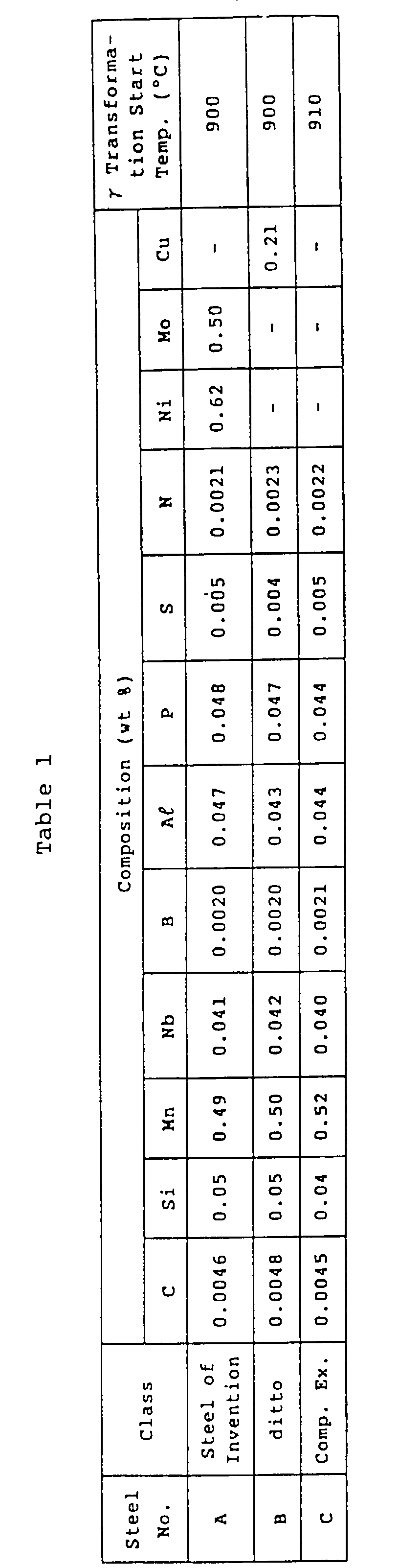
- Hot rolling condition:
- Slab heating temperature (SRT): 1200°C
- Hot rolling finish temperature (FDT): 910°C
- Coiling temperature (CT): 600°C
- Final sheet thickness: 3.5 mm
-
- Cold rolling condition:
- Rolling reduction: 77 %
- Final sheet thickness: 0.8 mm
-
- Continuous annealing condition:
- Heating temperature: 880 to 950°C (10°C gradation)
- Cooling rate: 30°C/sec
-
- The influences of addition of Ni, Mo and Cu on the tensile strength TS-El balance are shown in Fig. 1.
- As will be clear from Fig. 1, the steel C which does not contain Ni, Mo and Cu at all exhibits a drastic reduction of El when TS is 40 Kgf/mm2 or therearound and cannot provide any TS value higher than 40 Kgf/mm2. In contrast, steels A and B containing Ni, Mo or Cu do not exhibit drastic reduction in El when TS is increased, so that high strength can be achieved while maintaining good balance between TS and El, thus proving high-stability against two-phase-range annealing.
- The reason why these advantageous effects are produced by the addition of Ni, Mo and Cu has not been theoretically clarified yet. These advantageous effects, however, are considered to be attributable to the following facts:
- (1) These elements have tendency to suppress movement of grain boundaries.
- (2) In order that both the workability and strength are optimized in steel sheets of the kind described, it is necessary that grains are easy to grow in the step of recrystallization before the start of α to γ transformation and that, during the transformation, growth of the grains is suppressed.
-
- Particularly, it is considered that Ni, Mo and Cu are dissolved in a large amount at higher-temperature side of the transformation point, due to the above-mentioned facts, so as to suppress growth of the γ grains.
- All the steels shown in Table 1 showed a second-phase content (content of low-temperature transformed ferrite phase) of 1 to 70 % when the annealing was conducted at temperatures higher than the γ transformation temperature, thus exhibiting appreciably high non-aging property at room temperature, as well as bake hardenability. The second phase appears in one of the aforementioned three forms or a combination of two or more of these three forms, depending on the contents of C, Ni, Mo and Cu. However, no substantial correlation was observed between the form and absolute grain size of the second phase and the workability.
- Another experiment showed that general steels which are comparatively rich in strengthening elements tend to allow growth of the second phase grains to sizes greater than the grain size of the matrix phase (high-temperature transformed ferrite phase), more specifically to sizes which are more than three times as large that of the matrix phase grains. This should be contrasted to the steel sheets having compositions falling within the ranges specified by the invention which exhibit superior workability and which have mean grain size of second phase less than three times that of the matrix grain size. This fact gives a support to the aforementioned discovery that the promotion of growth α grains and suppression of growth of γ grains produce desirable effects on the material.
- A description will now be given of the reasons of limitation of contents of the constituents in the steel sheet according to the first aspect of the invention.
- In general, a steel tends to be softened when its C content is less than 0.001 wt%. Addition of large amounts of alloying elements is necessary for obtaining high strength of steel with such a small C content. In addition, it is considerably costly to industrially realize C content below 0.001 wt%. Conversely, any C content exceeding 0.025 wt% is ineffective to suppress degradation in the r-value and produces undesirable effects such as softening and aging strain when hot-dip galvannealing is conducted, due to martensitization of the second phase. C content, therefore, is limited to be not less than 0.001 wt% but not more than 0.025 wt%.
- Si content exceeding 1.0 wt% raises the transformation point to require annealing at elevated temperature. In addition, plating adhesion is impaired when the steel sheet having such large Si content is subjected to hot-dip zinc plating. The Si content is therefore determined to be 1.0 wt% or less. On the other hand, inclusion of Si by 0.05 wt% or more is effective in increasing strength, while improving the balance between strength and elongation more or less. This is considered to be attributable to promotion of enrichment of the second phase with C effected by the presence of Si.
- Harmful sulfides (FeS) tend to be formed when Mn content is less than 0.1 wt%. However, inclusion of Mn in excess of 2.0 wt% seriously affects the strength-elongation balance. The content of Mn, therefore, should be determined to be not less than 0.1 wt% but not more than 2.0 wt%. Preferably, the Mn content is determined to be 1.0 wt% or less, with addition of Ni, Mo or Cu for the purpose of compensation for reduction in the strength caused by the reduction in the Mn content.
- Nb is an element which, in cooperation with B, promotes formation of low-temperature transformed ferrite. The effect of addition of Nb, however, is not appreciable when the Nb content is less than 0.001 wt%. Conversely, Nb content exceeding 0.2 wt% adversely affects the workability. Consequently, the Nb content is determined to be not less than 0.001 wt% but not more than 0.2 wt%.
- B is an element which, in cooperation with Nb, promotes formation of low-temperature transformed ferrite. The effect of addition of B, however, is not appreciable when the B content is below 0.0003 wt%. Conversely, B content exceeding 0.01 wt% adversely affects the workability. Consequently, the B content is determined to be not less than 0.0003 wt% but not more than 0.01 wt%.
- Al is an element which is essential for enabling deoxidation during refining. To obtain an appreciable effect, the Al content should be 0.005 wt% or more. Any Al content exceeding 0.10 wt%, however, increases inclusions with the result that the material is degraded. The Al content, therefore, should be determined to be not less than 0.005 wt% but not more than 0.10 wt%.
- P is an element which is effective in strengthening steel. Presence of P in excess of 0.1 wt%, however, not only enhances surface defect due to segregation but also impairs adhesion of plating layer in hot-dip zinc plating. In addition, presence of P in such an amount undesirably suppresses the strengthening effect produced by the second phase. The P content, therefore, should be determined to be not more than 0.1 wt%. Preferably, the P content is determined to be 0.05 wt% or less, with the addition of Ni, Mo or Cu for compensating for the reduction in the strength caused by the reduction of the P content.
- N deteriorates both workability and aging resistance at room temperature when its content exceeds 0.007 wt%. In addition, presence of N in such an amount wastefully consumes B due to formation of BN. The N content, therefore, should be determined to be 0.007 wt% or less.
- Addition of at least one of Ni, Mo and Cu is one of the critical features of the steel sheet in accordance with the first aspect of the present invention. As described before, these elements can enhance strength without being accompanied by deterioration in the material. Ni content less than 0.05 wt%, Mo content less than 0.01 wt% and Cu content less than 0.05 wt%, respectively, cannot provide any appreciable effect. Conversely, Ni content exceeding 3.0 wt%, Mo content exceeding 2.0 wt% and Cu content exceeding 5.0 wt%, respectively, adversely affect workability of the steel. Therefore, the Ni content, Mo content and Cu content are determined to be not less than 0.05 wt% but not more than 3.0 wt%, not less than 0.01 wt% but not more than 20 wt% and not less than 0.05 wt% but not more than 5.0 wt%, respectively. When the steel sheet is used as the material of hot-dip zinc plated steel sheet, the contents of Ni, Mo and Cu, respectively, should be determined to be not more than 1.0 wt%, in order to improve plating wettability.
- Each of Cr and Ti is effective in fixing C, S and N so as to reduce any undesirable effect on the yield of the material, as well as the yield of B. Cr content below 0.05 wt% and Ti content below 0.005 wt% cannot provide appreciable effect. The effect, however, is saturated when the Cr content exceeds 3.0 wt%. Consequently, the Cr content is determined to be not less than 0.05 wt% but not more than 3.0 wt%. Ti effectively fixes C even at high temperatures, but the C-fixing effect produced by Cr and Nb is reduced as the temperature rises. Therefore, the steel sheet exhibits superior bake hardenability, as well as aging resistance at room temperature, when Ti is not added or when the Ti content is below a value expressed by 48/12 [C] + 48/32 [S] + 48/14 [N]. This is advantageous from the view point of enhancement of strength. Consequently, the Ti content is determined to be not less than 0.005 wt% but below a value expressed by 48/12 [C] + 48/32 [S] + 48/14 [N].
- A description will now be given of a preferred form of the method for producing the steel sheet in accordance with the first aspect of the present invention.
- A slab is formed by an ordinary continuous casting method or ingot-making process. Hot rolling also may be an ordinary hot rolling process with finish temperature not lower than Ar3 transformation temperature.
- The coiling temperature also has no limitation. In order to enable precipitation of Nb carbides at moderate grain sizes, however, the coiling temperature is preferably determined to range from 600 to 700°C.
- When the rolling reduction in the cold rolling is below 60 %, the second phase is undesirably coarsened. This may be attributed to the delay in the start of transformation in the annealing which is executed subsequently to the annealing. Consequently, the grain sizes of the second phase increase more than three times that of the ferrite grains in the matrix phase, resulting in inferior workability. The cold rolling, therefore, should be executed at a rolling reduction not smaller than 60 %.
- It is necessary that the annealing is conducted at a temperature higher than the temperature at which γ transformation is commenced, for otherwise the dual-phase structure cannot be obtained. However, if the annealing temperature exceeds the temperature region in which both the α phase and γ phase coexist, residual α grains which contribute to formation of crystalline azimuth effective for improving the r-value are extinguished during the annealing and, in addition, the proportion of the second phase is unduly increased. Furthermore, the second phase is coarsened during subsequent cooling so that the grain sizes of the second phase are increased to a level which is more than three times greater than that of the matrix phase grain size, with the result that the workability is seriously impaired. It is therefore preferred that the annealing temperature is not lower than the γ transformation start temperature but below the Ac3 transformation temperature.
- The rate of cooling subsequent to the annealing need not be so large because the dual-phase structure can be formed rater easily by virtue of combined addition of Nb and B. However, a slow cooling at a rate below 5°C/sec tends to cause the γ grains to be extinguished when the temperature has come down to a low level, thus making it difficult to obtain satisfactory low-temperature transformed ferrite phase. Conversely, cooling at large rate exceeding 100°C/sec is meaningless and, in addition, undesirably worsen the shape of the sheet. The cooling after the annealing, therefore, is preferably conducted at a rate of 5°C/sec or greater but 100°C/sec or less.,
- Skin-pass rolling is not essential but may be effected provided that the elongation is 3 % or smaller, for the purpose of straightening or profile control of the steel sheet.
- Slabs of 11 types of steel having compositions falling within the range specified by the invention, and 8 types of comparative example steels having compositions falling out of the range of the invention, were prepared by continuous casting. The compositions of these steels are shown in Table 2. These steel slabs were hot-rolled (final thickness 1.6 to 3.5 mm), cold rolled (final thickness 0.7 mm) and then annealed, under conditions as shown in Table 3. Some of the steel slabs were further subjected to hot-dip galvannealing or skin-pass rolling the conditions of which also are shown in Table 3.
- The hot-dip galvannealing shown in Table 3 was conducted in a continuous galvannealing line (CGL) which sequentially performs annealing, hot-dip zinc plating and alloying treatment (550°C, 20 sec). No inferior adhesion of plating layer was found in each case.
- The steel sheet products thus obtained were subjected to measurement of tensile characteristics, r-value, bake hardenability, and non-aging property at room temperature, as well as to an examination of the structure. The results are shown in Table 4.

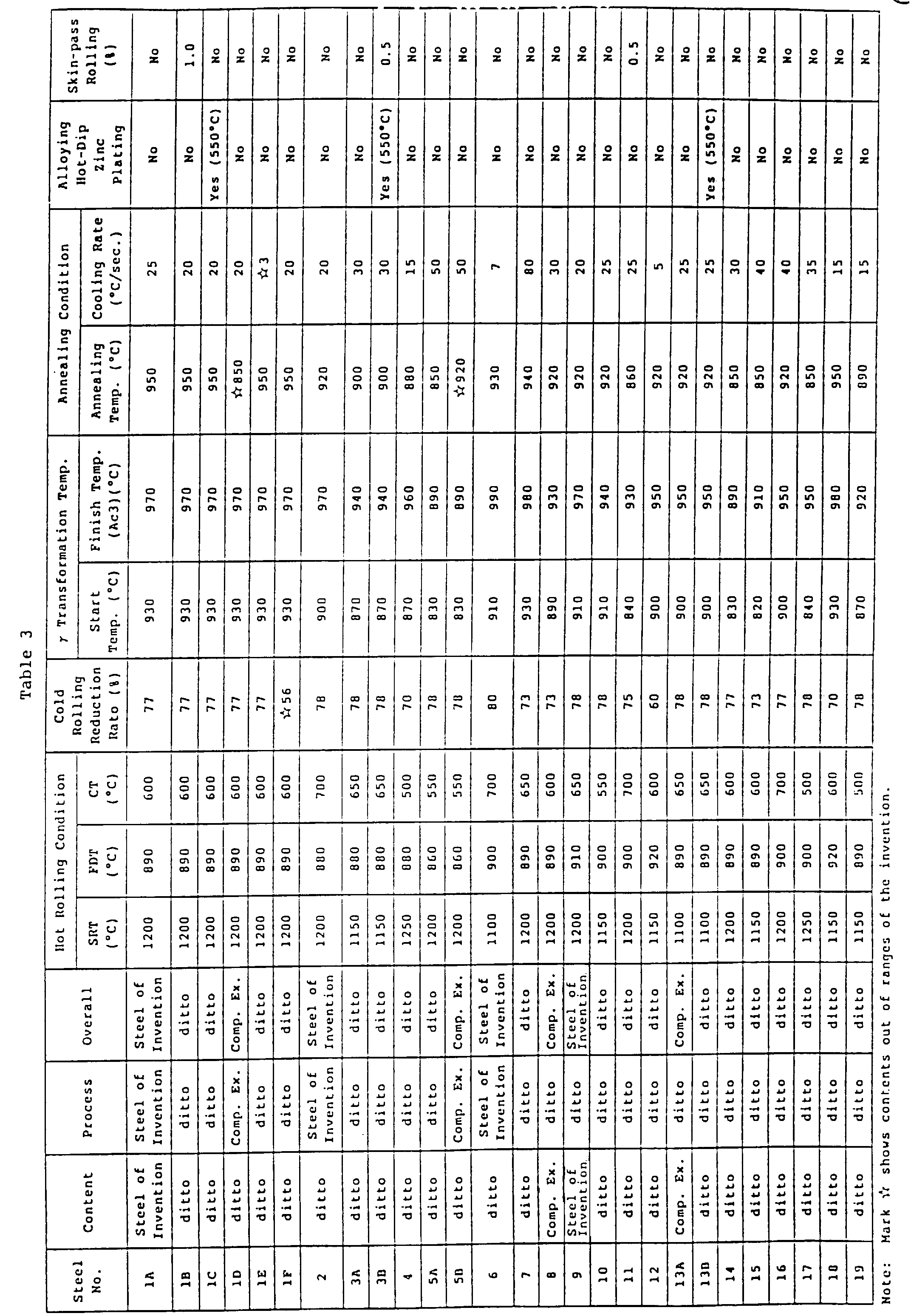

- The measuring methods and conditions were as follows.
- The tensile characteristics were measured by using a test piece No. 5 as specified by JIS (Japanese Industrial Standards) Z 2201.
- The mean r-value was determined by measuring the Lankford value (r-value) by three-point method under 15 % tension in three directions: namely, L direction (direction of rolling), D direction (direction which is 45° to the rolling direction) and C direction (direction 90° to the rolling direction), and calculating the mean value in accordance with the following formula:
- The level of stress (σ2) under 2 % tensile strain was measured. Measure also was the level of yield stress (σγ) after 2-hour aging at 170°C following release of 2 % tensile pre-loading. The work hardenability (BH) was then determined in accordance with the following formula:
- Yield elongation (YEI) was measured by conducting a tensile test (
tensile speed 10 mm/min) immediately after the annealing. The yield elongation also was measured after a 10-hour aging treatment at 100°C corresponding to 6-month aging at 30°C. The non-aging property at room temperature was then evaluated by using these two measured values of yield elongation. - Fig. 4 shows microscopic photograph (x400) of the dual-phase structure in a steel sheet (steel No. 8) produced in accordance with the present invention. And Fig. 5 shows microscopic photograph (x400) of a structure in a compared example of steel sheet (steel No. 13A).
- From Table 4, it will be understood that all the steel sheets which satisfy the requirements of the first aspect of the present invention exhibit tensile strength (TS) of 40 Kgf/mm2 or greater, as well high degrees of non-aging property at room temperature and workability. In addition, all the steel sheets of the first aspect of the invention had bake hardenability of not less than 3.5 Kgf/mm2. Furthermore, no degradation of material was observed in the steel sheets which had undergone hot-dip zinc plating by CGL or refining rolling.
- On the other hand, the following facts were noted on the steel sheets of comparative examples.
- Inferior non-aging property at room temperature was observed due to the facts that the annealing temperature was lower than the γ transformation temperature and that the structure consisted of a phase alone.
- Inferior non-aging property at room temperature was observed due to the facts that the rate of cooling after the annealing was too small and that the structure was constituted substantially by α phase alone.
- Inferior workability was observed due to too large grain size of the second phase as compared with that of the matrix phase, as a result of too small rolling reduction in the cold rolling.
- Workability was unsatisfactory due to the fact that the annealing was executed at a temperature higher than the temperature region where α and γ phases coexist.
- Inferior BH value was observed as a result of too much Ti.
- These steels were free of Cu, Ni and Mo. Consequently, the grain sizes of the second phase in each os these steels were excessively large as compared with that of the matrix phase, which deteriorated workability and adversely affected the non-aging property at room temperature. The undesirable effect on the aging resistance is serious particularly in the steels which have undergone the hot-dip galvannealing.
- The ratio between the grain size of the second phase and that of the matrix phase does not fall within the range specified by the invention, due to excessively large content of Ni,Mo or Cu. Consequently, good workability could not be obtained.
- The ratio between the grain size of the second phase and that of the matrix phase does not fall within the range specified by the invention due to excessively large content of Mn. Consequently, good workability could not be obtained.
- Workability was adversely affected by too large Nb content.
- Low-temperature transformed ferrite phase was not formed due to lack of Nb or B. Consequently, workability and non-aging property at room temperature were unsatisfactory.
- Thus, all the comparative example were inferior to the steel sheets in accordance with the first aspect of the present invention.
- A detailed description will now be given of a method of producing the steel sheet in accordance with the second aspect of the present invention.
- As explained before, the steel sheet in accordance with the second aspect features a tensile strength of TS ≥ 45 Kgf/mm2 in contrast to the steel of the first aspect having tensile strength of TS ≥ 40 Kgf/mm2, and possesses bake hardenability in addition to the advantageous features of the steel of the first aspect. The present inventors have found that such high tensile strength and superior bake hardenability are obtainable by addition of controlled amount of C and Nb.
- An experiment was conducted to examine the result of addition of C.
- Cold rolled steel sheets D and E were produced under the following conditions using two types of continuously-cast slabs having different C contents as shown in Table 5, and the tensile strengths of the thus obtained steel sheets were measured.
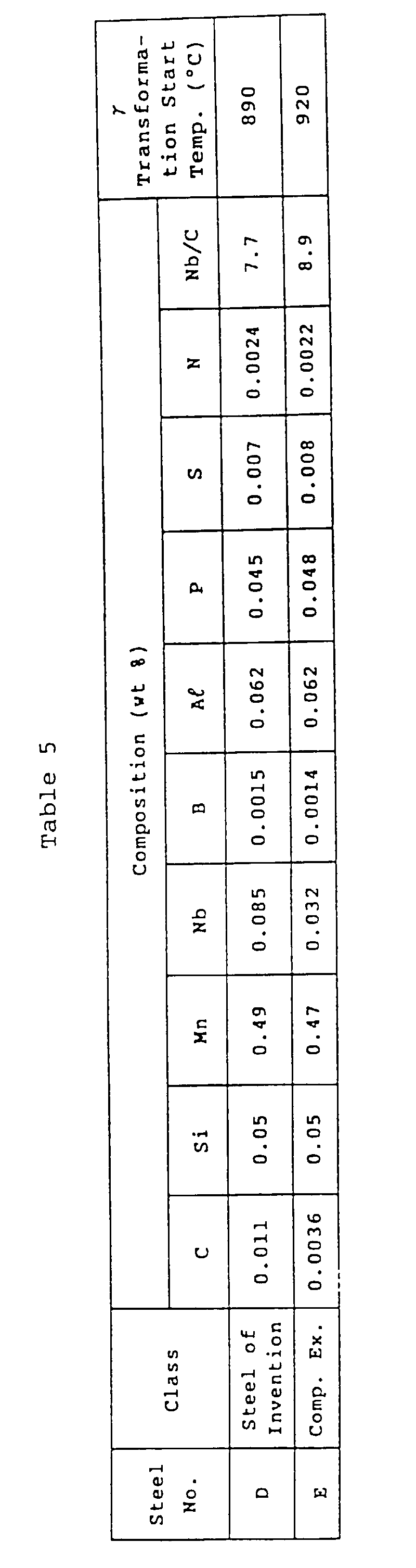
- Hot rolling condition:
- Slab heating temperature (SRT): 1200°C
- Hot rolling finish temperature (FDT): 900°C
- Coiling temperature (CT): 650°C
- Final sheet thickness: 3.2 mm
-
- Cold rolling condition:
- Rolling reduction: 78 %
- Final sheet thickness: 0.7 mm
-
- Continuous annealing condition:
- Heating temperature:
- Steel D 880 to 950°C (5°C gradation)
- Steel E 910 to 950°C (5°C gradation)
- Cooling rate: 30°C/sec
-
- The results of measurement are shown in Fig. 2 which illustrates influence of C on the balance between tensile strength (TS) and elongation (El).
- As will be clear from Fig. 2, the steel E which has a small C content of 0.0036 wt% exhibits a drastic reduction of El when TS is 45 Kgf/mm2 or therearound and cannot provide any TS value higher than 45 Kgf/mm2. In contrast, steel D containing 0.011 wt% of C does not exhibit drastic reduction in El when TS is increased, while exhibiting tensile strength of 45 Kgf/mm2 or greater, thus proving high-stability against strengthening treatment and two-phase-range annealing.
- Hitherto, it has been considered that increase in the C content inevitably causes a large reduction in the r-value. Reduction of the r-value in accordance with increase in the C content was generally observed also in experiments which were conducted on steel sheets having dual-phase structure composed of high-temperature transformed ferrite phase and low-temperature transformed phase.
- The present inventors, however, found that there exists a certain measure for avoiding reduction of the r-value in the steel sheets having above-mentioned dual-phase structure, provided that the C content is not more than 0.025 wt%, through an experiment.
- The result of the experiment will be described hereinunder. Steel slabs of group F with varying Nb content and steel slabs of group G with varying Ti content were produced to have compositions as shown in Table 6, and these steel slabs were tested for measurement of r-values.

- Hot rolling condition:
- Slab heating temperature (SRT): 1250°C
- Hot rolling finish temperature (FDT): 900°C
- Coiling temperature (CT): 620°C
- Final sheet thickness: 3.5 mm
-
- Cold rolling condition:
- Rolling reduction: 80 %
- Final sheet thickness: 0.7 mm
-
- Continuous annealing condition:
- Heating temperature: 910°C
- Cooling rate: 95°C/sec
-
- Refining rolling
Elongation: 0.8 % - The results of the measurement are shown in Fig. 3. Thus, Fig. 3 shows influences of Nb and Ti on the r-value.
- Referring to Fig. 3, Ti* indicates effective Ti content which is calculated in accordance with the following formula:
- From Fig. 3, it will be seen that high r-values are obtained in the steel sheets of the group F containing Nb, i.e., in the steel sheets in which C is fixed by Nb.
- This advantageous effect is considered as being attributable to the following function performed by Nb.
- The r-value, considered in connection with the crystal grain growth, increases where greater crystal grain growth speed is obtained within the temperature range where α phase exists alone in the course of annealing, as is the case of ordinary soft steels. From this point of view, it is preferred to add an element which fixes C. On the other hand, in the temperature range in which α and γ phases coexist, it is necessary to suppress coarsening of the γ phase in order to prevent reduction in the r-value. To this end, it is preferred to allow C to exist in the form of solid solution. Considering that decomposition of NbC occurs at temperatures just around the γ transformation temperature, it is understood that C is dissolved so as to realize the above-mentioned optimum condition at temperatures above the γ transformation temperature. Both the steels shown in Tables 5 and 6 showed a second-phase content (content of low-temperature transformed ferrite phase) of 1 to 70 % when the annealing was conducted at temperatures higher than the γ transformation temperature, thus exhibiting appreciably high non-aging property at room temperature, as well as bake hardenability. The second phase appears in one of the aforementioned three forms or a combination of two or more of these three forms, depending on the contents of C, Ni, Mo and Cu. However, no substantial correlation was observed between the form and absolute grain size of the second phase and the workability.
- General steels which are comparatively rich in strengthening elements tend to allow growth of the second phase grains to sizes greater than the grain size of the matrix phase (high-temperature transformed ferrite phase), more specifically to sizes which are more than three times as large that of the matrix phase grains. This should be contrasted to the steel sheets having compositions falling within the ranges specified by the invention which exhibit superior workability and which have mean grain size of second phase less that three times that of the matrix grain size. This fact gives a support to the aforementioned discovery that the promotion of growth a grains and suppression of growth of γ grains produce desirable effects on the material.
- A description will now be given of the reasons of limitation of contents of the constituents in the steel sheet according to the first aspect of the invention.
- The contents of Si, Mn, B, Al, P and N are the same as those of the steel in accordance with the first aspect of the invention.
- When C content is 0.008 wt% or less, it is impossible to obtain high strength without impairing workability. Conversely, C content exceeding 0.025 wt% makes it impossible to suppress reduction in the r-value and causes martensitization of the second phase, resulting in problems such as softening and strain aging at room temperature when the steel sheet is plated by hot-dip galvannealing. The C content, therefore, is determined to be more than 0.008 wt% but not more than 0.025 wt%.
- Si content exceeding 1.0 wt% raises the transformation point to require annealing at elevated temperature. In addition, plating adhesion is impaired when the steel sheet having such large Si content is subjected to hot-dip zinc plating. The Si content is therefore determined to be 1.0 wt% or less. On the other hand, inclusion of Si by 0.05 wt% or more is effective in increasing strength, while improving the balance between strength and elongation more or less. This is considered to be attributable to promotion of enrichment of the second phase with C effected by the presence of Si.
- Harmful sulfides (FeS) tend to be formed when Mn content is less than 0.1 wt%. However, inclusion of Mn in excess of 2.0 wt% seriously affects the strength-elongation balance. The content of Mn, therefore, should be determined to be not less than 0.1 wt% but not more than 2.0 wt%. Preferably, the Mn content is determined to be 1.0 wt% or less.
- Nb is an element which, in cooperation with B, promotes formation of low-temperature transformed ferrite. Nb, when its content (wt %) is equal to or greater than the value which is five times greater than that of solid solution C, it is possible to form carbide to fix C thereby preventing degradation of r-value caused by solid solution C in the beginning period of annealing. In the latter period of the annealing, the carbide is decomposed to impart bake hardenability. Thus, Nb plays the most important role in the second steel sheet in accordance with the present invention. Nb content exceeding 0.2 wt% adversely affects the workability. Consequently, the Nb content is determined to be not less than 0.001 wt% but not more than 0.2 wt%. The content of Nb, therefore, should be determined to be not more than 0.2 wt% but five times or more greater than C* which is expressed as follows:
- For Ti content given by Ti = 48/32[S] + 48/14[N] or smaller:
- For greater Ti content:
- B is an element which, in cooperation with Nb, promotes formation of low-temperature transformed ferrite. The effect of addition of B, however, is not appreciable when the B content is below 0.0003 wt%. Conversely, B content exceeding 0.01 wt% adversely affects the workability. Consequently, the B content is determined to be not less than 0.0003 wt% but not more than 0.01 wt%.
- Al is an element which is essential for enabling deoxidation during refining. To obtain an appreciable effect, the Al content should be 0.005 wt% or more. Any Al content exceeding 0.10 wt%, however, increases inclusions with the result that the material is degraded. The Al content, therefore, should be determined to be not less than 0.005 wt% but not more than 0.10 wt%.
- Presence of P in excess of 0.1 wt%, however, not only enhances surface defect due to segregation but also impairs adhesion of plating layer in hot-dip zinc plating. In addition, presence of P in such an amount undesirably suppresses the strengthening effect produced by the second phase. The P content, therefore, should be determined to be not more than 0.1 wt%. Preferably, the P content is determined to be 0.05 wt% or less.
- N deteriorates both workability and aging resistance at room temperature when its content exceeds 0.007 wt%. In addition, presence of N in such an amount wastefully consumes B due to formation of BN. The N content, therefore, should be determined to be 0.007 wt% or less. Ti: 0.005 wt% to below a value given by 48/12 [Cwt%] + 48/32 [Swt%] + 48/14 [Nwt%]
- Ti is an element which fixes both S and N so as to suppress undesirable effect on the yield of B and the material. Any excess Ti, i.e., Ti content (wt%) beyond the value expressed by 48/32 [Swt%] + 48/14 [Nwt%], serves to fix solid solution C more efficiently than Nb does. Inclusion of Ti by 0.005 wt% or more, therefore, is expected to improve workability. A too large Ti content, however, tends to cause surface defect. In addition, since Ti carbide is difficult to decompose, desired bake hardenability cannot be obtained when whole solid solution C is fixed by Ti and, in addition, high r-value which is considered to be a result of fixing of C by Nb is impaired. Consequently, the Ti content is determined to be not less than 0.005 wt% and less than a value which is given by 48/12 [Cwt%] + 48/32 [Swt%] + 48/14 [Nwt%].
- A tends to cause hot-work embrittlement when its content exceeds 0.050 wt%, so that S content is limited so as not to exceed 0.050 wt%. Even when S is made to precipitate by S, workability is impaired due to increase in the inclusions when S content exceeds 0.050 wt%.
- Conditions for producing the steel sheet in accordance with the second aspect of the invention, such as conditions for forming the slabs, hot-rolling conditions, coiling temperature, cold rolling conditions, annealing conditions, rate of cooling after annealing and refining rolling conditions are the same as those employed in the production of the steel sheets in accordance with the first aspect of the present invention.
- Slabs of 9 types steels having compositions falling within the range specified by the invention and 6 types of comparative example steels having compositions falling out of the range of the invention were prepared by continuous casting. The compositions of these steels are shown in Table 7. These steel slabs were hot-rolled (final thickness 1.6 to 3.5 mm), cold rolled (final thickness 0.7 mm) and then annealed, under conditions as shown in Table 8. Some of the steel slabs were further subjected to hot-dip galvannealing or skin-pass rolling the conditions of which also are shown in Table 3.
- The hot-dip galvannealing shown in Table 8 was conducted in a continuous galvannealing line (CGL) which sequentially performs annealing, hot-dip zinc plating and alloying treatment (550°C, 20 sec). No inferior adhesion of plating layer was found in each case.
- The steel sheet products thus obtained were subjected to measurement of tensile characteristics, r-value, bake hardenability, and non-aging property at room temperature, as well as to an examination of the structure. The results are shown in Table 9.
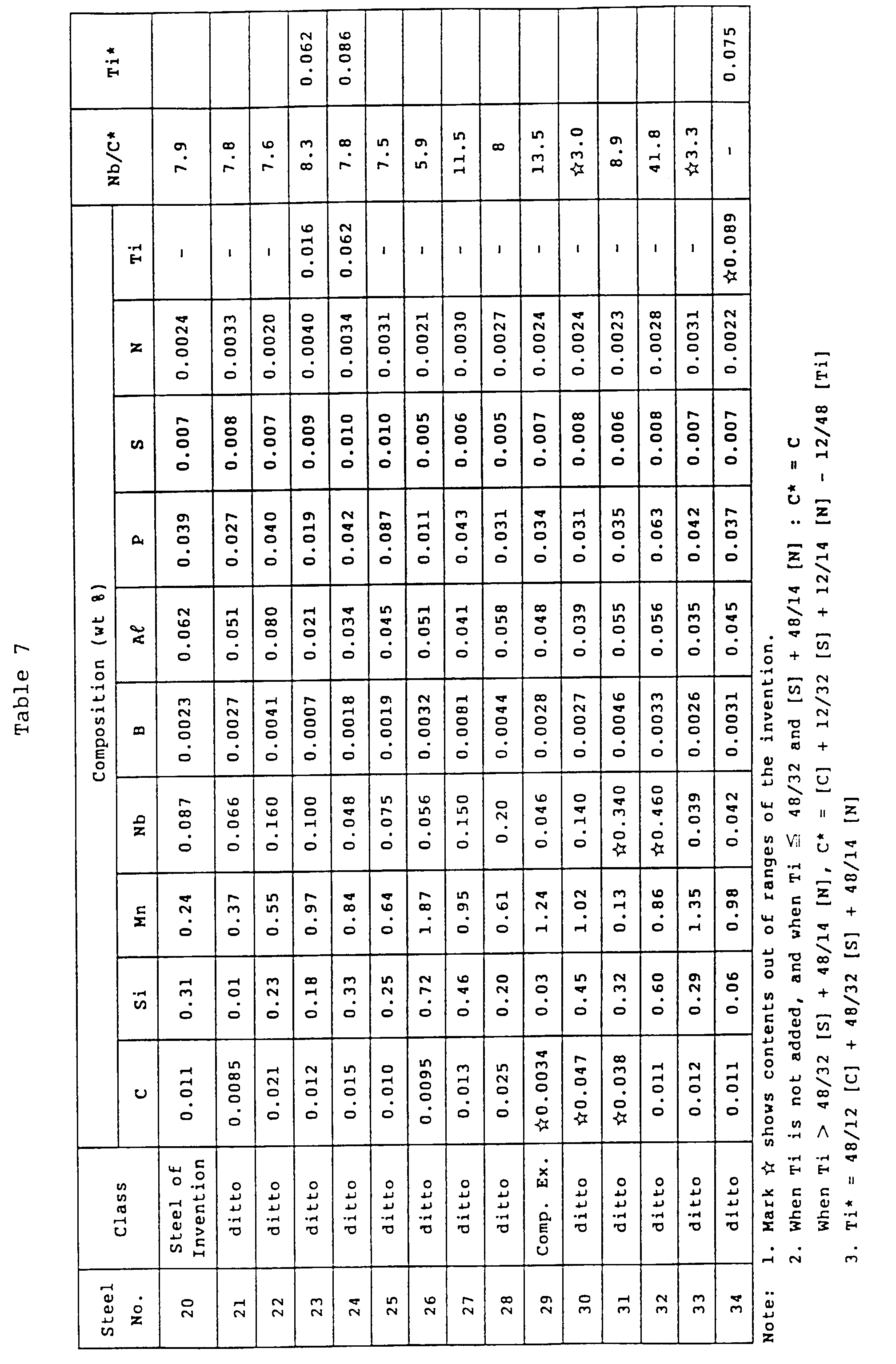


- The measuring methods and conditions were as follows.
- The tensile characteristics were measured by using a test piece No. 5 as specified by JIS (Japanese Industrial Standards) Z 2201.
- The mean r-value was determined by measuring the Lankford value (r-value) by three-point method under 15 % tension in three directions: namely, L direction (direction of rolling), D direction (direction which is 45° to the rolling direction) and C direction (direction 90° to the rolling direction), and calculating the mean value in accordance with the following formula:
- The level of stress (σ2) under 2 % tensile strain was measured. Measure also was the level of yield stress (σγ) after 2-hour aging at 170°C following release of 2 % tensile pre-loading. The work hardenability (BH) was then determined in accordance with the following formula:
- Yield elongation (YEI) was measured by conducting a tensile test (
tensile speed 10 mm/min) immediately after the annealing. The yield elongation also was measured after a 10-hour aging treatment at 100°C corresponding to 6-month aging at 30°C. The non-aging property at room temperature was then evaluated by using these two measured values of yield elongation. - From Table 9, it will be understood that all the steel sheets which satisfy the requirements of the second aspect of the present invention exhibit tensile strength (TS) of 40 Kgf/mm2 or greater, as well high degrees of non-aging property at room temperature and workability. Furthermore, no degradation of material was observed in the steel sheets which have undergone hot-dip zinc plating by CGL or refining rolling.
- On the other hand, the following facts were noted on the steel sheets of comparative examples.
- Inferior non-aging property at room temperature was observed due to the facts that the annealing temperature was lower than the γ transformation temperature and that the structure consisted of α phase alone.
- Inferior non-aging property at room temperature was observed due to the facts that the rate of cooling after the annealing was too small and that the structure was constituted substantially by α phase alone.
- Inferior workability was observed due to too large grin size of the second phase as compared with that of the matrix phase, as a result of too small rolling reduction in the cold rolling.
- Workability was unsatisfactory due to the fact that the annealing was executed at a temperature higher than the temperature region where α and γ phases coexist.
- Material quality was degraded due to too small C content and increase in the strength.
- Material quality was degraded due to too high C content and martensitization of the second phase. In particular, r-value was low due to martensitization of the second phase.
- Workability was adversely affected by large Ni content.
- Workability was not appreciable because the Nb content (Nb < 5C*) was insufficient for suppressing undesirable effect on the workability of solid solution C.
- Workability was not appreciable because the whole solid solution C was fixed by Ti, due to inclusion of Ti by the amount expressed by Ti > 48/12[C] + 48/32[S] + 48/14[N].
- Thus, all the comparative example were inferior to the steel sheets in accordance with the first aspect of the present invention.
- A detailed description will now be given of a method of producing the steel sheet in accordance with the second aspect of the present invention.
- As will be understood from the foregoing description, according to the present invention, it is possible to suppress degradation of workability which is caused in strengthening a steel sheet having a dual-phase structure composed of a high-temperature transformed ferrite phase and low-temperature transformed ferrite phase having high dislocation density. Thus, the present invention provides a high strength cold rolled steel sheet which has excellent non-aging property at room temperature and, as desired, high level of bake hardenability, as well as excellent drawability, and which is not degraded even when subjected to hot-dip galvannealing. The steel sheet of the present invention, therefore, can suitably be used as materials of various industrial products such as automotive panels.
Claims (6)
- A high strength cold rolled steel sheet having excellent non-aging property at room temperature and excellent drawability, said steel sheet having a dual-phase structure composed of a high temperature transformed ferrite phase and a low temperature transformed ferrite phase having high dislocation density, said steel sheet having a composition which contains: not less than 0.001 wt% but not more than 0.025 wt% of C; not more than 1.0 wt% of Si; not less than 0.1 wt% but not more than 2.0 wt% of Mn; not less than 0.001 wt% but not more than 0.2 wt% of Nb; not less than 0.0003 wt% but not more than 0.01 wt% of B; not less than 0.005 wt% but not more than 0.10 wt% of Al; not more than 0.1 wt% of P; not more than 0.007 wt% of N; and at least one selected from a group (A) consisting of not less than 0.05 wt% but not more than 3.0 wt% of Ni: not less than 0.01 wt% but not more than 2.0 wt% of Mo: and not less than 0.05 wt% but not more than 5.0 wt% of Cu and further optionally comprising at least one selected from a group (B) consisting of not less than 0.05 wt% but not more than 3.0 wt% of Cr and not less than 0.005 wt% but less than a value expressed by (48/12)C+(48/32)S+(48/14)N of Ti and the balance being Fe with inevitable impurities.
- A method of producing a high strength cold rolled steel sheet having excellent non-aging property at room temperature and excellent drawability, having a dual-phase structure composed of a high temperature transformed ferrite phase and a low temperature transformed ferrite phase with high dislocation density, comprising the steps of:preparing a hot-rolled steel sheet having a composition as defined in claim 1;cold rolling said steel sheet at a rolling reduction not smaller than 60%;annealing the cold rolled steel sheet at a temperature not lower than the γ transformation start temperature but below Ac3 transformation temperature; andcooling the annealed steel sheet at a rate not smaller than 5°C/sec but not greater than 100°C/sec.
- A high strength cold rolled steel sheet having excellent non-aging property at room temperature and bake hardenability, as well as excellent drawability, said steel sheet exhibiting a tensile strength not smaller than 45 Kgf/mm2 and having a dual-phase structure composed of a high temperature transformed ferrite phase and a low temperature transformed ferrite phase having high dislocation density, said steel sheet having a composition which contains: more than 0.008 wt% but not more than 0.025 wt% of C; not more than 1.0 wt% of Si; not less than 0.1 wt% but not more than 2.0 wt% of Mn; not more than 0.2 wt% but not less than five times the content of C of Nb; not less than 0.0003 wt% but not more than 0.01 wt% of B; not less than 0.005 wt% but not more than 0.10 wt% of Al; not more than 0.1 wt% of P; not more than 0.007 wt% of N; optionally: not more than 0.05 wt% S, and 0.005 wt% to 48/32 (Swt%) + 48/14 (Nwt%) of Ti; and the balance being Fe with inevitable impurities.
- A high strength cold rolled steel sheet having excellent non-aging property at room temperature and bake hardenability, as well as excellent drawability, said steel sheet exhibiting a tensile strength not smaller than 45 kgf/mm2 and having a dual-phase structure composed of a high temperature transformed ferrite phase and a low temperature transformed ferrite phase having high dislocation density, according to claim 3, said steel having a composition further containing not more than 0.050 wt% of S and not less than 0.005 wt% but more than a value given by the following formula (1) of Ti,
- A high strength cold rolled steel sheet having excellent non-ageing property at room temperature and bake hardenability, as well as excellent drawability, said steel sheet exhibiting a tensile strength not smaller than 45 kgf/mm2 and having a dual-phase structure composed of a high temperature transformed ferrite phase and a low temperature transformed ferrite phase having high dislocation density, according to claim 3, said steel sheet having a composition further containing not more than 0.050 wt% of S; not more than 0.2 wt% but not less than five times the content of C* given by the following formula (2) of Nb; and Ti of an amount meeting the condition of the following formula (3),
- A method of producing a high strength cold rolled steel sheet having excellent non-ageing property at room temperature and bake hardenability, as well as excellent drawability, said steel sheet exhibiting a tensile strength not smaller than 45 kgf/mm2 and having a dual-phase structure composed of a high temperature transformed ferrite phase and a low temperature transformed ferrite phase having high dislocation density, said method comprising the steps of:preparing a hot-rolled steel sheet having a composition as defined in any one of claims 3, 4 and 5;cold rolling said steel sheet at a rolling reduction not smaller than 60%;annealing the cold rolled steel sheet at a temperature not lower than the γ transformation start temperature but below Ac3 transformation temperature; andcooling the annealed steel sheet at a rate not smaller than 5°C/sec but not greater than 100°C/sec.
Applications Claiming Priority (4)
| Application Number | Priority Date | Filing Date | Title |
|---|---|---|---|
| JP123135/91 | 1991-04-26 | ||
| JP3123135A JP2818319B2 (en) | 1991-04-26 | 1991-04-26 | Non-ageing cold drawn high-strength cold-rolled steel sheet and method for producing same |
| JP12313491A JP2823974B2 (en) | 1991-04-26 | 1991-04-26 | High-temperature cold-rolled steel sheet for non-ageing BH type drawing at room temperature and method for producing the same |
| JP123134/91 | 1991-04-26 |
Publications (3)
| Publication Number | Publication Date |
|---|---|
| EP0510718A2 EP0510718A2 (en) | 1992-10-28 |
| EP0510718A3 EP0510718A3 (en) | 1993-09-29 |
| EP0510718B1 true EP0510718B1 (en) | 1999-02-10 |
Family
ID=26460132
Family Applications (1)
| Application Number | Title | Priority Date | Filing Date |
|---|---|---|---|
| EP92107173A Expired - Lifetime EP0510718B1 (en) | 1991-04-26 | 1992-04-27 | High strength cold rolled steel sheet having excellent non-agin property at room temperature and suitable for drawing and method of producing the same |
Country Status (5)
| Country | Link |
|---|---|
| US (1) | US5356494A (en) |
| EP (1) | EP0510718B1 (en) |
| KR (1) | KR950007472B1 (en) |
| CA (1) | CA2067043C (en) |
| DE (1) | DE69228403T2 (en) |
Cited By (1)
| Publication number | Priority date | Publication date | Assignee | Title |
|---|---|---|---|---|
| WO2012100762A1 (en) | 2011-01-26 | 2012-08-02 | Salzgitter Flachstahl Gmbh | High strength multi-phase steel having excellent forming properties |
Families Citing this family (20)
| Publication number | Priority date | Publication date | Assignee | Title |
|---|---|---|---|---|
| JPH07179946A (en) * | 1993-12-24 | 1995-07-18 | Kawasaki Steel Corp | Highly workable high-strength cold-rolled steel sheet with excellent secondary work brittleness resistance |
| WO1998024942A1 (en) * | 1996-12-06 | 1998-06-11 | Kawasaki Steel Corporation | Steel sheet for double wound pipe and method of producing the pipe |
| JP4177477B2 (en) * | 1998-04-27 | 2008-11-05 | Jfeスチール株式会社 | Manufacturing method of cold-rolled steel sheet and hot-dip galvanized steel sheet with excellent room temperature aging resistance and panel characteristics |
| JP3793351B2 (en) * | 1998-06-30 | 2006-07-05 | 新日本製鐵株式会社 | Cold rolled steel sheet with excellent bake hardenability |
| US6143100A (en) * | 1998-09-29 | 2000-11-07 | National Steel Corporation | Bake-hardenable cold rolled steel sheet and method of producing same |
| EP1193322B1 (en) * | 2000-02-29 | 2006-07-05 | JFE Steel Corporation | High tensile cold-rolled steel sheet having excellent strain aging hardening properties |
| US6676774B2 (en) * | 2000-04-07 | 2004-01-13 | Jfe Steel Corporation | Hot rolled steel plate and cold rolled steel plate being excellent in strain aging hardening characteristics |
| EP1498507B1 (en) * | 2000-05-26 | 2006-06-28 | JFE Steel Corporation | Cold-rolled steel sheet and galvanized steel sheet having excellent strain age hardenability and method of producing the same |
| US20030015263A1 (en) | 2000-05-26 | 2003-01-23 | Chikara Kami | Cold rolled steel sheet and galvanized steel sheet having strain aging hardening property and method for producing the same |
| KR100473497B1 (en) * | 2000-06-20 | 2005-03-09 | 제이에프이 스틸 가부시키가이샤 | Thin steel sheet and method for production thereof |
| WO2002000956A1 (en) * | 2000-06-26 | 2002-01-03 | Aceralia Corporacion Siderurgica, S.A. | Composition and method for the production of multiphase steels |
| JP3958921B2 (en) * | 2000-08-04 | 2007-08-15 | 新日本製鐵株式会社 | Cold-rolled steel sheet excellent in paint bake-hardening performance and room temperature aging resistance and method for producing the same |
| FR2820150B1 (en) * | 2001-01-26 | 2003-03-28 | Usinor | HIGH STRENGTH ISOTROPIC STEEL, METHOD FOR MANUFACTURING SHEETS AND SHEETS OBTAINED |
| EP1380663A1 (en) * | 2002-07-03 | 2004-01-14 | ThyssenKrupp Stahl AG | Cold rolled ULC - steel sheet and method of producing the same |
| US20040047756A1 (en) * | 2002-09-06 | 2004-03-11 | Rege Jayanta Shantaram | Cold rolled and galvanized or galvannealed dual phase high strength steel and method of its production |
| EP1735474B1 (en) * | 2004-03-25 | 2015-10-21 | Posco | Cold rolled steel sheet and hot dipped steel sheet with superior strength and bake hardenability and method for manufacturing the steel sheets |
| KR100859057B1 (en) * | 2006-03-09 | 2008-09-17 | 가부시키가이샤 고베 세이코쇼 | High yield ratio and high tension steel sheet excellent in control of fatigue crack growth and toughness of weld heat-affected zone |
| DE102006054300A1 (en) * | 2006-11-14 | 2008-05-15 | Salzgitter Flachstahl Gmbh | High-strength dual-phase steel with excellent forming properties |
| WO2014157823A1 (en) * | 2013-03-28 | 2014-10-02 | 현대제철 주식회사 | Steel sheet and manufacturing method therefor |
| KR102403647B1 (en) | 2020-11-12 | 2022-05-30 | 주식회사 포스코 | Bake hardening hot-dip galvannealed steel sheet having excellent powdering and method for manufacturing the same |
Family Cites Families (7)
| Publication number | Priority date | Publication date | Assignee | Title |
|---|---|---|---|---|
| JPS5931827A (en) * | 1982-08-13 | 1984-02-21 | Nippon Steel Corp | Production of quench hardenable steel plate for ultra deep drawing |
| US4504326A (en) * | 1982-10-08 | 1985-03-12 | Nippon Steel Corporation | Method for the production of cold rolled steel sheet having super deep drawability |
| JPS60174852A (en) * | 1984-02-18 | 1985-09-09 | Kawasaki Steel Corp | Cold rolled steel sheet having composite structure and superior deep drawability |
| JPS644429A (en) * | 1987-06-26 | 1989-01-09 | Nippon Steel Corp | Manufacture of high-strength cold-rolled steel sheet with high (r) value |
| CA2022907C (en) * | 1989-08-09 | 1994-02-01 | Mitsuru Kitamura | Method of manufacturing a steel sheet |
| ES2125856T5 (en) * | 1990-08-17 | 2004-09-16 | Jfe Steel Corporation | HIGH RESISTANCE STEEL SHEET FOR PRESS FORMATION AND PRODUCTION METHOD OF THE SAME. |
| US5685874A (en) * | 1996-02-22 | 1997-11-11 | The Procter & Gamble Company | Disposable pull-on pant |
-
1992
- 1992-04-24 US US07/874,306 patent/US5356494A/en not_active Expired - Lifetime
- 1992-04-24 CA CA002067043A patent/CA2067043C/en not_active Expired - Lifetime
- 1992-04-27 EP EP92107173A patent/EP0510718B1/en not_active Expired - Lifetime
- 1992-04-27 DE DE69228403T patent/DE69228403T2/en not_active Expired - Lifetime
- 1992-04-27 KR KR1019920007134A patent/KR950007472B1/en not_active Expired - Lifetime
Cited By (2)
| Publication number | Priority date | Publication date | Assignee | Title |
|---|---|---|---|---|
| WO2012100762A1 (en) | 2011-01-26 | 2012-08-02 | Salzgitter Flachstahl Gmbh | High strength multi-phase steel having excellent forming properties |
| DE102011117572A1 (en) | 2011-01-26 | 2012-08-16 | Salzgitter Flachstahl Gmbh | High-strength multiphase steel with excellent forming properties |
Also Published As
| Publication number | Publication date |
|---|---|
| KR950007472B1 (en) | 1995-07-11 |
| KR920019959A (en) | 1992-11-20 |
| EP0510718A2 (en) | 1992-10-28 |
| US5356494A (en) | 1994-10-18 |
| CA2067043C (en) | 1998-04-28 |
| DE69228403D1 (en) | 1999-03-25 |
| DE69228403T2 (en) | 1999-06-24 |
| EP0510718A3 (en) | 1993-09-29 |
| CA2067043A1 (en) | 1992-10-27 |
Similar Documents
| Publication | Publication Date | Title |
|---|---|---|
| EP0510718B1 (en) | High strength cold rolled steel sheet having excellent non-agin property at room temperature and suitable for drawing and method of producing the same | |
| RU2322518C2 (en) | High-strength sheet steel with excellent deformability and method for producing it | |
| EP0608430B1 (en) | Cold-rolled steel plate having excellent baking hardenability, non-cold-ageing characteristics and moldability, and molten zinc-plated cold-rolled steel plate and method of manufacturing the same | |
| KR101264574B1 (en) | Method for producing high-strength steel plate having superior deep drawing characteristics | |
| EP1264911A2 (en) | High-ductility steel sheet excellent in press formability and strain age hardenability, and method for manufacturing the same | |
| US7608156B2 (en) | High strength cold rolled steel sheet and method for manufacturing the same | |
| US5846343A (en) | Cold rolled steel sheet exhibiting excellent press workability and method of manufacturing the same | |
| EP0620288B1 (en) | Cold-rolled sheet and hot-galvanized cold-rolled sheet, both excellent in bake hardening, cold nonaging and forming properties, and process for producing the same | |
| EP0816524A1 (en) | Steel sheet for excellent panel appearance and dent resistance after forming | |
| US5290370A (en) | Cold-rolled high-tension steel sheet having superior deep drawability and method thereof | |
| JP3498504B2 (en) | High ductility type high tensile cold rolled steel sheet and galvanized steel sheet | |
| JP3473480B2 (en) | Hot-dip galvanized steel sheet excellent in strength and ductility and method for producing the same | |
| US20240229184A1 (en) | Coiling temperature influenced cold rolled strip or steel | |
| JP2002155317A (en) | Method for producing high-strength hot-dip galvanized steel sheet excellent in deep drawability and secondary work brittleness resistance | |
| EP0535238A1 (en) | High-strength steel sheet for forming and production thereof | |
| EP0694625B9 (en) | High tension alloyed molten zinc-plated steel plate having excellent plating characteristics and method off manufacturing the same | |
| JP3404798B2 (en) | Method for producing high-strength steel sheet having bake hardenability | |
| JPS6249323B2 (en) | ||
| JP4094498B2 (en) | Deep drawing high strength cold-rolled steel sheet and method for producing the same | |
| JP2004256893A (en) | High strength hot-dip galvanized steel sheet with excellent secondary work brittleness resistance | |
| JP3716439B2 (en) | Manufacturing method of high-tensile alloyed hot-dip galvanized steel sheet with excellent plating characteristics | |
| JP3932737B2 (en) | Manufacturing method of high-strength hot-dip galvanized steel sheet with excellent deep drawability | |
| JP2975774B2 (en) | Alloyed hot-dip galvanized steel sheet and method for producing the same | |
| JP4218598B2 (en) | High tensile alloyed hot dip galvanized steel sheet with excellent plating characteristics | |
| JP2004256895A (en) | Method for producing high-strength hot-dip galvanized steel sheet with excellent secondary work brittleness resistance |
Legal Events
| Date | Code | Title | Description |
|---|---|---|---|
| PUAI | Public reference made under article 153(3) epc to a published international application that has entered the european phase |
Free format text: ORIGINAL CODE: 0009012 |
|
| AK | Designated contracting states |
Kind code of ref document: A2 Designated state(s): DE FR GB |
|
| PUAL | Search report despatched |
Free format text: ORIGINAL CODE: 0009013 |
|
| AK | Designated contracting states |
Kind code of ref document: A3 Designated state(s): DE FR GB |
|
| 17P | Request for examination filed |
Effective date: 19940314 |
|
| 17Q | First examination report despatched |
Effective date: 19970523 |
|
| GRAG | Despatch of communication of intention to grant |
Free format text: ORIGINAL CODE: EPIDOS AGRA |
|
| GRAG | Despatch of communication of intention to grant |
Free format text: ORIGINAL CODE: EPIDOS AGRA |
|
| GRAH | Despatch of communication of intention to grant a patent |
Free format text: ORIGINAL CODE: EPIDOS IGRA |
|
| GRAH | Despatch of communication of intention to grant a patent |
Free format text: ORIGINAL CODE: EPIDOS IGRA |
|
| GRAA | (expected) grant |
Free format text: ORIGINAL CODE: 0009210 |
|
| AK | Designated contracting states |
Kind code of ref document: B1 Designated state(s): DE FR GB |
|
| ET | Fr: translation filed | ||
| REF | Corresponds to: |
Ref document number: 69228403 Country of ref document: DE Date of ref document: 19990325 |
|
| PLBE | No opposition filed within time limit |
Free format text: ORIGINAL CODE: 0009261 |
|
| STAA | Information on the status of an ep patent application or granted ep patent |
Free format text: STATUS: NO OPPOSITION FILED WITHIN TIME LIMIT |
|
| 26N | No opposition filed | ||
| REG | Reference to a national code |
Ref country code: GB Ref legal event code: IF02 |
|
| PGFP | Annual fee paid to national office [announced via postgrant information from national office to epo] |
Ref country code: FR Payment date: 20050408 Year of fee payment: 14 |
|
| PGFP | Annual fee paid to national office [announced via postgrant information from national office to epo] |
Ref country code: GB Payment date: 20050427 Year of fee payment: 14 |
|
| PG25 | Lapsed in a contracting state [announced via postgrant information from national office to epo] |
Ref country code: GB Free format text: LAPSE BECAUSE OF NON-PAYMENT OF DUE FEES Effective date: 20060427 |
|
| GBPC | Gb: european patent ceased through non-payment of renewal fee |
Effective date: 20060427 |
|
| REG | Reference to a national code |
Ref country code: FR Ref legal event code: ST Effective date: 20061230 |
|
| PG25 | Lapsed in a contracting state [announced via postgrant information from national office to epo] |
Ref country code: FR Free format text: LAPSE BECAUSE OF NON-PAYMENT OF DUE FEES Effective date: 20060502 |
|
| PGFP | Annual fee paid to national office [announced via postgrant information from national office to epo] |
Ref country code: DE Payment date: 20110420 Year of fee payment: 20 |
|
| REG | Reference to a national code |
Ref country code: DE Ref legal event code: R071 Ref document number: 69228403 Country of ref document: DE |
|
| REG | Reference to a national code |
Ref country code: DE Ref legal event code: R071 Ref document number: 69228403 Country of ref document: DE |
|
| PG25 | Lapsed in a contracting state [announced via postgrant information from national office to epo] |
Ref country code: DE Free format text: LAPSE BECAUSE OF EXPIRATION OF PROTECTION Effective date: 20120428 |