EP0513627A1 - Tetrahydro-alpha-pyronderivat, Verfahren zu seiner Herstellung und dieses enthaltende Riech- und/oder Geschmackstoffkompositionen - Google Patents
Tetrahydro-alpha-pyronderivat, Verfahren zu seiner Herstellung und dieses enthaltende Riech- und/oder Geschmackstoffkompositionen Download PDFInfo
- Publication number
- EP0513627A1 EP0513627A1 EP92107551A EP92107551A EP0513627A1 EP 0513627 A1 EP0513627 A1 EP 0513627A1 EP 92107551 A EP92107551 A EP 92107551A EP 92107551 A EP92107551 A EP 92107551A EP 0513627 A1 EP0513627 A1 EP 0513627A1
- Authority
- EP
- European Patent Office
- Prior art keywords
- methyl
- pentyl
- tetrahydro
- cis
- pyrone
- Prior art date
- Legal status (The legal status is an assumption and is not a legal conclusion. Google has not performed a legal analysis and makes no representation as to the accuracy of the status listed.)
- Granted
Links
- 0 CC(CC1)C(*)OC1=O Chemical compound CC(CC1)C(*)OC1=O 0.000 description 1
Classifications
-
- C—CHEMISTRY; METALLURGY
- C11—ANIMAL OR VEGETABLE OILS, FATS, FATTY SUBSTANCES OR WAXES; FATTY ACIDS THEREFROM; DETERGENTS; CANDLES
- C11B—PRODUCING, e.g. BY PRESSING RAW MATERIALS OR BY EXTRACTION FROM WASTE MATERIALS, REFINING OR PRESERVING FATS, FATTY SUBSTANCES, e.g. LANOLIN, FATTY OILS OR WAXES; ESSENTIAL OILS; PERFUMES
- C11B9/00—Essential oils; Perfumes
- C11B9/0069—Heterocyclic compounds
- C11B9/0073—Heterocyclic compounds containing only O or S as heteroatoms
- C11B9/008—Heterocyclic compounds containing only O or S as heteroatoms the hetero rings containing six atoms
-
- A—HUMAN NECESSITIES
- A23—FOODS OR FOODSTUFFS; TREATMENT THEREOF, NOT COVERED BY OTHER CLASSES
- A23L—FOODS, FOODSTUFFS OR NON-ALCOHOLIC BEVERAGES, NOT OTHERWISE PROVIDED FOR; PREPARATION OR TREATMENT THEREOF
- A23L27/00—Spices; Flavouring agents or condiments; Artificial sweetening agents; Table salts; Dietetic salt substitutes; Preparation or treatment thereof
- A23L27/20—Synthetic spices, flavouring agents or condiments
- A23L27/206—Dairy flavours
-
- C—CHEMISTRY; METALLURGY
- C07—ORGANIC CHEMISTRY
- C07D—HETEROCYCLIC COMPOUNDS
- C07D309/00—Heterocyclic compounds containing six-membered rings having one oxygen atom as the only ring hetero atom, not condensed with other rings
- C07D309/16—Heterocyclic compounds containing six-membered rings having one oxygen atom as the only ring hetero atom, not condensed with other rings having one double bond between ring members or between a ring member and a non-ring member
- C07D309/28—Heterocyclic compounds containing six-membered rings having one oxygen atom as the only ring hetero atom, not condensed with other rings having one double bond between ring members or between a ring member and a non-ring member with hetero atoms or with carbon atoms having three bonds to hetero atoms with at the most one bond to halogen, e.g. ester or nitrile radicals, directly attached to ring carbon atoms
- C07D309/30—Oxygen atoms, e.g. delta-lactones
Definitions
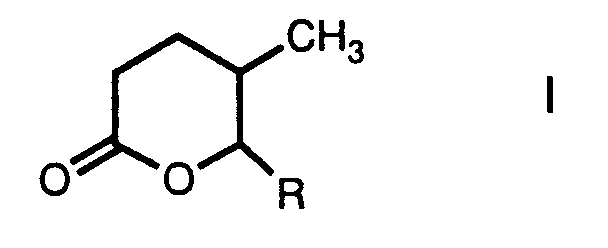
- the present invention relates to new fragrance and / or flavoring compositions which contain tetrahydro- ⁇ -pyrone derivatives of the general formula wherein R is C3 ⁇ 8-alkyl, Marked are.
- the invention thus relates to the new 5-methyl-6-pentyl-tetrahydro- ⁇ -pyrone (4-methyl-5-decanolide), its production, fragrance and flavoring compositions which contain such compounds I as organoleptic active substances, and the use of Compounds I as fragrances and / or flavors.
- the C3 ⁇ 8 alkyl group (R) can be straight-chain or branched.
- the compounds of the formula I inter alia in view of the methyl radical in the 5-position of the tetrahydro- ⁇ -pyrone ring, can be present as stereoisomers.
- Formula I is intended to include these stereoisomeric forms and mixtures thereof.
- the above-mentioned 5-methyl-6-pentyl-tetrahydro- ⁇ -pyrone (4-methyl-5-decanolide) represents both the cis isomer of the formula as well as the trans isomer of the formula a preferred compound of formula I.
- the cis isomer I'a has a very pleasant and surprisingly space-filling odor, which on the one hand relates to certain aspects of the floral scents of tuberose (Polianthes tuberosa) and gardenia species, on the other hand to caramel, condensed milk and coconut, especially coconut milk.
- the trans isomer shows similar olfactory characteristics.
- the process according to the invention for producing the 5-methyl-6-pentyl-tetrahydro- ⁇ -pyrone (4-methyl-5-decanolide) according to the invention is characterized in that 3-methyl-2-pentyl-cyclopentan-1-one is from a Bayer -Villiger undergoes oxidation (according to the equation A peracid, for example peracetic acid, trifluoroperacetic acid, perbenzoic acid or monoperphthalic acid, of which peracetic acid is the preferred oxidizing agent, is used as the oxidizing agent.
- the reaction is conveniently carried out in an inert organic diluent, such as methylene chloride, dichloroethane, toluene, xylene, etc. at temperatures between -30 ° C and + 50 ° C, preferably in the temperature range from 20 ° C to 35 ° C.
- cis or trans-3-methyl-2-pentylcyclopentan-1-one can be used as the starting material, which is predominantly cis or trans-5-methyl-6-pentyl-tetrahydro- ⁇ -pyrone (4-methyl- 5-decanolide) leads.
- it is expedient to start from a cis / trans mixture of 2-pentyl-3-methylcyclopentan-1-one since such a cis / trans mixture is suitably carried out in a manner known per se by hydrogenation of the 3- known as perfumery product Methyl-2-pentyl-2-cyclopenten-1-one (dihydrojasmon) of the formula is available.
- the corresponding trans compound is more or less formed from the cis-2-pentyl-3-methyl-cyclopentan-1-one primarily obtained by the hydrogenation.
- the yields of olfactory good material are high for both hydrogenation and oxidation reaction steps, usually over 75%.
- the compound I 'according to the invention [the cis isomer I'a, the trans isomer I'b and their mixtures (cis / trans-)] and the other compounds of the formula I are generally distinguished by fragrance notes which, on the one hand, are distinctive certain aspects of the floral scents of the tuberose and gardenia species, condensed milk, caramel and coconut, on the other hand remind of such tropical fruits.
- fragrance compositions produced using compounds I are particularly spectacular due to their originality.
- the compounds of the formula I can be used within wide limits, which can range, for example, from about 0.1 (detergents) to about 30 percent by weight (alcoholic solutions) in compositions without however, these values are intended to represent limit values, since the experienced perfumer can achieve effects with even lower concentrations or can build up novel complexes with even higher doses.
- the preferred concentrations range from about 0.5 to about 10 percent by weight.
- the compositions produced with the compounds I can be used for all types of perfumed consumer goods (eau de cologne, eau de toilette, extras, lotions, creams, shampoos, soaps, ointments, powder, toothpastes, mouthwashes, deodorants, detergents, fabric finishers, tobacco , etc.).
- the compounds I can accordingly be used in the production of compositions and - as the above compilation shows - using a wide range of known fragrances or mixtures of fragrances.
- the known fragrances or fragrance mixtures listed above can be used in a known manner, as described, for example, by WA Poucher, Perfumes, Cosmetics and Soaps 2 , 7th edition, Chapman and Hall, London, 1974 emerges.
- the compounds I can be used, for example, to produce or improve, enhance, increase or modify fruit flavors, for example mango, passion fruit, peach, coconut. Possible areas of application for these flavors are, for example, foods (yogurt, sweets, desserts, in particular caramel-based desserts, etc.), luxury foods (tea, coffee, tobacco, etc.) and drinks (lemonade, etc.).
- a suitable dosage ranges from 0.01 to 100 ppm, preferably from 0.1 to 10 ppm in the finished product, i.e. the flavored food, luxury food or drink.
- Aromas are understood to be flavor compositions that can be diluted in a manner known per se or distributed in edible materials. They contain, for example, about 0.01-30, in particular 0.1-10,% by weight of flavoring agent (s) of the formula I. They can be converted into the customary use forms, such as solutions, pastes or powders, by methods known per se.
- the products can be spray dried, vacuum dried or lyophilized.
- carrier materials Gum arabic, tragacanth, salts or brewer's yeast, alginates, carrageenan or similar absorbents; Maltol, spice oleoresins, smoke flavors; Cloves, diacetyl, sodium citrate; Monosodium glutamate, disodium aminosin 5'-monophosphate (IMP), disodium guanosine 5-phosphate (GMP); or special flavors, water, ethanol, propylene glycol, glycerin, etc.
- IMP disodium aminosin 5'-monophosphate
- GMP disodium guanosine 5-phosphate
- the compounds of formula I will be used primarily in luxury perfumery and in compositions for cosmetics.
- reaction solution is now washed three times with water, three times with sodium sulfite solution (10%) and twice with brine, and the organic phase is dried with anhydrous sodium sulfate and then concentrated under reduced pressure.
- the isomers I'a and I'b characterized below by their spectral data are obtained by separating the mixture described above with the aid of gas chromatography.
- the isomer I'a shows a somewhat longer retention time on the usual gas chromatographic columns than the isomer I'b.
- trans-4-methyl-5-decanolide (I'b): Infrared spectrum: 1735, 1248, 1200, 1118, 1098, 1080, 1032, 2020 cm ⁇ 1; 1 H-NMR (400 MHz, CDCl3): 0.90 (t, J ⁇ 7, -CH3), 1.00 [d, J ⁇ 7, H3C-C (4)], 1.22-1.64 ( m, together 8H), 1.66-1.78 (m, 2H), 1.86-1.94 (m, 1H), 2.42-2.51 [m, H a -C (2)] , 2.58-2.65 [m, H b -C (2)], 3.93 [m, HC (5)] ppm; Mass spectrum (m / e): 184 (M + , 0.2), 128 (4), 114 (10), 113 (100), 99 (3), 95 (2), 85 (27), 84 (44 ), 69 (8), 67 (8), 57 (14), 56 (100), 55 (34), 43 (29),
- Perfumery chord (composition) towards ylang-ylang containing cis and trans-4-methyl-5-decanolide Parts by weight Linalool 150 Benzyl acetate 130 Benzyl salicylate 100 Cinnamate acetate 80 Geranyl acetate 80 Benzyl benzoate 80 Methyl benzoate 78 Geraniol 75 Cinnamon alcohol 60 Thibetolide 30th cis-3-hexenyl salicylate 30th Hydroxycitronellal 20th Eugenol 20th cis-3-hexenyl benzoate 20th Methyl jasmonate 10th ⁇ -Jonon 5 cis-3-hexenol 1 cis-3-hexenyl acetate 1 970
- Herbal chord usable for aromas as well as for perfume creations (compositions): Parts by weight Linalool 210 Anethole 120 Phenylethyl alcohol 120 ⁇ -terpineol 60 Citronellol 60 Geranylacetone 60 cis-3-hexenyl benzoate 60 Anisaldehyde 45 Phenylacetaldehyde 30th Eugenol 30th menthol 30th Estragol 15 Verbenon 15 ⁇ -Jonon 9 Citral 6 Methyl jasmonate 3rd cis-3-hexenol 1 Dipropylene glycol 96 970
- Aroma with "milk character” a b Parts by weight Acetoin 25th 25th Vanillin 20th 20th Maltol 10th 10th Diacetyl 10th 10th Ethyl lactate 10th 10th ⁇ -decalactone 10th 10th Caproic acid 7 7 Ethyl butyrate 4th 4th Caprylic acid 1 1 cis- and trans-4-methyl-5-decanolide (I'a / I'b) - 10th Propylene glycol 903 893 1000 1000
- the two flavors a and b are tasted comparably after dilution in sugar syrup solution (20 g flavor a or b per 100 l sugar syrup 10 o Bx).
- Aroma b is clearly preferred by a panel of test subjects, since the desired notes pronounced of cream and condensed milk come into their own.
Landscapes
- Chemical & Material Sciences (AREA)
- Organic Chemistry (AREA)
- Engineering & Computer Science (AREA)
- Life Sciences & Earth Sciences (AREA)
- Polymers & Plastics (AREA)
- Food Science & Technology (AREA)
- Health & Medical Sciences (AREA)
- Nutrition Science (AREA)
- Chemical Kinetics & Catalysis (AREA)
- Oil, Petroleum & Natural Gas (AREA)
- Wood Science & Technology (AREA)
- Fats And Perfumes (AREA)
- Cosmetics (AREA)
- Seasonings (AREA)
- Pyrane Compounds (AREA)
Abstract
Description
- Die vorliegende Erfindung betrifft neue Riech- und/oder Geschmackstoffkompositionen, die durch einen Gehalt an Tetrahydro-α-pyronderivaten der allgemeinen Formel

worin R C₃₋₈-Alkyl bedeutet,
gekennzeichnet sind. - Aus dieser Gruppe von Verbindungen ist das 5-Methyl-6-pentyltetrahydro-α-pyran(2H)-2-on (4-Methyl-5-decanolid bzw. 5-Methyl-6-pentyltetrahydro-α-pyron) eine neue Verbindung. Die restlichen Verbindungen der Formel I sind zwar zum Teil bekannt, jedoch sind ihre organoleptischen Eigenschaften noch nie beschrieben worden.
- Somit betrifft die Erfindung das neue 5-Methyl-6-pentyl-tetrahydro-α-pyron (4-Methyl-5-decanolid), dessen Herstellung, Riechstoff- und Geschmackstoffkompositionen, die solche Verbindungen I als organoleptische Wirkstoffe enthalten, sowie die Verwendung der Verbindungen I als Riech- und/oder Geschmackstoffe.
- In der obigen Formel I kann die C₃₋₈-Alkylgruppe (R) geradkettig oder verzweigt sein. Darüber hinaus können die Verbindungen der Formel I u.a. angesichts des Methylrestes in der 5-Stellung des Tetrahydro-α-pyronringes als Stereoisomere vorliegen. Die Formel I soll u.a. diese stereoisomeren Formen und deren Gemische umfassen.
- Es hat sich herausgestellt, dass das eine Stereoisomere (das cis- oder trans-Isomere) eines stereoisomeren Paares der Formel I, verglichen mit dem andern Stereoisomeren, unterschiedliche organoleptische Eigenschaften besitzt.
- Aufgrund ihrer besonderen organoleptischen Eigenschaften stellt das obenerwähnte 5-Methyl-6-pentyl-tetrahydro-α-pyron (4-Methyl-5-decanolid), und zwar sowohl das cis-Isomere der Formel

als auch das trans-Isomere der Formel
eine bevorzugte Verbindung der Formel I dar. Das cis-Isomere I'a besitzt einen sehr angenehmen und überraschend raumfüllenden Geruch, der einerseits an bestimmte Aspekte der Blütendüfte der Tuberose (Polianthes tuberosa) und Gardenia-Arten, andererseits an Caramel, Kondensmilch und Kokos, insbesondere Kokosmilch, erinnert. Das trans-Isomere zeigt ähnliche olfaktorische Charakteristiken. - Das erfindungsgemässe Verfahren zur Herstellung des erfindungsgemässen 5-Methyl-6-pentyl-tetrahydro-α-pyrons (4-Methyl-5-decanolids) ist dadurch gekennzeichnet, dass man 3-Methyl-2-pentyl-cyclopentan-1-on einer Bayer-Villiger-Oxidation unterwirft (gemäss der Gleichung

Als Oxidationsmittel verwendet man eine Persäure, beispielsweise Peressigsäure, Trifluorperessigsäure, Perbenzoesäure oder Monoperphthalsäure, von denen Peressigsäure das bevorzugte Oxidationsmittel darstellt. Die Umsetzung erfolgt zweckmässigerweise in einem inerten organischen Verdünnungsmittel, wie Methylenchlorid, Dichloräthan, Toluol, Xylol, etc. bei Temperaturen zwischen -30°C und +50°C, vorzugsweise im Temperaturbereich von 20°C bis 35°C. - Als Ausgangsmaterial kann man reines cis- oder trans-3-Methyl-2-pentylcyclopentan-1-on verwenden, was vorwiegend zum cis- bzw. trans-5-Methy-6-pentyl-tetrahydro-α-pyron (4-Methyl-5-decanolid) führt. Zweckmässigerweise geht man jedoch von einem cis-/trans-Gemisch des 2-Pentyl-3-methylcyclopentan-1-on aus, da ein solches cis-/trans-Gemisch geeigneterweise durch auf an sich bekannte Weise durchführbare Hydrierung des als Parfümerieprodukt bekannten 3-Methyl-2-pentyl-2-cyclopenten-1-ons (Dihydrojasmon) der Formel

erhältlich ist. Je nach Reaktionsbedingungen (Lösungsmittel, Temperatur, Katalysator usw.) bildet sich aus dem durch die Hydrierung primär erhaltenen cis-2-Pentyl-3-methyl-cyclopentan-1-on mehr oder weniger die entsprechende trans-Verbindung. - Im Falle des Anfallens eines cis-/trans-Gemisches des 5-Methyl-6-pentyltetrahydro-α-pyrons (Verbindung der Formel I) kann dieses nach an sich bekannten Methoden in die reinen cis- und trans-Isomeren aufgetrennt werden, beispielsweise durch chromatographische oder destillative Verfahren.
- Die Ausbeuten an olfaktorisch gutem Material sind für beide Reaktionsschritte Hydrierung und Oxidation hoch, normalerweise über 75%.
- Die erfindungsgemässe Verbindung I' [das cis-Isomere I'a, das trans-Isomere I'b sowie deren Gemische (cis-/trans-)] und die restlichen Verbindungen der Formel I zeichnen sich im allgemeinen durch Duftnoten aus, die einerseits an bestimmte Aspekte der Blütendüfte der Tuberose und Gardenia-Arten, Kondensmilch, Caramel und Kokos, andererseits an solche tropischer Früchte erinnern.
- Aufgrund ihrer obenerwähnten wertvollen olfaktorischen Eigenschaften eignen sich die Verbindungen I als Riech- und/oder Geschmackstoffe, und zwar insbesondere in Kombination mit der heutzutage zur Verfügung stehenden umfangreichen Palette von natürlichen und synthetischen Riechstoffe bzw. Geschmackstoffe zur Kreation von Parfüm- bzw. Aroma-Kompositionen, welche ihre Anwendung in allen üblichen Applikations-Segmenten finden können. Beispiele der zahlreichen bekannten Riechstoffingredientien natürlichen oder synthetischen Ursprungs, wobei die Palette der natürlichen Rohstoffe sowohl leicht- als auch mittel- und schwerflüchtige Komponenten, und diejenige der Synthetika Vertreter aus etlichen Stoffklassen umfassen kann, sind:
- Naturprodukte, wie Baummoos-Absolue, Basilikumöl, Agrumenöle (wie Bergamotteöl, Mandarinenöl, usw.), Mastix-Absolue, Myrtenöl, Palmarosaöl, Patchouliöl, Petitgrainöl, Wermutöl, Lavendelöl, Rosenöl, Jasminöl, Ylang-Ylangöl, Sandelholzöl,
- Alkohole, wie Farnesol, Geraniol, Linalool, Nerol, Phenyläthylalkohol, Rhodinol, Zimtalkohol, cis-3-Hexenol, Menthol, α-Terpineol,
- Aldehyde, wie Citral, α-Hexylzimtaldehyd, Hydroxycitronellal, Lilial® (p-tert.Butyl-α-methyl-dihydrozimtaldehyd), Methylnonylacetaldehyd, Phenylacetaldehyd, Anisaldehyd, Vanillin,
- Ketone, wie Allyljonon, α-Jonon, β-Jonon, Isoraldein (Isomethyl-α-jonon), Verbenone, Nootkaton, Geranylaceton,
- Ester, wie Allyl-phenoxyacetat, Benzyl-salicylat, Cinnamylpropionat, Citronellyl-acetat, Decylacetat, Dimethylbenzylcarbinyl-acetat, Aethyl-acetoacetat, Aethyl-acetylacetat, cis-3-Hexenyl-isobutyrat, Linalylacetat, Methyl-dihydrojasmonat, Styrallylacetat, Vetiverylacetat, Benzylacetat, cis-3-Hexenylsalicylat, Geranylacetat, usw.
- Lactone, wie γ-Undecalacton, δ-Decalacton, Pentadecan-15-olid,
- verschiedene, in der Parfümerie oft benützte Komponenten, wie Indol, p-Menthan-8-thiol-3-on, Methyleugenol, Eugenol, Anethol.
- Die unter Verwendung von Verbindungen I hergestellten Riechstoffkompositionen, insbesonders solcher blumiger, blumig-würziger, blumig-fruchtiger und blumig-orientalischer Richtung, bestechen besonders durch ihre Originalität.
- Bei ihrer Verwendung als Riechstoffe lassen sich die Verbindungen der Formel I (bzw. deren Gemische) in weiten Grenzen einsetzen, die beispielsweise von ca. 0,1 (Detergentien) bis ca. 30 Gewichtsprozent (alkoholische Lösungen) in Kompositionen reichen können, ohne dass diese Werte jedoch Grenzwerte darstellen sollen, da der erfahrene Parfümeur auch mit noch geringeren Konzentrationen Effekte erzielen oder aber mit noch höheren Dosierungen neuartige Komplexe aufbauen kann. Die bevorzugten Konzentrationen bewegen sichzwischen ca. 0,5 und ca. 10 Gewichtsprozent. Die mit den Verbindungen I hergestellten Kompositionen lassen sich für alle Arten von parfümieren Verbrauchsgütern einsetzen (Eaux de Cologne, Eaux de Toilette, Extraits, Lotionen, Crèmes, Shampoos, Seifen, Salben, Puder, Zahnpasten, Mundwässer, Desodorantien, Detergentien, Gewebeveredler, Tabak, usw.).
- Die Verbindungen I können demgemäss bei der Herstellung von Kompositionen und - wie obige Zusammenstellung zeigt - unter Verwendung einer breiten Palette bekannter Riechstoffe bzw. Riechstoffgemische verwendet werden. Bei der Herstellung solcher Kompositionen können die oben aufgeführten bekannten Riechstoffe bzw. Riechstoffgemische nach (dem Parfümeur) bekannter Art und Weise verwendet werden, wie dies z.B. aus W.A. Poucher, Perfumes, Cosmetics and Soaps 2, 7. Auflage, Chapman und Hall, London, 1974 hervorgeht.
Als Geschmackstoffe können die Verbindungen I beispielsweise zur Erzeugung bzw. Verbesserung, Verstärkung, Steigerung oder Modifizierung von Fruchtaromen, z.B. Mango, Passionsfrucht, Pfirsich, Kokos verwendet werden. Als Anwendungsgebiete dieser Aromen kommen beispielsweise Nahrungsmittel (Joghurt, Süsswaren, Desserts, insbesondere Desserts auf Caramelbasis, usw.), Genussmittel (Tee, Kaffee, Tabak, usw.) und Getränke (Limonade usw.) in Frage. - Die ausgeprägten geschmacklichen Qualitäten der Verbindungen I ermöglichen die Verwendung als Geschmackstoffe in geringen Konzentrationen. Eine geeignete Dosierung umfasst den Bereich von 0,01 bis 100 ppm, vorzugsweise von 0,1 bis 10 ppm im Fertigprodukt, d.h. dem aromatisierten Nahrungsmittel, Genussmittel oder Getränk.
- Die Verbindungen können auf übliche Weise mit den für Geschmackstoffkompositionen verwendeten Bestandteilen vermischt bzw. solchen Aromen zugesetzt werden. Unter den erfindungsgemäss verwendeten Aromen werden Geschmackstoffkompositionen verstanden, die sich auf an sich bekannte Art verdünnen bzw. in essbaren Materialien verteilen lassen. Sie enthalten beispielsweise etwa 0,01-30, insbesondere 0,1 - 10 Gew.% Geschmackstoff(e) der Formel I. Sie können nach an sich bekannten Methoden in die üblichen Gebrauchsformen, wie Lösungen, Pasten oder Pulver übergeführt werden. Die Produkte können sprühgetrocknet, vakuumgetrocknet oder lyophilisiert werden.
- Die bei der Herstellung solcher Aromen zweckmässigerweise verwendeten bekannten Aromastoffe sind entweder in der obigen Zusammenstellung bereits enthalten oder können leicht der Literatur entnommen werden, wie z.B. J. Merory, Food Flavorings, Composition, Manufacture and Use, Second Edition, The Avi Publishing Company, Inc., Westport, Conn. 1968, oder G. Fenaroli, Fenaroli's Handbook of Flavor Ingredients, Second Edition, Volume 2, CRC-Press, Inc. Cleveland, Ohio, 1975.
- Für die Herstellung solcher üblicher Gebrauchsformen kommen beispielsweise folgende Trägermaterialien, Verdickungsmittel, Geschmackstoffverbesserer, Gewürze und Hilfsingredientien, usw. in Frage:
Gummi arabicum, Tragant, Salze oder Brauereihefe, Alginate, Carrageen oder ähnliche Absorbentien; Maltol, Gewürzoleoresine, Raucharomen; Gewürznelken, Diacetyl, Natriumcitrat; Mononatriumglutamat, Dinatriuminosin-5'-monophosphat (IMP), Dinatriumguanosin-5-phosphat (GMP); oder spezielle Aromastoffe, Wasser, Aethanol, Propylenglykol, Glycerin, usw. - Dank ihrer hochstehenden olfaktorischen Eigenschaften werden die Verbindungen der Formel I bevorzugt in der Luxusparfümerie und in Kompositionen für Kosmetika zum Einsatz kommen.
- Die nachstehenden Beispiele illustrieren die Erfindung.
- 78,0 g (0,47 Mol) kommerziell erhältliches 3-Methyl-2-pentyl-2-cyclopenten-1-on (Dihydrojasmon) werden in 90 ml reinem Aethanol gelöst, mit 0,50 g Palladium 10% auf Aktivkohle versetzt und anschliessend unter intensivem Rühren bei Normaldruck und Raumtemperatur bis zur Sättigung hydriert (verbrauchter Wasserstoff: 12,0 l in 2 Stunden). Die Reaktionslösung wird durch Filtration vom Katalysator befreit und anschliessend unter vermindertem Druck eingeengt. Die Destillation des Rohproduktes (76,0 g) über eine Destillationskolonne ergibt 68,0 g Material vom Kp0,12 67-68°C, welches bei einer Ausbeute von über 98% cis-3-Methyl-2-pentyl-cyclopentan-1-on (IIa) und trans-3-Methyl-2-pentyl-cyclopentan-1-on (IIb) im Verhältnis von 3:2 enthält.
- 42,6 g (0,25 Mol) des obigen Gemisches von IIa und IIb werden in 200 ml Methylenchlorid gelöst, mit 34,0 g wasserfreiem Natriumacetat versetzt und anschliessend unter gutem Rühren und Eiskühlung im Verlaufe von 30 Minuten mit 62,5 g Peressigsäure (40%) versetzt. Anschliessend wird die Eiskühlung entfernt und die Reaktionslösung durch gelegentliches Kühlen mit Wasser bei 15°C in einem Temperaturbereich von 25-30°C gehalten.
- Nach 1,5 Stunden kann keine exotherme Reaktion mehr festgestellt werden, und eine gaschromatographische Analyse zeigt den gewünschten Umsatz von über 95% an. Die Reaktionslösung wird nun dreimal mit Wasser, dreimal mit Natriumsulfit-Lösung (10%) und zweimal mit Kochsalzlösung gewaschen, und die organische Phase mit wasserfreiem Natriumsulfat getrocknet und anschliessend unter vermindertem Druck eingeengt.
- Die Destillation des so erhaltenen Rohlactones (41,9 g) über eine Destillationskolonne ergibt 35,9 g (78%) olfaktorisch gutes Produkt vom Kp0,05 82-83°C, bestehend aus über 97% cis-4-Methyl-5-decanolid (I'a) und trans-4-Methyl-5-decanolid (I'b) im Verhältnis von ca. 3:2.
- Die im folgenden durch ihre spektralen Daten charakterisierten Isomeren I'a und I'b werden durch Auftrennung des oben beschriebenen Gemisches mit Hilfe der Gaschromatographie erhalten. Das Isomere I'a zeigt auf den üblichen gaschromatographischen Säulen eine etwas längere Retentionszeit als das Isomere I'b.
cis-4-Methyl-5-decanolid (I'a):
Infrarot-Spektrum: 1735, 1238, 1200, 1140, 1095, 1069, 1054, 993, 908 cm⁻¹;
¹H-NMR (400 MHz, CDCl₃): 0,90 (t,J∼7, -CH₃), 0,96 [d,J∼7, H₃C-C(4)], 1,25-1,60 (m, zusammen 6H), 1,62-1,72 (m,2H), 1,95-2,10 (m,3H), 2,53 [dxd, J∼7, 2H-C(2)],4,28 [m, H-C(5)] ppm;
Massenspektrum (m/e): (M+, 0,2), 128(3), 113(23), 99(3), 95(1), 85(15), 84(39), 69(5), 67,5(5), 57(10), 56(100), 55(24), 43(26), 41(22).
trans-4-Methyl-5-decanolid (I'b):
Infrarot-Spektrum: 1735, 1248, 1200, 1118, 1098, 1080, 1032, 2020 cm⁻¹;
¹H-NMR (400 MHz, CDCl₃): 0,90 (t,J∼7, -CH₃), 1,00 [d,J∼7, H₃C-C(4)], 1,22-1,64 (m, zusammen 8H), 1,66-1,78 (m,2H), 1,86-1,94 (m,1H), 2,42-2,51 [m, Ha-C(2)], 2,58-2,65 [m, Hb-C(2)], 3,93 [m, H-C(5)] ppm;
Massenspektrum (m/e): 184 (M+, 0,2), 128(4), 114(10), 113(100), 99(3), 95(2), 85(27), 84(44), 69(8), 67(8), 57(14), 56(100), 55(34), 43(29), 41(26). - Auf analoge Weise werden erhalten:
cis/trans-4-Methyl-5-nonanolid, Geruch: nach Kokos, Sellerie,
cis/trans-4-Methyl-5-undecanolid, Geruch: süss, fruchtig. - Parfümerie-Akkord (Komposition) in Richtung Ylang-Ylang mit einem Gehalt an cis- und trans-4-Methyl-5-decanolid:
Gewichtsteile Linalool 150 Benzylacetat 130 Benzylsalicylat 100 Cinnamylacetat 80 Geranylacetat 80 Benzylbenzoat 80 Methylbenzoat 78 Geraniol 75 Zimtalkohol 60 Thibetolid 30 cis-3-Hexenylsalicylat 30 Hydroxycitronellal 20 Eugenol 20 cis-3-Hexenylbenzoat 20 Methyljasmonat 10 β-Jonon 5 cis-3-Hexenol 1 cis-3-Hexenylacetat 1 970 - Der Zusatz von 30 Gewichtsteilen des cis-/trans-Gemisches I'a/I'b (3:2) bewirkt eine sehr angenehme Abrundung dieses Parfümerie-Akkordes. Die in Richtung "Ylang-Ylang" gehende Grundnote wird durch den Frangipaniblüten (Plumeria acutifolia) und Tuberose erinnernde Aspekte bereichert. Dieses positiven Effekte lassen sich auch nach 24 Stunden noch deutlich feststellen.
- Kräuterte-Akkord, verwendbare für Aromen wie auch für Parfüm-Kreationen (Kompositionen):
Gewichtsteile Linalool 210 Anethol 120 Phenyläthylalkohol 120 α-Terpineol 60 Citronellol 60 Geranylacetone 60 cis-3-Hexenylbenzoat 60 Anisaldehyd 45 Phenylacetaldehyd 30 Eugenol 30 Menthol 30 Estragol 15 Verbenon 15 β-Jonon 9 Citral 6 Methyljasmonat 3 cis-3-Hexenol 1 Dipropylenglykol 96 970 - Der Zusatz von 30 Gewichtsteilen des cis-/trans-Gemisches von I'a/I'b (3:2) verleiht diesem Akkord viel Wärme und Natürlichkeit. Eine Note, die mit frisch getrockneten Alpenkräutern assoziiert werden kann, kommt sehr vorteilhaft zur Geltung.
- Aroma mit "Milch-Charakter'':
a b Gewichtsteile Acetoin 25 25 Vanillin 20 20 Maltol 10 10 Diacetyl 10 10 Aethyllactat 10 10 δ-Decalacton 10 10 Capronsäure 7 7 Aethylbutyrat 4 4 Caprylsäure 1 1 cis- und trans-4-Methyl-5-decanolide (I'a/I'b) - 10 Propylenglykol 903 893 1000 1000 - Die beiden Aromen a und b werden nach Verdünnen in Zuckersirup-Lösung (20 g Aroma a bzw. b pro 100 l Zuckersirup 10oBx) vergleichend verkostet.
- Aroma b wird von einem Panel von Testpersonen eindeutig vorgezogen, da die gewünschten an Sahne und Kondensmilch erinnernden Noten verstärkt zur Geltung kommen.
Claims (14)
- Riechstoff- und/oder Geschmackstoffkomposition, gekennzeichnet durch einen Gehalt an einer oder mehreren Verbindungen der allgemeinen Formel

- Riechstoff- und/oder Geschmackstoffkomposition, gekennzeichnet durch einen Gehalt an einer oder mehreren Verbindungen der allgemeinen Formel

mit der Ausnahme von natürlich vorkommende Verbindungen der Formel I enthaltenden Riechstoff- oder Geschmackstoffkompositionen. - Riechstoff- und/oder Geschmackstoffkomposition nach Anspruch 1 oder 2, gekennzeichnet durch einen Gehalt an cis- oder trans-5-Methyl-6-pentyl-tetrahydro-α-pyron oder an einem Gemisch der beiden Isomeren.
- Verbindungen der allgemeinen Formel
als Riech- und/oder Geschmackstoffe. - Synthetisch hergestellte Verbindungen der allgemeinen Formel

als Riech- und/oder Geschmackstoffe. - 5-Methyl-6-pentyl-tetrahydro-α-pyron.
- Synthetisch hergestelltes 5-Methyl-6-pentyl-tetrahydro-α-pyron.
- 5-Methyl-6-pentyl-tetrahydro-α-pyron in Form seines cis-Isomeren.
- Synthetisch hergestelltes cis-5-Methyl-6-pentyl-tetrahydro-α-pyron.
- 5-Methyl-6-pentyl-tetrahydro-α-pyron in Form seines trans-Isomeren.
- Synthetisch hergestelltes trans-5-Methyl-6-pentyl-tetrahydro-α-pyron.
- Verfahren zur Herstellung von 5-Methyl-6-pentyl-tetrahydro-α-pyron, dadurch gekennzeichnet, dass man 3-Methyl-2-pentyl-cyclopentan-1-on einer Bayer-Villiger-Oxidation unterwirft.
- Verwendung der Verbindungen der allgemeinen Formel

als Riech- und/oder Geschmackstoffe. - Verwendung von cis-5-Methyl-6-pentyl-tetrahydro-α-pyron, von trans-5-Methyl-6-pentyl-tetrahydro-α-pyron oder eines cis-/trans-Isomerengemisches von 5-Methyl-6-pentyl-tetrahydro-α-pyron als Riech- und/oder Geschmackstoff.
Applications Claiming Priority (4)
| Application Number | Priority Date | Filing Date | Title |
|---|---|---|---|
| CH1450/91 | 1991-05-15 | ||
| CH145091 | 1991-05-15 | ||
| CH87692 | 1992-03-18 | ||
| CH876/92 | 1992-03-18 |
Publications (2)
| Publication Number | Publication Date |
|---|---|
| EP0513627A1 true EP0513627A1 (de) | 1992-11-19 |
| EP0513627B1 EP0513627B1 (de) | 1996-02-28 |
Family
ID=25685980
Family Applications (1)
| Application Number | Title | Priority Date | Filing Date |
|---|---|---|---|
| EP92107551A Expired - Lifetime EP0513627B1 (de) | 1991-05-15 | 1992-05-05 | Tetrahydro-alpha-pyronderivat, Verfahren zu seiner Herstellung und dieses enthaltende Riech- und/oder Geschmackstoffkompositionen |
Country Status (5)
| Country | Link |
|---|---|
| US (1) | US5248792A (de) |
| EP (1) | EP0513627B1 (de) |
| JP (1) | JPH05132694A (de) |
| DE (1) | DE59205429D1 (de) |
| ES (1) | ES2084207T3 (de) |
Cited By (6)
| Publication number | Priority date | Publication date | Assignee | Title |
|---|---|---|---|---|
| WO2005123889A1 (de) * | 2004-06-19 | 2005-12-29 | Symrise Gmbh & Co. Kg | Verwendung eines gemisches von cis- und trans-3-methyl-ϝ-decalacton sowie riechstoffkompositionen und parfümierte artikel umfassend ein solches gemisch |
| EP1555261A4 (de) * | 2002-09-27 | 2007-05-02 | Kao Corp | Valerolactonverbindungen und parf mzusammensetzung |
| EP1847588A1 (de) * | 2006-04-19 | 2007-10-24 | Symrise GmbH & Co. KG | Neue Verwendungen von 4-Methyl-5-hydroxy-hexansäurelacton |
| CN102134526A (zh) * | 2010-12-29 | 2011-07-27 | 华宝食用香精香料(上海)有限公司 | 一种香料的制备方法及其用途 |
| WO2011110614A1 (en) * | 2010-03-11 | 2011-09-15 | Givaudan Sa | Organic compounds |
| CN114588083A (zh) * | 2022-02-28 | 2022-06-07 | 湖南农业大学 | 一种大叶种红茶香水及其制备方法 |
Families Citing this family (2)
| Publication number | Priority date | Publication date | Assignee | Title |
|---|---|---|---|---|
| JPH10275936A (ja) * | 1997-03-28 | 1998-10-13 | Rohm Co Ltd | 半導体発光素子の製法 |
| JP4615206B2 (ja) * | 2002-12-26 | 2011-01-19 | 花王株式会社 | シクロアルカノン誘導体の製造法 |
Family Cites Families (4)
| Publication number | Priority date | Publication date | Assignee | Title |
|---|---|---|---|---|
| DE2818244C2 (de) * | 1978-04-26 | 1986-10-30 | Henkel KGaA, 4000 Düsseldorf | Verwendung der 4,6,6- bzw. 4,4,6-Trimethyltetrahydropyran-2-one als Riechstoffe sowie diese enthaltende Riechstoffkompositionen |
| CH634479A5 (fr) * | 1978-09-29 | 1983-02-15 | Firmenich & Cie | Utilisation de la 6-n-butyl-5,6-dihydro-2h-pyran-2-one en tant qu'agent parfumant. |
| JPS55120579A (en) * | 1979-03-09 | 1980-09-17 | Nippon Zeon Co Ltd | Production of delta-alkyl-delta-lactones |
| JPS5813572A (ja) * | 1981-07-20 | 1983-01-26 | T Hasegawa Co Ltd | γ−もしくはδ−ラクトン類およびその利用 |
-
1992
- 1992-05-05 DE DE59205429T patent/DE59205429D1/de not_active Expired - Fee Related
- 1992-05-05 EP EP92107551A patent/EP0513627B1/de not_active Expired - Lifetime
- 1992-05-05 ES ES92107551T patent/ES2084207T3/es not_active Expired - Lifetime
- 1992-05-13 US US07/882,403 patent/US5248792A/en not_active Expired - Fee Related
- 1992-05-15 JP JP4123349A patent/JPH05132694A/ja active Pending
Non-Patent Citations (6)
| Title |
|---|
| JOURNAL OF ORGANIC CHEMISTRY, Bd. 54, Nr. 16, 4. August 1989, Washington, DC, US, Seiten 3988 - 3992; F. KAZMIERCZAK ET AL.: 'Synthesis of the branched nine-carbon unit of the type A streptogramins and other antibiotics' * |
| JOURNAL OF THE AMERICAN CHEMICAL SOCIETY, Bd. 105, Nr. 23, 16. November 1983, Washington, DC, US, Seiten 6882 - 6889; D.B. COLLUM ET AL.: 'Mercury(II)-mediated opening of cyclopropanes. Effects of proximate internal nucleophiles on stereo- and regioselectivity' * |
| JOURNAL OF THE CHEMICAL SOCIETY, PERKIN TRANSACTIONS 1, Nr. 4, April 1991, Letchworth, GB, Seiten 667 - 692; S.V. LEY ET AL.: 'Total synthesis of the anthelmintic macrolide avermectin B1a' * |
| PATENT ABSTRACTS OF JAPAN vol. 9, no. 12 (C-281)(1835) 16. Mai 1985 & JP-A-60 004 179 ( NIPPON ZEON ) 10. Januar 1985 * |
| TETRAHEDRON LETTERS, Bd. 24, Nr. 18, Mai 1983, Oxford, GB, Seiten 1893 - 1896; J.R. ROCCA ET AL.: 'Synthesis and stereochemistry of tetrahydro-3,5-dimethyl-6-(1 methylbutyl)2H-pyran-2-one, a component of the queen recognition pheromone of Solenopsis invicta' * |
| TETRAHEDRON LETTERS, Bd. 32, Nr. 14, 1. April 1991, Oxford, GB, Seiten 1719 - 1722; J. SHERKENBECK ET AL.: 'Synthesis and structure-activity relationships of some mibemycin E analogues' * |
Cited By (10)
| Publication number | Priority date | Publication date | Assignee | Title |
|---|---|---|---|---|
| EP1555261A4 (de) * | 2002-09-27 | 2007-05-02 | Kao Corp | Valerolactonverbindungen und parf mzusammensetzung |
| US7491833B2 (en) | 2002-09-27 | 2009-02-17 | Kao Corporation | Valerolactone compounds and perfume composition |
| WO2005123889A1 (de) * | 2004-06-19 | 2005-12-29 | Symrise Gmbh & Co. Kg | Verwendung eines gemisches von cis- und trans-3-methyl-ϝ-decalacton sowie riechstoffkompositionen und parfümierte artikel umfassend ein solches gemisch |
| US8034761B2 (en) | 2004-06-19 | 2011-10-11 | Symrise Ag | Use of a mixture of cis- and trans-3-methyl-γ-decalactone and compositions of odoriferous substances and perfumed articles comprising said mixture |
| EP1847588A1 (de) * | 2006-04-19 | 2007-10-24 | Symrise GmbH & Co. KG | Neue Verwendungen von 4-Methyl-5-hydroxy-hexansäurelacton |
| US8574554B2 (en) | 2006-04-19 | 2013-11-05 | Symrise Ag | Uses of 4-methyl-5-hydroxy-hexanoic acid lactone |
| WO2011110614A1 (en) * | 2010-03-11 | 2011-09-15 | Givaudan Sa | Organic compounds |
| CN102134526A (zh) * | 2010-12-29 | 2011-07-27 | 华宝食用香精香料(上海)有限公司 | 一种香料的制备方法及其用途 |
| CN102134526B (zh) * | 2010-12-29 | 2013-01-09 | 华宝食用香精香料(上海)有限公司 | 一种香料的制备方法及其用途 |
| CN114588083A (zh) * | 2022-02-28 | 2022-06-07 | 湖南农业大学 | 一种大叶种红茶香水及其制备方法 |
Also Published As
| Publication number | Publication date |
|---|---|
| EP0513627B1 (de) | 1996-02-28 |
| DE59205429D1 (de) | 1996-04-04 |
| ES2084207T3 (es) | 1996-05-01 |
| JPH05132694A (ja) | 1993-05-28 |
| US5248792A (en) | 1993-09-28 |
Similar Documents
| Publication | Publication Date | Title |
|---|---|---|
| DE2408689C3 (de) | Hydroacetonaphthonderivate, deren geometrische Isomere, Verfahren zu ihrer Herstellung und diese enthaltende Parfümzusammensetzungen und Tabakmassen | |
| DE1807568B2 (de) | Cycloaliphatische ungesättigte Ketone, Verfahren zu deren Herstellung und deren Verwendung als Riech- und Geschmacksstoffe | |
| DE2405568B2 (de) | Cycloaliphatische verbindungen und deren verwendung als riech- und geschmacksstoffe | |
| DE2163868A1 (de) | Verfahren zur Herstellung gamma, deltaungesättigter Carbonylderivate | |
| EP0513627B1 (de) | Tetrahydro-alpha-pyronderivat, Verfahren zu seiner Herstellung und dieses enthaltende Riech- und/oder Geschmackstoffkompositionen | |
| DE2812583C2 (de) | 2,4,4-Trimethyl-3-[but(-2-en; -1,3-dien)yl]-cyclohex-2-en-1-one, Verfahren zu deren Herstellung und sie enthaltende Riech- und Geschmackstoffkompositionen | |
| EP0164763B1 (de) | Neue substituierte Tetraline und Indane (I), Verwendung von (I) als Riech- und/oder Geschmackstoffe sowie Riech- und/oder Geschmackstoffkompositionen mit einem Gehalt an (I) | |
| DE2540624A1 (de) | Wuerz- und aromastoff | |
| DE2840823C2 (de) | Trans, trans- δ -Damascon, dessen Gemische mit mehr als 50% trans, trans- δ -Damascon und cis, trans- δ -Damascon sowie deren Verwendung als Würzstoffe | |
| DE2826302A1 (de) | Tricyclische derivate von norbornan, ihre herstellung und verwendung | |
| EP0045453B1 (de) | Neue Alkenole (I) und Verfahren zu deren Herstellung, Verwendung von (I) als Riech- und/oder Geschmackstoffe sowie Riech- und/oder Geschmackstoffkompositionen mit einem Gehalt an (I) | |
| EP0010142B1 (de) | Als Einzelverbindungen oder in Form von Gemischen vorliegende sesquiterpenoide Tetrahydrofuranderivate (I), Verfahren und Ausgangsstoffe (V) zu deren Herstellung, Verwendung von (I) als Riech- und/oder Geschmackstoffe und Riech- und/oder Geschmackstoffkompositionen mit einem Gehalt an (I) | |
| EP0021100B1 (de) | Als Einzelverbindungen (I) oder in Form von Gemischen mit (IV) vorliegende Cyclohexenderivate, Verfahren zur Herstellung von (I), Verwendung von (I) bzw. (I+IV) als Riech- und/oder Geschmackstoffe und Riech- und/oder Geschmackstoffkompositionen mit einem Gehalt an (I) bzw. (I+IV) | |
| DE2159924C3 (de) | Jonon- und Ironderivate, Verfahren zu ihrer Herstellung und Riech- und/oder Geschmackstoffkompositionen | |
| EP0000719B1 (de) | Neue 1,4-Epoxy-trimethyl-butenyliden-cyclohexane (I), Verfahren zu deren Herstellung, Verwendung von (I) als Riech- und/oder Geschmackstoffe, Riech- und/oder Geschmackstoffkompositionen mit einem Gehalt an den neuen Cyclohexanen | |
| DE2443191A1 (de) | Neue bicyclo- eckige klammer auf 2,2,2 eckige klammer zu- octanderivate, verfahren zu ihrer herstellung und ihre verwendung | |
| EP0260585B1 (de) | Bicyclische Ketone, Verfahren zu deren Herstellung und Riech- und/oder Geschmackstoffkompositionen mit einem Gehalt an diesen bicyclischen Ketonen | |
| EP0116277A2 (de) | Ketone von bicyclischen Verbindungen, Verfahren zu deren Herstellung und Riech- und/oder Geschmackstoffkompositionen mit einem Gehalt an solchen Verbindungen | |
| EP0053704B1 (de) | Neue cyclische Ester (I), Verfahren zu deren Herstellung, Verwendung von I als Riech- und/oder Geschmackstoffe sowie Riech- und/oder Geschmackstoffkompositionen mit einem Gehalt an I | |
| EP0773209B1 (de) | Ungesättigter Ester | |
| EP0086944B1 (de) | Neue ungesättigte Aether (I), Verfahren zu deren Herstellung, Verwendung von (I) als Riech- und/oder Geschmackstoffe und Riech- und/oder Geschmackstoffkompositionen mit einem Gehalt an (I) | |
| EP0479222B1 (de) | Neuer Riech- und/oder Geschmackstoff | |
| DE2242751A1 (de) | Verfahren zur herstellung von ungesaettigten ketonen und alkoholen | |
| DE2530227C3 (de) | 2-Methylsubstituierte Pentensäureester, 2-Methyl-cis-3-pentensäure, sowie deren Säure- und Estergemische, deren Herstellungsverfahren und Verwendung | |
| EP0006616B1 (de) | Neues Tiglat, Verfahren zu dessen Herstellung, dessen Verwendung und dieses enthaltende Kompositionen |
Legal Events
| Date | Code | Title | Description |
|---|---|---|---|
| PUAI | Public reference made under article 153(3) epc to a published international application that has entered the european phase |
Free format text: ORIGINAL CODE: 0009012 |
|
| 17P | Request for examination filed |
Effective date: 19920505 |
|
| AK | Designated contracting states |
Kind code of ref document: A1 Designated state(s): CH DE ES FR GB IT LI NL |
|
| 17Q | First examination report despatched |
Effective date: 19940425 |
|
| GRAA | (expected) grant |
Free format text: ORIGINAL CODE: 0009210 |
|
| AK | Designated contracting states |
Kind code of ref document: B1 Designated state(s): CH DE ES FR GB IT LI NL |
|
| REF | Corresponds to: |
Ref document number: 59205429 Country of ref document: DE Date of ref document: 19960404 |
|
| REG | Reference to a national code |
Ref country code: ES Ref legal event code: FG2A Ref document number: 2084207 Country of ref document: ES Kind code of ref document: T3 |
|
| ITF | It: translation for a ep patent filed | ||
| ET | Fr: translation filed | ||
| GBT | Gb: translation of ep patent filed (gb section 77(6)(a)/1977) |
Effective date: 19960513 |
|
| PLBE | No opposition filed within time limit |
Free format text: ORIGINAL CODE: 0009261 |
|
| STAA | Information on the status of an ep patent application or granted ep patent |
Free format text: STATUS: NO OPPOSITION FILED WITHIN TIME LIMIT |
|
| 26N | No opposition filed | ||
| PGFP | Annual fee paid to national office [announced via postgrant information from national office to epo] |
Ref country code: DE Payment date: 20000502 Year of fee payment: 9 |
|
| PGFP | Annual fee paid to national office [announced via postgrant information from national office to epo] |
Ref country code: GB Payment date: 20000503 Year of fee payment: 9 |
|
| PGFP | Annual fee paid to national office [announced via postgrant information from national office to epo] |
Ref country code: FR Payment date: 20000510 Year of fee payment: 9 |
|
| PGFP | Annual fee paid to national office [announced via postgrant information from national office to epo] |
Ref country code: CH Payment date: 20000512 Year of fee payment: 9 |
|
| PGFP | Annual fee paid to national office [announced via postgrant information from national office to epo] |
Ref country code: NL Payment date: 20000531 Year of fee payment: 9 Ref country code: ES Payment date: 20000531 Year of fee payment: 9 |
|
| PG25 | Lapsed in a contracting state [announced via postgrant information from national office to epo] |
Ref country code: GB Free format text: LAPSE BECAUSE OF NON-PAYMENT OF DUE FEES Effective date: 20010505 |
|
| PG25 | Lapsed in a contracting state [announced via postgrant information from national office to epo] |
Ref country code: ES Free format text: LAPSE BECAUSE OF NON-PAYMENT OF DUE FEES Effective date: 20010507 |
|
| PG25 | Lapsed in a contracting state [announced via postgrant information from national office to epo] |
Ref country code: LI Free format text: LAPSE BECAUSE OF NON-PAYMENT OF DUE FEES Effective date: 20010604 Ref country code: CH Free format text: LAPSE BECAUSE OF NON-PAYMENT OF DUE FEES Effective date: 20010604 |
|
| PG25 | Lapsed in a contracting state [announced via postgrant information from national office to epo] |
Ref country code: NL Free format text: LAPSE BECAUSE OF NON-PAYMENT OF DUE FEES Effective date: 20011201 |
|
| GBPC | Gb: european patent ceased through non-payment of renewal fee |
Effective date: 20010505 |
|
| REG | Reference to a national code |
Ref country code: CH Ref legal event code: PL |
|
| PG25 | Lapsed in a contracting state [announced via postgrant information from national office to epo] |
Ref country code: FR Free format text: LAPSE BECAUSE OF NON-PAYMENT OF DUE FEES Effective date: 20020131 |
|
| NLV4 | Nl: lapsed or anulled due to non-payment of the annual fee |
Effective date: 20011201 |
|
| PG25 | Lapsed in a contracting state [announced via postgrant information from national office to epo] |
Ref country code: DE Free format text: LAPSE BECAUSE OF NON-PAYMENT OF DUE FEES Effective date: 20020301 |
|
| REG | Reference to a national code |
Ref country code: ES Ref legal event code: FD2A Effective date: 20030303 |
|
| PG25 | Lapsed in a contracting state [announced via postgrant information from national office to epo] |
Ref country code: IT Free format text: LAPSE BECAUSE OF NON-PAYMENT OF DUE FEES;WARNING: LAPSES OF ITALIAN PATENTS WITH EFFECTIVE DATE BEFORE 2007 MAY HAVE OCCURRED AT ANY TIME BEFORE 2007. THE CORRECT EFFECTIVE DATE MAY BE DIFFERENT FROM THE ONE RECORDED. Effective date: 20050505 |