EP0518708A1 - Pointe d'écriture pour instrument à écrire - Google Patents
Pointe d'écriture pour instrument à écrire Download PDFInfo
- Publication number
- EP0518708A1 EP0518708A1 EP92305490A EP92305490A EP0518708A1 EP 0518708 A1 EP0518708 A1 EP 0518708A1 EP 92305490 A EP92305490 A EP 92305490A EP 92305490 A EP92305490 A EP 92305490A EP 0518708 A1 EP0518708 A1 EP 0518708A1
- Authority
- EP
- European Patent Office
- Prior art keywords
- nib
- head
- axially
- portions
- peripheral
- Prior art date
- Legal status (The legal status is an assumption and is not a legal conclusion. Google has not performed a legal analysis and makes no representation as to the accuracy of the status listed.)
- Granted
Links
- 230000002093 peripheral effect Effects 0.000 claims abstract description 75
- 239000000428 dust Substances 0.000 claims abstract description 19
- 239000002184 metal Substances 0.000 claims abstract description 12
- 229910052751 metal Inorganic materials 0.000 claims abstract description 12
- 239000000919 ceramic Substances 0.000 claims abstract description 8
- 239000000463 material Substances 0.000 claims abstract description 7
- 238000001746 injection moulding Methods 0.000 claims abstract description 5
- 238000007599 discharging Methods 0.000 claims abstract description 4
- 238000010438 heat treatment Methods 0.000 claims abstract description 3
- 229920003023 plastic Polymers 0.000 claims description 10
- 239000004033 plastic Substances 0.000 claims description 10
- 230000004323 axial length Effects 0.000 claims description 7
- 150000002739 metals Chemical class 0.000 claims description 3
- 239000011347 resin Substances 0.000 abstract description 7
- 229920005989 resin Polymers 0.000 abstract description 7
- 229920001187 thermosetting polymer Polymers 0.000 abstract description 3
- 238000000034 method Methods 0.000 description 14
- 239000000843 powder Substances 0.000 description 4
- 230000008569 process Effects 0.000 description 3
- 238000006748 scratching Methods 0.000 description 3
- 230000002393 scratching effect Effects 0.000 description 3
- 238000005245 sintering Methods 0.000 description 3
- FAPWRFPIFSIZLT-UHFFFAOYSA-M Sodium chloride Chemical compound [Na+].[Cl-] FAPWRFPIFSIZLT-UHFFFAOYSA-M 0.000 description 2
- 230000009471 action Effects 0.000 description 2
- 230000007423 decrease Effects 0.000 description 2
- 230000000052 comparative effect Effects 0.000 description 1
- 238000012790 confirmation Methods 0.000 description 1
- 238000001514 detection method Methods 0.000 description 1
- 230000006872 improvement Effects 0.000 description 1
- 238000004519 manufacturing process Methods 0.000 description 1
- 238000012986 modification Methods 0.000 description 1
- 230000004048 modification Effects 0.000 description 1
- 230000009467 reduction Effects 0.000 description 1
- 150000003839 salts Chemical class 0.000 description 1
- 239000011780 sodium chloride Substances 0.000 description 1
- 239000007787 solid Substances 0.000 description 1
- 239000007858 starting material Substances 0.000 description 1
- XLYOFNOQVPJJNP-UHFFFAOYSA-N water Substances O XLYOFNOQVPJJNP-UHFFFAOYSA-N 0.000 description 1
Images








Classifications
-
- B—PERFORMING OPERATIONS; TRANSPORTING
- B43—WRITING OR DRAWING IMPLEMENTS; BUREAU ACCESSORIES
- B43K—IMPLEMENTS FOR WRITING OR DRAWING
- B43K1/00—Nibs; Writing-points
- B43K1/06—Tubular writing-points
-
- B—PERFORMING OPERATIONS; TRANSPORTING
- B43—WRITING OR DRAWING IMPLEMENTS; BUREAU ACCESSORIES
- B43K—IMPLEMENTS FOR WRITING OR DRAWING
- B43K1/00—Nibs; Writing-points
- B43K1/003—Capillary nibs
Definitions
- the present invention relates to an improved pen nib of a writing instrument, particularly a pen nib made of a hard material such as hard plastics, metals or ceramics.
- Plastic pen nibs are well known and many patents have been granted for such plastic pen nibs.
- Most pen nibs are produced by an extruding method using a perforated die or a binding method whereby preproduced plastic filaments are bound to form capillary passages. Both of these methods produce a pen nib having plurality of ink capillary passages formed therein, and all of such passages are axial hollow extensions open axially at the head of a longitudinal plastic pen nib. The head is worked to have a round or pointed profile in a subsegment process, as desired.
- JP-B 49-2132 Japanese Examined Patent publication
- JP-B 49-2132 shows dies for use in such an extruding method, and various patterns of axially extending capillary ink passages with openings formed at the nib head.
- Each opening has the same profile or pattern as that of the axially extending passage, when the nib is seen in the axial direction, i.e., in an axially front view of the longitudinal nib.
- USP 3,558,392 and EP 82,206 disclose the binding methods with plastic filaments of producing pen nibs, each having axially extending capillary ink passages with openings formed at the nib heads.
- Each passage of a nib has the same profile as that of its outlet or opening in a front view of the nib, as in the above JP reference.
- Such a high speed writing pen nib must, of course, have a wear resistance against paper as the pen nib is in intermittently contact with and slides over the paper surface at a high speed.
- JP-A-60-112497 discloses a wear pen nib of metal for use in a dot type printer or various recording devices, which are kinds of plotters.
- Powder metal with a water solvable salt such as sodium chloride is pressed in a mold to form a nib blank, and the metal blank is sintered with the result that the sintered nib has randomly arranged perforations formed in the entire body, which, in combination, form many capillary passages therein.
- This nib is similar to a conventional pen nib of a felt block.
- the above sintered metal nib and the conventional felt nib do not have axially straight ink passages formed artificially, but have only naturally formed ink passages in the form of random perforations or the like.
- JP-A 1-146797 also describes inorganic wear pen nibs of metals or ceramics. Powder of the wear material is press-formed in a mold and sintered to form a nib having a plurality of molded ink passages, each extending axially and completely opening axially or straight forwardly opening at the nib head.
- each axially extending capillary ink passage has the same profile as that of its opening or outlet formed at the nib head, in an axially front view of the nib, with the same size.
- the inventors recognized that the conventional wear pen nib is apt to scratch the paper, with the result that the surface of the paper is damaged, and that dust produced from the paper is apt to enter the passage openings at the nib head and clog them.
- the wear nib pen to be unable to continue a smooth and good writing performance. That is, with the wear nib pen, the dust prevents the ink from flowing out smoothly from the openings, even if it does not clog them all, with the result that lines, letters or the like written by the ink on the paper become blurred, i.e., the pen becomes scratchy.
- the writing resistance is increased relative to the conventional plastic pen nib due to the hard edges of the passage openings.
- the conventional plastic pen nib is plastically deformable, and thus its passage openings have soft edges in comparison with those of the wear nib.
- a pen nib having no coaxial opening exhibits less writing resistance than the other nibs having a coaxial passage opening, i.e., a central outlet formed in the head at a central area of the head surface. This is because the edge of the coaxial opening is apt to scratch a paper during writing, but the central surface area having no opening exhibits no substantial resistance to the paper, so long as the head forms a smooth round central surface.
- the coaxial opening case is able to write a line having a narrowed width with a better ink flow, although the performance is definitely influenced by a capillary action of the ink passages formed in the nib body.
- a conventional non-coaxial opening case having only peripheral openings equivalent to those of the coaxial opening case is, as a matter of course, inferior to the coaxial opening case in respect of the , ink supply ability thereof.
- An object of the present invention is to provide an improved pen nib advantageously applicable for a high speed writing with a plotter or the like, although such a pen is also applicable for a normal or low speed writing.
- the present invention is based on the concept that such a non-coaxial opening case as above is provided with an internal longitudinal ink reservoir formed in a longitudinal nib, and while the ink is supplied onto a paper during writing directly through peripheral ink passage openings at the nib head from an external ink tank or reservoir provided in a writing instrument, additional ink is supplied from the internal reservoir into the peripheral passages.
- the ink in the internal reservoir is also supplied from the external tank.
- a pen nib of a writing instrument which nib has a longitudinal form having a round or pointed head, and comprises a coaxial capillary passage for ink formed therein to extend axially and open at the head.
- the nib of the present invention is characterized in that, in a cross-sectional view, the coaxial capillary passage has: a central and inner portion; a group of peripheral and outer portions radially spaced from the central inner portion; and intermediate connecting portions between the central portion and respective outer portions.
- the central passage portion and the intermediate passage portions all extend axially, but are axially closed at the head.
- the outer passage portions correspond to the conventional peripheral passages, and extend axially and open axially at the nib head.
- the axial openings or outlets formed in the head are arranged at a top surface of the head around a central area thereof, as in the conventional non-coaxial opening case.
- the round or pointed head of the nib has a covering portion axially closing all the central and intermediate passage portions.
- the covering head portion has an axial length or thickness considerably short relative to the entire axial length of the nib, to thereby allow the central and intermediate connecting passage portions, in combination, to provide or relatively large ink reservoir formed in the nib for supplying the ink to the outer passage portions.
- the ink reservoir has a bottom positioned in the vicinity of the top head surface. The ink reservoir reserves the ink therein due to a capillary action, but can supply the ink into the outer passage portions through respective intermediate connecting passage portions forming local portions of the reservoir.
- the reservoir may be called "an axial extension of the body tank" formed in the writing instrument.
- the writing instrument has a body with the nib detachably connected thereto.
- the body has the above mentioned ink tank communicating with the coaxial passage of the nib, so that the ink is supplied into the nib reservoir and the outer passage portions having the peripheral axial openings or outlets at the nib head. Therefore, the ink can be supplied onto a paper during writing though the peripheral axial openings from not only the body tank but also from the nib reservoir.
- the non-coaxial opening nib of the present invention is improved in that it ensures a smooth ink supply at a desired flow rate through the peripheral openings.
- the ink supply is obliged to rely on only the peripheral passages, and thus the ink supply ability is inferior to that of the nib according to the present invention.
- peripheral passages and additional peripheral outlets communicating axially thereto are required, and an increase in the number of the peripheral openings is not easy to attain in the limited area of the top head surface, while maintaining a predetermined width of written line by the nib on the paper.
- the nib can ensure a smooth ink supply while maintaining a predetermined width of written line, and ensures a smooth writing without scratching a paper, because a central area of the top head surface has no openings at all. Further, a writing resistance or scratchiness is reduced accordingly. Still further, an amount of dust produced from the paper by the nib head is considerably reduced during a high speed writing, with the result interruptions of the smooth supply of ink by the dust are considerably reduced.
- the present invention is most preferable for use in a high speed writing with a wear nib made of a hard material such as metal, ceramic or hard resin.
- the present invention is suitable for providing such a wear nib, for the following reasons:
- At least some of the above mentioned intermediate connecting portions of the coaxial ink passage may open radially at the nib head, particularly at the axial openings of corresponding outer passage portions, respectively.
- This is embodied such that the covering head portion at the subject intermediate portions is spaced axially from corresponding axial openings at the utmost radially outer edge point thereof, whereby the subject intermediate portions are allowed to open radially at the corresponding axial openings, respectively.
- Such an embodiment is viable because the nib head is round or sharpened with the result that any peripheral axial openings around a central area of the head top surface have the utmost radially inner edge point and the utmost radially outer edge point that are axially spaced from each other.
- Such radially opening intermediate portions of the coaxial ink passage increase the ink supply onto the paper through the axial openings of the outer passage portions, in comparison with a case where such radially opening intermediate portions do not exist.
- the radial openings as described above may be attained by designing the axial thickness of the covering head portion to an appropriate level, the axial opening of the outer passage portion to an appropriate profile and/or the nib head to an appropriate shape.
- each axial opening at the nib head is chamfered to give a round edge at the top head surface, to thereby reduce a writing resistance produced by the axial opening and to allow the dust to be discharged smoothly out of the opening with the ink, where the dust produced form the paper is forced to enter the opening.
- the axial opening may have a stepped portion following its edge.
- the stepped opening portion forms a groove for smoothly guiding and discharging the dust.
- the pen nib of the present invention may, of course, have peripheral passages axially extending and axially open at the head corresponding to those of a conventional nib, in addition to the coaxial ink passage partially opening axially at the head.
- Various embodied pen nibs of a writing instrument according to the present invention will be now described with reference to Figs. 1 to 17. All of the embodied nibs are wear nibs and made of powder metal or ceramics by injection molding, with a subsequent sintering process. These nibs also may be made of a hard resin such as a thermosetting resin by a method similar to the above.
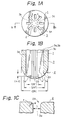
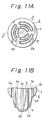
- a first embodied wear nib 1 is of a longitudinal solid form having an axial length of 8.8 mm and a diameter (2R) of 1.0 mm.
- the wear nib 1 has a coaxially extending ink passage 3 formed therein, which partially open axially at a head 2 of the nib.
- the head 2 is formed to be round.
- the coaxial passage 3 has, in a cross-sectional view, a coaxial portion 3c, equiangularly spaced intermediate connecting portions 3b and equiangularly spaced outer peripheral portions 3a.
- the coaxial portion 3c communicates with the outer peripheral portions 3a through corresponding intermediate connecting portions 3b.
- the coaxial portion 3c and the intermediate connecting portions 3b are all closed axially at the head 2, whereas each outer peripheral portion 3a completely opens axially whereby peripheral axial openings or outlets 2A for ink are formed at the head 2 around a central area of the head top surface as shown in Fig. IA and Fig. 1B.
- the peripheral openings 2A have a radially extending form, and are chamfered to form a round edge 4 having a curvature radius r of 0.03 mm.
- the central passage portion 3c and the intermediate connecting passage portions 3b are all covered by a central portion 2a of the head 2, which axial thickness is 0.05 mm.
- the width L of the opening 2A or outer passage portion 3a is 0.04 mm.
- the intermediate connecting passage portions 3b have the same profile and a radially extending form.
- the nib with the above coaxial ink passage 3 having the peripheral outlets 2A is rotation symmetrical.
- the covering head portion 2a has a central local surface area of a coaxial circle inscribing peripheral openings located the shortest radial distance form the nib axis or center.
- the inscribed circle has a radius R′ of 0.025 mm to 0.8 R ⁇ , where R ⁇ is a radius of a circle circumscribing at least some of the peripheral openings, of which the utmost radially outer edges are radially spaced at the longest distance from the center of the head.
- the radius R′ of the inscribed circle is 0.06 mm, and a radius R of the nib is 0.5 mm.
- the radius of the inscribed circle is a critical factor when designing a pattern of the coaxial ink passage having only peripheral openings at the nib head.
- axial gap H between the covering head portion 2a at each intermediate connecting passage portion 3b and the utmost radially outer edge point of a corresponding peripheral opening 2A.
- This axial gap H allows the intermediate passage portions 3b to open radially at the axial peripheral axial openings 2A, so that the ink in the intermediate connecting passage portions 3b can flow out of the openings of the outer passage portions 3A at the head directly, and is allowed to flow into the adjacent outer passage portions 2A over the entire axial length.
- the nib of the present invention is provided therein with an ink reservoir formed by the central portion 3c and the intermediate connecting portions 3b of the coaxial passage 3.
- the ink is supplied directly from a tank provided in the writing instrument to the peripheral outer passage portions 3a and to the internal reservoir (3b, 3c), and the ink in the peripheral outer passage portions 3a is supplied onto a paper, during writing, through the peripheral axial openings 2A, while the ink in the internal reservoir (3b, 3c) can be fed radially to the peripheral outer passage portions 3a over the entire axial length.
- the ink in the internal reservoir (3b, 3c) can be supplied radially to the peripheral openings 2A directly without passing through the peripheral outer passage portions 3a at the nib head 2.
- the nib allows a smooth writing with the instrument at any position between the vertical position and an inclined position of 50° from the vertical position.
- peripheral openings 2A have the chamfered round edges, the dust produced from a paper can be easily removed from the openings 2A.
- the nib Since the nib has the covering top head portion 2a, which is smoothly round, the paper is considerably less damaged with less produced dust even in a high speed writing, in comparison with a conventional nib having a central opening. Further, ink flowing through the peripheral openings 2A is superior to that of a conventional nib having no coaxial opening but having the same peripheral openings. The writing resistance is considerably reduced, compared with the above non-coaxial opening nib.
- the wear pen nib 1 is thus advantageous for use onto either a soft paper or a hard paper or the like, and for use in either a hand writing or a high speed writing by a plotter.
- a second embodied wear nib 1 is substantially the same as or similar to that of Fig. 1 except that a corresponding covering head portion 2a is made thicker at a corresponding central passage portion 3c to thereby project locally inward at a central area of the rear face.
- the thickness of the locally projected covering head portion is 0.26 mm.
- a round edge of each corresponding peripheral opening 3a has a curvature radius of 0.09 mm.
- the second embodied wear nib Due to the increased thickness of the covering head portion, the second embodied wear nib has an increased resistance against impact generated by the paper when the nib is forced to touch the paper frequently with a relatively strong force for writing, and thus it is more preferable for use in a plotter in this respect.
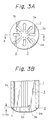
- a third embodied wear nib 1 is substantially the same as or similar to that of Fig. 1 except for a corresponding head 2 having a flattened top local face, a corresponding covering head portion being thicker (0.17 mm thickness) over the entire rear face thereof, and each corresponding outer passage portion 3a having an enlarged semi-circle local portion 3e, so that the ink supply ability of a corresponding peripheral opening 3a is increased.
- a corresponding axial gap H is a negative value, so that the thick covering head portion 2 prevents each corresponding intermediate passage portion 3b from opening radially at a corresponding enlarged opening 2A.
- the nib of Fig. 3 has an increased resistance against the impact compared to that of Fig. 2.
- a round edge of each enlarged opening 2A has a curvature radius of 0.2 mm.
- a fourth embodied wear nib is substantially the same as or similar to that of Fig. 1 except for each corresponding outer passage portion 3a and opening 2A having a waved or S-shaped profile.
- the waved openings may have corresponding utmost radially outer and inner edge points arranged along the same circles as those of Fig. 1.
- the nib such as shown in Fig. 4 can have the waved openings enlarged in the entire area, relative to the straight openings of Fig. 1, while the number of the openings is the same, but the width of the written line on the paper is the same.
- the ink supply ability of the nib is increased compared with that of Fig. 1.
- the nib such as shown in Fig. 4 can have the same entire area of the openings as that of Fig. 1, but the number of the openings of Fig. 4 is reduced. In this case, the writing resistance of the nib is reduced, and a possible amount of the dust from the paper is reduced.
- the S-shaped opening is advantageous in that it is not easy for the dust to clog the opening, since the opening orients in various directions rather than a single direction such as that of Fig. 1.
- the thickness of a corresponding covering head portion 2a of Fig. 4 is 0.08 mm, and a corresponding inscribed circle has a radius R′ of 0.025 mm, and a radius R of the nib is 0.4 mm.
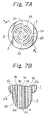
- a fifth embodied wear nib is substantially the same as or similar to that of Fig. 1 except for a second group of outer passage portions 3′a being additionally formed radially outside of corresponding outer passage portions 3a with additional intermediate connecting passage portions 3′b provided between the first and second groups of outer passage portions 3a and 3′a.
- the additional intermediate connecting passage portions 3′b are all axially closed at the head 2, similar to corresponding intermediate passage portions 3b.
- Each pair of the intermediate passage portions 3b and 3b′ extends in the same radial direction, and each pair of the outer passage portions 3a and 3′a is located in the same radial direction.
- Each group of outer passage portions 3a or 3′a is equiangularly spaced around the center of the head, and open at respective peripheral openings 2A or 2′A.
- a corresponding covering head portion 2 also covering the additional intermediate connecting passage portions 3′b, has an axial thickness of 0.03mm.
- a corresponding inscribed circle has a radius R′ of 0.1mm, and a radius R of the nib is 0.6mm.
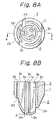
- the nibs of Figs. 6, 7, 8 and 9 have a further improved capacity for supplying the ink onto the paper from the openings in various directions other than that of Fig. 5.
- a third group of peripheral openings 3 ⁇ A is spaced equiangularly along a circle in the vicinity of the periphery of the top head surface, and thus the writing stability with the nib inclined relative to the paper is improved, compared with that of the fifth embodied nib as shown in Fig. 5.
- a tenth embodied wear nib is substantially the same as or similar to that of Fig. 1 except that each corresponding peripheral axial opening 2A, has a stepped portion 5 following the edge thereof.
- the stepped opening portion 5 is an enlarged top portion of the axial openings 2A, and forms a groove for guiding and discharging the dust out of the opening, together with the ink. Since the nib head 2 is round or pointed as shown in Fig. 10, the groove 5 can have a local face extending in a direction semi-perpendicular to the nib axis or inclined toward the rear end of the nib in the radial direction at the utmost radially outer edge of the peripheral opening 2A, in an axially sectional view of the nib.
- the stepped opening portion 5 has inner and outer local faces 5a, 5b, but preferably both the local faces, in combination, form a single flat face at the utmost radially outer edge of the opening 2A or 2B, i.e., preferably the opening may not be stepped at the utmost radially outer edge, in addition to the utmost radially inner edge.
- an eleventh embodied nib is substantially the same or similar to that of Fig. 5 except for each corresponding peripheral opening 3A having a groove 5 equivalent to that of Fig. 10.
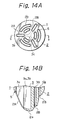
- nibs are substantially the same or similar to that of Fig. 10 except for additional peripheral openings 2B being formed at the nib head, each with a corresponding groove 5, and additional axially extending passages 3B being formed in the nib to open axially at corresponding additional peripheral openings 2B.
- the additional peripheral openings 2B of Figs. 12 and 14 are spaced equiangularly and are arranged alternately with the radially inner peripheral openings 2A of a corresponding coaxial passage 3a around the center of the nib head.
- the pattern of the peripheral openings as shown in Fig. 13 is substantially the same as that of Fig. 5 except for the radially outer openings 2B of Fig. 13 being isolated from the others, whereas corresponding outer openings 2′A of Fig. 5 communicate with the inner openings 2A via the intermediate connecting passage portions 3b.
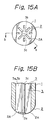
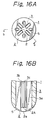
- the embodied nibs are substantially the same or similar to those of Fig. 1 and Fig. 10, respectively, except for corresponding peripheral openings 3A consisting of radially longer openings and radially shorter openings, which are arranged alternately with each other around the center of the nib head 2.
- the nibs as shown in Figs. 15 and 16 can provide an enlarged portion 2a of the head 2 covering the central and intermediate passage portions (3c and 3b), assuming that the entire area of the peripheral openings 3A is the same.
- the enlarged covering head portion 2a decreases an amount of dust produced from a paper during a high speed writing, and decreases a writing resistance, while maintaining the same ink supply ability.
- a corresponding inscribed circle of Fig. 15 has a radius of 0.06mm, and a radius of the nib is 0.45mm.
- Figs. 1 to 16 show wear nibs of a cylindrical axial extension, having a round head 2
- Fig. 17 shows a wear nib 1 consisting of a cylindrical axial extension portion 7, polygonal tapered portion 8 and a round head 2 having peripheral openings 2A similar to those of Fig. 10.
- the cylindrical portion 7 is disposed into the body of the writing instrument and the polygonal tapered portion 8 acts as a stopper against the body.
- the wear nib is produced, using an injection molding, with a subsequent heat treatment such as a sintering process.
- a wear nib having a relatively complicated profile such as that of Fig. 17, as needed, by the above method, whereas the extruding method cannot produce such a complicated profiled nib, although it also, of course, cannot produce a nib having a coaxial ink passage formed in the nib body, which partially opens axially at peripheral openings formed in the nib head around the center thereof.
Landscapes
- Pens And Brushes (AREA)
Applications Claiming Priority (6)
| Application Number | Priority Date | Filing Date | Title |
|---|---|---|---|
| JP44996/91U | 1991-06-14 | ||
| JP4499691 | 1991-06-14 | ||
| JP1774492U JP2533157Y2 (ja) | 1991-06-14 | 1992-03-30 | 筆記用ペン先 |
| JP17744/92U | 1992-03-30 | ||
| JP28502/92U | 1992-04-28 | ||
| JP2850292U JPH0586571U (ja) | 1992-04-28 | 1992-04-28 | 筆記用ペン先 |
Publications (2)
| Publication Number | Publication Date |
|---|---|
| EP0518708A1 true EP0518708A1 (fr) | 1992-12-16 |
| EP0518708B1 EP0518708B1 (fr) | 1995-03-29 |
Family
ID=27281950
Family Applications (1)
| Application Number | Title | Priority Date | Filing Date |
|---|---|---|---|
| EP92305490A Expired - Lifetime EP0518708B1 (fr) | 1991-06-14 | 1992-06-15 | Pointe d'écriture pour instrument à écrire |
Country Status (4)
| Country | Link |
|---|---|
| US (1) | US5238320A (fr) |
| EP (1) | EP0518708B1 (fr) |
| DE (1) | DE69201826T2 (fr) |
| HK (1) | HK31596A (fr) |
Cited By (2)
| Publication number | Priority date | Publication date | Assignee | Title |
|---|---|---|---|---|
| WO1995000345A1 (fr) * | 1993-06-25 | 1995-01-05 | J.S. Staedtler Gmbh & Co | Corps moules comportant des canaux axiaux et leur procede de fabrication |
| FR2856012A1 (fr) * | 2003-06-10 | 2004-12-17 | Isaac Emile Leon Steidl | Pointe d'ecriture a canaux capillaires |
Families Citing this family (4)
| Publication number | Priority date | Publication date | Assignee | Title |
|---|---|---|---|---|
| FR2855818B1 (fr) * | 2003-06-06 | 2006-03-31 | Yves Ducroquet | Dispositif applicateur de produit liquide |
| US20080247809A1 (en) * | 2003-06-06 | 2008-10-09 | Richard Rene Bloc | Assembly With Applicator Device For Applying A Liquid Such As Scent On A Wetable Surface Such As Human Skin |
| US20080142406A1 (en) * | 2006-12-18 | 2008-06-19 | Spatz Laboratories | Flexible cosmetic applicator |
| US20090154983A1 (en) * | 2007-12-12 | 2009-06-18 | University Of Southern California | Multi-color writing and painting instruments with single nib fed with user-selected colored ink |
Citations (5)
| Publication number | Priority date | Publication date | Assignee | Title |
|---|---|---|---|---|
| US3614248A (en) * | 1967-07-25 | 1971-10-19 | Katsumi Otsuka | Pen wick made of synthetic resin |
| FR2228599A1 (fr) * | 1973-05-11 | 1974-12-06 | Global Control Corp | |
| FR2386421A1 (fr) * | 1977-04-07 | 1978-11-03 | Pentel Kk | Tige extrudee en matiere synthetique avec passages capillaires pour stylographe, et stylographe pourvu de cette tige |
| GB2169562A (en) * | 1984-09-27 | 1986-07-16 | Pentel Kk | A ceramic nib for a writing instrument |
| GB2217658A (en) * | 1987-11-12 | 1989-11-01 | Mitsubishi Pencil Co | Writing tip for liquid writing instrument |
Family Cites Families (6)
| Publication number | Priority date | Publication date | Assignee | Title |
|---|---|---|---|---|
| BE463518A (fr) * | 1943-11-16 | |||
| GB1112684A (en) * | 1965-05-13 | 1968-05-08 | R W Hare Ltd | Improvements in and relating to writing and like instruments or devices |
| US3467478A (en) * | 1965-07-27 | 1969-09-16 | Brunswick Corp | Pen point |
| BE794388A (fr) * | 1972-01-24 | 1973-07-23 | Gillette Co | Instruments pour ecrire, procede de realisation et moyen de mise en oeuvre du procede |
| DE2535906A1 (de) * | 1975-08-12 | 1977-02-17 | Pelikan Werke Wagner Guenther | Schreibspitze fuer fluessigkeits- schreibgeraete |
| GB8312584D0 (en) * | 1983-05-06 | 1983-06-08 | Gillette Co | Pens |
-
1992
- 1992-06-15 EP EP92305490A patent/EP0518708B1/fr not_active Expired - Lifetime
- 1992-06-15 DE DE69201826T patent/DE69201826T2/de not_active Expired - Fee Related
- 1992-06-15 US US07/898,957 patent/US5238320A/en not_active Expired - Fee Related
-
1996
- 1996-02-22 HK HK31596A patent/HK31596A/en not_active IP Right Cessation
Patent Citations (5)
| Publication number | Priority date | Publication date | Assignee | Title |
|---|---|---|---|---|
| US3614248A (en) * | 1967-07-25 | 1971-10-19 | Katsumi Otsuka | Pen wick made of synthetic resin |
| FR2228599A1 (fr) * | 1973-05-11 | 1974-12-06 | Global Control Corp | |
| FR2386421A1 (fr) * | 1977-04-07 | 1978-11-03 | Pentel Kk | Tige extrudee en matiere synthetique avec passages capillaires pour stylographe, et stylographe pourvu de cette tige |
| GB2169562A (en) * | 1984-09-27 | 1986-07-16 | Pentel Kk | A ceramic nib for a writing instrument |
| GB2217658A (en) * | 1987-11-12 | 1989-11-01 | Mitsubishi Pencil Co | Writing tip for liquid writing instrument |
Cited By (2)
| Publication number | Priority date | Publication date | Assignee | Title |
|---|---|---|---|---|
| WO1995000345A1 (fr) * | 1993-06-25 | 1995-01-05 | J.S. Staedtler Gmbh & Co | Corps moules comportant des canaux axiaux et leur procede de fabrication |
| FR2856012A1 (fr) * | 2003-06-10 | 2004-12-17 | Isaac Emile Leon Steidl | Pointe d'ecriture a canaux capillaires |
Also Published As
| Publication number | Publication date |
|---|---|
| US5238320A (en) | 1993-08-24 |
| DE69201826T2 (de) | 1995-07-27 |
| EP0518708B1 (fr) | 1995-03-29 |
| HK31596A (en) | 1996-03-01 |
| DE69201826D1 (de) | 1995-05-04 |
Similar Documents
| Publication | Publication Date | Title |
|---|---|---|
| EP0518708B1 (fr) | Pointe d'écriture pour instrument à écrire | |
| US4208145A (en) | Nib for writing instruments | |
| US20190262879A1 (en) | Method for Producing a Blank from Extrusion Material, and Extruder | |
| KR20090040853A (ko) | 니들형 볼펜 팁 | |
| EP1632359A1 (fr) | Procede de production d'une pointe d'applicateur | |
| JPH0241438B2 (fr) | ||
| JP2648941B2 (ja) | 合成樹脂製筆記用ペン軸 | |
| US4386867A (en) | Multangular pen nib construction | |
| JP7093581B2 (ja) | ペン及びペン用リフィル | |
| KR200178144Y1 (ko) | 직액식 필기구 | |
| JPH0331578Y2 (fr) | ||
| JP3289253B2 (ja) | 筆記用ペン先 | |
| JP4707003B2 (ja) | 合成樹脂製ペン先 | |
| CN215751602U (zh) | 一种多色选用的荧光笔 | |
| JPS6341183Y2 (fr) | ||
| JP2533157Y2 (ja) | 筆記用ペン先 | |
| JPH0586571U (ja) | 筆記用ペン先 | |
| CN213639989U (zh) | 一种自成型化妆笔 | |
| JP7402442B2 (ja) | 液体供給体およびこの液体供給体を備える塗布具 | |
| JPS6350145Y2 (fr) | ||
| JPS641101Y2 (fr) | ||
| JPH0578591U (ja) | 筆記用ペン先 | |
| JP2006509657A (ja) | 通気溝を設けられた軸部を有するボールペン先体 | |
| JP2002086974A (ja) | 筆記具用金属製ペン先 | |
| JP2846318B2 (ja) | 筆ペン用ペン体 |
Legal Events
| Date | Code | Title | Description |
|---|---|---|---|
| PUAI | Public reference made under article 153(3) epc to a published international application that has entered the european phase |
Free format text: ORIGINAL CODE: 0009012 |
|
| AK | Designated contracting states |
Kind code of ref document: A1 Designated state(s): CH DE FR GB LI |
|
| 17P | Request for examination filed |
Effective date: 19930524 |
|
| 17Q | First examination report despatched |
Effective date: 19930922 |
|
| GRAA | (expected) grant |
Free format text: ORIGINAL CODE: 0009210 |
|
| AK | Designated contracting states |
Kind code of ref document: B1 Designated state(s): CH DE FR GB LI |
|
| REF | Corresponds to: |
Ref document number: 69201826 Country of ref document: DE Date of ref document: 19950504 |
|
| ET | Fr: translation filed | ||
| PLBE | No opposition filed within time limit |
Free format text: ORIGINAL CODE: 0009261 |
|
| STAA | Information on the status of an ep patent application or granted ep patent |
Free format text: STATUS: NO OPPOSITION FILED WITHIN TIME LIMIT |
|
| 26N | No opposition filed | ||
| PGFP | Annual fee paid to national office [announced via postgrant information from national office to epo] |
Ref country code: GB Payment date: 20010605 Year of fee payment: 10 |
|
| PGFP | Annual fee paid to national office [announced via postgrant information from national office to epo] |
Ref country code: FR Payment date: 20010628 Year of fee payment: 10 |
|
| PGFP | Annual fee paid to national office [announced via postgrant information from national office to epo] |
Ref country code: DE Payment date: 20010629 Year of fee payment: 10 |
|
| PGFP | Annual fee paid to national office [announced via postgrant information from national office to epo] |
Ref country code: CH Payment date: 20010816 Year of fee payment: 10 |
|
| REG | Reference to a national code |
Ref country code: GB Ref legal event code: IF02 |
|
| PG25 | Lapsed in a contracting state [announced via postgrant information from national office to epo] |
Ref country code: GB Free format text: LAPSE BECAUSE OF NON-PAYMENT OF DUE FEES Effective date: 20020615 |
|
| PG25 | Lapsed in a contracting state [announced via postgrant information from national office to epo] |
Ref country code: LI Free format text: LAPSE BECAUSE OF NON-PAYMENT OF DUE FEES Effective date: 20020630 Ref country code: CH Free format text: LAPSE BECAUSE OF NON-PAYMENT OF DUE FEES Effective date: 20020630 |
|
| PG25 | Lapsed in a contracting state [announced via postgrant information from national office to epo] |
Ref country code: DE Free format text: LAPSE BECAUSE OF NON-PAYMENT OF DUE FEES Effective date: 20030101 |
|
| GBPC | Gb: european patent ceased through non-payment of renewal fee |
Effective date: 20020615 |
|
| REG | Reference to a national code |
Ref country code: CH Ref legal event code: PL |
|
| PG25 | Lapsed in a contracting state [announced via postgrant information from national office to epo] |
Ref country code: FR Free format text: LAPSE BECAUSE OF NON-PAYMENT OF DUE FEES Effective date: 20030228 |
|
| REG | Reference to a national code |
Ref country code: FR Ref legal event code: ST |