EP0522814A2 - Method of fabricating ink-jet type printer head - Google Patents
Method of fabricating ink-jet type printer head Download PDFInfo
- Publication number
- EP0522814A2 EP0522814A2 EP92306186A EP92306186A EP0522814A2 EP 0522814 A2 EP0522814 A2 EP 0522814A2 EP 92306186 A EP92306186 A EP 92306186A EP 92306186 A EP92306186 A EP 92306186A EP 0522814 A2 EP0522814 A2 EP 0522814A2
- Authority
- EP
- European Patent Office
- Prior art keywords
- low
- grooves
- piezoelectric members
- rigidity member
- piezoelectric
- Prior art date
- Legal status (The legal status is an assumption and is not a legal conclusion. Google has not performed a legal analysis and makes no representation as to the accuracy of the status listed.)
- Granted
Links
Images


Classifications
-
- B—PERFORMING OPERATIONS; TRANSPORTING
- B41—PRINTING; LINING MACHINES; TYPEWRITERS; STAMPS
- B41J—TYPEWRITERS; SELECTIVE PRINTING MECHANISMS, i.e. MECHANISMS PRINTING OTHERWISE THAN FROM A FORME; CORRECTION OF TYPOGRAPHICAL ERRORS
- B41J2/00—Typewriters or selective printing mechanisms characterised by the printing or marking process for which they are designed
- B41J2/005—Typewriters or selective printing mechanisms characterised by the printing or marking process for which they are designed characterised by bringing liquid or particles selectively into contact with a printing material
- B41J2/01—Ink jet
- B41J2/135—Nozzles
- B41J2/16—Production of nozzles
- B41J2/1621—Manufacturing processes
- B41J2/1632—Manufacturing processes machining
-
- B—PERFORMING OPERATIONS; TRANSPORTING
- B41—PRINTING; LINING MACHINES; TYPEWRITERS; STAMPS
- B41J—TYPEWRITERS; SELECTIVE PRINTING MECHANISMS, i.e. MECHANISMS PRINTING OTHERWISE THAN FROM A FORME; CORRECTION OF TYPOGRAPHICAL ERRORS
- B41J2/00—Typewriters or selective printing mechanisms characterised by the printing or marking process for which they are designed
- B41J2/005—Typewriters or selective printing mechanisms characterised by the printing or marking process for which they are designed characterised by bringing liquid or particles selectively into contact with a printing material
- B41J2/01—Ink jet
- B41J2/135—Nozzles
- B41J2/14—Structure thereof only for on-demand ink jet heads
- B41J2/14201—Structure of print heads with piezoelectric elements
- B41J2/14209—Structure of print heads with piezoelectric elements of finger type, chamber walls consisting integrally of piezoelectric material
-
- B—PERFORMING OPERATIONS; TRANSPORTING
- B41—PRINTING; LINING MACHINES; TYPEWRITERS; STAMPS
- B41J—TYPEWRITERS; SELECTIVE PRINTING MECHANISMS, i.e. MECHANISMS PRINTING OTHERWISE THAN FROM A FORME; CORRECTION OF TYPOGRAPHICAL ERRORS
- B41J2/00—Typewriters or selective printing mechanisms characterised by the printing or marking process for which they are designed
- B41J2/005—Typewriters or selective printing mechanisms characterised by the printing or marking process for which they are designed characterised by bringing liquid or particles selectively into contact with a printing material
- B41J2/01—Ink jet
- B41J2/135—Nozzles
- B41J2/16—Production of nozzles
- B41J2/1607—Production of print heads with piezoelectric elements
- B41J2/1609—Production of print heads with piezoelectric elements of finger type, chamber walls consisting integrally of piezoelectric material
-
- B—PERFORMING OPERATIONS; TRANSPORTING
- B41—PRINTING; LINING MACHINES; TYPEWRITERS; STAMPS
- B41J—TYPEWRITERS; SELECTIVE PRINTING MECHANISMS, i.e. MECHANISMS PRINTING OTHERWISE THAN FROM A FORME; CORRECTION OF TYPOGRAPHICAL ERRORS
- B41J2/00—Typewriters or selective printing mechanisms characterised by the printing or marking process for which they are designed
- B41J2/005—Typewriters or selective printing mechanisms characterised by the printing or marking process for which they are designed characterised by bringing liquid or particles selectively into contact with a printing material
- B41J2/01—Ink jet
- B41J2/135—Nozzles
- B41J2/16—Production of nozzles
- B41J2/1621—Manufacturing processes
- B41J2/1623—Manufacturing processes bonding and adhesion
-
- B—PERFORMING OPERATIONS; TRANSPORTING
- B41—PRINTING; LINING MACHINES; TYPEWRITERS; STAMPS
- B41J—TYPEWRITERS; SELECTIVE PRINTING MECHANISMS, i.e. MECHANISMS PRINTING OTHERWISE THAN FROM A FORME; CORRECTION OF TYPOGRAPHICAL ERRORS
- B41J2/00—Typewriters or selective printing mechanisms characterised by the printing or marking process for which they are designed
- B41J2/005—Typewriters or selective printing mechanisms characterised by the printing or marking process for which they are designed characterised by bringing liquid or particles selectively into contact with a printing material
- B41J2/01—Ink jet
- B41J2/135—Nozzles
- B41J2/16—Production of nozzles
- B41J2/1621—Manufacturing processes
- B41J2/164—Manufacturing processes thin film formation
- B41J2/1643—Manufacturing processes thin film formation thin film formation by plating
-
- B—PERFORMING OPERATIONS; TRANSPORTING
- B41—PRINTING; LINING MACHINES; TYPEWRITERS; STAMPS
- B41J—TYPEWRITERS; SELECTIVE PRINTING MECHANISMS, i.e. MECHANISMS PRINTING OTHERWISE THAN FROM A FORME; CORRECTION OF TYPOGRAPHICAL ERRORS
- B41J2202/00—Embodiments of or processes related to ink-jet or thermal heads
- B41J2202/01—Embodiments of or processes related to ink-jet heads
- B41J2202/20—Modules
-
- Y—GENERAL TAGGING OF NEW TECHNOLOGICAL DEVELOPMENTS; GENERAL TAGGING OF CROSS-SECTIONAL TECHNOLOGIES SPANNING OVER SEVERAL SECTIONS OF THE IPC; TECHNICAL SUBJECTS COVERED BY FORMER USPC CROSS-REFERENCE ART COLLECTIONS [XRACs] AND DIGESTS
- Y10—TECHNICAL SUBJECTS COVERED BY FORMER USPC
- Y10T—TECHNICAL SUBJECTS COVERED BY FORMER US CLASSIFICATION
- Y10T29/00—Metal working
- Y10T29/42—Piezoelectric device making
-
- Y—GENERAL TAGGING OF NEW TECHNOLOGICAL DEVELOPMENTS; GENERAL TAGGING OF CROSS-SECTIONAL TECHNOLOGIES SPANNING OVER SEVERAL SECTIONS OF THE IPC; TECHNICAL SUBJECTS COVERED BY FORMER USPC CROSS-REFERENCE ART COLLECTIONS [XRACs] AND DIGESTS
- Y10—TECHNICAL SUBJECTS COVERED BY FORMER USPC
- Y10T—TECHNICAL SUBJECTS COVERED BY FORMER US CLASSIFICATION
- Y10T29/00—Metal working
- Y10T29/49—Method of mechanical manufacture
- Y10T29/49401—Fluid pattern dispersing device making, e.g., ink jet
-
- Y—GENERAL TAGGING OF NEW TECHNOLOGICAL DEVELOPMENTS; GENERAL TAGGING OF CROSS-SECTIONAL TECHNOLOGIES SPANNING OVER SEVERAL SECTIONS OF THE IPC; TECHNICAL SUBJECTS COVERED BY FORMER USPC CROSS-REFERENCE ART COLLECTIONS [XRACs] AND DIGESTS
- Y10—TECHNICAL SUBJECTS COVERED BY FORMER USPC
- Y10T—TECHNICAL SUBJECTS COVERED BY FORMER US CLASSIFICATION
- Y10T29/00—Metal working
- Y10T29/49—Method of mechanical manufacture
- Y10T29/49789—Obtaining plural product pieces from unitary workpiece
- Y10T29/49796—Coacting pieces
Definitions
- the present invention relates to a method of producing an ink-jet type printer head of an on-demand type.
- a piezoelectric member 30 has a plurality of pressure chambers 31 coupled to an ink supply unit, which are respectively partitioned by side walls 32.
- a plurality of nozzles 33 are defined in one end of each pressure chamber 31, respectively.
- a roof 34 is stuck on the piezoelectric member 30 to close the pressure chambers 31.
- a pair of opposed electrodes 35, 36 are formed onto both side faces of each of the side walls 32.
- the piezoelectric member 30 is polarized in its thickness direction, i.e., in the direction indicated by the arrow ⁇ .
- the side wall 32 of the piezoelectric member 30 is deformed in the direction perpendicular to the polarized direction referred to above.
- the direction in which the side wall 32 is deformed is reversed depending on the polarity of the applied voltage.
- the capacity of the pressure chamber 31 partitioned by the side walls 32 is increased or decreased depending upon the polarity of the voltage applied between the electrodes 35 and 36.
- the capacity of the pressure chamber 31 increases, the pressure in the pressure chamber 31 is reduced to thereby suck ink from the ink supply unit.
- the capacity of the pressure chamber 31 is decreased, the pressure in the pressure chamber 31 is increased to thereby deliver the internally-supplied ink from the nozzle 33.
- the ink-jet type printer head for a line printer is manufactured using such a principle, it is necessary to set the width of the ink-jet type printer head to 210 mm or longer when its width is associated with the paper size of A4, for example. It is, however, difficult to fabricate the piezoelectric member in a long size of 210 mm or longer and in thin form. Even if the piezoelectric member is produced in this condition, it becomes expensive. Therefore, a subdivided head block 37 is formed as shown in FIGS. 8 and 9. Then, an ink-jet type printer head 38 suitable to a line printer is formed by coupling a plurality of subdivided head blocks 37 to one another so that they are disposed adjacent to one another as shown in FIG. 10.
- FIG. 11 shows the structure of each of the head blocks 37.
- Reference numeral 30 indicates a piezoelectric member which has a plurality of grooves 39 defined therein.
- the respective grooves 39 have electrodes (not shown) disposed on the inner surfaces thereof.
- the roof 34 for covering the grooves 39 is stuck on the piezoelectric member 30, and a nozzle plate 40 having a plurality of nozzles 33 defined therethrough in an opposing relationship to the leading ends of the grooves 39 is stuck on the end face of the piezoelectric member 30, thereby forming a head block 37.
- the head blocks 37 should be coupled to one another in plural form to form the ink-jet type printer head 38 shown in each of FIGS. 8 through 11. Therefore, joints between the adjacent head blocks 37 look awkward. It is also difficult to stick or couple the head blocks 37 to one another because the area of a face 41 for sticking or bonding the head blocks 37 to one another is small. Further, since the pitch of each of the grooves 39 to be arranged is small and a side wall 42 between the adjacent grooves 39 is narrow in width, the centers of the side walls 42 cannot be regarded as the junction between the piezoelectric members 30 disposed adjacent to one another, and the grooves 39 are also defined on the face 41 for sticking the piezoelectric members 30 to each other. Therefore, a process for preventing the ink from leaking out of the bottom of each groove 39 should also be carried out. Accordingly, the manufacturing cost of the printer head is raised.
- a method of fabricating an ink-jet type printer head comprising the steps of sticking a plurality of plate-shaped piezoelectric members polarized in their thickness directions on the surface of a low-rigidity member having a non-conductive property and a non-electrostrictive property so that the piezoelectric members are disposed adjacent to the low-rigidity member; defining a plurality of grooves extending from the surfaces of the piezoelectric members to the inside of the low-rigidity member by grinding in parallel at given intervals inclusive of positions at which the grooves extend through respective joints between the adjacent piezoelectric members; forming posts on both sides of each of the grooves; forming electrodes on two inner sides of each of the grooves; sticking a roof on the surfaces of the piezoelectric members so as to close top opening surfaces of the grooves, thereby defining a plurality of pressure chambers coupled to an ink supply unit; and forming a plurality of nozzles in one
- a piezoelectric member stuck on a single low-rigidity member can be divided into plural shapes. Therefore, inexpensive and short piezoelectric members can be used. It is also possible to form pressure chambers each partitioned into a shear-deformed piezoelectric member and a simple low-rigidity member. Therefore, the thickness of each piezoelectric member can be rendered thin and the cost of the piezoelectric member can be further reduced. In addition, the recessing can be applied to the low-rigidity member and each piezoelectric member stuck on the low-rigidity member in a stable state.
- a plurality of piezoelectric members can be brought into the same state as when they are shaped in integral form, without changing the shapes of the joints between the adjacent piezoelectric members. Further, grooves are defined in the joints between the adjacent piezoelectric members by grinding.
- the bottoms of the pressure chambers are formed by the single low-rigidity member, whereas the top surfaces thereof are formed by a single roof. Both sides of each pressure chamber are formed by posts each comprising the low-rigidity member and the piezoelectric member both of which have stuck to each other. It is, therefore, possible to reliably prevent ink from leaking out of each pressure chamber.
- the low-rigidity member has rigidity lower than that of the piezoelectric member, the resistivity of each post on the low-rigidity member side to each post on the piezoelectric member side can be reduced, thereby making it possible to increase the amount of strain of each post and improve the property of delivery of ink drops.
- a low-rigidity member (substrate) 1 which has a non-conductive property and a non-electrostrictive property, and which facilitates the production of an elongate shape, can be mechanically processed, and is formed of a material having rigidity lower than that of each of piezoelectric members 2 as in the case of liquid-crystal polymeric plastic, for example.
- a plurality of piezoelectric members 2, which are provided adjacent to one another, are stuck on the surface of the low-rigidity member 1.
- each piezoelectric member 2 is formed of a piezoelectric ceramic and polarized in its thickness direction.
- a plurality of grooves 3 and a plurality of columns or posts 4 are formed in the low-rigidity member 1 and each piezoelectric member 2 in such a manner as to be alternately arranged.
- the intervals of the respective grooves 3 to be arranged and the widths of the piezoelectric members 2 are determined in such a way that each of specific grooves 3 is positioned on a joint 2a between the adjacent piezoelectric members 2.
- these posts 4 comprise upper posts 4a formed in each piezoelectric member 2 and lower posts 4b formed integrally with the low-rigidity member 1.
- grooves 3 are mechanically processed by a diamond wheel 5 of a dicing saw used to cut an IC wafer.
- the respective grooves 3 are in communication with a passage 6 which extends at a right angle to the grooves 3.
- the passage 6 is formed of the low-rigidity member 1 before the respective piezoelectric members 2 are stuck on the low-rigidity member 1.
- electrodes 7 each having an inverted U-shaped cross section are formed in the respectively corresponding grooves 3. Thereafter, leads (not shown) are electrically connected to the electrodes 7.
- These electrodes 7 are formed by a means for forming a catalytic layer on the low-rigidity member 1 and each piezoelectric member 2 after they have been subjected to pre-processing prior to plating, subjecting them to either electroless nickel plating or electroless copper plating or electroless gold plating and removing a plated layer formed onto the surface of each piezoelectric member 2.
- a roof 8 is stuck on the surface of each piezoelectric member 2 so as to close or block an opening surface or area of each groove 3, thereby defining a plurality of pressure chambers 10.
- nozzle plates 12 having a plurality of nozzles 11 are stuck onto corresponding end faces of the low-rigidity member 1 and the piezoelectric member 2.
- an ink-jet type printer head 14 is formed by connecting an ink supply pipe 13 to the passage 6.
- Designated at numeral 15 is a platen on which a roll of sheet 16 is wound.
- ink is delivered from a centrally-defined pressure chamber 10 under the construction referred to above with reference to FIG. 5.
- the centrally-defined pressure chamber is indicated by 10c, and pressure chambers disposed on both sides as seen from the centrally-defined pressure chamber 10c are denoted by 10L, 10R respectively.
- a central electrode is indicated by 7c, and electrodes disposed on both sides as seen from the central electrode 7c are denoted by 7L, 7R respectively.
- the posts 4 located on both sides of the central pressure chamber 7c are symmetrically deformed outward as indicated by the chain lines to thereby increase the capacity of the central pressure chamber 10c and to reduce its internal pressure.
- the ink in an ink supply unit is sucked into the central pressure chamber 10c.
- the posts 4 serve to return to the original form owing to strain energy stored in the posts 4. Therefore, the capacity of the central pressure chamber 10c is reduced so that its internal pressure is raised.
- the ink of the central pressure chamber 10c is delivered from the nozzle 11.
- each upper post 4a is formed of the piezoelectric member 2 having high rigidity
- each lower post 4b is formed of the low-rigidity member 1 which is made of a synthetic resin and has rigidity lower than that of the piezoelectric member 2. Therefore, the resistivity of each lower post 4b to the strain of each upper post 4a is reduced, thus increasing the amount of strain of each post 4 so as to enable the property of delivery of ink drops to be improved.
- a piezoelectric member 2 stuck on a single low-rigidity member 1 can be divided into plural shapes. Therefore, an inexpensive and short piezoelectric member 2 can be used. It is also possible to form a pressure chamber 10 partitioned into a shear-deformed piezoelectric member 2 and a simple low-rigidity member 1. Therefore, the thickness of each piezoelectric member 2 can be rendered thin and the cost of each piezoelectric member 2 can be further reduced. In addition, the recessing can be applied to the low-rigidity member 1 and each piezoelectric member 2 stuck to the low-rigidity member 1 in a stable state.
- a plurality of piezoelectric members 2 can be brought into the same state as when they are shaped in an integral manner, without changing the shape of the joint 2a between the piezoelectric members 2.
- each of the grooves 3 is defined in the joint 2a between the adjacent piezoelectric members 2 by grinding.
- the bottoms of the pressure chambers 10 are formed by the single low-rigidity member 1, whereas the top surfaces thereof are formed of the single roof 8.
- Both sides of the pressure chamber 10 are formed of the posts 4 each comprising the low-rigidity member 1 and the piezoelectric member 2, both of which have stuck to each other. It is, therefore, possible to reliably prevent the ink from leaking out of the pressure chamber 10.
- an adhesive layer for causing a substrate 17 and a piezoelectric member 2 to stick to each other is used as a low-rigidity member 18.
- a plurality of grooves are defined so as to extend from the surface of the piezoelectric member 2 to the inside of the low-rigidity member 18.
- a plurality of pressure chambers 10 are defined by joining a roof 8 to the surface of the piezoelectric member 2.
- each of posts 4 disposed on both sides of the pressure chamber 10 comprises an upper post 4a of the piezoelectric member 2 and a lower post 4b of the low-rigidity member 18. Therefore, the amount of deformation of each post 4 can be increased in the same manner as the previous embodiment.
- the adhesive layer for joining the substrate 17 and the piezoelectric member 2 to each other is used as the low-rigidity member 18 as described above, it is unnecessary to make the substrate 17 non-conductive.
- the adhesive layer is mixed with a metal such as palladium or the like, which serves as a catalytic nucleus, thereby making it possible to apply the electroless plating to the low-rigidity member 18.
- a plurality of plate-shaped piezoelectric members polarized in their thickness directions are stuck, adjacent to one another, on the surface of a single low-rigidity member having a non-conductive property and a non-electrostrictive property.
- a plurality of grooves are defined in parallel at given intervals by grinding so as to extend from the surface of each of the piezoelectric members to the inside of the low-rigidity member, inclusive of positions at which the grooves extend through joints among the piezoelectric members.
- posts are formed on both sides of each of the grooves and electrodes are disposed on both inner sides of each groove.
- each piezoelectric member stuck on the single low-rigidity member can be divided into plural shapes, thereby making it possible to use inexpensive and short piezoelectric members. It is also possible to form a pressure chamber partitioned into a shear-deformed piezoelectric member and a simple low-rigidity member. Therefore, the thickness of each piezoelectric member can be decreased and the manufacturing cost of the piezoelectric member can be reduced.
- the recessing can be applied to the low-rigidity member and each piezoelectric member stuck to the low-rigidity member in a stable state.
- a plurality of piezoelectric members can be brought into the same state as when they are shaped in integral form, without changing the configurations of the joints among the piezoelectric members.
- the grooves are respectively defined in the joints among the piezoelectric members disposed adjacent to one another by grinding.
- the bottoms of the pressure chambers are formed by the single low-rigidity member, whereas the top surfaces thereof are formed by the single roof. Both sides of the pressure chamber are formed by the posts each comprising the low-rigidity member and the piezoelectric member, both of which have stuck to each other.
- the low-rigidity member has rigidity lower than that of the piezoelectric member, the resistivity of each post on the low-rigidity member side to the strain of each post on the piezoelectric member side can be reduced, thereby increasing the amount of strain of each post so as to enable the property of delivery of ink drops to be improved.
Landscapes
- Engineering & Computer Science (AREA)
- Manufacturing & Machinery (AREA)
- Particle Formation And Scattering Control In Inkjet Printers (AREA)
Abstract
Description
- The present invention relates to a method of producing an ink-jet type printer head of an on-demand type.
- An ink-jet type printer head disclosed in Japanese Patent Application Laid-Open No. Hei 2-150355 will first be described with reference to FIG. 7. More specifically, a
piezoelectric member 30 has a plurality ofpressure chambers 31 coupled to an ink supply unit, which are respectively partitioned by side walls 32. A plurality ofnozzles 33 are defined in one end of eachpressure chamber 31, respectively. Aroof 34 is stuck on thepiezoelectric member 30 to close thepressure chambers 31. Further, a pair of opposed electrodes 35, 36 are formed onto both side faces of each of the side walls 32. Thepiezoelectric member 30 is polarized in its thickness direction, i.e., in the direction indicated by the arrow γ. Thus, when a desired voltage is applied between the electrodes 35 and 36, the side wall 32 of thepiezoelectric member 30 is deformed in the direction perpendicular to the polarized direction referred to above. The direction in which the side wall 32 is deformed is reversed depending on the polarity of the applied voltage. Accordingly, the capacity of thepressure chamber 31 partitioned by the side walls 32 is increased or decreased depending upon the polarity of the voltage applied between the electrodes 35 and 36. When the capacity of thepressure chamber 31 increases, the pressure in thepressure chamber 31 is reduced to thereby suck ink from the ink supply unit. When, on the other hand, the capacity of thepressure chamber 31 is decreased, the pressure in thepressure chamber 31 is increased to thereby deliver the internally-supplied ink from thenozzle 33. - When the ink-jet type printer head for a line printer is manufactured using such a principle, it is necessary to set the width of the ink-jet type printer head to 210 mm or longer when its width is associated with the paper size of A4, for example. It is, however, difficult to fabricate the piezoelectric member in a long size of 210 mm or longer and in thin form. Even if the piezoelectric member is produced in this condition, it becomes expensive. Therefore, a subdivided
head block 37 is formed as shown in FIGS. 8 and 9. Then, an ink-jettype printer head 38 suitable to a line printer is formed by coupling a plurality of subdividedhead blocks 37 to one another so that they are disposed adjacent to one another as shown in FIG. 10. - FIG. 11 shows the structure of each of the
head blocks 37.Reference numeral 30 indicates a piezoelectric member which has a plurality ofgrooves 39 defined therein. Therespective grooves 39 have electrodes (not shown) disposed on the inner surfaces thereof. Theroof 34 for covering thegrooves 39 is stuck on thepiezoelectric member 30, and anozzle plate 40 having a plurality ofnozzles 33 defined therethrough in an opposing relationship to the leading ends of thegrooves 39 is stuck on the end face of thepiezoelectric member 30, thereby forming ahead block 37. - The
head blocks 37 should be coupled to one another in plural form to form the ink-jettype printer head 38 shown in each of FIGS. 8 through 11. Therefore, joints between theadjacent head blocks 37 look awkward. It is also difficult to stick or couple thehead blocks 37 to one another because the area of aface 41 for sticking or bonding thehead blocks 37 to one another is small. Further, since the pitch of each of thegrooves 39 to be arranged is small and aside wall 42 between theadjacent grooves 39 is narrow in width, the centers of theside walls 42 cannot be regarded as the junction between thepiezoelectric members 30 disposed adjacent to one another, and thegrooves 39 are also defined on theface 41 for sticking thepiezoelectric members 30 to each other. Therefore, a process for preventing the ink from leaking out of the bottom of eachgroove 39 should also be carried out. Accordingly, the manufacturing cost of the printer head is raised. - It is a first object of the present invention to provide an ink-jet type printer head which can be increased in width by using an inexpensive and narrow piezoelectric member.
- It is a second object of the present invention to provide an ink-jet type printer head which can be reduced in cost by using a thin piezoelectric member.
- It is a third object of the present invention to provide an ink-jet type printer head capable of reliably preventing ink from leaking out of a pressure chamber.
- It is a fourth object of the present invention to provide an ink-jet type printer head capable of increasing the amount of strain of each of posts so as to improve the property of delivery of ink drops.
- According to one aspect of the present invention, there is provided a method of fabricating an ink-jet type printer head, comprising the steps of sticking a plurality of plate-shaped piezoelectric members polarized in their thickness directions on the surface of a low-rigidity member having a non-conductive property and a non-electrostrictive property so that the piezoelectric members are disposed adjacent to the low-rigidity member; defining a plurality of grooves extending from the surfaces of the piezoelectric members to the inside of the low-rigidity member by grinding in parallel at given intervals inclusive of positions at which the grooves extend through respective joints between the adjacent piezoelectric members; forming posts on both sides of each of the grooves; forming electrodes on two inner sides of each of the grooves; sticking a roof on the surfaces of the piezoelectric members so as to close top opening surfaces of the grooves, thereby defining a plurality of pressure chambers coupled to an ink supply unit; and forming a plurality of nozzles in one end of each pressure chamber, respectively.
- Accordingly, a piezoelectric member stuck on a single low-rigidity member can be divided into plural shapes. Therefore, inexpensive and short piezoelectric members can be used. It is also possible to form pressure chambers each partitioned into a shear-deformed piezoelectric member and a simple low-rigidity member. Therefore, the thickness of each piezoelectric member can be rendered thin and the cost of the piezoelectric member can be further reduced. In addition, the recessing can be applied to the low-rigidity member and each piezoelectric member stuck on the low-rigidity member in a stable state. Thus, a plurality of piezoelectric members can be brought into the same state as when they are shaped in integral form, without changing the shapes of the joints between the adjacent piezoelectric members. Further, grooves are defined in the joints between the adjacent piezoelectric members by grinding. The bottoms of the pressure chambers are formed by the single low-rigidity member, whereas the top surfaces thereof are formed by a single roof. Both sides of each pressure chamber are formed by posts each comprising the low-rigidity member and the piezoelectric member both of which have stuck to each other. It is, therefore, possible to reliably prevent ink from leaking out of each pressure chamber. Further, since the low-rigidity member has rigidity lower than that of the piezoelectric member, the resistivity of each post on the low-rigidity member side to each post on the piezoelectric member side can be reduced, thereby making it possible to increase the amount of strain of each post and improve the property of delivery of ink drops.
- The above and other objects, features and advantages of the present invention will become apparent from the following description and the appended claims, taken in conjunction with the accompanying drawings in which preferred embodiments of the present invention are shown by way of illustrative example.
-
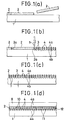
- FIG. 1 is a front view showing one embodiment of the present invention as claimed in
claims - FIG. 2 is a perspective view showing one step of the production process;
- FIG. 3 is a vertical sectional side view illustrating the one step of the production process;
- FIG. 4 is a perspective view showing the manner of completion of an ink-jet type printer head;
- FIG. 5 is a vertical sectional front view showing variations in strain of each post employed in the printer head;
- FIG. 6 is a vertical sectional side view depicting one embodiment of the present invention as claimed in
claim 3; - FIG. 7 is a vertical sectional front view illustrating a conventional example;
- FIG. 8 is a perspective view illustrating one step of a conventional production process;
- FIG. 9 is a perspective view showing one step of the conventional production process;
- FIG. 10 is a perspective view showing a conventional ink-jet type printer head; and
- FIG. 11 is an exploded perspective view showing a part of the printer head illustrated in FIG. 10.
- One embodiment of the present invention as claimed in
claims piezoelectric members 2 as in the case of liquid-crystal polymeric plastic, for example. A plurality ofpiezoelectric members 2, which are provided adjacent to one another, are stuck on the surface of the low-rigidity member 1. In addition, eachpiezoelectric member 2 is formed of a piezoelectric ceramic and polarized in its thickness direction. - As shown in FIGS. 1(b), 2 and 3, a plurality of
grooves 3 and a plurality of columns orposts 4 are formed in the low-rigidity member 1 and eachpiezoelectric member 2 in such a manner as to be alternately arranged. At this time, the intervals of therespective grooves 3 to be arranged and the widths of thepiezoelectric members 2 are determined in such a way that each ofspecific grooves 3 is positioned on a joint 2a between the adjacentpiezoelectric members 2. Accordingly, theseposts 4 compriseupper posts 4a formed in eachpiezoelectric member 2 andlower posts 4b formed integrally with the low-rigidity member 1. Thesegrooves 3 are mechanically processed by a diamond wheel 5 of a dicing saw used to cut an IC wafer. In FIGS. 2 and 3, therespective grooves 3 are in communication with apassage 6 which extends at a right angle to thegrooves 3. Thepassage 6 is formed of the low-rigidity member 1 before the respectivepiezoelectric members 2 are stuck on the low-rigidity member 1. - As shown in FIG. 1(c), electrodes 7 each having an inverted U-shaped cross section are formed in the respectively corresponding
grooves 3. Thereafter, leads (not shown) are electrically connected to the electrodes 7. These electrodes 7 are formed by a means for forming a catalytic layer on the low-rigidity member 1 and eachpiezoelectric member 2 after they have been subjected to pre-processing prior to plating, subjecting them to either electroless nickel plating or electroless copper plating or electroless gold plating and removing a plated layer formed onto the surface of eachpiezoelectric member 2. - As shown in FIG. 1(d), a
roof 8 is stuck on the surface of eachpiezoelectric member 2 so as to close or block an opening surface or area of eachgroove 3, thereby defining a plurality of pressure chambers 10. Further,nozzle plates 12 having a plurality ofnozzles 11 are stuck onto corresponding end faces of the low-rigidity member 1 and thepiezoelectric member 2. As illustrated in FIG. 4, an ink-jettype printer head 14 is formed by connecting anink supply pipe 13 to thepassage 6. Designated atnumeral 15 is a platen on which a roll ofsheet 16 is wound. - A description will now be made to the case where ink is delivered from a centrally-defined pressure chamber 10 under the construction referred to above with reference to FIG. 5. Now, the centrally-defined pressure chamber is indicated by 10c, and pressure chambers disposed on both sides as seen from the centrally-defined
pressure chamber 10c are denoted by 10L, 10R respectively. A central electrode is indicated by 7c, and electrodes disposed on both sides as seen from thecentral electrode 7c are denoted by 7L, 7R respectively. When a negative voltage is applied to theelectrode 7c formed onto the inner side face of thecentral pressure chamber 10c and a positive voltage is applied to each of theelectrodes posts 4 located on both sides of thecentral pressure chamber 7c are symmetrically deformed outward as indicated by the chain lines to thereby increase the capacity of thecentral pressure chamber 10c and to reduce its internal pressure. As a result, the ink in an ink supply unit is sucked into thecentral pressure chamber 10c. Then, when the application of the voltage to the above electrodes is stopped, theposts 4 serve to return to the original form owing to strain energy stored in theposts 4. Therefore, the capacity of thecentral pressure chamber 10c is reduced so that its internal pressure is raised. Thus, the ink of thecentral pressure chamber 10c is delivered from thenozzle 11. - At this time, each
upper post 4a is formed of thepiezoelectric member 2 having high rigidity, whereas eachlower post 4b is formed of the low-rigidity member 1 which is made of a synthetic resin and has rigidity lower than that of thepiezoelectric member 2. Therefore, the resistivity of eachlower post 4b to the strain of eachupper post 4a is reduced, thus increasing the amount of strain of eachpost 4 so as to enable the property of delivery of ink drops to be improved. - As described above, a
piezoelectric member 2 stuck on a single low-rigidity member 1 can be divided into plural shapes. Therefore, an inexpensive and shortpiezoelectric member 2 can be used. It is also possible to form a pressure chamber 10 partitioned into a shear-deformedpiezoelectric member 2 and a simple low-rigidity member 1. Therefore, the thickness of eachpiezoelectric member 2 can be rendered thin and the cost of eachpiezoelectric member 2 can be further reduced. In addition, the recessing can be applied to the low-rigidity member 1 and eachpiezoelectric member 2 stuck to the low-rigidity member 1 in a stable state. Thus, a plurality ofpiezoelectric members 2 can be brought into the same state as when they are shaped in an integral manner, without changing the shape of the joint 2a between thepiezoelectric members 2. Further, each of thegrooves 3 is defined in the joint 2a between the adjacentpiezoelectric members 2 by grinding. The bottoms of the pressure chambers 10 are formed by the single low-rigidity member 1, whereas the top surfaces thereof are formed of thesingle roof 8. Both sides of the pressure chamber 10 are formed of theposts 4 each comprising the low-rigidity member 1 and thepiezoelectric member 2, both of which have stuck to each other. It is, therefore, possible to reliably prevent the ink from leaking out of the pressure chamber 10. - One embodiment of the invention as claimed in
claim 3 will now be described with reference to FIG. 6. The same elements of structure as those employed in the aforementioned embodiment are identified by like reference numerals and their description will therefore be omitted. In the present embodiment, an adhesive layer for causing asubstrate 17 and apiezoelectric member 2 to stick to each other is used as a low-rigidity member 18. A plurality of grooves are defined so as to extend from the surface of thepiezoelectric member 2 to the inside of the low-rigidity member 18. Further, a plurality of pressure chambers 10 are defined by joining aroof 8 to the surface of thepiezoelectric member 2. In the present embodiment as well, each ofposts 4 disposed on both sides of the pressure chamber 10 comprises anupper post 4a of thepiezoelectric member 2 and alower post 4b of the low-rigidity member 18. Therefore, the amount of deformation of eachpost 4 can be increased in the same manner as the previous embodiment. - Since the adhesive layer for joining the
substrate 17 and thepiezoelectric member 2 to each other is used as the low-rigidity member 18 as described above, it is unnecessary to make thesubstrate 17 non-conductive. When the plating for forming electrodes 7 in the low-rigidity member 18 as the adhesive layer is made, the adhesive layer is mixed with a metal such as palladium or the like, which serves as a catalytic nucleus, thereby making it possible to apply the electroless plating to the low-rigidity member 18. - According to the present invention, a plurality of plate-shaped piezoelectric members polarized in their thickness directions are stuck, adjacent to one another, on the surface of a single low-rigidity member having a non-conductive property and a non-electrostrictive property. A plurality of grooves are defined in parallel at given intervals by grinding so as to extend from the surface of each of the piezoelectric members to the inside of the low-rigidity member, inclusive of positions at which the grooves extend through joints among the piezoelectric members. In addition, posts are formed on both sides of each of the grooves and electrodes are disposed on both inner sides of each groove. Then, a roof is stuck on the surface of each piezoelectric member to block or close the top opening area of each groove, thereby defining a plurality of pressure chambers coupled to an ink supply unit and each having one end at which a nozzle is provided. Therefore, the piezoelectric member stuck on the single low-rigidity member can be divided into plural shapes, thereby making it possible to use inexpensive and short piezoelectric members. It is also possible to form a pressure chamber partitioned into a shear-deformed piezoelectric member and a simple low-rigidity member. Therefore, the thickness of each piezoelectric member can be decreased and the manufacturing cost of the piezoelectric member can be reduced. Further, the recessing can be applied to the low-rigidity member and each piezoelectric member stuck to the low-rigidity member in a stable state. Thus, a plurality of piezoelectric members can be brought into the same state as when they are shaped in integral form, without changing the configurations of the joints among the piezoelectric members. Furthermore, the grooves are respectively defined in the joints among the piezoelectric members disposed adjacent to one another by grinding. The bottoms of the pressure chambers are formed by the single low-rigidity member, whereas the top surfaces thereof are formed by the single roof. Both sides of the pressure chamber are formed by the posts each comprising the low-rigidity member and the piezoelectric member, both of which have stuck to each other. It is, therefore, possible to reliably prevent the ink from leaking out of each pressure chamber. Since the low-rigidity member has rigidity lower than that of the piezoelectric member, the resistivity of each post on the low-rigidity member side to the strain of each post on the piezoelectric member side can be reduced, thereby increasing the amount of strain of each post so as to enable the property of delivery of ink drops to be improved.
- Having now fully described the invention, it will be apparent to those skilled in the art that many changes and modifications can be made without departing from the spirit or scope of the invention as set forth herein.
Claims (3)
- A method of fabricating an ink-jet type printer head, comprising the steps of:
sticking a plurality of plate-shaped piezoelectric members polarized in their thickness directions on the surface of a low-rigidity member having a non-conductive property and a non-electrostrictive property so that said piezoelectric members are disposed adjacent to said low-rigidity member;
defining a plurality of grooves extending from the surfaces of said piezoelectric members to the inside of said low-rigidity member by grinding in parallel at given intervals inclusive of positions at which said grooves extend through respective joints between said adjacent piezoelectric members;
forming posts on both sides of each of said grooves;
forming electrodes on two inner sides of each of said grooves;
sticking a roof on the surfaces of said piezoelectric members so as to close top opening surfaces of said grooves, thereby defining a plurality of pressure chambers coupled to an ink supply unit; and
forming a plurality of nozzles in one end of each of said pressure chambers, respectively. - A method according to claim 1, wherein said low-rigidity member is a substrate formed of plastic.
- A method according to claim 1, wherein said low-rigidity member is an adhesive layer for sticking each of said piezoelectric members and said substrate to each other.
Applications Claiming Priority (4)
| Application Number | Priority Date | Filing Date | Title |
|---|---|---|---|
| JP166631/91 | 1991-07-08 | ||
| JP16663191 | 1991-07-08 | ||
| JP3255565A JP2744535B2 (en) | 1991-07-08 | 1991-10-02 | Method of manufacturing ink jet printer head |
| JP255565/91 | 1991-10-02 |
Publications (3)
| Publication Number | Publication Date |
|---|---|
| EP0522814A2 true EP0522814A2 (en) | 1993-01-13 |
| EP0522814A3 EP0522814A3 (en) | 1993-05-26 |
| EP0522814B1 EP0522814B1 (en) | 1995-10-11 |
Family
ID=26490922
Family Applications (1)
| Application Number | Title | Priority Date | Filing Date |
|---|---|---|---|
| EP92306186A Expired - Lifetime EP0522814B1 (en) | 1991-07-08 | 1992-07-06 | Method of fabricating ink-jet type printer head |
Country Status (5)
| Country | Link |
|---|---|
| US (1) | US5193256A (en) |
| EP (1) | EP0522814B1 (en) |
| JP (1) | JP2744535B2 (en) |
| KR (1) | KR960003336B1 (en) |
| DE (1) | DE69205350T2 (en) |
Cited By (13)
| Publication number | Priority date | Publication date | Assignee | Title |
|---|---|---|---|---|
| EP0615845A3 (en) * | 1993-03-19 | 1994-11-02 | Compaq Computer Corp | Methods of fabricating a page wide piezoelectric ink jet printhead assembly. |
| WO1995018717A1 (en) * | 1994-01-04 | 1995-07-13 | Xaar Limited | Manufacture of ink jet printheads |
| EP0695639A3 (en) * | 1994-06-14 | 1996-12-04 | Compaq Computer Corp | Method of manufacturing a sidewall actuator array for an ink jet printhead |
| EP0774355A3 (en) * | 1993-02-10 | 1997-11-19 | Brother Kogyo Kabushiki Kaisha | Ink jet apparatus |
| EP0810093A3 (en) * | 1993-02-10 | 1998-01-14 | Brother Kogyo Kabushiki Kaisha | Ink jet apparatus |
| WO1998052763A3 (en) * | 1997-05-23 | 1999-03-18 | Xaar Technology Ltd | Droplet deposition apparatus and methods of manufacture thereof |
| EP0870616A3 (en) * | 1997-04-09 | 1999-03-31 | Brother Kogyo Kabushiki Kaisha | A method for producing an ink jet head |
| WO2000029217A1 (en) * | 1998-11-14 | 2000-05-25 | Xaar Technology Limited | Droplet deposition apparatus |
| US6725543B2 (en) | 1999-08-14 | 2004-04-27 | Xaar Technology Limited | Droplet deposition apparatus |
| WO2006129074A1 (en) * | 2005-05-28 | 2006-12-07 | Xaar Technology Limited | Droplet deposition apparatus |
| EP1817169A4 (en) * | 2004-11-29 | 2008-10-29 | Ricoh Kk | Liquid discharge head, liquid discharge device, and image forming device |
| EP2390094A1 (en) * | 2010-05-27 | 2011-11-30 | SII Printek Inc | Liquid Jet Head, Liquid Jet Apparatus, and Manufacturing Method for the Liquid Jet Head |
| CN102555477A (en) * | 2010-11-09 | 2012-07-11 | 精工电子打印科技有限公司 | Liquid jet head, liquid jet apparatus, and method of driving a liquid jet head |
Families Citing this family (23)
| Publication number | Priority date | Publication date | Assignee | Title |
|---|---|---|---|---|
| JP2744536B2 (en) * | 1991-10-04 | 1998-04-28 | 株式会社テック | Ink jet printer head and method of manufacturing the same |
| JPH04363250A (en) * | 1991-03-19 | 1992-12-16 | Tokyo Electric Co Ltd | Inkjet printer head and its manufacturing method |
| CA2075786A1 (en) * | 1991-08-16 | 1993-02-17 | John R. Pies | Method of manufacturing a high density ink jet printhead array |
| JP2798845B2 (en) * | 1992-03-26 | 1998-09-17 | 株式会社テック | Method of manufacturing ink jet printer head |
| WO1993022140A1 (en) * | 1992-04-23 | 1993-11-11 | Seiko Epson Corporation | Liquid jet head and production thereof |
| US5311252A (en) * | 1992-05-29 | 1994-05-10 | Eastman Kodak Company | Method of proximity imaging photolithographic structures for ink jet printers |
| JPH06246916A (en) * | 1993-02-26 | 1994-09-06 | Brother Ind Ltd | Ink jet device |
| US5479685A (en) * | 1993-03-16 | 1996-01-02 | Rohm Co., Ltd. | Method of producing ink jet print head |
| US5438739A (en) * | 1993-05-25 | 1995-08-08 | Compaq Computer Corporation | Method of making an elongated ink jet printhead |
| US5585956A (en) * | 1993-07-31 | 1996-12-17 | Daewoo Electronics Co, Ltd. | Electrostrictive actuated mirror array |
| JP2857303B2 (en) * | 1993-08-20 | 1999-02-17 | 株式会社テック | Method of manufacturing ink jet printer head |
| JP2854508B2 (en) * | 1993-08-27 | 1999-02-03 | 株式会社テック | Ink jet printer head and driving method thereof |
| JP3081737B2 (en) * | 1993-08-30 | 2000-08-28 | セイコーエプソン株式会社 | Method of manufacturing inkjet head |
| JP3052692B2 (en) * | 1993-09-30 | 2000-06-19 | ブラザー工業株式会社 | Print head and method of manufacturing the same |
| JP3183017B2 (en) * | 1994-02-24 | 2001-07-03 | ブラザー工業株式会社 | Ink jet device |
| JPH07276624A (en) * | 1994-04-07 | 1995-10-24 | Tec Corp | Ink jet printer head |
| US5680702A (en) * | 1994-09-19 | 1997-10-28 | Fuji Xerox Co., Ltd. | Method for manufacturing ink jet heads |
| US5535494A (en) * | 1994-09-23 | 1996-07-16 | Compaq Computer Corporation | Method of fabricating a piezoelectric ink jet printhead assembly |
| JP3177897B2 (en) * | 1996-04-23 | 2001-06-18 | ザール テクノロジー リミテッド | Droplet deposit device |
| US6739028B2 (en) * | 2001-07-13 | 2004-05-25 | Hrl Laboratories, Llc | Molded high impedance surface and a method of making same |
| JP4353670B2 (en) * | 2002-01-23 | 2009-10-28 | シャープ株式会社 | Inkjet head manufacturing method |
| US20070211403A1 (en) * | 2003-12-05 | 2007-09-13 | Hrl Laboratories, Llc | Molded high impedance surface |
| JP2012218183A (en) | 2011-04-04 | 2012-11-12 | Sii Printek Inc | Method for manufacturing liquid injection head |
Family Cites Families (3)
| Publication number | Priority date | Publication date | Assignee | Title |
|---|---|---|---|---|
| US5003679A (en) * | 1987-01-10 | 1991-04-02 | Xaar Limited | Method of manufacturing a droplet deposition apparatus |
| GB8824014D0 (en) * | 1988-10-13 | 1988-11-23 | Am Int | High density multi-channel array electrically pulsed droplet deposition apparatus |
| EP0372521B1 (en) * | 1988-12-07 | 1993-04-14 | Seiko Epson Corporation | On-demand type ink jet print head |
-
1991
- 1991-10-02 JP JP3255565A patent/JP2744535B2/en not_active Expired - Fee Related
-
1992
- 1992-06-25 KR KR1019920011121A patent/KR960003336B1/en not_active Expired - Fee Related
- 1992-07-02 US US07/907,589 patent/US5193256A/en not_active Expired - Lifetime
- 1992-07-06 EP EP92306186A patent/EP0522814B1/en not_active Expired - Lifetime
- 1992-07-06 DE DE69205350T patent/DE69205350T2/en not_active Expired - Fee Related
Cited By (26)
| Publication number | Priority date | Publication date | Assignee | Title |
|---|---|---|---|---|
| EP0774355A3 (en) * | 1993-02-10 | 1997-11-19 | Brother Kogyo Kabushiki Kaisha | Ink jet apparatus |
| EP0810093A3 (en) * | 1993-02-10 | 1998-01-14 | Brother Kogyo Kabushiki Kaisha | Ink jet apparatus |
| EP0810094A3 (en) * | 1993-02-10 | 1998-01-21 | Brother Kogyo Kabushiki Kaisha | Ink jet apparatus |
| US5914739A (en) * | 1993-02-10 | 1999-06-22 | Brother Kogyo Kabushiki Kaisha | Ink jet apparatus |
| EP0615845A3 (en) * | 1993-03-19 | 1994-11-02 | Compaq Computer Corp | Methods of fabricating a page wide piezoelectric ink jet printhead assembly. |
| WO1995018717A1 (en) * | 1994-01-04 | 1995-07-13 | Xaar Limited | Manufacture of ink jet printheads |
| US5842258A (en) * | 1994-01-04 | 1998-12-01 | Xaar Technology Limited | Manufacture of ink jet printheads |
| EP0695639A3 (en) * | 1994-06-14 | 1996-12-04 | Compaq Computer Corp | Method of manufacturing a sidewall actuator array for an ink jet printhead |
| US6070310A (en) * | 1997-04-09 | 2000-06-06 | Brother Kogyo Kabushiki Kaisha | Method for producing an ink jet head |
| EP0870616A3 (en) * | 1997-04-09 | 1999-03-31 | Brother Kogyo Kabushiki Kaisha | A method for producing an ink jet head |
| US6582066B1 (en) | 1997-05-23 | 2003-06-24 | Xaar Technology Limited | Droplet deposition apparatus and methods of manufacture thereof |
| WO1998052763A3 (en) * | 1997-05-23 | 1999-03-18 | Xaar Technology Ltd | Droplet deposition apparatus and methods of manufacture thereof |
| WO2000029217A1 (en) * | 1998-11-14 | 2000-05-25 | Xaar Technology Limited | Droplet deposition apparatus |
| AU762936B2 (en) * | 1998-11-14 | 2003-07-10 | Xaar Technology Limited | Droplet deposition apparatus |
| US6959471B2 (en) | 1998-11-14 | 2005-11-01 | Xaar Technology Limited | Method of manufacturing a droplet deposition apparatus |
| US6725543B2 (en) | 1999-08-14 | 2004-04-27 | Xaar Technology Limited | Droplet deposition apparatus |
| EP1817169A4 (en) * | 2004-11-29 | 2008-10-29 | Ricoh Kk | Liquid discharge head, liquid discharge device, and image forming device |
| US7665830B2 (en) | 2004-11-29 | 2010-02-23 | Ricoh Company, Ltd. | Liquid discharge head, liquid discharge device, and image forming device |
| WO2006129074A1 (en) * | 2005-05-28 | 2006-12-07 | Xaar Technology Limited | Droplet deposition apparatus |
| US8052252B2 (en) | 2005-05-28 | 2011-11-08 | Xaar Technology Limited | Droplet deposition apparatus |
| EP2390094A1 (en) * | 2010-05-27 | 2011-11-30 | SII Printek Inc | Liquid Jet Head, Liquid Jet Apparatus, and Manufacturing Method for the Liquid Jet Head |
| CN102294897A (en) * | 2010-05-27 | 2011-12-28 | 精工电子打印科技有限公司 | Liquid jet head, liquid jet apparatus, and manufacturing method for the liquid jet head |
| US8480210B2 (en) | 2010-05-27 | 2013-07-09 | Sii Printek Inc. | Liquid jet head, liquid jet apparatus, and manufacturing method for the liquid jet head |
| CN102294897B (en) * | 2010-05-27 | 2015-09-30 | 精工电子打印科技有限公司 | The manufacture method of jet head liquid, liquid injection apparatus and jet head liquid |
| CN102555477A (en) * | 2010-11-09 | 2012-07-11 | 精工电子打印科技有限公司 | Liquid jet head, liquid jet apparatus, and method of driving a liquid jet head |
| CN102555477B (en) * | 2010-11-09 | 2016-01-20 | 精工电子打印科技有限公司 | The driving method of jet head liquid, liquid injection apparatus and jet head liquid |
Also Published As
| Publication number | Publication date |
|---|---|
| US5193256A (en) | 1993-03-16 |
| DE69205350D1 (en) | 1995-11-16 |
| JP2744535B2 (en) | 1998-04-28 |
| KR960003336B1 (en) | 1996-03-08 |
| DE69205350T2 (en) | 1996-05-15 |
| JPH0564893A (en) | 1993-03-19 |
| EP0522814B1 (en) | 1995-10-11 |
| EP0522814A3 (en) | 1993-05-26 |
Similar Documents
| Publication | Publication Date | Title |
|---|---|---|
| EP0522814B1 (en) | Method of fabricating ink-jet type printer head | |
| EP0615845B1 (en) | Methods of fabricating a page wide piezoelectric ink jet printhead assembly | |
| DE69504493T2 (en) | INK JET HEAD AND METHOD FOR THE PRODUCTION THEREOF | |
| EP0576037B1 (en) | Ink-jet recording head | |
| US6863383B2 (en) | Piezoelectric transducer and ink ejector using the piezoelectric transducer | |
| US5554247A (en) | Method of manufacturing a high density ink jet printhead array | |
| US6986189B2 (en) | Method of manufacturing a piezoelectric vibrator unit | |
| EP0786342A1 (en) | Ink jet print head and nozzle plate used therefor | |
| US5557309A (en) | Ink jet printhead assembly having aligned dual internal channel | |
| DE69427837T2 (en) | Ink jet head and method of making and controlling the same | |
| CN1159156C (en) | Inkjet recording head, manufacturing method thereof, and printer having the inkjet recording head | |
| EP0936684A1 (en) | Piezoelectric actuator having an array of drive columns | |
| US5786833A (en) | Piezoelectric driver for an ink jet recording head, including front end plate having front end face aligned with front end face of inactive region of driver | |
| US5886717A (en) | Printing head for an ink jet printer with titanium plate comb | |
| US6724129B2 (en) | Laminated piezoelectric element, method for manufacturing the same, and piezoelectric actuator | |
| US7434918B2 (en) | Liquid transporting apparatus and method for producing liquid transporting apparatus | |
| US20020140785A1 (en) | Piezoelectric actuator and fluid jet apparatus and method for manufacturing the piezoelectric actuator and the fluid jet apparatus | |
| JPH04353457A (en) | Liquid-drop jet apparatus | |
| US6679588B2 (en) | Piezoelectric transducer and ink ejector using piezoelectric transducer | |
| US20040001125A1 (en) | Ink-jet recording head and method for producing the same | |
| JP3024291B2 (en) | Droplet ejector | |
| EP1022140B1 (en) | Inkjet printhead | |
| JP3067239B2 (en) | Inkjet head | |
| JP3149448B2 (en) | Droplet ejector | |
| JP3021820B2 (en) | Droplet ejector |
Legal Events
| Date | Code | Title | Description |
|---|---|---|---|
| PUAI | Public reference made under article 153(3) epc to a published international application that has entered the european phase |
Free format text: ORIGINAL CODE: 0009012 |
|
| 17P | Request for examination filed |
Effective date: 19920721 |
|
| AK | Designated contracting states |
Kind code of ref document: A2 Designated state(s): DE FR GB IT |
|
| PUAL | Search report despatched |
Free format text: ORIGINAL CODE: 0009013 |
|
| AK | Designated contracting states |
Kind code of ref document: A3 Designated state(s): DE FR GB IT |
|
| 17Q | First examination report despatched |
Effective date: 19941206 |
|
| GRAA | (expected) grant |
Free format text: ORIGINAL CODE: 0009210 |
|
| AK | Designated contracting states |
Kind code of ref document: B1 Designated state(s): DE FR GB IT |
|
| ITF | It: translation for a ep patent filed | ||
| REF | Corresponds to: |
Ref document number: 69205350 Country of ref document: DE Date of ref document: 19951116 |
|
| ET | Fr: translation filed | ||
| RAP2 | Party data changed (patent owner data changed or rights of a patent transferred) |
Owner name: KABUSHIKI KAISHA TEC |
|
| PLBE | No opposition filed within time limit |
Free format text: ORIGINAL CODE: 0009261 |
|
| STAA | Information on the status of an ep patent application or granted ep patent |
Free format text: STATUS: NO OPPOSITION FILED WITHIN TIME LIMIT |
|
| 26N | No opposition filed | ||
| REG | Reference to a national code |
Ref country code: GB Ref legal event code: IF02 |
|
| PGFP | Annual fee paid to national office [announced via postgrant information from national office to epo] |
Ref country code: DE Payment date: 20060629 Year of fee payment: 15 |
|
| PGFP | Annual fee paid to national office [announced via postgrant information from national office to epo] |
Ref country code: GB Payment date: 20060705 Year of fee payment: 15 |
|
| PGFP | Annual fee paid to national office [announced via postgrant information from national office to epo] |
Ref country code: FR Payment date: 20060719 Year of fee payment: 15 |
|
| PGFP | Annual fee paid to national office [announced via postgrant information from national office to epo] |
Ref country code: IT Payment date: 20060731 Year of fee payment: 15 |
|
| GBPC | Gb: european patent ceased through non-payment of renewal fee |
Effective date: 20070706 |
|
| PG25 | Lapsed in a contracting state [announced via postgrant information from national office to epo] |
Ref country code: DE Free format text: LAPSE BECAUSE OF NON-PAYMENT OF DUE FEES Effective date: 20080201 |
|
| PG25 | Lapsed in a contracting state [announced via postgrant information from national office to epo] |
Ref country code: GB Free format text: LAPSE BECAUSE OF NON-PAYMENT OF DUE FEES Effective date: 20070706 |
|
| REG | Reference to a national code |
Ref country code: FR Ref legal event code: ST Effective date: 20080331 |
|
| PG25 | Lapsed in a contracting state [announced via postgrant information from national office to epo] |
Ref country code: FR Free format text: LAPSE BECAUSE OF NON-PAYMENT OF DUE FEES Effective date: 20070731 |
|
| PG25 | Lapsed in a contracting state [announced via postgrant information from national office to epo] |
Ref country code: IT Free format text: LAPSE BECAUSE OF NON-PAYMENT OF DUE FEES Effective date: 20070706 |