EP0529976A1 - 1,3,2-Dioxathiolan-S-oxide derivatives, their use as fungicedes and as intermediates - Google Patents
1,3,2-Dioxathiolan-S-oxide derivatives, their use as fungicedes and as intermediates Download PDFInfo
- Publication number
- EP0529976A1 EP0529976A1 EP92307669A EP92307669A EP0529976A1 EP 0529976 A1 EP0529976 A1 EP 0529976A1 EP 92307669 A EP92307669 A EP 92307669A EP 92307669 A EP92307669 A EP 92307669A EP 0529976 A1 EP0529976 A1 EP 0529976A1
- Authority
- EP
- European Patent Office
- Prior art keywords
- dioxathiolan
- derivative
- preparation
- oxide derivative
- oxide
- Prior art date
- Legal status (The legal status is an assumption and is not a legal conclusion. Google has not performed a legal analysis and makes no representation as to the accuracy of the status listed.)
- Granted
Links
- WDXYVJKNSMILOQ-UHFFFAOYSA-N 1,3,2-dioxathiolane 2-oxide Chemical class O=S1OCCO1 WDXYVJKNSMILOQ-UHFFFAOYSA-N 0.000 title claims abstract description 32
- 239000000543 intermediate Substances 0.000 title 1
- 238000002360 preparation method Methods 0.000 claims abstract description 25
- 125000000217 alkyl group Chemical group 0.000 claims abstract description 14
- 125000005843 halogen group Chemical group 0.000 claims abstract description 7
- 125000004435 hydrogen atom Chemical group [H]* 0.000 claims abstract description 7
- 125000001997 phenyl group Chemical group [H]C1=C([H])C([H])=C(*)C([H])=C1[H] 0.000 claims abstract description 7
- 125000001188 haloalkyl group Chemical group 0.000 claims abstract description 6
- 125000004093 cyano group Chemical group *C#N 0.000 claims abstract description 5
- WTCLHADIQBSFAE-UHFFFAOYSA-N 1-(1h-pyrrol-2-ylmethyl)cyclopentan-1-ol Chemical class C=1C=CNC=1CC1(O)CCCC1 WTCLHADIQBSFAE-UHFFFAOYSA-N 0.000 claims description 13
- 125000002496 methyl group Chemical group [H]C([H])([H])* 0.000 claims description 11
- 239000000417 fungicide Substances 0.000 claims description 8
- FYSNRJHAOHDILO-UHFFFAOYSA-N thionyl chloride Chemical compound ClS(Cl)=O FYSNRJHAOHDILO-UHFFFAOYSA-N 0.000 claims description 8
- HBIQSLRAIUMVEV-UHFFFAOYSA-N 1-(hydroxymethyl)cyclopentan-1-ol Chemical class OCC1(O)CCCC1 HBIQSLRAIUMVEV-UHFFFAOYSA-N 0.000 claims description 7
- 150000007980 azole derivatives Chemical class 0.000 claims description 7
- 238000000034 method Methods 0.000 claims description 7
- 229910052757 nitrogen Inorganic materials 0.000 claims description 5
- 125000004433 nitrogen atom Chemical group N* 0.000 claims description 4
- 229910052717 sulfur Inorganic materials 0.000 claims description 4
- 229910052801 chlorine Inorganic materials 0.000 claims description 3
- 125000001309 chloro group Chemical group Cl* 0.000 claims description 3
- 230000000855 fungicidal effect Effects 0.000 claims description 3
- 230000001590 oxidative effect Effects 0.000 claims description 3
- 125000004434 sulfur atom Chemical group 0.000 claims description 3
- 239000004480 active ingredient Substances 0.000 claims description 2
- 229910052783 alkali metal Inorganic materials 0.000 claims description 2
- 150000001340 alkali metals Chemical class 0.000 claims description 2
- 150000001875 compounds Chemical class 0.000 description 32
- 239000000203 mixture Substances 0.000 description 26
- ZMXDDKWLCZADIW-UHFFFAOYSA-N N,N-Dimethylformamide Chemical compound CN(C)C=O ZMXDDKWLCZADIW-UHFFFAOYSA-N 0.000 description 18
- YMWUJEATGCHHMB-UHFFFAOYSA-N Dichloromethane Chemical compound ClCCl YMWUJEATGCHHMB-UHFFFAOYSA-N 0.000 description 15
- RTZKZFJDLAIYFH-UHFFFAOYSA-N Diethyl ether Chemical compound CCOCC RTZKZFJDLAIYFH-UHFFFAOYSA-N 0.000 description 15
- WEVYAHXRMPXWCK-UHFFFAOYSA-N Acetonitrile Chemical compound CC#N WEVYAHXRMPXWCK-UHFFFAOYSA-N 0.000 description 12
- XEKOWRVHYACXOJ-UHFFFAOYSA-N Ethyl acetate Chemical compound CCOC(C)=O XEKOWRVHYACXOJ-UHFFFAOYSA-N 0.000 description 12
- -1 etc. Chemical class 0.000 description 11
- 239000012044 organic layer Substances 0.000 description 11
- XLYOFNOQVPJJNP-UHFFFAOYSA-N water Substances O XLYOFNOQVPJJNP-UHFFFAOYSA-N 0.000 description 11
- HEDRZPFGACZZDS-MICDWDOJSA-N Trichloro(2H)methane Chemical compound [2H]C(Cl)(Cl)Cl HEDRZPFGACZZDS-MICDWDOJSA-N 0.000 description 10
- 239000000243 solution Substances 0.000 description 10
- 238000006243 chemical reaction Methods 0.000 description 9
- VLKZOEOYAKHREP-UHFFFAOYSA-N n-Hexane Chemical compound CCCCCC VLKZOEOYAKHREP-UHFFFAOYSA-N 0.000 description 8
- 239000011541 reaction mixture Substances 0.000 description 8
- 125000003854 p-chlorophenyl group Chemical group [H]C1=C([H])C(*)=C([H])C([H])=C1Cl 0.000 description 7
- IAZDPXIOMUYVGZ-UHFFFAOYSA-N Dimethylsulphoxide Chemical compound CS(C)=O IAZDPXIOMUYVGZ-UHFFFAOYSA-N 0.000 description 6
- PMZURENOXWZQFD-UHFFFAOYSA-L Sodium Sulfate Chemical compound [Na+].[Na+].[O-]S([O-])(=O)=O PMZURENOXWZQFD-UHFFFAOYSA-L 0.000 description 6
- WYURNTSHIVDZCO-UHFFFAOYSA-N Tetrahydrofuran Chemical compound C1CCOC1 WYURNTSHIVDZCO-UHFFFAOYSA-N 0.000 description 6
- YXFVVABEGXRONW-UHFFFAOYSA-N Toluene Chemical compound CC1=CC=CC=C1 YXFVVABEGXRONW-UHFFFAOYSA-N 0.000 description 6
- ZMANZCXQSJIPKH-UHFFFAOYSA-N Triethylamine Chemical compound CCN(CC)CC ZMANZCXQSJIPKH-UHFFFAOYSA-N 0.000 description 6
- 238000009472 formulation Methods 0.000 description 6
- 239000001963 growth medium Substances 0.000 description 6
- 239000000463 material Substances 0.000 description 6
- 239000002904 solvent Substances 0.000 description 6
- 238000005160 1H NMR spectroscopy Methods 0.000 description 5
- 241000233866 Fungi Species 0.000 description 5
- 238000001816 cooling Methods 0.000 description 5
- 230000000704 physical effect Effects 0.000 description 5
- 238000003756 stirring Methods 0.000 description 5
- 239000004615 ingredient Substances 0.000 description 4
- 239000003960 organic solvent Substances 0.000 description 4
- VZGDMQKNWNREIO-UHFFFAOYSA-N tetrachloromethane Chemical compound ClC(Cl)(Cl)Cl VZGDMQKNWNREIO-UHFFFAOYSA-N 0.000 description 4
- ZWEHNKRNPOVVGH-UHFFFAOYSA-N 2-Butanone Chemical compound CCC(C)=O ZWEHNKRNPOVVGH-UHFFFAOYSA-N 0.000 description 3
- QTBSBXVTEAMEQO-UHFFFAOYSA-N Acetic acid Chemical compound CC(O)=O QTBSBXVTEAMEQO-UHFFFAOYSA-N 0.000 description 3
- LFQSCWFLJHTTHZ-UHFFFAOYSA-N Ethanol Chemical compound CCO LFQSCWFLJHTTHZ-UHFFFAOYSA-N 0.000 description 3
- OKKJLVBELUTLKV-UHFFFAOYSA-N Methanol Chemical compound OC OKKJLVBELUTLKV-UHFFFAOYSA-N 0.000 description 3
- VYPSYNLAJGMNEJ-UHFFFAOYSA-N Silicium dioxide Chemical compound O=[Si]=O VYPSYNLAJGMNEJ-UHFFFAOYSA-N 0.000 description 3
- 230000015572 biosynthetic process Effects 0.000 description 3
- 125000004432 carbon atom Chemical group C* 0.000 description 3
- 238000004440 column chromatography Methods 0.000 description 3
- 239000003085 diluting agent Substances 0.000 description 3
- 238000001035 drying Methods 0.000 description 3
- 239000000428 dust Substances 0.000 description 3
- 239000000839 emulsion Substances 0.000 description 3
- 239000008187 granular material Substances 0.000 description 3
- YBCAZPLXEGKKFM-UHFFFAOYSA-K ruthenium(iii) chloride Chemical compound [Cl-].[Cl-].[Cl-].[Ru+3] YBCAZPLXEGKKFM-UHFFFAOYSA-K 0.000 description 3
- 238000010898 silica gel chromatography Methods 0.000 description 3
- 239000011343 solid material Substances 0.000 description 3
- 238000003786 synthesis reaction Methods 0.000 description 3
- YLQBMQCUIZJEEH-UHFFFAOYSA-N tetrahydrofuran Natural products C=1C=COC=1 YLQBMQCUIZJEEH-UHFFFAOYSA-N 0.000 description 3
- 238000005406 washing Methods 0.000 description 3
- 239000004563 wettable powder Substances 0.000 description 3
- ZPFAVCIQZKRBGF-UHFFFAOYSA-N 1,3,2-dioxathiolane 2,2-dioxide Chemical class O=S1(=O)OCCO1 ZPFAVCIQZKRBGF-UHFFFAOYSA-N 0.000 description 2
- CSCPPACGZOOCGX-UHFFFAOYSA-N Acetone Chemical compound CC(C)=O CSCPPACGZOOCGX-UHFFFAOYSA-N 0.000 description 2
- IJGRMHOSHXDMSA-UHFFFAOYSA-N Atomic nitrogen Chemical compound N#N IJGRMHOSHXDMSA-UHFFFAOYSA-N 0.000 description 2
- HEDRZPFGACZZDS-UHFFFAOYSA-N Chloroform Chemical compound ClC(Cl)Cl HEDRZPFGACZZDS-UHFFFAOYSA-N 0.000 description 2
- JLTDJTHDQAWBAV-UHFFFAOYSA-N N,N-dimethylaniline Chemical compound CN(C)C1=CC=CC=C1 JLTDJTHDQAWBAV-UHFFFAOYSA-N 0.000 description 2
- IMNFDUFMRHMDMM-UHFFFAOYSA-N N-Heptane Chemical compound CCCCCCC IMNFDUFMRHMDMM-UHFFFAOYSA-N 0.000 description 2
- JUJWROOIHBZHMG-UHFFFAOYSA-N Pyridine Chemical compound C1=CC=NC=C1 JUJWROOIHBZHMG-UHFFFAOYSA-N 0.000 description 2
- UIIMBOGNXHQVGW-UHFFFAOYSA-M Sodium bicarbonate Chemical compound [Na+].OC([O-])=O UIIMBOGNXHQVGW-UHFFFAOYSA-M 0.000 description 2
- FAPWRFPIFSIZLT-UHFFFAOYSA-M Sodium chloride Chemical compound [Na+].[Cl-] FAPWRFPIFSIZLT-UHFFFAOYSA-M 0.000 description 2
- 150000001350 alkyl halides Chemical class 0.000 description 2
- 239000012752 auxiliary agent Substances 0.000 description 2
- 239000002585 base Substances 0.000 description 2
- 239000003054 catalyst Substances 0.000 description 2
- MVPPADPHJFYWMZ-UHFFFAOYSA-N chlorobenzene Chemical compound ClC1=CC=CC=C1 MVPPADPHJFYWMZ-UHFFFAOYSA-N 0.000 description 2
- JHIVVAPYMSGYDF-UHFFFAOYSA-N cyclohexanone Chemical compound O=C1CCCCC1 JHIVVAPYMSGYDF-UHFFFAOYSA-N 0.000 description 2
- GGSUCNLOZRCGPQ-UHFFFAOYSA-N diethylaniline Chemical compound CCN(CC)C1=CC=CC=C1 GGSUCNLOZRCGPQ-UHFFFAOYSA-N 0.000 description 2
- 238000007865 diluting Methods 0.000 description 2
- 229910052736 halogen Inorganic materials 0.000 description 2
- 150000002367 halogens Chemical group 0.000 description 2
- 230000002401 inhibitory effect Effects 0.000 description 2
- 239000010410 layer Substances 0.000 description 2
- 239000007800 oxidant agent Substances 0.000 description 2
- 239000005648 plant growth regulator Substances 0.000 description 2
- BWHMMNNQKKPAPP-UHFFFAOYSA-L potassium carbonate Chemical compound [K+].[K+].[O-]C([O-])=O BWHMMNNQKKPAPP-UHFFFAOYSA-L 0.000 description 2
- 238000000926 separation method Methods 0.000 description 2
- JQWHASGSAFIOCM-UHFFFAOYSA-M sodium periodate Chemical compound [Na+].[O-]I(=O)(=O)=O JQWHASGSAFIOCM-UHFFFAOYSA-M 0.000 description 2
- 125000003003 spiro group Chemical group 0.000 description 2
- 239000004094 surface-active agent Substances 0.000 description 2
- GETQZCLCWQTVFV-UHFFFAOYSA-N trimethylamine Chemical compound CN(C)C GETQZCLCWQTVFV-UHFFFAOYSA-N 0.000 description 2
- SCYULBFZEHDVBN-UHFFFAOYSA-N 1,1-Dichloroethane Chemical compound CC(Cl)Cl SCYULBFZEHDVBN-UHFFFAOYSA-N 0.000 description 1
- 150000000178 1,2,4-triazoles Chemical class 0.000 description 1
- VPGSXIKVUASQIY-UHFFFAOYSA-N 1,2-dibutylnaphthalene Chemical compound C1=CC=CC2=C(CCCC)C(CCCC)=CC=C21 VPGSXIKVUASQIY-UHFFFAOYSA-N 0.000 description 1
- NSPMIYGKQJPBQR-UHFFFAOYSA-N 4H-1,2,4-triazole Chemical compound C=1N=CNN=1 NSPMIYGKQJPBQR-UHFFFAOYSA-N 0.000 description 1
- VUCDBVODHLTDBF-UHFFFAOYSA-N 5-[(4-chlorophenyl)methyl]-1-(hydroxymethyl)-2,2-dimethylcyclopentan-1-ol Chemical compound OCC1(O)C(C)(C)CCC1CC1=CC=C(Cl)C=C1 VUCDBVODHLTDBF-UHFFFAOYSA-N 0.000 description 1
- 239000005995 Aluminium silicate Substances 0.000 description 1
- WKBOTKDWSSQWDR-UHFFFAOYSA-N Bromine atom Chemical compound [Br] WKBOTKDWSSQWDR-UHFFFAOYSA-N 0.000 description 1
- ZAMOUSCENKQFHK-UHFFFAOYSA-N Chlorine atom Chemical compound [Cl] ZAMOUSCENKQFHK-UHFFFAOYSA-N 0.000 description 1
- 241000222199 Colletotrichum Species 0.000 description 1
- 241001133184 Colletotrichum agaves Species 0.000 description 1
- XDTMQSROBMDMFD-UHFFFAOYSA-N Cyclohexane Chemical compound C1CCCCC1 XDTMQSROBMDMFD-UHFFFAOYSA-N 0.000 description 1
- NHTMVDHEPJAVLT-UHFFFAOYSA-N Isooctane Chemical compound CC(C)CC(C)(C)C NHTMVDHEPJAVLT-UHFFFAOYSA-N 0.000 description 1
- 239000005909 Kieselgur Substances 0.000 description 1
- 229920001732 Lignosulfonate Polymers 0.000 description 1
- FXHOOIRPVKKKFG-UHFFFAOYSA-N N,N-Dimethylacetamide Chemical compound CN(C)C(C)=O FXHOOIRPVKKKFG-UHFFFAOYSA-N 0.000 description 1
- SECXISVLQFMRJM-UHFFFAOYSA-N N-Methylpyrrolidone Chemical compound CN1CCCC1=O SECXISVLQFMRJM-UHFFFAOYSA-N 0.000 description 1
- 241001626624 Nakataea sigmoidea Species 0.000 description 1
- CTQNGGLPUBDAKN-UHFFFAOYSA-N O-Xylene Chemical compound CC1=CC=CC=C1C CTQNGGLPUBDAKN-UHFFFAOYSA-N 0.000 description 1
- 229920003171 Poly (ethylene oxide) Polymers 0.000 description 1
- 229920001213 Polysorbate 20 Polymers 0.000 description 1
- XBDQKXXYIPTUBI-UHFFFAOYSA-M Propionate Chemical compound CCC([O-])=O XBDQKXXYIPTUBI-UHFFFAOYSA-M 0.000 description 1
- 241000813090 Rhizoctonia solani Species 0.000 description 1
- 241000221662 Sclerotinia Species 0.000 description 1
- KEAYESYHFKHZAL-UHFFFAOYSA-N Sodium Chemical compound [Na] KEAYESYHFKHZAL-UHFFFAOYSA-N 0.000 description 1
- NINIDFKCEFEMDL-UHFFFAOYSA-N Sulfur Chemical compound [S] NINIDFKCEFEMDL-UHFFFAOYSA-N 0.000 description 1
- 239000000642 acaricide Substances 0.000 description 1
- KXKVLQRXCPHEJC-UHFFFAOYSA-N acetic acid trimethyl ester Natural products COC(C)=O KXKVLQRXCPHEJC-UHFFFAOYSA-N 0.000 description 1
- 239000002671 adjuvant Substances 0.000 description 1
- 150000001298 alcohols Chemical class 0.000 description 1
- 150000001338 aliphatic hydrocarbons Chemical class 0.000 description 1
- 150000001346 alkyl aryl ethers Chemical class 0.000 description 1
- 150000008052 alkyl sulfonates Chemical class 0.000 description 1
- 235000012211 aluminium silicate Nutrition 0.000 description 1
- 150000001408 amides Chemical class 0.000 description 1
- 150000001412 amines Chemical class 0.000 description 1
- 230000000844 anti-bacterial effect Effects 0.000 description 1
- 230000000843 anti-fungal effect Effects 0.000 description 1
- 239000007864 aqueous solution Substances 0.000 description 1
- 150000004945 aromatic hydrocarbons Chemical class 0.000 description 1
- 239000000440 bentonite Substances 0.000 description 1
- 229910000278 bentonite Inorganic materials 0.000 description 1
- SVPXDRXYRYOSEX-UHFFFAOYSA-N bentoquatam Chemical compound O.O=[Si]=O.O=[Al]O[Al]=O SVPXDRXYRYOSEX-UHFFFAOYSA-N 0.000 description 1
- GDTBXPJZTBHREO-UHFFFAOYSA-N bromine Substances BrBr GDTBXPJZTBHREO-UHFFFAOYSA-N 0.000 description 1
- 229910052794 bromium Inorganic materials 0.000 description 1
- 125000000484 butyl group Chemical group [H]C([*])([H])C([H])([H])C([H])([H])C([H])([H])[H] 0.000 description 1
- 239000000969 carrier Substances 0.000 description 1
- 239000003795 chemical substances by application Substances 0.000 description 1
- 239000000460 chlorine Substances 0.000 description 1
- 239000004927 clay Substances 0.000 description 1
- GKIRPKYJQBWNGO-OCEACIFDSA-N clomifene Chemical compound C1=CC(OCCN(CC)CC)=CC=C1C(\C=1C=CC=CC=1)=C(\Cl)C1=CC=CC=C1 GKIRPKYJQBWNGO-OCEACIFDSA-N 0.000 description 1
- 238000007796 conventional method Methods 0.000 description 1
- 239000007799 cork Substances 0.000 description 1
- 239000013078 crystal Substances 0.000 description 1
- 239000002178 crystalline material Substances 0.000 description 1
- 125000001511 cyclopentyl group Chemical group [H]C1([H])C([H])([H])C([H])([H])C([H])(*)C1([H])[H] 0.000 description 1
- 238000010790 dilution Methods 0.000 description 1
- 239000012895 dilution Substances 0.000 description 1
- JVSWJIKNEAIKJW-UHFFFAOYSA-N dimethyl-hexane Natural products CCCCCC(C)C JVSWJIKNEAIKJW-UHFFFAOYSA-N 0.000 description 1
- 239000002270 dispersing agent Substances 0.000 description 1
- 235000013399 edible fruits Nutrition 0.000 description 1
- 150000002148 esters Chemical class 0.000 description 1
- 150000002170 ethers Chemical class 0.000 description 1
- 125000001495 ethyl group Chemical group [H]C([H])([H])C([H])([H])* 0.000 description 1
- 238000001125 extrusion Methods 0.000 description 1
- 238000001914 filtration Methods 0.000 description 1
- 125000001153 fluoro group Chemical group F* 0.000 description 1
- 239000003517 fume Substances 0.000 description 1
- 244000000004 fungal plant pathogen Species 0.000 description 1
- 230000012010 growth Effects 0.000 description 1
- 239000004009 herbicide Substances 0.000 description 1
- 150000002430 hydrocarbons Chemical group 0.000 description 1
- VEXZGXHMUGYJMC-UHFFFAOYSA-N hydrochloric acid Substances Cl VEXZGXHMUGYJMC-UHFFFAOYSA-N 0.000 description 1
- WQYVRQLZKVEZGA-UHFFFAOYSA-N hypochlorite Chemical class Cl[O-] WQYVRQLZKVEZGA-UHFFFAOYSA-N 0.000 description 1
- 150000002460 imidazoles Chemical class 0.000 description 1
- 238000011065 in-situ storage Methods 0.000 description 1
- 238000011081 inoculation Methods 0.000 description 1
- 239000002917 insecticide Substances 0.000 description 1
- 125000001449 isopropyl group Chemical group [H]C([H])([H])C([H])(*)C([H])([H])[H] 0.000 description 1
- NLYAJNPCOHFWQQ-UHFFFAOYSA-N kaolin Chemical compound O.O.O=[Al]O[Si](=O)O[Si](=O)O[Al]=O NLYAJNPCOHFWQQ-UHFFFAOYSA-N 0.000 description 1
- 150000002576 ketones Chemical class 0.000 description 1
- 239000007788 liquid Substances 0.000 description 1
- 150000002825 nitriles Chemical class 0.000 description 1
- 230000003647 oxidation Effects 0.000 description 1
- 238000007254 oxidation reaction Methods 0.000 description 1
- KHIWWQKSHDUIBK-UHFFFAOYSA-N periodic acid Chemical class OI(=O)(=O)=O KHIWWQKSHDUIBK-UHFFFAOYSA-N 0.000 description 1
- 239000003208 petroleum Substances 0.000 description 1
- 239000002798 polar solvent Substances 0.000 description 1
- 239000000256 polyoxyethylene sorbitan monolaurate Substances 0.000 description 1
- 235000010486 polyoxyethylene sorbitan monolaurate Nutrition 0.000 description 1
- 229910000027 potassium carbonate Inorganic materials 0.000 description 1
- 125000001436 propyl group Chemical group [H]C([*])([H])C([H])([H])C([H])([H])[H] 0.000 description 1
- UMJSCPRVCHMLSP-UHFFFAOYSA-N pyridine Natural products COC1=CC=CN=C1 UMJSCPRVCHMLSP-UHFFFAOYSA-N 0.000 description 1
- 239000011369 resultant mixture Substances 0.000 description 1
- 150000003303 ruthenium Chemical class 0.000 description 1
- WOCIAKWEIIZHES-UHFFFAOYSA-N ruthenium(iv) oxide Chemical compound O=[Ru]=O WOCIAKWEIIZHES-UHFFFAOYSA-N 0.000 description 1
- 150000003839 salts Chemical class 0.000 description 1
- 229930195734 saturated hydrocarbon Natural products 0.000 description 1
- 125000002914 sec-butyl group Chemical group [H]C([H])([H])C([H])([H])C([H])(*)C([H])([H])[H] 0.000 description 1
- 239000000741 silica gel Substances 0.000 description 1
- 229910002027 silica gel Inorganic materials 0.000 description 1
- 229910000030 sodium bicarbonate Inorganic materials 0.000 description 1
- 235000017557 sodium bicarbonate Nutrition 0.000 description 1
- 239000012312 sodium hydride Substances 0.000 description 1
- 229910000104 sodium hydride Inorganic materials 0.000 description 1
- 229910052938 sodium sulfate Inorganic materials 0.000 description 1
- 235000011152 sodium sulphate Nutrition 0.000 description 1
- 239000007858 starting material Substances 0.000 description 1
- 239000000126 substance Substances 0.000 description 1
- HXJUTPCZVOIRIF-UHFFFAOYSA-N sulfolane Chemical compound O=S1(=O)CCCC1 HXJUTPCZVOIRIF-UHFFFAOYSA-N 0.000 description 1
- BDHFUVZGWQCTTF-UHFFFAOYSA-M sulfonate Chemical compound [O-]S(=O)=O BDHFUVZGWQCTTF-UHFFFAOYSA-M 0.000 description 1
- 239000011593 sulfur Substances 0.000 description 1
- QAOWNCQODCNURD-UHFFFAOYSA-N sulfuric acid Substances OS(O)(=O)=O QAOWNCQODCNURD-UHFFFAOYSA-N 0.000 description 1
- 239000000454 talc Substances 0.000 description 1
- 229910052623 talc Inorganic materials 0.000 description 1
- 125000000999 tert-butyl group Chemical group [H]C([H])([H])C(*)(C([H])([H])[H])C([H])([H])[H] 0.000 description 1
- 238000010998 test method Methods 0.000 description 1
- 125000002023 trifluoromethyl group Chemical group FC(F)(F)* 0.000 description 1
- 239000000080 wetting agent Substances 0.000 description 1
- 239000008096 xylene Substances 0.000 description 1
Classifications
-
- C—CHEMISTRY; METALLURGY
- C07—ORGANIC CHEMISTRY
- C07D—HETEROCYCLIC COMPOUNDS
- C07D231/00—Heterocyclic compounds containing 1,2-diazole or hydrogenated 1,2-diazole rings
- C07D231/02—Heterocyclic compounds containing 1,2-diazole or hydrogenated 1,2-diazole rings not condensed with other rings
- C07D231/10—Heterocyclic compounds containing 1,2-diazole or hydrogenated 1,2-diazole rings not condensed with other rings having two or three double bonds between ring members or between ring members and non-ring members
- C07D231/12—Heterocyclic compounds containing 1,2-diazole or hydrogenated 1,2-diazole rings not condensed with other rings having two or three double bonds between ring members or between ring members and non-ring members with only hydrogen atoms, hydrocarbon or substituted hydrocarbon radicals, directly attached to ring carbon atoms
-
- A—HUMAN NECESSITIES
- A01—AGRICULTURE; FORESTRY; ANIMAL HUSBANDRY; HUNTING; TRAPPING; FISHING
- A01N—PRESERVATION OF BODIES OF HUMANS OR ANIMALS OR PLANTS OR PARTS THEREOF; BIOCIDES, e.g. AS DISINFECTANTS, AS PESTICIDES OR AS HERBICIDES; PEST REPELLANTS OR ATTRACTANTS; PLANT GROWTH REGULATORS
- A01N43/00—Biocides, pest repellants or attractants, or plant growth regulators containing heterocyclic compounds
- A01N43/02—Biocides, pest repellants or attractants, or plant growth regulators containing heterocyclic compounds having rings with one or more oxygen or sulfur atoms as the only ring hetero atoms
- A01N43/24—Biocides, pest repellants or attractants, or plant growth regulators containing heterocyclic compounds having rings with one or more oxygen or sulfur atoms as the only ring hetero atoms with two or more hetero atoms
- A01N43/26—Biocides, pest repellants or attractants, or plant growth regulators containing heterocyclic compounds having rings with one or more oxygen or sulfur atoms as the only ring hetero atoms with two or more hetero atoms five-membered rings
-
- A—HUMAN NECESSITIES
- A61—MEDICAL OR VETERINARY SCIENCE; HYGIENE
- A61P—SPECIFIC THERAPEUTIC ACTIVITY OF CHEMICAL COMPOUNDS OR MEDICINAL PREPARATIONS
- A61P31/00—Antiinfectives, i.e. antibiotics, antiseptics, chemotherapeutics
- A61P31/04—Antibacterial agents
-
- C—CHEMISTRY; METALLURGY
- C07—ORGANIC CHEMISTRY
- C07D—HETEROCYCLIC COMPOUNDS
- C07D233/00—Heterocyclic compounds containing 1,3-diazole or hydrogenated 1,3-diazole rings, not condensed with other rings
- C07D233/54—Heterocyclic compounds containing 1,3-diazole or hydrogenated 1,3-diazole rings, not condensed with other rings having two double bonds between ring members or between ring members and non-ring members
- C07D233/56—Heterocyclic compounds containing 1,3-diazole or hydrogenated 1,3-diazole rings, not condensed with other rings having two double bonds between ring members or between ring members and non-ring members with only hydrogen atoms or radicals containing only hydrogen and carbon atoms, attached to ring carbon atoms
-
- C—CHEMISTRY; METALLURGY
- C07—ORGANIC CHEMISTRY
- C07D—HETEROCYCLIC COMPOUNDS
- C07D249/00—Heterocyclic compounds containing five-membered rings having three nitrogen atoms as the only ring hetero atoms
- C07D249/02—Heterocyclic compounds containing five-membered rings having three nitrogen atoms as the only ring hetero atoms not condensed with other rings
- C07D249/08—1,2,4-Triazoles; Hydrogenated 1,2,4-triazoles
-
- C—CHEMISTRY; METALLURGY
- C07—ORGANIC CHEMISTRY
- C07D—HETEROCYCLIC COMPOUNDS
- C07D327/00—Heterocyclic compounds containing rings having oxygen and sulfur atoms as the only ring hetero atoms
- C07D327/10—Heterocyclic compounds containing rings having oxygen and sulfur atoms as the only ring hetero atoms two oxygen atoms and one sulfur atom, e.g. cyclic sulfates
Definitions
- the present invention relates to 1,3,2-dioxathiolan-S-oxide derivatives and to their preparation and use.
- the 1,3,2-dioxathiolan-S-oxide derivatives according to the present invention are useful as fungicides, and they can be employed as intermediate compounds for the preparation of azolylmethylcyclopentanols known as agricultural and horticultural fungicides and plant growth regulators.
- US-A-4,612,322 discloses fungicidal 1,3,2-dioxathiolan-2-oxide derivatives.
- the present invention provides 1,3,2-dioxathiolan-S-oxide derivatives of formula (I): where R1 and R2 are the same or different and selected from a hydrogen atom and lower alkyl groups; the or each X, when present, is selected from halogen atoms and cyano, lower alkyl, haloalkyl and phenyl groups; n is 1 or 2; m is 0 or an integer from 1 to 5; and when m is greater than 1 any two X's can be the same or different.
- the invention also provides a method for the preparation of 1,3,2-dioxathiolan-2-oxide derivative (I-I) by reacting hydroxymethylcyclopentanol derivative (II) with thionyl chloride, where R1, R2, X and m are as defined above.
- the present invention also provides a method for the preparation of 1,3,2-dioxathiolan-2,2-dioxide derivative (I-II) by oxidizing the sulfur atom of 1,3,2-dioxathiolan-2-oxide derivative (I-I).
- the present invention further provides a method for the preparation of azolylmethylcyclopentanol derivative (IV) from 1,3,2-dioxathiolan-2-dioxide derivative (I-II) by reacting derivative (I-II) with azole derivative (III) where R1, R2, X and m are as defined above, A is a nitrogen atom or CH group, and M is an alkali metal or hydrogen atom.
- the azolylmethylcyclopentanol derivatives ( IV ) are useful as horticultural fungicides and plant growth regulators.
- lower alkyl group used herein means a monovalent, straight-chained or branched, saturated hydrocarbon residue, preferably of up to 5 carbon atomes (e.g. methyl, ethyl, propyl, iso-propyl, butyl, sec-butyl, tert-butyl and the like).
- halogen atom used herein includes for example chlorine, bromine, and fluorine atoms etc.
- haloalkyl group used herein includes lower alkyl groups substituted by halogen - for example a fluorine-substituted lower alkyl group such as trifluoromethyl and the like.
- the 1,3,2-dioxathiolan-S-oxide derivatives (I) include those of Table 1 below;
- the 1,3,2-dioxathiolan-S-oxide derivatives (I) may be prepared by the following reaction scheme, which also shows preparation of azolylmethylcyclopentanol derivatives (IV)
- the 1,3,2-dioxathiolan-S-oxide derivative(s) (I-I) may be synthesized by reacting hydroxymethylcyclopentanol derivative(s) (II) with thionyl chloride in an organic solvent in the presence of a base.
- Suitable organic solvents for the reaction include, for example, haloalkanes such as dichloromethane, chloroform, dichloroethane, etc., aromatic hydro carbons such as toluene, etc., aliphatic hydrocarbons such as hexane, heptane, isooctane, etc., and the like.
- Suitable bases include, for example, amines such as trimethylamine,triethylamine, N,N-dimethylaniline, N,N-diethylaniline, pyridine, and the like.
- the reaction may be carried out at from approximately -40° C to 100° C, preferably from approximately -10° C to 30° C.
- 1,3,2-dioxathiolan-S-oxide derivative (I-I) may be isolated from the reaction mixture by conventional separation methods such as column chromatography.
- the 1,3,2-dioxathiolan-S-dioxide derivative(s) (I-II) may be prepared by oxidizing the sulfur atom of 1,3,2-dioxathiolan-S-oxide derivative(s) (I-I) with oxidizing agent in a solvent in the presence of a catalyst.
- Suitable oxidising agents include, for example, halogen oxyacid salts such as hypochlorites, periodates etc., and the like.
- Suitable catalysts include, for example, ruthenium derivatives such as ruthenium oxide (RuO2) or ruthenium chloride (RuCl3).
- Suitable solvents for the oxidation include, for example, polar solvents such as water, lower alcohols (e.g. methanol, ethanol, etc.), acetonitrile, N,N-dimethylformamide, and the like. These solvents may be employed singly or in combination of two or more.
- the organic solvent may include, for example, haloalkane such as dichloromethane, carbon tetrachloride, etc., or ester such as methyl acetate, ethyl acetate, etc.
- the reaction may be carried out at from approximately -40° C to 20° C, preferably from approximately -10 ° C to 10 ° C.
- the 1,3,2-dioxathiolan-S-dioxide derivative (I-II) may be isolated from the reaction mixture by conventional separation methods.
- the 1,3,2-dioxathiolan-S-oxide derivatives (I-I) contain isomers derived from the 2-oxide moiety, and these isomers are part of the invention.
- the 1,3,2-dioxathiolan-S-dioxide derivative (I-II) can be reacted with azole derivative (III) above in a solvent to give the azolylmethylcyclopentanol derivatives (V) (where the or each X1 when present is selected from halogen atoms and lower alkyl, haloalkyl, phenyl, and cyano groups; A is a nitrogen atom or CH group; ml is 0 or an integer from 1 to 5;and when ml is greater than 1 any two Xl's can be the same or different); or (VI) (where R3 and R4 are the same or different and selected from a hydrogen atom and lower alkyl group having from 1 to 5 carbon atoms; the or each X2, when present, is selected from halogen atoms,, alkyl groups having from 1 to 5 carbon atoms and a phenyl group; A is a nitrogen atom or a CH group; m2 is 0,
- Suitable azole derivatives (III) for the reaction include, for example, 1,2,4-triazoles and imidazoles.
- Suitable solvents for the reaction include, for example, amides such as N,N-dimethylformamide, N,N-dimethylacetamide, N-methylpyrrolidone, etc., nitriles such as acetonitrile, etc., ketones such as acetone, methyl ethyl ketone, etc., sulfur-containing compounds such as dimethylsulfoxide, sulfolan, etc., ethers such as diethyl ether, tetrahydrofuran, etc., and the like.
- the reaction may be carried out at approximately -40° C to 60° C, preferably from approximately -10° C to 30° C.
- the azolylmethylcyclopentanol derivatives (IV) can be isolated from the resulting reaction mixture by conventional methods, such as column chromatography.
- 1,3,2-dioxathiolan-S-oxide derivatives (I) are used for fungicidal compositions, they are generally in the form of dust, wettable powder, granules, emulsion and the like together with carriers or other adjuvants.
- the preparations suitably contain one or more compounds (I) in an amount of 0.1 % - 95 % by weight, preferably, 0.5 % - 90 % by weight, and more preferably 2 % - 70 % by weight.
- the auxiliary agent to be employed for the preparation may comprise, for example, a carrier, a diluent, a surfactant and the like, which have conventionally been employed as auxiliary agents for the preparation of fungicides.
- Suitable carriersin the form of solid material may include, for example, talc, kaolin, bentonite, diatomaceous earth, white carbon, clay, and the like; diluent in the form of liquid may include, for example, water, xylene, toluene, chlorobenzene, cyclohexane, cyclohexanone,dimethylsulfoxide, dimethylformamide, an alcohol, and the like.
- the surfactant is preferably chosen depending upon the form of the preparation; an emulsifiable agent may include, for example, polyoxyethylene alkyl aryl ether, polyoxyethylene sorbitan monolaurate, and the like; a dispersing agent may include, for example, lignin sulfonate, dibutylnaphthalene sulfonate, and the like; and a wetting agent may include, for example, alkyl sulfonate, alkylbenzene sulfonate, and the like.
- the above preparations are classified into those which can be used directly, and those which are used after diluting so as to have a suitable concentration with a diluent such as water, etc..
- the concentration of compound (I) after dilution is preferably from 0.001 % - 1.0 %.
- the application dosage of compound of this invention is suitably 20 g - 5,000 g, preferably 50 g - 1,000 g,per 1 ha of agricultural and horticultural land such as farm, paddy field; fruit garden, hothouse, etc..
- Compounds (I) may be used in combination with other active compounds, such as fungicides, insecticides, miticides, herbicides, and the like.
- the present invention is not limited to the following Examples.
- the present invention is first illustrated by way of Examples of the preparation of specific compounds.
- reaction mixture was mixed with 100 ml of ether, thereby separating it into aqueous and organic layers.
- the aqueous layer was extracted with ether, and the extract was combined with the organic layer, followed by drying it over anhydrous sodium sulfate and concentrating it under reduced pressure, thereby yielding a pale yellow oily material in an amount of 4.47 grams.
- Oily sodium hydride (60%; 24.3 mg; 0.6 mmole) was washed with n-hexane, and 3 ml of dimethylformamide (DMF) was added, followed by stirring the mixture at room temperature.
- DMF dimethylformamide
- To the resulting mixture was added 41.4 mg (0.6 mmole) of 1,2,4-triazole, and the mixture was stirred for 10 minutes, followed by dropwise addition of 1 ml of a DMF solution of 0.1654 gram (0.5 mmole) of the compound (I-II-1) to the resulting mixture.
- the oily material was then dissolved in 3 ml of tetrahydrofuran (THF), and 0.1 ml of concentrated sulfuric acid and 0.1 ml of water were added to the solution. After the solution was stirred at room temperature for 1 hour, it was neutralized with 1 gram of potassium carbonate and 3 ml of water and then the whole mixture was extracted by ethyl acetate to obtain an organic layer.
- THF tetrahydrofuran
- the yellow oil material was then purified by column chromatography with silica gel (Wakogel C-300®; 10 grams) using a hexane:ethyl acetate (5:1) mixture as a developing solution, thereby yielding the compound (IV-1) as a white crystalline substance in an amount of 70.4 mg (0.22 mmole).
- the above-mentioned ingredients were mixed and kneaded with addition of water.
- the mixture was granulated by means of an extrusion granulating machine, followed by drying to obtain, granules.
- Each of the 1,3,2-dioxathiolan-S-oxide derivatives (I-I-1) and (I-II-1) was dissolved in dimethylsulfoxide in a suitable concentration, 0.6 ml of the solution was well mixed with 60 ml of a PAS culture medium at about 60°C in a 100 ml conical flask, and the resultant mixture was poured into Petri dishes and was caused to coagulate, by which plate culture media containing compound of this invention were obtained.
- the results were ranked in three stages by the following ranking system.
Landscapes
- Organic Chemistry (AREA)
- Chemical & Material Sciences (AREA)
- Life Sciences & Earth Sciences (AREA)
- Health & Medical Sciences (AREA)
- General Health & Medical Sciences (AREA)
- Engineering & Computer Science (AREA)
- Zoology (AREA)
- Environmental Sciences (AREA)
- Wood Science & Technology (AREA)
- Dentistry (AREA)
- Plant Pathology (AREA)
- Pest Control & Pesticides (AREA)
- Agronomy & Crop Science (AREA)
- Pharmacology & Pharmacy (AREA)
- Nuclear Medicine, Radiotherapy & Molecular Imaging (AREA)
- Oncology (AREA)
- Animal Behavior & Ethology (AREA)
- Chemical Kinetics & Catalysis (AREA)
- Communicable Diseases (AREA)
- General Chemical & Material Sciences (AREA)
- Public Health (AREA)
- Veterinary Medicine (AREA)
- Medicinal Chemistry (AREA)
- Agricultural Chemicals And Associated Chemicals (AREA)
- Heterocyclic Carbon Compounds Containing A Hetero Ring Having Oxygen Or Sulfur (AREA)
- Plural Heterocyclic Compounds (AREA)
- Pharmaceuticals Containing Other Organic And Inorganic Compounds (AREA)
Abstract

where R₁ and R₂ are the same or different and selected from a hydrogen atom and lower alkyl groups;
the or each X, when present, is selected from halogen atoms and cyano, lower alkyl, haloalkyl and phenyl groups; n is 1 or 2;
m is 0 or an integer from 1 to 5; and when m is greater than 1 any two X's can be the same or different.
Description
- The present invention relates to 1,3,2-dioxathiolan-S-oxide derivatives and to their preparation and use. The 1,3,2-dioxathiolan-S-oxide derivatives according to the present invention are useful as fungicides, and they can be employed as intermediate compounds for the preparation of azolylmethylcyclopentanols known as agricultural and horticultural fungicides and plant growth regulators.
- U. S. Patent Nos. 3,395,226 and 3,454,597 disclose that 1,3,2-dioxathiolan-2-oxide and 1,3,2-dioxathiolan-2,2-dioxide derivatives are useful as fungicides.
- US-A-4,612,322 (EP-A-133,248) discloses fungicidal 1,3,2-dioxathiolan-2-oxide derivatives.
- However, the 1,3,2-dioxathiolan-S-oxide derivatives disclosed in the above U.S. Patents have no spiro structure.
- We have found that some compounds having 1,3,2-dioxathiolan-S-oxide joined with a cyclopentane ring through a spiro structure are useful as fungicides and that they are useful as intermediate compounds for the preparation of azolylmethylcyclopentanol derivatives of formulae (V) and (VI) below, which are disclosed in US-A- 4,863,505 (GB-A-2,180,236) and US-A-4,938,792 (EP-A-267,778).
- The present invention provides 1,3,2-dioxathiolan-S-oxide derivatives of formula (I):

where R₁ and R₂ are the same or different and selected from a
hydrogen atom and lower alkyl groups;
the or each X, when present, is selected from halogen atoms
and cyano, lower alkyl, haloalkyl and phenyl groups; n is 1 or 2;
m is 0 or an integer from 1 to 5; and when m is greater than 1
any two X's can be the same or different. - The invention also provides a method for the preparation of 1,3,2-dioxathiolan-2-oxide derivative (I-I)

by reacting hydroxymethylcyclopentanol derivative (II)
with thionyl chloride, where R₁, R₂, X and m are as defined above. - The present invention also provides a method for the preparation of 1,3,2-dioxathiolan-2,2-dioxide derivative (I-II)

by oxidizing the sulfur atom of 1,3,2-dioxathiolan-2-oxide derivative (I-I). - The present invention further provides a method for the preparation of azolylmethylcyclopentanol derivative (IV) from 1,3,2-dioxathiolan-2-dioxide derivative (I-II)

by reacting derivative (I-II) with azole derivative (III)
where R₁, R₂, X and m are as defined above, A is a nitrogen atom or CH group, and M is an alkali metal or hydrogen atom. - The azolylmethylcyclopentanol derivatives ( IV ) are useful as horticultural fungicides and plant growth regulators.
- The term "lower alkyl group" used herein means a monovalent, straight-chained or branched, saturated hydrocarbon residue, preferably of up to 5 carbon atomes (e.g. methyl, ethyl, propyl, iso-propyl, butyl, sec-butyl, tert-butyl and the like). The term "halogen atom" used herein includes for example chlorine, bromine, and fluorine atoms etc. the term "haloalkyl group" used herein includes lower alkyl groups substituted by halogen - for example a fluorine-substituted lower alkyl group such as trifluoromethyl and the like.
- The 1,3,2-dioxathiolan-S-oxide derivatives (I) include those of Table 1 below;

- The 1,3,2-dioxathiolan-S-oxide derivatives (I) may be prepared by the following reaction scheme, which also shows preparation of azolylmethylcyclopentanol derivatives (IV)

- The 1,3,2-dioxathiolan-S-oxide derivative(s) (I-I) may be synthesized by reacting hydroxymethylcyclopentanol derivative(s) (II) with thionyl chloride in an organic solvent in the presence of a base.
- Suitable organic solvents for the reaction include, for example, haloalkanes such as dichloromethane, chloroform, dichloroethane, etc., aromatic hydro carbons such as toluene, etc., aliphatic hydrocarbons such as hexane, heptane, isooctane, etc., and the like. Suitable bases include, for example, amines such as trimethylamine,triethylamine, N,N-dimethylaniline, N,N-diethylaniline, pyridine, and the like.
- The reaction may be carried out at from approximately -40° C to 100° C, preferably from approximately -10° C to 30° C.
- After the completion of the reaction, 1,3,2-dioxathiolan-S-oxide derivative (I-I) may be isolated from the reaction mixture by conventional separation methods such as column chromatography.
- The 1,3,2-dioxathiolan-S-dioxide derivative(s) (I-II) may be prepared by oxidizing the sulfur atom of 1,3,2-dioxathiolan-S-oxide derivative(s) (I-I) with oxidizing agent in a solvent in the presence of a catalyst.
- Suitable oxidising agents include, for example, halogen oxyacid salts such as hypochlorites, periodates etc., and the like.
- Suitable catalysts include, for example, ruthenium derivatives such as ruthenium oxide (RuO₂) or ruthenium chloride (RuCl₃).
- Suitable solvents for the oxidation include, for example, polar solvents such as water, lower alcohols (e.g. methanol, ethanol, etc.), acetonitrile, N,N-dimethylformamide, and the like. These solvents may be employed singly or in combination of two or more. When the solvent is employed as a two-phase, water-organic solvent system, the organic solvent may include, for example, haloalkane such as dichloromethane, carbon tetrachloride, etc., or ester such as methyl acetate, ethyl acetate, etc.
- The reaction may be carried out at from approximately -40° C to 20° C, preferably from approximately -10 ° C to 10 ° C.
- The 1,3,2-dioxathiolan-S-dioxide derivative (I-II) may be isolated from the reaction mixture by conventional separation methods.
- The 1,3,2-dioxathiolan-S-oxide derivatives (I-I) contain isomers derived from the 2-oxide moiety, and these isomers are part of the invention.
- The 1,3,2-dioxathiolan-S-dioxide derivative (I-II) can be reacted with azole derivative (III) above in a solvent to give the azolylmethylcyclopentanol derivatives (V)

(where the or each X1 when present is selected from halogen atoms and lower alkyl, haloalkyl, phenyl, and cyano groups;
A is a nitrogen atom or CH group;
ml is 0 or an integer from 1 to 5;and
when ml is greater than 1 any two Xl's can be the same or different); or (VI)
(where R₃ and R₄ are the same or different and selected from a hydrogen atom and lower alkyl group having from 1 to 5 carbon atoms;
the or each X2, when present, is selected from halogen atoms,, alkyl groups having from 1 to 5 carbon atoms and a phenyl group;
A is a nitrogen atom or a CH group;
m2 is 0, 1 or 2; and when m2 is 2 the X2's can be the same or different. - Suitable azole derivatives (III) for the reaction include, for example, 1,2,4-triazoles and imidazoles.
- Suitable solvents for the reaction include, for example, amides such as N,N-dimethylformamide, N,N-dimethylacetamide, N-methylpyrrolidone, etc., nitriles such as acetonitrile, etc., ketones such as acetone, methyl ethyl ketone, etc., sulfur-containing compounds such as dimethylsulfoxide, sulfolan, etc., ethers such as diethyl ether, tetrahydrofuran, etc., and the like.
- The reaction may be carried out at approximately -40° C to 60° C, preferably from approximately -10° C to 30° C.
- The azolylmethylcyclopentanol derivatives (IV) can be isolated from the resulting reaction mixture by conventional methods, such as column chromatography.
- When 1,3,2-dioxathiolan-S-oxide derivatives (I) are used for fungicidal compositions, they are generally in the form of dust, wettable powder, granules, emulsion and the like together with carriers or other adjuvants. In such a case, the preparations suitably contain one or more compounds (I) in an amount of 0.1 % - 95 % by weight, preferably, 0.5 % - 90 % by weight, and more preferably 2 % - 70 % by weight.
- The auxiliary agent to be employed for the preparation may comprise, for example, a carrier, a diluent, a surfactant and the like, which have conventionally been employed as auxiliary agents for the preparation of fungicides.
- Suitable carriersin the form of solid material may include, for example, talc, kaolin, bentonite, diatomaceous earth, white carbon, clay, and the like;
diluent in the form of liquid may include, for example, water, xylene, toluene, chlorobenzene, cyclohexane, cyclohexanone,dimethylsulfoxide, dimethylformamide, an alcohol, and the like. - The surfactant is preferably chosen depending upon the form of the preparation; an emulsifiable agent may include, for example, polyoxyethylene alkyl aryl ether, polyoxyethylene sorbitan monolaurate, and the like; a dispersing agent may include, for example, lignin sulfonate, dibutylnaphthalene sulfonate, and the like; and a wetting agent may include, for example, alkyl sulfonate, alkylbenzene sulfonate, and the like.
- The above preparations are classified into those which can be used directly, and those which are used after diluting so as to have a suitable concentration with a diluent such as water, etc..
- The concentration of compound (I) after dilution is preferably from 0.001 % - 1.0 %.
- The application dosage of compound of this invention is suitably 20 g - 5,000 g, preferably 50 g - 1,000 g,per 1 ha of agricultural and horticultural land such as farm, paddy field; fruit garden, hothouse, etc..
- It is of course possible to increase and decrease the concentration and the application dosage beyond the above-mentioned ranges, because they depend upon the form of preparations, method of application, place to be used, target crops, etc..
- Compounds (I) may be used in combination with other active compounds, such as fungicides, insecticides, miticides, herbicides, and the like.
- The present invention is not limited to the following Examples.
- The present invention is first illustrated by way of Examples of the preparation of specific compounds.
- Synthesis of 9-[(4-chlorophenyl)methyl]-6,6-dimethyl-1,3,2-dioxathiaspiro[4.4]nonan-2-oxide (Compound No. I-I-1)
- Into a 200-ml three-necked flask was charged 100 ml of dichloromethane which in turn was stirred under a nitrogen stream while cooled with ice. In this solution was dissolved 10.75 grams (0.04 mole) of 5-[(4-chlorophenyl )methyl]-1-hydroxy-2,2-dimethylcyclopentanemethanol (R₁ = CH₃, R₂ = CH₃ and Xm = 4-Cl in the general formula (II) above), and 16.22 grams (0.16 mole) of triethylamine was added to the resulting solution.
- Into this solution was dropwise added a solution of 7.16 grams (0.06 mole) of thionyl chloride in 20 ml of dichloromethane. The dropwise addition was conducted so that no white fumes were caused to occur and the reaction was carried out between 10° C and 20° C. The solution was then stirred for 15 minutes while cooling it with ice, followed by adding 100 ml of dichloromethane to the resulting reaction mixture and washing it with IN-hydrochloric acid and water. The separated organic layer was then dried over anhydrous sodium sulfate and concentrated under reduced pressure, thereby leaving a black oily material in an amount of 15.22 grams.
- The oily material was purified by silica gel column chromatography, and the eluate was concentrated to give a crystalline material which in turn was washed with petroleum ether, thereby yielding 9-[(4-chlorophenyl)methyl]-6,6-dimethyl-1,3,2-dioxathiaspiro[4.4]nonan-2-oxide (Compound No. I-I-1) as white crystals in a quantity of 12.37 grams (39.3 mmole).
- The percentage yield and the physical properties of the compound (I-I-1) are as follows:
- Yield:
- 98%
- mp:
- 83° C - 85° C (a mixture of two isomers)
- MS:
- M⁺ = 314 (6%), M⁺ +2 = 316 (2%)
- It was found that the compound prepared hereinabove was a mixture of two isomers so that a portion of the compound was purified by silica gel column chromatography into two isomers. The physical properties of the two isomers were measured and are as follows:
- (a) Isomer A:
mp: 103° C to 104° C
¹H-NMR (CDCl₃): δ 0.97 (s, 6H), 1.17-2.0 (m, 4H), 2.2 - 3.1 (m, 3H), 4.43 (s, 2H), 7.2 (m, 4H)
IR (KBr, νmax): 2968, 2876, 1498, 1202 (S = 0), 1092, 950, 928, 850, 838, 786 cm⁻¹ - (b) Isomer B:
mp: 118° C to 119° C
¹H-NMR (CDCl₃): δ 0.93 (s, 3H), 1.1 (s, 3H), 1.23 - 1.93 (m, 4H), 2.07 - 3.0 (m, 3H), 4.23 (d, 1H, J=8Hz), 4.5 (d, 1H, J=8Hz), 7.03 (d, 2H, J=8Hz), 7.2 (d, 2H, J=8Hz)
IR (KBr, νmax): 2976, 2876, 1496, 1202 (S = 0), 1092, 952, 926, 842, 820, 794 cm⁻¹ - Synthesis of 9-[(4-chlorophenyl)methyl]-6,6-dimethyl-1,3,2-dioxathia-spiro[4.4]nonane-2,2-dioxide (Compound No. I-II-1)
- Into a 300-ml Erlenmeyer flask was charged 4.38 grams (14 mmole) of the compound (I-I-1) prepared in Example 1 above (as the mixture of the two isomers), and 50 ml of carbon tetrachloride, 50 ml of acetonitrile, and 75 ml of water were added to the compound. After stirring the mixture while cooling with ice, 14.5 mg (0.07 mmole; 0.5 mole%) of RuCl₃ and 6.02 grams (28 mmole; 2 mole-eq.) of NaIO₄ were added to the mixture, and the resulting mixture was stirred while cooling it with ice.
- After 1 hour, the reaction mixture was mixed with 100 ml of ether, thereby separating it into aqueous and organic layers.The aqueous layer was extracted with ether, and the extract was combined with the organic layer, followed by drying it over anhydrous sodium sulfate and concentrating it under reduced pressure, thereby yielding a pale yellow oily material in an amount of 4.47 grams.
- The oily material was then purified by silica gel column chromatography, leaving .9-[(4-chlorophenyl)methyl]-6,6-dimethyl-1,3,2-dioxathiaspiro[4.4]nonane-2,2-dioxide (Compound No. I-II-1) as a white crystalline compound in an amount of 4.38 grams (13.5 mmole).
- The percentage yield and the physical properties of the compound (I-II-1) are as follows:
- Yield:
- 96.4%
- mp:
- 98° C - 100° C
- ¹H-NMR (CDCl₃):
- δ 0.97 (s, 3H), 1.2 (s, 3H), 1.33 - 2.0 (m, 4H), 2.1 - 2.6 (m, 1H), 2.6 - 3.27 (m, 2H), 4.43 (d, 1H, J=9Hz), 4.6 (d, 1H, J=9Hz), 7.07 (d, 2H, J.=8Hz), 7.27 (d, 2H, J=8Hz)
- IR (KBr, νmax):
- 2980, 2870, 1498, 1478, 1374 (S = 0), 1206 (S = 0), 964, 872, 850 cm⁻¹
- Synthesis of 9-[(4-chlorophenyl)methyl]-6,6-dimethyl-1,3,2-dioxathia-spiro[4.4]nonane-2,2-dioxide (Compound No. I-II-1)
- Into a 100-ml Erlenmeyer flask was charged 1.14 grams (3.62 mmole) of the compound (I-I-1) prepared in Example 1 above (as the mixture of the two isomers), and 20 ml of acetonitrile and 30 ml of water were added to the compound. After stirring the mixture while cooling with ice, 4.0 mg (0.019 mmole; 0.52 mole%) of RuCl₃ and 1.55 grams (7.24 mmole; 2 mole-eq.) of NaIO₄ were added to the mixture, followed by stirring it under cooling with ice. The starting material disappeared in 0.5 hour.
- To the reaction mixture was added 100 ml of ether, and the reaction mixture was separated into aqueous and organic layers.The aqueous layer was extracted with ether, and the extract was combined with the organic layer, followed by drying it over anhydrous sodium sulfate, filtering out the sodium sulfate, and concentrating it under reduced pressure, thereby yielding a pale yellow solid material.
- The solid material was then washed with ether, leaving 9-[(4-chlorophenyl)methyl]-6,6-dimethyl-1,3,2-dioxathiaspiro [4.4]nonane-2,2-dioxide (Compound No. I-II-1) as a white crystalline compound in an amount of 1.13 grams (3.42 mmole).
- The percentage yield and the physical properties of the compound (I-II-1) are as follows:
- Yield:
- 94.5%
- mp:
- 98° C - 100° C
- ¹H-NMR (CDCl₃):
- δ 0.97 (s, 3H), 1.2 (s, 3H), 1.33 - 2.0 (m, 4H), 2.1 - 2.6 (m, 1H), 2.6 - 3.27 (m, 2H), 4.43 (d, 1H, J=9Hz), 4.6 (d, 1H, J=9Hz), 7.07 (d, 2H, J=8Hz), 7.27 (d, 2H, J=8Hz)
- IR (KBr, νmax):
- 2980, 2870, 1498, 1478, 1374 (S = 0), 1206 (S = 0), 964, 872, 850 cm⁻¹
- Preparation of cis-5-[(4-chlorophenyl)methyl]-2,2-dimethyl-1-(1H-1,2,4-triazol-1-ylmethyl)-cyclopentanol (IV-1)
- Oily sodium hydride (60%; 24.3 mg; 0.6 mmole) was washed with n-hexane, and 3 ml of dimethylformamide (DMF) was added, followed by stirring the mixture at room temperature. To the resulting mixture was added 41.4 mg (0.6 mmole) of 1,2,4-triazole, and the mixture was stirred for 10 minutes, followed by dropwise addition of 1 ml of a DMF solution of 0.1654 gram (0.5 mmole) of the compound (I-II-1) to the resulting mixture.
- After stirring the mixture at room temperature for 3 hours, the reaction mixture was poured into a mixture of acetic acid and iced water, and the whole mixture was extracted with ethyl acetate to obtain an organic layer.
- After washing the thus obtained organic layer with an aqueous solution of sodium hydrogen carbonate and then with a saline solution, the thus washed organic layer was dried on anhydrous sodium sulfate and then evaporated under reduced pressure to give 0.2026 grin of red oil.
- The oily material was then dissolved in 3 ml of tetrahydrofuran (THF), and 0.1 ml of concentrated sulfuric acid and 0.1 ml of water were added to the solution. After the solution was stirred at room temperature for 1 hour, it was neutralized with 1 gram of potassium carbonate and 3 ml of water and then the whole mixture was extracted by ethyl acetate to obtain an organic layer.
- After washing the thus obtained organic layer with a saline solution, the thus washed organic layer was dried on anhydrous sodium sulfate and then evaporated under reduced pressure to give 0.1357 gram of yellow oil.
- The yellow oil material was then purified by column chromatography with silica gel (Wakogel C-300®; 10 grams) using a hexane:ethyl acetate (5:1) mixture as a developing solution, thereby yielding the compound (IV-1) as a white crystalline substance in an amount of 70.4 mg (0.22 mmole).
- The percentage yield and the physical properties of the compound (IV-1) are as follows:
- Yield:
- 44%
- mp:
- 113° C - 114° C
- ¹H-NMR (CDCl₃):
- δ 0.60 (s, 3H), 1.00 (s, 3H), 1.07 - 1.19 (m, 5H), 2.33 (bs, 2H), 3.53 (bs, 1H), 4.13 (s, 2Hz), 7.06 (d, 2H, J=8Hz), 7.25 (d, 2H, J=8Hz), 8.02 (s, 1H), 8.25 (s, 1H)
- IR (KBr, νmax):
- 3250, 2940, 2850, 1480, 1380, 1262, 1200, 1124, 1080, 1002, 840, 800, 720, 670 cm⁻¹
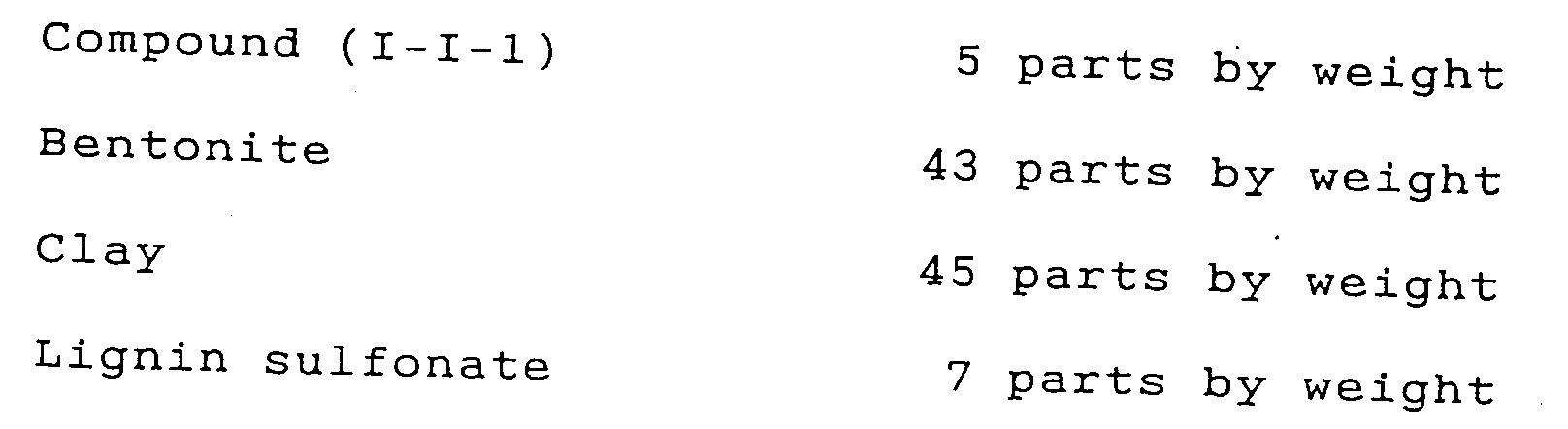
- The following examples are directed to formulations or preparations containing 1,3,2-dioxathiolan-S-oxide derivative (I) as an active ingredient.
-
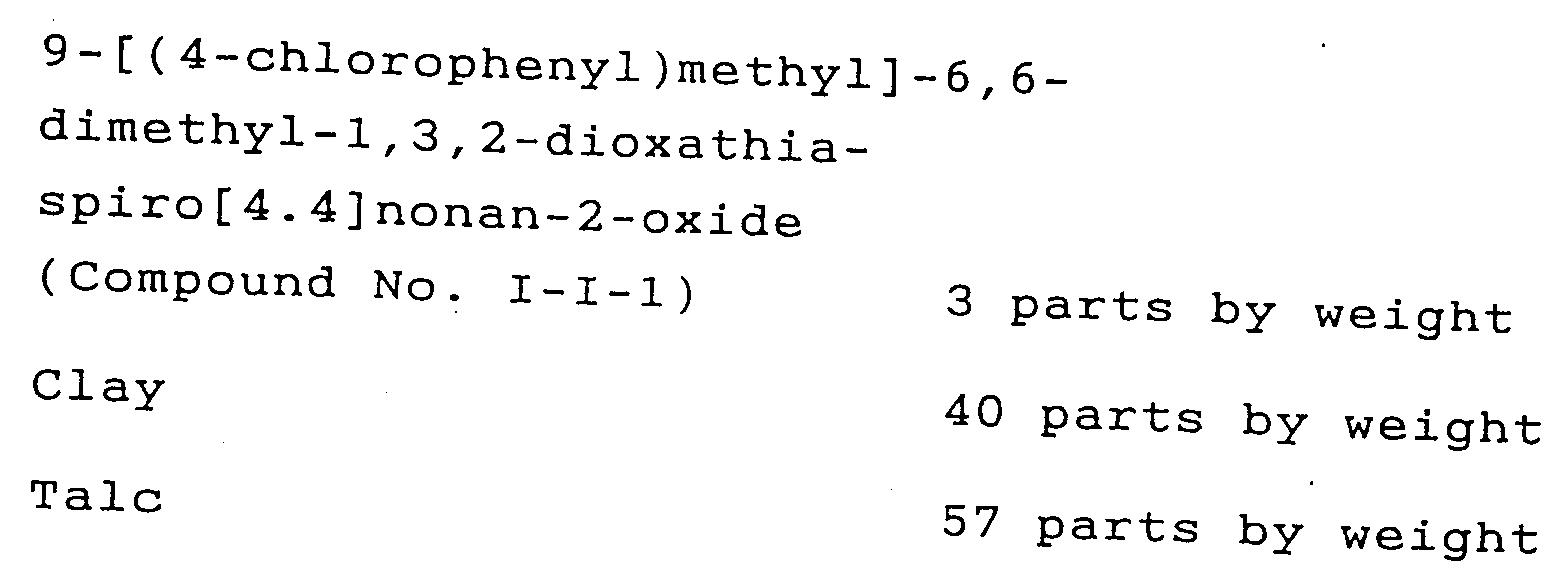
- The above-mentioned ingredients were mixed to prepare a dust.
-

- The above-mentioned ingredients were mixed to prepare a wettable powder. This preparation was used in situ by diluting it with water.
-
- The above-mentioned ingredients were mixed and kneaded with addition of water. The mixture was granulated by means of an extrusion granulating machine, followed by drying to obtain, granules.
-

- The 1,3,2-dioxathiolan-S-oxide derivatives (I-I-1) and (I-II-1) were tested for antifungal activities against various plant pathogenic fungi.
- Each of the 1,3,2-dioxathiolan-S-oxide derivatives (I-I-1) and (I-II-1) was dissolved in dimethylsulfoxide in a suitable concentration, 0.6 ml of the solution was well mixed with 60 ml of a PAS culture medium at about 60°C in a 100 ml conical flask, and the resultant mixture was poured into Petri dishes and was caused to coagulate, by which plate culture media containing compound of this invention were obtained.
- Plate culture media on which test fungi were previously cultured were punched by a cork borer so as to have a diameter of 4 mm, followed by inoculating on the above-mentioned plate culture medium. After inoculation was carried out, they were incubated for 1 - 3 days at optimum temperature for each fungus and growth of fungi was observed by measuring the diameter of the colony. Hyphae elongation inhibitory rates were determined respectively in accordance with the below described equation:

where - R =
- Hyphae elongation inhibitory rate (%)
- dc =
- Diameter of colony on the non-treated plate culture medium
- dt =
- Diameter of colony on the plate culture medium containing the tested compound
- The results were ranked in three stages by the following ranking system.
- 0: R is lower than 50%;
- 1: R is between 50% and 80%; and
- 2: R is higher than 80%.
- The results against the test fungi are shown in Table 2 below.

- The abbreviations for the test fungi in Table 2 above are as follows:
- H.s.:
- Helminthosporium sigmoideum
- R.s.:
- Rhizoctonia solani
- C.1.:
- Colletotrichum langenarium
- S.c.:
- Sclerotinia sclerotirum
- G.c.:
- Glomerella cingulata
Claims (7)
- A 1,3,2-dioxathiolan-S-oxide derivative (I)

the or each X, when present, is selected from halogen atoms and cyano, lower alkyl, haloalkyl and phenyl groups; n is 1 or 2;
m is 0 or an integer from 1 to 5; and when m is greater than 1 any two X's can be the same or different. - A 1,3,2-dioxathiolan-2-oxide derivative according to claim 1 wherein R₁ and R₂ are methyl, and Xm is a chlorine atom.
- A 1,3,2-dioxathiolan-2-oxide derivative according to claim 2 wherein the chlorine atom Xm is in the para-position of the phenyl group.
- A method for the preparation of 1,3,2-dioxathiolan-2-oxide derivative (I-I)


where R₁ and R₂ are the same or different and selected from a hydrogen atom and lower alkyl groups;
the or each X, when present, is selected from halogen atoms and cyano, lower alkyl, haloalkyl and phenyl groups; n is 1 or 2;
m is 0 or an integer from 1 to 5; and when m is greater than 1 any two X's can be the same or different. - A method for the preparation of 1,3,2-dioxathiolan-2-oxide derivative (I-II)

- A method for the preparation of azolylmethylcyclopentanol derivative (IV)


- A fungicide containing, as an active ingredient, 1,3,2-dioxathiolan-S-oxide derivative according to any of claims 1 to 3.
Applications Claiming Priority (2)
| Application Number | Priority Date | Filing Date | Title |
|---|---|---|---|
| JP3237488A JPH0826012B2 (en) | 1991-08-23 | 1991-08-23 | Novel 1,3,2-dioxathiolane S oxide derivative, production method thereof and use thereof |
| JP237488/91 | 1991-08-23 |
Publications (2)
| Publication Number | Publication Date |
|---|---|
| EP0529976A1 true EP0529976A1 (en) | 1993-03-03 |
| EP0529976B1 EP0529976B1 (en) | 1996-05-15 |
Family
ID=17016069
Family Applications (1)
| Application Number | Title | Priority Date | Filing Date |
|---|---|---|---|
| EP92307669A Expired - Lifetime EP0529976B1 (en) | 1991-08-23 | 1992-08-21 | 1,3,2-Dioxathiolan-S-oxide derivatives, their use as fungicedes and as intermediates |
Country Status (4)
| Country | Link |
|---|---|
| US (1) | US5223531A (en) |
| EP (1) | EP0529976B1 (en) |
| JP (1) | JPH0826012B2 (en) |
| DE (1) | DE69210717T2 (en) |
Cited By (1)
| Publication number | Priority date | Publication date | Assignee | Title |
|---|---|---|---|---|
| WO2016116679A1 (en) | 2015-01-21 | 2016-07-28 | Ab7 Innovation S.A.S.U. | Method for producing a non-porous composite material that is water-absorbent and lipid-absorbent for active liquid compositions |
Citations (3)
| Publication number | Priority date | Publication date | Assignee | Title |
|---|---|---|---|---|
| US3395226A (en) * | 1964-11-05 | 1968-07-30 | E I Du Pont De Nemourd And Com | Control of fungi and nematodes with ethylene sulfite and propylene sulfite |
| US3454597A (en) * | 1966-11-14 | 1969-07-08 | Dow Chemical Co | Cyclic sulfates and their preparation |
| EP0357404A2 (en) * | 1988-08-31 | 1990-03-07 | Kureha Kagaku Kogyo Kabushiki Kaisha | Process for the preparation of cyclopentane derivatives |
Family Cites Families (3)
| Publication number | Priority date | Publication date | Assignee | Title |
|---|---|---|---|---|
| JPS6025990A (en) * | 1983-07-20 | 1985-02-08 | Shionogi & Co Ltd | Triazole dioxolane derivative |
| US4863505A (en) * | 1985-09-12 | 1989-09-05 | Kureha Kagaku Kogyo Kabushiki Kaisha | Novel derivative of azole, and agricultural and horticultural composition containing the same as an active incredient |
| JPH0625140B2 (en) * | 1986-11-10 | 1994-04-06 | 呉羽化学工業株式会社 | Novel azole derivative, method for producing the same and agricultural / horticultural drug of the derivative |
-
1991
- 1991-08-23 JP JP3237488A patent/JPH0826012B2/en not_active Expired - Lifetime
-
1992
- 1992-08-20 US US07/933,032 patent/US5223531A/en not_active Expired - Fee Related
- 1992-08-21 EP EP92307669A patent/EP0529976B1/en not_active Expired - Lifetime
- 1992-08-21 DE DE69210717T patent/DE69210717T2/en not_active Expired - Fee Related
Patent Citations (3)
| Publication number | Priority date | Publication date | Assignee | Title |
|---|---|---|---|---|
| US3395226A (en) * | 1964-11-05 | 1968-07-30 | E I Du Pont De Nemourd And Com | Control of fungi and nematodes with ethylene sulfite and propylene sulfite |
| US3454597A (en) * | 1966-11-14 | 1969-07-08 | Dow Chemical Co | Cyclic sulfates and their preparation |
| EP0357404A2 (en) * | 1988-08-31 | 1990-03-07 | Kureha Kagaku Kogyo Kabushiki Kaisha | Process for the preparation of cyclopentane derivatives |
Non-Patent Citations (1)
| Title |
|---|
| JOURNAL OF THE CHEMICAL SOCIETY, SECTION C, no. 2, February 1971, Letchworth, GB, pages 257 - 259 G.P. BLACKBOURN ET AL. 'Studies of the reactions of anhydrosulphites of alpha-hydroxycarboxylic acids. Part VI. Anhydrosulphite synthesis and characterisation' * |
Cited By (1)
| Publication number | Priority date | Publication date | Assignee | Title |
|---|---|---|---|---|
| WO2016116679A1 (en) | 2015-01-21 | 2016-07-28 | Ab7 Innovation S.A.S.U. | Method for producing a non-porous composite material that is water-absorbent and lipid-absorbent for active liquid compositions |
Also Published As
| Publication number | Publication date |
|---|---|
| EP0529976B1 (en) | 1996-05-15 |
| JPH0551376A (en) | 1993-03-02 |
| DE69210717D1 (en) | 1996-06-20 |
| JPH0826012B2 (en) | 1996-03-13 |
| US5223531A (en) | 1993-06-29 |
| DE69210717T2 (en) | 1996-10-31 |
Similar Documents
| Publication | Publication Date | Title |
|---|---|---|
| EP0256503A2 (en) | Pyridinecarboxamide derivatives and their use as fungicide | |
| US5574056A (en) | Fungicidal azole derivatives | |
| EP0092158A2 (en) | Thiazolidine compound and fungicidal composition containing it | |
| EP0324646B1 (en) | Azole-substituted cycloalkanol derivatives, a process for producing the same and a use of the derivatives as an agricultural and horticultural fungicide | |
| US5258404A (en) | 3-(Unsubstituted or substituted benzyl)-1-alkyl-2-oxocyclopentane carboxylic acid alkyl ester derivatives, method for preparation fungicides, and use thereof as intermediate compounds | |
| CZ466989A3 (en) | Oximether derivative, fungicidal agent containing thereof and method of fighting fungi | |
| US4962278A (en) | Novel azole derivative and agricultural/horticultural fungicide containing said derivative as active ingredient | |
| EP0529976B1 (en) | 1,3,2-Dioxathiolan-S-oxide derivatives, their use as fungicedes and as intermediates | |
| EP0513397A1 (en) | Benzohydroximoylazole derivative, production thereof and insecticide | |
| US5116838A (en) | Guanidine derivatives and fungicides for agriculture and horticulture containing the same | |
| US5225430A (en) | Azolylmethyloxabicyclohexane derivatives and fungicidal compositions thereof | |
| AU692847B2 (en) | Propenoic ester derivatives having 4-hydroxypyrazole group and the use | |
| US4514418A (en) | 2,2-Dihalogeno-3,3-dimethylcyclopropane derivative fungicides | |
| US4443246A (en) | Herbicidal pyridyl-ethoxy-phenyl urea derivatives | |
| US5691363A (en) | Fungicidal azole derivatives | |
| US4512995A (en) | Phenoxyalkenylpyridine derivatives and fungicidal methods of use | |
| JPS6341476A (en) | Novel tricyclic azole derivative, production thereof and agricultural and horticultural fungicide containing said derivative as active ingredient | |
| KR950004699B1 (en) | Herbicidal N-substituted phenyl-3,4-dimethyl maleimide derivatives and preparation methods thereof | |
| JP2684476B2 (en) | Process for producing cis-type azole derivative, intermediate thereof and fungicide | |
| JP2686794B2 (en) | Novel azole derivative, its manufacturing method and agricultural / horticultural fungicide | |
| JP3101038B2 (en) | Benzohydroxymoylazole derivatives and insecticides | |
| US5162583A (en) | Benzylether derivatives | |
| WO2000021915A1 (en) | Methyl acetate derivatives and pesticide compositions containing the same as the active ingredient | |
| KR0128544B1 (en) | 2,3-dihydro-3-methylene-2-substituted phenyl-1H-isoindol-1-one derivative | |
| JPH0232056A (en) | Cyclic amine and sterilizing agent containing the same |
Legal Events
| Date | Code | Title | Description |
|---|---|---|---|
| PUAI | Public reference made under article 153(3) epc to a published international application that has entered the european phase |
Free format text: ORIGINAL CODE: 0009012 |
|
| 17P | Request for examination filed |
Effective date: 19920904 |
|
| AK | Designated contracting states |
Kind code of ref document: A1 Designated state(s): BE DE GB NL |
|
| 17Q | First examination report despatched |
Effective date: 19950517 |
|
| GRAH | Despatch of communication of intention to grant a patent |
Free format text: ORIGINAL CODE: EPIDOS IGRA |
|
| GRAA | (expected) grant |
Free format text: ORIGINAL CODE: 0009210 |
|
| AK | Designated contracting states |
Kind code of ref document: B1 Designated state(s): BE DE GB NL |
|
| REF | Corresponds to: |
Ref document number: 69210717 Country of ref document: DE Date of ref document: 19960620 |
|
| PGFP | Annual fee paid to national office [announced via postgrant information from national office to epo] |
Ref country code: NL Payment date: 19960831 Year of fee payment: 5 |
|
| PGFP | Annual fee paid to national office [announced via postgrant information from national office to epo] |
Ref country code: BE Payment date: 19960909 Year of fee payment: 5 |
|
| PLBE | No opposition filed within time limit |
Free format text: ORIGINAL CODE: 0009261 |
|
| STAA | Information on the status of an ep patent application or granted ep patent |
Free format text: STATUS: NO OPPOSITION FILED WITHIN TIME LIMIT |
|
| 26N | No opposition filed | ||
| PGFP | Annual fee paid to national office [announced via postgrant information from national office to epo] |
Ref country code: GB Payment date: 19970812 Year of fee payment: 6 |
|
| PG25 | Lapsed in a contracting state [announced via postgrant information from national office to epo] |
Ref country code: BE Free format text: LAPSE BECAUSE OF NON-PAYMENT OF DUE FEES Effective date: 19970831 |
|
| PGFP | Annual fee paid to national office [announced via postgrant information from national office to epo] |
Ref country code: DE Payment date: 19970901 Year of fee payment: 6 |
|
| BERE | Be: lapsed |
Owner name: KUREHA CHEMICAL INDUSTRY CO. LTD Effective date: 19970831 |
|
| PG25 | Lapsed in a contracting state [announced via postgrant information from national office to epo] |
Ref country code: NL Free format text: LAPSE BECAUSE OF NON-PAYMENT OF DUE FEES Effective date: 19980301 |
|
| NLV4 | Nl: lapsed or anulled due to non-payment of the annual fee |
Effective date: 19980301 |
|
| PG25 | Lapsed in a contracting state [announced via postgrant information from national office to epo] |
Ref country code: GB Free format text: LAPSE BECAUSE OF NON-PAYMENT OF DUE FEES Effective date: 19980821 |
|
| GBPC | Gb: european patent ceased through non-payment of renewal fee |
Effective date: 19980821 |
|
| PG25 | Lapsed in a contracting state [announced via postgrant information from national office to epo] |
Ref country code: DE Free format text: LAPSE BECAUSE OF NON-PAYMENT OF DUE FEES Effective date: 19990601 |