EP0532210A2 - Flüssigkristallanzeige - Google Patents
Flüssigkristallanzeige Download PDFInfo
- Publication number
- EP0532210A2 EP0532210A2 EP92307860A EP92307860A EP0532210A2 EP 0532210 A2 EP0532210 A2 EP 0532210A2 EP 92307860 A EP92307860 A EP 92307860A EP 92307860 A EP92307860 A EP 92307860A EP 0532210 A2 EP0532210 A2 EP 0532210A2
- Authority
- EP
- European Patent Office
- Prior art keywords
- liquid crystal
- orientation
- substrates
- uniaxial orientation
- display device
- Prior art date
- Legal status (The legal status is an assumption and is not a legal conclusion. Google has not performed a legal analysis and makes no representation as to the accuracy of the status listed.)
- Granted
Links
Images


Classifications
-
- G—PHYSICS
- G02—OPTICS
- G02F—OPTICAL DEVICES OR ARRANGEMENTS FOR THE CONTROL OF LIGHT BY MODIFICATION OF THE OPTICAL PROPERTIES OF THE MEDIA OF THE ELEMENTS INVOLVED THEREIN; NON-LINEAR OPTICS; FREQUENCY-CHANGING OF LIGHT; OPTICAL LOGIC ELEMENTS; OPTICAL ANALOGUE/DIGITAL CONVERTERS
- G02F1/00—Devices or arrangements for the control of the intensity, colour, phase, polarisation or direction of light arriving from an independent light source, e.g. switching, gating or modulating; Non-linear optics
- G02F1/01—Devices or arrangements for the control of the intensity, colour, phase, polarisation or direction of light arriving from an independent light source, e.g. switching, gating or modulating; Non-linear optics for the control of the intensity, phase, polarisation or colour
- G02F1/13—Devices or arrangements for the control of the intensity, colour, phase, polarisation or direction of light arriving from an independent light source, e.g. switching, gating or modulating; Non-linear optics for the control of the intensity, phase, polarisation or colour based on liquid crystals, e.g. single liquid crystal display cells
- G02F1/137—Devices or arrangements for the control of the intensity, colour, phase, polarisation or direction of light arriving from an independent light source, e.g. switching, gating or modulating; Non-linear optics for the control of the intensity, phase, polarisation or colour based on liquid crystals, e.g. single liquid crystal display cells characterised by the electro-optical or magneto-optical effect, e.g. field-induced phase transition, orientation effect, guest-host interaction or dynamic scattering
- G02F1/139—Devices or arrangements for the control of the intensity, colour, phase, polarisation or direction of light arriving from an independent light source, e.g. switching, gating or modulating; Non-linear optics for the control of the intensity, phase, polarisation or colour based on liquid crystals, e.g. single liquid crystal display cells characterised by the electro-optical or magneto-optical effect, e.g. field-induced phase transition, orientation effect, guest-host interaction or dynamic scattering based on orientation effects in which the liquid crystal remains transparent
- G02F1/141—Devices or arrangements for the control of the intensity, colour, phase, polarisation or direction of light arriving from an independent light source, e.g. switching, gating or modulating; Non-linear optics for the control of the intensity, phase, polarisation or colour based on liquid crystals, e.g. single liquid crystal display cells characterised by the electro-optical or magneto-optical effect, e.g. field-induced phase transition, orientation effect, guest-host interaction or dynamic scattering based on orientation effects in which the liquid crystal remains transparent using ferroelectric liquid crystals
- G02F1/1416—Details of the smectic layer structure, e.g. bookshelf, chevron, C1 and C2
-
- G—PHYSICS
- G02—OPTICS
- G02F—OPTICAL DEVICES OR ARRANGEMENTS FOR THE CONTROL OF LIGHT BY MODIFICATION OF THE OPTICAL PROPERTIES OF THE MEDIA OF THE ELEMENTS INVOLVED THEREIN; NON-LINEAR OPTICS; FREQUENCY-CHANGING OF LIGHT; OPTICAL LOGIC ELEMENTS; OPTICAL ANALOGUE/DIGITAL CONVERTERS
- G02F1/00—Devices or arrangements for the control of the intensity, colour, phase, polarisation or direction of light arriving from an independent light source, e.g. switching, gating or modulating; Non-linear optics
- G02F1/01—Devices or arrangements for the control of the intensity, colour, phase, polarisation or direction of light arriving from an independent light source, e.g. switching, gating or modulating; Non-linear optics for the control of the intensity, phase, polarisation or colour
- G02F1/13—Devices or arrangements for the control of the intensity, colour, phase, polarisation or direction of light arriving from an independent light source, e.g. switching, gating or modulating; Non-linear optics for the control of the intensity, phase, polarisation or colour based on liquid crystals, e.g. single liquid crystal display cells
- G02F1/133—Constructional arrangements; Operation of liquid crystal cells; Circuit arrangements
- G02F1/1333—Constructional arrangements; Manufacturing methods
- G02F1/1337—Surface-induced orientation of the liquid crystal molecules, e.g. by alignment layers
- G02F1/133746—Surface-induced orientation of the liquid crystal molecules, e.g. by alignment layers for high pretilt angles, i.e. higher than 15 degrees
-
- G—PHYSICS
- G02—OPTICS
- G02F—OPTICAL DEVICES OR ARRANGEMENTS FOR THE CONTROL OF LIGHT BY MODIFICATION OF THE OPTICAL PROPERTIES OF THE MEDIA OF THE ELEMENTS INVOLVED THEREIN; NON-LINEAR OPTICS; FREQUENCY-CHANGING OF LIGHT; OPTICAL LOGIC ELEMENTS; OPTICAL ANALOGUE/DIGITAL CONVERTERS
- G02F1/00—Devices or arrangements for the control of the intensity, colour, phase, polarisation or direction of light arriving from an independent light source, e.g. switching, gating or modulating; Non-linear optics
- G02F1/01—Devices or arrangements for the control of the intensity, colour, phase, polarisation or direction of light arriving from an independent light source, e.g. switching, gating or modulating; Non-linear optics for the control of the intensity, phase, polarisation or colour
- G02F1/13—Devices or arrangements for the control of the intensity, colour, phase, polarisation or direction of light arriving from an independent light source, e.g. switching, gating or modulating; Non-linear optics for the control of the intensity, phase, polarisation or colour based on liquid crystals, e.g. single liquid crystal display cells
- G02F1/133—Constructional arrangements; Operation of liquid crystal cells; Circuit arrangements
- G02F1/1333—Constructional arrangements; Manufacturing methods
- G02F1/1337—Surface-induced orientation of the liquid crystal molecules, e.g. by alignment layers
- G02F1/13378—Surface-induced orientation of the liquid crystal molecules, e.g. by alignment layers by treatment of the surface, e.g. embossing, rubbing or light irradiation
- G02F1/133784—Surface-induced orientation of the liquid crystal molecules, e.g. by alignment layers by treatment of the surface, e.g. embossing, rubbing or light irradiation by rubbing
Definitions
- the present invention relates to a liquid crystal display device and more particularly, to a liquid crystal display device using a ferroelectric liquid crystal.
- a conventional liquid crystal display device using a nematic liquid crystal comprises a twisted nematic (TN) type liquid crystal display device and a supertwisted birefringence effect (SBE) type liquid crystal display device.
- TN twisted nematic
- SBE supertwisted birefringence effect
- the twisted nematic type liquid crystal display device In the twisted nematic type liquid crystal display device, however, as a driving method becomes multiplex, a driving margin becomes narrow, so that sufficient contrast can not be obtained. In the supertwisted birefringence effect type liquid crystal display using a large twist angle, which is an improved display device of the twisted nematic type liquid crystal display device, when it is used in large-capacity display device, the contrast is lowered or response speed is decreased.
- This liquid crystal display device is different from the above liquid crystal device using an electric field effect in which dielectric anisotropy of a liquid crystal molecule is used and has a structure employing rotating force for matching a polarity of a spontaneous polarization of the ferroelectric liquid crystal with a polarity of the electric field.
- This liquid crystal device has a bistable characteristic, a memory characteristic, and high-speed response characteristic.
- the ferroelectric liquid crystal when the ferroelectric liquid crystal is injected into a cell having a thin gap, a spiral structure of the ferroelectric liquid crystal is broken by an influence of an interface of the substrate, and then there exist together a region where the liquid crystal molecule is inclined from the normal line of the smectic layer by an angle of ⁇ and a region where the liquid crystal molecule is inclined in the opposite direction by - ⁇ , so that bistable property is provided.
- the directions of the liquid crystal molecule and its spontaneous polarization can be uniform by applying a voltage to the ferroelectric liquid crystal in the cell. Therefore, by switching the polarity of the voltage to be applied, the orientation of the liquid crystal molecule can be switched from a certain constant state to another constant state.
- the ferroelectric liquid crystal display device oriented by rubbing has the twisted orientation because regulating force at the interface strongly acts thereon. In such orientation, it is found that a difference in optical molecular axis in switching between two states does not generally effectively appear and high contrast characteristic is not obtained.
- a layer structure model proposed by Clark et al For example, there is one example in which an SiO oblique deposition method is used, and then the layer is prevented from being doglegged by applying a relatively high pretilt to the substrate interface to attain an oblique layer structure.
- a ferroelectric liquid crystal display device includes a pair of substrates on which an electrode is selectively formed on the surface, then an insulating film and an orientation film are formed thereon and uniaxial orientation processing is performed and which are arranged so that directions of their uniaxial orientation processing may be almost parallel to each other; a liquid crystal panel which is formed by injecting a liquid crystal having a chiral smectic C phase between the substrates; driving means for switching an optical axis of the liquid crystal by selectively applying a voltage to the electrode; and means for optically identifying the switching of the optical axis, in which the liquid crystal shows a chevron structure as a layer structure at the chiral smectic C phase in which a layer structure is doglegged, and an orientation region generated from interaction in the uniaxial orientation processing direction and the layer structure is an inside region surrounded by a lightning defect generated in the uniaxial orientation direction and a hair pin defect generated behind the lightning defect or an outside region surrounded by the hair pin defect generated in
- the uniaxial orientation processing is performed on the orientation film by the rubbing method.
- a liquid crystal of the present invention is a liquid crystal having a chiral smectic C phase like as cyanophenyl cyclohexane type, cyanobiphenyl type, fluoride type, tolane type and so on.
- the driving method of the present invention can be employed such a conventional method that a signal is applied to the scanning electrodes and signal electrodes connected to pixels .
- a liquid crystal molecule is inverted not only in the vicinity of the doglegged region in the chevron structure generated almost in the center of the pair of substrates but also in the vicinity of the substrates. Therefore, although the orientation of the liquid crystal molecule is a little different from each other because of the doglegged structure in the vicinity of the substrates, the liquid crystal molecule is almost uniformly oriented between the substrate and the vicinity of the interface and then it is uniform from one substrate to the border and from the border to the other substrate. As a result, the liquid crystal molecule shows the orientation which is not almost twisted.
- the liquid crystal is not almost twisted, it is possible to prevent leakage of light when the light is shielded by using with means for optically identifying the switching of the optical axis such as the polariser, and thus the contrast characteristic can be improved.
- the doglegged direction in the chevron structure in the present invention is the direction generated inside the region surrounded by the lightning defect generated in the uniaxial orientation processing direction and the hair pin defect generated behind the lightning defect or outside the region surrounded by the hair pin defect generated in the uniaxial orientation processing direction and the lightning defect generated behind the hair pin defect. Therefore, when the optical axis of the liquid crystal is switched by the driving means in the present invention, the difference between the optical molecular axes of two states, that is, the memory angle is large.
- the doglegged direction of the layer can be further easily implemented by a simple rubbing method.
- the layer structure of the chiral smectic C phase is generally a doglegged structure.
- the reason for the structure is that the molecule in the vicinity of the border of the substrates is not likely to move, while the space between layers in the liquid crystal phase (generally a smectic A phase) at a temperature higher than that of the chiral smectic C phase is reduced because the liquid crystal molecule is inclined when changed to the chiral smectic C phase. It is thought that the liquid crystal molecule in the middle phase at a high temperature is extended so as to keep the space between the molecules, while the space between molecules of the liquid crystal molecule at the interfaces remained.
- the above doglegged structure is employed, which will be described in detail hereinafter.
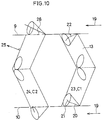
- orientation processing directions in the upper and lower substrates are the same, there are two different orientations, which depends on whether the doglegged direction is the same as the orientation processing direction or it is opposite, which is shown in Fig. 5.
- a cone shape shown in Fig. 5 is a raceway track on which the liquid crystal molecule can move on switching, which is inclined from the layer normal line 25 by the tilt angle 26 of the liquid crystal.
- An arrow 19 shows the rubbing direction.
- This relation is discussed in Japanese Unexamined Patent No. 158415/1989, in which a layer structure 23 shown in Fig. 5 where the rubbing direction is opposite to the doglegged direction in the layer is defined as chevron 1 (C1 orientation) and a layer structure 24 shown in Fig. 5 where the rubbing direction is the same as the doglegged direction in the layer is defined as chevron 2 (C2 orientation).
- chevron 1 C1 orientation
- a layer structure 24 shown in Fig. 5 where the rubbing direction is the same as the doglegged direction in the layer is defined as chevron 2 (C2 orientation).
- C1 orientation chevron 1
- C2 orientation chevron 2
- the C1 orientation and C2 orientation show almost the equivalent orientation when there is no pretilt of the liquid crystal molecule at the interface of the substrates.
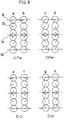
- a pretilt 22 of the liquid crystal molecule is generated in the direction shown in Fig. 6. If the pretilt is increased, the difference in the orientation of the liquid crystal molecule between the C1 and C2 becomes obvious, which is shown in Fig. 9.
- a, b, c and d designate molecules of the C1 and C2 orientations when the molecules are not likely to move at the interface of the substrates, which are shown by a display method using the C director. Since the liquid crystal molecules are twisted in the upper and lower substrates, in this case, the C1 orientation and C2 orientation are defined as C1T (C1 twist) orientation and C2T (C2 twist) orientation, respectively.
- the switching when the electric field is applied occurs between a and b and between c and d. In this case, the switching of the memory state occurs only at a joint part 14 of the chevron structure.
- an n director 20 is considerably twisted in the C1T orientation of a and b in Fig. 9, while it is twisted a little in the C2T orientation of c and d in Fig. 9.
- the polarizing plates are arranged so as to cross at right angles at the upper and lower cells and the cell is rotated therein, there is not quenching angle in the C1T orientation and there is a quenching angle in the C2T orientation.
- Japanese Unexamined Patent No. 158415 Japanese Unexamined Patent No. 158415
- e, f, g, and h shows molecule of the C1 and C2 orientations in the memory state when the interface invention is generated.
- the C1 orientation and C2 orientation are defined as C1U (C1 uniform) orientation and C2U (C2 uniform) orientation, respectively.
- the switching when the electric field is applied occurs between e and f, and between g and h.
- the contrast characteristic has the following relation.
- the C1U orientation is employed in the liquid crystal display device in view of the fact described above. How to distinguish these orientations will be described hereinafter in view of the fact described above.
- the doglegged direction of the layer can be estimated from the configuration of the zigzag defect generated from a damage in the cell or the spacer.
- There are two kinds of configurations in the defect such as the lightning defect and the hair pin defect. Normally, these two defects are connected and it is known that the doglegged direction of the layer at a region surrounded by the defects is different from that of the outside thereof (referring to Fig. 2). Therefore, the rubbing direction and the doglegged direction of the layer can be estimated.
- the rubbing direction is the direction of the pretilt of the molecule, which shown in Fig. 6.
- the C1U orientation in which high contrast can be obtained is employed in the liquid crystal display device in view of the fact described above.
- the angle of inclination ⁇ of the layer of the chevron structure was measured using various liquid crystals shown in table 1 by X-ray diffraction method, which is shown in Fig. 7.
- the liquid crystals CS-1014 and CS-1022 are made by Chisso Petrochemical Co., Ltd and the liquid crystals ZLI-3654 and ZLI-3489 are made by Merck & Co.
- the liquid crystal FELIX-002 is made by Hoechst AG
- Mixture A is a liquid crystal as follows. and x in the figure are data when a polyimide material (PSI-A-2001 made by Chisso Petrochemical Co., Ltd.) and polyvinyl alcohol (PVA) are used as the orientation film.
- PSI-A-2001 made by Chisso Petrochemical Co., Ltd.
- PVA polyvinyl alcohol
- the angle of inclination ⁇ is a little smaller than the tilt angle ⁇ .
- Two orientation states shown in Fig. 5 are drawn from the above relation. Then, it is found that there is a difference in stability of generation of the C1 orientation and C2 orientation, depending on the relation of the angle of inclination ⁇ 28 of the layer and the tilt angle ⁇ 26.
- the another means described above is technique implementing that an interface pretilt ⁇ p (angle formed between the substrate and the liquid crystal molecule) >> the tilt angle ⁇ (an angle when a cone angle of the liquid crystal molecule in the C1U orientation is 2 ⁇ ) disclosed in Japanese Unexamined Patent No. 7879/1991 or technique implementing the interface pretilt of 8 to 35 ° disclosed in Japanese Unexamined Patent No. 32395/1991.
- Fig. 8 is a graph showing the relation between ⁇ (28) > ⁇ (26) and ⁇ (26) for more detail examination, where ⁇ / ⁇ is an absolute value.
- ⁇ / ⁇ is an absolute value.
- a liquid crystal display device according to the present invention will be described in reference to an embodiment of the present invention.
- Fig. 1 is a sectional view showing the liquid crystal display device of the present invention.
- a plurality of transparent electrodes 2a having a thickness of 300 to 5000 ⁇ , preferably 1000 to 3000 ⁇ , which are arranged in the form of stripes so as to be parallel to each other, are formed on a glass substrate 1a.
- an electrode protective film 3a formed of SiO2 having a thickness 300 to 5000 ⁇ , preferably 1000 to 2000 ⁇ is formed thereon by sputtering and then a PSI-A-2001 (polyimide) orientation film 4a made by Chisso Petrochemical Co., Ltd. is formed thereon with a thickness of 400 ⁇ by spin coating.
- the uniaxial orientation processing is performed using rayon cloth by a rubbing method.
- a substrate 9 is formed.
- a plurality of transparent electrodes 2b are arranged in the form of stripes so as to be parallel to each other on another glass substrate 1b in the same manner and then an orientation film 4b is formed through an electrode protective film 3b under the same condition. Thereafter, the uniaxial orientation processing is performed by the rubbing method. Thus, another substrate 10 is formed.
- the substrates 10 and 9 are put together at a distance of 1.5 ⁇ m through a silica spacer 5 with a sealing material 6 formed of epoxy resin so that the orientation films 4a and 4b may be opposite to each other, the transparent electrodes 2a and 2b may cross at right angles, and the rubbing directions coincide with each other.
- a liquid crystal 7 showing a chiral smectic C phase is injected between the substrates 9 and 10 from an inlet by a vacuum injection method while the liquid crystal is heated, and then the inlet is shielded by an acrylic resin of a UV curing type.
- a liquid crystal cell 11 is made.
- polarizing plates 12a and 12b whose polarizing axes cross at right angles are arranged on the upper and lower side of the cell and one polarizing axis of the polarizing plate is made to coincide with either one of optical axes of the liquid crystal of the cell 11.
- the liquid crystal display device is made.
- the state of orientation is observed through experiments in the liquid crystal display device to which various liquid crystals shown in table 1 are injected.
- the C1U orientation is seen from a transition point (T AC ) from the smectic A phase to the smectic C phase, to the vicinity of the room temperature (25°C), which is confirmed by the above described method.
- the C1U orientation and C2U orientation exist together from T AC to the vicinity of the room temperature.
- the C1U orientation and C2 orientation exist together from T AC to the vicinity of the room temperature.
- Table 2 Liquid Crystal Material( ⁇ / ⁇ ) Orientation Film Orientation CS-1014 (0.918) PSI-A-2001 C1U PVA C1T Mixture A (0.982) PSI-A-2001 C1U PVA C1T CS-1022 (0.936) PSI-A-2001 C1U PVA C1T ZLI-3654 (0.845) PSI-A-2001 C1U,C2 PVA C1T,C2 ZLI-3489 (0.872) PSI-A-2001 C1U,C2 PVA C1T,C2 FELIX-002 (0.892) PSI-A-2001 C1U,C2 PVA C1T,C2
- the C2 orientation can be prevented from being generated and the C1 orientation can be stably obtained. Furthermore, the CIU orientation can be stably obtained by another well-known means and further high contrast characteristic (40 or more) can be attained.
Landscapes
- Physics & Mathematics (AREA)
- Chemical & Material Sciences (AREA)
- Crystallography & Structural Chemistry (AREA)
- Nonlinear Science (AREA)
- General Physics & Mathematics (AREA)
- Optics & Photonics (AREA)
- Liquid Crystal (AREA)
Applications Claiming Priority (2)
| Application Number | Priority Date | Filing Date | Title |
|---|---|---|---|
| JP218949/91 | 1991-08-29 | ||
| JP3218949A JP2713513B2 (ja) | 1991-08-29 | 1991-08-29 | 液晶表示装置 |
Publications (3)
| Publication Number | Publication Date |
|---|---|
| EP0532210A2 true EP0532210A2 (de) | 1993-03-17 |
| EP0532210A3 EP0532210A3 (de) | 1993-04-21 |
| EP0532210B1 EP0532210B1 (de) | 1996-10-16 |
Family
ID=16727863
Family Applications (1)
| Application Number | Title | Priority Date | Filing Date |
|---|---|---|---|
| EP92307860A Expired - Lifetime EP0532210B1 (de) | 1991-08-29 | 1992-08-28 | Flüssigkristallanzeige |
Country Status (4)
| Country | Link |
|---|---|
| US (1) | US5537237A (de) |
| EP (1) | EP0532210B1 (de) |
| JP (1) | JP2713513B2 (de) |
| CA (1) | CA2077132C (de) |
Cited By (3)
| Publication number | Priority date | Publication date | Assignee | Title |
|---|---|---|---|---|
| GB2274519A (en) * | 1993-01-20 | 1994-07-27 | Marconi Gec Ltd | Liquid crystal devices |
| EP0775930A3 (de) * | 1995-11-24 | 1997-12-29 | Sharp Kabushiki Kaisha | Flüssigkristallanzeigevorrichtung |
| WO2001007535A1 (de) * | 1999-07-28 | 2001-02-01 | Clariant International Ltd. | Smektische flüssigkristallschalt- oder anzeigevorrichtung mit hohem kontrast |
Families Citing this family (3)
| Publication number | Priority date | Publication date | Assignee | Title |
|---|---|---|---|---|
| JP2004151578A (ja) * | 2002-10-31 | 2004-05-27 | Fujitsu Display Technologies Corp | 液晶表示装置及びその製造方法 |
| JP4112472B2 (ja) | 2003-10-21 | 2008-07-02 | 株式会社東芝 | 半導体装置の製造方法及び半導体装置の製造装置 |
| KR100587395B1 (ko) | 2004-06-24 | 2006-06-08 | 동부일렉트로닉스 주식회사 | 반도체 소자의 제조를 위한 이온 주입 장치 |
Family Cites Families (11)
| Publication number | Priority date | Publication date | Assignee | Title |
|---|---|---|---|---|
| US4367924A (en) * | 1980-01-08 | 1983-01-11 | Clark Noel A | Chiral smectic C or H liquid crystal electro-optical device |
| US4775225A (en) * | 1985-05-16 | 1988-10-04 | Canon Kabushiki Kaisha | Liquid crystal device having pillar spacers with small base periphery width in direction perpendicular to orientation treatment |
| US5164852A (en) * | 1986-12-16 | 1992-11-17 | Semiconductor Energy Laboratory Co., Ltd. | Method of orientating a ferroelectric liquid crystal layer by AC electric field |
| FR2618587B1 (fr) * | 1987-07-20 | 1992-04-24 | Commissariat Energie Atomique | Ecran a cristal liquide, a electrodes opacifiees dans la zone non commutable de l'ecran et procedes d'obtention d'espaceurs et de traitement de cet ecran |
| US4932758A (en) * | 1987-09-17 | 1990-06-12 | Canon Kabushiki Kaisha | Ferroelectric smectic liquid crystal device having a bistable alignment state providing two stable orientation states |
| US5005953A (en) * | 1987-10-06 | 1991-04-09 | Canon Kabushiki Kaisha | High contrast liquid crystal element |
| NL8901481A (nl) * | 1989-06-12 | 1991-01-02 | Philips Nv | Passieve ferro-elektrisch vloeibaar kristal weergeefinrichting en werkwijze ter vervaardiging daarvan. |
| CA2024445C (en) * | 1989-09-01 | 1994-11-08 | Yuko Morikawa | Liquid crystal device |
| US5182662A (en) * | 1989-12-01 | 1993-01-26 | Canon Kabushiki Kaisha | Liquid crystal device |
| GB9002105D0 (en) * | 1990-01-31 | 1990-03-28 | Stc Plc | Ferro electric liquid crystal cells |
| AU634031B2 (en) * | 1990-03-02 | 1993-02-11 | Canon Kabushiki Kaisha | Liquid crystal element and liquid crystal apparatus using the same |
-
1991
- 1991-08-29 JP JP3218949A patent/JP2713513B2/ja not_active Expired - Fee Related
-
1992
- 1992-08-28 CA CA002077132A patent/CA2077132C/en not_active Expired - Fee Related
- 1992-08-28 EP EP92307860A patent/EP0532210B1/de not_active Expired - Lifetime
-
1995
- 1995-01-09 US US08/370,559 patent/US5537237A/en not_active Expired - Lifetime
Cited By (7)
| Publication number | Priority date | Publication date | Assignee | Title |
|---|---|---|---|---|
| GB2274519A (en) * | 1993-01-20 | 1994-07-27 | Marconi Gec Ltd | Liquid crystal devices |
| US5528394A (en) * | 1993-01-20 | 1996-06-18 | Gec Marconi Limited | Ferroelectric liquid crystal device having frequency ≦500 Hz and voltage ≦35 volts that switches a C1 chevron structure to a C2 chevron structure |
| GB2274519B (en) * | 1993-01-20 | 1996-08-21 | Marconi Gec Ltd | Liquid crystal devices |
| EP0775930A3 (de) * | 1995-11-24 | 1997-12-29 | Sharp Kabushiki Kaisha | Flüssigkristallanzeigevorrichtung |
| US6091472A (en) * | 1995-11-24 | 2000-07-18 | Sharp Kabushiki Kaisha | Ferroelectric LCD with particular rubbing directions |
| WO2001007535A1 (de) * | 1999-07-28 | 2001-02-01 | Clariant International Ltd. | Smektische flüssigkristallschalt- oder anzeigevorrichtung mit hohem kontrast |
| US7019811B1 (en) | 1999-07-28 | 2006-03-28 | Clariant International, Ltd. | Smectic liquid crystal high-contrast control or display device |
Also Published As
| Publication number | Publication date |
|---|---|
| CA2077132C (en) | 2000-03-28 |
| CA2077132A1 (en) | 1993-03-01 |
| US5537237A (en) | 1996-07-16 |
| JPH0553116A (ja) | 1993-03-05 |
| EP0532210A3 (de) | 1993-04-21 |
| JP2713513B2 (ja) | 1998-02-16 |
| EP0532210B1 (de) | 1996-10-16 |
Similar Documents
| Publication | Publication Date | Title |
|---|---|---|
| US5543943A (en) | Chiral smectic device subjected to a simultaneous thermal and AC field treatment | |
| EP0448124A2 (de) | Optische Modulationsvorrichtung und Anzeigegerät | |
| EP0496628B1 (de) | Ferroelektrische Flüssigkristall-Anzeigevorrichtung | |
| JPH02176625A (ja) | 液晶表示装置 | |
| EP0631672B1 (de) | Flüssigkristall-vorrichtungen | |
| EP0532210B1 (de) | Flüssigkristallanzeige | |
| JP3099937B2 (ja) | 液晶表示装置 | |
| EP0645662B1 (de) | Flüssigkristall-Anzeigevorrichtung | |
| US5016989A (en) | Liquid crystal element with improved contrast and brightness | |
| US5557435A (en) | Liquid crystal device and display apparatus | |
| JP2880807B2 (ja) | 液晶表示装置 | |
| JP2918343B2 (ja) | 強誘電性液晶表示装置 | |
| US5844653A (en) | Liquid crystal mixture | |
| KR100383542B1 (ko) | 횡전극 배열 구조를 이용한 스멕틱 액정 표시장치 | |
| JP2681779B2 (ja) | 液晶セル | |
| JP2947700B2 (ja) | 液晶表示装置 | |
| JP2851500B2 (ja) | 液晶表示装置 | |
| JP3091091B2 (ja) | 液晶表示素子 | |
| JP3062978B2 (ja) | 強誘電性液晶素子 | |
| JP2645745B2 (ja) | 強誘電性液晶ディスプレイ装置 | |
| JP2645744B2 (ja) | 強誘電性液晶ディスプレイ装置 | |
| JPH05341289A (ja) | 液晶表示装置 | |
| JPH04232919A (ja) | 液晶表示装置 | |
| JPH06273801A (ja) | 液晶電気光学装置 | |
| JPH0776819B2 (ja) | 液晶素子 |
Legal Events
| Date | Code | Title | Description |
|---|---|---|---|
| PUAI | Public reference made under article 153(3) epc to a published international application that has entered the european phase |
Free format text: ORIGINAL CODE: 0009012 |
|
| PUAL | Search report despatched |
Free format text: ORIGINAL CODE: 0009013 |
|
| AK | Designated contracting states |
Kind code of ref document: A2 Designated state(s): FR GB NL |
|
| AK | Designated contracting states |
Kind code of ref document: A3 Designated state(s): FR GB NL |
|
| 17P | Request for examination filed |
Effective date: 19930429 |
|
| 17Q | First examination report despatched |
Effective date: 19950517 |
|
| GRAG | Despatch of communication of intention to grant |
Free format text: ORIGINAL CODE: EPIDOS AGRA |
|
| GRAH | Despatch of communication of intention to grant a patent |
Free format text: ORIGINAL CODE: EPIDOS IGRA |
|
| GRAH | Despatch of communication of intention to grant a patent |
Free format text: ORIGINAL CODE: EPIDOS IGRA |
|
| GRAA | (expected) grant |
Free format text: ORIGINAL CODE: 0009210 |
|
| AK | Designated contracting states |
Kind code of ref document: B1 Designated state(s): FR GB NL |
|
| ET | Fr: translation filed | ||
| PLBE | No opposition filed within time limit |
Free format text: ORIGINAL CODE: 0009261 |
|
| STAA | Information on the status of an ep patent application or granted ep patent |
Free format text: STATUS: NO OPPOSITION FILED WITHIN TIME LIMIT |
|
| 26N | No opposition filed | ||
| REG | Reference to a national code |
Ref country code: GB Ref legal event code: IF02 |
|
| PGFP | Annual fee paid to national office [announced via postgrant information from national office to epo] |
Ref country code: FR Payment date: 20020808 Year of fee payment: 11 |
|
| PGFP | Annual fee paid to national office [announced via postgrant information from national office to epo] |
Ref country code: GB Payment date: 20020828 Year of fee payment: 11 |
|
| PGFP | Annual fee paid to national office [announced via postgrant information from national office to epo] |
Ref country code: NL Payment date: 20020829 Year of fee payment: 11 |
|
| PG25 | Lapsed in a contracting state [announced via postgrant information from national office to epo] |
Ref country code: GB Free format text: LAPSE BECAUSE OF NON-PAYMENT OF DUE FEES Effective date: 20030828 |
|
| PG25 | Lapsed in a contracting state [announced via postgrant information from national office to epo] |
Ref country code: NL Free format text: LAPSE BECAUSE OF NON-PAYMENT OF DUE FEES Effective date: 20040301 |
|
| GBPC | Gb: european patent ceased through non-payment of renewal fee | ||
| PG25 | Lapsed in a contracting state [announced via postgrant information from national office to epo] |
Ref country code: FR Free format text: LAPSE BECAUSE OF NON-PAYMENT OF DUE FEES Effective date: 20040430 |
|
| NLV4 | Nl: lapsed or anulled due to non-payment of the annual fee |
Effective date: 20040301 |
|
| REG | Reference to a national code |
Ref country code: FR Ref legal event code: ST |