EP0533589A1 - Halbleitervorrichtung - Google Patents
Halbleitervorrichtung Download PDFInfo
- Publication number
- EP0533589A1 EP0533589A1 EP92402587A EP92402587A EP0533589A1 EP 0533589 A1 EP0533589 A1 EP 0533589A1 EP 92402587 A EP92402587 A EP 92402587A EP 92402587 A EP92402587 A EP 92402587A EP 0533589 A1 EP0533589 A1 EP 0533589A1
- Authority
- EP
- European Patent Office
- Prior art keywords
- signal
- receiving
- formation surface
- bonding pad
- solely
- Prior art date
- Legal status (The legal status is an assumption and is not a legal conclusion. Google has not performed a legal analysis and makes no representation as to the accuracy of the status listed.)
- Granted
Links
Images





Classifications
-
- H—ELECTRICITY
- H10—SEMICONDUCTOR DEVICES; ELECTRIC SOLID-STATE DEVICES NOT OTHERWISE PROVIDED FOR
- H10W—GENERIC PACKAGES, INTERCONNECTIONS, CONNECTORS OR OTHER CONSTRUCTIONAL DETAILS OF DEVICES COVERED BY CLASS H10
- H10W70/00—Package substrates; Interposers; Redistribution layers [RDL]
- H10W70/40—Leadframes
- H10W70/411—Chip-supporting parts, e.g. die pads
- H10W70/415—Leadframe inner leads serving as die pads
-
- H—ELECTRICITY
- H10—SEMICONDUCTOR DEVICES; ELECTRIC SOLID-STATE DEVICES NOT OTHERWISE PROVIDED FOR
- H10W—GENERIC PACKAGES, INTERCONNECTIONS, CONNECTORS OR OTHER CONSTRUCTIONAL DETAILS OF DEVICES COVERED BY CLASS H10
- H10W72/00—Interconnections or connectors in packages
-
- H—ELECTRICITY
- H10—SEMICONDUCTOR DEVICES; ELECTRIC SOLID-STATE DEVICES NOT OTHERWISE PROVIDED FOR
- H10W—GENERIC PACKAGES, INTERCONNECTIONS, CONNECTORS OR OTHER CONSTRUCTIONAL DETAILS OF DEVICES COVERED BY CLASS H10
- H10W72/00—Interconnections or connectors in packages
- H10W72/50—Bond wires
-
- H—ELECTRICITY
- H10—SEMICONDUCTOR DEVICES; ELECTRIC SOLID-STATE DEVICES NOT OTHERWISE PROVIDED FOR
- H10W—GENERIC PACKAGES, INTERCONNECTIONS, CONNECTORS OR OTHER CONSTRUCTIONAL DETAILS OF DEVICES COVERED BY CLASS H10
- H10W72/00—Interconnections or connectors in packages
- H10W72/90—Bond pads, in general
-
- H—ELECTRICITY
- H10—SEMICONDUCTOR DEVICES; ELECTRIC SOLID-STATE DEVICES NOT OTHERWISE PROVIDED FOR
- H10W—GENERIC PACKAGES, INTERCONNECTIONS, CONNECTORS OR OTHER CONSTRUCTIONAL DETAILS OF DEVICES COVERED BY CLASS H10
- H10W72/00—Interconnections or connectors in packages
- H10W72/50—Bond wires
- H10W72/541—Dispositions of bond wires
- H10W72/5445—Dispositions of bond wires being orthogonal to a side surface of the chip, e.g. parallel arrangements
-
- H—ELECTRICITY
- H10—SEMICONDUCTOR DEVICES; ELECTRIC SOLID-STATE DEVICES NOT OTHERWISE PROVIDED FOR
- H10W—GENERIC PACKAGES, INTERCONNECTIONS, CONNECTORS OR OTHER CONSTRUCTIONAL DETAILS OF DEVICES COVERED BY CLASS H10
- H10W72/00—Interconnections or connectors in packages
- H10W72/50—Bond wires
- H10W72/541—Dispositions of bond wires
- H10W72/5453—Dispositions of bond wires connecting between multiple bond pads on a chip, e.g. daisy chain
-
- H—ELECTRICITY
- H10—SEMICONDUCTOR DEVICES; ELECTRIC SOLID-STATE DEVICES NOT OTHERWISE PROVIDED FOR
- H10W—GENERIC PACKAGES, INTERCONNECTIONS, CONNECTORS OR OTHER CONSTRUCTIONAL DETAILS OF DEVICES COVERED BY CLASS H10
- H10W72/00—Interconnections or connectors in packages
- H10W72/50—Bond wires
- H10W72/551—Materials of bond wires
- H10W72/552—Materials of bond wires comprising metals or metalloids, e.g. silver
- H10W72/5522—Materials of bond wires comprising metals or metalloids, e.g. silver comprising gold [Au]
-
- H—ELECTRICITY
- H10—SEMICONDUCTOR DEVICES; ELECTRIC SOLID-STATE DEVICES NOT OTHERWISE PROVIDED FOR
- H10W—GENERIC PACKAGES, INTERCONNECTIONS, CONNECTORS OR OTHER CONSTRUCTIONAL DETAILS OF DEVICES COVERED BY CLASS H10
- H10W72/00—Interconnections or connectors in packages
- H10W72/50—Bond wires
- H10W72/59—Bond pads specially adapted therefor
-
- H—ELECTRICITY
- H10—SEMICONDUCTOR DEVICES; ELECTRIC SOLID-STATE DEVICES NOT OTHERWISE PROVIDED FOR
- H10W—GENERIC PACKAGES, INTERCONNECTIONS, CONNECTORS OR OTHER CONSTRUCTIONAL DETAILS OF DEVICES COVERED BY CLASS H10
- H10W72/00—Interconnections or connectors in packages
- H10W72/851—Dispositions of multiple connectors or interconnections
- H10W72/853—On the same surface
- H10W72/865—Die-attach connectors and bond wires
-
- H—ELECTRICITY
- H10—SEMICONDUCTOR DEVICES; ELECTRIC SOLID-STATE DEVICES NOT OTHERWISE PROVIDED FOR
- H10W—GENERIC PACKAGES, INTERCONNECTIONS, CONNECTORS OR OTHER CONSTRUCTIONAL DETAILS OF DEVICES COVERED BY CLASS H10
- H10W72/00—Interconnections or connectors in packages
- H10W72/90—Bond pads, in general
- H10W72/931—Shapes of bond pads
- H10W72/932—Plan-view shape, i.e. in top view
-
- H—ELECTRICITY
- H10—SEMICONDUCTOR DEVICES; ELECTRIC SOLID-STATE DEVICES NOT OTHERWISE PROVIDED FOR
- H10W—GENERIC PACKAGES, INTERCONNECTIONS, CONNECTORS OR OTHER CONSTRUCTIONAL DETAILS OF DEVICES COVERED BY CLASS H10
- H10W72/00—Interconnections or connectors in packages
- H10W72/90—Bond pads, in general
- H10W72/941—Dispositions of bond pads
- H10W72/944—Dispositions of multiple bond pads
- H10W72/9445—Top-view layouts, e.g. mirror arrays
-
- H—ELECTRICITY
- H10—SEMICONDUCTOR DEVICES; ELECTRIC SOLID-STATE DEVICES NOT OTHERWISE PROVIDED FOR
- H10W—GENERIC PACKAGES, INTERCONNECTIONS, CONNECTORS OR OTHER CONSTRUCTIONAL DETAILS OF DEVICES COVERED BY CLASS H10
- H10W72/00—Interconnections or connectors in packages
- H10W72/90—Bond pads, in general
- H10W72/951—Materials of bond pads
- H10W72/952—Materials of bond pads comprising metals or metalloids, e.g. PbSn, Ag or Cu
-
- H—ELECTRICITY
- H10—SEMICONDUCTOR DEVICES; ELECTRIC SOLID-STATE DEVICES NOT OTHERWISE PROVIDED FOR
- H10W—GENERIC PACKAGES, INTERCONNECTIONS, CONNECTORS OR OTHER CONSTRUCTIONAL DETAILS OF DEVICES COVERED BY CLASS H10
- H10W74/00—Encapsulations, e.g. protective coatings
-
- H—ELECTRICITY
- H10—SEMICONDUCTOR DEVICES; ELECTRIC SOLID-STATE DEVICES NOT OTHERWISE PROVIDED FOR
- H10W—GENERIC PACKAGES, INTERCONNECTIONS, CONNECTORS OR OTHER CONSTRUCTIONAL DETAILS OF DEVICES COVERED BY CLASS H10
- H10W74/00—Encapsulations, e.g. protective coatings
- H10W74/10—Encapsulations, e.g. protective coatings characterised by their shape or disposition
-
- H—ELECTRICITY
- H10—SEMICONDUCTOR DEVICES; ELECTRIC SOLID-STATE DEVICES NOT OTHERWISE PROVIDED FOR
- H10W—GENERIC PACKAGES, INTERCONNECTIONS, CONNECTORS OR OTHER CONSTRUCTIONAL DETAILS OF DEVICES COVERED BY CLASS H10
- H10W90/00—Package configurations
- H10W90/701—Package configurations characterised by the relative positions of pads or connectors relative to package parts
- H10W90/731—Package configurations characterised by the relative positions of pads or connectors relative to package parts of die-attach connectors
- H10W90/736—Package configurations characterised by the relative positions of pads or connectors relative to package parts of die-attach connectors between a chip and a stacked lead frame, conducting package substrate or heat sink
-
- H—ELECTRICITY
- H10—SEMICONDUCTOR DEVICES; ELECTRIC SOLID-STATE DEVICES NOT OTHERWISE PROVIDED FOR
- H10W—GENERIC PACKAGES, INTERCONNECTIONS, CONNECTORS OR OTHER CONSTRUCTIONAL DETAILS OF DEVICES COVERED BY CLASS H10
- H10W90/00—Package configurations
- H10W90/701—Package configurations characterised by the relative positions of pads or connectors relative to package parts
- H10W90/751—Package configurations characterised by the relative positions of pads or connectors relative to package parts of bond wires
- H10W90/756—Package configurations characterised by the relative positions of pads or connectors relative to package parts of bond wires between a chip and a stacked lead frame, conducting package substrate or heat sink
Definitions
- This invention pertains to a semiconductor device having a so-called LOC (Lead on Chip) structure.
- the LOC structure is configured by connecting to an upper surface of a semiconductor chip, an inner lead of a lead frame using a bonding agent, i.e. by attaching the semiconductor chip and the lead frame, such that the tip of the inner lead of the lead frame is positioned on top of the element-formation surface of the semiconductor chip.
- the bonding pad of the semiconductor chip and the tip of the inner lead are wire-bonded and resin-sealed.
- Adopting the LOC structure gives increased electrical advantages and enables a chip with a large size to be installed in a small relatively package.
- the inner lead for example, a bus-bar-lead
- the inner lead for example, a bus-bar-lead
- a ground line separately from the inner lead to be used for each circuit block such as a sense amplifier and input section 3.
- the LOC structure is also advantageous in that it can be inserted in a package with a predetermined size. Namely, the conventional package structure requires a large space for the wiring leads around a semiconductor chip but in contrast, the LOC structure can increase the ratio of the area of the chip to that of the package.
- Figure 1 is a slant view of a semiconductor device having a conventional LOC structure.
- Figure 2 shows an A-A cutaway of the semiconductor device having the conventional LOC structure shown in Figure 1.
- 1 is a semiconductor chip (an LSI chip)
- 2 is an element-formation surface for the semiconductor chip 1
- 3 is a lead frame
- 4 is an inner lead of the lead frame 3
- 5 is an outer lead of the lead frame 3
- 6 is a double-sided adhesive tape for attaching the semiconductor chip 1 to the lead frame 3.
- 7 is the bus bar around the inner leads for a Vcc power source
- 8 is the bus bar around the inner leads for a Vss power source
- 9 is a bonding wire comprised of an Au wire
- 10 is a molding resin.
- Such LOC structured semiconductor devices have been developed mainly as a technique for packaging DRAMs (Dynamic Random Access Memory) with capacities between four megabits [4M] and sixteen megabits [16M] for example, at the present and SRAMs (Static Random Access Memory) of four megabits [ 4M ], for example, at the present. It removes from the conventional lead frame a part called a die-pad for loading a semiconductor chip and has an inner lead extended on to the element-formation surface of the semiconductor chip.
- DRAMs Dynamic Random Access Memory
- SRAMs Static Random Access Memory
- the semiconductor device shown in Figure 1 has the bus bars 7 and 8 with low impedances comprising iron, for example, in lieu of an aluminum power source wiring formed on a conventional semiconductor chip, which are treated as wirings to be wire-bonded to peripheral circuits at multiple places, thereby improving the electrical characteristics of a power source.
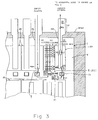
- Figure 3 shows a portion of a DRAM with a conventional LOC structure.
- Figure 4 shows an equivalent circuit for the portion shown in Figure 3 and represents a circuit diagram for an output stage of the semiconductor device having the conventional LOC structure shown in Figure 1.
- Figure 4 highlights the problems with the conventional structure.
- Figure 5 shows a schematic plan view of the portion shown in Figure 3 and represents a plan view of a semiconductor device having the conventional LOC structure shown in Figure 1.
- Figure 5 highlights a problem with the conventional structure.
- 12 and 13 are inverters, 14 and 15 are nMOS transistors, 16 is a bonding pad, 17 is an external lead, and 18 is an external load.
- R1 through R3, L1, and C1 through C4 are respectively resistances, an inductance, and capacitances of the parasitic impedance to the signal path from the bonding pad 16 to the external lead 17.
- the external load 18 is exemplified by a model, comprising a capacitance CL, resistances R4 and R5 and current sources J1 and J2.
- R1 represents the resistance of the bonding wiring 9.
- C1 is equal to half the total capacitance of the wire bonding 9 plus the parasitic capacitance between the bonding pad 16 and the final stage (comprising a buffer including nMOS 14 and 15) of the output buffer 11.
- C2 is equal to half the capacitance of the wire bonding 9 and half the total capacitance of the inner lead 4.
- C3 is equal to half the total capacitance of the inner lead plus half the total capacitance of the external lead 17.
- C4 is half the total capacitance of the external lead 17.
- CL is the total capacitance of the external load 18.
- R2 is the resistance of the inner lead 4.
- R3 is the resistance of the external lead 5.
- L1 is the inductance of the line from an output buffer 11 of the final stage to the foremost end of external lead 17.
- Reference numeral 20 in Figure 3 represents a block obtained by dividing a memory cell array.
- the position of a bonding pad outputting a signal, and the length and area of an inner lead transmitting a signal, should be given more consideration in terms of the electrical characteristics than a bonding pad or an inner lead receiving a signal.
- an inner lead and a bonding pad transmitting a signal need to be configured to minimize the parasitic impedance components, i.e. R1, R2, R3, L1, and C1 through C4, shown in Figure 3 for the purpose of achieving high-speed access.
- a semiconductor device having the conventional LOC structure shown in Figure 1 such as the DRAM shown in Figure 3 treats an inner lead and a bonding pad transmitting a signal in the same way as it treats an inner lead and a bonding pad for solely receiving a signal, such that the bonding pad outputting a signal is arrayed in the direction of the longer side and near the middle of the element-formation surface 2 of the semiconductor chip 1 as shown in Figure 5.
- the tip 4BB of the inner lead 4B for outputting a signal is positioned on the top in the middle and in the direction of the longer side of the element-formation surface 2 of the semiconductor chip 1, as with the tip 4AA of the inner lead 4A for solely receiving a signal.
- a semiconductor device having the conventional LOC structure such as shown in Figure 1 has its signal paths 19 formed with kinked lines as shown in Figure 5, thereby preventing fast operation.
- 20 is a block split from a memory cell array
- 4A is an inner lead for solely receiving a signal
- 21A is a bonding pad for receiving a signal
- 21B is a bonding pad for transmitting a signal
- 4B is an inner lead for transmitting a signal.
- This invention aims at expending a data readout/write-in by providing a semiconductor device having a LOC structure with the least impedance parasitic to signal paths going to an external lead from a bonding pad for solely transmitting a signal or from a bonding pad for both transmitting and receiving a signal. Moreover it aims at further expediting high-speed readout with a shortened signal path.
- the feature of the present invention resides in a semiconductor device configured by attaching a semiconductor chip to a lead frame such that the tip of the inner lead of the lead frame is positioned on top of the element-formation surface of the semiconductor chip, and by resin-sealing a wire-bonding between the bonding pad of the semiconductor chip and the tip of the inner lead is performed.
- a bonding pad for solely receiving a signal is formed parallel to a perimeter on top in the middle of the element-formation surface.
- a bonding pad for solely transmitting a signal or for both receiving and transmitting a signal is formed near the periphery of the element-formation surface.
- An inner lead for solely receiving a signal has its tip positioned parallel to a perimeter on top in the middle of the element-formation surface in correspondence with the bonding pad for solely receiving a signal.
- An inner lead solely for transmitting a signal or for both receiving and transmitting a signal has its tip positioned on top of the periphery of the element-formation surface in correspondence with the bonding pad for solely transmitting a signal or for both receiving and transmitting a signal.
- FIG. 6 is a block diagram illustrating the underlying principles of this invention.
- 22 is a semiconductor chip
- 23 is an element-formation surface of the semiconductor chip 22
- 24 is a bonding pad for solely receiving a signal
- 25 is a bonding pad for solely transmitting a signal or for both receiving and transmitting a signal
- 26 is an inner lead for solely receiving a signal
- 27 is an inner lead for solely trnsmitting a signal or for both receiving and transmitting a signal
- 28 and 29 are bonding wires.
- the semiconductor device having the LOC structure pursuant to this invention is such that the bonding pad 24 for solely receiving a signal is formed near the middle along one side of the perimeter and the bonding pad 25 for solely transmitting a signal or for both receiving and transmitting a signal is formed near the periphery of the element-formation surface 23.
- the inner lead 26 for solely receiving a signal has its tip 26A positioned on top in the middle along one side of the perimeter of the element-formation surface 23, in correspondence with the bonding pad 24 for solely receiving a signal.
- the inner lead 27 for both receiving and transmitting a signal has its tip 27A positioned on top of the periphery of the element-formation surface 23, in correspondence with the bonding pad 25 solely for transmitting a signal or for both receiving and transmitting a signal.
- this invention makes a signal path shorter by short-cutting the turnaround part in a chip for a signal path compared with the conventional structure shown in Figure 5. Therefore, this invention further expedites readout.
- Figure 7 shows a plan view showing a pertinent part of the first preferred embodiment.
- 32 is the main chip body
- 33 is the element-formation surface of the main chip body
- 34 through 41 are eight megabit [8M] blocks
- 42 through 77 are bonding pads
- 78 through 103 are inner leads.
- RAS ⁇ is a row address strobe signal
- CAS ⁇ is a column address strobe signal
- WE ⁇ is a write enable
- OE ⁇ is an output enable signal
- A0 through A11 are addresses
- DQ0 through DQ7 are data input/output terminals
- Vcc and Vss are power source voltages.
- bonding pads 42 through 77 bonding pads 43, 46, 51, 57, 62 and 69 are for a Vcc power source, and bonding pads 42, 48, 54, 59, 65 and 68 are for a Vss power source.
- bonding pads 44, 45, 47 and 49 are for receiving control signals ( WE ⁇ , CAS ⁇ , RAS ⁇ , and OE ⁇ ).
- bonding pads 50, 52, 53, 55, 56, 58, 60, 61, 63, 64, 66 and 67 are for receiving addresses (A0 to A12).
- bonding pads 70 through 77 are for both receiving and transmitting data (DQ0 to DQ7).
- inner lead 84 is for the Vcc power source
- inner lead 97 is for the Vss power source
- inner leads 78, 79, 102 and 103 are for receiving control signals ( WE ⁇ , RAS ⁇ , OE ⁇ and CAS ⁇ ).
- inner leads 81, 83, 85, 87, 89 through 92, 94, 96, 98 and 100 are for receiving addresses (A0 to A12), and inner leads 80, 82, 86, 88, 93, 95, 99 and 101 are for both receiving and transmitting data (DQ0 to DQ7).
- bonding pads 43, 46, 51, 57, 62 and 69 for the Vcc power source and bonding pads 42, 48, 54, 59, 65 and 68 for the Vss power source are formed in the direction of the longer side and in the middle of the element-formation surface 33.
- inner lead 84 for the Vcc power source and inner lead 97 for the Vss power source have their tips extended in the direction of the longer side and on top in the middle of the element-formation surface 33.
- the foremost ends of the inner leads 84 and 97 are provided opposite to each other with a predetermined interval.
- Bonding pads 44, 45, 47 and 49 for receiving control signals ( WE ⁇ , CAS ⁇ , RAS ⁇ and DE ⁇ ) and bonding pads 50, 52, 53, 55, 56, 58, 60, 61, 63, 64, 66 and 67 for receiving addresses are also formed in the direction of the longer side of the element-formation surface 33 and in the area under the area provided between the foremost end of the inner lead 84 and the foremost end of the inner lead 97 on top in the middle of the element-formation surface 33.
- inner leads 78, 79, 102 and 103 for receiving control signal and inner leads 81, 83, 85, 87, 89 through 92, 94, 96, 98 and 100 have their respective tips formed along the longitudinal direction on top of the center of the element-formation surface 33.
- inner leads 80, 82, 86, 88, 93, 95, 99, and 101 for both receiving and transmitting data have their respective tips formed on top of the periphery along the longitudinal direction of the element-formation surface 33.
- the circuitry formed along the longitudinal direction in the middle receives input signals, such as the row address strobe signal RAS ⁇ , the column address strobe signal CAS ⁇ , and addresses A0 through A11.
- the circuitry concentrates along the direction of the longer side and in the middle of the element-formation surface 33 and the power source has a low impedance due to the bus bar, the LOC structure is taken advantage of, and bonding pads provided in the middle of the element-formation surface 33 transmit access instruction signals to the eight megabit [8M] blocks 34 through 41.
- the access instruction signals are transmitted from the middle of the chip toward the chip periphery accompanied by a transmission delay of a word line, a transmission delay of a sense amplifier activation signal and a transmission delay of a column address, until they finally reach bonding pads 70 through 77 via output buffers near bonding pads 70 through 77 for both receiving and transmitting data signals and provided in the periphery of the element-formation surface 33. They are emitted to the outside via inner leads 80, 82, 86, 88, 93, 95 99 and 101 for both receiving and transmitting data signals.
- Bonding pads 70 through 77 for both receiving and transmitting data signals are formed on the periphery in the longitudinal direction. Also, because inner leads 80, 82, 86, 88, 93, 95, 99 and 101 have their respective tips formed on top of the periphery in the longitudinal direction of the element-formation surface 33 correspondingly, the overlaps between the element-formation surface 33 and inner leads 80, 82, 86, 88, 93, 95, 99 and 101 for both receiving and transmitting a data signal can be minimized.
- the shortening of the turnaround part for a signal path from an input signal to an output signal is effective in further expediting operations.
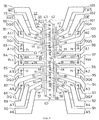
- Figure 8 shows a plan view showing a pertinent part of a second preferred embodiment.
- the second preferred embodiment aims at improving the impedance of the power source for an output buffer.
- bonding pads 104 and 105 for the Vcc power source are formed in a vicinity of eight megabit [8M] blocks 35 and 36 on the periphery of the element-formation surface 33, and that bonding pads 106 and 107 for the Vss power source are formed in a vicinity of eight megabit [8M] blocks 38 and 39 on the periphery of the element-formation surface 33.
- the second preferred embodiment configures everything else the same as the first preferred embodiment.
- bonding pads 104 and 105 for the Vcc power source are provided in a vicinity of eight megabit [8M] blocks 35 and 36 as well as in a central portion of the element-formation surface 33 and thus the impedance of the power source in an output buffer portion provided within blocks 35 and 36 can be more effectively decreased than in the first embodiment.
- the bonding pad for the Vss power source is provided in the vicinity of blocks 38 and 39 as well as in a central portion of the element-formation surface 33, and the impedance of the power source in the output buffer portion provided within blocks 38 and 39 can be more effectively decreased than in the first preferred embodiment. Therefore, the data signals DQ1, DQ2, DQ6 and DQ7 can be read/written with a speed higher than in the first embodiment.
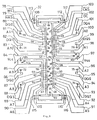
- Figure 9 shows a plan view showing a pertinent part of a third preferred embodiment.
- the third embodiment aims at further improving the impedance of the power source of an output buffer beyond the second embodiment.
- bonding pads 108 through 112 for the Vcc power source are formed near eight megabit [8M] blocks 34, 37, 38, 40 and 41 (shown in Figures 7 and 8 but not shown in Figure 9) on the periphery of the element-formation surface 33, that bonding pads 113 through 117 for the Vss power source are formed near eight megabit [8M] blocks 34, 36, 37, 38 and 41 (shown in Figures 7 and 8 but not shown in Figure 9) on the periphery of the element-formation surface 33, and that bonding pad 104 for the Vcc power source and bonding pad 106 for the Vss power source are not formed.
- the third preferred embodiment configures everything else the same as the second preferred embodiment.
- the bonding pads for the Vcc power source are further provided in the vicinity of blocks 34, 37, 38, 40 and 41 and the bonding pads for the Vss power source are provided in the vicinity of the blocks 34, 37, 38, 40 and 41 and thus the impedance of the power source in the output buffer portion of blocks 34, 37, 38, 40 and 41 can be decreased more effectively than in the second embodiment. Therefore, a read/write for the data signal DQ0, DQ3, DQ4, DQ5 and DQ7 can be performed with a higher speed than in the second embodiment.
- Figure 10 shows a plan view showing a pertinent part of a fourth preferred embodiment.
- the fourth embodiment is such that bonding pads 43 and 69 for the Vcc power source, bonding pads 42 and 68 for the Vss power source, bonding pads 44, 45, 47 and 49 for receiving control signals, and bonding pads 50, 52, 53, 55, 56, 58, 60, 61, 63, 64, 66 and 67 are formed in the width direction, namely, in the direction of the shorter side near the center of the element-formation surface 33, and that bonding pads 70 through 77 for both receiving and transmitting data signals are formed on the short sides of the perimeter of the element-formation surface 33.
- inner lead 84 for the Vcc power source has its tip extended, namely, across the width on top near the center of the element-formation surface 33.
- Inner leads 78, 79, 102 and 103 for receiving control signals WE ⁇ , RAS ⁇ , DE ⁇ and CAS ⁇ , and inner leads for 81, 83, 85, 87, 89 through 92, 94, 96, 98 and 100 for receiving address signals A0 through A11 have their tips positioned along the short side on top near the center of the element-formation surface 33.
- Inner leads 80, 82, 86, 88, 93, 95, 99 and 101 for both receiving and transmitting data signals DQ0 through DQ7 have their tips positioned along the short sides of the perimeter on top of the element-formation surface 33.
- the fourth embodiment can achieve advantages similar to the third embodiment.
- this invention enables the overlap between an element-formation surface and an inner lead for solely transmitting a signal or for both receiving and transmitting a signal, it is effective in reducing the parasitic impedance to signal paths going to an external lead from a bonding pad, and expediting a read/write operation. Moreover shortening the turnaround part of the signal path further expedites a read/write.
Landscapes
- Semiconductor Integrated Circuits (AREA)
- Dram (AREA)
- Lead Frames For Integrated Circuits (AREA)
- Design And Manufacture Of Integrated Circuits (AREA)
Applications Claiming Priority (2)
| Application Number | Priority Date | Filing Date | Title |
|---|---|---|---|
| JP3241045A JP2932785B2 (ja) | 1991-09-20 | 1991-09-20 | 半導体装置 |
| JP241045/91 | 1991-09-20 |
Publications (2)
| Publication Number | Publication Date |
|---|---|
| EP0533589A1 true EP0533589A1 (de) | 1993-03-24 |
| EP0533589B1 EP0533589B1 (de) | 1998-08-26 |
Family
ID=17068492
Family Applications (1)
| Application Number | Title | Priority Date | Filing Date |
|---|---|---|---|
| EP92402587A Expired - Lifetime EP0533589B1 (de) | 1991-09-20 | 1992-09-21 | Halbleitervorrichtung |
Country Status (5)
| Country | Link |
|---|---|
| US (1) | US5648680A (de) |
| EP (1) | EP0533589B1 (de) |
| JP (1) | JP2932785B2 (de) |
| KR (1) | KR960003767B1 (de) |
| DE (1) | DE69226742T2 (de) |
Cited By (6)
| Publication number | Priority date | Publication date | Assignee | Title |
|---|---|---|---|---|
| EP0576021A1 (de) * | 1992-06-24 | 1993-12-29 | Kabushiki Kaisha Toshiba | Struktur von Anschlussleiter auf Chip für Halbleiterbauelement |
| GB2278956B (en) * | 1993-06-09 | 1997-10-08 | At & T Corp | Integrated circuit with multiple relative offset bond pad array |
| GB2312988A (en) * | 1996-05-10 | 1997-11-12 | Memory Corp Plc | Connecting a semiconductor die to a carrier |
| GB2320616A (en) * | 1996-12-18 | 1998-06-24 | Hyundai Electronics Ind | Semiconductor chip package |
| EP0962976A3 (de) * | 1998-06-03 | 2000-05-10 | Hewlett-Packard Company | Integrierte Schaltung mit besonderer Anordnung der Verbindungsleiter |
| US6781220B2 (en) | 2001-05-30 | 2004-08-24 | Infineon Technologies Ag | Printed circuit board for semiconductor memory device |
Families Citing this family (8)
| Publication number | Priority date | Publication date | Assignee | Title |
|---|---|---|---|---|
| US5384487A (en) * | 1993-05-05 | 1995-01-24 | Lsi Logic Corporation | Off-axis power branches for interior bond pad arrangements |
| KR0179924B1 (ko) * | 1996-06-14 | 1999-03-20 | 문정환 | 버텀리드 반도체 패키지 |
| JP3036498B2 (ja) * | 1997-12-08 | 2000-04-24 | 日本電気株式会社 | 半導体パッケージ |
| US6268643B1 (en) | 1997-12-22 | 2001-07-31 | Texas Instruments Incorporated | Lead frame device for delivering electrical power to a semiconductor die |
| TW530525B (en) * | 2001-07-27 | 2003-05-01 | Via Tech Inc | Method of disposing buffer and its chip |
| US7489026B2 (en) * | 2006-10-31 | 2009-02-10 | Freescale Semiconductor, Inc. | Methods and apparatus for a Quad Flat No-Lead (QFN) package |
| US11631623B2 (en) * | 2018-09-06 | 2023-04-18 | Mitsubishi Electric Corporation | Power semiconductor device and method of manufacturing the same, and power conversion device |
| WO2020059751A1 (ja) | 2018-09-19 | 2020-03-26 | ローム株式会社 | 半導体装置 |
Citations (4)
| Publication number | Priority date | Publication date | Assignee | Title |
|---|---|---|---|---|
| EP0198194A1 (de) * | 1985-04-18 | 1986-10-22 | International Business Machines Corporation | Halbleiterelement in einem Gehäuse |
| EP0204177A1 (de) * | 1985-05-31 | 1986-12-10 | Siemens Aktiengesellschaft | Anschlussanordnung für einen integrierten Halbleiterschaltkreis |
| EP0295459A2 (de) * | 1987-06-15 | 1988-12-21 | International Business Machines Corporation | Elekrtronischer Zusammenbau und Verfahren zur Herstellung desselben |
| US4951122A (en) * | 1987-05-27 | 1990-08-21 | Hitachi, Ltd. | Resin-encapsulated semiconductor device |
Family Cites Families (2)
| Publication number | Priority date | Publication date | Assignee | Title |
|---|---|---|---|---|
| KR0158868B1 (ko) * | 1988-09-20 | 1998-12-01 | 미다 가쓰시게 | 반도체장치 |
| US5151559A (en) * | 1991-05-02 | 1992-09-29 | International Business Machines Corporation | Planarized thin film surface covered wire bonded semiconductor package |
-
1991
- 1991-09-20 JP JP3241045A patent/JP2932785B2/ja not_active Expired - Fee Related
-
1992
- 1992-09-21 DE DE69226742T patent/DE69226742T2/de not_active Expired - Fee Related
- 1992-09-21 KR KR1019920017207A patent/KR960003767B1/ko not_active Expired - Fee Related
- 1992-09-21 EP EP92402587A patent/EP0533589B1/de not_active Expired - Lifetime
-
1995
- 1995-09-29 US US08/536,674 patent/US5648680A/en not_active Expired - Fee Related
Patent Citations (4)
| Publication number | Priority date | Publication date | Assignee | Title |
|---|---|---|---|---|
| EP0198194A1 (de) * | 1985-04-18 | 1986-10-22 | International Business Machines Corporation | Halbleiterelement in einem Gehäuse |
| EP0204177A1 (de) * | 1985-05-31 | 1986-12-10 | Siemens Aktiengesellschaft | Anschlussanordnung für einen integrierten Halbleiterschaltkreis |
| US4951122A (en) * | 1987-05-27 | 1990-08-21 | Hitachi, Ltd. | Resin-encapsulated semiconductor device |
| EP0295459A2 (de) * | 1987-06-15 | 1988-12-21 | International Business Machines Corporation | Elekrtronischer Zusammenbau und Verfahren zur Herstellung desselben |
Cited By (8)
| Publication number | Priority date | Publication date | Assignee | Title |
|---|---|---|---|---|
| EP0576021A1 (de) * | 1992-06-24 | 1993-12-29 | Kabushiki Kaisha Toshiba | Struktur von Anschlussleiter auf Chip für Halbleiterbauelement |
| US5391918A (en) * | 1992-06-24 | 1995-02-21 | Kabushiki Kaisha Toshiba | Semiconductor device |
| GB2278956B (en) * | 1993-06-09 | 1997-10-08 | At & T Corp | Integrated circuit with multiple relative offset bond pad array |
| GB2312988A (en) * | 1996-05-10 | 1997-11-12 | Memory Corp Plc | Connecting a semiconductor die to a carrier |
| GB2320616A (en) * | 1996-12-18 | 1998-06-24 | Hyundai Electronics Ind | Semiconductor chip package |
| GB2320616B (en) * | 1996-12-18 | 2002-01-16 | Hyundai Electronics Ind | An improved chip-size package semiconductor |
| EP0962976A3 (de) * | 1998-06-03 | 2000-05-10 | Hewlett-Packard Company | Integrierte Schaltung mit besonderer Anordnung der Verbindungsleiter |
| US6781220B2 (en) | 2001-05-30 | 2004-08-24 | Infineon Technologies Ag | Printed circuit board for semiconductor memory device |
Also Published As
| Publication number | Publication date |
|---|---|
| JPH0582703A (ja) | 1993-04-02 |
| DE69226742D1 (de) | 1998-10-01 |
| JP2932785B2 (ja) | 1999-08-09 |
| KR960003767B1 (ko) | 1996-03-22 |
| DE69226742T2 (de) | 1999-01-14 |
| EP0533589B1 (de) | 1998-08-26 |
| KR930006889A (ko) | 1993-04-22 |
| US5648680A (en) | 1997-07-15 |
Similar Documents
| Publication | Publication Date | Title |
|---|---|---|
| US6625050B2 (en) | Semiconductor memory device adaptable to various types of packages | |
| US5357478A (en) | Semiconductor integrated circuit device including a plurality of cell array blocks | |
| US6593646B2 (en) | Dual die memory | |
| EP0533589B1 (de) | Halbleitervorrichtung | |
| US6353549B1 (en) | Architecture and package orientation for high speed memory devices | |
| US5587607A (en) | Semiconductor integrated circuit device having improvement arrangement of pads | |
| US5789808A (en) | Semiconductor device structured to be less susceptible to power supply noise | |
| US5900021A (en) | Pad input select circuit for use with bond options | |
| JPH0621320A (ja) | 半導体集積回路装置 | |
| KR100224770B1 (ko) | 리드 온 칩 리드프레임 및 이를 이용한 반도체 소자 패키지 | |
| US7227251B2 (en) | Semiconductor device and a memory system including a plurality of IC chips in a common package | |
| US5998869A (en) | High storage capacity, wide data input/output channel, static random access memory device | |
| KR100481184B1 (ko) | 반도체 메모리 집적회로 | |
| JP2985479B2 (ja) | 半導体メモリおよび半導体メモリモジュール | |
| US6147924A (en) | Arrangement of data input/output circuits for use in a semiconductor memory device | |
| KR100306967B1 (ko) | 반도체메모리집적회로장치의데이터입/출력회로배열 | |
| KR0175022B1 (ko) | 반도체 기억장치의 데이터 입출력 모드 변환장치 | |
| KR100192588B1 (ko) | 부분칩을 갖는 반도체 메모리장치 | |
| KR20010063182A (ko) | 멀티칩 패키지 구성을 위한 반도체 장치의 칩 선택회로 | |
| JPH06302644A (ja) | 半導体装置 | |
| KR19980034266A (ko) | 반도체 메모리 장치의 뱅크 분리 방법 및 그 장치 | |
| JPH0358544B2 (de) | ||
| JP2011170914A (ja) | 半導体装置 | |
| JPH04284636A (ja) | 半導体装置 | |
| JPH0366091A (ja) | 半導体集積回路装置及びそれを搭載する樹脂封止型半導体装置 |
Legal Events
| Date | Code | Title | Description |
|---|---|---|---|
| PUAI | Public reference made under article 153(3) epc to a published international application that has entered the european phase |
Free format text: ORIGINAL CODE: 0009012 |
|
| AK | Designated contracting states |
Kind code of ref document: A1 Designated state(s): DE FR GB IT |
|
| 17P | Request for examination filed |
Effective date: 19930903 |
|
| 17Q | First examination report despatched |
Effective date: 19950403 |
|
| GRAG | Despatch of communication of intention to grant |
Free format text: ORIGINAL CODE: EPIDOS AGRA |
|
| GRAG | Despatch of communication of intention to grant |
Free format text: ORIGINAL CODE: EPIDOS AGRA |
|
| GRAH | Despatch of communication of intention to grant a patent |
Free format text: ORIGINAL CODE: EPIDOS IGRA |
|
| GRAH | Despatch of communication of intention to grant a patent |
Free format text: ORIGINAL CODE: EPIDOS IGRA |
|
| GRAA | (expected) grant |
Free format text: ORIGINAL CODE: 0009210 |
|
| AK | Designated contracting states |
Kind code of ref document: B1 Designated state(s): DE FR GB IT |
|
| REF | Corresponds to: |
Ref document number: 69226742 Country of ref document: DE Date of ref document: 19981001 |
|
| ET | Fr: translation filed | ||
| PLBE | No opposition filed within time limit |
Free format text: ORIGINAL CODE: 0009261 |
|
| STAA | Information on the status of an ep patent application or granted ep patent |
Free format text: STATUS: NO OPPOSITION FILED WITHIN TIME LIMIT |
|
| 26N | No opposition filed | ||
| REG | Reference to a national code |
Ref country code: GB Ref legal event code: IF02 |
|
| PGFP | Annual fee paid to national office [announced via postgrant information from national office to epo] |
Ref country code: DE Payment date: 20070913 Year of fee payment: 16 |
|
| PGFP | Annual fee paid to national office [announced via postgrant information from national office to epo] |
Ref country code: GB Payment date: 20070919 Year of fee payment: 16 |
|
| PGFP | Annual fee paid to national office [announced via postgrant information from national office to epo] |
Ref country code: IT Payment date: 20070926 Year of fee payment: 16 |
|
| PGFP | Annual fee paid to national office [announced via postgrant information from national office to epo] |
Ref country code: FR Payment date: 20070914 Year of fee payment: 16 |
|
| GBPC | Gb: european patent ceased through non-payment of renewal fee |
Effective date: 20080921 |
|
| REG | Reference to a national code |
Ref country code: FR Ref legal event code: ST Effective date: 20090529 |
|
| PG25 | Lapsed in a contracting state [announced via postgrant information from national office to epo] |
Ref country code: IT Free format text: LAPSE BECAUSE OF NON-PAYMENT OF DUE FEES Effective date: 20080921 Ref country code: DE Free format text: LAPSE BECAUSE OF NON-PAYMENT OF DUE FEES Effective date: 20090401 |
|
| PG25 | Lapsed in a contracting state [announced via postgrant information from national office to epo] |
Ref country code: FR Free format text: LAPSE BECAUSE OF NON-PAYMENT OF DUE FEES Effective date: 20080930 |
|
| PG25 | Lapsed in a contracting state [announced via postgrant information from national office to epo] |
Ref country code: GB Free format text: LAPSE BECAUSE OF NON-PAYMENT OF DUE FEES Effective date: 20080921 |