EP0538902B1 - Appareil de formation d'images muni de moyens de séparation du matériau d'enregistrement - Google Patents
Appareil de formation d'images muni de moyens de séparation du matériau d'enregistrement Download PDFInfo
- Publication number
- EP0538902B1 EP0538902B1 EP92118261A EP92118261A EP0538902B1 EP 0538902 B1 EP0538902 B1 EP 0538902B1 EP 92118261 A EP92118261 A EP 92118261A EP 92118261 A EP92118261 A EP 92118261A EP 0538902 B1 EP0538902 B1 EP 0538902B1
- Authority
- EP
- European Patent Office
- Prior art keywords
- recording material
- separation
- image
- voltage
- transfer
- Prior art date
- Legal status (The legal status is an assumption and is not a legal conclusion. Google has not performed a legal analysis and makes no representation as to the accuracy of the status listed.)
- Expired - Lifetime
Links
- 239000000463 material Substances 0.000 title claims description 95
- 238000012546 transfer Methods 0.000 claims description 138
- 238000000926 separation method Methods 0.000 claims description 100
- 238000007599 discharging Methods 0.000 claims description 26
- 238000011144 upstream manufacturing Methods 0.000 claims description 5
- 230000015572 biosynthetic process Effects 0.000 claims 2
- 230000008859 change Effects 0.000 description 5
- 230000006872 improvement Effects 0.000 description 5
- 230000009471 action Effects 0.000 description 4
- 230000000694 effects Effects 0.000 description 4
- 230000007423 decrease Effects 0.000 description 3
- 239000002245 particle Substances 0.000 description 3
- 230000007547 defect Effects 0.000 description 2
- 239000000428 dust Substances 0.000 description 2
- 238000000034 method Methods 0.000 description 2
- 230000004048 modification Effects 0.000 description 2
- 238000012986 modification Methods 0.000 description 2
- 230000008569 process Effects 0.000 description 2
- 229910021417 amorphous silicon Inorganic materials 0.000 description 1
- 238000013459 approach Methods 0.000 description 1
- 238000011109 contamination Methods 0.000 description 1
- 230000003247 decreasing effect Effects 0.000 description 1
- 230000001419 dependent effect Effects 0.000 description 1
- 238000001514 detection method Methods 0.000 description 1
- 238000011161 development Methods 0.000 description 1
- 239000003989 dielectric material Substances 0.000 description 1
- 230000003467 diminishing effect Effects 0.000 description 1
- 230000005684 electric field Effects 0.000 description 1
- 230000010354 integration Effects 0.000 description 1
- 238000011835 investigation Methods 0.000 description 1
- 230000007774 longterm Effects 0.000 description 1
- 230000007246 mechanism Effects 0.000 description 1
- 230000002093 peripheral effect Effects 0.000 description 1
- 230000002265 prevention Effects 0.000 description 1
- 230000009467 reduction Effects 0.000 description 1
- 238000009877 rendering Methods 0.000 description 1
- 230000004044 response Effects 0.000 description 1
Images



Classifications
-
- G—PHYSICS
- G03—PHOTOGRAPHY; CINEMATOGRAPHY; ANALOGOUS TECHNIQUES USING WAVES OTHER THAN OPTICAL WAVES; ELECTROGRAPHY; HOLOGRAPHY
- G03G—ELECTROGRAPHY; ELECTROPHOTOGRAPHY; MAGNETOGRAPHY
- G03G15/00—Apparatus for electrographic processes using a charge pattern
- G03G15/65—Apparatus which relate to the handling of copy material
- G03G15/6532—Removing a copy sheet form a xerographic drum, band or plate
- G03G15/6535—Removing a copy sheet form a xerographic drum, band or plate using electrostatic means, e.g. a separating corona
-
- B—PERFORMING OPERATIONS; TRANSPORTING
- B82—NANOTECHNOLOGY
- B82Y—SPECIFIC USES OR APPLICATIONS OF NANOSTRUCTURES; MEASUREMENT OR ANALYSIS OF NANOSTRUCTURES; MANUFACTURE OR TREATMENT OF NANOSTRUCTURES
- B82Y15/00—Nanotechnology for interacting, sensing or actuating, e.g. quantum dots as markers in protein assays or molecular motors
Definitions
- the present invention relates to an image forming apparatus such as an electrophotographic apparatus or electrostatic recording apparatus, which is provided with separating means for electrostatically separating a recording material.
- An electrostatic separating means has been proposed as a transfer material separating means, in which a separating charger is disposed at a predetermined position immediately after the image transfer position to apply electric charge having the polarity opposite to that of the transfer charger to the transfer material to neutralize or discharge the electric charge applied during the transfer operation, by which the attraction force toward the image bearing member is reduced.
- This electrostatic separation means is effective to a certain extent.
- the separation charger is in the form of an AC corona discharger supplied with a DC biased AC voltage, and is called electrostatic separation system.
- FIG. 6 there is shown an electrostatic separation system, schematically.
- a transfer charger 2 Adjacent the position where the transfer material P is contacted to the toner image T (charged to the negative polarity) on the image bearing member in the form of a photosensitive drum 1, a transfer charger 2 supplies to the backside of the transfer material P a transfer potential having the polarity (positive) opposite to that of the toner image T, so that the toner image T is transferred onto the transfer material P.
- an AC discharge operation is effected by a separation charger 3 for removing the transfer potential.
- the recent increase of the copy speed is remarkable with the result that it becomes difficult to maintain the transfer and separation performance by increasing the peak-to-peak voltage Vpp alone. More particularly, if the peak-to-peak voltage Vpp is too high, the toner image T may be deposited back to the photosensitive drum 1 during the separating action (back-transfer).
- the problem is particularly remarkable in the case of high speed copying machines in which the transfer material feeding speed is not less than about 300 mm/sec.
- the problem is not remarkable in middle or low speed machines, but assisting mechanisms such as pre-transfer charger, pre-transfer exposure, air sucking (separation pawls, separation belt, scorotron separation charger or the like), in order to prevent the back-transfer.
- assisting mechanisms such as pre-transfer charger, pre-transfer exposure, air sucking (separation pawls, separation belt, scorotron separation charger or the like), in order to prevent the back-transfer.
- the disadvantages of high cost and poor durability are involved.
- a current difference which is a difference between an absolute value of the positive component and the absolute value of the negative component in the separation charger, is adjusted to provide a desired separation performance. If the current difference is directed strongly to the side of the same polarity as the transfer bias, an improper separation action occurs due to insufficient electric discharge of the transfer material. If it is strongly directed to the side of the polarity opposite to that of the transfer bias, the back-transfer is liable to occur due to excessive discharge. In order to effect stabilized separation, it is desirable that the proper current range of the current difference is large. In order to achieve this, Japanese Laid-Open Patent Application No.
- US 4 979 000 discloses an image forming apparatus for forming an image on a recording sheet comprising a photosensitive drum for holding a toner image thereon, a developer for forming the toner image on the photosensitive drum, an image transfer device for electrostatically transferring the toner image from the photosensitive drum to the recording sheet and a sheet seperator for separating the recording sheet from the photosensitive drum as the recording sheet advances.
- the sheet separator comprises a single fork-like electrode and is controlled to generate a discharge voltage which includes at least alternating currents at various duty factors.
- Figure 1 is a schematic sectional view of an image forming apparatus according to an embodiment of the present invention.
- Figure 2 is a graph showing a relationship between a transfer material conveying speed and a total discharging current.
- Figure 3 is a side view of a transfer material separating device in an image forming apparatus according to a second embodiment of the present invention.
- Figure 4 is a side view of a separation charger which is a modification of the separation charger of Figure 3.
- Figure 5 is a side view of a transfer material separating device used in an image forming apparatus according to a third embodiment of the present invention.
- Figure 6 is a side view of a transfer material separating device not using the present invention.
- Figure 7 is a graph of discharging current through a photosensitive drum.
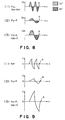
- Figure 8 is graphs of discharging currents through a point Q before a separation point.
- Figure 9 is graphs of potential change corresponding to (1), (2) and (3) of Figure 8.
- Figure 10 is a graph showing a relationship between a change of current difference and a backside potential of the transfer material after the separation.
- Figure 11 is a side view of an opening of a separation charger with a grid.
- Figures 12 and 13 are side views of shields of separation chargers according to other examples.
- an image forming apparatus there is shown an image forming apparatus according to an embodiment of the present invention.
- the photosensitive drum 1 comprises an amorphous silicon photosensitive layer 1A having a positive charging property and a conductive base electrically grounded and effective to support the photosensitive layer 1A.
- the photosensitive drum 1 is electrically charged to the positive polarity by a charger 7, and is exposed to image light L in accordance with image information representing original or the like, so that an electrostatic latent image is formed.
- the electrostatic latent image is developed by a developing device 8 with the toner particles charged to the negative polarity.
- the toner image T is developed and is transferred from the photosensitive drum 1 onto the recording material in the form of a transfer material P (paper or the like) by a transfer corona charger 2.
- the charger 2 is supplied with a voltage of the positive polarity which is the opposite from the charging polarity of the toner.
- the charger 2 supplies positive electric charge to the backside of the transfer material P.
- a separation corona charger 3 removes the transfer charge from the backside of the transfer material P, thus diminishing the electrostatic attraction force between the photosensitive drum 1 and the transfer material P, so that the transfer material P is permitted to be separated from the photosensitive drum 1.
- the separation corona charger 3 comprises a wire electrode 31 and a shield electrode 32.
- the wire electrodes 31 is supplied with a DC biased AC voltage, in which the DC component has a negative polarity which is the opposite from the transfer charge polarity.
- the transfer material carrying the toner image T is conveyed to an image fixing device 10, so that a toner image T is fixed on the transfer material P.
- the photosensitive drum 1 is cleaned by a cleaner 7 so that the residual toner is removed therefrom. Thereafter, the photosensitive drum 1 is uniformly exposed to light by an unshown pre-exposure lamp, so that the residual electric charge is removed to be prepared for the repeated image forming operation.
- a transfer charger 2' is supplied with a voltage having a polarity opposite from that of the charging polarity of the toner image T', and the separation charger 3' is supplied with a DC biased AC voltage in which the DC component has the polarity opposite from that of the transfer voltage.
- Figure 7 is a graph of the discharge current through the photosensitive drum from the transfer charger 2' and the separation charger 3' in Figure 6. After the photosensitive drum 1 is subjected to the transfer discharge current having the polarity (positive) opposite from that of the toner, it is subjected to the AC discharge current for the electric discharge. Figure 7 shows that the separation point A of the transfer material P from the photosensitive drum 1 is a point where the photosensitive drum 1 and the discharging wire electrode 31' of the separation charger 3' are closest, that is, where the discharge current from the separation charger 3' is largest. The separation at this point is most stable, since the received discharging current decreases, and therefore, the separation power decreases, after the point A.
- (1) shows the AC discharge current Ip received from the separation charger with respect to a movement distance x of a point Q on the transfer material before the separation point A; (2) shows the same when the transfer material conveying speed Vp is doubled in which the period of the current Ip is twice, and the peak level of the current Ip is one half. Therefore, the total current received by the point Q before it reaches the point A, (
- (3) shows the case in which the voltage Vpp is increased so that the discharge current (
- a current difference Is which is the difference between the absolute value of a positive component of the separation discharge current and the absolute value of the negative component thereof, is adjusted to provide a desired separation function.
- the proper range may change or reduce due the ambient conditions or copy modes. Therefore, in order to provide the stabilized separation at all times, it is desirable to increase the range.
- the separation charger 3 is disposed faced to the photosensitive member 1, and the opening of the shield of the separation charger 3 is reduced toward the photosensitive member 1, as shown in Figure 1.
- the opening 32A is smaller than the shield bottom 32B.
- Figures 12 and 13 show other examples satisfying this requirement.
- the current tends to leak to the edge 32C of the shield 32 with the result of the tendency of the toner particles and the paper dust being attracted to the edge 32C.
- Figure 1 and Figure 13 configurations are preferable in which the shield edge 32C is gradually away from the discharging electrode 31 comprising a wire.
- the discharge current into the shield is not less than 60 % of the total discharge current.
- the discharge current into the reducing portion of the shield is not less than 10 % of the total discharging current. The percentages can be controlled by properly selecting the distances between the wire electrode and the portions of the inside surface of the shield.
- the transfer action is assured by increasing the frequency f of the separation AC voltage. This will be described in detail.
- Table 1 shows whether the range is practically usable or not.
- Table 1 three right side data with the frequencies given, are for the case of using the separation charger in which the shield opening is not reduced.
- the leftmost data are for the separation charger having the reduced opening as shown in Figure 1 with the frequency of 500 Hz.
- the proper current difference range reduces very much if the transfer material conveying speed Vp > 300 mm/sec. For this reason, if the electrophotographic apparatus has a photosensitive drum and has a process speed Vp which is higher than 300 mm/sec, the above-described assisting device or devices (pre-transfer charger or the like) have to be used between the developing device and the transfer charger in most cases.
- the performance is further improved if the frequency of the separation high voltage is increased to 1000 Hz.
- the performance is stabilized by the improvement of the charger, and the performance can be increased very much by the increase of the frequency.
- Table 2 shows the results of the investigated proper current difference range for the various conveying speed Vp when the opening is reduced as shown in Figure 1, and the frequency of the AC separating high voltage is increased.
- Vp/f in the parentheses are spatial periods on the transfer material corresponding to the time periods of the separation AC high voltage.
- the frequency f may be adjusted if necessary. In the transfer material separating device of this embodiment, when the transfer material conveying speed Vp is not less than 300 mm/sec, the frequency f is increased up to 600 - 1400 Hz, and the opening is reduced or converged.
- the toner image T provided by the development is charged to the negative polarity, and is attracted by the positive electric charge of the image on the photosensitive member 1.
- the transfer charger 2 providing the positive corona discharge
- the backside of the transfer material P is charged to the positive polarity, which is effective to attract the toner image T onto the transfer material.
- the transfer material P proceeds toward the separation charger 3
- the backside of the transfer material is electrically discharged by AC corona discharge.
- the transfer material P with the toner image T is separated from the drum 1 by the rigidity of the transfer material P, and it is conveyed to an image fixing device, and is discharged to the outside of the apparatus.
- the separation charging means 3 comprises a first separation charger 31 and a second separation charger 32 to stabilize the separating performance.
- the total current from the transformer is doubled, and the discharging region is doubled.
- the next separation charger 32 is effective to further discharge it. Therefore, the risk of the paper jam due to the paper or transfer material P wrapping around the photosensitive drum 1, can be remarkably reduced.
- Figure 4 shows an embodiment in which the frequency of the AC voltage applied to the discharging wire electrode 31a and the frequency of the AC voltage applied to the discharging wire electrode 31b which is downstream with respect to the movement direction of the transfer material, are made different.
- the transfer material conveying speed Vp is approximately 400 mm/sec
- the AC high voltage supplied to the separation charger is not less than 10 KVpp
- two discharging electrodes require total transformer output current (
- the used frequency is preferably not less than 800 - 1000 Hz, which, however, may be hard by people as corona noise in 3 case.
- the upstream discharging electrode 31a is more effective in the separating power and the back-transfer transfer prevention than the downstream one, and the downstream one has an auxiliary effect. Therefore, the voltage applied to the upstream wire electrode is given a higher frequency than the downstream one.
- the downstream wire electrode 31b is supplied with a voltage having such a low frequency which is lower than the audible range, by which the volume of the audible range can be decreased. By doing so, the noise level is substantially equivalent to the case of single separation discharging electrode.
- the reduced opening structure of the shield may be usable for both of the upstream and downstream separation dischargers, by which the contamination can be prevented in both of the chargers.
- the reduced opening structure of the shield may be used only in the upstream one, as shown in Figure 4, if desirable.
- the separation charger is used to separate the recording material from the image bearing member.
- the present invention is not limited to such use.
- Figure 5 is a side view of a major portion of an image forming apparatus using the separating device of Figure 1.
- a transfer belt 5 is trained around transfer belt supporting rollers 4a, 4b and 4c.
- the roller 4a is a conductive roller which is electrically grounded.
- a transfer member 20 for applying a transfer bias so as to face the photosensitive member 1.
- the transfer belt 5 is made of dielectric material having a volume resistivity of approximately 10 14 ohm.cm and has a thickness of approximately 50 microns. It rotates in the direction indicated by an arrow D in synchronism with the photosensitive member 1.
- the transfer material P is supplied from the left of the transfer belt to the transfer position, where it is supplied with the transfer bias by the transfer member 20.
- the transfer bias voltage is -3 KV, for example, which constitutes an electric field.
- the toner image electrostatically formed on the surface of the photosensitive member 1 is transferred onto the transfer material P.
- the toner image is formed in the same manner as in the case of Figure 1.
- the transfer material P is kept attracted on the transfer belt 5 electrically charged by the transfer member 6, and is conveyed to the right to the separating position C, where it is separated from the transfer belt 2 and is conveyed to an unshown image fixing station.
- the residual charge on the transfer belt is dissipated by the time it reaches the position where the transfer material is separated from the transfer belt, and therefore, no special discharging means is required.
- a separation charger 3 for effecting high frequency AC discharge (800 Hz) to a separating position C is disposed at the separating position C.
- the structure of the separation charger is the same as in Figure 1.
- the waveform of the AC voltage may be sine, triangular, rectangular or the like.
- the AC voltage may be in the form of the rectangular provided by periodically rendering on and off a AC voltage source, and various voltage which changes periodically is usable.
- the frequency of the AC voltage applied to the separation charger is increased in accordance with the conveying speed of the recording material, and the opening of the shield electrode is reduced, by which the improper separation, the back transfer, the image defects due to the separation discharge or the like, can be avoided with stability and with high durability.
Landscapes
- Chemical & Material Sciences (AREA)
- Engineering & Computer Science (AREA)
- Nanotechnology (AREA)
- Physics & Mathematics (AREA)
- General Physics & Mathematics (AREA)
- Health & Medical Sciences (AREA)
- Life Sciences & Earth Sciences (AREA)
- General Health & Medical Sciences (AREA)
- Molecular Biology (AREA)
- Crystallography & Structural Chemistry (AREA)
- Electrostatic Charge, Transfer And Separation In Electrography (AREA)
Claims (17)
- Appareil de formation d'image comprenant:un moyen (1, 2, 7, 8, 9) de formation d'image pour former une image (T) sur un support d'enregistrement (P), ledit moyen de formation d'image comportant un élément (1, 5) de contact, pouvant être mis en contact avec le support d'enregistrement à l'aide d'une force d'attraction électrostatique entre l'élément de contact et le support d'enregistrement;un moyen (3) de décharge par séparation, pour décharger électriquement le support d'enregistrement lors de la séparation du support d'enregistrement dudit élément de contact, après la formation d'image sur le support d'enregistrement, ledit moyen de décharge par séparation comportant une électrode filaire (31) et une électrode de protection (32), ladite électrode de protection comportant une première partie d'électrode de protection et une seconde partie d'électrode de protection, dans cet ordre, dans la direction de déplacement du support d'enregistrement, et ladite électrode filaire étant disposée entre la première partie d'électrode de protection et la seconde partie d'électrode de protection; dans lequella relation Vp/f ≤ 0,5 mm est satisfaite, Vp étant la vitesse de transport du support d'enregistrement en mm/sec, et f étant la fréquence d'une tension à variation périodique appliquée audit moyen de décharge par séparation, exprimée en Hz, la distance entre la première partie d'électrode de protection et la seconde partie d'électrode de protection, mesurée dans la direction de déplacement, étant inférieure, dans la position d'une ouverture de ladite électrode de protection, à celle dans la position de ladite électrode filaire.
- Appareil selon la revendication 1, dans lequel ledit élément de contact est un élément (1) de support d'image, et ledit moyen de formation d'image comporte un moyen de transfert (2) pour transférer l'image de manière électrostatique, depuis ledit élément de support d'image sur le support d'enregistrement.
- Appareil selon la revendication 2, dans lequel ladite tension est une tension alternative polarisée avec une tension continue ayant une polarité opposée à la polarité de charge du moyen de transfert.
- Appareil selon la revendication 1, dans lequel ledit élément de contact-est un élément (5) de support du support d'enregistrement, pour supporter le support d'enregistrement, et ledit moyen de formation d'image comprend un élément (1) de support d'image, et un moyen (3) de transfert pour transférer l'image depuis ledit élément de support d'image sur le support d'enregistrement disposé sur l'élément de support de support d'enregistrement.
- Appareil selon la revendication 1 ou 4, dans lequel ladite électrode de protection est réduite progressivement vers l'élément de contact.
- Appareil selon la revendication 5, dans lequel ladite électrode de protection a une largeur constante entre le bas de celle-ci et la partie réduite (32c).
- Appareil de formation d'image comprenant:un moyen (1, 2, 7, 8, 9) de formation d'image pour former une image (T) sur un support d'enregistrement (P), ledit moyen de formation d'image comportant un élément (1) de contact qui peut être mis en contact avec le support d'enregistrement à l'aide d'une force d'attraction électrostatique entre l'élément de contact et le support d'enregistrement;un moyen (3) de décharge par séparation, pour décharger électriquement le support d'enregistrement lors de la séparation du support d'enregistrement dudit élément de contact, après formation de l'image sur le support d'enregistrement, caractérisé en ce queledit moyen de décharge par séparation comprend un premier (31) et un second (32) dispositifs de décharge par séparation, qui sont disposés, respectivement, à l'amont et à l'aval, dans la direction de transport du support d'enregistrement, les premier et second dispositifs de décharge par séparation étant alimentés par des première et seconde tensions ayant des niveaux de tension à variation périodique;dans lequel les première et seconde tensions ont des fréquences différentes.
- Appareil selon la revendication 7, dans lequel la fréquence de la première tension est supérieure à celle de la seconde tension.
- Appareil selon la revendication 8, dans lequel la fréquence de la seconde tension est inférieure à la plage audible.
- Appareil selon la revendication 7, 8 ou 9, dans lequel les premier et second dispositifs de décharge par séparation comprennent chacun une électrode filaire (31a, 31b) et une électrode de protection.
- Appareil selon l'une des revendications 7 à 10, dans lequel Vp/f ≤ 0,5 mm, Vp étant la vitesse de déplacement du support d'enregistrement, en mm/sec, et f étant la fréquence de la première tension, en Hz.
- Appareil selon la revendication 10 ou 11, dans lequel ledit premier dispositif de décharge par séparation comporte une électrode de protection qui est réduite vers ledit élément de contact.
- Appareil selon l'une des revendications 7 à 12, dans lequel ledit élément de contact est un élément (1) de support d'image, et ledit moyen de formation d'image comporte un moyen de transfert (2) pour transférer l'image de manière électrostatique, depuis ledit élément de support d'image sur le support d'enregistrement.
- Appareil selon la revendication 13, dans lequel les première et seconde tensions se présentent chacune sous la forme d'une tension alternative polarisée avec une tension continue d'une polarité opposée à la polarité de charge dudit moyen de transfert.
- Appareil selon la revendication 12, dans lequel ladite électrode de protection a une partie inférieure qui est plus grande qu'une ouverture de l'électrode de protection.
- Appareil selon la revendication 12, 13, 14 ou 15 dans lequel ladite électrode de protection est réduite progressivement vers ledit élément de contact.
- Appareil selon la revendication 16, dans lequel l'électrode de protection a une largeur constante entre sa partie du bas et la partie réduite.
Applications Claiming Priority (2)
| Application Number | Priority Date | Filing Date | Title |
|---|---|---|---|
| JP307056/91 | 1991-10-25 | ||
| JP3307056A JP2737036B2 (ja) | 1991-10-25 | 1991-10-25 | 記録材分離装置 |
Publications (3)
| Publication Number | Publication Date |
|---|---|
| EP0538902A2 EP0538902A2 (fr) | 1993-04-28 |
| EP0538902A3 EP0538902A3 (en) | 1993-08-11 |
| EP0538902B1 true EP0538902B1 (fr) | 1996-06-05 |
Family
ID=17964520
Family Applications (1)
| Application Number | Title | Priority Date | Filing Date |
|---|---|---|---|
| EP92118261A Expired - Lifetime EP0538902B1 (fr) | 1991-10-25 | 1992-10-26 | Appareil de formation d'images muni de moyens de séparation du matériau d'enregistrement |
Country Status (4)
| Country | Link |
|---|---|
| US (1) | US5523834A (fr) |
| EP (1) | EP0538902B1 (fr) |
| JP (1) | JP2737036B2 (fr) |
| DE (1) | DE69211285T2 (fr) |
Families Citing this family (4)
| Publication number | Priority date | Publication date | Assignee | Title |
|---|---|---|---|---|
| JP4115051B2 (ja) * | 1998-10-07 | 2008-07-09 | キヤノン株式会社 | 電子線装置 |
| JP2000242089A (ja) * | 1999-02-22 | 2000-09-08 | Kyocera Mita Corp | 画像形成方法 |
| US7599647B2 (en) * | 2005-10-26 | 2009-10-06 | Sharp Kabushiki Kaisha | Charging device and electrophotographic apparatus including the same |
| JP5729227B2 (ja) * | 2011-09-13 | 2015-06-03 | 株式会社リコー | 画像形成装置 |
Family Cites Families (15)
| Publication number | Priority date | Publication date | Assignee | Title |
|---|---|---|---|---|
| US3620615A (en) * | 1968-12-31 | 1971-11-16 | Xerox Corp | Sheet stripping apparatus |
| US4533618A (en) * | 1974-08-01 | 1985-08-06 | Mita Industrial Company, Ltd. | Method for transferring toner image |
| US4239373A (en) * | 1978-11-01 | 1980-12-16 | Xerox Corporation | Full wave rectification apparatus for operation of DC corotrons |
| JPS5570862A (en) * | 1978-11-22 | 1980-05-28 | Copyer Co Ltd | Transfer paper separating device in electronic copier |
| DE3109812A1 (de) * | 1980-03-13 | 1982-01-07 | Canon K.K., Tokyo | "elektrofotografisches verfahren" |
| JPS61153679A (ja) * | 1984-12-27 | 1986-07-12 | Minolta Camera Co Ltd | 複写機 |
| JPH0677171B2 (ja) * | 1985-01-08 | 1994-09-28 | キヤノン株式会社 | 画像形成装置 |
| JPS629375A (ja) * | 1985-07-05 | 1987-01-17 | Canon Inc | 画像形成装置 |
| JPS6243681A (ja) * | 1985-08-20 | 1987-02-25 | Konishiroku Photo Ind Co Ltd | 複写装置 |
| JPS62205978A (ja) * | 1986-03-06 | 1987-09-10 | 三菱電機株式会社 | エレベ−タのかご内表示装置 |
| JPS63298265A (ja) * | 1987-05-29 | 1988-12-06 | Canon Inc | 転写材分離装置 |
| JPH01229277A (ja) * | 1988-03-10 | 1989-09-12 | Fuji Xerox Co Ltd | 画像形成装置の転写・剥離装置 |
| JPH01287589A (ja) * | 1988-05-16 | 1989-11-20 | Canon Inc | 画像形成装置の転写材分離装置 |
| JPH0283566A (ja) * | 1988-09-20 | 1990-03-23 | Konica Corp | 画像形成装置 |
| JP2707331B2 (ja) * | 1989-08-10 | 1998-01-28 | キヤノン株式会社 | 画像形成装置 |
-
1991
- 1991-10-25 JP JP3307056A patent/JP2737036B2/ja not_active Expired - Lifetime
-
1992
- 1992-10-23 US US07/965,861 patent/US5523834A/en not_active Expired - Lifetime
- 1992-10-26 EP EP92118261A patent/EP0538902B1/fr not_active Expired - Lifetime
- 1992-10-26 DE DE69211285T patent/DE69211285T2/de not_active Expired - Lifetime
Also Published As
| Publication number | Publication date |
|---|---|
| JPH05119634A (ja) | 1993-05-18 |
| EP0538902A2 (fr) | 1993-04-28 |
| US5523834A (en) | 1996-06-04 |
| EP0538902A3 (en) | 1993-08-11 |
| DE69211285D1 (de) | 1996-07-11 |
| JP2737036B2 (ja) | 1998-04-08 |
| DE69211285T2 (de) | 1996-11-21 |
Similar Documents
| Publication | Publication Date | Title |
|---|---|---|
| EP0538902B1 (fr) | Appareil de formation d'images muni de moyens de séparation du matériau d'enregistrement | |
| JP2665290B2 (ja) | 分離装置 | |
| JPH0570817B2 (fr) | ||
| JPH04133085A (ja) | 画像形成装置 | |
| JP3028509B2 (ja) | 転写装置 | |
| JPS6114674A (ja) | 現像剤飛散防止装置 | |
| JPH07261562A (ja) | 転写ベルト装置 | |
| JPS5952268A (ja) | 転写紙分離方法 | |
| JP3310069B2 (ja) | 画像形成装置 | |
| KR920007721B1 (ko) | 전자 사진 프로세스의 전사분리장치 | |
| JPH01269969A (ja) | 画像形成装置 | |
| JP3699826B2 (ja) | 画像形成方法及び画像形成装置 | |
| JP3565345B2 (ja) | 画像形成装置 | |
| JPS6356674A (ja) | 転写装置のクリ−ニング方法 | |
| JPS6114664A (ja) | 画像形成装置の現像剤飛散防止装置 | |
| JPS6383766A (ja) | 電子写真装置 | |
| JPS6221168A (ja) | 電子写真装置の感光体 | |
| JP3621320B2 (ja) | 転写ローラの電気的特性を決定する方法 | |
| JPS62111275A (ja) | クリ−ニング装置 | |
| JP3463830B2 (ja) | 帯電ブラシを用いた電子写真装置 | |
| JP3319135B2 (ja) | 電子写真装置 | |
| JPH0827584B2 (ja) | 記録装置のクリ−ニング装置 | |
| JP2003228225A (ja) | 画像形成装置 | |
| JPS6383762A (ja) | 帯電粒子の転写装置 | |
| JP2001022191A (ja) | ベルト転写装置及び画像形成装置 |
Legal Events
| Date | Code | Title | Description |
|---|---|---|---|
| PUAI | Public reference made under article 153(3) epc to a published international application that has entered the european phase |
Free format text: ORIGINAL CODE: 0009012 |
|
| 17P | Request for examination filed |
Effective date: 19921026 |
|
| AK | Designated contracting states |
Kind code of ref document: A2 Designated state(s): DE FR GB IT |
|
| PUAL | Search report despatched |
Free format text: ORIGINAL CODE: 0009013 |
|
| AK | Designated contracting states |
Kind code of ref document: A3 Designated state(s): DE FR GB IT |
|
| 17Q | First examination report despatched |
Effective date: 19941026 |
|
| GRAA | (expected) grant |
Free format text: ORIGINAL CODE: 0009210 |
|
| AK | Designated contracting states |
Kind code of ref document: B1 Designated state(s): DE FR GB IT |
|
| REF | Corresponds to: |
Ref document number: 69211285 Country of ref document: DE Date of ref document: 19960711 |
|
| ITF | It: translation for a ep patent filed | ||
| ET | Fr: translation filed | ||
| GRAH | Despatch of communication of intention to grant a patent |
Free format text: ORIGINAL CODE: EPIDOS IGRA |
|
| PLBE | No opposition filed within time limit |
Free format text: ORIGINAL CODE: 0009261 |
|
| STAA | Information on the status of an ep patent application or granted ep patent |
Free format text: STATUS: NO OPPOSITION FILED WITHIN TIME LIMIT |
|
| 26N | No opposition filed | ||
| REG | Reference to a national code |
Ref country code: GB Ref legal event code: IF02 |
|
| PGFP | Annual fee paid to national office [announced via postgrant information from national office to epo] |
Ref country code: IT Payment date: 20081020 Year of fee payment: 17 |
|
| PGFP | Annual fee paid to national office [announced via postgrant information from national office to epo] |
Ref country code: FR Payment date: 20081024 Year of fee payment: 17 |
|
| REG | Reference to a national code |
Ref country code: FR Ref legal event code: ST Effective date: 20100630 |
|
| PG25 | Lapsed in a contracting state [announced via postgrant information from national office to epo] |
Ref country code: FR Free format text: LAPSE BECAUSE OF NON-PAYMENT OF DUE FEES Effective date: 20091102 |
|
| PGFP | Annual fee paid to national office [announced via postgrant information from national office to epo] |
Ref country code: DE Payment date: 20101031 Year of fee payment: 19 |
|
| PG25 | Lapsed in a contracting state [announced via postgrant information from national office to epo] |
Ref country code: IT Free format text: LAPSE BECAUSE OF NON-PAYMENT OF DUE FEES Effective date: 20091026 |
|
| PGFP | Annual fee paid to national office [announced via postgrant information from national office to epo] |
Ref country code: GB Payment date: 20101019 Year of fee payment: 19 |
|
| GBPC | Gb: european patent ceased through non-payment of renewal fee |
Effective date: 20111026 |
|
| PG25 | Lapsed in a contracting state [announced via postgrant information from national office to epo] |
Ref country code: DE Free format text: LAPSE BECAUSE OF NON-PAYMENT OF DUE FEES Effective date: 20120501 |
|
| REG | Reference to a national code |
Ref country code: DE Ref legal event code: R119 Ref document number: 69211285 Country of ref document: DE Effective date: 20120501 |
|
| PG25 | Lapsed in a contracting state [announced via postgrant information from national office to epo] |
Ref country code: GB Free format text: LAPSE BECAUSE OF NON-PAYMENT OF DUE FEES Effective date: 20111026 |