EP0539340B1 - Abschiessvorrichtung für Submunitionen - Google Patents
Abschiessvorrichtung für Submunitionen Download PDFInfo
- Publication number
- EP0539340B1 EP0539340B1 EP92850238A EP92850238A EP0539340B1 EP 0539340 B1 EP0539340 B1 EP 0539340B1 EP 92850238 A EP92850238 A EP 92850238A EP 92850238 A EP92850238 A EP 92850238A EP 0539340 B1 EP0539340 B1 EP 0539340B1
- Authority
- EP
- European Patent Office
- Prior art keywords
- sub
- canister
- combat unit
- protective
- combat
- Prior art date
- Legal status (The legal status is an assumption and is not a legal conclusion. Google has not performed a legal analysis and makes no representation as to the accuracy of the status listed.)
- Expired - Lifetime
Links
Images

Classifications
-
- F—MECHANICAL ENGINEERING; LIGHTING; HEATING; WEAPONS; BLASTING
- F42—AMMUNITION; BLASTING
- F42B—EXPLOSIVE CHARGES, e.g. FOR BLASTING, FIREWORKS, AMMUNITION
- F42B12/00—Projectiles, missiles or mines characterised by the warhead, the intended effect, or the material
- F42B12/02—Projectiles, missiles or mines characterised by the warhead, the intended effect, or the material characterised by the warhead or the intended effect
- F42B12/36—Projectiles, missiles or mines characterised by the warhead, the intended effect, or the material characterised by the warhead or the intended effect for dispensing materials; for producing chemical or physical reaction; for signalling ; for transmitting information
- F42B12/56—Projectiles, missiles or mines characterised by the warhead, the intended effect, or the material characterised by the warhead or the intended effect for dispensing materials; for producing chemical or physical reaction; for signalling ; for transmitting information for dispensing discrete solid bodies
- F42B12/58—Cluster or cargo ammunition, i.e. projectiles containing one or more submissiles
- F42B12/62—Cluster or cargo ammunition, i.e. projectiles containing one or more submissiles the submissiles being ejected parallel to the longitudinal axis of the projectile
Definitions
- the present invention relates to a launching system for such sub-combat units provided with their own triggering sensors as a carrier or vehicle body in the form of a shell or missile transported to a predetermined target area in order there to be launched from the carrier body and, while the sub-combat unit falls towards the earth, to scan the target area with its sensors in a helical pattern and combat any possible identified targets such as AFVs etc.
- the characterizing feature of the sub-combat unit described in the above patent is that it is provided partly with a pivotally disposed target identification and triggering sensor and partly with one or more similarly outwardly pivotal aerodynamic surfaces. Together, the sensors and the aerodynamic surfaces provide, in their flip-out positions, the sub-combat unit with a suitably balanced retarding area which imparts to the unit the predetermined fall speed and rotation which make it possible for the sensors to scan the relevant target area for targets to be combatted.
- the sub-combat units are provided with a plurality of flip-out parts which, during the launching process from the carrier or vehicle body, must be protected from damage at the same time as the pre-planned scanning of the target area requires that the flip-out of these parts take place exactly as pre-planned.
- a further problem which must be solved is that, since each carrier body contains several sub-combat units, systems must be integrated in the design which give the different sub-combat units a desired spread and ensure that launched parts do not collide with one another in the air after launching.
- the separation between the different sub-combat units can be effected in that these are retarded to different degrees after being launched so that that the sub-combat unit which was originally placed most forwardly in the carrier body is retarded least, the retardation being progressively increased on those sub-combat units which were placed further rearwardly in the carrier body.
- the sub-combat units must be released from these specific retarder devices before carrier surfaces and sensors can be flipped out. If the carrier body or vehicle had been rotation-stabilized, rotation brakes may also be included.
- the problem inherent in protecting the sub-combat units during the launching phase and the requirement of having access, during the specific separation phase, to retarder devices connected to the sub-combat units is solved by surrounding the sub-combat units with specific protective canisters to which the retarder devices and possibly rotation brakes are secured and from which the sub-combat units are in their turn discharged once the desired retardation in respect of both rotation and flight speed has been completed.
- the protective canister can then simultaneously be utilized for holding the aerodynamic surfaces and the sensors in the inwardly folded state, which implies that these will be flipped out as soon as the sub-combat unit has left its protective canister. Discharge of the sub-combat unit from the protective canister must, however, be affected in such a manner that no parts are damaged, at the same time as it must be ensured that the now activated sub-combat unit runs no risk of colliding with its own former protective canister or corresponding canisters from other sub-combat units.
- the present invention therefore relates to a method and an apparatus intended to solve this specific problem. Accordingly, the present invention entails a method of discharging sub-combat units from their protective canisters without sensors and aerodynamic surfaces being damaged, at the same time as the mutually separated canisters and sub-combat units are given different fall trajectories and fall speeds which eliminate the risk of collision between them.
- the present invention also includes an apparatus designed in accordance with the above disclosed method.
- the problem solved by our invention is how to avoid a later collision between the sub-combat unit and the canister.
- EP-A1-0 350 821 which comprises the features of the pre-characterising portions of claims 1 and 3 and which thus is describing sub-combat units, which are much less complex than those intended in this application but which anyhow are of the type having triggering means and bursting charges of their own and which are to be transported to a predetermined target area in a protective canister in an artillery shell or the like and from which the canisters are removed and the sub-combat units are pushed out by pyrotechnical charges or the like.
- Said sub-combat units are however not protected in any way and no action has been suggested in order to eliminate the risks of collisions.
- the sub-combat unit designed in accordance with the above-disclosed general guidelines and thus having departed from the vehicle or carrier body enclosed in its protective canister, is in turn discharged out of the protective canister by a driving sabot or ram disposed between the bottom of the canister and the sub-combat unit and displaceable towards the open end of the canister.
- a driving sabot or ram disposed between the bottom of the canister and the sub-combat unit and displaceable towards the open end of the canister.
- an elevated gas pressure is generated by combustion of a gas-generating pyrotechnical charge which is initiated at the point in time of discharge of the sub-combat unit.
- the protective canister must further be provided with arrest means which rapidly retard the driving sabot as soon as this has imparted the desired discharged velocity to the sub-combat unit, so that the driving sabot does not accompany the sub-combat unit in its new trajectory.
- the arrest or braking means suitably consist of initially folded brake bands which are stretched on displacement of the driving sabot and which, when they are fully stretched, thus impart to the now empty protective canister a tumbling motion.
- the jerk generated on activation of the arrest means i.e.
- the stretching of the brake bands can then be utilized for dividing up the protective canister into several parts, which further ensures that the sub-combat unit and canister parts achieve different fall speeds.
- This division can be effected in that the protective canister is made from several parts which are joined together in such a manner that there are natural indications of fracture between the parts.
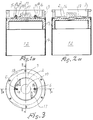
- the protective canister 1 is composed of an inner bottom portion 2, an annular outer bottom portion 3 disposed concentrically around the inner bottom portion, and a tubular protective can 4.
- the protective can 4 is glued or welded to the outer edge of the outer bottom portion 3, and the inner bottom portion 2 is inserted in the central aperture of the outer bottom portion by means of shear pins or keepers, 5 and 6, respectively. These latter are secured by means of specifically adapted washers and bolts, 8 and 9, respectively.
- a pyrocharge is disposed in a specifically adapted combustion chamber 10 in the inner bottom portion, discharge generating gas 11 on its initiation.
- the protective canister 1 also contains driving sabot 13 disposed between the bottom of the canister and the sub-combat unit and displaceable interiorly in the canister.
- the displacement of the driving sabot 13 in relation to the inner lid portion 2 is determined by two brake bands 14 and 15, respectively, which are secured in both the inner bottom portion 2 and in the driving sabot.
- the brake bands are folded in specifically adapted grooves of which one is marked with reference numeral 16 and is visible in Figs. 2a and 2b.
- the brake bands are, in the present example, produced from stainless steel of extreme extensibility.
- the anchorage in the lid portion and driving sabot, respectively, is effected with the aid of through grooves and locking pins.
- the locking pins for the anchorage in the bottom portion 2 have reference numerals 17 and 18.
- the anchorage in the driving sabot is effected in accordance with the same principles, but this is not immediately apparent from the accompanying Drawings.
- the gas-generating pyrokit 11 which appropriately consists of a powder charge, is initiated.
- a pressure is built up in the combustion chamber 10 and the driving sabot 13 is given a separation speed which is determined by the size and combustion speed of the separation charge.
- the pressure increases in the pressurized volume.
- the force on the interior end surfaces imparts to the driving sabot and the combustion chamber 10 an increased separation velocity.
- the brake bands 14 and 15 When the pressure has fallen to approximately atmospheric, the brake bands 14 and 15 are fully taut. However, the residual kinetic energy of the driving sabot is sufficient to sever the keepers 5 and 6, and the driving sabot 13 with the bottom portion 2 connected via the brake bands 14 and 15 will be separated from the other parts 3 and 4 of the protective canister, whereafter these separated parts follow their own trajectories towards the ground.
- the outer lid portion 3 may possibly have rotation brakes and friction brakes still in place, which can impart a stable trajectory to this portion, while the driving sabot with its connected lid portion will assume a tumbling trajectory.
- the sub-combat unit which will have already departed from the protective canister before the driving sabot has been wholly arrested and the keepers 5 and 6 severed, will then have already achieved its own stable and completely different predetermined trajectory and had time to flip out its sensor and aerodynamic surfaces.
Landscapes
- Engineering & Computer Science (AREA)
- Chemical & Material Sciences (AREA)
- Combustion & Propulsion (AREA)
- General Engineering & Computer Science (AREA)
- Medicines Containing Antibodies Or Antigens For Use As Internal Diagnostic Agents (AREA)
- Aiming, Guidance, Guns With A Light Source, Armor, Camouflage, And Targets (AREA)
- Devices Affording Protection Of Roads Or Walls For Sound Insulation (AREA)
- Automotive Seat Belt Assembly (AREA)
Claims (6)
- Verfahren zum Abtrennen von Gefechts-Subeinheiten (12) von einem Schutzkanister (1) mit einem ersten offenen Ende und einem zweiten geschlossenen Ende, wobei die GefechtsSubeinheit ihre eigenen Auslösesensoren und Sprengladungen aufweist und in dem Schutzkanister (1) durch ein Fahrzeug oder einen Trägerkörper in Form eines Geschosses oder Flugkörpers zu einem vorgegebenen Zielgebiet transportiert wird, wo der Schutzkanister (1) mit der umschlossenen Gefechtssubeinheit (12) von dem Trägerkörper entfernt wird und danach der Schutzkanister (1) und die Gefechtssubeinheit (12), ggf. nach Verzögerung bezüglich Flugrichtung des Trägerkörpers und eventueller Rotation, voneinander getrennt werden sollen durch einen erhöhten Gasdruck, der durch die Verbrennung einer gaserzeugenden pyrotechnischen Ladung (11) erzeugt wird, um die Gefechtssubeinheit aus dem offenen Ende des Schutzkanisters auszuwerfen, dadurch g e k e n n z e i c h n e t , daß die Gefechtssubeinheit (12) aus dem Schutzkanister (1) durch einen in diesem verschiebbaren Treibspiegel (13) ausgeworfen wird, hinter dem der erhöhte Gasdruck erzeugt wird, wobei der verschiebbare Treibspiegel (13) durch Haltemittel (14, 15), die ihn mit dem Kanister verbinden, daran gehindert wird, mit der Gefechtssubeinheit (12) auf ihrer neuen Flugbahn mitzufliegen.
- Verfahren nach Anspruch 1, dadurch g e k e n n z e i c h n e t , daß die Verzögerung des verschiebbaren Treibspiegels (13) so ausgelegt ist, daß sie zu einer Trennung des Schutzkanisters (1) in mehrere Teile (2, 14, 15, 13; bzw. 3, 4) führt, welche bewirkt, daß die Teile in andere Flugbahnen eintreten und/oder andere Fallgeschwindigkeiten annehmen als die Gefechtssubeinheit (12).
- Schutzkanister mit einem ersten offenen Ende und einem zweiten geschlossenen Ende, der eine abtrennbare Gefechtssubeinheit (12) enthält und auf allen Seiten, außer einer, umschließt, wobei die Gefechtssubeinheit mindestens einen eigenen Auslösesensor, eine Aufsprengladung und eine oder mehrere ausklappbare Tragflächen aufweist, die der Gefechtssubeinheit (12) im ausgeklappten Zustand eine vorgegebene Fall flugbahn geben, auf der die Auslösesensoren ein vorgegebenes Zielgebiet abtasten und bei Identifizierung eines Ziels diese mit der Sprengladung bekämpfen können, wobei der Schutzkanister (1) zusammen mit der zugehörigen Gefechtssubeinheit (12) durch ein Fahrzeug oder einen Trägerkörper in Form eines Geschosses oder Flugkörpers zu dem jeweiligen Zielgebiet transportiert wird, um dort von dem Trägerkörper abgetrennt zu werden und wobei die Gefechtssubeinheit (12) von dem Schutzkanister (1) durch einen erhöhten Gasdruck abgetrennt wird, der durch die Verbrennung einer gaserzeugenden pyrotechnischen Ladung (11) zwischen dem geschlossenen Ende des Kanisters (1) und der Gefechtssubeinheit (12) erzeugt wird,
dadurch g e k e n n z e i c h n e t , daß in dem Schutzkanister (1) zusätzlich zu der Gefechtsunterheinheit (12) ein verschiebbarer Treibspiegel oder Kolben (13) zwischen der Gefechtssubeinheit und dem anfänglich geschlossenen Ende (2, 3) des Kanisters angeordnet ist, wobei der Treibspiegel oder Kolben gegen die Gefechtssubeinheit (12) anliegt, und daß zwischen dem Treibspiegel oder Kolben und dem Boden (2, 3) des Kanisters die gaserzeugende pyrotechnische Ladung (11) angeordnet ist, wobei der Kanister ferner alte Mittel (14, 15) aufweist, die zwischen dem Treibspiegel und dem anfänglich geschlossenen Ende des Kanisters verbunden sind und die Bewegung des Treibspiegels (5) nach einer vorgegebenen Bewegungsstrecke anhalten. - Schutzkanister 1 nach Anspruch 3,
dadurch g e k e n n z e i c h n e t , daß der verschiebbare Treibspiegel (13) mit dem Boden (2, 3) des Schutzkanisters (1) durch zwei oder mehr anfänglich gefaltete Bremsbänder (14, 15) verbunden ist, die im straffen Zustand die weitere Bewegung des Treibspiegels relativ zum Boden (2, 3) des Schutzkanisters anhalten. - Schutzkanister 1 nach Anspruch 4,
dadurch g e k e n n z e i c h n e t , daß der Teil seines Bodens (2), an dem die Bremsbänder befestigt sind, mit Sollbruchstellen (5, 6) relativ zum restlichen Teil des Schutzkanisters (3, 4) versehen ist, die durch den Stoß, der durch das völlige Straffwerden der Bremsbänder (14, 15) und das Anhalten der Bewegung des Treibspiegels (13) erzeugt wird, brechen, wodurch der Schutzkanister (1) mit seinem Zubehör in Teile (2, 14, 15, 13 bzw. 3, 4) zerlegt wird, die sich auf eigenen Fallflugbahnen bewegen. - Schutzkanister nach Anspruch 5,
dadurch g e k e n n z e i c h n e t , daß sein Boden aus zwei zueinander konzentrisch angeordneten Teilen (2, 3) bestehen, wobei die Bremsbänder am mittleren Teil (2) befestigt sind, und daß diese Teile (3, 4) durch Abscherstifte oder Brücken (5, 6) zusammengehalten werden, die beim völligen Straffwerden der Bremsbänder (14, 15) brechen.
Applications Claiming Priority (2)
| Application Number | Priority Date | Filing Date | Title |
|---|---|---|---|
| SE9103081A SE9103081L (sv) | 1991-10-23 | 1991-10-23 | Saett att fraan en skyddskanister separera substridsdelar samt skyddskanister |
| SE9103081 | 1991-10-23 |
Publications (3)
| Publication Number | Publication Date |
|---|---|
| EP0539340A2 EP0539340A2 (de) | 1993-04-28 |
| EP0539340A3 EP0539340A3 (en) | 1993-12-22 |
| EP0539340B1 true EP0539340B1 (de) | 1996-01-03 |
Family
ID=20384078
Family Applications (1)
| Application Number | Title | Priority Date | Filing Date |
|---|---|---|---|
| EP92850238A Expired - Lifetime EP0539340B1 (de) | 1991-10-23 | 1992-10-09 | Abschiessvorrichtung für Submunitionen |
Country Status (5)
| Country | Link |
|---|---|
| US (1) | US5315933A (de) |
| EP (1) | EP0539340B1 (de) |
| AT (1) | ATE132616T1 (de) |
| DE (1) | DE69207343T2 (de) |
| SE (1) | SE9103081L (de) |
Families Citing this family (5)
| Publication number | Priority date | Publication date | Assignee | Title |
|---|---|---|---|---|
| SE501082C2 (sv) * | 1993-03-30 | 1994-11-07 | Bofors Ab | Sätt och anordning för att ge en luftburen stridsdel ett önskat rörelsemönster |
| SE508475C2 (sv) * | 1993-03-30 | 1998-10-12 | Bofors Ab | Sätt och anordning för spridning av stridsdelar |
| RU2125704C1 (ru) * | 1998-03-16 | 1999-01-27 | Государственное научно-производственное предприятие "Сплав" | Ракета |
| DE102004061658A1 (de) * | 2004-12-22 | 2006-07-13 | Diehl Bgt Defence Gmbh & Co. Kg | Verfahren und System zum Ausstoßen einer Submunition aus einem Flugkörper |
| SE540780C2 (sv) * | 2016-04-06 | 2018-11-06 | Bae Systems Bofors Ab | Delningsbar granat med fallskärmsanordning |
Family Cites Families (12)
| Publication number | Priority date | Publication date | Assignee | Title |
|---|---|---|---|---|
| US3677182A (en) * | 1970-10-29 | 1972-07-18 | Us Army | Base ejecting projectile |
| US3712224A (en) * | 1971-06-21 | 1973-01-23 | Us Navy | Decoy flare with traveling ignition charge |
| US4178851A (en) * | 1972-03-08 | 1979-12-18 | The United States Of America As Represented By The Secretary Of The Army | Dual purpose munition |
| SE373939B (de) * | 1973-06-21 | 1975-02-17 | Bofors Ab | |
| DE3111907A1 (de) * | 1981-03-26 | 1982-10-07 | Dynamit Nobel Ag, 5210 Troisdorf | Verfahren zum verteilen von submunition |
| FR2552871B1 (fr) * | 1981-04-28 | 1986-11-07 | France Etat Armement | Projectile antichar agissant en vitesse defilante |
| SE452505B (sv) * | 1986-03-27 | 1987-11-30 | Bofors Ab | Substridsdel med svengbart anordnad maldetektor |
| DE3823823A1 (de) * | 1988-07-14 | 1990-01-18 | Diehl Gmbh & Co | Gefechtskopf |
| SE464833B (sv) * | 1989-10-20 | 1991-06-17 | Bofors Ab | Substridsdel med svaengbart anordnad maaldetektor och baeryta |
| DE3937762C2 (de) * | 1989-11-14 | 1993-11-25 | Diehl Gmbh & Co | Artilleriegeschoß-Submunition |
| SE465440B (sv) * | 1990-04-04 | 1991-09-09 | Bofors Ab | Substridsdel |
| US5160800A (en) * | 1991-04-24 | 1992-11-03 | The United States Of America As Represented By The Secretary Of The Navy | Obturator retaining means |
-
1991
- 1991-10-23 SE SE9103081A patent/SE9103081L/ not_active IP Right Cessation
-
1992
- 1992-10-09 EP EP92850238A patent/EP0539340B1/de not_active Expired - Lifetime
- 1992-10-09 DE DE69207343T patent/DE69207343T2/de not_active Expired - Fee Related
- 1992-10-09 AT AT92850238T patent/ATE132616T1/de not_active IP Right Cessation
- 1992-10-22 US US07/964,963 patent/US5315933A/en not_active Expired - Fee Related
Also Published As
| Publication number | Publication date |
|---|---|
| EP0539340A3 (en) | 1993-12-22 |
| DE69207343D1 (de) | 1996-02-15 |
| DE69207343T2 (de) | 1996-08-01 |
| EP0539340A2 (de) | 1993-04-28 |
| US5315933A (en) | 1994-05-31 |
| SE468568B (sv) | 1993-02-08 |
| ATE132616T1 (de) | 1996-01-15 |
| SE9103081L (sv) | 1993-02-08 |
Similar Documents
| Publication | Publication Date | Title |
|---|---|---|
| US8387540B2 (en) | Interceptor projectile and method of use | |
| US4922826A (en) | Active component of submunition, as well as flechette warhead and flechettes therefor | |
| US5760330A (en) | Method and apparatus for conveying a large-calibre payload over an operational terrain | |
| US6957602B1 (en) | Parachute active protection apparatus | |
| US6672220B2 (en) | Apparatus and method for dispersing munitions from a projectile | |
| US4744301A (en) | Safer and simpler cluster bomb | |
| US4622900A (en) | Exploding missile | |
| US5814753A (en) | Device for the nonlethal combating of aircraft | |
| EP2577216B1 (de) | Fahrzeugstabilisierung bei einer grossen explosion | |
| CA2234726A1 (en) | Ballistically deployed restraining net | |
| US3070018A (en) | Nose cone ejection system | |
| US3626415A (en) | Radar chaff ejector | |
| JPS6347756Y2 (de) | ||
| EP0694156B1 (de) | Flugbahnumlenkungsvorrichtung und verfahren für einen gefechtskopf | |
| US4178854A (en) | Multiple sequential burst system | |
| EP0539340B1 (de) | Abschiessvorrichtung für Submunitionen | |
| US5299503A (en) | Shell whose base serves as the parachute can of a submunition | |
| US3290681A (en) | Device for jamming radar detection and interception of ballistic missiles | |
| JP3466615B2 (ja) | 空輸弾頭に所望の運動パターンを付与する方法並びに装置 | |
| IL127136A (en) | Projectile having a radial direction of action | |
| NL192694C (nl) | Projectiel. | |
| GB2142418A (en) | Cluster bombs | |
| RU22326U1 (ru) | Устройство противоракетной обороны носителя | |
| JP2996479B2 (ja) | 魚雷等のペイロード運搬飛しょう体 | |
| US7261039B1 (en) | Artillery Rocket Kinetic Energy Rod Warhead |
Legal Events
| Date | Code | Title | Description |
|---|---|---|---|
| PUAI | Public reference made under article 153(3) epc to a published international application that has entered the european phase |
Free format text: ORIGINAL CODE: 0009012 |
|
| AK | Designated contracting states |
Kind code of ref document: A2 Designated state(s): AT BE CH DE DK ES FR GB GR IT LI NL SE |
|
| PUAL | Search report despatched |
Free format text: ORIGINAL CODE: 0009013 |
|
| AK | Designated contracting states |
Kind code of ref document: A3 Designated state(s): AT BE CH DE DK ES FR GB GR IT LI NL SE |
|
| 17P | Request for examination filed |
Effective date: 19940517 |
|
| 17Q | First examination report despatched |
Effective date: 19940919 |
|
| GRAA | (expected) grant |
Free format text: ORIGINAL CODE: 0009210 |
|
| AK | Designated contracting states |
Kind code of ref document: B1 Designated state(s): AT BE CH DE DK ES FR GB GR IT LI NL SE |
|
| PG25 | Lapsed in a contracting state [announced via postgrant information from national office to epo] |
Ref country code: NL Free format text: LAPSE BECAUSE OF FAILURE TO SUBMIT A TRANSLATION OF THE DESCRIPTION OR TO PAY THE FEE WITHIN THE PRESCRIBED TIME-LIMIT Effective date: 19960103 Ref country code: GR Free format text: LAPSE BECAUSE OF FAILURE TO SUBMIT A TRANSLATION OF THE DESCRIPTION OR TO PAY THE FEE WITHIN THE PRESCRIBED TIME-LIMIT Effective date: 19960103 Ref country code: ES Free format text: THE PATENT HAS BEEN ANNULLED BY A DECISION OF A NATIONAL AUTHORITY Effective date: 19960103 Ref country code: DK Effective date: 19960103 Ref country code: BE Effective date: 19960103 Ref country code: AT Effective date: 19960103 |
|
| REF | Corresponds to: |
Ref document number: 132616 Country of ref document: AT Date of ref document: 19960115 Kind code of ref document: T |
|
| ITF | It: translation for a ep patent filed | ||
| ET | Fr: translation filed | ||
| REF | Corresponds to: |
Ref document number: 69207343 Country of ref document: DE Date of ref document: 19960215 |
|
| REG | Reference to a national code |
Ref country code: CH Ref legal event code: NV Representative=s name: E. BLUM & CO. PATENTANWAELTE |
|
| PG25 | Lapsed in a contracting state [announced via postgrant information from national office to epo] |
Ref country code: SE Effective date: 19960403 |
|
| NLV1 | Nl: lapsed or annulled due to failure to fulfill the requirements of art. 29p and 29m of the patents act | ||
| PLBE | No opposition filed within time limit |
Free format text: ORIGINAL CODE: 0009261 |
|
| 26N | No opposition filed | ||
| PGFP | Annual fee paid to national office [announced via postgrant information from national office to epo] |
Ref country code: FR Payment date: 19980911 Year of fee payment: 7 |
|
| PGFP | Annual fee paid to national office [announced via postgrant information from national office to epo] |
Ref country code: CH Payment date: 19980918 Year of fee payment: 7 |
|
| PGFP | Annual fee paid to national office [announced via postgrant information from national office to epo] |
Ref country code: GB Payment date: 19981009 Year of fee payment: 7 |
|
| PGFP | Annual fee paid to national office [announced via postgrant information from national office to epo] |
Ref country code: DE Payment date: 19981221 Year of fee payment: 7 |
|
| PG25 | Lapsed in a contracting state [announced via postgrant information from national office to epo] |
Ref country code: GB Free format text: LAPSE BECAUSE OF NON-PAYMENT OF DUE FEES Effective date: 19991009 |
|
| PG25 | Lapsed in a contracting state [announced via postgrant information from national office to epo] |
Ref country code: LI Free format text: LAPSE BECAUSE OF NON-PAYMENT OF DUE FEES Effective date: 19991031 Ref country code: CH Free format text: LAPSE BECAUSE OF NON-PAYMENT OF DUE FEES Effective date: 19991031 |
|
| GBPC | Gb: european patent ceased through non-payment of renewal fee |
Effective date: 19991009 |
|
| REG | Reference to a national code |
Ref country code: CH Ref legal event code: PL |
|
| PG25 | Lapsed in a contracting state [announced via postgrant information from national office to epo] |
Ref country code: FR Free format text: LAPSE BECAUSE OF NON-PAYMENT OF DUE FEES Effective date: 20000630 |
|
| PG25 | Lapsed in a contracting state [announced via postgrant information from national office to epo] |
Ref country code: DE Free format text: LAPSE BECAUSE OF NON-PAYMENT OF DUE FEES Effective date: 20000801 |
|
| REG | Reference to a national code |
Ref country code: FR Ref legal event code: ST |
|
| PG25 | Lapsed in a contracting state [announced via postgrant information from national office to epo] |
Ref country code: IT Free format text: LAPSE BECAUSE OF NON-PAYMENT OF DUE FEES;WARNING: LAPSES OF ITALIAN PATENTS WITH EFFECTIVE DATE BEFORE 2007 MAY HAVE OCCURRED AT ANY TIME BEFORE 2007. THE CORRECT EFFECTIVE DATE MAY BE DIFFERENT FROM THE ONE RECORDED. Effective date: 20051009 |