EP0540204A2 - Verfahren zur Formationsfrakturierung - Google Patents
Verfahren zur Formationsfrakturierung Download PDFInfo
- Publication number
- EP0540204A2 EP0540204A2 EP92309274A EP92309274A EP0540204A2 EP 0540204 A2 EP0540204 A2 EP 0540204A2 EP 92309274 A EP92309274 A EP 92309274A EP 92309274 A EP92309274 A EP 92309274A EP 0540204 A2 EP0540204 A2 EP 0540204A2
- Authority
- EP
- European Patent Office
- Prior art keywords
- granules
- fracturing fluid
- fluid
- breaker
- agent
- Prior art date
- Legal status (The legal status is an assumption and is not a legal conclusion. Google has not performed a legal analysis and makes no representation as to the accuracy of the status listed.)
- Withdrawn
Links
Images


Classifications
-
- C—CHEMISTRY; METALLURGY
- C09—DYES; PAINTS; POLISHES; NATURAL RESINS; ADHESIVES; COMPOSITIONS NOT OTHERWISE PROVIDED FOR; APPLICATIONS OF MATERIALS NOT OTHERWISE PROVIDED FOR
- C09K—MATERIALS FOR MISCELLANEOUS APPLICATIONS, NOT PROVIDED FOR ELSEWHERE
- C09K8/00—Compositions for drilling of boreholes or wells; Compositions for treating boreholes or wells, e.g. for completion or for remedial operations
- C09K8/60—Compositions for stimulating production by acting on the underground formation
- C09K8/62—Compositions for forming crevices or fractures
- C09K8/70—Compositions for forming crevices or fractures characterised by their form or by the form of their components, e.g. foams
- C09K8/706—Encapsulated breakers
-
- C—CHEMISTRY; METALLURGY
- C09—DYES; PAINTS; POLISHES; NATURAL RESINS; ADHESIVES; COMPOSITIONS NOT OTHERWISE PROVIDED FOR; APPLICATIONS OF MATERIALS NOT OTHERWISE PROVIDED FOR
- C09K—MATERIALS FOR MISCELLANEOUS APPLICATIONS, NOT PROVIDED FOR ELSEWHERE
- C09K8/00—Compositions for drilling of boreholes or wells; Compositions for treating boreholes or wells, e.g. for completion or for remedial operations
- C09K8/60—Compositions for stimulating production by acting on the underground formation
- C09K8/62—Compositions for forming crevices or fractures
- C09K8/66—Compositions based on water or polar solvents
- C09K8/665—Compositions based on water or polar solvents containing inorganic compounds
-
- C—CHEMISTRY; METALLURGY
- C09—DYES; PAINTS; POLISHES; NATURAL RESINS; ADHESIVES; COMPOSITIONS NOT OTHERWISE PROVIDED FOR; APPLICATIONS OF MATERIALS NOT OTHERWISE PROVIDED FOR
- C09K—MATERIALS FOR MISCELLANEOUS APPLICATIONS, NOT PROVIDED FOR ELSEWHERE
- C09K8/00—Compositions for drilling of boreholes or wells; Compositions for treating boreholes or wells, e.g. for completion or for remedial operations
- C09K8/60—Compositions for stimulating production by acting on the underground formation
- C09K8/84—Compositions based on water or polar solvents
- C09K8/845—Compositions based on water or polar solvents containing inorganic compounds
-
- Y—GENERAL TAGGING OF NEW TECHNOLOGICAL DEVELOPMENTS; GENERAL TAGGING OF CROSS-SECTIONAL TECHNOLOGIES SPANNING OVER SEVERAL SECTIONS OF THE IPC; TECHNICAL SUBJECTS COVERED BY FORMER USPC CROSS-REFERENCE ART COLLECTIONS [XRACs] AND DIGESTS
- Y10—TECHNICAL SUBJECTS COVERED BY FORMER USPC
- Y10S—TECHNICAL SUBJECTS COVERED BY FORMER USPC CROSS-REFERENCE ART COLLECTIONS [XRACs] AND DIGESTS
- Y10S507/00—Earth boring, well treating, and oil field chemistry
- Y10S507/922—Fracture fluid
-
- Y—GENERAL TAGGING OF NEW TECHNOLOGICAL DEVELOPMENTS; GENERAL TAGGING OF CROSS-SECTIONAL TECHNOLOGIES SPANNING OVER SEVERAL SECTIONS OF THE IPC; TECHNICAL SUBJECTS COVERED BY FORMER USPC CROSS-REFERENCE ART COLLECTIONS [XRACs] AND DIGESTS
- Y10—TECHNICAL SUBJECTS COVERED BY FORMER USPC
- Y10S—TECHNICAL SUBJECTS COVERED BY FORMER USPC CROSS-REFERENCE ART COLLECTIONS [XRACs] AND DIGESTS
- Y10S507/00—Earth boring, well treating, and oil field chemistry
- Y10S507/926—Packer fluid
Definitions
- the present invention relates generally to the treatment of subterranean formations using gelled liquids. In one aspect, it relates to gelled fracturing fluids. In another aspect, the invention relates to the use of granules containing breaker chemicals in the fracturing and gravel packinq operation. In still another aspect, the invention relates to the granules per se containing breaker chemicals.
- Hydraulic fracturing has been widely used as a means for improving the rates at which fluids can be injected into or withdrawn from subterranean formations surrounding oil wells and similar boreholes.
- the methods employed normally involve the injection of a viscous fracturing fluid having a low fluid loss value into the well at a rate sufficient to generate a fracture in the exposed formation, the introduction of fluid containing suspended propping agent particles into the resultant fracture, and the subsequent shutting in of the well until the formation is closed on the injected particles. This results in the formation of a vertical, hiqh-conductivity channels through which fluids can thereafter be injected or produced.
- the conductivity in the propped fracture is a function of the fracture dimensions and the permeability of the bed of propping agent particles within the fracture.
- the fluid In order to generate the fracture of sufficient length, height, and width and to carry the propping agent particles into the fracture, it is necessary for the fluid to have relatively high viscosity.
- This viscosity in aqueous liquids is provided by the addition of polymers, frequently referred to as gelling agents.
- gelling agents Following the treatment of the well, it is desirable to return the aqueous liquid to its low viscosity state, thereby permitting the fracturing fluid and polymer to be removed from the formation and the propped fracture.
- the highly viscous liquid if left in the fracture, would impede the production of formation fluids through the propped fracture.
- the residue of the polymer on the fracture face and in the pores of the propped fracture would significantly reduce fluid permeability therethrough.
- U.S. Patent 4,741,401 discloses a number of oxidizing agents contained in capsules for breaking the fracture fluid.
- U.S. Patent 3,938,594 discloses the use of sodium hypochlorite solution, acid, micellar solutions, and surfactants for degrading the fracturing fluid polymers.
- Other references describing breakers include U.S. Patent Nos. 3,167,510; 3,816,151; 3,960,736; 4,250,044; 4,506,734; and 4,964,466.
- breakers that are not "delayed breakers” cannot generally be used because they tend to degrade the polymer prior to completion of fracture generation phase of the operation and/or placement of the proppant.
- Many of these breakers are pumped into the formation after placement of the fracturing because these breakers immediately start to degrade the viscosity enhancer in the fracturing fluid upon contact.
- additional time and labor are needed to effect the reduction of the viscosity of fracturing fluids introduced into the subterranean formation.
- the use of organic breaker such as alkyl formate may alleviate this problem, since they can be applied along with the fracturing fluid.
- a breaker chemical into the fracturing fluid prior to the pumping of the fracturing fluid into the wellbore and well fractures is desirable.
- the breaker chemical must be in a passive, non-reactive state such that it cannot react with the viscous fluid of the fracturing fluid into the fractures, but the breaker chemical must be capable of reacting with the viscous fluid of the fracturing fluid within the fracture upon the completion of the fracturing process.
- the present invention teaches a method of accomplishing this objective.
- the breaker material is sometimes coated as described in U.S. Patent Nos. 3,163,219; 4,506,734; 4,741,401; 5,102,558 and 5,110,486.
- the encapsulation adds to the expense.
- U.S. Patent No. 3,163,219 also discloses the use of water-soluble or oil-soluble binders that are dissolved in the fracture; and
- U.S. Patent No. 4,202,795 discloses pellets containing a mixture of hydratable gelling agent (e.g., guar gum) and a breaker for that gelling agent.
- a mixture of hydratable gelling agent e.g., guar gum
- the method of the present invention involves the use of agglomerated particles referred to as granules containing a gel breaker which are introduced into a well treating fluid and function as delayed breakers in well treating operations.
- the granules exhibit a delayed release of the active chemical (gel breaker) so the degradation of the polymer occurs well after the fracturing fluid or gravel packing fluid has been pumped into the formation.
- the breakers are effective within reasonable time periods so that long shut-in times are not required.
- the granules comprise 40 to 90 percent of a solid (particulate) breaker compound (preferably an oxidizer), from 8 to 58 percent of an inorganic powdered binder such as clay, and a small amount of an organic binder/processing aid.
- a solid (particulate) breaker compound preferably an oxidizer
- an inorganic powdered binder such as clay
- an organic binder/processing aid preferably is made up of a mixture of clay, talc and infusorial earth such as diatomaceous earth.
- the granules contain a major percentage of the breaker compound such as sodium persulfate or ammonium persulfate.
- the breaker compound such as sodium persulfate or ammonium persulfate.
- This high concentration of the breaker chemical coupled with inorganic clays, or mixtures containing clay surprisingly results in a delayed release of the breaker compound thereby permitting the well treating operation to be completed before the gel is broken.
- the breaker is activated by the well treating fluid dissolving the soluble breaker. As more and more of the breaker is dissolved, the particles disintegrates exposing more of the breaker compound to the liquid.
- the granules containing the breaker are introduced directly into the gelled well treating fluid as the fluid is pumped from the surface to and into the subterranean formation.
- the granule sizes of the particles containing the breaker are ideally suited for fracturing and gravel packing operations, ranging from 10 to 80 mesh (U.S. Sieve Series), more preferably from 12 to 60 mesh, and most preferably from 20 to 40 mesh.
- the breaker may be incorporated into the frac sand or gravel slurry or into the fluid without the frac sand or gravel (e.g., pad fluid).
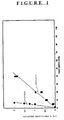
- Figures 1,2, and 3 are plots comparing the delayed release of breaker chemical from the granules with that of ungranulated breaker crystals.
- the granules useful in the present invention are agglomerates of two main powdered (finely divided) particulates: a breaker compound and inorganic binder.
- a breaker compound finely divided particulates
- inorganic binder for clarity of description, the agglomerated particles are referred to herein as "granules" and the constituent particulates are referred to merely as particles or powder.
- the main components of the granules, the method of manufacture and method of use are described in detail below.
- Breaker Compound Specific examples of preferred breaker compounds of the instant invention are selected from the group consisting of ammonium and alkali persulfates, alkyl formates, salicylates, acetates, chlorites, phosphates, sulfamic acid, laureates, lactates, chloroacetates, enzymes and other solid breakers. These solids are available in particulate form and are capable of being granulated or agglomerated to form delayed breaker granules.
- the preferred breakers are the crystalline particulates such as sodium persulfate and ammonium persulfate. It should be noted that sodium persulfate and many of the particulate breakers are too small in particle size (generally smaller than 100 mesh) for effective coating by the prior art techniques. Moreover, such particles present handling problems since they are so tiny. Also, the crystalline forms of these solids are generally angular which also contributes to difficulties in handling and encapsulating.
- the chemical breaker solids may be used per se in the agglomeration process to form the granules or, in other embodiments, may be deposited on or in a particle which functions as a core, seed, or carrier for the breaker in the agglomeration process.
- the breaker chemical may be sprayed as a solution or in liquid form onto small, finely divided seed particles to form a coating on or in these seed particles.
- any solid which is of the proper size and which is inert to the breaker chemical (or other active material) may be used as the seed, core, or carrier particle, but urea is preferred. This embodiment is especially preferred where the breaker chemical is itself a liquid.
- the breaker chemical can also be used in a carrier particles with a solid polymeric matrix as described in U.S. Patent No. 4,738,897 (incorporated herein by reference), or absorbed on or in a porous solid such as diatomaceous earth or coated on an inert core substrate such as urea as described above.
- the agglomerated granules containing breaker chemical, with or without a seed, core or carrier may be overcoated or encapsulated with a thermoplastic polymer material.
- the preferred coating or encapsulation is as described in U.S. Patent 5,102,558, the disclosure of which is incorporated herein by references.
- chemical breaker compounds refers to the constituent particles (e.g., crystals, core, seed, carrier) in the agglomerated granules.
- the preferred breaker chemicals for use in the present invention include oxidizers such as ammonium per sulfate, sodium persulfate, potassium persulfate, sodium chlorite, ammonium bifluoride, ammonium fluoride, sodium fluoride, potassium fluoride, sulfamic acid, citric acid, oxalic acid, ammonium sulfate, sodium acetate and enzymes and mixtures thereof.
- oxidizers such as ammonium per sulfate, sodium persulfate, potassium persulfate, sodium chlorite, ammonium bifluoride, ammonium fluoride, sodium fluoride, potassium fluoride, sulfamic acid, citric acid, oxalic acid, ammonium sulfate, sodium acetate and enzymes and mixtures thereof.
- the preferred oxidizer are the persulfates (sodium and ammonium) which are commercially available.
- Sodium persulfate for example, is available in crystalline form (average particle size between 150 to 50 microns) and are typically available in 85%-95% pure form.
- Each granule used in the present invention contains at least 3 particles, and preferably from 5 to 30 particles, of the breaker compound, and most preferably 8 to 15 particles.
- Binders The binder must be chemically nonreactive with the well treating fluid and the breaker compound.
- the preferred binders are powdered inorganic binders which are classified as nonchemical or inert binders (i.e., they do not react with the constituent particles to achieve agglomeration).
- the inorganic powdered binder functions to bind the particulate breaker compound together and increase the strength and integrity of the granules.
- the powdered binder also, provides a microporous matrix for conducting the carrier liquid (e.g., water) by capillary attraction to the interior of the granule thereby enabling the liquid to contact the breaker compounds. Therefore, the dissolution of the breaker is by contacting the granule surface and/or interior.
- the carrier liquid e.g., water
- clay is the preferred binder for use in the present invention.
- the term “powdered” or “powder” means tiny particles having an average particle size of 10 to 50 microns, preferably 20 to 40 microns.
- Clays (bentonite and attupulgate) are easily wet by water and are capable of being granulated with high levels of breaker compounds to form relatively strong granules of the proper size for use in well treating operations.
- the clay particles develop agglomeration forces by surface tension of the water present, adhesion forces, and electrostatic forces.
- Other inorganic binders include sodium silicate, colloidal alumina, colloidal silica, fullers earth, and the like.
- Talc which is magnesium silicate hydrate, functions as a binder and as a solid lubricant in the granulation process.
- Infusorial earth e.g., diatomaceous earth
- Infusorial earth is a powder which is capable of holding four times its weight in water.
- Infusorial earth includes siliceous earth, diatomaceous earth, fossil flour, celite, kieselguhr, and the like.
- the mixture of particles comprising the granules include a small amount of an organic binder/processing aid.
- the organic binder serves as a processing aid in the granulation process and as a binder in the final granule. Because of hazards involved in the granulation process, it is necessary that the organic material selected as the binder/processing aid be substantially non-oxidizable. The non-oxidizable character also increases the shelf life of the granules.
- Polyvinyl pyrrolidone (PVP), polyvinyl alcohol, a thermoplastic resin, or thermosetting resin are substantially non-oxidizable and therefore preferred.
- the granules useable in the present may be agglomerated by a variety of well known processes including granulation, pelletizing, briquetting, and the like.
- the preferred method of agglomerating the particles and powders into granules is by low pressure granulation.
- Granulation is defined as the formation of small particles called granules by growth agitation.
- particles of the breaker compound and binder powder are moistened and intimately mixed.
- the substantially homogeneous mixture is extruded at low pressure (e.g., below 100 psig) through screen openings forming cylindrical extrudate pellets which are then subjected to spheronization treatment to reform them into generally spherical or rounded shapes.
- Low pressure granulation avoids the hazards of decomposing the unstable persulfates.
- the extrusion phase of the granulation process involves introducing a mixture of the breaker particles and binder powder wet with about 1 to 30, preferably 5 to 25, most preferably 5-10 percent water (based on the weight of the mixture) into an extruder hopper.
- the moist mixture is fed into the feed zone of an auger-like screw extruder which mixes and kneads the mixture to disperse the solids uniformly into a moist generally homogeneous mass.
- the screw auger transfers the mass to the compression zone of the extruder where the particles are compacted together, forcing air out of the voids. (Separate mixing augers and compression augers may also be used.)
- the compacted moist mass is then forced or extruded radially through a screen forming generally cylindrical pellets which may be separated from the extrudate by breaking off by gravity, or by a blade which separates the extrudate from the screen.
- the generally cylindrically shaped pellets are not suitable for handling or for use in well treating operations.
- the extrudate pellets are therefore subjected to spheronizing which may be as follows:
- the damp extrudate pellets are fed into equipment referred to as a spheronizer, where they are reshaped or deformed into well rounded or spherical shapes.
- the pellet deformation may be carried out in a rotating bowl with a friction plate.
- the pellet collisions with each other and with the wall and contact with the friction plate imparts kinetic energy to the pellets which gradually reform the pellets into generally spherical shape.
- the granulation of powdered granules is described in detail in an article "EXTRUSION AND SPHERONIZING EQUIPMENT" by Douglas C. Hicks, presented at a seminar sponsored by The Center for Professional Advancement on April 24-26, 1989 in Princeton, New Jersey. The disclosure in this article is incorporated herein by reference.
- the rounded granules may be screened for sizing and are dried to remove the water and thereby provide for sufficient storage time before use.
- granulation as described above, is the preferred process of manufacturing process, other agglomeration processes may be used. These include pelletizing, fluid bed granulating, pan or drum granulating, and briquetting. Tests have shown, however, that the low pressure extrusion granulation produces moderately strong granules possessing a balance of strength to (a) endure the rigors of handling and pumping and (b) release of the soluble breaker compound upon contact with the fracturing fluid.
- the high pressure agglomeration processes are expensive and may produce agglomerates which do not release the breaker compound within the time constraints of a fracturing operation or other well treating operation.
- the mixture of particles that are agglomerated into granules may include primarily the breaker chemical solids, clay particles, and an organic binder/processing aid.
- the dry mixture granulated will be as follows:
- the granules preferably should exhibit the following properties: Particle Size 10 to 80 mesh Strength or Hardness (particle crush strength*) about .5 to about 16 pounds S.G. (particle) 2.0 - 3.0 Delayed Release Time reduction of 2 to 20 (most preferably 2-15) times vis-vis ungranulated crystals. * Penwalt Stokes Hardness Tester (U.S. Patent 2,041,869)
- fracturing fluids include water-based brine fluids containing a water-soluble polymer such as hydroxypropyl guar crosslinked with a transition metal salt as is well known in the art.
- a water-soluble polymer such as hydroxypropyl guar crosslinked with a transition metal salt
- Other polymers used to viscosify aqueous fracturing fluids are guar gum hydroxyethyl cellulose, polyacrylamide, gum karaya and the like.
- fracturing fluids may be viscous oils or oil-based emulsions as x-linked gelled forms or liquid gel forms. Viscosification of these is accomplished via addition of surfactants, aluminum alkyl phosphates, asphalts, fatty-acid soaps, other emulsion and foam stabilizing agents and the like.
- Typical propping agents used in hydraulic fracturing for retaining the integrity of the fractures are sand, sintered ceramics (e.g., sintered bauxite), resin coated sand or combinations having a particle size between 10 to 80 mesh.
- concentration used depends on the size and shape of the proppant, the type of formation being fractured, the carrying capacity of the fracturing fluids and the desired permeability of the resistant fractures. The concentrations generally range from 1 to 30 pounds per 1000 gallons.
- fluid loss or wall building agents such as starch, bentonite, silica flour, guar gum an surfactants; friction-reducing agents such as small amounts of high molecular weight linear polymers such as polyacrylamide; specific gravity increasing agents; bactericides; scale-removal/prevention agents, and surfactants or alcohol to reduce interfacial tension and the resistance to return flow.
- the granules containing the chemical breaker may be employed in the gelled fracturing fluid.
- the concentration of the granules should be sufficient to provide the fracturing fluid with from 0.1 to 20 pounds per 1000 gallons of the fracturing fluid. Preferably, from 1 to 15 pounds,and most preferably, from 2 to 10 pounds of granules are used per 1000 gallons of fracturing fluid.
- the process of the present invention may be carried out at formation temperatures between 80 degrees Fahrenheit and 225 degrees Fahrenheit, preferably at high temperatures (above 140 degrees Fahrenheit).
- the fracturing fluid may include an activator such as triethanolamine as taught in U.S. Patent 4,250,044 for persulfates to accelerate the activation of the breaker, the disclosure of which is incorporated herein by reference.
- the well is shut in permitting the fracturing fluid in the fracture to bleed off and the fracture to collapse on the proppant.
- the well is back flowed.
- the degradation of the polymer by the action of the breaker chemical reduces the viscosity of the fracturing fluid permitting the fluid to be withdrawn from fracture by the back flowing operations.
- Iodometric titration tests were carried out to demonstrate the delayed release of the breaker chemical in an aqueous medium. These tests compared the release of sodium persulfate crystals with the release of granules containing sodium persulfates at three pH's: 10,7, and 4.
- the crystals were obtained from FMC Corporation; and the granules contained: AVG. WT% Sodium Persulfate about 75 Powdered Binder (Clay, Talc, Diatomaceous Earth) about 24 Organic Binder (PVP) about .5 to 1.0%
- the titration tests involved preparing bottle samples containing a buffer and KI solution.
- the pH of each sample was adjusted to he test conditions (4,7, or 10) and one gram of the ungranulated crystals or 1 gram of the granules were added to a bottle sample.
- Each sample was titrated with 0.1 N sodium thio sulfate until color changed from reddish yellow to clear. Titrations were performed on each sample at the following typical time intervals: 1 min., 5 min., 10 min., 20 min., 40 min., 60 min., and 80 min.
- the bottle samples were weighed before and after titration to determine titrate used from which the amount of sodium persulfate in solution was calculated. Replicate samples were tested at each condition.
- the base gel was fed to an open blending device by the Moyno Pump where the fluid was stirred with a ribbon-shaped stirring device.
- the breaker 2.0 lb of granules per 1000 gal of water
- the crosslinking was accomplished by adding 2 gal/1000 gal of a borate source equivalent to 0.8 lb/1000 gal boron with a high pressure metering pump on the high pressure side of the intensifier system.
- the fluid proceeded from the intensifier pumps to a length of 1/4 inch tubing where it was sheared at a shear rate near 1000/sec for 5 minutes to simulate pumping down tubing at 12 BPM.
- the fluid then entered a length of 1 inch tubing surrounded by a heating jacket to simulate the formation.
- the shear rate was 40-50/sec while undergoing heat-up to the temperature used for the fluid loss simulation.
- a temperature of 100 degrees Fahrenheit was selected to represent the average cool-down temperature of a point within 50 feet of the wellbore in formations with a BHT of 160 degrees Fahrenheit. Residence time in the formation simulator was approximately 5 minutes.
- the fluid was heated at a shear rate of 40-50/sec, it flowed through the test cell, again at a shear rate of 40-50/sec. Flow was between two approximately 3/8 inch slabs of Ohio Sandstone core that had been saturated with 2% KCl. The leakoff rate through each core was monitored vs time. The fluid traveled to a series of high pressure knock-out pots where the fluid was collected and dumped while maintaining a constant pressure of 1000 psi on the system.
- the amount of proppant was selected to obtain 2 lb/sq.ft. in the 1/3 inch slot.
- the final slurry was flowed into the cell and the cell shut-in.
- the pipe-to-slot flow ends were removed and replaced with the inserts containing a 1/8 inch hole with a filter screen to confine proppant to the cell during closure.
- the top piston set-screws and spacers were removed and an increasing closure pressure was applied while heating to the test temperature of 160 degrees Fahrenheit and monitoring leakoff. A closure pressure of 1000 psi was achieved over the course of 100 minutes.
- the base gel was pumped to the blender where marker proppant, 20/40 sand, and breaker were added.
- the slurry was then pumped with a triplex pump through 0.899 inch coiled tubing at 15 gal/min (1300 1/sec) to the choke table where it is split to load the formation simulator at 5 gal/min (196 1/sec).
- the residence time in the tubing simulator was 2.5 min and the bath temperature was 85 degrees Fahrenheit.
- the intensifier pump was shut down.
- the test gel was displaced through the rheometer by a small triplex pump. A low rate, 0.5 to 1 gal/min, was maintained through bones of the test.
- the temperature of the fluid coming out of the formation simulator was adjusted to 150 degrees Fahrenheit initially and rampled to 160 degrees Fahrenheit during the test to give the desired temperature range.
- the rheology was determined with a 4-pipe sequential rheometer.
- the fluid first entered 20.474 ft of 0.93 inch ID tubing and then 13.533 ft of 0.807 inch ID pipe, 11.021 ft of 0.674 inch ID tubing and, finally, 6.291 ft of 0.615 inch ID pipe.
- Each pipe had two DP-15 Validyne pressure transducers.
- the test fluid then goes through a mass flow meter where rate and density are recorded, and on to the slot, where the test is video taped.
- the rate was measured with a Micro-Motion D-40 mass flow meter.
- the 8 dP's, temperature, density, and rate were routed to a Validyne MCI-20 signal conditioner then to a Validyne DA-380.
- the data was then sent to a
- the breaker should delay degradation of the gel for at least 30 minutes, preferably 60 minutes, and should complete the release (by dissolution) of the breaker within 360 minutes.
- “Complete release” is defined where at least 99% of the breaker has been dissolved and diffused into the surrounding fracturing fluid. The above tests demonstrate that the granules exhibit (a) sufficient reaction to permit safe placement of the proppant and (b) sufficient release of the breaker to effect degradation of the gel and provide at least 90% of the retained propped permeability (i.e., permeability without gel).
Landscapes
- Chemical & Material Sciences (AREA)
- Life Sciences & Earth Sciences (AREA)
- General Life Sciences & Earth Sciences (AREA)
- Engineering & Computer Science (AREA)
- Materials Engineering (AREA)
- Organic Chemistry (AREA)
- Inorganic Chemistry (AREA)
- Colloid Chemistry (AREA)
- Solid-Sorbent Or Filter-Aiding Compositions (AREA)
- Fats And Perfumes (AREA)
- Compositions Of Macromolecular Compounds (AREA)
Applications Claiming Priority (2)
| Application Number | Priority Date | Filing Date | Title |
|---|---|---|---|
| US784532 | 1991-10-29 | ||
| US07/784,532 US5217074A (en) | 1991-10-29 | 1991-10-29 | Method of fracturing formations |
Publications (2)
| Publication Number | Publication Date |
|---|---|
| EP0540204A2 true EP0540204A2 (de) | 1993-05-05 |
| EP0540204A3 EP0540204A3 (en) | 1993-06-16 |
Family
ID=25132724
Family Applications (1)
| Application Number | Title | Priority Date | Filing Date |
|---|---|---|---|
| EP19920309274 Withdrawn EP0540204A3 (en) | 1991-10-29 | 1992-10-12 | Method of fracturing formations |
Country Status (4)
| Country | Link |
|---|---|
| US (2) | US5217074A (de) |
| EP (1) | EP0540204A3 (de) |
| CA (1) | CA2079296A1 (de) |
| NO (1) | NO924061L (de) |
Cited By (13)
| Publication number | Priority date | Publication date | Assignee | Title |
|---|---|---|---|---|
| US5373901A (en) * | 1993-07-27 | 1994-12-20 | Halliburton Company | Encapsulated breakers and method for use in treating subterranean formations |
| EP1091086A1 (de) * | 1999-10-08 | 2001-04-11 | Halliburton Energy Services, Inc. | Gelierte wässerige Zusammensetzungen zur Bohrlochbehandlung |
| GB2383809A (en) * | 2001-11-13 | 2003-07-09 | Baker Hughes Inc | Fracturing fluids for delayed flow back operations |
| WO2012012224A1 (en) * | 2010-07-19 | 2012-01-26 | Baker Hughes Incorporated | Shaped compressed pellets for slow release of well treatment agents into a well and methods of using the same |
| US9976070B2 (en) | 2010-07-19 | 2018-05-22 | Baker Hughes, A Ge Company, Llc | Method of using shaped compressed pellets in well treatment operations |
| US10400159B2 (en) | 2014-07-23 | 2019-09-03 | Baker Hughes, A Ge Company, Llc | Composite comprising well treatment agent and/or a tracer adhered onto a calcined substrate of a metal oxide coated core and a method of using the same |
| US10413966B2 (en) | 2016-06-20 | 2019-09-17 | Baker Hughes, A Ge Company, Llc | Nanoparticles having magnetic core encapsulated by carbon shell and composites of the same |
| US10641083B2 (en) | 2016-06-02 | 2020-05-05 | Baker Hughes, A Ge Company, Llc | Method of monitoring fluid flow from a reservoir using well treatment agents |
| US10822536B2 (en) | 2010-07-19 | 2020-11-03 | Baker Hughes, A Ge Company, Llc | Method of using a screen containing a composite for release of well treatment agent into a well |
| US10961444B1 (en) | 2019-11-01 | 2021-03-30 | Baker Hughes Oilfield Operations Llc | Method of using coated composites containing delayed release agent in a well treatment operation |
| US11254850B2 (en) | 2017-11-03 | 2022-02-22 | Baker Hughes Holdings Llc | Treatment methods using aqueous fluids containing oil-soluble treatment agents |
| US11254861B2 (en) | 2017-07-13 | 2022-02-22 | Baker Hughes Holdings Llc | Delivery system for oil-soluble well treatment agents and methods of using the same |
| US12060523B2 (en) | 2017-07-13 | 2024-08-13 | Baker Hughes Holdings Llc | Method of introducing oil-soluble well treatment agent into a well or subterranean formation |
Families Citing this family (42)
| Publication number | Priority date | Publication date | Assignee | Title |
|---|---|---|---|---|
| US5411093A (en) * | 1993-12-10 | 1995-05-02 | Mobil Oil Corporation | Method of enhancing stimulation load fluid recovery |
| US5460226A (en) * | 1994-05-18 | 1995-10-24 | Shell Oil Company | Formation fracturing |
| US5604186A (en) * | 1995-02-15 | 1997-02-18 | Halliburton Company | Encapsulated enzyme breaker and method for use in treating subterranean formations |
| US5497830A (en) * | 1995-04-06 | 1996-03-12 | Bj Services Company | Coated breaker for crosslinked acid |
| US5649596A (en) * | 1996-02-27 | 1997-07-22 | Nalco/Exxon Energy Chemicals, L.P. | Use of breaker chemicals in gelled hydrocarbons |
| US5911923A (en) * | 1996-07-01 | 1999-06-15 | Microtek Laboratories, Inc. | Method for microencapsulating water-soluble or water-dispersible or water-sensitive materials in an organic continuous phase |
| US5948735A (en) * | 1997-04-14 | 1999-09-07 | Nalco/Exxon Energy Chemicals, L.P. | Use of breaker chemicals in gelled hydrocarbons |
| US6209259B1 (en) * | 1997-07-11 | 2001-04-03 | Encap, Llc | Seeding treatments |
| US6387853B1 (en) * | 1998-03-27 | 2002-05-14 | Bj Services Company | Derivatization of polymers and well treatments using the same |
| US6209646B1 (en) | 1999-04-21 | 2001-04-03 | Halliburton Energy Services, Inc. | Controlling the release of chemical additives in well treating fluids |
| US6207620B1 (en) | 1999-06-04 | 2001-03-27 | Texaco Inc. | Use of encapsulated acid in acid fracturing treatments |
| US6818594B1 (en) | 1999-11-12 | 2004-11-16 | M-I L.L.C. | Method for the triggered release of polymer-degrading agents for oil field use |
| BR0015547A (pt) * | 1999-11-12 | 2002-07-23 | Mi Llc | Processos para degradar um substrato pré-determinado, uma torta de filtro e um contaminante emergindo de uma formação subterrânea, para aumentar o fluxo de hidrocarbonetos de um poço e para tratar um furo de poço e composição para uso em operações de exploração de hidrocarbonetos |
| US6357527B1 (en) | 2000-05-05 | 2002-03-19 | Halliburton Energy Services, Inc. | Encapsulated breakers and method for use in treating subterranean formations |
| US6444316B1 (en) | 2000-05-05 | 2002-09-03 | Halliburton Energy Services, Inc. | Encapsulated chemicals for use in controlled time release applications and methods |
| EP1378492B1 (de) * | 2001-02-21 | 2008-04-02 | Seiwa Pro Co., Ltd. | Mittel zur entfernung von ablagerungen auf titanwerkstoff |
| US6617285B2 (en) * | 2001-07-03 | 2003-09-09 | Baker Hughes Incorporated | Polyols for breaking of borate crosslinked fracturing fluid |
| US6795773B2 (en) * | 2001-09-07 | 2004-09-21 | Halliburton Energy Services, Inc. | Well completion method, including integrated approach for fracture optimization |
| US6840318B2 (en) * | 2002-06-20 | 2005-01-11 | Schlumberger Technology Corporation | Method for treating subterranean formation |
| US6939833B2 (en) * | 2002-08-01 | 2005-09-06 | Burts, Iii Boyce Donald | Additive for, treatment fluid for, and method of plugging a tubing/casing annulus in a well bore |
| US6886635B2 (en) * | 2002-08-28 | 2005-05-03 | Tetra Technologies, Inc. | Filter cake removal fluid and method |
| US7181380B2 (en) | 2002-12-20 | 2007-02-20 | Geomechanics International, Inc. | System and process for optimal selection of hydrocarbon well completion type and design |
| US7000701B2 (en) * | 2003-11-18 | 2006-02-21 | Halliburton Energy Services, Inc. | Compositions and methods for weighting a breaker coating for uniform distribution in a particulate pack |
| US20100267594A1 (en) * | 2005-06-24 | 2010-10-21 | Rana Rohit K | Nano-encapsulated triggered-release viscosity breakers |
| US8003214B2 (en) * | 2006-07-12 | 2011-08-23 | Georgia-Pacific Chemicals Llc | Well treating materials comprising coated proppants, and methods |
| US8133587B2 (en) * | 2006-07-12 | 2012-03-13 | Georgia-Pacific Chemicals Llc | Proppant materials comprising a coating of thermoplastic material, and methods of making and using |
| US8058213B2 (en) * | 2007-05-11 | 2011-11-15 | Georgia-Pacific Chemicals Llc | Increasing buoyancy of well treating materials |
| US7754659B2 (en) * | 2007-05-15 | 2010-07-13 | Georgia-Pacific Chemicals Llc | Reducing flow-back in well treating materials |
| US8196660B2 (en) * | 2008-02-14 | 2012-06-12 | David Randolph Smith | Method and apparatus to treat well stimulation fluids in-situ |
| US7686081B1 (en) | 2008-10-30 | 2010-03-30 | Bj Services Company | Squeeze process for reactivation of well treatment fluids containing diatomaceous earth |
| US8336624B2 (en) * | 2008-10-30 | 2012-12-25 | Baker Hughes Incorporated | Squeeze process for reactivation of well treatment fluids containing a water-insoluble adsorbent |
| US8728990B2 (en) * | 2009-12-04 | 2014-05-20 | Elementis Specialties, Inc. | Phosphate ester oil gellant |
| US9016375B2 (en) * | 2011-11-30 | 2015-04-28 | Halliburton Energy Services, Inc. | Breaking diutan with oxalic acid at 180° F to 220° F |
| US9169433B2 (en) * | 2012-09-27 | 2015-10-27 | Halliburton Energy Services, Inc. | Methods for enhancing well productivity and minimizing water production using swellable polymers |
| AU2014279245B2 (en) * | 2013-06-10 | 2017-09-07 | Sumitomo Seika Chemicals Co., Ltd. | Fracturing fluid viscosity-controlling agent to be used in hydraulic fracturing |
| US20160137905A1 (en) * | 2013-08-06 | 2016-05-19 | Halliburton Energy Services, Inc. | Composition for fines agglomeration |
| US9234124B2 (en) | 2013-08-09 | 2016-01-12 | Halliburton Energy Services, Inc. | Dimer acid grafted polymer for stabilizing particulate in a well |
| CA2930183C (en) * | 2013-12-30 | 2018-06-12 | Halliburton Energy Services, Inc. | Liquid slurries of micron- and nano-sized solids for use in subterranean operations |
| US10400527B2 (en) | 2015-12-10 | 2019-09-03 | Saudi Arabian Oil Company | Downhole in-situ heat generation to remove filtercake |
| GB201616925D0 (en) * | 2016-10-05 | 2016-11-16 | Johnson Matthey Public Limited Company | Oil field chemical-carrying material and method |
| CN112322274B (zh) * | 2020-11-27 | 2022-12-20 | 西安石油大学 | 可重复水基压裂液的制备方法、破胶剂及破胶剂的应用 |
| CN113652221B (zh) * | 2021-08-23 | 2023-05-05 | 南京工业大学 | 一种增强低渗土壤中多环芳烃处理效率的压裂液及其制备方法 |
Citations (13)
| Publication number | Priority date | Publication date | Assignee | Title |
|---|---|---|---|---|
| US3163219A (en) | 1961-06-22 | 1964-12-29 | Atlantic Refining Co | Borate-gum gel breakers |
| US3167510A (en) | 1960-11-25 | 1965-01-26 | Stein Hall & Co Inc | Fluid and process for treating wells |
| US3816151A (en) | 1972-08-03 | 1974-06-11 | Hercules Inc | Self-destructing gels |
| US3938594A (en) | 1974-04-08 | 1976-02-17 | Marathon Oil Company | Fracturing fluid |
| US3960736A (en) | 1974-06-03 | 1976-06-01 | The Dow Chemical Company | Self-breaking viscous aqueous solutions and the use thereof in fracturing subterranean formations |
| US4202795A (en) | 1978-09-28 | 1980-05-13 | Halliburton Company | Methods and additives for delaying the release of chemicals in aqueous fluids |
| US4250044A (en) | 1978-06-26 | 1981-02-10 | The Dow Chemical Company | Breaker system for high viscosity fluids |
| US4506734A (en) | 1983-09-07 | 1985-03-26 | The Standard Oil Company | Fracturing fluid breaker system which is activated by fracture closure |
| US4738897A (en) | 1985-02-27 | 1988-04-19 | Exxon Chemical Patents Inc. | Polymer article and its use for controlled introduction of reagent into a fluid |
| US4741401A (en) | 1987-01-16 | 1988-05-03 | The Dow Chemical Company | Method for treating subterranean formations |
| US4964466A (en) | 1989-08-07 | 1990-10-23 | Exxon Chemicals Patents Inc | Hydraulic fracturing with chlorine dioxide cleanup |
| US5102558A (en) | 1989-12-14 | 1992-04-07 | Exxon Research And Engineering Company | Encapsulated breaker chemical |
| US5110486A (en) | 1989-12-14 | 1992-05-05 | Exxon Research And Engineering Company | Breaker chemical encapsulated with a crosslinked elastomer coating |
Family Cites Families (8)
| Publication number | Priority date | Publication date | Assignee | Title |
|---|---|---|---|---|
| NL232500A (de) * | 1957-10-22 | |||
| AR207130A1 (es) * | 1973-12-12 | 1976-09-15 | Dow Chemical Co | Un metodo de reducir la viscosidad de un liquido organico |
| US3948325A (en) * | 1975-04-03 | 1976-04-06 | The Western Company Of North America | Fracturing of subsurface formations with Bingham plastic fluids |
| US4220566A (en) * | 1978-03-21 | 1980-09-02 | The Dow Chemical Company | Aqueous based slurry containing enediol breaker and method for forming a consolidated gravel pack |
| US4610795A (en) * | 1985-08-07 | 1986-09-09 | Fmc Corporation | Peroxygen breaker systems for well completion fluids |
| US4877894A (en) * | 1988-01-11 | 1989-10-31 | Nalco Chemical Company | Hydrocarbon geller and method for making the same |
| US5102559A (en) * | 1989-12-14 | 1992-04-07 | Exxon Research And Engineering Company | Encapsulated breaker chemical with a multi-coat layer urea |
| US5054552A (en) * | 1990-08-31 | 1991-10-08 | The Western Company Of North America | Breaker system for aqueous fluids containing xanthan gums |
-
1991
- 1991-10-29 US US07/784,532 patent/US5217074A/en not_active Expired - Lifetime
-
1992
- 1992-09-28 CA CA002079296A patent/CA2079296A1/en not_active Abandoned
- 1992-10-12 EP EP19920309274 patent/EP0540204A3/en not_active Withdrawn
- 1992-10-20 NO NO92924061A patent/NO924061L/no unknown
-
1993
- 1993-06-02 US US08/070,216 patent/US5370184A/en not_active Expired - Fee Related
Patent Citations (13)
| Publication number | Priority date | Publication date | Assignee | Title |
|---|---|---|---|---|
| US3167510A (en) | 1960-11-25 | 1965-01-26 | Stein Hall & Co Inc | Fluid and process for treating wells |
| US3163219A (en) | 1961-06-22 | 1964-12-29 | Atlantic Refining Co | Borate-gum gel breakers |
| US3816151A (en) | 1972-08-03 | 1974-06-11 | Hercules Inc | Self-destructing gels |
| US3938594A (en) | 1974-04-08 | 1976-02-17 | Marathon Oil Company | Fracturing fluid |
| US3960736A (en) | 1974-06-03 | 1976-06-01 | The Dow Chemical Company | Self-breaking viscous aqueous solutions and the use thereof in fracturing subterranean formations |
| US4250044A (en) | 1978-06-26 | 1981-02-10 | The Dow Chemical Company | Breaker system for high viscosity fluids |
| US4202795A (en) | 1978-09-28 | 1980-05-13 | Halliburton Company | Methods and additives for delaying the release of chemicals in aqueous fluids |
| US4506734A (en) | 1983-09-07 | 1985-03-26 | The Standard Oil Company | Fracturing fluid breaker system which is activated by fracture closure |
| US4738897A (en) | 1985-02-27 | 1988-04-19 | Exxon Chemical Patents Inc. | Polymer article and its use for controlled introduction of reagent into a fluid |
| US4741401A (en) | 1987-01-16 | 1988-05-03 | The Dow Chemical Company | Method for treating subterranean formations |
| US4964466A (en) | 1989-08-07 | 1990-10-23 | Exxon Chemicals Patents Inc | Hydraulic fracturing with chlorine dioxide cleanup |
| US5102558A (en) | 1989-12-14 | 1992-04-07 | Exxon Research And Engineering Company | Encapsulated breaker chemical |
| US5110486A (en) | 1989-12-14 | 1992-05-05 | Exxon Research And Engineering Company | Breaker chemical encapsulated with a crosslinked elastomer coating |
Cited By (16)
| Publication number | Priority date | Publication date | Assignee | Title |
|---|---|---|---|---|
| US5373901A (en) * | 1993-07-27 | 1994-12-20 | Halliburton Company | Encapsulated breakers and method for use in treating subterranean formations |
| EP1091086A1 (de) * | 1999-10-08 | 2001-04-11 | Halliburton Energy Services, Inc. | Gelierte wässerige Zusammensetzungen zur Bohrlochbehandlung |
| GB2383809A (en) * | 2001-11-13 | 2003-07-09 | Baker Hughes Inc | Fracturing fluids for delayed flow back operations |
| GB2383809B (en) * | 2001-11-13 | 2005-10-26 | Baker Hughes Inc | Fracturing fluids for delayed flow back operations |
| US7256160B2 (en) | 2001-11-13 | 2007-08-14 | Baker Hughes Incorporated | Fracturing fluids for delayed flow back operations |
| US10822536B2 (en) | 2010-07-19 | 2020-11-03 | Baker Hughes, A Ge Company, Llc | Method of using a screen containing a composite for release of well treatment agent into a well |
| WO2012012224A1 (en) * | 2010-07-19 | 2012-01-26 | Baker Hughes Incorporated | Shaped compressed pellets for slow release of well treatment agents into a well and methods of using the same |
| US9010430B2 (en) | 2010-07-19 | 2015-04-21 | Baker Hughes Incorporated | Method of using shaped compressed pellets in treating a well |
| US9976070B2 (en) | 2010-07-19 | 2018-05-22 | Baker Hughes, A Ge Company, Llc | Method of using shaped compressed pellets in well treatment operations |
| US10400159B2 (en) | 2014-07-23 | 2019-09-03 | Baker Hughes, A Ge Company, Llc | Composite comprising well treatment agent and/or a tracer adhered onto a calcined substrate of a metal oxide coated core and a method of using the same |
| US10641083B2 (en) | 2016-06-02 | 2020-05-05 | Baker Hughes, A Ge Company, Llc | Method of monitoring fluid flow from a reservoir using well treatment agents |
| US10413966B2 (en) | 2016-06-20 | 2019-09-17 | Baker Hughes, A Ge Company, Llc | Nanoparticles having magnetic core encapsulated by carbon shell and composites of the same |
| US11254861B2 (en) | 2017-07-13 | 2022-02-22 | Baker Hughes Holdings Llc | Delivery system for oil-soluble well treatment agents and methods of using the same |
| US12060523B2 (en) | 2017-07-13 | 2024-08-13 | Baker Hughes Holdings Llc | Method of introducing oil-soluble well treatment agent into a well or subterranean formation |
| US11254850B2 (en) | 2017-11-03 | 2022-02-22 | Baker Hughes Holdings Llc | Treatment methods using aqueous fluids containing oil-soluble treatment agents |
| US10961444B1 (en) | 2019-11-01 | 2021-03-30 | Baker Hughes Oilfield Operations Llc | Method of using coated composites containing delayed release agent in a well treatment operation |
Also Published As
| Publication number | Publication date |
|---|---|
| NO924061D0 (no) | 1992-10-20 |
| EP0540204A3 (en) | 1993-06-16 |
| CA2079296A1 (en) | 1993-04-30 |
| US5370184A (en) | 1994-12-06 |
| US5217074A (en) | 1993-06-08 |
| NO924061L (no) | 1993-04-30 |
Similar Documents
| Publication | Publication Date | Title |
|---|---|---|
| US5217074A (en) | Method of fracturing formations | |
| US4464270A (en) | Method and compositions for fracturing subterranean formations | |
| US4462917A (en) | Method and compositions for fracturing subterranean formations | |
| US4502967A (en) | Method and compositions for fracturing subterranean formations | |
| EP1152121B1 (de) | Aufbruch einer Frakturierungsflüssigkeit in einer unterirdischen Formation | |
| US4470915A (en) | Method and compositions for fracturing subterranean formations | |
| US5558161A (en) | Method for controlling fluid-loss and fracturing high permeability subterranean formations | |
| US6165947A (en) | Method and composition for controlling fluid loss in high permeability hydrocarbon bearing formations | |
| CA2211319C (en) | A method for enhancing fluid loss control in subterranean formation | |
| US4202795A (en) | Methods and additives for delaying the release of chemicals in aqueous fluids | |
| EP1268976B1 (de) | Viskositätsverringerung von auf viskoelastischem öberflächenaktiven mittel basierten flüssigkeiten | |
| EP0132044B1 (de) | Methoden und Zusammensetzungen für die Frakturierung von unterirdischen Formationen | |
| EP0559783B1 (de) | Verfahren zur behandlung unterirdischer formationen und kapseln enthaltende hydraulische flüssigkeit zu deren verwendung | |
| US4686052A (en) | Stabilized fracture fluid and crosslinker therefor | |
| EP0177135B1 (de) | Verfahren zum Sandrückpacken eines Bohrlochs | |
| US20090247430A1 (en) | Elongated particle breakers in low pH fracturing fluids | |
| US5658861A (en) | Delayed borate crosslinked fracturing fluid having increased temperature range | |
| EP0738824A1 (de) | Mit Borat verzögerte, vernetzte Frakturierungsflüssigkeit für erhöhten Temperaturbereich | |
| EP1654439B1 (de) | VERFAHREN ZUR BEHANDLUNG VON UNTERIRDISCHEN FORMATIONEN mit VISKOSEn WÄSSERIGEn FLÜSSIGKEITEN DIE XANTAN UND EINEN KOMBINIERTEN VERNETZER-BRECHER ENTHALTEN | |
| EP0594364A1 (de) | Vernetzungsmittel mit verzögerter Freisetzung von Boraten | |
| EP0679795A2 (de) | Verfahren zum Flüssigkeitsverlustkontrollieren in einer durchlässigen Formation | |
| AU2001260178A1 (en) | Viscosity reduction of viscoelastic surfactant based fluids | |
| AU2001260178A2 (en) | Viscosity reduction of viscoelastic surfactant based fluids | |
| EP1267034A2 (de) | Flüssigkeiten und Konzentrate zur Behandlung unterirdischer Formationen | |
| US7216704B2 (en) | Methods and compositions for breaking viscosified fluids |
Legal Events
| Date | Code | Title | Description |
|---|---|---|---|
| PUAI | Public reference made under article 153(3) epc to a published international application that has entered the european phase |
Free format text: ORIGINAL CODE: 0009012 |
|
| PUAL | Search report despatched |
Free format text: ORIGINAL CODE: 0009013 |
|
| AK | Designated contracting states |
Kind code of ref document: A2 Designated state(s): DE DK GB NL |
|
| AK | Designated contracting states |
Kind code of ref document: A3 Designated state(s): DE DK GB NL |
|
| 17P | Request for examination filed |
Effective date: 19931208 |
|
| 17Q | First examination report despatched |
Effective date: 19950117 |
|
| 18D | Application deemed to be withdrawn |
Effective date: 19950728 |