EP0544660B1 - Verfahren und vorrichtung zum verhindern von umweltverschmutzung durch müll sowie sammeleinrichtung zur durchführung des verfahrens - Google Patents
Verfahren und vorrichtung zum verhindern von umweltverschmutzung durch müll sowie sammeleinrichtung zur durchführung des verfahrens Download PDFInfo
- Publication number
- EP0544660B1 EP0544660B1 EP19900913284 EP90913284A EP0544660B1 EP 0544660 B1 EP0544660 B1 EP 0544660B1 EP 19900913284 EP19900913284 EP 19900913284 EP 90913284 A EP90913284 A EP 90913284A EP 0544660 B1 EP0544660 B1 EP 0544660B1
- Authority
- EP
- European Patent Office
- Prior art keywords
- waste
- identification
- collection unit
- voucher
- gift
- Prior art date
- Legal status (The legal status is an assumption and is not a legal conclusion. Google has not performed a legal analysis and makes no representation as to the accuracy of the status listed.)
- Expired - Lifetime
Links
- 239000000463 material Substances 0.000 title claims abstract description 6
- 238000000034 method Methods 0.000 title claims description 20
- 239000002699 waste material Substances 0.000 claims description 65
- 239000000696 magnetic material Substances 0.000 claims description 6
- 238000000926 separation method Methods 0.000 claims description 4
- 238000004806 packaging method and process Methods 0.000 claims description 3
- 235000013305 food Nutrition 0.000 claims description 2
- 238000001514 detection method Methods 0.000 claims 1
- 238000003912 environmental pollution Methods 0.000 claims 1
- 238000010200 validation analysis Methods 0.000 claims 1
- 238000000151 deposition Methods 0.000 abstract 1
- 239000004484 Briquette Substances 0.000 description 17
- 239000000523 sample Substances 0.000 description 7
- 235000021183 entrée Nutrition 0.000 description 6
- JEIPFZHSYJVQDO-UHFFFAOYSA-N iron(III) oxide Inorganic materials O=[Fe]O[Fe]=O JEIPFZHSYJVQDO-UHFFFAOYSA-N 0.000 description 4
- 239000002184 metal Substances 0.000 description 3
- 239000010819 recyclable waste Substances 0.000 description 3
- 241001080024 Telles Species 0.000 description 2
- 241000287828 Gallus gallus Species 0.000 description 1
- 240000008042 Zea mays Species 0.000 description 1
- 238000010521 absorption reaction Methods 0.000 description 1
- 210000000988 bone and bone Anatomy 0.000 description 1
- 238000004140 cleaning Methods 0.000 description 1
- 230000003749 cleanliness Effects 0.000 description 1
- 238000009264 composting Methods 0.000 description 1
- 235000009508 confectionery Nutrition 0.000 description 1
- 239000000470 constituent Substances 0.000 description 1
- 238000005520 cutting process Methods 0.000 description 1
- 238000009826 distribution Methods 0.000 description 1
- 230000000694 effects Effects 0.000 description 1
- 230000007613 environmental effect Effects 0.000 description 1
- 239000010794 food waste Substances 0.000 description 1
- 239000012634 fragment Substances 0.000 description 1
- 230000006870 function Effects 0.000 description 1
- 235000015243 ice cream Nutrition 0.000 description 1
- 238000003780 insertion Methods 0.000 description 1
- 230000037431 insertion Effects 0.000 description 1
- 238000005192 partition Methods 0.000 description 1
- 238000003825 pressing Methods 0.000 description 1
- 238000011084 recovery Methods 0.000 description 1
- 239000012783 reinforcing fiber Substances 0.000 description 1
Images



Classifications
-
- B—PERFORMING OPERATIONS; TRANSPORTING
- B65—CONVEYING; PACKING; STORING; HANDLING THIN OR FILAMENTARY MATERIAL
- B65F—GATHERING OR REMOVAL OF DOMESTIC OR LIKE REFUSE
- B65F1/00—Refuse receptacles; Accessories therefor
- B65F1/0033—Refuse receptacles; Accessories therefor specially adapted for segregated refuse collecting, e.g. receptacles with several compartments; Combination of receptacles
-
- G—PHYSICS
- G07—CHECKING-DEVICES
- G07F—COIN-FREED OR LIKE APPARATUS
- G07F7/00—Mechanisms actuated by objects other than coins to free or to actuate vending, hiring, coin or paper currency dispensing or refunding apparatus
- G07F7/06—Mechanisms actuated by objects other than coins to free or to actuate vending, hiring, coin or paper currency dispensing or refunding apparatus by returnable containers, i.e. reverse vending systems in which a user is rewarded for returning a container that serves as a token of value, e.g. bottles
-
- B—PERFORMING OPERATIONS; TRANSPORTING
- B65—CONVEYING; PACKING; STORING; HANDLING THIN OR FILAMENTARY MATERIAL
- B65F—GATHERING OR REMOVAL OF DOMESTIC OR LIKE REFUSE
- B65F1/00—Refuse receptacles; Accessories therefor
- B65F1/0033—Refuse receptacles; Accessories therefor specially adapted for segregated refuse collecting, e.g. receptacles with several compartments; Combination of receptacles
- B65F2001/008—Means for automatically selecting the receptacle in which refuse should be placed
-
- B—PERFORMING OPERATIONS; TRANSPORTING
- B65—CONVEYING; PACKING; STORING; HANDLING THIN OR FILAMENTARY MATERIAL
- B65F—GATHERING OR REMOVAL OF DOMESTIC OR LIKE REFUSE
- B65F2210/00—Equipment of refuse receptacles
- B65F2210/152—Material detecting means
- B65F2210/1525—Material detecting means for metal
-
- B—PERFORMING OPERATIONS; TRANSPORTING
- B65—CONVEYING; PACKING; STORING; HANDLING THIN OR FILAMENTARY MATERIAL
- B65F—GATHERING OR REMOVAL OF DOMESTIC OR LIKE REFUSE
- B65F2210/00—Equipment of refuse receptacles
- B65F2210/168—Sensing means
-
- Y—GENERAL TAGGING OF NEW TECHNOLOGICAL DEVELOPMENTS; GENERAL TAGGING OF CROSS-SECTIONAL TECHNOLOGIES SPANNING OVER SEVERAL SECTIONS OF THE IPC; TECHNICAL SUBJECTS COVERED BY FORMER USPC CROSS-REFERENCE ART COLLECTIONS [XRACs] AND DIGESTS
- Y02—TECHNOLOGIES OR APPLICATIONS FOR MITIGATION OR ADAPTATION AGAINST CLIMATE CHANGE
- Y02W—CLIMATE CHANGE MITIGATION TECHNOLOGIES RELATED TO WASTEWATER TREATMENT OR WASTE MANAGEMENT
- Y02W30/00—Technologies for solid waste management
- Y02W30/10—Waste collection, transportation, transfer or storage, e.g. segregated refuse collecting, electric or hybrid propulsion
Definitions
- the present invention relates to a method of combating pollution of the environment by waste, and a device for implementing this method, according to the first part of claims 1 and 12 (for example GB-A-2 224 922) .
- the purpose of the identification means is to prevent any object from being introduced into the collection unit and giving rise to proof of deposit. They will depend on the type of waste for which the collection unit is intended, a type which is itself a function of the location of said unit. They may also depend on other objectives such as the collection of precise waste as to their origin or their nature, as will be seen below.
- Proof of deposit could be, for example, a fraction of free admission to a cinema or a racetrack, a reduction voucher on the purchase of a product of the same origin as that of the waste deposited, etc. .
- the identification of the waste is done, at least partially, by comparison between a dimension of at least part of the waste and those of said access orifice. This type of identification prevents objects whose size obviously does not correspond to the type of waste expected to be introduced into the collection unit.
- the method according to the invention proposes to attach, to the consumable product sold, a sachet suitable for collecting the packaging of said product and / or the waste resulting from the product after consumption, and it is characterized in that it consists in providing on said bag said proof of deposit and in providing the collection unit with separation means, marking and for restoring said proof of deposit, which means act on the sachet while it is introduced and / or conveyed into the collection unit.
- the sachet is a fragment of the sachet which serves as proof of deposit.
- the sachet can be tear-resistant by hand (non-woven sachet with possibly reinforcing fibers).
- the marking carried out by the collection unit may be composting, a perforation or a characteristic trace left by the separation means and it will confirm that the proof of deposit has been delivered by the collection unit.
- the identification of the waste may consist of a recognition of a property of a material making up the waste, such as its magnetic or non-magnetic character. It may also consist of recognition of a standard section of the waste. The identification of the scrap can be further clarified by crossing the two pieces of information.
- the identification can be further refined by reading the dominant color of the scrap and / or that of a bar code carried by the scrap.
- the identification only relates to a characteristic if the objective is to recover a certain category of recyclable waste, for example magnetic waste.
- the identification of the scrap is done before sorting into recognized scrap and accepted for collection in a main container and in unrecognized waste and diverted to a secondary container, only accepted waste being taken into account for the delivery of proof of deposit.
- the invention extends its scope to a collection unit for implementing the method according to the invention.
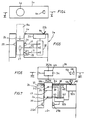
- a waste collection unit generally designated by 1, formed of a container 2 surmounted by an operational block 3. This the latter has an access or introduction slot 4 for a waste bag, a proof of deposit ejection slot 6 and a lateral actuation lever or crank 7.
- the width of the access slot 4 is too small for the fingers to be inserted therein.
- the block 3 determines a path 8 for transporting the waste bag 19, part of which consists of an endless conveyor 9 stretched over cylinders 10 ⁇ and 11.
- the cylinder 10 ⁇ is pressed against a drive cylinder 12 on the axis of rotation 13 from which aqit the crank 7.
- This drive cylinder 12 is, in fact, in two parts 12a and 12b between which is locked a circular knife 14 with wavy blade 14a.
- the path 8 splits into an ejection path 15 following the cylinder 12a and a collection path 16 following the cylinder 12b.
- the ejection path 15 opens out of the block 3 through the slot 6, while the collection path 16 ends between the cylinder 11 and a pressure cylinder 17, facing each other, after having determined a ramp 18 folding down.
- the actuation of the crank 7 rotates said cylinder 12, therefore the cylinder 10 ⁇ , the conveyor 9 and at the same time the cylinders 11 and 17.
- the rotation of the cylinders 10 ⁇ and 12 snaps the bag between them, which bag passes entirely into the slot 4 and is routed beyond said cylinders.
- the knife 14, which is blocked on the axis of rotation 13 rotates at the same time as it by cutting the bag 19 along the line 21.
- the access orifice 4a of the block 3a is circular, with a diameter very slightly greater than the diameter of the product or products 19a whose collection is desired, this to avoid that scrap whose section has a dimension greater than the diameter of the orifice 4a can be introduced into the unit.
- Block 3a has a downcomer 24 which opens into container 2.
- a magnetic metal detector consisting of a transmitter 25 and a receiver 26, and two color readers 27 and 28.
- the transmitter emits a field that receives the receiver, which records any disturbance of this field caused by the passage of a magnetic object.
- the color reader sends a light beam and receives in return the beam which is reflected to it by any object passing in front of it. It analyzes the reflected beam and, depending on the absorption observed, determines whether the object is of the expected color or not.
- Two color detectors are provided, arranged at 90 ° from one another to ensure that the color read is not that of a point area, but rather a dominant color.
- the output 29 of the receiver 26 provides directly, or via a known interface, a logic level "1" (for example) when it finds that the scrap is magnetic and a logic level "O" if it is not not.
- the output 30 ⁇ and 31 of the color readers 27 and 28 provide directly, or via a known interface, a logic level “1" (for example) when they find that the scrap is red and a logic level respectively "O" if it is not.
- the outputs 29-31 are connected to a logic control circuit 32, the output of which is connected by an interface not shown to a distributor 33 of proofs of deposit 22a.
- the device could include more color readers if the accuracy of the reading is to be increased and that the types of detectors mentioned above, both with regard to the magnetic or non-magnetic nature of the scrap, than its color dominant, are just examples among many others.
- the property detected could be other than the magnetic character.
- the access orifice 4b of the block 3b is rectangular and its section is very slightly greater than that, standard, of the briquettes 19b whose collection is desired, for the same reason as that set out above.
- the block 3b has a downcomer 24 which opens into the container 2. Along this downcomer are arranged three pairs of feelers 34, 35 and 36. The pair of feelers 35 is offset at 90 ° with respect to the pair probes 34 to ensure that the waste has a section corresponding to the standard section. The distance between the pair of feelers 34 and 36 is such that only a large format briquette 19b can touch them simultaneously.
- the outputs 37, 38 of the pair of probes 34, those 39, 40 ⁇ of the pair of probes 35 and those 41, 42 of the pair of probes 36 provide directly, or via a known interface, a logic level "1" (for example) when they are touched by the waste 19b during its fall in the conduit 24 and a logic level "O" if they are not.
- the outputs 37-42 are connected to a logic control circuit 32b, the output of which is connected by an interface not shown to a distributor 33b of proofs of deposit 22b or 22b ′.
- this embodiment could also include a detector of the nature of a material constituting the waste such as the assembly 25a, 25b, the output signal of which would be combined with the aforementioned signals. It could issue proof of deposit only for a given briquette format, in which case the pair of feelers 35 and the slot 4b ′ would be eliminated. Distributor 33b could also distribute proofs of deposits for small and large formats through a single slot.
- the unit according to the invention could be designed to accept, for example, briquettes of the same capacity, but of rectangular section different, a dimension of this section being however common to the different briquettes, called “small” and “large” sections.
- the opening 4b would have two of its opposite sides, called “standard spacing sides", the length of which would correspond to this common dimension, apart from the insertion clearance, the length of the opposite sides of the opening being chosen so as to allow the introduction of both small section and large section briquettes.
- the feelers could be arranged only along the walls of the conduit 24 which extend the standard spacing sides, if one does not try to distinguish, in the identification, the briquettes of small section of those of large section.
- FIG. 7 applies the incentive method according to the invention to the deposit of recyclable waste of a certain type.
- the downcomer 24 is provided with a transmitter 25c and with a receiver 26c, the output 29c of which is connected to a read-only memory 32c, itself connected by a interface not shown, to a distributor 33c of proof of deposit 22c and to a motor 43.
- the duct 24 is further provided with a passage detector, constituted for example by a photoelectric cell 48, 49, the output 50 ⁇ of the receiver 49 also being connected to read only memory 32c.
- a passage detector constituted for example by a photoelectric cell 48, 49, the output 50 ⁇ of the receiver 49 also being connected to read only memory 32c.
- a tank 44 blocked on an axis of rotation 45 controlled by the motor 43.
- a partition 46 separating a main container 20 ⁇ 1 a secondary container 20 ⁇ 2.
- the transmitter 25c and receiver 26c are sufficiently distant from the orifice 4c and a one-way passage device 47 equips said orifice.
- the read-only memory When the read-only memory receives the input signal 11 (passage of a magnetic material), it commands the distributor 33c to distribute a proof of deposit 22c, through the slot 6c, and to rotate the motor 43 so as to rotate the axis 45 in the direction of the arrow F1: the tank then empties of the waste 19c that it received in the container 20 ⁇ 1.
- the read-only memory receives the input signal 10 ⁇ (passage of a non-magnetic material)
- it does not send any order to the distributor 33c, but controls the rotation of the motor 43 so as to rotate the axis 45 in the direction of arrow F2: the tank then empties of the waste 19c in the container 20 ⁇ 2.
Landscapes
- Physics & Mathematics (AREA)
- General Physics & Mathematics (AREA)
- Engineering & Computer Science (AREA)
- Mechanical Engineering (AREA)
- Refuse Collection And Transfer (AREA)
- Processing Of Solid Wastes (AREA)
Claims (19)
- Verfahren zur Vermeidung von Umweltverschmutzung durch Abfall (19, 19a-19c), insbesondere durch Konsumgüterverpackungen wie Essen zum Mitnehmen oder gebrauchte Eintritts- und sonstige Karten, gemäß dem der Öffentlichkeit Sammelbehälter mit einer Einwurföffnung (4, 4a-4c) zur Aufnahme dieser Abfälle (19, 19a -19c) bereitgestellt werden, dadurch gekennzeichnet, daß die Sammelbehälter erstens mit einer geeigneten Vorrichtung für die zumindest grobe Erkennung des in die Einwurföffnung (4, 4a-4c) gehaltenen bzw. eingeworfenen Abfalls, zweitens mit einer Weiterbeförderungsvorrichtung (9, 24) des Abfalls (19, 19a-19c) nach der Einwurföffnung (4, 4a-4c) und drittens mit geeigneten Vorrichtungen (14, 15, 33a-c) zur Ausgabe und Gültigkeitskennzeichnung eines abfallbezogenen Einwurfbelegs (22, 22a-22c) wie z. B. eines Geschenkbons nach positiver Erkennung des Abfalls durch die Erkennungsvorrichtung in eventueller Verbindung mit der Weiterbeförderungsvorrichtung versehen werden.
- Verfahren nach Anspruch 1, dadurch gekennzeichnet, daß die Abfallerkennung (19, 19a-19c) zumindest teilweise durch Vergleich zwischen einer Abmessung von zumindest einem Teil des Abfalls (19, 19a-19c) und den Abmessungen der Einwurföffnung (4, 4a-4c) erfolgt.
- Verfahren nach Anspruch 1 oder 2, gemäß dem einem verkauften Konsumgut eine Tüte (19) zur Aufnahme der Produktverpackung bzw. der nach Verbrauch anfallenden Abfälle beigegeben wird, dadurch gekennzeichnet, daß auf der Tüte der Einwurfbeleg (22), z. B. Geschenkbon, angebracht wird und die Sammelbehälter mit einer Abtrenn- (14), einer Markier- (14a) und einer Rückgabevorrichtung (15, 6) des Einwurfbelegs (22), wie eines gültigen Geschenkbons, versehen wird, wobei während des Einwerfens bzw. der Weiterbeförderung im Sammelbehälter die Tüte (19) von diesen Vorrichtungen bearbeitet wird.
- Verfahren nach Anspruch 3, dadurch gekennzeichnet, daß die Markiervorrichtung (14a) eine zur Identifizierung des eingeworfenen Abfalls kennzeichnende Lochung, Stempelung oder Spur hinterläßt.
- Verfahren nach Anspruch 3 oder 4, dadurch gekennzeichnet, daß die Abtrennvorrichtung (14) auch als Markiervorrichtung des Einwurfbelegs wie z. B. eines Geschenkbons dient.
- Verfahren nach Anspruch 3, 4 oder 5, dadurch gekennzeichnet, daß die auch als Markiervorrichtung (14a) des Einwurfbelegs wie z. B. eines Geschenkbons dienende Abtrennvorrichtung (14) ein Rundmesser (14) mit welliger Schneide (14a) ist.
- Verfahren nach Anspruch 1 - 6, dadurch gekennzeichnet, daß die Identifizierung des Abfalls (19a-c) in der Erkennung einer Materialeigenschaft des Abfalls (19a-c) besteht.
- Verfahren nach Anspruch 7, dadurch gekennzeichnet, daß die erkannte Eigenschaft die magnetische oder nichtmagnetische Beschaffenheit des Abfalls (19a-c) oder eine andere erkennbare Eigenschaft des Abfalls, wie Leitfähigkeit, ist.
- Verfahren nach Anspruch 1 - 8, dadurch gekennzeichnet, daß die Identifizierung des Abfalls (19b) in der Erkennung eines Standardquerschnitts des Abfalls (19b) besteht.
- Verfahren nach Anspruch 1 - 9, dadurch gekennzeichnet, daß es außerdem eine Zusatzerkennung durch Erfassen der domininierenden Farbe des Abfalls (19a) besitzt.
- Verfahren nach Anspruch 4 - 10, dadurch gekennzeichnet, daß nach Identifizierung des Abfalls (19c) ein Sortieren in erkannte und zum Sammeln in einem Hauptsammelbehälter (201) zulässige Abfälle (19c) und nicht erkannte und in einen Nebensammelbehälter (202) geleitete Abfälle erfolgt, wobei zur Ausgabe des Einwurfbelegs wie z. B. eines Geschenkbons (22c) nur die zugelassenen Abfälle (19c) berücksichtigt werden.
- Sammelbehälter zur Durchführung des Verfahrens nach Anspruch 1 - 3 mit einer Einwurföffnung (4, 4a, 4c), dadurch gekennzeichnet, daß er erstens eine geeignete Vorrichtung (4, 4a, 4c, 25, 25b, 25c, 26, 26b, 26c, 27, 28, 48, 49) für die zumindest grobe Erkennung eines in die Einwurföffnung (4, 4a, 4c) gehaltenen bzw. eingeworfenen Abfalls (19, 19a, 19c), zweitens eine Weiterbeförderungsvorrichtung (9, 24) des Abfalls (19, 19a-c) nach der Einwurföffnung (4, 4a, 4c) und drittens eine geeignete Vorrichtung (14, 15, 6, 33, 33b, 33c) zur Ausgabe eines Einwurfbelegs (22, 22a, 22c) wie eines Geschenkbons nach positiver Erkennung des Abfalls durch die Erkennungsvorrichtung in eventueller Verbindung mit der Weiterbeförderungsvorrichtung besitzt.
- Sammelbehälter nach Anspruch 12, dadurch gekennzeichnet, daß der Einwurfbeleg (22), z. B. ein Geschenkbon, Teil einer Tüte (19) zur Aufnahme des oder der Abfälle vor Einwurf in die Einwurföffnung (4) ist.
- Sammelbehälter nach Anspruch 13, dadurch gekennzeichnet, daß er mit einer Abtrenn- (14), Markier- (14a) und einer Rückgabevorrichtung (15, 6) des Einwurfbelegs (22), wie z. B. eines Geschenkbons, versehen wird, wobei während des Einwerfens bzw. der Weiterbeförderung im Sammelbehälter die Tüte (19) von diesen Vorrichtungen bearbeitet wird.
- Sammelbehälter nach Anspruch 12 oder 13, dadurch gekennzeichnet, daß er einen Magnetdetektor (25, 26, 25b, 26b) oder einen Detektor einer anderen erkennbaren Eigenschaft, wie Leitfähigkeit, besitzt.
- Sammelbehälter nach Anspruch 12, 14 und 15, dadurch gekennzeichnet, daß er Meßfühler (34, 36) besitzt, mit denen ein Standardquerschnitt und eventuell eine oder mehrere Standardlängen erfaßt werden können.
- Sammelbehälter nach Anspruch 12 und 14 - 16, dadurch gekennzeichnet, daß er zumindest ein Farblesegerät (27, 28) besitzt.
- Sammelbehälter nach Anspruch 13 und 14 - 17, dadurch gekennzeichnet, daß er zumindest einen Strichcodeleser besitzt.
- Sammelbehälter nach Anspruch 13 - 18, dadurch gekennzeichnet, daß er erstens einen Hauptsammelbehälter (201) für erkannte und zum Sammeln zugelassene Abfälle (19c) und einen Nebensammelbehälter (202) für nicht erkannte Abfälle, zweitens eine Vorrichtung (44) zum Sortieren zwischen diesen beiden Behältern und drittens eine mit der Identifizierungsvorrichtung, der Vorrichtung zur Ausgabe eines Einwurfbelegs wie z. B. eines Geschenkbons und mit der Sortiervorrichtung verbundene Steuerung (32c) besitzt, wobei die Identifizierungsvorrichtung (25, 25b, 25c, 26, 26b, 26c, 48, 49) in Beförderungsrichtung des Abfalls (19c) vor der Sortiervorrichtung liegt, wodurch die Steuerung (32c) je nach den von der Identifizierungsvorrichtung erhaltenen Daten entweder die Ausgabe des Einwurfbelegs (22c) und die Lenkung des Abfalls (19c) in den Hauptsammelbehälter (201) oder nur die Lenkung des Abfalls zum Nebensammelbehälter (202) bewirkt.
Priority Applications (1)
| Application Number | Priority Date | Filing Date | Title |
|---|---|---|---|
| AT90913284T ATE106351T1 (de) | 1990-08-20 | 1990-08-20 | Verfahren und vorrichtung zum verhindern von umweltverschmutzung durch müll sowie sammeleinrichtung zur durchführung des verfahrens. |
Applications Claiming Priority (2)
| Application Number | Priority Date | Filing Date | Title |
|---|---|---|---|
| CA002089641A CA2089641C (fr) | 1990-08-20 | 1990-08-20 | Procede de lutte contre la pollution de l'environnement par des rebuts recyclables ou non |
| PCT/FR1990/000616 WO1992003360A1 (fr) | 1990-08-20 | 1990-08-20 | Procede de lutte contre la pollution de l'environnement par des rebuts, application de ce procede a la recuperation de rebuts recyclables et dispositif pour la mise en ×uvre de ce procede |
Publications (2)
| Publication Number | Publication Date |
|---|---|
| EP0544660A1 EP0544660A1 (de) | 1993-06-09 |
| EP0544660B1 true EP0544660B1 (de) | 1994-06-01 |
Family
ID=4151167
Family Applications (1)
| Application Number | Title | Priority Date | Filing Date |
|---|---|---|---|
| EP19900913284 Expired - Lifetime EP0544660B1 (de) | 1990-08-20 | 1990-08-20 | Verfahren und vorrichtung zum verhindern von umweltverschmutzung durch müll sowie sammeleinrichtung zur durchführung des verfahrens |
Country Status (4)
| Country | Link |
|---|---|
| US (1) | US5348128A (de) |
| EP (1) | EP0544660B1 (de) |
| CA (1) | CA2089641C (de) |
| DE (1) | DE69009498T2 (de) |
Families Citing this family (6)
| Publication number | Priority date | Publication date | Assignee | Title |
|---|---|---|---|---|
| EP0915035A1 (de) * | 1997-11-05 | 1999-05-12 | Mondotech S.A. | System zum Sammeln von nach Art getrenntem Hausmüll |
| CN101898193B (zh) * | 2009-05-31 | 2013-03-06 | 郑经涛 | 一种处理垃圾的方法 |
| CN103387104A (zh) * | 2012-05-10 | 2013-11-13 | 李文庆 | 一种垃圾回收充值系统 |
| US20160001297A1 (en) * | 2014-07-07 | 2016-01-07 | Zeguo Qiu | Method for automatic classification separately collection and automatic transportation of the solid waste |
| CN111268303A (zh) * | 2020-01-06 | 2020-06-12 | 南京理工大学 | 基于单片机的智能可自动分类垃圾箱 |
| CN114476418B (zh) * | 2022-02-25 | 2023-02-24 | 北京惠友科技有限公司 | 一种垃圾智能处理方法、设备、介质 |
Family Cites Families (10)
| Publication number | Priority date | Publication date | Assignee | Title |
|---|---|---|---|---|
| DE1506444A1 (de) * | 1967-01-19 | 1969-06-26 | Dom Samen Gmbh | Verfahren und Vorrichtung zum Sortieren von Samenbeuteln nach Sorten und Sortenpartien |
| EP0029822B1 (de) * | 1978-06-21 | 1982-12-29 | Apura GmbH + Co. PWA Einmalhandtücher | Behälter zum Aufnehmen und Pressen von Abfall |
| US4653627A (en) * | 1985-08-26 | 1987-03-31 | Can And Bottle Systems, Inc. | Reverse vending machine |
| US4784251A (en) * | 1987-01-16 | 1988-11-15 | Environmental Products Corporation | Reverse vending machine |
| FR2618239B1 (fr) * | 1987-07-17 | 1991-10-25 | Muller Sarl | Appareil pour recuperer un objet, notamment un gobelet en matiere plastique, contre delivrance d'une contre-valeur, notamment monetaire. |
| DE8806095U1 (de) * | 1988-05-07 | 1988-09-08 | Mabeg Muell- Und Abfallbeseitigungsgesellschaft Mbh & Co Ohg, 4690 Herne | Glassammelbehälter |
| US4919534A (en) * | 1988-09-30 | 1990-04-24 | Environmental Products Corp. | Sensing of material of construction and color of containers |
| GB8824218D0 (en) * | 1988-10-15 | 1988-11-23 | Caulfield L | Waste receptable |
| FR2643617B1 (fr) * | 1989-02-27 | 1991-12-13 | Sand Sidonie | Machine " composteur-collecteur " mecanique pour absorber des sachets de detritus des lieux publics |
| US5100005A (en) * | 1989-08-11 | 1992-03-31 | Plastics Recovery, Inc. | Trash bags for recyclable articles and system and method for collecting recyclable waste |
-
1990
- 1990-08-20 US US07/971,839 patent/US5348128A/en not_active Expired - Fee Related
- 1990-08-20 EP EP19900913284 patent/EP0544660B1/de not_active Expired - Lifetime
- 1990-08-20 DE DE69009498T patent/DE69009498T2/de not_active Expired - Fee Related
- 1990-08-20 CA CA002089641A patent/CA2089641C/fr not_active Expired - Fee Related
Also Published As
| Publication number | Publication date |
|---|---|
| EP0544660A1 (de) | 1993-06-09 |
| CA2089641A1 (fr) | 1992-02-21 |
| DE69009498T2 (de) | 1994-12-22 |
| DE69009498D1 (de) | 1994-07-07 |
| CA2089641C (fr) | 2003-07-22 |
| US5348128A (en) | 1994-09-20 |
Similar Documents
| Publication | Publication Date | Title |
|---|---|---|
| US5355987A (en) | Single station reverse vending machine | |
| EP0544660B1 (de) | Verfahren und vorrichtung zum verhindern von umweltverschmutzung durch müll sowie sammeleinrichtung zur durchführung des verfahrens | |
| CA2680866A1 (en) | Automated banking machine which dispenses, receives and stores notes and other financial instrument sheets | |
| WO2009080929A2 (fr) | Dispositif de dépilage d'envois postaux multi-modes | |
| WO1992003360A1 (fr) | Procede de lutte contre la pollution de l'environnement par des rebuts, application de ce procede a la recuperation de rebuts recyclables et dispositif pour la mise en ×uvre de ce procede | |
| CN1326577A (zh) | 用于接收和封存纸币的机器,其中,信息被打印在透明薄膜的内侧 | |
| US5477953A (en) | Filter and filter cleaning system for a reverse vending machine | |
| FR2501535A1 (fr) | Appareil pour identifier des objets d'aluminium dans des ordures municipales et pour effectuer un paiement automatique sur la base du poids de ces objets | |
| FR2618239A1 (fr) | Appareil pour recuperer un objet, notamment un gobelet en matiere plastique, contre delivrance d'une contre-valeur, notamment monetaire. | |
| US5346048A (en) | Apparatus for collecting articles | |
| WO2021156228A1 (fr) | Dispositif de detection et/ou d'inspection d'objets et machine de collecte et/ou de deconsignation le comprenant | |
| EP1770037A1 (de) | Verfahren zum Erkennen von Doppelabzügen von Postsendungen durch Bildanalyse der aufrechten Sendungen | |
| EP0169145A2 (de) | Apparat zum Sortieren von Briefumschlägen | |
| EP0862067A1 (de) | Vorrichtung und Verfahren zum Detektieren, Identifizieren und Sortieren von ganz oder teilweise metallische Verpackungen | |
| EP1274519B1 (de) | Verfahren zur unterscheidung zwischen umschläge aus papier und aus kunststoff | |
| EP3807021A2 (de) | System zur auswahl von objekten, die sich entlang einer transferlinie bewegen | |
| FR3070613A1 (fr) | Dispositif pour la reprise de materiaux en vrac en grande surface de vente ou dans des points de reprise accessibles au public, par exemple pour des cartons, des livres d'autres dechets propres. | |
| EP1235191B1 (de) | Pfandrückgabegerät | |
| FR2786295A1 (fr) | Dispositif de decalage d'empreinte postale | |
| EP0723691A1 (de) | Vorrichtung zur rücknahme von abfällen | |
| EP2424802B1 (de) | Verfahren zur erkennung geöffneter postsendungen, z.b. umschlagloser magazine | |
| EP0558426A1 (de) | Verfahren und System zur Rückgewinnung von Gegenständen ohne wesentlichen tatsächlichen Wert, zum Beispiel Einwegbehälter | |
| JP2984771B2 (ja) | 空缶回収機 | |
| KR940008273Y1 (ko) | 자동공병수집기 | |
| BE1015209A3 (fr) | Sacs identifiables pour le triage selectif. |
Legal Events
| Date | Code | Title | Description |
|---|---|---|---|
| PUAI | Public reference made under article 153(3) epc to a published international application that has entered the european phase |
Free format text: ORIGINAL CODE: 0009012 |
|
| 17P | Request for examination filed |
Effective date: 19930312 |
|
| AK | Designated contracting states |
Kind code of ref document: A1 Designated state(s): AT BE CH DE DK ES FR GB IT LI LU NL SE |
|
| 17Q | First examination report despatched |
Effective date: 19930913 |
|
| GRAA | (expected) grant |
Free format text: ORIGINAL CODE: 0009210 |
|
| AK | Designated contracting states |
Kind code of ref document: B1 Designated state(s): AT BE CH DE DK ES FR GB IT LI LU NL SE |
|
| PG25 | Lapsed in a contracting state [announced via postgrant information from national office to epo] |
Ref country code: AT Effective date: 19940601 Ref country code: DK Effective date: 19940601 Ref country code: ES Free format text: THE PATENT HAS BEEN ANNULLED BY A DECISION OF A NATIONAL AUTHORITY Effective date: 19940601 Ref country code: NL Effective date: 19940601 |
|
| REF | Corresponds to: |
Ref document number: 106351 Country of ref document: AT Date of ref document: 19940615 Kind code of ref document: T |
|
| ITF | It: translation for a ep patent filed | ||
| REF | Corresponds to: |
Ref document number: 69009498 Country of ref document: DE Date of ref document: 19940707 |
|
| GBT | Gb: translation of ep patent filed (gb section 77(6)(a)/1977) |
Effective date: 19940812 |
|
| NLV1 | Nl: lapsed or annulled due to failure to fulfill the requirements of art. 29p and 29m of the patents act | ||
| EAL | Se: european patent in force in sweden |
Ref document number: 90913284.7 |
|
| PLBE | No opposition filed within time limit |
Free format text: ORIGINAL CODE: 0009261 |
|
| STAA | Information on the status of an ep patent application or granted ep patent |
Free format text: STATUS: NO OPPOSITION FILED WITHIN TIME LIMIT |
|
| 26N | No opposition filed | ||
| ITTA | It: last paid annual fee | ||
| PGFP | Annual fee paid to national office [announced via postgrant information from national office to epo] |
Ref country code: LU Payment date: 19960801 Year of fee payment: 7 |
|
| PG25 | Lapsed in a contracting state [announced via postgrant information from national office to epo] |
Ref country code: LU Free format text: LAPSE BECAUSE OF NON-PAYMENT OF DUE FEES Effective date: 19970820 |
|
| REG | Reference to a national code |
Ref country code: GB Ref legal event code: IF02 |
|
| PGFP | Annual fee paid to national office [announced via postgrant information from national office to epo] |
Ref country code: DE Payment date: 20041007 Year of fee payment: 15 |
|
| PG25 | Lapsed in a contracting state [announced via postgrant information from national office to epo] |
Ref country code: IT Free format text: LAPSE BECAUSE OF NON-PAYMENT OF DUE FEES;WARNING: LAPSES OF ITALIAN PATENTS WITH EFFECTIVE DATE BEFORE 2007 MAY HAVE OCCURRED AT ANY TIME BEFORE 2007. THE CORRECT EFFECTIVE DATE MAY BE DIFFERENT FROM THE ONE RECORDED. Effective date: 20050820 |
|
| PGFP | Annual fee paid to national office [announced via postgrant information from national office to epo] |
Ref country code: FR Payment date: 20050821 Year of fee payment: 16 |
|
| PG25 | Lapsed in a contracting state [announced via postgrant information from national office to epo] |
Ref country code: DE Free format text: LAPSE BECAUSE OF NON-PAYMENT OF DUE FEES Effective date: 20060301 |
|
| PG25 | Lapsed in a contracting state [announced via postgrant information from national office to epo] |
Ref country code: FR Free format text: LAPSE BECAUSE OF NON-PAYMENT OF DUE FEES Effective date: 20060428 |
|
| REG | Reference to a national code |
Ref country code: FR Ref legal event code: ST Effective date: 20060428 |
|
| PGFP | Annual fee paid to national office [announced via postgrant information from national office to epo] |
Ref country code: GB Payment date: 20060810 Year of fee payment: 17 |
|
| PGFP | Annual fee paid to national office [announced via postgrant information from national office to epo] |
Ref country code: BE Payment date: 20060918 Year of fee payment: 17 |
|
| PGFP | Annual fee paid to national office [announced via postgrant information from national office to epo] |
Ref country code: CH Payment date: 20061018 Year of fee payment: 17 |
|
| REG | Reference to a national code |
Ref country code: FR Ref legal event code: RN |
|
| REG | Reference to a national code |
Ref country code: FR Ref legal event code: D5 |
|
| PGFP | Annual fee paid to national office [announced via postgrant information from national office to epo] |
Ref country code: SE Payment date: 20060823 Year of fee payment: 17 |
|
| BERE | Be: lapsed |
Owner name: *DRU FRANCOISE Effective date: 20070831 |
|
| EUG | Se: european patent has lapsed | ||
| REG | Reference to a national code |
Ref country code: CH Ref legal event code: PL |
|
| GBPC | Gb: european patent ceased through non-payment of renewal fee |
Effective date: 20070820 |
|
| PG25 | Lapsed in a contracting state [announced via postgrant information from national office to epo] |
Ref country code: CH Free format text: LAPSE BECAUSE OF NON-PAYMENT OF DUE FEES Effective date: 20070831 Ref country code: SE Free format text: LAPSE BECAUSE OF NON-PAYMENT OF DUE FEES Effective date: 20070821 Ref country code: LI Free format text: LAPSE BECAUSE OF NON-PAYMENT OF DUE FEES Effective date: 20070831 |
|
| PG25 | Lapsed in a contracting state [announced via postgrant information from national office to epo] |
Ref country code: BE Free format text: LAPSE BECAUSE OF NON-PAYMENT OF DUE FEES Effective date: 20070831 |
|
| PG25 | Lapsed in a contracting state [announced via postgrant information from national office to epo] |
Ref country code: GB Free format text: LAPSE BECAUSE OF NON-PAYMENT OF DUE FEES Effective date: 20070820 |