EP0548773A1 - Selbsttragende Baufassade für Gebäude aus unabhängigen Elementen - Google Patents
Selbsttragende Baufassade für Gebäude aus unabhängigen Elementen Download PDFInfo
- Publication number
- EP0548773A1 EP0548773A1 EP92121381A EP92121381A EP0548773A1 EP 0548773 A1 EP0548773 A1 EP 0548773A1 EP 92121381 A EP92121381 A EP 92121381A EP 92121381 A EP92121381 A EP 92121381A EP 0548773 A1 EP0548773 A1 EP 0548773A1
- Authority
- EP
- European Patent Office
- Prior art keywords
- wing
- cross
- seat
- facade
- facade according
- Prior art date
- Legal status (The legal status is an assumption and is not a legal conclusion. Google has not performed a legal analysis and makes no representation as to the accuracy of the status listed.)
- Withdrawn
Links
Images



Classifications
-
- E—FIXED CONSTRUCTIONS
- E06—DOORS, WINDOWS, SHUTTERS, OR ROLLER BLINDS IN GENERAL; LADDERS
- E06B—FIXED OR MOVABLE CLOSURES FOR OPENINGS IN BUILDINGS, VEHICLES, FENCES OR LIKE ENCLOSURES IN GENERAL, e.g. DOORS, WINDOWS, BLINDS, GATES
- E06B3/00—Window sashes, door leaves, or like elements for closing wall or like openings; Layout of fixed or moving closures, e.g. windows in wall or like openings; Features of rigidly-mounted outer frames relating to the mounting of wing frames
- E06B3/54—Fixing of glass panes or like plates
- E06B3/5427—Fixing of glass panes or like plates the panes mounted flush with the surrounding frame or with the surrounding panes
-
- E—FIXED CONSTRUCTIONS
- E06—DOORS, WINDOWS, SHUTTERS, OR ROLLER BLINDS IN GENERAL; LADDERS
- E06B—FIXED OR MOVABLE CLOSURES FOR OPENINGS IN BUILDINGS, VEHICLES, FENCES OR LIKE ENCLOSURES IN GENERAL, e.g. DOORS, WINDOWS, BLINDS, GATES
- E06B7/00—Special arrangements or measures in connection with doors or windows
- E06B7/14—Measures for draining-off condensed water or water leaking-in frame members for draining off condensation water, throats at the bottom of a sash
Definitions
- the present invention relates to a continuous structural facade for buildings with independent elements.
- continuous facade currently designates a system which is external to the supporting structure of building and has no vertical discontinuities.
- Said continuous facades are usually constituted by a grid of metallic elements in which the panels, made of glass or opaque material, are inserted.
- Known types of continuous facade include a facade wherein the grid is made of extruded profiled elements which are frontally provided with a shape suitable to accommodate curtain-wall panels made of various materials.
- the supporting structure is defined by means of a planar lattice formed by uprights, which are anchored to the floor slab by means of appropriate adjustable L-shaped elements, and by cross-members, which are connected to the uprights by means of a quick snap-together coupling.
- the finish of the profiled elements is provided by means of a covering element which naturally protrudes with respect to the plane of arrangement of the panel.
- Windows are thus known which are mounted on lateral hinges so that they can be opened by rotating about a vertical axis.
- Said windows usually provide for the use of hinges which are generally constituted by an element which can be coupled to the casement, which has a guide for a mushroom-shaped stud which protrudes from an end of a sliding block which can be coupled laterally to the window.
- Hinges composed of a plurality of mutually variously articulated arms are also known in this regard, but they are complicated from the point of view of manufacture and are thus onerous from the constructive point of view.
- the windows can also have hinges which allow to open them along planes which are parallel to the plane of arrangement of the casement; said hinges are usually constituted by two pairs of arms which are mutually articulated so as to form an X and are coupled to the window at one end and to the casement at the other end.
- each individual facade is divided from the others by a casement or in any case by an element whose dimensions are such as to considerably delimit each individual facade and thus limit the appearance of vertical "continuity" of the building; on the other hand, in known continuous structural facades it is necessary to provide alternating fixed windows and openable windows, either of the shutter-like type or of the tilt-down type, thus creating bands of fixed windows which are interposed both horizontally and vertically between openable windows.
- Structural facades are also known wherein the glazing is not interrupted by any type of external profiled element but is fixed to supports by means of structural sealant.
- Facades thus obtained can be divided essentially into three types: a first facade, known as supported facade, comprises a mechanical support on the inner pane of the glass-box both at the uprights and at the cross-members of the grid.
- a first facade known as supported facade, comprises a mechanical support on the inner pane of the glass-box both at the uprights and at the cross-members of the grid.
- structural silicone is used along the entire perimeter of the glass-box and of the mechanical support in order to support said glass-box.
- a second type of facade provides for the application of the structural sealant outside the supporting grid, the glass pane being associated thereon.
- a third type of continuous facade termed ventilated or triple continuous facade, provides for the use of structural sealant to seal a monolithic plate outside the grid, the glass-box being applied inside with conventional methods.
- the coupling elements can furthermore constitute localized pressure points which can lead to the breakage of the glass.
- the aim of the present invention is therefore to eliminate the problems described above in known types by providing a continuous structural facade wherein each individual window can be opened in a shutter-like or tilt-down manner, the glass pane being appropriately supported and retained, the internal lattice and the outer lattice furthermore both having reduced dimensions.
- an important object is to provide a continuous structural facade wherein each individual glass pane which constitutes the windows has the same size and thus allows to always have the same viewing surface for the user.
- Another important object is to provide a facade wherein each individual window can be opened both along the horizontal direction of the facade and along the vertical one.
- Another important object is to provide a continuous structural facade which associates with the preceding characteristics that of allowing assembly at the building yard without requiring particular machines or controlled ambient conditions.
- Another object is to provide a structural facade wherein there is an optimum conveyance and discharge of meteoric and condensation water.
- Another object is to provide a continuous facade which can be assembled rapidly and easily.
- Another object is to provide a continuous facade which allows the easy insertion of accessories for the mounting and fixing of the windows.
- Another object is to provide a continuous facade wherein it is possible to achieve optimum ventilation.
- Yet another object is to provide a facade wherein it is possible to clean each individual window in absolute safety even with personnel not specifically trained for this purpose.
- Not least object is to provide a continuous structural facade which has very modest manufacturing and installation costs and is reliable and safe in use.
- a continuous structural facade for buildings with a supporting frame characterized in that it comprises a plurality of cross-members and uprights which are identical and mutually interconnectable and have a thermal insulation element with which a first profiled element can be associated in a snap-together manner, said first profiled element having means for the conveyance and discharge of meteoric and/or condensation water and means for supporting a glass pane which can be associated with a second shutter profiled element which has ventilation holes.
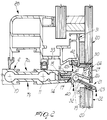
- the continuous structural facade for buildings designated by the reference numeral 1
- the continuous structural facade for buildings comprises a plurality of cross-members 2 and uprights 3 which are mutually identical and are preferably made of extruded aluminum.
- Said cross-members and uprights have a first portion 4 shaped essentially like a parallelepiped, followed by a second portion 5 whose cross-section is essentially shaped like a truncated pyramid.
- first seats 7a and 7b are furthermore defined on the lateral surface of each cross-member and upright, at the region where the first portion 4 and the second portion 5 meet; said seats are arranged approximately transversely with respect to each upright and cross-member and allow the coupling of structural elements by using suitable L-shaped elements.
- Each cross-member 2 and upright 3 has an internal cavity 8 at which a second seat 9, a third seat 10 and a fourth seat 11 are defined respectively at the ends of the first portion 4 and at the end of the second portion 5 which is adjacent to said first portion 4; said seats are cylindrical, parallel and mutually identical and are arranged transversely to said upright and cross-member.
- the longitudinal extension of the first portion 4 is advantageously greater than the extension of the second portion 5, so that the center distances between the second, third and fourth seats are not constant.
- a fifth seat 13 is present at the free end 12 of the second portion 5, and a thermal insulation element 14, constituted by a rigid gasket oxidized during the extrusion of the upright or of the cross-member, can be arranged in said fifth seat.
- Said thermal insulation element 14 has, at its free end, a sixth axial seat 15 inside which the stem 16 of a first profiled element 17 can be associated in a snap-together manner; said first profiled element is essentially Y-shaped, with a first wing 18 and a second wing 19 which are mutually parallel and are arranged so as to be inclined with respect to the axis of the stem 16.
- Said first profiled element 17 is mounted, during installation, at the sixth seat 15 of the cross-member 2 so that there are no interruptions, and this ensures, as described hereinafter, optimum drainage.
- said first profiled element 17 shows no horizontal discontinuity for the facade, while constituting a means for water collection and drainage.
- the first wing 18 of the first profiled element 17 associated with a cross-member 2 is directed toward the glass pane 20 which constitutes the underlying window of the facade.
- a means for conveying and discharging meteoric and/or condensation water can be associated in the interspace between the first wing 18 and the second wing 19; said means is constituted by a first gasket 21 which surrounds the end of the first wing 18 and protrudes therefrom beyond the plane of arrangement of the outer surface 22 of the pane 20.
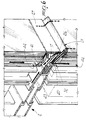
- the function of the first inclined wing 18 and gasket 21 is also to retain the pane 20 in case of outward movements thereof, since the upper perimetric edge of said pane is arranged on an inclined plane in abutment against the inclined gasket 21, as seen in figure 2.
- An essentially L-shaped tab 24 is associated with the terminal end of the second wing 19 and is directed in the opposite direction with respect to the first wing 18; the terminal end 25 of said tab is inclined with respect to the axis of the stem 16 and is directed toward it.
- At least one hole or slot 26 is defined at the connection between the ends of the second wing 19 and of the tab 24 and is suitable to convey the water which has deposited on said second wing 19 onto the underlying first gasket 21, so as to convey the drops of water 23 beyond the outer surface 22 of the underlying pane 20.
- the terminal end 25 of the tab 24 furthermore interacts, by means of the second gasket 27, with a means for supporting a pane 20 of the facade, which is constituted by a foot 30 which is associated below a second profiled element 31 which constitutes the shutter 28.
- At least one second hole or slot 32 is furthermore defined approximately at the region which connects the stem 16 and the first wing 18 of the first profiled element 17, and its function is to allow, together with the first hole or slot 26 defined on the tab 24 and with third holes 33 defined on said second profiled element 31, optimum ventilation and drainage for the facade.
- a recess is defined on the head of the first gasket 21 at the second holes or slots 32.
- a sleeve 34 made of extruded aluminum with steel reinforcements, which is composed of three mutually spaced cylindrical pivots 35 which are shaped complementarily with respect to the seats 9, 10 and 11 defined on the cross-members; the length of said pivots is such that they protrude beyond the opposite lateral perimetric edge, with respect to the insertion edge, of a cross-member and enter adapted fourth holes defined on the lateral surface of an adjacent upright so as to allow mutual interconnection.
- Some of the cross-members may have, as shown in figure 4, a seventh seat 37, which is defined on the end which is opposite to the one provided with the thermal insulation element 14 in order to allow coupling to supports 38, and an eighth seat 39, which is defined at the first portion 4, in order to allow the accommodation of for example a wing 18.
- an upright 3 which is shaped essentially like a parallelepiped, can be divided into two specular elements which can be mutually coupled at their ends, and can be used if one wishes to assemble modules; in this case, the second gasket 27 is C-shaped so as to completely surround the outward edge of said upright.
- a first ridge or protrusion 40 is provided at the connection between the first wing 18 and the stem 16 and is directed opposite to the wing 24.
- the foot 30 furthermore has a head 41 which can be accommodated within a complementarily shaped seat 42 defined along the entire perimeter of the second profiled element 31 of the shutter 28.
- Said seat 42 is occupied by the head 41 of the foot 30 only at its lower transverse side.
- the other sides of the seat 42 are used as channels for draining the water conveyed thereto by the first ridge or protrusion 40 of the first profiled element 17 of the facade which is arranged above the one being considered.
- This conveyance can be due to water which, by interacting with the second wing 19, is discharged through the first slotted hole 26 onto the first gasket 21.
- the water subsequently interacts with the first ridge or protrusion 40 and is then discharged onto the underlying seat 42.
- a second ridge or protrusion 43 furthermore protrudes at the head 41 of the foot 30 and is directed toward the underlying first profiled element 17.
- Said second ridge or protrusion 43 has the purpose of preventing the passage of water toward the inner part of the shutter 28.
- the facade has achieved the above described aim and objects, since it is possible to use a window which can be opened both in a shutter-like manner, or about a vertical axis, and in a tilt-down manner, and this occurs for the entire arrangement of said windows in the facade and thus even in the case of equally openable windows arranged above, below or on both sides.
- Each individual glass pane which constitutes the windows furthermore has the same size, thus allowing to always have the same viewing surface for the user.
- the facade thus executed also allows to achieve optimum ventilation and optimum conveyance and discharge of meteoric and condensation water.
- This solution furthermore has optimum safety characteristics, since each individual pane is part of a casement which is associated with the internal lattice of the building.
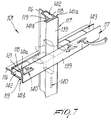
- Figures 7, 8 and 9 illustrate a second embodiment for the continuous structural facade of buildings, designated by the reference numeral 101, which comprises a plurality of cross-members 102 and uprights 103 preferably made of extruded aluminum.
- Each one of said cross-members and of said uprights has a thermal insulation element 114 constituted by a gasket which can be inserted in a snap-together manner at the fifth seat 113.
- Said thermal insulation element 114 has, at its free end, a sixth axial seat within which the stem 116 of a first essentially Y-shaped profiled element 117 can be associated in a snap-together manner; said first profiled element 117 has, at the horizontal node, a first wing 118 and a second wing 119 which are mutually connected so as to define a flat surface 139 at which means for conveying and discharging meteoric and/or condensation water, such as second longitudinal slots 140, can be defined.
- Adapted eighth seats 141a and 141b for third sealing gaskets 129a and 129b which interact with the facing inclined surfaces of the perimetric edges of the panels 120 are furthermore defined at the portion of the first wing 118 and of the second wing 119 which is inclined with respect to the stem 116.
- the first profiled element 117 has a ninth axial seat 142 between the first wing 118 and the second wing 119.
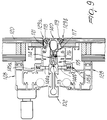
- the first profiled element 117 has a first wing 118 and a second wing 119; the latter, however, is not connected to the stem 116, so as to define, in an upward region, an opening 143 which is connected to the ninth axial seat 142 so as to allow the insertion therein of an adapted first gasket 121 for the conveyance and discharge of meteoric and/or condensation water; said first gasket 121 can also be positioned at the ninth axial seat 142 defined on the first profiled element 117 which is associated with the upright 103.
- adapted eighth seats 141a and 141b for third gaskets 129a and 129b which interact with the facing inclined surfaces of the panels 120 are defined on the first wing 118 and on the second wing 119.
- One end of said brushes 144a and 144b interacts directly with cross-members and uprights, whereas the other end is arranged so that it can slide within adapted tenth seats 145a and 145b defined at the profile of the shutter 128.
- One end of the brushes 144a and 144b is kept in contact with the outer lateral surfaces of the cross-members and of the uprights by virtue of the presence of adapted elastically deformable elements, such as springs 146a and 146b, arranged within the tenth seats 145a and 145b; said springs allow to ensure tightness and to automatically correct the minimal dimensional differences between the shutter 128 and the first profiled elements 117.
- adapted elastically deformable elements such as springs 146a and 146b
Landscapes
- Engineering & Computer Science (AREA)
- Civil Engineering (AREA)
- Structural Engineering (AREA)
- Load-Bearing And Curtain Walls (AREA)
- Building Environments (AREA)
Applications Claiming Priority (2)
| Application Number | Priority Date | Filing Date | Title |
|---|---|---|---|
| ITTV91125 | 1991-12-20 | ||
| ITTV910125A IT1253665B (it) | 1991-12-20 | 1991-12-20 | Facciata strutturale continua per edifici ad elementi indipendenti |
Publications (1)
| Publication Number | Publication Date |
|---|---|
| EP0548773A1 true EP0548773A1 (de) | 1993-06-30 |
Family
ID=11418933
Family Applications (1)
| Application Number | Title | Priority Date | Filing Date |
|---|---|---|---|
| EP92121381A Withdrawn EP0548773A1 (de) | 1991-12-20 | 1992-12-16 | Selbsttragende Baufassade für Gebäude aus unabhängigen Elementen |
Country Status (2)
| Country | Link |
|---|---|
| EP (1) | EP0548773A1 (de) |
| IT (1) | IT1253665B (de) |
Cited By (5)
| Publication number | Priority date | Publication date | Assignee | Title |
|---|---|---|---|---|
| US5839236A (en) * | 1997-06-09 | 1998-11-24 | International Aluminum Corporation | Curtain wall integral drip system |
| CN104088572A (zh) * | 2014-06-18 | 2014-10-08 | 苏州金螳螂幕墙有限公司 | 一种水密性开窗 |
| CN105421969A (zh) * | 2015-12-11 | 2016-03-23 | 山东舜泽门窗有限公司 | 一种防止雨水倒灌的铝合金窗框排水系统 |
| CN106978870A (zh) * | 2016-11-25 | 2017-07-25 | 绿城装饰工程集团有限公司 | 自排水明框幕墙系统 |
| CN116856594A (zh) * | 2023-07-07 | 2023-10-10 | 深圳市晶宫建筑装饰集团有限公司 | 建筑玻璃幕墙通风装置 |
Citations (4)
| Publication number | Priority date | Publication date | Assignee | Title |
|---|---|---|---|---|
| DE3317948A1 (de) * | 1983-05-17 | 1984-11-22 | GBK Gesellschaft für Baukonstruktionen mbH, 7250 Leonberg | Tragwerk fuer glasfassaden, -waende und/oder -daecher |
| WO1987006291A1 (en) * | 1986-04-15 | 1987-10-22 | Construction Utilities Group Limited | Curtain walling |
| EP0426008A1 (de) * | 1989-10-30 | 1991-05-08 | Josef Gartner & Co. | Fassadenkonstruktion |
| GB2239466A (en) * | 1989-12-21 | 1991-07-03 | Hueck Fa E | Curtain wall |
-
1991
- 1991-12-20 IT ITTV910125A patent/IT1253665B/it active IP Right Grant
-
1992
- 1992-12-16 EP EP92121381A patent/EP0548773A1/de not_active Withdrawn
Patent Citations (4)
| Publication number | Priority date | Publication date | Assignee | Title |
|---|---|---|---|---|
| DE3317948A1 (de) * | 1983-05-17 | 1984-11-22 | GBK Gesellschaft für Baukonstruktionen mbH, 7250 Leonberg | Tragwerk fuer glasfassaden, -waende und/oder -daecher |
| WO1987006291A1 (en) * | 1986-04-15 | 1987-10-22 | Construction Utilities Group Limited | Curtain walling |
| EP0426008A1 (de) * | 1989-10-30 | 1991-05-08 | Josef Gartner & Co. | Fassadenkonstruktion |
| GB2239466A (en) * | 1989-12-21 | 1991-07-03 | Hueck Fa E | Curtain wall |
Cited By (8)
| Publication number | Priority date | Publication date | Assignee | Title |
|---|---|---|---|---|
| US5839236A (en) * | 1997-06-09 | 1998-11-24 | International Aluminum Corporation | Curtain wall integral drip system |
| GB2326172A (en) * | 1997-06-09 | 1998-12-16 | Int Aluminum Corp | Horizontal mullion with integral drip-directing surface |
| CN104088572A (zh) * | 2014-06-18 | 2014-10-08 | 苏州金螳螂幕墙有限公司 | 一种水密性开窗 |
| CN104088572B (zh) * | 2014-06-18 | 2016-01-27 | 苏州金螳螂幕墙有限公司 | 一种水密性开窗 |
| CN105421969A (zh) * | 2015-12-11 | 2016-03-23 | 山东舜泽门窗有限公司 | 一种防止雨水倒灌的铝合金窗框排水系统 |
| CN106978870A (zh) * | 2016-11-25 | 2017-07-25 | 绿城装饰工程集团有限公司 | 自排水明框幕墙系统 |
| CN106978870B (zh) * | 2016-11-25 | 2019-01-15 | 绿城装饰工程集团有限公司 | 自排水明框幕墙系统 |
| CN116856594A (zh) * | 2023-07-07 | 2023-10-10 | 深圳市晶宫建筑装饰集团有限公司 | 建筑玻璃幕墙通风装置 |
Also Published As
| Publication number | Publication date |
|---|---|
| ITTV910125A0 (it) | 1991-12-20 |
| ITTV910125A1 (it) | 1993-06-20 |
| IT1253665B (it) | 1995-08-22 |
Similar Documents
| Publication | Publication Date | Title |
|---|---|---|
| US11578485B2 (en) | Curtain wall and wall element thereby applied and method for manufacturing such a wall element | |
| US5090168A (en) | Extruded window frame system | |
| US4738065A (en) | Curtainwall system | |
| EP0153574B1 (de) | Fassadenwandsystem | |
| US10934707B2 (en) | Curtain wall with a wall element with a frame with a compartment for a wing or the like and method for replacing an infill element in a curtain wall | |
| US5199234A (en) | Skylight assembly | |
| US4633631A (en) | Curtainwall system | |
| US4676026A (en) | Window or door construction for a building | |
| EP0079064A2 (de) | Schwelle und Rahmen für Fenster und Türen | |
| US20200032510A1 (en) | Wall element for a curtain wall with a compartment for a wing and a sealing element | |
| EA010558B1 (ru) | Рама для двери, окна или иной аналогичной конструкции | |
| EP0548773A1 (de) | Selbsttragende Baufassade für Gebäude aus unabhängigen Elementen | |
| KR101758618B1 (ko) | 제로바시스템을 이용한 온실지붕 | |
| GB2269622A (en) | Improvements in and relating to glazing assemblies | |
| EP0591597B1 (de) | Kontinuierliche Gebäudefassade mit festen und sich nach innen öffnenden Glasrahmen | |
| US5353565A (en) | Louvered window assembly | |
| US4596099A (en) | Heat-insulating frame assembly for use in curtain wall construction | |
| US4120127A (en) | Double glazed wall structure | |
| EP0765988A1 (de) | Fenstersystem | |
| EP0275154A1 (de) | Wandgefüge | |
| EP0255808B1 (de) | Verglasung für Gebäude mit Glasfassade | |
| CZ285989B6 (cs) | Těsnění okenního rámu se sklem | |
| GB2130629A (en) | Double window installation | |
| CA1228708A (en) | Heat-insulating frame assembly for use in curtain wall construction | |
| EP0049147B1 (de) | Wärmeisolierter Rahmen für Schiebefensterbausätze od. dgl. |
Legal Events
| Date | Code | Title | Description |
|---|---|---|---|
| PUAI | Public reference made under article 153(3) epc to a published international application that has entered the european phase |
Free format text: ORIGINAL CODE: 0009012 |
|
| AK | Designated contracting states |
Kind code of ref document: A1 Designated state(s): AT CH DE ES FR GR IT LI PT |
|
| STAA | Information on the status of an ep patent application or granted ep patent |
Free format text: STATUS: THE APPLICATION IS DEEMED TO BE WITHDRAWN |
|
| 18D | Application deemed to be withdrawn |
Effective date: 19931230 |