EP0550126A1 - Thrust augmentor heat shield - Google Patents
Thrust augmentor heat shield Download PDFInfo
- Publication number
- EP0550126A1 EP0550126A1 EP92307914A EP92307914A EP0550126A1 EP 0550126 A1 EP0550126 A1 EP 0550126A1 EP 92307914 A EP92307914 A EP 92307914A EP 92307914 A EP92307914 A EP 92307914A EP 0550126 A1 EP0550126 A1 EP 0550126A1
- Authority
- EP
- European Patent Office
- Prior art keywords
- housing
- heat shield
- diffuser
- wall
- duct wall
- Prior art date
- Legal status (The legal status is an assumption and is not a legal conclusion. Google has not performed a legal analysis and makes no representation as to the accuracy of the status listed.)
- Withdrawn
Links
- 239000000446 fuel Substances 0.000 claims abstract description 31
- 238000001816 cooling Methods 0.000 claims abstract description 12
- 230000000295 complement effect Effects 0.000 claims 1
- 230000000717 retained effect Effects 0.000 claims 1
- 239000003351 stiffener Substances 0.000 claims 1
- 239000007789 gas Substances 0.000 description 6
- 239000003381 stabilizer Substances 0.000 description 2
- 229910000831 Steel Inorganic materials 0.000 description 1
- 239000011324 bead Substances 0.000 description 1
- 239000002184 metal Substances 0.000 description 1
- 238000000034 method Methods 0.000 description 1
- 239000010959 steel Substances 0.000 description 1
- 238000011144 upstream manufacturing Methods 0.000 description 1
Images
Classifications
-
- F—MECHANICAL ENGINEERING; LIGHTING; HEATING; WEAPONS; BLASTING
- F23—COMBUSTION APPARATUS; COMBUSTION PROCESSES
- F23R—GENERATING COMBUSTION PRODUCTS OF HIGH PRESSURE OR HIGH VELOCITY, e.g. GAS-TURBINE COMBUSTION CHAMBERS
- F23R3/00—Continuous combustion chambers using liquid or gaseous fuel
- F23R3/02—Continuous combustion chambers using liquid or gaseous fuel characterised by the air-flow or gas-flow configuration
- F23R3/16—Continuous combustion chambers using liquid or gaseous fuel characterised by the air-flow or gas-flow configuration with devices inside the flame tube or the combustion chamber to influence the air or gas flow
- F23R3/18—Flame stabilising means, e.g. flame holders for after-burners of jet-propulsion plants
- F23R3/20—Flame stabilising means, e.g. flame holders for after-burners of jet-propulsion plants incorporating fuel injection means
-
- F—MECHANICAL ENGINEERING; LIGHTING; HEATING; WEAPONS; BLASTING
- F01—MACHINES OR ENGINES IN GENERAL; ENGINE PLANTS IN GENERAL; STEAM ENGINES
- F01D—NON-POSITIVE DISPLACEMENT MACHINES OR ENGINES, e.g. STEAM TURBINES
- F01D9/00—Stators
- F01D9/06—Fluid supply conduits to nozzles or the like
- F01D9/065—Fluid supply or removal conduits traversing the working fluid flow, e.g. for lubrication-, cooling-, or sealing fluids
Definitions
- the present invention relates to thrust augmentors for gas turbine engines and, more particularly, to heat shield designs for the fuel pipes of such thrust augmentors.
- a thrust augmentor In order to increase the thrust temporarily of a gas turbine engine, a thrust augmentor is used.
- Such thrust augmentors are located downstream of the core engine and include a substantially cylindrical diffuser wall which defines the augmentor or afterburner chamber, and a plurality of fuel tubes projecting radially inwardly to the augmentor chamber for injecting fuel directly into the heated exhaust gases of the core engine.
- a thrust augmentor having a plurality of tubular injectors concentric with an outer sleeve which directs cooling air trapped by an air scoop in the bypass air duct, along the length of the fuel tube.
- the fuel tube is within a V-shaped flame stabilizer which opens downstream of the fuel tube.
- the fuel tube includes a plurality of orifices arranged along its length and which open in an upstream direction, so that fuel issues in counterflow fashion of the flame stabilizer.
- the present invention provides in a gas turbine engine of a type having an augmentor aft of an engine core, said augmentor including at least one substantially radially-extending fuel pipe and a substantially cylindrical diffuser wall, and a generally cylindrical bypass duct for conveying cooling air to said augmentor, said duct including an outer duct wall through which said fuel pipe extends, a heat shield comprising: a hollow, elongate housing enclosing said fuel pipe substantially entirely along its length; and means for removably mounting said housing on said outer duct wall, said mounting means permitting removal of said housing by access from within said augmentor.
- the present invention is a thrust augmentor heat shield in which the heat shield is attached to the outer duct wall of the bypass air chamber by a mechanism which is completely accessible from within the augmentor chamber.
- the heat shield includes a housing which extends along the length of the fuel tube and includes a forwardly projecting nose which is received within a slot formed in the outer wall and a bolt which threads into the duct wall. The bolt is oriented such that tightening down on the bolt urges the nose of the housing into the slot. Consequently, the entire heat shield assembly can be attached or removed by actuating the bolt.
- the heat shield includes a diffuser flowpath segment which is oriented to be contiguous with the diffuser wall adjacent to the heat shield.
- the diffuser flowpath segments combine to form a continuous, annular shell and abut each other with splined connections.
- a leaf seal is employed.
- the leaf seal is mounted on the diffuser wall and includes a leaf portion which resiliently engages the diffuser flowpath segment and seals the seam between the segment and the diffuser wall.
- a diffuser flowpath segment which is a thin plate of sheet steel which includes stiffening ribs.
- the stiffening ribs are arranged to modify the natural vibration frequency of the segment such that it falls outside of the maximum engine operating speed, typically in excess of 10,000 RPM.
- the housing includes a flared frustoconical upper end which engages a wedge-shaped recess at a forward end and a wedge-shaped cam at an aft end.
- the block is attached to a bolt which is threaded through a guide attached to the outer duct wall.
- the bolted connection includes a lug carried on the bolt which engages an aft extending flange.
- the duct wall includes a cylindrical strut which extends to the diffuser wall and is connected to the housing by the bolted connection.
- the portion of the heat shield extending between the duct wall and diffuser wall includes openings which act as a scoop to direct cooling air down radially inwardly along the length of the housing to cool the fuel tube.
- the bolted connection is completely accessible from within the augmentor chamber.
- features of the present invention provide a heat shield for a thrust augmentor which is completely accessible from within the augmentor chamber; a heat shield which is relatively easy to fabricate; a heat shield which can be mounted within the engine or removed from the engine relatively easily; and a heat shield which directs cooling bypass air along the length of the fuel tube to maintain the fuel tube below the temperature within the augmentor.
- the heat shield of the present invention is positioned in the augmentor 12 of a gas turbine engine of a type similar to that described in U.S. Patent No. 4,813,229, the disclosure of which is incorporated herein by reference.
- the heat shield includes a housing 14 which is attached to the outer duct wall 16 and extends through the diffuser wall 18.
- the outer duct wall 16 and diffuser wall 18 between them define a bypass duct 20 of conventional design for conveying cooling bypass air rearwardly from the core engine.
- the housing 14 has an oval, aerodynamic shape in cross-section (see Fig. 2), and is elongated in shape in elevation and encloses a substantially radially-inwardly extending fuel tube assembly 21 which also passes through the outer duct wall 16 and diffuser wall 18.
- the housing includes a forward-facing opening 22 which forms a scoop for conveying cooling air from the bypass duct 20 along the interior of the housing 14.
- the housing includes elongated, oval openings 23, positioned along the lateral sides of the housing in registry with the side orifices of the fuel tube assembly 21. The openings 23 also allow cooling air to exit the housing 14.
- the openings are oval so that relative thermal expansion of the housing 14 will not result in the orifice of the fuel tube assembly 21 being blocked.
- the housing 14 is generally oval in cross-section and includes a forwardly extending nose 24 and an aft end forming a boss 26 having a bore 28 for receiving a threaded bolt 30, which may be a self-retaining bolt.
- the outer duct wall 16 includes a lip 32 forming a slot 34 shaped to receive the nose 24.
- the outer duct wall 16 includes a boss 36 forming a bore 38 shaped to receive a nut 40 in a press fit.
- the bores 28, 38 are aligned and angled relative to the outer duct wall 16 such that tightening the bolt 30 forces the nose 24 into the slot 34.
- the bolt 30 includes a cap 42 which is seated on the boss 26 and clamps the boss and housing against the outer duct wall 16 when tightened.
- the heat shield 10 includes a diffuser flowpath segment, generally designated 44.
- the diffuser flowpath segment 44 includes a substantially rectangular arcuate base plate 46 of sheet metal which is attached to the housing 14.
- the base plate 46 includes a raised collar 48 and a plurality of splayed ribs 50 extending outwardly from the collar.
- the ribs 50 act to stiffen the base plate 46 and change its vibration characteristics.
- the ribs 50 shown are sufficient to change the vibration characteristics of the base plate 46 such that the first natural frequency of the base plate is above the highest engine speed. In practice, this would require that the natural frequency of the base plate exceed about 166 hz, since engine speed typically reaches 10,000 rpm.
- the axially-extending longitudinal edges 52 of the base plate 46 include raised ribs 54 forming slots 56.
- the slots 56 receive longitudinally extending spline seals 58 such that adjacent base plates 60, 62 are joined to base plate 46 by spline seals 58.
- the joints thus formed provide an air seal.
- the diffuser flowpath segments 44 form a continuous ring and an extension of the diffuser wall 18.
- Spline seals 58 can be inserted laterally into slots 56 as the shields 10 are being installed for the first time.
- the spline 58 may be inserted into a slot through the aft leaf spring, as will be described below.
- the diffuser wall 18 includes a leaf seal 64 which forms a seal between the diffuser flowpath segment and a contiguous portion of the diffuser wall 18.
- Each leaf seal 64 includes a base member 66 welded or brazed to an outer surface of the diffuser wall 18 and having a generally U-shape.
- a plurality of leaf elements 68 are mounted on the base portion 66 by rivets 70.
- a second leaf spring assembly 72 is mounted on a continuation of 74 of the diffuser wall 18 and forms a seal between the rearward transverse edge 76 of the base plate 46.
- the rearward transverse edge 76 and forward transverse edge 78 are slightly upturned to avoid projecting into the augmentor volume 12 and creating undesirable turbulence in the augmentor.
- the housing 14' includes a flared, frustoconical upper end 80 which abuts the outer duct wall 16'.
- the front end of the upper end 80 is received within a wedge-shaped forward block 82 which is mounted on the wall 16' by a nut and bolt combination 84.
- the rear portion of the frustoconical upper end 80 is engaged by a wedge-shaped cam 86 mounted on the end of a mounting bolt 30' which is threaded through a boss 88 mounted on the wall 16'.
- the boss 88 includes an axially-extending guideway 90 which maintains proper orientation of the cam 86 relative to the upper end 80 and further, prevents deflection of the cam 86 away from the wall 16'.
- the housing 14' is mounted on the outer duct wall 16' by tightening the bolt 30' against the boss 88. This causes the cam 86 to jam against the aft portion of the frustoconical upper end 80 of the housing 14', which also urges the forward portion 80 against the block 82. Additional lateral support is effected by the inter-engagement of the diffuser flowpath segments 44 on the housings 14' of an array of heat shields 10'.
- the outer duct wall 16'' includes an opening 92 which receives a fuel tube header 94 which is integral with the fuel tube 21''.
- the forward end of the header 94 is attached to the duct wall 16'' by a nut and bolt combination 96, and the aft end includes a boss 98 which receives a nut 40 in a press fit.
- the bolt 30 is threaded into the nut 40 and carries a lug 100 having a forward lip 102 which engages in an aft extending flange 104 formed on the housing 14''.
- the outer duct wall 16'' includes a radially extending bead 106 which engages in undercut down the flange 104.
- the housing 14'' includes a forwardly projecting nose 108 which is received within a slot 110 formed by a lip 112 projecting radially inwardly from the header 94.
- the heat shield 14'' is attached to the header 94 by inserting the nose 108 within the slot 110, then threading the bolt 30 into the nut 40, which causes the lug 100 to clamp against the flanged 104.
- the bolt 30 also clamps the header 94 against the outer duct wall 16''.
- the outer duct 16''' includes a strut 114 having a body 116 which is attached to the duct 16''' by bolts 117 and includes, at its radially-inner end, a slot 118 at a forward end and a boss 120 at a rearward end which receives a nut 40.
- the strut 114 includes an opening 22''' for directing cooling air from bypass duct 20 radially inwardly through strut 114 and housing 14'''.
- the housing 14''' of the heat shield 10''' includes a forwardly projecting nose 24''', which engages the slot 118 at a forward end, and a flange 122 at an aft end which receives the bolt 30 therethrough.
- the end of the strut 114 is aligned with but not rigidly connected to the diffuser wall 18''', and includes an offset 124 which receives the bolt 30 so that the bolt does not project radially inwardly into the augmentor volume 12.
- a flange 126 is mounted on the outer surface of the diffuser wall 18''' and includes a rearwardly-opening slot 128.
- An oval seal ring 130 is inserted in the slot 128 and is captured by the strut. In assembly, the strut is inserted through the ring 130 and bolted to the outer duct wall 16''' by bolts 117.
- the heat shield has been attached to supporting structure in such a manner that it can be removed easily and quickly from within the augmentor volume.
- the attachment and removal procedure requires only the tightening down or backing off of a single mounting bolt for each shield.
- the bolt 30 may be accessed by a suitably long-shanked tool inserted through a hole (not shown) in the diffuser wall continuation 74, through the aft leaf spring 72 or through a VABI as described in copending application filed , Serial No. (attorney docket 13DV-10484), the disclosure of which is incorporated herein by reference.
- it is a simple matter for one to reach around the open longitudinal edge 52 to access bolt 30.
- attachment structure for the heat shield can be applied to other structures within the exhaust system without departing from the scope of the invention.
- the attachment mechanism can be employed to mount a flame holder of the type disclosed in the aforementioned Gastebois U.S. Patent No. 4,899,539, as well as Grant, Jr. U.S. Patent No. 4,989,407. The disclosures of which are incorporated herein by reference.
Landscapes
- Engineering & Computer Science (AREA)
- Chemical & Material Sciences (AREA)
- Combustion & Propulsion (AREA)
- Mechanical Engineering (AREA)
- General Engineering & Computer Science (AREA)
- Physics & Mathematics (AREA)
- Fluid Mechanics (AREA)
- Exhaust Silencers (AREA)
Abstract
A thrust augmentor heat shield (10) for enclosing radially extending fuel pipes (21) which can be attached to and removed from the outer duct wall (16) from within the augmentor. The heat shield includes a hollow, elongate housing (14) extending substantially entirely along the length of the fuel pipe, a nose (24) projecting forwardly from the housing and received within a slot (34) formed in the duct wall and a bolt (30) for clamping the housing to the duct wall and urging the nose of the housing into the slot. The housing includes an opening (22) between the outer duct wall and the diffuser wall for conveying cooling air radially inwardly along the housing, and openings (23) along lateral sides of the housing in registry with the fuel discharge ports of the fuel tube. The housing includes a diffuser flowpath segment (44) such that, when the housings are arranged in a spoke pattern, the segments form a continuous annular wall joined by splined connections. In an alternate embodiment, the outer duct wall includes a strut which extends from the duct wall to the diffuser wall and the housing is connected to it by a bolt and nose connection. With other embodiments, the housing connection includes a wedge-shaped cam mounted on the diffuser wall which jams against a correspondingly-shaped flared upper end of the housing.
Description
- The present invention relates to thrust augmentors for gas turbine engines and, more particularly, to heat shield designs for the fuel pipes of such thrust augmentors.
- In order to increase the thrust temporarily of a gas turbine engine, a thrust augmentor is used. Such thrust augmentors are located downstream of the core engine and include a substantially cylindrical diffuser wall which defines the augmentor or afterburner chamber, and a plurality of fuel tubes projecting radially inwardly to the augmentor chamber for injecting fuel directly into the heated exhaust gases of the core engine.
- An example of such a thrust augmentor is disclosed in Gastebois et al. U.S. Patent No. 4,899,539. That patent discloses a thrust augmentor having a plurality of tubular injectors concentric with an outer sleeve which directs cooling air trapped by an air scoop in the bypass air duct, along the length of the fuel tube. The fuel tube is within a V-shaped flame stabilizer which opens downstream of the fuel tube. The fuel tube includes a plurality of orifices arranged along its length and which open in an upstream direction, so that fuel issues in counterflow fashion of the flame stabilizer.
- A disadvantage with such designs is that it is often difficult to replace damaged heat shields. As in the Gastebois, et al. device, it is necessary to access the heat shield from outside the augmentor chamber in order to disconnect the heat shield from its supporting structure and remove it. Consequently, engine downtime is increased. Accordingly, there is a need for a thrust augmentor heat shield which can be accessed from within the thrust augmentor chamber and replaced without requiring access to the outer wall of the chamber.
- The present invention provides in a gas turbine engine of a type having an augmentor aft of an engine core, said augmentor including at least one substantially radially-extending fuel pipe and a substantially cylindrical diffuser wall, and a generally cylindrical bypass duct for conveying cooling air to said augmentor, said duct including an outer duct wall through which said fuel pipe extends, a heat shield comprising: a hollow, elongate housing enclosing said fuel pipe substantially entirely along its length; and means for removably mounting said housing on said outer duct wall, said mounting means permitting removal of said housing by access from within said augmentor.
- The present invention is a thrust augmentor heat shield in which the heat shield is attached to the outer duct wall of the bypass air chamber by a mechanism which is completely accessible from within the augmentor chamber. In a preferred embodiment, the heat shield includes a housing which extends along the length of the fuel tube and includes a forwardly projecting nose which is received within a slot formed in the outer wall and a bolt which threads into the duct wall. The bolt is oriented such that tightening down on the bolt urges the nose of the housing into the slot. Consequently, the entire heat shield assembly can be attached or removed by actuating the bolt.
- Also in the preferred embodiment, the heat shield includes a diffuser flowpath segment which is oriented to be contiguous with the diffuser wall adjacent to the heat shield. In an engine design in which a plurality of fuel tubes are employed and are arranged in a spoke fashion, the diffuser flowpath segments combine to form a continuous, annular shell and abut each other with splined connections.
- In order to form a seal between the diffuser flowpath segment of the heat shields of such an embodiment and the diffuser wall, a leaf seal is employed. The leaf seal is mounted on the diffuser wall and includes a leaf portion which resiliently engages the diffuser flowpath segment and seals the seam between the segment and the diffuser wall.
- It is also preferred to utilize a diffuser flowpath segment which is a thin plate of sheet steel which includes stiffening ribs. The stiffening ribs are arranged to modify the natural vibration frequency of the segment such that it falls outside of the maximum engine operating speed, typically in excess of 10,000 RPM.
- In alternate embodiments, the housing includes a flared frustoconical upper end which engages a wedge-shaped recess at a forward end and a wedge-shaped cam at an aft end. The block is attached to a bolt which is threaded through a guide attached to the outer duct wall. In another embodiment, the bolted connection includes a lug carried on the bolt which engages an aft extending flange.
- In another embodiment, the duct wall includes a cylindrical strut which extends to the diffuser wall and is connected to the housing by the bolted connection. As with all the embodiments, the portion of the heat shield extending between the duct wall and diffuser wall includes openings which act as a scoop to direct cooling air down radially inwardly along the length of the housing to cool the fuel tube. Also with all the embodiments, the bolted connection is completely accessible from within the augmentor chamber.
- Accordingly, features of the present invention provide a heat shield for a thrust augmentor which is completely accessible from within the augmentor chamber; a heat shield which is relatively easy to fabricate; a heat shield which can be mounted within the engine or removed from the engine relatively easily; and a heat shield which directs cooling bypass air along the length of the fuel tube to maintain the fuel tube below the temperature within the augmentor.
- Other objects and advantages will be apparent from the following description, the accompanying drawings and the appended claims.
-
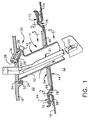
- Fig. 1 is a partial side elevation, in section, of a heat shield of the present invention mounted in a gas turbine engine;
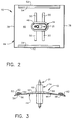
- Fig. 2 is a top plan view of the heat shield of Fig. 1;
- Fig. 3 is a rear elevation of the heat shield taken at line 3-3 of Fig. 1;
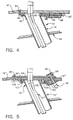
- Fig. 4 is an alternate embodiment of the heat shield of the present invention;
- Fig. 5 is another alternate embodiment of the heat shield of the present invention; and
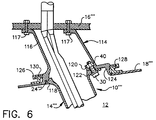
- Fig. 6 is another alternate embodiment of the heat shield of the present invention.
- As shown in Figs. 1 and 2, the heat shield of the present invention, generally designated 10, is positioned in the
augmentor 12 of a gas turbine engine of a type similar to that described in U.S. Patent No. 4,813,229, the disclosure of which is incorporated herein by reference. The heat shield includes ahousing 14 which is attached to theouter duct wall 16 and extends through thediffuser wall 18. Theouter duct wall 16 anddiffuser wall 18 between them define abypass duct 20 of conventional design for conveying cooling bypass air rearwardly from the core engine. - The
housing 14 has an oval, aerodynamic shape in cross-section (see Fig. 2), and is elongated in shape in elevation and encloses a substantially radially-inwardly extendingfuel tube assembly 21 which also passes through theouter duct wall 16 anddiffuser wall 18. The housing includes a forward-facingopening 22 which forms a scoop for conveying cooling air from thebypass duct 20 along the interior of thehousing 14. The housing includes elongated,oval openings 23, positioned along the lateral sides of the housing in registry with the side orifices of thefuel tube assembly 21. Theopenings 23 also allow cooling air to exit thehousing 14. The openings are oval so that relative thermal expansion of thehousing 14 will not result in the orifice of thefuel tube assembly 21 being blocked. - The
housing 14 is generally oval in cross-section and includes a forwardly extendingnose 24 and an aft end forming aboss 26 having abore 28 for receiving a threadedbolt 30, which may be a self-retaining bolt. Theouter duct wall 16 includes alip 32 forming aslot 34 shaped to receive thenose 24. Theouter duct wall 16 includes aboss 36 forming abore 38 shaped to receive anut 40 in a press fit. Thebores outer duct wall 16 such that tightening thebolt 30 forces thenose 24 into theslot 34. Thebolt 30 includes acap 42 which is seated on theboss 26 and clamps the boss and housing against theouter duct wall 16 when tightened. - As shown in Figs. 1, 2 and 3, the
heat shield 10 includes a diffuser flowpath segment, generally designated 44. Thediffuser flowpath segment 44 includes a substantially rectangulararcuate base plate 46 of sheet metal which is attached to thehousing 14. Thebase plate 46 includes a raisedcollar 48 and a plurality ofsplayed ribs 50 extending outwardly from the collar. Theribs 50 act to stiffen thebase plate 46 and change its vibration characteristics. Theribs 50 shown are sufficient to change the vibration characteristics of thebase plate 46 such that the first natural frequency of the base plate is above the highest engine speed. In practice, this would require that the natural frequency of the base plate exceed about 166 hz, since engine speed typically reaches 10,000 rpm. - As shown in Fig. 3, the axially-extending
longitudinal edges 52 of thebase plate 46 include raisedribs 54 formingslots 56. Theslots 56 receive longitudinally extendingspline seals 58 such thatadjacent base plates base plate 46 byspline seals 58. The joints thus formed provide an air seal. In a preferred embodiment of the invention, there are approximately 32-36heat shields 10 arranged in spoke fashion about thefuel pipes 22 of the augmentor 12 (Fig. 1). With this configuration, thediffuser flowpath segments 44 form a continuous ring and an extension of thediffuser wall 18. Spline seals 58 can be inserted laterally intoslots 56 as theshields 10 are being installed for the first time. When ashield 10 is replaced and is abutted by adjacent shields, thespline 58 may be inserted into a slot through the aft leaf spring, as will be described below. - As shown in Fig. 1, the
diffuser wall 18 includes aleaf seal 64 which forms a seal between the diffuser flowpath segment and a contiguous portion of thediffuser wall 18. Eachleaf seal 64 includes abase member 66 welded or brazed to an outer surface of thediffuser wall 18 and having a generally U-shape. A plurality ofleaf elements 68 are mounted on thebase portion 66 byrivets 70. A secondleaf spring assembly 72 is mounted on a continuation of 74 of thediffuser wall 18 and forms a seal between the rearwardtransverse edge 76 of thebase plate 46. The rearwardtransverse edge 76 and forwardtransverse edge 78 are slightly upturned to avoid projecting into theaugmentor volume 12 and creating undesirable turbulence in the augmentor. - As shown in Fig. 4, in an alternate embodiment of the heat shield 10', the housing 14' includes a flared, frustoconical
upper end 80 which abuts the outer duct wall 16'. The front end of theupper end 80 is received within a wedge-shaped forward block 82 which is mounted on the wall 16' by a nut andbolt combination 84. The rear portion of the frustoconicalupper end 80 is engaged by a wedge-shapedcam 86 mounted on the end of a mounting bolt 30' which is threaded through aboss 88 mounted on the wall 16'. Theboss 88 includes an axially-extendingguideway 90 which maintains proper orientation of thecam 86 relative to theupper end 80 and further, prevents deflection of thecam 86 away from the wall 16'. - Accordingly, the housing 14' is mounted on the outer duct wall 16' by tightening the bolt 30' against the
boss 88. This causes thecam 86 to jam against the aft portion of the frustoconicalupper end 80 of the housing 14', which also urges theforward portion 80 against theblock 82. Additional lateral support is effected by the inter-engagement of thediffuser flowpath segments 44 on the housings 14' of an array of heat shields 10'. - Another alternate embodiment of the heat shield 10'' is shown in Fig. 5. In that embodiment, the outer duct wall 16'' includes an
opening 92 which receives afuel tube header 94 which is integral with the fuel tube 21''. The forward end of theheader 94 is attached to the duct wall 16'' by a nut andbolt combination 96, and the aft end includes aboss 98 which receives anut 40 in a press fit. Thebolt 30 is threaded into thenut 40 and carries alug 100 having aforward lip 102 which engages in anaft extending flange 104 formed on the housing 14''. The outer duct wall 16'' includes aradially extending bead 106 which engages in undercut down theflange 104. - The housing 14'' includes a forwardly projecting
nose 108 which is received within aslot 110 formed by alip 112 projecting radially inwardly from theheader 94. The heat shield 14'' is attached to theheader 94 by inserting thenose 108 within theslot 110, then threading thebolt 30 into thenut 40, which causes thelug 100 to clamp against the flanged 104. Thebolt 30 also clamps theheader 94 against the outer duct wall 16''. - Another embodiment of the heat shield 10''' is shown in Fig. 6. In that embodiment, the outer duct 16''' includes a
strut 114 having abody 116 which is attached to the duct 16''' bybolts 117 and includes, at its radially-inner end, aslot 118 at a forward end and aboss 120 at a rearward end which receives anut 40. Thestrut 114 includes an opening 22''' for directing cooling air frombypass duct 20 radially inwardly throughstrut 114 and housing 14'''. The housing 14''' of the heat shield 10''' includes a forwardly projecting nose 24''', which engages theslot 118 at a forward end, and aflange 122 at an aft end which receives thebolt 30 therethrough. - The end of the
strut 114 is aligned with but not rigidly connected to the diffuser wall 18''', and includes an offset 124 which receives thebolt 30 so that the bolt does not project radially inwardly into theaugmentor volume 12. Aflange 126 is mounted on the outer surface of the diffuser wall 18''' and includes a rearwardly-opening slot 128. Anoval seal ring 130 is inserted in theslot 128 and is captured by the strut. In assembly, the strut is inserted through thering 130 and bolted to the outer duct wall 16''' bybolts 117. - In each of the foregoing embodiments, the heat shield has been attached to supporting structure in such a manner that it can be removed easily and quickly from within the augmentor volume. In each case, the attachment and removal procedure requires only the tightening down or backing off of a single mounting bolt for each shield. The
bolt 30 may be accessed by a suitably long-shanked tool inserted through a hole (not shown) in the diffuser wall continuation 74, through theaft leaf spring 72 or through a VABI as described in copending application filed , Serial No. (attorney docket 13DV-10484), the disclosure of which is incorporated herein by reference. Also, when installing theheat shields 14 the first time, it is a simple matter for one to reach around the openlongitudinal edge 52 to accessbolt 30. - It should also be noted that the attachment structure for the heat shield can be applied to other structures within the exhaust system without departing from the scope of the invention. For example, the attachment mechanism can be employed to mount a flame holder of the type disclosed in the aforementioned Gastebois U.S. Patent No. 4,899,539, as well as Grant, Jr. U.S. Patent No. 4,989,407. The disclosures of which are incorporated herein by reference.
- While the forms of apparatus herein described constitute preferred embodiments of this invention, it is to be understood that the invention is not limited to these precise forms of apparatus and that changes may be made therein without departing from the scope of the invention claimed.
Claims (20)
- In a gas turbine engine of a type having an augmentor aft of an engine core, said augmentor including at least one substantially radially-extending fuel pipe and a substantially cylindrical diffuser wall, and a generally cylindrical bypass duct for conveying cooling air to said augmentor, said duct including an outer duct wall through which said fuel pipe extends, a heat shield comprising:
a hollow, elongate housing enclosing said fuel pipe substantially entirely along its length; and
means for removably mounting said housing on said outer duct wall, said mounting means permitting removal of said housing by access from within said augmentor. - The heat shield of claim 1 wherein said mounting means includes bolt means threaded substantially radially outwardly into said outer duct wall.
- The shield of claim 2 wherein said mounting means includes a nose projecting outwardly from said housing; and said outer duct wall includes slot means for receiving said nose.
- The heat shield of claim 3 wherein said housing is retained by engagement of said nose and said slot at a forward end of said housing and by said bolt means at an aft end of said housing.
- The heat shield of claim 2 wherein said bolt means includes lug means shaped to engage said housing and clamp said housing against said outer duct wall when said bolt means is tightened.
- The heat shield of claim 5 wherein said housing includes a rearwardly-projecting flange shaped to be engaged by said lug means.
- The heat shield of claim 6 wherein said outer duct wall includes a radially inwardly projecting lip; and said flange includes a recess shaped to receive said lip.
- The heat shield of claim 2 wherein said housing includes a frustoconical portion at radially outer end thereof; and said outer duct wall includes a complementary wedge-shaped recess; and said bolt means includes a wedge-shaped cam at an end thereof, said cam being shaped to engage and lock said frustoconical portion against said wedge-shaped recess.
- The heat shield of claim 8 wherein said bolt means includes a threaded boss, attached to said outer duct wall and including a guideway for said block.
- The heat shield of claim 3 wherein said outer duct wall includes a substantially cylindrical strut enclosing a radially outer portion of said fuel pipe and extending from said outer duct wall to said diffuser wall; and said mounting means attaches said housing to said strut.
- The heat shield of claim 10 wherein said slot is formed in an end of said strut; and said housing includes a flange receiving said bolt means therethrough.
- The heat shield of claim 1 wherein said housing includes diffuser flowpath segment means aligned substantially with said diffuser wall in said augmentor.
- The heat shield of claim 12 herein said diffuser flowpath segment means includes stiffener means for changing vibration characteristics of said diffuser flowpath segment means such that a natural frequency thereof is greater than an engine operating speed.
- The heat shield of claim 12 wherein said diffuser flowpath segment means includes opposing, axially-extending lateral edges, said lateral edges defining longitudinal slots.
- The heat shield of claim 14 further comprising a plurality of housings arranged in a spoke pattern such that said lateral edges adjacent ones of said diffuser flowpath segment means abut each other; and said flowpath segment means includes spline seal segment means, mounted in said longitudinal slots, for effecting a seal between said diffuser flowpath segments.
- The heat shield of claim 12 wherein said diffuser flowpath segment means includes a forward transverse edge, and a contiguous portion of said diffuser includes means for effecting a seal between said portion and said transverse edge.
- The heat shield of claim 16 wherein said seal means includes a leaf seal.
- The heat shield of claim 17 wherein said leaf seal includes a resilient base portion mounted on a radially outer surface of said contiguous portion; and a resilient leaf portion, attached to said base portion and contacting a radially outer surface of said diffuser flowpath segment adjacent to said transverse edge.
- The heat shield of claim 1 wherein said housing includes a plurality of lateral openings positioned in registry with said orifices in said fuel pipe.
- The heat shield of claim 1 wherein said housing includes an opening, positioned between said outer duct wall and said diffuser wall, for receiving cooling air from said bypass duct and conveying said cooling air radially inwardly along said housing.
Applications Claiming Priority (2)
| Application Number | Priority Date | Filing Date | Title |
|---|---|---|---|
| US81600092A | 1992-01-02 | 1992-01-02 | |
| US816000 | 1992-01-02 |
Publications (1)
| Publication Number | Publication Date |
|---|---|
| EP0550126A1 true EP0550126A1 (en) | 1993-07-07 |
Family
ID=25219406
Family Applications (1)
| Application Number | Title | Priority Date | Filing Date |
|---|---|---|---|
| EP92307914A Withdrawn EP0550126A1 (en) | 1992-01-02 | 1992-09-01 | Thrust augmentor heat shield |
Country Status (3)
| Country | Link |
|---|---|
| US (1) | US5335490A (en) |
| EP (1) | EP0550126A1 (en) |
| JP (1) | JPH05231176A (en) |
Cited By (8)
| Publication number | Priority date | Publication date | Assignee | Title |
|---|---|---|---|---|
| EP0713057A1 (en) * | 1994-11-16 | 1996-05-22 | ROLLS-ROYCE plc | High temperature mounting |
| WO1999054597A1 (en) * | 1998-04-21 | 1999-10-28 | Siemens Aktiengesellschaft | Turbine blade |
| US6887040B2 (en) | 2001-09-12 | 2005-05-03 | Siemens Aktiengesellschaft | Turbine blade/vane |
| EP1840364A1 (en) * | 2006-03-30 | 2007-10-03 | Snecma | Device for installing a flow-separating wall in the afterburner of a jet engine. |
| EP1840471A2 (en) | 2006-03-31 | 2007-10-03 | ALSTOM Technology Ltd | Device for fastening a sequentially operated burner in a gas turbine arrangement |
| EP2058476A1 (en) | 2007-11-09 | 2009-05-13 | Snecma | Connection of radial struts to a circular casing by interleaving inserts |
| WO2009127203A1 (en) * | 2008-04-17 | 2009-10-22 | Mtu Aero Engines Gmbh | Strut for an intermediate turbine housing, intermediate turbine housing, and method for producing an intermediate turbine housing |
| WO2014105573A1 (en) * | 2012-12-29 | 2014-07-03 | United Technologies Corporation | Heat shield based air dam for a turbine exhaust case |
Families Citing this family (47)
| Publication number | Priority date | Publication date | Assignee | Title |
|---|---|---|---|---|
| FR2708086B1 (en) * | 1993-06-30 | 1995-09-01 | Snecma | Sectorized tubular structure working on implosion. |
| US5396763A (en) * | 1994-04-25 | 1995-03-14 | General Electric Company | Cooled spraybar and flameholder assembly including a perforated hollow inner air baffle for impingement cooling an outer heat shield |
| US5560198A (en) * | 1995-05-25 | 1996-10-01 | United Technologies Corporation | Cooled gas turbine engine augmentor fingerseal assembly |
| US6141968A (en) * | 1997-10-29 | 2000-11-07 | Pratt & Whitney Canada Corp. | Fuel nozzle for gas turbine engine with slotted fuel conduits and cover |
| US6125627A (en) | 1998-08-11 | 2000-10-03 | Allison Advanced Development Company | Method and apparatus for spraying fuel within a gas turbine engine |
| US6553769B2 (en) * | 1998-12-16 | 2003-04-29 | General Electric Company | Method for providing concentricity of pilot fuel assembly in a combustor |
| US6286298B1 (en) * | 1998-12-18 | 2001-09-11 | General Electric Company | Apparatus and method for rich-quench-lean (RQL) concept in a gas turbine engine combustor having trapped vortex cavity |
| US6295801B1 (en) * | 1998-12-18 | 2001-10-02 | General Electric Company | Fuel injector bar for gas turbine engine combustor having trapped vortex cavity |
| US6438940B1 (en) * | 1999-12-21 | 2002-08-27 | General Electric Company | Methods and apparatus for providing uniform ignition in an augmenter |
| US6540162B1 (en) * | 2000-06-28 | 2003-04-01 | General Electric Company | Methods and apparatus for decreasing combustor emissions with spray bar assembly |
| US6463739B1 (en) | 2001-02-05 | 2002-10-15 | General Electric Company | Afterburner heat shield |
| US6415609B1 (en) * | 2001-03-15 | 2002-07-09 | General Electric Company | Replaceable afterburner heat shield |
| TW591372B (en) * | 2003-05-15 | 2004-06-11 | High Tech Comp Corp | Power control method of portable electronic device, portable electronic device and electronic system |
| US7415828B2 (en) * | 2003-05-29 | 2008-08-26 | Pratt & Whitney Canada Corp. | Fuel nozzle sheath retention ring |
| FR2869954B1 (en) * | 2004-05-05 | 2006-06-16 | Snecma Moteurs Sa | DEVICE FOR FIXING A BURNER RING IN A POSTCOMBUSTION CHAMBER OF A TURBOJETACTOR |
| US6983601B2 (en) * | 2004-05-28 | 2006-01-10 | General Electric Company | Method and apparatus for gas turbine engines |
| US7229249B2 (en) * | 2004-08-27 | 2007-06-12 | Pratt & Whitney Canada Corp. | Lightweight annular interturbine duct |
| FR2875855B1 (en) * | 2004-09-27 | 2006-12-22 | Snecma Moteurs Sa | TURBOREACTOR WITH A MONOBLOC SERVITUDE CONNECTION ARM AND THE MONOBLOC SERVITUDE CONNECTION ARM |
| US7464536B2 (en) * | 2005-07-07 | 2008-12-16 | General Electric Company | Methods and apparatus for assembling gas turbine engines |
| US7596950B2 (en) * | 2005-09-16 | 2009-10-06 | General Electric Company | Augmentor radial fuel spray bar with counterswirling heat shield |
| US20070193272A1 (en) * | 2006-02-21 | 2007-08-23 | Woodward Fst, Inc. | Gas turbine engine fuel injector |
| US7909570B2 (en) * | 2006-08-25 | 2011-03-22 | Pratt & Whitney Canada Corp. | Interturbine duct with integrated baffle and seal |
| MX2009006034A (en) | 2006-12-07 | 2009-10-12 | Novartis Ag | Antagonist antibodies against ephb3. |
| US8196410B2 (en) * | 2007-05-18 | 2012-06-12 | Pratt & Whitney Canada Corp. | Stress reduction feature to improve fuel nozzle sheath durability |
| DE102008028025B4 (en) * | 2008-06-12 | 2011-05-05 | Siemens Aktiengesellschaft | Heat shield arrangement |
| US8069648B2 (en) * | 2008-07-03 | 2011-12-06 | United Technologies Corporation | Impingement cooling for turbofan exhaust assembly |
| US20100162714A1 (en) * | 2008-12-31 | 2010-07-01 | Edward Claude Rice | Fuel nozzle with swirler vanes |
| US8393154B2 (en) * | 2009-02-12 | 2013-03-12 | Pratt & Whitney Canada Corp. | Fuel delivery system with reduced heat transfer to fuel manifold seal |
| US8596959B2 (en) * | 2009-10-09 | 2013-12-03 | Pratt & Whitney Canada Corp. | Oil tube with integrated heat shield |
| US8844643B2 (en) | 2011-03-08 | 2014-09-30 | Honeywell International Inc. | Fireproof systems with local heat shields for aircraft engines |
| US20130199191A1 (en) * | 2011-06-10 | 2013-08-08 | Matthew D. Tyler | Fuel injector with increased feed area |
| US9638422B2 (en) * | 2012-06-22 | 2017-05-02 | Delavan Inc. | Active purge mechanism with backflow preventer for gas turbine fuel injectors |
| US9470151B2 (en) | 2012-12-21 | 2016-10-18 | United Technologies Corporation | Alignment system and methodology to account for variation in a gas turbine engine |
| US9863261B2 (en) | 2012-12-29 | 2018-01-09 | United Technologies Corporation | Component retention with probe |
| FR3012514B1 (en) * | 2013-10-31 | 2015-12-25 | Airbus Operations Sas | THERMAL PROTECTION DEVICE FOR EQUIPMENT IN A TURBOMACHINE ENGINE COMPARTMENT |
| US9879606B2 (en) | 2014-07-28 | 2018-01-30 | Pratt & Whitney Canada Corp. | Method of supplying fuel to an internal fuel manifold |
| US9869204B2 (en) * | 2015-03-06 | 2018-01-16 | United Technologies Corporation | Integrated inner case heat shield |
| CN105841193B (en) * | 2016-05-18 | 2018-07-20 | 葛明龙 | Two kinds of aerospace fanjets |
| US11230995B2 (en) * | 2017-11-08 | 2022-01-25 | Raytheon Technologies Corporation | Cable conduit for turbine engine bypass |
| CN112204227B (en) * | 2018-06-07 | 2023-04-28 | 西门子能源全球两合公司 | Exhaust gas device for a gas turbine and method for repairing a gas turbine |
| US11725529B2 (en) * | 2019-02-08 | 2023-08-15 | Raytheon Technologies Corporation | Fluid transfer assembly for rotational equipment |
| JP7419002B2 (en) * | 2019-09-12 | 2024-01-22 | 三菱重工業株式会社 | Strut cover, exhaust casing and gas turbine |
| GB202006964D0 (en) | 2020-05-12 | 2020-06-24 | Rolls Royce Plc | Afterburner strut with integrated fueld feed lines |
| US11702946B1 (en) * | 2022-07-13 | 2023-07-18 | Pratt & Whitney Canada Corp. | Service tube locking device |
| CN115992776B (en) * | 2023-03-23 | 2023-06-02 | 中国航发沈阳发动机研究所 | Rear thrust increasing component of engine turbine |
| US12345169B2 (en) * | 2023-08-09 | 2025-07-01 | Rtx Corporation | Thermally compliant forward outer-diameter ring for a gas turbine engine |
| GB2643904A (en) * | 2024-09-06 | 2026-03-11 | Rolls Royce Plc | Reheat assembly for a gas turbine engine |
Citations (10)
| Publication number | Priority date | Publication date | Assignee | Title |
|---|---|---|---|---|
| US2766963A (en) * | 1952-11-01 | 1956-10-16 | Gen Motors Corp | Turbine stator assembly |
| US2861424A (en) * | 1954-04-09 | 1958-11-25 | Douglas Aircraft Co Inc | Fuel supply means for combustion apparatus |
| FR2330867A1 (en) * | 1975-11-04 | 1977-06-03 | Gen Electric | REMOVABLE FLAME STABILIZER |
| FR2482661A1 (en) * | 1980-05-16 | 1981-11-20 | United Technologies Corp | FLOW DIRECTOR ASSEMBLY FOR A GAS TURBINE |
| EP0328813A1 (en) * | 1988-02-18 | 1989-08-23 | General Electric Company | Flame holder mount for gas turbine engine |
| FR2636378A1 (en) * | 1988-09-14 | 1990-03-16 | Snecma | Bypass turbojet blower nozzle guide vane |
| GB2226086A (en) * | 1988-12-14 | 1990-06-20 | Gen Electric | Gas turbine engine frame |
| EP0387123A1 (en) * | 1989-03-08 | 1990-09-12 | Societe Nationale D'etude Et De Construction De Moteurs D'aviation "Snecma" | Thermic protection liner for hot pipe of turbo-jet engine |
| DE4033678A1 (en) * | 1989-10-24 | 1991-04-25 | United Technologies Corp | SHEATHING HOLDER FOR BLADES OF GAS TURBINES |
| FR2660362A1 (en) * | 1990-04-03 | 1991-10-04 | Gen Electric | STRUCTURE FOR FIXING THE EXTERIOR EXTERMENTS OF THE BLADES OF A TURBINE. |
Family Cites Families (15)
| Publication number | Priority date | Publication date | Assignee | Title |
|---|---|---|---|---|
| US3646763A (en) * | 1970-05-25 | 1972-03-07 | Gen Electric | Gas turbine engine with improved afterburner |
| US3780529A (en) * | 1971-08-05 | 1973-12-25 | Gen Motors Corp | Combustion apparatus |
| BE795529A (en) * | 1972-02-17 | 1973-06-18 | Gen Electric | IGNITER MOUNTED ON A TURBOREACTOR THRUST INCREASING DEVICE AND AIR COOLED |
| US3879940A (en) * | 1973-07-30 | 1975-04-29 | Gen Electric | Gas turbine engine fuel delivery tube assembly |
| US4312185A (en) * | 1980-02-19 | 1982-01-26 | General Electric Company | Low profile fuel injection system |
| US4426191A (en) * | 1980-05-16 | 1984-01-17 | United Technologies Corporation | Flow directing assembly for a gas turbine engine |
| US4431373A (en) * | 1980-05-16 | 1984-02-14 | United Technologies Corporation | Flow directing assembly for a gas turbine engine |
| FR2588920B1 (en) * | 1985-10-23 | 1987-12-04 | Snecma | POSTCOMBUSTION TURBOREACTOR WITH INDIVIDUAL RADIAL POSTCOMBUSTION INJECTORS |
| US4751815A (en) * | 1986-08-29 | 1988-06-21 | United Technologies Corporation | Liquid fuel spraybar |
| US4989407A (en) * | 1986-08-29 | 1991-02-05 | United Technologies Corporation | Thrust augmentor flameholder |
| US4706453A (en) * | 1986-11-12 | 1987-11-17 | General Motors Corporation | Support and seal assembly |
| FR2626044A1 (en) * | 1988-01-14 | 1989-07-21 | Snecma | VARIABLE SECTION FLUX MIXER WITH INTEGRATED HEATING STABILIZER FOR DOUBLE FLOW TURBOJETACTOR |
| US5022805A (en) * | 1989-02-16 | 1991-06-11 | Rolls-Royce Incorporated | Cantilever mounting system for structural members having dissimilar coefficients of thermal expansion |
| FR2646880A1 (en) * | 1989-05-11 | 1990-11-16 | Snecma | THERMAL PROTECTION SHIRT FOR POST-COMBUSTION CHANNEL OR TRANSITION OF TURBOREACTOR |
| US5031407A (en) * | 1989-06-06 | 1991-07-16 | Allied-Signal Inc. | Apparatus for use in a fuel delivery system for a gas turbine engine |
-
1992
- 1992-09-01 EP EP92307914A patent/EP0550126A1/en not_active Withdrawn
- 1992-09-02 JP JP4234626A patent/JPH05231176A/en active Pending
-
1993
- 1993-06-30 US US08/084,886 patent/US5335490A/en not_active Expired - Lifetime
Patent Citations (10)
| Publication number | Priority date | Publication date | Assignee | Title |
|---|---|---|---|---|
| US2766963A (en) * | 1952-11-01 | 1956-10-16 | Gen Motors Corp | Turbine stator assembly |
| US2861424A (en) * | 1954-04-09 | 1958-11-25 | Douglas Aircraft Co Inc | Fuel supply means for combustion apparatus |
| FR2330867A1 (en) * | 1975-11-04 | 1977-06-03 | Gen Electric | REMOVABLE FLAME STABILIZER |
| FR2482661A1 (en) * | 1980-05-16 | 1981-11-20 | United Technologies Corp | FLOW DIRECTOR ASSEMBLY FOR A GAS TURBINE |
| EP0328813A1 (en) * | 1988-02-18 | 1989-08-23 | General Electric Company | Flame holder mount for gas turbine engine |
| FR2636378A1 (en) * | 1988-09-14 | 1990-03-16 | Snecma | Bypass turbojet blower nozzle guide vane |
| GB2226086A (en) * | 1988-12-14 | 1990-06-20 | Gen Electric | Gas turbine engine frame |
| EP0387123A1 (en) * | 1989-03-08 | 1990-09-12 | Societe Nationale D'etude Et De Construction De Moteurs D'aviation "Snecma" | Thermic protection liner for hot pipe of turbo-jet engine |
| DE4033678A1 (en) * | 1989-10-24 | 1991-04-25 | United Technologies Corp | SHEATHING HOLDER FOR BLADES OF GAS TURBINES |
| FR2660362A1 (en) * | 1990-04-03 | 1991-10-04 | Gen Electric | STRUCTURE FOR FIXING THE EXTERIOR EXTERMENTS OF THE BLADES OF A TURBINE. |
Cited By (21)
| Publication number | Priority date | Publication date | Assignee | Title |
|---|---|---|---|---|
| EP0713057A1 (en) * | 1994-11-16 | 1996-05-22 | ROLLS-ROYCE plc | High temperature mounting |
| WO1999054597A1 (en) * | 1998-04-21 | 1999-10-28 | Siemens Aktiengesellschaft | Turbine blade |
| US6533544B1 (en) | 1998-04-21 | 2003-03-18 | Siemens Aktiengesellschaft | Turbine blade |
| US6887040B2 (en) | 2001-09-12 | 2005-05-03 | Siemens Aktiengesellschaft | Turbine blade/vane |
| EP1840364A1 (en) * | 2006-03-30 | 2007-10-03 | Snecma | Device for installing a flow-separating wall in the afterburner of a jet engine. |
| US7908868B2 (en) | 2006-03-30 | 2011-03-22 | Snecma | Device for mounting an air-flow dividing wall in a turbojet engine afterburner |
| FR2899280A1 (en) * | 2006-03-30 | 2007-10-05 | Snecma Sa | DEVICE FOR MOUNTING A FLOW SEPARATION WALL IN A POST-COMBUSTION CHAMBER OF A TURBOREACTOR |
| RU2406033C2 (en) * | 2006-03-30 | 2010-12-10 | Снекма | Afterburner of double-flow jet turbine engine, double-flow jet turbine engine and bracket of flame stabiliser for afterburner |
| EP2077421A2 (en) | 2006-03-31 | 2009-07-08 | ALSTOM Technology Ltd | Device for fastening a sequentially operated burner in a gas turbine arrangement |
| EP2077421A3 (en) * | 2006-03-31 | 2009-07-15 | ALSTOM Technology Ltd | Device for fastening a sequentially operated burner in a gas turbine arrangement |
| EP1840471A3 (en) * | 2006-03-31 | 2008-02-20 | ALSTOM Technology Ltd | Device for fastening a sequentially operated burner in a gas turbine arrangement |
| EP1840471A2 (en) | 2006-03-31 | 2007-10-03 | ALSTOM Technology Ltd | Device for fastening a sequentially operated burner in a gas turbine arrangement |
| US7937950B2 (en) | 2006-03-31 | 2011-05-10 | Alstom Technology Ltd. | Device for fastening a sequentially operated burner in a gas turbine arrangement |
| FR2923529A1 (en) * | 2007-11-09 | 2009-05-15 | Snecma Sa | CONNECTION OF RADIAL ARMS TO A CIRCULAR VIROLE BY ILLUMINATION OF REPORTED PARTS |
| EP2058476A1 (en) | 2007-11-09 | 2009-05-13 | Snecma | Connection of radial struts to a circular casing by interleaving inserts |
| US8303246B2 (en) | 2007-11-09 | 2012-11-06 | Snecma | Connecting radial arms to a circular ferrule by imbricating attached parts |
| RU2492331C2 (en) * | 2007-11-09 | 2013-09-10 | Снекма | Device to connect radial brackets with round ring and turbomachine |
| WO2009127203A1 (en) * | 2008-04-17 | 2009-10-22 | Mtu Aero Engines Gmbh | Strut for an intermediate turbine housing, intermediate turbine housing, and method for producing an intermediate turbine housing |
| US8579583B2 (en) | 2008-04-17 | 2013-11-12 | MTU Aero Engines AG | Strut for an intermediate turbine housing, intermediate turbine housing, and method for producing an intermediate turbine housing |
| WO2014105573A1 (en) * | 2012-12-29 | 2014-07-03 | United Technologies Corporation | Heat shield based air dam for a turbine exhaust case |
| US9976442B2 (en) | 2012-12-29 | 2018-05-22 | United Technologies Corporation | Heat shield based air dam for a turbine exhaust case |
Also Published As
| Publication number | Publication date |
|---|---|
| US5335490A (en) | 1994-08-09 |
| JPH05231176A (en) | 1993-09-07 |
Similar Documents
| Publication | Publication Date | Title |
|---|---|---|
| US5335490A (en) | Thrust augmentor heat shield | |
| EP1229290B1 (en) | Support strut for supporting an afterburner heat shield | |
| EP2312217B1 (en) | Combustor for a gas turbine | |
| US6449952B1 (en) | Removable cowl for gas turbine combustor | |
| EP0328813B1 (en) | Flame holder mount for gas turbine engine | |
| US5524430A (en) | Gas-turbine engine with detachable combustion chamber | |
| US8205336B2 (en) | Method for manufacturing a combustor heat shield | |
| EP0797747B1 (en) | Bulkhead cooling fairing | |
| EP0187731A1 (en) | Combustion liner for a gas turbine engine | |
| US5396763A (en) | Cooled spraybar and flameholder assembly including a perforated hollow inner air baffle for impingement cooling an outer heat shield | |
| GB2252152A (en) | Combustor dome of a gas turbine engine | |
| JPH04227413A (en) | Combustion-apparatus dome assembly | |
| JP3998494B2 (en) | Replaceable afterburner heat shield | |
| EP1640565B1 (en) | Swirl-enhanced aerodynamic fastener shield for turbomachine | |
| EP3760927A1 (en) | Combustor floating collar mounting arrangement | |
| AU674727B2 (en) | Removable afterburner flameholder | |
| US4487015A (en) | Mounting arrangements for combustion equipment | |
| CA2451303A1 (en) | Methods for replacing combustor liners | |
| JP3697093B2 (en) | Gas turbine combustor | |
| JPH0674756B2 (en) | Seal device |
Legal Events
| Date | Code | Title | Description |
|---|---|---|---|
| PUAI | Public reference made under article 153(3) epc to a published international application that has entered the european phase |
Free format text: ORIGINAL CODE: 0009012 |
|
| AK | Designated contracting states |
Kind code of ref document: A1 Designated state(s): DE FR GB |
|
| STAA | Information on the status of an ep patent application or granted ep patent |
Free format text: STATUS: THE APPLICATION IS DEEMED TO BE WITHDRAWN |
|
| 18D | Application deemed to be withdrawn |
Effective date: 19940108 |