EP0557597A1 - Thermisches und akustisches Isolierlaminat - Google Patents
Thermisches und akustisches Isolierlaminat Download PDFInfo
- Publication number
- EP0557597A1 EP0557597A1 EP92120569A EP92120569A EP0557597A1 EP 0557597 A1 EP0557597 A1 EP 0557597A1 EP 92120569 A EP92120569 A EP 92120569A EP 92120569 A EP92120569 A EP 92120569A EP 0557597 A1 EP0557597 A1 EP 0557597A1
- Authority
- EP
- European Patent Office
- Prior art keywords
- aluminum
- insulating laminate
- foils
- laminate according
- layer
- Prior art date
- Legal status (The legal status is an assumption and is not a legal conclusion. Google has not performed a legal analysis and makes no representation as to the accuracy of the status listed.)
- Granted
Links
Images
Classifications
-
- B—PERFORMING OPERATIONS; TRANSPORTING
- B32—LAYERED PRODUCTS
- B32B—LAYERED PRODUCTS, i.e. PRODUCTS BUILT-UP OF STRATA OF FLAT OR NON-FLAT, e.g. CELLULAR OR HONEYCOMB, FORM
- B32B15/00—Layered products comprising a layer of metal
- B32B15/20—Layered products comprising a layer of metal comprising aluminium or copper
-
- B—PERFORMING OPERATIONS; TRANSPORTING
- B32—LAYERED PRODUCTS
- B32B—LAYERED PRODUCTS, i.e. PRODUCTS BUILT-UP OF STRATA OF FLAT OR NON-FLAT, e.g. CELLULAR OR HONEYCOMB, FORM
- B32B3/00—Layered products comprising a layer with external or internal discontinuities or unevennesses, or a layer of non-planar shape; Layered products comprising a layer having particular features of form
- B32B3/26—Layered products comprising a layer with external or internal discontinuities or unevennesses, or a layer of non-planar shape; Layered products comprising a layer having particular features of form characterised by a particular shape of the outline of the cross-section of a continuous layer; characterised by a layer with cavities or internal voids ; characterised by an apertured layer
- B32B3/28—Layered products comprising a layer with external or internal discontinuities or unevennesses, or a layer of non-planar shape; Layered products comprising a layer having particular features of form characterised by a particular shape of the outline of the cross-section of a continuous layer; characterised by a layer with cavities or internal voids ; characterised by an apertured layer characterised by a layer comprising a deformed thin sheet, i.e. the layer having its entire thickness deformed out of the plane, e.g. corrugated, crumpled
-
- B—PERFORMING OPERATIONS; TRANSPORTING
- B32—LAYERED PRODUCTS
- B32B—LAYERED PRODUCTS, i.e. PRODUCTS BUILT-UP OF STRATA OF FLAT OR NON-FLAT, e.g. CELLULAR OR HONEYCOMB, FORM
- B32B15/00—Layered products comprising a layer of metal
- B32B15/01—Layered products comprising a layer of metal all layers being exclusively metallic
- B32B15/016—Layered products comprising a layer of metal all layers being exclusively metallic all layers being formed of aluminium or aluminium alloys
-
- F—MECHANICAL ENGINEERING; LIGHTING; HEATING; WEAPONS; BLASTING
- F01—MACHINES OR ENGINES IN GENERAL; ENGINE PLANTS IN GENERAL; STEAM ENGINES
- F01N—GAS-FLOW SILENCERS OR EXHAUST APPARATUS FOR MACHINES OR ENGINES IN GENERAL; GAS-FLOW SILENCERS OR EXHAUST APPARATUS FOR INTERNAL-COMBUSTION ENGINES
- F01N13/00—Exhaust or silencing apparatus characterised by constructional features
- F01N13/14—Exhaust or silencing apparatus characterised by constructional features having thermal insulation
-
- F—MECHANICAL ENGINEERING; LIGHTING; HEATING; WEAPONS; BLASTING
- F16—ENGINEERING ELEMENTS AND UNITS; GENERAL MEASURES FOR PRODUCING AND MAINTAINING EFFECTIVE FUNCTIONING OF MACHINES OR INSTALLATIONS; THERMAL INSULATION IN GENERAL
- F16L—PIPES; JOINTS OR FITTINGS FOR PIPES; SUPPORTS FOR PIPES, CABLES OR PROTECTIVE TUBING; MEANS FOR THERMAL INSULATION IN GENERAL
- F16L59/00—Thermal insulation in general
- F16L59/02—Shape or form of insulating materials, with or without coverings integral with the insulating materials
- F16L59/029—Shape or form of insulating materials, with or without coverings integral with the insulating materials layered
-
- G—PHYSICS
- G10—MUSICAL INSTRUMENTS; ACOUSTICS
- G10K—SOUND-PRODUCING DEVICES; METHODS OR DEVICES FOR PROTECTING AGAINST, OR FOR DAMPING, NOISE OR OTHER ACOUSTIC WAVES IN GENERAL; ACOUSTICS NOT OTHERWISE PROVIDED FOR
- G10K11/00—Methods or devices for transmitting, conducting or directing sound in general; Methods or devices for protecting against, or for damping, noise or other acoustic waves in general
- G10K11/16—Methods or devices for protecting against, or for damping, noise or other acoustic waves in general
- G10K11/162—Selection of materials
- G10K11/168—Plural layers of different materials, e.g. sandwiches
-
- B—PERFORMING OPERATIONS; TRANSPORTING
- B32—LAYERED PRODUCTS
- B32B—LAYERED PRODUCTS, i.e. PRODUCTS BUILT-UP OF STRATA OF FLAT OR NON-FLAT, e.g. CELLULAR OR HONEYCOMB, FORM
- B32B2307/00—Properties of the layers or laminate
- B32B2307/10—Properties of the layers or laminate having particular acoustical properties
- B32B2307/102—Insulating
-
- B—PERFORMING OPERATIONS; TRANSPORTING
- B32—LAYERED PRODUCTS
- B32B—LAYERED PRODUCTS, i.e. PRODUCTS BUILT-UP OF STRATA OF FLAT OR NON-FLAT, e.g. CELLULAR OR HONEYCOMB, FORM
- B32B2307/00—Properties of the layers or laminate
- B32B2307/30—Properties of the layers or laminate having particular thermal properties
- B32B2307/304—Insulating
-
- B—PERFORMING OPERATIONS; TRANSPORTING
- B32—LAYERED PRODUCTS
- B32B—LAYERED PRODUCTS, i.e. PRODUCTS BUILT-UP OF STRATA OF FLAT OR NON-FLAT, e.g. CELLULAR OR HONEYCOMB, FORM
- B32B2311/00—Metals, their alloys or their compounds
- B32B2311/24—Aluminium
Definitions
- the invention relates to a thermal and acoustic insulating laminate with at least two layer-forming elements.
- Insulating materials for thermal and acoustic purposes have been used extensively for many years. Organic and inorganic materials, fibers, mats, braids, granules and the like are often used here. With the increased efforts to reduce energy consumption and contain noise sources, the demands on the insulating materials have also increased. In particular, it is expected that the insulating materials are inert, harmless to the environment and also recyclable. At the same time, however, expectations regarding insulation capability, service life, non-flammability and inexpensive production are increasing gone up.
- the object of the present invention is to provide an insulating material which overcomes the disadvantages of the known materials and, in particular, also satisfies the demands made at the outset.
- the object is achieved according to the invention with a thermal and acoustic insulating laminate with at least two layer-forming elements, in that only aluminum foils are included as layer-forming elements, in that at least one of the foils has a thickness of ⁇ 20 ⁇ m, and spacing elements are arranged between the layer-forming elements are, these spacer elements in turn consist only of aluminum and the contact area of each aluminum foil with the adjacent spacer element is 20% or less, based on the area of the aluminum foil.
- Customary or customarily produced aluminum foils can be used as the layer-forming aluminum foils. These are mostly foils made of unalloyed or weakly alloyed aluminum. For example, aluminum foils with aluminum contents of more than 99% by weight can be used. At least two aluminum foils are arranged essentially on parallel planes, for example at a distance of 2-10, preferably 3-8 mm. Foil packages with 3 or more layer-forming aluminum foils are possible. At least one of the layer-forming aluminum foils has a thickness of ⁇ 20 ⁇ m, the lower limit should not be ⁇ 10 ⁇ m for processing reasons. Films in the range of 15 - 20 ⁇ m have proven particularly useful.
- the contact area of the spacer elements, which also consist of aluminum, with the adjacent aluminum foil is, based on the foil surface, 20%, preferably smaller. Contact areas in the range of less than 15%, preferably between 4 and 10%, have proven particularly useful.
- an aluminum film can be used as the layer-forming aluminum film in accordance with the technical, in particular mechanical, requirements. So stronger aluminum carrier foils can be used.
- the use of foils with a thickness of 30-60 ⁇ m, in particular 35-50 ⁇ m has proven particularly useful if significantly thicker layer-forming foils, for example of up to 100 ⁇ m or up to 500 ⁇ m, cannot be excluded.
- Aluminum foils can be used as spacer elements, which are deformed to form elevations, projections and the like which protrude beyond their foil surface. These foils can e.g. pyramid, strip, hump and dome-like deformations.
- the films are preferably of such a thickness and of such a deformation that they have sufficient rigidity in the sense of maintaining the spacing function and the intended conditions of use.
- V-shaped profiled aluminum foil Spacers that are designed as a V-shaped profiled aluminum foil have proven particularly useful.
- the height of the V-like deformation of this bellows-like aluminum foil is usually between 2 and 6 mm, depending on the respectively expected or specified total thickness of the insulating laminate.
- the tip angle of the V-shaped profile is preferably between 60 and 95 °.
- V-shaped aluminum foils with sharp edges are used with particular advantage. It has also proven useful if the longitudinal edges formed by the V-shaped profile are interrupted by impressions, particularly in the area of the tips.
- Such a configuration has the particular advantage that the laminate can also be bent with relatively small radii, without the laminate thickness being significantly impaired, maintaining sufficient distances within the laminate also in the curvature areas is advantageous for thermal and acoustic reasons.
- Insulating laminates of the type according to the invention have proven particularly useful, in which two bellows-like V-shaped aluminum foils are provided, which are arranged at an angle to one another, based on the profile profile. Particularly when the angles approach 90 °, this makes it possible, in particular in cooperation with a sharp-edged profile, to only make point contact between the two spacer elements.
- the use of V-shaped aluminum foils allows a contact zone of less than 10% relative to foils such as the layer-forming elements, based on the total area of the layer-forming foil, while the total contact area between two V-shaped profiled, spaced aluminum foils is still clear is less.
- the aluminum foils provided as spacers are designed in terms of their thickness according to the expected load. Aluminum foils with a Thickness of 30 - 60 ⁇ m, especially 35 - 50 ⁇ m.
- further cavities e.g. known insulating materials or sound-breaking materials arranged.
- One or more of the aluminum foils present can be perforated.
- Perforated spacer elements e.g. proven very effective for acoustic insulation.
- the individual parts of the insulating laminate can be fixed in the usual way. This can be done, for example, by needling or quilting. B. with aluminum wire.
- the insulating laminates of the invention can be used for a variety of purposes, e.g. in construction, shipbuilding, but especially in aircraft and vehicle construction.
- the catalysts are the insulating laminates thanks to the low weight and the fact that they consist only or essentially only of aluminum with special Benefit usable.
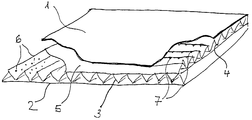
- It comprises two layer-forming aluminum foils 1 and 2, the aluminum foil 2 having a thickness of just under 20 ⁇ m, and crossed V-shaped spacing elements 3 and 4 and with a 20 ⁇ m aluminum foil 5, if present, as an intermediate layer. Possibly existing perforations 6 and impressions 7 are shown as examples.
Landscapes
- Engineering & Computer Science (AREA)
- General Engineering & Computer Science (AREA)
- Mechanical Engineering (AREA)
- Chemical & Material Sciences (AREA)
- Combustion & Propulsion (AREA)
- Physics & Mathematics (AREA)
- Acoustics & Sound (AREA)
- Multimedia (AREA)
- Thermal Insulation (AREA)
- Laminated Bodies (AREA)
- Soundproofing, Sound Blocking, And Sound Damping (AREA)
Abstract
Description
- Die Erfindung betrifft ein thermisches und akustisches Isolierlaminat mit mindestens zwei schichtbildenden Elementen.
- Isoliermaterialien für thermische und akustische Zwecke werden seit vielen Jahren in großem Umfang verwendet. Häufig finden hierbei organische und anorganische Materialien, Fasern, Matten, Geflechte, Granulate und dergleichen Verwendung. Mit den erhöhten Bestrebungen, den Energieverbrauch zu reduzieren und Lärmquellen einzudämmen, sind auch die Forderungen an die Isoliermaterialien gestiegen. Insbesondere wird erwartet, daß die Isoliermaterialien inert, Umwelt-unbedenklich und auch recyclebar sind. Gleichzeitig sind aber die Erwartungen an die Isolierfähigkeit, Standzeit, Nichtbrennbarkeit und kostengünstige Herstellung zunehmend gestiegen.
- Die nahezu zahllosen Vorschläge, die zur Schaffung von Isoliermaterialien bekannt geworden sind, zeigen, daß immer wieder mangelnde Eigenschaften in der ein oder anderen Richtung in Kauf genommen werden mußten, d.h. Verbesserungen in der einen Richtung durch Nachteile in einer anderen Richtung.
- Aufgabe der vorliegenden Erfindung ist es, ein Isoliermaterial zur Verfügung zu stellen, das die Nachteile der bekannten Materialien überwindet und namentlich auch die eingangs gestellten Forderungen befriedigt.
- Die Lösung der gestellten Aufgabe gelingt erfindungsgemäß bei einem thermischen und akustischen Isolierlaminat mit mindestens zwei schichtbildenden Elementen, dadurch, daß als schichtbildende Elemente ausschließlich Aluminiumfolien enthalten sind, daß mindestens eine der Folien eine Dicke von ≦ 20 µm aufweist, daß zwischen den schichtbildenden Elementen Abstandselemente angeordnet sind, diese Abstandselemente wiederum nur aus Aluminium bestehen und die Berührungsfläche einer jeden Aluminiumfolie mit dem benachbarten Abstandselement 20% oder kleiner, bezogen auf die Fläche der Aluminiumfolie, ist.
- Als schichtbildende Aluminiumfolien können übliche bzw. in üblicher Weise hergestellte Aluminiumfolien verwendet werden. Es handelt sich meist um Folien aus unlegiertem oder schwachlegiertem Aluminium. Verwendbar sind beispielsweise Aluminiumfolien mit Aluminiumgehalten von mehr als 99 Gew.-%. Mindestens zwei Aluminiumfolien sind im wesentlichen auf parallelen Ebenen, z.B. im Abstand von 2-10, vorzugsweise 3-8 mm angeordnet. Folienpakete mit 3 oder mehr schichtbildenden Aluminiumfolien sind möglich. Mindestens eine der schichtbildenden Aluminiumfolien hat eine Dicke von ≦ 20 µm, wobei die Untergrenze aus verarbeitungstechnischen Gründen nicht < 10 µm sein sollte. Folien im Bereich von 15 - 20 µm haben sich besonders bewährt. Die Berührungsfläche der ebenfalls aus Aluminium bestehenden Abstandselemente mit der benachbarten Aluminiumfolie ist, bezogen auf die Folienfläche, 20%, vorzugsweise kleiner. Besonders bewährt haben sich Berührungsflächen im Bereich von unter 15 %, vorzugsweise zwischen 4 und 10%. Als schichtbildende Aluminiumfolie kann, abgesehen von einer ≦ 20 µm-Folie, eine Aluminiumfolie entsprechend den technischen, namentlich mechanischen Erfordernissen verwendet werden. So können stärkere Aluminium-Trägerfolien verwendet werden. Es hat sich jedoch die Verwendung von Folien mit einer Dicke von 30 - 60 µm, insbesondere 35 - 50 µm besonders bewährt, wenn auch wesentlich stärkere schichtbildende Folien, z.B. von bis 100 µm oder bis 500 µm nicht ausgeschlossen sind.
- Als Abstandselemente können Aluminiumfolien verwendet werden, die unter Bildung von ihre Folienfläche überragenden Erhebungen, Vorsprüngen und dergleichen verformt sind. Diese Folien können z.B. pyramiden-, leisten-, buckel- und kalotten-artige Verformungen aufweisen. Die Folien sind vorzugsweise von solcher Dicke und von einer solchen Verformung, daß sie eine ausreichende Steifigkeit im Sinne der Bewahrung der Abstandsfunktion und der vorgesehenen Einsatzbedingungen aufweisen.
- Besonders bewährt haben sich Abstandselemente, die als V-förmig profilierte Aluminiumfolie ausgebildet sind. Die Höhe derv-artigen Verformung dieser faltenbalgähnlich ausgebildeten Aluminiumfolie beträgt meist zwischen 2 und 6 mm, in Abhängigkeit von der jeweils erwarteten oder vorgegebenen Gesamtdicke des Isolierlaminats. Der Spitzenwinkel des V-förmigen Profils beträgt vorzugsweise zwischen 60 und 95°. Mit besonderem Vorteil werden V-förmig profilierte Aluminiumfolien, die scharfkantig sind verwendet. Weiter hat es sich bewährt, wenn die von dem V-förmigen Profil gebildeten Längskanten vor allem im Bereich der Spitzendurch Einprägungen unterbrochen sind. Eine solche Ausgestaltung hat den besonderen Vorteil, daß das Laminat auch mit verhältnismäßig kleinen Radien gebogen werden kann, ohne daß die Laminatdicke wesentlich beeinträchtigt wird, wobei die Aufrechterhaltung ausreichender Abstände innerhalb des Laminats auch in den Krümmungsbereichen aus thermischen und akustischen Gründen von Vorteil ist.
- Besonders bewährt haben sich Isolierlaminate der erfindungsgemäßen Art, bei denen zwei faltenbalgähnliche V-förmig profilierte Aluminiumfolien vorgesehen sind, die im Winkel zueinander, bezogen auf den Profilverlauf, angeordnet sind. Namentlich bei sich 90° annähernden Winkeln ist hierdurch, insbesondere im Zusammenwirken mit einem scharfkantigen Profil, eine praktisch nur punktförmige Berührung zwischen den beiden Abstandselementen möglich. Die Verwendung V-förmig profilierter Aluminiumfolien erlaubt gegenüber Folien, wie den schichtbildenden Elementen eine Berührungszone von weniger als 10 %, bezogen auf die Gesamtfläche der schichtbildenden Folie, während die Gesamt-Berührungsfläche zwischen zwei V-förmig profilierten, gekreuzt angeordneten Abstands-Aluminiumfolien noch deutlich geringer ist. Die als Abstandselemente versehenen Aluminiumfolien sind in ihrer Dicke entsprechend der erwarteten Belastung ausgelegt. Besonders bewährt haben sich Aluminiumfolien mit einer Dicke von 30 - 60 µm, insbesondere 35 - 50 µm.
- In weiterer Ausgestaltung der Erfindung sind in den zwischen oder von den schichtbildenden Folien oder Abstandselementen gebildeten Hohlräumen weitere z.B. an sich bekannte Isoliermaterialien bzw. schallbrechende Materialien angeordnet.
- Sowohl unter akustischen wie auch thermischen Gesichtspunkten hat sich weiter die Anordnung einer Aluminiumfolienmembran ≦ 20 µm namentlich zwischen zwei Abstandselementen bewährt. Dies gilt für alle Arten der Abstandselemente. Besonders günstige Ergebnisse werden dann erzielt, wenn eine derartige Aluminiumfolienmembran zwischen zwei faltenbalgähnlichen V-förmig profilierten Abstandselementen aus Aluminiumfolie eingebracht ist.
- Eine oder mehrere der vorhandenen Aluminiumfolien, einschließlich der schichtbildenden Aluminiumfolien, vorzugsweise aber die als Abstandselemente ausgebildeten Folien können gelocht sein. So haben sich perforierte Abstandselemente z.B. zur akustischen Isolierung als sehr wirksam erwiesen.
- Die einzelnen Teile des Isolierlaminats können in üblicher Weise fixiert werden. Dies kann beispielsweise durch Nadeln oder Steppen z. B. mit Aluminiumdraht erfolgen.
- Die Isolierlaminate der Erfindung können für unterschiedlichste Zwecke, z.B. im Bauwesen, im Schiffsbau, insbesondere aber im Fluggerätebau und Fahrzeugbau eingesetzt werden. Vor allem im Fahrzeugbau, zur Isolierung des Motorraums, der Fahrzeugzelle, insbesondere im Unterbodenbereich, aber auch im Seitenbereich der Abgasleitungen, der Katalysatoren sind die Isolierlaminate dank des geringen Gewichts und des Umstands, daß sie nur bzw. im wesentlichen nur aus Aluminium bestehen mit besonderem Vorteil verwendbar.
- In der
einzigen Zeichnung ist teilgeschnitten in beispielhafter Form eine Ausführungsform des Isolierlaminats der Erfindung dargestellt. - Sie umfaßt zwei schichtbildende Aluminiumfolien 1 und 2, wobei die Aluminiumfolie 2 eine Dicke von knapp 20 µm aufweist, und gekreuzt angeordnete V-förmige Abstandselemente 3 und 4 und mit einer gegebenenfalls vorhandenen 20 µm Aluminiumfolie 5 als Zwischenschicht. Gegebenenfalls vorhandene Perforationen 6 und Einprägungen 7 sind beispielhaft dargestellt.
Claims (10)
- Thermisches und akustisches Isolierlaminat mit mindestens zwei schichtbildenden Elementen, dadurch gekennzeichnet, daß als schichtbildende Elemente ausschließlich Aluminiumfolien (1;2) angeordnet sind, daß mindestens eine dieser Folien(2) eine Dicke von ≦ 20 µm aufweist, daß Abstandselemente (3:4) ausschließlich aus Aluminium zwischen den schichtbildenden Elementen(1;2) vorgesehen sind und die Berührungsfläche einer Aluminiumfolie (1;2) mit dem benachbarten Abstandselement (3;4) , bezogen auf die Gesamtfläche der Aluminiumfolie (1;2), 20% oder kleiner ist.
- Isolierlaminat gemäß Patentanspruch 1, dadurch gekennzeichnet, daß als Abstandselement (3;4) eine ihre Fläche überragende Erhebungen aufweisende Aluminiumfolie enthalten ist.
- Isolierlaminat gemäß einem der vorhergehenden Patentansprüche, dadurch gekennzeichnet, daß als Abstandselement (3;4) eine V-förmig profilierte Aluminiumfolie enthalten ist.
- Isolierlaminat nach Patentanspruch 3, dadurch gekennzeichnet, daß die von dem V-förmigen Profil gebildeten Kanten durch Einprägungen (7) unterbrochen sind.
- Isolierlaminat gemäß einem der vorhergehenden Patentansprüche, dadurch gekennzeichnet, daß zwei oder mehr die Fläche überragende Erhebungen aufweisende Aluminiumfolien (3;4) enthalten sind.
- Isolierlaminat gemäß einem der vorhergehenden Patentansprüche, dadurch gekennzeichnet, daß zwei V-förmig profilierte Aluminiumfolien (3;4) übereinander im Winkel, bezogen auf den Profilverlauf, angeordnet sind.
- Isolierlaminat gemäß einem der vorhergehenden Patentansprüche, dadurch gekennzeichnet, daß die Dicke der als Abstandselemente (3;4) enthaltenen Aluminiumfolien 30 - 60, vorzugsweise 35 - 50 µm beträgt.
- Isolierlaminat gemäß einem der vorhergehenden Patentansprüche, dadurch gekennzeichnet, daß zwischen zwei Abstandselementen eine Aluminiumfolie (5) einer Dicke von ≦ 20 µm angeordnet ist.
- Isolierlaminat gemäß einem der vorhergehenden Patentansprüche, dadurch gekennzeichnet, daß eine oder mehrere der Aluminiumfolien Lochungen (6) aufweisen.
- Isolierlaminat gemäß einem der vorhergehenden Patentansprüche, dadurch gekennzeichnet, daß eine oder mehrere der schichtbildenden Aluminiumfolien (1;2) Erhebungen und/oder Einbuchtungen aufweisen.
Applications Claiming Priority (2)
| Application Number | Priority Date | Filing Date | Title |
|---|---|---|---|
| DE4141855A DE4141855C2 (de) | 1991-12-18 | 1991-12-18 | Thermisches und akustisches Isolierlaminat |
| DE4141855 | 1991-12-18 |
Publications (2)
| Publication Number | Publication Date |
|---|---|
| EP0557597A1 true EP0557597A1 (de) | 1993-09-01 |
| EP0557597B1 EP0557597B1 (de) | 1999-11-03 |
Family
ID=6447425
Family Applications (1)
| Application Number | Title | Priority Date | Filing Date |
|---|---|---|---|
| EP92120569A Expired - Lifetime EP0557597B1 (de) | 1991-12-18 | 1992-12-02 | Thermisches und akustisches Isolierlaminat |
Country Status (2)
| Country | Link |
|---|---|
| EP (1) | EP0557597B1 (de) |
| DE (2) | DE4141855C2 (de) |
Cited By (13)
| Publication number | Priority date | Publication date | Assignee | Title |
|---|---|---|---|---|
| WO1998016915A1 (de) * | 1996-10-14 | 1998-04-23 | M. Faist Gmbh & Co. Kg | Einrichtung zum absorbieren und/oder dämpfen von schallwellen |
| NL1009583C2 (nl) * | 1998-07-07 | 2000-01-10 | Omega Laser Systems B V | Paneel en werkwijze voor het vervaardigen daarvan. |
| WO2000006422A1 (en) * | 1998-07-25 | 2000-02-10 | Federal-Mogul Sealing Systems (Rochdale) Limited | Heat shields |
| EP0739270A4 (de) * | 1994-01-10 | 2000-04-05 | Lydall Inc | Wärmeisolator aus metal |
| WO2000026020A1 (en) * | 1998-10-30 | 2000-05-11 | Corus Aluminium Walzprodukte Gmbh | Composite aluminium panel |
| WO2002043047A1 (de) * | 2000-11-21 | 2002-05-30 | Thomas Wiegel | Schichtwerkstoff |
| WO2003021096A1 (en) * | 2001-09-04 | 2003-03-13 | Hp-Chemie Pelzer Research And Development Ltd. | Heat-insulating and sound-absorbing lining for the engine compartment of motor vehicles |
| WO2006066523A1 (de) * | 2004-12-22 | 2006-06-29 | Federal-Mogul Sealing Systems Gmbh | Abschirmelement für kraftfahrzeuge |
| DE4412865B4 (de) * | 1994-04-14 | 2007-08-02 | H. Wilhelm Meckenstock Gmbh | Verwendung eines Leichtbauelementes |
| DE202007010592U1 (de) | 2007-07-27 | 2008-12-11 | Az Pokorny S.R.O. | Anordnung zur Befestigung einer Leitung mit einem profilierten Außendurchmesser |
| WO2010091614A1 (zh) * | 2009-02-11 | 2010-08-19 | Xue Xiaomin | 一种微穿孔铝箔 |
| KR20190003741A (ko) * | 2016-05-04 | 2019-01-09 | 손테크 인터내셔널 아베 | 덕트 또는 챔버를 위한 음향 감쇠 장치 |
| CN111703147A (zh) * | 2020-06-29 | 2020-09-25 | 安徽福瑞尔铝业科技有限公司 | 一种建筑外墙用隔热型铝单板及其制造工艺 |
Families Citing this family (13)
| Publication number | Priority date | Publication date | Assignee | Title |
|---|---|---|---|---|
| ES2045958T3 (es) * | 1990-01-22 | 1994-01-16 | Atd Corp | Almohadilla que incluye un disipador termico y areas de aislamiento termico y un estratificado que tiene conformabilidad. |
| DE9215277U1 (de) * | 1992-11-10 | 1993-02-18 | Asglawo GmbH, 09599 Freiberg | Mehrlagiges Wärme- und Schalldämm-Material |
| GB9304453D0 (en) * | 1993-03-04 | 1993-04-21 | Eften Europa Bv | Improvements relating to bonded panel structures |
| GB9304427D0 (en) * | 1993-03-04 | 1993-04-21 | Eften Europa Bv | Improvements relating to bonded panel structures |
| DE19504063A1 (de) * | 1995-02-08 | 1996-08-14 | Gerhard Pirchl | Flächengebilde aus Folie oder Blech für die Verwendung als Hitzeschild |
| EP0806555B1 (de) * | 1996-05-03 | 2001-10-31 | ElringKlinger AG | Hitzeschild, insbesondere zur Abschirmung abgasführender Teile in Kraftfahrzeugen |
| RU2126872C1 (ru) * | 1996-08-05 | 1999-02-27 | Борис Николаевич Юрманов | Устройство для дополнительной теплоизоляции наружных стен помещений эксплуатируемых зданий |
| DE19633839C2 (de) * | 1996-08-22 | 1999-04-01 | Volkswagen Ag | Geräuschdämpfendes Abschirmbauteil |
| IT1295761B1 (it) * | 1997-10-22 | 1999-05-27 | Delta Di Amidei Dario & C Sas | Metodo per la fabbricazione di elementi strutturali leggeri in lamiera metallica con anima cellulare a irrigidimento integrato e relativi |
| DE19952689A1 (de) * | 1999-11-02 | 2001-05-03 | Cww Gerko Akustik Gmbh & Co Kg | Schalldämmwand und Verwendung derselben |
| GB0114691D0 (en) * | 2001-06-15 | 2001-08-08 | Rasmussen O B | Laminates of films and methods and apparatus for their manufacture |
| CH708016A1 (de) * | 2013-04-25 | 2014-10-31 | Barcol Air | Klimaelement. |
| CN105904791B (zh) * | 2016-03-22 | 2018-04-10 | 苏州阿尔惟光电科技有限公司 | 阻燃薄膜板及其制备方法 |
Citations (7)
| Publication number | Priority date | Publication date | Assignee | Title |
|---|---|---|---|---|
| FR2396868A1 (fr) * | 1977-07-07 | 1979-02-02 | Snecma | Garniture insonorisante pour paroi interne de conduit de gaz, notamment de conduit de turboreacteur |
| EP0069401A2 (de) * | 1981-07-08 | 1983-01-12 | Manfred Klaus Schertler | Verfahren zur Herstellung eines flächigen Verbundmaterials |
| US4386128A (en) * | 1980-02-06 | 1983-05-31 | Yutaka Yoshikawa | Heat insulating laminate |
| US4461796A (en) * | 1982-07-06 | 1984-07-24 | Bridgestone Tire Company Limited | Sound damping materials |
| US4495237A (en) * | 1983-06-10 | 1985-01-22 | Patterson Fred R | Pyramidal core structure |
| DE8714436U1 (de) * | 1987-10-30 | 1988-02-11 | HDW-Isoliertechnik GmbH, 24149 Kiel | Füllplatte aus schalldämpfendem und wärmedämmendem Material |
| US4837388A (en) * | 1987-12-23 | 1989-06-06 | Nudvuck Enterprises | Evacuated insulation and a method of manufacturing same |
Family Cites Families (1)
| Publication number | Priority date | Publication date | Assignee | Title |
|---|---|---|---|---|
| DE1784524C3 (de) * | 1968-08-16 | 1973-10-04 | Nobis, Richard Pregler, 8011 Hohenbrunn | Schallabsorbierendes und warmeiso herendes Verbundmatenal |
-
1991
- 1991-12-18 DE DE4141855A patent/DE4141855C2/de not_active Expired - Fee Related
-
1992
- 1992-12-02 DE DE59209763T patent/DE59209763D1/de not_active Expired - Fee Related
- 1992-12-02 EP EP92120569A patent/EP0557597B1/de not_active Expired - Lifetime
Patent Citations (7)
| Publication number | Priority date | Publication date | Assignee | Title |
|---|---|---|---|---|
| FR2396868A1 (fr) * | 1977-07-07 | 1979-02-02 | Snecma | Garniture insonorisante pour paroi interne de conduit de gaz, notamment de conduit de turboreacteur |
| US4386128A (en) * | 1980-02-06 | 1983-05-31 | Yutaka Yoshikawa | Heat insulating laminate |
| EP0069401A2 (de) * | 1981-07-08 | 1983-01-12 | Manfred Klaus Schertler | Verfahren zur Herstellung eines flächigen Verbundmaterials |
| US4461796A (en) * | 1982-07-06 | 1984-07-24 | Bridgestone Tire Company Limited | Sound damping materials |
| US4495237A (en) * | 1983-06-10 | 1985-01-22 | Patterson Fred R | Pyramidal core structure |
| DE8714436U1 (de) * | 1987-10-30 | 1988-02-11 | HDW-Isoliertechnik GmbH, 24149 Kiel | Füllplatte aus schalldämpfendem und wärmedämmendem Material |
| US4837388A (en) * | 1987-12-23 | 1989-06-06 | Nudvuck Enterprises | Evacuated insulation and a method of manufacturing same |
Cited By (16)
| Publication number | Priority date | Publication date | Assignee | Title |
|---|---|---|---|---|
| EP0739270A4 (de) * | 1994-01-10 | 2000-04-05 | Lydall Inc | Wärmeisolator aus metal |
| DE4412865B4 (de) * | 1994-04-14 | 2007-08-02 | H. Wilhelm Meckenstock Gmbh | Verwendung eines Leichtbauelementes |
| KR100381740B1 (ko) * | 1996-10-14 | 2003-04-26 | 파이스트 오토모티브 게엠베하 체오.카게 | 음파를 흡수 및/또는 감쇠하기 위한 장치 |
| WO1998016915A1 (de) * | 1996-10-14 | 1998-04-23 | M. Faist Gmbh & Co. Kg | Einrichtung zum absorbieren und/oder dämpfen von schallwellen |
| NL1009583C2 (nl) * | 1998-07-07 | 2000-01-10 | Omega Laser Systems B V | Paneel en werkwijze voor het vervaardigen daarvan. |
| WO2000006422A1 (en) * | 1998-07-25 | 2000-02-10 | Federal-Mogul Sealing Systems (Rochdale) Limited | Heat shields |
| US6848233B1 (en) | 1998-10-30 | 2005-02-01 | Corus Aluminium Walzprodukte Gmbh | Composite aluminium panel |
| WO2000026020A1 (en) * | 1998-10-30 | 2000-05-11 | Corus Aluminium Walzprodukte Gmbh | Composite aluminium panel |
| WO2002043047A1 (de) * | 2000-11-21 | 2002-05-30 | Thomas Wiegel | Schichtwerkstoff |
| WO2003021096A1 (en) * | 2001-09-04 | 2003-03-13 | Hp-Chemie Pelzer Research And Development Ltd. | Heat-insulating and sound-absorbing lining for the engine compartment of motor vehicles |
| WO2006066523A1 (de) * | 2004-12-22 | 2006-06-29 | Federal-Mogul Sealing Systems Gmbh | Abschirmelement für kraftfahrzeuge |
| DE202007010592U1 (de) | 2007-07-27 | 2008-12-11 | Az Pokorny S.R.O. | Anordnung zur Befestigung einer Leitung mit einem profilierten Außendurchmesser |
| EP2019246A2 (de) | 2007-07-27 | 2009-01-28 | AZ Industrietechnik GmbH & Co. KG | Anordnung zur Befestigung einer Leitung mit einem profilierten Aussendurchmesser und Montageverfahren |
| WO2010091614A1 (zh) * | 2009-02-11 | 2010-08-19 | Xue Xiaomin | 一种微穿孔铝箔 |
| KR20190003741A (ko) * | 2016-05-04 | 2019-01-09 | 손테크 인터내셔널 아베 | 덕트 또는 챔버를 위한 음향 감쇠 장치 |
| CN111703147A (zh) * | 2020-06-29 | 2020-09-25 | 安徽福瑞尔铝业科技有限公司 | 一种建筑外墙用隔热型铝单板及其制造工艺 |
Also Published As
| Publication number | Publication date |
|---|---|
| DE4141855A1 (de) | 1993-06-24 |
| DE59209763D1 (de) | 1999-12-09 |
| EP0557597B1 (de) | 1999-11-03 |
| DE4141855C2 (de) | 1996-06-20 |
Similar Documents
| Publication | Publication Date | Title |
|---|---|---|
| EP0557597B1 (de) | Thermisches und akustisches Isolierlaminat | |
| DE19706123A1 (de) | Bremsbelag für Scheibenbremsen und Verfahren zu seiner Herstellung | |
| DE7706988U1 (de) | Mehrschichtiges klebematerial in platten- oder streifenform | |
| DE19833934A1 (de) | Fenster-Vorrichtung zur Verwendung in einem Kraftfahrzeug | |
| EP0707282A2 (de) | ID-Karte | |
| EP1545962A1 (de) | Stirnwandmodul | |
| DE102008052938A1 (de) | Innenverkleidung für ein Radhaus eines Kraftfahrzeugs | |
| DE102013007700A1 (de) | Verbundplatte | |
| DE60103656T2 (de) | Energie aufnehmende stossstangenstruktur | |
| DE4412865B4 (de) | Verwendung eines Leichtbauelementes | |
| AT391515B (de) | Waermegedaemmtes verbundprofil | |
| DE4323922A1 (de) | Wabenstruktur, vorzugsweise für ein plattenförmiges Verbundmaterial, Verbundmaterial sowie Verfahren zur Herstellung eine solchen Verbundmaterials | |
| DE8617998U1 (de) | Plattenförmiges Verbundelement | |
| DE2224529C2 (de) | Schneideinsatz für Schneidwerkzeuge der spanabhebenden Bearbeitung | |
| DE3002321A1 (de) | Befestigungselement | |
| DE4419652A1 (de) | Plattenförmiges Formelement | |
| DE29915429U1 (de) | Hitzeabschirmelement | |
| DE60109332T2 (de) | Verschleissanzeige für bremsbeläge für eine scheibenbremse | |
| DE69400750T2 (de) | Aussenspiegel für ein fahrzeug | |
| DE29918214U1 (de) | Verbundplatte zur Herstellung eines Automobil-Formhimmels | |
| AT160664B (de) | Biegbare, mit Metallüberzug versehene Leisten. | |
| DE102007058895A1 (de) | Akustisches Hitzeschild | |
| DE102024201134A1 (de) | Bauteileverbund | |
| DE102021208733A1 (de) | Staubschutzplatte zur Reduzierung von Bremsgeräuschen und Bremssystem mit einem Staubschutzblech | |
| DE60310610T2 (de) | Dichtungs- und schalldämmungsfolie für ein karrosserieelement |
Legal Events
| Date | Code | Title | Description |
|---|---|---|---|
| PUAI | Public reference made under article 153(3) epc to a published international application that has entered the european phase |
Free format text: ORIGINAL CODE: 0009012 |
|
| AK | Designated contracting states |
Kind code of ref document: A1 Designated state(s): CH DE FR IT LI |
|
| 17P | Request for examination filed |
Effective date: 19930813 |
|
| 17Q | First examination report despatched |
Effective date: 19970822 |
|
| GRAG | Despatch of communication of intention to grant |
Free format text: ORIGINAL CODE: EPIDOS AGRA |
|
| GRAG | Despatch of communication of intention to grant |
Free format text: ORIGINAL CODE: EPIDOS AGRA |
|
| GRAH | Despatch of communication of intention to grant a patent |
Free format text: ORIGINAL CODE: EPIDOS IGRA |
|
| RAP1 | Party data changed (applicant data changed or rights of an application transferred) |
Owner name: REX INDUSTRIE PRODUKTE GRAF VON REX GMBH |
|
| GRAH | Despatch of communication of intention to grant a patent |
Free format text: ORIGINAL CODE: EPIDOS IGRA |
|
| GRAA | (expected) grant |
Free format text: ORIGINAL CODE: 0009210 |
|
| AK | Designated contracting states |
Kind code of ref document: B1 Designated state(s): CH DE FR IT LI |
|
| REG | Reference to a national code |
Ref country code: CH Ref legal event code: NV Representative=s name: A. BRAUN, BRAUN, HERITIER, ESCHMANN AG PATENTANWAE Ref country code: CH Ref legal event code: EP |
|
| REF | Corresponds to: |
Ref document number: 59209763 Country of ref document: DE Date of ref document: 19991209 |
|
| ET | Fr: translation filed | ||
| ITF | It: translation for a ep patent filed | ||
| PLBE | No opposition filed within time limit |
Free format text: ORIGINAL CODE: 0009261 |
|
| STAA | Information on the status of an ep patent application or granted ep patent |
Free format text: STATUS: NO OPPOSITION FILED WITHIN TIME LIMIT |
|
| 26N | No opposition filed | ||
| REG | Reference to a national code |
Ref country code: CH Ref legal event code: PFA Owner name: REX INDUSTRIE PRODUKTE GRAF VON REX GMBH Free format text: REX INDUSTRIE PRODUKTE GRAF VON REX GMBH#SCHILLERSTRASSE 40#74523 SCHWAEBISCH HALL (DE) -TRANSFER TO- REX INDUSTRIE PRODUKTE GRAF VON REX GMBH#SCHILLERSTRASSE 40#74523 SCHWAEBISCH HALL (DE) |
|
| PGFP | Annual fee paid to national office [announced via postgrant information from national office to epo] |
Ref country code: CH Payment date: 20081222 Year of fee payment: 17 |
|
| PGFP | Annual fee paid to national office [announced via postgrant information from national office to epo] |
Ref country code: IT Payment date: 20081125 Year of fee payment: 17 |
|
| PGFP | Annual fee paid to national office [announced via postgrant information from national office to epo] |
Ref country code: FR Payment date: 20081127 Year of fee payment: 17 |
|
| PGFP | Annual fee paid to national office [announced via postgrant information from national office to epo] |
Ref country code: DE Payment date: 20081223 Year of fee payment: 17 |
|
| REG | Reference to a national code |
Ref country code: CH Ref legal event code: PL |
|
| REG | Reference to a national code |
Ref country code: FR Ref legal event code: ST Effective date: 20100831 |
|
| PG25 | Lapsed in a contracting state [announced via postgrant information from national office to epo] |
Ref country code: LI Free format text: LAPSE BECAUSE OF NON-PAYMENT OF DUE FEES Effective date: 20091231 Ref country code: CH Free format text: LAPSE BECAUSE OF NON-PAYMENT OF DUE FEES Effective date: 20091231 Ref country code: FR Free format text: LAPSE BECAUSE OF NON-PAYMENT OF DUE FEES Effective date: 20091231 |
|
| PG25 | Lapsed in a contracting state [announced via postgrant information from national office to epo] |
Ref country code: DE Free format text: LAPSE BECAUSE OF NON-PAYMENT OF DUE FEES Effective date: 20100701 |
|
| PG25 | Lapsed in a contracting state [announced via postgrant information from national office to epo] |
Ref country code: IT Free format text: LAPSE BECAUSE OF NON-PAYMENT OF DUE FEES Effective date: 20091202 |