EP0566838A2 - Procédé de fabrication d'un transistor à couches minces - Google Patents
Procédé de fabrication d'un transistor à couches minces Download PDFInfo
- Publication number
- EP0566838A2 EP0566838A2 EP93102520A EP93102520A EP0566838A2 EP 0566838 A2 EP0566838 A2 EP 0566838A2 EP 93102520 A EP93102520 A EP 93102520A EP 93102520 A EP93102520 A EP 93102520A EP 0566838 A2 EP0566838 A2 EP 0566838A2
- Authority
- EP
- European Patent Office
- Prior art keywords
- thin film
- ions
- forming
- source
- drain regions
- Prior art date
- Legal status (The legal status is an assumption and is not a legal conclusion. Google has not performed a legal analysis and makes no representation as to the accuracy of the status listed.)
- Withdrawn
Links
Images


Classifications
-
- H—ELECTRICITY
- H10—SEMICONDUCTOR DEVICES; ELECTRIC SOLID-STATE DEVICES NOT OTHERWISE PROVIDED FOR
- H10D—INORGANIC ELECTRIC SEMICONDUCTOR DEVICES
- H10D30/00—Field-effect transistors [FET]
- H10D30/01—Manufacture or treatment
- H10D30/021—Manufacture or treatment of FETs having insulated gates [IGFET]
- H10D30/031—Manufacture or treatment of FETs having insulated gates [IGFET] of thin-film transistors [TFT]
- H10D30/0312—Manufacture or treatment of FETs having insulated gates [IGFET] of thin-film transistors [TFT] characterised by the gate electrodes
- H10D30/0314—Manufacture or treatment of FETs having insulated gates [IGFET] of thin-film transistors [TFT] characterised by the gate electrodes of lateral top-gate TFTs comprising only a single gate
-
- H—ELECTRICITY
- H10—SEMICONDUCTOR DEVICES; ELECTRIC SOLID-STATE DEVICES NOT OTHERWISE PROVIDED FOR
- H10D—INORGANIC ELECTRIC SEMICONDUCTOR DEVICES
- H10D30/00—Field-effect transistors [FET]
- H10D30/01—Manufacture or treatment
- H10D30/021—Manufacture or treatment of FETs having insulated gates [IGFET]
- H10D30/031—Manufacture or treatment of FETs having insulated gates [IGFET] of thin-film transistors [TFT]
- H10D30/0312—Manufacture or treatment of FETs having insulated gates [IGFET] of thin-film transistors [TFT] characterised by the gate electrodes
- H10D30/0316—Manufacture or treatment of FETs having insulated gates [IGFET] of thin-film transistors [TFT] characterised by the gate electrodes of lateral bottom-gate TFTs comprising only a single gate
-
- H—ELECTRICITY
- H10—SEMICONDUCTOR DEVICES; ELECTRIC SOLID-STATE DEVICES NOT OTHERWISE PROVIDED FOR
- H10D—INORGANIC ELECTRIC SEMICONDUCTOR DEVICES
- H10D30/00—Field-effect transistors [FET]
- H10D30/01—Manufacture or treatment
- H10D30/021—Manufacture or treatment of FETs having insulated gates [IGFET]
- H10D30/031—Manufacture or treatment of FETs having insulated gates [IGFET] of thin-film transistors [TFT]
- H10D30/0321—Manufacture or treatment of FETs having insulated gates [IGFET] of thin-film transistors [TFT] comprising silicon, e.g. amorphous silicon or polysilicon
-
- H—ELECTRICITY
- H10—SEMICONDUCTOR DEVICES; ELECTRIC SOLID-STATE DEVICES NOT OTHERWISE PROVIDED FOR
- H10D—INORGANIC ELECTRIC SEMICONDUCTOR DEVICES
- H10D30/00—Field-effect transistors [FET]
- H10D30/60—Insulated-gate field-effect transistors [IGFET]
- H10D30/67—Thin-film transistors [TFT]
- H10D30/6729—Thin-film transistors [TFT] characterised by the electrodes
- H10D30/673—Thin-film transistors [TFT] characterised by the electrodes characterised by the shapes, relative sizes or dispositions of the gate electrodes
- H10D30/6731—Top-gate only TFTs
-
- H—ELECTRICITY
- H10—SEMICONDUCTOR DEVICES; ELECTRIC SOLID-STATE DEVICES NOT OTHERWISE PROVIDED FOR
- H10D—INORGANIC ELECTRIC SEMICONDUCTOR DEVICES
- H10D30/00—Field-effect transistors [FET]
- H10D30/60—Insulated-gate field-effect transistors [IGFET]
- H10D30/67—Thin-film transistors [TFT]
- H10D30/6729—Thin-film transistors [TFT] characterised by the electrodes
- H10D30/673—Thin-film transistors [TFT] characterised by the electrodes characterised by the shapes, relative sizes or dispositions of the gate electrodes
- H10D30/6732—Bottom-gate only TFTs
-
- H—ELECTRICITY
- H10—SEMICONDUCTOR DEVICES; ELECTRIC SOLID-STATE DEVICES NOT OTHERWISE PROVIDED FOR
- H10D—INORGANIC ELECTRIC SEMICONDUCTOR DEVICES
- H10D30/00—Field-effect transistors [FET]
- H10D30/60—Insulated-gate field-effect transistors [IGFET]
- H10D30/67—Thin-film transistors [TFT]
- H10D30/674—Thin-film transistors [TFT] characterised by the active materials
- H10D30/6741—Group IV materials, e.g. germanium or silicon carbide
- H10D30/6743—Silicon
- H10D30/6745—Polycrystalline or microcrystalline silicon
-
- H—ELECTRICITY
- H10—SEMICONDUCTOR DEVICES; ELECTRIC SOLID-STATE DEVICES NOT OTHERWISE PROVIDED FOR
- H10P—GENERIC PROCESSES OR APPARATUS FOR THE MANUFACTURE OR TREATMENT OF DEVICES COVERED BY CLASS H10
- H10P32/00—Diffusion of dopants within, into or out of wafers, substrates or parts of devices
- H10P32/30—Diffusion for doping of conductive or resistive layers
- H10P32/302—Doping polycrystalline silicon or amorphous silicon layers
-
- Y—GENERAL TAGGING OF NEW TECHNOLOGICAL DEVELOPMENTS; GENERAL TAGGING OF CROSS-SECTIONAL TECHNOLOGIES SPANNING OVER SEVERAL SECTIONS OF THE IPC; TECHNICAL SUBJECTS COVERED BY FORMER USPC CROSS-REFERENCE ART COLLECTIONS [XRACs] AND DIGESTS
- Y10—TECHNICAL SUBJECTS COVERED BY FORMER USPC
- Y10S—TECHNICAL SUBJECTS COVERED BY FORMER USPC CROSS-REFERENCE ART COLLECTIONS [XRACs] AND DIGESTS
- Y10S148/00—Metal treatment
- Y10S148/15—Silicon on sapphire SOS
Definitions
- the present invention relates to a method for manufacturing a thin film transistor and semiconductor devices such as a liquid crystal display, an image sensor and a memory including thin film transistors.
- the control of the threshold voltage of the thin film transistor is important. Especially for an active-matrix type liquid crystal display which includes peripheral circuits, it is necessary to control the threshold voltages of p- and n-channel thin film transistors in the periphery circuits for decreasing the dissipation of electric power and for driving at a faster rate.
- the threshold voltage is mainly controlled by the state at the interface between the semiconductor active layer and the gate insulator layer in the thin film transistor, and it is not easy to control the threshold voltage in a wide range.
- channel doping technique is used for controlling the threshold voltage of thin film transistor.
- the ion implantation process is used to introduce a very small amount of impurities into a semiconductor active layer.
- the size of the ion beam is small in the prior art technique.
- the ion beam has to scan over the large substrate, and this limits the area to be processed and the throughput of the processing. Therefore, it is difficult to adopt the ion implantation for manufacturing thin film transistors on a large substrate.
- the ion implantation is carried out on an insulator substrate such as a silica or glass plate, a charge up phenomenon occurs or the substrate is charged due to the implanted ions, and this lowers the precision of the implantation. Therefore, it is needed to introduce impurities while preventing the charge up of the substrate.
- An object of the present invention is to provide a method for controlling the threshold level of thin film transistor at a desired level.
- a manufacturing method of thin film transistor when impurity ions are introduced in the channel region between the source and drain regions, first an insulator layer is formed on a non-monocrystalline thin film of semiconductor material. Then, impurity ions generated on high frequency discharge are introduced through the insulator layer into the semiconductor layer under a specified acceleration voltage. Then, the introduction depth of impurities and the amount of the impurities to be introduced in the channel region can be controlled or the threshold voltage of the thin film transistor can be controlled. That is, the impurities are introduced without using mass separation of the ions.
- the acceleration voltage on the introduction into the non-monocrystalline thin film is preferably 80 kV or less or the dose of the impurity ions for controlling the valence electrons is preferably 5*1015 ion/cm2 or less.
- An advantage of the present invention is that ions can be introduced into the channel region of the thin film transistor on a large substrate.
- a technique called as ion doping or ion shower doping is adopted in the present invention (refer IEEE Electron Devices Letters, Vol. 9, No. 2, 1988, 90 - 93 on the technique).
- a gas including impurities to be introduced as constituent elements thereof is ionized by using high frequency discharge, and the ionized impurities to be introduced in a sample are all accelerated at a specified acceleration voltage.
- generated ions are all introduced into a sample without using mass separation of the generated ions as in the prior art ion implantation. Because mass production is not needed, the size of ion beam can be increased as large as the size of the ion generator. Thus, the ion beam size can be increased remarkably larger than that in the prior art, and the impurities can be introduced over a large substrate at a fast rate.
- Figs. 1(a) - (d) illustrate a manufacturing method of a top gate type n-channel thin film transistor of an embodiment according to the present invention.
- a polycrystalline silicon thin film 12 of 100 nm thickness is formed first on a transparent substrate (glass substrate) 11.
- the polycrystalline silicon 12 is etched to form an island as shown in Fig. 1(b), and a silicon oxide thin film 13 of 200 nm thickness is formed as a gate insulator layer.
- boron is introduced in the polycrystalline silicon thin film 12 for the channel region near the interface between the insulator layer 13 and the polycrystalline silicon thin film 12 with the ion doping technique wherein ions are generated by decomposing B2H6 gas on the high frequency discharge without using mass separation of generated ions.
- ions of boron hydrides such as BH x and B2H x and hydrogen ions are generated as well as boron ions, and they are introduced in the sample.
- the acceleration voltage is 30 kV
- the total dose of boron is 1*1014 ions/cm2.
- Fig. 2 shows two examples of the distribution of boron density in the depth direction after boron is introduced in a monocrystalline silicon substrate with the ion doping technique and with the ion implantation technique (comparison example) in conditions of 40 kV of acceleration voltage and 5*1015 ions/cm2 of dose of boron.
- the abscissa represents the depth from the surface of the substrate, while the ordinate represents the boron (impurity) concentration.
- B2H x ions can be generated mainly from B2H6 gas, and a sharp impurity concentration distribution can be realized.
- the impurity concentration to be introduced in the channel region is 1*1018 ions/cm3 of boron
- an insulator layer of 210 nm thickness (refer point A in Fig. 2) is needed to hinder the impurities in the ion doping technique
- that of 350 nm thickness (refer point B in Fig. 2) is needed in the ion implantation technique.
- the thickness of an insulator layer (the gate insulator layer 22 in the present embodiment) needed for the introduction of impurities can be decreased when the same concentration of impurities is introduced, and the characteristics of a device including the thin film transistor can be improved.
- a gate electrode 14 of chromium of 100 nm thickness is formed on the gate insulator layer 13.
- phosphor ions are generated by decomposing PH3 gas by using the high frequency discharge, and they are introduced with use of the gate electrode 14 as a mask into the source and drain regions 14b in the polycrystalline silicon thin film 12 at a high concentration, in the conditions of the acceleration voltage of 80 kV and the dose of the total amount of the impurity ions of 3*1015 ions/cm2.
- the source and drain regions 14b are formed with self-alignment.
- a region between the source and drain regions 14b becomes a channel region 14a eventually.
- the impurity activation annealing of the source and drain regions 14b are performed.
- an inter-layer insulator layer 15 is formed, and contact holes for the source and drain regions 14b are opened.
- hydrogen plasma treatment is carried out to deactivate dangling bonds in the polycrystalline silicon thin film 12 to form the source and drain regions 14b.
- source and drain electrodes 16 are formed through the openings, to complete a thin film transistor.
- a characteristic of the present embodiment is that the impurities are introduced into the channel region 14a for the control of the threshold voltage of the thin film transistor during the manufacturing process, as shown in Fig. 1(c).
- the threshold voltage can be controlled at a desired value by changing the channel doping conditions (acceleration voltage or the total dose of impurities to be introduced).
- the threshold voltage can be changed by 5 V in the ion doping conditions of the acceleration voltage of 35 kV and the dose of boron of 1*1014 ions/cm2.
- the channel doping step is performed after forming the gate insulator layer 13 as shown in Fig. 1(b) in the present embodiment, the sequence of the steps is not limited at the above-mentioned one, and a similar advantage can be obtained when the channel doping step is included during the manufacturing process of thin film transistor.
- the threshold voltage of thin film transistor can be controlled without using the channel doping step if the film thickness of the gate electrode 14 is so thin as to reduce the hinderance of the gate electrode 14 against the ions on forming the source and drain regions 14b, and ions are introduced in the channel region between the source and drain regions 14b to change the concentration difference between the source and drain regions 14b.
- a p-channel thin film transistor can also be manufactured by using appropriate species of impurities.
- the ion beam size is determined only by the size of the ion source, and the introduction to a substrate of wide area becomes easy by enlarging the size of the ion source. Further, the cost of manufacturing can be reduced by the reduction of the cost of the apparatus and the improvement of the throughput.
- a gate electrode 21 made of chromium of 100 nm thickness is formed first on a transparent substrate (glass substrate) 20, and a gate insulator layer 22 of silicon nitride of 400 nm thickness and an amorphous silicon thin film of 50 nm thickness are formed successively on the gate electrode 21 in vacuum with a plasma chemical vapor deposition process (PCVD). Then, the amorphous silicon thin film is crystallized by using the thermal annealing at about 600 °C to form a polycrystalline silicon thin film 23 as a semiconductor active layer.
- PCVD plasma chemical vapor deposition process
- ions of impurities are introduced into source and drain regions in the polycrystalline silicon thin film 23 with an ion doping apparatus. That is, PH3 gas is decomposed on high frequency discharge to generate phosphor ions, and the generated ions are introduced in the source and drain regions 24a, without mass separation, as shown in Fig 3(b).
- the conditions for forming the source and drain regions 24a are as follows: 20 kV of acceleration voltage, and 1*1015 ions/cm2 of total dose of phosphor. Impurities are not introduced into a channel region 24b below the mask 24 between the source and drain regions 24a.
- the polycrystalline silicon is etched to form an island pattern, then the source and drain electrodes 25, 26 are formed on the source and drain regions, as shown in Fig. 3(b).
- a passivation layer 27 of silicon oxide of 200 nm thickness is formed.
- boron is introduced for the control of the threshold voltage from above the passivation layer 27 of insulator into the semiconductor active layer 23 to form a channel region 24b between the source and drain regions 24a.
- the introduced boron is activated in the conditions of 400 °C for 60 minutes, and a thin film transistor is completed.
- An ion doping apparatus is used to introduce boron ions for the control of the threshold voltage, and B2H6 gas is decomposed on high frequency discharge and the generated ions are introduced in the sample without mass separation.
- the conditions for the control of the threshold voltage is as follows: 35 kV of acceleration voltage, and 1*1014/cm2 of dose. Thus, a thin film transistor is completed.
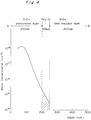
- Fig. 4 shows an example of the impurity distribution after boron is introduced for the control of the threshold voltage along the A-B line displayed in Fig. 3(c). Because the impurities are introduced through the silicon oxide layer 27, most of the impurities remain in the inactive state in the silicon oxide layer 27, and only a very small amount at the tail of the impurity distribution is introduced into the active layer 23 (refer the hatched area in Fig. 4). Thus, the above-mentioned method makes it possible to control the very small amount of impurities beyond the control limit of the ion doping apparatus.
- the damages at the interface between the polycrystalline silicon 23 and the silicon nitride (gate insulator layer) 22 caused by the ion implantation in the prior art method can be suppressed and the characteristics of thin film transistor can be improved.
- the amount of impurities to be introduced in the active layer 23 can be controlled at a desired level by controlling the acceleration voltage and the film thickness of the insulator layer 27. It is found that silicon oxide film is the best as the insulator layer for the control of threshold voltage.
- the threshold voltage of thin film transistor of bottom gate structure can be controlled by changing the introduction conditions of boron. Further, most of the impurities are deactivated in the silicon oxide thin film, and only a tail portion of the impurity distribution is introduced into the active layer. Therefore, the implantation depth into the active layer can be controlled at a desired value by the acceleration voltage on the ion doping and the thickness of the insulator layer on the thin film transistor. In the channel doping conditions according to the example, the threshold voltage varies by about 5 volts.
- thermal annealing is used for crystallizing and for activating the introduced impurities.
- PTA process laser anneal or rapid thermal annealing
- a p-channel thin film transistor can also be manufactured similarly.
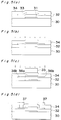
- a gate electrode 31 made of chromium of 100 nm thickness is formed first on a transparent substrate (glass substrate) 30, and a gate insulator layer 32 of silicon nitride of 400 nm thickness and a polycrystalline silicon thin film of 50 nm thickness as a semiconductor active layer 33 are formed successively on the gate electrode 31 in vacuum with a plasma chemical vapor deposition process (PCVD). Then, after an island of the polycrystalline silicon thin film is formed, a passivation insulator layer 34 of silicon oxide of 200 nm thickness is formed.
- PCVD plasma chemical vapor deposition process
- boron ions are introduced through the passivation insulator layer 34 into the semiconductor active layer 33 to control the threshold voltage.
- the ions of impurities for the control of the threshold voltage is introduced with an ion doping apparatus. That is, B2H6 gas is decomposed on high frequency discharge to generate boron ions, and the generated ions are introduced in the sample, without mass separation of the generated ions.
- the conditions for the threshold voltage control are as follows: 35 kV of acceleration voltage, and 1 * 1014 ions/cm2 of dose.
- a doping mask 35 is formed with a photoresist, and impurities (boron) are introduced into the source and drain regions 36b.
- impurities boron
- the region between the source and drain regions 36b becomes a channel region 36a eventually.
- the ion doping apparatus is used to introduce the boron ions, and B2H6 gas is decomposed on high frequency discharge and the generated ions are introduced into the source and drain regions 36b without mass separation.
- the conditions for forming the source and drain regions are as follows: 60 kV of acceleration voltage, and 5*1015 ions/cm2 of total dose of impurities. By using the above-mentioned conditions, the threshold voltage can be changed by 5 volts.
- contact holes are formed in the passivation layer 34.
- the plasma treatment is performed to deactivate the dangling bonds in the polycrystalline silicon thin film in the hydrogen plasma, and the source and drain electrodes 37 are formed in the contact holes as shown in Fig. 5(d), to complete a thin film transistor.
- thermal annealing is used for crystallizing and for activating the implanted impurities.
- laser annealing or rapid thermal annealing PTA process
- PTA process rapid thermal annealing
- a p-channel thin film transistor can be manufactured similarly.
- the order of the steps in the example can be changed. For example, similar advantages can be obtained if the steps shown in Figs. 5(b) and (c) are exchanged. Further, similar advantages can be obtained even if the step shown in Fig. 5(b) is omitted and impurities can be introduced after the step shown in Fig. 5(d) by using the conditions mentioned with reference to Fig. 5(b).
- the threshold voltage of the thin film transistor can be controlled at a desired value according to the present invention. Because the ion doping process needs no mass separation of generated ions, the cost of the apparatus is reduced. Further, because it can be applied to a wide area and a high throughput is possible, the manufacturing cost can be reduced.
- the thickness of the insulator layer above the active layer of the thin film transistor suitably, doping of very sharp distribution can be realized without damaging the interface between the channel region and gate insulator layer. Because most of the introduced ions is inactive in the insulator layer and only a very small amount of the implanted ions arrive to the active layer, the implantation at a dose much larger than realized previously becomes possible, and the controllability of the threshold voltage can be improved. The cost of the apparatus is reduced by sharing the apparatus commonly in the steps for introducing impurity ions.
- the present invention by introducing a very small amount of ionized impurities from above the insulator layer into the semiconductor layer to control the threshold voltage, most of the implanted impurities lose an energy in the insulator layer to stop and to be deactivated electrically. Thus, only a portion of the impurities at the tail of the impurity profile is introduced into the semiconductor active layer. Further, the film thickness of the insulator layer can be changed. Then, the depth of the impurity distribution and the amount of the impurities can be controlled at desired values.
Landscapes
- Thin Film Transistor (AREA)
Applications Claiming Priority (4)
| Application Number | Priority Date | Filing Date | Title |
|---|---|---|---|
| JP3466092A JP2970176B2 (ja) | 1992-02-21 | 1992-02-21 | 薄膜トランジスタの製造方法及びその薄膜トランジスタを用いた液晶表示装置 |
| JP34660/92 | 1992-02-21 | ||
| JP20583692A JPH0653507A (ja) | 1992-08-03 | 1992-08-03 | 薄膜トランジスタの製造方法およびその薄膜トランジスタを用いた半導体装置 |
| JP205836/92 | 1992-08-03 |
Publications (2)
| Publication Number | Publication Date |
|---|---|
| EP0566838A2 true EP0566838A2 (fr) | 1993-10-27 |
| EP0566838A3 EP0566838A3 (en) | 1996-07-31 |
Family
ID=26373491
Family Applications (1)
| Application Number | Title | Priority Date | Filing Date |
|---|---|---|---|
| EP93102520A Withdrawn EP0566838A3 (en) | 1992-02-21 | 1993-02-18 | Manufacturing method of thin film transistor |
Country Status (2)
| Country | Link |
|---|---|
| US (1) | US5397718A (fr) |
| EP (1) | EP0566838A3 (fr) |
Cited By (7)
| Publication number | Priority date | Publication date | Assignee | Title |
|---|---|---|---|---|
| FR2747237A1 (fr) * | 1996-04-09 | 1997-10-10 | Lg Electronics Inc | Dispositif d'affichage a cristal liquide et son procede de fabrication |
| EP0989614A2 (fr) | 1998-09-04 | 2000-03-29 | Sel Semiconductor Energy Laboratory Co., Ltd. | TFT avec une structure LDD et sa méthode de fabrication |
| EP1017108A3 (fr) * | 1998-12-25 | 2001-01-24 | Semiconductor Energy Laboratory Co., Ltd. | Dispositifs semi-conducteurs et procédés de fabrication |
| CN1103117C (zh) * | 1997-02-06 | 2003-03-12 | 日本电气株式会社 | 可用氢离子改变其阈值电压的场效应晶体管的制造工艺 |
| WO2003067666A1 (fr) * | 2002-02-07 | 2003-08-14 | Matsushita Electric Industrial Co., Ltd. | Dispositif a semi-conducteur et son procede de production |
| US6891236B1 (en) | 1999-01-14 | 2005-05-10 | Semiconductor Energy Laboratory Co., Ltd. | Semiconductor device and method of fabricating the same |
| CN100334743C (zh) * | 1994-08-19 | 2007-08-29 | 株式会社半导体能源研究所 | 半导体器件 |
Families Citing this family (21)
| Publication number | Priority date | Publication date | Assignee | Title |
|---|---|---|---|---|
| US6964890B1 (en) * | 1992-03-17 | 2005-11-15 | Semiconductor Energy Laboratory Co., Ltd. | Semiconductor device and method for forming the same |
| JP2912506B2 (ja) * | 1992-10-21 | 1999-06-28 | シャープ株式会社 | 透明導電膜の形成方法 |
| US6323071B1 (en) | 1992-12-04 | 2001-11-27 | Semiconductor Energy Laboratory Co., Ltd. | Method for forming a semiconductor device |
| US5403762A (en) * | 1993-06-30 | 1995-04-04 | Semiconductor Energy Laboratory Co., Ltd. | Method of fabricating a TFT |
| US5543335A (en) * | 1993-05-05 | 1996-08-06 | Ixys Corporation | Advanced power device process for low drop |
| US5477073A (en) * | 1993-08-20 | 1995-12-19 | Casio Computer Co., Ltd. | Thin film semiconductor device including a driver and a matrix circuit |
| JPH07142743A (ja) * | 1993-09-22 | 1995-06-02 | Sharp Corp | 薄膜トランジスタの製造方法 |
| KR100319332B1 (ko) * | 1993-12-22 | 2002-04-22 | 야마자끼 순페이 | 반도체장치및전자광학장치 |
| US5976919A (en) * | 1994-06-10 | 1999-11-02 | Matsushita Electric Industrial Co., Ltd. | Apparatus and method of manufacturing semiconductor element |
| JP3176527B2 (ja) * | 1995-03-30 | 2001-06-18 | シャープ株式会社 | 半導体装置の製造方法 |
| US6933182B1 (en) * | 1995-04-20 | 2005-08-23 | Semiconductor Energy Laboratory Co., Ltd. | Method of manufacturing a semiconductor device and manufacturing system thereof |
| US5721163A (en) * | 1996-06-10 | 1998-02-24 | Chartered Semiconductor Manufacturing Pte, Ltd. | Method of manufacture of thin film transistor SRAM device with a titanium nitride or silicide gate |
| JP3323889B2 (ja) * | 1996-10-28 | 2002-09-09 | 三菱電機株式会社 | 薄膜トランジスタの製造方法 |
| US6197624B1 (en) * | 1997-08-29 | 2001-03-06 | Semiconductor Energy Laboratory Co., Ltd. | Method of adjusting the threshold voltage in an SOI CMOS |
| JPH11112002A (ja) * | 1997-10-07 | 1999-04-23 | Semiconductor Energy Lab Co Ltd | 半導体装置およびその製造方法 |
| JP3968484B2 (ja) * | 1998-02-18 | 2007-08-29 | ソニー株式会社 | 薄膜トランジスタの製造方法 |
| JP4869509B2 (ja) * | 2001-07-17 | 2012-02-08 | 株式会社半導体エネルギー研究所 | 半導体装置の作製方法 |
| KR100682893B1 (ko) * | 2004-10-13 | 2007-02-15 | 삼성전자주식회사 | 박막 트랜지스터 및 그 제조 방법 |
| KR100749010B1 (ko) * | 2005-12-26 | 2007-08-13 | (주)포인트엔지니어링 | 투명기판을 이용한 다결정 실리콘 박막 제조 방법 및 장치 |
| TWI305682B (en) * | 2006-08-14 | 2009-01-21 | Au Optronics Corp | Bottom substrate for liquid crystal display device and the method of making the same |
| US8354674B2 (en) * | 2007-06-29 | 2013-01-15 | Semiconductor Energy Laboratory Co., Ltd. | Semiconductor device wherein a property of a first semiconductor layer is different from a property of a second semiconductor layer |
Family Cites Families (25)
| Publication number | Priority date | Publication date | Assignee | Title |
|---|---|---|---|---|
| JPS5421180A (en) * | 1977-07-19 | 1979-02-17 | Fujitsu Ltd | Semiconductor device |
| US4312680A (en) * | 1980-03-31 | 1982-01-26 | Rca Corporation | Method of manufacturing submicron channel transistors |
| JPS5830123A (ja) * | 1981-08-18 | 1983-02-22 | Toshiba Corp | 半導体装置の製造方法 |
| JPS5856409A (ja) * | 1981-09-30 | 1983-04-04 | Toshiba Corp | 半導体装置の製造方法 |
| JPS58206121A (ja) * | 1982-05-27 | 1983-12-01 | Toshiba Corp | 薄膜半導体装置の製造方法 |
| JPS59159563A (ja) * | 1983-03-02 | 1984-09-10 | Toshiba Corp | 半導体装置の製造方法 |
| JPS60128668A (ja) * | 1983-12-15 | 1985-07-09 | Toshiba Corp | 半導体装置の製造方法 |
| JPS6148979A (ja) * | 1984-08-17 | 1986-03-10 | Seiko Epson Corp | 多結晶シリコン薄膜トランジスタの製造方法 |
| JPS62219574A (ja) * | 1986-03-19 | 1987-09-26 | Sharp Corp | 半導体装置 |
| JPS6329978A (ja) * | 1986-07-23 | 1988-02-08 | Sharp Corp | 薄膜トランジスタの製造方法 |
| JPS63283068A (ja) * | 1987-05-14 | 1988-11-18 | Sharp Corp | 薄膜トランジスタの製造方法 |
| US4992838A (en) * | 1988-02-29 | 1991-02-12 | Texas Instruments Incorporated | Vertical MOS transistor with threshold voltage adjustment |
| JP2663500B2 (ja) * | 1988-04-28 | 1997-10-15 | 富士通株式会社 | 薄膜トランジスタの製造方法 |
| GB2223353A (en) * | 1988-09-30 | 1990-04-04 | Philips Electronic Associated | Thin-film transistor |
| JPH02123743A (ja) * | 1988-11-02 | 1990-05-11 | Fujitsu Ltd | 薄膜トランジスタの製造方法 |
| US4951113A (en) * | 1988-11-07 | 1990-08-21 | Xerox Corporation | Simultaneously deposited thin film CMOS TFTs and their method of fabrication |
| EP0598409B1 (fr) * | 1989-02-14 | 1998-11-18 | Seiko Epson Corporation | Procédé pour fabriquer un dispositif semi-conducteur |
| US5116771A (en) * | 1989-03-20 | 1992-05-26 | Massachusetts Institute Of Technology | Thick contacts for ultra-thin silicon on insulator films |
| JPH03276765A (ja) * | 1990-03-27 | 1991-12-06 | Nec Corp | 半導体集積回路の製造方法 |
| US5198379A (en) * | 1990-04-27 | 1993-03-30 | Sharp Kabushiki Kaisha | Method of making a MOS thin film transistor with self-aligned asymmetrical structure |
| JP2796175B2 (ja) * | 1990-06-05 | 1998-09-10 | 松下電器産業株式会社 | 薄膜トランジスターの製造方法 |
| JPH0494133A (ja) * | 1990-08-10 | 1992-03-26 | Fuji Xerox Co Ltd | 薄膜半導体装置の製造方法 |
| US5064775A (en) * | 1990-09-04 | 1991-11-12 | Industrial Technology Research Institute | Method of fabricating an improved polycrystalline silicon thin film transistor |
| JPH04134831A (ja) * | 1990-09-27 | 1992-05-08 | Oki Electric Ind Co Ltd | Mos型半導体素子の製造方法 |
| US5252502A (en) * | 1992-08-03 | 1993-10-12 | Texas Instruments Incorporated | Method of making MOS VLSI semiconductor device with metal gate |
-
1993
- 1993-02-18 EP EP93102520A patent/EP0566838A3/en not_active Withdrawn
- 1993-02-19 US US08/019,682 patent/US5397718A/en not_active Expired - Lifetime
Cited By (9)
| Publication number | Priority date | Publication date | Assignee | Title |
|---|---|---|---|---|
| CN100334743C (zh) * | 1994-08-19 | 2007-08-29 | 株式会社半导体能源研究所 | 半导体器件 |
| FR2747237A1 (fr) * | 1996-04-09 | 1997-10-10 | Lg Electronics Inc | Dispositif d'affichage a cristal liquide et son procede de fabrication |
| CN1103117C (zh) * | 1997-02-06 | 2003-03-12 | 日本电气株式会社 | 可用氢离子改变其阈值电压的场效应晶体管的制造工艺 |
| EP0989614A2 (fr) | 1998-09-04 | 2000-03-29 | Sel Semiconductor Energy Laboratory Co., Ltd. | TFT avec une structure LDD et sa méthode de fabrication |
| EP0989614A3 (fr) * | 1998-09-04 | 2009-06-10 | Sel Semiconductor Energy Laboratory Co., Ltd. | TFT avec une structure LDD et sa méthode de fabrication |
| EP1017108A3 (fr) * | 1998-12-25 | 2001-01-24 | Semiconductor Energy Laboratory Co., Ltd. | Dispositifs semi-conducteurs et procédés de fabrication |
| US6891236B1 (en) | 1999-01-14 | 2005-05-10 | Semiconductor Energy Laboratory Co., Ltd. | Semiconductor device and method of fabricating the same |
| US7491655B2 (en) | 1999-01-14 | 2009-02-17 | Semiconductor Energy Laboratory Co., Ltd. | Semiconductor device and method of fabricating the same |
| WO2003067666A1 (fr) * | 2002-02-07 | 2003-08-14 | Matsushita Electric Industrial Co., Ltd. | Dispositif a semi-conducteur et son procede de production |
Also Published As
| Publication number | Publication date |
|---|---|
| EP0566838A3 (en) | 1996-07-31 |
| US5397718A (en) | 1995-03-14 |
Similar Documents
| Publication | Publication Date | Title |
|---|---|---|
| EP0566838A2 (fr) | Procédé de fabrication d'un transistor à couches minces | |
| US5373803A (en) | Method of epitaxial growth of semiconductor | |
| US5180690A (en) | Method of forming a layer of doped crystalline semiconductor alloy material | |
| US7227229B2 (en) | Active matrix display device comprising an inverter circuit | |
| EP0494628A2 (fr) | Transistor couche mince du type SOI avec multigrille et sa méthode de fabrication | |
| EP0513590A2 (fr) | Transistor en couche mince et procédé pour sa fabrication | |
| JP2796175B2 (ja) | 薄膜トランジスターの製造方法 | |
| KR100402845B1 (ko) | 액정표시장치의제조방법 | |
| US7148542B2 (en) | Semiconductor device and method of forming the same | |
| US6444507B1 (en) | Fabrication process for thin film transistors in a display or electronic device | |
| JP3741741B2 (ja) | 相補型集積回路の作製方法 | |
| JP4634569B2 (ja) | イオン注入装置及び薄膜半導体装置 | |
| JPH0864549A (ja) | イオンドーピング方法及びイオンドーピング装置 | |
| EP0544470A1 (fr) | Transistor à couche mince, procédé pour sa fabrication et procédé d'implantation d'ions utilisé | |
| JP3210568B2 (ja) | 薄膜トランジスタの製造方法と薄膜トランジスタアレイの製造方法と液晶表示装置の製造方法 | |
| JP3428143B2 (ja) | 不純物の活性化方法ならびに薄膜トランジスタの製造方法 | |
| JP3331642B2 (ja) | 薄膜トランジスタの製造方法 | |
| JP3260165B2 (ja) | 薄膜素子の製造方法 | |
| JPH11154482A (ja) | 半導体装置の製造方法 | |
| JPH04275437A (ja) | 薄膜トランジスタおよびその製造方法 | |
| JP3946690B2 (ja) | インバータ回路の作製方法 | |
| JP3219501B2 (ja) | 薄膜トランジスタの製造方法 | |
| JP3413704B2 (ja) | 薄膜半導体装置の製造方法 | |
| JP3357038B2 (ja) | 薄膜トランジスタの製造方法と液晶表示装置の製造方法 | |
| KR100301852B1 (ko) | 박막트랜지스터제조방법 |
Legal Events
| Date | Code | Title | Description |
|---|---|---|---|
| PUAI | Public reference made under article 153(3) epc to a published international application that has entered the european phase |
Free format text: ORIGINAL CODE: 0009012 |
|
| 17P | Request for examination filed |
Effective date: 19930218 |
|
| AK | Designated contracting states |
Kind code of ref document: A2 Designated state(s): DE GB |
|
| PUAL | Search report despatched |
Free format text: ORIGINAL CODE: 0009013 |
|
| AK | Designated contracting states |
Kind code of ref document: A3 Designated state(s): DE GB |
|
| 17Q | First examination report despatched |
Effective date: 19990225 |
|
| STAA | Information on the status of an ep patent application or granted ep patent |
Free format text: STATUS: THE APPLICATION IS DEEMED TO BE WITHDRAWN |
|
| 18D | Application deemed to be withdrawn |
Effective date: 20020808 |