EP0571208A1 - Verfahren zur Herstellung eines gemusterten Formkörpers - Google Patents
Verfahren zur Herstellung eines gemusterten Formkörpers Download PDFInfo
- Publication number
- EP0571208A1 EP0571208A1 EP93303920A EP93303920A EP0571208A1 EP 0571208 A1 EP0571208 A1 EP 0571208A1 EP 93303920 A EP93303920 A EP 93303920A EP 93303920 A EP93303920 A EP 93303920A EP 0571208 A1 EP0571208 A1 EP 0571208A1
- Authority
- EP
- European Patent Office
- Prior art keywords
- pattern
- partition body
- course
- materials
- pieces
- Prior art date
- Legal status (The legal status is an assumption and is not a legal conclusion. Google has not performed a legal analysis and makes no representation as to the accuracy of the status listed.)
- Granted
Links
- 238000004519 manufacturing process Methods 0.000 title claims description 8
- 239000000463 material Substances 0.000 claims abstract description 154
- 238000005192 partition Methods 0.000 claims abstract description 48
- 238000000034 method Methods 0.000 claims abstract description 26
- XLYOFNOQVPJJNP-UHFFFAOYSA-N water Substances O XLYOFNOQVPJJNP-UHFFFAOYSA-N 0.000 description 27
- 239000000919 ceramic Substances 0.000 description 25
- 239000003795 chemical substances by application Substances 0.000 description 20
- 239000008187 granular material Substances 0.000 description 15
- 239000004568 cement Substances 0.000 description 13
- 239000004567 concrete Substances 0.000 description 13
- 239000002184 metal Substances 0.000 description 12
- 239000002904 solvent Substances 0.000 description 11
- 239000004033 plastic Substances 0.000 description 10
- 229920003023 plastic Polymers 0.000 description 10
- 229920005989 resin Polymers 0.000 description 10
- 239000011347 resin Substances 0.000 description 10
- 239000007767 bonding agent Substances 0.000 description 9
- 239000000835 fiber Substances 0.000 description 9
- 239000011521 glass Substances 0.000 description 9
- 239000000049 pigment Substances 0.000 description 9
- 239000000203 mixture Substances 0.000 description 8
- 239000002245 particle Substances 0.000 description 8
- 239000000843 powder Substances 0.000 description 8
- -1 etc. Substances 0.000 description 7
- 238000010438 heat treatment Methods 0.000 description 7
- 239000004014 plasticizer Substances 0.000 description 7
- 239000002023 wood Substances 0.000 description 7
- 239000000654 additive Substances 0.000 description 6
- 239000003086 colorant Substances 0.000 description 5
- 239000004745 nonwoven fabric Substances 0.000 description 5
- 239000000853 adhesive Substances 0.000 description 4
- 230000001070 adhesive effect Effects 0.000 description 4
- 239000003973 paint Substances 0.000 description 4
- 239000000123 paper Substances 0.000 description 4
- 238000010298 pulverizing process Methods 0.000 description 4
- 239000002994 raw material Substances 0.000 description 4
- 239000011435 rock Substances 0.000 description 4
- 239000002759 woven fabric Substances 0.000 description 4
- 235000013339 cereals Nutrition 0.000 description 3
- 238000004898 kneading Methods 0.000 description 3
- 239000002932 luster Substances 0.000 description 3
- 238000002844 melting Methods 0.000 description 3
- 230000008018 melting Effects 0.000 description 3
- 239000011802 pulverized particle Substances 0.000 description 3
- 229920000049 Carbon (fiber) Polymers 0.000 description 2
- YCKRFDGAMUMZLT-UHFFFAOYSA-N Fluorine atom Chemical compound [F] YCKRFDGAMUMZLT-UHFFFAOYSA-N 0.000 description 2
- 239000002969 artificial stone Substances 0.000 description 2
- 230000015572 biosynthetic process Effects 0.000 description 2
- 239000004917 carbon fiber Substances 0.000 description 2
- 238000005266 casting Methods 0.000 description 2
- 235000019219 chocolate Nutrition 0.000 description 2
- 239000004927 clay Substances 0.000 description 2
- 235000009508 confectionery Nutrition 0.000 description 2
- 238000001035 drying Methods 0.000 description 2
- 239000011737 fluorine Substances 0.000 description 2
- 229910052731 fluorine Inorganic materials 0.000 description 2
- 239000004088 foaming agent Substances 0.000 description 2
- 239000003365 glass fiber Substances 0.000 description 2
- VNWKTOKETHGBQD-UHFFFAOYSA-N methane Chemical compound C VNWKTOKETHGBQD-UHFFFAOYSA-N 0.000 description 2
- 239000004005 microsphere Substances 0.000 description 2
- 235000012736 patent blue V Nutrition 0.000 description 2
- 238000003825 pressing Methods 0.000 description 2
- 239000000047 product Substances 0.000 description 2
- 239000002893 slag Substances 0.000 description 2
- 229920002994 synthetic fiber Polymers 0.000 description 2
- 239000012209 synthetic fiber Substances 0.000 description 2
- 238000004078 waterproofing Methods 0.000 description 2
- 239000004925 Acrylic resin Substances 0.000 description 1
- 229920000178 Acrylic resin Polymers 0.000 description 1
- 239000004278 EU approved seasoning Substances 0.000 description 1
- 239000004593 Epoxy Substances 0.000 description 1
- 244000043261 Hevea brasiliensis Species 0.000 description 1
- 239000004677 Nylon Substances 0.000 description 1
- 240000007594 Oryza sativa Species 0.000 description 1
- 235000007164 Oryza sativa Nutrition 0.000 description 1
- 244000046052 Phaseolus vulgaris Species 0.000 description 1
- 235000010627 Phaseolus vulgaris Nutrition 0.000 description 1
- 239000004698 Polyethylene Substances 0.000 description 1
- 239000004721 Polyphenylene oxide Substances 0.000 description 1
- 239000004743 Polypropylene Substances 0.000 description 1
- 239000004793 Polystyrene Substances 0.000 description 1
- 244000061456 Solanum tuberosum Species 0.000 description 1
- 235000002595 Solanum tuberosum Nutrition 0.000 description 1
- PPBRXRYQALVLMV-UHFFFAOYSA-N Styrene Chemical compound C=CC1=CC=CC=C1 PPBRXRYQALVLMV-UHFFFAOYSA-N 0.000 description 1
- 235000021307 Triticum Nutrition 0.000 description 1
- 244000098338 Triticum aestivum Species 0.000 description 1
- BZHJMEDXRYGGRV-UHFFFAOYSA-N Vinyl chloride Chemical compound ClC=C BZHJMEDXRYGGRV-UHFFFAOYSA-N 0.000 description 1
- 240000008042 Zea mays Species 0.000 description 1
- 235000005824 Zea mays ssp. parviglumis Nutrition 0.000 description 1
- 235000002017 Zea mays subsp mays Nutrition 0.000 description 1
- 239000011358 absorbing material Substances 0.000 description 1
- DHKHKXVYLBGOIT-UHFFFAOYSA-N acetaldehyde Diethyl Acetal Natural products CCOC(C)OCC DHKHKXVYLBGOIT-UHFFFAOYSA-N 0.000 description 1
- 125000002777 acetyl group Chemical class [H]C([H])([H])C(*)=O 0.000 description 1
- NIXOWILDQLNWCW-UHFFFAOYSA-N acrylic acid group Chemical group C(C=C)(=O)O NIXOWILDQLNWCW-UHFFFAOYSA-N 0.000 description 1
- XECAHXYUAAWDEL-UHFFFAOYSA-N acrylonitrile butadiene styrene Chemical compound C=CC=C.C=CC#N.C=CC1=CC=CC=C1 XECAHXYUAAWDEL-UHFFFAOYSA-N 0.000 description 1
- 229920000122 acrylonitrile butadiene styrene Polymers 0.000 description 1
- 239000004676 acrylonitrile butadiene styrene Substances 0.000 description 1
- 239000003963 antioxidant agent Substances 0.000 description 1
- 230000003078 antioxidant effect Effects 0.000 description 1
- 239000010426 asphalt Substances 0.000 description 1
- 239000012752 auxiliary agent Substances 0.000 description 1
- 239000003638 chemical reducing agent Substances 0.000 description 1
- 235000005822 corn Nutrition 0.000 description 1
- 239000003431 cross linking reagent Substances 0.000 description 1
- 238000007872 degassing Methods 0.000 description 1
- 229920001971 elastomer Polymers 0.000 description 1
- 230000002708 enhancing effect Effects 0.000 description 1
- 239000005038 ethylene vinyl acetate Substances 0.000 description 1
- 238000001125 extrusion Methods 0.000 description 1
- 238000005243 fluidization Methods 0.000 description 1
- 239000010881 fly ash Substances 0.000 description 1
- 235000011194 food seasoning agent Nutrition 0.000 description 1
- 230000004927 fusion Effects 0.000 description 1
- 239000010438 granite Substances 0.000 description 1
- 239000000314 lubricant Substances 0.000 description 1
- 239000004579 marble Substances 0.000 description 1
- 238000000465 moulding Methods 0.000 description 1
- 229920003052 natural elastomer Polymers 0.000 description 1
- 229920001194 natural rubber Polymers 0.000 description 1
- 229920001778 nylon Polymers 0.000 description 1
- 229920001200 poly(ethylene-vinyl acetate) Polymers 0.000 description 1
- 239000004417 polycarbonate Substances 0.000 description 1
- 229920000515 polycarbonate Polymers 0.000 description 1
- 229920000728 polyester Polymers 0.000 description 1
- 229920001225 polyester resin Polymers 0.000 description 1
- 239000004645 polyester resin Substances 0.000 description 1
- 229920000573 polyethylene Polymers 0.000 description 1
- 229920006380 polyphenylene oxide Polymers 0.000 description 1
- 229920001155 polypropylene Polymers 0.000 description 1
- 229920002223 polystyrene Polymers 0.000 description 1
- 239000012255 powdered metal Substances 0.000 description 1
- 238000002360 preparation method Methods 0.000 description 1
- 238000004321 preservation Methods 0.000 description 1
- 230000001737 promoting effect Effects 0.000 description 1
- 230000001902 propagating effect Effects 0.000 description 1
- 230000002787 reinforcement Effects 0.000 description 1
- 235000009566 rice Nutrition 0.000 description 1
- 239000005060 rubber Substances 0.000 description 1
- 239000004576 sand Substances 0.000 description 1
- 239000002002 slurry Substances 0.000 description 1
- 235000013599 spices Nutrition 0.000 description 1
- 239000005315 stained glass Substances 0.000 description 1
- 238000003860 storage Methods 0.000 description 1
- 235000000346 sugar Nutrition 0.000 description 1
- 239000006228 supernatant Substances 0.000 description 1
- 239000012756 surface treatment agent Substances 0.000 description 1
- 229920003051 synthetic elastomer Polymers 0.000 description 1
- 239000005061 synthetic rubber Substances 0.000 description 1
- 229920001169 thermoplastic Polymers 0.000 description 1
- 229920001187 thermosetting polymer Polymers 0.000 description 1
- 239000004416 thermosoftening plastic Substances 0.000 description 1
Images



Classifications
-
- B—PERFORMING OPERATIONS; TRANSPORTING
- B28—WORKING CEMENT, CLAY, OR STONE
- B28B—SHAPING CLAY OR OTHER CERAMIC COMPOSITIONS; SHAPING SLAG; SHAPING MIXTURES CONTAINING CEMENTITIOUS MATERIAL, e.g. PLASTER
- B28B7/00—Moulds; Cores; Mandrels
- B28B7/06—Moulds with flexible parts
-
- B—PERFORMING OPERATIONS; TRANSPORTING
- B28—WORKING CEMENT, CLAY, OR STONE
- B28B—SHAPING CLAY OR OTHER CERAMIC COMPOSITIONS; SHAPING SLAG; SHAPING MIXTURES CONTAINING CEMENTITIOUS MATERIAL, e.g. PLASTER
- B28B13/00—Feeding the unshaped material to moulds or apparatus for producing shaped articles; Discharging shaped articles from such moulds or apparatus
- B28B13/02—Feeding the unshaped material to moulds or apparatus for producing shaped articles
- B28B13/0215—Feeding the moulding material in measured quantities from a container or silo
- B28B13/022—Feeding several successive layers, optionally of different materials
-
- B—PERFORMING OPERATIONS; TRANSPORTING
- B28—WORKING CEMENT, CLAY, OR STONE
- B28B—SHAPING CLAY OR OTHER CERAMIC COMPOSITIONS; SHAPING SLAG; SHAPING MIXTURES CONTAINING CEMENTITIOUS MATERIAL, e.g. PLASTER
- B28B1/00—Producing shaped prefabricated articles from the material
- B28B1/008—Producing shaped prefabricated articles from the material made from two or more materials having different characteristics or properties
-
- B—PERFORMING OPERATIONS; TRANSPORTING
- B44—DECORATIVE ARTS
- B44C—PRODUCING DECORATIVE EFFECTS; MOSAICS; TARSIA WORK; PAPERHANGING
- B44C1/00—Processes, not specifically provided for elsewhere, for producing decorative surface effects
- B44C1/26—Inlaying with ornamental structures, e.g. niello work, tarsia work
Definitions
- This invention relates to a method for producing patterned shaped articles including patterned concrete shaped articles, patterned artificial stone shaped articles, raw materials for patterned ceramic shaped articles, patterned ceramic shaped articles, impasto shaped articles, plastic shaped articles, shaped foodstuffs, etc.
- 07/750,618 they proposed methods for producing patterned shaped articles by disposing on a given surface such as the bottom plate of a main form for producing a shaped article an auxiliary form representing a pattern to be formed, supplying plural kinds of dry particulate or granular pattern-course materials inside and outside the auxiliary form, and allowing the materials to set into an integral mass.
- This invention has been proposed to eliminate these disadvantages and has as its object to provide a method for producing a patterned shaped article, enabling easy and precise supply of the pattern-course materials to prescribed portions and provision of a clear-cut pattern.
- this invention provides a method for producing a patterned shaped article, characterized by disposing a partition body on a given surface, temporarily fixing a plurality of cut pattern pieces to an upper surface of the partition body so that the cut pattern pieces are disposed adjacent to each other to constitute a pattern to be formed, unfixing one of the cut pattern pieces from a portion of the upper surface of the partition body to which a pattern-course material is to be supplied, supplying the pattern-course material to the portion, repeating the unfixing and supplying steps until the partition body is filled with a prescribed amount of pattern-course materials, removing the partition body from the pattern-course materials, and allowing the pattern-course materials to set into the patterned shaped article on the given surface.
- a patterned shaped article produced by the method of this invention comprises a pattern course 1 and a backing layer 2.
- the backing layer 2 may be omitted.
- the pattern course 1 comprises a dry white pattern-course material 3 for representing the snow covered peak of a mountain, a dry brown pattern-course material 4 for representing the side of the mountain and a dry sky-blue pattern-course material 5 for representing the sky.
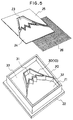
- the patterned shaped article shown in Figure 1 is produced using a cell form 11 or a bristling form 12 serving as a partition body 10, a main form 20 having a surrounding frame 20' and a bottom plate 22 serving as a given surface 21 for disposing the partition body 10 thereon, cut pattern pieces 23, 24 and 25 separately unfixed for supplying the pattern-course materials 3, 4 and 5, and a mesh member 26 for supporting the cut pattern pieces 23, 24 and 25 thereon.
- These component members are shown in Figure 2(a) and Figure 2(b).
- use of the mesh member 26 may be omitted and the cell form 11 and the bristling form 12 may be used either alone or in combination with each other.
- the three pattern pieces 23, 24 and 25 are unfixed for supplying the white pattern-course material 3 for representing the snow covered peak of a mountain, the brown pattern-course material 4 for representing the side of the mountain and the sky-blue pattern-course material 5 for representing the sky. They are temporarily fixed to the upper surface of the mesh member 26 so as to be disposed adjacent to each other to constitute the pattern to be formed.
- the mesh member 26 permits passage of the dry, particulate or granular, pattern-course materials 3, 4 and 5 therethrough.
- the temporary fixation is for positioning the pattern pieces on the surface of either the partition body 10 or the mesh member 26 so as not to shift and is attained by imparting an adhesive or magnetic property to the pattern pieces. Otherwise, the temporary fixation may rely on mechanical means such as projections and springs.
- the patterned shaped article shown in Figure 1 is produced by the following procedure.
- the partition body 10 is disposed on the bottom plate 22 of the main form 20.
- the mesh member 26 having the pattern pieces 23, 24 and 25 fixed temporarily thereto is temporarily fixed to the upper surface of the partition body 10.
- the pattern piece 23 is first unfixed from the mesh member 26 to supply the white pattern-course material 3 for representing the snow covered peak of a mountain into the cells or between the projections of the partition body 10 via the exposed portion of the mesh member 26. At this time, the supplied white pattern-course material 3 does not spread over other portions than the exposed portion of the mesh member 26.
- the unfixed pattern piece 23 is again fixed temporarily to the upper surface of the mesh member 26 at its original position and the pattern piece 25, for example, is then unfixed from the mesh member to supply the blue-sky pattern-course material 5 for representing the sky into the cells or between the projections of the partition body 10.
- the unfixed pattern piece 25 is again fixed temporarily to the upper surface of the mesh member 26 at its original position.
- the pattern piece 24 is unfixed from the mesh member 26 to supply the brown pattern-course material 4 for representing the side of the mountain into the cells or between the projections of the partition body 10.
- the mesh member 26 is removed together with the pattern pieces 23 and 25.
- the material for the formation of the backing layer 2 is supplied onto the pattern-course materials 3, 4 and 5 supplied into the partition body 10 and all of the materials are moistened and, if necessary pressed, and allowed to set into an integral mass. Where the backing layer 2 is not formed on the supplied pattern-course materials, the supplied pattern-course materials are moistened and, if necessary pressed, and allowed to set into an integral mass. Thus, the patterned shaped article is produced.
- the unfixed pattern pieces are again fixed temporarily to the mesh member 26.
- the pattern pieces may be disposed of.
- the mesh member 26 may be omitted as described above.
- the pattern pieces 23, 24 and 25 are temporarily fixed directly to the partition body 10.
- the subsequent procedure is in the same manner as described above.
- the partition body 10 When the partition body 10 is made of a material soluble in water, it need not be removed because it is dissolved by the moisture, solvent, etc. used in moistening the pattern-course materials. If the partition body 10 is made of a material insoluble in water, it has to be removed from the pattern course 1 before the pattern-course materials are allowed to completely set. When it is required to remove the partition body 10 or to make the pattern course 1 and the backing layer 2 integral with each other, it is preferable that the bottom plate 22 and the surrounding frame 20' of the main form 20 be separable from each other.
- the pattern course 1 can be formed integrally on the surface of an existing concrete article.
- the partition body 10 since the concrete surface serves as the given surface 21, the partition body 10 is placed on the concrete surface.
- the mesh member is superposed on the partition body 10 before the pattern pieces 23, 24 and 25 are temporarily fixed to the mesh member 26, or the pattern pieces are temporarily fixed directly to the partition body 10 without use of the mesh member 26.
- each of the pattern-course materials 3, 4 and 5 is supplied into the partition body 10 after the pattern pieces 23, 24 and 25 are unfixed one by one.
- the supplied materials are allowed to set into an integral mass while the supplied materials are kept intact or after the partition body 10 is turned upside down.
- the patterned shaped article of Figure 1 can be produced using a continuous auxiliary form 30 as the partition body 10.
- the auxiliary form 30 is disposed on the bottom plate 22 of the main form 20.
- the mesh member 26 having the pattern pieces 23, 24 and 25 fixed temporarily thereto is temporarily fixed to the upper surface of the main form 20.
- the pattern piece 23 is first unfixed from the mesh member 26 to supply the white pattern-course material 3 for representing the snow covered peak of a mountain into the space 31 of the auxiliary form 30 via the exposed portion of the mesh member 26.
- the unfixed pattern piece 23 is again fixed temporarily to the upper surface of the mesh member 26 at its original position and the pattern piece 25, for example, is then unfixed from the mesh member to supply the blue-sky pattern-course material 5 for representing the sky into the space 33 outside the auxiliary form 30 but inside the main form 20.
- the unfixed pattern piece 25 is again fixed temporarily to the upper surface of the mesh member 26 at its original position.
- the pattern piece 24 is unfixed from the mesh member 26 to supply the brown pattern-course material 4 for representing the side of the mountain into the space 32 of the auxiliary form 30.
- the mesh member 26 is removed together with the pattern pieces 23 and 25.
- the material for the formation of the backing layer 2 is supplied onto the pattern-course materials 3, 4 and 5 supplied inside and outside the auxiliary form 30 and all of the materials are moistened and, if necessary pressed, and allowed to set into an integral mass. Where the backing layer 2 is not formed on the supplied pattern-course materials, the supplied pattern-course materials are moistened and, if necessary pressed, and allowed to set into an integral mass. Thus, the patterned shaped article is produced.
- the unfixed pattern pieces are again fixed temporarily to the mesh member 26.
- the pattern pieces may be disposed of.
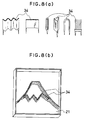
- upright pieces 34 which may be pins, fibers, small pieces, pipes, or other member as shown in Figure 8(a) can be used to form a discontinuous auxiliary form as shown in Figure 8(b) by providing the upright pieces 34 at prescribed intervals on the support member 22 serving as the given surface 21 along a pattern to be formed.
- the mesh member 26 may be omitted as described above.
- the pattern pieces 23, 24 and 25 are temporarily fixed directly to the partition body 10.
- the subsequent procedure is in the same manner as described above.
- the auxiliary form 30 When the auxiliary form 30 is made of a material soluble in water, it need not be removed because it is dissolved by the moisture, solvent, etc. used in moistening the pattern-course materials. If the auxiliary form 30 is made of a material insoluble in water, it has to be removed from the pattern course 1 before the pattern-course materials are allowed to completely set. When it is required to remove the auxiliary form 30 or to make the pattern course 1 and the backing layer 2 integral with each other, it is preferable that the bottom plate 22 and the surrounding frame 20' of the main form 20 be separable from each other.
- the pattern course 1 can be formed integrally on the surface of an existing concrete article.
- the concrete surface serves as the given surface 21
- a combination of the surrounding frame 20' and the auxiliary form 30 is placed on the concrete surface.
- the mesh member 26 is superposed on the combination before the pattern pieces 23, 24 and 25 are temporarily fixed to the mesh member 26, or the pattern pieces are temporarily fixed directly to the combination without use of the mesh member 26.
- each of the pattern-course materials 3, 4 and 5 is supplied into the spaces 31, 32 and 33 after the pattern pieces 23, 24 and 25 are unfixed one by one.
- the supplied materials are allowed to set into an integral mass while the supplied materials are kept intact or after the combination is turned upside down.
- Each of the dry pattern-course materials 3, 4 and 5 may be one which has absorbed some moisture after drying but is not kneaded with water, oil, lubricant-bonding agent, solvent, setting agent, or plasticizer and is in a state readily amenable to pulverization before charging.
- the material for forming the backing layer 2 may be either such a dry material or a wet material kneaded with at least one of water, oil, lubricant-bonding agent, solvent, setting agent and plasticizer.
- a plate of metal, wood, cement, glass or ceramic or a sheet of paper, non-woven fabric, woven fabric or plastic may be used as the backing layer 2.
- the surface of the plate or sheet serves as the given surface 21.
- the surface of an existing concrete article may be used as the given surface 21.
- the pattern course 1 and the backing layer 2 are required to differ from each other in color, luster, texture and the like.
- Examples of the dry pattern-course material for producing a concrete shaped article include cement powder, resin, a mixture of cement powder and resin, and the mixture further containing at least one of a pigment and a fine aggregate.
- Examples of the backing layer material include cement powder, resin, a mixture of cement powder and resin, the mixture further containing a fine aggregate and, if necessary, additionally containing a pigment and at least one of coarse aggregates and various kinds of fibers.
- the backing layer material may either be the same material as the pattern-course material or be in the form of a concrete slurry obtained by kneading with water etc. Wood chips may be used as an aggregate or fine aggregate.
- Examples of the fibers include metal fiber, carbon fiber, synthetic fiber and glass fiber.
- the pattern-course material and the backing layer material may, as found necessary, further have mixed therewith pulverized particles or granules of granite, marble, etc., slag, light-reflecting grains, inorganic hollow micro-spheres including Shirasu balloons, pulverized particles or granules of ceramic, grains or granules of new ceramic, metal and ore. They may also contain various additives of congealing and setting agents, water proofing agents, and inflating agents.
- All the materials are caused to set within the main form by supplying all the materials into the main form and either allowing them to stand therein or supplying a prescribed amount of water etc.
- the backing layer material is wet, however, the amount of water etc. to be supplied is reduced.
- a plate of metal, wood, cement, glass or ceramic or a sheet of paper, non-woven fabric, woven fabric may be used as the backing layer.
- An asphaltic concrete shaped article can be produced using a thermal fusion material, such as asphalt etc.
- the dry pattern-course material and the backing layer material for producing an artificial stone shaped article include wood chips and granules of rock, ceramic, new ceramic, glass, plastic and metal. They may, if necessary, contain a pigment-containing aggregate and a setting agent.
- the setting agent is a mixture of cement powder and water, a mixture of cement powder, water and resin, or a mixture of cement powder, water and solvent and may additionally contain powders of at least one of rock, ceramic, new ceramic, glass and plastic and, when necessary, may be further kneaded with a pigment or colorant and, when found necessary, may have mixed therewith various kinds of particles or granules, various kinds of fibers and various kinds of additives.
- Examples of the particles or granules include slag, fly ash and light-reflecting granules.
- Examples of the fibers include metal fiber, carbon fiber, synthetic fiber and glass fiber.
- Examples of the additives include shrink proofing agents, congealing and setting agents, delaying agents, water proofing agents, inflating agents, water reducing agents and fluidizing agents.
- the aggregate is spread with or immersed in water, solvent, surface treatment agent, etc.
- All the materials supplied into the main form are caused to set into an integral mass by propagating setting agent between the aggregates by means of suction under vacuum, for example.
- a mixture of aggregate and setting agent may be used as the backing layer material.
- a plate of metal, wood, cement, glass, ceramic, etc. or a sheet of paper, non-woven fabric, woven fabric, plastic, etc. may be used as the backing layer, and all the materials may be set on and together with the backing layer into an integral mass.
- the dry pattern-course material for producing a ceramic shaped article or a raw material for a ceramic shaped article may, for example, be constituted of one or more of clay, glaze, and particles and granules of rock, glass, new ceramic and fine ceramic, with or without a pigment or colorant added thereto.
- the dry pattern-course material may be one which has absorbed some water or been added with a lubricant-bonding agent after drying, but it is not kneaded with water or the lubricant-bonding agent and is in a state readily amenable to pulverization.
- the backing layer material may, for example, be constituted of one or more of clay, and particles and granules of rock, glass, new ceramic and fine ceramic, with or without a pigment or colorant added thereto.
- the backing layer material is required to differ from the pattern-course materials in color, luster, texture and the like and may either be dry similarly to the pattern-course materials or be kneaded with water, lubricant-bonding agent, etc.
- the pattern-course materials or the backing layer material may contain inorganic hollow micro-spheres including Shirasu balloons, pulverized particles or granules of ceramic, grains or granules of metal, ore, etc.
- a raw product for a ceramic sintered article is obtained by supplying all the materials into the main form, then pressing the materials without or after adding a prescribed amount of water or lubricant-bonding agent so that the materials are plasticized into an integral mass, and removing the integral mass from the main form. The raw product is then sintered to obtain a ceramic shaped article. Otherwise, a ceramic shaped article is obtained by supplying all the materials into a refractory setter, heating the materials within the setter to melt or fuse them into an integral mass, and removing the integral mass from the setter.
- a ceramic shaped article is obtained by supplying all the materials onto a sheet of metal, glass, ceramic, etc. to form a layer of materials, melting or fusing the layer by heating to make the layer integral with the sheet.
- patterned enameled articles, patterned stained glass articles, patterned crystalline glass articles, etc. can be produced.
- the dry pattern-course materials for producing an impasto shaped article is constituted of various kinds of powdered paints.
- a plate or other shaped piece of metal, wood, cement, ceramic, etc. may be used as the backing layer.
- the paints include acrylic resin, polyester resin, acrylic polyester hybrid resin, fluorine resin, etc. with a pigment or colorant added thereto.
- An impasto shaped article is obtained by supplying the powdered paints onto the plate to form a layer of paints, melting or fusing the layer by heating and baking the layer to make the layer integral with the plate. When found necessary, the layer may be pressed while making it integral with the plate.
- Examples of the dry pattern-course material for producing a plastic shaped article include particles or granules of plastics, with or without a pigment and colorant added thereto, and may contain a plasticizer, solvent, etc. However, the dry pattern-course material is not kneaded with a plasticizer, solvent, etc. and is in a state readily amenable to pulverization.
- the backing layer material used in this case may be either a dry material or a wet material obtained by kneading with a plasticizer, solvent, etc.
- plastics examples include polyethylene, nylon, polypropylene, polycarbonate, acetal, polystyrene, epoxy, vinyl chloride, natural rubber, synthetic rubber, acrylonitrile-butadiene-styrene, polyphenylene oxide, ethylene-vinyl acetate copolymer, fluorine resin or other thermoplastic and thermosetting resins.
- Both the pattern-course materials and the backing layer material may, when found necessary, contain various additives such as foaming agent, antioxidant, thermostabilizer, crosslinking agent, etc. These materials are melted or fused by heating and, if necessary, applying pressure thereto during heating, thereby obtaining an integral mass.
- a patterned foamed styrol shaped article, patterned plastic bathtub, floor tile, etc. can be produced.
- the integral mass may be made integral with a backing layer such as a plate of metal, wood, cement, ceramic, etc. or a sheet of paper, non-woven fabric, woven fabric, plastic, etc.
- Examples of the dry pattern-course materials for producing confectionery or other shaped foodstuffs include particles or granules of one or more of wheat, rice, potato, bean, corn and sugar.
- the materials may additionally contain seasonings and spices and may also contain oil or water, but are not kneaded with oil or water and are in a state readily amenable to pulverization.
- the backing layer material may either be dry, similarly to the pattern-course materials, or be wetted by kneading with oil or water. Both the pattern-course materials and the backing layer material may, when found necessary, further contain an inflating agent and other additives. All the materials supplied into the main form are allowed to set or caused to set by adding a prescribed amount of water or oil to be plasticized into an integral mass.
- the integral mass is, when necessary, pressed and removed from the main form to obtain a raw material.
- the raw material is then baked. Otherwise, all the materials are baked within the main form.
- the materials usable in the present invention are not limited to those listed above.
- the materials to be used are suitably selected in compliance with a shaped article to be produced.
- the materials which, in the finished state, differ in color, luster, texture and the like can be used in combination with each other.
- casting sand or powdered metal for example, it is possible to obtain castings or sintered metal at high speed.
- the movement of the materials can be promoted by applying vibration during the supply of the materials.
- vibration By rubbing with a brush or comb or applying a jet of air or water to the portion at the boundary between the different kinds of materials for the pattern course, the pattern can be blurred.
- any excess amount of water, oil, lubricant-bonding agent, plasticizer or solvent contained in part of the materials can be absorbed or supplied to another part of the materials to uniformize the amount of water, oil, lubricant-bonding agent, plasticizer or solvent in the entire shaped article.
- the water (auxiliary agent) to cement (resin) ratio of the shaped article becomes small, the strength of the shaped article can be enhanced.
- An air-permeable mat is advantageously used in press molding the supplied materials because degassing is promoted to enable production of a dense shaped article.
- a shaped article can be reinforced with long fiber, short fiber, wire mesh or other reinforcement placed in or between the pattern course and the backing layer.
- the shaped article obtained can be used as an architectural panel or board, a wall sheet, tile or the like.
- a layer of pattern-course materials can be made integral with the surface of the existing concrete article.
- a deformable mat when used as the given surface or when a partially or entirely deformable main form is used, it is possible to produce a patterned shaped article having a curved finished surface.
- Temporary fixation of the pattern pieces can be attained by imparting them with adhesive or magnetic property or by use of mechanical means.
- the cut pattern pieces are obtained from an adhesive sheet, for example, since the adhesive sheet is thin and inexpensive, the pieces are easy to handle and dispose of.
- a magnetic rubber sheet is used as the material for the cut pattern pieces, a pattern piece once unfixed can be fixed again to its original position with ease.
- an insertion-fit method utilizing spring force can be advantageously adopted.
- this invention provides a method for producing a patterned shaped article, which includes the steps of fixing a plurality of cut pattern pieces temporarily to the upper surface of a partition body so that they are disposed adjacent to each other to constitute a pattern to be formed and supplying pattern-course materials separately into the partition body after the cut pattern pieces are unfixed one by one. Since the size of all the pattern pieces disposed adjacent to each other is substantially the same as that of the pattern course of the shaped article, a small space will suffice for the storage thereof, and it is possible to simplify and rationalize the production steps.
- the pattern pieces are unfixed one by one to supply a pattern-course material to a portion from which one of the pattern pieces has been unfixed, the supplied pattern-course material is prevented from entering the remaining portions and, therefore, it is possible to obtain a shaped article having a clear-cut pattern with high reproducibility.
Landscapes
- Engineering & Computer Science (AREA)
- Manufacturing & Machinery (AREA)
- Chemical & Material Sciences (AREA)
- Ceramic Engineering (AREA)
- Mechanical Engineering (AREA)
- Finishing Walls (AREA)
- Press-Shaping Or Shaping Using Conveyers (AREA)
- Moulds, Cores, Or Mandrels (AREA)
- Casting Or Compression Moulding Of Plastics Or The Like (AREA)
- Glass Compositions (AREA)
- Polishing Bodies And Polishing Tools (AREA)
- Adornments (AREA)
- Optical Integrated Circuits (AREA)
- Recrystallisation Techniques (AREA)
- Vehicle Interior And Exterior Ornaments, Soundproofing, And Insulation (AREA)
- Devices For Post-Treatments, Processing, Supply, Discharge, And Other Processes (AREA)
- Buffer Packaging (AREA)
Applications Claiming Priority (2)
| Application Number | Priority Date | Filing Date | Title |
|---|---|---|---|
| JP154173/92 | 1992-05-22 | ||
| JP04154173A JP3131803B2 (ja) | 1992-05-22 | 1992-05-22 | 模様入り成形体の製造方法 |
Publications (2)
| Publication Number | Publication Date |
|---|---|
| EP0571208A1 true EP0571208A1 (de) | 1993-11-24 |
| EP0571208B1 EP0571208B1 (de) | 1996-12-18 |
Family
ID=15578433
Family Applications (1)
| Application Number | Title | Priority Date | Filing Date |
|---|---|---|---|
| EP93303920A Expired - Lifetime EP0571208B1 (de) | 1992-05-22 | 1993-05-20 | Verfahren zur Herstellung eines gemusterten Formkörpers |
Country Status (9)
| Country | Link |
|---|---|
| US (1) | US5833907A (de) |
| EP (1) | EP0571208B1 (de) |
| JP (1) | JP3131803B2 (de) |
| KR (1) | KR100244548B1 (de) |
| CN (1) | CN1092010A (de) |
| AT (1) | ATE146395T1 (de) |
| CA (1) | CA2096777A1 (de) |
| DE (1) | DE69306655T2 (de) |
| ES (1) | ES2095571T3 (de) |
Cited By (3)
| Publication number | Priority date | Publication date | Assignee | Title |
|---|---|---|---|---|
| US5814260A (en) * | 1996-04-29 | 1998-09-29 | Arai; Takeshi | Method of casting-masking-molding thermoplastic resin product |
| IT202100023540A1 (it) * | 2021-09-13 | 2023-03-13 | Luca Toncelli | Apparato e metodo per la realizzazione di inclusioni in lastre prodotte a partire da un impasto base e da un impasto complementare ed impianto per la produzione di lastre |
| WO2023037305A1 (en) * | 2021-09-13 | 2023-03-16 | Luca Toncelli | Apparatus and method for performing inclusions and/or veins in slabs manufactured from a base mix and additional mix and plant for manufacturing slabs |
Families Citing this family (10)
| Publication number | Priority date | Publication date | Assignee | Title |
|---|---|---|---|---|
| EP0941824A3 (de) * | 1998-03-12 | 2002-01-16 | Cca Inc. | Verfahren zur Herstellung eines gemusterten Formkörpers |
| US20040173926A1 (en) * | 2001-07-27 | 2004-09-09 | Kecheng Fang | Method for making man-made stone slab for decoration |
| WO2004011218A1 (ja) * | 2002-07-29 | 2004-02-05 | Tagawasangyo Co., Ltd. | 成形体表面の模様形成方法 |
| US7258897B1 (en) | 2005-03-07 | 2007-08-21 | Schindler Anthony J | Process for producing an ornamental surface on a substrate |
| US8091305B2 (en) * | 2009-02-27 | 2012-01-10 | Skeeter Jane A | Recycled glass structural and decorative barrier or building, lighting and furniture component |
| CN101806102B (zh) * | 2010-04-06 | 2012-05-02 | 山东申原新材料有限公司 | 一种复合保温板 |
| KR20120136855A (ko) * | 2011-06-10 | 2012-12-20 | 삼성전자주식회사 | 세라믹제품 제조방법 |
| CN102700268B (zh) * | 2012-05-28 | 2016-01-27 | 苏州汇诚智造工业设计有限公司 | 仿古建筑印画模板及其制作方法 |
| CN113334541B (zh) * | 2021-06-23 | 2022-03-25 | 佛山东鹏洁具股份有限公司 | 一种异形石膏模具的改模方法 |
| CN115341327B (zh) * | 2022-08-18 | 2023-10-24 | 广州市实尚实业有限公司 | 平滑交替式带扣的织带机控制方法、装置、设备及介质 |
Citations (5)
| Publication number | Priority date | Publication date | Assignee | Title |
|---|---|---|---|---|
| DE635156C (de) * | 1934-11-13 | 1936-09-11 | Karl Lauckner | Verfahren zur Herstellung von durchgehend gemusterten Presskoerpern |
| DE2165616B1 (de) * | 1971-12-30 | 1973-06-20 | Stotmeister & Co Farben und Bau stoff KG, 7891 Weizen | Verfahren zum herstellen von wandschmuck und schichtenkonstruktion zur durchfuehrung des verfahrens |
| EP0473383A2 (de) * | 1990-08-27 | 1992-03-04 | Cca Inc. | Verfahren zur Herstellung von gemusterten geformten Gegenständen |
| EP0479512A2 (de) * | 1990-10-01 | 1992-04-08 | Cca Inc. | Verfahren zur Herstellung eines gemusterten Formkörpers |
| EP0515098A2 (de) * | 1991-05-23 | 1992-11-25 | Cca Inc. | Verfahren zur Herstellung eines gemusterten Form-Körpers |
Family Cites Families (7)
| Publication number | Priority date | Publication date | Assignee | Title |
|---|---|---|---|---|
| US537703A (en) * | 1895-04-16 | Process of and apparatus for manufacturing mosaics | ||
| US723281A (en) * | 1902-11-01 | 1903-03-24 | Alfred O Crozier | Making cementitious products or artificial stone. |
| US1524824A (en) * | 1923-04-16 | 1925-02-03 | Henroz Arthur | Counterpattern used in the manufacture of tiles |
| US1597373A (en) * | 1925-08-07 | 1926-08-24 | Alexander M Grimm | Method of and mold for making pressed cement tiles |
| US1666232A (en) * | 1927-07-16 | 1928-04-17 | Boynton Sidney Hollis | Method of making mosaics |
| US2007961A (en) * | 1933-11-11 | 1935-07-16 | Ralph S Bolton | Apparatus for manufacturing varicolored tile |
| US2434477A (en) * | 1943-07-07 | 1948-01-13 | Messrs Hornflowa Ltd | Manufacture of moulded articles having differently shaded zones therein from moulding powders |
-
1992
- 1992-05-22 JP JP04154173A patent/JP3131803B2/ja not_active Expired - Lifetime
-
1993
- 1993-05-20 EP EP93303920A patent/EP0571208B1/de not_active Expired - Lifetime
- 1993-05-20 ES ES93303920T patent/ES2095571T3/es not_active Expired - Lifetime
- 1993-05-20 DE DE69306655T patent/DE69306655T2/de not_active Expired - Fee Related
- 1993-05-20 AT AT93303920T patent/ATE146395T1/de active
- 1993-05-21 CA CA002096777A patent/CA2096777A1/en not_active Abandoned
- 1993-05-22 CN CN93107205A patent/CN1092010A/zh active Pending
- 1993-05-22 KR KR1019930009038A patent/KR100244548B1/ko not_active Expired - Fee Related
-
1997
- 1997-05-05 US US08/851,488 patent/US5833907A/en not_active Expired - Fee Related
Patent Citations (5)
| Publication number | Priority date | Publication date | Assignee | Title |
|---|---|---|---|---|
| DE635156C (de) * | 1934-11-13 | 1936-09-11 | Karl Lauckner | Verfahren zur Herstellung von durchgehend gemusterten Presskoerpern |
| DE2165616B1 (de) * | 1971-12-30 | 1973-06-20 | Stotmeister & Co Farben und Bau stoff KG, 7891 Weizen | Verfahren zum herstellen von wandschmuck und schichtenkonstruktion zur durchfuehrung des verfahrens |
| EP0473383A2 (de) * | 1990-08-27 | 1992-03-04 | Cca Inc. | Verfahren zur Herstellung von gemusterten geformten Gegenständen |
| EP0479512A2 (de) * | 1990-10-01 | 1992-04-08 | Cca Inc. | Verfahren zur Herstellung eines gemusterten Formkörpers |
| EP0515098A2 (de) * | 1991-05-23 | 1992-11-25 | Cca Inc. | Verfahren zur Herstellung eines gemusterten Form-Körpers |
Cited By (3)
| Publication number | Priority date | Publication date | Assignee | Title |
|---|---|---|---|---|
| US5814260A (en) * | 1996-04-29 | 1998-09-29 | Arai; Takeshi | Method of casting-masking-molding thermoplastic resin product |
| IT202100023540A1 (it) * | 2021-09-13 | 2023-03-13 | Luca Toncelli | Apparato e metodo per la realizzazione di inclusioni in lastre prodotte a partire da un impasto base e da un impasto complementare ed impianto per la produzione di lastre |
| WO2023037305A1 (en) * | 2021-09-13 | 2023-03-16 | Luca Toncelli | Apparatus and method for performing inclusions and/or veins in slabs manufactured from a base mix and additional mix and plant for manufacturing slabs |
Also Published As
| Publication number | Publication date |
|---|---|
| ES2095571T3 (es) | 1997-02-16 |
| ATE146395T1 (de) | 1997-01-15 |
| EP0571208B1 (de) | 1996-12-18 |
| DE69306655T2 (de) | 1997-04-30 |
| JPH05318423A (ja) | 1993-12-03 |
| KR100244548B1 (en) | 2000-02-01 |
| US5833907A (en) | 1998-11-10 |
| KR940005364A (ko) | 1994-03-21 |
| JP3131803B2 (ja) | 2001-02-05 |
| CN1092010A (zh) | 1994-09-14 |
| CA2096777A1 (en) | 1993-11-23 |
| DE69306655D1 (de) | 1997-01-30 |
Similar Documents
| Publication | Publication Date | Title |
|---|---|---|
| EP0558247B1 (de) | Verfahren zur Herstellung von gemusterten, geformten Artikeln | |
| US5445772A (en) | Method of producing patterned shaped article | |
| EP0586257B1 (de) | Vorrichtung zum gleichzeitigen Verteilen von verschiedenen Partikelförmigen Materialien und Absaugen dieser Partikel und Verfahren zur Erzeugung von gemusterten Artikeln mittels dieser Vorrichtung | |
| EP0558248B1 (de) | Vorrichtung zur Zuführung von Teilchen und/oder Körnchen für die Gestaltung einer Schicht mit einer vorbestimmten Stärke sowie Verfahren zur Herstellung von gemusterten, geformten Artikeln mittels der Vorrichtung | |
| CA2125899C (en) | Molding apparatus for patterned shaped article and method of producing patterned shaped article | |
| EP0571208B1 (de) | Verfahren zur Herstellung eines gemusterten Formkörpers | |
| EP0479512B1 (de) | Verfahren zur Herstellung eines gemusterten Formkörpers | |
| US6103160A (en) | Method for producing patterned shaped articles | |
| EP0473383B1 (de) | Verfahren zur Herstellung von gemusterten geformten Gegenständen | |
| US5795621A (en) | Methods for production of patterned shaped articles | |
| EP0667219B1 (de) | Verfahren zur herstellung von muster tragenden, geformten gegenständen unter verwendung von reibungswinkelformwerkzeug | |
| JPH0760728A (ja) | 立体成形体の成形方法 | |
| JPH07195325A (ja) | 粉粒体重合層による模様入り成形体の成形方法 | |
| JPH05319892A (ja) | 模様入り成形体の製造方法 | |
| JPH05238767A (ja) | 模様入り硝子成形体の製造方法 |
Legal Events
| Date | Code | Title | Description |
|---|---|---|---|
| PUAI | Public reference made under article 153(3) epc to a published international application that has entered the european phase |
Free format text: ORIGINAL CODE: 0009012 |
|
| AK | Designated contracting states |
Kind code of ref document: A1 Designated state(s): AT BE CH DE ES FR GB GR IT LI NL PT SE |
|
| 17P | Request for examination filed |
Effective date: 19940427 |
|
| GRAG | Despatch of communication of intention to grant |
Free format text: ORIGINAL CODE: EPIDOS AGRA |
|
| 17Q | First examination report despatched |
Effective date: 19960216 |
|
| GRAH | Despatch of communication of intention to grant a patent |
Free format text: ORIGINAL CODE: EPIDOS IGRA |
|
| GRAH | Despatch of communication of intention to grant a patent |
Free format text: ORIGINAL CODE: EPIDOS IGRA |
|
| GRAA | (expected) grant |
Free format text: ORIGINAL CODE: 0009210 |
|
| AK | Designated contracting states |
Kind code of ref document: B1 Designated state(s): AT BE CH DE ES FR GB GR IT LI NL PT SE |
|
| PG25 | Lapsed in a contracting state [announced via postgrant information from national office to epo] |
Ref country code: NL Free format text: LAPSE BECAUSE OF FAILURE TO SUBMIT A TRANSLATION OF THE DESCRIPTION OR TO PAY THE FEE WITHIN THE PRESCRIBED TIME-LIMIT Effective date: 19961218 Ref country code: LI Effective date: 19961218 Ref country code: GR Free format text: LAPSE BECAUSE OF FAILURE TO SUBMIT A TRANSLATION OF THE DESCRIPTION OR TO PAY THE FEE WITHIN THE PRESCRIBED TIME-LIMIT Effective date: 19961218 Ref country code: CH Effective date: 19961218 Ref country code: BE Effective date: 19961218 Ref country code: AT Effective date: 19961218 |
|
| REF | Corresponds to: |
Ref document number: 146395 Country of ref document: AT Date of ref document: 19970115 Kind code of ref document: T |
|
| ITF | It: translation for a ep patent filed | ||
| REF | Corresponds to: |
Ref document number: 69306655 Country of ref document: DE Date of ref document: 19970130 |
|
| ET | Fr: translation filed | ||
| REG | Reference to a national code |
Ref country code: ES Ref legal event code: FG2A Ref document number: 2095571 Country of ref document: ES Kind code of ref document: T3 |
|
| PG25 | Lapsed in a contracting state [announced via postgrant information from national office to epo] |
Ref country code: SE Effective date: 19970318 Ref country code: PT Effective date: 19970318 |
|
| NLV1 | Nl: lapsed or annulled due to failure to fulfill the requirements of art. 29p and 29m of the patents act | ||
| REG | Reference to a national code |
Ref country code: CH Ref legal event code: PL |
|
| PLBE | No opposition filed within time limit |
Free format text: ORIGINAL CODE: 0009261 |
|
| STAA | Information on the status of an ep patent application or granted ep patent |
Free format text: STATUS: NO OPPOSITION FILED WITHIN TIME LIMIT |
|
| 26N | No opposition filed | ||
| PGFP | Annual fee paid to national office [announced via postgrant information from national office to epo] |
Ref country code: GB Payment date: 20010412 Year of fee payment: 9 |
|
| PGFP | Annual fee paid to national office [announced via postgrant information from national office to epo] |
Ref country code: FR Payment date: 20010507 Year of fee payment: 9 |
|
| PGFP | Annual fee paid to national office [announced via postgrant information from national office to epo] |
Ref country code: DE Payment date: 20010509 Year of fee payment: 9 |
|
| PGFP | Annual fee paid to national office [announced via postgrant information from national office to epo] |
Ref country code: ES Payment date: 20010514 Year of fee payment: 9 |
|
| REG | Reference to a national code |
Ref country code: GB Ref legal event code: IF02 |
|
| PG25 | Lapsed in a contracting state [announced via postgrant information from national office to epo] |
Ref country code: GB Free format text: LAPSE BECAUSE OF NON-PAYMENT OF DUE FEES Effective date: 20020520 |
|
| PG25 | Lapsed in a contracting state [announced via postgrant information from national office to epo] |
Ref country code: ES Free format text: LAPSE BECAUSE OF NON-PAYMENT OF DUE FEES Effective date: 20020521 |
|
| PG25 | Lapsed in a contracting state [announced via postgrant information from national office to epo] |
Ref country code: DE Free format text: LAPSE BECAUSE OF NON-PAYMENT OF DUE FEES Effective date: 20021203 |
|
| GBPC | Gb: european patent ceased through non-payment of renewal fee |
Effective date: 20020520 |
|
| PG25 | Lapsed in a contracting state [announced via postgrant information from national office to epo] |
Ref country code: FR Free format text: LAPSE BECAUSE OF NON-PAYMENT OF DUE FEES Effective date: 20030131 |
|
| REG | Reference to a national code |
Ref country code: FR Ref legal event code: ST |
|
| REG | Reference to a national code |
Ref country code: ES Ref legal event code: FD2A Effective date: 20030611 |
|
| PG25 | Lapsed in a contracting state [announced via postgrant information from national office to epo] |
Ref country code: IT Free format text: LAPSE BECAUSE OF NON-PAYMENT OF DUE FEES Effective date: 20050520 |