EP0572057A1 - PCR reagent composition, test kit and methods for amplification and detection with reduced nonspecific amplification of nucleic acids - Google Patents
PCR reagent composition, test kit and methods for amplification and detection with reduced nonspecific amplification of nucleic acids Download PDFInfo
- Publication number
- EP0572057A1 EP0572057A1 EP93201281A EP93201281A EP0572057A1 EP 0572057 A1 EP0572057 A1 EP 0572057A1 EP 93201281 A EP93201281 A EP 93201281A EP 93201281 A EP93201281 A EP 93201281A EP 0572057 A1 EP0572057 A1 EP 0572057A1
- Authority
- EP
- European Patent Office
- Prior art keywords
- nucleic acid
- encapsulated
- pcr
- dna polymerase
- amplification
- Prior art date
- Legal status (The legal status is an assumption and is not a legal conclusion. Google has not performed a legal analysis and makes no representation as to the accuracy of the status listed.)
- Withdrawn
Links
- 150000007523 nucleic acids Chemical class 0.000 title claims abstract description 99
- 108020004707 nucleic acids Proteins 0.000 title claims abstract description 94
- 102000039446 nucleic acids Human genes 0.000 title claims abstract description 94
- 239000012807 PCR reagent Substances 0.000 title claims abstract description 54
- 238000001514 detection method Methods 0.000 title claims abstract description 40
- 230000003321 amplification Effects 0.000 title claims abstract description 39
- 238000003199 nucleic acid amplification method Methods 0.000 title claims abstract description 39
- 238000000034 method Methods 0.000 title claims description 68
- 239000000203 mixture Substances 0.000 title claims description 30
- 238000012360 testing method Methods 0.000 title claims description 29
- 230000002829 reductive effect Effects 0.000 title description 4
- 239000000463 material Substances 0.000 claims abstract description 40
- 102000016928 DNA-directed DNA polymerase Human genes 0.000 claims abstract description 38
- 108010014303 DNA-directed DNA polymerase Proteins 0.000 claims abstract description 38
- 239000001226 triphosphate Substances 0.000 claims abstract description 18
- 239000007787 solid Substances 0.000 claims abstract description 16
- 239000000155 melt Substances 0.000 claims abstract description 14
- 238000003752 polymerase chain reaction Methods 0.000 claims description 53
- 230000015572 biosynthetic process Effects 0.000 claims description 16
- 238000010438 heat treatment Methods 0.000 claims description 16
- 230000000295 complement effect Effects 0.000 claims description 15
- YBJHBAHKTGYVGT-ZKWXMUAHSA-N (+)-Biotin Chemical compound N1C(=O)N[C@@H]2[C@H](CCCCC(=O)O)SC[C@@H]21 YBJHBAHKTGYVGT-ZKWXMUAHSA-N 0.000 claims description 10
- 159000000003 magnesium salts Chemical group 0.000 claims description 9
- 238000005516 engineering process Methods 0.000 claims description 8
- 239000003446 ligand Substances 0.000 claims description 6
- 230000009870 specific binding Effects 0.000 claims description 6
- 239000000758 substrate Substances 0.000 claims description 6
- 108090001008 Avidin Proteins 0.000 claims description 5
- 229960002685 biotin Drugs 0.000 claims description 5
- 235000020958 biotin Nutrition 0.000 claims description 5
- 239000011616 biotin Substances 0.000 claims description 5
- 238000002405 diagnostic procedure Methods 0.000 claims description 4
- 241000589596 Thermus Species 0.000 claims description 2
- 150000002696 manganese Chemical class 0.000 claims description 2
- 230000000536 complexating effect Effects 0.000 claims 1
- 238000010668 complexation reaction Methods 0.000 claims 1
- 239000003153 chemical reaction reagent Substances 0.000 abstract description 25
- 238000006243 chemical reaction Methods 0.000 abstract description 22
- 230000003993 interaction Effects 0.000 abstract description 2
- 239000000047 product Substances 0.000 description 50
- 239000000243 solution Substances 0.000 description 41
- TWRXJAOTZQYOKJ-UHFFFAOYSA-L Magnesium chloride Chemical class [Mg+2].[Cl-].[Cl-] TWRXJAOTZQYOKJ-UHFFFAOYSA-L 0.000 description 28
- 239000000523 sample Substances 0.000 description 20
- 239000001993 wax Substances 0.000 description 19
- 108020004414 DNA Proteins 0.000 description 16
- 108091034117 Oligonucleotide Proteins 0.000 description 16
- 235000011147 magnesium chloride Nutrition 0.000 description 14
- 229910001629 magnesium chloride Inorganic materials 0.000 description 13
- 230000008569 process Effects 0.000 description 13
- XLYOFNOQVPJJNP-UHFFFAOYSA-N water Substances O XLYOFNOQVPJJNP-UHFFFAOYSA-N 0.000 description 12
- 239000000975 dye Substances 0.000 description 11
- -1 fatty acid salts Chemical class 0.000 description 11
- 239000002245 particle Substances 0.000 description 11
- 102000004190 Enzymes Human genes 0.000 description 10
- 108090000790 Enzymes Proteins 0.000 description 10
- 229940088598 enzyme Drugs 0.000 description 10
- 239000002773 nucleotide Substances 0.000 description 10
- 125000003729 nucleotide group Chemical group 0.000 description 10
- 239000012188 paraffin wax Substances 0.000 description 10
- 230000000694 effects Effects 0.000 description 9
- 238000003556 assay Methods 0.000 description 7
- 239000000539 dimer Substances 0.000 description 7
- 239000000499 gel Substances 0.000 description 7
- 239000000725 suspension Substances 0.000 description 7
- MHAJPDPJQMAIIY-UHFFFAOYSA-N Hydrogen peroxide Chemical compound OO MHAJPDPJQMAIIY-UHFFFAOYSA-N 0.000 description 6
- WCUXLLCKKVVCTQ-UHFFFAOYSA-M Potassium chloride Chemical compound [Cl-].[K+] WCUXLLCKKVVCTQ-UHFFFAOYSA-M 0.000 description 6
- 239000000872 buffer Substances 0.000 description 6
- 238000004925 denaturation Methods 0.000 description 6
- 230000036425 denaturation Effects 0.000 description 6
- 239000004519 grease Substances 0.000 description 6
- 238000011534 incubation Methods 0.000 description 6
- 239000012528 membrane Substances 0.000 description 6
- JLVVSXFLKOJNIY-UHFFFAOYSA-N Magnesium ion Chemical compound [Mg+2] JLVVSXFLKOJNIY-UHFFFAOYSA-N 0.000 description 5
- 230000004888 barrier function Effects 0.000 description 5
- 230000000994 depressogenic effect Effects 0.000 description 5
- 229910001425 magnesium ion Inorganic materials 0.000 description 5
- 239000011541 reaction mixture Substances 0.000 description 5
- 238000003786 synthesis reaction Methods 0.000 description 5
- 235000011178 triphosphate Nutrition 0.000 description 5
- 102000003992 Peroxidases Human genes 0.000 description 4
- JLCPHMBAVCMARE-UHFFFAOYSA-N [3-[[3-[[3-[[3-[[3-[[3-[[3-[[3-[[3-[[3-[[3-[[5-(2-amino-6-oxo-1H-purin-9-yl)-3-[[3-[[3-[[3-[[3-[[3-[[5-(2-amino-6-oxo-1H-purin-9-yl)-3-[[5-(2-amino-6-oxo-1H-purin-9-yl)-3-hydroxyoxolan-2-yl]methoxy-hydroxyphosphoryl]oxyoxolan-2-yl]methoxy-hydroxyphosphoryl]oxy-5-(5-methyl-2,4-dioxopyrimidin-1-yl)oxolan-2-yl]methoxy-hydroxyphosphoryl]oxy-5-(6-aminopurin-9-yl)oxolan-2-yl]methoxy-hydroxyphosphoryl]oxy-5-(6-aminopurin-9-yl)oxolan-2-yl]methoxy-hydroxyphosphoryl]oxy-5-(6-aminopurin-9-yl)oxolan-2-yl]methoxy-hydroxyphosphoryl]oxy-5-(6-aminopurin-9-yl)oxolan-2-yl]methoxy-hydroxyphosphoryl]oxyoxolan-2-yl]methoxy-hydroxyphosphoryl]oxy-5-(5-methyl-2,4-dioxopyrimidin-1-yl)oxolan-2-yl]methoxy-hydroxyphosphoryl]oxy-5-(4-amino-2-oxopyrimidin-1-yl)oxolan-2-yl]methoxy-hydroxyphosphoryl]oxy-5-(5-methyl-2,4-dioxopyrimidin-1-yl)oxolan-2-yl]methoxy-hydroxyphosphoryl]oxy-5-(5-methyl-2,4-dioxopyrimidin-1-yl)oxolan-2-yl]methoxy-hydroxyphosphoryl]oxy-5-(6-aminopurin-9-yl)oxolan-2-yl]methoxy-hydroxyphosphoryl]oxy-5-(6-aminopurin-9-yl)oxolan-2-yl]methoxy-hydroxyphosphoryl]oxy-5-(4-amino-2-oxopyrimidin-1-yl)oxolan-2-yl]methoxy-hydroxyphosphoryl]oxy-5-(4-amino-2-oxopyrimidin-1-yl)oxolan-2-yl]methoxy-hydroxyphosphoryl]oxy-5-(4-amino-2-oxopyrimidin-1-yl)oxolan-2-yl]methoxy-hydroxyphosphoryl]oxy-5-(6-aminopurin-9-yl)oxolan-2-yl]methoxy-hydroxyphosphoryl]oxy-5-(4-amino-2-oxopyrimidin-1-yl)oxolan-2-yl]methyl [5-(6-aminopurin-9-yl)-2-(hydroxymethyl)oxolan-3-yl] hydrogen phosphate Polymers Cc1cn(C2CC(OP(O)(=O)OCC3OC(CC3OP(O)(=O)OCC3OC(CC3O)n3cnc4c3nc(N)[nH]c4=O)n3cnc4c3nc(N)[nH]c4=O)C(COP(O)(=O)OC3CC(OC3COP(O)(=O)OC3CC(OC3COP(O)(=O)OC3CC(OC3COP(O)(=O)OC3CC(OC3COP(O)(=O)OC3CC(OC3COP(O)(=O)OC3CC(OC3COP(O)(=O)OC3CC(OC3COP(O)(=O)OC3CC(OC3COP(O)(=O)OC3CC(OC3COP(O)(=O)OC3CC(OC3COP(O)(=O)OC3CC(OC3COP(O)(=O)OC3CC(OC3COP(O)(=O)OC3CC(OC3COP(O)(=O)OC3CC(OC3COP(O)(=O)OC3CC(OC3COP(O)(=O)OC3CC(OC3COP(O)(=O)OC3CC(OC3CO)n3cnc4c(N)ncnc34)n3ccc(N)nc3=O)n3cnc4c(N)ncnc34)n3ccc(N)nc3=O)n3ccc(N)nc3=O)n3ccc(N)nc3=O)n3cnc4c(N)ncnc34)n3cnc4c(N)ncnc34)n3cc(C)c(=O)[nH]c3=O)n3cc(C)c(=O)[nH]c3=O)n3ccc(N)nc3=O)n3cc(C)c(=O)[nH]c3=O)n3cnc4c3nc(N)[nH]c4=O)n3cnc4c(N)ncnc34)n3cnc4c(N)ncnc34)n3cnc4c(N)ncnc34)n3cnc4c(N)ncnc34)O2)c(=O)[nH]c1=O JLCPHMBAVCMARE-UHFFFAOYSA-N 0.000 description 4
- 238000007705 chemical test Methods 0.000 description 4
- 239000011248 coating agent Substances 0.000 description 4
- 238000000576 coating method Methods 0.000 description 4
- 238000001816 cooling Methods 0.000 description 4
- 235000014113 dietary fatty acids Nutrition 0.000 description 4
- 239000000194 fatty acid Substances 0.000 description 4
- 229930195729 fatty acid Natural products 0.000 description 4
- 239000003094 microcapsule Substances 0.000 description 4
- 108091032973 (ribonucleotides)n+m Proteins 0.000 description 3
- 241000894006 Bacteria Species 0.000 description 3
- PWHULOQIROXLJO-UHFFFAOYSA-N Manganese Chemical compound [Mn] PWHULOQIROXLJO-UHFFFAOYSA-N 0.000 description 3
- 108091028043 Nucleic acid sequence Proteins 0.000 description 3
- 241000589500 Thermus aquaticus Species 0.000 description 3
- 241000700605 Viruses Species 0.000 description 3
- 239000006227 byproduct Substances 0.000 description 3
- 230000001413 cellular effect Effects 0.000 description 3
- 150000001875 compounds Chemical class 0.000 description 3
- 230000001351 cycling effect Effects 0.000 description 3
- RGWHQCVHVJXOKC-SHYZEUOFSA-J dCTP(4-) Chemical compound O=C1N=C(N)C=CN1[C@@H]1O[C@H](COP([O-])(=O)OP([O-])(=O)OP([O-])([O-])=O)[C@@H](O)C1 RGWHQCVHVJXOKC-SHYZEUOFSA-J 0.000 description 3
- HAAZLUGHYHWQIW-KVQBGUIXSA-N dGTP Chemical compound C1=NC=2C(=O)NC(N)=NC=2N1[C@H]1C[C@H](O)[C@@H](COP(O)(=O)OP(O)(=O)OP(O)(O)=O)O1 HAAZLUGHYHWQIW-KVQBGUIXSA-N 0.000 description 3
- NHVNXKFIZYSCEB-XLPZGREQSA-N dTTP Chemical compound O=C1NC(=O)C(C)=CN1[C@@H]1O[C@H](COP(O)(=O)OP(O)(=O)OP(O)(O)=O)[C@@H](O)C1 NHVNXKFIZYSCEB-XLPZGREQSA-N 0.000 description 3
- 238000005538 encapsulation Methods 0.000 description 3
- 239000010408 film Substances 0.000 description 3
- 238000001914 filtration Methods 0.000 description 3
- 239000012530 fluid Substances 0.000 description 3
- 150000002681 magnesium compounds Chemical class 0.000 description 3
- 229910052748 manganese Inorganic materials 0.000 description 3
- 239000011572 manganese Substances 0.000 description 3
- 238000002156 mixing Methods 0.000 description 3
- 239000000123 paper Substances 0.000 description 3
- 108040007629 peroxidase activity proteins Proteins 0.000 description 3
- 229920000642 polymer Polymers 0.000 description 3
- 239000001103 potassium chloride Substances 0.000 description 3
- 235000011164 potassium chloride Nutrition 0.000 description 3
- 230000037452 priming Effects 0.000 description 3
- 108090000623 proteins and genes Proteins 0.000 description 3
- 150000003839 salts Chemical class 0.000 description 3
- 238000000926 separation method Methods 0.000 description 3
- 239000000126 substance Substances 0.000 description 3
- 150000003467 sulfuric acid derivatives Chemical class 0.000 description 3
- 125000002264 triphosphate group Chemical class [H]OP(=O)(O[H])OP(=O)(O[H])OP(=O)(O[H])O* 0.000 description 3
- 241001430294 unidentified retrovirus Species 0.000 description 3
- FERIUCNNQQJTOY-UHFFFAOYSA-N Butyric acid Natural products CCCC(O)=O FERIUCNNQQJTOY-UHFFFAOYSA-N 0.000 description 2
- WWZKQHOCKIZLMA-UHFFFAOYSA-N Caprylic acid Natural products CCCCCCCC(O)=O WWZKQHOCKIZLMA-UHFFFAOYSA-N 0.000 description 2
- 208000035473 Communicable disease Diseases 0.000 description 2
- 241000701022 Cytomegalovirus Species 0.000 description 2
- GHVNFZFCNZKVNT-UHFFFAOYSA-N Decanoic acid Natural products CCCCCCCCCC(O)=O GHVNFZFCNZKVNT-UHFFFAOYSA-N 0.000 description 2
- 108010010803 Gelatin Proteins 0.000 description 2
- 241000701806 Human papillomavirus Species 0.000 description 2
- 208000026350 Inborn Genetic disease Diseases 0.000 description 2
- XEEYBQQBJWHFJM-UHFFFAOYSA-N Iron Chemical compound [Fe] XEEYBQQBJWHFJM-UHFFFAOYSA-N 0.000 description 2
- 241001465754 Metazoa Species 0.000 description 2
- 240000004808 Saccharomyces cerevisiae Species 0.000 description 2
- FAPWRFPIFSIZLT-UHFFFAOYSA-M Sodium chloride Chemical compound [Na+].[Cl-] FAPWRFPIFSIZLT-UHFFFAOYSA-M 0.000 description 2
- 241000589499 Thermus thermophilus Species 0.000 description 2
- 108020005202 Viral DNA Proteins 0.000 description 2
- 150000001242 acetic acid derivatives Chemical class 0.000 description 2
- 239000000853 adhesive Substances 0.000 description 2
- 230000001070 adhesive effect Effects 0.000 description 2
- 230000002411 adverse Effects 0.000 description 2
- 238000003149 assay kit Methods 0.000 description 2
- 230000001580 bacterial effect Effects 0.000 description 2
- 239000011324 bead Substances 0.000 description 2
- 230000008901 benefit Effects 0.000 description 2
- 210000004369 blood Anatomy 0.000 description 2
- 239000008280 blood Substances 0.000 description 2
- 239000007853 buffer solution Substances 0.000 description 2
- 150000001805 chlorine compounds Chemical class 0.000 description 2
- 238000010367 cloning Methods 0.000 description 2
- 238000005354 coacervation Methods 0.000 description 2
- SUYVUBYJARFZHO-RRKCRQDMSA-N dATP Chemical compound C1=NC=2C(N)=NC=NC=2N1[C@H]1C[C@H](O)[C@@H](COP(O)(=O)OP(O)(=O)OP(O)(O)=O)O1 SUYVUBYJARFZHO-RRKCRQDMSA-N 0.000 description 2
- SUYVUBYJARFZHO-UHFFFAOYSA-N dATP Natural products C1=NC=2C(N)=NC=NC=2N1C1CC(O)C(COP(O)(=O)OP(O)(=O)OP(O)(O)=O)O1 SUYVUBYJARFZHO-UHFFFAOYSA-N 0.000 description 2
- 239000005547 deoxyribonucleotide Substances 0.000 description 2
- 125000002637 deoxyribonucleotide group Chemical group 0.000 description 2
- 230000001419 dependent effect Effects 0.000 description 2
- 208000037265 diseases, disorders, signs and symptoms Diseases 0.000 description 2
- 230000002255 enzymatic effect Effects 0.000 description 2
- 150000002148 esters Chemical class 0.000 description 2
- ZMMJGEGLRURXTF-UHFFFAOYSA-N ethidium bromide Chemical compound [Br-].C12=CC(N)=CC=C2C2=CC=C(N)C=C2[N+](CC)=C1C1=CC=CC=C1 ZMMJGEGLRURXTF-UHFFFAOYSA-N 0.000 description 2
- 229960005542 ethidium bromide Drugs 0.000 description 2
- 238000000605 extraction Methods 0.000 description 2
- 150000004665 fatty acids Chemical class 0.000 description 2
- 238000011842 forensic investigation Methods 0.000 description 2
- 238000009472 formulation Methods 0.000 description 2
- 239000008273 gelatin Substances 0.000 description 2
- 229920000159 gelatin Polymers 0.000 description 2
- 235000019322 gelatine Nutrition 0.000 description 2
- 235000011852 gelatine desserts Nutrition 0.000 description 2
- 208000016361 genetic disease Diseases 0.000 description 2
- 230000002068 genetic effect Effects 0.000 description 2
- 238000009396 hybridization Methods 0.000 description 2
- CBFCDTFDPHXCNY-UHFFFAOYSA-N icosane Chemical compound CCCCCCCCCCCCCCCCCCCC CBFCDTFDPHXCNY-UHFFFAOYSA-N 0.000 description 2
- 239000012678 infectious agent Substances 0.000 description 2
- 239000002198 insoluble material Substances 0.000 description 2
- 239000007788 liquid Substances 0.000 description 2
- 239000006249 magnetic particle Substances 0.000 description 2
- FUZZWVXGSFPDMH-UHFFFAOYSA-N n-hexanoic acid Natural products CCCCCC(O)=O FUZZWVXGSFPDMH-UHFFFAOYSA-N 0.000 description 2
- 239000002777 nucleoside Substances 0.000 description 2
- ZYURHZPYMFLWSH-UHFFFAOYSA-N octacosane Chemical compound CCCCCCCCCCCCCCCCCCCCCCCCCCCC ZYURHZPYMFLWSH-UHFFFAOYSA-N 0.000 description 2
- 239000003921 oil Substances 0.000 description 2
- 210000003819 peripheral blood mononuclear cell Anatomy 0.000 description 2
- 229920001223 polyethylene glycol Polymers 0.000 description 2
- 238000002360 preparation method Methods 0.000 description 2
- 238000012545 processing Methods 0.000 description 2
- 235000018102 proteins Nutrition 0.000 description 2
- 102000004169 proteins and genes Human genes 0.000 description 2
- 239000008213 purified water Substances 0.000 description 2
- 239000012064 sodium phosphate buffer Substances 0.000 description 2
- 241000894007 species Species 0.000 description 2
- 238000010186 staining Methods 0.000 description 2
- 239000011550 stock solution Substances 0.000 description 2
- LENZDBCJOHFCAS-UHFFFAOYSA-N tris Chemical compound OCC(N)(CO)CO LENZDBCJOHFCAS-UHFFFAOYSA-N 0.000 description 2
- 230000003612 virological effect Effects 0.000 description 2
- 239000002699 waste material Substances 0.000 description 2
- DGVVWUTYPXICAM-UHFFFAOYSA-N β‐Mercaptoethanol Chemical compound OCCS DGVVWUTYPXICAM-UHFFFAOYSA-N 0.000 description 2
- FLPJVCMIKUWSDR-UHFFFAOYSA-N 2-(4-formylphenoxy)acetamide Chemical compound NC(=O)COC1=CC=C(C=O)C=C1 FLPJVCMIKUWSDR-UHFFFAOYSA-N 0.000 description 1
- SXGZJKUKBWWHRA-UHFFFAOYSA-N 2-(N-morpholiniumyl)ethanesulfonate Chemical compound [O-]S(=O)(=O)CC[NH+]1CCOCC1 SXGZJKUKBWWHRA-UHFFFAOYSA-N 0.000 description 1
- 229920000536 2-Acrylamido-2-methylpropane sulfonic acid Polymers 0.000 description 1
- FPQQSJJWHUJYPU-UHFFFAOYSA-N 3-(dimethylamino)propyliminomethylidene-ethylazanium;chloride Chemical compound Cl.CCN=C=NCCCN(C)C FPQQSJJWHUJYPU-UHFFFAOYSA-N 0.000 description 1
- YRNWIFYIFSBPAU-UHFFFAOYSA-N 4-[4-(dimethylamino)phenyl]-n,n-dimethylaniline Chemical compound C1=CC(N(C)C)=CC=C1C1=CC=C(N(C)C)C=C1 YRNWIFYIFSBPAU-UHFFFAOYSA-N 0.000 description 1
- RZVAJINKPMORJF-UHFFFAOYSA-N Acetaminophen Chemical compound CC(=O)NC1=CC=C(O)C=C1 RZVAJINKPMORJF-UHFFFAOYSA-N 0.000 description 1
- 102000002260 Alkaline Phosphatase Human genes 0.000 description 1
- 108020004774 Alkaline Phosphatase Proteins 0.000 description 1
- 241000972773 Aulopiformes Species 0.000 description 1
- 108020000946 Bacterial DNA Proteins 0.000 description 1
- 239000005632 Capric acid (CAS 334-48-5) Substances 0.000 description 1
- 239000005635 Caprylic acid (CAS 124-07-2) Substances 0.000 description 1
- 241000498849 Chlamydiales Species 0.000 description 1
- 201000003883 Cystic fibrosis Diseases 0.000 description 1
- 239000003298 DNA probe Substances 0.000 description 1
- DKMROQRQHGEIOW-UHFFFAOYSA-N Diethyl succinate Chemical compound CCOC(=O)CCC(=O)OCC DKMROQRQHGEIOW-UHFFFAOYSA-N 0.000 description 1
- KCXVZYZYPLLWCC-UHFFFAOYSA-N EDTA Chemical compound OC(=O)CN(CC(O)=O)CCN(CC(O)=O)CC(O)=O KCXVZYZYPLLWCC-UHFFFAOYSA-N 0.000 description 1
- 241000196324 Embryophyta Species 0.000 description 1
- LFQSCWFLJHTTHZ-UHFFFAOYSA-N Ethanol Chemical compound CCO LFQSCWFLJHTTHZ-UHFFFAOYSA-N 0.000 description 1
- 102000008857 Ferritin Human genes 0.000 description 1
- 238000008416 Ferritin Methods 0.000 description 1
- 108050000784 Ferritin Proteins 0.000 description 1
- 108020000949 Fungal DNA Proteins 0.000 description 1
- 108010015776 Glucose oxidase Proteins 0.000 description 1
- 239000004366 Glucose oxidase Substances 0.000 description 1
- 241000606768 Haemophilus influenzae Species 0.000 description 1
- 241000282412 Homo Species 0.000 description 1
- 108010001336 Horseradish Peroxidase Proteins 0.000 description 1
- 206010020460 Human T-cell lymphotropic virus type I infection Diseases 0.000 description 1
- 241000714260 Human T-lymphotropic virus 1 Species 0.000 description 1
- 241000701044 Human gammaherpesvirus 4 Species 0.000 description 1
- XQFRJNBWHJMXHO-RRKCRQDMSA-N IDUR Chemical compound C1[C@H](O)[C@@H](CO)O[C@H]1N1C(=O)NC(=O)C(I)=C1 XQFRJNBWHJMXHO-RRKCRQDMSA-N 0.000 description 1
- DGAQECJNVWCQMB-PUAWFVPOSA-M Ilexoside XXIX Chemical class C[C@@H]1CC[C@@]2(CC[C@@]3(C(=CC[C@H]4[C@]3(CC[C@@H]5[C@@]4(CC[C@@H](C5(C)C)OS(=O)(=O)[O-])C)C)[C@@H]2[C@]1(C)O)C)C(=O)O[C@H]6[C@@H]([C@H]([C@@H]([C@H](O6)CO)O)O)O.[Na+] DGAQECJNVWCQMB-PUAWFVPOSA-M 0.000 description 1
- 102100034343 Integrase Human genes 0.000 description 1
- 101710203526 Integrase Proteins 0.000 description 1
- 238000012695 Interfacial polymerization Methods 0.000 description 1
- 239000005639 Lauric acid Substances 0.000 description 1
- 102000004856 Lectins Human genes 0.000 description 1
- 108090001090 Lectins Proteins 0.000 description 1
- 102000003960 Ligases Human genes 0.000 description 1
- 108090000364 Ligases Proteins 0.000 description 1
- 241000186781 Listeria Species 0.000 description 1
- FYYHWMGAXLPEAU-UHFFFAOYSA-N Magnesium Chemical compound [Mg] FYYHWMGAXLPEAU-UHFFFAOYSA-N 0.000 description 1
- 241001502334 Mycobacterium avium complex bacterium Species 0.000 description 1
- 241000187479 Mycobacterium tuberculosis Species 0.000 description 1
- 241000204031 Mycoplasma Species 0.000 description 1
- QPCDCPDFJACHGM-UHFFFAOYSA-N N,N-bis{2-[bis(carboxymethyl)amino]ethyl}glycine Chemical compound OC(=O)CN(CC(O)=O)CCN(CC(=O)O)CCN(CC(O)=O)CC(O)=O QPCDCPDFJACHGM-UHFFFAOYSA-N 0.000 description 1
- YNLCVAQJIKOXER-UHFFFAOYSA-N N-[tris(hydroxymethyl)methyl]-3-aminopropanesulfonic acid Chemical compound OCC(CO)(CO)NCCCS(O)(=O)=O YNLCVAQJIKOXER-UHFFFAOYSA-N 0.000 description 1
- 206010028980 Neoplasm Diseases 0.000 description 1
- 108020005187 Oligonucleotide Probes Proteins 0.000 description 1
- 238000012408 PCR amplification Methods 0.000 description 1
- 238000002944 PCR assay Methods 0.000 description 1
- 108700020962 Peroxidase Proteins 0.000 description 1
- 239000004952 Polyamide Substances 0.000 description 1
- 239000004698 Polyethylene Substances 0.000 description 1
- 108091028664 Ribonucleotide Proteins 0.000 description 1
- 241000607142 Salmonella Species 0.000 description 1
- 241000607768 Shigella Species 0.000 description 1
- 238000002105 Southern blotting Methods 0.000 description 1
- 108010090804 Streptavidin Proteins 0.000 description 1
- 108010092464 Urate Oxidase Proteins 0.000 description 1
- 108020000999 Viral RNA Proteins 0.000 description 1
- SMLXTTLNOGQHHB-UHFFFAOYSA-N [3-docosanoyloxy-2,2-bis(docosanoyloxymethyl)propyl] docosanoate Chemical compound CCCCCCCCCCCCCCCCCCCCCC(=O)OCC(COC(=O)CCCCCCCCCCCCCCCCCCCCC)(COC(=O)CCCCCCCCCCCCCCCCCCCCC)COC(=O)CCCCCCCCCCCCCCCCCCCCC SMLXTTLNOGQHHB-UHFFFAOYSA-N 0.000 description 1
- 239000002250 absorbent Substances 0.000 description 1
- 230000002745 absorbent Effects 0.000 description 1
- 230000001154 acute effect Effects 0.000 description 1
- 238000000246 agarose gel electrophoresis Methods 0.000 description 1
- 230000032683 aging Effects 0.000 description 1
- 150000001298 alcohols Chemical class 0.000 description 1
- 201000006288 alpha thalassemia Diseases 0.000 description 1
- 238000004458 analytical method Methods 0.000 description 1
- 239000012164 animal wax Substances 0.000 description 1
- 239000000427 antigen Substances 0.000 description 1
- 230000000890 antigenic effect Effects 0.000 description 1
- 102000036639 antigens Human genes 0.000 description 1
- 108091007433 antigens Proteins 0.000 description 1
- 239000007864 aqueous solution Substances 0.000 description 1
- 239000007900 aqueous suspension Substances 0.000 description 1
- 238000000889 atomisation Methods 0.000 description 1
- 230000027455 binding Effects 0.000 description 1
- 210000001124 body fluid Anatomy 0.000 description 1
- 239000010839 body fluid Substances 0.000 description 1
- 239000005018 casein Substances 0.000 description 1
- BECPQYXYKAMYBN-UHFFFAOYSA-N casein, tech. Chemical compound NCCCCC(C(O)=O)N=C(O)C(CC(O)=O)N=C(O)C(CCC(O)=N)N=C(O)C(CC(C)C)N=C(O)C(CCC(O)=O)N=C(O)C(CC(O)=O)N=C(O)C(CCC(O)=O)N=C(O)C(C(C)O)N=C(O)C(CCC(O)=N)N=C(O)C(CCC(O)=N)N=C(O)C(CCC(O)=N)N=C(O)C(CCC(O)=O)N=C(O)C(CCC(O)=O)N=C(O)C(COP(O)(O)=O)N=C(O)C(CCC(O)=N)N=C(O)C(N)CC1=CC=CC=C1 BECPQYXYKAMYBN-UHFFFAOYSA-N 0.000 description 1
- 235000021240 caseins Nutrition 0.000 description 1
- 150000001768 cations Chemical class 0.000 description 1
- 210000004027 cell Anatomy 0.000 description 1
- 238000005119 centrifugation Methods 0.000 description 1
- 239000000919 ceramic Substances 0.000 description 1
- 229940074979 cetyl palmitate Drugs 0.000 description 1
- 238000012512 characterization method Methods 0.000 description 1
- 239000002738 chelating agent Substances 0.000 description 1
- 238000005229 chemical vapour deposition Methods 0.000 description 1
- 238000003776 cleavage reaction Methods 0.000 description 1
- 238000011109 contamination Methods 0.000 description 1
- 239000011162 core material Substances 0.000 description 1
- UFJPAQSLHAGEBL-RRKCRQDMSA-N dITP Chemical compound O1[C@H](COP(O)(=O)OP(O)(=O)OP(O)(O)=O)[C@@H](O)C[C@@H]1N1C(N=CNC2=O)=C2N=C1 UFJPAQSLHAGEBL-RRKCRQDMSA-N 0.000 description 1
- 230000018044 dehydration Effects 0.000 description 1
- 238000006297 dehydration reaction Methods 0.000 description 1
- 238000012217 deletion Methods 0.000 description 1
- 230000037430 deletion Effects 0.000 description 1
- 239000005549 deoxyribonucleoside Substances 0.000 description 1
- 238000011161 development Methods 0.000 description 1
- 230000018109 developmental process Effects 0.000 description 1
- LOKCTEFSRHRXRJ-UHFFFAOYSA-I dipotassium trisodium dihydrogen phosphate hydrogen phosphate dichloride Chemical compound P(=O)(O)(O)[O-].[K+].P(=O)(O)([O-])[O-].[Na+].[Na+].[Cl-].[K+].[Cl-].[Na+] LOKCTEFSRHRXRJ-UHFFFAOYSA-I 0.000 description 1
- 201000010099 disease Diseases 0.000 description 1
- 208000035475 disorder Diseases 0.000 description 1
- 238000001035 drying Methods 0.000 description 1
- 239000012992 electron transfer agent Substances 0.000 description 1
- 238000007720 emulsion polymerization reaction Methods 0.000 description 1
- 238000001125 extrusion Methods 0.000 description 1
- 239000012634 fragment Substances 0.000 description 1
- 239000013505 freshwater Substances 0.000 description 1
- 238000001502 gel electrophoresis Methods 0.000 description 1
- 239000011521 glass Substances 0.000 description 1
- 239000011491 glass wool Substances 0.000 description 1
- 229940116332 glucose oxidase Drugs 0.000 description 1
- 235000019420 glucose oxidase Nutrition 0.000 description 1
- 229940047650 haemophilus influenzae Drugs 0.000 description 1
- 208000006454 hepatitis Diseases 0.000 description 1
- 231100000283 hepatitis Toxicity 0.000 description 1
- PXDJXZJSCPSGGI-UHFFFAOYSA-N hexadecanoic acid hexadecyl ester Natural products CCCCCCCCCCCCCCCCOC(=O)CCCCCCCCCCCCCCC PXDJXZJSCPSGGI-UHFFFAOYSA-N 0.000 description 1
- 210000005260 human cell Anatomy 0.000 description 1
- 229930195733 hydrocarbon Natural products 0.000 description 1
- 150000002430 hydrocarbons Chemical class 0.000 description 1
- 229910052739 hydrogen Inorganic materials 0.000 description 1
- 239000001257 hydrogen Substances 0.000 description 1
- 125000002887 hydroxy group Chemical group [H]O* 0.000 description 1
- 230000003100 immobilizing effect Effects 0.000 description 1
- 238000011065 in-situ storage Methods 0.000 description 1
- 230000000977 initiatory effect Effects 0.000 description 1
- 229910052500 inorganic mineral Inorganic materials 0.000 description 1
- 229910052742 iron Inorganic materials 0.000 description 1
- 238000003475 lamination Methods 0.000 description 1
- 239000002523 lectin Substances 0.000 description 1
- 210000000265 leukocyte Anatomy 0.000 description 1
- 230000000670 limiting effect Effects 0.000 description 1
- 125000005647 linker group Chemical group 0.000 description 1
- 239000011777 magnesium Substances 0.000 description 1
- 229910052749 magnesium Inorganic materials 0.000 description 1
- 235000019341 magnesium sulphate Nutrition 0.000 description 1
- 238000012423 maintenance Methods 0.000 description 1
- 238000004519 manufacturing process Methods 0.000 description 1
- 239000011159 matrix material Substances 0.000 description 1
- 238000010297 mechanical methods and process Methods 0.000 description 1
- 230000007246 mechanism Effects 0.000 description 1
- 238000002844 melting Methods 0.000 description 1
- 230000008018 melting Effects 0.000 description 1
- 108020004999 messenger RNA Proteins 0.000 description 1
- 229910052751 metal Inorganic materials 0.000 description 1
- 239000002184 metal Substances 0.000 description 1
- 150000002739 metals Chemical class 0.000 description 1
- 125000002496 methyl group Chemical group [H]C([H])([H])* 0.000 description 1
- POULHZVOKOAJMA-UHFFFAOYSA-N methyl undecanoic acid Natural products CCCCCCCCCCCC(O)=O POULHZVOKOAJMA-UHFFFAOYSA-N 0.000 description 1
- 235000010755 mineral Nutrition 0.000 description 1
- 239000012184 mineral wax Substances 0.000 description 1
- 238000010369 molecular cloning Methods 0.000 description 1
- 150000004712 monophosphates Chemical class 0.000 description 1
- 230000035772 mutation Effects 0.000 description 1
- 239000013642 negative control Substances 0.000 description 1
- 150000003833 nucleoside derivatives Chemical class 0.000 description 1
- 229940124276 oligodeoxyribonucleotide Drugs 0.000 description 1
- 239000002751 oligonucleotide probe Substances 0.000 description 1
- 239000003960 organic solvent Substances 0.000 description 1
- 229960003330 pentetic acid Drugs 0.000 description 1
- 238000005191 phase separation Methods 0.000 description 1
- 239000008055 phosphate buffer solution Substances 0.000 description 1
- 239000002953 phosphate buffered saline Substances 0.000 description 1
- 230000003169 placental effect Effects 0.000 description 1
- 239000013612 plasmid Substances 0.000 description 1
- 229920002647 polyamide Polymers 0.000 description 1
- 229920000573 polyethylene Polymers 0.000 description 1
- 229920000139 polyethylene terephthalate Polymers 0.000 description 1
- 239000005020 polyethylene terephthalate Substances 0.000 description 1
- 239000012985 polymerization agent Substances 0.000 description 1
- 238000006116 polymerization reaction Methods 0.000 description 1
- 239000013641 positive control Substances 0.000 description 1
- 239000003755 preservative agent Substances 0.000 description 1
- 230000002335 preservative effect Effects 0.000 description 1
- 244000000040 protozoan parasite Species 0.000 description 1
- 230000002285 radioactive effect Effects 0.000 description 1
- 239000012429 reaction media Substances 0.000 description 1
- 238000009877 rendering Methods 0.000 description 1
- 230000010076 replication Effects 0.000 description 1
- 239000002336 ribonucleotide Substances 0.000 description 1
- 125000002652 ribonucleotide group Chemical group 0.000 description 1
- 235000019515 salmon Nutrition 0.000 description 1
- 230000007017 scission Effects 0.000 description 1
- 238000011896 sensitive detection Methods 0.000 description 1
- 230000035945 sensitivity Effects 0.000 description 1
- 208000007056 sickle cell anemia Diseases 0.000 description 1
- 239000011734 sodium Substances 0.000 description 1
- 229910052708 sodium Inorganic materials 0.000 description 1
- 239000011780 sodium chloride Substances 0.000 description 1
- 239000001488 sodium phosphate Substances 0.000 description 1
- 229910000162 sodium phosphate Inorganic materials 0.000 description 1
- XZTJQQLJJCXOLP-UHFFFAOYSA-M sodium;decyl sulfate Chemical compound [Na+].CCCCCCCCCCOS([O-])(=O)=O XZTJQQLJJCXOLP-UHFFFAOYSA-M 0.000 description 1
- 239000002195 soluble material Substances 0.000 description 1
- 238000001694 spray drying Methods 0.000 description 1
- 239000007858 starting material Substances 0.000 description 1
- 238000003756 stirring Methods 0.000 description 1
- 238000003860 storage Methods 0.000 description 1
- 239000004094 surface-active agent Substances 0.000 description 1
- 229920001059 synthetic polymer Polymers 0.000 description 1
- 238000010998 test method Methods 0.000 description 1
- 239000012085 test solution Substances 0.000 description 1
- 210000001550 testis Anatomy 0.000 description 1
- RTKIYNMVFMVABJ-UHFFFAOYSA-L thimerosal Chemical compound [Na+].CC[Hg]SC1=CC=CC=C1C([O-])=O RTKIYNMVFMVABJ-UHFFFAOYSA-L 0.000 description 1
- 229940033663 thimerosal Drugs 0.000 description 1
- 238000013518 transcription Methods 0.000 description 1
- 230000035897 transcription Effects 0.000 description 1
- 238000012546 transfer Methods 0.000 description 1
- UNXRWKVEANCORM-UHFFFAOYSA-N triphosphoric acid Chemical compound OP(O)(=O)OP(O)(=O)OP(O)(O)=O UNXRWKVEANCORM-UHFFFAOYSA-N 0.000 description 1
- RYFMWSXOAZQYPI-UHFFFAOYSA-K trisodium phosphate Chemical compound [Na+].[Na+].[Na+].[O-]P([O-])([O-])=O RYFMWSXOAZQYPI-UHFFFAOYSA-K 0.000 description 1
- 229960001005 tuberculin Drugs 0.000 description 1
- 239000012178 vegetable wax Substances 0.000 description 1
- 235000013311 vegetables Nutrition 0.000 description 1
- 230000000007 visual effect Effects 0.000 description 1
Classifications
-
- C—CHEMISTRY; METALLURGY
- C12—BIOCHEMISTRY; BEER; SPIRITS; WINE; VINEGAR; MICROBIOLOGY; ENZYMOLOGY; MUTATION OR GENETIC ENGINEERING
- C12Q—MEASURING OR TESTING PROCESSES INVOLVING ENZYMES, NUCLEIC ACIDS OR MICROORGANISMS; COMPOSITIONS OR TEST PAPERS THEREFOR; PROCESSES OF PREPARING SUCH COMPOSITIONS; CONDITION-RESPONSIVE CONTROL IN MICROBIOLOGICAL OR ENZYMOLOGICAL PROCESSES
- C12Q1/00—Measuring or testing processes involving enzymes, nucleic acids or microorganisms; Compositions therefor; Processes of preparing such compositions
- C12Q1/68—Measuring or testing processes involving enzymes, nucleic acids or microorganisms; Compositions therefor; Processes of preparing such compositions involving nucleic acids
- C12Q1/6844—Nucleic acid amplification reactions
- C12Q1/6848—Nucleic acid amplification reactions characterised by the means for preventing contamination or increasing the specificity or sensitivity of an amplification reaction
-
- C—CHEMISTRY; METALLURGY
- C12—BIOCHEMISTRY; BEER; SPIRITS; WINE; VINEGAR; MICROBIOLOGY; ENZYMOLOGY; MUTATION OR GENETIC ENGINEERING
- C12Q—MEASURING OR TESTING PROCESSES INVOLVING ENZYMES, NUCLEIC ACIDS OR MICROORGANISMS; COMPOSITIONS OR TEST PAPERS THEREFOR; PROCESSES OF PREPARING SUCH COMPOSITIONS; CONDITION-RESPONSIVE CONTROL IN MICROBIOLOGICAL OR ENZYMOLOGICAL PROCESSES
- C12Q1/00—Measuring or testing processes involving enzymes, nucleic acids or microorganisms; Compositions therefor; Processes of preparing such compositions
- C12Q1/70—Measuring or testing processes involving enzymes, nucleic acids or microorganisms; Compositions therefor; Processes of preparing such compositions involving virus or bacteriophage
- C12Q1/701—Specific hybridization probes
- C12Q1/702—Specific hybridization probes for retroviruses
- C12Q1/703—Viruses associated with AIDS
Definitions
- This invention relates to diagnostic test kits and methods useful for amplification of nucleic acids using polymerase chain reaction (PCR) procedures. More specifically, the present invention relates to amplification and detection methods and test kits which can be used to greatly reduce nonspecific amplification of undesirable nucleic acids, or what is known in the art as "zero-cycle artifacts". This invention is particularly directed to the field of nucleic acid diagnostics.
- PCR polymerase chain reaction
- probes and primers in such technology is based upon the concept of complementarity, that is the bonding of two strands of a nucleic acid by hydrogen bonds between complementary nucleotides (also known as nucleotide pairs).
- PCR is a significant advance in the art to allow detection of very small concentrations of a targeted nucleic acid.
- the details of PCR are described, for example, in US-A-4,683,195, US-A-4,683,202 and US-A-4,965,188, although there is a rapidly expanding volume of literature in this field.
- PCR involves hybridizing primers to the strands of a targeted nucleic acid (considered "templates") in the presence of a polymerization agent (such as a DNA polymerase) and deoxyribonucleoside triphosphates under the appropriate temperature, pH and concentrations.
- a polymerization agent such as a DNA polymerase
- deoxyribonucleoside triphosphates under the appropriate temperature, pH and concentrations.
- the cycle of priming, extending and denaturation can be carried out as many times as desired to provide an exponential increase in the amount of nucleic acid which has the same sequence as the targeted nucleic acid.
- the targeted nucleic acid is duplicated (or "amplified") many times so that it is more easily detected.
- nucleic acids are generally considered "low-copy" nucleic acids, and can arise from early stages of infectious diseases or because of a very small specimen, such as may be the situation with forensic investigations.
- the high sensitivity of PCR makes the process especially susceptible to contamination where amplified targeted nucleic acid from one reaction is transferred into subsequent reactions using the same primers, generating a false positive in the later reactions.
- the primers used will bind very specifically to the targeted nucleic acid only, particularly at elevated temperatures used in the process.
- the reaction mixture may also be held at lower temperatures at certain times (for example, during manufacture, shipping or before use by a customer), and the primers may undesirably bind to the non-targeted nucleic acids. If this occurs, nonspecific primer extension products and primer dimers can form which can be amplified along with the target nucleic acid during PCR cycles at elevated temperatures. These undesired products can obscure any amplified target nucleic acid (that is, produce high background).
- the primers are less efficient in amplification of the target nucleic acid, and thus the process requires more of the highly expensive reagents to produce an accurate result. Because reagents in the reaction are utilized to make non-specific products, less specific product is produced, rendering the process less sensitive for target nucleic acid.
- WO 91/12342 describes amplification procedures in which the PCR reagents are mixed in certain vessels in such a manner that nonspecific product formation is apparently minimized.
- the reagents are in part separated from each other until amplification is desired using barriers of a wax or grease in a reaction or storage vessel.
- the PCR reagents are embedded within the wax or grease, or in a gel or matrix.
- a magnesium compound essential in preferred PCR using thermostable DNA polymerases is preferably kept separate from the other PCR reagents in such a manner.
- PCR reagent composition comprising a PCR reagent, the composition characterized wherein the PCR reagent is encapsulated within an inert material which is a water-impermeable solid at room temperature, but which melts at a temperature of at least 50°C.
- This invention also provides a diagnostic test kit for polymerase chain reaction comprising, individually packaged, two or more PCR reagents, the kit characterized wherein at least one of the PCR reagents is encapsulated as described above.
- This invention also provides a method for the amplification of a target nucleic acid comprising the steps of:
- a method for the amplification and detection of a target double-stranded nucleic acid comprises the steps of:
- a method for controlling the formation of nonspecific nucleic acids during the amplification of a target nucleic acid by polymerase chain reaction comprises: amplifying a target nucleic acid in the presence of the following PCR reagents:
- the present invention overcomes the problem of amplification of non-target nucleic acids by keeping an essential PCR reagent needed for PCR isolated by encapsulation from other reagents until such time as PCR can proceed without the non-target nucleic acids being amplified.
- the formation of primer dimers is also greatly reduced.
- any primed non-target nucleic acid can be heated to a temperature sufficient to dissociate the primers, and at the same time the encapsulated PCR reagent can be released to effect amplification of the target nucleic acid.
- the PCR reagent is encapsulated by a material which is inert to the reagent and other reagents in the PCR process. It is also a water-impermeable solid at room temperature, but melts at a temperature of at least 50°C.
- this invention avoids the problems associated with the use of a wax or grease barrier layer as described in WO-A-91/12342.
- the present invention is directed to the amplification or detection of one or more specific nucleic acid sequences present in one or more target nucleic acids in a test specimen.
- a test specimen can include cellular or viral material, hair, body fluids or other materials containing genetic DNA or RNA which can be detected.
- the primary purpose of detection is diagnostic in nature, the invention can also be used to improve the efficiency of cloning DNA or messenger RNA, or for obtaining large amounts of the desired sequence from a mixture of nucleic acids resulting from chemical synthesis.
- the present invention is especially useful for producing, in exponential quantities relative to the number of reaction steps involved, at least one specific nucleic acid sequence in a nucleic acid associated with an infectious agent.
- the product will be a discrete nucleic acid duplex with termini corresponding to the ends of the specific primers employed. Any source of nucleic acid, purified or not, can be utilized as the starting material if it is known to or suspected of containing the specific nucleic acid sequence targeted for detection.
- a plurality of target nucleic acids can be amplified and detected simultaneously by using a corresponding set of primers and detection means for each specific nucleic acid. Multiple sequences in the same nucleic acid can also be amplified and detected.
- Nucleic acids to be detected can be obtained from various sources including plasmids, naturally occurring DNA or RNA from any source (such as bacteria, yeast, viruses, plants and higher animals, humans). It may be extracted from various tissues including blood, peripheral blood mononuclear cells (PBMC), tissue material or other sources known in the art using known procedures.
- PBMC peripheral blood mononuclear cells
- the present invention is particularly useful for the amplification and detection of nucleic acid sequences found in genomic DNA, bacterial DNA, fungal DNA, viral RNA, or DNA or RNA found in bacterial or viral infected cells.
- the method described herein can be used to provide the detection or characterization of specific nucleic acid sequences associated with infectious diseases, genetic disorders or cellular disorders such as cancers. It may also be used in forensic investigations and DNA typing.
- genetic diseases include specific deletions or mutations in genomic DNA from any organism, such as sickle cell anemia, cystic fibrosis, ⁇ -thalassemia, ⁇ -thalessemia and others readily apparent to one skilled in the art.
- Human Leukocyte Antigen (HLA) can be categorized with the present invention.
- Bacteria which can be detected include, but are not limited to, Salmonella, Streptococcal organisms, Chlamydial organisms, Gonococcal organisms, Mycobacterium tuberculosis , Mycobacterium avium complex, Mycoplasma Haemophilus influenzae , Shigella and Listeria.
- Viruses which are detectable include, but are not limited to, herpes, Epstein Barr virus, cytomegalovirus, human papilloma virus, hepatitis and retroviruses such as HTLV-I, HIV-I and HIV-II.
- Protozoan parasites, yeasts and molds are also detectable. Other detectable species would be readily apparent to one skilled in the art.
- the invention is particularly useful for the detection of the presence of DNA associated with various bacteria or viruses, with the amplification and detection of viral DNA being of most interest. Detection of DNA associated with HIV-I (and other retroviruses), cytomegalovirus or human papilloma virus is advantageously accomplished with this invention. Most preferably, it is used to detect DNA associated with retroviruses, such as HIV-I.
- oligonucleotide refers to a molecule comprised of two or more deoxyribonucleotides or ribonucleotides, and preferably more than three. Its exact size is not critical but depends upon many factors including the ultimate use or function of the oligonucleotide.
- the oligonucleotide may be derived synthetically, by cloning or by other methods known in the art.
- PCR reagent refers to any of the reagents considered essential to PCR, namely one or more primers for the target nucleic acid, a DNA polymerase, a DNA polymerase cofactor, and one or more deoxyribonucleotide-5'-triphosphates.
- primer refers to an oligonucleotide, whether naturally occurring or synthetically produced, which is capable of acting as a point of initiation of synthesis when placed under conditions in which synthesis of a primer extension product complementary to a nucleic acid strand (that is, template) is induced.
- Such conditions include the presence of nucleotides (such as the four standard deoxyribonucleoside-5'-triphosphates) a DNA polymerase, and suitable temperature, pH and cofactor.
- the primer is preferably a single stranded oligodeoxyribonucleotide. It must be long enough to prime the synthesis of extension products in the presence of the DNA polymerase.
- the exact size of each primer will vary depending upon the use contemplated, the complexity of the targeted sequence, reaction temperature and the source of the primer. Generally, the primers used in this invention will have from 12 to 60 nucleotides, and preferably, they have from 18 to 45 nucleotides.
- the primers used in the present invention are selected to be “substantially complementary” to the different strands of each specific sequence to be amplified. This means that they must be sufficiently complementary to hybridize with their respective strands to form the desired hybridized products and then be extendible by a DNA polymerase. In the preferred and most practical situation, the primer has exact complementarity to the target nucleic acid.
- a "probe” is an oligonucleotide which is substantially complementary to a nucleic acid sequence of the target nucleic acid and which is generally not able to form primer extension products.
- the probes can be of any suitable length of nucleotides, but generally, they have from 12 to 40 nucleotides. They are labeled (commonly at the 3' end) with any suitable detectable material (either directly or indirectly), as described below. They can also be attached to a water-insoluble substrate of some type for capture of the target nucleic acid using known technology.
- a DNA polymerase is an enzyme which will add deoxynucleoside monophosphate molecules to the 3' hydroxy end of the primer in a complex of primer and template, but this addition is in a template dependent manner (that is, dependent upon the nucleotides in the template).
- the invention is carried out using a "thermostable DNA polymerase" which is stable to heat, especially the high temperatures used for denaturation of DNA strands. More particularly, the thermostable DNA polymerases are not substantially inactivated at the high temperatures used in polymerase chain reactions as described herein. Such temperatures will vary depending upon a number of reaction conditions, including pH, the nucleotide composition of the target nucleic acid and primers, the length of primer, salt concentration and other conditions known in the art and will be in the ranges noted below.
- thermostable DNA polymerases have been reported in the art, including those mentioned in detail in US-A-4,965,188 and US-A-4,889,818. Particularly useful polymerases are those obtained from various Thermus bacterial species, such as Thermus aquaticus , Thermus thermophilus or Thermus flavus . Other useful thermostable polymerases are described in WO-A-89/06691.
- a DNA polymerase cofactor refers to a non-protein compound on which the enzyme depends for activity. Thus, the enzyme is catalytically inactive without the presence of the cofactor. The exact mechanism of the interaction of the cofactor with the DNA polymerase is unknown at present.
- cofactors including manganese and magnesium compounds. Such compounds contain the manganese or magnesium in such a form that divalent cations are released into an aqueous solution under conditions of pH 6 to 9 and temperatures over 50°C.
- Useful cofactors include, but are not limited to, manganese and magnesium salts, such as chlorides, sulfates, acetates and fatty acid salts (for example, butyric, caproic, caprylic, capric and lauric acid salts).
- Magnesium salts such as magnesium chlorides and sulfates, are most preferred in the practice of the invention.
- a deoxyribonucleotide-5'-triphosphate such as dATP, dCTP, dGTP or dTTP. Usually, all four are used in PCR. Analogues such as dITP and 7-deaza-dGTP are also useful.
- the material used for encapsulating a PCR reagent in the practice of this invention is "inert" to the PCR process, meaning that it does not participate in or adversely affect the operation of PCR except to keep the encapsulated reagent from reaction until released.
- the material is a water-impermeable solid at room temperature (generally from 15 to 30°C) meaning that no water passes through it until the material melts generally at a temperature of at least 50°C.
- the encapsulating material melts at a temperature of at least 50°C in a very short time (that is, a few seconds).
- Useful encapsulating materials include, but are not limited to, waxes, singly or in admixture.
- a wax is an organic substance (synthetically prepared or naturally occurring, such as mineral, vegetable or animal waxes) which melts at or above 50°C to form a liquid having a density lower than that of water.
- waxes are esters of high molecular weight fatty acids with a high molecular weight alcohol.
- Representative pure waxes include eicosane, octacosane, cetyl palmitate and pentaerythritol tetrabehenate.
- waxes are mixtures of materials (such as esters, fatty acids, high molecular weight alcohols and hydrocarbons) which provide properties similar to those of pure waxes.
- Such mixtures include, but are not limited to, paraffin, PARAPLASTTM wax (Sherwood Medical), ULTRAFLEXTM wax (Petrolite Corporation) and BESQUARETM 175 wax (Petrolite Corporation).
- Waxes can be purchased or prepared by mixing pure or mixed waxes with one another or with suitable greases or oils which preserve the relative hardness, reduced stickiness typical of waxes, and desired melting temperatures.
- oils and greases described in WO 91/12342 are not useful as encapsulating materials.
- a preferred group of encapsulating materials include mixed waxes, such as paraffin.
- microencapsulation has been developing for some time and is accomplished, in general, by physical, chemical or mechanical methods, or combinations thereof. More specifically, useful procedures include, but are not limited to, coacervation (including complex coacervation), phase separation, dehydration (by atomization or using an organic solvent or polymer), spray drying, fluidized bed, chemical vapor deposition, pan coating, in situ polymerization (when coating with polymers), interfacial polymerization, centrifugally forcing core material through coating films or projecting them through hollow tubes through a curtain of coating materials, electrostatic processes and extrusion processes.
- coacervation including complex coacervation
- phase separation by atomization or using an organic solvent or polymer
- dehydration by atomization or using an organic solvent or polymer
- spray drying fluidized bed
- chemical vapor deposition pan coating
- in situ polymerization when coating with polymers
- interfacial polymerization when coating with polymers
- microcapsules have an average diameter in the range of from 0.1 to 25 mm, while diameters of from 1 to 10 mm are more common.
- the thickness of microcapsule walls generally range from 0.2 to 100 ⁇ meters.
- the PCR coreagents and triphosphates are encapsulated in the practice of this invention.
- the encapsulated reagent is a magnesium salt, manganese salt or a deoxyribonucleotide triphosphate.
- the encapsulated PCR reagent can be supplied as an individually packaged component of a diagnostic test kit having individually packaged reagents and equipment useful for carrying out PCR, as described herein.
- the encapsulated PCR reagent can be included in a composition along with one or more other PCR reagents.
- PCR reagents are provided and used in PCR in any concentration suitable for a given process.
- the minimal amounts needed for amplification and suitable ranges of concentrations are well known in the art.
- the reagents can be used together in any combination or added sequentially.
- a target nucleic acid (that is, one to be amplified or detected) can be obtained from any of a variety of sources as noted above. Generally, it is extracted in some manner to make it available for contact with the primers and other PCR reagents. This usually means removing unwanted proteins and cellular matter from the specimen in a suitable manner.
- Various procedures are known in the art, including those described by Laure and others in The Lancet , pp. 538-540 (Sept. 3, 1988), Maniatis and others, Molecular Cloning: A Laboratory Manual , pp. 280-281 (1982), Gross-Belland and others in Eur.J.Biochem. , 36 , 32 (1973) and US-A-4,965,188.
- the nucleic acid to be amplified or detected is usually in double stranded form, the two strands must be separated (that is, denatured) before priming can take place. This can occur during the extraction process, or be a separate step afterwards. Denaturation is accomplished using a heat treatment alone or in combination with any suitable other physical, chemical or enzymatic means as described in the art. Denaturation is generally carried out by heating the specimen suspected of containing the targeted nucleic acid at a first temperature of from 85 to 100°C for a suitable time, for example from 1 second to 3 minutes.
- the denatured strands are then cooled to a temperature which is generally in the range of from 55 to 70°C.
- the time needed for cooling the denatured strands will vary depending upon the type of apparatus used for the PCR process.
- the reaction mixture containing PCR reagents is incubated at a suitable temperature to effect formation of primer extension products.
- this temperature is at least 50°C, and preferably in the range of from 55 to 70°C.
- This incubation is effective to maintain the melted state of the encapsulating material and to allow the encapsulated PCR reagent to participate in the PCR reaction.
- the time for incubation can vary widely depending upon the incubation temperature, but in preferred embodiments, it is from 1 to 90 seconds.
- the primer extension products thus formed can be detected in a suitable manner while as hybridized products, or denatured either for detection of a single strand or further cycling in PCR.
- PCR can be carried out further in as many cycles of priming, extension and denaturation as desired. Generally, at least 20 cycles will be carried out, with from 20 to 50 cycles being preferred.
- the final primer extension products can be detected using known procedures, as described below.
- the primer extension products can be detected in undenatured form using known procedures such as agarose gel electrophoresis, ethidium bromide staining or both.
- the amplification method of this invention is preferably conducted in a continuous, automated manner so that the reaction mixture is temperature cycled in a controlled manner for desired preset times.
- a number of instruments have been developed for this purpose, as one of ordinary skill in the art would know. Such instruments are commercially available from Perkin Elmer/Cetus.
- One instrument utilizes temperature cycling without a liquid handling system, and is described in some detail in US-A-4,965,188 and EP-A-0 236 069.
- this instrument includes a heat conducting container for holding a number of reaction tubes containing reaction mixture, a means for heating, cooling and temperature maintenance, and a computing means to generate signals to control the amplification sequence, changes in temperature and timing.
- an instrument for processing amplification reactions in a disposable chemical test pack is described in some detail in EP-A-0 402,994.
- this instrument comprises a surface for supporting a chemical test pack, pressure applicators supported above the surface for acting on the reaction pack to transfer fluids between adjacent chambers in the test pack, and means for operating the pressure applicators through a range of movement extending across the test pack.
- EP-A-0 402,994 provides details of useful chemical test packs which can be processed using the instrument described in that same publication. Also described therein are means for heating and cooling the test pack at repeated intervals (that is, through cycles) appropriate for the method of the present invention.
- the method of this invention can be used to advantage to rapidly detect or characterize a targeted nucleic acid which is present in an infectious agent. Detection can be accomplished in a number of known ways, such as those described in US-A-4,965,188.
- the amplified nucleic acid can be analyzed using Southern blotting techniques.
- amplification can be carried out using radioisotopic or biotinylated primers which can then be detected using appropriate techniques.
- Sequence specific oligonucleotides can be used with dot blot techniques to detect single-base pair variations in nucleic acids.
- the amplified targeted nucleic acid is detected using an oligonucleotide probe which is labeled for detection and can be directly or indirectly hybridized with one of the primer extension products.
- Procedures for attaching labels and preparing probes are well known in the art, for example, as described by Agrawal and others, Nucleic Acid Res. , 14 , pp. 6227-45 (1986), US-A-4,914,210 (Levenson and others) relating to biotin labels, US-A-4,962,029 relating to enzyme labels, and the references noted therein.
- Useful labels include radioisotopes, electron-dense reagents, chromogens, fluorogens, phosphorescent moieties, ferritin and other magnetic particles (see US-A-4,795,698 and US-A-4,920,061), chemiluminescent moieties and enzymes (which are preferred).
- Useful enzymes include, glucose oxidase, peroxidases, uricase, alkaline phosphatase and others known in the art and can be attached to oligonucleotides using known procedures. Substrates and dye forming compositions for such enzymes are well known.
- the label is a preferred enzyme such as a peroxidase
- suitable dye-forming compositions are added to provide a detectable dye.
- useful dye-providing reagents include tetramethylbenzidine and derivatives thereof, and leuco dyes, such as triarylimidazole leuco dyes (as described in US-A-4,089,747), or other compounds which react to provide a dye in the presence of peroxidase and hydrogen peroxide.
- leuco dyes such as triarylimidazole leuco dyes (as described in US-A-4,089,747), or other compounds which react to provide a dye in the presence of peroxidase and hydrogen peroxide.
- Particularly useful dye-providing compositions are described in EP-A-0 308 236.
- Detection of the presence of the probe which is in the complementary product can be achieved using suitable detection equipment and procedures which are well known. Certain probes may be visible to the eye without the use of detection equipment.
- one of the primers is biotinylated and the amplified nucleic acid is detected using detectably labeled avidin or a derivative thereof.
- avidin can be conjugated preferably with an enzyme, or have a radioactive moiety. Biotin on the amplified product complexes with the avidin, and appropriate detection techniques are used.
- a suitable container such as a test tube, cuvette, flask or beaker, or more sophisticated containers which have been fashioned to facilitate automated procedures (see for example, WO-A-91/12342).
- a suitable container such as a test tube, cuvette, flask or beaker, or more sophisticated containers which have been fashioned to facilitate automated procedures (see for example, WO-A-91/12342).
- cuvettes constructed to provide certain temperature characteristics during the practice of the method are described in US-A-4,902,624 and EP-A-0 381,501.
- Such containers are also known as chemical test packs (or pouches) as described above.
- Such test packs have a multiplicity of reaction chambers having various reagents, buffers and other materials which are useful at various stages in the amplification and detection methods.
- the packs can be appropriately and rapidly heated and cooled in cycles to promote the various steps of the amplification method of this invention.
- Other useful containers could be suitably fashioned for the method of this invention.
- primer extension products which are replicated in the method are water-insolubilized and removed from the reagent mixture.
- Primers or probes can be attached to insoluble materials in a suitable manner, or they can be designed to be capturable, that is, reactive with a capture means at some point in the method.
- a primer has a specific binding ligand attached thereto (such as biotin, an antibody or a lectin) which is capable of specifically binding to a receptor molecule (such as avidin, an antigenic material or a sugar) which is bound in a suitable manner to an insoluble material such as polymeric particles.
- a receptor molecule such as avidin, an antigenic material or a sugar
- the resulting insolubilized specifically bound product can be separated from water-soluble materials by filtration, centrifugation or other suitable separation techniques. Detection of the captured nucleic acid strand can be accomplished directly using a probe complementary thereto, or indirectly using one or more intermediate oligonucleotides to which a labeled probe can be hybridized.
- the amplified product can be separated from undesired materials by using an oligonucleotide complementary thereto, which oligonucleotide is attached to an insoluble substrate (such as polymeric particles) using known attachment techniques.
- an oligonucleotide complementary thereto which oligonucleotide is attached to an insoluble substrate (such as polymeric particles) using known attachment techniques.
- an insoluble substrate such as polymeric particles
- attachment techniques is described in EP-A-0 439,222.
- Other techniques are described for example in US-A-4,713,326, WO-A-88/01302 and EP-B-0 070 687 so that intermediate oligonucleotides are used in a hybridized product of multiple components to which the capture oligonucleotide and amplified nucleic acid are joined.
- Useful separation means are microporous filtration membranes such as the polyamide membranes marketed by Pall Corp. (for example as LOPRODYNETM or BIODYNETM membranes). They can be used uncoated or precoated with surfactants or other materials which facilitate the analytical procedures.
- the membranes can be used as a separate substrate with suitable containers for carrying out other steps of the assay. Preferably, however, they are mounted as part of a disposable test device.
- a disposable test device Various disposable test devices are known in the art including those described in US-A-3,825,410, US-A-3,888,629, US-A-3,970,429 and US-A-4,446,232. Particularly useful devices are described in US-A-4,921,677 and are commercially available as SURECELLTM test devices and assay kits from Eastman Kodak Company.
- Any useful solid support can be used for separation of water-insoluble product for detection, including a microtiter plate, test tube, beaker, beads, film, membrane filters, filter papers, gels, magnetic particles or glass wool. It can be made of a number of materials including glass, ceramics, metals, naturally occurring or synthetic polymers, cellulosic materials, filter materials and others readily apparent to one of ordinary skill in the art. Particularly useful solid support materials are polymeric beads generally having an average particle size of from 0.1 to 10 ⁇ meters.
- the detection can also be carried out by immobilizing a capture probe on a flat substrate, such as the microporous filtration membranes described above, or on thin polymeric films, uncoated papers or polymer coated papers, a number of which are known in the art. Other details about such materials are provided in EP-A-0 408 738.
- the invention is also useful in other procedures for enzymatic replication of nucleic acids, such as the transcription based amplification technique described by Kwoh and others, Proc.Natl.Acad.Sci.USA 87 :1974, 1989, nucleic acid ligase techniques described by Wu and others, Genomics 4 :560, 1989 and Barringer and others, Gene 89 :117, 1990, and ribonuclease H cleavage of DNA-RNA-DNA probes annealed to nucleic acid targets.
- This example illustrates the preparation of a PCR reagent composition having an encapsulated magnesium salt cofactor. It illustrates a procedure for encapsulating the magnesium salt cofactor using paraffin.
- a magnesium salt was encapsulated by heating paraffin (3.7 g) to 75-80°C until it was completely melted. Anhydrous magnesium chloride (0.3 g) was then stirred into the melted paraffin until a uniform suspension was formed. The suspension was slowly cooled until it became tacky, and it was maintained in this form. Small portions of the tacky suspension were removed and formed into spheres having a diameter of about 5 mm. These spheres were then cooled to room temperature, washed in cold water to remove any magnesium chloride on the surface, dried and stored at room temperature. Each sphere contained about 5.9-6.7% of magnesium chloride cofactor.
- This encapsulated PCR reagent was tested for water impermeability by suspending it overnight at room temperature in sufficient water to provide 100 mmolar of magnesium ion if all of the salt was released. An aliquot (2.5%) of the water was removed from the suspension, replaced with fresh water, and the remaining suspension was heated for 5 minutes at 74°C to melt the paraffin and release the magnesium chloride. A similar aliquot of fluid was removed after this heating step.
- DNA polymerase activity was measured as follows: Enzyme from Thermus aquaticus was assayed at 2.4 units/ml in a solution of N-tris(hydroxymethyl)methyl-3-aminopropanesulfonic acid buffer (25 mmolar, pH 9.8), potassium chloride (50 mmolar), 2-mercaptoethanol (1 mmolar), activated salmon testes DNA (0.29 ⁇ g/ ⁇ l), dCTP, dGTP and dTTP (200 ⁇ molar of each) and 3H-dATP (100 ⁇ molar, 0.02 ⁇ Ci/ ⁇ l).
- Each assay was carried out using one of the following as a source of magnesium ion: either one of the aqueous suspensions noted above, a stock solution of magnesium chloride (100 mmolar) as a positive control, or water as a negative control.
- the DNA polymerase activity observed in each reaction mixture was sensitive to the level of free magnesium ion present.
- the DNA polymerase is inactive with 0.25 mmolar magnesium ion and has optimum activity with about 2 mmolar magnesium ion.
- Example 2 This example is similar to Example 1 except that the four dNTP's were encapsulated instead of the magnesium chloride cofactor.
- the encapsulation process was as follows: Paraffin (0.5 g) was heated to 75-80°C and maintained at that temperature until it was completely melted. The nucleoside triphosphates dATP, dCTP, dGTP and dTTP (2 mg of each) were added to the melted paraffin with stirring to form a uniform suspension. While keeping the suspension at 75-80°C, it was taken up with a PASTEURTM pipette and transferred dropwise to water being held at about 0-4°C. The drops became solidified particles in the water, each containing about 10 mg of paraffin and encapsulated reagents. Upon drying, the oval-shaped particles had dimensions of about 3 mm in diameter and 1-2 mm in height and were stored at -20°C.
- This example demonstrates the use of the PCR reagent composition described in Example 1 in a PCR method to detect a targeted nucleic acid, namely HIV-I DNA incorporated at a single-copy level in a human cell line, identified in the art as HUT AAV78 DNA, present at a concentration of about 1000 copies of HIV-I/100 ⁇ l.
- PCR reagent solutions were prepared containing tris(hydroxymethyl)aminomethane buffer (10 mmolar, pH 8), potassium chloride (50 mmolar), gelatin (0.1 mg/ml), primers (identified below, 1 ⁇ molar of each), four standard dNTP's (6 mmolar total, 1.5 mmolar of each), human placental DNA (2 ⁇ g) and DNA polymerase from Thermus aquaticus (32 units in 200 ⁇ l total volume). Each solution was put into six different reaction tubes (0.2 ml volume). In addition, these solutions contained the following:
- the primers had the following sequences and were obtained by synthesis on an Applied Biosystems Model 380B DNA synthesizer: SEQ ID NO:1: 5'-ATAATCCACC TATCCCAGTA GGAGAAAT-3' SEQ ID NO:2: 5'-X-TTTGGTCCTT GTCTTATGTC CAGAATGC-3' SEQ ID NO:1: and SEQ ID NO:2: are well known in the art as "SK38” and "SK39", respectively, and "X” represents a biotin moiety attached to the sequence through two tetraethylene glycol spacer units.
- PCR protocol was carried out using a Perkin-Elmer thermocycling instrument: Denaturing at 95°C for about 15 seconds, Cooling to 55°C over 30 seconds, and Formation of primer extension products at 70°C for about 30 seconds.
- the amplified targeted nucleic acid was detected using standard gel electrophoresis/ethidium bromide staining.
- solutions 1 and 2 produced an extensive range of nonspecific products as well as targeted product.
- the gel lane for solution 3 was clear, and the gel lane for solution 4 showed a distinct band for targeted nucleic acid with no observable nonspecific product or primer dimer products.
- This example demonstrates the use of an encapsulated cofactor in PCR carried out using a test pack for detection of product, such as the PCR product described in Example 3. Solutions 1-4 described in Example 3 were tested and the results are provided in Table II below.
- the capture probe used in this example was prepared as follows: Polymeric particles (1.2 ⁇ m average diameter) of poly[styrene- co -mono-2-( p -vinylbenzylthio)ethyl succinate] (95:5 weight ratio) were prepared using known emulsion polymerization techniques.
- oligonucleotide having the sequence: SEQ ID NO:3: 5'-Y-ATCCTGGGAT TAAATAAAAT AGTAAGAATG TATAGCCCTA C-3' wherein "Y” is an aminediol linking group with two tetraethylene glycol spacer groups prepared and attached to the oligonucleotide according to the teaching of US-A-4,962,029 (noted above).
- the particles were washed twice with 2-(N-morpholino)ethanesulfonic acid buffer (0.1 molar, pH 6). Samples (30 ⁇ g) of the particles suspended in the buffer (1 ml) were mixed with 1-(3-dimethylaminopropyl)-3-ethylcarbodiimide hydrochloride (0.15 ml of 100 mg/ml of buffer) and the oligonucleotide (0.0288 ml of 57.3 OD/ml of purified water, 1.65 OD units or 55 ⁇ g). The mixture was rotated end over end at room temperature (20-25°C) for 15 hours and centrifuged. The particles were washed three times with water and resuspended in purified water at a solids content of 0.9%.
- the capture probe was mixed with an adhesive of poly(methyl acrylate- co -2-acrylamido-2-methylpropanesulfonic acid, sodium salt- co -2-acetoacetoxyethyl methacrylate) (90:4:6 weight ratio).
- the resulting composition comprised about 18% (dry weight) of adhesive.
- a conjugate of streptavidin and horseradish peroxidase was obtained from Zymed Labs (San Francisco) and was diluted 1:8000 with casein (0.5%) in a phosphate buffer solution (pH 7.3) containing thimerosal preservative (0.01%).
- a leuco dye composition was prepared as follows: 2-(4-hydroxy-3,5-dimethyoxyphenyl)-4,5-bis(4-methoxyphenyl)imidazole (to make a 0.1% solution) was dissolved in a solution of poly(vinylpyrrolidone) (20%) in sodium phosphate buffer (5 mmolar). This solution was then added to a solution containing hydrogen peroxide (10 mmolar), 4'-hydroxyacetanilide electron transfer agent (5 mmolar) and diethylenetriaminepentaacetic acid chelating agent (10 ⁇ molar) in sodium phosphate buffer to produce a final concentration of 1% poly(vinyl pyrrolidone) and 0.005% leuco dye.
- test packs were prepared by heating a sheet of poly(ethylene terephthalate)/polyethylene laminate (SCOTCHPAKTM 241, 3M Co.) at a forming station (or mold) to form an array of depressed areas toward one side of the sheet, so that upon lamination to a cover sheet at a later time, the resulting pouch had narrow channels leading from the depressed areas to a main channel. Each depressed area was later filled with an appropriate composition or solution. A sheet was laminated to form a cover over the depressed and channel areas, and sealed to create a burst seal between each depressed area and the channel leading from it to the main channel.
- SCOTCHPAKTM 241, 3M Co. poly(ethylene terephthalate)/polyethylene laminate
- one section near the end of the main channel was treated with corona discharge from an Enercon DYNE-A-MITETM corona discharge unit at 0.95 cm clearance to a TEFLONTM dielectric plate for 8 seconds.
- the capture probe was then immediately deposited as a spot on the treated surface, each spot having 0.9 to 1.1 ⁇ l of the formulation.
- the disposed formulation was dried for about 20 seconds in a stream of air at room temperature while heating the opposite side of the support with an iron at about 95°C.
- the blisters (or chambers) formed in the test pack were filled with the desired reagents.
- a first blister of each test pack was adapted to receive a sample of one of Solutions 1-4 to be tested after PCR amplification which was performed in tubes (like Example 3).
- a second blister was filled with a streptavidin-horseradish peroxidase conjugate composition as described above.
- a third blister contained a 1% sodium decylsulfate wash solution (in phosphate buffered saline solution containing 10 mmolar sodium phosphate, 150 mmolar sodium chloride and 1 mmolar ethylenediaminetetraacetic acid, pH 7.4), and a fourth blister contained the leuco dye composition (described above).
- a last blister located at the end of the main channel was larger than the others and fitted with an absorbent to be a reservoir for waste fluids.
- the cover sheet was then laminated and sealed in three steps.
- the sandwich was pressed and sealed by heating at about 149°C only around the blisters containing the 3 reagent solutions and around the waste blister.
- the formation of the sample-receiving PCR blister, including burst seals, and the channels was completed by heating the test pack between appropriately shaped heating jaws at about 163°C.
- the third step was the formation of perimeter seals around the test pack, and resealing all blister perimeter seals using a top plate temperature of 199°C while the bottom plate remained at ambient temperature.
- the channels formed in the completed test pack were located so that passage of a roller across the portion of the test pack containing the blisters would sequentially burst the seals of the blisters and force the reagent from each blister into and along an exit channel to the main channel leading to the area containing the capture probes.
- the completed integral test packs were used to evaluate Solutions 1-4 as follows:
- the PCR products from Solutions 1-4 (described in Example 3) were diluted 20 times in a buffer containing tris(hydroxymethyl)aminomethane buffer (10 mmolar, pH 8), magnesium chloride (10 mmolar), potassium chloride (50 mmolar) and gelatin (0.1 mg/ml).
- About 200 ⁇ l of the diluted product was introduced into the first blister of the test pack by using a 1 ml disposable tuberculin syringe, and the blister was sealed.
- the blister containing one of Solutions 1-4 was preheated to 95-98°C for 120 seconds and then rolled to break the seal and advance the solution to the area containing the capture probe.
- the target nucleic acid (if present) and capture probe were hybridized in the detection blister during incubation at 42°C for 5 minutes.
- the seal of the conjugate blister was broken, and the solution directed to the detection area, where it complexed with the available amplified biotinylated target nucleic acid for five minutes.
- the seal of the wash solution blister (preheated to 55°C) was then broken and the wash solution directed to the detection area to clean out the main channel and to remove unbound conjugate from the detection area.
- the seal of the blister containing the leuco dye was then broken and its contents were directed to the detection area. Incubation for five minutes allowed dye formation to occur before the color density scores were read.
- the color density scores are visual observations with “0” representing no density and “10” representing the highest density.
Landscapes
- Chemical & Material Sciences (AREA)
- Life Sciences & Earth Sciences (AREA)
- Health & Medical Sciences (AREA)
- Organic Chemistry (AREA)
- Engineering & Computer Science (AREA)
- Zoology (AREA)
- Wood Science & Technology (AREA)
- Proteomics, Peptides & Aminoacids (AREA)
- Virology (AREA)
- Immunology (AREA)
- Microbiology (AREA)
- Biochemistry (AREA)
- Biophysics (AREA)
- Molecular Biology (AREA)
- Analytical Chemistry (AREA)
- Physics & Mathematics (AREA)
- Chemical Kinetics & Catalysis (AREA)
- Biotechnology (AREA)
- Bioinformatics & Cheminformatics (AREA)
- General Engineering & Computer Science (AREA)
- General Health & Medical Sciences (AREA)
- Genetics & Genomics (AREA)
- AIDS & HIV (AREA)
- Measuring Or Testing Involving Enzymes Or Micro-Organisms (AREA)
Abstract
A PCR reagent can be encapsulated with an inert, meltable material which will keep the reagent from interaction in unwanted amplification reactions until its reaction is desired in the amplification of a targeted nucleic acid. Various reagents used in PCR can be so encapsulated, but particularly the DNA polymerase coreagents and deoxyribonucleotide-5'-triphosphates. The encapsulating material is a water-impermeable solid at room temperature, but melts at a temperature of at least about 50°C at which primer extension products are generally formed. The encapsulated PCR reagent can be used in various amplification and detection methods to reduce nonspecific amplifications.
Description
- This invention relates to diagnostic test kits and methods useful for amplification of nucleic acids using polymerase chain reaction (PCR) procedures. More specifically, the present invention relates to amplification and detection methods and test kits which can be used to greatly reduce nonspecific amplification of undesirable nucleic acids, or what is known in the art as "zero-cycle artifacts". This invention is particularly directed to the field of nucleic acid diagnostics.
- Technology to detect minute quantities of nucleic acids has advanced rapidly over the last two decades including the development of highly sophisticated hybridization assays using probes in amplification techniques such as PCR. Researchers have readily recognized the value of such technology to detect diseases and genetic features in human or animal test specimens. The use of probes and primers in such technology is based upon the concept of complementarity, that is the bonding of two strands of a nucleic acid by hydrogen bonds between complementary nucleotides (also known as nucleotide pairs).
- PCR is a significant advance in the art to allow detection of very small concentrations of a targeted nucleic acid. The details of PCR are described, for example, in US-A-4,683,195, US-A-4,683,202 and US-A-4,965,188, although there is a rapidly expanding volume of literature in this field. Without going into extensive detail, PCR involves hybridizing primers to the strands of a targeted nucleic acid (considered "templates") in the presence of a polymerization agent (such as a DNA polymerase) and deoxyribonucleoside triphosphates under the appropriate temperature, pH and concentrations. The result is the formation of primer extension products along the templates, the products having added thereto nucleotides which are complementary to the templates.
- Once the primer extension products are denatured, one copy of the templates has been prepared, and the cycle of priming, extending and denaturation can be carried out as many times as desired to provide an exponential increase in the amount of nucleic acid which has the same sequence as the targeted nucleic acid. In effect, the targeted nucleic acid is duplicated (or "amplified") many times so that it is more easily detected. Despite the broad and rapid use of PCR in a variety of biological and diagnostic fields, there are still practical limitations which must be overcome to achieve the optimum success of the technology. PCR also exhibits considerable inefficiency in the use of expensive reagents.
- Many amplification procedures yield nonspecific side products of nucleic acids that are not targeted. Sometimes nonspecificity is caused by mispriming by the primers so that they anneal to non-targeted nucleic acids. Many PCR procedures also yield primer dimers or oligomers and double-stranded side products containing the sequences of several primer molecules joined end-to-end. All of these unwanted products adversely affect accurate and sensitive detection of the targeted nucleic acid.
- The problem caused by unwanted side products is particularly acute when the targeted nucleic acid is present in very low concentrations, for example, less than 1000 molecules. Such nucleic acids are generally considered "low-copy" nucleic acids, and can arise from early stages of infectious diseases or because of a very small specimen, such as may be the situation with forensic investigations.
- The high sensitivity of PCR makes the process especially susceptible to contamination where amplified targeted nucleic acid from one reaction is transferred into subsequent reactions using the same primers, generating a false positive in the later reactions.
- Under ideal conditions for PCR, the primers used will bind very specifically to the targeted nucleic acid only, particularly at elevated temperatures used in the process. However, the reaction mixture may also be held at lower temperatures at certain times (for example, during manufacture, shipping or before use by a customer), and the primers may undesirably bind to the non-targeted nucleic acids. If this occurs, nonspecific primer extension products and primer dimers can form which can be amplified along with the target nucleic acid during PCR cycles at elevated temperatures. These undesired products can obscure any amplified target nucleic acid (that is, produce high background). The primers are less efficient in amplification of the target nucleic acid, and thus the process requires more of the highly expensive reagents to produce an accurate result. Because reagents in the reaction are utilized to make non-specific products, less specific product is produced, rendering the process less sensitive for target nucleic acid.
- WO 91/12342 describes amplification procedures in which the PCR reagents are mixed in certain vessels in such a manner that nonspecific product formation is apparently minimized. The reagents are in part separated from each other until amplification is desired using barriers of a wax or grease in a reaction or storage vessel. In some instances, the PCR reagents are embedded within the wax or grease, or in a gel or matrix. A magnesium compound essential in preferred PCR using thermostable DNA polymerases is preferably kept separate from the other PCR reagents in such a manner.
- This teaching provides some advantages in certain contexts of PCR, but has a number of disadvantages as well, including the possibility of leakage through the wax or grease barrier. To reduce this possibility, a tedious aging test is proposed. Moreover, the magnesium salts used in the PCR are fatty acid salts which presumably are needed for compatibility with the barrier and to reduce leakage (that is, less diffusibility). The use of such a "macro-barrier" of wax or grease seems adaptable to certain specialized reaction vessels which may not be readily available to every PCR operator. Moreover, the reaction vessel must be such that a good seal can be maintained between it and the wax or grease barrier to minimize leakage. These particular reaction vessels may not be suitable for a given PCR cycling apparatus.
- It would be highly desirable to eliminate the problem of non-targeted nucleic acids being amplified and formation of primer dimers without having to actually separate them from the targeted nucleic acid. It would also be desirable to avoid the problems attendant with the techniques described in WO 91/12342 (noted above).
- The problems described above have been overcome with the use of a PCR reagent composition comprising a PCR reagent, the composition characterized wherein the PCR reagent is encapsulated within an inert material which is a water-impermeable solid at room temperature, but which melts at a temperature of at least 50°C.
- This invention also provides a diagnostic test kit for polymerase chain reaction comprising, individually packaged, two or more PCR reagents, the kit characterized wherein at least one of the PCR reagents is encapsulated as described above.
- This invention also provides a method for the amplification of a target nucleic acid comprising the steps of:
- A. contacting a specimen suspected of containing a target nucleic acid with the following PCR reagents, in any order,
- 1) a primer complementary to the target nucleic acid,
- 2) a DNA polymerase,
- 3) a DNA polymerase cofactor, and
- 4) a deoxyribonucleotide-5'-triphosphate, provided at least one of the PCR reagents 1) to 4) is encapsulated within an inert material which is a water-impermeable solid at room temperature, but which melts at a temperature of at least 50°C, and
- B. heating the resulting mixture of the specimen and the encapsulated PCR reagent at a temperature sufficient to melt the encapsulating material and to form the primer extension product, the temperature being at least 50°C.
- Moreover, a method for the amplification and detection of a target double-stranded nucleic acid comprises the steps of:
- A. heating a target double-stranded nucleic acid to denature its strands,
- B. in the presence of the following PCR reagents:
- 1) a set of primers complementary to the denatured strands,
- 2) a DNA polymerase,
- 3) a DNA polymerase cofactor, and
- 4) a deoxyribonucleotide-5'-triphosphate, provided at least one of the PCR reagents 1) to 4) is encapsulated within an inert material which is a water-impermeable solid at room temperature, but which melts at a temperature of at least 50°C,
forming primer extension products of the primers and the denatured strands at a temperature of at least 50°C, and
- C. separating the strands of the primer extension products, and
- D. detecting at least one of the primer extension product strands as an indication of the presence of the target nucleic acid.
- Still further, a method for controlling the formation of nonspecific nucleic acids during the amplification of a target nucleic acid by polymerase chain reaction, comprises:
amplifying a target nucleic acid in the presence of the following PCR reagents: - 1) a primer complementary to the target nucleic acid,
- 2) a DNA polymerase,
- 3) a DNA polymerase cofactor, and
- 4) a deoxyribonucleotide-5'-triphosphate, provided at least one of the PCR reagents 1) to 4) is encapsulated within an inert material which is a water-impermeable solid at room temperature, but which melts at a temperature of at least 50°C.
- The present invention overcomes the problem of amplification of non-target nucleic acids by keeping an essential PCR reagent needed for PCR isolated by encapsulation from other reagents until such time as PCR can proceed without the non-target nucleic acids being amplified. The formation of primer dimers is also greatly reduced. For example, any primed non-target nucleic acid can be heated to a temperature sufficient to dissociate the primers, and at the same time the encapsulated PCR reagent can be released to effect amplification of the target nucleic acid. The PCR reagent is encapsulated by a material which is inert to the reagent and other reagents in the PCR process. It is also a water-impermeable solid at room temperature, but melts at a temperature of at least 50°C. The improvements provided by this invention are more readily seen in the examples below.
- Moreover, this invention avoids the problems associated with the use of a wax or grease barrier layer as described in WO-A-91/12342.
- The general principles and conditions for amplification and detection of nucleic acids using polymerase chain reaction are quite well known, the details of which are provided in numerous references including US-A-4,683,195, US-A-4,683,202, US-A-4,965,188 and WO-A-91/12342 and by Guatelli and others, Clin.Microbiol.Rev., 2(2), pp. 217-226 (1989). In view of the teaching in the art and the specific teaching provided herein, a worker skilled in the art should have no difficulty in practicing the present invention by making the adjustments taught herein to accomplish amplification of a target nucleic acid with reduced amplification of non-target nucleic acids.
- The present invention is directed to the amplification or detection of one or more specific nucleic acid sequences present in one or more target nucleic acids in a test specimen. Such specimens can include cellular or viral material, hair, body fluids or other materials containing genetic DNA or RNA which can be detected. While the primary purpose of detection is diagnostic in nature, the invention can also be used to improve the efficiency of cloning DNA or messenger RNA, or for obtaining large amounts of the desired sequence from a mixture of nucleic acids resulting from chemical synthesis.
- The present invention is especially useful for producing, in exponential quantities relative to the number of reaction steps involved, at least one specific nucleic acid sequence in a nucleic acid associated with an infectious agent. The product will be a discrete nucleic acid duplex with termini corresponding to the ends of the specific primers employed. Any source of nucleic acid, purified or not, can be utilized as the starting material if it is known to or suspected of containing the specific nucleic acid sequence targeted for detection. Moreover, a plurality of target nucleic acids can be amplified and detected simultaneously by using a corresponding set of primers and detection means for each specific nucleic acid. Multiple sequences in the same nucleic acid can also be amplified and detected.
- Nucleic acids to be detected can be obtained from various sources including plasmids, naturally occurring DNA or RNA from any source (such as bacteria, yeast, viruses, plants and higher animals, humans). It may be extracted from various tissues including blood, peripheral blood mononuclear cells (PBMC), tissue material or other sources known in the art using known procedures. The present invention is particularly useful for the amplification and detection of nucleic acid sequences found in genomic DNA, bacterial DNA, fungal DNA, viral RNA, or DNA or RNA found in bacterial or viral infected cells.
- The method described herein can be used to provide the detection or characterization of specific nucleic acid sequences associated with infectious diseases, genetic disorders or cellular disorders such as cancers. It may also be used in forensic investigations and DNA typing. For purposes of this invention, genetic diseases include specific deletions or mutations in genomic DNA from any organism, such as sickle cell anemia, cystic fibrosis, α-thalassemia, β-thalessemia and others readily apparent to one skilled in the art. Human Leukocyte Antigen (HLA) can be categorized with the present invention. Bacteria which can be detected include, but are not limited to, Salmonella, Streptococcal organisms, Chlamydial organisms, Gonococcal organisms, Mycobacterium tuberculosis, Mycobacterium avium complex, Mycoplasma Haemophilus influenzae, Shigella and Listeria. Viruses which are detectable include, but are not limited to, herpes, Epstein Barr virus, cytomegalovirus, human papilloma virus, hepatitis and retroviruses such as HTLV-I, HIV-I and HIV-II. Protozoan parasites, yeasts and molds are also detectable. Other detectable species would be readily apparent to one skilled in the art. The invention is particularly useful for the detection of the presence of DNA associated with various bacteria or viruses, with the amplification and detection of viral DNA being of most interest. Detection of DNA associated with HIV-I (and other retroviruses), cytomegalovirus or human papilloma virus is advantageously accomplished with this invention. Most preferably, it is used to detect DNA associated with retroviruses, such as HIV-I.
- As used herein in referring to primers, probes or oligomer fragments to be detected, the term "oligonucleotide" refers to a molecule comprised of two or more deoxyribonucleotides or ribonucleotides, and preferably more than three. Its exact size is not critical but depends upon many factors including the ultimate use or function of the oligonucleotide. The oligonucleotide may be derived synthetically, by cloning or by other methods known in the art.
- A "PCR reagent" refers to any of the reagents considered essential to PCR, namely one or more primers for the target nucleic acid, a DNA polymerase, a DNA polymerase cofactor, and one or more deoxyribonucleotide-5'-triphosphates.
- The term "primer" refers to an oligonucleotide, whether naturally occurring or synthetically produced, which is capable of acting as a point of initiation of synthesis when placed under conditions in which synthesis of a primer extension product complementary to a nucleic acid strand (that is, template) is induced. Such conditions include the presence of nucleotides (such as the four standard deoxyribonucleoside-5'-triphosphates) a DNA polymerase, and suitable temperature, pH and cofactor.
- The primer is preferably a single stranded oligodeoxyribonucleotide. It must be long enough to prime the synthesis of extension products in the presence of the DNA polymerase. The exact size of each primer will vary depending upon the use contemplated, the complexity of the targeted sequence, reaction temperature and the source of the primer. Generally, the primers used in this invention will have from 12 to 60 nucleotides, and preferably, they have from 18 to 45 nucleotides.
- The primers used in the present invention are selected to be "substantially complementary" to the different strands of each specific sequence to be amplified. This means that they must be sufficiently complementary to hybridize with their respective strands to form the desired hybridized products and then be extendible by a DNA polymerase. In the preferred and most practical situation, the primer has exact complementarity to the target nucleic acid.
- As used herein, a "probe" is an oligonucleotide which is substantially complementary to a nucleic acid sequence of the target nucleic acid and which is generally not able to form primer extension products. The probes can be of any suitable length of nucleotides, but generally, they have from 12 to 40 nucleotides. They are labeled (commonly at the 3' end) with any suitable detectable material (either directly or indirectly), as described below. They can also be attached to a water-insoluble substrate of some type for capture of the target nucleic acid using known technology.
- A DNA polymerase is an enzyme which will add deoxynucleoside monophosphate molecules to the 3' hydroxy end of the primer in a complex of primer and template, but this addition is in a template dependent manner (that is, dependent upon the nucleotides in the template).
- Preferably, the invention is carried out using a "thermostable DNA polymerase" which is stable to heat, especially the high temperatures used for denaturation of DNA strands. More particularly, the thermostable DNA polymerases are not substantially inactivated at the high temperatures used in polymerase chain reactions as described herein. Such temperatures will vary depending upon a number of reaction conditions, including pH, the nucleotide composition of the target nucleic acid and primers, the length of primer, salt concentration and other conditions known in the art and will be in the ranges noted below.
- A number of thermostable DNA polymerases have been reported in the art, including those mentioned in detail in US-A-4,965,188 and US-A-4,889,818. Particularly useful polymerases are those obtained from various Thermus bacterial species, such as Thermus aquaticus, Thermus thermophilus or Thermus flavus. Other useful thermostable polymerases are described in WO-A-89/06691.
- A DNA polymerase cofactor refers to a non-protein compound on which the enzyme depends for activity. Thus, the enzyme is catalytically inactive without the presence of the cofactor. The exact mechanism of the interaction of the cofactor with the DNA polymerase is unknown at present. A number of such materials are known cofactors including manganese and magnesium compounds. Such compounds contain the manganese or magnesium in such a form that divalent cations are released into an aqueous solution under conditions of pH 6 to 9 and temperatures over 50°C. Useful cofactors include, but are not limited to, manganese and magnesium salts, such as chlorides, sulfates, acetates and fatty acid salts (for example, butyric, caproic, caprylic, capric and lauric acid salts). The smaller salts, that is chlorides, sulfates and acetates, are preferred.
- Magnesium salts, such as magnesium chlorides and sulfates, are most preferred in the practice of the invention.
- Also needed for PCR is a deoxyribonucleotide-5'-triphosphate, such as dATP, dCTP, dGTP or dTTP. Usually, all four are used in PCR. Analogues such as dITP and 7-deaza-dGTP are also useful.
- The material used for encapsulating a PCR reagent in the practice of this invention is "inert" to the PCR process, meaning that it does not participate in or adversely affect the operation of PCR except to keep the encapsulated reagent from reaction until released. The material is a water-impermeable solid at room temperature (generally from 15 to 30°C) meaning that no water passes through it until the material melts generally at a temperature of at least 50°C. Preferably, the encapsulating material melts at a temperature of at least 50°C in a very short time (that is, a few seconds).
- Useful encapsulating materials include, but are not limited to, waxes, singly or in admixture. A wax is an organic substance (synthetically prepared or naturally occurring, such as mineral, vegetable or animal waxes) which melts at or above 50°C to form a liquid having a density lower than that of water. Usually, waxes are esters of high molecular weight fatty acids with a high molecular weight alcohol. Representative pure waxes include eicosane, octacosane, cetyl palmitate and pentaerythritol tetrabehenate. Many useful waxes are mixtures of materials (such as esters, fatty acids, high molecular weight alcohols and hydrocarbons) which provide properties similar to those of pure waxes. Such mixtures include, but are not limited to, paraffin, PARAPLAST™ wax (Sherwood Medical), ULTRAFLEX™ wax (Petrolite Corporation) and BESQUARE™ 175 wax (Petrolite Corporation). Waxes can be purchased or prepared by mixing pure or mixed waxes with one another or with suitable greases or oils which preserve the relative hardness, reduced stickiness typical of waxes, and desired melting temperatures.
- The oils and greases described in WO 91/12342 (noted above) are not useful as encapsulating materials.
- A preferred group of encapsulating materials include mixed waxes, such as paraffin.
- The art of microencapsulation has been developing for some time and is accomplished, in general, by physical, chemical or mechanical methods, or combinations thereof. More specifically, useful procedures include, but are not limited to, coacervation (including complex coacervation), phase separation, dehydration (by atomization or using an organic solvent or polymer), spray drying, fluidized bed, chemical vapor deposition, pan coating, in situ polymerization (when coating with polymers), interfacial polymerization, centrifugally forcing core material through coating films or projecting them through hollow tubes through a curtain of coating materials, electrostatic processes and extrusion processes.
- The details of such encapsulation methods are well known in the art, including such texts as those by Vandegaer (Ed.), Microencapsulation Processes and Applications, Plenum Press, New York, 1974; Gutcho, Microcapsules and Microencapsulation Techniques, Noyes Data Corporation, Park Ridge, New Jersey, 1976; and Kondo, Microcapsule Processing and Technology, Marcel Dekker, Inc., New York, 1979.
- In general, microcapsules have an average diameter in the range of from 0.1 to 25 mm, while diameters of from 1 to 10 mm are more common. The thickness of microcapsule walls generally range from 0.2 to 100 µmeters.
- Representative methods for encapsulating PCR reagents are described in Examples 1 and 2 below.
- Preferably, the PCR coreagents and triphosphates are encapsulated in the practice of this invention. More particularly, the encapsulated reagent is a magnesium salt, manganese salt or a deoxyribonucleotide triphosphate.
- The encapsulated PCR reagent can be supplied as an individually packaged component of a diagnostic test kit having individually packaged reagents and equipment useful for carrying out PCR, as described herein. Alternatively, the encapsulated PCR reagent can be included in a composition along with one or more other PCR reagents.
- The PCR reagents are provided and used in PCR in any concentration suitable for a given process. The minimal amounts needed for amplification and suitable ranges of concentrations are well known in the art. The reagents can be used together in any combination or added sequentially.
- A target nucleic acid (that is, one to be amplified or detected) can be obtained from any of a variety of sources as noted above. Generally, it is extracted in some manner to make it available for contact with the primers and other PCR reagents. This usually means removing unwanted proteins and cellular matter from the specimen in a suitable manner. Various procedures are known in the art, including those described by Laure and others in The Lancet, pp. 538-540 (Sept. 3, 1988), Maniatis and others, Molecular Cloning: A Laboratory Manual, pp. 280-281 (1982), Gross-Belland and others in Eur.J.Biochem., 36, 32 (1973) and US-A-4,965,188. Extraction of DNA from whole blood or components thereof are described, for example, in EP-A-0 393 744, Bell and others, Proc. Natl. Acad. Sci. USA, 78(9), pp. 5759-5763 (1981) and Saiki and others, Bio/Technology, 3, pp. 1008-1012 (1985).
- Since the nucleic acid to be amplified or detected is usually in double stranded form, the two strands must be separated (that is, denatured) before priming can take place. This can occur during the extraction process, or be a separate step afterwards. Denaturation is accomplished using a heat treatment alone or in combination with any suitable other physical, chemical or enzymatic means as described in the art. Denaturation is generally carried out by heating the specimen suspected of containing the targeted nucleic acid at a first temperature of from 85 to 100°C for a suitable time, for example from 1 second to 3 minutes.
- The denatured strands are then cooled to a temperature which is generally in the range of from 55 to 70°C. The time needed for cooling the denatured strands will vary depending upon the type of apparatus used for the PCR process.
- Once the denatured strands are cooled to the second temperature, the reaction mixture containing PCR reagents is incubated at a suitable temperature to effect formation of primer extension products. Generally, this temperature is at least 50°C, and preferably in the range of from 55 to 70°C. This incubation is effective to maintain the melted state of the encapsulating material and to allow the encapsulated PCR reagent to participate in the PCR reaction. The time for incubation can vary widely depending upon the incubation temperature, but in preferred embodiments, it is from 1 to 90 seconds.
- The primer extension products thus formed can be detected in a suitable manner while as hybridized products, or denatured either for detection of a single strand or further cycling in PCR.
- If the hybridized primer extension products are denatured, PCR can be carried out further in as many cycles of priming, extension and denaturation as desired. Generally, at least 20 cycles will be carried out, with from 20 to 50 cycles being preferred.
- After denaturation the last time in the assay, the final primer extension products can be detected using known procedures, as described below. Alternatively, the primer extension products can be detected in undenatured form using known procedures such as agarose gel electrophoresis, ethidium bromide staining or both.
- The amplification method of this invention is preferably conducted in a continuous, automated manner so that the reaction mixture is temperature cycled in a controlled manner for desired preset times. A number of instruments have been developed for this purpose, as one of ordinary skill in the art would know. Such instruments are commercially available from Perkin Elmer/Cetus.
- One instrument utilizes temperature cycling without a liquid handling system, and is described in some detail in US-A-4,965,188 and EP-A-0 236 069. Generally, this instrument includes a heat conducting container for holding a number of reaction tubes containing reaction mixture, a means for heating, cooling and temperature maintenance, and a computing means to generate signals to control the amplification sequence, changes in temperature and timing.
- An instrument for processing amplification reactions in a disposable chemical test pack is described in some detail in EP-A-0 402,994. In general, this instrument comprises a surface for supporting a chemical test pack, pressure applicators supported above the surface for acting on the reaction pack to transfer fluids between adjacent chambers in the test pack, and means for operating the pressure applicators through a range of movement extending across the test pack.
- EP-A-0 402,994 provides details of useful chemical test packs which can be processed using the instrument described in that same publication. Also described therein are means for heating and cooling the test pack at repeated intervals (that is, through cycles) appropriate for the method of the present invention.
- The method of this invention can be used to advantage to rapidly detect or characterize a targeted nucleic acid which is present in an infectious agent. Detection can be accomplished in a number of known ways, such as those described in US-A-4,965,188. For example, the amplified nucleic acid can be analyzed using Southern blotting techniques. Alternatively, amplification can be carried out using radioisotopic or biotinylated primers which can then be detected using appropriate techniques. Sequence specific oligonucleotides can be used with dot blot techniques to detect single-base pair variations in nucleic acids.
- In one preferred embodiment, once a desired amount of the targeted nucleic acid of interest has been generated and the primer extension products are denatured for a last time, the amplified targeted nucleic acid is detected using an oligonucleotide probe which is labeled for detection and can be directly or indirectly hybridized with one of the primer extension products. Procedures for attaching labels and preparing probes are well known in the art, for example, as described by Agrawal and others, Nucleic Acid Res., 14, pp. 6227-45 (1986), US-A-4,914,210 (Levenson and others) relating to biotin labels, US-A-4,962,029 relating to enzyme labels, and the references noted therein. Useful labels include radioisotopes, electron-dense reagents, chromogens, fluorogens, phosphorescent moieties, ferritin and other magnetic particles (see US-A-4,795,698 and US-A-4,920,061), chemiluminescent moieties and enzymes (which are preferred). Useful enzymes include, glucose oxidase, peroxidases, uricase, alkaline phosphatase and others known in the art and can be attached to oligonucleotides using known procedures. Substrates and dye forming compositions for such enzymes are well known.
- Where the label is a preferred enzyme such as a peroxidase, at some point in the assay, hydrogen peroxide and suitable dye-forming compositions are added to provide a detectable dye. For example, useful dye-providing reagents include tetramethylbenzidine and derivatives thereof, and leuco dyes, such as triarylimidazole leuco dyes (as described in US-A-4,089,747), or other compounds which react to provide a dye in the presence of peroxidase and hydrogen peroxide. Particularly useful dye-providing compositions are described in EP-A-0 308 236.
- Detection of the presence of the probe which is in the complementary product can be achieved using suitable detection equipment and procedures which are well known. Certain probes may be visible to the eye without the use of detection equipment.
- In a preferred embodiment, one of the primers is biotinylated and the amplified nucleic acid is detected using detectably labeled avidin or a derivative thereof. For example, avidin can be conjugated preferably with an enzyme, or have a radioactive moiety. Biotin on the amplified product complexes with the avidin, and appropriate detection techniques are used.
- Other formats for detection are well known in the art which includes standard hybridization procedures (such as "sandwich assays), and other procedures described in the amplification art such as US-A-4,965,188.
- It is also useful for the method of this invention to be carried out in a suitable container, such as a test tube, cuvette, flask or beaker, or more sophisticated containers which have been fashioned to facilitate automated procedures (see for example, WO-A-91/12342). For example, cuvettes constructed to provide certain temperature characteristics during the practice of the method are described in US-A-4,902,624 and EP-A-0 381,501. Such containers are also known as chemical test packs (or pouches) as described above. Such test packs have a multiplicity of reaction chambers having various reagents, buffers and other materials which are useful at various stages in the amplification and detection methods. The packs can be appropriately and rapidly heated and cooled in cycles to promote the various steps of the amplification method of this invention. Other useful containers could be suitably fashioned for the method of this invention.
- In order for the amplified product to be detected, it is often useful (but not necessary) for it to be separated from the other materials in the reaction medium. This is done by any of a number of ways, including using a water-insoluble capture means on a primer or probe so that the primer extension products which are replicated in the method are water-insolubilized and removed from the reagent mixture. Primers or probes can be attached to insoluble materials in a suitable manner, or they can be designed to be capturable, that is, reactive with a capture means at some point in the method.
- One useful capture means is described in EP-A-0 370 694. A primer has a specific binding ligand attached thereto (such as biotin, an antibody or a lectin) which is capable of specifically binding to a receptor molecule (such as avidin, an antigenic material or a sugar) which is bound in a suitable manner to an insoluble material such as polymeric particles. The resulting insolubilized specifically bound product can be separated from water-soluble materials by filtration, centrifugation or other suitable separation techniques. Detection of the captured nucleic acid strand can be accomplished directly using a probe complementary thereto, or indirectly using one or more intermediate oligonucleotides to which a labeled probe can be hybridized.
- Alternatively, the amplified product can be separated from undesired materials by using an oligonucleotide complementary thereto, which oligonucleotide is attached to an insoluble substrate (such as polymeric particles) using known attachment techniques. One such technique is described in EP-A-0 439,222. Other techniques are described for example in US-A-4,713,326, WO-A-88/01302 and EP-B-0 070 687 so that intermediate oligonucleotides are used in a hybridized product of multiple components to which the capture oligonucleotide and amplified nucleic acid are joined.
- Useful separation means are microporous filtration membranes such as the polyamide membranes marketed by Pall Corp. (for example as LOPRODYNE™ or BIODYNE™ membranes). They can be used uncoated or precoated with surfactants or other materials which facilitate the analytical procedures.
- The membranes can be used as a separate substrate with suitable containers for carrying out other steps of the assay. Preferably, however, they are mounted as part of a disposable test device. Various disposable test devices are known in the art including those described in US-A-3,825,410, US-A-3,888,629, US-A-3,970,429 and US-A-4,446,232. Particularly useful devices are described in US-A-4,921,677 and are commercially available as SURECELL™ test devices and assay kits from Eastman Kodak Company.
- Any useful solid support can be used for separation of water-insoluble product for detection, including a microtiter plate, test tube, beaker, beads, film, membrane filters, filter papers, gels, magnetic particles or glass wool. It can be made of a number of materials including glass, ceramics, metals, naturally occurring or synthetic polymers, cellulosic materials, filter materials and others readily apparent to one of ordinary skill in the art. Particularly useful solid support materials are polymeric beads generally having an average particle size of from 0.1 to 10 µmeters.
- The detection can also be carried out by immobilizing a capture probe on a flat substrate, such as the microporous filtration membranes described above, or on thin polymeric films, uncoated papers or polymer coated papers, a number of which are known in the art. Other details about such materials are provided in EP-A-0 408 738.
- Although this disclosure has focused on the use of the claimed composition and test kit in PCR, the invention is also useful in other procedures for enzymatic replication of nucleic acids, such as the transcription based amplification technique described by Kwoh and others, Proc.Natl.Acad.Sci.USA 87:1974, 1989, nucleic acid ligase techniques described by Wu and others, Genomics 4:560, 1989 and Barringer and others, Gene 89:117, 1990, and ribonuclease H cleavage of DNA-RNA-DNA probes annealed to nucleic acid targets.
- The following examples are included to illustrate the practice of this invention, and are not meant to be limiting in any way. All percentages are by weight unless otherwise noted.
- This example illustrates the preparation of a PCR reagent composition having an encapsulated magnesium salt cofactor. It illustrates a procedure for encapsulating the magnesium salt cofactor using paraffin.
- A magnesium salt was encapsulated by heating paraffin (3.7 g) to 75-80°C until it was completely melted. Anhydrous magnesium chloride (0.3 g) was then stirred into the melted paraffin until a uniform suspension was formed. The suspension was slowly cooled until it became tacky, and it was maintained in this form. Small portions of the tacky suspension were removed and formed into spheres having a diameter of about 5 mm. These spheres were then cooled to room temperature, washed in cold water to remove any magnesium chloride on the surface, dried and stored at room temperature. Each sphere contained about 5.9-6.7% of magnesium chloride cofactor.
- This encapsulated PCR reagent was tested for water impermeability by suspending it overnight at room temperature in sufficient water to provide 100 mmolar of magnesium ion if all of the salt was released. An aliquot (2.5%) of the water was removed from the suspension, replaced with fresh water, and the remaining suspension was heated for 5 minutes at 74°C to melt the paraffin and release the magnesium chloride. A similar aliquot of fluid was removed after this heating step.
- The amount of magnesium chloride in each aliquot was determined by measuring DNA polymerase activity. DNA polymerase activity was measured as follows:
Enzyme from Thermus aquaticus was assayed at 2.4 units/ml in a solution of N-tris(hydroxymethyl)methyl-3-aminopropanesulfonic acid buffer (25 mmolar, pH 9.8), potassium chloride (50 mmolar), 2-mercaptoethanol (1 mmolar), activated salmon testes DNA (0.29 µg/µl), dCTP, dGTP and dTTP (200 µmolar of each) and ³H-dATP (100 µmolar, 0.02 µCi/µl). Each assay was carried out using one of the following as a source of magnesium ion: either one of the aqueous suspensions noted above, a stock solution of magnesium chloride (100 mmolar) as a positive control, or water as a negative control. The DNA polymerase activity observed in each reaction mixture was sensitive to the level of free magnesium ion present. The DNA polymerase is inactive with 0.25 mmolar magnesium ion and has optimum activity with about 2 mmolar magnesium ion. - The data from these tests are presented below in Table I in terms of units/ml of DNA polymerase activity and "percent of Control" represented by reaction in the presence of the stock solution. It is apparent that the magnesium chloride coreagent was completely inaccessible for reaction prior to heating the encapsulated material, and was completely available thereafter.

- These data indicate that encapsulated magnesium chloride would be useful to prevent nonspecific amplification during PCR processes.
- This example is similar to Example 1 except that the four dNTP's were encapsulated instead of the magnesium chloride cofactor.
- The encapsulation process was as follows:
Paraffin (0.5 g) was heated to 75-80°C and maintained at that temperature until it was completely melted. The nucleoside triphosphates dATP, dCTP, dGTP and dTTP (2 mg of each) were added to the melted paraffin with stirring to form a uniform suspension. While keeping the suspension at 75-80°C, it was taken up with a PASTEUR™ pipette and transferred dropwise to water being held at about 0-4°C. The drops became solidified particles in the water, each containing about 10 mg of paraffin and encapsulated reagents. Upon drying, the oval-shaped particles had dimensions of about 3 mm in diameter and 1-2 mm in height and were stored at -20°C. - This example demonstrates the use of the PCR reagent composition described in Example 1 in a PCR method to detect a targeted nucleic acid, namely HIV-I DNA incorporated at a single-copy level in a human cell line, identified in the art as HUT AAV78 DNA, present at a concentration of about 1000 copies of HIV-I/100 µl.
- Four PCR reagent solutions were prepared containing tris(hydroxymethyl)aminomethane buffer (10 mmolar, pH 8), potassium chloride (50 mmolar), gelatin (0.1 mg/ml), primers (identified below, 1 µmolar of each), four standard dNTP's (6 mmolar total, 1.5 mmolar of each), human placental DNA (2 µg) and DNA polymerase from Thermus aquaticus (32 units in 200 µl total volume). Each solution was put into six different reaction tubes (0.2 ml volume). In addition, these solutions contained the following:
- Solution 1 contained magnesium chloride (10 mmolar) free in solution, and no target nucleic acid.
- Solution 2 contained magnesium chloride (10 mmolar) free in solution along with 2000 copies of target nucleic acid per 200 µl.
- Solution 3 contained paraffin particles (without magnesium chloride) with 2000 copies of target nucleic acid per 200 µl.
- Solution 4 contained encapsulated magnesium chloride (sufficient to release 10 mmolar cofactor) with 2000 copies of target nucleic acid per 200 µl.
- Three tubes of each solution were used in PCR immediately after the solutions were prepared, while the remaining tubes were kept for five hours at 20-25°C after solution preparation, and then used in PCR.
- The primers had the following sequences and were obtained by synthesis on an Applied Biosystems Model 380B DNA synthesizer:
SEQ ID NO:1:
5'-ATAATCCACC TATCCCAGTA GGAGAAAT-3'
SEQ ID NO:2:
5'-X-TTTGGTCCTT GTCTTATGTC CAGAATGC-3'
SEQ ID NO:1: and SEQ ID NO:2: are well known in the art as "SK38" and "SK39", respectively, and "X" represents a biotin moiety attached to the sequence through two tetraethylene glycol spacer units. - The following PCR protocol was carried out using a Perkin-Elmer thermocycling instrument:
Denaturing at 95°C for about 15 seconds,
Cooling to 55°C over 30 seconds, and
Formation of primer extension products at 70°C for about 30 seconds. - After the last cycle, the amplified targeted nucleic acid was detected using standard gel electrophoresis/ethidium bromide staining.
- For the reagent solutions used in PCR immediately after mixing, both solutions 2 and 4 gave specific product. However, the specific product band was stronger with solution 4, and the gel lane contained no nonspecific PCR products. The gel lane with solution 2 contained considerable nonspecific products from PCR. Also, solution 2 produced some primer/dimer product whereas solution 4 did not. The gel lane for solution 3 was clear.
- For the solutions used in PCR 5 hours after mixing, solutions 1 and 2 produced an extensive range of nonspecific products as well as targeted product. The gel lane for solution 3 was clear, and the gel lane for solution 4 showed a distinct band for targeted nucleic acid with no observable nonspecific product or primer dimer products.
- These results indicate that the encapsulated PCR reagent provided the desired amplification and detection of a targeted nucleic acid with little or no formation of nonspecific amplified products or primer/dimer product.
- This example demonstrates the use of an encapsulated cofactor in PCR carried out using a test pack for detection of product, such as the PCR product described in Example 3. Solutions 1-4 described in Example 3 were tested and the results are provided in Table II below.
- The capture probe used in this example was prepared as follows:
Polymeric particles (1.2 µm average diameter) of poly[styrene-co-mono-2-(p-vinylbenzylthio)ethyl succinate] (95:5 weight ratio) were prepared using known emulsion polymerization techniques. To these particles were attached molecules of the oligonucleotide having the sequence:
SEQ ID NO:3:
5'-Y-ATCCTGGGAT TAAATAAAAT AGTAAGAATG TATAGCCCTA C-3'
wherein "Y" is an aminediol linking group with two tetraethylene glycol spacer groups prepared and attached to the oligonucleotide according to the teaching of US-A-4,962,029 (noted above). - The particles were washed twice with 2-(N-morpholino)ethanesulfonic acid buffer (0.1 molar, pH 6). Samples (30 µg) of the particles suspended in the buffer (1 ml) were mixed with 1-(3-dimethylaminopropyl)-3-ethylcarbodiimide hydrochloride (0.15 ml of 100 mg/ml of buffer) and the oligonucleotide (0.0288 ml of 57.3 OD/ml of purified water, 1.65 OD units or 55 µg). The mixture was rotated end over end at room temperature (20-25°C) for 15 hours and centrifuged. The particles were washed three times with water and resuspended in purified water at a solids content of 0.9%.
- The capture probe was mixed with an adhesive of poly(methyl acrylate-co-2-acrylamido-2-methylpropanesulfonic acid, sodium salt-co-2-acetoacetoxyethyl methacrylate) (90:4:6 weight ratio). The resulting composition comprised about 18% (dry weight) of adhesive.
- A conjugate of streptavidin and horseradish peroxidase was obtained from Zymed Labs (San Francisco) and was diluted 1:8000 with casein (0.5%) in a phosphate buffer solution (pH 7.3) containing thimerosal preservative (0.01%).
- A leuco dye composition was prepared as follows: 2-(4-hydroxy-3,5-dimethyoxyphenyl)-4,5-bis(4-methoxyphenyl)imidazole (to make a 0.1% solution) was dissolved in a solution of poly(vinylpyrrolidone) (20%) in sodium phosphate buffer (5 mmolar). This solution was then added to a solution containing hydrogen peroxide (10 mmolar), 4'-hydroxyacetanilide electron transfer agent (5 mmolar) and diethylenetriaminepentaacetic acid chelating agent (10 µmolar) in sodium phosphate buffer to produce a final concentration of 1% poly(vinyl pyrrolidone) and 0.005% leuco dye.
- The test packs were prepared by heating a sheet of poly(ethylene terephthalate)/polyethylene laminate (SCOTCHPAK™ 241, 3M Co.) at a forming station (or mold) to form an array of depressed areas toward one side of the sheet, so that upon lamination to a cover sheet at a later time, the resulting pouch had narrow channels leading from the depressed areas to a main channel. Each depressed area was later filled with an appropriate composition or solution. A sheet was laminated to form a cover over the depressed and channel areas, and sealed to create a burst seal between each depressed area and the channel leading from it to the main channel. First, however, one section near the end of the main channel was treated with corona discharge from an Enercon DYNE-A-MITE™ corona discharge unit at 0.95 cm clearance to a TEFLON™ dielectric plate for 8 seconds. The capture probe was then immediately deposited as a spot on the treated surface, each spot having 0.9 to 1.1 µl of the formulation. The disposed formulation was dried for about 20 seconds in a stream of air at room temperature while heating the opposite side of the support with an iron at about 95°C.
- The blisters (or chambers) formed in the test pack were filled with the desired reagents. A first blister of each test pack was adapted to receive a sample of one of Solutions 1-4 to be tested after PCR amplification which was performed in tubes (like Example 3).
- A second blister was filled with a streptavidin-horseradish peroxidase conjugate composition as described above. A third blister contained a 1% sodium decylsulfate wash solution (in phosphate buffered saline solution containing 10 mmolar sodium phosphate, 150 mmolar sodium chloride and 1 mmolar ethylenediaminetetraacetic acid, pH 7.4), and a fourth blister contained the leuco dye composition (described above). A last blister located at the end of the main channel was larger than the others and fitted with an absorbent to be a reservoir for waste fluids.
- The cover sheet was then laminated and sealed in three steps. First, the sandwich was pressed and sealed by heating at about 149°C only around the blisters containing the 3 reagent solutions and around the waste blister. The formation of the sample-receiving PCR blister, including burst seals, and the channels was completed by heating the test pack between appropriately shaped heating jaws at about 163°C. The third step was the formation of perimeter seals around the test pack, and resealing all blister perimeter seals using a top plate temperature of 199°C while the bottom plate remained at ambient temperature. The channels formed in the completed test pack were located so that passage of a roller across the portion of the test pack containing the blisters would sequentially burst the seals of the blisters and force the reagent from each blister into and along an exit channel to the main channel leading to the area containing the capture probes.
- The completed integral test packs were used to evaluate Solutions 1-4 as follows:
The PCR products from Solutions 1-4 (described in Example 3) were diluted 20 times in a buffer containing tris(hydroxymethyl)aminomethane buffer (10 mmolar, pH 8), magnesium chloride (10 mmolar), potassium chloride (50 mmolar) and gelatin (0.1 mg/ml). About 200 µl of the diluted product was introduced into the first blister of the test pack by using a 1 ml disposable tuberculin syringe, and the blister was sealed. The blister containing one of Solutions 1-4 was preheated to 95-98°C for 120 seconds and then rolled to break the seal and advance the solution to the area containing the capture probe. The target nucleic acid (if present) and capture probe were hybridized in the detection blister during incubation at 42°C for 5 minutes. The seal of the conjugate blister was broken, and the solution directed to the detection area, where it complexed with the available amplified biotinylated target nucleic acid for five minutes. The seal of the wash solution blister (preheated to 55°C) was then broken and the wash solution directed to the detection area to clean out the main channel and to remove unbound conjugate from the detection area. The seal of the blister containing the leuco dye was then broken and its contents were directed to the detection area. Incubation for five minutes allowed dye formation to occur before the color density scores were read. - The color density scores, provided in Table II below, are visual observations with "0" representing no density and "10" representing the highest density.
- The tests labeled with "i" were carried out immediately after the reagents were mixed, whereas those labeled with "ℓ" were carried out after incubation of the reagents for five hours at 22°C.
TABLE II Test Solution Dye Density Assay Background 4"i" 5 0 2"i" 6.5 0 3"i" 1.5 1.5 1"i" 0.5 0 4"i" 3 1 3"i" 1 1 2"i" 7 1 1"i" 1 1 1"i" 1 1 2"i" 7.5 0 3"i" 1 1 4"i" 6.5 0 4"ℓ" 7 0.5 3"ℓ" 1 0.5 2"ℓ" 4.5 0 1"ℓ" 0 0 1"ℓ" 1 1 2"ℓ" 6 0.5 3"ℓ" 1 1 4"ℓ" 8 1 4"ℓ" 1 1 3"ℓ" 0 0 2"ℓ" 5 0 1"ℓ" 0 0 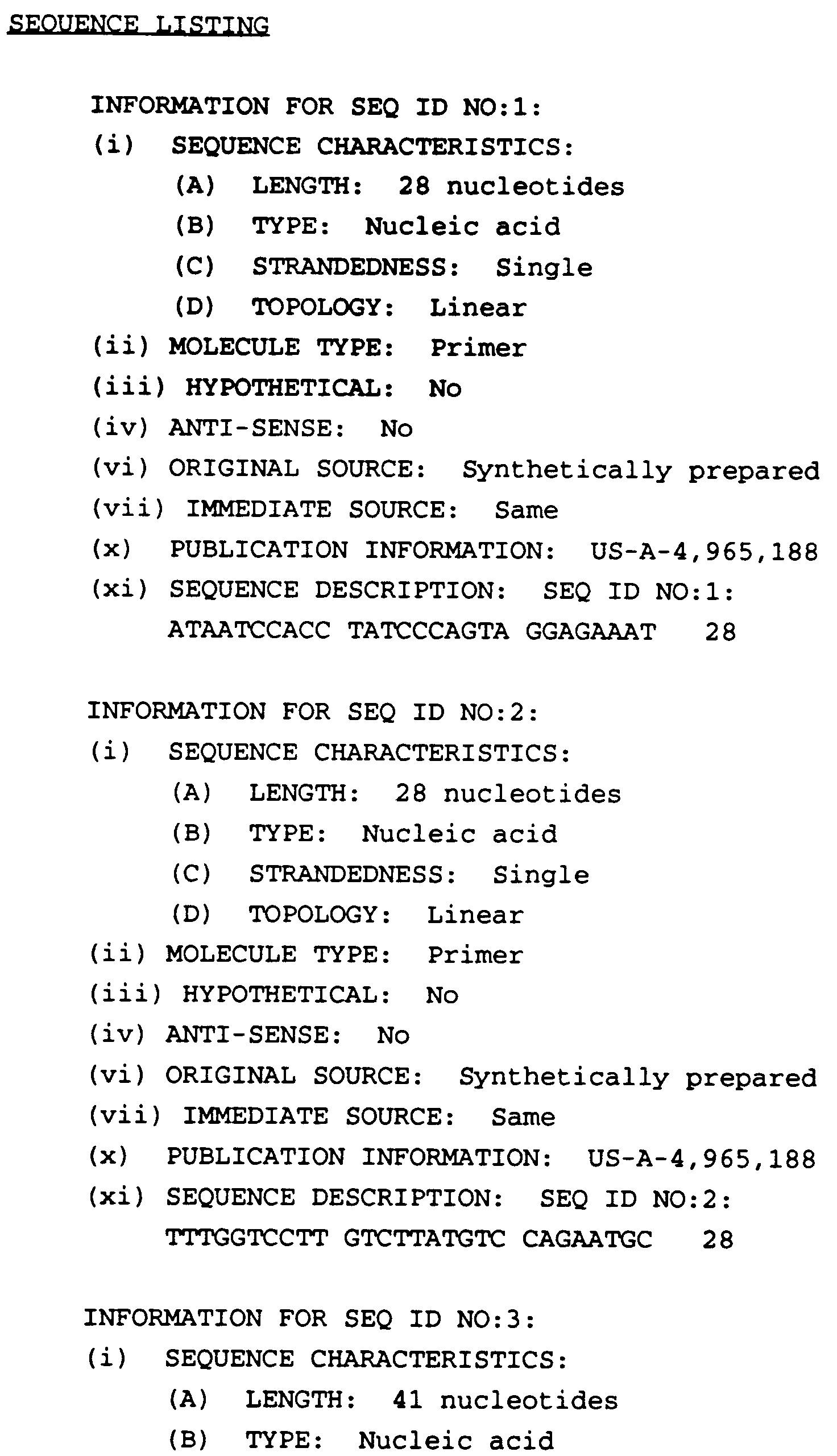

Claims (14)
- A PCR reagent composition comprising a PCR reagent, the composition characterized wherein the PCR reagent is encapsulated within an inert material which is a water-impermeable solid at room temperature, but which melts at a temperature of at least 50°C.
- The composition as claimed in claim 1 wherein the encapsulated PCR reagent is a magnesium salt, a manganese salt or a deoxyribonucleotide-5'-triphosphate.
- The composition as claimed in either of claims 1 or 2 wherein the encapsulated PCR reagent is encapsulated with a wax.
- A diagnostic test kit for polymerase chain reaction comprising, individually packaged, two or more PCR reagents, the kit characterized wherein at least one of the PCR reagents is encapsulated within an inert material which is a water-impermeable solid at room temperature, but which melts at a temperature of at least 50°C.
- The test kit as claimed in claim 4 wherein the encapsulated PCR reagent is:a. a primer,b. a DNA polymerase,c. a DNA polymerase cofactor, ord. a deoxyribonucleotide-5'-triphosphate.
- A method for the amplification of a targeted nucleic acid comprising the steps of:A. contacting a specimen suspected of containing a targeted nucleic acid with the following PCR reagents, in any order,1) a primer complementary to the targeted nucleic acid,2) a DNA polymerase,3) a DNA polymerase cofactor, and4) a deoxyribonucleotide-5'-triphosphate, provided at least one of the PCR reagents 1) to 4) is encapsulated within an inert material which is a water-impermeable solid at room temperature, but which melts at a temperature of at least 50°C, andB. heating the resulting mixture of the specimen and the encapsulated PCR reagent at a temperature sufficient to melt the inert encapsulating material and to form a primer extension product, the temperature being at least 50°C.
- The method as claimed in claim 6 wherein the specimen is contacted with all of the PCR reagents simultaneously.
- The method as claimed in either of claims 6 or 7 wherein the DNA polymerase cofactor is encapsulated with a wax, and the DNA polymeraae cofactor is a magnesium salt.
- A method for the amplification and detection of a targeted double-stranded nucleic acid comprising the steps of:A. heating a targeted double-stranded nucleic acid to denature its strands,B. in the presence of the following PCR reagents:1) a set of primers complementary to the denatured strands,2) a DNA polymerase,3) a DNA polymerase cofactor, and4) a deoxyribonucleotide-5'-triphosphate, provided at least one of the PCR reagents 1) to 4) is encapsulated within an inert material which is a water-impermeable solid at room temperature, but which melts at a temperature of at least about 50°C,
forming primer extension products of the primers and the denatured strands at a temperature of at least 50°C, andC. separating the strands of primer extension products, andD. detecting at least one of the primer extension product strands as an indication of the presence of the targeted nucleic acid. - The method of claim 9 wherein the DNA polymerase cofactor or the deoxyribonucleotide-5'-triphosphate is encapsulated, and the DNA polymerase is a thermostable DNA polymerase isolated from a Thermus species or is an equivalent thereof prepared using recombinant technology.
- The method of claim 9 wherein one of the primers is labeled with a specific binding capture ligand, and detection in step D is carried out by capturing the labeled primer by complexation with a receptor for the specific binding capture ligand which is immobilized on a solid substrate.
- The method of claim 9 wherein the labeled primer is labeled with a specific binding detection ligand, and detection in step D is carried out by complexing the labeled primer with a detectably labeled receptor for the specific binding detection ligand.
- The method of claim 12 wherein the specific binding detection ligand is biotin, and the detectably labeled receptor is detectably labeled avidin.
- A method for controlling the formation of nonspecific nucleic acids during the amplification of a targeted nucleic acid by polymerase chain reaction, comprising:
amplifying a targeted nucleic acid in the presence of the following PCR reagents:1) a primer complementary to the targeted nucleic acid,2) a DNA polymerase,3) a DNA polymerase cofactor, and4) a deoxyribonucleotide-5'-triphosphate, provided at least one of the PCR reagents 1) to 4) is encapsulated within an inert material which is a water-impermeable solid at room temperature, but which melts at a temperature of at least about 50°C.
Applications Claiming Priority (2)
| Application Number | Priority Date | Filing Date | Title |
|---|---|---|---|
| US88091192A | 1992-05-11 | 1992-05-11 | |
| US880911 | 1992-05-11 |
Publications (1)
| Publication Number | Publication Date |
|---|---|
| EP0572057A1 true EP0572057A1 (en) | 1993-12-01 |
Family
ID=25377383
Family Applications (1)
| Application Number | Title | Priority Date | Filing Date |
|---|---|---|---|
| EP93201281A Withdrawn EP0572057A1 (en) | 1992-05-11 | 1993-05-06 | PCR reagent composition, test kit and methods for amplification and detection with reduced nonspecific amplification of nucleic acids |
Country Status (2)
| Country | Link |
|---|---|
| EP (1) | EP0572057A1 (en) |
| JP (1) | JPH0622796A (en) |
Cited By (16)
| Publication number | Priority date | Publication date | Assignee | Title |
|---|---|---|---|---|
| EP0594260A1 (en) * | 1992-10-23 | 1994-04-27 | Johnson & Johnson Clinical Diagnostics, Inc. | Nucleic acid material amplification and detection |
| WO1996000301A1 (en) * | 1994-06-24 | 1996-01-04 | The University Of Houston | Encapsulated pcr reagents |
| US5576197A (en) * | 1995-04-07 | 1996-11-19 | Molecular Bio-Products | Polymerase chain reaction container and methods of using the same |
| US5599660A (en) * | 1993-01-19 | 1997-02-04 | Pharmacia Biotech Inc. | Method and preparation for sequential delivery of wax-embedded, inactivated biological and chemical reagents |
| WO2003078659A3 (en) * | 2002-03-20 | 2003-12-24 | Innovativebio Biz | Microcapsules with controlable permeability encapsulating a nucleic acid amplification reaction mixture and their use as reaction compartments for parallels reactions |
| WO2005106023A1 (en) * | 2004-04-30 | 2005-11-10 | Siemens Aktiengesellschaft | Pcr process and arrangement for dna amplification using dry reagents |
| US7306929B2 (en) | 2003-04-04 | 2007-12-11 | Promega Corporation | Method for controlled release of enzymatic reaction components |
| WO2008140568A3 (en) * | 2006-11-15 | 2009-01-15 | Idaho Technology Inc | High density self-contained biological analysis |
| CN102296023A (en) * | 2010-06-22 | 2011-12-28 | 索尼公司 | Microchip for isothermal nucleic-acid amplification reaction, method for producing the same, and isothermal nucleic-acid amplification method |
| US8088576B2 (en) | 2004-04-30 | 2012-01-03 | Siemens Aktiengesellschaft | Method and assembly for DNA isolation with dry reagents |
| US20130171045A1 (en) * | 2002-04-23 | 2013-07-04 | BioFire Diagnostics, Inc. f/k/a Idaho Technology, Inc. | Sample Withdrawal and Dispensing Device |
| US8940526B2 (en) | 2005-05-09 | 2015-01-27 | Biofire Diagnostics, Llc | Self-contained biological analysis |
| CN104673937A (en) * | 2015-03-05 | 2015-06-03 | 河北农业大学 | Porcine encephalomyocarditis virus nano PCR detection kit and detection method thereof |
| US9102911B2 (en) | 2009-05-15 | 2015-08-11 | Biofire Diagnostics, Llc | High density self-contained biological analysis |
| GB2501179B (en) * | 2012-03-28 | 2016-11-23 | Dnae Group Holdings Ltd | Biosensor device and system |
| WO2024098324A1 (en) * | 2022-11-10 | 2024-05-16 | 深圳先进技术研究院 | Device and method for purifying nucleic acid and preparing detection reaction liquid |
Families Citing this family (3)
| Publication number | Priority date | Publication date | Assignee | Title |
|---|---|---|---|---|
| JP5015441B2 (en) * | 2005-09-30 | 2012-08-29 | 凸版印刷株式会社 | Reaction chip and reaction method |
| WO2010106997A1 (en) * | 2009-03-19 | 2010-09-23 | 株式会社カネカ | Method, kit and device for detecting nucleic acid |
| WO2011002319A2 (en) * | 2009-07-02 | 2011-01-06 | Zygem Corporation Limited | Combined nucleic acid blocking, extraction, and detection in a single reaction vessel |
Citations (3)
| Publication number | Priority date | Publication date | Assignee | Title |
|---|---|---|---|---|
| WO1991012342A1 (en) * | 1990-02-16 | 1991-08-22 | F. Hoffmann-La Roche Ag | Improvements in the specificity and convenience of the polymerase chain reaction |
| WO1991018110A1 (en) * | 1990-05-16 | 1991-11-28 | Mats Malmquist | Method and means to perform biochemical reactions |
| WO1993016200A1 (en) * | 1992-02-13 | 1993-08-19 | Kosak Kenneth M | Heat-releasable reagents for in vitro chemical reactions |
-
1993
- 1993-05-06 EP EP93201281A patent/EP0572057A1/en not_active Withdrawn
- 1993-05-11 JP JP5109117A patent/JPH0622796A/en active Pending
Patent Citations (3)
| Publication number | Priority date | Publication date | Assignee | Title |
|---|---|---|---|---|
| WO1991012342A1 (en) * | 1990-02-16 | 1991-08-22 | F. Hoffmann-La Roche Ag | Improvements in the specificity and convenience of the polymerase chain reaction |
| WO1991018110A1 (en) * | 1990-05-16 | 1991-11-28 | Mats Malmquist | Method and means to perform biochemical reactions |
| WO1993016200A1 (en) * | 1992-02-13 | 1993-08-19 | Kosak Kenneth M | Heat-releasable reagents for in vitro chemical reactions |
Non-Patent Citations (2)
| Title |
|---|
| BIOTECHNIQUES vol. 13, no. 2, February 1992, NATICK, MA US pages 266 - 274 G. RUANO ET AL. 'Heat-soaked PCR: an efficient method for DNA amplification with applications to forensic analysis' * |
| PHARMACEUTICAL RESEARCH vol. 7, no. 11, 1990, pages 1119 - 1126 M. J. JOZWIAKOWSKI 'Characterization of a hot-melt fluid bed coating process for fine granules' * |
Cited By (28)
| Publication number | Priority date | Publication date | Assignee | Title |
|---|---|---|---|---|
| EP0594260A1 (en) * | 1992-10-23 | 1994-04-27 | Johnson & Johnson Clinical Diagnostics, Inc. | Nucleic acid material amplification and detection |
| US5599660A (en) * | 1993-01-19 | 1997-02-04 | Pharmacia Biotech Inc. | Method and preparation for sequential delivery of wax-embedded, inactivated biological and chemical reagents |
| WO1996000301A1 (en) * | 1994-06-24 | 1996-01-04 | The University Of Houston | Encapsulated pcr reagents |
| US5576197A (en) * | 1995-04-07 | 1996-11-19 | Molecular Bio-Products | Polymerase chain reaction container and methods of using the same |
| WO2003078659A3 (en) * | 2002-03-20 | 2003-12-24 | Innovativebio Biz | Microcapsules with controlable permeability encapsulating a nucleic acid amplification reaction mixture and their use as reaction compartments for parallels reactions |
| US20130171045A1 (en) * | 2002-04-23 | 2013-07-04 | BioFire Diagnostics, Inc. f/k/a Idaho Technology, Inc. | Sample Withdrawal and Dispensing Device |
| US7306929B2 (en) | 2003-04-04 | 2007-12-11 | Promega Corporation | Method for controlled release of enzymatic reaction components |
| CN102409039A (en) * | 2004-04-30 | 2012-04-11 | 西门子公司 | Method and device for amplifying DNA by means of PCR using dry reagents |
| US7993828B2 (en) | 2004-04-30 | 2011-08-09 | Siemens Aktiengesellschaft | PCR process and arrangement for DNA amplification using dry reagents |
| US8088576B2 (en) | 2004-04-30 | 2012-01-03 | Siemens Aktiengesellschaft | Method and assembly for DNA isolation with dry reagents |
| DE102004021822B3 (en) * | 2004-04-30 | 2005-11-17 | Siemens Ag | Method and arrangement for DNA amplification by means of PCR using dry reagents |
| WO2005106023A1 (en) * | 2004-04-30 | 2005-11-10 | Siemens Aktiengesellschaft | Pcr process and arrangement for dna amplification using dry reagents |
| US12403479B2 (en) | 2005-05-09 | 2025-09-02 | Biofire Diagnostics, Llc | Self-contained biological analysis |
| US12275013B2 (en) | 2005-05-09 | 2025-04-15 | Biofire Diganostics, Llc | Self-contained biological analysis |
| US10058868B2 (en) | 2005-05-09 | 2018-08-28 | Biofire Diagnostics, Llc | Self-contained biological analysis |
| US8940526B2 (en) | 2005-05-09 | 2015-01-27 | Biofire Diagnostics, Llc | Self-contained biological analysis |
| US11707741B2 (en) | 2005-05-09 | 2023-07-25 | Biofire Diagnostics, Llc | Self-contained biological analysis |
| US8895295B2 (en) | 2006-11-15 | 2014-11-25 | Biofire Diagnostics, Llc | High density self-contained biological analysis |
| US10053728B2 (en) | 2006-11-15 | 2018-08-21 | Biofire Diagnostics, Llc | High density self-contained biological analysis |
| EP2089543B1 (en) * | 2006-11-15 | 2020-07-01 | BioFire Diagnostics, LLC | High density self-contained biological analysis |
| US10889856B2 (en) | 2006-11-15 | 2021-01-12 | Biofire Diagnostics, Llc | High density self-contained biological analysis |
| US11866774B2 (en) | 2006-11-15 | 2024-01-09 | Biofire Diagnostics, Llc | High density self-contained biological analysis |
| WO2008140568A3 (en) * | 2006-11-15 | 2009-01-15 | Idaho Technology Inc | High density self-contained biological analysis |
| US9102911B2 (en) | 2009-05-15 | 2015-08-11 | Biofire Diagnostics, Llc | High density self-contained biological analysis |
| CN102296023A (en) * | 2010-06-22 | 2011-12-28 | 索尼公司 | Microchip for isothermal nucleic-acid amplification reaction, method for producing the same, and isothermal nucleic-acid amplification method |
| GB2501179B (en) * | 2012-03-28 | 2016-11-23 | Dnae Group Holdings Ltd | Biosensor device and system |
| CN104673937A (en) * | 2015-03-05 | 2015-06-03 | 河北农业大学 | Porcine encephalomyocarditis virus nano PCR detection kit and detection method thereof |
| WO2024098324A1 (en) * | 2022-11-10 | 2024-05-16 | 深圳先进技术研究院 | Device and method for purifying nucleic acid and preparing detection reaction liquid |
Also Published As
| Publication number | Publication date |
|---|---|
| JPH0622796A (en) | 1994-02-01 |
Similar Documents
| Publication | Publication Date | Title |
|---|---|---|
| EP0572057A1 (en) | PCR reagent composition, test kit and methods for amplification and detection with reduced nonspecific amplification of nucleic acids | |
| US5587287A (en) | Thermostable polymerase specific antibody-containing DNA amplification composition and kit | |
| US5888723A (en) | Method for nucleic acid amplification and detection using adhered probes | |
| EP0795751B1 (en) | Whole blood sample preparation for polymerase chain reaction using ammonium chloride and a carboxylic acid or metal carboxylate for selective red blood cell lysis | |
| EP0546590B1 (en) | Detection of amplified nucleic acid using secondary soluble helper oligonucleotides and test kit | |
| EP0530357B1 (en) | Element and method for nucleic acid amplification and detection using adhered probes | |
| JP3727692B2 (en) | Method for obtaining nucleic acid from lysate and test kit for amplifying target nucleic acid | |
| EP0511712B2 (en) | Nucleic acid amplification and detection methods using rapid polymerase chain reaction cycle | |
| US6936415B1 (en) | Diagnostic compositions, elements, methods and test kits for amplification and detection of two or more DNA's using primers having matched melting temperatures | |
| EP0408738B1 (en) | Nucleic acid test article and its use to detect a predetermined nucleic acid | |
| US5403707A (en) | Diagnostic compositions, elements, methods and test kits for amplification and detection of retroviral DNA using primers having matched melting temperatures | |
| EP0481069A1 (en) | Method for reducing carryover contamination in an amplification procedure | |
| EP0630974A2 (en) | Method and test kit for the detection of inorganic orthophosphate by-product from amplification of target nucleic acid | |
| HK1000253B (en) | Detection of amplified nucleic acid using secondary soluble helper oligonucleotides and test kit | |
| EP0702090A2 (en) | Coamplification of target nucleic acids using volume exclusion agent, in reaction composition, test kit and test device useful therefor | |
| EP0648845A2 (en) | Method for coamplification of two different nucleic acid sequences using polymerase chain reaction | |
| EP0630973A2 (en) | Diagnostic compositions, elements, methods & test kits for amplification & detection of two or more DNA's using primers having matched melting temperatures | |
| CA2145957C (en) | Method, test element and kit for semi-quantitative detection of target nucleic acid | |
| EP0586011A2 (en) | Methods for production and amplification of nucleic acids | |
| US5559013A (en) | Method of amplification using intermediate renaturation step | |
| AU636499C (en) | Method for reducing carryover contamination in an amplification procedure | |
| HK1004861B (en) | Nucleic acid amplification and detection methods using rapid polymerase chain reaction cycle |
Legal Events
| Date | Code | Title | Description |
|---|---|---|---|
| PUAI | Public reference made under article 153(3) epc to a published international application that has entered the european phase |
Free format text: ORIGINAL CODE: 0009012 |
|
| AK | Designated contracting states |
Kind code of ref document: A1 Designated state(s): AT BE CH DE DK FR GB IE IT LI LU NL SE |
|
| 17P | Request for examination filed |
Effective date: 19940530 |
|
| RAP1 | Party data changed (applicant data changed or rights of an application transferred) |
Owner name: CLINICAL DIAGNOSTIC SYSTEMS, INC. |
|
| RAP1 | Party data changed (applicant data changed or rights of an application transferred) |
Owner name: JOHNSON & JOHNSON CLINICAL DIAGNOSTICS, INC. |
|
| 17Q | First examination report despatched |
Effective date: 19961115 |
|
| STAA | Information on the status of an ep patent application or granted ep patent |
Free format text: STATUS: THE APPLICATION IS DEEMED TO BE WITHDRAWN |
|
| 18D | Application deemed to be withdrawn |
Effective date: 19970527 |