EP0581754A1 - Process and catalyst for producing isotactic polyolefins - Google Patents
Process and catalyst for producing isotactic polyolefins Download PDFInfo
- Publication number
- EP0581754A1 EP0581754A1 EP19930870130 EP93870130A EP0581754A1 EP 0581754 A1 EP0581754 A1 EP 0581754A1 EP 19930870130 EP19930870130 EP 19930870130 EP 93870130 A EP93870130 A EP 93870130A EP 0581754 A1 EP0581754 A1 EP 0581754A1
- Authority
- EP
- European Patent Office
- Prior art keywords
- catalyst
- recited
- carbon atoms
- metallocene
- cpr
- Prior art date
- Legal status (The legal status is an assumption and is not a legal conclusion. Google has not performed a legal analysis and makes no representation as to the accuracy of the status listed.)
- Withdrawn
Links
- 239000003054 catalyst Substances 0.000 title claims abstract description 78
- 238000000034 method Methods 0.000 title claims abstract description 31
- 230000008569 process Effects 0.000 title claims abstract description 16
- 229920000098 polyolefin Polymers 0.000 title claims abstract description 11
- YBYIRNPNPLQARY-UHFFFAOYSA-N 1H-indene Natural products C1=CC=C2CC=CC2=C1 YBYIRNPNPLQARY-UHFFFAOYSA-N 0.000 claims abstract description 38
- 125000003454 indenyl group Chemical group C1(C=CC2=CC=CC=C12)* 0.000 claims abstract description 30
- 125000004432 carbon atom Chemical group C* 0.000 claims abstract description 27
- 150000001336 alkenes Chemical class 0.000 claims abstract description 11
- 229910052736 halogen Inorganic materials 0.000 claims abstract description 10
- 229910052751 metal Inorganic materials 0.000 claims abstract description 10
- 239000002184 metal Substances 0.000 claims abstract description 10
- 229910052739 hydrogen Inorganic materials 0.000 claims abstract description 7
- 239000001257 hydrogen Substances 0.000 claims abstract description 7
- OKTJSMMVPCPJKN-UHFFFAOYSA-N Carbon Chemical compound [C] OKTJSMMVPCPJKN-UHFFFAOYSA-N 0.000 claims abstract description 6
- 229910052799 carbon Inorganic materials 0.000 claims abstract description 6
- 229910052723 transition metal Inorganic materials 0.000 claims abstract description 6
- 150000003624 transition metals Chemical class 0.000 claims abstract description 6
- 125000004435 hydrogen atom Chemical group [H]* 0.000 claims abstract description 4
- 125000005843 halogen group Chemical group 0.000 claims abstract 3
- -1 hydrocarbyl radical Chemical group 0.000 claims description 47
- 238000006116 polymerization reaction Methods 0.000 claims description 24
- 239000004743 Polypropylene Substances 0.000 claims description 16
- 229920001155 polypropylene Polymers 0.000 claims description 15
- 239000003795 chemical substances by application Substances 0.000 claims description 9
- 238000002844 melting Methods 0.000 claims description 8
- 230000008018 melting Effects 0.000 claims description 8
- 229910052710 silicon Inorganic materials 0.000 claims description 7
- 239000010703 silicon Substances 0.000 claims description 7
- QQONPFPTGQHPMA-UHFFFAOYSA-N propylene Natural products CC=C QQONPFPTGQHPMA-UHFFFAOYSA-N 0.000 claims description 6
- 125000004805 propylene group Chemical group [H]C([H])([H])C([H])([*:1])C([H])([H])[*:2] 0.000 claims description 6
- 239000002841 Lewis acid Substances 0.000 claims description 5
- 150000007517 lewis acids Chemical class 0.000 claims description 5
- JRZJOMJEPLMPRA-UHFFFAOYSA-N olefin Natural products CCCCCCCC=C JRZJOMJEPLMPRA-UHFFFAOYSA-N 0.000 claims description 5
- LEOYKWIXWJXYQJ-UHFFFAOYSA-L [Cl-].[Cl-].CC1=CC2=CC=CC=C2C1[Zr+2]([SiH](C)C)C1C2=CC=CC=C2C=C1C Chemical group [Cl-].[Cl-].CC1=CC2=CC=CC=C2C1[Zr+2]([SiH](C)C)C1C2=CC=CC=C2C=C1C LEOYKWIXWJXYQJ-UHFFFAOYSA-L 0.000 claims description 3
- QCWXUUIWCKQGHC-UHFFFAOYSA-N Zirconium Chemical group [Zr] QCWXUUIWCKQGHC-UHFFFAOYSA-N 0.000 claims description 2
- 229910052801 chlorine Inorganic materials 0.000 claims description 2
- 239000000460 chlorine Substances 0.000 claims description 2
- WCYWZMWISLQXQU-UHFFFAOYSA-N methyl Chemical group [CH3] WCYWZMWISLQXQU-UHFFFAOYSA-N 0.000 claims description 2
- 229910052726 zirconium Inorganic materials 0.000 claims description 2
- 125000001309 chloro group Chemical group Cl* 0.000 claims 1
- 229920000642 polymer Polymers 0.000 abstract description 21
- 239000012968 metallocene catalyst Substances 0.000 abstract description 18
- 238000004519 manufacturing process Methods 0.000 abstract description 10
- 230000000379 polymerizing effect Effects 0.000 abstract description 3
- 125000001183 hydrocarbyl group Chemical group 0.000 abstract description 2
- 229910001507 metal halide Inorganic materials 0.000 abstract description 2
- 150000005309 metal halides Chemical class 0.000 abstract description 2
- VLKZOEOYAKHREP-UHFFFAOYSA-N n-Hexane Chemical compound CCCCCC VLKZOEOYAKHREP-UHFFFAOYSA-N 0.000 description 21
- 125000002496 methyl group Chemical group [H]C([H])([H])* 0.000 description 14
- 239000007787 solid Substances 0.000 description 11
- 229910007928 ZrCl2 Inorganic materials 0.000 description 9
- 125000001424 substituent group Chemical group 0.000 description 9
- 238000006243 chemical reaction Methods 0.000 description 8
- 229920001580 isotactic polymer Polymers 0.000 description 8
- RTZKZFJDLAIYFH-UHFFFAOYSA-N Diethyl ether Chemical compound CCOCC RTZKZFJDLAIYFH-UHFFFAOYSA-N 0.000 description 7
- 150000002367 halogens Chemical group 0.000 description 7
- 229920001576 syndiotactic polymer Polymers 0.000 description 7
- YMWUJEATGCHHMB-UHFFFAOYSA-N Dichloromethane Chemical compound ClCCl YMWUJEATGCHHMB-UHFFFAOYSA-N 0.000 description 6
- YXFVVABEGXRONW-UHFFFAOYSA-N Toluene Chemical compound CC1=CC=CC=C1 YXFVVABEGXRONW-UHFFFAOYSA-N 0.000 description 6
- 229910052782 aluminium Inorganic materials 0.000 description 6
- 229920001585 atactic polymer Polymers 0.000 description 6
- 239000002904 solvent Substances 0.000 description 6
- XUIMIQQOPSSXEZ-UHFFFAOYSA-N Silicon Chemical compound [Si] XUIMIQQOPSSXEZ-UHFFFAOYSA-N 0.000 description 5
- 150000001768 cations Chemical class 0.000 description 5
- 150000002469 indenes Chemical class 0.000 description 5
- 239000000203 mixture Substances 0.000 description 5
- 238000002360 preparation method Methods 0.000 description 5
- 238000001644 13C nuclear magnetic resonance spectroscopy Methods 0.000 description 4
- 238000005481 NMR spectroscopy Methods 0.000 description 4
- CTQNGGLPUBDAKN-UHFFFAOYSA-N O-Xylene Chemical compound CC1=CC=CC=C1C CTQNGGLPUBDAKN-UHFFFAOYSA-N 0.000 description 4
- 150000001450 anions Chemical class 0.000 description 4
- 239000000178 monomer Substances 0.000 description 4
- 239000008096 xylene Substances 0.000 description 4
- YSAXEHWHSLANOM-UHFFFAOYSA-N 2-methyl-1h-indene Chemical compound C1=CC=C2CC(C)=CC2=C1 YSAXEHWHSLANOM-UHFFFAOYSA-N 0.000 description 3
- UHOVQNZJYSORNB-UHFFFAOYSA-N Benzene Chemical compound C1=CC=CC=C1 UHOVQNZJYSORNB-UHFFFAOYSA-N 0.000 description 3
- UFHFLCQGNIYNRP-UHFFFAOYSA-N Hydrogen Chemical compound [H][H] UFHFLCQGNIYNRP-UHFFFAOYSA-N 0.000 description 3
- XAGFODPZIPBFFR-UHFFFAOYSA-N aluminium Chemical compound [Al] XAGFODPZIPBFFR-UHFFFAOYSA-N 0.000 description 3
- 230000008901 benefit Effects 0.000 description 3
- 239000000706 filtrate Substances 0.000 description 3
- 150000002500 ions Chemical class 0.000 description 3
- 239000003446 ligand Substances 0.000 description 3
- 150000002736 metal compounds Chemical class 0.000 description 3
- 230000000737 periodic effect Effects 0.000 description 3
- 239000011541 reaction mixture Substances 0.000 description 3
- 238000001228 spectrum Methods 0.000 description 3
- CPLXHLVBOLITMK-UHFFFAOYSA-N Magnesium oxide Chemical compound [Mg]=O CPLXHLVBOLITMK-UHFFFAOYSA-N 0.000 description 2
- MZRVEZGGRBJDDB-UHFFFAOYSA-N N-Butyllithium Chemical compound [Li]CCCC MZRVEZGGRBJDDB-UHFFFAOYSA-N 0.000 description 2
- VYPSYNLAJGMNEJ-UHFFFAOYSA-N Silicium dioxide Chemical compound O=[Si]=O VYPSYNLAJGMNEJ-UHFFFAOYSA-N 0.000 description 2
- GWEVSGVZZGPLCZ-UHFFFAOYSA-N Titan oxide Chemical compound O=[Ti]=O GWEVSGVZZGPLCZ-UHFFFAOYSA-N 0.000 description 2
- MCMNRKCIXSYSNV-UHFFFAOYSA-N Zirconium dioxide Chemical compound O=[Zr]=O MCMNRKCIXSYSNV-UHFFFAOYSA-N 0.000 description 2
- 125000002091 cationic group Chemical group 0.000 description 2
- 239000003426 co-catalyst Substances 0.000 description 2
- 150000001875 compounds Chemical class 0.000 description 2
- 229910000365 copper sulfate Inorganic materials 0.000 description 2
- ARUVKPQLZAKDPS-UHFFFAOYSA-L copper(II) sulfate Chemical compound [Cu+2].[O-][S+2]([O-])([O-])[O-] ARUVKPQLZAKDPS-UHFFFAOYSA-L 0.000 description 2
- 238000001914 filtration Methods 0.000 description 2
- 238000000655 nuclear magnetic resonance spectrum Methods 0.000 description 2
- 125000002524 organometallic group Chemical group 0.000 description 2
- 239000000047 product Substances 0.000 description 2
- 230000000707 stereoselective effect Effects 0.000 description 2
- 238000003756 stirring Methods 0.000 description 2
- JLTRXTDYQLMHGR-UHFFFAOYSA-N trimethylaluminium Chemical compound C[Al](C)C JLTRXTDYQLMHGR-UHFFFAOYSA-N 0.000 description 2
- 238000005160 1H NMR spectroscopy Methods 0.000 description 1
- ZAMOUSCENKQFHK-UHFFFAOYSA-N Chlorine atom Chemical compound [Cl] ZAMOUSCENKQFHK-UHFFFAOYSA-N 0.000 description 1
- VGGSQFUCUMXWEO-UHFFFAOYSA-N Ethene Chemical compound C=C VGGSQFUCUMXWEO-UHFFFAOYSA-N 0.000 description 1
- 239000005977 Ethylene Substances 0.000 description 1
- 239000004698 Polyethylene Substances 0.000 description 1
- WYURNTSHIVDZCO-UHFFFAOYSA-N Tetrahydrofuran Chemical compound C1CCOC1 WYURNTSHIVDZCO-UHFFFAOYSA-N 0.000 description 1
- 125000005234 alkyl aluminium group Chemical group 0.000 description 1
- 125000000217 alkyl group Chemical group 0.000 description 1
- PNEYBMLMFCGWSK-UHFFFAOYSA-N aluminium oxide Inorganic materials [O-2].[O-2].[O-2].[Al+3].[Al+3] PNEYBMLMFCGWSK-UHFFFAOYSA-N 0.000 description 1
- 229920006125 amorphous polymer Polymers 0.000 description 1
- 238000004458 analytical method Methods 0.000 description 1
- 125000000129 anionic group Chemical group 0.000 description 1
- 125000003118 aryl group Chemical group 0.000 description 1
- 230000009286 beneficial effect Effects 0.000 description 1
- 230000003197 catalytic effect Effects 0.000 description 1
- 230000008859 change Effects 0.000 description 1
- 239000012230 colorless oil Substances 0.000 description 1
- 125000004122 cyclic group Chemical group 0.000 description 1
- 230000003247 decreasing effect Effects 0.000 description 1
- 229960004132 diethyl ether Drugs 0.000 description 1
- LIKFHECYJZWXFJ-UHFFFAOYSA-N dimethyldichlorosilane Chemical compound C[Si](C)(Cl)Cl LIKFHECYJZWXFJ-UHFFFAOYSA-N 0.000 description 1
- 238000004821 distillation Methods 0.000 description 1
- 230000000694 effects Effects 0.000 description 1
- 238000010438 heat treatment Methods 0.000 description 1
- 229920001519 homopolymer Polymers 0.000 description 1
- 238000011065 in-situ storage Methods 0.000 description 1
- 229910052809 inorganic oxide Inorganic materials 0.000 description 1
- 150000008040 ionic compounds Chemical class 0.000 description 1
- 239000000395 magnesium oxide Substances 0.000 description 1
- 239000000463 material Substances 0.000 description 1
- 230000007246 mechanism Effects 0.000 description 1
- 229910044991 metal oxide Inorganic materials 0.000 description 1
- 150000004706 metal oxides Chemical class 0.000 description 1
- DVSDBMFJEQPWNO-UHFFFAOYSA-N methyllithium Chemical compound C[Li] DVSDBMFJEQPWNO-UHFFFAOYSA-N 0.000 description 1
- 238000012986 modification Methods 0.000 description 1
- 230000004048 modification Effects 0.000 description 1
- 239000012299 nitrogen atmosphere Substances 0.000 description 1
- 239000002574 poison Substances 0.000 description 1
- 231100000614 poison Toxicity 0.000 description 1
- 229920000573 polyethylene Polymers 0.000 description 1
- 239000011148 porous material Substances 0.000 description 1
- 239000000843 powder Substances 0.000 description 1
- 239000012260 resinous material Substances 0.000 description 1
- 239000000377 silicon dioxide Substances 0.000 description 1
- 239000002002 slurry Substances 0.000 description 1
- 230000006641 stabilisation Effects 0.000 description 1
- 238000011105 stabilization Methods 0.000 description 1
- 229910001220 stainless steel Inorganic materials 0.000 description 1
- 239000010935 stainless steel Substances 0.000 description 1
- 239000000454 talc Substances 0.000 description 1
- 229910052623 talc Inorganic materials 0.000 description 1
- 150000003623 transition metal compounds Chemical class 0.000 description 1
- VOITXYVAKOUIBA-UHFFFAOYSA-N triethylaluminium Chemical compound CC[Al](CC)CC VOITXYVAKOUIBA-UHFFFAOYSA-N 0.000 description 1
- 238000013022 venting Methods 0.000 description 1
- 238000005406 washing Methods 0.000 description 1
- XLYOFNOQVPJJNP-UHFFFAOYSA-N water Substances O XLYOFNOQVPJJNP-UHFFFAOYSA-N 0.000 description 1
- DUNKXUFBGCUVQW-UHFFFAOYSA-J zirconium tetrachloride Chemical compound Cl[Zr](Cl)(Cl)Cl DUNKXUFBGCUVQW-UHFFFAOYSA-J 0.000 description 1
- VPGLGRNSAYHXPY-UHFFFAOYSA-L zirconium(2+);dichloride Chemical compound Cl[Zr]Cl VPGLGRNSAYHXPY-UHFFFAOYSA-L 0.000 description 1
- 239000004711 α-olefin Substances 0.000 description 1
Images


Classifications
-
- C—CHEMISTRY; METALLURGY
- C08—ORGANIC MACROMOLECULAR COMPOUNDS; THEIR PREPARATION OR CHEMICAL WORKING-UP; COMPOSITIONS BASED THEREON
- C08F—MACROMOLECULAR COMPOUNDS OBTAINED BY REACTIONS ONLY INVOLVING CARBON-TO-CARBON UNSATURATED BONDS
- C08F10/00—Homopolymers and copolymers of unsaturated aliphatic hydrocarbons having only one carbon-to-carbon double bond
-
- C—CHEMISTRY; METALLURGY
- C08—ORGANIC MACROMOLECULAR COMPOUNDS; THEIR PREPARATION OR CHEMICAL WORKING-UP; COMPOSITIONS BASED THEREON
- C08F—MACROMOLECULAR COMPOUNDS OBTAINED BY REACTIONS ONLY INVOLVING CARBON-TO-CARBON UNSATURATED BONDS
- C08F4/00—Polymerisation catalysts
- C08F4/42—Metals; Metal hydrides; Metallo-organic compounds; Use thereof as catalyst precursors
- C08F4/44—Metals; Metal hydrides; Metallo-organic compounds; Use thereof as catalyst precursors selected from light metals, zinc, cadmium, mercury, copper, silver, gold, boron, gallium, indium, thallium, rare earths or actinides
- C08F4/60—Metals; Metal hydrides; Metallo-organic compounds; Use thereof as catalyst precursors selected from light metals, zinc, cadmium, mercury, copper, silver, gold, boron, gallium, indium, thallium, rare earths or actinides together with refractory metals, iron group metals, platinum group metals, manganese, rhenium technetium or compounds thereof
- C08F4/62—Refractory metals or compounds thereof
- C08F4/639—Component covered by group C08F4/62 containing a transition metal-carbon bond
- C08F4/63912—Component covered by group C08F4/62 containing a transition metal-carbon bond in combination with an organoaluminium compound
-
- C—CHEMISTRY; METALLURGY
- C08—ORGANIC MACROMOLECULAR COMPOUNDS; THEIR PREPARATION OR CHEMICAL WORKING-UP; COMPOSITIONS BASED THEREON
- C08F—MACROMOLECULAR COMPOUNDS OBTAINED BY REACTIONS ONLY INVOLVING CARBON-TO-CARBON UNSATURATED BONDS
- C08F4/00—Polymerisation catalysts
- C08F4/42—Metals; Metal hydrides; Metallo-organic compounds; Use thereof as catalyst precursors
- C08F4/44—Metals; Metal hydrides; Metallo-organic compounds; Use thereof as catalyst precursors selected from light metals, zinc, cadmium, mercury, copper, silver, gold, boron, gallium, indium, thallium, rare earths or actinides
- C08F4/60—Metals; Metal hydrides; Metallo-organic compounds; Use thereof as catalyst precursors selected from light metals, zinc, cadmium, mercury, copper, silver, gold, boron, gallium, indium, thallium, rare earths or actinides together with refractory metals, iron group metals, platinum group metals, manganese, rhenium technetium or compounds thereof
- C08F4/62—Refractory metals or compounds thereof
- C08F4/639—Component covered by group C08F4/62 containing a transition metal-carbon bond
- C08F4/6392—Component covered by group C08F4/62 containing a transition metal-carbon bond containing at least one cyclopentadienyl ring, condensed or not, e.g. an indenyl or a fluorenyl ring
- C08F4/63922—Component covered by group C08F4/62 containing a transition metal-carbon bond containing at least one cyclopentadienyl ring, condensed or not, e.g. an indenyl or a fluorenyl ring containing at least two cyclopentadienyl rings, fused or not
- C08F4/63927—Component covered by group C08F4/62 containing a transition metal-carbon bond containing at least one cyclopentadienyl ring, condensed or not, e.g. an indenyl or a fluorenyl ring containing at least two cyclopentadienyl rings, fused or not two cyclopentadienyl rings being mutually bridged
-
- Y—GENERAL TAGGING OF NEW TECHNOLOGICAL DEVELOPMENTS; GENERAL TAGGING OF CROSS-SECTIONAL TECHNOLOGIES SPANNING OVER SEVERAL SECTIONS OF THE IPC; TECHNICAL SUBJECTS COVERED BY FORMER USPC CROSS-REFERENCE ART COLLECTIONS [XRACs] AND DIGESTS
- Y10—TECHNICAL SUBJECTS COVERED BY FORMER USPC
- Y10S—TECHNICAL SUBJECTS COVERED BY FORMER USPC CROSS-REFERENCE ART COLLECTIONS [XRACs] AND DIGESTS
- Y10S526/00—Synthetic resins or natural rubbers -- part of the class 520 series
- Y10S526/943—Polymerization with metallocene catalysts
Definitions
- This invention relates to a metallocene catalyst component useful in preparing isotactic polyolefins.
- the catalyst component comprises a bridged metallocene in which the two substituted indenyl rings are complexed to a metal hydrocarbyl or metal halide.
- the invention further includes a process of preparing isotactic polyolefins that comprises the use of one or more of the disclosed catalyst components and also a process for preparing the catalyst components.
- the present invention provides a catalyst and process for polymerizing olefins having three or more carbon atoms to produce a polymer with a isotactic stereochemical configuration.
- the catalyst and process are particularly useful in polymerizing propylene to form isotactic polypropylene.
- the isotactic structure is typically described as having the methyl groups attached to the tertiary carbon atoms of successive monomeric units on the same side of a hypothetical plane through the main chain of the polymer, e.g., the methyl groups are all above or all below the plane.
- Fischer projection formula the stereochemical sequence of isotactic polypropylene is described as follows:
- Bovey's NMR nomenclature for an isotactic pentad is ...mmmm... with each "m” representing a “meso" dyad or successive methyl groups on the same side in the plane.
- any deviation or inversion in the structure of the chain lowers the degree of isotacticity and crystallinity of the polymer.
- syndiotactic polymers are those in which the methyl groups attached to the tertiary carbon atoms of successive monomeric units in the chain lie on alternate sides of the plane of the polymer.
- Fischer projection formula the structure of a syndiotactic polymer is designated as:
- this pentad is described as ...rrrr... in which each "r” represents a "racemic" dyad, i.e., successive methyl group on alternate sides of the plane.
- the percentage of rdyads in the chain determines the degree of syndiotacticity of the polymer.
- Syndiotactic polymers are crystalline and, like the isotactic polymers, are insoluble in xylene. This crystallinity distinguishes both syndiotactic and isotactic polymers from an atactic polymer which is soluble in xylene.
- Atactic polymer exhibits no regular order of repeating unit configurations in the polymer chain and forms essentially a waxy product.
- Catalysts that produce isotactic polyolefins are disclosed in European Patent Application No. 87870132.5 (Publication No. 0 284 708 published October 5, 1988), and U.S. Patent Nos. 4,794,096 and 4,975,403. This applica-tion and these patents disclosed chiral, stereorigid metallocene catalyst components that are used in the polymerization of olefins to form isotactic polymers and are especially useful in the preparation of a highly isotactic polypropylene.
- the present invention provides an isospecific catalyst, a process for preparing the catalyst and a polymerization process for preparing isotactic polyolefins, more particularly, isotactic polypropylene, using the catalyst.
- the novel catalyst component provided by the present invention is a stereorigid metallocene described by the formula: wherein (CpR 2 C 4 R 4 ) and (CpR' 2 C 4 R' 4 ) are substituted indenyl rings; each R and R' is a hydrogen or a hydro- carbyl radical having 1-20 carbon atoms; R" is a structural bridge between the two indenyl rings imparting stereorigidity to the indenyl rings; Me is a transition metal; and each Q is a hydrocarbyl radical or is a halogen. Further, one R and R' is a hydrocarbyl radical having 1-20 carbon atoms in a proximal position adjacent to the bridgehead carbon of the indenyl rings.
- the present invention provides a process for producing isotactic polyolefins and, particularly, isotactic polypropylene, that comprises utilizing at least one of t he catalyst components described by the above formula and introducing the catalyst into a polymeriza-tion reaction zone containing an olefin monomer.
- a cocatalyst such as alumoxane and/or an ionic compound capable of reacting with the metallocene to form a cationic metallocene may be introduced into the reaction zone.
- the catalyst component may also be pre-polymerized prior to introducing it into the reaction zone and/or prior to the stabilization of reaction conditions in the reactor.
- the present invention also includes a process for preparing a bridged metallocene component comprising contacting a substituted indenyl with an dialkylsilyldichloride followed by a second equivalent of a different substituted indenyl to produce a silicon bridged disubsti-tuted indenyl.
- the present invention further includes a process for preparing a bridged metallocene catalyst component comprising contacting a substituted indene anion having proximal substituent(s) on the indenyl ring with a substituted indene anion having proximal substituent(s) under reaction conditions sufficient to produce a bridged substituted diindene.
- the process further comprises contacting the bridged diindene with a metal compound of the formula MeQ k as defined above under reaction conditions sufficient to complex the bridged diindene to produce a bridged metallocene wherein Me is a Group IIIB, IVB, VB or VIB metal from the Periodic Table of Elements, each Q is a hydrocarbyl radical having 1-20 carbon atoms or is a halogen and k is the valence of Me minus 2.
- the present invention provides a metallocene catalyst component and processes for making and using the catalyst component, particularly in the production of isotactic polyolefins, especially isotactic polypropylene.
- the polymer product When propylene or other alpha-olefins are polymerized using a catalyst component consisting of a transition metal compound, the polymer product typically comprises a mixture of amorphous atactic and crystalline xylene insoluble fractions.
- the crystalline fraction may contain either isotactic or syndiotactic polymer, or a mixture of both.
- Highly iso-specific metallocene catalyst components are disclosed in copending U.S. Application Serial No. 317,089 and U.S. Patent Nos. 4,794,096 and 4,975,403.
- each (CpR 2 C 4 R 4 ) and (CpR' 2 C 4 R' 4 ) are substituted indenyl rings;
- R and R' are hydrogen or a hydro- carbyl radical having 1-20 carbon atoms, each R may be the same or different, each R' also may be the same or differ-ent, one R and R' is a proximal substituent which is a hydro-carbyl radical from 1-20 carbon atoms, preferably is an alkyl radical of 1-4 carbon atoms and, most preferably, is a methyl radical, where proximal refers to position 2 of the indenyl ring relative to the carbon attached to R" (position 1), i.e., adjacent to the bridgehead carbon, the R and R' proximal substitutents being the same or different, but preferably are the same, and the remaining R and R' substituents are preferably hydrogen;
- R" is a structural bridge between the two inden
- the metallocene catalyst component may be supported or unsupported.
- the support can be any solid which is chemically inert and unreactive with the metallocene and the other catalyst components.
- support material are porous materials such as talc; inorganic oxides, such as Group IIA, IIIA, IVA or IVB metal oxides, specifically, silica, alumina, magnesia, titania, zirconia, and mixtures thereof; and resinous materials, such as polyolefins, specifically, finely divided polyethylene, as disclosed in U.S. Patent No. 4,701,432, hereby incorporated by reference.
- the catalyst component may be prepared by any method known in the art. Two methods of preparing the catalyst component are disclosed below. It is important that the catalyst complex be "clean" as usually low molecular weight, amorphous polymer is produced by impure catalysts. Generally, the prepara-tion of the catalyst complex consists of forming and isolating the substituted indenyl ligands, the anions of which are then reacted with a halogenated metal to form the complex.
- a process for preparing a bridged metallocene catalyst component comprises contacting a substituted indene having a proximal substituent on the indenyl ring with the same or another substituted indene having a proximal substituent under reaction conditions sufficient to produce a bridged substituted diindene.
- the process further comprises contacting the anionic form of the bridged substituted diindene with a metal compound of the formula MeQ " wherein Me is a Group IIIB, IVB, VB or VIB metal from the Periodic Table of Elements, each Q is a hydrocarbyl radical having 1-20 carbon atoms or is a halogen and v is the valence of Me, under reaction conditions sufficient to complex the bridged diindene to produce a bridged metallocene.
- the process step of contacting the bridged substituted diindene with a metal compound can be performed in a chlorinated solvent.
- Another process for preparing a bridged metallocene catalyst component comprises contacting a substituted indene having proximal substituents on the indenyl ring with an alkylsilylchloride of the formula R A 2 SiX 2 where R is a hydrocarbyl radical having 1-20 carbon atoms and X is an halogen.
- R is a hydrocarbyl radical having 1-20 carbon atoms and X is an halogen.
- a second equivalent of the same or another substituted indene having proximal substituents on the indenyl ring is added to produce a silicon bridged disubsti-tuted indene.
- the subsequent steps are similar to those above for producing a bridged disubstituted indene coordinated to a metal.
- the metallocene catalyst components of the present invention are useful in many of the polymerization processes known in the art including many of those disclosed for the preparation of isotactic poly-propylene. When the catalyst components of the present invention are used in these types of processes, the processes produce isotactic polymers rather than atactic or syndiotactic polymers. Further examples of polymerization processes useful in the practice of the present invention include those disclosed in U.S. Pat. No. 4,767,735, and U.S. Patent No. 4,975,403, the disclosures of which are hereby incorporated herein by reference. These preferred polymerization procedures include the step of prepolymer-izing the catalyst component by contacting the catalyst component with a cocatalyst and an olefin monomer prior to introduction into a reaction zone at a temperature below that of polymerization.
- the catalyst components of the present invention are particularly useful in combination with a co- catalyst, preferably an alumoxane, an alkyl aluminum, or other Lewis acids or a mixture thereof to form an active catalyst.
- a complex may be isolated between a metallocene catalyst component as described herein and an aluminum cocatalyst in accordance with the disclosure of U.S. Patent Nos. 4,752,597 and 4,791,180.
- a metallocene is reacted with an excess of alumoxane in the presence of a suitable solvent.
- a complex of the metallocene and alumoxane may be isolated and used as a catalyst in the present invention.
- the alumoxanes useful in combination with the catalyst component of the present invention may be represented by the general formula (R-Al-O-) n in the cyclic form and R(R-Ai-0)- n -AiR 2 in the linear form wherein R is an alkyl group with one to five carbon atoms and n is an integerfrom 1 to about 20. Most preferably, R is a methyl group.
- the alumoxanes can be prepared by various methods known in the art.
- a solution of trialkyl aluminum such as, trimethyl aluminum
- a suitable solvent such as benzene.
- Another preferred method includes the preparation of alumoxane in the presence of a hydrated copper sulfate as described in U.S. Patent No. 4,404,344, the disclosure of which is hereby incorporated by reference. This method comprises treating a dilute solution of trimethyl aluminum in toluene with copper sulfate.
- the preparation of other aluminum cocatalysts useful in the present invention may be prepared by methods known to those skilled in the art.
- MAO co-catalyst is a catalyst system of a metallocene, a Lewis acid ionic ionizing agent and, optionally, an aluminum alkyl.
- Methods for preparing a cationic metallocene catalyst system are disclosed in European Patent Application Nos. 90870174.1, 90870175.8 and 90870176.6 (Publication Nos. 0 426 637 A2, 0 426 638 A2 and 0 427 697 A2, published on May 8, 1991; May 8, 1991 and May 15, 1991, respectively), which are hereby incorporated by reference.
- the ionizing agent which is an ion pair ionizes the metallocene to a cation.
- the metallocene cation forms an ion pair with the anion component of the ionizing agent.
- the segment of the metallocene compound removed by ionization forms an anion which associates with the cation component of the ionizing agent.
- the ion pair formed from the anion of the segment of metallocene and the cation of ionizing agent is chemically inert and non-reactive with regard to the metallocene cation and the metallocene cation-ionizing agent anion ion pair which is an active catalyst for polymerization of olefins.
- An aluminum alkyl such as triethyl aluminum, is useful in such an ionic catalyst system to improve yields. It is believed that aluminum alkyl acts to enhance the ionizing process and to scavenge catalyst poisons.
- polymerization process comprises:
- the reaction mixture was filtered and the solvents were removed from the filtrate under reduced pressure to obtain a white solid.
- the solid was washed with a small amount of hexane which was prechilled to - 78°C to obtain a whiter powder (0.75 g). From the hexane wash a second crop of the ligand was obtained (0.25 g). Total yield was 32%.
- the ligand (1.0 g) obtained from the previous procedure was dissolved in anhydrous tetrahydofuran (40 ml) and a solution of n-butyllithium in hexane (1.6M, 4.4 ml) was and stirred for 3 hours.
- the solvents were removed under vacuum to obtain a off-white solid which was washed with dry hexane under nitrogen atmosphere.
- the solid was cooled to -78°C and methylene chloride prechilled to -78°C was added followed by a slurry of zirconium tetrachloride in methylene chloride which was also prechilled to -78°C.
- the reaction mixture was allowed to gradually come to room temperature and stirred overnight.
- This catalyst was prepared according to the published procedures, for example in references; Organometallics, 10, 1501 (1991), J. Organomet. Chem. 288, 63 (1985), J. Organomet. Chem. 342, 21 (1988).
- the catalyst was dissolved in 5 ml of 10% MAO in toluene, transferred to a stainless steel sample transfer cylinder, and charged with 400 ml of propylene into an autoclave reactor containing 1000 ml of propylene stirring at room temperature.
- the catalyst was prepolymerized in situ by heating the reactor contents to 60°C for one hour, the polymerization was terminated by rapidly venting the unreacted monomer and opening the reactor to the air.
- the contents of the reactor were dried in a vacuum oven. Atactic polymer produced by the meso- isomer was removed by recrystallizing the polymer samples from 1 % xylene solutions prior to analysis.
- the above was followed with only one minor change.
- the amount of MAO used in the polymerization was increased to 10 ml.
- the polymerization data in Table 1 clearly points out that methyl substituent at C2 results in substantially different properties for polypropylene relative to the unsubstituted catalyst or the catalyst containing methyl substituent at C3.
- the silicon bridged catalyst containing a methyl substituent at C3 provides atactic polymer which does not show a melting point.
- the isotactic polypropylene obtained at a given polymerization temperature under similar conditions with the catalyst with a C2 methyl substituent has higher crystallinity (higher melting point) than that obtained with other similar catalyst systems listed in Table 1.
- the molecular weight of the polymer obtained with the catalyst with a C2 methyl substituent is also higher than that obtained with the other catalyst systems. Comparison of 13 CNMR spectrum (see Figs.
- Polymer melting points which reflect the degree of crystallinity increase with increasing metallocene structural rigidity.
- the melting point of polypropylene produced with the rac-Me 2 Si[2-Melnd] 3 ZrCl 2 catalyst system is at least 148°C.
- the polymer produced with rac-Me 2 Si[2-Melnd] 3 ZrCl 2 has a microstructure due to enantiomorphic site control mechanism, as shown below
- the methyl groups labeled "a”, “b”, “c”, and “d” give the most intense signals in the C-13 NMR spectra.
- the intensity of the peak represent by “d” is a direct measre of the number of mistakes (mrrm) in monomer 7 c-face selectivity (re vs. si), providing the probability of "errors” in close succession is negligible.
- the C-13 NMR pentad intensities for polymer produced with rac-Me 2 Si[2-Melnd] 3 ZrCl 2 at 60°C is given below :
- the metallocene catalysts of this invention produce isotactic polymer with melting points similar to commercial grades of homopolymer produced with conventional Ziegler-Natta catalysts.
- the metallocenes, when pure, are single site catalysts which produce isotactic propylene with a polydispersity of approximately 2.0-2.5.
Landscapes
- Chemical & Material Sciences (AREA)
- Health & Medical Sciences (AREA)
- Chemical Kinetics & Catalysis (AREA)
- Medicinal Chemistry (AREA)
- Polymers & Plastics (AREA)
- Organic Chemistry (AREA)
- Transition And Organic Metals Composition Catalysts For Addition Polymerization (AREA)
- Addition Polymer Or Copolymer, Post-Treatments, Or Chemical Modifications (AREA)
Abstract
R"(CpR2C4R4)(CpR'2C4R'4)MeQk
wherein (CpR2C4R4) and (CpR'2C4R'4) are substituted indenyl rings; each R and R' is a hydrogen or a hydrocarbyl radical having 1-20 carbon atoms ; R" is a structural bridge between the two indenyl rings imparting stereorigidity to the indenyl rings; Me is a transition metal ; and each is a hydrocarbyl radical or is a halogen. Further, one R and R' is a hydrocarbyl radical having 1-20 carbon atoms in a proximal position adjacent to the bridgehead carbon of the indenyl rings. The invention also includes a process of preparing isotactic polyolefins that comprises the use of one or more of the disclosed catalyst components and also a process for preparing the catalyst components.
Description
- This invention relates to a metallocene catalyst component useful in preparing isotactic polyolefins. The catalyst component comprises a bridged metallocene in which the two substituted indenyl rings are complexed to a metal hydrocarbyl or metal halide. The invention further includes a process of preparing isotactic polyolefins that comprises the use of one or more of the disclosed catalyst components and also a process for preparing the catalyst components.
- The present invention provides a catalyst and process for polymerizing olefins having three or more carbon atoms to produce a polymer with a isotactic stereochemical configuration. The catalyst and process are particularly useful in polymerizing propylene to form isotactic polypropylene. The isotactic structure is typically described as having the methyl groups attached to the tertiary carbon atoms of successive monomeric units on the same side of a hypothetical plane through the main chain of the polymer, e.g., the methyl groups are all above or all below the plane. Using the Fischer projection formula, the stereochemical sequence of isotactic polypropylene is described as follows:

- Another way of describing the structure is through the use of NMR spectroscopy. Bovey's NMR nomenclature for an isotactic pentad is ...mmmm... with each "m" representing a "meso" dyad or successive methyl groups on the same side in the plane. As known in the art, any deviation or inversion in the structure of the chain lowers the degree of isotacticity and crystallinity of the polymer.
- In contrast to the isotactic structure, syndiotactic polymers are those in which the methyl groups attached to the tertiary carbon atoms of successive monomeric units in the chain lie on alternate sides of the plane of the polymer. Using the Fischer projection formula, the structure of a syndiotactic polymer is designated as:
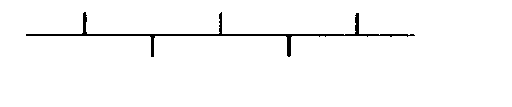
- In NMR nomenclature, this pentad is described as ...rrrr... in which each "r" represents a "racemic" dyad, i.e., successive methyl group on alternate sides of the plane. The percentage of rdyads in the chain determines the degree of syndiotacticity of the polymer. Syndiotactic polymers are crystalline and, like the isotactic polymers, are insoluble in xylene. This crystallinity distinguishes both syndiotactic and isotactic polymers from an atactic polymer which is soluble in xylene. Atactic polymer exhibits no regular order of repeating unit configurations in the polymer chain and forms essentially a waxy product.
- While it is possible for a catalyst to produce all three types of polymer, it is desirable for a catalyst to produce predominantly isotactic or syndiotactic polymer with very little atactic polymer. Catalysts that produce isotactic polyolefins are disclosed in European Patent Application No. 87870132.5 (Publication No. 0 284 708 published October 5, 1988), and U.S. Patent Nos. 4,794,096 and 4,975,403. This applica-tion and these patents disclosed chiral, stereorigid metallocene catalyst components that are used in the polymerization of olefins to form isotactic polymers and are especially useful in the preparation of a highly isotactic polypropylene.
- The present invention provides an isospecific catalyst, a process for preparing the catalyst and a polymerization process for preparing isotactic polyolefins, more particularly, isotactic polypropylene, using the catalyst. The novel catalyst component provided by the present invention is a stereorigid metallocene described by the formula:

wherein (CpR2C4R4) and (CpR'2C4R'4) are substituted indenyl rings; each R and R' is a hydrogen or a hydro- carbyl radical having 1-20 carbon atoms; R" is a structural bridge between the two indenyl rings imparting stereorigidity to the indenyl rings; Me is a transition metal; and each Q is a hydrocarbyl radical or is a halogen. Further, one R and R' is a hydrocarbyl radical having 1-20 carbon atoms in a proximal position adjacent to the bridgehead carbon of the indenyl rings. - The present invention provides a process for producing isotactic polyolefins and, particularly, isotactic polypropylene, that comprises utilizing at least one of t he catalyst components described by the above formula and introducing the catalyst into a polymeriza-tion reaction zone containing an olefin monomer. In addition, a cocatalyst such as alumoxane and/or an ionic compound capable of reacting with the metallocene to form a cationic metallocene may be introduced into the reaction zone. Further, the catalyst component may also be pre-polymerized prior to introducing it into the reaction zone and/or prior to the stabilization of reaction conditions in the reactor.
- The present invention also includes a process for preparing a bridged metallocene component comprising contacting a substituted indenyl with an dialkylsilyldichloride followed by a second equivalent of a different substituted indenyl to produce a silicon bridged disubsti-tuted indenyl.
- The present invention further includes a process for preparing a bridged metallocene catalyst component comprising contacting a substituted indene anion having proximal substituent(s) on the indenyl ring with a substituted indene anion having proximal substituent(s) under reaction conditions sufficient to produce a bridged substituted diindene. The process further comprises contacting the bridged diindene with a metal compound of the formula MeQk as defined above under reaction conditions sufficient to complex the bridged diindene to produce a bridged metallocene wherein Me is a Group IIIB, IVB, VB or VIB metal from the Periodic Table of Elements, each Q is a hydrocarbyl radical having 1-20 carbon atoms or is a halogen and k is the valence of Me
minus 2. - Amore complete appreciation of the invention and many of the attendant advantages thereof will be readily understood by reference to the following detailed description when considered in connection with the accompanying drawings wherein:
- FIG. 1 is an illustration of the structure of a preferred catalyst component of the present invention and specifically shows rac-dimethylsilylbis[2-methylindenyl]zirconium dichloride.
- FIG. 2 is an NMR spectra for the polymer obtained with rac-dimethylsilylbis[2-methylindenyl]zirconium dichloride.
- FIG. 3 is an NMR spectra for the polymer obtained with rac-ethylenebis(tetrahydraindenyl)zirconium dichloride.
- The present invention provides a metallocene catalyst component and processes for making and using the catalyst component, particularly in the production of isotactic polyolefins, especially isotactic polypropylene.
- When propylene or other alpha-olefins are polymerized using a catalyst component consisting of a transition metal compound, the polymer product typically comprises a mixture of amorphous atactic and crystalline xylene insoluble fractions. The crystalline fraction may contain either isotactic or syndiotactic polymer, or a mixture of both. Highly iso-specific metallocene catalyst components are disclosed in copending U.S. Application Serial No. 317,089 and U.S. Patent Nos. 4,794,096 and 4,975,403.
- The metallocene catalyst components of the present invention may be described by the formula

wherein each (CpR2C4R4) and (CpR'2C4R'4) are substituted indenyl rings; R and R' are hydrogen or a hydro- carbyl radical having 1-20 carbon atoms, each R may be the same or different, each R' also may be the same or differ-ent, one R and R' is a proximal substituent which is a hydro-carbyl radical from 1-20 carbon atoms, preferably is an alkyl radical of 1-4 carbon atoms and, most preferably, is a methyl radical, where proximal refers toposition 2 of the indenyl ring relative to the carbon attached to R" (position 1), i.e., adjacent to the bridgehead carbon, the R and R' proximal substitutents being the same or different, but preferably are the same, and the remaining R and R' substituents are preferably hydrogen; R" is a structural bridge between the two indenyl rings imparting stereo-rigidity to the indenyl rings within the catalyst component, preferably is a hydrocarbyl radical containing silicon as the bridging component, more preferably, is an alkyl radical of one to eight carbon atoms containing silicon as the bridging component and, most preferably is dimethylsilyl; Me is a transition metal, preferably, is a Group IVB, VB or VIB metal from the Periodic Table of Elements, more preferably, is a Group IVB metal and, most preferably, is zirconium; each Q is a hydrocarbyl radical having 1-20 carbon atoms or is a halogen, preferably, is halogen and, most preferably, is chlorine; k is the valence of Meminus 2. Preferably, all R and R' other than the proximal substituents are hydrogen and, most preferably, (CpR2C4R4) and (CpR'2C4R'4) are both 2-methyl indenyl. - An additional representation of the metallocene catalyst components of the present invention is:

where R, R', R", Me and Q are as defined above. - The metallocene catalyst component may be supported or unsupported. The support can be any solid which is chemically inert and unreactive with the metallocene and the other catalyst components. Examples of support material are porous materials such as talc; inorganic oxides, such as Group IIA, IIIA, IVA or IVB metal oxides, specifically, silica, alumina, magnesia, titania, zirconia, and mixtures thereof; and resinous materials, such as polyolefins, specifically, finely divided polyethylene, as disclosed in U.S. Patent No. 4,701,432, hereby incorporated by reference.
- The catalyst component may be prepared by any method known in the art. Two methods of preparing the catalyst component are disclosed below. It is important that the catalyst complex be "clean" as usually low molecular weight, amorphous polymer is produced by impure catalysts. Generally, the prepara-tion of the catalyst complex consists of forming and isolating the substituted indenyl ligands, the anions of which are then reacted with a halogenated metal to form the complex.
- A process for preparing a bridged metallocene catalyst component comprises contacting a substituted indene having a proximal substituent on the indenyl ring with the same or another substituted indene having a proximal substituent under reaction conditions sufficient to produce a bridged substituted diindene. The process further comprises contacting the anionic form of the bridged substituted diindene with a metal compound of the formula MeQ" wherein Me is a Group IIIB, IVB, VB or VIB metal from the Periodic Table of Elements, each Q is a hydrocarbyl radical having 1-20 carbon atoms or is a halogen and v is the valence of Me, under reaction conditions sufficient to complex the bridged diindene to produce a bridged metallocene. The process step of contacting the bridged substituted diindene with a metal compound can be performed in a chlorinated solvent.
- Another process for preparing a bridged metallocene catalyst component comprises contacting a substituted indene having proximal substituents on the indenyl ring with an alkylsilylchloride of the formula RA 2SiX2 where R is a hydrocarbyl radical having 1-20 carbon atoms and X is an halogen. A second equivalent of the same or another substituted indene having proximal substituents on the indenyl ring is added to produce a silicon bridged disubsti-tuted indene. The subsequent steps are similar to those above for producing a bridged disubstituted indene coordinated to a metal.
- The metallocene catalyst components of the present invention are useful in many of the polymerization processes known in the art including many of those disclosed for the preparation of isotactic poly-propylene. When the catalyst components of the present invention are used in these types of processes, the processes produce isotactic polymers rather than atactic or syndiotactic polymers. Further examples of polymerization processes useful in the practice of the present invention include those disclosed in U.S. Pat. No. 4,767,735, and U.S. Patent No. 4,975,403, the disclosures of which are hereby incorporated herein by reference. These preferred polymerization procedures include the step of prepolymer-izing the catalyst component by contacting the catalyst component with a cocatalyst and an olefin monomer prior to introduction into a reaction zone at a temperature below that of polymerization.
- Consistent with the prior disclosures of metallocene catalyst components for the production of isotactic polymers, the catalyst components of the present invention are particularly useful in combination with a co- catalyst, preferably an alumoxane, an alkyl aluminum, or other Lewis acids or a mixture thereof to form an active catalyst. In addition, a complex may be isolated between a metallocene catalyst component as described herein and an aluminum cocatalyst in accordance with the disclosure of U.S. Patent Nos. 4,752,597 and 4,791,180. As disclosed therein, a metallocene is reacted with an excess of alumoxane in the presence of a suitable solvent. A complex of the metallocene and alumoxane may be isolated and used as a catalyst in the present invention.
- The alumoxanes useful in combination with the catalyst component of the present invention, either in the polymerization reaction or in forming the complex disclosed in U.S. Patent Nos. 4,752,597 and 4,791,180, may be represented by the general formula (R-Al-O-)n in the cyclic form and R(R-Ai-0)-n-AiR2 in the linear form wherein R is an alkyl group with one to five carbon atoms and n is an integerfrom 1 to about 20. Most preferably, R is a methyl group. The alumoxanes can be prepared by various methods known in the art. Preferably, the are prepared by contacting water with a solution of trialkyl aluminum, such as, trimethyl aluminum, in a suitable solvent such as benzene. Another preferred method includes the preparation of alumoxane in the presence of a hydrated copper sulfate as described in U.S. Patent No. 4,404,344, the disclosure of which is hereby incorporated by reference. This method comprises treating a dilute solution of trimethyl aluminum in toluene with copper sulfate. The preparation of other aluminum cocatalysts useful in the present invention may be prepared by methods known to those skilled in the art.
- An alternative to the use of MAO co-catalyst is a catalyst system of a metallocene, a Lewis acid ionic ionizing agent and, optionally, an aluminum alkyl. Methods for preparing a cationic metallocene catalyst system are disclosed in European Patent Application Nos. 90870174.1, 90870175.8 and 90870176.6 (Publication Nos. 0 426 637 A2, 0 426 638 A2 and 0 427 697 A2, published on May 8, 1991; May 8, 1991 and May 15, 1991, respectively), which are hereby incorporated by reference. The ionizing agent which is an ion pair ionizes the metallocene to a cation. The metallocene cation forms an ion pair with the anion component of the ionizing agent. The segment of the metallocene compound removed by ionization forms an anion which associates with the cation component of the ionizing agent. The ion pair formed from the anion of the segment of metallocene and the cation of ionizing agent is chemically inert and non-reactive with regard to the metallocene cation and the metallocene cation-ionizing agent anion ion pair which is an active catalyst for polymerization of olefins.
- An aluminum alkyl, such as triethyl aluminum, is useful in such an ionic catalyst system to improve yields. It is believed that aluminum alkyl acts to enhance the ionizing process and to scavenge catalyst poisons.
- The polymerization procedures useful with the isospecific metallocene catalyst are known in the art. In general, the polymerization process comprises:
- a) selecting a stereorigid metallocene described by the formula:

wherein (CpR2C4R4) and (CpR'2C4R'4) are substituted indenyl rings; each Rand R' is a hydrogen or a hydrocarbyl radical having 1-20 carbon atoms, each R being the same or different, each R' also being the same or differ-ent, one R and R' being a hydrocarbyl radical having 1-20 carbon atoms in a proximal position adjacent to the bridgehead carbon of the indenyl rings; R" is a structural bridge between the two indenyl rings imparting stereorigidity to the indenyl rings; Me is a transition metal; and each Q is a hydrocarbyl radical or is a halogen; and - b) forming a catalyst by contacting the metallocene with a cocatalyst or a Lewis acid ionic ionizing agent;
- c) bringing the catalyst in contact with an olefin of at least three carbon atoms under polymerization conditions.
- d) extracting isotactic polyolefin of high molecular weight and crystallinity.
- The Examples given below illustrate the present invention and its various advantages and benefits in more detail.
- The synthetic procedure reported for 2-methylindene in J. Org. Chem. 47, 1058 (1982) was followed to obtain the compound as a colorless oil after distillation.

To a solution of 2-methylindene (2.58 g) in dry diethylether (150 ml), a solution of methyllithium in ether (1.4M, 14 ml) was added slowly at room temperature and stirred overnight. The solvents were removed under reduced pressure and the resulting solid was slurried in dry hexane (150 ml). Dichlorodimethylsilane diluted in ether (30 ml) was transferred into the previous solution which was prechilled to -78°C. The reaction mixture was allowed to come to room temperature and stirring continued overnight. The reaction mixture was filtered and the solvents were removed from the filtrate under reduced pressure to obtain a white solid. The solid was washed with a small amount of hexane which was prechilled to - 78°C to obtain a whiter powder (0.75 g). From the hexane wash a second crop of the ligand was obtained (0.25 g). Total yield was 32%.
- The ligand (1.0 g) obtained from the previous procedure was dissolved in anhydrous tetrahydofuran (40 ml) and a solution of n-butyllithium in hexane (1.6M, 4.4 ml) was and stirred for 3 hours. The solvents were removed under vacuum to obtain a off-white solid which was washed with dry hexane under nitrogen atmosphere. The solid was cooled to -78°C and methylene chloride prechilled to -78°C was added followed by a slurry of zirconium tetrachloride in methylene chloride which was also prechilled to -78°C. The reaction mixture was allowed to gradually come to room temperature and stirred overnight. The solution was filtered and the solid was washed with hexane. The hexane washings were added to the filtrate at which time a off-white solid precipitated. Upon filtration the filtrate was concentrated and cooled to -78°C for several hours to obtain a yellow solid. This yellow solid (0.30 g) was isolated by filtration and was found to be a mixture (65:35) of rac- and meso-isomers by NMR spectroscopy. 1HNMR (CD2CI2) (in ppm), 7.67(2d), 7.45(d), 7.08(t), 6.99(t), 6.76(s), 6.74(s), 6.64(s), 2.44(s), 2.20(s), 1.42(s), 1.29(s), 1.22(s). The solid was used as such in polymerizations.
-

- This catalyst was prepared according to the published procedures, for example in references; Organometallics, 10, 1501 (1991), J. Organomet. Chem. 288, 63 (1985), J. Organomet. Chem. 342, 21 (1988).
-

- This catalyst was prepared according to the procedure described in European Patent Application No. 87870132.5 (Publication No. 0284708 published October 5, 1988). For additional polymerization data, see "Transition Metals and Organometallics as CatalystsforOlefin Polymerization", p. 281,1988; Eds. W. Kaminsky and H. Sinn., Published by Springer-Verlag Berlin, Heidelberg.
- The catalyst was dissolved in 5 ml of 10% MAO in toluene, transferred to a stainless steel sample transfer cylinder, and charged with 400 ml of propylene into an autoclave reactor containing 1000 ml of propylene stirring at room temperature. The catalyst was prepolymerized in situ by heating the reactor contents to 60°C for one hour, the polymerization was terminated by rapidly venting the unreacted monomer and opening the reactor to the air. The contents of the reactor were dried in a vacuum oven. Atactic polymer produced by the meso- isomer was removed by recrystallizing the polymer samples from 1 % xylene solutions prior to analysis.
- The above was followed with only one minor change. The amount of MAO used in the polymerization was increased to 10 ml.
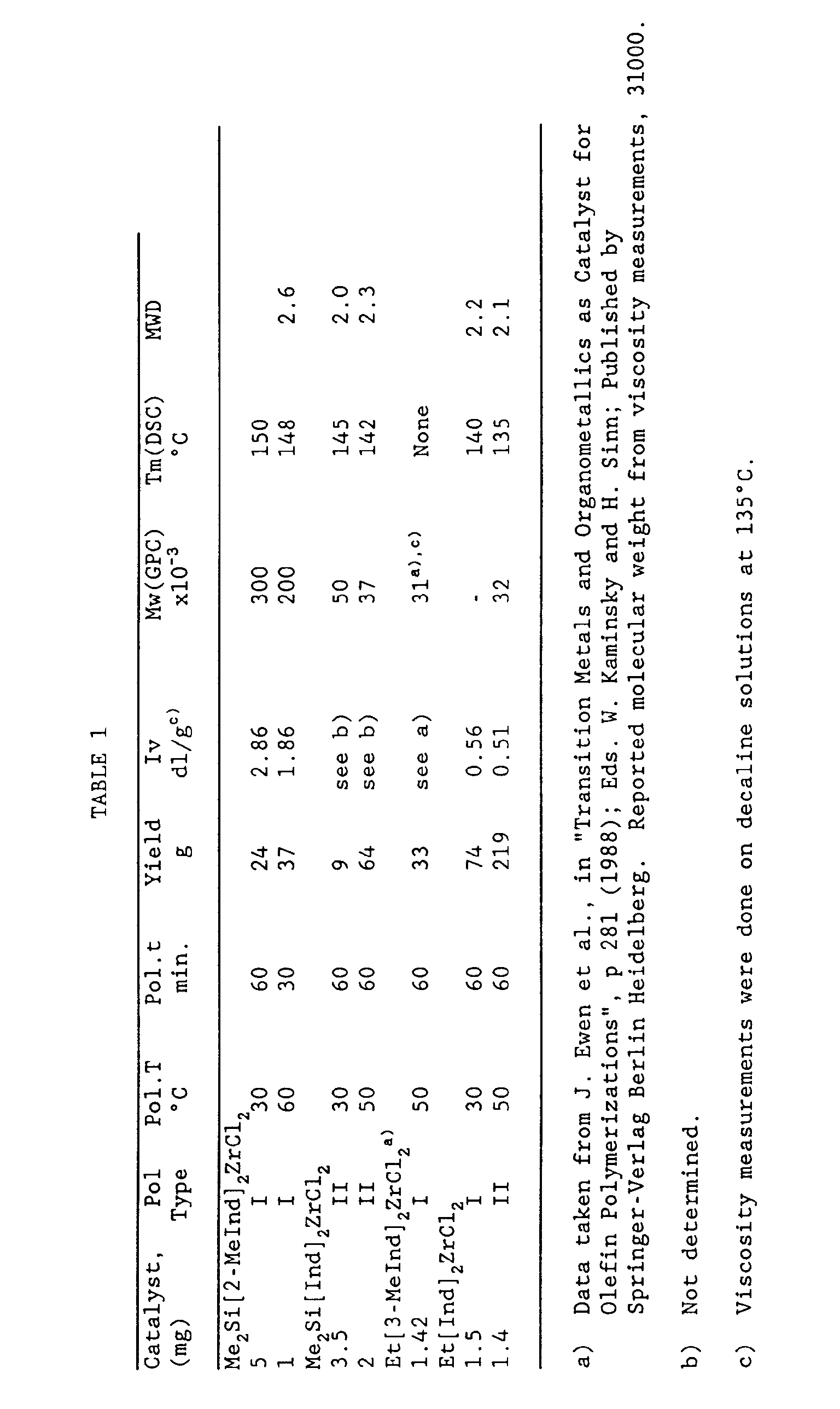
- The polymerization data in Table 1 clearly points out that methyl substituent at C2 results in substantially different properties for polypropylene relative to the unsubstituted catalyst or the catalyst containing methyl substituent at C3. The silicon bridged catalyst containing a methyl substituent at C3 provides atactic polymer which does not show a melting point. The isotactic polypropylene obtained at a given polymerization temperature under similar conditions with the catalyst with a C2 methyl substituent has higher crystallinity (higher melting point) than that obtained with other similar catalyst systems listed in Table 1. The molecular weight of the polymer obtained with the catalyst with a C2 methyl substituent is also higher than that obtained with the other catalyst systems. Comparison of 13CNMR spectrum (see Figs. 2 and 3) of the isotactic polypropylene obtained with the rac-Me2Si[2-Melnd]3ZrCl2 with that published in the literature (Makromol. Chem. 190, 1931 (1989)) for ethylene bis(tetrahydraindenyl)ZrC12 shows that regio-irregularities in the polymer microstructures are drastically decreased in the polymer obtained with the former catalyst. It is also clear from the tabulated data that the 2-methylindenyl catalyst shows greaterthermal stability than previously reported isospecific metallocenes with respect to stereospecificity and polymer chain termination (Tm = 150°C, Mw = 300000 at pol.T = 30°C; Tm = 148°C, Mw = 200000 at pol. T= 60°C). It is expected that additional alkyl substituents on the aromatic ring at positions other than those in close proximity to the catalytic center would also be beneficial in the production of isotactic polypropylene with high crystallinity and high molecular weight.
- When polymerization results for rac-Me2Si[2-Melnd]3ZrCl2 are compared to results for rac-Me2Si[lnd]ZrCI2, rac-Et[Ind]3ZrCl2, and rac-Et[3-Melnd]2ZrCl2, the effect of the proximal methyl substituent on molecular weight is shown to be remarkable. The molecularweight of polypropylene produced with the rac-Me2Si[2-Melnd]3ZrCl2 catalyst system is at least 200,000. The proximal methyl substituent also results in a more stereospecific catalyst. Polymer melting points which reflect the degree of crystallinity increase with increasing metallocene structural rigidity. The melting point of polypropylene produced with the rac-Me2Si[2-Melnd]3ZrCl2 catalyst system is at least 148°C.
- The polymer produced with rac-Me2Si[2-Melnd]3ZrCl2 has a microstructure due to enantiomorphic site control mechanism, as shown below

- The methyl groups labeled "a", "b", "c", and "d" give the most intense signals in the C-13 NMR spectra. The intensity of the peak represent by "d" is a direct measre of the number of mistakes (mrrm) in monomer 7c-face selectivity (re vs. si), providing the probability of "errors" in close succession is negligible. The C-13 NMR pentad intensities for polymer produced with rac-Me2Si[2-Melnd]3ZrCl2 at 60°C is given below :

- The C-13 NMR spectra of polymer produced with rac-Me2Si[2-Melnd]3ZrCl2 show no regio-regularities and the differences between observed polymer melting points and the melting point of perfectly stereoregular isotactic polypropylene are primarily due to the number of stereospecific "site errors".
- The metallocene catalysts of this invention produce isotactic polymer with melting points similar to commercial grades of homopolymer produced with conventional Ziegler-Natta catalysts. The metallocenes, when pure, are single site catalysts which produce isotactic propylene with a polydispersity of approximately 2.0-2.5.
- Obviously, numerous modifications and variations of the present invention are possible in light of the above teachings. It is therefore to be understood that within the scope of the appended claims, the invention may be practiced otherwise than as specifically described herein.
Claims (20)

wherein (CpR2C4R4) and (CpR'2C4R'4) are substituted indenyl rings; each R and R' is a hydrogen or a hydrocarbyl radical having 1-20 carbon atoms, each R being the same or different, each R' also being the same ordiffer-ent, one R and R' being a hydrocarbyl radical having 1-20 carbon atoms in a proximal position adjacent to the bridgehead carbon of the indenyl rings; R" is a structural bridge between the two indenyl rings imparting stereorigidity to the indenyl rings; Me is a transition metal; and each Q is a hydrocarbyl radical or is a halogen; k is the valence of Me minus 2; and

Applications Claiming Priority (2)
| Application Number | Priority Date | Filing Date | Title |
|---|---|---|---|
| US91163492A | 1992-07-10 | 1992-07-10 | |
| US911634 | 1992-07-10 |
Publications (1)
| Publication Number | Publication Date |
|---|---|
| EP0581754A1 true EP0581754A1 (en) | 1994-02-02 |
Family
ID=25430599
Family Applications (1)
| Application Number | Title | Priority Date | Filing Date |
|---|---|---|---|
| EP19930870130 Withdrawn EP0581754A1 (en) | 1992-07-10 | 1993-07-09 | Process and catalyst for producing isotactic polyolefins |
Country Status (3)
| Country | Link |
|---|---|
| US (1) | US6262199B1 (en) |
| EP (1) | EP0581754A1 (en) |
| JP (1) | JPH072936A (en) |
Cited By (13)
| Publication number | Priority date | Publication date | Assignee | Title |
|---|---|---|---|---|
| US5556997A (en) * | 1995-04-24 | 1996-09-17 | Albemarle Corporation | Enhanced synthesis of racemic metallocenes |
| US5679814A (en) * | 1995-12-11 | 1997-10-21 | Albemarle Corporation | Purification of metallocenes |
| US5710299A (en) * | 1996-06-27 | 1998-01-20 | Albemarle Corporation | Production of bridged metallocene complexes and intermediates therefor |
| EP0693506A3 (en) * | 1994-07-20 | 1998-04-08 | Montell Technology Company bv | Process for the preparation of amorphous polymers of propylene |
| US5760262A (en) * | 1996-09-17 | 1998-06-02 | Albemarle Corporation | Enhanced production of bridged hafnocenes |
| EP0870779A1 (en) * | 1997-04-09 | 1998-10-14 | Fina Technology, Inc. | Metallocene catalyst and catalyst system for producing polypropylene blend of iso- and syndiotactic polypropylene. |
| US5847175A (en) * | 1995-04-24 | 1998-12-08 | Albemarle Corporation | Enhanced synthesis of racemic metallocenes |
| US5883278A (en) * | 1995-04-24 | 1999-03-16 | Albemarle Corporation | Enhanced synthesis of racemic metallocenes |
| US5936108A (en) * | 1996-10-17 | 1999-08-10 | Albemarle Corporation | Metallocene synthesis |
| EP1070729A3 (en) * | 1993-06-07 | 2002-01-23 | Mitsui Chemicals, Inc. | Transition metal compound, olefin polymerization catalyst component comprising said compound, olefin polymerization catalyst containing said component, process for olefin polymerization using said catalyst, propylene homopolymer, propylene copolymer and propylene elastomer |
| US6884846B2 (en) | 2001-10-11 | 2005-04-26 | Atofina S.A. | Composition based on isotactic polypropylene obtained by metallocene catalysis and on grafted isotactic polypropylene obtained by Ziegler-Natta catalysis |
| DE19711339B4 (en) * | 1996-03-19 | 2008-09-11 | Denki Kagaku Kogyo K.K. | Copolymer of ethylene and aromatic vinyl compound, process for its preparation, molded articles thereof and composition comprising the copolymer |
| US7619106B2 (en) | 2002-10-25 | 2009-11-17 | Basell Polyolefine Gmbh | Preparation of partially hydrogenated rac-ansa-metallocene complexes |
Families Citing this family (11)
| Publication number | Priority date | Publication date | Assignee | Title |
|---|---|---|---|---|
| DE3751694T2 (en) * | 1987-04-03 | 1996-08-01 | Fina Technology | Metallocene catalyst systems for the polymerization of olefins, with a silicon-hydrocarbyl bridge. |
| TW440567B (en) * | 1996-04-04 | 2001-06-16 | Toho Titanium Co Ltd | Propylene homopolymer |
| KR100398740B1 (en) * | 1998-04-09 | 2003-12-31 | 주식회사 엘지화학 | Bridged metallocene catalyst having substituent at alpha position |
| CN1167718C (en) * | 1998-08-26 | 2004-09-22 | 埃克森美孚化学专利公司 | branched polypropylene composition |
| DE10122077A1 (en) | 2000-10-18 | 2002-05-02 | Tok Bearing Co Ltd | rotary damper |
| US7060848B2 (en) * | 2002-04-24 | 2006-06-13 | Symyx Technologies, Inc. | Bridged bi-aromatic catalysts, complexes, and methods of using the same |
| US7091292B2 (en) | 2002-04-24 | 2006-08-15 | Symyx Technologies, Inc. | Bridged bi-aromatic catalysts, complexes, and methods of using the same |
| US6841502B2 (en) * | 2002-04-24 | 2005-01-11 | Symyx Technologies, Inc. | Bridged bi-aromatic ligands, catalysts, processes for polymerizing and polymers therefrom |
| US20070040292A1 (en) * | 2005-08-22 | 2007-02-22 | Fina Technology, Inc. | Polypropylene composition for high gloss retention |
| US7589138B2 (en) * | 2006-12-05 | 2009-09-15 | Fina Technology, Inc. | Injection molding process |
| US8623261B2 (en) * | 2007-12-13 | 2014-01-07 | Fina Technology, Inc. | Transforming process |
Citations (2)
| Publication number | Priority date | Publication date | Assignee | Title |
|---|---|---|---|---|
| EP0485822A2 (en) * | 1990-11-12 | 1992-05-20 | Hoechst Aktiengesellschaft | Process for preparing high molecular weight polyolefines |
| EP0485823B1 (en) * | 1990-11-12 | 1995-03-08 | Hoechst Aktiengesellschaft | 2-Substituted bisindenyl-metallocenes, process for their preparation and their use as catalysts for the polymerization of olefins |
Family Cites Families (6)
| Publication number | Priority date | Publication date | Assignee | Title |
|---|---|---|---|---|
| DE59107926D1 (en) * | 1990-11-12 | 1996-07-18 | Hoechst Ag | Metallocenes with ligands from 2-substituted indenyl derivatives, processes for their preparation and their use as catalysts |
| US5243001A (en) * | 1990-11-12 | 1993-09-07 | Hoechst Aktiengesellschaft | Process for the preparation of a high molecular weight olefin polymer |
| EP0702030B1 (en) * | 1991-05-27 | 2001-03-21 | TARGOR GmbH | Process for preparing olefin polymers with large molecular weight distribution |
| DE4120009A1 (en) * | 1991-06-18 | 1992-12-24 | Basf Ag | SOLUBLE CATALYST SYSTEMS FOR THE PRODUCTION OF POLYALK-1-ENEN WITH HIGH MOLES |
| TW300901B (en) * | 1991-08-26 | 1997-03-21 | Hoechst Ag | |
| TW318184B (en) * | 1991-11-30 | 1997-10-21 | Hoechst Ag |
-
1993
- 1993-07-09 JP JP93192983A patent/JPH072936A/en active Pending
- 1993-07-09 EP EP19930870130 patent/EP0581754A1/en not_active Withdrawn
-
1998
- 1998-05-29 US US09/087,547 patent/US6262199B1/en not_active Expired - Fee Related
Patent Citations (2)
| Publication number | Priority date | Publication date | Assignee | Title |
|---|---|---|---|---|
| EP0485822A2 (en) * | 1990-11-12 | 1992-05-20 | Hoechst Aktiengesellschaft | Process for preparing high molecular weight polyolefines |
| EP0485823B1 (en) * | 1990-11-12 | 1995-03-08 | Hoechst Aktiengesellschaft | 2-Substituted bisindenyl-metallocenes, process for their preparation and their use as catalysts for the polymerization of olefins |
Cited By (17)
| Publication number | Priority date | Publication date | Assignee | Title |
|---|---|---|---|---|
| EP1070729A3 (en) * | 1993-06-07 | 2002-01-23 | Mitsui Chemicals, Inc. | Transition metal compound, olefin polymerization catalyst component comprising said compound, olefin polymerization catalyst containing said component, process for olefin polymerization using said catalyst, propylene homopolymer, propylene copolymer and propylene elastomer |
| EP0693506A3 (en) * | 1994-07-20 | 1998-04-08 | Montell Technology Company bv | Process for the preparation of amorphous polymers of propylene |
| US5556997A (en) * | 1995-04-24 | 1996-09-17 | Albemarle Corporation | Enhanced synthesis of racemic metallocenes |
| US5847175A (en) * | 1995-04-24 | 1998-12-08 | Albemarle Corporation | Enhanced synthesis of racemic metallocenes |
| US5883278A (en) * | 1995-04-24 | 1999-03-16 | Albemarle Corporation | Enhanced synthesis of racemic metallocenes |
| US5679814A (en) * | 1995-12-11 | 1997-10-21 | Albemarle Corporation | Purification of metallocenes |
| DE19711339B4 (en) * | 1996-03-19 | 2008-09-11 | Denki Kagaku Kogyo K.K. | Copolymer of ethylene and aromatic vinyl compound, process for its preparation, molded articles thereof and composition comprising the copolymer |
| US5710299A (en) * | 1996-06-27 | 1998-01-20 | Albemarle Corporation | Production of bridged metallocene complexes and intermediates therefor |
| US5861522A (en) * | 1996-06-27 | 1999-01-19 | Albemarle Corporation | Production of bridged metallocene complexes and intermediates therefor |
| US5760262A (en) * | 1996-09-17 | 1998-06-02 | Albemarle Corporation | Enhanced production of bridged hafnocenes |
| US5936108A (en) * | 1996-10-17 | 1999-08-10 | Albemarle Corporation | Metallocene synthesis |
| US6143683A (en) * | 1997-04-09 | 2000-11-07 | Fina Technology, Inc. | Metallocene catalyst and catalyst system for polymerizing an olefin having at least 3 carbon atoms |
| US6362125B1 (en) * | 1997-04-09 | 2002-03-26 | Fina Technology, Inc. | Metallocene catalyst and catalyst system for producing polypropylene blend of iso and syndio-tactic polypropylene |
| EP0870779A1 (en) * | 1997-04-09 | 1998-10-14 | Fina Technology, Inc. | Metallocene catalyst and catalyst system for producing polypropylene blend of iso- and syndiotactic polypropylene. |
| US6884846B2 (en) | 2001-10-11 | 2005-04-26 | Atofina S.A. | Composition based on isotactic polypropylene obtained by metallocene catalysis and on grafted isotactic polypropylene obtained by Ziegler-Natta catalysis |
| US7510775B2 (en) | 2001-10-11 | 2009-03-31 | Arkema France | Composition based on isotactic polypropylene obtained by metallocene catalysis and on grafted isotactic polypropylene obtained by ziegler-natta catalysis |
| US7619106B2 (en) | 2002-10-25 | 2009-11-17 | Basell Polyolefine Gmbh | Preparation of partially hydrogenated rac-ansa-metallocene complexes |
Also Published As
| Publication number | Publication date |
|---|---|
| US6262199B1 (en) | 2001-07-17 |
| JPH072936A (en) | 1995-01-06 |
Similar Documents
| Publication | Publication Date | Title |
|---|---|---|
| US6262199B1 (en) | Process and catalyst for producing isotactic polyolefins | |
| US5416228A (en) | Process and catalyst for producing isotactic polyolefins | |
| EP0773239B1 (en) | Method for controlling the melting points and molecular weights of syndiotactic polyolefins using metallocene catalyst systems | |
| US5968864A (en) | Catalyst efficiency for supported metallocene catalyst | |
| US5304523A (en) | Process and catalyst for producing crystalline polyolefins | |
| US6197902B1 (en) | Syndio-isoblock polymer and process for its preparation | |
| US6245870B1 (en) | Process for producing syndiotactic/isotactic block polyolefins | |
| JP4771500B2 (en) | Syndiotactic / atactic block polyolefins, catalysts and methods for producing the same | |
| EP0984989B1 (en) | Use of metallocene catalysts for producing regiospecific, isotactic polyolefins | |
| US6894132B2 (en) | Polyolefin production | |
| US6111046A (en) | Atactic copolymers of propylene with ethylene | |
| KR20020002471A (en) | Polyolefin production | |
| EP0802206B1 (en) | Process and catalyst for producing polyolefins having low molecular weight | |
| EP0387609A1 (en) | Alpha-olefin polymers with syndiotactic structure | |
| US5945365A (en) | Stereorigid bis-fluorenyl metallocenes | |
| US5733990A (en) | Catalyst for producing polyolefin and process for producing polyolefin | |
| US6630550B1 (en) | Olefin polymerization catalyst | |
| WO1992012184A1 (en) | Syndiotactic polypropylene | |
| EP0426644A1 (en) | Syndiotactic homopolymers of olefins | |
| CA2260891C (en) | Syndiotactic/atactic block polyolefins, catalysts and processes for producing the same | |
| CA2518358A1 (en) | Syndiotactic/atactic block polyolefins, catalysts and processes for producing the same | |
| AU5450401A (en) | Syndiotactic/atactic block polyolefins, catalysts and processes for producing the same |
Legal Events
| Date | Code | Title | Description |
|---|---|---|---|
| PUAI | Public reference made under article 153(3) epc to a published international application that has entered the european phase |
Free format text: ORIGINAL CODE: 0009012 |
|
| 17P | Request for examination filed |
Effective date: 19930720 |
|
| AK | Designated contracting states |
Kind code of ref document: A1 Designated state(s): BE DE ES FR GB IT NL SE |
|
| RIN1 | Information on inventor provided before grant (corrected) |
Inventor name: REDDY, B.R. Inventor name: ELDER, MICHAEL J. Inventor name: EWEN, JOHN A. |
|
| 17Q | First examination report despatched |
Effective date: 19960215 |
|
| STAA | Information on the status of an ep patent application or granted ep patent |
Free format text: STATUS: THE APPLICATION IS DEEMED TO BE WITHDRAWN |
|
| 18D | Application deemed to be withdrawn |
Effective date: 19971029 |