EP0586002B1 - Anticorps monoclonaux contre le récepteur du facteur épidermique de croissance, cellules et méthodes pour leur préparation et compositions qui les contiennent - Google Patents
Anticorps monoclonaux contre le récepteur du facteur épidermique de croissance, cellules et méthodes pour leur préparation et compositions qui les contiennent Download PDFInfo
- Publication number
- EP0586002B1 EP0586002B1 EP93202428A EP93202428A EP0586002B1 EP 0586002 B1 EP0586002 B1 EP 0586002B1 EP 93202428 A EP93202428 A EP 93202428A EP 93202428 A EP93202428 A EP 93202428A EP 0586002 B1 EP0586002 B1 EP 0586002B1
- Authority
- EP
- European Patent Office
- Prior art keywords
- monoclonal antibody
- egf
- cells
- receptor
- producing
- Prior art date
- Legal status (The legal status is an assumption and is not a legal conclusion. Google has not performed a legal analysis and makes no representation as to the accuracy of the status listed.)
- Expired - Lifetime
Links
Images






Classifications
-
- C—CHEMISTRY; METALLURGY
- C07—ORGANIC CHEMISTRY
- C07K—PEPTIDES
- C07K16/00—Immunoglobulins [IG], e.g. monoclonal or polyclonal antibodies
- C07K16/18—Immunoglobulins [IG], e.g. monoclonal or polyclonal antibodies against material from animals or humans
- C07K16/28—Immunoglobulins [IG], e.g. monoclonal or polyclonal antibodies against material from animals or humans against receptors, cell surface antigens or cell surface determinants
- C07K16/2863—Immunoglobulins [IG], e.g. monoclonal or polyclonal antibodies against material from animals or humans against receptors, cell surface antigens or cell surface determinants against receptors for growth factors, growth regulators
-
- A—HUMAN NECESSITIES
- A61—MEDICAL OR VETERINARY SCIENCE; HYGIENE
- A61K—PREPARATIONS FOR MEDICAL, DENTAL OR TOILETRY PURPOSES
- A61K39/00—Medicinal preparations containing antigens or antibodies
- A61K39/395—Antibodies; Immunoglobulins; Immune serum, e.g. antilymphocytic serum
- A61K39/39533—Antibodies; Immunoglobulins; Immune serum, e.g. antilymphocytic serum against materials from animals
- A61K39/3955—Antibodies; Immunoglobulins; Immune serum, e.g. antilymphocytic serum against materials from animals against proteinaceous materials, e.g. enzymes, hormones, lymphokines
-
- C—CHEMISTRY; METALLURGY
- C07—ORGANIC CHEMISTRY
- C07K—PEPTIDES
- C07K2317/00—Immunoglobulins specific features
- C07K2317/70—Immunoglobulins specific features characterized by effect upon binding to a cell or to an antigen
- C07K2317/73—Inducing cell death, e.g. apoptosis, necrosis or inhibition of cell proliferation
-
- C—CHEMISTRY; METALLURGY
- C07—ORGANIC CHEMISTRY
- C07K—PEPTIDES
- C07K2317/00—Immunoglobulins specific features
- C07K2317/70—Immunoglobulins specific features characterized by effect upon binding to a cell or to an antigen
- C07K2317/73—Inducing cell death, e.g. apoptosis, necrosis or inhibition of cell proliferation
- C07K2317/732—Antibody-dependent cellular cytotoxicity [ADCC]
-
- C—CHEMISTRY; METALLURGY
- C07—ORGANIC CHEMISTRY
- C07K—PEPTIDES
- C07K2317/00—Immunoglobulins specific features
- C07K2317/70—Immunoglobulins specific features characterized by effect upon binding to a cell or to an antigen
- C07K2317/73—Inducing cell death, e.g. apoptosis, necrosis or inhibition of cell proliferation
- C07K2317/734—Complement-dependent cytotoxicity [CDC]
Definitions
- This invention is related to the field of monoclonal antibodies and provides a method for selecting hybrids which produce monoclonal antibodies that recognize the Epidermal Growth Factor (EGF)-receptor, an antigen present in normal cells and tumoral cells of epithelial origin.
- EGF Epidermal Growth Factor
- This invention is also related to therapeutic and diagnostic compositions using these antibodies.
- the Epidermal Growth Factor (EGF), a 53 aminoacid polypeptide of 6 kD molecular weight that stimulates epithelial and mesenchymal cell proliferation, has been considered to be one of the growth factors involved in malignant transformations (Cohen S. and Carpenter G., PNAS USA 72, 1317, 1975). This action is mainly performed via its membrane receptor, a 1,186 aminoacid glycoprotein of 170 kD molecular weight.
- the Epidermal Growth Factor Receptor (EGF-R) has become the object of growing interest in cancer research (Carpenter G. and Cohen S., Receptor Regulation (B series), Vol. 13, 41, Lefkowitz, Ed. Chapman and Hall).
- EGF-Receptor High levels of EGF-Receptor have been detected in malignant tumors of epithelial origin such as breast, bladder, ovarian, vulva, colonic, lung, brain and esophagus cancers.
- the role played by EGF and its receptor in regulating tumor growth is unknown, but it has been suggested that the EGF-Receptor expression in tumor cells provides a mechanism for autocrine growth stimulation which leads to uncontrolled proliferation (Schlessinger J., Schreiber A.B., Levi A., Liberman T. and Yarden Y., Crit. Rev. Biochem. 14 (2), 93-111, 1983).
- EGF-R EGF receptor
- Monoclonal antibodies constitute a group of biomolecules being used for such purposes (Deusch K., Mauthe B., Reiter C., Endres N., Classen M. and Riethmuller G., Proceeding of the International Congress of Immunology, Budapest Hungary, 11, 1992).
- Immunotherapy with monoclonal antibodies is being studied by many researchers to test its efficacy in the treatment of different neoplastic localizations (Frodin J.E., Philstedt P., Lefvert A.K. and Mellstedt H., Hybridoma, Vol. 7, No. 4, 1988). Many modalities have been proposed, among them: native, conjugated with drugs, bi-specific, anti-idiotype and human monoclonal antibodies.
- the high EGF receptor expression in poorly differentiated epidermoid tumors offers the possibility of considering the antibodies as a route for onco-specific treatment whether native or associated with drugs, toxins or radionuclides; (Vollmar A.M., Banker D.E., Mendelsohn J. and Herschman H.R., J. Cell. Physiol. 131, 418-425, 1987). Clinical trials are in progress for the treatment of malignant tumors with these monoclonal antibodies (Magdelenat H., Delarue J.Y., Mady E., Faillot T., Vega F. and Poisson M., Proceedings of VI Conference of MESTMO International Journal of Tumor Markers, Nice, France, Nov. 1991).
- the antibodies against EGF receptor which have been used for treatment have been selected primarily for the antigenic recognition, producing tumor growth inhibition through this action. This inhibition occurs through the mechanism of signal transduction in which the EGF receptor is involved (Mendelsohn J., Kawamoto T., Sato G., Sato D., Schlesinger J., Givol D. and Kris R., US Appl. No. 23988, EP 0359282).
- gangliosides have been considered both as EGF receptor phosphorylation inhibitors and cell signal transduction inhibitors resulting in cell proliferation inhibition. This indicates that ganglioside could be considered an effective treatment for different neoplastic localization specially EGF receptor bearing tumors (Davis R.J., J. Biol. Chem. 265, 12O59-12O66, 1990).
- hybrids have been selected according to antigenic recognition and, moreover, the antibodies have been obtained through immunizations with the antigen developed from tumor cell lines and have been selected according to anti-tumoral activity through this antigenic recognition.
- MAb425 could stimulate cell growth in some human tumors.
- This tyrosine kinase receptor belongs to the HER family as does the EGF receptor (HER1), but they are different molecules with different physiological relevance in normal embryogenesis and development and also carcinogenesis.
- ganglioside De-N-acetyl-GM3 acts as a strong promoter for Epidermal Growth Factor Receptor Kinase and as a stimulator for cell growth.
- This invention provides monoclonal antibodies, and a selection method for hybrids producing them, with qualitatively superior features that may be used to develop diagnostic systems, treatment and research.
- the main goal of this invention is to provide monoclonal antibodies having superior properties, which recognize the EGF-receptor in human placenta or A-431 cells with high affinity, are capable of inhibiting EGF binding to the receptor, have the ability to produce antibody-dependent cellular cytotoxicity, have the ability to develop complement-mediated cytotoxic activity, which also have the property of inhibiting tumoral growth in certain cell lines and show a synergetic effect to inhibit proliferation of these cell lines when they are used in combination with gangliosides or monoclonal antibodies against EGF.
- Another objective of this invention is to provide a selection method for new hybrid cell lines that produce the monoclonal antibodies referred to above.
- Another objective is to provide monoclonal antibody-producing hybridomas which meet the selection criteria.
- One of the most important objectives of this invention is to provide a pharmaceutical composition containing the monoclonal antibodies against EGF receptor and gangliosides or monoclonal antibodies against EGF, that produces a synergetic effect on inhibiting cell growth.
- the importance of this preparation could be of remarkable impact in the treatment of lung cancer, any other tumor of epidermoid origin, nervous system origin or any other EGF-Receptor bearing tumor.
- the invention should provide the aforementioned selection method for obtaining the monoclonal antibodies produced in this way and the compositions these antibodies use, both for diagnosis and treatment.
- This invention provides a monoclonal antibody which recognizes human Epidermal Growth Factor (EGF) receptor, is capable of inhibiting EGF binding to the receptor, is capable of inhibiting growth of EGF-dependent tumor cells, and in addition has at least one of the following properties:
- a monoclonal antibody which has antibody-dependent cellular cytotoxicity and complement-mediated cytotoxic activity is preferred.
- said monoclonal antibody is furthermore capable of producing a synergetic effect in inhibiting proliferation of tumor cells if combined with a ganglioside, and/or capable of producing a synergetic effect in inhibiting proliferation of tumor cells if combined with a monoclonal antibody against EGF.
- the monoclonal antibody recognizes both human EGF receptor present in normal cells and EGF receptor present in tumoral cells, most preferably recognizes both human placental EGF receptor and EGF receptor from the A-431 tumor cell line.
- the monoclonal antibody is capable of inhibiting the growth of the EGF-dependent lung tumor cell lines U-1752 and/or H-125; that it has an antibody-dependent cellular cytotoxicity in a test using the A-431 cell line as target cells; and that it has a complement-mediated cytotoxic activity in a test using the A-431 cell line as target cells.
- a monoclonal antibody which is capable of producing a synergetic effect in inhibiting proliferation of tumor cells (such as H-125 cells) if combined with the ganglioside N-acetyl GM3, and which is capable of producing a synergetic effect in inhibiting proliferation of tumor cells (such as H-125 cells) if combined with an anti-EGF monoclonal antibody.
- the monoclonal antibody of this invention is an immunoglobuline of the IgG 2a-type.
- This invention furthermore provides a composition comprising a monoclonal antibody as defined herein, together with a carrier, a diluent or an excipient therefor.
- the invention provides a pharmaceutical composition for use in a therapeutical or prophylactic treatment of malignant neoplasms or pre-neoplastic diseases, comprising a therapeutically or prophylactically effective amount of a monoclonal antibody as defined herein, together with a carrier, a diluent or an excipient therefor.
- said pharmaceutical composition contains a ganglioside and/or a monoclonal antibody against EGF.
- This invention furthermore provides a process for preparing a monoclonal antibody which recognizes human EGF-R, comprising the steps of immunizing a test animal with human EGF-R or an antigenic derivative or fragment thereof, isolating antibody-producing cells from the immunized animal, immortalizing said antibody-producing cells, selecting from said immortalized cells a cell which produces a monoclonal antibody which recognizes human EGF-R, is capable of inhibiting EGF binding to the receptor, is capable of inhibiting growth of EGF-dependent tumor cells, and in addition has at least one of the following properties:
- the step of immortalizing the antibody-producing cells isolated from the immunized animal is carried out by fusing the cells with myeloma cells to produce hybridoma cells.
- the test animal used in the immunisation step preferably is a rodent animal, most preferably a mouse or rat. In the process, the test animal is immunized preferably with human placenta EGF-R.
- immortalized cells producing the selected monoclonal antibody are cultivated, either in vitro in a culture medium of the proper tissue, or in vivo in a histocompatible body fluid, or in fermenters such as production medium, followed by separation of the immortalized cells from said medium.
- the monoclonal antibody produced may then be purified and optionally derivatized or fragmented.
- This invention also provides an immortalized cell producing a monoclonal antibody as defined herein, and comprises the use of said monoclonal antibody.
- this invention consists of immunizing mice with a partially purified fraction of human placenta epidermic growth factor receptor; removing their spleens and preparing a cell suspension; fusing the spleen cells with myeloma cells in the presence of a fusion promoter; diluting and cultivating the cells; evaluating the supernatant which contains the hybridoma; selecting and cloning a hybridoma which produces antibodies with the following characteristics: recognition of the EGF receptor, with high affinity, and with the ability to inhibit EGF binding to the receptor, the capability of producing antibody-dependent cellular cytotoxicity (ADCC), complement-mediated cytotoxic activity, inhibition of tumoral growth in certain cell lines and show a synergetic effect in proliferation inhibition of these cell lines in combination with gangliosides or monoclonal antibodies against EGF; recover the antibody from the supernatant liquid and collect the malignant ascites or the serum which contains the desired antibodies.
- ADCC antibody-dependent cellular cytotoxicity
- hybrid cells hybrid cells
- the hybridoma preparation method generally includes the stages described below, which includes the methods used for the selection of hybridomas.
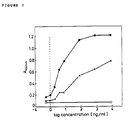
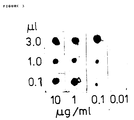
- the hybridoma supernatant in each well was evaluated, to determine the presence of antibodies which selectively recognize with high affinity the human placenta EGF receptor and the receptor from the A-431 cell line of epidermoid origin and are also capable of inhibiting EGF union with the receptor.
- the cells were cultured in selective HAT medium (hypoxanthine, aminopterin and thymidine) at 37°C, with a 5% CO 2 moist atmosphere.
- selective HAT medium hypoxanthine, aminopterin and thymidine
- Hybridoma cultures which contain antibodies that react to membrane extracts containing the receptor, are selected and they are cloned twice according to the limiting dilution method, in the presence of conditioning cells.
- the method has the special characteristic of simultaneously select the antibodies for both antigens: the receptor from human placenta, which possesses normal epitopes, and the receptor from the A-431 cell line, which epitopes appears during the malignant progression, which means that the epitope selected in the antibody by the Selection Method is preserved in the receptor molecules present in normal tissues and also appears in most of the receptor molecules present in tumoral tissue of epidermoid origin.
- the hybridoma supernatant in each well was evaluated to determine the presence of the antibodies which inhibit tumoral growth in lung cancer cell lines U-1752 and H-125 (NCI, Bethesda, Maryland). These cell lines show an EGF dependence for their proliferation.
- the culture medium used was RPMI-1640 (Gibco, USA) supplemented with 5-10% calf serum.
- the cells were kept in incubators at 37°C in a humid atmosphere and carbon-dioxide air (95%-5%).
- the monoclonal antibody's inhibitory effect was measured in the cells in trypsin suspension and re-suspended at concentrations of 2.5 x 10 4 cells/mL of culture medium to which different concentrations of monoclonal antibody were added: 10, 30 and 100 ⁇ g/mL.
- a control group with an irrelevant antibody was also studied in concentrations of 100 ⁇ g/mL.
- the cellular suspensions were placed in 24-well culture plates (1 mL per well), and each sample was tested three times. Plates were prepared for each cellular line and analyzed at different exposure times (1, 3, 5 and 7 days). The determination of the total number of cells was made according to the quantitative method of total protein determination (D.H. Lowry).
- This part of the selection method has the particular characteristic that the hybridomas selected produce monoclonal antibodies with a specific recognition of the antigen and simultaneously present the ability to inhibit tumoral growth.
- the hybridoma supernatant in each well was evaluated to determine the presence of the antibodies which produce antibody-dependent cellular cytotoxicity.
- a standard measurement technique for this activity was used; A-431 cell line labeled with 51 Cr (100 ⁇ Ci) was used as targets.
- the effector cells were blood cells from normal adults prepared with a Ficoll-Hypaque gradient in which the mononuclear cells from the peripheric blood were separated, washed three times and adjusted in an EFFECTOR CELL/TARGET CELL ratio of 200:1.
- the target cells in 10 4 concentration were pipetted into 96-well plates which contain 25 ⁇ L of monoclonal antibody (ascitic liquid diluted 1/10).
- the plates with the target cells and the antibody were incubated at 4°C for 30 minutes.
- the effector cells 100 ⁇ L were added to the plate and centrifuged immediately 100 x g for 2 minutes. They were then incubated during four hours in a humid chamber at 37°C with 5-95% CO 2 air. From this experiment it could be demonstrated an antibody dependent inhibitory effect of 22%.
- the supernatant in each well was evaluated to determined the presence of the antibodies which produces complement-mediated cytotoxic activity, using the standard measurement method and an A-431 cell line labeled with 51 Cr (100 ⁇ Ci) was used as target cells.
- the target cells in a concentration of 10 4 were pipetted into 96-well plates which contain 25 ⁇ L of monoclonal antibody (ascitic liquid diluted 1/10).
- the complement source consisted of 100 ⁇ L of rabbit serum at 25% in culture medium. It was incubated for four hours in a humid chamber at 37°C with 5-95% CO 2 air. The plates were later centrifuged and the counts per minute (cpm) were measured in 100 ⁇ L of the supernatant in a gamma counter.
- the H-125 cell line expressing 10 4 - 10 5 EGF receptor binding sites and classified as lung adenocarcinoma was used as the experimental model for the screening.
- a cellular suspension was obtained with 10 4 - 10 5 cells per mL and was resuspended in culture medium.
- N-acetyl GM3 is added then at a concentration of 5 micrograms and a monoclonal antibody against EGF Receptor is added at a concentration of 30 micrograms per mL.
- At the third and sixth day total protein concentration was measured by Lowry Rosebrough method.
- the H-125 cell line expressing 10 4 -10 5 EGF receptor binding sites and classified as lung adenocarcinoma was used as the experimental model for the screening.
- a cellular suspension was obtained with 10 4 - 10 5 cells per mL and was resuspended in culture medium.
- the MAbs against EGF are added at a concentration of 5 microMoles and monoclonal antibodies against EGF-Receptor are added at a concentration of 30 micrograms per mL.
- At the third and sixth day total protein concentration was measured by Lowry Rosebrough method.
- the antibodies produced by the hybridomas based on the selection method used have superior properties which give them the distinction of: high affinity antigenic recognition for the EGF Receptor; antibody-dependent cellular cytotoxicity; complement-mediated cytotoxic activity; the capacity of inhibiting the tumoral growth in cell lines and a synergetic effect in combination with N acetyl GM3 or MAbs against EGF.
- Monoclonal antibodies obtained are IgG2a -type immunoglobulins secreted by the hybridomas obtained from the fusion of SP2/Ag14 mouse myeloma with Balb/c mouse spleen lymphocytes immunized with a partially purified fraction of Human placenta EGF receptor.
- solubilized EGF receptor was performed by affinity chromatography. Briefly: the placenta crude membrane fractions were solubilized in Tris-HCl 20 mM buffer, pH 7.4, glycerin 10% and Triton X-100 1% solution during 1 hour at room temperature. The homogenate was centrifuged at 10,000 g. The supernatant was applied to an EGF affinity matrix. The EGF enriched fraction was eluted with ethanolamine 5 mM buffer, pH 9.7 with glycerin 10% and Triton X-100 0.1% solution. This solubilized EGF receptor enriched fraction has the capacity to bind 125 I-EGF, and showed a major 170 kD band in SDS-PAGE. One hundred grams were processed each time. Average yield was 15-25 ⁇ g of partially purified EGF receptor per gram of wet tissue.
- monoclonal antibodies are also characterized by complement-mediated cytotoxic activity and antibody-dependent cellular cytotoxicity.
- N-acetyl GM3 was added in a concentration of 5 micromoles and the MAb was added in concentration of 30 micrograms per mL.
- a synergetic effect of the combination N-acetyl GM3-monoclonal antibody against EGF receptor is observed in inhibiting proliferation of a lung cancer cell line in relation to the controls used in this test.
- PCR Polymerase Chain Reaction
- variable regions of the heavy chain defines the epitope of the EGF receptor which is recognized by these monoclonal antibodies.
- Fresh tissues were selected for the study, these included samples of heart, prostate, liver, lung, kidney, spleen, ovary, pancreas, brain, testis, adrenal glands, hypophysis, lymph nodes, medulla, thyroid, tonsils, stomach, small intestine, colon, skin, submaxillary gland, placenta and cerebellum.
- Several nerve tissues, hematopoietic and sarcomatous tumors were also studied.
- the fresh tissues were frozen in liquid nitrogen and stored at -20°C. Histopathological study was evaluated using hematoxylineosin stained sections. Consecutive sections based on the histopathologically evaluated blocks were used for staining with the immunoperoxidase technique.
- tissue reactivity was demonstrated using the biotin-streptoavidin-peroxidase complex (Amersham, U.K.).
- the study includes sections with positive (skin sections) and negative (tris buffered saline solution) controls.
- the reaction with the enzyme produces a brown precipitate and is classified as follows:
- Epidermoid tumors, and central nervous system tumors such as glioma, meningioma, malignant histiocytoma, neuro-fibrosarcoma, as well as mammary and nasopharyngeal tumors have shown intense reaction, according to the established pattern, and in much higher concentration than in normal tissues of the same origin (Table 2).
- a therapeutic compound is developed containing an effective quantity of monoclonal antibody produced by the hybridoma obtained through the Hybridoma Selection Method that produces antibody-dependent cellular cytotoxicity.
- A-431 cell line labeled with 51 Cr (100 ⁇ Ci) was used as targets.
- the effector cells were blood cells from normal adults prepared with a Ficoll-Hypaque gradient in which the mononuclear cells from the peripheric blood were separated, washed three times and adjusted in a EFFECTOR CELL/TARGET CELL ratio of 200:1.
- the plates with the target cells and the antibody were incubated at 4°C for 30 minutes.
- the effector cells (100 ⁇ L) were added to the plate and centrifuged immediately 100 x g for 2 minutes. They were then incubated for four hours in a humid chamber at 37°C with 5-95% CO 2 air.
- the counts per minute (cpm) were measured in 100 ⁇ L of supernatant in a gamma counter.
- the complement-mediated cytotoxic activity was measured, using the standard measurement method and using A-431 cell line labeled with 51 Cr radioactive (100 ⁇ Ci) as target cells.
- the target cells in a concentration of 10 4 were pipetted on 96 - well plates which contain 25 ⁇ L of monoclonal antibody (ascitic liquid) diluted 1/10.
- the complement source consisted of 100 ⁇ L of rabbit serum at 25% in culture medium. It was incubated for four hours in a humid chamber at 37°C with 5-95% CO 2 air. The plates were later centrifuged and the counts per minute were measured in 100 ⁇ L of the supernatant in a gamma counter. Several working solutions of the antibody were tested to verify what was the maximum toxicity.
- This preparation includes a pharmaceutical vehicle which contains 2.55 mg of monobasic sodium phosphate, 9.00 mg of dibasic sodium phosphate, 43.00 mg of sodium chloride, 1 mg of polysorbate 80, 5.00 mL of injection water.
- a therapeutic compound is developed containing an effective quantity of monoclonal antibody produced by the hybridoma obtained through the Hybridoma Selection method, together with N-acetyl GM3.
- This preparation includes a pharmaceutical vehicle which contains 2.55 mg of monobasic sodium phosphate, 9.00 mg of dibasic sodium phosphate, 43.00 mg of sodium chloride, 1 mg of polysorbate 80, and 5.00 mL of injection water.
- a therapeutic compound is developed containing an effective quantity of monoclonal antibody produced by the hybridoma obtained through the Hybridoma Selection Method, together with anti EGF MAb, plus a pharmaceutical vehicle which contains 2.55 mg of monobasic sodium phosphate, 9.00 mg of dibasic sodium phosphate, 43.00 mg of sodium chloride, 1 mg of polysorbate 80, 5.00 mL of injection water.
Landscapes
- Health & Medical Sciences (AREA)
- Chemical & Material Sciences (AREA)
- Medicinal Chemistry (AREA)
- Immunology (AREA)
- Life Sciences & Earth Sciences (AREA)
- Organic Chemistry (AREA)
- General Health & Medical Sciences (AREA)
- Bioinformatics & Cheminformatics (AREA)
- Epidemiology (AREA)
- Molecular Biology (AREA)
- Proteomics, Peptides & Aminoacids (AREA)
- Biophysics (AREA)
- Endocrinology (AREA)
- Engineering & Computer Science (AREA)
- Biochemistry (AREA)
- Microbiology (AREA)
- Mycology (AREA)
- Pharmacology & Pharmacy (AREA)
- Genetics & Genomics (AREA)
- Animal Behavior & Ethology (AREA)
- Public Health (AREA)
- Veterinary Medicine (AREA)
- Medicines Containing Antibodies Or Antigens For Use As Internal Diagnostic Agents (AREA)
- Preparation Of Compounds By Using Micro-Organisms (AREA)
- Medicines That Contain Protein Lipid Enzymes And Other Medicines (AREA)
- Peptides Or Proteins (AREA)
- Macromolecular Compounds Obtained By Forming Nitrogen-Containing Linkages In General (AREA)
- Nitrogen Condensed Heterocyclic Rings (AREA)
Claims (29)
- Anticorps monoclonal qui reconnaít le récepteur du facteur de croissance épidermique EGF (Epidermal Growth Factor) humain, qui est capable d'inhiber la liaison de l'EGF au récepteur, qui est capable d'inhiber la croissance des cellules tumorales dépendantes de l'EGF, et qui présente en plus les propriétés suivantes :a) il possède une cytotoxicité cellulaire dépendante des anticorps,b) il possède une activité cytotoxique à médiation par le complément,c) il est capable de produire un effet de synergie lors de l'inhibition de la prolifération des cellules tumorales s'il est associé au ganglioside N-acétyl-GM3, etd) il est capable de produire un effet de synergie lors de l'inhibition de la prolifération des cellules tumorales s'il est associé à un anticorps monoclonal dirigé contre l'EGF,
ou dérivé dudit anticorps monoclonal choisi parmi les formes humanisées, chimériques, reformées, bispécifiques, conjuguées et anti-idiotypiques de celui-ci,
ou bien fragment dudit anticorps monoclonal ou dudit dérivé choisi parmi les fragments Fv, Fab, Fab' et F(ab')2 de celui-ci. - Anticorps monoclonal selon la revendication 1, qui reconnaít à la fois le récepteur de l'EGF humain présent dans les cellules normales et le récepteur de l'EGF présent dans les cellules tumorales.
- Anticorps monoclonal selon la revendication 2, qui reconnaít à la fois le récepteur de l'EGF placentaire humain et le récepteur de l'EGF provenant de la lignée de cellules tumorales A-431 (ATCC CRL 1555).
- Anticorps monoclonal selon l'une quelconque des revendications 1 à 3, qui est capable d'inhiber la croissance dépendante de l'EGF des lignées de cellules tumorales pulmonaires U-1752 et/ou H-125.
- Anticorps monoclonal selon l'une quelconque des revendications 1 à 4, qui possède une cytotoxicité cellulaire dépendante des anticorps dans un test utilisant la lignée cellulaire A-431 (ATCC CRL 1555) comme cellules cibles.
- Anticorps monoclonal selon l'une quelconque des revendications 1 à 5, qui possède une cytotoxicité cellulaire à médistion par le complément dans un test utilisant la lignée cellulaire A-431 (ATCC CRL 1555) comme cellules cibles.
- Anticorps monoclonal selon l'une quelconque des revendications 1 à 6, qui est capable de produire un effet de synergie lors de l'inhibition de la prolifération des cellules tumorales H-125 s'il est associé au ganglioside N-acétyl-GM3.
- Anticorps monoclonal selon l'une quelconque des revendications 1 à 7, qui est capable de produire un effet de synergie lors de l'inhibition de la prolifération des cellules tumorales H-125 s'il est associé à un anticorps monoclonal anti-EGF.
- Anticorps monoclonal selon l'une quelconque des revendications 1 à 8, qui est une immunoglobuline du type IgG 2a.
- Composition contenant un anticorps monoclonal selon l'une quelconque des revendications 1 à 9, ensemble avec un véhicule, un diluant ou un excipient pour celle-ci.
- Composition pharmaceutique pour utilisation dans un traitement thérapeutique ou prophylactique de néoplasmes malins ou de maladies pré-néoplasiques, comprenant une quantité thérapeutiquement ou prophylactiquement efficace d'un anticorps monoclonal selon l'une quelconque des revendications 1 à 9, ensemble avec un véhicule, un diluant ou un excipient pour celle-ci.
- Composition pharmaceutique selon la revendication 11, comprenant du ganglioside N-acétyl-GM3.
- Composition pharmaceutique selon la revendication 11 ou la revendication 12, qui contient un anticorps monoclonal dirigé contre l'EGF.
- Procédé de préparation d'un anticorps monoclonal qui reconnaít le récepteur du facteur de croissance épidermique EGF (Epidermal Growth Factor), comprenant les étapes consistant à immuniser un animal de test avec un récepteur de l'EGF humain ou avec un dérivé ou fragment antigénique de celui-ci ; isoler les cellules produisant des anticorps à partir de l'animal immunisé ; immortaliser lesdites cellules produisant des anticorps ; sélectionner parmi lesdites cellules immortalisées une cellule qui produit un anticorps monoclonal qui reconnaít le récepteur de l'EGF humain, qui est capable d'inhiber la liaison de l'EGF au récepteur, qui est capable d'inhiber la croissance des cellules tumorales dépendantes de l'EGF, et qui présente en plus les propriétés suivantes :a) il possède une cytotoxicité cellulaire dépendante des anticorps,b) il possède une activité cytotoxique a médiation par le complément,c) il est capable de produire un effet de synergie lors de l'inhibition de la prolifération des cellules tumorales s'il est associé au ganglioside N-acétyl-GM3, etd) il est capable de produire un effet de synergie lors de l'inhibition de la prolifération des cellules tumorales s'il est associé a un anticorps monoclonal dirigé contre l'EGF ;
et isoler l'anticorps monoclonal produit par lesdites cellules sélectionnées. - Procédé selon la revendication 14, dans lequel l'étape d'immortalisation des cellules produisant des anticorps isolées à partir de l'animal immunisé se fait en fusionnant les cellules avec des cellules de myélome afin de produire des cellules d'hybridome.
- Procédé selon la revendication 14 ou la revendication 15, dans lequel l'animal de test utilisé dans l'étape d'immunisation est un animal rongeur, de préférence une souris ou un rat.
- Procédé selon l'une quelconque des revendications 14 à 16, dans lequel l'animal de test est immunisé avec le récepteur de l'EGF placentaire humain.
- Procédé selon l'une quelconque des revendications 14 à 17, dans lequel l'anticorps monoclonal sélectionné reconnaít à la fois le récepteur de l'EGF humain présent dans les cellules normales et le récepteur de l'EGF présent dans les cellules tumorales.
- Procédé selon l'une quelconque des revendications 14 à 18, dans lequel l'anticorps monoclonal sélectionné reconnaít à la fois le récepteur de l'EGF placentaire humain et le récepteur de l'EGF provenant de la lignée de cellules tumorales A-431 (ATCC CRL 1555).
- Procédé selon l'une quelconque des revendications 14 à 19, dans lequel l'anticorps monoclonal sélectionné est capable d'inhiber la croissance dépendante de l'EGF des lignées de cellules tumorales pulmonaires U-1752 et/ou H-125.
- Procédé selon l'une quelconque des revendications 14 à 20, dans lequel l'anticorps monoclonal sélectionné possède une cytotoxicité cellulaire dépendante des anticorps dans un test utilisant la lignée cellulaire A-431 (ATCC CRL 1555) comme cellules cibles.
- Procédé selon l'une quelconque des revendications 14 à 21, dans lequel l'anticorps monoclonal sélectionné possède une cytotoxicité cellulaire à médiation par le complément dans un test utilisant la lignée cellulaire A-431 (ATCC CRL 1555) comme cellules cibles.
- Procédé selon l'une quelconque des revendications 14 à 22, dans lequel l'anticorps monoclonal sélectionné est capable de produire un effet de synergie lors de l'inhibition de la prolifération des cellules tumorales H-125 s'il est associé au ganglioside N-acétyl-GM3.
- Procédé selon l'une quelconque des revendications 14 à 23, dans lequel l'anticorps monoclonal sélectionné est capable de produire un effet de synergie lors de l'inhibition de la prolifération des cellules tumorales H-125 s'il est associé à un anticorps monoclonal anti-EGF.
- Procédé selon l'une quelconque des revendications 14 à 24, dans lequel l'anticorps monoclonal sélectionné est une immunoglobuline du type IgG 2a.
- Procédé selon l'une quelconque des revendications 14 à 25, dans lequel les cellules immortalisées produisant l'anticorps monoclonal sélectionné sont cultivées in vitro dans un milieu de culture du tissu approprié, ou bien in vivo dans un fluide corporel histocompatible, ou dans des fermenteurs tels que le milieu de production, suivi de la séparation des cellules immortalisées d'avec ledit milieu.
- Procédé selon l'une quelconque des revendications 14 à 26, dans lequel l'anticorps monoclonal produit est purifié et facultativement dérivatisé ou fragmenté.
- Cellule immortalisée produisant un anticorps monoclonal selon l'une quelconque des revendications 1 à 9.
- Utilisation d'un anticorps monoclonal selon l'une quelconque des revendications 1 à 9 pour préparer une composition pharmaceutique pour le traitement thérapeutique ou prophylactique de néoplasmes malins ou de maladies pré-néoplasiques.
Applications Claiming Priority (4)
| Application Number | Priority Date | Filing Date | Title |
|---|---|---|---|
| CU10092 | 1992-08-18 | ||
| CU1992100A CU22387A1 (es) | 1992-08-18 | 1992-08-18 | Anticuerpos monoclonados que reconocen el receptor del factor de crecimiento epidermico. procedimiento de obtencion |
| CU1993017 | 1993-03-01 | ||
| CU1793 | 1993-03-01 |
Publications (3)
| Publication Number | Publication Date |
|---|---|
| EP0586002A2 EP0586002A2 (fr) | 1994-03-09 |
| EP0586002A3 EP0586002A3 (en) | 1994-05-25 |
| EP0586002B1 true EP0586002B1 (fr) | 2000-01-19 |
Family
ID=25746823
Family Applications (1)
| Application Number | Title | Priority Date | Filing Date |
|---|---|---|---|
| EP93202428A Expired - Lifetime EP0586002B1 (fr) | 1992-08-18 | 1993-08-18 | Anticorps monoclonaux contre le récepteur du facteur épidermique de croissance, cellules et méthodes pour leur préparation et compositions qui les contiennent |
Country Status (7)
| Country | Link |
|---|---|
| EP (1) | EP0586002B1 (fr) |
| AT (1) | ATE188874T1 (fr) |
| DE (1) | DE69327620T2 (fr) |
| DK (1) | DK0586002T3 (fr) |
| ES (1) | ES2144440T3 (fr) |
| GR (1) | GR3033290T3 (fr) |
| PT (1) | PT586002E (fr) |
Cited By (8)
| Publication number | Priority date | Publication date | Assignee | Title |
|---|---|---|---|---|
| US7247301B2 (en) | 2001-06-13 | 2007-07-24 | Genmab A/S | Human monoclonal antibodies to epidermal growth factor receptor (EGFR) |
| EP2005996A2 (fr) | 2000-12-08 | 2008-12-24 | Centro de Inmunologia Molecular | Combinaison immunothérapeutique pour le traitement des tumeurs |
| US7595378B2 (en) | 2001-06-13 | 2009-09-29 | Genmab A/S | Human monoclonal antibodies to epidermal growth factor receptor (EGFR) |
| US7696320B2 (en) | 2004-08-24 | 2010-04-13 | Domantis Limited | Ligands that have binding specificity for VEGF and/or EGFR and methods of use therefor |
| US8106161B2 (en) | 2001-01-17 | 2012-01-31 | Emergent Product Development Seattle, Llc | Binding domain-immunoglobulin fusion proteins |
| WO2013097834A1 (fr) | 2011-12-27 | 2013-07-04 | Centro De Inmunologia Molecular | Compositions pharmaceutiques pour le traitement de tumeurs qui expriment le regf et ganglioside n-glycolyl gm3 (neugcgm3) |
| US8513390B2 (en) | 2009-01-12 | 2013-08-20 | Cytomx Therapeutics, Inc. | Modified antibody compositions, methods of making and using thereof |
| WO2017017133A1 (fr) | 2015-07-27 | 2017-02-02 | Innocimab Pte Ltd | Traitement de patients diagnostiqués avec un adénocarcinome canalaire du pancréas au moyen de l'utilisation d'anticorps monoclonaux contre le récepteur de facteur de croissance épidermique (egfr) |
Families Citing this family (38)
| Publication number | Priority date | Publication date | Assignee | Title |
|---|---|---|---|---|
| CU22545A1 (es) * | 1994-11-18 | 1999-03-31 | Centro Inmunologia Molecular | Obtención de un anticuerpo quimérico y humanizado contra el receptor del factor de crecimiento epidérmico para uso diagnóstico y terapéutico |
| EP0659439B1 (fr) | 1993-12-24 | 2001-10-24 | MERCK PATENT GmbH | Immunoconjugués |
| US6149921A (en) * | 1993-12-29 | 2000-11-21 | Centro De Inmunologia Molecular | Vaccine compositions for eliciting an immune response against N-acetylated gangliosides and their use for cancer treatment |
| CU22420A1 (es) * | 1993-12-29 | 1996-01-31 | Centro Inmunologia Molecular | Composicion vacunal para el desarrollo de una respuesta contra gangliosidos n glicolilados y su uso para el tratamiento del cancer |
| GB9405046D0 (en) * | 1994-03-15 | 1994-04-27 | Unilever Plc | Skin treatment composition |
| CU22615A1 (es) * | 1994-06-30 | 2000-02-10 | Centro Inmunologia Molecular | Procedimiento de obtención de anticuerpos monoclonales murinos menos inmunogénicos. anticuerpos monoclonales obtenidos |
| ES2167391T3 (es) * | 1994-09-16 | 2002-05-16 | Merck Patent Gmbh | Inmunoconjugados ii. |
| IT1277827B1 (it) * | 1995-03-01 | 1997-11-12 | Ministero Uni Ricerca Scient E | Anticorpo monoclonale chimerico murino/umano o un suo frammento specifico per il recettore egf (egf-r) |
| EP0745612B1 (fr) * | 1995-05-26 | 2001-11-07 | MERCK PATENT GmbH | Anticorps anti-idiotypiques qui induisent une réponse immunitaire contre le récepteur de croissance épidermique |
| ATE208403T1 (de) * | 1995-05-26 | 2001-11-15 | Merck Patent Gmbh | Antiidiotypische antikörper die eine immunantwort gegen den rezeptor für epidermalen wachstumsfaktor induzieren |
| US5942602A (en) * | 1997-02-13 | 1999-08-24 | Schering Aktiengessellschaft | Growth factor receptor antibodies |
| US20020173629A1 (en) | 1997-05-05 | 2002-11-21 | Aya Jakobovits | Human monoclonal antibodies to epidermal growth factor receptor |
| US6235883B1 (en) * | 1997-05-05 | 2001-05-22 | Abgenix, Inc. | Human monoclonal antibodies to epidermal growth factor receptor |
| CN1239701C (zh) * | 2000-05-19 | 2006-02-01 | 梨树化学株式会社 | 抗表皮生长因子受体的人源化抗体 |
| US7754208B2 (en) | 2001-01-17 | 2010-07-13 | Trubion Pharmaceuticals, Inc. | Binding domain-immunoglobulin fusion proteins |
| US7829084B2 (en) | 2001-01-17 | 2010-11-09 | Trubion Pharmaceuticals, Inc. | Binding constructs and methods for use thereof |
| AU2002241922B2 (en) * | 2001-01-17 | 2007-10-25 | Aptevo Research And Development Llc | Binding domain-immunoglobulin fusion proteins |
| CU23007A1 (es) * | 2001-04-06 | 2004-12-17 | Ct De Inmunologia Molecular Ct De Inmunologia Mole | Combinaciones inmunoterapéuticas para el tratamiencombinaciones inmunoterapéuticas para el tratamiento de tumores que sobre-expresan gangliósidos to de tumores que sobre-expresan gangliósidos |
| US20100056762A1 (en) | 2001-05-11 | 2010-03-04 | Old Lloyd J | Specific binding proteins and uses thereof |
| EP1392359B2 (fr) | 2001-05-11 | 2013-03-13 | Ludwig Institute for Cancer Research Ltd. | Proteines de liaison specifiques et utilisations associees |
| US7754209B2 (en) | 2003-07-26 | 2010-07-13 | Trubion Pharmaceuticals | Binding constructs and methods for use thereof |
| DE10355904A1 (de) | 2003-11-29 | 2005-06-30 | Merck Patent Gmbh | Feste Formen von anti-EGFR-Antikörpern |
| HRP20140338T1 (hr) | 2005-07-25 | 2014-06-20 | Emergent Product Development Seattle, Llc | Smanjenje broja b-stanica upotrebom molekula koje se specifiäśno vežu na cd37 i cd20 |
| WO2007146968A2 (fr) | 2006-06-12 | 2007-12-21 | Trubion Pharmaceuticals, Inc. | Protéines de liaison monocaténaires polyvalentes dotées d'une fonction d'effecteur |
| US9090693B2 (en) | 2007-01-25 | 2015-07-28 | Dana-Farber Cancer Institute | Use of anti-EGFR antibodies in treatment of EGFR mutant mediated disease |
| ES2542152T3 (es) | 2007-03-15 | 2015-07-31 | Ludwig Institute For Cancer Research Ltd. | Método de tratamiento que emplea anticuerpos de EGFR e inhibidores de Src y formulaciones relacionadas |
| CN108424454B (zh) | 2007-08-14 | 2022-05-31 | 路德维格癌症研究所有限公司 | 靶向egf受体的单克隆抗体175及其衍生物和用途 |
| EP2365003A1 (fr) | 2008-04-11 | 2011-09-14 | Emergent Product Development Seattle, LLC | Produits d'immunothérapie de CD37 et combinaison avec un produit chimiothérapique bifonctionnel de celui-ci |
| PL3086814T3 (pl) | 2013-12-23 | 2020-12-28 | Bayer Pharma Aktiengesellschaft | Koniugaty środka wiążącego (ADC) z inhibitorami KSP |
| EP3209687A1 (fr) | 2014-10-23 | 2017-08-30 | Innate Pharma | Traitement des cancers au moyen d'agents anti-nkg2a |
| RU2751512C2 (ru) | 2015-06-22 | 2021-07-14 | Байер Фарма Акциенгезельшафт | Конъюгаты антитела и лекарственного средства (adc) и конъюгаты антитела и пролекарства (apdc), содержащие ферментативно расщепляемые группы |
| RU2018102358A (ru) | 2015-06-23 | 2019-07-25 | Байер Фарма Акциенгезельшафт | Нацеленные конъюгаты ksp ингибиторов |
| EP3352760B1 (fr) | 2015-09-21 | 2026-03-11 | Aptevo Research and Development LLC | Polypeptides de liaison à cd3 |
| WO2017060322A2 (fr) | 2015-10-10 | 2017-04-13 | Bayer Pharma Aktiengesellschaft | Conjugué anticorps-médicament (adc) inhibiteur de ptefb |
| WO2017216028A1 (fr) | 2016-06-15 | 2017-12-21 | Bayer Pharma Aktiengesellschaft | Conjugués anticorps-médicament spécifiques (adc) avec inhibiteurs de ksp et des anticorps anti-cd123 |
| JP7066714B2 (ja) | 2016-12-21 | 2022-05-13 | バイエル・ファルマ・アクティエンゲゼルシャフト | 酵素的に切断可能な基を有する抗体薬物コンジュゲート(adc) |
| JP7030811B2 (ja) | 2016-12-21 | 2022-03-07 | バイエル・ファルマ・アクティエンゲゼルシャフト | Ksp阻害剤を有する特異的抗体-薬物コンジュゲート(adc) |
| EP3902829A2 (fr) | 2018-12-26 | 2021-11-03 | Innate Pharma | Anticorps neutralisant le récepteur de type immunoglobuline des leucocytes |
-
1993
- 1993-08-18 DK DK93202428T patent/DK0586002T3/da not_active Application Discontinuation
- 1993-08-18 DE DE69327620T patent/DE69327620T2/de not_active Expired - Lifetime
- 1993-08-18 ES ES93202428T patent/ES2144440T3/es not_active Expired - Lifetime
- 1993-08-18 EP EP93202428A patent/EP0586002B1/fr not_active Expired - Lifetime
- 1993-08-18 AT AT93202428T patent/ATE188874T1/de active
- 1993-08-18 PT PT93202428T patent/PT586002E/pt unknown
-
2000
- 2000-04-20 GR GR20000400972T patent/GR3033290T3/el unknown
Cited By (15)
| Publication number | Priority date | Publication date | Assignee | Title |
|---|---|---|---|---|
| EP2005996A2 (fr) | 2000-12-08 | 2008-12-24 | Centro de Inmunologia Molecular | Combinaison immunothérapeutique pour le traitement des tumeurs |
| US8106161B2 (en) | 2001-01-17 | 2012-01-31 | Emergent Product Development Seattle, Llc | Binding domain-immunoglobulin fusion proteins |
| US8586041B2 (en) | 2001-06-13 | 2013-11-19 | Genmab A/S | Human monoclonal antibodies to epidermal growth factor receptor (EGFR) |
| US7595378B2 (en) | 2001-06-13 | 2009-09-29 | Genmab A/S | Human monoclonal antibodies to epidermal growth factor receptor (EGFR) |
| US9458236B2 (en) | 2001-06-13 | 2016-10-04 | Genmab A/S | Human monoclonal antibodies to epidermal growth factor receptor (EGFR) |
| US7247301B2 (en) | 2001-06-13 | 2007-07-24 | Genmab A/S | Human monoclonal antibodies to epidermal growth factor receptor (EGFR) |
| US7696320B2 (en) | 2004-08-24 | 2010-04-13 | Domantis Limited | Ligands that have binding specificity for VEGF and/or EGFR and methods of use therefor |
| US8513390B2 (en) | 2009-01-12 | 2013-08-20 | Cytomx Therapeutics, Inc. | Modified antibody compositions, methods of making and using thereof |
| US8563269B2 (en) | 2009-01-12 | 2013-10-22 | Cytomx Therapeutics, Inc. | Modified antibody compositions, methods of making and using thereof |
| US9453078B2 (en) | 2009-01-12 | 2016-09-27 | Cytomx Therapeutics, Inc. | Modified antibody compositions, methods of making and using thereof |
| US10059762B2 (en) | 2009-01-12 | 2018-08-28 | Cytomx Therapeutics, Inc. | Anti-EGFR activatable antibodies |
| US10118961B2 (en) | 2009-01-12 | 2018-11-06 | Cytomx Therapeutics, Inc. | Modified antibody containing the cleavable peptide with the amino acid sequence TGRGPSWV |
| US10875913B2 (en) | 2009-01-12 | 2020-12-29 | Cytomx Therapeutics, Inc. | Methods of treatment using activatable anti-EGFR antibodies |
| WO2013097834A1 (fr) | 2011-12-27 | 2013-07-04 | Centro De Inmunologia Molecular | Compositions pharmaceutiques pour le traitement de tumeurs qui expriment le regf et ganglioside n-glycolyl gm3 (neugcgm3) |
| WO2017017133A1 (fr) | 2015-07-27 | 2017-02-02 | Innocimab Pte Ltd | Traitement de patients diagnostiqués avec un adénocarcinome canalaire du pancréas au moyen de l'utilisation d'anticorps monoclonaux contre le récepteur de facteur de croissance épidermique (egfr) |
Also Published As
| Publication number | Publication date |
|---|---|
| ES2144440T3 (es) | 2000-06-16 |
| DE69327620D1 (de) | 2000-02-24 |
| DE69327620T2 (de) | 2000-08-03 |
| PT586002E (pt) | 2000-07-31 |
| DK0586002T3 (da) | 2000-06-19 |
| ATE188874T1 (de) | 2000-02-15 |
| EP0586002A3 (en) | 1994-05-25 |
| EP0586002A2 (fr) | 1994-03-09 |
| GR3033290T3 (en) | 2000-09-29 |
Similar Documents
| Publication | Publication Date | Title |
|---|---|---|
| EP0586002B1 (fr) | Anticorps monoclonaux contre le récepteur du facteur épidermique de croissance, cellules et méthodes pour leur préparation et compositions qui les contiennent | |
| CN113527489B (zh) | 抗cd73的抗体及其用途 | |
| KR101671378B1 (ko) | c-Met에 특이적으로 결합하는 항체 및 그의 용도 | |
| US5705157A (en) | Methods of treating cancerous cells with anti-receptor antibodies | |
| US5725856A (en) | Monoclonal antibodies directed to the HER2 receptor | |
| KR101683884B1 (ko) | 항-EpCAM 항체 및 이의 용도 | |
| US5720954A (en) | Monoclonal antibodies directed to the HER2 receptor | |
| US7939072B2 (en) | Anti-EGFR antibodies with an improved anti-tumor activity and compositions and articles of manufacture comprising same | |
| US20090297509A1 (en) | Treatment of human tumors with radiation and inhibitors of growth factor receptor tyrosine kinases | |
| JP2002515511A (ja) | 放射線及び成長因子レセプター・チロシン・キナーゼのインヒビターを使用するヒト腫瘍の治療 | |
| US20020192211A1 (en) | Method of treating tumor cells by inhibiting growth factor receptor function | |
| US20040176576A1 (en) | Antibodies against cancer | |
| US20240018254A1 (en) | Anti-cd73 antibody and use thereof | |
| CN110563843A (zh) | 一种靶向人vista蛋白的单克隆抗体 | |
| CN108883163B (zh) | 用于癌症治疗的抗存活蛋白抗体 | |
| EP4703389A1 (fr) | Anticorps anti-ptk7 et ses utilisations | |
| EP0156578A2 (fr) | Procédé de préparation de cellules hybridomes produisant des anticorps monoclonaux spécifiques de tumeurs | |
| JP2024546939A (ja) | ヒトcd73と結合する抗体、その製造方法と使用 | |
| EP0154550A2 (fr) | Anticorps monoclonaux capables de se lier aux carcinomes pancréatiques d'origine canaliculaire | |
| CN110642950B (zh) | 一种人源化t细胞活化的v域免疫抑制因子抗原结合片段 | |
| Starnes et al. | Heterogeneity of a murine B cell lymphoma. Isolation and characterization of idiotypic variants. | |
| US7550568B2 (en) | Monoclonal antibodies to human high molecular weight-melanoma associated antigen | |
| CA2116753C (fr) | Anticorps monoclonaux reconnaissant le recepteur du facteur de croissance epidermique (egf), celluces et methodes de production et compositions contenant ces anticorps | |
| CN101165068A (zh) | 抗HER2/ErbB2抗原的单克隆抗体及其制备方法和药物组合物 | |
| CN110606892B (zh) | 一种高亲和力高生物活性的lag-3抗体及其应用 |
Legal Events
| Date | Code | Title | Description |
|---|---|---|---|
| PUAI | Public reference made under article 153(3) epc to a published international application that has entered the european phase |
Free format text: ORIGINAL CODE: 0009012 |
|
| AK | Designated contracting states |
Kind code of ref document: A2 Designated state(s): AT BE CH DE DK ES FR GB GR IE IT LI LU MC NL PT SE |
|
| PUAL | Search report despatched |
Free format text: ORIGINAL CODE: 0009013 |
|
| AK | Designated contracting states |
Kind code of ref document: A3 Designated state(s): AT BE CH DE DK ES FR GB GR IE IT LI LU MC NL PT SE |
|
| RIN1 | Information on inventor provided before grant (corrected) |
Inventor name: PEREZ RODRIGUEZ, ROLANDO Inventor name: TORMO BRAVO, BLANCA ROSA Inventor name: MACINEIRA PEREZ, PEDRO PABLO Inventor name: MACIAS ABRAHAM, AMPARO EMILIA, CALLE 10 NO. 208 Inventor name: MATEO DE ACOSTA DEL RIO,, CRISTINA MARIA Inventor name: FERNANDEZ ORDONEZ, ALICIA, CALLE RABI NO.803 ALTOS |
|
| 17P | Request for examination filed |
Effective date: 19941118 |
|
| 17Q | First examination report despatched |
Effective date: 19970523 |
|
| GRAG | Despatch of communication of intention to grant |
Free format text: ORIGINAL CODE: EPIDOS AGRA |
|
| GRAG | Despatch of communication of intention to grant |
Free format text: ORIGINAL CODE: EPIDOS AGRA |
|
| GRAG | Despatch of communication of intention to grant |
Free format text: ORIGINAL CODE: EPIDOS AGRA |
|
| GRAH | Despatch of communication of intention to grant a patent |
Free format text: ORIGINAL CODE: EPIDOS IGRA |
|
| RIC1 | Information provided on ipc code assigned before grant |
Free format text: 6A 61K 39/395 A, 6C 12P 21/08 B |
|
| GRAH | Despatch of communication of intention to grant a patent |
Free format text: ORIGINAL CODE: EPIDOS IGRA |
|
| GRAA | (expected) grant |
Free format text: ORIGINAL CODE: 0009210 |
|
| AK | Designated contracting states |
Kind code of ref document: B1 Designated state(s): AT BE CH DE DK ES FR GB GR IE IT LI LU MC NL PT SE |
|
| REF | Corresponds to: |
Ref document number: 188874 Country of ref document: AT Date of ref document: 20000215 Kind code of ref document: T |
|
| REG | Reference to a national code |
Ref country code: CH Ref legal event code: EP |
|
| REF | Corresponds to: |
Ref document number: 69327620 Country of ref document: DE Date of ref document: 20000224 |
|
| REG | Reference to a national code |
Ref country code: IE Ref legal event code: FG4D |
|
| ITF | It: translation for a ep patent filed | ||
| REG | Reference to a national code |
Ref country code: CH Ref legal event code: NV Representative=s name: ISLER & PEDRAZZINI AG |
|
| ET | Fr: translation filed | ||
| REG | Reference to a national code |
Ref country code: ES Ref legal event code: FG2A Ref document number: 2144440 Country of ref document: ES Kind code of ref document: T3 |
|
| REG | Reference to a national code |
Ref country code: DK Ref legal event code: T3 |
|
| REG | Reference to a national code |
Ref country code: PT Ref legal event code: SC4A Free format text: AVAILABILITY OF NATIONAL TRANSLATION Effective date: 20000418 |
|
| PLBE | No opposition filed within time limit |
Free format text: ORIGINAL CODE: 0009261 |
|
| 26N | No opposition filed | ||
| REG | Reference to a national code |
Ref country code: GB Ref legal event code: IF02 |
|
| REG | Reference to a national code |
Ref country code: CH Ref legal event code: NV Representative=s name: CRONIN INTELLECTUAL PROPERTY |
|
| REG | Reference to a national code |
Ref country code: CH Ref legal event code: PCAR Free format text: CRONIN INTELLECTUAL PROPERTY;CHEMIN DE PRECOSSY 31;1260 NYON (CH) |
|
| PG25 | Lapsed in a contracting state [announced via postgrant information from national office to epo] |
Ref country code: IT Free format text: LAPSE BECAUSE OF NON-PAYMENT OF DUE FEES Effective date: 20090818 |
|
| PGRI | Patent reinstated in contracting state [announced from national office to epo] |
Ref country code: IT Effective date: 20110616 |
|
| PGFP | Annual fee paid to national office [announced via postgrant information from national office to epo] |
Ref country code: DK Payment date: 20110805 Year of fee payment: 19 Ref country code: CH Payment date: 20110805 Year of fee payment: 19 |
|
| PGFP | Annual fee paid to national office [announced via postgrant information from national office to epo] |
Ref country code: GB Payment date: 20120815 Year of fee payment: 20 Ref country code: MC Payment date: 20120726 Year of fee payment: 20 Ref country code: SE Payment date: 20120813 Year of fee payment: 20 Ref country code: LU Payment date: 20120913 Year of fee payment: 20 Ref country code: IE Payment date: 20120810 Year of fee payment: 20 |
|
| PGFP | Annual fee paid to national office [announced via postgrant information from national office to epo] |
Ref country code: GR Payment date: 20120726 Year of fee payment: 20 |
|
| PGFP | Annual fee paid to national office [announced via postgrant information from national office to epo] |
Ref country code: FR Payment date: 20120823 Year of fee payment: 20 Ref country code: ES Payment date: 20120907 Year of fee payment: 20 Ref country code: DE Payment date: 20120816 Year of fee payment: 20 Ref country code: IT Payment date: 20120810 Year of fee payment: 20 Ref country code: BE Payment date: 20120820 Year of fee payment: 20 |
|
| PGFP | Annual fee paid to national office [announced via postgrant information from national office to epo] |
Ref country code: PT Payment date: 20120220 Year of fee payment: 20 Ref country code: NL Payment date: 20120809 Year of fee payment: 20 |
|
| PGFP | Annual fee paid to national office [announced via postgrant information from national office to epo] |
Ref country code: AT Payment date: 20120726 Year of fee payment: 20 |
|
| REG | Reference to a national code |
Ref country code: DK Ref legal event code: EUP |
|
| REG | Reference to a national code |
Ref country code: DE Ref legal event code: R071 Ref document number: 69327620 Country of ref document: DE |
|
| REG | Reference to a national code |
Ref country code: PT Ref legal event code: MM4A Free format text: MAXIMUM VALIDITY LIMIT REACHED Effective date: 20130818 |
|
| REG | Reference to a national code |
Ref country code: NL Ref legal event code: V4 Effective date: 20130818 |
|
| REG | Reference to a national code |
Ref country code: CH Ref legal event code: PL |
|
| BE20 | Be: patent expired |
Owner name: *CENTRO DE IMMUNOLOGIA MOLECULAR Effective date: 20130818 |
|
| REG | Reference to a national code |
Ref country code: GB Ref legal event code: PE20 Expiry date: 20130817 |
|
| REG | Reference to a national code |
Ref country code: SE Ref legal event code: EUG |
|
| REG | Reference to a national code |
Ref country code: AT Ref legal event code: MK07 Ref document number: 188874 Country of ref document: AT Kind code of ref document: T Effective date: 20130818 |
|
| REG | Reference to a national code |
Ref country code: GR Ref legal event code: MA Ref document number: 20000400972 Country of ref document: GR Effective date: 20130819 |
|
| PG25 | Lapsed in a contracting state [announced via postgrant information from national office to epo] |
Ref country code: DE Free format text: LAPSE BECAUSE OF EXPIRATION OF PROTECTION Effective date: 20130820 Ref country code: PT Free format text: LAPSE BECAUSE OF EXPIRATION OF PROTECTION Effective date: 20130827 |
|
| PG25 | Lapsed in a contracting state [announced via postgrant information from national office to epo] |
Ref country code: GB Free format text: LAPSE BECAUSE OF EXPIRATION OF PROTECTION Effective date: 20130817 |
|
| REG | Reference to a national code |
Ref country code: IE Ref legal event code: MK9A |
|
| PG25 | Lapsed in a contracting state [announced via postgrant information from national office to epo] |
Ref country code: IE Free format text: LAPSE BECAUSE OF EXPIRATION OF PROTECTION Effective date: 20130818 |
|
| REG | Reference to a national code |
Ref country code: ES Ref legal event code: FD2A Effective date: 20140925 |
|
| PG25 | Lapsed in a contracting state [announced via postgrant information from national office to epo] |
Ref country code: ES Free format text: LAPSE BECAUSE OF EXPIRATION OF PROTECTION Effective date: 20130819 |