EP0592040A1 - High pressure discharge lamp - Google Patents
High pressure discharge lamp Download PDFInfo
- Publication number
- EP0592040A1 EP0592040A1 EP93202815A EP93202815A EP0592040A1 EP 0592040 A1 EP0592040 A1 EP 0592040A1 EP 93202815 A EP93202815 A EP 93202815A EP 93202815 A EP93202815 A EP 93202815A EP 0592040 A1 EP0592040 A1 EP 0592040A1
- Authority
- EP
- European Patent Office
- Prior art keywords
- lamp
- discharge vessel
- coating
- ceramic wall
- wall
- Prior art date
- Legal status (The legal status is an assumption and is not a legal conclusion. Google has not performed a legal analysis and makes no representation as to the accuracy of the status listed.)
- Granted
Links
Images
Classifications
-
- H—ELECTRICITY
- H01—ELECTRIC ELEMENTS
- H01J—ELECTRIC DISCHARGE TUBES OR DISCHARGE LAMPS
- H01J9/00—Apparatus or processes specially adapted for the manufacture, installation, removal, maintenance of electric discharge tubes, discharge lamps, or parts thereof; Recovery of material from discharge tubes or lamps
- H01J9/20—Manufacture of screens on or from which an image or pattern is formed, picked up, converted or stored; Applying coatings to the vessel
-
- H—ELECTRICITY
- H01—ELECTRIC ELEMENTS
- H01J—ELECTRIC DISCHARGE TUBES OR DISCHARGE LAMPS
- H01J61/00—Gas-discharge or vapour-discharge lamps
- H01J61/02—Details
- H01J61/30—Vessels; Containers
- H01J61/34—Double-wall vessels or containers
-
- H—ELECTRICITY
- H01—ELECTRIC ELEMENTS
- H01J—ELECTRIC DISCHARGE TUBES OR DISCHARGE LAMPS
- H01J61/00—Gas-discharge or vapour-discharge lamps
- H01J61/02—Details
- H01J61/30—Vessels; Containers
- H01J61/35—Vessels; Containers provided with coatings on the walls thereof; Selection of materials for the coatings
-
- H—ELECTRICITY
- H01—ELECTRIC ELEMENTS
- H01J—ELECTRIC DISCHARGE TUBES OR DISCHARGE LAMPS
- H01J61/00—Gas-discharge or vapour-discharge lamps
- H01J61/02—Details
- H01J61/52—Cooling arrangements; Heating arrangements; Means for circulating gas or vapour within the discharge space
-
- H—ELECTRICITY
- H01—ELECTRIC ELEMENTS
- H01J—ELECTRIC DISCHARGE TUBES OR DISCHARGE LAMPS
- H01J61/00—Gas-discharge or vapour-discharge lamps
- H01J61/02—Details
- H01J61/54—Igniting arrangements, e.g. promoting ionisation for starting
- H01J61/541—Igniting arrangements, e.g. promoting ionisation for starting using a bimetal switch
- H01J61/544—Igniting arrangements, e.g. promoting ionisation for starting using a bimetal switch and an auxiliary electrode outside the vessel
-
- H—ELECTRICITY
- H01—ELECTRIC ELEMENTS
- H01J—ELECTRIC DISCHARGE TUBES OR DISCHARGE LAMPS
- H01J61/00—Gas-discharge or vapour-discharge lamps
- H01J61/02—Details
- H01J61/54—Igniting arrangements, e.g. promoting ionisation for starting
- H01J61/547—Igniting arrangements, e.g. promoting ionisation for starting using an auxiliary electrode outside the vessel
-
- H—ELECTRICITY
- H01—ELECTRIC ELEMENTS
- H01J—ELECTRIC DISCHARGE TUBES OR DISCHARGE LAMPS
- H01J61/00—Gas-discharge or vapour-discharge lamps
- H01J61/82—Lamps with high-pressure unconstricted discharge having a cold pressure > 400 Torr
Definitions
- the invention relates to a high-pressure discharge lamp provided with a discharge vessel with a ceramic wall which has an outer surface on which a metallic coating is present.
- the invention also relates to a method of manufacturing such a lamp.
- ceramic wall in the present description and claims is understood to mean a wall made of either translucent crystalline metal oxide such as, for example, monocrystalline sapphire or, for example, gastight polycrystalline aluminium oxide, or a wall of translucent gastight sintered polycrystalline AlN.
- a lamp of the land mentioned in the opening paragraph is known from EP-A-0002848.
- the outer surface of the discharge vessel of the known lamp is provided with an electrically conducting ignition strip in the form of a metallic coating.
- the strip is adhered to the outer surface of the wall of the discharge vessel in the form of a mixture of metal and metal-oxide particles by means of heating.
- a metallic coating of a portion of the outer surface of the discharge vessel wall is also known in the form of a heat shield. The aim of this is to exert a positive influence on the heat balance of the lamp.
- Such a coating is known from inter alia EP-A-034 4 433.
- the metallic coating may be vapour-deposited in vacuum or provided as a paste which is subsequently cured.
- the metallic coating thus obtained often shows defects during lamp life, in the form of fractures or cracks in the coating or detaching of the coating from the ceramic wall. Such defects in an ignition strip adversely affect the ignition-promoting effect thereof. If the defects are found in a coating serving as a heat shield, they will lead to an undefined change in the heat balance of the lamp. This will generally result in undesirable changes in photometric properties (luminous efficacy, colour temperature, colour rendering) of the lamp.
- a lamp of the land mentioned in the opening paragraph is for this purpose characterized in that the metallic coating is a metal layer sintered on the ceramic wall. It was found that sintering of a metal directly on the ceramic wall as a coating results in a well-adhering, continuous coating which is not subject to any appreciable changes during lamp life.
- a very suitable metal for the metallic coating is W because this combines a large number of favourable properties such as a good heat resistance, good electrical conductance, good sintering possibilities.
- W, also Zr, Mo, Ta and Nb are highly suitable for use as metals for the metallic coating.
- a lamp according to the invention is manufactured by a method according to which the discharge vessel with ceramic wall is formed in that a coating is provided on an outer surface of a wall of a previously baked moulded piece by the application of a paste, which paste is formed by a mixture of metal powder and a solvent, and subsequently the moulded piece thus coated is dried, after which the coated moulded piece is sintered so as to achieve translucence.
- the paste can also include a binder.
- previously baked moulded piece in the present description and claims is understood to mean a piece moulded under pressure from a powder mixture which can be sintered so as to achieve translucence, which moulded piece is then baked in such a manner that an initial sintering growth between the powder particles occurs.
- both a translucent discharge vessel and a sintered bond between the wall of the discharge vessel thus formed and the metallic coating is realised in a single sintering process by the method according to the invention.
- the invention results in a lamp which is more robust than the known lamp and which is easier to manufacture. Also compared with lamps which are much used in practice and which are provided with separate ignition antennas in the form of a wire which is either coiled around the discharge vessel or tensioned alongside the discharge vessel, the lamp according to the invention is much more robust while the manufacture of the lamp according to the invention is much simpler.
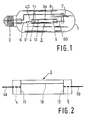
- a high-pressure sodium lamp is provided with a discharge vessel 3 with a ceramic wall 3a in which at least Na as an ionizable filling component and a rare gas are present.
- the discharge vessel encloses a discharge space.
- the lamp is provided with main electrodes 4, 5 which are arranged in the discharge space and between which a discharge takes place in the operational condition of the lamp.
- the main electrodes 4, 5 are each connected to a respective current lead-through member 40, 50, which is passed through the wall 3a of the discharge vessel 3 and is connected thereto in a gastight manner by means of a connection of a ceramic sealing compound.
- the lamp is also provided with an outer bulb 1 and a lamp cap 2.
- the lead-through member 40 is electrically connected to a rigid current conductor 6, which is internally connected to the lamp cap 2, via a flexible conductor 6'.
- the lead-through member 50 is electrically and mechanically connected to a rigid current conductor 8, which is also internally connected to the lamp cap 2, via an auxiliary conductor 7.
- a metallic coating in the form of a metal layer 10 sintered on the ceramic wall is present on the outer surface of the ceramic wall 3a.
- the metal layer serves as an ignition aid and extends substantially between the main electrodes 4, 5.
- an end of a bimetal element 11 rests against the metal layer 10 near the main electrode 4.
- the bimetal element 11 is fastened with another end to the current conductor 8.
- the heat generated by the discharge breaks the contact between the metal layer 10 and the bimetal element 11 by bending away the bimetal element 11.
- the ceramic discharge vessel is provided with a wall formed from translucent, densely sintered polycrystalline Al2O3 on which a coating of W is present.
- the discharge vessel was preferably formed during manufacture of the lamp by the advantageous method to be described in detail below. Starting in usual manner from a powder mixture of Al2O3 with at most 1000 ppm MgO, a moulded piece is made under pressure which is subsequently pre-baked in the air at a temperature of 1200° C.
- a coating is then provided on the moulded piece thus obtained through the application of a paste formed by a mixture of W-powder and a solvent.
- a suitable solvent is terpineol.
- the paste may in addition contain a binder, for example, ethyl cellulose.
- a large number of industrially applicable methods is available for applying the coating, such as, for example, painting, writing, tampon printing, ink-jet printing, dispensing, roller coating.
- the moulded piece thus coated is subsequently dried, whereby the solvent substantially evaporates. It was found with the use of terpineol that heating for approximately 30 minutes at 175° C results in evaporation of more than 95% of the terpineol originally present. If a binder is present in the paste, it is then baked out. With ethyl cellulose as the binder, it was found that heating for approximately 30 minutes in a dry atmosphere of 7 vol% H2 and 93 vol% N2 leads to a substantially complete firing away/combustion of the binder present.
- the moulded piece After drying and baking, the moulded piece is sintered so as to achieve translucence. This is done in a manner known per se through heating in an atmosphere of moist hydrogen at approximately 1950° C for approximately 2 hours. Sintering between Al2O3 and the W of the coating takes place simultaneously with sintering of the Al2O3 to achieve the translucent state.
- W-powder with a particle size distribution of between 0.2 ⁇ m and 1 ⁇ m was used, with an average value of 0.4 ⁇ m, which corresponds to the particle size distribution of the Al2O3 powder usual in practice.
- High-pressure sodium lamps with a power rating of 400 W were manufactured from the discharge tubes made by the method described above in a manner which was conventional in all further respects.
- the filling of the discharge vessel contains excess Na amalgam in a weight ratio Na/Hg of 9/40 and Xe with a pressure of 40 kPa at room temperature.
- the ignition strip has a width of approximately 0,5 mm and a thickness which varies between 30 ⁇ m and 50 ⁇ m, resulting in a luminous decrement of less than 3%. After a lamp life of 100 hours, the average ignition voltage is 2350 V, and after a life of 1000 hours it is 2425 V.
- production lamps of the same power rating and the same filling in the discharge vessel, provided with an external loose antenna as an ignition aid have an average ignition voltage of 2400 V after 100 hours of lamp life, and 2650 V after 1000 hours of lamp life.
- the ignition strip is arranged so as to be electrically floating.
- the discharge vessel is pictured in Fig. 2, components corresponding to those of Fig. 1 having the same reference numerals.
- the discharge vessel 3 is provided with an ignition strip 10 which is provided with a transverse strip 11, 12 at either end at the level of the respective main electrode.
- Each of the transverse strips 11, 12 forms a substantially closed ring.
- High-pressure sodium lamps were manufactured from the discharge tubes according to Fig. 2, which were manufactured by the method described above, in an otherwise conventional manner.
- the ignition strip has a width of 0.5 mm, as do the transverse strips.
- the average ignition voltage is 2625 V. According to IES standards, an ignition voltage of 2800 V is admissible.
- the power rating of the lamp was 70 W and the pressure at room temperature of the Xe was 26 kPa.
- the ignition strip in this case is 0.16 mm wide.
- the average ignition voltage is 1730 V against the IES standard according to which 1800 V is admissible.
- the luminous efficacy is 96 lm/W, which is a loss of 1.5% compared with similar lamps provided with ignition antennae which deflect away.
Landscapes
- Engineering & Computer Science (AREA)
- Manufacturing & Machinery (AREA)
- Vessels And Coating Films For Discharge Lamps (AREA)
- Discharge Lamps And Accessories Thereof (AREA)
- Manufacture Of Electron Tubes, Discharge Lamp Vessels, Lead-In Wires, And The Like (AREA)
- Other Surface Treatments For Metallic Materials (AREA)
Abstract
Description
- The invention relates to a high-pressure discharge lamp provided with a discharge vessel with a ceramic wall which has an outer surface on which a metallic coating is present.
- The invention also relates to a method of manufacturing such a lamp.
- The term "ceramic wall" in the present description and claims is understood to mean a wall made of either translucent crystalline metal oxide such as, for example, monocrystalline sapphire or, for example, gastight polycrystalline aluminium oxide, or a wall of translucent gastight sintered polycrystalline AlN.
- A lamp of the land mentioned in the opening paragraph is known from EP-A-0002848. To promote lamp ignition, the outer surface of the discharge vessel of the known lamp is provided with an electrically conducting ignition strip in the form of a metallic coating. The strip is adhered to the outer surface of the wall of the discharge vessel in the form of a mixture of metal and metal-oxide particles by means of heating. A metallic coating of a portion of the outer surface of the discharge vessel wall is also known in the form of a heat shield. The aim of this is to exert a positive influence on the heat balance of the lamp. Such a coating is known from inter alia EP-
A-034 4 433. The metallic coating may be vapour-deposited in vacuum or provided as a paste which is subsequently cured. - It is found that the metallic coating thus obtained often shows defects during lamp life, in the form of fractures or cracks in the coating or detaching of the coating from the ceramic wall. Such defects in an ignition strip adversely affect the ignition-promoting effect thereof. If the defects are found in a coating serving as a heat shield, they will lead to an undefined change in the heat balance of the lamp. This will generally result in undesirable changes in photometric properties (luminous efficacy, colour temperature, colour rendering) of the lamp.
- The invention has for its object to provide a measure by which the occurrence of the said defects is counteracted. According to the invention, a lamp of the land mentioned in the opening paragraph is for this purpose characterized in that the metallic coating is a metal layer sintered on the ceramic wall. It was found that sintering of a metal directly on the ceramic wall as a coating results in a well-adhering, continuous coating which is not subject to any appreciable changes during lamp life. A very suitable metal for the metallic coating is W because this combines a large number of favourable properties such as a good heat resistance, good electrical conductance, good sintering possibilities. Besides W, also Zr, Mo, Ta and Nb are highly suitable for use as metals for the metallic coating.
- Preferably, a lamp according to the invention is manufactured by a method according to which the discharge vessel with ceramic wall is formed in that a coating is provided on an outer surface of a wall of a previously baked moulded piece by the application of a paste, which paste is formed by a mixture of metal powder and a solvent, and subsequently the moulded piece thus coated is dried, after which the coated moulded piece is sintered so as to achieve translucence. The paste can also include a binder.
- The term "previously baked moulded piece" in the present description and claims is understood to mean a piece moulded under pressure from a powder mixture which can be sintered so as to achieve translucence, which moulded piece is then baked in such a manner that an initial sintering growth between the powder particles occurs. Advantageously, both a translucent discharge vessel and a sintered bond between the wall of the discharge vessel thus formed and the metallic coating is realised in a single sintering process by the method according to the invention.
- It has indeed been suggested in the literature to sinter W on a base surface of Al₂O₃. It is stated there that the addition of 3% up to even 10% of ZrO₂ or ZrO₂ and SiO₂to the otherwise pure Al₂O₃ is essential for achieving a good sintering bond between Al₂O₃ and W. To obtain translucent Al₂O₃, on the one hand the addition of quantities as mentioned above was found to be absolutely unsuitable, while on the other hand MgO as a sintering dopant is indispensable for achieving a density of the sintered Al₂O₃ required for satisfactory translucence.
- The invention results in a lamp which is more robust than the known lamp and which is easier to manufacture. Also compared with lamps which are much used in practice and which are provided with separate ignition antennas in the form of a wire which is either coiled around the discharge vessel or tensioned alongside the discharge vessel, the lamp according to the invention is much more robust while the manufacture of the lamp according to the invention is much simpler.
- Aspects of the invention as described above as well as other aspects are explained in more detail below with reference to a drawing in which
- Fig. 1 shows a lamp according to the invention and
- Fig. 2 shows a discharge vessel according to an alternative embodiment.
- In Fig. 1, a high-pressure sodium lamp according to the invention is provided with a
discharge vessel 3 with aceramic wall 3a in which at least Na as an ionizable filling component and a rare gas are present. The discharge vessel encloses a discharge space. The lamp is provided withmain electrodes main electrodes member wall 3a of thedischarge vessel 3 and is connected thereto in a gastight manner by means of a connection of a ceramic sealing compound. The lamp is also provided with an outer bulb 1 and alamp cap 2. The lead-throughmember 40 is electrically connected to a rigidcurrent conductor 6, which is internally connected to thelamp cap 2, via a flexible conductor 6'. The lead-throughmember 50 is electrically and mechanically connected to a rigidcurrent conductor 8, which is also internally connected to thelamp cap 2, via an auxiliary conductor 7. - A metallic coating in the form of a
metal layer 10 sintered on the ceramic wall is present on the outer surface of theceramic wall 3a. The metal layer serves as an ignition aid and extends substantially between themain electrodes bimetal element 11 rests against themetal layer 10 near themain electrode 4. Thebimetal element 11 is fastened with another end to thecurrent conductor 8. When the lamp is operating, the heat generated by the discharge breaks the contact between themetal layer 10 and thebimetal element 11 by bending away thebimetal element 11. - In an advantageous practical embodiment of a lamp as described, the ceramic discharge vessel is provided with a wall formed from translucent, densely sintered polycrystalline Al₂O₃ on which a coating of W is present. The discharge vessel was preferably formed during manufacture of the lamp by the advantageous method to be described in detail below. Starting in usual manner from a powder mixture of Al₂O₃ with at most 1000 ppm MgO, a moulded piece is made under pressure which is subsequently pre-baked in the air at a temperature of 1200° C.
- A coating is then provided on the moulded piece thus obtained through the application of a paste formed by a mixture of W-powder and a solvent. A suitable solvent is terpineol. The paste may in addition contain a binder, for example, ethyl cellulose. A large number of industrially applicable methods is available for applying the coating, such as, for example, painting, writing, tampon printing, ink-jet printing, dispensing, roller coating.
- The moulded piece thus coated is subsequently dried, whereby the solvent substantially evaporates. It was found with the use of terpineol that heating for approximately 30 minutes at 175° C results in evaporation of more than 95% of the terpineol originally present. If a binder is present in the paste, it is then baked out. With ethyl cellulose as the binder, it was found that heating for approximately 30 minutes in a dry atmosphere of 7 vol% H₂ and 93 vol% N₂ leads to a substantially complete firing away/combustion of the binder present.
- After drying and baking, the moulded piece is sintered so as to achieve translucence. This is done in a manner known per se through heating in an atmosphere of moist hydrogen at approximately 1950° C for approximately 2 hours. Sintering between Al₂O₃ and the W of the coating takes place simultaneously with sintering of the Al₂O₃ to achieve the translucent state.
- In addition to MgO as the sintering dopant in the basic material for the manufacture of the discharge vessel, extra additions, albeit in small quantities up to approximately 500 ppm, were found useful in practice, such as Er₂O₃, Y₂O₃ and ZrO₂. The temperature and time required for sintering to achieve translucence are influenced to some extent by such extra additions. The use of SiO₂ is known to be unsuitable as an additive when a good translucence of the sintered product is required.
- In the embodiment described, W-powder with a particle size distribution of between 0.2 µm and 1 µm was used, with an average value of 0.4 µm, which corresponds to the particle size distribution of the Al₂O₃ powder usual in practice.
- Inspection of discharge tubes manufactured by the method described shows that Al₂O₃ crystals have assumed a different surface structure at the area of the coating compared with that which is present and usual at the exposed surface of the ceramic wall of the discharge vessel. The surface structure at the area of the coating has a crystal size distribution which is comparable to the size and pore structure of the W-particles.
- High-pressure sodium lamps with a power rating of 400 W were manufactured from the discharge tubes made by the method described above in a manner which was conventional in all further respects. The filling of the discharge vessel contains excess Na amalgam in a weight ratio Na/Hg of 9/40 and Xe with a pressure of 40 kPa at room temperature. The ignition strip has a width of approximately 0,5 mm and a thickness which varies between 30 µm and 50 µm, resulting in a luminous decrement of less than 3%. After a lamp life of 100 hours, the average ignition voltage is 2350 V, and after a life of 1000 hours it is 2425 V. For comparison it should be noted that production lamps of the same power rating and the same filling in the discharge vessel, provided with an external loose antenna as an ignition aid have an average ignition voltage of 2400 V after 100 hours of lamp life, and 2650 V after 1000 hours of lamp life.
- In an alternative embodiment of the lamp according to the invention, the ignition strip is arranged so as to be electrically floating. The discharge vessel is pictured in Fig. 2, components corresponding to those of Fig. 1 having the same reference numerals.
- The
discharge vessel 3 is provided with anignition strip 10 which is provided with atransverse strip transverse strips - High-pressure sodium lamps were manufactured from the discharge tubes according to Fig. 2, which were manufactured by the method described above, in an otherwise conventional manner. In a first instance, these were lamps with a power rating of 400 W, provided with a filling of the discharge vessel comprising an excess quantity of sodium amalgam in a weight ratio Na/Hg of 9/40 and Xe with a pressure of 40 kPa at room temperature. The ignition strip has a width of 0.5 mm, as do the transverse strips. The average ignition voltage is 2625 V. According to IES standards, an ignition voltage of 2800 V is admissible.
- In a second instance, the power rating of the lamp was 70 W and the pressure at room temperature of the Xe was 26 kPa. The ignition strip in this case is 0.16 mm wide. The average ignition voltage is 1730 V against the IES standard according to which 1800 V is admissible.
- The luminous efficacy is 96 lm/W, which is a loss of 1.5% compared with similar lamps provided with ignition antennae which deflect away.
Claims (2)
- A high-pressure discharge lamp provided with a discharge vessel with a ceramic wall which has an outer surface on which a metallic coating is present, characterized in that the metallic coating is a metal layer sintered on the ceramic wall.
- A method of manufacturing a high-pressure discharge lamp provided with a discharge vessel with a ceramic wall as claimed in Claim 1, according to which the discharge vessel with ceramic wall is formed in that a coating is provided on an outer surface of a wall of a previously baked moulded piece by the application of a paste, which paste is formed by a mixture of metal powder and a solvent, and subsequently the moulded piece thus coated is dried, after which the coated moulded piece is sintered so as to achieve translucence.
Priority Applications (1)
| Application Number | Priority Date | Filing Date | Title |
|---|---|---|---|
| EP93202815A EP0592040B1 (en) | 1992-10-08 | 1993-10-04 | High pressure discharge lamp |
Applications Claiming Priority (3)
| Application Number | Priority Date | Filing Date | Title |
|---|---|---|---|
| EP92203092 | 1992-10-08 | ||
| EP92203092 | 1992-10-08 | ||
| EP93202815A EP0592040B1 (en) | 1992-10-08 | 1993-10-04 | High pressure discharge lamp |
Publications (2)
| Publication Number | Publication Date |
|---|---|
| EP0592040A1 true EP0592040A1 (en) | 1994-04-13 |
| EP0592040B1 EP0592040B1 (en) | 1999-01-13 |
Family
ID=8210953
Family Applications (1)
| Application Number | Title | Priority Date | Filing Date |
|---|---|---|---|
| EP93202815A Expired - Lifetime EP0592040B1 (en) | 1992-10-08 | 1993-10-04 | High pressure discharge lamp |
Country Status (7)
| Country | Link |
|---|---|
| US (1) | US5541480A (en) |
| EP (1) | EP0592040B1 (en) |
| JP (2) | JP3566974B2 (en) |
| CN (1) | CN1048353C (en) |
| CA (1) | CA2107701C (en) |
| DE (1) | DE69323026T2 (en) |
| ES (1) | ES2128387T3 (en) |
Cited By (5)
| Publication number | Priority date | Publication date | Assignee | Title |
|---|---|---|---|---|
| EP1037259A1 (en) * | 1999-03-16 | 2000-09-20 | Patent-Treuhand-Gesellschaft für elektrische Glühlampen mbH | High pressure discharge lamp with an ignition aid |
| WO2001037319A1 (en) * | 1999-11-15 | 2001-05-25 | Koninklijke Philips Electronics N.V. | Ceramic metal halide lamp with integral uv-enhancer |
| WO2005073999A3 (en) * | 2004-01-28 | 2007-04-19 | Patent Treuhand Ges Fuer Elektrische Gluehlampen Mbh | Method for producing discharge lamps |
| WO2005027183A3 (en) * | 2003-09-17 | 2007-08-16 | Koninkl Philips Electronics Nv | High intensity discharge lamp |
| US8456087B2 (en) | 2008-07-10 | 2013-06-04 | Koninklijke Philips Electronics N.V. | High-pressure sodium vapor discharge lamp with hybrid antenna |
Families Citing this family (29)
| Publication number | Priority date | Publication date | Assignee | Title |
|---|---|---|---|---|
| US5661367A (en) * | 1996-08-08 | 1997-08-26 | Philips Electronics North America Corporation | High pressure series arc discharge lamp construction with simplified starting aid |
| JPH10223182A (en) * | 1997-02-10 | 1998-08-21 | Stanley Electric Co Ltd | Fluorescent lamp |
| WO1999014781A1 (en) * | 1997-09-15 | 1999-03-25 | Osram Sylvania Inc. | Alumina arc tube seal having increased resistance to thermal shock |
| KR100822490B1 (en) * | 2000-02-11 | 2008-04-16 | 코닌클리즈케 필립스 일렉트로닉스 엔.브이. | Unit containing high voltage discharge lamp and ignition antenna |
| WO2001073817A1 (en) * | 2000-03-28 | 2001-10-04 | Robert Bosch Gmbh | Gas discharge lamp with ignition assisting electrodes, especially for automobile headlights |
| US6456005B1 (en) * | 2000-10-31 | 2002-09-24 | General Electric Company | Materials and methods for application of conducting members on arc tubes |
| US6538377B1 (en) | 2000-11-03 | 2003-03-25 | General Electric Company | Means for applying conducting members to arc tubes |
| US6563265B1 (en) | 2000-11-06 | 2003-05-13 | General Electric Company | Applying prealloyed powders as conducting members to arc tubes |
| EP1463691B1 (en) * | 2002-01-04 | 2006-06-14 | Koninklijke Philips Electronics N.V. | Sintered body and electric lamp |
| US6661171B2 (en) * | 2002-04-16 | 2003-12-09 | Osram Sylvania Inc. | Integral starting aid for high intensity discharge lamps |
| CN101070242A (en) * | 2002-07-10 | 2007-11-14 | 皇家飞利浦电子股份有限公司 | Transparent polycrystalline aluminium oxide |
| WO2005088679A2 (en) * | 2004-03-02 | 2005-09-22 | Koninklijke Philips Electronics N.V. | A process for manufacturing a high-intensity discharge lamp |
| CN1969366B (en) * | 2004-06-14 | 2011-06-08 | 皇家飞利浦电子股份有限公司 | Ceramic metal halide discharge lamp |
| US7170228B2 (en) * | 2004-06-30 | 2007-01-30 | Osram Sylvania Inc. | Ceramic arc tube having an integral susceptor |
| US7038383B2 (en) * | 2004-09-27 | 2006-05-02 | Osram Sylvania Inc. | Ignition aid for high intensity discharge lamp |
| WO2006085162A1 (en) | 2005-01-03 | 2006-08-17 | Philips Intellectual Property & Standards Gmbh | Gas discharge lamp |
| ATE489723T1 (en) * | 2006-07-07 | 2010-12-15 | Koninkl Philips Electronics Nv | GAS DISCHARGE LAMP |
| DE102006033871A1 (en) * | 2006-07-21 | 2008-01-24 | Patent-Treuhand-Gesellschaft für elektrische Glühlampen mbH | Discharge lamp with Zündhilfselement |
| US8102121B2 (en) * | 2007-02-26 | 2012-01-24 | Osram Sylvania Inc. | Single-ended ceramic discharge lamp |
| US7852004B2 (en) | 2007-06-06 | 2010-12-14 | General Electric Company | Ignition aid and fitting shroud for discharge lamp |
| WO2009030265A1 (en) * | 2007-08-29 | 2009-03-12 | Osram Gesellschaft mit beschränkter Haftung | Lamp having directly applied starting aid device |
| JP5655006B2 (en) | 2008-12-30 | 2015-01-14 | コーニンクレッカ フィリップス エヌ ヴェ | Metal halide lamp with ceramic discharge vessel |
| EP2476133B1 (en) | 2009-09-10 | 2016-09-07 | Philips Lighting Holding B.V. | High intensity discharge lamp |
| DE102011002634A1 (en) * | 2011-01-13 | 2012-07-19 | Osram Ag | Discharge lamp with discharge vessel and mercury filling |
| US8766518B2 (en) | 2011-07-08 | 2014-07-01 | General Electric Company | High intensity discharge lamp with ignition aid |
| US8659225B2 (en) | 2011-10-18 | 2014-02-25 | General Electric Company | High intensity discharge lamp with crown and foil ignition aid |
| US20130093310A1 (en) | 2011-10-14 | 2013-04-18 | General Electric Company | High intensity discharge lamp with coiled wire ignition aid |
| WO2014088733A1 (en) | 2012-12-06 | 2014-06-12 | General Electric Company | Conductive layer net ignition aids |
| CN103236384B (en) * | 2013-04-12 | 2015-08-12 | 冷水江市汇鑫电子陶瓷有限公司 | Gas discharge tube replaces with ceramal line the technique of carbon line |
Citations (4)
| Publication number | Priority date | Publication date | Assignee | Title |
|---|---|---|---|---|
| EP0002848A1 (en) * | 1977-12-16 | 1979-07-11 | Koninklijke Philips Electronics N.V. | Electrical high-pressure metal vapour discharge lamp |
| JPS5968165A (en) * | 1982-10-08 | 1984-04-18 | Matsushita Electronics Corp | High pressure sodium lamp |
| EP0344433A2 (en) * | 1988-05-31 | 1989-12-06 | Patent-Treuhand-Gesellschaft für elektrische Glühlampen mbH | High-pressure sodium discharge lamp |
| EP0453652A2 (en) * | 1990-04-27 | 1991-10-30 | Patent-Treuhand-Gesellschaft für elektrische Glühlampen mbH | High pressure discharge lamp |
Family Cites Families (2)
| Publication number | Priority date | Publication date | Assignee | Title |
|---|---|---|---|---|
| US4665344A (en) * | 1984-04-25 | 1987-05-12 | Ngk Insulators, Ltd. | Ceramic envelope device for high-pressure discharge lamp |
| US4808876A (en) * | 1986-02-04 | 1989-02-28 | General Electric Company | Metal halide lamp |
-
1993
- 1993-10-04 DE DE69323026T patent/DE69323026T2/en not_active Expired - Fee Related
- 1993-10-04 ES ES93202815T patent/ES2128387T3/en not_active Expired - Lifetime
- 1993-10-04 EP EP93202815A patent/EP0592040B1/en not_active Expired - Lifetime
- 1993-10-05 CA CA002107701A patent/CA2107701C/en not_active Expired - Fee Related
- 1993-10-06 JP JP25055793A patent/JP3566974B2/en not_active Expired - Fee Related
- 1993-10-07 CN CN93114434A patent/CN1048353C/en not_active Expired - Fee Related
-
1995
- 1995-05-23 US US08/448,020 patent/US5541480A/en not_active Expired - Fee Related
-
2004
- 2004-05-11 JP JP2004140834A patent/JP2004265875A/en active Pending
Patent Citations (4)
| Publication number | Priority date | Publication date | Assignee | Title |
|---|---|---|---|---|
| EP0002848A1 (en) * | 1977-12-16 | 1979-07-11 | Koninklijke Philips Electronics N.V. | Electrical high-pressure metal vapour discharge lamp |
| JPS5968165A (en) * | 1982-10-08 | 1984-04-18 | Matsushita Electronics Corp | High pressure sodium lamp |
| EP0344433A2 (en) * | 1988-05-31 | 1989-12-06 | Patent-Treuhand-Gesellschaft für elektrische Glühlampen mbH | High-pressure sodium discharge lamp |
| EP0453652A2 (en) * | 1990-04-27 | 1991-10-30 | Patent-Treuhand-Gesellschaft für elektrische Glühlampen mbH | High pressure discharge lamp |
Non-Patent Citations (1)
| Title |
|---|
| PATENT ABSTRACTS OF JAPAN vol. 008, no. 176 (E - 260) 14 August 1984 (1984-08-14) * |
Cited By (7)
| Publication number | Priority date | Publication date | Assignee | Title |
|---|---|---|---|---|
| EP1037259A1 (en) * | 1999-03-16 | 2000-09-20 | Patent-Treuhand-Gesellschaft für elektrische Glühlampen mbH | High pressure discharge lamp with an ignition aid |
| US6429588B1 (en) | 1999-03-16 | 2002-08-06 | Patent-Treuhand-Gesellschaft Fuer Elektrische Gluehlampen Mbh | Sodium high-pressure lamp having a starting aid |
| WO2001037319A1 (en) * | 1999-11-15 | 2001-05-25 | Koninklijke Philips Electronics N.V. | Ceramic metal halide lamp with integral uv-enhancer |
| WO2005027183A3 (en) * | 2003-09-17 | 2007-08-16 | Koninkl Philips Electronics Nv | High intensity discharge lamp |
| WO2005073999A3 (en) * | 2004-01-28 | 2007-04-19 | Patent Treuhand Ges Fuer Elektrische Gluehlampen Mbh | Method for producing discharge lamps |
| US8456087B2 (en) | 2008-07-10 | 2013-06-04 | Koninklijke Philips Electronics N.V. | High-pressure sodium vapor discharge lamp with hybrid antenna |
| DE202009018836U1 (en) | 2008-07-10 | 2013-10-22 | Koninklijke Philips N.V. | Sodium vapor high-pressure discharge lamp |
Also Published As
| Publication number | Publication date |
|---|---|
| DE69323026T2 (en) | 1999-07-01 |
| JP3566974B2 (en) | 2004-09-15 |
| JPH06196128A (en) | 1994-07-15 |
| CA2107701C (en) | 2003-05-27 |
| US5541480A (en) | 1996-07-30 |
| ES2128387T3 (en) | 1999-05-16 |
| DE69323026D1 (en) | 1999-02-25 |
| CN1087749A (en) | 1994-06-08 |
| EP0592040B1 (en) | 1999-01-13 |
| CN1048353C (en) | 2000-01-12 |
| JP2004265875A (en) | 2004-09-24 |
| CA2107701A1 (en) | 1994-04-09 |
Similar Documents
| Publication | Publication Date | Title |
|---|---|---|
| EP0592040B1 (en) | High pressure discharge lamp | |
| CA1063150A (en) | Fluorescent lamp with an integral fail-safe and auxiliary-amalgam component | |
| US5111108A (en) | Vapor discharge device with electron emissive material | |
| AU687174B2 (en) | High-pressure metal halide lamp | |
| US4136227A (en) | Electrode of discharge lamp | |
| US3969279A (en) | Method of treating electron emissive cathodes | |
| US20120169225A1 (en) | Electrode for discharge lamp, method of manufacturing electrode for discharge lamp, and discharge lamp | |
| CN1069149C (en) | Metal halide lamp | |
| US6380118B1 (en) | Nonlinear dielectric ceramic, pulse generating capacitor, high-pressure vapor discharge lamp circuit, and high-pressure vapor discharge lamp | |
| US6538377B1 (en) | Means for applying conducting members to arc tubes | |
| US3919581A (en) | Thoria-yttria emission mixture for discharge lamps | |
| US4031426A (en) | Emissive coating for electrodes | |
| US6563265B1 (en) | Applying prealloyed powders as conducting members to arc tubes | |
| US6384534B1 (en) | Electrode material for fluorescent lamps | |
| EP0249743A2 (en) | Discharge lamps with coated ceramic arc tubes and fabrication thereof | |
| GB2091032A (en) | High pressure sodium discharge lamp | |
| US3953376A (en) | Method for preparing emissive coating for electrodes | |
| HU180274B (en) | High-pressure metal vapour discharge lamp | |
| US4806826A (en) | High pressure sodium vapor discharge device | |
| US2959702A (en) | Lamp and mount | |
| US7038383B2 (en) | Ignition aid for high intensity discharge lamp | |
| US3048737A (en) | Gaseous discharge device and method | |
| US3951874A (en) | Method for preparing electron emissive coatings | |
| US2973450A (en) | Electric discharge lamp starting strip | |
| US4924146A (en) | Unsaturated high-pressure sodium lamp |
Legal Events
| Date | Code | Title | Description |
|---|---|---|---|
| PUAI | Public reference made under article 153(3) epc to a published international application that has entered the european phase |
Free format text: ORIGINAL CODE: 0009012 |
|
| AK | Designated contracting states |
Kind code of ref document: A1 Designated state(s): BE DE ES FR GB IT NL |
|
| RAP1 | Party data changed (applicant data changed or rights of an application transferred) |
Owner name: N.V. PHILIPS' GLOEILAMPENFABRIEKEN |
|
| 17P | Request for examination filed |
Effective date: 19940908 |
|
| 17Q | First examination report despatched |
Effective date: 19951214 |
|
| GRAG | Despatch of communication of intention to grant |
Free format text: ORIGINAL CODE: EPIDOS AGRA |
|
| GRAG | Despatch of communication of intention to grant |
Free format text: ORIGINAL CODE: EPIDOS AGRA |
|
| GRAH | Despatch of communication of intention to grant a patent |
Free format text: ORIGINAL CODE: EPIDOS IGRA |
|
| RAP3 | Party data changed (applicant data changed or rights of an application transferred) |
Owner name: KONINKLIJKE PHILIPS ELECTRONICS N.V. |
|
| GRAH | Despatch of communication of intention to grant a patent |
Free format text: ORIGINAL CODE: EPIDOS IGRA |
|
| GRAA | (expected) grant |
Free format text: ORIGINAL CODE: 0009210 |
|
| AK | Designated contracting states |
Kind code of ref document: B1 Designated state(s): BE DE ES FR GB IT NL |
|
| PG25 | Lapsed in a contracting state [announced via postgrant information from national office to epo] |
Ref country code: NL Free format text: LAPSE BECAUSE OF FAILURE TO SUBMIT A TRANSLATION OF THE DESCRIPTION OR TO PAY THE FEE WITHIN THE PRESCRIBED TIME-LIMIT Effective date: 19990113 |
|
| REF | Corresponds to: |
Ref document number: 69323026 Country of ref document: DE Date of ref document: 19990225 |
|
| ET | Fr: translation filed | ||
| ITF | It: translation for a ep patent filed | ||
| REG | Reference to a national code |
Ref country code: ES Ref legal event code: FG2A Ref document number: 2128387 Country of ref document: ES Kind code of ref document: T3 |
|
| NLV1 | Nl: lapsed or annulled due to failure to fulfill the requirements of art. 29p and 29m of the patents act | ||
| PLBE | No opposition filed within time limit |
Free format text: ORIGINAL CODE: 0009261 |
|
| 26N | No opposition filed | ||
| REG | Reference to a national code |
Ref country code: GB Ref legal event code: IF02 |
|
| PGFP | Annual fee paid to national office [announced via postgrant information from national office to epo] |
Ref country code: BE Payment date: 20040920 Year of fee payment: 12 |
|
| PGFP | Annual fee paid to national office [announced via postgrant information from national office to epo] |
Ref country code: ES Payment date: 20041006 Year of fee payment: 12 |
|
| PGFP | Annual fee paid to national office [announced via postgrant information from national office to epo] |
Ref country code: FR Payment date: 20041027 Year of fee payment: 12 |
|
| PGFP | Annual fee paid to national office [announced via postgrant information from national office to epo] |
Ref country code: GB Payment date: 20041028 Year of fee payment: 12 |
|
| PGFP | Annual fee paid to national office [announced via postgrant information from national office to epo] |
Ref country code: DE Payment date: 20041214 Year of fee payment: 12 |
|
| PG25 | Lapsed in a contracting state [announced via postgrant information from national office to epo] |
Ref country code: IT Free format text: LAPSE BECAUSE OF NON-PAYMENT OF DUE FEES Effective date: 20051004 Ref country code: GB Free format text: LAPSE BECAUSE OF NON-PAYMENT OF DUE FEES Effective date: 20051004 |
|
| PG25 | Lapsed in a contracting state [announced via postgrant information from national office to epo] |
Ref country code: ES Free format text: LAPSE BECAUSE OF NON-PAYMENT OF DUE FEES Effective date: 20051005 |
|
| PG25 | Lapsed in a contracting state [announced via postgrant information from national office to epo] |
Ref country code: BE Free format text: LAPSE BECAUSE OF NON-PAYMENT OF DUE FEES Effective date: 20051031 |
|
| PG25 | Lapsed in a contracting state [announced via postgrant information from national office to epo] |
Ref country code: DE Free format text: LAPSE BECAUSE OF NON-PAYMENT OF DUE FEES Effective date: 20060503 |
|
| GBPC | Gb: european patent ceased through non-payment of renewal fee |
Effective date: 20051004 |
|
| PG25 | Lapsed in a contracting state [announced via postgrant information from national office to epo] |
Ref country code: FR Free format text: LAPSE BECAUSE OF NON-PAYMENT OF DUE FEES Effective date: 20060630 |
|
| REG | Reference to a national code |
Ref country code: FR Ref legal event code: ST Effective date: 20060630 |
|
| REG | Reference to a national code |
Ref country code: ES Ref legal event code: FD2A Effective date: 20051005 |
|
| BERE | Be: lapsed |
Owner name: KONINKLIJKE *PHILIPS ELECTRONICS N.V. Effective date: 20051031 |