EP0597632A1 - Packet mode digital data receiver - Google Patents
Packet mode digital data receiver Download PDFInfo
- Publication number
- EP0597632A1 EP0597632A1 EP93308837A EP93308837A EP0597632A1 EP 0597632 A1 EP0597632 A1 EP 0597632A1 EP 93308837 A EP93308837 A EP 93308837A EP 93308837 A EP93308837 A EP 93308837A EP 0597632 A1 EP0597632 A1 EP 0597632A1
- Authority
- EP
- European Patent Office
- Prior art keywords
- signal
- reset
- input
- receiver
- data
- Prior art date
- Legal status (The legal status is an assumption and is not a legal conclusion. Google has not performed a legal analysis and makes no representation as to the accuracy of the status listed.)
- Granted
Links
Images




Classifications
-
- H—ELECTRICITY
- H04—ELECTRIC COMMUNICATION TECHNIQUE
- H04B—TRANSMISSION
- H04B10/00—Transmission systems employing electromagnetic waves other than radio-waves, e.g. infrared, visible or ultraviolet light, or employing corpuscular radiation, e.g. quantum communication
- H04B10/60—Receivers
- H04B10/66—Non-coherent receivers, e.g. using direct detection
- H04B10/69—Electrical arrangements in the receiver
- H04B10/695—Arrangements for optimizing the decision element in the receiver, e.g. by using automatic threshold control
-
- H—ELECTRICITY
- H04—ELECTRIC COMMUNICATION TECHNIQUE
- H04B—TRANSMISSION
- H04B10/00—Transmission systems employing electromagnetic waves other than radio-waves, e.g. infrared, visible or ultraviolet light, or employing corpuscular radiation, e.g. quantum communication
- H04B10/60—Receivers
- H04B10/66—Non-coherent receivers, e.g. using direct detection
- H04B10/69—Electrical arrangements in the receiver
- H04B10/693—Arrangements for optimizing the preamplifier in the receiver
- H04B10/6933—Offset control of the differential preamplifier
-
- H—ELECTRICITY
- H04—ELECTRIC COMMUNICATION TECHNIQUE
- H04L—TRANSMISSION OF DIGITAL INFORMATION, e.g. TELEGRAPHIC COMMUNICATION
- H04L25/00—Baseband systems
- H04L25/02—Details ; arrangements for supplying electrical power along data transmission lines
- H04L25/06—DC level restoring means; Bias distortion correction ; Decision circuits providing symbol by symbol detection
Definitions
- This invention relates to digital data receivers and more particularly to a receiver for receiving burst mode digital data.
- a requirement for conventional data transmission is the establishment of well-defined logic thresholds.
- Metallic wired systems use pre-defined dc logic levels for this purpose. This is unsatisfactory in an optical system where absolute signal levels are not known a priori.
- the conventional solution is ac-coupling between the receiver and the logic quantizer. With this approach, dc logic threshold levels are established by forming a "signal average" of the received data pulse. Signals above the average are considered as logic ONEs, while signals below the average are logic ZEROs. While ac-coupled receivers work well for continuous data transmission they do not work well for burst mode data transmissions, where the time average of the signal is continuously and unpredictably varying.
- receivers are likely to receive closely-spaced packet data signals from different transmitters which have widely varying power levels. For example, one packet may arrive with power level of-15 dBm, followed a few bits later by another packet with power level of -35 dBm (one hundred times smaller).
- the receiver has to be able to handle a wide range of packet amplitudes, separated by only a few nanoseconds in time.
- This invention is directed toward solving the first problem while the above recited related application is directed toward solving the second problem.
- a digital data receiver includes a dc-coupled differential input amplifier circuit for receiving a digital packet data input signal, a detector circuit for detecting and storing a peak amplitude of the signal, and a reset circuit responsive to an end-of-packet reset signal.
- the reset circuit discharges the stored peak amplitude signal to a non-zero dc voltage substantially equal to the initial dc voltage stored by the detector circuit during the absence of a received input signal.
- the reset circuit includes both coarse and fine reset circuits which are enabled by the reset signal.
- the coarse reset circuit discharges the detector circuit at a high rate until the stored voltage is within a predetermined voltage of the initial dc voltage after which it is shut off.
- the fine reset circuit discharges the detector at a low discharge rate until the initial dc voltage is reached.
- the reset circuit of the present invention is arranged to operate with the prior art digital data receiver described in our previously referenced U. S. patent 5,025,456.
- the reset circuit of the present invention is arranged to operate with the data receiver of our previously referenced related patent application.
- the data receiver includes a dc-coupled differential input amplifier circuit having a first input for receiving the input data signal, a second input for receiving a first reference signal, and an amplifier output.
- a first peak detector detects and stores the peak amplitude of the amplifier output data signal and generates therefrom the first reference signal.
- a second peak detector detects and stores a negative (minimum) peak amplitude of the amplifier output data signal and generates therefrom a second reference signal.
- a dc compensator in response to the first and second reference signals, shunts away a portion of the dc or low frequency current of the data input signal applied to the first input of the amplifier.
- the reset circuit is used to discharge each peak detector to a non-zero dc voltage substantially equal to an initial dc voltage which is stored in said peak detector during the absence of a received data input signal.
- the reset signal is also used to reset other circuitry of the receiver.
- the present reset circuit enables the receiver to more effectively handle closely-spaced packet data signals having widely varying power levels.
- the receiver includes four blocks: a differential input/output transimpedance amplifier ( A1 ), a high speed peak detector ( A2 ), an optional gain amplifier ( A3 ), and a quantizer circuit ( Q1 ).
- the quantizer circuit Q1 converts the analog signal outputted from the receiver to a clean digital ZERO or ONE signal at a voltage level (e.g., ECL) compatible with the circuits to which it connects.
- Z T is the transimpedance (feedback resistor) between the positive input and negative output of A1 .
- One of A1 's differential outputs, and therefore one-half of the net output swing, is sampled by the peak detector and stored on C PD . This half-amplitude reference level, I in Z T /2, is applied to the complementary (negative) input of A1 , thus establishing the logic threshold V REF .
- the peak detector charges very rapidly, but there may be some pulse width distortion of the output during the first few bits in a burst.
- Logic level acquisition is accelerated by reducing the size of the peak detector capacitor C PD .
- C PD is used also to stabilize the peak detector feedback loop around A1 and A2 . If C PD is too small, then peak detector loop instability results.
- optical packets with widely varying signal amplitudes can appear, closely spaced on the bus.
- this is shown by 203 where the packets PK1 (from a first transmitter) and PK2 (from a second transmitter) may have the same time slot width T1 and where packets PK1 have significantly higher signal amplitudes than the packets PK2.
- the circuit of FIG. 1 after a large amplitude packet PK1 threshold has been stored on C PD , then the circuit may not distinguish a small amplitude packet PK2 from noise. Therefore, such packets must be separated by a long enough time interval (e.g., T2 shown in 203) to allow C PD to discharge.
- the problem is illustrated in FIG. 3.
- the photocurrents I in(1) and I in(2) are proportional to the received optical signal powers P1 and P2 , and I in(1) is much larger than I in(2) .
- the peak detector output is determined by the first large I in(1) signal (pulse 0), and is too large for the peak of the first following I in(2) pulse (pulse 1) to reach the logic slicing level 331, of the quantizer circuit Q1 .
- the quantizer circuit Q1 output bit 1 is completely missing, (shown as dotted pattern) and bit 2 suffers a large pulse width distortion (in this example).
- a second problem in optical bus applications is the low frequency "dark level" optical power.
- FIG. 4 we illustratively depict the operating levels of a laser diode. It is impractical to modulate a transmitter's laser diode between its "true" OFF (i.e., P O , I O ) and its ON (i.e., P on , I on ) states at high speed. Consequently, lasers are typically biased OFF at a current I off (slightly below the lasing threshold current ( I th )) where there is some light output ( P OFF ) even in the OFF state. Extinction ratios ( P on / P off ) of 10 - 20 are typical.
- the dark (all off) light level could be NP off , where N is the number of lasers.
- This light-level approaches the ON-state light-level of an individual laser.
- the optical power of the dark level signal could exceed the burst signal level of some packets by a significant factor.
- logic threshold is I in Z T /2, where I in is the input signal corresponding to the maximum optical signal input P in .
- I in is the input signal corresponding to the maximum optical signal input P in .
- a "false" logic threshold TH1 equal to ( I dark + I in ) Z T /2 is established rather than the "true” logic threshold TH2 equal to I in Z T/2 .
- I dark ⁇ I in as shown by 501
- proper input signal detection is still probable, as shown by 503.
- the false threshold TH1 would cause the input signal to be improperly detected, as shown by 504, rather than being properly detected, as shown by 505.
- FIG. 6 A simplified functional diagram of our new circuit is shown in FIG. 6.
- the preamp corresponding to A1 in FIG. 1, is a differential input/output transimpedance amplifier.
- the Adaptive Threshold Circuit 610 is a modified, enhanced version of the peak detector ( A 2, B X, B Y, C PD ) in FIG. 1.
- the Output Amplifier corresponds to A3
- the Packet Threshold Reset Circuitry (hereinafter Reset circuit) 620 is a new function, added to allow zeroing of the peak detector capacitor between data packets.
- the new capabilities are described in the following sections.
- the Reset function is introduced to each peak detector circuit and allows rapid and precise zeroing of the peak detector capacitor.
- the receiver By activating the Reset circuit 620 at the conclusion of a data packet (T2 of FIG. 2), the receiver is prepared to establish a new logic threshold (e.g., at a substantially reduced level) after a short reset interval.
- the dark level light problem is handled by a "dark level compensator" (Darcom) circuit (includes preamp A1 and Adaptive Threshold Circuit 610) which measures and shunts or subtracts out the low frequency input signal ( I comp ) portion of I in .
- the peak detector circuits A 2P, A 2N ), as described later, are modified to increase stability and improve the accuracy of peak detector tracking.
- a block diagram of the dark level compensator (Darcom) circuit 600 is shown in FIG. 6.
- Darcom circuit 600 consists of the input amplifier A1 , a positive peak detector A 2P , a negative peak detector A 2N , a comparison amplifier, A4 , and a low pass filter LP1 .
- Detector A 2P samples the peak value of the positive output of amplifier A1 .
- Detector A 2N samples the peak value of the negative output of amplifier A1 . Because of the differential outputs, ( V0 + and V0 ⁇ ) of amplifier A1 , the positive and negative peak detectors, A 2P and A 2N , can be implemented as identical circuits, thus assuring matching of tracking accuracy, and improving overall precision.
- Detector A 2P is used with amplifier A1 to set a logic threshold equal to half the maximum input swing (e.g., TH2 of FIG. 5).
- the Darcom circuit 600 relies on the spectral characteristics of the peak detector circuits ( A 2P , A 2N ). In the higher frequency range, bounded on the lower end by the discharge time of the peak detector capacitors, the peak detectors ( A 2P , A 2N ) act as peak sampling circuits with unity gain. At low frequencies, however, the peak detector capacitors have enough time to discharge, and consequently A 2P and A 2N are simply unity gain amplifiers. While the outputs of A 2P and A 2N do track low frequency variations in the input current I in , the following, for simplicity, refers to these low frequency variations as the "dc" I dark current.
- a 2P and A 2N apply the peak values of the positive and negative outputs ( V 0 + and V0 ⁇ ) of amplifier A1 as inputs to comparison amplifier A4 .
- these peak detector outputs ( V0 + and V0 ⁇ ) consist of the sum of a high frequency common signal peak and a low frequency difference signal (dark level offset).
- A4 together with low pass filter LP1 converts this into a "dc difference" signal, ( I comp ) which is subtracted from the input signal I in .
- a dc (or low frequency) feedback loop is established in Darcom circuit 600 that forces the dc (or low frequency) signals' differential output of A1 to zero, cancelling out the input dark current ( I dark ) along with any other dc offset signals (or low frequency offset signals).
- Such other dc offset signals may be derived from the outputs V0 + and V0 ⁇ of amplifier A1 or from peak detectors A 2P orA 2N .
- Low pass filter LP1 serves to stabilize the Darcom feedback loop, and also to average out fluctuations in the dark level signal.
- Darcom circuit 600 ignores high frequency inputs, while forcing the dc (or low frequency) output component to zero.
- Proper operation of Darcom circuit 600 depends on accurate tracking and matching of the two peak detectors A 2P and A 2N . If the positive peak detector A 2P is inaccurate, then an improper logic threshold may be established, and the peak detector outputs will not be symmetric. This is illustrated by the wave forms 702 in FIG. 7. This may manifest itself as an offset in the differential PreAmp A1 output voltage( V 0 + - V 0 - ). Likewise, if the peak detectors A 2P and A 2N do not precisely match each other, then the mismatch will again appear as a PreAmp A1 output offset.
- the gain of peak detector circuit A 2P was increased slightly.
- the fractional tracking error ( V in - V0 )/ V in is 1/(1 + A ), where A is the open loop gain of the amplifier A2 , and V in and V0 are the input and output signals of the peak detector consisting of A 2, B X, B Y, and C PD .
- the error is reduced with increasing gain A, but it never goes to zero.
- this loop is identified as the path leading from the positive output of A1 through the peak detector and then back to the negative input of A1 .
- Stability requires that there be a single dominant pole in this feedback loop. This is normally designed to be set by the peak detector capacitor C PD in series with the emitter drive resistance of transistor B X . Unhappily, there are many other poles in this loop, including the amplifier poles of A1 and A2 , as well as the input poles of A1 . Moreover, the driving resistance of B X is very small, and consequently a large capacitor C PD is needed to establish a dominant pole. Stability of this loop can become marginal.
- the peak detector A 2P operates in one of two modes: (1) charging or (2) maintenance.
- charging mode the positive input to amplifier A2 is greater than the negative input, and the circuit responds by pumping charge into the peak detector capacitor C PD .
- the charging mode the circuit is "slew limited”. Equivalently, the loop gain is zero, and thus stability is not at issue.
- maintenance mode the positive and negative inputs to amplifier A2 are approximately equal, and the charge pump B X on average provides just enough current to balance the discharge current (base current of B Y ). In this mode, stability is an issue, and must be assured.
- Stability is improved by putting a large series resistance R PD in series with the charging transistor B X , as shown in FIG. 8. This lowers the frequency of the dominant pole, now determined approximately by R PD and C PD .
- the impaired charging characteristic that results is remedied by introducing a "slew booster" circuit 810, shown as amplifier A5 and charging transistor B Z in FIG. 8.
- the slew booster circuit 810 charges C PD directly, without a limiting series resistor.
- the input to amplifier A5 is offset slightly ( V OFF ) with respect to the input of A2 . Consequently, the slew booster turns on only when the difference between the input V 0 + and the stored output V OUT is large, i.e. > V OFF .
- the slew booster circuit 810 When the voltage stored on C PD charges to within V OFF of the final value, the slew booster circuit 810 turns off, and the main peak detector amplifier A2 charges C PD the rest of the way to equilibrium. Thus, the slew booster circuit 810 is "on" only when the circuit is in the charging mode. When the circuit is in the maintenance mode, the slew booster circuit 810 is off, and therefore does not affect overall feedback loop stability.
- the Reset circuit in response to an end-of-packet Reset signal, is designed to discharge both the positive and negative peak detector circuits A 2P andA 2N very rapidly so that data packets (PK1, PK2) differing in amplitude by approximately 100:1 (P1/P2) can be separated by a time interval (T2), illustratively, as short as four bit periods (this would be approximately 130ns for a 30Mb data signal).
- T2 shown in 203 of FIG. 2
- the Reset circuit includes a common Reset Enable Circuit 820 which generates a Reset enable signal from a reset signal and a Reset Discharge circuit 830 which is part of each peak detector circuit (830 is shown only for positive peak detector A 2P )
- the Reset circuit provides the following attributes: speed, precision, "clamp” function, power conservation and CMOS/TTL input levels.
- the first attribute, speed, is obtained by discharging or clamping the peak detector capacitor C PD as rapidly as possible. This requires, simply, a large discharge current ( I DIS ).
- the clamp function is necessary to turn the peak detector charging circuitry (i.e., amplifiers A2 and A5) off during the Reset interval, and likewise to turn-off the discharge circuitry (i.e., amplifier A6 ) during all but the Reset period.
- the clamp circuit also is used to force the packet receiver output (i.e., amplifiers A3 ) to a well-defined logic state during the Reset interval. Obviously, if amplifier A3 is part of quantizer circuit Q1 , then quantizer Q1 would be reset by the clamp function. Power conservation and CMOS/TTL input levels are system requirements.
- the Reset Discharge circuit 830 operates as follows. Comparator amplifier A6 compares the voltage across C PD with a precision reference voltage, V DIS . If it exceeds the reference voltage, V DIS then switch S F is closed and the discharge current I DIS is drawn from C PD .
- the precision reference V DIS is implemented as a two stage image circuit.
- the voltage V DIS essentially represents the initial output voltage V OUT , when no input data is being received by the receiver of FIG. 8.
- the first stage, A 1i is a copy of input amplifier A1
- the second stage, A 2i is a copy of peak detector circuit A2 .
- the gain enhancing resistor, R1 used within the peak detector amplifier A2 , is referenced to the output 840 of the first image stage, A 1i ). Because I DIS is very large, in order to discharge capacitor C PD rapidly, the time delay through the amplifier A6 discharge loop must be short, or the capacitor C PD will be discharged too far. Likewise, the gain of amplifier A6 must be large to assure a precision discharge. Fortunately, stability is not a concern for the amplifier A6 loop because it can only discharge the capacitor, C PD not charge it; i.e. there is no restoring force to cause oscillation.
- the clamping function is effected by the Reset block 820 in FIG. 8.
- This circuit block translates the Reset input signal into the Reset enable clamping signals, and also turns on and off the discharge current, I DIS . This conserves power by minimizing power consumption of the Reset Discharge Circuit 830 at times when the Reset input signal is not present.
- a Reset discharge circuit may include a coarse discharge circuit 850 and a fine discharge circuit 830 (Note, using Reset discharge circuit 830 for the fine discharge circuit requires adjusting the discharge current source I DIS to a smaller current value).
- the coarse discharge circuit 850 operates like the previously described discharge circuit 830 except that it is not activated unless the difference between voltage V OUT and V Dis exceeds the offset voltage V OFF1 .
- coarse discharge circuit 850 enables switch S C to connect current source I DIS2 to discharge capacitor C PD .
- the fine discharge circuit 830 is also activated since V out is greater than V DIS .
- the coarse discharge circuit 850 switches off the current source I DIS2 from capacitor C PD . Thereafter, only fine discharge circuit 830 is discharging capacitor C PD , ensuring a slower more accurately controllable discharge rate.
- the Reset discharge circuit Using the combined coarse and fine discharge circuits enables the Reset discharge circuit to 1) quickly discharge capacitor C PD of the peak voltage from a high power level packet data and 2) be able to very accurately discharge capacitor C PD down to the desired voltage V DIS .
- the coarse discharge circuit 850 may not be utilized at all. The end result is that the Reset discharge circuit enables the discharge rate to be increased (ensuring fast discharge) without sacrificing the accuracy of controlling the final discharge voltage.
- This arrangement allows the Reset circuit to discharge C PD rapidly and precisely without overshooting due to too great a discharge rate.
- the fast discharge rate ensures that the receiver can reset within a few bit times for a data rate which may vary from the tens to hundreds of megabits/s.
- the accuracy of setting the final discharge voltage of capacitor C PD ensures that the receiver's dynamic input signal range for adjacent packet data power levels can be about 100 to 1. That is, the receiver can detect a low level packet data signal which immediately follows a high level packet data signal which is 100 times as large as the low level signal.
- the Reset circuit includes the Reset Discharge Circuits 830 and 850, Reset Enable Circuit 820, precision references A 1i and A 2i , and resistors R1 and R2 interconnected as shown. Since the Reset circuit 830 and 850 shown in FIG. 9 is implemented using the same circuitry and operates in the same way as previously described with reference to FIG. 8, it is not further described herein.
- the dark level offset is determined by the difference between the output of A 2N and a new reference voltage which is analogous to the output of image circuit A 1i ; i.e., the amplifier A1 output with no dark level signal present.
- the comparison amplifier A4 would then remain a difference amplifier that would take the difference between the minimum peak voltages outputted from detector A 2N and this new reference.
- the difference amplifier together with a low pass filter would then produce the dc current I comp which is subtracted or shunted from I in prior to input to amplifier A1 .
- the receiver could be used with voltage input signals (rather than current input signals) by changing amplifier A1 from a transimpedance amplifier to a voltage amplifier. This is accomplished by replacing photodetector P D1 with a voltage signal source V S of specified output impedance. Such an arrangement would replace photodetector P D1 with the circuitry shown in the dotted blocks 860 and 870, where the voltage source V REF1 is a dc bias voltage and the voltage source V S is the input voltage signal.
- the resistors Z IN in 860 and 870 convert amplifier A1 from a transimpedance amplifier to a voltage amplifier.
- the analog circuit blocks are actually either well-known ECL gates, or simple modifications of ECL gates.
- the ECL gate consists of a differential pair with current source load, followed by an emitter follower stage. These circuits, while offering limited gain, are inherently very fast.
- the input amplifier, output amplifier, peak detectors A 2P and A 2N , amplifiers A5 and A6 , and precision references A 1i and A 2i may be implemented using circuits which are described in more detail in our previously referenced article.
- the circuit can be implemented using, for example, silicon, gallium arsenide or other appropriate semiconductor materials. Moreover, it is contemplated that other well-known circuits can be used to implement the amplifier circuit functions shown in FIG. 8 without departing from the teaching of the present invention.
- the present invention was described as a receiver for use in a burst mode operated packet data system, it could be utilized in a system that utilizes continuous data transmissions. Although the present invention has been described for use with optical signals, it should be understood that the present invention can be utilized in non-optical signals as well.
Landscapes
- Engineering & Computer Science (AREA)
- Computer Networks & Wireless Communication (AREA)
- Signal Processing (AREA)
- Physics & Mathematics (AREA)
- Electromagnetism (AREA)
- Power Engineering (AREA)
- Optical Communication System (AREA)
- Dc Digital Transmission (AREA)
- Transmission Systems Not Characterized By The Medium Used For Transmission (AREA)
- Circuits Of Receivers In General (AREA)
- Input Circuits Of Receivers And Coupling Of Receivers And Audio Equipment (AREA)
Abstract
Description
- Related subject matter is disclosed in the following application filed concurrently herewith and assigned to the same Assignee hereof: U.S. patent application Serial No. 07/976039 entitled "Improved Burst Mode Digital Data Receiver".
- This invention relates to digital data receivers and more particularly to a receiver for receiving burst mode digital data.
- A requirement for conventional data transmission is the establishment of well-defined logic thresholds. Metallic wired systems use pre-defined dc logic levels for this purpose. This is unsatisfactory in an optical system where absolute signal levels are not known a priori. The conventional solution is ac-coupling between the receiver and the logic quantizer. With this approach, dc logic threshold levels are established by forming a "signal average" of the received data pulse. Signals above the average are considered as logic ONEs, while signals below the average are logic ZEROs. While ac-coupled receivers work well for continuous data transmission they do not work well for burst mode data transmissions, where the time average of the signal is continuously and unpredictably varying.
- By contrast, high-speed, dc-coupled receivers, while ideally suited for burst mode operation, have proven difficult to implement because of the necessity of establishing a logic reference voltage level within a few millivolts of the dc center (one-half of the sum of the minimum and maximum excursions of the data signal) of the received data pulse.
- Our prior U. S. patent 5,025,456 entitled "Burst Mode Digital Data Receiver" and issued June 18, 1991, solved the above problem using a burst mode digital data receiver which adapts to the amplitude of the incoming burst data packet and automatically adjusts the logic threshold voltage to the dc center, ideally during the first bit of the input data burst.
- Today, packet data transmissions are now being sent over optical bus communication systems as described in our article entitled "DC-lGb/s Burst-Mode Compatible Receiver for Optical Bus Applications" by Yusuke Ota, et al., Journal of Lightwave Technology, Vol. 10, No. 2, February 1992. In a bus system, the above-described problem is elevated to a higher degree of difficulty, because now the bus medium is time shared by many optical transmitters.
- These bus systems impose two new constraints on the prior art receivers. The first is that receivers are likely to receive closely-spaced packet data signals from different transmitters which have widely varying power levels. For example, one packet may arrive with power level of-15 dBm, followed a few bits later by another packet with power level of -35 dBm (one hundred times smaller). The receiver has to be able to handle a wide range of packet amplitudes, separated by only a few nanoseconds in time.
- Second, because it is difficult to turn a transmitter's laser optical source "on" and completely "off" very quickly, lasers are typically biased so that they are always slightly on. But when many lasers are mounted on a bus, each of them slightly on all the time, the dc "dark level" light that results can easily be more than some of the weaker ac signals you are trying to detect. So, there is a need for some equivalent of a high-pass filter to get rid of sensitivity to dc light levels. The easiest way to introduce a high-pass filter is simply to ac couple the signal. But that reintroduces all the problems with ac coupling that the burst mode receiver was originally intended to solve.
- This invention is directed toward solving the first problem while the above recited related application is directed toward solving the second problem.
- In accordance with the present invention, a digital data receiver includes a dc-coupled differential input amplifier circuit for receiving a digital packet data input signal, a detector circuit for detecting and storing a peak amplitude of the signal, and a reset circuit responsive to an end-of-packet reset signal. The reset circuit discharges the stored peak amplitude signal to a non-zero dc voltage substantially equal to the initial dc voltage stored by the detector circuit during the absence of a received input signal. Preferably, the reset circuit includes both coarse and fine reset circuits which are enabled by the reset signal. The coarse reset circuit discharges the detector circuit at a high rate until the stored voltage is within a predetermined voltage of the initial dc voltage after which it is shut off. The fine reset circuit discharges the detector at a low discharge rate until the initial dc voltage is reached.
- In a first embodiment, the reset circuit of the present invention is arranged to operate with the prior art digital data receiver described in our previously referenced U. S. patent 5,025,456.
- In a second embodiment, the reset circuit of the present invention is arranged to operate with the data receiver of our previously referenced related patent application. In such an arrangement, the data receiver includes a dc-coupled differential input amplifier circuit having a first input for receiving the input data signal, a second input for receiving a first reference signal, and an amplifier output. A first peak detector detects and stores the peak amplitude of the amplifier output data signal and generates therefrom the first reference signal. A second peak detector detects and stores a negative (minimum) peak amplitude of the amplifier output data signal and generates therefrom a second reference signal. A dc compensator, in response to the first and second reference signals, shunts away a portion of the dc or low frequency current of the data input signal applied to the first input of the amplifier.
- The reset circuit is used to discharge each peak detector to a non-zero dc voltage substantially equal to an initial dc voltage which is stored in said peak detector during the absence of a received data input signal. The reset signal is also used to reset other circuitry of the receiver. The present reset circuit enables the receiver to more effectively handle closely-spaced packet data signals having widely varying power levels.
-
- FIG. 1 shows a block diagram of our prior art burst mode receiver circuit of U.S. Patent 5,025,456;
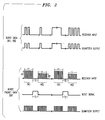
- FIG. 2 shows illustrative data wave forms received over an optical communication system operating in one of two modes (1) burst mode, intermittent, single-transmitter source and (2) packet mode, intermittent, multiple transmitter source;
- FIG. 3 shows illustrative photo current input, peak detector output, preamplifier output, and decision circuit (quantizer) output for the circuit of FIG. 1 operated in the packet mode;
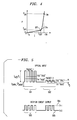
- FIG. 4 shows an illustrative curve having laser luminosity (or optical output P) as a function of laser current;
- FIG. 5 shows the photo current (optical) input and decision circuit receiver output for the circuit of FIG. 1 in the case when the "dark current" (essentially a dc current) is non-zero. "TH2" represents the "true" or ideal logic thresholds at the center of the ac signal swing; "TH1" is the false logic threshold established at half the total input amplitude, including the dark current;
- FIG. 6 is a block diagram of a "Packet Data Receiver" in accordance with the present invention which includes an Adaptive Threshold Circuit modified to handle "dark level" input currents, and a Reset circuit which enables the reception of closely-spaced data packets of differing power levels;
- FIG. 7 shows representative output signal levels for preamp A₁ and the corresponding levels for peak detectors A 2P and A 2N in the cases where dark level signal is and is not present;
- FIG. 8 is a more detailed block diagram of an embodiment of the present invention illustrating the details of the two identical peak detectors each having a Boosted Slew Circuit and the Reset circuit including a peak detector discharge circuit and precision references; and
- FIG. 9 shows a block diagram of our prior art burst mode receiver circuit of U. S. Patent 5,025,456 adapted to incorporate the reset circuit in accordance with the present invention.
- With reference to FIG. 1, we describe the prior art burst mode receiver architecture (disclosed in our U. S. Patent 5,025,456 issued on June 18, 1992, entitled "Burst Mode Digital Data Receiver", and incorporated by reference herein) which establishes an "instantaneous logic threshold", V REF , determined at the beginning of each signal burst. This logic threshold level replaces the dc signal average usually established in ac-coupled receivers. The logic threshold V REF is set equal to the half amplitude point of the peak input signal, and subsequent signal amplification is referenced to this level. Threshold determination must be very rapid, and ideally is completed by the conclusion of the first bit in the signal burst. With reference to FIG. 2, a typical burst mode digital data input signal inputted to the burst mode receiver is shown by 201 and the quantizer output is shown by 202.
- Returning to FIG. 1, the receiver includes four blocks: a differential input/output transimpedance amplifier (A₁), a high speed peak detector (A₂), an optional gain amplifier (A₃), and a quantizer circuit (Q₁). The quantizer circuit Q₁ converts the analog signal outputted from the receiver to a clean digital ZERO or ONE signal at a voltage level (e.g., ECL) compatible with the circuits to which it connects.
- The operation of the receiver is as follows. With no data present, the peak hold capacitor C PD is discharged. When data arrives, photodetector PD1 produces photocurrent I in , the differential output voltage of amplifier A₁ becomes V₀⁺-V₀⁻=ΔV₀=I in Z T , where Z T is the transimpedance (feedback resistor) between the positive input and negative output of A₁. One of A₁'s differential outputs, and therefore one-half of the net output swing, is sampled by the peak detector and stored on C PD . This half-amplitude reference level, I in Z T /2, is applied to the complementary (negative) input of A₁, thus establishing the logic threshold V REF . The peak detector charges very rapidly, but there may be some pulse width distortion of the output during the first few bits in a burst. Logic level acquisition is accelerated by reducing the size of the peak detector capacitorC PD . However, C PD is used also to stabilize the peak detector feedback loop around A₁ and A₂. If C PD is too small, then peak detector loop instability results.
- In an optical bus application of the receiver of FIG. 1, two new problems arise. First, optical packets with widely varying signal amplitudes can appear, closely spaced on the bus. With reference to FIG. 2, this is shown by 203 where the packets PK1 (from a first transmitter) and PK2 (from a second transmitter) may have the same time slot width T1 and where packets PK1 have significantly higher signal amplitudes than the packets PK2. In the circuit of FIG. 1, after a large amplitude packet PK1 threshold has been stored on C PD , then the circuit may not distinguish a small amplitude packet PK2 from noise. Therefore, such packets must be separated by a long enough time interval (e.g., T2 shown in 203) to allow C PD to discharge. The problem is illustrated in FIG. 3. As shown in 310 the photocurrents I in(1) and I in(2) are proportional to the received optical signal powers P₁ and P₂, and I in(1) is much larger than I in(2) . In this case, 320, the peak detector output is determined by the first large I in(1) signal (pulse 0), and is too large for the peak of the first following I in(2) pulse (pulse 1) to reach the
logic slicing level 331, of the quantizer circuit Q₁. Then, as shown by 340, the quantizer circuitQ₁ output bit 1 is completely missing, (shown as dotted pattern) andbit 2 suffers a large pulse width distortion (in this example). - A second problem in optical bus applications is the low frequency "dark level" optical power. With reference to FIG. 4 we illustratively depict the operating levels of a laser diode. It is impractical to modulate a transmitter's laser diode between its "true" OFF (i.e., P O, I O ) and its ON (i.e., P on, I on ) states at high speed. Consequently, lasers are typically biased OFF at a current I off (slightly below the lasing threshold current (I th )) where there is some light output (P OFF ) even in the OFF state. Extinction ratios (P on /P off ) of 10 - 20 are typical. Therefore, with many lasers on a bus, the dark (all off) light level could be NP off , where N is the number of lasers. This light-level approaches the ON-state light-level of an individual laser. Moreover, because of the 100:1 permissible variation in received optical power from packet to packet, it is possible that the optical power of the dark level signal could exceed the burst signal level of some packets by a significant factor.
- In the present dc-coupled packet data receiver architecture, logic threshold is I in Z T /2, where I in is the input signal corresponding to the maximum optical signal input P in . With reference to FIG. 5, in the presence of dark level current, a "false" logic threshold TH1 equal to (I dark + I in )Z T /2 is established rather than the "true" logic threshold TH2 equal to I in Z T/2 . When I dark <I in , as shown by 501, proper input signal detection is still probable, as shown by 503. However, when I dark ≧ I in , then, as shown by 502, the false threshold TH1 would cause the input signal to be improperly detected, as shown by 504, rather than being properly detected, as shown by 505.
- A simplified functional diagram of our new circuit is shown in FIG. 6. The preamp, corresponding to A₁ in FIG. 1, is a differential input/output transimpedance amplifier. The
Adaptive Threshold Circuit 610 is a modified, enhanced version of the peak detector (A 2, B X, B Y, C PD ) in FIG. 1. The Output Amplifier corresponds to A₃, and the Packet Threshold Reset Circuitry (hereinafter Reset circuit) 620 is a new function, added to allow zeroing of the peak detector capacitor between data packets. The new capabilities are described in the following sections. The Reset function is introduced to each peak detector circuit and allows rapid and precise zeroing of the peak detector capacitor. By activating theReset circuit 620 at the conclusion of a data packet (T2 of FIG. 2), the receiver is prepared to establish a new logic threshold (e.g., at a substantially reduced level) after a short reset interval. The dark level light problem is handled by a "dark level compensator" (Darcom) circuit (includes preamp A1 and Adaptive Threshold Circuit 610) which measures and shunts or subtracts out the low frequency input signal (I comp ) portion of I in . Moreover, the peak detector circuits (A 2P, A 2N ), as described later, are modified to increase stability and improve the accuracy of peak detector tracking. - A block diagram of the dark level compensator (Darcom)
circuit 600 is shown in FIG. 6.Darcom circuit 600 consists of the input amplifier A₁, a positive peak detector A 2P , a negative peak detector A 2N , a comparison amplifier, A₄, and a low pass filter LP1. Detector A 2P samples the peak value of the positive output of amplifier A₁. Detector A 2N samples the peak value of the negative output of amplifier A₁. Because of the differential outputs, (V₀⁺ and V₀⁻) of amplifier A₁, the positive and negative peak detectors, A 2P andA 2N , can be implemented as identical circuits, thus assuring matching of tracking accuracy, and improving overall precision. Detector A 2P is used with amplifier A₁ to set a logic threshold equal to half the maximum input swing (e.g., TH2 of FIG. 5). - The
Darcom circuit 600 relies on the spectral characteristics of the peak detector circuits (A 2P, A 2N ). In the higher frequency range, bounded on the lower end by the discharge time of the peak detector capacitors, the peak detectors (A 2P , A 2N ) act as peak sampling circuits with unity gain. At low frequencies, however, the peak detector capacitors have enough time to discharge, and consequently A 2P and A 2N are simply unity gain amplifiers. While the outputs of A 2P andA 2N do track low frequency variations in the input current I in , the following, for simplicity, refers to these low frequency variations as the "dc" I dark current. Thus, A 2P andA 2N apply the peak values of the positive and negative outputs (V
waveforms 702 depict the outputs in the presence of a dark level offset signal Δ=A 2P -A 2N . In turn, A₄ together with low pass filter LP1 converts this into a "dc difference" signal, (I comp ) which is subtracted from the input signal I in . Thus, a dc (or low frequency) feedback loop is established inDarcom circuit 600 that forces the dc (or low frequency) signals' differential output of A₁ to zero, cancelling out the input dark current (I dark ) along with any other dc offset signals (or low frequency offset signals). Such other dc offset signals may be derived from the outputs V₀⁺ and V₀⁻ of amplifier A1 or from peak detectors A 2P orA 2N . Low pass filter LP1 serves to stabilize the Darcom feedback loop, and also to average out fluctuations in the dark level signal. - If the logic threshold has been properly established by the positive peak detector A 2P as I in Z T /2, (as shown by TH2 of FIG. 4) then the differential outputs of A₁ swing symmetrically above and below the logic threshold. Accordingly, the magnitude of the positive and negative peaks will be equal. Therefore, the outputs of A 2P and A 2N will also be equal, thus the differential voltage into amplifier A₄ is zero and hence inducing no net change in I comp at the output of comparison amplifier A₄. This is illustrated as the "ideal"
case 701 in FIG. 7. - In effect,
Darcom circuit 600 ignores high frequency inputs, while forcing the dc (or low frequency) output component to zero. Proper operation ofDarcom circuit 600 depends on accurate tracking and matching of the two peak detectors A 2P andA 2N . If the positive peak detector A 2P is inaccurate, then an improper logic threshold may be established, and the peak detector outputs will not be symmetric. This is illustrated by the wave forms 702 in FIG. 7. This may manifest itself as an offset in the differential PreAmp A1 output voltage(V

- With the scheme described here, there is in principle no limit on the allowed size of the dark current I dark except for noise considerations. Moreover, even though the
Darcom circuit 600 subtracts the low frequency part of the input spectrum from the main signal path, the information there is still available for other purposes (e.g. monitoring) at the A₄ output. - Two modifications were made to the prior art peak detector circuitry shown in FIG. 1 to improve tracking and feedback loop stability. In the following discussion since peak detectors A 2P and A 2N employ similar circuitry and operate in a similar manner, we describe only the operation of positive peak detector A 2P . The following paragraphs make joint reference to FIGs. 1 and 8. Note the dotted line blocks 860 and 870, as will be described in a later paragraph, illustrate an alternate embodiment for receiving input voltage signals.
- To improve tracking accuracy, the gain of peak detector circuit A 2P was increased slightly. For the peak detector circuit shown in FIG. 1, the fractional tracking error (V in - V₀)/V in is 1/(1 + A), where A is the open loop gain of the amplifier A₂, and V in and V₀ are the input and output signals of the peak detector consisting of A 2, B X, B Y, and C PD . The error is reduced with increasing gain A, but it never goes to zero. A way to minimize the error is to introduce a small amount of gain into the peak detector as shown in FIG. 8. It is easy to show that for A = 1 + R1/R2, the fractional tracking error is eliminated.
- A second modification was incorporated to improve the stability of the peak detector feedback loop. Referring again to FIG. 1, this loop is identified as the path leading from the positive output of A₁ through the peak detector and then back to the negative input of A₁. Stability requires that there be a single dominant pole in this feedback loop. This is normally designed to be set by the peak detector capacitor C PD in series with the emitter drive resistance of transistor B X . Unhappily, there are many other poles in this loop, including the amplifier poles of A₁ and A₂, as well as the input poles of A₁. Moreover, the driving resistance of B X is very small, and consequently a large capacitor C PD is needed to establish a dominant pole. Stability of this loop can become marginal.
- We improve stability by increasing either C PD or the emitter drive resistance of B X . Unfortunately, if either is increased, then the peak detector charging time is increased and circuit operation is impaired. So, it seems that we are left with a choice between feedback loop instability or slow peak detector charging. We recognize that the peak detector A 2P operates in one of two modes: (1) charging or (2) maintenance. In the charging mode, the positive input to amplifier A₂ is greater than the negative input, and the circuit responds by pumping charge into the peak detector capacitor C PD . In the charging mode, the circuit is "slew limited". Equivalently, the loop gain is zero, and thus stability is not at issue. In the maintenance mode, the positive and negative inputs to amplifier A₂ are approximately equal, and the charge pump B X on average provides just enough current to balance the discharge current (base current of B Y ). In this mode, stability is an issue, and must be assured.
- Stability is improved by putting a large series resistance R PD in series with the charging transistor B X , as shown in FIG. 8. This lowers the frequency of the dominant pole, now determined approximately by R PD and C PD . The impaired charging characteristic that results is remedied by introducing a "slew booster"
circuit 810, shown as amplifier A₅ and charging transistor B Z in FIG. 8. Theslew booster circuit 810 charges C PD directly, without a limiting series resistor. However, the input to amplifier A₅ is offset slightly (V OFF ) with respect to the input of A₂. Consequently, the slew booster turns on only when the difference between the input V
slew booster circuit 810 turns off, and the main peak detector amplifier A₂ charges C PD the rest of the way to equilibrium. Thus, theslew booster circuit 810 is "on" only when the circuit is in the charging mode. When the circuit is in the maintenance mode, theslew booster circuit 810 is off, and therefore does not affect overall feedback loop stability. - With reference to 203 of FIG. 2, the Reset circuit, in response to an end-of-packet Reset signal, is designed to discharge both the positive and negative peak detector circuits A 2P andA 2N very rapidly so that data packets (PK1, PK2) differing in amplitude by approximately 100:1 (P1/P2) can be separated by a time interval (T2), illustratively, as short as four bit periods (this would be approximately 130ns for a 30Mb data signal). This interval T2, shown in 203 of FIG. 2, is defined as the "Reset interval." With reference to FIG. 8, the Reset circuit includes a common
Reset Enable Circuit 820 which generates a Reset enable signal from a reset signal and aReset Discharge circuit 830 which is part of each peak detector circuit (830 is shown only for positive peak detector A 2P ) - The Reset circuit provides the following attributes: speed, precision, "clamp" function, power conservation and CMOS/TTL input levels.
- The first attribute, speed, is obtained by discharging or clamping the peak detector capacitor C PD as rapidly as possible. This requires, simply, a large discharge current (I DIS ). The second necessary attribute, precision, complicates the problem by requiring that the discharge current I DIS (clamping function) be turned-off immediately when the peak detector capacitor C PD voltage has reached its starting (no data present) value. That starting value is not zero volts, because of the initial bias voltages within the peak detector circuit A 2P . The clamp function is necessary to turn the peak detector charging circuitry (i.e., amplifiers A₂andA₅) off during the Reset interval, and likewise to turn-off the discharge circuitry (i.e., amplifier A₆) during all but the Reset period. The clamp circuit also is used to force the packet receiver output (i.e., amplifiers A₃) to a well-defined logic state during the Reset interval. Obviously, if amplifier A₃ is part of quantizer circuit Q₁, then quantizer Q₁ would be reset by the clamp function. Power conservation and CMOS/TTL input levels are system requirements.
- The
Reset Discharge circuit 830 operates as follows. Comparator amplifier A₆ compares the voltage across C PD with a precision reference voltage, V DIS . If it exceeds the reference voltage, V DIS then switch S F is closed and the discharge current I DIS is drawn from C PD . The precision reference V DIS is implemented as a two stage image circuit. The voltage V DIS essentially represents the initial output voltage V OUT , when no input data is being received by the receiver of FIG. 8. The first stage, A 1i , is a copy of input amplifier A₁, while the second stage, A 2i , is a copy of peak detector circuit A₂. (Note: The gain enhancing resistor, R1, used within the peak detector amplifier A₂, is referenced to theoutput 840 of the first image stage, A 1i ). Because I DIS is very large, in order to discharge capacitor C PD rapidly, the time delay through the amplifier A₆ discharge loop must be short, or the capacitor C PD will be discharged too far. Likewise, the gain of amplifier A₆ must be large to assure a precision discharge. Fortunately, stability is not a concern for the amplifier A₆ loop because it can only discharge the capacitor, C PD not charge it; i.e. there is no restoring force to cause oscillation. - The clamping function is effected by the
Reset block 820 in FIG. 8. This circuit block translates the Reset input signal into the Reset enable clamping signals, and also turns on and off the discharge current, I DIS . This conserves power by minimizing power consumption of theReset Discharge Circuit 830 at times when the Reset input signal is not present. - In an alternate embodiment a Reset discharge circuit may include a
coarse discharge circuit 850 and a fine discharge circuit 830 (Note, usingReset discharge circuit 830 for the fine discharge circuit requires adjusting the discharge current source I DIS to a smaller current value). Thecoarse discharge circuit 850 operates like the previously describeddischarge circuit 830 except that it is not activated unless the difference between voltage V OUT and V Dis exceeds the offset voltage V OFF1 . When activated,coarse discharge circuit 850 enables switch S C to connect current source I DIS2 to discharge capacitor C PD . Note, that thefine discharge circuit 830 is also activated since V out is greater than V DIS . Hence, when V OUT is greater than V DIS + V OFF1 both thecoarse discharge circuit 850 andfine discharge circuit 830 are discharging capacitor C PD at the same time. Since I DIS2 is much greater than I DIS , it essentially controls the discharge rate. - Once the voltage V OUT decreases and reaches the value V DIS + V OFF1 , the
coarse discharge circuit 850 switches off the current source I DIS2 from capacitor C PD . Thereafter, onlyfine discharge circuit 830 is discharging capacitor C PD , ensuring a slower more accurately controllable discharge rate. Using the combined coarse and fine discharge circuits enables the Reset discharge circuit to 1) quickly discharge capacitor C PD of the peak voltage from a high power level packet data and 2) be able to very accurately discharge capacitor C PD down to the desired voltage V DIS . For low power packet data, thecoarse discharge circuit 850 may not be utilized at all. The end result is that the Reset discharge circuit enables the discharge rate to be increased (ensuring fast discharge) without sacrificing the accuracy of controlling the final discharge voltage. This arrangement allows the Reset circuit to discharge C PD rapidly and precisely without overshooting due to too great a discharge rate. The fast discharge rate ensures that the receiver can reset within a few bit times for a data rate which may vary from the tens to hundreds of megabits/s. The accuracy of setting the final discharge voltage of capacitor C PD ensures that the receiver's dynamic input signal range for adjacent packet data power levels can be about 100 to 1. That is, the receiver can detect a low level packet data signal which immediately follows a high level packet data signal which is 100 times as large as the low level signal. - With reference to FIG. 9 there is shown an embodiment of the Reset circuit of the present invention for use in the prior art circuit of FIG. 1. In such an embodiment, the Reset circuit includes the Reset
Discharge Circuits Reset Enable Circuit 820, precision references A 1i and A 2i , and resistors R1 and R2 interconnected as shown. Since theReset circuit - While the disclosed implementation of our digital data receiver utilizes a transimpedance preamp A₁ having a differential output, it should be understood that an amplifier having a single ended output could also be used. In such an embodiment, the output amplifier A₃ would then have a single input. Moreover, in such an embodiment, negative peak detector A 2N would become a "minimum level" detector utilizing PNP type transistors in place of the NPN type transistors utilized for B X , B Y and B Z . Thus, detector A 2N would then form a minimum level voltage representing the minimum signal (rather than the maximum voltage representation of the negative peak voltage which is produced in the disclosed embodiment). In this case, the dark level offset is determined by the difference between the output of A 2N and a new reference voltage which is analogous to the output of image circuit A 1i ; i.e., the amplifier A₁ output with no dark level signal present. The comparison amplifier A₄ would then remain a difference amplifier that would take the difference between the minimum peak voltages outputted from detector A 2N and this new reference. The difference amplifier together with a low pass filter would then produce the dc current I comp which is subtracted or shunted from I in prior to input to amplifier A₁.
- Furthermore, the receiver could be used with voltage input signals (rather than current input signals) by changing amplifier A₁ from a transimpedance amplifier to a voltage amplifier. This is accomplished by replacing photodetector P D1 with a voltage signal source V S of specified output impedance. Such an arrangement would replace photodetector P D1 with the circuitry shown in the dotted
blocks - In the disclosed embodiment, the analog circuit blocks are actually either well-known ECL gates, or simple modifications of ECL gates. The ECL gate consists of a differential pair with current source load, followed by an emitter follower stage. These circuits, while offering limited gain, are inherently very fast. The input amplifier, output amplifier, peak detectors A 2P and A 2N , amplifiers A₅ and A₆, and precision references A 1i and A 2i may be implemented using circuits which are described in more detail in our previously referenced article.
- While the disclosed embodiment of the present invention is implemented using bipolar integrated circuit technology, it should be noted that other circuit technologies could be utilized, including FET.
- The circuit can be implemented using, for example, silicon, gallium arsenide or other appropriate semiconductor materials. Moreover, it is contemplated that other well-known circuits can be used to implement the amplifier circuit functions shown in FIG. 8 without departing from the teaching of the present invention.
- Additionally, while the present invention was described as a receiver for use in a burst mode operated packet data system, it could be utilized in a system that utilizes continuous data transmissions. Although the present invention has been described for use with optical signals, it should be understood that the present invention can be utilized in non-optical signals as well.
Claims (9)
- A digital data receiver comprising
a dc-coupled differential input amplifier circuit A₁ having first input means for receiving a digital packet data input signal, second input means for receiving a reference signal, and output means for outputting a data output signal;
detector means A 2P, A 2N for detecting and storing a peak amplitude of said data output signal and for generating said reference signal; and
reset means (620), responsive to an end-of-packet reset signal, for discharging said data output signal stored by said detector means to a non-zero dc voltage substantially equal to an initial dc voltage which is stored by said detector means during an absence of a received data input signal. - The receiver of claim 1 wherein said reset means includes
coarse reset means A 6A for discharging said stored data output signal at a high discharge rate until it is within a predetermined voltage difference of said initial dc voltage; and
fine reset means A₆ for discharging said stored data output signal at a low discharge rate, until said initial dc voltage is reached. - The receiver of claim 1 wherein said first detector means includes
capacitor means C PD for storing the peak amplitude of said data output signal and wherein
said reset means includes
switchable current source means (SC, SF) for discharging said capacitor means in response to said reset signal and switchable so that it is off at all other times. - The receiver of claim 1 further including
output amplifier means A₃ having an input connected to said input amplifier circuit output means and an output for providing a receiver output signal and
means for disabling (A₃, 620) said output amplifier means in response to said reset signal. - A digital data receiver comprising
a dc-coupled differential amplifier circuit A₁ having first input means for receiving a digital data input signal, second input means for receiving a reference signal, and output means for outputting a data output signal;
first detector means A 2P for detecting and storing a peak amplitude of said data output signal and for generating said first reference signal; and
second detector means A 2N for detecting and storing a second peak amplitude of said data output signal and for generating a second reference signal;
means, A₄ responsive to said first and second reference signals, for shunting a portion of a dc or low frequency current of said data input signal from said first input means; and
reset means (620), responsive to an end-of-packet reset signal, for discharging said data output signal stored by each of said detector means to a non-zero dc voltage substantially equal to an initial dc voltage which is stored by said detector means during an absence of a received data input signal. - The receiver of claim 5 wherein said reset means includes
coarse reset means A 6A for discharging said stored data output signal on each detector means at a first discharge rate until it is within a predetermined voltage difference of said initial dc voltage; and
fine reset means A₆ for discharging said stored data output signal at a second discharge rate, smaller than said first rate, until said initial dc voltage is reached. - The receiver of claim 5 wherein said first and second detector means each includes
capacitor means C PD for storing the peak amplitude of said data output signal and wherein
said reset means includes
separate switchable current source means (SC, SF) for each detector means for discharging the capacitor means in response to said reset signal and switchable so that it is off at all other times. - The receiver of claim 5 further including
output amplifier means A₃ having an input connected to the output means of said input amplifier circuit and an output for providing a receiver output signal and
means for disabling (A₃, 620) said output amplifier means in response to a reset signal from said reset means. - An optical signal receiver comprising
means for receiving and converting P D1 the received digital optical signal into an electronic data signal,
a dc-coupled differential input amplifier circuit A₁ having first input means for receiving said electronic data signal, second input means for receiving a first reference signal, and output means for outputting a data output signal;
first detector means A 2P for detecting and storing a first peak amplitude of said data output signal and for generating said first reference signal;
second detector means A 2N for detecting and storing a second peak amplitude of said data output signal and in response thereto shunting a portion of a dc or low frequency current from said data input signal; and
reset means 620, responsive to an end-of-packet reset signal, for discharging said data output signal stored by each of said detector means to a non-zero dc voltage substantially equal to an initial dc voltage which is stored by said detector means during an absence of a received data input signal.
Applications Claiming Priority (2)
| Application Number | Priority Date | Filing Date | Title |
|---|---|---|---|
| US976037 | 1992-11-13 | ||
| US07/976,037 US5371763A (en) | 1992-11-13 | 1992-11-13 | Packet mode digital data receiver |
Publications (2)
| Publication Number | Publication Date |
|---|---|
| EP0597632A1 true EP0597632A1 (en) | 1994-05-18 |
| EP0597632B1 EP0597632B1 (en) | 1998-05-27 |
Family
ID=25523651
Family Applications (1)
| Application Number | Title | Priority Date | Filing Date |
|---|---|---|---|
| EP93308837A Expired - Lifetime EP0597632B1 (en) | 1992-11-13 | 1993-11-04 | Packet mode digital data receiver |
Country Status (5)
| Country | Link |
|---|---|
| US (1) | US5371763A (en) |
| EP (1) | EP0597632B1 (en) |
| JP (1) | JP2991911B2 (en) |
| CA (1) | CA2106438C (en) |
| DE (1) | DE69318802T2 (en) |
Cited By (8)
| Publication number | Priority date | Publication date | Assignee | Title |
|---|---|---|---|---|
| EP0715439A3 (en) * | 1994-12-01 | 1997-11-19 | Nec Corporation | Decision device for burst-mode receiver |
| EP0729243A3 (en) * | 1995-02-24 | 1998-04-22 | Nec Corporation | Digital optical receiving apparatus |
| EP0828359A3 (en) * | 1996-09-10 | 2000-12-20 | Nec Corporation | Receiver for optical burst signal and receiving method therefor |
| EP0903751A3 (en) * | 1997-09-18 | 2000-12-27 | Sharp Kabushiki Kaisha | Peak-hold circuit and an infrared communication device provided with such a circuit |
| EP1257103A1 (en) * | 2001-05-11 | 2002-11-13 | Alcatel | Circuitry for determining levels in data flows |
| FR2829888A1 (en) * | 2001-09-20 | 2003-03-21 | Cit Alcatel | DECISION DEVICE FOR ELECTRICAL SIGNAL MODULE |
| EP1355436A1 (en) * | 2002-04-16 | 2003-10-22 | Samsung Electronics Co., Ltd. | Burst mode optical receiver generating a reset signal for an automatic threshold control device during inter-burst periods |
| EP1292020A4 (en) * | 2000-06-12 | 2004-12-29 | Mitsubishi Electric Corp | Amplifier circuit |
Families Citing this family (31)
| Publication number | Priority date | Publication date | Assignee | Title |
|---|---|---|---|---|
| JP3115739B2 (en) * | 1993-01-27 | 2000-12-11 | シャープ株式会社 | Pulse light receiving circuit |
| US5499244A (en) * | 1994-05-02 | 1996-03-12 | At&T Corp. | Packet data reciever with sampled data output and background light cancellation |
| US5491434A (en) * | 1994-12-05 | 1996-02-13 | Motorola, Inc. | Circuit and method of differential amplitude detection |
| US5541759A (en) * | 1995-05-09 | 1996-07-30 | Microsym Computers, Inc. | Single fiber transceiver and network |
| US5703504A (en) * | 1995-12-26 | 1997-12-30 | Motorola | Feedforward adaptive threshold processing method |
| US5801867A (en) * | 1996-03-20 | 1998-09-01 | Ericsson Raynet | DC-coupled receiver for shared optical system |
| CA2196239C (en) * | 1996-03-22 | 2002-09-10 | Lucent Technologies, Inc. | Optical wavelength demultiplexer for a video passive optical network |
| US5828476A (en) * | 1996-06-11 | 1998-10-27 | The Boeing Company | Dual rate, burst mode, radiation hardened, optical transceiver |
| JP3758750B2 (en) * | 1996-07-02 | 2006-03-22 | 富士通株式会社 | Optical receiver |
| US5838735A (en) * | 1996-07-08 | 1998-11-17 | Telefonaktiebolaget Lm Ericsson | Method and apparatus for compensating for a varying d.c. offset in a sampled signal |
| US6359939B1 (en) * | 1998-05-20 | 2002-03-19 | Diva Systems Corporation | Noise-adaptive packet envelope detection |
| JP3606143B2 (en) | 1999-12-15 | 2005-01-05 | 日本電気株式会社 | Offset control circuit, optical receiver using the same, and optical communication system |
| US6735260B1 (en) * | 2000-04-17 | 2004-05-11 | Texas Instruments Incorporated | Adaptive data slicer |
| US7215883B1 (en) | 2003-01-24 | 2007-05-08 | Jds Uniphase Corporation | Methods for determining the performance, status, and advanced failure of optical communication channels |
| US7002131B1 (en) | 2003-01-24 | 2006-02-21 | Jds Uniphase Corporation | Methods, systems and apparatus for measuring average received optical power |
| JP4471598B2 (en) * | 2003-07-16 | 2010-06-02 | Okiセミコンダクタ株式会社 | Light emitting element driving device |
| US7197170B2 (en) * | 2003-11-10 | 2007-03-27 | M2S, Inc. | Anatomical visualization and measurement system |
| US7394996B2 (en) * | 2004-06-16 | 2008-07-01 | Industrial Technology Research Institute | Burst mode optical receiver and system and method therefor |
| CN100399727C (en) * | 2004-08-27 | 2008-07-02 | 电子科技大学 | An Optical Burst Mode Receiver |
| JP4926408B2 (en) | 2005-03-14 | 2012-05-09 | 浜松ホトニクス株式会社 | Photodetection circuit |
| US7782095B2 (en) * | 2007-11-26 | 2010-08-24 | Faraday Technology Corp. | Signal comparison circuit |
| US8824903B2 (en) | 2011-07-12 | 2014-09-02 | Mellanox Technologies Denmark Aps | Optical receiver/transmitter with circuit for determining modulation amplitude |
| US9252889B2 (en) | 2011-11-03 | 2016-02-02 | Mellanox Technologies Denmark Aps | Fast optical receiver |
| JP6218404B2 (en) * | 2013-03-18 | 2017-10-25 | エスアイアイ・セミコンダクタ株式会社 | Light receiving circuit |
| JP6088306B2 (en) * | 2013-03-18 | 2017-03-01 | エスアイアイ・セミコンダクタ株式会社 | Light receiving circuit |
| US9509294B2 (en) * | 2015-04-09 | 2016-11-29 | Aeroflex Colorado Springs Inc. | Baseline restore sampling method |
| CN108322679B (en) * | 2017-12-29 | 2020-06-30 | 成都微光集电科技有限公司 | Circuit and system for eliminating dark current |
| CN115473501B (en) * | 2022-11-15 | 2023-03-28 | 上海阿米芯光半导体有限责任公司 | Regulating and controlling circuit of trans-impedance amplifier and method for reducing influence of stray inductance on circuit |
| US12229071B2 (en) * | 2022-12-01 | 2025-02-18 | Nxp Usa, Inc. | eUSB repeater for passing repeating mode packets between a differential bus and a single-ended bus |
| US12210404B2 (en) | 2022-12-01 | 2025-01-28 | Nxp Usa, Inc. | Lockup detection circuit for an eUSB repeater |
| EP4776584A1 (en) * | 2025-01-14 | 2026-07-15 | NXP USA, Inc. | Fast-settling threshold estimator for a bit slicer |
Citations (1)
| Publication number | Priority date | Publication date | Assignee | Title |
|---|---|---|---|---|
| JPH04309025A (en) * | 1991-04-08 | 1992-10-30 | Matsushita Electric Ind Co Ltd | Burst optical reception circuit |
Family Cites Families (22)
| Publication number | Priority date | Publication date | Assignee | Title |
|---|---|---|---|---|
| GB1603016A (en) * | 1978-05-31 | 1981-11-18 | Abbott Lab | Amplifier with dark current compensation |
| FR2473823A1 (en) * | 1980-01-14 | 1981-07-17 | Dassault Electronique | INSTALLATION FOR THE TRANSMISSION OF INFORMATION BY OMNIBUS OPTIC LINE |
| CA1175919A (en) * | 1980-02-20 | 1984-10-09 | Toshitaka Tsuda | Device for discriminating between two values of a signal with dc offset compensation |
| CA1212729A (en) * | 1981-12-08 | 1986-10-14 | Hiroshi Ogawa | Digital signal detecting and compensating circuit with adjustable window signal |
| FR2579045B1 (en) * | 1985-03-14 | 1988-03-04 | Bull Sa | OPTOELECTRONIC TRANSDUCER |
| JPS62132411A (en) * | 1985-12-04 | 1987-06-15 | Hitachi Ltd | Gain/offset control circuit |
| US4736391A (en) * | 1986-07-22 | 1988-04-05 | General Electric Company | Threshold control with data receiver |
| JPS63196136A (en) * | 1987-02-10 | 1988-08-15 | Matsushita Electric Ind Co Ltd | receiving circuit |
| JPH0195640A (en) * | 1987-10-08 | 1989-04-13 | Hitachi Cable Ltd | optical receiver circuit |
| US4781195A (en) * | 1987-12-02 | 1988-11-01 | The Boc Group, Inc. | Blood monitoring apparatus and methods with amplifier input dark current correction |
| US4926442A (en) * | 1988-06-17 | 1990-05-15 | International Business Machines Corporation | CMOS signal threshold detector |
| JPH0695741B2 (en) * | 1988-07-27 | 1994-11-24 | 三菱電機株式会社 | Automatic gain control circuit |
| JPH0786513B2 (en) * | 1988-12-14 | 1995-09-20 | 三菱電機株式会社 | Data receiver |
| US4905255A (en) * | 1989-01-03 | 1990-02-27 | American Telephone And Telegraph Company | Decision directed gain control |
| JPH0754335B2 (en) * | 1989-01-31 | 1995-06-07 | 富士通株式会社 | Peak value detection circuit |
| US5025456A (en) * | 1989-02-02 | 1991-06-18 | At&T Bell Laboratories | Burst mode digital data receiver |
| US4937842A (en) * | 1989-02-23 | 1990-06-26 | Motorola Inc. | Self adjusting data detector |
| US5119404A (en) * | 1990-08-06 | 1992-06-02 | Japan Aviation Electronics Industry Limited | Signal receiver |
| JPH04269018A (en) * | 1991-02-25 | 1992-09-25 | Nippon Telegr & Teleph Corp <Ntt> | Radio transmitter |
| JP3021913B2 (en) * | 1992-02-13 | 2000-03-15 | 日本電気株式会社 | Optical receiver |
| JP2503837B2 (en) * | 1992-07-16 | 1996-06-05 | 日本電気株式会社 | Digital optical receiver circuit and preamplifier circuit in digital optical receiver circuit |
| JPH0810808B2 (en) * | 1993-01-07 | 1996-01-31 | 日本電気株式会社 | Unipolar code / bipolar code conversion circuit |
-
1992
- 1992-11-13 US US07/976,037 patent/US5371763A/en not_active Expired - Lifetime
-
1993
- 1993-09-17 CA CA002106438A patent/CA2106438C/en not_active Expired - Lifetime
- 1993-11-04 EP EP93308837A patent/EP0597632B1/en not_active Expired - Lifetime
- 1993-11-04 DE DE69318802T patent/DE69318802T2/en not_active Expired - Lifetime
- 1993-11-12 JP JP5306081A patent/JP2991911B2/en not_active Expired - Lifetime
Patent Citations (1)
| Publication number | Priority date | Publication date | Assignee | Title |
|---|---|---|---|---|
| JPH04309025A (en) * | 1991-04-08 | 1992-10-30 | Matsushita Electric Ind Co Ltd | Burst optical reception circuit |
Non-Patent Citations (3)
| Title |
|---|
| AIKI ET AL: "446 Mbit/s integrated optical repeater", JOURNAL OF LIGHTWAVE TECHNOLOGY., vol. 3, no. 2, April 1985 (1985-04-01), NEW YORK US, pages 392 - 399, XP011422519, DOI: doi:10.1109/JLT.1985.1074201 * |
| OTA ET AL: "DC - 1Gbit/s burst-mode compatible receiver for optical bus applications", JOURNAL OF LIGHTWAVE TECHNOLOGY., vol. 10, no. 2, February 1992 (1992-02-01), NEW YORK US, pages 244 - 249, XP000267495, DOI: doi:10.1109/50.120581 * |
| PATENT ABSTRACTS OF JAPAN vol. 17, no. 140 (E - 1336) 1993 * |
Cited By (14)
| Publication number | Priority date | Publication date | Assignee | Title |
|---|---|---|---|---|
| US5838731A (en) * | 1994-12-01 | 1998-11-17 | Nec Corporation | Burst-mode digital receiver |
| EP0715439A3 (en) * | 1994-12-01 | 1997-11-19 | Nec Corporation | Decision device for burst-mode receiver |
| EP0729243A3 (en) * | 1995-02-24 | 1998-04-22 | Nec Corporation | Digital optical receiving apparatus |
| EP0828359A3 (en) * | 1996-09-10 | 2000-12-20 | Nec Corporation | Receiver for optical burst signal and receiving method therefor |
| EP0903751A3 (en) * | 1997-09-18 | 2000-12-27 | Sharp Kabushiki Kaisha | Peak-hold circuit and an infrared communication device provided with such a circuit |
| US6480311B1 (en) | 1997-09-18 | 2002-11-12 | Sharp Kabushiki Kaisha | Peak-hold circuit and an infrared communication device provided with such a circuit |
| EP1615359A3 (en) * | 1997-09-18 | 2006-06-07 | Sharp Kabushiki Kaisha | Infrared communication device |
| EP1292020A4 (en) * | 2000-06-12 | 2004-12-29 | Mitsubishi Electric Corp | Amplifier circuit |
| EP1257103A1 (en) * | 2001-05-11 | 2002-11-13 | Alcatel | Circuitry for determining levels in data flows |
| EP1296469A1 (en) * | 2001-09-20 | 2003-03-26 | Alcatel | Decision device for a modulated electrical signal |
| FR2829888A1 (en) * | 2001-09-20 | 2003-03-21 | Cit Alcatel | DECISION DEVICE FOR ELECTRICAL SIGNAL MODULE |
| US7136597B2 (en) | 2001-09-20 | 2006-11-14 | Alcatel | Decision system for modulated electrical signals |
| EP1355436A1 (en) * | 2002-04-16 | 2003-10-22 | Samsung Electronics Co., Ltd. | Burst mode optical receiver generating a reset signal for an automatic threshold control device during inter-burst periods |
| US7266312B2 (en) | 2002-04-16 | 2007-09-04 | Samsung Electronics Co., Ltd. | Burst mode optical receiver |
Also Published As
| Publication number | Publication date |
|---|---|
| US5371763A (en) | 1994-12-06 |
| JP2991911B2 (en) | 1999-12-20 |
| EP0597632B1 (en) | 1998-05-27 |
| DE69318802T2 (en) | 1998-10-29 |
| JPH06232917A (en) | 1994-08-19 |
| DE69318802D1 (en) | 1998-07-02 |
| CA2106438A1 (en) | 1994-05-14 |
| CA2106438C (en) | 1998-10-06 |
Similar Documents
| Publication | Publication Date | Title |
|---|---|---|
| US5430766A (en) | Burst mode digital data receiver | |
| US5371763A (en) | Packet mode digital data receiver | |
| KR970000063B1 (en) | Burst Mode Digital Data Receiver | |
| US6118829A (en) | Apparatus and method for automatic mode selection in a communications receiver | |
| US4415803A (en) | Optical receiver with improved dynamic range | |
| US6784750B2 (en) | Transimpedance amplifier with selective DC compensation | |
| KR100630089B1 (en) | Burstmode Optical Receiver with Differential Output Structure | |
| US6909082B2 (en) | Automatic threshold control device for burst mode optical receiver | |
| US20200014463A1 (en) | Transimpedance amplifier for receiving burst optical signal | |
| EP0611059B1 (en) | A system for DC restoration of serially transmitted binary signals | |
| US9882539B1 (en) | Multi-data rate, burst-mode transimpedance amplifier (TIA) circuit | |
| JPH06177664A (en) | Digital photoreception circuit, trans-impedance amplifier circuit and preamplifier circuit | |
| US9496826B2 (en) | Transimpedance amplifier | |
| US11601203B2 (en) | Transimpedance amplifier for receiving burst optical signal | |
| KR20030084382A (en) | Automatic gain controller in an optical receiver for receiving burst-mode signal | |
| US6191879B1 (en) | Offset control for burst-mode optical receiver | |
| US5499244A (en) | Packet data reciever with sampled data output and background light cancellation | |
| EP0402044B1 (en) | Optical receivers | |
| JP2003318682A (en) | Minimum level detector for burst mode optical receiver | |
| JP6661057B1 (en) | Limiting amplifier circuit | |
| JPH05136635A (en) | Signal receiver | |
| Swartz et al. | A burst mode, packet receiver with precision reset and automatic dark level compensation for optical bus communications | |
| JPH1065473A (en) | Amplifier circuit | |
| US5146476A (en) | High gain amplifier for reception of low level pulse code modulation nonreturn-to-zero signals | |
| US5561383A (en) | Switchable peak/average detect circuit |
Legal Events
| Date | Code | Title | Description |
|---|---|---|---|
| PUAI | Public reference made under article 153(3) epc to a published international application that has entered the european phase |
Free format text: ORIGINAL CODE: 0009012 |
|
| AK | Designated contracting states |
Kind code of ref document: A1 Designated state(s): DE ES FR GB IT NL SE |
|
| RAP3 | Party data changed (applicant data changed or rights of an application transferred) |
Owner name: AT&T CORP. |
|
| 17P | Request for examination filed |
Effective date: 19941103 |
|
| 17Q | First examination report despatched |
Effective date: 19960605 |
|
| GRAG | Despatch of communication of intention to grant |
Free format text: ORIGINAL CODE: EPIDOS AGRA |
|
| GRAG | Despatch of communication of intention to grant |
Free format text: ORIGINAL CODE: EPIDOS AGRA |
|
| GRAH | Despatch of communication of intention to grant a patent |
Free format text: ORIGINAL CODE: EPIDOS IGRA |
|
| GRAH | Despatch of communication of intention to grant a patent |
Free format text: ORIGINAL CODE: EPIDOS IGRA |
|
| GRAA | (expected) grant |
Free format text: ORIGINAL CODE: 0009210 |
|
| AK | Designated contracting states |
Kind code of ref document: B1 Designated state(s): DE ES FR GB IT NL SE |
|
| PG25 | Lapsed in a contracting state [announced via postgrant information from national office to epo] |
Ref country code: NL Free format text: LAPSE BECAUSE OF FAILURE TO SUBMIT A TRANSLATION OF THE DESCRIPTION OR TO PAY THE FEE WITHIN THE PRESCRIBED TIME-LIMIT Effective date: 19980527 Ref country code: IT Free format text: LAPSE BECAUSE OF FAILURE TO SUBMIT A TRANSLATION OF THE DESCRIPTION OR TO PAY THE FEE WITHIN THE PRESCRIBED TIME-LIMIT;WARNING: LAPSES OF ITALIAN PATENTS WITH EFFECTIVE DATE BEFORE 2007 MAY HAVE OCCURRED AT ANY TIME BEFORE 2007. THE CORRECT EFFECTIVE DATE MAY BE DIFFERENT FROM THE ONE RECORDED. Effective date: 19980527 Ref country code: ES Free format text: THE PATENT HAS BEEN ANNULLED BY A DECISION OF A NATIONAL AUTHORITY Effective date: 19980527 |
|
| ET | Fr: translation filed | ||
| REF | Corresponds to: |
Ref document number: 69318802 Country of ref document: DE Date of ref document: 19980702 |
|
| PG25 | Lapsed in a contracting state [announced via postgrant information from national office to epo] |
Ref country code: SE Free format text: LAPSE BECAUSE OF FAILURE TO SUBMIT A TRANSLATION OF THE DESCRIPTION OR TO PAY THE FEE WITHIN THE PRESCRIBED TIME-LIMIT Effective date: 19980827 |
|
| NLV1 | Nl: lapsed or annulled due to failure to fulfill the requirements of art. 29p and 29m of the patents act | ||
| PLBE | No opposition filed within time limit |
Free format text: ORIGINAL CODE: 0009261 |
|
| 26N | No opposition filed | ||
| PGFP | Annual fee paid to national office [announced via postgrant information from national office to epo] |
Ref country code: FR Payment date: 20011022 Year of fee payment: 9 |
|
| REG | Reference to a national code |
Ref country code: GB Ref legal event code: IF02 |
|
| PG25 | Lapsed in a contracting state [announced via postgrant information from national office to epo] |
Ref country code: FR Free format text: LAPSE BECAUSE OF NON-PAYMENT OF DUE FEES Effective date: 20030731 |
|
| REG | Reference to a national code |
Ref country code: FR Ref legal event code: ST |
|
| PGFP | Annual fee paid to national office [announced via postgrant information from national office to epo] |
Ref country code: DE Payment date: 20121031 Year of fee payment: 20 |
|
| PGFP | Annual fee paid to national office [announced via postgrant information from national office to epo] |
Ref country code: GB Payment date: 20121031 Year of fee payment: 20 |
|
| REG | Reference to a national code |
Ref country code: DE Ref legal event code: R071 Ref document number: 69318802 Country of ref document: DE |
|
| REG | Reference to a national code |
Ref country code: GB Ref legal event code: PE20 Expiry date: 20131103 |
|
| PG25 | Lapsed in a contracting state [announced via postgrant information from national office to epo] |
Ref country code: GB Free format text: LAPSE BECAUSE OF EXPIRATION OF PROTECTION Effective date: 20131103 Ref country code: DE Free format text: LAPSE BECAUSE OF EXPIRATION OF PROTECTION Effective date: 20131105 |