EP0604610B1 - Telephone public a encaissement/carte d'appel et son procede de commande - Google Patents
Telephone public a encaissement/carte d'appel et son procede de commande Download PDFInfo
- Publication number
- EP0604610B1 EP0604610B1 EP93913611A EP93913611A EP0604610B1 EP 0604610 B1 EP0604610 B1 EP 0604610B1 EP 93913611 A EP93913611 A EP 93913611A EP 93913611 A EP93913611 A EP 93913611A EP 0604610 B1 EP0604610 B1 EP 0604610B1
- Authority
- EP
- European Patent Office
- Prior art keywords
- card
- call
- controller
- public telephone
- coins
- Prior art date
- Legal status (The legal status is an assumption and is not a legal conclusion. Google has not performed a legal analysis and makes no representation as to the accuracy of the status listed.)
- Expired - Lifetime
Links
Images


Classifications
-
- H—ELECTRICITY
- H04—ELECTRIC COMMUNICATION TECHNIQUE
- H04M—TELEPHONIC COMMUNICATION
- H04M17/00—Prepayment of wireline communication systems, wireless communication systems or telephone systems
-
- H—ELECTRICITY
- H04—ELECTRIC COMMUNICATION TECHNIQUE
- H04M—TELEPHONIC COMMUNICATION
- H04M17/00—Prepayment of wireline communication systems, wireless communication systems or telephone systems
- H04M17/02—Coin-freed or check-freed systems, e.g. mobile- or card-operated phones, public telephones or booths
-
- H—ELECTRICITY
- H04—ELECTRIC COMMUNICATION TECHNIQUE
- H04M—TELEPHONIC COMMUNICATION
- H04M3/00—Automatic or semi-automatic exchanges
- H04M3/22—Arrangements for supervision, monitoring or testing
- H04M3/24—Arrangements for supervision, monitoring or testing with provision for checking the normal operation
- H04M3/248—Arrangements for supervision, monitoring or testing with provision for checking the normal operation for metering arrangements or prepayment telephone systems
Definitions
- This invention relates to a coin/card operated public telephone and its controlling method, and more particularly to a coin/card operated public telephone capable of making local, toll, and international calls using coins, credit card, or IC (Integrated Circuit) card and of being centrally managed from a remote location and to its controlling method.
- IC Integrated Circuit
- a caller can make a call by inserting certain amount of coins into the public telephone.
- a caller experiences difficulties in making a long-distance call, long lasting call, and international call since the coin-type telephone can only accommodate a limited amount of coins at one time.
- a caller can make a call by inserting a plastic card (2000, 3000, and 5000 Wons) into the public telephone.
- a plastic card 2000, 3000, and 5000 Wons
- the disadvantages are that the content of card can be easily damaged and erased due to its weak coercive force and the amount of information that can be recorded in the pre-paid card type telephone is limited. Therefore, it is extremely difficult to make the functional improvements and provide additional services.
- a caller pays for the calls he has made through the post-paid card type telephone using his credit card afterwards.
- LCD Liquid Crystal Display
- the public telephone of the present invention comprises a controller that controls the entire telephone, a memory that stores programs and data, a speech circuit for interfacing with the telephone lines and for voice transmission, a coin processing unit used to select and store coins, a card reader used to read and write an IC card and magnetic credit card, a modem used for authorizing a magnetic credit card data transmission, a voice synthesizing circuit for service announcement through voice, an LCD for character/graphic information display, a keypad for inputting telephone number, special buttons used for an emergency call, re-dialing, sound control and language selection, function buttons used for the IC card, various sensors for central management, and a power supply unit used to supply power to the entire telephone.
- all the data are initialized from the start signal and automatic diagnosis is carried out to find out whether any fault has occurred. If any fault is found by the above automatic diagnosis, a step where the fault is found is recorded and an evaluation on impossibility of making a call is made.
- an evaluation is made to find out whether an IC card, instead of a credit card, has been inserted.
- a call may be made in an IC card call mode.
- an evaluation is made to find out whether an emergency button has been activated.
- a call may be made in an emergency call mode.
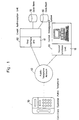
- Fig. 1 is a configuration diagram depicting an operational environment of a coin/card operated public telephone according to the present invention.
- Fig. 2 is a configuration diagram of a coin/card operated public telephone according to the present invention.
- Fig. 1 is a configuration diagram of operational environment of a coin/card operated public telephone used to describe the characteristics according to the present invention.
- the coin/card operated public telephone 30 is connected to a Public Telephone Network 40 and the Public Telephone Network 40 is connected to a Credit Authorization Unit 50 and a Public Telephone Central Management System 60.
- Each of the Credit Authorization Unit 50 and the Central Management System 60 has a first and second interface units 17, 18 used for interfacing with the Public Telephone Network 40, respectively.
- Two data banks 70 and 80 used to record the balance of a credit card, are connected to the Credit Authorization Unit 50.
- a caller When coins are inserted into a coin/card operated public telephone 30, a caller can make a call with a called party via the Public Telephone Network 40.
- the public telephone checks whether the inserted credit card is a valid one using data bank 70 and 80 connected to the Credit Authorization Unit 50 and informs the result to the caller by means of voice or character/graphic displayed on the LCD. If the credit card is a valid one, a caller may make a call to a subscriber he likes to converse with via the Public Telephone Network 40.
- the information on billing details and fault status of the public telephone 30 are sent to the Public Telephone Central Management System 60 when the public telephone 30 receives an information request signal from the Central Management System 60.
- the Central Management System 60 upon receiving the information from the public telephone 30, analyzes them and outputs messages corresponding to the information received.
- Fig. 2 is a configuration diagram according to the public telephone of the present invention.
- a coin processing unit 20 used to select and store coins that had been inserted
- a card reader 14 for reading and writing an IC card/credit card
- a memory unit 12 for storing various programs and data
- an LCD 10 for displaying information as character and graphic
- a keypad and buttons 11 for inputting telephone numbers
- a sensor unit 13 consisting of various sensors used for central management
- a power supply unit 15 used for supplying power are connected to a controller 16 that controls the entire system.
- a voice synthesizing circuit 7 used for voice announcement service
- a DTMF (Dual Tone Multi Frequency) generating unit 8 used to generate DTMF signal by inputting telephone numbers through the key pad and buttons 11, and a modem 9 used for data transmission with a credit authorization unit 50, a public telephone central management system 60, are connected to the controller 16.
- a speech circuit 6 used for interfacing with the telephone line from the voice synthesizing circuit 7, the DTMF generating unit 8, and the modem 9 and for transmitting voice is connected to the controller 16 and a handset 1 used for calls made to the called parties is connected to the speech circuit 6.
- a coin selector 2 discriminates the coins and then stores the coins in a coin storage unit 3.
- a relay 5 is activated in order to seize the exchange line (Off-hook state) and the amount of the inserted coins is displayed on an LCD 10.
- DTMF signals are generated at a DTMF generating unit 8 and a speech circuit 6 is connected to a Public Telephone Network 40 in order to make a call circuit with the called party. Therefore, the caller can converse with the called party through the handset 1 of the public telephone. As soon as the call is over, the coins that had been stored in the coin storage unit 3 are transferred to the coinbox 4.
- a controller 16 of the public telephone reads the card content through a card reader 14 and calls a credit authorization unit 50 through a DTMF generating unit 8 after the caller lifts up the handset 1 and inserts a card into the card reader 14.
- the controller 16 sends the data, that had been read, to the modem 9.
- the modem 9 modulates the data that had been inputted and sends them to the credit authorization unit 50 through a speech circuit 6 and the Public Telephone Network 40.
- the credit authorization unit 50 searches the received data and sends the searched result to the modem through the Public Telephone Network 40 and speech circuit 6.
- the modem 9 demodulates the searched result and inputs it into the controller 16.
- the controller 16 activates the relay 5 and connects the exchange line. Then, the caller can make a call and start to talk to the called party by pressing the telephone numbers of called party through the key pad and buttons 11 after hearing the dial tone.
- the public telephone When the call is over, the public telephone stores the billing information of the call in a memory unit 12. Thereafter, when the next caller make a call, the public telephone notifies this information to the credit authorization unit 50 through the modem 9.
- the controller 16 transmits the voice data from the memory unit 12 to the voice synthesizing unit 7 and the voice synthesizing unit 7 combines the voice by assembling the voice data and verbally informs the caller that the card is an invalid one. At the same time, it notifies the caller such fact by characters and graphics displayed on the LCD 10.
- the controller 16 reads the amount recorded in the IC card and activates the relay 5 for exchange line connection if the amount that has been read exceeds the local charging unit. Then, the caller can press the number of called party through the key pad and buttons 11 and make a call with the called party after hearing a dial tone. When the caller first hears a charging pulse during the conversation, the unit charge is subtracted from the amount displayed on LCD.
- the remaining amount and charging unit is compared for continuous charging pulse. If the remaining amount is less than the unit charge, the exchange line is disconnected (On-hook state). If the remaining amount is greater than the unit charge, it is subtracted. This procedure is repeated until the caller terminates the call.
- the sensor unit 13 detects the door open status, handset disconnection status, internal battery voltage, AC power supply voltage, line current and voltage, surrounding temperature and humidity. As the central management system 60 requests the data collected as a result of detection, the sensor unit 13 sends them to the central management system 60.
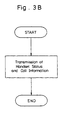
- Fig. 3A through 3B are flow charts used to explain the operations described in Fig.2.
- step 101 all the data are initialized in step 101 from the start signal generated by lifting up the handset and the operation proceeds to step 102.
- step 102 an automatic diagnosis of a coin/card operated public telephone is carried out and the operation proceeds to step 103.
- step 103 an evaluation to find out whether any faults had occurred in the public telephone is carried out.
- step 104 If faults are found, fault details are recorded in step 104 and the operation proceeds to step 105. If no fault had occurred in step 103, the operation proceeds to step 106. In step 105, if the call is evaluated to be impossible, the operation is terminated and if the call is evaluated to be possible, the operation proceeds to step 106. In step 106, an evaluation as to whether the diagnostic switch is in an activated state is made. If the diagnostic switch is activated, the operation proceeds to step 107 to carry out the diagnosis. Then, the result of the diagnosis is recorded and the activation is terminated. If the diagnostic switch is not in an activated state, the operation proceeds to step 108 where an evaluation as to whether the coins have been inserted properly is made.
- step 108 If the coins have been properly inserted in step 108, the operation proceeds to step 109 so that the public telephone changes into a coin call mode. Thereafter, the activation is terminated after completing the call. If no coins have been inserted, the operation proceeds to step 110 where an evaluation to find out whether the credit card has been inserted is made. If the credit card is found to have been inserted in step 110, the operation proceeds to step 111 so that the public telephone changes into a credit card call mode. Thereafter, the activation is terminated after completing the call. If the credit card is found not to have been inserted, the operation proceeds to step 112 where an evaluation to find out whether the IC card has been properly inserted is made.
- step 112 the operation proceeds to step 113 and the public telephone changes into an IC card call mode and then stops activating after completing the call. If the IC card has not been properly inserted, the operation proceeds to step 114 where an emergency button is in an activation state. If the emergency button is in an activation state, the operation proceeds to step 115 so that the public telephone changes into the emergency call mode. Thereafter, the activation of public telephone is terminated after completing the call. If the emergency button is not in an activation state, the operation proceeds to step 116. In step 116, an evaluation to find out whether the public telephone is in on-hook state is carried out. If it is in on-hook state, the activation terminates and if not, the operation returns to step 106.
Landscapes
- Engineering & Computer Science (AREA)
- Signal Processing (AREA)
- Computer Networks & Wireless Communication (AREA)
- Computer Security & Cryptography (AREA)
- Prepayment Telephone Systems (AREA)
- Meter Arrangements (AREA)
- Control Of Vending Devices And Auxiliary Devices For Vending Devices (AREA)
Claims (2)
- Téléphone public à pièces/cartes (30) pour faire des appels locaux, interurbains et internationaux en utilisant des pièces, des cartes de crédits ou des cartes à circuits intégrés, comprenant:un contrôleur (16) pour piloter le téléphone public;un clavier et des boutons (11) connectés audit contrôleur;un dispositif de traitement de pièces (20) connecté audit contrôleur pour sélectionner et stocker les pièces qui ont été insérées;une unité de génération d'une signalisation multifréquence (8) connectée audit contrôleur pour générer des signaux de signalisation multifréquence en fonction de la manipulation dudit clavier et desdits boutons;une unité de mémoire (12) pour mémoriser des programmes requis pour piloter ledit contrôleur, ainsi que des détails concernant les dérangements et la facturation;une unité de synthèse vocale (7) connectée entre ledit contrôleur (16) et un circuit de conversation pour combiner les données vocales mémorisées dans ladite unité de mémoire;un lecteur de carte (14) connecté audit contrôleur pour lire et enregistrer ladite carte à circuits intégrés ou ladite carte de crédit;un modem (9) connecté entre ledit contrôleur et ledit circuit de conversation pour moduler le contenu de la carte qui a été lue via ledit lecteur de carte, ainsi que les données émanant d'un système de gestion central et d'une unité d'autorisation de crédit; etun affichage à cristaux liquides (10) connecté audit contrôleur pour afficher le message d'annonce d'appel et le nombre de pièces qui ont été insérées, caractérisé parune unité de capteur (13) connectée audit contrôleur pour détecter l'état de porte ouverte, la tension de la batterie interne, le courant et la tension de ligne, ainsi que la température ambiante.
- Procédé pour commander un téléphone public à pièces/cartes permettant de faire des appels locaux, interurbains et internationaux en utilisant des pièces, des cartes de crédits ou des cartes à circuits intégrés, comprenant les étapes consistant à:caractérisé par le fait de détecter l'état de porte ouverte, la tension de la batterie interne, le courant et la tension de ligne, ainsi que la température ambiante du téléphone.initialiser toutes les données à partir d'un signal de départ et mettre en oeuvre un diagnostic automatique;procéder à une évaluation afin de vérifier la présence ou l'absence d'un quelconque dérangement par la mise en oeuvre dudit diagnostic automatique;mémoriser l'état de dérangement lorsqu'un dérangement est détecté suite audit diagnostic automatique;procéder à une évaluation afin de vérifier le fait de savoir si l'appel est impossible à faire;procéder à une évaluation afin de vérifier le fait de savoir si un commutateur de diagnostic est activé lorsqu'aucun dérangement n'a été détecté par ledit diagnostic automatique;mettre en oeuvre un diagnostic lorsque ledit commutateur de diagnostic est activé suite à l'évaluation et à la mémorisation du résultat dudit diagnostic;procéder à une évaluation afin de vérifier le fait de savoir si les pièces ont été insérées comme il se doit lorsqu'il s'avère que ledit commutateur diagnostic n'a pas été activé;faire un appel dans un mode d'appel par pièces lorsque des pièces ont été insérées comme il se doit;procéder à une évaluation afin de vérifier le fait de savoir si une carte de crédit a été insérée comme il se doit en l'absence d'une insertion de pièces;faire un appel dans un mode de carte de crédit lorsque ladite carte de crédit a été insérée comme il se doit;procéder à une évaluation afin de vérifier le fait de savoir si une carte à circuits intégrés a été insérée comme il se doit en l'absence d'insertion de ladite carte de crédit;faire un appel dans un mode de carte à circuits intégrés lorsque ladite carte à circuits intégrés a été insérée;procéder à une évaluation afin de vérifier le fait de savoir si un bouton d'urgence a été activé en l'absence d'insertion de ladite carte à circuits intégrés;faire un appel dans un mode d'appel d'urgence lorsque ledit bouton d'urgence est activé;procéder à une évaluation de l'état raccroché lorsque ledit bouton d'urgence n'a pas été activé; etretourner à l'étape d'évaluation pour vérifier le fait de savoir si ledit commutateur de diagnostic est activé lorsqu'aucun dérangement n'a été détecté et le fait de savoir si ledit appel peut être fait, si ledit téléphone public n'est pas à l'état raccroché,
Applications Claiming Priority (3)
| Application Number | Priority Date | Filing Date | Title |
|---|---|---|---|
| KR1019920010645A KR940001633A (ko) | 1992-06-19 | 1992-06-19 | 주화 및 카드 겸용 공중전화기 및 그 제어방법 |
| KR1992106 | 1992-06-19 | ||
| PCT/KR1993/000051 WO1994000947A1 (fr) | 1992-06-19 | 1993-06-18 | Telephone public a encaissement/carte d'appel et son procede de commande |
Publications (2)
| Publication Number | Publication Date |
|---|---|
| EP0604610A1 EP0604610A1 (fr) | 1994-07-06 |
| EP0604610B1 true EP0604610B1 (fr) | 1999-04-21 |
Family
ID=19334911
Family Applications (1)
| Application Number | Title | Priority Date | Filing Date |
|---|---|---|---|
| EP93913611A Expired - Lifetime EP0604610B1 (fr) | 1992-06-19 | 1993-06-18 | Telephone public a encaissement/carte d'appel et son procede de commande |
Country Status (6)
| Country | Link |
|---|---|
| EP (1) | EP0604610B1 (fr) |
| JP (1) | JPH06510649A (fr) |
| KR (1) | KR940001633A (fr) |
| CA (1) | CA2115842C (fr) |
| DE (1) | DE69324555D1 (fr) |
| WO (1) | WO1994000947A1 (fr) |
Families Citing this family (11)
| Publication number | Priority date | Publication date | Assignee | Title |
|---|---|---|---|---|
| ES2119702B1 (es) * | 1996-10-07 | 1999-06-16 | Isern S A | Dispositivo para el control y pago de servicios multiples mediante tarjeta de credito o similar, aplicable en habitaciones de centros hospitalarios. |
| ES2125825B1 (es) * | 1997-02-12 | 1999-11-16 | M J M Consultores S L | Sistemas de monedero electronico para telefono de uso publico. |
| FR2776795B1 (fr) * | 1998-03-31 | 2000-06-02 | France Telecom | Carte a memoire de test d'automate lisant des cartes a puce |
| CN1067825C (zh) * | 1998-06-22 | 2001-06-27 | 沈阳市联友通信有限公司 | 帐号卡式公用电话机 |
| RU2151469C1 (ru) * | 1999-06-29 | 2000-06-20 | Общество с ограниченной ответственностью "Интент" | Способ автоматической голосовой связи с использованием карт предварительной оплаты |
| MY130409A (en) * | 2000-12-07 | 2007-06-29 | Alif Mfg Sdn Bhd | Improved telephone apparatus |
| KR100422170B1 (ko) * | 2001-08-21 | 2004-03-11 | 권황섭 | 공중통신 단말기의 전원 제어장치 |
| KR100418384B1 (ko) * | 2001-09-10 | 2004-02-11 | 권황섭 | 멀티미디어 공중통신 단말 네트워크 시스템 |
| KR101049882B1 (ko) * | 2009-06-11 | 2011-07-15 | (주)렛츠공칠공 | 인터넷 공중전화기 관리시스템 및 방법 |
| FR2968999B1 (fr) | 2010-12-20 | 2013-01-04 | Guerbet Sa | Nanoemulsion de chelate pour irm |
| US9713893B2 (en) * | 2013-07-09 | 2017-07-25 | Wenger Manufacturing, Inc. | Method of preconditioning comestible materials using steam/water static mixer |
Family Cites Families (3)
| Publication number | Priority date | Publication date | Assignee | Title |
|---|---|---|---|---|
| DK608684D0 (da) * | 1984-12-18 | 1984-12-18 | Gnt Automatic As | Betalingstelefon |
| US4731818A (en) * | 1985-12-05 | 1988-03-15 | Communication Equipment & Engineering Co. | Self-computing credit card telephone paystation method and system |
| JPS63290449A (ja) * | 1987-05-22 | 1988-11-28 | Omron Tateisi Electronics Co | 公衆電話機 |
-
1992
- 1992-06-19 KR KR1019920010645A patent/KR940001633A/ko not_active Ceased
-
1993
- 1993-06-18 JP JP6502211A patent/JPH06510649A/ja active Pending
- 1993-06-18 CA CA002115842A patent/CA2115842C/fr not_active Expired - Fee Related
- 1993-06-18 WO PCT/KR1993/000051 patent/WO1994000947A1/fr not_active Ceased
- 1993-06-18 EP EP93913611A patent/EP0604610B1/fr not_active Expired - Lifetime
- 1993-06-18 DE DE69324555T patent/DE69324555D1/de not_active Expired - Lifetime
Also Published As
| Publication number | Publication date |
|---|---|
| CA2115842C (fr) | 1997-12-30 |
| JPH06510649A (ja) | 1994-11-24 |
| CA2115842A1 (fr) | 1994-01-26 |
| DE69324555D1 (de) | 1999-05-27 |
| KR940001633A (ko) | 1994-01-11 |
| EP0604610A1 (fr) | 1994-07-06 |
| WO1994000947A1 (fr) | 1994-01-06 |
Similar Documents
| Publication | Publication Date | Title |
|---|---|---|
| US4731818A (en) | Self-computing credit card telephone paystation method and system | |
| US4595983A (en) | Central office powered credit only telephone paystation | |
| US5361297A (en) | Method and apparatus for providing answer supervision and an autonomous pay telephone incorporating the same | |
| US5440621A (en) | Apparatus for prepayment of telecommunication connections in a telecommunication switching network without utilization of rate schedules and call cost computations | |
| JP2881357B2 (ja) | 公衆電話機 | |
| US5359643A (en) | Telecommunications device with simplified calling procedures | |
| EP0604610B1 (fr) | Telephone public a encaissement/carte d'appel et son procede de commande | |
| JP2983640B2 (ja) | 電気通信方法および電気通信装置 | |
| US5734702A (en) | Telephone card with commercial information and a telephone connection method therefor | |
| JPS63290449A (ja) | 公衆電話機 | |
| JPS6411188B2 (fr) | ||
| JPH0831929B2 (ja) | 公衆電話機 | |
| AU661554B2 (en) | Credit validation arrangement | |
| KR0133220B1 (ko) | 무선공중전화기의 ic카드 접속방법 및 그 장치 | |
| JP2920777B2 (ja) | 公衆電話機 | |
| JP2920809B2 (ja) | カード式料金徴収装置 | |
| JP2932029B2 (ja) | 不正通話防止装置 | |
| US7463725B1 (en) | Telephone line use enablement of lottery or fund participation | |
| KR950009398B1 (ko) | 무선 공중전화 시스템 | |
| JPH10327245A (ja) | 交換装置及びこの交換装置を用いたネットワークシステム | |
| WO2000016535A2 (fr) | Telephone public dote d'une fonction d'interface d'ordinateur portable et procede de commande dudit telephone | |
| KR19990007658A (ko) | 전자식 화폐정보처리장치와 그 처리방법 | |
| KR950000973B1 (ko) | 공중전화기의 단위요금 변경방법 | |
| KR100707249B1 (ko) | 자동 다이얼링 기능을 가지는 공중 전화기 및 그 방법 | |
| KR950000974B1 (ko) | 공중전화기 및 그것의 음성안내방법 |
Legal Events
| Date | Code | Title | Description |
|---|---|---|---|
| PUAI | Public reference made under article 153(3) epc to a published international application that has entered the european phase |
Free format text: ORIGINAL CODE: 0009012 |
|
| 17P | Request for examination filed |
Effective date: 19940219 |
|
| AK | Designated contracting states |
Kind code of ref document: A1 Designated state(s): CH DE FR GB IT LI |
|
| 17Q | First examination report despatched |
Effective date: 19970513 |
|
| GRAG | Despatch of communication of intention to grant |
Free format text: ORIGINAL CODE: EPIDOS AGRA |
|
| GRAG | Despatch of communication of intention to grant |
Free format text: ORIGINAL CODE: EPIDOS AGRA |
|
| GRAH | Despatch of communication of intention to grant a patent |
Free format text: ORIGINAL CODE: EPIDOS IGRA |
|
| GRAH | Despatch of communication of intention to grant a patent |
Free format text: ORIGINAL CODE: EPIDOS IGRA |
|
| GRAA | (expected) grant |
Free format text: ORIGINAL CODE: 0009210 |
|
| AK | Designated contracting states |
Kind code of ref document: B1 Designated state(s): CH DE FR GB IT LI |
|
| PG25 | Lapsed in a contracting state [announced via postgrant information from national office to epo] |
Ref country code: LI Free format text: LAPSE BECAUSE OF FAILURE TO SUBMIT A TRANSLATION OF THE DESCRIPTION OR TO PAY THE FEE WITHIN THE PRESCRIBED TIME-LIMIT Effective date: 19990421 Ref country code: IT Free format text: LAPSE BECAUSE OF FAILURE TO SUBMIT A TRANSLATION OF THE DESCRIPTION OR TO PAY THE FEE WITHIN THE PRE;WARNING: LAPSES OF ITALIAN PATENTS WITH EFFECTIVE DATE BEFORE 2007 MAY HAVE OCCURRED AT ANY TIME BEFORE 2007. THE CORRECT EFFECTIVE DATE MAY BE DIFFERENT FROM THE ONE RECORDED.SCRIBED TIME-LIMIT Effective date: 19990421 Ref country code: FR Free format text: LAPSE BECAUSE OF FAILURE TO SUBMIT A TRANSLATION OF THE DESCRIPTION OR TO PAY THE FEE WITHIN THE PRESCRIBED TIME-LIMIT Effective date: 19990421 Ref country code: CH Free format text: LAPSE BECAUSE OF FAILURE TO SUBMIT A TRANSLATION OF THE DESCRIPTION OR TO PAY THE FEE WITHIN THE PRESCRIBED TIME-LIMIT Effective date: 19990421 |
|
| REG | Reference to a national code |
Ref country code: CH Ref legal event code: EP |
|
| REF | Corresponds to: |
Ref document number: 69324555 Country of ref document: DE Date of ref document: 19990527 |
|
| PG25 | Lapsed in a contracting state [announced via postgrant information from national office to epo] |
Ref country code: GB Free format text: LAPSE BECAUSE OF NON-PAYMENT OF DUE FEES Effective date: 19990721 |
|
| PG25 | Lapsed in a contracting state [announced via postgrant information from national office to epo] |
Ref country code: DE Free format text: LAPSE BECAUSE OF FAILURE TO SUBMIT A TRANSLATION OF THE DESCRIPTION OR TO PAY THE FEE WITHIN THE PRESCRIBED TIME-LIMIT Effective date: 19990722 |
|
| EN | Fr: translation not filed | ||
| REG | Reference to a national code |
Ref country code: CH Ref legal event code: PL |
|
| PLBE | No opposition filed within time limit |
Free format text: ORIGINAL CODE: 0009261 |
|
| STAA | Information on the status of an ep patent application or granted ep patent |
Free format text: STATUS: NO OPPOSITION FILED WITHIN TIME LIMIT |
|
| GBPC | Gb: european patent ceased through non-payment of renewal fee |
Effective date: 19990721 |
|
| 26N | No opposition filed |