EP0611803A1 - Polymermischungen mit LCST-Verhalten - Google Patents
Polymermischungen mit LCST-Verhalten Download PDFInfo
- Publication number
- EP0611803A1 EP0611803A1 EP94101781A EP94101781A EP0611803A1 EP 0611803 A1 EP0611803 A1 EP 0611803A1 EP 94101781 A EP94101781 A EP 94101781A EP 94101781 A EP94101781 A EP 94101781A EP 0611803 A1 EP0611803 A1 EP 0611803A1
- Authority
- EP
- European Patent Office
- Prior art keywords
- polymer
- mixtures
- lcst
- poly
- methylstyrene
- Prior art date
- Legal status (The legal status is an assumption and is not a legal conclusion. Google has not performed a legal analysis and makes no representation as to the accuracy of the status listed.)
- Granted
Links
- 229920002959 polymer blend Polymers 0.000 title claims abstract description 35
- 229920000642 polymer Polymers 0.000 claims abstract description 39
- XYLMUPLGERFSHI-UHFFFAOYSA-N alpha-Methylstyrene Chemical compound CC(=C)C1=CC=CC=C1 XYLMUPLGERFSHI-UHFFFAOYSA-N 0.000 claims abstract description 17
- 229920002432 poly(vinyl methyl ether) polymer Polymers 0.000 claims abstract description 16
- 238000005204 segregation Methods 0.000 claims description 8
- 238000000034 method Methods 0.000 claims description 5
- 230000005540 biological transmission Effects 0.000 claims description 2
- 238000004519 manufacturing process Methods 0.000 abstract description 2
- 239000000203 mixture Substances 0.000 description 17
- YXFVVABEGXRONW-UHFFFAOYSA-N Toluene Chemical compound CC1=CC=CC=C1 YXFVVABEGXRONW-UHFFFAOYSA-N 0.000 description 15
- 238000002156 mixing Methods 0.000 description 10
- 239000011347 resin Substances 0.000 description 8
- 229920005989 resin Polymers 0.000 description 8
- 239000004014 plasticizer Substances 0.000 description 7
- 239000000243 solution Substances 0.000 description 7
- -1 poly(o-chlorostyrene) Polymers 0.000 description 6
- 239000002904 solvent Substances 0.000 description 5
- 239000000126 substance Substances 0.000 description 5
- 230000007704 transition Effects 0.000 description 5
- PPBRXRYQALVLMV-UHFFFAOYSA-N Styrene Chemical compound C=CC1=CC=CC=C1 PPBRXRYQALVLMV-UHFFFAOYSA-N 0.000 description 4
- 239000000047 product Substances 0.000 description 4
- 238000000926 separation method Methods 0.000 description 4
- 238000001816 cooling Methods 0.000 description 3
- 229920001519 homopolymer Polymers 0.000 description 3
- 239000012071 phase Substances 0.000 description 3
- 229920006254 polymer film Polymers 0.000 description 3
- MQIUGAXCHLFZKX-UHFFFAOYSA-N Di-n-octyl phthalate Natural products CCCCCCCCOC(=O)C1=CC=CC=C1C(=O)OCCCCCCCC MQIUGAXCHLFZKX-UHFFFAOYSA-N 0.000 description 2
- IAYPIBMASNFSPL-UHFFFAOYSA-N Ethylene oxide Chemical compound C1CO1 IAYPIBMASNFSPL-UHFFFAOYSA-N 0.000 description 2
- 239000004793 Polystyrene Substances 0.000 description 2
- GOOHAUXETOMSMM-UHFFFAOYSA-N Propylene oxide Chemical compound CC1CO1 GOOHAUXETOMSMM-UHFFFAOYSA-N 0.000 description 2
- QYKIQEUNHZKYBP-UHFFFAOYSA-N Vinyl ether Chemical compound C=COC=C QYKIQEUNHZKYBP-UHFFFAOYSA-N 0.000 description 2
- BJQHLKABXJIVAM-UHFFFAOYSA-N bis(2-ethylhexyl) phthalate Chemical compound CCCCC(CC)COC(=O)C1=CC=CC=C1C(=O)OCC(CC)CCCC BJQHLKABXJIVAM-UHFFFAOYSA-N 0.000 description 2
- 238000004040 coloring Methods 0.000 description 2
- 239000013078 crystal Substances 0.000 description 2
- RWGFKTVRMDUZSP-UHFFFAOYSA-N cumene Chemical compound CC(C)C1=CC=CC=C1 RWGFKTVRMDUZSP-UHFFFAOYSA-N 0.000 description 2
- 238000001035 drying Methods 0.000 description 2
- 230000009477 glass transition Effects 0.000 description 2
- 238000010438 heat treatment Methods 0.000 description 2
- 239000003999 initiator Substances 0.000 description 2
- 230000003993 interaction Effects 0.000 description 2
- 239000000155 melt Substances 0.000 description 2
- XNGIFLGASWRNHJ-UHFFFAOYSA-N phthalic acid Chemical compound OC(=O)C1=CC=CC=C1C(O)=O XNGIFLGASWRNHJ-UHFFFAOYSA-N 0.000 description 2
- 229920003023 plastic Polymers 0.000 description 2
- 239000004033 plastic Substances 0.000 description 2
- 238000006116 polymerization reaction Methods 0.000 description 2
- 229920002223 polystyrene Polymers 0.000 description 2
- 238000002360 preparation method Methods 0.000 description 2
- JLBJTVDPSNHSKJ-UHFFFAOYSA-N 4-Methylstyrene Chemical compound CC1=CC=C(C=C)C=C1 JLBJTVDPSNHSKJ-UHFFFAOYSA-N 0.000 description 1
- 239000002841 Lewis acid Substances 0.000 description 1
- 239000006057 Non-nutritive feed additive Substances 0.000 description 1
- ISWSIDIOOBJBQZ-UHFFFAOYSA-N Phenol Chemical compound OC1=CC=CC=C1 ISWSIDIOOBJBQZ-UHFFFAOYSA-N 0.000 description 1
- 239000006096 absorbing agent Substances 0.000 description 1
- 239000003963 antioxidant agent Substances 0.000 description 1
- 230000003078 antioxidant effect Effects 0.000 description 1
- 238000000149 argon plasma sintering Methods 0.000 description 1
- QVGXLLKOCUKJST-UHFFFAOYSA-N atomic oxygen Chemical compound [O] QVGXLLKOCUKJST-UHFFFAOYSA-N 0.000 description 1
- 230000009286 beneficial effect Effects 0.000 description 1
- 230000015572 biosynthetic process Effects 0.000 description 1
- 239000006227 byproduct Substances 0.000 description 1
- 125000002091 cationic group Chemical group 0.000 description 1
- 238000000975 co-precipitation Methods 0.000 description 1
- 239000011248 coating agent Substances 0.000 description 1
- 229920005622 compatible polymer blend Polymers 0.000 description 1
- 238000007334 copolymerization reaction Methods 0.000 description 1
- 239000011557 critical solution Substances 0.000 description 1
- 230000007423 decrease Effects 0.000 description 1
- 239000000975 dye Substances 0.000 description 1
- 150000002148 esters Chemical class 0.000 description 1
- 238000002474 experimental method Methods 0.000 description 1
- 230000002349 favourable effect Effects 0.000 description 1
- UPBDXRPQPOWRKR-UHFFFAOYSA-N furan-2,5-dione;methoxyethene Chemical compound COC=C.O=C1OC(=O)C=C1 UPBDXRPQPOWRKR-UHFFFAOYSA-N 0.000 description 1
- 238000005227 gel permeation chromatography Methods 0.000 description 1
- 230000020169 heat generation Effects 0.000 description 1
- 238000009434 installation Methods 0.000 description 1
- JEIPFZHSYJVQDO-UHFFFAOYSA-N iron(III) oxide Inorganic materials O=[Fe]O[Fe]=O JEIPFZHSYJVQDO-UHFFFAOYSA-N 0.000 description 1
- 239000004922 lacquer Substances 0.000 description 1
- 150000007517 lewis acids Chemical class 0.000 description 1
- 230000007774 longterm Effects 0.000 description 1
- 229920002521 macromolecule Polymers 0.000 description 1
- 125000002496 methyl group Chemical group [H]C([H])([H])* 0.000 description 1
- 239000000178 monomer Substances 0.000 description 1
- 238000001956 neutron scattering Methods 0.000 description 1
- 239000012454 non-polar solvent Substances 0.000 description 1
- 239000003921 oil Substances 0.000 description 1
- 230000003287 optical effect Effects 0.000 description 1
- 238000002103 osmometry Methods 0.000 description 1
- 229910052760 oxygen Inorganic materials 0.000 description 1
- 239000001301 oxygen Substances 0.000 description 1
- 239000003973 paint Substances 0.000 description 1
- 229920000314 poly p-methyl styrene Polymers 0.000 description 1
- 229920001289 polyvinyl ether Polymers 0.000 description 1
- 230000005855 radiation Effects 0.000 description 1
- 150000003254 radicals Chemical class 0.000 description 1
- 230000002441 reversible effect Effects 0.000 description 1
- 230000005070 ripening Effects 0.000 description 1
- 230000006641 stabilisation Effects 0.000 description 1
- 238000011105 stabilization Methods 0.000 description 1
- 239000003381 stabilizer Substances 0.000 description 1
- 238000003860 storage Methods 0.000 description 1
- 238000003786 synthesis reaction Methods 0.000 description 1
- 239000012808 vapor phase Substances 0.000 description 1
Images


Classifications
-
- G—PHYSICS
- G01—MEASURING; TESTING
- G01K—MEASURING TEMPERATURE; MEASURING QUANTITY OF HEAT; THERMALLY-SENSITIVE ELEMENTS NOT OTHERWISE PROVIDED FOR
- G01K11/00—Measuring temperature based upon physical or chemical changes not covered by groups G01K3/00, G01K5/00, G01K7/00 or G01K9/00
- G01K11/12—Measuring temperature based upon physical or chemical changes not covered by groups G01K3/00, G01K5/00, G01K7/00 or G01K9/00 using changes in colour, translucency or reflectance
- G01K11/16—Measuring temperature based upon physical or chemical changes not covered by groups G01K3/00, G01K5/00, G01K7/00 or G01K9/00 using changes in colour, translucency or reflectance of organic materials
-
- C—CHEMISTRY; METALLURGY
- C08—ORGANIC MACROMOLECULAR COMPOUNDS; THEIR PREPARATION OR CHEMICAL WORKING-UP; COMPOSITIONS BASED THEREON
- C08L—COMPOSITIONS OF MACROMOLECULAR COMPOUNDS
- C08L25/00—Compositions of, homopolymers or copolymers of compounds having one or more unsaturated aliphatic radicals, each having only one carbon-to-carbon double bond, and at least one being terminated by an aromatic carbocyclic ring; Compositions of derivatives of such polymers
- C08L25/02—Homopolymers or copolymers of hydrocarbons
- C08L25/16—Homopolymers or copolymers of alkyl-substituted styrenes
-
- C—CHEMISTRY; METALLURGY
- C08—ORGANIC MACROMOLECULAR COMPOUNDS; THEIR PREPARATION OR CHEMICAL WORKING-UP; COMPOSITIONS BASED THEREON
- C08L—COMPOSITIONS OF MACROMOLECULAR COMPOUNDS
- C08L29/00—Compositions of homopolymers or copolymers of compounds having one or more unsaturated aliphatic radicals, each having only one carbon-to-carbon double bond, and at least one being terminated by an alcohol, ether, aldehydo, ketonic, acetal or ketal radical; Compositions of hydrolysed polymers of esters of unsaturated alcohols with saturated carboxylic acids; Compositions of derivatives of such polymers
- C08L29/10—Homopolymers or copolymers of unsaturated ethers
-
- Y—GENERAL TAGGING OF NEW TECHNOLOGICAL DEVELOPMENTS; GENERAL TAGGING OF CROSS-SECTIONAL TECHNOLOGIES SPANNING OVER SEVERAL SECTIONS OF THE IPC; TECHNICAL SUBJECTS COVERED BY FORMER USPC CROSS-REFERENCE ART COLLECTIONS [XRACs] AND DIGESTS
- Y10—TECHNICAL SUBJECTS COVERED BY FORMER USPC
- Y10S—TECHNICAL SUBJECTS COVERED BY FORMER USPC CROSS-REFERENCE ART COLLECTIONS [XRACs] AND DIGESTS
- Y10S525/00—Synthetic resins or natural rubbers -- part of the class 520 series
- Y10S525/931—Blend of stated incompatibility
-
- Y—GENERAL TAGGING OF NEW TECHNOLOGICAL DEVELOPMENTS; GENERAL TAGGING OF CROSS-SECTIONAL TECHNOLOGIES SPANNING OVER SEVERAL SECTIONS OF THE IPC; TECHNICAL SUBJECTS COVERED BY FORMER USPC CROSS-REFERENCE ART COLLECTIONS [XRACs] AND DIGESTS
- Y10—TECHNICAL SUBJECTS COVERED BY FORMER USPC
- Y10S—TECHNICAL SUBJECTS COVERED BY FORMER USPC CROSS-REFERENCE ART COLLECTIONS [XRACs] AND DIGESTS
- Y10S525/00—Synthetic resins or natural rubbers -- part of the class 520 series
- Y10S525/932—Blend of matched optical properties
Definitions
- the invention relates to polymer mixtures with LCST behavior, which are composed of poly- ⁇ -methylstyrene on the one hand and polyvinyl methyl ether on the other.
- thermosensing systems with temperature-controlled light transmission using plastics are known.
- the glazing systems consist of a polymer mixture formed from two different polymer components or contain these, the mixture of the polymers having an LCST ⁇ 150 degrees C. There is a single-phase, transparent mixture below the LCST; Demixing to the polymer components is observed above the LCST.
- the refractive indices of the polymer components must differ from one another.
- Patents result from the fundamental premise of incompatibility and the unpredictability of behavior in individual cases.
- polystyrene for example, poly-p-methylstyrene proved to be completely incompatible with polyvinyl methyl ether.
- thermotropic glazing In the field of thermotropic glazing (EP-B 0 181 485) beyond the requirements set out there, as well as in the field of recording, storage and display of optically readable information, sharp phase transitions within the shortest possible time are very desirable. (EP-B 0177 063) It has now been found that polymer mixtures P, formed from poly- ⁇ -methylstyrene as component P1 and polyvinyl methyl ether as component P2, are a compatible polymer system with LCST behavior, which meets the requirements of the technology particularly well in many respects Fulfills.
- the components P1 and P2 in the polymer mixtures P are preferably in the ratio 98: 2 to 2: 98 parts by weight, preferably 90:10 to 10:90, in particular 80:20 to 20:80 parts by weight.
- the refractive indices of the polymers P1 and P2 above the LCST differ significantly beyond the required value of 0.01.
- the polymer component P1 is the polymer component of the polymer component P1
- the polymer component P1 the poly- ⁇ -methylstyrene
- the polymer component P1 is manufactured industrially and is available on the market in various qualities which, however, according to the experience available to date, are useful for the purposes of the present invention. (. See Kirk-Othmer Encyclopedia of Chemical Technology 3rd Ed, Vol 21, pg 795 -... 797, J. Wiley) ⁇ -methyl styrene is much less reactive than styrene and polymerized considerably slower.
- the polymers to be used according to the invention are composed of at least 80 and up to 100% by weight of ⁇ -methylstyrene; Comonomers copolymerizable with ⁇ -methylstyrene, such as styrene, are permissible provided they do not interfere with the properties required for the polymer system P.
- the molecular weight M w of the polymers P1 is generally in the range from 600 to 200,000 daltons (molecular weight determination by gel permeation chromatography, see HF Mark et al Encyclopedia of Polymer Science & Engineering, 2 nd Ed vol 10, 1 -.... 18, J Wiley, 1987).
- relatively low molecular weight polymers of methylstyrene for example in the molecular weight range 600-10,000 daltons.
- Particularly interesting are poly- ⁇ -methylstyrenes in a molecular weight range of 600-2000 daltons.
- the polymer component P2 is the polymer component of the polymer component P2
- polymethyl vinyl ethers which are used, for example, as plasticizers for coating agents and as aqueous tackifiers with specific viscosities ( ⁇ spec ) in the range of 0.68 (e.g. product ®LUTONAL M from BASF) and in the range of 0.3 - 0.5 ( e.g. product ®GANTREZ M from GAF).
- polyvinyl ethers are sensitive to atmospheric oxygen and radiation. It is therefore advisable to add up to 1% by weight of at least one antioxidant (cf. Ullmann's Encyclopedia of Industrial Chemistry 5 th Ed., Vol. A20, pg. 459-507 VCH, 1992).
- the polymer mixtures P can be prepared in a manner known per se (cf. Ullmann's Encyclopedia of Industrial Chemistry loc. Cit. Vol. A 21 , pg 277-281, VCH 1992), the later form of use having to be taken into account.
- the polymer mixtures P can be produced by intensive mechanical mixing of the components P1 and P2 in the melt, in the extruder, etc., or they can also be produced from a common solvent as a so-called "solution cast polyblends". (... See Kirk-Othmer "Encyclopedia of Chemical Technology” 3rd Ed Vol 18, pg 443 -. 478, J. Wiley, 1982)
- the polymer mixture P can be produced by co-precipitation with precipitants.
- mixing takes place by homogeneous mixing in the melt using heatable mixing units at the appropriate temperatures, in kneaders or preferably extruders, e.g. single or multi-screw extruders or, if necessary, in extruders with an oscillating screw and shear pins (e.g. in a BUSSCO kneader).
- extruders e.g. single or multi-screw extruders or, if necessary, in extruders with an oscillating screw and shear pins (e.g. in a BUSSCO kneader).
- polymer mixtures P according to the invention are therefore particularly suitable as thermally writable lacquers, for example as a bar code or for specifying expiration dates.
- the segregation temperature of the polymer mixtures P according to the invention is in the range of 60-100 degrees C, depending on the composition. If appropriate, it can be reduced further by adding a third, usually low-molecular or oligomeric component W.
- Component W serves in particular low molecular weight substances, for example plasticizers and / or solvents.
- plasticizers are esters of phthalic acid, for example dioctyl phthalate. (See H. Gnamm, O. Fuchs, solvents and plasticizers, 8th edition, Vol. I & II,ticianliche Verlagsgesellschaft Stuttgart, 1980.)
- the W content is in the range 0.1 to 1000 parts by weight preferably 5-300 parts by weight, based on the weight of the polymers P1 plus P2.
- the polymer mixtures P according to the invention can also contain known stabilizers, UV absorbers, dyes and processing aids in the amounts provided for this, ie usually below 5% by weight. (....
- polymer mixtures according to the invention with a high content of poly- ⁇ -methylstyrene e.g.> 70% by weight of P2
- a high content of poly- ⁇ -methylstyrene e.g.> 70% by weight of P2
- Such blends show a sharp transition clear, colorless to white when the temperature rises above the demixing temperature, upon cooling the demixed samples dissolve to a crystal-clear, compatible mixture within a few minutes, if necessary hours.
- polymer mixtures P with a small content (e.g. 10% by weight) of plasticizer segregate reversibly.
- thermally activated instructions in particular warning instructions, for example when a predetermined temperature is exceeded, in the industrial sector and in Household, for example as information about the commissioning of installations and devices coupled with heat generation.
- warning instructions for example when a predetermined temperature is exceeded
- Household for example as information about the commissioning of installations and devices coupled with heat generation.
- Polyvinyl methyl ether (M w about 50,000) is dissolved in toluene to a 20% solution.
- Poly- ⁇ -methylstyrene (M w about 80,000 is dissolved in toluene to a 20% solution
- the polymer solutions are mixed in different weight ratios (according to Table 1) and first dried at room temperature under normal pressure and then at 30 degrees C in a vacuum (24 h).
- the films obtained are crystal clear.
- Polyvinyl methyl ether (M w 50,000) and poly- ⁇ -methylstyrene (Amoco-Resin 18 - 240, M n according to the manufacturer's instructions 790 g / mol) are dissolved in a 20% solution in toluene.
- the polymer solutions are mixed in different weight ratios and dried to polymer blend films, as described in Example 1.
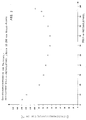
- Fig. 1 shows the segregation curve of the PVMe / Amoco-Resin-18-240 mixture.
- Example 2 The procedure is as in Example 2, but a different poly- ⁇ -methylstyrene (Amoco-Resin 18-290, M n according to the manufacturer's specification 960 g / mol) is used. In this case too, crystal-clear polymer films are obtained after drying. These polymer films also show segregation when heated. The corresponding segregation curve is shown in Figure 2.
- the polymer mixtures of 30 (50, 70) parts PVMe and 70 (50, 30) parts Po1y- ⁇ -methylstyrene (Amoco-Resin 18 - 240) are each dried with 10, 30 or 50% by weight dioctyl phthalate ( based on the sum of PVMe and Amoco-Resin 18-240).
- the mixture is then dried as described in Example 2. Crystal-clear polymer films are obtained, which separate when heated. The separation temperatures are shown in Figure 3. As can be seen in Fig. 3, the demixing temperature is reduced by adding plasticizer.
Landscapes
- Chemical & Material Sciences (AREA)
- Health & Medical Sciences (AREA)
- Chemical Kinetics & Catalysis (AREA)
- Medicinal Chemistry (AREA)
- Polymers & Plastics (AREA)
- Organic Chemistry (AREA)
- Physics & Mathematics (AREA)
- General Physics & Mathematics (AREA)
- Compositions Of Macromolecular Compounds (AREA)
Abstract
Description
- Die Erfindung betrifft Polymermischungen mit LCST-Verhalten, die aus Poly-α-methylstyrol einerseits und Polyvinylmethylether andererseits aufgebaut sind.
- Mischungen aus Polyvinylmethylether (PVMe) und Polystyrol gehören zu den bestuntersuchten "Polymer Blend"-Systemen. Sie werden öfter zur Illustration der physikalischchemischen Erklärungsmodelle (LCST-Verhalten) herangezogen (vgl. T. Nishi et al. Macromolecules 8, 227 (1975), Kirk-Othmer, Encyclopedia of Chemical Technology 3rd Ed., Vol. 18, 443 - 447, J. Wiley, 1982, Ullmann's Encyclopedia of Industrial Chemistry 5th Ed., Vol 21A, 273 - 304 VCH 1992). Allerdings gelten bis in die Gegenwart hinein mischbare (kompatible) Polymersysteme als die Ausnahme. So wird in Ullmann's Encyclopedia of Industrial Chemistry 5th Ed. Vol. 20A, S. 653, VCH (1992) festgestellt: "Plastic blends are usually immiscible because the combinatorial entropy of mixing is too small (high molar masses) and the enthalpy charges on mixing are often positive. Miscibility is observed for three types of systems:
- 1) Chemically similar systems, e.g. polystyrene-poly(o-chlorostyrene) showing both LCST and UCST.
- 2) Systems having specific interactions between different components e.g. polystyrene-poly(vinyl methyl ether); these systems show only LCST's.
- 3) Systems consisting of oligomers, e.g. oligo(ethylene oxide)-oligo (propylene oxide); these systems possess only UCST's."
- Die Existenz homogener, verträglicher Polymermischungen wird u.a. durch das Auftreten des Phänomens der "Lower Critical Solution Temperature" (LCST) nachgewiesen. Das - auch aus der Theorie abzuleitende Phänomen - besteht darin, daß die Mischbarkeit zweier nicht identischer Polymerer mit steigender Temperatur abnimmt, wobei die LCST experimentell bestimmbar ist. (vgl. O. Olabisi, L.M. Robeson & M.T. Shaw, Polymer-Polymer Miscibility, Academic Press.)
In die Untersuchung verträglicher Polymersysteme mit Polymethylvinylether als Polymerkomponente wurden auch Neutronen- und Lichtstreuungsexperimente einbezogen. (Vgl. E.W. Fischer, Mater. Res. Soc. Symp. Proc. 79, 73 - 86 (1987) Chem. Abstr. 107 (20), 176 911q.)
Mitte der 80-iger Jahre wurden technische Anwendungen des LCST-Verhaltens von verträglichen Polymermischungen vorgeschlagen. Das EP-B 0 177 063 (vgl. US-A 4 722 595) bedient sich solcher verträglicher Polymermischungen zur Aufzeichnung, Speicherung und Darstellung optisch ablesbarer Information auf einem Träger. Dabei werden optisch wahrnehmbare Übergänge von der einen in die andere Phase unter der Einwirkung thermischer Energie (oder unmittelbar in thermische Energie umwandelbarer Energieformen) genützt. - Aus der EP-B 0 181 485 (US-A 4 722 506) sind Verglasungssysteme mit temperaturgesteuerter Lichtdurchlässigkeit unter Verwendung von Kunststoffen bekannt. Die Verglasungssysteme bestehen aus einer Polymermischung gebildet aus zwei verschiedenen Polymerkomponenten bzw. enthalten diese, wobei die Mischung der Polymeren eine LCST < 150 Grad C besitzt. Dabei liegt unterhalb der LCST eine einphasige, transparente Mischung vor; oberhalb der LCST wird Entmischung zu den Polymerkomponenten beobachtet. Die Brechungsindices der Polymerkomponenten müssen voneinander abweichen.
- Die europ. Patente machen ausführliche Angaben u.a. über Auswahlregeln, bevorzugte Polymerkombinationen, technische Regeln für die Anwendung usw.
- Nach wie vor stehen der weiteren Erschließung der technischen Möglichkeiten, die sich beispielsweise aus den genannten europ. Patenten ergeben, die grundsätzlich Praemisse der Inkompatibilität und die Nicht-Vorhersagbarkeit des Verhaltens im Einzelfall entgegen.
- Im Gegensatz zu Polystyrol erwies sich z.B. Poly-p-methylstyrol als völlig unverträglich mit Polyvinylmethylether.
- Zwar sind in den genannten europ. Patentanmeldungen verträgliche Polymersysteme konkret angegeben worden, die die dort formulierten technischen Aufgaben erfüllen. Die vielfältigen Anwendungsmöglichkeiten und die damit gekoppelten unterschiedlichen Temperaturbereiche, die als besonders günstig gelten, ließen jedoch von vorneherein erwarten, daß nicht alle Anwendungsbereiche von einer einzigen Ausführungsform optimal abgedeckt werden können. Es tritt hinzu, daß zur technischen Nutzung nicht nur das LCST-Verhalten des Polymersystems als reversibler Vorgang gehört, sondern daß die Polymeren selbst einem mehr oder weniger restriktiven Anforderungsprofil genügen sollen.
- Auf dem Gebiet der thermotropen Verglasungen (EP-B 0 181 485) über die dort aufgestellten Forderungen hinaus, ebenso wie auf dem Gebiet der Aufzeichnung, Speicherung und Darstellung optisch ablesbarer Information, sind scharfe Phasenübergänge innerhalb möglichst kurzer Zeiträume sehr erwünscht. (EP-B 0177 063) Es wurde nun gefunden, daß Polymermischungen P, gebildet aus Poly-α-methylstyrol als Komponente P1 und Polyvinylmethylether als Komponente P2 ein verträgliches Polymersystem mit LCST-Verhalten darstellen, das die Anforderungen der Technik in vieler Hinsicht besonders gut erfüllt.
- Besonders interessant an dem erfindungsgemäßen Polymerisat P ist der sehr scharfe Übergang von "glasklar, verträglich" nach "weiß, entmischt", der bei diesem System bei ca. 60 Grad C liegt.
- Vorzugsweise stehen die Komponenten P1 und P2 in den Polymermischungen P im Verhältnis 98 : 2 bis 2 : 98 Gew.-Teilen, vorzugsweise 90 : 10 bis 10 : 90, insbesondere 80 : 20 bis 20 : 80 Gew.-Teile. Die Brechungsindices der Polymeren P1 und P2 oberhalb der LCST differieren deutlich über den zu fordernden Wert von 0,01 hinaus.
- Die Polymerkomponente P1, das Poly-α-methylstyrol wird industriell hergestellt und ist auf dem Markt in verschiedenen Qualitäten erhältlich, die indessen nach den bisher vorliegenden Erfahrungen für die Zwecke der vorliegenden Erfindung brauchbar sind. (Vgl. Kirk-Othmer, Encyclopedia of Chemical Technology 3 rd Ed., Vol. 21, pg. 795 - 797, J. Wiley) α-Methylstyrol ist sehr viel weniger reaktiv als Styrol und polymerisiert erheblich langsamer.
- Traditionell erhält man reines α-Methylstyrol als Nebenprodukt der Phenolherstellung (Cumol-Synthese). Die erfindungsgemäß einzusetzenden Polymeren sind zu mindestens 80 und bis zu 100 Gew.-% aus α-Methylstyrol aufgebaut; mit α-Methylstyrol copolymerisierbare Comonomere, wie z.B. Styrol, sind zulässig, soweit sie nicht mit den für das Polymersystem P zu fordernden Eigenschaften interferieren.
- Das Molekulargewicht Mw der Polymeren P1 liegt im allgemeinen im Bereich 600 bis 200.000 Dalton (Bestimmung des Molekulargewichts mittels Gelpermeationschromatographie, vgl. H.F. Mark et al. Encyclopedia of Polymer Science & Engineering, 2 nd Ed. Vol. 10, 1 - 18, J. Wiley, 1987). Im Zusammenhang mit der vorliegenden Erfindung sind von besonderem Interesse relativ niedermolekulare Polymerisate des -Methylstyrols, beispielsweise im Molekulargewichtsbereich 600 - 10.000 Dalton. Besonders interessant sind vor allem Poly-α-Methylstyrole in einem Molekulargewichtsbereich von 600 - 2000 Dalton. So sind gut brauchbare Produkte mit Molekulargewichten (bestimmt durch Dampfphasenosmometrie bei 16 Grad C) von 790 (AMOCO Resin 18 - 240) und von 960 (AMOCO Resin 18 - 290 der Amoco Comp.) kommerziell zugänglich. Im Mischungsverhalten mit der Komponente P2 zeichnet sich keine kritische Abhängigkeit vom Molekulargewicht der Komponente P1 ab.
- Für die Herstellung der monomeren Methylvinylether stehen verschiedene Verfahren zur Verfügung (vgl. Kirk-Othmer, Encyclopedia of Chemical Technology 3 rd Ed. Vol. 23, pg. 937 - 959. J. Wiley, 1983, Houben-Weyl, Methoden der Organischen Chemie, 4. Aufl., Bd. E20/2, S. 1071 - 1088, Georg Thieme Verlag, 1987). Die Polymerisation kann unter dem Einfluß kationischer Initiatoren, insbesondere von Lewis-Säuren erfolgen, oder auch freiradiklisch, durch UV-Einwirkung oder thermisch. In den letztgenannten Fällen werden vorwiegend niedermolekulare Homopolymere in Form von viskosen Ölen gebildet. Auch stereoreguläre Homopolymere z.B. hergestellt mit Fe₂O₃ als Initiator in Toluol sind beschrieben (M. Hino et al. Chem. Lett. 8, 963 [1980]). Tiefe Polymerisationstemperaturen, niedrige Monomer-Konzentrationen (z.B. <10 Gew.-%) und unpolare Lösungsmittel, begünstigen eine hohe Isotaktizität der Polymerprodukte.
- Im Handel erhältlich sind Polymethylvinylether, die beispielsweise als Weichmacher für Überzugsmittel und als wäßrige Tackifier eingesetzt werden mit spezifischen Viskositäten (ηspez) im Bereich 0,68 (z.B. Produkt ®LUTONAL M der BASF) und im Bereich 0,3 - 0,5 (z.B. Produkt ®GANTREZ M der Fa. GAF). Polyvinylether sind bekanntlich gegenüber Luftsauerstoff und Strahlung empfindlich. Es empfiehlt sich daher der Zusatz von bis zu 1 Gew.-% mindestens eines Antioxidans (vgl. Ullmann's Encyclopedia of Industrial Chemistry 5 th Ed., Vol. A20, pg. 459 - 507 VCH, 1992).
- Die Herstellung der Polymermischungen P kann in an sich bekannter Weise vorgenommen werden (vgl. Ullmann's Encyclopedia of Industrial Chemistry loc. cit. Vol. A21, pg 277 - 281, VCH 1992), wobei die spätere Anwendungsform zu berücksichtigen ist. So können die Polymermischungen P z.B. durch intensives mechanisches Vermischen der Komponenten P1 und P2 in der Schmelze, im Extruder usw. erzeugt, oder sie können auch aus einem gemeinsamen Lösungsmittel heraus als sogenannte "solution cast polyblends" hergestellt werden. (Vgl. Kirk-Othmer "Encyclopedia of Chemical Technology" 3 rd Ed. Vol. 18, pg. 443 - 478, J. Wiley, 1982)
Ebenso kann die Polymermischung P durch gemeinsame Ausfällung mit Fällungsmitteln erzeugt werden. Der Mischungsart sind keine Grenzen gesetzt. Beispielsweise erfolgt die Mischung durch homogenes Mischen in der Schmelze unter Verwendung von heizbaren Mischaggregaten bei den dafür geeigneten Temperaturen, in Knetern oder vorzugsweise Extrudern, z.B. Ein- oder Mehrschneckenextrudern oder gegebenenfalls in Extrudern mit oszillierender Schnecke und Scherstiften (z.B. im BUSSCO-Kneter). - Gerade der sehr große Unterschied in der Glastemperatur der beiden Polymeren macht eine Herstellung der Mischung aus einem gemeinsamen Lösungsmittel besonders interessant.
- Durch Ausgießen aus einem gemeinsamen Lösungsmittel, wie beispielsweise Toluol, lassen sich glasklare Filme herstellen, die auch nach dem Trocknen noch völlig klar sind, aber beim Erwärmen schneeweiß werden. Diese Übergänge sind in der Regel außerordentlich scharf. Damit eignen sich die erfindungsgemäßen Polymermischungen P insbesondere als thermisch beschreibbare Lacke, beispielsweise als Bar-Code oder zur Angabe von Verfallsdaten.
- Die Entmischungstemperatur der erfindungsgemäßen Polymermischungen P liegt je nach der Zusammensetzung im Bereich 60 - 100 Grad C. Sie läßt sich gegebenenfalls durch Zusatz einer dritten gewöhnlich niedermolekularen oder oligomeren Komponente W weiter absenken. Als Komponente W dienen insbesondere niedermolekulare Substanzen, z.B. Weichmacher und/oder Lösemittel.
- Darüber hinaus ist auch eine Variation der Entmischungstemperatur durch Variation der Polymeren P1 und P2 durch Copolymerisation möglich. Besonders bevorzugt ist jedoch der Einsatz von Homopolymeren.
- Als Weichmacher seien z.B. Ester der Phthalsäure, z.B. Dioctylphthalat, genannt. (Vgl. H. Gnamm, O. Fuchs, Lösungsmittel und Weichmachungsmittel, 8. Auflage, Bd. I & II, Wissenschaftliche Verlagsgesellschaft Stuttgart, 1980.) Im allgemeinen liegt der Gehalt an W im Bereich 0,1 bis 1000 Gew.- Teile vorzugsweise 5 - 300 Gew.-Teile, bezogen auf das Gewicht der Polymeren P1 plus P2. Wie bereits erwähnt können den erfindungsgemäßen Polymermischungen P noch an sich bekannte Stabilisatoren, UV-Absorber, Farbstoffe und Verarbeitungshilfsmittel in den dafür vorgesehenen Mengen, d.h. gewöhnlich unter 5 Gew.-% enthalten. (Vgl. Ullmann's Encyclopädie der Techn. Chemie, 4. Aufl., Bd. 15, S. 275 -280, Verlag Chemie 1978; Ullmann's Encyclopedia of Industrial Chemistry, 5 th Ed Vol. A20 loc. cit.) Die Handhabungs- und Anwendungsmöglichkeiten der Polymermischungen P entsprechen weitgehend den in US-A 4 722 595 bzw. US-A 4 722 506 dargestellten. Besonders interessant ist die gute Langzeitstabilität der Weißfärbung, da aufgrund der hohen Glastemperatur des Poly-α-methylstyrols P2 die in anderen Systemen zu beobachtende Reifung zu größeren Domänen mit anderem Streuverhalten nicht eintritt. Die erfindungsgemäßen Polymermischungen P können somit unmittelbar als thermisch beschriftbare Lacke eingesetzt werden.
- Von besonderem Interesse erscheint der Umstand, daß die erfindungsgemäßen Polymermischungen mit einem hohen Gehalt an Poly-α-methylstyrol (z.B. >70 Gew.-% an P2) thermoreversibel entmischen. Derartige Blends zeigen bei Temperaturerhöhung über die Entmischungstemperatur hinaus einen scharfen Übergang klar, farblos nach weiß, beim Abkühlen erfolgt innerhalb weniger Minuten, allenfalls Stunden, die Auflösung der entmischten Proben zur glasklaren, verträglichen Mischung. Insbesondere Polymerischungen P mit einem kleinen Gehalt (z.B. 10 Gew.-%) an Weichmacher entmischen reversibel.
- Es muß als besonders erstaunlich gelten, daß gute Umkehrbarkeit des Entmischungsvorgangs auch und gerade auf der harten und unbeweglichen Seite des Mischungsverhältnisses vorgefunden wird.
- Bei Außenanwendungen der erfindungsgemäßen Polymermischungen P ist zweckmäßig für eine ausreichende Stabilisierung zu sorgen. Die Innenanwendung unterliegt dagegen kaum irgendwelchen Beschränkungen. Zu erwähnen sind z.B. thermisch aktivierte Hinweise, insbesondere Warnhinweise, beispielsweise beim Überschreiten einer vorbestimmten Temperatur, im industriellen Bereich und im Haushalt, z.B. als Hinweise auf die mit Wärmeerzeugung gekoppelte Inbetriebnahme von Installationen und Geräten. In diesem Zusammenhang sind z.B. Schriftzüge auf Backofentüren, Wärmeschränken, Saunen u.a. zu nennen.
- Die folgenden Beispiele dienen zur Erläuterung der Erfindung.
- Polyvinylmethylether (Mw ca. 50.000) wird in Toluol zu einer 20 %igen Lösung gelöst. Poly-α-methylstyrol (Mw ca. 80.000 wird in Toluol zu einer 20 %igen Lösung gelöst
- Die Polymerlösungen werden in unterschiedlichen Gewichtsverhältnissen gemischt (nach Tabelle 1) und zunächst bei Raumtemperatur unter Normaldruck und anschließend bei 30 Grad C im Vacuum (24 h) getrocknet. Die dabei erhaltenen Filme sind glasklar.
- Beim Erwärmen der Filme findet man je nach Mischungsverhältnis ab ca. 70 Grad C Entmischung und damit Weißfärbung der Proben. Die Entmischungstemperaturen als Funktion der Zusammensetzung der Polymermischung P sind in Tabelle 1 angegeben.
Tabelle 1 Entmischungstemperaturen von Poly-α-methylstyrol/Polyvinylmethylether-Mischungen P. Zusammensetzung der Polymermischung Gew.-%) Entmischungstemperatur (°C) Poly-vinylmethyl-ether 2 Poly-α-methylstyrol P1 99 1 120 95 5 100 85 15 81 75 25 75 65 35 74 55 45 73 45 55 72 35 65 72 25 75 76 15 85 77 5 95 85 1 99 105 - Polyvinylmethylether (Mw 50.000) und Poly-α-Methylstyrol (Amoco-Resin 18 - 240, Mn gemäß Herstellerangabe 790 g/Mol) werden zu einer 20 %igen Lösung in Toluol gelöst.
- Die Polymerlösungen werden in unterschiedlichen Gewichtsverhältnissen gemischt und zu Polymerblend-Filmen getrocknet, wie in Beispiel 1 beschrieben.
- Man erhält in allen Mischungsverhältnissen glasklare Filme, die beim Erwärmen zu einer weißen Polymermischung entmischen.
- In Abb. 1 ist die Entmischungskurve der PVMe/Amoco-Resin-18-240-Mischung dargestellt. Bei langsamem Erwärmen und Abkühlen sind die Mischungen mit einem Gehalt > 80 % Amoco-Resin 18-240 umkehrbar entmischt, d.h. diese Mischungen werden beim Abkühlen wieder klar.
- Man verfährt wie in Beispiel 2, verwendet jedoch ein anderes Poly-α-Methylstyrol (Amoco-Resin 18 - 290, Mn gemäß Herstellerangabe 960 g/Mol). Auch in diesem Fall erhält man nach dem Trocknen glasklare Polymerfilme. Auch diese Polymerfilme zeigen beim Erwärmen Entmischung. Die entsprechende Entmischungskurve ist in Abbildung 2 dargestellt.
- Die Polymermischungen aus 30 (50, 70) Teilen PVMe und 70 (50, 30) Teilen Po1y-α-Methylstyrol (Amoco-Resin 18 - 240) werden jeweils vor dem Trocknen mit 10, 30 bzw. 50 Gew.-% Dioctylphthalat (bezogen auf die Summe PVMe und Amoco-Resin 18 - 240) versetzt. Anschließend wird wie in Beispiel 2 beschrieben, getrocknet. Man erhält glasklare Polymerfilme, die beim Erwärmen entmischen. Die Entmischungstemperaturen sind in Abbildung 3 dargestellt. Wie aus Abb. 3 zu entnehmen ist, wird durch den Zusatz von Weichmacher die Entmischungstemperatur gesenkt. Besonders die Mischungen mit einem Gehalt an 70 % Poly-α-Methylstyrol (Amoco-Resin 18 - 240) zeigen bei Weichmacherzusatz gute Umkehrbarkeit der Entmischung; diese Polymermischungen sind somit als optische Schalter gut geeignet.
Claims (6)
- Polymermischungen aus zwei verschiedenen Polymerkomponenten mit LCST-Verhalten zur Anwendung bei technischen Prozessen, die eine temperaturgesteuerte Lichtdurchlässigkeit voraussetzen,
dadurch gekennzeichnet,
daß die Polymermischungen P aufgebaut sind aus Poly-α-methylstyrol als Polymerkomponente P1 und Polyvinylmethylether als Polymerkomponente P2 im Gewichtsverhältnis 98 : 2 bis 2 : 98. - Polymermischungen P gemäß Anspruch 1, dadurch gekennzeichnet, daß die Polymerkomponenten P1 und P2 im Gewichtsverhältnis 90 : 10 bis 10 : 90 stehen.
- Polymermischungen P gemäß den Ansprüchen 1 und 2, dadurch gekennzeichnet, daß das Molekulargewicht der Polymerkomponente P1 im Bereich 600 bis 10.000 Dalton liegt.
- Polymermischungen P gemäß Anspruch 3, dadurch gekennzeichnet, daß das Molekulargewicht der Polymerkomponente P1 im Bereich 600 bis 2000 Dalton liegt.
- Polymermischungen P gemäß den Ansprüchen 1 bis 4, dadurch gekennzeichnet, daß sie noch eine niedermolekulare Komponente W in Anteilen von 0,1 bis 1000 Gew.-Teilen enthalten.
- Polymermischungen P gemäß den Ansprüchen 1 bis 5, dadurch gekennzeichnet, daß ihre Entmischungstemperatur im Bereich 60 - 100 Grad C liegt.
Applications Claiming Priority (2)
| Application Number | Priority Date | Filing Date | Title |
|---|---|---|---|
| DE4304340A DE4304340A1 (de) | 1993-02-13 | 1993-02-13 | Polymermischungen mit LCST-Verhalten |
| DE4304340 | 1993-02-13 |
Publications (2)
| Publication Number | Publication Date |
|---|---|
| EP0611803A1 true EP0611803A1 (de) | 1994-08-24 |
| EP0611803B1 EP0611803B1 (de) | 1996-11-27 |
Family
ID=6480368
Family Applications (1)
| Application Number | Title | Priority Date | Filing Date |
|---|---|---|---|
| EP94101781A Expired - Lifetime EP0611803B1 (de) | 1993-02-13 | 1994-02-07 | Polymermischungen mit LCST-Verhalten |
Country Status (5)
| Country | Link |
|---|---|
| US (1) | US5430104A (de) |
| EP (1) | EP0611803B1 (de) |
| JP (1) | JPH06287381A (de) |
| AT (1) | ATE145658T1 (de) |
| DE (2) | DE4304340A1 (de) |
Cited By (1)
| Publication number | Priority date | Publication date | Assignee | Title |
|---|---|---|---|---|
| WO2001018148A1 (de) * | 1999-09-09 | 2001-03-15 | Basf Aktiengesellschaft | Thermotrope gewächshausfolien |
Families Citing this family (10)
| Publication number | Priority date | Publication date | Assignee | Title |
|---|---|---|---|---|
| US6881915B2 (en) * | 2001-01-31 | 2005-04-19 | Spectra Systems Corporation | Contrast enhancing marking system for application of unobtrusive identification and other markings |
| US6565530B2 (en) | 2001-02-28 | 2003-05-20 | Scimed Life Systems, Inc. | Immobilizing objects in the body |
| US7011930B2 (en) * | 2002-03-15 | 2006-03-14 | The Penn State Research Foundation | Method for control of temperature-sensitivity of polymers in solution |
| TWI470049B (zh) * | 2012-12-06 | 2015-01-21 | Chi Mei Corp | 可剝離型黏著劑組成物及其應用 |
| US9182420B2 (en) | 2013-03-15 | 2015-11-10 | Palo Alto Research Center Incorporated | Phase-change enabled flow field visualization |
| EP3194490B1 (de) * | 2014-09-17 | 2018-01-31 | ExxonMobil Chemical Patents Inc. | Elastomermischung für reifen enthaltend kohlenwasserstoffharze mit hoher glasübergangstemperatur |
| DE102015100097B4 (de) * | 2015-01-07 | 2016-09-29 | Bundesrepublik Deutschland, Vertreten Durch Den Bundesminister Für Wirtschaft Und Energie, Dieser Vertreten Durch Den Präsidenten Der Bundesanstalt Für Materialforschung Und -Prüfung (Bam) | Stoffzusammensetzung mit linear verlaufender spezifischer kritischer Mischungstemperatur und faseroptischer Temperatursensor basierend auf thermoresponsiven Polymeren |
| US10167627B2 (en) | 2015-12-31 | 2019-01-01 | Certainteed Corporation | Building assembly including a weather resistant barrier, a sheet for use as a weather resistant barrier, a liquid coating composition and methods of making the foregoing |
| WO2021124343A1 (en) | 2019-12-18 | 2021-06-24 | Council Of Scientific And Industrial Research | Thermo-responsive molecules for controlled heat and light transmission windows and applications thereof |
| EP4412598A4 (de) | 2021-10-04 | 2026-02-18 | Council Scient Ind Res | Temperaturprogrammierbare kleine moleküle für wärmeempfindliche intelligente fenster und anwendungen davon |
Family Cites Families (5)
| Publication number | Priority date | Publication date | Assignee | Title |
|---|---|---|---|---|
| US2861899A (en) * | 1956-08-15 | 1958-11-25 | B B Chem Co | Pressure-sensitive adhesive compositions for tape and methods for dispensing same |
| US3497574A (en) * | 1961-04-04 | 1970-02-24 | Jack J Press | Adhesive compositions |
| DE3436476A1 (de) * | 1984-10-05 | 1986-04-10 | Röhm GmbH, 6100 Darmstadt | Verfahren zur darstellung optisch ablesbarer information |
| DE3436477A1 (de) * | 1984-10-05 | 1986-04-10 | Röhm GmbH, 6100 Darmstadt | Verglasungen mit temperaturgesteuerter lichtdurchlaessigkeit |
| US5080978A (en) * | 1988-12-30 | 1992-01-14 | Amoco Corporation | Poly(vinylalkylether)-containing hot-melt adhesives for polyethylene and polypropylene |
-
1993
- 1993-02-13 DE DE4304340A patent/DE4304340A1/de not_active Withdrawn
-
1994
- 1994-02-07 AT AT94101781T patent/ATE145658T1/de not_active IP Right Cessation
- 1994-02-07 EP EP94101781A patent/EP0611803B1/de not_active Expired - Lifetime
- 1994-02-07 DE DE59401099T patent/DE59401099D1/de not_active Expired - Fee Related
- 1994-02-08 JP JP6014468A patent/JPH06287381A/ja active Pending
- 1994-02-14 US US08/195,339 patent/US5430104A/en not_active Expired - Fee Related
Non-Patent Citations (1)
| Title |
|---|
| No relevant documents disclosed * |
Cited By (1)
| Publication number | Priority date | Publication date | Assignee | Title |
|---|---|---|---|---|
| WO2001018148A1 (de) * | 1999-09-09 | 2001-03-15 | Basf Aktiengesellschaft | Thermotrope gewächshausfolien |
Also Published As
| Publication number | Publication date |
|---|---|
| US5430104A (en) | 1995-07-04 |
| ATE145658T1 (de) | 1996-12-15 |
| DE4304340A1 (de) | 1994-08-18 |
| DE59401099D1 (de) | 1997-01-09 |
| JPH06287381A (ja) | 1994-10-11 |
| EP0611803B1 (de) | 1996-11-27 |
Similar Documents
| Publication | Publication Date | Title |
|---|---|---|
| EP0268040B1 (de) | Verträgliche Polymermischungen | |
| DE3605512C2 (de) | ||
| EP0611803B1 (de) | Polymermischungen mit LCST-Verhalten | |
| US4743654A (en) | Single phase blends of polycarbonate and polymethyl methacrylate | |
| DE69524861T2 (de) | Nichtdoppelbrechendes optisches harzmaterial, verfahren zur herstellung und gegenstand mit optischem harzmaterial enthaltendem flüssigkristallelement | |
| EP0946443B1 (de) | Verfahren zur herstellung eines thermooptischen variablen polymerwerkstoffes und seine anwendung | |
| EP0477726B1 (de) | Ternäre Polymermischungen | |
| DE2444759A1 (de) | Antistatisch wirkende verbindungen | |
| EP0181485A2 (de) | Verglasungen mit temperaturgesteuerter Lichtdurchlässigkeit | |
| DE3632946A1 (de) | Vertraegliche mischungen aus polycarbonat und methylmethacrylat-copolymeren | |
| EP0264645B1 (de) | Verträgliche Polymermischungen (II) | |
| EP0268168B1 (de) | Verträgliche Polymermischungen | |
| EP0344601A2 (de) | Verträgliche Polymermischungen | |
| DE3708427C2 (de) | Verträgliche Polymermischungen | |
| DE3510135C2 (de) | ||
| DE69412134T2 (de) | Schlagfeste flüssigkristalline polymer enthaltende polymermischungen | |
| DE3248602C2 (de) | ||
| EP0451809A1 (de) | Verträgliche Polymermischungen aus Polystyrol und Polycyclopentyl(meth)acrylat | |
| EP0306785A2 (de) | Verträgliche Polymermischungen (I) | |
| DE2160929B2 (de) | Hydroxylierte Copolymerisate auf der Basis von Vinylchlorid | |
| Tomaselli et al. | Poly (vinyl chloride)/plasticizer‐mixture interactions. Part I. Phthalate ester mixtures | |
| EP0296472A1 (de) | Verwendung von doppelbrechungsarmen Formmassen für Datenspeicher | |
| DE4208327A1 (de) | Gegenstaende aus schwer brennbaren polymerisaten mit vertraeglichen (meth)arcylat-beschichtungen | |
| JPS63122749A (ja) | 光学樹脂材料 | |
| DE1810285A1 (de) | Hochpolymere Traeger fuer Farbstoffe |
Legal Events
| Date | Code | Title | Description |
|---|---|---|---|
| PUAI | Public reference made under article 153(3) epc to a published international application that has entered the european phase |
Free format text: ORIGINAL CODE: 0009012 |
|
| AK | Designated contracting states |
Kind code of ref document: A1 Designated state(s): AT BE CH DE DK ES FR GB IT LI NL SE |
|
| 17P | Request for examination filed |
Effective date: 19941214 |
|
| GRAG | Despatch of communication of intention to grant |
Free format text: ORIGINAL CODE: EPIDOS AGRA |
|
| 17Q | First examination report despatched |
Effective date: 19960125 |
|
| GRAH | Despatch of communication of intention to grant a patent |
Free format text: ORIGINAL CODE: EPIDOS IGRA |
|
| GRAH | Despatch of communication of intention to grant a patent |
Free format text: ORIGINAL CODE: EPIDOS IGRA |
|
| ITF | It: translation for a ep patent filed | ||
| GRAA | (expected) grant |
Free format text: ORIGINAL CODE: 0009210 |
|
| AK | Designated contracting states |
Kind code of ref document: B1 Designated state(s): AT BE CH DE DK ES FR GB IT LI NL SE |
|
| PG25 | Lapsed in a contracting state [announced via postgrant information from national office to epo] |
Ref country code: ES Free format text: THE PATENT HAS BEEN ANNULLED BY A DECISION OF A NATIONAL AUTHORITY Effective date: 19961127 Ref country code: DK Effective date: 19961127 |
|
| REF | Corresponds to: |
Ref document number: 145658 Country of ref document: AT Date of ref document: 19961215 Kind code of ref document: T |
|
| GBT | Gb: translation of ep patent filed (gb section 77(6)(a)/1977) |
Effective date: 19961218 |
|
| REF | Corresponds to: |
Ref document number: 59401099 Country of ref document: DE Date of ref document: 19970109 |
|
| PG25 | Lapsed in a contracting state [announced via postgrant information from national office to epo] |
Ref country code: AT Free format text: LAPSE BECAUSE OF NON-PAYMENT OF DUE FEES Effective date: 19970207 |
|
| PG25 | Lapsed in a contracting state [announced via postgrant information from national office to epo] |
Ref country code: SE Effective date: 19970227 |
|
| PG25 | Lapsed in a contracting state [announced via postgrant information from national office to epo] |
Ref country code: LI Effective date: 19970228 Ref country code: CH Effective date: 19970228 |
|
| ET | Fr: translation filed | ||
| PLBE | No opposition filed within time limit |
Free format text: ORIGINAL CODE: 0009261 |
|
| STAA | Information on the status of an ep patent application or granted ep patent |
Free format text: STATUS: NO OPPOSITION FILED WITHIN TIME LIMIT |
|
| REG | Reference to a national code |
Ref country code: CH Ref legal event code: PL |
|
| 26N | No opposition filed | ||
| PG25 | Lapsed in a contracting state [announced via postgrant information from national office to epo] |
Ref country code: NL Free format text: LAPSE BECAUSE OF NON-PAYMENT OF DUE FEES Effective date: 19980901 |
|
| NLV4 | Nl: lapsed or anulled due to non-payment of the annual fee |
Effective date: 19980901 |
|
| PGFP | Annual fee paid to national office [announced via postgrant information from national office to epo] |
Ref country code: GB Payment date: 19990128 Year of fee payment: 6 |
|
| PGFP | Annual fee paid to national office [announced via postgrant information from national office to epo] |
Ref country code: FR Payment date: 19990216 Year of fee payment: 6 |
|
| PGFP | Annual fee paid to national office [announced via postgrant information from national office to epo] |
Ref country code: DE Payment date: 19990224 Year of fee payment: 6 |
|
| PG25 | Lapsed in a contracting state [announced via postgrant information from national office to epo] |
Ref country code: GB Free format text: LAPSE BECAUSE OF NON-PAYMENT OF DUE FEES Effective date: 20000207 |
|
| GBPC | Gb: european patent ceased through non-payment of renewal fee |
Effective date: 20000207 |
|
| PG25 | Lapsed in a contracting state [announced via postgrant information from national office to epo] |
Ref country code: FR Free format text: LAPSE BECAUSE OF NON-PAYMENT OF DUE FEES Effective date: 20001031 |
|
| PG25 | Lapsed in a contracting state [announced via postgrant information from national office to epo] |
Ref country code: DE Free format text: LAPSE BECAUSE OF NON-PAYMENT OF DUE FEES Effective date: 20001201 |
|
| REG | Reference to a national code |
Ref country code: FR Ref legal event code: ST |
|
| PGFP | Annual fee paid to national office [announced via postgrant information from national office to epo] |
Ref country code: BE Payment date: 20010219 Year of fee payment: 8 |
|
| PG25 | Lapsed in a contracting state [announced via postgrant information from national office to epo] |
Ref country code: BE Free format text: LAPSE BECAUSE OF NON-PAYMENT OF DUE FEES Effective date: 20020228 |
|
| BERE | Be: lapsed |
Owner name: ROHM G.M.B.H. Effective date: 20020228 |
|
| PG25 | Lapsed in a contracting state [announced via postgrant information from national office to epo] |
Ref country code: IT Free format text: LAPSE BECAUSE OF NON-PAYMENT OF DUE FEES;WARNING: LAPSES OF ITALIAN PATENTS WITH EFFECTIVE DATE BEFORE 2007 MAY HAVE OCCURRED AT ANY TIME BEFORE 2007. THE CORRECT EFFECTIVE DATE MAY BE DIFFERENT FROM THE ONE RECORDED. Effective date: 20050207 |