EP0624828A1 - Procede et appareil de mise en circulation d'un revelateur au cours de la realisation d'un cliche flexographique - Google Patents
Procede et appareil de mise en circulation d'un revelateur au cours de la realisation d'un cliche flexographique Download PDFInfo
- Publication number
- EP0624828A1 EP0624828A1 EP93923645A EP93923645A EP0624828A1 EP 0624828 A1 EP0624828 A1 EP 0624828A1 EP 93923645 A EP93923645 A EP 93923645A EP 93923645 A EP93923645 A EP 93923645A EP 0624828 A1 EP0624828 A1 EP 0624828A1
- Authority
- EP
- European Patent Office
- Prior art keywords
- developer
- liquid
- solid content
- tank
- flocculating
- Prior art date
- Legal status (The legal status is an assumption and is not a legal conclusion. Google has not performed a legal analysis and makes no representation as to the accuracy of the status listed.)
- Withdrawn
Links
Images








Classifications
-
- G—PHYSICS
- G03—PHOTOGRAPHY; CINEMATOGRAPHY; ANALOGOUS TECHNIQUES USING WAVES OTHER THAN OPTICAL WAVES; ELECTROGRAPHY; HOLOGRAPHY
- G03F—PHOTOMECHANICAL PRODUCTION OF TEXTURED OR PATTERNED SURFACES, e.g. FOR PRINTING, FOR PROCESSING OF SEMICONDUCTOR DEVICES; MATERIALS THEREFOR; ORIGINALS THEREFOR; APPARATUS SPECIALLY ADAPTED THEREFOR
- G03F7/00—Photomechanical, e.g. photolithographic, production of textured or patterned surfaces, e.g. printing surfaces; Materials therefor, e.g. comprising photoresists; Apparatus specially adapted therefor
- G03F7/26—Processing photosensitive materials; Apparatus therefor
- G03F7/30—Imagewise removal using liquid means
-
- G—PHYSICS
- G03—PHOTOGRAPHY; CINEMATOGRAPHY; ANALOGOUS TECHNIQUES USING WAVES OTHER THAN OPTICAL WAVES; ELECTROGRAPHY; HOLOGRAPHY
- G03F—PHOTOMECHANICAL PRODUCTION OF TEXTURED OR PATTERNED SURFACES, e.g. FOR PRINTING, FOR PROCESSING OF SEMICONDUCTOR DEVICES; MATERIALS THEREFOR; ORIGINALS THEREFOR; APPARATUS SPECIALLY ADAPTED THEREFOR
- G03F7/00—Photomechanical, e.g. photolithographic, production of textured or patterned surfaces, e.g. printing surfaces; Materials therefor, e.g. comprising photoresists; Apparatus specially adapted therefor
- G03F7/26—Processing photosensitive materials; Apparatus therefor
- G03F7/30—Imagewise removal using liquid means
- G03F7/3092—Recovery of material; Waste processing
Definitions
- the present invention relates to a developer-circulating method and an apparatus for carrying out the method in manufacturing a printing plate made of photosensitive resin and in particular, a flexographic printing plate of water-development type, with water-dispersion type resin grains which have been eluted in developer (water) being effectively removed and developer circulated.
- an apparatus for developing a printing plate comprising a device for separating solid content from liquid by circulating resin grains by a pump and filtering them with a cartridge filter in order to prevent a printing plate and the interior of the developing apparatus from being polluted by tailings of eluted resin.
- EP430,233A an apparatus, similar to the art disclosed in USP4,239,368, for flocculating and precipitating dispersed resin (tailings) by transferring developer to a precipitation tank and allowing it to stand overnight, and then, separating solid content from liquid by means of a filter.
- grains are stably dispersed without depositing as tailings by adding complexing agent (Examined Japanese Patent Publication No. 4-14342), carrying out the pH adjustment of the grains by adding acid or alkali (USP4,796,042), or adding emulsifying agent.
- complexing agent Examined Japanese Patent Publication No. 4-14342
- USP4,796,042 acid or alkali
- emulsifying agent emulsifying agent
- solid content is separated from liquid by means of a cartridge filter (USP4,239,368; EP430,233A), or grains are allowed to stand to separate them from liquid by flocculation (EP430,233A) to separate solid content from liquid.
- a cartridge filter USP4,239,368; EP430,233A
- flocculation EP430,233A
- flocculating agent flocculates solid content of liquid containing resin component water-dispersed in developer for developing a flexographic printing plate material; the flocculated solid content in the liquid containing the flocculated solid content is separated from the liquid; and the solid content is discharged and the liquid is re-utilized as the developer.
- a developer-circulating method comprises a developing process of developing a flexographic printing plate material composed of a photosensitive resin compound less than one in specific gravity and containing water-dispersion type resin component; a flocculating process of supplying developer containing unexposed photosensitive resin compound discharged from the developing process and supplying flocculating agent in the developer to flocculate the resin component contained in the developer, and discharging flocculated liquid containing the flocculated resin component; and solid content/liquid content separating process of separating the flocculated liquid discharged from the flocculating process into solid content and liquid content and supplying only the liquid content again into the developing process by discharging the solid content and the liquid content separately.
- a pH-adjusting process of adjusting the pH of the liquid content discharged from the solid content/liquid content separating process to 5.5 through 8.5 subsequently to the developing process and the solid content/liquid content separating process and then supplying into the developing process the pH-adjusted liquid content again.
- the resin component in flocculating the resin component by means of the flocculating agent in the flocculating process, the resin component can be floated on the liquid surface-side by allowing the developer to stand, and the floated resin component can be discharged to the solid content/liquid content separating process.
- the pH of the developer containing the unexposed resin compound discharged from the developing process can be adjusted to 5.5 through 8.5.
- a developer-circulating apparatus comprises a developing tank for developing a flexographic printing plate material composed of a photosensitive resin compound less than one in specific gravity and containing water-dispersion type resin component; a flocculating tank in which developer containing unexposed resin compound discharged from the developing tank is supplied and then flocculating agent is supplied to flocculate the resin component contained in the developer, and flocculated liquid containing the flocculated resin component is discharged; and a solid content/liquid content separation device for separating the flocculated liquid discharged from the flocculating tank into solid content and liquid content and then discharging the solid content and the liquid content separately, and then supplying only the liquid content again into the developing tank.
- the apparatus can further comprise a pH-adjusting tank, disposed between the solid content/liquid content separation device and the developing tank, for adjusting the pH of the liquid content discharged from the solid/liquid separation device to 5.5 through 8.5 and supplying the pH-adjusted liquid content into the developing tank.
- a pH-adjusting tank disposed between the solid content/liquid content separation device and the developing tank, for adjusting the pH of the liquid content discharged from the solid/liquid separation device to 5.5 through 8.5 and supplying the pH-adjusted liquid content into the developing tank.
- the flocculating tank can further comprise a stationary tank for causing the resin component to float on the liquid surface-side in flocculating the resin component by means of the flocculating agent and then discharging the floated resin component to the solid content/liquid content separation device.
- the solid content/liquid content separation device can be a continuous type vacuum filtration device having a rotary cylindrical filtering material; and a liquid supply angle ⁇ 1 between the flocculating tank and the filtering material in a range of from a vertical line passing through the center of the filtering material to the flocculating tank is 0 through 90°.
- the apparatus having the above construction can be so constructed that the pH of the developer containing the unexposed photosensitive resin compound discharged from the developing tank is adjusted to 5.5 through 8.5 in the flocculating tank.
- the apparatus having the above construction can be so constructed that the flocculating tank is composed of a hopper, having a cone portion at a lower portion thereof, to which the developer discharged from the developing tank is supplied to generate a rotary water flow in a peripheral direction thereof; and the developer is discharged from a lower end of the hopper.
- the solid content/liquid content separation device can be composed of a bag filter.
- a developer-circulating method comprises a developing process of developing a flexographic printing plate material composed of a photosensitive resin compound less than one in specific gravity and containing water-dispersion type resin component; a solid content/liquid content separating process of separating developer containing unexposed photosensitive resin compound discharged from the developing process into solid content and liquid content, and then discharging the solid content and the liquid content separately, and then supplying only the liquid content into a subsequent process; and a pH-adjusting process of adjusting the pH of the liquid content discharged from the solid content/liquid content separating process to 5.5 through 8.5, and then supplying the pH-adjusted liquid content into the developing process again.
- a developer-circulating apparatus comprises a developing tank for developing a flexographic printing plate material composed of a photosensitive resin compound less than one in specific gravity and containing water-dispersion type resin component; a solid content/liquid content separation device for separating developer containing unexposed photosensitive resin compound discharged from the developing tank into solid content and liquid content, and then discharging the solid content and the liquid content separately supplying only the liquid content into a subsequent tank; and a pH-adjusting tank for adjusting the pH of the flocculated liquid content discharged from the solid/liquid separation device to 5.5 through 8.5, and then supplying the pH-adjusted liquid content into the developing process again.
- the solid content such as resin in the developer is flocculated
- the solid content is separated from the liquid content successively.
- an unnecessary substance solid content of resin not exposed to light
- the quality of manufactured printing plates are uniform; and the unnecessary substance does not adhere to the printing plate or the apparatus and hence, the printing performance of the printing plate is not deteriorated and the durability of the apparatus is not reduced.
- the developer from which the solid content has been removed can be recycled so that the developer can be utilized again in development and thus running cost can be reduced.
- the resin compound having a specific gravity less than 1 since the resin compound having a specific gravity less than 1 is used, it is easy for the solid content to float on the surface of the developer and hence liquid containing the solid content having a high density can be supplied to the solid content concentrating process through overflow. Accordingly, the solid content can be discharged effectively and solid content-collecting time period is short. Thus, operation efficiency, work efficiency, and processing efficiency are favorable.
- the pH of the developer from which the solid content has been removed through the solid/liquid separation process can be adjusted so that the developer has little adverse effect on a human body. Therefore, dissolved chemical substances do not affect the human body and hence the developer is safe and in addition, the increase in the viscosity of the developer can be prevented. Thus, the change in the characteristics of the developer such as pH can be reduced and printing plates can be made in uniform quality.
- the solid content of the liquid when it is supposed that the solid content of the liquid is flocculated and the pH thereof is adjusted in the flocculating process or the flocculating tank at the same time, the solid content can be flocculated effectively, which further improves the filtering efficiency in the filtering process.
- the provision of the pH-adjusting tank to be used in a subsequent process can be omitted. Accordingly, a compact apparatus can be provided.
- a hopper As the flocculating process or the flocculating tank, a hopper can be used which has a cone portion at a lower portion thereof, to which the developer discharged from the developing tank is supplied to generate a small rotary water flow in a peripheral direction thereof, wherein the developer is discharged from a lower end of the hopper. Therefore, it is unnecessary to provide the apparatus with a propeller stirrer and hence the apparatus is allowed to be compact and in addition, flocculated slurry can include liquid having a uniform density and solid content having an appropriate grain size. As a result, the clogging of the bag filter (filtering material) is minimized, thus maintaining a favorable filtering efficiency.
- the small rotary water flow is generated, thus causing a turbulent state and considerably preventing the solid content from adhering to the wall surface of the flocculating unit and the inner walls of pipes. Accordingly, the apparatus can be operated for a long time and the maintenance thereof can be facilitated.
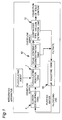
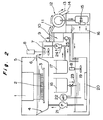
- a developer-circulating method in making a flexographic printing plate and an apparatus for carrying out the method according to a first embodiment of the present invention generally comprises an elution unit (an elution tank or developing tank 4); a flocculation unit (a flocculation reaction tank 7 and a solid content concentration tank 10) of dispersed polymer; solid/liquid separation unit (a continuous type vacuum filtration separation unit 12); and a pH-adjusting unit (a pH-adjusting tank 19) for optimizing the pH of filtrate as a secondary treatment thereof, thus constituting a recycling closed system.
- the transportation of the developer between the units is accomplished by gravity drop utilizing potential energy or a pump for feeding a fixed flow rate of liquid.
- An overflow by gravity drop is used to transport the developer from the elution tank 4 to the flocculation reaction tank 7 and from the solid content concentration tank 10 to the continuous type vacuum filtration separation unit 12 so that solid content floating on the surface of the developer is selectively transferred.
- an appropriate range of the flow rate of recycling developer which circulates in the developer-circulating apparatus is favorably, 1 through 30 liters/minute, and more favorably, 5 through 20 liters/minute if, for example, the capacity of the elution tank 4 is 50 liters. If the flow rate of this recycling developer is less than the appropriate range, the adherence of resin tailings to the interior of the apparatus such as the elution tank 4 becomes conspicuous. This phenomenon occurs on the flexographic printing plate 3 as well during development. If the flow rate of this recycling developer is more than the appropriate range, air suction to the liquid feeding pump or a vacuum pump of a filtering device becomes conspicuous, which leads to bubbling. Accordingly, as described above, preferably, the flow rate is adjusted to the appropriate range.
- Treating process to be performed by each unit is described below.
- elution resin (unexposed portion) is eluted in an aqueous medium and dispersed in the developer by a brush 2. While the resin which has eluted in the aqueous medium in the elution tank 4 is being dispersed in the water, it is apt to float in the vicinity of the surface of the water because its specific gravity is lower than one.
- the resin is selectively overflowed from a weir 6 of the developing tank 4 so as to effectively supply it to the flocculation reaction tank 7.
- an outlet can be formed on an upper portion of the developing tank 4 to discharge the developer through the outlet.
- the resin is sufficiently dispersed on a lower side of the developer as well. Therefore, the developer can be discharged through a desired place, for example, a lower portion or a portion of the bottom of the developing tank 4.
- the eluted/dispersed component is flocculated and separated from the developer by flocculating agent.
- the solid content is flocculated by the flocculating agent injected quantitatively into the flocculation reaction tank 7 from the flocculating agent tank 17 by using a metering pump 24.
- the flocculation reaction operation is performed by using a stirring device 8 in a stirring condition.
- a grain size appropriate for the filtration/separation is approximately 20 microns through 2mm.
- the addition amount of the flocculating agent is injected by the metering pump 24 in a range of 1 ppm through 1,000 ppm of the developer (waste liquid) and more favorably, 10 through 500 ppm.
- inorganic and organic flocculating agents conventionally used in treating waster water can be used.
- inorganic flocculating agents aluminum salts (aluminum sulfate, sodium aluminate, polyvinyl aluminum (PAC)); iron salt (iron sulfate (II), iron chloride (III), iron sulfate (III), chlorinated copparas).
- anion polymer sodium alginate, CMC sodium salt, poly acrylic sodium, partially hydrolyzed salt of polyacrylamide, copolymer of maleic acid
- cation polymer water-soluble aniline resin, polythionic urea, polyethyleneimine, acrylic polymer having quaternary ammonium salt in side chain, polyvinyl pyridines
- nonionic polymer polyacrylic amide, polyoxyethylene, caustic starch
- the high polymer flocculating agent cation polymers or ampholytic ion polymers not greatly affecting the pH of liquid to be treated and being safe is preferable.
- the flocculated liquid is fed to the cylindrical solid content concentration tank 10 through the outlet 9 formed on an upper portion of the flocculation reaction tank 7. Since the liquid is allowed to stand in the solid content concentration tank 10, grains become large, thus floating in the vicinity of the surface of liquid, while a liquid phase is present in the lower portion of the solid content concentration tank 10. A part of the liquid in the lower portion of the solid content concentration tank 10 is sent from the bottom portion thereof to the pH-adjusting tank 19 through a flow rate-adjusting valve 25 as necessary without passing through the filtering device. As a result, the liquid in the solid content concentration tank 10 is concentrated further.
- the solid content concentration tank 10 can be provided as necessary, i.e., it can not be provided if it is of simplified type.
- slurry containing concentrated solid content floating in the vicinity of the liquid surface of the solid content concentration tank 10 is supplied by an overflow to the continuous type vacuum filtration unit 12, for example, a rotary cylindrical filtering material of an Oliver filter, via a conduit 11.
- the continuous type vacuum filtration unit 12 in the first embodiment has a rotary cylindrical filtering material known as the Oliver filter.
- the pressure inside the filtering material is kept at a pressure-reduced state, namely, at vacuum degree 400 through 600 mmHg, and the water content of the slurry supplied to the continuous type vacuum filtration unit 12 via the conduit 11 is absorbed into the filtering material to dehydrate the slurry so that the solid content is adhered to the surface of the filtering material.
- the rotational speed of the filtering material is arbitrarily adjusted according to the formation speed of cake (dehydrated solid content).
- the filtering material is rotated around a center shaft by a rotary motor provided to drive only the filtering material.
- the solid content which has adhered to the surface of the filtering material is dehydrated by the suction force of a vacuum pump 15 via the filtering material.
- the vacuum pump 15 is of water-sealed type, and hence supplementary water is supplied thereto from a filtrate tank 16. Filtered liquid is collected into the filtrate tank 16 disposed alongside the vacuum pump 15.
- the filtering material is composed of porous material (average of hole diameters: several microns through several tens of microns).
- the filtering material is wound around a porous drum, or molded into a cylindrical configuration if the filtering material is hard.
- the filtering material made of diatomaceous earth is best known.
- resin in the form of a sponge layer made of soft polyvinyl acetal (Examined Japanese Patent Publication No. 64-10247) and a porous material formed by mixing hard phenol resin and polyvinyl acetal resin with each other (Examined Japanese Patent Publication No. 3-66004); ceramic; and material made of carbon may be used. Any of these filtering material can be advantageously utilized in the present invention.
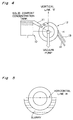
- the method for supplying the developer to the Oliver filter is carried out as follows: It is necessary to supply the slurry to the cylindrical filtering material from above (namely, top feeding) a virtual horizontal line (H) passing through the center of the filtering material, as shown in Fig. 4.
- V vertical line
- the thickness of the cake is frequently 1mm or less. Consequently, generally, it is difficult to remove the cake by only one scraper 13, as is often the case with sticky resin. Therefore, as shown in Fig. 6, it is necessary to install, below the scraper 13, the cake shoot 14 with which the cake scraped from the filtering material by the scraper 13 is guided to remove therefrom. As shown in Fig. 7, preferably, the leading end of the cake shoot 14 has an angle in conformity to the peripheral direction (or tangential direction) of the filtering material so as to improve the collecting performance thereof.
- the conventional collecting method (EP430,233A) based on the separation of resin grains from liquid owing to the precipitation thereof caused by allowing developer to stand and the collecting method (USP4,239,368 and EP430,233A) based on the separation of resin grains from the liquid by means of a cartridge filter have problems that it takes much time to collect solid content because the developer is left overnight and thus operability and efficiency are unfavorable; an amount to be treated is small; and a filter clogs in a short period of time and it is necessary to replace filters repeatedly if the amount of the developer to be treated is to be increased. These problems do not occur when the Oliver filter is used, and thus the present invention is advantageous in this point.
- the filtrate in the filtrate tank 16 is sent to the pH-adjusting tank 19 by the overflow.
- the developer taken out from the bottom of the solid content concentration tank 10 is supplied into the pH-adjusting tank 19 through the flow rate-adjusting valve 25. That is, transparent filtrate obtained by almost completely removing the solid content obtained in the solid content-concentrating process and the filtering process previously performed is supplied to the pH-adjusting tank 19.
- a necessary amount of pH-adjustor (acid or alkali) is supplied to the pH-adjusting tank 19 from the tank 18 through an electromagnetic valve 23.
- the pH-adjustor means acid or alkali. Since the developer indicates weak alkali (pH: 9.5 through 9.8), acid is mainly preferably used to neutralize the weak alkali.
- inorganic acid such as sulfuric acid, hydrochloric acid, or nitric acid
- organic acid such as citric acid, malic acid, or acetic acid
- a heater 20 for keeping the pH-adjusting tank 19 at a temperature suitable for a subsequent developing process can be provided in the pH-adjusting tank 19.
- Purified liquid re-obtained by the pH-adjustment in the above manner is returned to the developing tank 4 through a feed-back pump 21 and then utilized for elution again.
- the pH is less than 5.5, not only the developing performance of a printing plate can be adversely affected, but also a portion of the apparatus in contact with the developer may be corroded with the elapse of time. If the pH is more than 8.5, there is a possibility that a human body, for example, the operator's skin is affected. If a compound is apt to be dispersed in the entire developer due to its self-emulsification action when the pH is more than 9, the pH is adjusted to 8.5 or less so as to restrain the self-emulsification action and facilitate flocculating/separating operation to be performed in a later stage.
- an absorbing carrier is used to absorb/remove a basic nitrogen-contained compound, of the photosensitive resin compound, which has dissolved in the developer (water) so as to remove it from the developer.
- This method makes it possible for the pH of the developer to be kept within a pH range appropriate for plate-making without increasing the pH.
- Activated carbon and ion exchange resin are used as absorbing carriers in the above method. If the basic nitrogen-contained compound is water-soluble, the utilization of the ion exchange resin is preferable because it is superior in the property of absorbing it.
- the ion exchange resin strong acid cation exchange resin represented by Imberite IR-120B (manufactured by Rome and Hurse Corp.) is most favorable.
- the bag is immersed in the pH-adjusting tank 19 shown in Fig. 2, or the bag is installed to be filled in an ion exchange resin cartridge 26 provided on a path through which the liquid to be treated is fed from the filtrate tank 16 of the Oliver filter to the pH-neutralization tank 19, as shown in Fig. 21.
- the ion exchange resin can be conveniently replaced.
- a time for replacing the ion exchange resin should be judged by a control method of a pH measured by the pH meter 22 provided in the neutralization tank or the conductivity of the filtrate.
- the solid content is dissolved in the liquid or fine grains less than a proper grain size are precipitated, flocculated, and dissipated in the liquid by providing the flocculating process of adding a proper amount of flocculating agent to the liquid subsequent to the developing process. In this manner, the solid content can be removed.
- the filtering material of the vacuum filtering device can be prevented from clogging, and hence the liquid-treating performance per time and the efficiency of dehydrating water content from the cake can be improved.
- comparison data obtained in a case in which only pH-adjustment of a liquid was performed, a case in which the pH-adjustment of a liquid was performed and flocculating agent was used, and a case in which neither pH-adjustment of a liquid was performed nor flocculating agent was used is shown below.
- the substances of the mixture thus obtained were fully mixed by pressure-applying two-axis kneader.
- a photo polymerization resin compound thus obtained was extruded, by a kneader pressing device having a T-die, on a polyester film to which chloroprene adhesive agent and HIBON 1920LT (manufactured by Hitachi Chemical Co., ltd.) had been applied in a thickness of 5 ⁇ .
- chloroprene adhesive agent and HIBON 1920LT manufactured by Hitachi Chemical Co., ltd.
- Irradiation was carried out for 10 minutes by an ultraviolet lamp of 350W, with a negative film having an appropriate image uniformly brought into contact with the surface of the photosensitive resin layer of each of photosensitive resin plates in vacuum, and photosensitive resin plates were developed for five minutes per photosensitive resin plate by using water of 40°C by the apparatus according to the first embodiment.
- 1% dilute sulfuric acid was used.
- flocculating agent 0.02% water solution of Sunflock C-109P (acrylic polymer having quaternary ammonium salt in side chain; cationic high polymer flocculating agent, manufactured by Sanyo Chemical Co., Ltd) was used.
- Table 1 shows comparison data obtained in a case in which only pH-adjustment of a developer was performed (experiment No. 2), in a case in which the pH-adjustment was performed and flocculating agent was used (experiment No. 1), and in a case in which neither the pH-adjustment was performed nor flocculating agent was used (experiment No. 3).
- the developing performance of a plate relief was favorable.
- the solid content of resin was accumulated in the developing tank 4. As a result, the resin layer adhered to the brush 2 and the tank of the flexographic printing plate 3 during development and hence, a favorable plate relief could not be formed.
- the developer is circulated in the above-described unit.
- Photosensitive resin compounds suitable for the application to the developer-circulating method and the apparatus for carrying out the method in the flexographic plate-making process are less than 1 in specific gravity, and more favorably, 0.85 through 0.99, and in addition they are required to be developable by using water or an aqueous medium.
- Photosensitive resin compounds suitable for the application to the developer-circulating method and the apparatus for carrying out the method in the flexographic plate-making process are less than 1 in specific gravity, and more favorably, 0.85 through 0.99, and in addition they are required to be developable by using water or an aqueous medium.
- the compounds comprise: three-dimensional bridged grain polymer (Microgel) having a diameter of 0.01 through 5 ⁇ obtained by polymerizing mixture of aliphatic conjugate diene monomer and monofunctional ethylene unsaturated monomer and/or multi-functional ethylene unsaturated monomer; hydrophobic elastomer having a molecular weight of 5,000 through 1,000,000 and containing at least 30% mole of conjugate diene monomer unit per molecular in the compound; compound containing basic nitrogen atoms; photo polymerization ethylene unsaturated monomer; and photo polymerization initiator.
- Microgel three-dimensional bridged grain polymer having a diameter of 0.01 through 5 ⁇ obtained by polymerizing mixture of aliphatic conjugate diene monomer and monofunctional ethylene unsaturated monomer and/or multi-functional ethylene unsaturated monomer
- hydrophobic elastomer having a molecular weight of 5,000 through 1,000,000 and containing at least 30% mole of conjugate diene monomer unit per molecular in the
- compound including photosensitive resin compound consisting of hydrophilic polymer containing hydrophilic functional group and the molecular weight of which is 1,000 through 1,000,000 is also suitable.
- polymers are suitable provided that specific gravities thereof are in the above-described range: aliphatic conjugate diene, namely, homopolymer or copolymer such as butadiene, isoprene, and isobutylene; copolymerization resin (including block copolymerization) consisting of conjugate diene and (meta) acrylic acid or (meta) acrylic ester, and styrene monomer; organic acid such as maleic acid thereof; and amine-denatured resin.
- aliphatic conjugate diene namely, homopolymer or copolymer such as butadiene, isoprene, and isobutylene
- copolymerization resin including block copolymerization
- organic acid such as maleic acid thereof
- amine-denatured resin amine-denatured resin
- photosensitive resin compound to be used in the present invention does not have a problem in development even though emulsifying agent is not used in dispersing resin of an unexposed portion in the developer.
- water is used as the developer.
- purified city water is preferable.
- ion exchange resin is used for natural water such as ground water which is high in hardness and hence unsuitable for plate-making, or the natural water is distilled to make it soft.
- water-soluble organic solvent for example, alcohols
- surface active agent for example, water-soluble organic solvents
- the solid content such as resin in the developer is flocculated
- the solid content is separated from the liquid successively.
- an unnecessary substance solid content
- the quality of manufactured printing plates are uniform, and the unnecessary resin does not adhere to the printing plate or the apparatus.
- it can greatly prevent the printing performance of the printing plate from being deteriorated and the durability of the apparatus from being reduced.
- the developer from which the solid content has been removed can be recycled so that the developer can be utilized again in development and thus running cost can be reduced.
- the resin compound having a specific gravity less than 1 since the resin compound having a specific gravity less than 1 is used, it is easy for the solid content to float on the surface of the developer and hence liquid containing the solid content having high density can be supplied to the solid content concentrating process. Accordingly, the solid content can be discharged effectively and solid content-collecting time period is short. Thus, operation efficiency, work efficiency, and processing efficiency are favorable.
- the pH of the developer from which the solid content has been removed can be adjusted so that the developer does not adversely affect a human body. Therefore, dissolved chemical substances do not adversely affect a human body and hence the developer has excellent safety and in addition, the increase in the viscosity of the developer can be prevented. Thus, the change in the characteristics of the developer such as pH can be reduced and printing plates can be made in uniform quality.
- the present invention is not limited to the first embodiment, but can be embodied in various aspects.
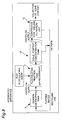
- flocculating agent to be used in the second embodiment, having a function of flocculating the solid content, dissolved or dispersed in liquid to be treated, in a grain size appropriate for separating the solid content from the liquid and a function of adjusting the pH of the developer.
- inorganic flocculating agents indicating acidic property in water solution are favorable: aluminum salt (aluminum sulfate, sodium aluminate, polyvinyl aluminum); and iron salt (iron sulfate (I), iron chloride (III), iron sulfate (III), chlorinated copparas).
- aluminum salt having property of not coloring filtrate is used more favorably.
- Inorganic acids such as sulfuric acid, hydrochloric acid, and nitric acid; and proton acid such as organic acid, for example, citric acid, malic acid, and acetic acid may be used as flocculating agent, although these substances are a little inferior to the above-described inorganic flocculating agents in flocculating effect.
- the substances utilized as the pH-adjustors in the pH-adjusting unit in the first embodiment may be used as these substances.
- a necessary amount of flocculating agent is supplied from the flocculating agent tank 17 to the flocculation reaction tank 7 via the metering pump 24 by an automatic control of the pH-meter 22 which measures the pH of the liquid to be treated in the flocculation reaction tank 7.
- the solid content of the liquid to be treated is flocculated and the pH thereof is adjusted in the flocculation reaction tank 7 at the same time.
- the pH-adjusting tank is not required in the second embodiment unlike the first embodiment (see Fig. 2). Accordingly, the performance of separating the solid content from the liquid is superior to that of the first embodiment and in addition, the entire apparatus is smaller in size than that of the first embodiment, and thus, the second embodiment can be advantageously manufactured.
- a heater 4a for keeping the liquid hot is disposed in the elution tank. Tests generally similar to the examples made on those according to the first embodiment were conducted by using the apparatus (Fig. 9) according to the second embodiment. The examples of the second embodiment are different from those the first embodiment in that 1% water solution of aluminium sulfate was used as flocculating agent.
- the pH-adjusting treatment may be omitted if the developer is safe and the solid content can be separated from the liquid smoothly even though pH-adjustment is not performed.
- a grain size attained is generally suitable for separating the solid content from the liquid by merely adjusting the pH of the developer
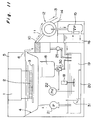
- the provision of the flocculation reaction tank 7 may be omitted and the solid content concentration tank 10 may be provided at a portion subsequent to the developing tank 4. That is, in Fig. 11, the developer discharged from the weir 6 of the developing tank 4 is supplied into the solid content concentration tank 10 so that the above-described operation for separating the solid content from the liquid is performed.
- reference numeral 30 denotes a metering pump for measuring the amount of pH-adjustor
- 31 denotes a weir for preventing a short pass of liquid flow in the pH-adjusting tank 19.
- the developer discharged by the overflow is introduced horizontally into a hopper having a cone portion at a lower portion thereof so as to generate a rotary water flow. Therefore, the solid content in the developer can be efficiently uniformly flocculated by accelerating the mixture of the flocculating agent which has dripped from an upper portion of the hopper. Because the rotary water flow generated in the hopper causes a turbulent state in a pipe connected with a portion subsequent to the hopper, it is effective for preventing the inner wall of the pipe from being polluted (due to adherence of solid content) even though time elapses. Slurry containing an appropriate amount of flocculating agent uniformly mixed with the developer prevents the solid content from clogging on a bag-shaped filter in a great degree, thus improving filtering efficiency remarkably.
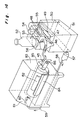
- a conventional flexographic printing plate-making apparatus (elution apparatus) is provided with only pipes [pipes are installed on an outlet (a portion on which a flow rate-adjusting valve 45 has been installed) of overflowed water and an inlet (a portion on which a flow rate-adjusting valve 60 has been installed) of water to be recycled], as shown in Fig. 12.
- Reference numeral 41 denotes a cover; 42 denotes a flexographic printing plate installed on the cover 41; 43 denotes the main body of the elution apparatus; and 44 denotes a brush.
- Reference numerals 45, 48, 58, and 60 each denote a flow rate adjusting valve; 46 denotes a hopper; 47 denotes a slurry feeding pipe; 49 denotes a slurry discharge pipe; 50 denotes the main body of a filtering device; 51 denotes a filtrate tank; 52 denotes a flocculating agent tank; 53 denotes a flocculating agent feeding/metering pump; 54 denotes an automatic controller (controller for drive of metering pump) for connecting a pH meter; 55 denotes the pH meter; 56 denotes a flocculating agent feeding tube; 57 denotes a purified liquid-feed back pump; and 59 denotes a purified liquid-returning pipe.
- 46 denotes a hopper
- 47 denotes a slurry feeding pipe
- 49 denotes a slurry discharge pipe
- 50 denotes the main body of a filtering device
- 51 denotes a filtrate tank
- the conventional flexographic printing plate-making apparatus includes a cylindrical type (Fig. 14 shows a connection view showing the cylindrical type elution apparatus) for allowing a printing plate to be installed on a cylinder so as to develop the printing plate, a one-way automatic processor for making plates automatically and continuously, and a one-way semi-automatic processor for making plates semi-automatically and continuously, other than a flat plate type shown in Fig. 12.
- a cylindrical type Fig. 14 shows a connection view showing the cylindrical type elution apparatus
- a one-way automatic processor for making plates automatically and continuously
- a one-way semi-automatic processor for making plates semi-automatically and continuously, other than a flat plate type shown in Fig. 12.
- the fourth embodiment is characterized in the flocculating unit.
- the developer is introduced into the hopper 46 having a cone portion 46a disposed at a lower portion thereof, the rotary water flow is generated in the cone portion 46a, the mixture of the flocculating agent is accelerated by the drip of the developer from the flocculating agent feeding tube 56 disposed at an upper portion of the hopper 46. In this manner, the solid content is uniformly flocculated.
- the introduction of the developer from the elution tank 43 to the hopper 46 is accomplished through gravity drop by overflow supply. But if it is difficult to drop the developer by gravity due to the height relationship between the water surface of the elution tank and the inlet of the hopper 46, the developer may be supplied by a pump.
- the developer in which the solid content has been flocculated is introduced into the filtering device serving as a solid content/liquid separating unit via the slurry feeding pipe 47.
- the slurry-feeding pipe 7 is branched into two pipes in an downstream side thereof, and each branch pipe is provided with the flow rate adjusting valve 8, and a filter 61 is disposed on a downstream side of the flow rate adjusting valve 48. This is to allow one filter 61 to perform its operation while the other filter 61 is being replaced, by closing one of the valves 8.
- the flocculating unit formed of a hopper having the cone portion the solid content is uniformly (proper grain size range) dispersed in the slurry and in addition, short pass, namely, the passage of the liquid on only the surface of the slurry does not occur. As a result, the clogging of the filtering material becomes less and favorable filtering efficiency can be held. Further, since the rotary flow is generated and thus a turbulent state is generated, the solid content adheres to the wall surface of the flocculating unit and pipes in a small extent, which enables the operation of the apparatus for a long time and facilitates the maintenance thereof.
- the kind of the flocculating agent to be used in the fourth embodiment is as follows:
- flocculating agents to be used in the flocculating process conventional inorganic and organic (polymer) flocculating agents used in the treatment of waste water can be used.
- inorganic flocculating agents aluminum salt (aluminum sulfate, sodium aluminate, polyvinyl aluminum (PAC)); and iron salt (iron sulfate (II), iron chloride (III), iron sulfate (III), chlorinated copparas) are used.
- anionic polymer sodium alginate, CMC sodium salt, sodium polyacrylate, partially hydrolyzed salt of polyacrylamide, copolymer of maleic acid
- cationic polymer water-soluble aniline resin, polythionic urea, polyethylene imine, acrylic polymer having quaternary ammonium salt in side chain, polyvinyl pyridines
- nonionic polymer polyacrylamide, polyoxyethylene, caustic starch
- the flocculating agent is injected to the developer by the metering pump 53 in a range of 5 through 5000ppm, and more favorably, 20 through 1000ppm.
- a grain size appropriate for the filtration/separation in the fourth embodiment is approximately 20 microns through 5mm and more favorably, it is adjusted to 0.1mm or more so as to improve the filtering efficiency in the filtering method utilizing gravity drop.
- a rectangular bag filter 61 formed by folding a piece of cloth double and sewing three sides together except the folded portion is prepared, and a slurry discharge pipe 49 is inserted into the bag-shaped folded portion of the filter 61.
- the material of the filter 61 is cloth made of rayon, polyester, polypropylene, or nylon.
- Screen gauze made of nylon, tetron, silk, or stainless
- the average diameter of the hole of the filter is 3 through 500 microns, and more favorably, 20 through 200 microns to prevent the filter from clogging, improve dehydration performance, and improve the efficiency of collecting the solid content.
- the filtering area of the filter 61 is great.
- the supply amount (load) of slurry per area (1cm2) of filter is 0.05 through 10 milliliters/cm2 per time (one minute), and more favorably, 0.1 through 5 milliliters/cm2 to prevent the filter from clogging and keep filtering efficiency.
- the above-described strong acidic cation exchange resin is favorably put into the bag filter 61 beforehand to facilitate the filtration of the flocculated solid content and a pH control in absorbing/collecting basic nitrogen-contained compound which has dissolved in water.
- flocculating agent such as high molecular flocculating agent having no pH-adjusting function.
- the strong acidic cation exchange resin since the strong acidic cation exchange resin is put into the bag filter 61, it can be collected together with the resin solid content after the use and thus it can be handled easily.
- Filtrate which has dripped from the filter 61 is stored in the filtrate tank 51.
- the pH value of the filtrate in the filtrate tank 51 is measured by the holder-provided pH meter 55 (a sensor is disposed at leading end thereof); a signal indicating a measured value is converted by an automatic controller 54 controlled by a microcomputer; and a switch or the stroke length of the flocculating agent feeding/metering pump 53 is automatically controlled. In this manner, a liquid feeding amount is controlled.
- the filtrate in the filtrate tank 51 is supplied to the developing tank 4 by the purified liquid-feedback pump 57.
- Fig. 14 Tests approximately similar to the examples made on those according to the above-described embodiments were conducted by using the apparatus (Fig. 14) according to the fourth embodiment.
- the examples of the fourth embodiment are different from those the above-described embodiment in that 1% water solution of sulfuric acid was used as flocculating agent.
- 81 denotes a cover
- 82 denotes a fitted flexographic printing plate
- 83 denotes the main body of the elution apparatus
- 84 denotes a brush
- 85 denotes a plate-fitted drum
- 86 denotes a drum-driving motor.
- Table 3 shows comparison data obtained in a case in which a conventional flocculating tank was used; in a case in which the flocculating device according to the fourth embodiment was used; and in a case in which no flocculating device was used.
- the pH of the filtrate in the filtrate tank 11 was measured and then, the flocculating agent (acidic flocculating agent) having the above-described pH-adjusting function was supplied into the hopper 46 serving as the flocculating tank.
- flocculating agent such as high molecular flocculating agent having no pH-adjusting function
- pH-adjustor can be provided in addition to the flocculating agent as a fifth embodiment, as shown in Fig.
Landscapes
- Physics & Mathematics (AREA)
- General Physics & Mathematics (AREA)
- Engineering & Computer Science (AREA)
- Environmental & Geological Engineering (AREA)
- Photosensitive Polymer And Photoresist Processing (AREA)
- Separation Of Suspended Particles By Flocculating Agents (AREA)
Abstract
Procédé de mise en circulation d'un révélateur, au cours de la réalisation d'un cliché flexographique, permettant d'empêcher qu'une substance chimique dissoute ait un effet nocif sur le corps humain, d'une grande sécurité, permettant également d'empêcher une augmentation de la viscosité du liquide, le dépôt d'une substance dissoute sur un appareil et la réduction de la longévité de l'appareil, de réduire le temps de remise en état d'utilisation, et présentant une grande facilité de mise en oeuvre ainsi qu'une grande efficacité d'exploitation et de traitement. L'invention concerne également un appareil permettant de mettre en oeuvre ce procédé. Selon ledit procédé, on fait coaguler, avec un coagulant, le solide se trouvant dans un liquide contenant la résine dispersée dans l'eau, constituant le matériau d'un cliché flexographique (3, 42), dans un révélateur, et le liquide contenant un solide coagulé est soumis à une séparation solide-liquide permettant d'extraire le solide et de réutiliser le liquide en tant que révélateur. Une régulation du pH peut également être exécutée en plus de la coagulation du solide. La régulation du pH peut aussi être exécutée une fois que le révélateur a été soumis à une séparation solide-liquide, cela sans que le solide ait été soumis à la coagulation.
Applications Claiming Priority (5)
| Application Number | Priority Date | Filing Date | Title |
|---|---|---|---|
| JP29262492 | 1992-10-30 | ||
| JP292624/92 | 1992-10-30 | ||
| JP33150892A JP3138553B2 (ja) | 1992-10-30 | 1992-12-11 | フレキソ製版工程における現像液循環方法及びその方法を実施するための装置 |
| JP331508/92 | 1992-12-11 | ||
| PCT/JP1993/001547 WO1994010611A1 (fr) | 1992-10-30 | 1993-10-27 | Procede et appareil de mise en circulation d'un revelateur au cours de la realisation d'un cliche flexographique |
Publications (2)
| Publication Number | Publication Date |
|---|---|
| EP0624828A1 true EP0624828A1 (fr) | 1994-11-17 |
| EP0624828A4 EP0624828A4 (fr) | 1995-11-22 |
Family
ID=26559067
Family Applications (1)
| Application Number | Title | Priority Date | Filing Date |
|---|---|---|---|
| EP93923645A Withdrawn EP0624828A4 (fr) | 1992-10-30 | 1993-10-27 | Procede et appareil de mise en circulation d'un revelateur au cours de la realisation d'un cliche flexographique. |
Country Status (4)
| Country | Link |
|---|---|
| EP (1) | EP0624828A4 (fr) |
| JP (1) | JP3138553B2 (fr) |
| CA (1) | CA2127108A1 (fr) |
| WO (1) | WO1994010611A1 (fr) |
Cited By (6)
| Publication number | Priority date | Publication date | Assignee | Title |
|---|---|---|---|---|
| EP0897135A1 (fr) * | 1997-08-14 | 1999-02-17 | Asahi Kasei Kogyo Kabushiki Kaisha | Procédé et appareil pour le traitement de développateurs usés |
| EP0933684A1 (fr) * | 1998-01-22 | 1999-08-04 | Toyo Boseki Kabushiki Kaisha | Procédé de développement de plaques photosensibles et appareil de développement |
| WO2004095141A1 (fr) * | 2003-04-24 | 2004-11-04 | Kodak Polychrome Graphics Gmbh | Procede et appareil de regeneration et de reutilisation d'un revelateur charge |
| US6855487B2 (en) | 2001-10-26 | 2005-02-15 | Kodak Polychrome Graphics, Llc | Method and apparatus for refreshment and reuse of loaded developer |
| EP3460575A1 (fr) * | 2017-09-22 | 2019-03-27 | Sasu Vianord Engineering | Ensemble de traitement de liquide à base d'eau utilisé dans une station de lavage de plaques flexographiques |
| EP4703802A1 (fr) * | 2024-08-27 | 2026-03-04 | Eco3 Bv | Appareil de traitement et procédé de traitement pour plaques d'impression flexographique |
Families Citing this family (10)
| Publication number | Priority date | Publication date | Assignee | Title |
|---|---|---|---|---|
| US5811224A (en) * | 1994-08-24 | 1998-09-22 | Bayer Corporation | Process for rejuvenating developer in printing plate development |
| EP0747773A4 (fr) * | 1994-12-27 | 1997-06-18 | Mitsubishi Chem Corp | Procede et appareil pour traiter un revelateur pour materiau photosensible sans halogenure d'argent et contenant des pigments, et machine a developper automatique |
| JPH10239857A (ja) * | 1997-02-27 | 1998-09-11 | Toyobo Co Ltd | 感光性樹脂版の現像液および現像方法 |
| JP5496586B2 (ja) * | 2009-09-15 | 2014-05-21 | 旭化成イーマテリアルズ株式会社 | 印刷版の製造方法および製造装置 |
| JP6826787B1 (ja) * | 2019-08-01 | 2021-02-10 | 東洋紡株式会社 | 現像液のリサイクル装置及びリサイクル方法、並びに現像装置 |
| EP4309899A4 (fr) * | 2021-03-19 | 2025-07-23 | Toyobo Mc Corp | Procédé de production de révélateur recyclé, et procédé de production de plaque d'impression flexographique l'utilisant |
| JPWO2024062680A1 (fr) | 2022-09-21 | 2024-03-28 | ||
| WO2025094632A1 (fr) * | 2023-10-31 | 2025-05-08 | 富士フイルム株式会社 | Procédé de traitement et dispositif de traitement |
| WO2025164233A1 (fr) * | 2024-01-31 | 2025-08-07 | 富士フイルム株式会社 | Filtre, dispositif de traitement et procédé de traitement |
| WO2026058793A1 (fr) * | 2024-09-13 | 2026-03-19 | 富士フイルム株式会社 | Système de traitement de circulation flexographique développable à l'eau, procédé de traitement de circulation flexographique développable à l'eau et liquide de rinçage régénéré |
Family Cites Families (7)
| Publication number | Priority date | Publication date | Assignee | Title |
|---|---|---|---|---|
| DE3102135C2 (de) * | 1981-01-23 | 1986-07-10 | Basf Ag, 6700 Ludwigshafen | Verfahren zum Regenerieren von wäßrigen Auswaschlösungen wasserentwickelbarer photosensitiver Aufzeichnungsmateralien |
| JPS5865433A (ja) * | 1981-10-14 | 1983-04-19 | Hitachi Chem Co Ltd | アルカリ型感光性フイルムの現像又ははく離方法および現像又ははく離装置 |
| JPS5928154A (ja) * | 1982-08-06 | 1984-02-14 | Hitachi Chem Co Ltd | アルカリ型感光性フイルムの現像又ははく離方法および現像又ははく離装置 |
| JPS62294487A (ja) * | 1986-06-11 | 1987-12-21 | Matsushita Electric Ind Co Ltd | アルカリ溶解型感光性ドライフイルム現像廃液の処理方法 |
| JP2587996B2 (ja) * | 1988-06-01 | 1997-03-05 | コニカ株式会社 | 廃液処理の作業性等が改善される非銀塩感光材料の処理方法 |
| JP2610678B2 (ja) * | 1989-02-21 | 1997-05-14 | 富士写真フイルム株式会社 | 水なし平版印刷版の現像かす除去装置 |
| JPH0341453A (ja) * | 1989-07-07 | 1991-02-21 | Toyobo Co Ltd | 感光性樹脂版の現像方法 |
-
1992
- 1992-12-11 JP JP33150892A patent/JP3138553B2/ja not_active Expired - Fee Related
-
1993
- 1993-10-27 CA CA 2127108 patent/CA2127108A1/fr not_active Abandoned
- 1993-10-27 EP EP93923645A patent/EP0624828A4/fr not_active Withdrawn
- 1993-10-27 WO PCT/JP1993/001547 patent/WO1994010611A1/fr not_active Ceased
Cited By (11)
| Publication number | Priority date | Publication date | Assignee | Title |
|---|---|---|---|---|
| EP0897135A1 (fr) * | 1997-08-14 | 1999-02-17 | Asahi Kasei Kogyo Kabushiki Kaisha | Procédé et appareil pour le traitement de développateurs usés |
| US6153107A (en) * | 1997-08-14 | 2000-11-28 | Asahi Kasei Kogyo Kabushiki Kaisha | Process for treating development waste liquor |
| US6379558B1 (en) | 1997-08-14 | 2002-04-30 | Asahi Kasei Kabushiki Kaisha | Process for treating development waste liquor |
| EP0933684A1 (fr) * | 1998-01-22 | 1999-08-04 | Toyo Boseki Kabushiki Kaisha | Procédé de développement de plaques photosensibles et appareil de développement |
| US6247856B1 (en) | 1998-01-22 | 2001-06-19 | Toyo Boseki Kabushiki Kaisha | Developing system of photosensitive resin plates and apparatus used therein |
| US6855487B2 (en) | 2001-10-26 | 2005-02-15 | Kodak Polychrome Graphics, Llc | Method and apparatus for refreshment and reuse of loaded developer |
| WO2004095141A1 (fr) * | 2003-04-24 | 2004-11-04 | Kodak Polychrome Graphics Gmbh | Procede et appareil de regeneration et de reutilisation d'un revelateur charge |
| EP3460575A1 (fr) * | 2017-09-22 | 2019-03-27 | Sasu Vianord Engineering | Ensemble de traitement de liquide à base d'eau utilisé dans une station de lavage de plaques flexographiques |
| EP3460576A1 (fr) * | 2017-09-22 | 2019-03-27 | Sasu Vianord Engineering | Ensemble de traitement de liquide à base d'eau utilisé dans une station de lavage de plaques flexographiques |
| EP4703802A1 (fr) * | 2024-08-27 | 2026-03-04 | Eco3 Bv | Appareil de traitement et procédé de traitement pour plaques d'impression flexographique |
| WO2026046963A1 (fr) * | 2024-08-27 | 2026-03-05 | Eco3 Bv | Appareil de traitement et procédé de traitement pour plaques d'impression flexographique |
Also Published As
| Publication number | Publication date |
|---|---|
| WO1994010611A1 (fr) | 1994-05-11 |
| EP0624828A4 (fr) | 1995-11-22 |
| CA2127108A1 (fr) | 1994-05-11 |
| JP3138553B2 (ja) | 2001-02-26 |
| JPH06194824A (ja) | 1994-07-15 |
Similar Documents
| Publication | Publication Date | Title |
|---|---|---|
| EP0624828A1 (fr) | Procede et appareil de mise en circulation d'un revelateur au cours de la realisation d'un cliche flexographique | |
| US5759743A (en) | Developer-circulating method in flexographic printing plate-making process and apparatus for carrying out developer-circulating method | |
| KR100218900B1 (ko) | 감광성수지판의 현상방법 및 현상장치 | |
| EP0357170B1 (fr) | Procédé et dispositif de traitement d'une eau usée provenant d'un matériau ne contenant pas d'halogénure d'argent et étant sensible à la lumière | |
| US5828923A (en) | Apparatus and method for processing water wash photopolymer solution | |
| CN114207528B (zh) | 显影液的回收装置及回收方法和显影装置 | |
| JPH02157084A (ja) | 廃液処理の作業性等が改善される非銀塩感光材料の処理方法及び処理装置 | |
| EP1406125A1 (fr) | Procede de fabrication d'une plaque d'impression recouverte d'une resine photosensible et traitement a base de revelateur | |
| EP0520793A1 (fr) | Procédé pour le traitement d'une eau usée provenant d'un matériau ne contenant pas d'halogénure d'argent et sensible à la lumière | |
| CN114873779A (zh) | 一种焦化废水深度处理方法与处理系统 | |
| JP2000325710A (ja) | 固液分離装置 | |
| GB2132635A (en) | Regeneration of photographic fixing agents | |
| JP2002085907A (ja) | 凝集沈澱装置 | |
| CN213834921U (zh) | 一种砂再生污水处理系统 | |
| CN209797636U (zh) | 一种草铵膦生产废水处理装置 | |
| JP2001239272A (ja) | 銀含有排水の処理方法及び処理装置 | |
| JPH05337470A (ja) | 非銀塩感光材料の現像廃液の処理方法 | |
| CN219567676U (zh) | 一种市政污水处理加药设备 | |
| CN209815889U (zh) | 一种用于明胶污水的循环处理装置 | |
| CN208995260U (zh) | 一种炼铅厂的废水处理系统 | |
| CN208700854U (zh) | 一种河水快速异位净化装置 | |
| JP2568729B2 (ja) | 汚水処理装置 | |
| KR20010055004A (ko) | 침전조내에서 슬러지 부상분리에 의한 슬러지 제거장치 | |
| CN217809037U (zh) | 一种pcb油墨废水聚铁活性碳处理系统 | |
| JPH05104058A (ja) | 塗料スラツジの連続回収方法 |
Legal Events
| Date | Code | Title | Description |
|---|---|---|---|
| PUAI | Public reference made under article 153(3) epc to a published international application that has entered the european phase |
Free format text: ORIGINAL CODE: 0009012 |
|
| AK | Designated contracting states |
Kind code of ref document: A1 Designated state(s): DE FR GB IT |
|
| 17P | Request for examination filed |
Effective date: 19940929 |
|
| A4 | Supplementary search report drawn up and despatched |
Effective date: 19951005 |
|
| AK | Designated contracting states |
Kind code of ref document: A4 Designated state(s): DE FR GB IT |
|
| 17Q | First examination report despatched |
Effective date: 19970703 |
|
| STAA | Information on the status of an ep patent application or granted ep patent |
Free format text: STATUS: THE APPLICATION IS DEEMED TO BE WITHDRAWN |
|
| 18D | Application deemed to be withdrawn |
Effective date: 19981201 |