EP0627513A1 - Gewebe zur Verstärkung bzw. Armierung von Flächengebilden - Google Patents
Gewebe zur Verstärkung bzw. Armierung von Flächengebilden Download PDFInfo
- Publication number
- EP0627513A1 EP0627513A1 EP94107170A EP94107170A EP0627513A1 EP 0627513 A1 EP0627513 A1 EP 0627513A1 EP 94107170 A EP94107170 A EP 94107170A EP 94107170 A EP94107170 A EP 94107170A EP 0627513 A1 EP0627513 A1 EP 0627513A1
- Authority
- EP
- European Patent Office
- Prior art keywords
- fabric
- threads
- edge region
- weft
- warp threads
- Prior art date
- Legal status (The legal status is an assumption and is not a legal conclusion. Google has not performed a legal analysis and makes no representation as to the accuracy of the status listed.)
- Granted
Links
- 239000004744 fabric Substances 0.000 title claims abstract description 56
- 230000003014 reinforcing effect Effects 0.000 title claims description 6
- 239000004033 plastic Substances 0.000 claims abstract description 11
- 229920003023 plastic Polymers 0.000 claims abstract description 11
- 238000007789 sealing Methods 0.000 claims abstract description 7
- 239000000463 material Substances 0.000 claims description 5
- 239000000853 adhesive Substances 0.000 claims description 3
- 230000001070 adhesive effect Effects 0.000 claims description 3
- 230000006641 stabilisation Effects 0.000 claims description 3
- 238000011105 stabilization Methods 0.000 claims description 3
- 229920002472 Starch Polymers 0.000 claims description 2
- 239000008107 starch Substances 0.000 claims description 2
- 235000019698 starch Nutrition 0.000 claims description 2
- 230000002787 reinforcement Effects 0.000 abstract description 17
- 238000012360 testing method Methods 0.000 description 5
- 230000033228 biological regulation Effects 0.000 description 4
- 238000010276 construction Methods 0.000 description 4
- 239000012528 membrane Substances 0.000 description 4
- 238000009941 weaving Methods 0.000 description 3
- 238000004026 adhesive bonding Methods 0.000 description 2
- 239000000835 fiber Substances 0.000 description 2
- 239000011521 glass Substances 0.000 description 2
- 238000009413 insulation Methods 0.000 description 2
- 210000001503 joint Anatomy 0.000 description 2
- 238000009940 knitting Methods 0.000 description 2
- 238000004519 manufacturing process Methods 0.000 description 2
- 238000000034 method Methods 0.000 description 2
- 229920000728 polyester Polymers 0.000 description 2
- 238000004078 waterproofing Methods 0.000 description 2
- 238000003466 welding Methods 0.000 description 2
- OKTJSMMVPCPJKN-UHFFFAOYSA-N Carbon Chemical compound [C] OKTJSMMVPCPJKN-UHFFFAOYSA-N 0.000 description 1
- 239000004952 Polyamide Substances 0.000 description 1
- 229910000831 Steel Inorganic materials 0.000 description 1
- 239000004760 aramid Substances 0.000 description 1
- 229920003235 aromatic polyamide Polymers 0.000 description 1
- 239000010426 asphalt Substances 0.000 description 1
- 230000004888 barrier function Effects 0.000 description 1
- 229910052799 carbon Inorganic materials 0.000 description 1
- 239000002657 fibrous material Substances 0.000 description 1
- 239000003292 glue Substances 0.000 description 1
- 230000001771 impaired effect Effects 0.000 description 1
- 239000012784 inorganic fiber Substances 0.000 description 1
- 239000000203 mixture Substances 0.000 description 1
- 239000004745 nonwoven fabric Substances 0.000 description 1
- 239000011505 plaster Substances 0.000 description 1
- 239000002985 plastic film Substances 0.000 description 1
- 229920002647 polyamide Polymers 0.000 description 1
- 239000010959 steel Substances 0.000 description 1
- 239000000758 substrate Substances 0.000 description 1
- 238000010408 sweeping Methods 0.000 description 1
- 239000004753 textile Substances 0.000 description 1
- 239000002759 woven fabric Substances 0.000 description 1
Images

Classifications
-
- E—FIXED CONSTRUCTIONS
- E04—BUILDING
- E04D—ROOF COVERINGS; SKY-LIGHTS; GUTTERS; ROOF-WORKING TOOLS
- E04D5/00—Roof covering by making use of flexible material, e.g. supplied in roll form
- E04D5/06—Roof covering by making use of flexible material, e.g. supplied in roll form by making use of plastics
-
- C—CHEMISTRY; METALLURGY
- C09—DYES; PAINTS; POLISHES; NATURAL RESINS; ADHESIVES; COMPOSITIONS NOT OTHERWISE PROVIDED FOR; APPLICATIONS OF MATERIALS NOT OTHERWISE PROVIDED FOR
- C09K—MATERIALS FOR MISCELLANEOUS APPLICATIONS, NOT PROVIDED FOR ELSEWHERE
- C09K3/00—Materials not provided for elsewhere
- C09K3/10—Materials in mouldable or extrudable form for sealing or packing joints or covers
- C09K3/1025—Materials in mouldable or extrudable form for sealing or packing joints or covers characterised by non-chemical features of one or more of its constituents
- C09K3/1028—Fibres
-
- D—TEXTILES; PAPER
- D03—WEAVING
- D03D—WOVEN FABRICS; METHODS OF WEAVING; LOOMS
- D03D13/00—Woven fabrics characterised by the special disposition of the warp or weft threads, e.g. with curved weft threads, with discontinuous warp threads, with diagonal warp or weft
-
- D—TEXTILES; PAPER
- D03—WEAVING
- D03D—WOVEN FABRICS; METHODS OF WEAVING; LOOMS
- D03D13/00—Woven fabrics characterised by the special disposition of the warp or weft threads, e.g. with curved weft threads, with discontinuous warp threads, with diagonal warp or weft
- D03D13/004—Woven fabrics characterised by the special disposition of the warp or weft threads, e.g. with curved weft threads, with discontinuous warp threads, with diagonal warp or weft with weave pattern being non-standard or providing special effects
-
- D—TEXTILES; PAPER
- D03—WEAVING
- D03D—WOVEN FABRICS; METHODS OF WEAVING; LOOMS
- D03D13/00—Woven fabrics characterised by the special disposition of the warp or weft threads, e.g. with curved weft threads, with discontinuous warp threads, with diagonal warp or weft
- D03D13/008—Woven fabrics characterised by the special disposition of the warp or weft threads, e.g. with curved weft threads, with discontinuous warp threads, with diagonal warp or weft characterised by weave density or surface weight
-
- D—TEXTILES; PAPER
- D03—WEAVING
- D03D—WOVEN FABRICS; METHODS OF WEAVING; LOOMS
- D03D15/00—Woven fabrics characterised by the material, structure or properties of the fibres, filaments, yarns, threads or other warp or weft elements used
- D03D15/20—Woven fabrics characterised by the material, structure or properties of the fibres, filaments, yarns, threads or other warp or weft elements used characterised by the material of the fibres or filaments constituting the yarns or threads
- D03D15/242—Woven fabrics characterised by the material, structure or properties of the fibres, filaments, yarns, threads or other warp or weft elements used characterised by the material of the fibres or filaments constituting the yarns or threads inorganic, e.g. basalt
- D03D15/267—Glass
-
- D—TEXTILES; PAPER
- D03—WEAVING
- D03D—WOVEN FABRICS; METHODS OF WEAVING; LOOMS
- D03D15/00—Woven fabrics characterised by the material, structure or properties of the fibres, filaments, yarns, threads or other warp or weft elements used
- D03D15/20—Woven fabrics characterised by the material, structure or properties of the fibres, filaments, yarns, threads or other warp or weft elements used characterised by the material of the fibres or filaments constituting the yarns or threads
- D03D15/283—Woven fabrics characterised by the material, structure or properties of the fibres, filaments, yarns, threads or other warp or weft elements used characterised by the material of the fibres or filaments constituting the yarns or threads synthetic polymer-based, e.g. polyamide or polyester fibres
-
- D—TEXTILES; PAPER
- D03—WEAVING
- D03D—WOVEN FABRICS; METHODS OF WEAVING; LOOMS
- D03D15/00—Woven fabrics characterised by the material, structure or properties of the fibres, filaments, yarns, threads or other warp or weft elements used
- D03D15/50—Woven fabrics characterised by the material, structure or properties of the fibres, filaments, yarns, threads or other warp or weft elements used characterised by the properties of the yarns or threads
- D03D15/573—Tensile strength
-
- D—TEXTILES; PAPER
- D03—WEAVING
- D03D—WOVEN FABRICS; METHODS OF WEAVING; LOOMS
- D03D25/00—Woven fabrics not otherwise provided for
-
- D—TEXTILES; PAPER
- D03—WEAVING
- D03D—WOVEN FABRICS; METHODS OF WEAVING; LOOMS
- D03D5/00—Selvedges
-
- D—TEXTILES; PAPER
- D03—WEAVING
- D03D—WOVEN FABRICS; METHODS OF WEAVING; LOOMS
- D03D9/00—Open-work fabrics
-
- E—FIXED CONSTRUCTIONS
- E04—BUILDING
- E04D—ROOF COVERINGS; SKY-LIGHTS; GUTTERS; ROOF-WORKING TOOLS
- E04D5/00—Roof covering by making use of flexible material, e.g. supplied in roll form
- E04D5/02—Roof covering by making use of flexible material, e.g. supplied in roll form of materials impregnated with sealing substances, e.g. roofing felt
-
- E—FIXED CONSTRUCTIONS
- E04—BUILDING
- E04D—ROOF COVERINGS; SKY-LIGHTS; GUTTERS; ROOF-WORKING TOOLS
- E04D5/00—Roof covering by making use of flexible material, e.g. supplied in roll form
- E04D5/12—Roof covering by making use of flexible material, e.g. supplied in roll form specially modified, e.g. perforated, with granulated surface, with attached pads
-
- C—CHEMISTRY; METALLURGY
- C09—DYES; PAINTS; POLISHES; NATURAL RESINS; ADHESIVES; COMPOSITIONS NOT OTHERWISE PROVIDED FOR; APPLICATIONS OF MATERIALS NOT OTHERWISE PROVIDED FOR
- C09K—MATERIALS FOR MISCELLANEOUS APPLICATIONS, NOT PROVIDED FOR ELSEWHERE
- C09K2200/00—Chemical nature of materials in mouldable or extrudable form for sealing or packing joints or covers
- C09K2200/02—Inorganic compounds
- C09K2200/0278—Fibres
-
- C—CHEMISTRY; METALLURGY
- C09—DYES; PAINTS; POLISHES; NATURAL RESINS; ADHESIVES; COMPOSITIONS NOT OTHERWISE PROVIDED FOR; APPLICATIONS OF MATERIALS NOT OTHERWISE PROVIDED FOR
- C09K—MATERIALS FOR MISCELLANEOUS APPLICATIONS, NOT PROVIDED FOR ELSEWHERE
- C09K2200/00—Chemical nature of materials in mouldable or extrudable form for sealing or packing joints or covers
- C09K2200/06—Macromolecular organic compounds, e.g. prepolymers
- C09K2200/0692—Fibres
-
- D—TEXTILES; PAPER
- D10—INDEXING SCHEME ASSOCIATED WITH SUBLASSES OF SECTION D, RELATING TO TEXTILES
- D10B—INDEXING SCHEME ASSOCIATED WITH SUBLASSES OF SECTION D, RELATING TO TEXTILES
- D10B2101/00—Inorganic fibres
- D10B2101/02—Inorganic fibres based on oxides or oxide ceramics, e.g. silicates
- D10B2101/06—Glass
-
- D—TEXTILES; PAPER
- D10—INDEXING SCHEME ASSOCIATED WITH SUBLASSES OF SECTION D, RELATING TO TEXTILES
- D10B—INDEXING SCHEME ASSOCIATED WITH SUBLASSES OF SECTION D, RELATING TO TEXTILES
- D10B2101/00—Inorganic fibres
- D10B2101/10—Inorganic fibres based on non-oxides other than metals
- D10B2101/12—Carbon; Pitch
-
- D—TEXTILES; PAPER
- D10—INDEXING SCHEME ASSOCIATED WITH SUBLASSES OF SECTION D, RELATING TO TEXTILES
- D10B—INDEXING SCHEME ASSOCIATED WITH SUBLASSES OF SECTION D, RELATING TO TEXTILES
- D10B2101/00—Inorganic fibres
- D10B2101/20—Metallic fibres
-
- D—TEXTILES; PAPER
- D10—INDEXING SCHEME ASSOCIATED WITH SUBLASSES OF SECTION D, RELATING TO TEXTILES
- D10B—INDEXING SCHEME ASSOCIATED WITH SUBLASSES OF SECTION D, RELATING TO TEXTILES
- D10B2321/00—Fibres made from polymers obtained by reactions only involving carbon-to-carbon unsaturated bonds
- D10B2321/10—Fibres made from polymers obtained by reactions only involving carbon-to-carbon unsaturated bonds polymers of unsaturated nitriles, e.g. polyacrylonitrile, polyvinylidene cyanide
-
- D—TEXTILES; PAPER
- D10—INDEXING SCHEME ASSOCIATED WITH SUBLASSES OF SECTION D, RELATING TO TEXTILES
- D10B—INDEXING SCHEME ASSOCIATED WITH SUBLASSES OF SECTION D, RELATING TO TEXTILES
- D10B2331/00—Fibres made from polymers obtained otherwise than by reactions only involving carbon-to-carbon unsaturated bonds, e.g. polycondensation products
- D10B2331/02—Fibres made from polymers obtained otherwise than by reactions only involving carbon-to-carbon unsaturated bonds, e.g. polycondensation products polyamides
- D10B2331/021—Fibres made from polymers obtained otherwise than by reactions only involving carbon-to-carbon unsaturated bonds, e.g. polycondensation products polyamides aromatic polyamides, e.g. aramides
-
- D—TEXTILES; PAPER
- D10—INDEXING SCHEME ASSOCIATED WITH SUBLASSES OF SECTION D, RELATING TO TEXTILES
- D10B—INDEXING SCHEME ASSOCIATED WITH SUBLASSES OF SECTION D, RELATING TO TEXTILES
- D10B2331/00—Fibres made from polymers obtained otherwise than by reactions only involving carbon-to-carbon unsaturated bonds, e.g. polycondensation products
- D10B2331/04—Fibres made from polymers obtained otherwise than by reactions only involving carbon-to-carbon unsaturated bonds, e.g. polycondensation products polyesters, e.g. polyethylene terephthalate [PET]
-
- D—TEXTILES; PAPER
- D10—INDEXING SCHEME ASSOCIATED WITH SUBLASSES OF SECTION D, RELATING TO TEXTILES
- D10B—INDEXING SCHEME ASSOCIATED WITH SUBLASSES OF SECTION D, RELATING TO TEXTILES
- D10B2401/00—Physical properties
- D10B2401/06—Load-responsive characteristics
- D10B2401/063—Load-responsive characteristics high strength
-
- D—TEXTILES; PAPER
- D10—INDEXING SCHEME ASSOCIATED WITH SUBLASSES OF SECTION D, RELATING TO TEXTILES
- D10B—INDEXING SCHEME ASSOCIATED WITH SUBLASSES OF SECTION D, RELATING TO TEXTILES
- D10B2505/00—Industrial
- D10B2505/02—Reinforcing materials; Prepregs
Definitions
- the invention relates to a fabric for reinforcing or reinforcing flat structures, in particular plastic roofing and sealing sheets, from weft and warp threads, which form open spaces with one another.
- Fabrics are used for reinforcement or reinforcement, which are embedded in these fabrics, for a large number of fabrics. Road construction, for example, in which special fabrics are embedded in the bitumen layer, should be mentioned here. Fabrics are also used to fix slopes on roads or as plaster reinforcement.
- fabric is to be understood to mean all flat structures or the like caused by weaving, knitting, knitting, rustling. be produced, or available as a scrim, fleece, etc.
- the reinforcement or reinforcement fabric has a high tear strength or a certain force / elongation behavior. This is especially true for the edge area.
- plastic roofing and sealing membranes These sheets are closed plastic sheets in which a fabric for reinforcement and reinforcement is embedded. As a rule, this fabric consists of spaced weft and warp threads that cross and form open spaces between them, which are filled and covered by the material of the fabric. These webs are exposed to considerable mechanical stresses, so that considerable demands are also placed on the fabric insert. Loads occur in both the longitudinal and transverse directions, which can lead to tearing, further tearing and tearing of the fabric insert or the entire web.
- the plastic roofing and sealing sheets mentioned are laid on a corresponding substrate in sheets of different widths and glued over the entire surface.
- this type of application of webs is becoming less and less important, since there are considerable problems with load and weight when gluing in order to avoid voids.
- a large amount of adhesive is required with a uniform application of adhesive, which also disappears in joints and depressions. If a vapor barrier is required, an additional intermediate layer is also required, so that the construction of such a roof structure is complex and complicated.
- Fastening by means of mechanical fastening systems has the disadvantage, however, that the webs are caused to vibrate by wind forces, and here above all by suction forces of the wind when sweeping over them, and consequently corresponding tensile forces act on the fastening points and the particularly stressed edge area. With a corresponding building height, area, acting force, etc., it is possible that the sheets tear at their fastening points and detach.
- Plastic roofing and waterproofing membranes are preferably used in flat roof construction in commercial buildings or also in private construction.
- these railways are subject to a large number of approval and suitability regulations.
- National and international regulations of building authorities, building authorities, approval and testing bodies apply, e.g. Din, BS, ISO, ASTM as well as regulations of insurance companies (in hurricane and storm-prone areas) as in the future the tightened FMI in America.
- These regulations require the webs to be strengthened by more suitable reinforcements or reinforcements so that they meet the corresponding approval criteria without increasing production costs or changing the existing system.
- the object of the present invention is to provide a special fabric of the above. To develop a type that is a universal, easy-to-use product to reinforce or reinforce webs and, in particular, to significantly increase their tear resistance in the edge area.
- the base fabric is left the same overall, whereby, as usual, it can consist of organic fibers, such as polyester, polyamide, polyacrylic, etc., or also of inorganic fibers, such as glass.
- organic fibers such as polyester, polyamide, polyacrylic, etc.
- inorganic fibers such as glass.
- These textile surfaces are available as nonwovens, woven fabrics, knitted fabrics, braid, scrims or the like.
- edge area There are several options for reinforcing the edge area. On the one hand, it is possible to work with stronger warp threads in the edge area. Furthermore, warp threads made of a different material, which has a higher strength, can also be used in the edge area. If, for example, the base fabric consists of polyester threads, the warp threads in the edge area could be made of aramid, which has a much higher strength. The same applies to fibers made of carbon, glass or steel threads. Combinations of the individual fiber materials with one another are also possible.
- the reinforcement not only applies to the warp threads but can also be used in the same sense for the weft threads. This is especially true if the weft threads form the edge area.
- the edge area is reinforced by special weaving techniques.
- the warp or weft threads in the edge area can consist not only of a single thread, but of a bundle of threads.
- at least two adjacent threads are preferably combined to form a bundle of threads, so that larger open spaces are created between the threads in the edge region. These open spaces together with the reinforcement of the threads by bundling prevent damage and also pulling out under high loads. It is sufficient if, as before, the same number of fasteners is used.
- the reinforcement of the edge area can thus be adapted to the corresponding webs using a different weaving technique, a different use of material or a different mixture and a certain width.
- the demands made are met by an exactly dimensioned bundling of individual threads into bundles of threads, in particular in the right and left edge region in the longitudinal and / or transverse direction of the fabric, and by the choice of a certain width.
- a web measuring 3.8 mx 7.5 m must withstand a pressure of 4.3 kPa for one minute without causing damage.
- the FM I-90 test will become mandatory for railroads in the United States in the near future.
- the fabrics according to the invention are preferably still stabilized so that they cannot be warped or moved. Stabilization takes place, for example, with plastic, starch or glue.
- the fabric should be stabilized with a material that is adapted to the respective fabric of the web.
- the fabric according to the invention creates a reinforcement or reinforcement which withstands significantly increased wind loads, particularly in the edge area.
- the fabric itself can still be folded and rolled and its effectiveness is not impaired by kinking.
- a fabric according to the invention can also be produced by first producing a fabric web with a multiple width of the desired fabric. An area reinforced according to the invention is then located not only in the edge area of this fabric web, but also in the area of the width of the desired fabric. After production of this fabric sheet, the fabric sheet can then be cut lengthwise in the width of the desired fabric, so that a reinforced area located in the fabric sheet is cut through. As a result, tissues are again formed, the edge region of which is preferably reinforced on both sides.
- FIG. 1 With a conventional roof layout acc. Figures 1 and 2, for example, an insulation 2 is placed on a concrete slab 1. This insulation 2 is then covered by plastic roofing and sealing sheets 3, which are laid in sheets of different widths. The individual webs 3a and 3b can overlap in the edge area, as shown in FIG. 1. It is also possible to lay it on a butt joint. Fig. 2.
- the webs 3 are also fixed in their edge region by means of mechanical fastening systems 4, these consisting, for example, of a screw 5 with a washer 6.
- the fastening systems 4 are covered by an edge region of the adjacent web 3b, this web being thermally welded in its edge region after the fastening system 4 has been covered, as is indicated by the reference number 7.
- gluing or the like can also be done. occur.
- These plastic roofing and sealing membranes are exposed to considerable loads, they are usually reinforced by a special fabric, a special fabric according to the invention being shown in FIG. 3.
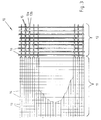
- These special fabrics 10 essentially consist of a base fabric area 11 and a reinforced edge area 12. Weft threads 13 run in the transverse direction and warp threads 14 in the longitudinal direction.
- the base fabric 11 consists of individual, intersecting weft threads and warp threads 13 and 14, it can be seen that the edge region 12 is substantially reinforced. Two adjacent weft threads 13a and 13b are bundled, with larger open spaces 15 being produced between the individual threads.
- the chains no longer consist of individual warp threads 14 but of bundles of threads 16. This forms a substantially reinforced edge region 12, which is considerably more resistant to mechanical loads.
Landscapes
- Engineering & Computer Science (AREA)
- Textile Engineering (AREA)
- Architecture (AREA)
- Civil Engineering (AREA)
- Structural Engineering (AREA)
- Chemical & Material Sciences (AREA)
- Materials Engineering (AREA)
- Organic Chemistry (AREA)
- Inorganic Chemistry (AREA)
- Woven Fabrics (AREA)
- Treatment Of Fiber Materials (AREA)
- Walking Sticks, Umbrellas, And Fans (AREA)
- Aiming, Guidance, Guns With A Light Source, Armor, Camouflage, And Targets (AREA)
Abstract
Description
- Die Erfindung betrifft ein Gewebe zur Verstärkung bzw. Armierung von Flächengebilden, insbesondere von Kunststoffdach- und Dichtungsbahnen, aus Schuß- und Kettfäden, die miteinander offene Räume ausbilden.
- Für eine Vielzahl von Flächengebilden werden heute Gewebe zur Verstärkung bzw. Armierung verwendet, die in diese Flächengebilde eingebettet sind. Zu erwähnen ist hier beispielsweise der Straßenbau, bei dem Spezialgewebe in die Bitumenschicht eingebettet werden. Gewebe dienen auch zur Hangbefestigung an Straßen oder als Putzarmierung. Dabei sollen im vorliegenden Fall unter Gewebe alle Flächengebilde verstanden werden, die durch Weben, Stricken, Wirken, Rascheln od.dgl. hergestellt werden, oder als Gelege, Vlies usw. vorliegen.
- In vielen Fällen kommt es darauf an, daß das Verstärkungs- bzw. Armierungsgewebe eine hohe Reißfestigkeit bzw. ein bestimmtes Kraft/Dehnungsverhalten aufweist. Vor allem gilt dies für den Kantenbereich. Als Beispiel wird im vorliegenden Fall auf Kunststoffdach- und Dichtungsbahnen verwiesen. Diese Bahnen sind geschlossene Kunststofflächengebilde, in die ein Gewebe zur Verstärkung und Armierung eingebettet ist. In der Regel besteht dieses Gewebe aus beabstandeten Schuß- und Kettfäden, die sich kreuzen und zwischen sich offene Räume bilden, die von dem Werkstoff des Flächengebildes ausgefüllt und bedeckt werden. Diese Bahnen sind erheblichen mechanischen Beanspruchungen aus- gesetzt, so daß auch an die Gewebeeinlage erhebliche An- forderungen gestellt werden. Belastungen treten dabei so- wohl in Längs- als auch in Querrichtung auf, die zu einem An-, Weiter- und Durchreißen der Gewebeeinlage bzw. der gesamten Bahn führen können.
- Beispielsweise die erwähnten Kunststoffdach- und Dichtungsbahnen, auf die allerdings die vorliegende Erfindung keinesfalls beschränkt sein soll, werden auf einen entsprechenden Untergrund in Bahnen verschiedener Breite verlegt und vollflächig aufgeklebt. Diese Art der Aufbringung von Bahnen verliert aber immer mehr an Bedeutung, da sich erhebliche Auflast- und Beschwerungsprobleme beim Aufkleben zur Vermeidung von Hohlräumen ergeben. Ferner ist bei einem gleichmäßigen Kleberauftrag eine große Menge an Kleber erforderlich, der zudem in Fugen und Vertiefungen verschwindet. Bei der Notwendigkeit einer Dampfsperre ist zudem eine zusätzliche Zwischenschicht erforderlich, so daß die Ausführung eines derartigen Dachaufbaus aufwendig und kompliziert ist.
- Heute werden deshalb zur Befestigung der Bahnen vermehrt mechanische Befestigungssysteme verwendet. Hierbei werden die Bahnen randseits durch Schrauben mit Unterlegscheiben festgelegt und dann entweder überlappend verschweißt oder aber, sofern sie auf Stoß verlegt sind, durch einen zusätzlichen Streifen überdeckt und ebenfalls verschweißt.
- Die Befestigung mittels mechanischer Befestigungssysteme hat jedoch den Nachteil, daß die Bahnen durch Windkräfte, und hier vor allem durch Saugkräfte des Windes beim Drüberstreichen, in Schwingung versetzt werden und dadurch entspechende Zugkräfte auf die Befestigungspunkte und den besonders beanspruchten Kantenbereich einwirken. Bei einer entsprechenden Gebäudehöhe, Fläche, einwirkenden Kraft usw. ist es möglich, daß die Bahnen an ihren Befestigungspunkten einreißen und sich lösen.
- Kunststoffdach- und Dichtungsbahnen werden vorzugsweise im Flachdachbau bei gewerblichen Gebäuden oder aber auch im Privatbaubereich eingesetzt. Insbesondere bei öffentlichen Objekten unterliegen diese Bahnen einer Vielzahl von Zulassungs- und Eignungsvorschriften. Es gelten nationale und internationale Vorschriften von Baubehörden, Bauämtern, Zulassung- und Prüfungsstellen, wie z.B. Din, BS,ISO, ASTM sowie Vorschriften von Versicherungsgesellschaften (in orkan- und sturmgefährdete Gebiete) wie in Zukunft die verschärfte FMI in Amerika. Diese Vorschriften machen es erforderlich, daß die Bahnen durch geeignetere Verstärkungen bzw. Armierungen verfestigt werden, damit sie den entsprechenden Zulassungskriterien entsprechen, ohne daß dabei eine Erhöhung der Produktionskosten stattfindet, oder sich am bestehenden System etwas ändert.
- Aufgabe der vorliegenden Erfindung ist es, ein Spezialgewebe der o.g. Art zu entwickeln, welches ein universelles, ohne großen Aufwand zu handhabendes Produkt darstellt, um Bahnen zu verstärken bzw. armieren und insbesondere ihre Weiterreißfestigkeit im Kantenbereich maßgeblich zu erhöhen.
- Zur Lösung dieser Aufgabe führt, daß an ein Grundgewebe ein Kantenbereich anschließt, in dem die Schußfäden und/oder die Kettfäden verstärkt sind.
- Dies bedeutet, daß das Grundgewebe insgesamt gleich belassen wird, wobei es, wie üblich, aus organischen Faserstoffen, wie Polyester, Polyamid, Polyacryl usw. oder auch aus anorganischen Faserstoffen wie Glas bestehen kann. Diese textilen Flächen liegen als Vliesstoffe, Gewebe, Gewirke, Geflecht, Gelege oder ähnliches vor.
- Für die Verstärkung des Kantenbereiches kommen mehrere Möglichkeiten in Betracht. Zum einen ist es möglich, im Kantenbereich mit stärkeren Kettfäden zu arbeiten. Ferner können auch im Kantenbereich Kettfäden aus einem anderen Material benutzt werden, welches eine höhere Festigkeit besitzt. Besteht beispielsweise das Grundgewebe aus Polyesterfäden, so könnten die Kettfäden im Randbereich aus Aramid sein, welches eine wesentlich höhere Festigkeit besitzt. Das Gleiche gilt auch für Fasern aus Kohlenstoff, Glas oder für Stahlfäden. Kombinationen der einzelnen Faserstoffe untereinander sind ebenfalls möglich.
- Die Verstärkung gilt im übrigen nicht nur für die Kettfäden sondern ist im gleichen Sinne auch für die Schußfäden anwendbar. Vor allem gilt dies, wenn die Schußfäden den Kantenbereich bilden.
- Im bevorzugten Ausführungsbeispiel wird die Verstärkung des Kantenbereichs jedoch durch besondere Webtechniken erzielt. Zum einen können die Kett- bzw. Schußfäden im Kantenbereich nicht nur aus einem einzigen Faden, sondern aus einem Fadenbündel bestehen. Zum anderen werden bevorzugt auch zumindest zwei benachbarte Fäden zu einem Fadenbündel zusammengefaßt, so daß im Kantenbereich größere offene Räume zwischen den Fäden entstehen. Diese offenen Räume zusammen mit der Verstärkung der Fäden durch Bündelung verhindern ein Beschädigen und auch ein Ausreißen bei hohen Belastungen. Es genügt, wenn, wie bisher, die gleiche Anzahl von Befestigungselementen verwendet wird.
- Die Verstärkung des Randbereichs kann somit je nach Anforderung durch eine andere Webtechnik, einen anderen Materialeinsatz oder eine andere Mischung sowie eine bestimmte Breite den entsprechenden Bahnen angepaßt werden. Durch eine exakt bemessene Bündelung einzelner Fäden zu Fadenbündeln insbesonder im rechten und linken Kantenbereich in Längs- und/oder in Querrichtung des Gewebes sowie durch die Wahl einer bestimmten Breite werden die gestellten Forderungen erfüllt. Beispielsweise muß nach dem FM I-90 Test eine Bahn der Größe 3,8m x 7,5m eine Minute lang einem Druck von 4,3 kPa standhalten, ohne daß dabei eine Schädigung auftritt. Der FM I-90 Test wird in naher Zukunft für Bahnen in den USA Pflicht werden. Bisherige Gewebe mußten dagegen nur den FM I-60 Test überstehen, der besagte, daß eine Bahn der Größe 3,8m x 7,5m ohne Schädigung eine Minute einem Druck von 2,9 kPa standhalten muß. Mit den erfindungsgemäßen Kantenbereichverstärkungen ist der FM I-90 Test ohne Schwierigkeiten zu überstehen.
- Bevorzugt werden die erfindungsgemäßen Gewebe noch stabilisiert, so daß sie nicht verzogen bzw. verschoben werden können. Die Stabilisierung erfolgt beispielsweise mit Kunststoff, Stärke oder Kleber. Dabei sollte die Stabilisierung des Gewebes mit einem Material erfolgen, welches dem jeweiligen Stoff der Bahn angepaßt ist.
- Durch das erfindungsgemäße Gewebe wird eine Verstärkung bzw. Armierung geschaffen, welche wesentlich erhöhten Windlasten besonders im Kantenbereich standhält. Das Gewebe selbst ist unverändert falt- und rollbar und wird durch Knickung in seiner Wirksamkeit nicht beeinträchtigt.
- Ein erfindungsgemäßes Gewebe kann im übrigen auch dadurch hergestellt werden, daß zuerst eine Gewebebahn mit einer mehrfachen Breite des gewünschten Gewebes hergestellt wird. Ein erfindungsgemäß verstärkter Bereich befindet sich dann nicht nur im Kantenbereich dieser Gewebebahn, sondern auch im Bereich der Breite des gewünschten Gewebes. Nach Herstellung dieser Gewebebahn kann dann die Gewebebahn in der Breite des gewünschten Gewebes längs geschnitten werden, so daß ein sich in der Gewebebahn befindlicher verstärkter Bereich durchgeschnitten wird. Hierdurch werden wieder Gewebe gebildet, deren Kantenbereich bevorzugt beidseits verstärkt ist.
- Weitere Vorteile, Merkmale und Einzelheiten der Erfindung ergeben sich aus der nachfolgenden Beschreibung bevorzugter Ausführungsbeispiele sowie anhand der Zeichnung; diese zeigt in
- Fig. 1 einen Querschnitt durch ein Ausführungsbeispiel einer Dachbelegung nach dem Stand der Technik;
- Fig. 2 einen Querschnitt durch ein weiteres Ausführungsbeispiel einer Dachbelegung nach dem Stand der Technik;
- Fig. 3 eine Draufsicht auf einen Ausschnitt einer erfindungsgemäßen Armierung insbesondere für Kunststoffdach- und Dichtungsbahnen.
- Bei einer herkömmlichen Dachbelegung gem. den Figuren 1 und 2 wird beispielsweise auf eine Betonplatte 1 eine Isolierung 2 aufgelegt. Diese Isolierung 2 wird sodann von Kunststoffdach- und Dichtungsbahnen 3 abgedeckt, die in Bahnen verschiedener Breite verlegt werden. Dabei können die einzelnen Bahnen 3a und 3b sich im Randbereich überlappen, wie dies in Fig. 1 dargestellt ist. Möglich ist auch die Verlegung auf Stoß gern. Fig. 2.
- In der Regel findet auch die Festlegung der Bahnen 3 in ihrem Randbereich mittels mechanischer Befestigungssysteme 4 statt, wobei diese beispielsweise aus einer Schraube 5 mit Unterlegscheibe 6 bestehen. Im überlappenden Bereich werden die Befestigungssysteme 4 von einem Randbereich der benachbarten Bahn 3b überdeckt, wobei diese Bahn nach der Überdeckung des Befestigungssystems 4 in ihrem Randbereich thermisch verschweißt wird, wie dies durch die Bezugszahl 7 angedeutet ist. Anstelle einer Verschweißung kann auch ein Verkleben od.dgl. stattfinden.
- Werden die Bahnen 3a und 3b gem. Fig. 2 auf Stoß verlegt und jeweils in ihrem Randbereich durch Befestigungssysteme 4 festgelegt, so werden diese Befestigungssysteme 4 durch einen zusätzlichen Abdeckstreifen 8 überdeckt, der wiederum beidseits der Befestigungssysteme 4 durch thermische Verschweißung 7a und 7b mit den Bahnen 3a und 3b verbunden wird.
- Da diese Kunststoffdach- und Dichtungsbahnen erheblichen Belastungen ausgesetzt sind, sind sie in der Regel durch ein Spezialgewebe armiert, wobei ein erfindungsgemäßes Spezialgewebe in Fig. 3 gezeigt ist. Diese Spezialgewebe 10 bestehen im wesentlichen aus einem Grundgewebebereich 11 und einem verstärkten Kantenbereich 12. In Querrichtung verlaufen Schußfäden 13, in Längsrichtung Kettfäden 14.
- Während in dem gezeigten Ausführungsbeispiel das Grundgewebe 11 aus einzelnen, sich kreuzenden Schußfäden und Kettfäden 13 bzw. 14 besteht, ist erkennbar, daß der Kantenbereich 12 wesentlich verstärkt ist. Jeweils zwei benachbarte Schußfäden 13a und 13b werden gebündelt, wobei sich zwischen den einzelnen Fäden größere offene Räume 15 ergeben.
- Ferner bestehen im Randbereich 12 die Ketten nicht mehr aus einzelnen Kettfäden 14 sondern aus Fadenbündeln 16. Hierdurch wird ein wesentlich verstärkter Kantenbereich 12 gebildet, der erheblich widerstandsfähiger gegen mechanische Belastungen ist.
Claims (8)
- Gewebe zur Verstärkung bzw. Armierung von Flächengebilden (3), insbesondere von Kunststoffdach- und Dichtungsbahnen, aus Schuß- und Kettfäden (13, 14), die miteinander offene Räume (15) ausbilden,
dadurch gekennzeichnet,
daß an ein Grundgewebe (11) ein Kantenbereich (12) anschließt, in dem die Schußfäden (13) und/oder die Kettfäden (14) verstärkt sind. - Gewebe nach Anspruch 1, dadurch gekennzeichnet, daß zwei oder mehr benachbarte Schußfäden (13a, 13b) im Kantenbereich (12) zusammengeführt sind.
- Gewebe nach Anspruch 1 oder 2, dadurch gekennzeichnet, daß die Kettfäden im Kantenbereich (12) aus Fadenbündeln (16) bestehen.
- Gewebe nach einem der Ansprüche 1 - 3, dadurch gekennzeichnet, daß die Schußfäden im Kantenbereich (12) einen stärkeren Durchmesser haben und/oder aus einem widerstandsfähigeren Werkstoff bestehen.
- Gewebe nach wenigstens einem der Ansprüche 1 - 4, dadurch gekennzeichnet, daß die offenen Räume (15) im Kantenbereich (12) größer sind als im Grundgewebe (11).
- Gewebe nach wenigstens einem der Ansprüche 1 - 5, dadurch gekennzeichnet, daß Schuß- und Kettfäden (13, 14) im Grundgewebe (11) und/oder im Kantenbereich (12) stabilisiert sind.
- Gewebe nach Anspruch 6, dadurch gekennzeichnet, daß die Stabilisierung mittels Kunststoffen, Stärke oder Kleber erfolgt.
- Gewebe nach Anspruch 7, dadurch gekennzeichnet, daß die Stabilisierung des Gewebes (10) dem jeweiligen Stoff des Flächengebildes (3) angepaßt ist.
Applications Claiming Priority (4)
| Application Number | Priority Date | Filing Date | Title |
|---|---|---|---|
| DE9307658U DE9307658U1 (de) | 1993-05-19 | 1993-05-19 | Gewebe zur Verstärkung bzw. Armierung von Flächengebilden |
| DE9307658U | 1993-05-19 | ||
| DE4334306A DE4334306A1 (de) | 1993-05-19 | 1993-10-08 | Gewebe zur Verstärkung bzw. Armierung von Flächengebilden |
| DE4334306 | 1993-10-08 |
Publications (2)
| Publication Number | Publication Date |
|---|---|
| EP0627513A1 true EP0627513A1 (de) | 1994-12-07 |
| EP0627513B1 EP0627513B1 (de) | 1997-12-29 |
Family
ID=25930252
Family Applications (1)
| Application Number | Title | Priority Date | Filing Date |
|---|---|---|---|
| EP94107170A Expired - Lifetime EP0627513B1 (de) | 1993-05-19 | 1994-05-07 | Gewebe zur Verstärkung bzw. Armierung von Flächengebilden |
Country Status (4)
| Country | Link |
|---|---|
| EP (1) | EP0627513B1 (de) |
| AT (1) | ATE161592T1 (de) |
| ES (1) | ES2111201T3 (de) |
| GR (1) | GR3025867T3 (de) |
Cited By (1)
| Publication number | Priority date | Publication date | Assignee | Title |
|---|---|---|---|---|
| EP2302117A2 (de) | 2009-09-21 | 2011-03-30 | Storsack Holding GmbH | Transportsack und Verfahren zur Herstellung von einer verstärkten Gewebekante |
Citations (6)
| Publication number | Priority date | Publication date | Assignee | Title |
|---|---|---|---|---|
| GB784511A (en) * | 1954-03-25 | 1957-10-09 | Schuller W H W | Glass fibre reinforced sheet or mat |
| FR2339488A1 (fr) * | 1976-02-02 | 1977-08-26 | Exxon Research Engineering Co | Procede de formage d'une mousse de resine armee de fibres |
| FR2571766A1 (fr) * | 1984-10-17 | 1986-04-18 | Materiaux Etancheite Entrepris | Materiau d'etancheite presentant au moins un bord stabilise |
| FR2625243A1 (fr) * | 1987-12-24 | 1989-06-30 | Soprema Sa | Systeme d'etancheisation des toitures |
| EP0402099A2 (de) * | 1989-06-06 | 1990-12-12 | Toray Industries, Inc. | Verstärkungsgewebe und vorgeformtes Halbzeug, faserverstärkter Verbundwerkstoff und daraus hergestellter Träger |
| US5212010A (en) * | 1991-05-28 | 1993-05-18 | Ketema, Inc. | Stabilizing fabric with weave reinforcement for resin matrices |
-
1994
- 1994-05-07 ES ES94107170T patent/ES2111201T3/es not_active Expired - Lifetime
- 1994-05-07 AT AT94107170T patent/ATE161592T1/de not_active IP Right Cessation
- 1994-05-07 EP EP94107170A patent/EP0627513B1/de not_active Expired - Lifetime
-
1998
- 1998-01-12 GR GR980400038T patent/GR3025867T3/el unknown
Patent Citations (6)
| Publication number | Priority date | Publication date | Assignee | Title |
|---|---|---|---|---|
| GB784511A (en) * | 1954-03-25 | 1957-10-09 | Schuller W H W | Glass fibre reinforced sheet or mat |
| FR2339488A1 (fr) * | 1976-02-02 | 1977-08-26 | Exxon Research Engineering Co | Procede de formage d'une mousse de resine armee de fibres |
| FR2571766A1 (fr) * | 1984-10-17 | 1986-04-18 | Materiaux Etancheite Entrepris | Materiau d'etancheite presentant au moins un bord stabilise |
| FR2625243A1 (fr) * | 1987-12-24 | 1989-06-30 | Soprema Sa | Systeme d'etancheisation des toitures |
| EP0402099A2 (de) * | 1989-06-06 | 1990-12-12 | Toray Industries, Inc. | Verstärkungsgewebe und vorgeformtes Halbzeug, faserverstärkter Verbundwerkstoff und daraus hergestellter Träger |
| US5212010A (en) * | 1991-05-28 | 1993-05-18 | Ketema, Inc. | Stabilizing fabric with weave reinforcement for resin matrices |
Cited By (1)
| Publication number | Priority date | Publication date | Assignee | Title |
|---|---|---|---|---|
| EP2302117A2 (de) | 2009-09-21 | 2011-03-30 | Storsack Holding GmbH | Transportsack und Verfahren zur Herstellung von einer verstärkten Gewebekante |
Also Published As
| Publication number | Publication date |
|---|---|
| EP0627513B1 (de) | 1997-12-29 |
| ES2111201T3 (es) | 1998-03-01 |
| ATE161592T1 (de) | 1998-01-15 |
| GR3025867T3 (en) | 1998-04-30 |
Similar Documents
| Publication | Publication Date | Title |
|---|---|---|
| EP1382768B1 (de) | Dichtungs- bzw. Isolierbahnen aus (Polymer-)Bitumen | |
| EP2126243B1 (de) | Gefälledachsystem sowie dämmplatte für gefälledachsysteme | |
| DE19543991A1 (de) | Gewebe zur Armierung von Strukturen | |
| EP3266951B1 (de) | Verbundbauteil mit flächigen betonfertigteilen | |
| DE9307658U1 (de) | Gewebe zur Verstärkung bzw. Armierung von Flächengebilden | |
| DE19812475A1 (de) | Gittergewebe | |
| DE19737219C2 (de) | Gewebeband als rißüberbrückender Träger auf Wärmedämm-Fassaden | |
| EP0627513B1 (de) | Gewebe zur Verstärkung bzw. Armierung von Flächengebilden | |
| DE19524703A1 (de) | Dämmflächenelement mit Verstärkungsbahn | |
| DE60003066T2 (de) | Gittervliese zur verwendung als verstärkungsgewebe | |
| EP1509656A1 (de) | Belagskonstruktion für verkehrsflächen und bauwerksoberflächen | |
| EP0269989A1 (de) | Bitumen-Abdichtbahn | |
| DE10334178A1 (de) | Mehrlagige textile Warenbahn aus parallel angeordneten Faserbündeln und einem Vlies mittels Haftfadengitter verbunden | |
| DE2814396C2 (de) | ||
| DE2509283A1 (de) | Dachdeckung fuer flachdaecher | |
| DE1609409C3 (de) | Bituminöse Feuchtigkeitsisolierung, insbesondere für befahrbare Flächen | |
| EP0591963A1 (de) | Hinterfüllmatte | |
| DE9307660U1 (de) | Gewebe zur Verstärkung bzw. Armierung von Flächengebilden | |
| EP1122373B1 (de) | Verfahren zur Herstellung eines Dämmaterials aus Mineralfasern | |
| US5851638A (en) | Fabric for strengthening and/or reinforcing flat-shaped articles | |
| DE102016114927B4 (de) | Schutzplattenanordnung und Verfahren zur Reparatur einer solchen Schutzplattenanordnung | |
| DE102019132849B4 (de) | Sandwich-Geokunststoffbahn mit verriegelnder Vernadelung | |
| DE29704770U1 (de) | Tragschichtbewehrung | |
| DE19822876C2 (de) | Isolier- und Abdichtungsbahn | |
| EP0627514B1 (de) | Gewebe zur Verstärkung bzw. Armierung von Flächengebilden |
Legal Events
| Date | Code | Title | Description |
|---|---|---|---|
| PUAI | Public reference made under article 153(3) epc to a published international application that has entered the european phase |
Free format text: ORIGINAL CODE: 0009012 |
|
| AK | Designated contracting states |
Kind code of ref document: A1 Designated state(s): AT BE CH DE DK ES FR GB GR IT LI NL PT SE |
|
| 17P | Request for examination filed |
Effective date: 19950329 |
|
| 17Q | First examination report despatched |
Effective date: 19950519 |
|
| GRAG | Despatch of communication of intention to grant |
Free format text: ORIGINAL CODE: EPIDOS AGRA |
|
| GRAG | Despatch of communication of intention to grant |
Free format text: ORIGINAL CODE: EPIDOS AGRA |
|
| GRAH | Despatch of communication of intention to grant a patent |
Free format text: ORIGINAL CODE: EPIDOS IGRA |
|
| GRAH | Despatch of communication of intention to grant a patent |
Free format text: ORIGINAL CODE: EPIDOS IGRA |
|
| GRAA | (expected) grant |
Free format text: ORIGINAL CODE: 0009210 |
|
| AK | Designated contracting states |
Kind code of ref document: B1 Designated state(s): AT BE CH DE DK ES FR GB GR IT LI NL PT SE |
|
| PG25 | Lapsed in a contracting state [announced via postgrant information from national office to epo] |
Ref country code: DK Free format text: LAPSE BECAUSE OF NON-PAYMENT OF DUE FEES Effective date: 19971229 |
|
| REF | Corresponds to: |
Ref document number: 161592 Country of ref document: AT Date of ref document: 19980115 Kind code of ref document: T |
|
| REG | Reference to a national code |
Ref country code: CH Ref legal event code: NV Representative=s name: FREI PATENTANWALTSBUERO Ref country code: CH Ref legal event code: EP |
|
| GBT | Gb: translation of ep patent filed (gb section 77(6)(a)/1977) |
Effective date: 19971229 |
|
| RAP2 | Party data changed (patent owner data changed or rights of a patent transferred) |
Owner name: SYNTEEN TEXTIL TECHNIK GMBH & CO. KG. |
|
| REF | Corresponds to: |
Ref document number: 59404861 Country of ref document: DE Date of ref document: 19980205 |
|
| RAP2 | Party data changed (patent owner data changed or rights of a patent transferred) |
Owner name: SYNTEEN GMBH & CO. KG. |
|
| REG | Reference to a national code |
Ref country code: ES Ref legal event code: FG2A Ref document number: 2111201 Country of ref document: ES Kind code of ref document: T3 |
|
| ET | Fr: translation filed | ||
| ITF | It: translation for a ep patent filed | ||
| NLT2 | Nl: modifications (of names), taken from the european patent patent bulletin |
Owner name: SYNTEEN GMBH & CO. KG.;SYNTEEN TEXTIL TECHNIK GMBH |
|
| NLT1 | Nl: modifications of names registered in virtue of documents presented to the patent office pursuant to art. 16 a, paragraph 1 |
Owner name: SYNTEEN TEXTIL TECHNIK GMBH & CO. KG. |
|
| REG | Reference to a national code |
Ref country code: PT Ref legal event code: SC4A Free format text: AVAILABILITY OF NATIONAL TRANSLATION Effective date: 19980311 |
|
| NLT1 | Nl: modifications of names registered in virtue of documents presented to the patent office pursuant to art. 16 a, paragraph 1 |
Owner name: SYNTEEN GMBH & CO. KG. |
|
| PLBE | No opposition filed within time limit |
Free format text: ORIGINAL CODE: 0009261 |
|
| STAA | Information on the status of an ep patent application or granted ep patent |
Free format text: STATUS: NO OPPOSITION FILED WITHIN TIME LIMIT |
|
| 26N | No opposition filed | ||
| PGFP | Annual fee paid to national office [announced via postgrant information from national office to epo] |
Ref country code: NL Payment date: 20010930 Year of fee payment: 9 |
|
| REG | Reference to a national code |
Ref country code: GB Ref legal event code: IF02 |
|
| PGFP | Annual fee paid to national office [announced via postgrant information from national office to epo] |
Ref country code: PT Payment date: 20020426 Year of fee payment: 9 Ref country code: GR Payment date: 20020426 Year of fee payment: 9 |
|
| PGFP | Annual fee paid to national office [announced via postgrant information from national office to epo] |
Ref country code: SE Payment date: 20020502 Year of fee payment: 9 Ref country code: GB Payment date: 20020502 Year of fee payment: 9 Ref country code: AT Payment date: 20020502 Year of fee payment: 9 |
|
| PGFP | Annual fee paid to national office [announced via postgrant information from national office to epo] |
Ref country code: FR Payment date: 20020513 Year of fee payment: 9 |
|
| PGFP | Annual fee paid to national office [announced via postgrant information from national office to epo] |
Ref country code: ES Payment date: 20020516 Year of fee payment: 9 |
|
| PGFP | Annual fee paid to national office [announced via postgrant information from national office to epo] |
Ref country code: BE Payment date: 20020527 Year of fee payment: 9 |
|
| PG25 | Lapsed in a contracting state [announced via postgrant information from national office to epo] |
Ref country code: GB Free format text: LAPSE BECAUSE OF NON-PAYMENT OF DUE FEES Effective date: 20030507 Ref country code: AT Free format text: LAPSE BECAUSE OF NON-PAYMENT OF DUE FEES Effective date: 20030507 |
|
| PG25 | Lapsed in a contracting state [announced via postgrant information from national office to epo] |
Ref country code: SE Free format text: LAPSE BECAUSE OF NON-PAYMENT OF DUE FEES Effective date: 20030508 Ref country code: ES Free format text: LAPSE BECAUSE OF NON-PAYMENT OF DUE FEES Effective date: 20030508 |
|
| PG25 | Lapsed in a contracting state [announced via postgrant information from national office to epo] |
Ref country code: BE Free format text: LAPSE BECAUSE OF NON-PAYMENT OF DUE FEES Effective date: 20030531 |
|
| BERE | Be: lapsed |
Owner name: *SYNTEEN G.M.B.H. & CO. K.G. Effective date: 20030531 |
|
| PG25 | Lapsed in a contracting state [announced via postgrant information from national office to epo] |
Ref country code: PT Free format text: LAPSE BECAUSE OF NON-PAYMENT OF DUE FEES Effective date: 20031130 |
|
| PG25 | Lapsed in a contracting state [announced via postgrant information from national office to epo] |
Ref country code: NL Free format text: LAPSE BECAUSE OF NON-PAYMENT OF DUE FEES Effective date: 20031201 |
|
| PG25 | Lapsed in a contracting state [announced via postgrant information from national office to epo] |
Ref country code: GR Free format text: LAPSE BECAUSE OF NON-PAYMENT OF DUE FEES Effective date: 20031203 |
|
| GBPC | Gb: european patent ceased through non-payment of renewal fee |
Effective date: 20030507 |
|
| EUG | Se: european patent has lapsed | ||
| PG25 | Lapsed in a contracting state [announced via postgrant information from national office to epo] |
Ref country code: FR Free format text: LAPSE BECAUSE OF NON-PAYMENT OF DUE FEES Effective date: 20040130 |
|
| NLV4 | Nl: lapsed or anulled due to non-payment of the annual fee |
Effective date: 20031201 |
|
| REG | Reference to a national code |
Ref country code: FR Ref legal event code: ST Ref country code: PT Ref legal event code: MM4A Free format text: LAPSE DUE TO NON-PAYMENT OF FEES Effective date: 20031130 |
|
| REG | Reference to a national code |
Ref country code: ES Ref legal event code: FD2A Effective date: 20030508 |
|
| PG25 | Lapsed in a contracting state [announced via postgrant information from national office to epo] |
Ref country code: IT Free format text: LAPSE BECAUSE OF NON-PAYMENT OF DUE FEES;WARNING: LAPSES OF ITALIAN PATENTS WITH EFFECTIVE DATE BEFORE 2007 MAY HAVE OCCURRED AT ANY TIME BEFORE 2007. THE CORRECT EFFECTIVE DATE MAY BE DIFFERENT FROM THE ONE RECORDED. Effective date: 20050507 |
|
| PGFP | Annual fee paid to national office [announced via postgrant information from national office to epo] |
Ref country code: CH Payment date: 20050512 Year of fee payment: 12 |
|
| PGFP | Annual fee paid to national office [announced via postgrant information from national office to epo] |
Ref country code: DE Payment date: 20050727 Year of fee payment: 12 |
|
| PG25 | Lapsed in a contracting state [announced via postgrant information from national office to epo] |
Ref country code: LI Free format text: LAPSE BECAUSE OF NON-PAYMENT OF DUE FEES Effective date: 20060531 Ref country code: CH Free format text: LAPSE BECAUSE OF NON-PAYMENT OF DUE FEES Effective date: 20060531 |
|
| PG25 | Lapsed in a contracting state [announced via postgrant information from national office to epo] |
Ref country code: DE Free format text: LAPSE BECAUSE OF NON-PAYMENT OF DUE FEES Effective date: 20061201 |
|
| REG | Reference to a national code |
Ref country code: CH Ref legal event code: PL |