EP0629810A1 - Système cryogénique se basant sur d'aérogel cohérent, à perte de chaleur minime - Google Patents
Système cryogénique se basant sur d'aérogel cohérent, à perte de chaleur minime Download PDFInfo
- Publication number
- EP0629810A1 EP0629810A1 EP94108890A EP94108890A EP0629810A1 EP 0629810 A1 EP0629810 A1 EP 0629810A1 EP 94108890 A EP94108890 A EP 94108890A EP 94108890 A EP94108890 A EP 94108890A EP 0629810 A1 EP0629810 A1 EP 0629810A1
- Authority
- EP
- European Patent Office
- Prior art keywords
- aerogel
- lamina
- coherent
- micrometers
- internal side
- Prior art date
- Legal status (The legal status is an assumption and is not a legal conclusion. Google has not performed a legal analysis and makes no representation as to the accuracy of the status listed.)
- Granted
Links
- 239000004964 aerogel Substances 0.000 title claims abstract description 91
- 230000001427 coherent effect Effects 0.000 claims abstract description 52
- 239000012530 fluid Substances 0.000 claims abstract description 42
- QSHDDOUJBYECFT-UHFFFAOYSA-N mercury Chemical compound [Hg] QSHDDOUJBYECFT-UHFFFAOYSA-N 0.000 claims abstract description 22
- 229910052753 mercury Inorganic materials 0.000 claims abstract description 22
- VYPSYNLAJGMNEJ-UHFFFAOYSA-N Silicium dioxide Chemical compound O=[Si]=O VYPSYNLAJGMNEJ-UHFFFAOYSA-N 0.000 claims description 28
- 239000004965 Silica aerogel Substances 0.000 claims description 24
- 239000007789 gas Substances 0.000 claims description 21
- 239000011148 porous material Substances 0.000 claims description 14
- 230000005540 biological transmission Effects 0.000 claims description 12
- 230000005855 radiation Effects 0.000 claims description 10
- 238000000034 method Methods 0.000 claims description 8
- 239000000843 powder Substances 0.000 claims description 8
- WSFSSNUMVMOOMR-UHFFFAOYSA-N Formaldehyde Chemical compound O=C WSFSSNUMVMOOMR-UHFFFAOYSA-N 0.000 claims description 6
- 239000000203 mixture Substances 0.000 claims description 6
- MCMNRKCIXSYSNV-UHFFFAOYSA-N Zirconium dioxide Chemical compound O=[Zr]=O MCMNRKCIXSYSNV-UHFFFAOYSA-N 0.000 claims description 4
- 238000006116 polymerization reaction Methods 0.000 claims description 4
- GHMLBKRAJCXXBS-UHFFFAOYSA-N resorcinol Chemical compound OC1=CC=CC(O)=C1 GHMLBKRAJCXXBS-UHFFFAOYSA-N 0.000 claims description 4
- 229920000877 Melamine resin Polymers 0.000 claims description 2
- RTAQQCXQSZGOHL-UHFFFAOYSA-N Titanium Chemical compound [Ti] RTAQQCXQSZGOHL-UHFFFAOYSA-N 0.000 claims description 2
- PNEYBMLMFCGWSK-UHFFFAOYSA-N aluminium oxide Inorganic materials [O-2].[O-2].[O-2].[Al+3].[Al+3] PNEYBMLMFCGWSK-UHFFFAOYSA-N 0.000 claims description 2
- JDSHMPZPIAZGSV-UHFFFAOYSA-N melamine Chemical compound NC1=NC(N)=NC(N)=N1 JDSHMPZPIAZGSV-UHFFFAOYSA-N 0.000 claims description 2
- WSFSSNUMVMOOMR-NJFSPNSNSA-N methanone Chemical compound O=[14CH2] WSFSSNUMVMOOMR-NJFSPNSNSA-N 0.000 claims description 2
- 239000011253 protective coating Substances 0.000 claims description 2
- 239000010936 titanium Substances 0.000 claims description 2
- 229910052719 titanium Inorganic materials 0.000 claims description 2
- WFKWXMTUELFFGS-UHFFFAOYSA-N tungsten Chemical compound [W] WFKWXMTUELFFGS-UHFFFAOYSA-N 0.000 claims description 2
- 239000010937 tungsten Substances 0.000 claims description 2
- 229910052721 tungsten Inorganic materials 0.000 claims description 2
- ZOXJGFHDIHLPTG-UHFFFAOYSA-N Boron Chemical compound [B] ZOXJGFHDIHLPTG-UHFFFAOYSA-N 0.000 claims 1
- 239000004966 Carbon aerogel Substances 0.000 claims 1
- 239000003463 adsorbent Substances 0.000 claims 1
- 229910052796 boron Inorganic materials 0.000 claims 1
- 239000011248 coating agent Substances 0.000 claims 1
- 238000000576 coating method Methods 0.000 claims 1
- 239000008188 pellet Substances 0.000 claims 1
- 239000000463 material Substances 0.000 description 20
- 239000010451 perlite Substances 0.000 description 12
- 235000019362 perlite Nutrition 0.000 description 12
- 239000011152 fibreglass Substances 0.000 description 11
- CURLTUGMZLYLDI-UHFFFAOYSA-N Carbon dioxide Chemical compound O=C=O CURLTUGMZLYLDI-UHFFFAOYSA-N 0.000 description 8
- LFQSCWFLJHTTHZ-UHFFFAOYSA-N Ethanol Chemical compound CCO LFQSCWFLJHTTHZ-UHFFFAOYSA-N 0.000 description 6
- 239000007787 solid Substances 0.000 description 5
- 239000001569 carbon dioxide Substances 0.000 description 4
- 229910002092 carbon dioxide Inorganic materials 0.000 description 4
- 230000003247 decreasing effect Effects 0.000 description 4
- 239000011888 foil Substances 0.000 description 4
- 239000000499 gel Substances 0.000 description 4
- 238000011068 loading method Methods 0.000 description 4
- 239000011159 matrix material Substances 0.000 description 4
- 229910052751 metal Inorganic materials 0.000 description 4
- 239000002184 metal Substances 0.000 description 4
- 229910052782 aluminium Inorganic materials 0.000 description 3
- XAGFODPZIPBFFR-UHFFFAOYSA-N aluminium Chemical compound [Al] XAGFODPZIPBFFR-UHFFFAOYSA-N 0.000 description 3
- 230000002860 competitive effect Effects 0.000 description 3
- 238000009833 condensation Methods 0.000 description 3
- 230000005494 condensation Effects 0.000 description 3
- 239000000835 fiber Substances 0.000 description 3
- 239000006260 foam Substances 0.000 description 3
- 239000002904 solvent Substances 0.000 description 3
- XKRFYHLGVUSROY-UHFFFAOYSA-N Argon Chemical compound [Ar] XKRFYHLGVUSROY-UHFFFAOYSA-N 0.000 description 2
- IJGRMHOSHXDMSA-UHFFFAOYSA-N Atomic nitrogen Chemical compound N#N IJGRMHOSHXDMSA-UHFFFAOYSA-N 0.000 description 2
- OKTJSMMVPCPJKN-UHFFFAOYSA-N Carbon Chemical compound [C] OKTJSMMVPCPJKN-UHFFFAOYSA-N 0.000 description 2
- 229910052799 carbon Inorganic materials 0.000 description 2
- -1 for example Substances 0.000 description 2
- 238000009472 formulation Methods 0.000 description 2
- 230000007062 hydrolysis Effects 0.000 description 2
- 238000006460 hydrolysis reaction Methods 0.000 description 2
- 239000007788 liquid Substances 0.000 description 2
- 239000002808 molecular sieve Substances 0.000 description 2
- 239000000377 silicon dioxide Substances 0.000 description 2
- URGAHOPLAPQHLN-UHFFFAOYSA-N sodium aluminosilicate Chemical compound [Na+].[Al+3].[O-][Si]([O-])=O.[O-][Si]([O-])=O URGAHOPLAPQHLN-UHFFFAOYSA-N 0.000 description 2
- XLYOFNOQVPJJNP-UHFFFAOYSA-N water Substances O XLYOFNOQVPJJNP-UHFFFAOYSA-N 0.000 description 2
- DGXAGETVRDOQFP-UHFFFAOYSA-N 2,6-dihydroxybenzaldehyde Chemical compound OC1=CC=CC(O)=C1C=O DGXAGETVRDOQFP-UHFFFAOYSA-N 0.000 description 1
- WKBOTKDWSSQWDR-UHFFFAOYSA-N Bromine atom Chemical compound [Br] WKBOTKDWSSQWDR-UHFFFAOYSA-N 0.000 description 1
- RYGMFSIKBFXOCR-UHFFFAOYSA-N Copper Chemical compound [Cu] RYGMFSIKBFXOCR-UHFFFAOYSA-N 0.000 description 1
- 239000004338 Dichlorodifluoromethane Substances 0.000 description 1
- MYMOFIZGZYHOMD-UHFFFAOYSA-N Dioxygen Chemical compound O=O MYMOFIZGZYHOMD-UHFFFAOYSA-N 0.000 description 1
- UFHFLCQGNIYNRP-UHFFFAOYSA-N Hydrogen Chemical compound [H][H] UFHFLCQGNIYNRP-UHFFFAOYSA-N 0.000 description 1
- 241000761557 Lamina Species 0.000 description 1
- 239000004793 Polystyrene Substances 0.000 description 1
- 229910018503 SF6 Inorganic materials 0.000 description 1
- 239000003570 air Substances 0.000 description 1
- 150000004703 alkoxides Chemical class 0.000 description 1
- 238000013459 approach Methods 0.000 description 1
- 229910052786 argon Inorganic materials 0.000 description 1
- 239000011449 brick Substances 0.000 description 1
- GDTBXPJZTBHREO-UHFFFAOYSA-N bromine Substances BrBr GDTBXPJZTBHREO-UHFFFAOYSA-N 0.000 description 1
- 229940074995 bromine Drugs 0.000 description 1
- 229910052794 bromium Inorganic materials 0.000 description 1
- QGJOPFRUJISHPQ-NJFSPNSNSA-N carbon disulfide-14c Chemical compound S=[14C]=S QGJOPFRUJISHPQ-NJFSPNSNSA-N 0.000 description 1
- 238000005234 chemical deposition Methods 0.000 description 1
- 238000010276 construction Methods 0.000 description 1
- 229910052802 copper Inorganic materials 0.000 description 1
- 239000010949 copper Substances 0.000 description 1
- 230000007423 decrease Effects 0.000 description 1
- 238000011161 development Methods 0.000 description 1
- PXBRQCKWGAHEHS-UHFFFAOYSA-N dichlorodifluoromethane Chemical compound FC(F)(Cl)Cl PXBRQCKWGAHEHS-UHFFFAOYSA-N 0.000 description 1
- 235000019404 dichlorodifluoromethane Nutrition 0.000 description 1
- 229940042935 dichlorodifluoromethane Drugs 0.000 description 1
- 230000000694 effects Effects 0.000 description 1
- 238000011049 filling Methods 0.000 description 1
- 230000008014 freezing Effects 0.000 description 1
- 238000007710 freezing Methods 0.000 description 1
- 239000001307 helium Substances 0.000 description 1
- 229910052734 helium Inorganic materials 0.000 description 1
- SWQJXJOGLNCZEY-UHFFFAOYSA-N helium atom Chemical compound [He] SWQJXJOGLNCZEY-UHFFFAOYSA-N 0.000 description 1
- 239000001257 hydrogen Substances 0.000 description 1
- 229910052739 hydrogen Inorganic materials 0.000 description 1
- 238000009434 installation Methods 0.000 description 1
- 229910052743 krypton Inorganic materials 0.000 description 1
- DNNSSWSSYDEUBZ-UHFFFAOYSA-N krypton atom Chemical compound [Kr] DNNSSWSSYDEUBZ-UHFFFAOYSA-N 0.000 description 1
- 239000003562 lightweight material Substances 0.000 description 1
- 238000012423 maintenance Methods 0.000 description 1
- 230000013011 mating Effects 0.000 description 1
- 238000012986 modification Methods 0.000 description 1
- 230000004048 modification Effects 0.000 description 1
- 229910052757 nitrogen Inorganic materials 0.000 description 1
- 239000002245 particle Substances 0.000 description 1
- 239000004033 plastic Substances 0.000 description 1
- 238000006068 polycondensation reaction Methods 0.000 description 1
- 229920000728 polyester Polymers 0.000 description 1
- 229920000642 polymer Polymers 0.000 description 1
- 229920002223 polystyrene Polymers 0.000 description 1
- 230000001681 protective effect Effects 0.000 description 1
- 230000009467 reduction Effects 0.000 description 1
- 230000002787 reinforcement Effects 0.000 description 1
- 229910052710 silicon Inorganic materials 0.000 description 1
- 239000010703 silicon Substances 0.000 description 1
- 235000012239 silicon dioxide Nutrition 0.000 description 1
- 238000005728 strengthening Methods 0.000 description 1
- 239000000126 substance Substances 0.000 description 1
- SFZCNBIFKDRMGX-UHFFFAOYSA-N sulfur hexafluoride Chemical compound FS(F)(F)(F)(F)F SFZCNBIFKDRMGX-UHFFFAOYSA-N 0.000 description 1
- 229960000909 sulfur hexafluoride Drugs 0.000 description 1
- 238000000194 supercritical-fluid extraction Methods 0.000 description 1
- LFQCEHFDDXELDD-UHFFFAOYSA-N tetramethyl orthosilicate Chemical compound CO[Si](OC)(OC)OC LFQCEHFDDXELDD-UHFFFAOYSA-N 0.000 description 1
- CYRMSUTZVYGINF-UHFFFAOYSA-N trichlorofluoromethane Chemical compound FC(Cl)(Cl)Cl CYRMSUTZVYGINF-UHFFFAOYSA-N 0.000 description 1
- 229940029284 trichlorofluoromethane Drugs 0.000 description 1
- 238000007740 vapor deposition Methods 0.000 description 1
- 229910052724 xenon Inorganic materials 0.000 description 1
- FHNFHKCVQCLJFQ-UHFFFAOYSA-N xenon atom Chemical compound [Xe] FHNFHKCVQCLJFQ-UHFFFAOYSA-N 0.000 description 1
Images

Classifications
-
- F—MECHANICAL ENGINEERING; LIGHTING; HEATING; WEAPONS; BLASTING
- F17—STORING OR DISTRIBUTING GASES OR LIQUIDS
- F17C—VESSELS FOR CONTAINING OR STORING COMPRESSED, LIQUEFIED OR SOLIDIFIED GASES; FIXED-CAPACITY GAS-HOLDERS; FILLING VESSELS WITH, OR DISCHARGING FROM VESSELS, COMPRESSED, LIQUEFIED, OR SOLIDIFIED GASES
- F17C3/00—Vessels not under pressure
- F17C3/02—Vessels not under pressure with provision for thermal insulation
- F17C3/04—Vessels not under pressure with provision for thermal insulation by insulating layers
-
- C—CHEMISTRY; METALLURGY
- C04—CEMENTS; CONCRETE; ARTIFICIAL STONE; CERAMICS; REFRACTORIES
- C04B—LIME, MAGNESIA; SLAG; CEMENTS; COMPOSITIONS THEREOF, e.g. MORTARS, CONCRETE OR LIKE BUILDING MATERIALS; ARTIFICIAL STONE; CERAMICS; REFRACTORIES; TREATMENT OF NATURAL STONE
- C04B30/00—Compositions for artificial stone, not containing binders
-
- C—CHEMISTRY; METALLURGY
- C04—CEMENTS; CONCRETE; ARTIFICIAL STONE; CERAMICS; REFRACTORIES
- C04B—LIME, MAGNESIA; SLAG; CEMENTS; COMPOSITIONS THEREOF, e.g. MORTARS, CONCRETE OR LIKE BUILDING MATERIALS; ARTIFICIAL STONE; CERAMICS; REFRACTORIES; TREATMENT OF NATURAL STONE
- C04B38/00—Porous mortars, concrete, artificial stone or ceramic ware; Preparation thereof
- C04B38/08—Porous mortars, concrete, artificial stone or ceramic ware; Preparation thereof by adding porous substances
-
- F—MECHANICAL ENGINEERING; LIGHTING; HEATING; WEAPONS; BLASTING
- F16—ENGINEERING ELEMENTS AND UNITS; GENERAL MEASURES FOR PRODUCING AND MAINTAINING EFFECTIVE FUNCTIONING OF MACHINES OR INSTALLATIONS; THERMAL INSULATION IN GENERAL
- F16L—PIPES; JOINTS OR FITTINGS FOR PIPES; SUPPORTS FOR PIPES, CABLES OR PROTECTIVE TUBING; MEANS FOR THERMAL INSULATION IN GENERAL
- F16L59/00—Thermal insulation in general
- F16L59/04—Arrangements using dry fillers, e.g. using slag wool
-
- F—MECHANICAL ENGINEERING; LIGHTING; HEATING; WEAPONS; BLASTING
- F17—STORING OR DISTRIBUTING GASES OR LIQUIDS
- F17C—VESSELS FOR CONTAINING OR STORING COMPRESSED, LIQUEFIED OR SOLIDIFIED GASES; FIXED-CAPACITY GAS-HOLDERS; FILLING VESSELS WITH, OR DISCHARGING FROM VESSELS, COMPRESSED, LIQUEFIED, OR SOLIDIFIED GASES
- F17C13/00—Details of vessels or of the filling or discharging of vessels
- F17C13/001—Thermal insulation specially adapted for cryogenic vessels
-
- F—MECHANICAL ENGINEERING; LIGHTING; HEATING; WEAPONS; BLASTING
- F17—STORING OR DISTRIBUTING GASES OR LIQUIDS
- F17C—VESSELS FOR CONTAINING OR STORING COMPRESSED, LIQUEFIED OR SOLIDIFIED GASES; FIXED-CAPACITY GAS-HOLDERS; FILLING VESSELS WITH, OR DISCHARGING FROM VESSELS, COMPRESSED, LIQUEFIED, OR SOLIDIFIED GASES
- F17C2201/00—Vessel construction, in particular geometry, arrangement or size
- F17C2201/01—Shape
- F17C2201/0104—Shape cylindrical
- F17C2201/0109—Shape cylindrical with exteriorly curved end-piece
-
- F—MECHANICAL ENGINEERING; LIGHTING; HEATING; WEAPONS; BLASTING
- F17—STORING OR DISTRIBUTING GASES OR LIQUIDS
- F17C—VESSELS FOR CONTAINING OR STORING COMPRESSED, LIQUEFIED OR SOLIDIFIED GASES; FIXED-CAPACITY GAS-HOLDERS; FILLING VESSELS WITH, OR DISCHARGING FROM VESSELS, COMPRESSED, LIQUEFIED, OR SOLIDIFIED GASES
- F17C2201/00—Vessel construction, in particular geometry, arrangement or size
- F17C2201/03—Orientation
- F17C2201/035—Orientation with substantially horizontal main axis
-
- F—MECHANICAL ENGINEERING; LIGHTING; HEATING; WEAPONS; BLASTING
- F17—STORING OR DISTRIBUTING GASES OR LIQUIDS
- F17C—VESSELS FOR CONTAINING OR STORING COMPRESSED, LIQUEFIED OR SOLIDIFIED GASES; FIXED-CAPACITY GAS-HOLDERS; FILLING VESSELS WITH, OR DISCHARGING FROM VESSELS, COMPRESSED, LIQUEFIED, OR SOLIDIFIED GASES
- F17C2203/00—Vessel construction, in particular walls or details thereof
- F17C2203/01—Reinforcing or suspension means
- F17C2203/011—Reinforcing means
- F17C2203/012—Reinforcing means on or in the wall, e.g. ribs
-
- F—MECHANICAL ENGINEERING; LIGHTING; HEATING; WEAPONS; BLASTING
- F17—STORING OR DISTRIBUTING GASES OR LIQUIDS
- F17C—VESSELS FOR CONTAINING OR STORING COMPRESSED, LIQUEFIED OR SOLIDIFIED GASES; FIXED-CAPACITY GAS-HOLDERS; FILLING VESSELS WITH, OR DISCHARGING FROM VESSELS, COMPRESSED, LIQUEFIED, OR SOLIDIFIED GASES
- F17C2203/00—Vessel construction, in particular walls or details thereof
- F17C2203/03—Thermal insulations
- F17C2203/0304—Thermal insulations by solid means
- F17C2203/0308—Radiation shield
- F17C2203/032—Multi-sheet layers
-
- F—MECHANICAL ENGINEERING; LIGHTING; HEATING; WEAPONS; BLASTING
- F17—STORING OR DISTRIBUTING GASES OR LIQUIDS
- F17C—VESSELS FOR CONTAINING OR STORING COMPRESSED, LIQUEFIED OR SOLIDIFIED GASES; FIXED-CAPACITY GAS-HOLDERS; FILLING VESSELS WITH, OR DISCHARGING FROM VESSELS, COMPRESSED, LIQUEFIED, OR SOLIDIFIED GASES
- F17C2203/00—Vessel construction, in particular walls or details thereof
- F17C2203/03—Thermal insulations
- F17C2203/0304—Thermal insulations by solid means
- F17C2203/0325—Aerogel
-
- F—MECHANICAL ENGINEERING; LIGHTING; HEATING; WEAPONS; BLASTING
- F17—STORING OR DISTRIBUTING GASES OR LIQUIDS
- F17C—VESSELS FOR CONTAINING OR STORING COMPRESSED, LIQUEFIED OR SOLIDIFIED GASES; FIXED-CAPACITY GAS-HOLDERS; FILLING VESSELS WITH, OR DISCHARGING FROM VESSELS, COMPRESSED, LIQUEFIED, OR SOLIDIFIED GASES
- F17C2203/00—Vessel construction, in particular walls or details thereof
- F17C2203/03—Thermal insulations
- F17C2203/0304—Thermal insulations by solid means
- F17C2203/0329—Foam
- F17C2203/0333—Polyurethane
-
- F—MECHANICAL ENGINEERING; LIGHTING; HEATING; WEAPONS; BLASTING
- F17—STORING OR DISTRIBUTING GASES OR LIQUIDS
- F17C—VESSELS FOR CONTAINING OR STORING COMPRESSED, LIQUEFIED OR SOLIDIFIED GASES; FIXED-CAPACITY GAS-HOLDERS; FILLING VESSELS WITH, OR DISCHARGING FROM VESSELS, COMPRESSED, LIQUEFIED, OR SOLIDIFIED GASES
- F17C2203/00—Vessel construction, in particular walls or details thereof
- F17C2203/03—Thermal insulations
- F17C2203/0391—Thermal insulations by vacuum
-
- F—MECHANICAL ENGINEERING; LIGHTING; HEATING; WEAPONS; BLASTING
- F17—STORING OR DISTRIBUTING GASES OR LIQUIDS
- F17C—VESSELS FOR CONTAINING OR STORING COMPRESSED, LIQUEFIED OR SOLIDIFIED GASES; FIXED-CAPACITY GAS-HOLDERS; FILLING VESSELS WITH, OR DISCHARGING FROM VESSELS, COMPRESSED, LIQUEFIED, OR SOLIDIFIED GASES
- F17C2203/00—Vessel construction, in particular walls or details thereof
- F17C2203/06—Materials for walls or layers thereof; Properties or structures of walls or their materials
- F17C2203/0602—Wall structures; Special features thereof
- F17C2203/0612—Wall structures
- F17C2203/0626—Multiple walls
- F17C2203/0629—Two walls
-
- F—MECHANICAL ENGINEERING; LIGHTING; HEATING; WEAPONS; BLASTING
- F17—STORING OR DISTRIBUTING GASES OR LIQUIDS
- F17C—VESSELS FOR CONTAINING OR STORING COMPRESSED, LIQUEFIED OR SOLIDIFIED GASES; FIXED-CAPACITY GAS-HOLDERS; FILLING VESSELS WITH, OR DISCHARGING FROM VESSELS, COMPRESSED, LIQUEFIED, OR SOLIDIFIED GASES
- F17C2221/00—Handled fluid, in particular type of fluid
- F17C2221/01—Pure fluids
- F17C2221/011—Oxygen
-
- F—MECHANICAL ENGINEERING; LIGHTING; HEATING; WEAPONS; BLASTING
- F17—STORING OR DISTRIBUTING GASES OR LIQUIDS
- F17C—VESSELS FOR CONTAINING OR STORING COMPRESSED, LIQUEFIED OR SOLIDIFIED GASES; FIXED-CAPACITY GAS-HOLDERS; FILLING VESSELS WITH, OR DISCHARGING FROM VESSELS, COMPRESSED, LIQUEFIED, OR SOLIDIFIED GASES
- F17C2221/00—Handled fluid, in particular type of fluid
- F17C2221/01—Pure fluids
- F17C2221/012—Hydrogen
-
- F—MECHANICAL ENGINEERING; LIGHTING; HEATING; WEAPONS; BLASTING
- F17—STORING OR DISTRIBUTING GASES OR LIQUIDS
- F17C—VESSELS FOR CONTAINING OR STORING COMPRESSED, LIQUEFIED OR SOLIDIFIED GASES; FIXED-CAPACITY GAS-HOLDERS; FILLING VESSELS WITH, OR DISCHARGING FROM VESSELS, COMPRESSED, LIQUEFIED, OR SOLIDIFIED GASES
- F17C2221/00—Handled fluid, in particular type of fluid
- F17C2221/01—Pure fluids
- F17C2221/014—Nitrogen
-
- F—MECHANICAL ENGINEERING; LIGHTING; HEATING; WEAPONS; BLASTING
- F17—STORING OR DISTRIBUTING GASES OR LIQUIDS
- F17C—VESSELS FOR CONTAINING OR STORING COMPRESSED, LIQUEFIED OR SOLIDIFIED GASES; FIXED-CAPACITY GAS-HOLDERS; FILLING VESSELS WITH, OR DISCHARGING FROM VESSELS, COMPRESSED, LIQUEFIED, OR SOLIDIFIED GASES
- F17C2221/00—Handled fluid, in particular type of fluid
- F17C2221/01—Pure fluids
- F17C2221/016—Noble gases (Ar, Kr, Xe)
- F17C2221/017—Helium
-
- F—MECHANICAL ENGINEERING; LIGHTING; HEATING; WEAPONS; BLASTING
- F17—STORING OR DISTRIBUTING GASES OR LIQUIDS
- F17C—VESSELS FOR CONTAINING OR STORING COMPRESSED, LIQUEFIED OR SOLIDIFIED GASES; FIXED-CAPACITY GAS-HOLDERS; FILLING VESSELS WITH, OR DISCHARGING FROM VESSELS, COMPRESSED, LIQUEFIED, OR SOLIDIFIED GASES
- F17C2223/00—Handled fluid before transfer, i.e. state of fluid when stored in the vessel or before transfer from the vessel
- F17C2223/01—Handled fluid before transfer, i.e. state of fluid when stored in the vessel or before transfer from the vessel characterised by the phase
- F17C2223/0146—Two-phase
- F17C2223/0153—Liquefied gas, e.g. LPG, GPL
- F17C2223/0161—Liquefied gas, e.g. LPG, GPL cryogenic, e.g. LNG, GNL, PLNG
-
- F—MECHANICAL ENGINEERING; LIGHTING; HEATING; WEAPONS; BLASTING
- F17—STORING OR DISTRIBUTING GASES OR LIQUIDS
- F17C—VESSELS FOR CONTAINING OR STORING COMPRESSED, LIQUEFIED OR SOLIDIFIED GASES; FIXED-CAPACITY GAS-HOLDERS; FILLING VESSELS WITH, OR DISCHARGING FROM VESSELS, COMPRESSED, LIQUEFIED, OR SOLIDIFIED GASES
- F17C2223/00—Handled fluid before transfer, i.e. state of fluid when stored in the vessel or before transfer from the vessel
- F17C2223/03—Handled fluid before transfer, i.e. state of fluid when stored in the vessel or before transfer from the vessel characterised by the pressure level
- F17C2223/033—Small pressure, e.g. for liquefied gas
-
- F—MECHANICAL ENGINEERING; LIGHTING; HEATING; WEAPONS; BLASTING
- F17—STORING OR DISTRIBUTING GASES OR LIQUIDS
- F17C—VESSELS FOR CONTAINING OR STORING COMPRESSED, LIQUEFIED OR SOLIDIFIED GASES; FIXED-CAPACITY GAS-HOLDERS; FILLING VESSELS WITH, OR DISCHARGING FROM VESSELS, COMPRESSED, LIQUEFIED, OR SOLIDIFIED GASES
- F17C2260/00—Purposes of gas storage and gas handling
- F17C2260/01—Improving mechanical properties or manufacturing
- F17C2260/012—Reducing weight
-
- F—MECHANICAL ENGINEERING; LIGHTING; HEATING; WEAPONS; BLASTING
- F17—STORING OR DISTRIBUTING GASES OR LIQUIDS
- F17C—VESSELS FOR CONTAINING OR STORING COMPRESSED, LIQUEFIED OR SOLIDIFIED GASES; FIXED-CAPACITY GAS-HOLDERS; FILLING VESSELS WITH, OR DISCHARGING FROM VESSELS, COMPRESSED, LIQUEFIED, OR SOLIDIFIED GASES
- F17C2260/00—Purposes of gas storage and gas handling
- F17C2260/01—Improving mechanical properties or manufacturing
- F17C2260/015—Facilitating maintenance
-
- F—MECHANICAL ENGINEERING; LIGHTING; HEATING; WEAPONS; BLASTING
- F17—STORING OR DISTRIBUTING GASES OR LIQUIDS
- F17C—VESSELS FOR CONTAINING OR STORING COMPRESSED, LIQUEFIED OR SOLIDIFIED GASES; FIXED-CAPACITY GAS-HOLDERS; FILLING VESSELS WITH, OR DISCHARGING FROM VESSELS, COMPRESSED, LIQUEFIED, OR SOLIDIFIED GASES
- F17C2260/00—Purposes of gas storage and gas handling
- F17C2260/03—Dealing with losses
- F17C2260/031—Dealing with losses due to heat transfer
- F17C2260/033—Dealing with losses due to heat transfer by enhancing insulation
-
- Y—GENERAL TAGGING OF NEW TECHNOLOGICAL DEVELOPMENTS; GENERAL TAGGING OF CROSS-SECTIONAL TECHNOLOGIES SPANNING OVER SEVERAL SECTIONS OF THE IPC; TECHNICAL SUBJECTS COVERED BY FORMER USPC CROSS-REFERENCE ART COLLECTIONS [XRACs] AND DIGESTS
- Y02—TECHNOLOGIES OR APPLICATIONS FOR MITIGATION OR ADAPTATION AGAINST CLIMATE CHANGE
- Y02E—REDUCTION OF GREENHOUSE GAS [GHG] EMISSIONS, RELATED TO ENERGY GENERATION, TRANSMISSION OR DISTRIBUTION
- Y02E60/00—Enabling technologies; Technologies with a potential or indirect contribution to GHG emissions mitigation
- Y02E60/30—Hydrogen technology
- Y02E60/32—Hydrogen storage
-
- Y—GENERAL TAGGING OF NEW TECHNOLOGICAL DEVELOPMENTS; GENERAL TAGGING OF CROSS-SECTIONAL TECHNOLOGIES SPANNING OVER SEVERAL SECTIONS OF THE IPC; TECHNICAL SUBJECTS COVERED BY FORMER USPC CROSS-REFERENCE ART COLLECTIONS [XRACs] AND DIGESTS
- Y10—TECHNICAL SUBJECTS COVERED BY FORMER USPC
- Y10S—TECHNICAL SUBJECTS COVERED BY FORMER USPC CROSS-REFERENCE ART COLLECTIONS [XRACs] AND DIGESTS
- Y10S220/00—Receptacles
- Y10S220/09—Receptacles insulating materials
Definitions
- This invention relates to a low heat-leak system for containing or guiding fluids at cryogenic temperatures.
- cryogenic fluids In the containment or guidance of fluids at cryogenic temperatures, namely, cryogenic fluids, it is important to provide a system that will have a very low rate of heat transmission, that is, heat leak from the surface exposed to ambient atmosphere to the surface exposed to the fluid at cryogenic temperature. Because of the large temperature difference, the thermal driving potential is very high. Heat leak into a fluid at cryogenic temperature is particularly costly and undesirable because of the large amount of work required in achieving the cryogenic temperature, particularly, in liquefying a gas to form a fluid at cryogenic temperature.
- cryogenic temperature range has been identified in publications, and as is used herein extends from 0K to about 172K. Insulative systems that perform satisfactorily at temperatures above cryogenic temperatures usually do not perform satisfactorily at cryogenic temperatures. At temperatures below the freezing temperature of water, insulative systems have low internal vapor pressure, which creates high potential for atmospheric moisture to enter the system and impair the insulative quality of a system.
- heat leak is usually decreased by providing a space of reduced gaseous pressure, that is, a space evacuated of air or gas to some degree to reduce heat transmission by gaseous conduction.
- a space of reduced gaseous pressure that is, a space evacuated of air or gas to some degree to reduce heat transmission by gaseous conduction.
- the structure necessary varies with the subatmospheric pressure in the space or degree of evacuation. Higher degrees of evacuation require stronger and thicker walls and structures to support the pressure differential between the evacuated space and the ambient atmosphere.
- the space usually is filled at least in part with radiation shields, a powder or a matrix of solids and voids.
- a high degree of evacuation is still typically necessary to achieve tolerable rates of heat transmission across the space.
- the matrix or powder usually contributes somewhat to the heat transmission rate across the space by conduction through the solid portion of the matrix or powder.
- the invention employs a coherent aerogel to achieve low rates of heat transmission, preferably with gaseous environment pressures higher than used with other materials in the prior art.
- the coherent aerogel is in a fixed form capable of bearing and transmitting load so that the structure surrounding the aerogel preferably need not support fully the pressure loading imposed by the ambient atmosphere, but can transmit the pressure loading from one external face of the enclosure, through the aerogel, to the other face of the enclosure, thereby balancing the pressure loading of the ambient atmosphere.
- Aerogels are water-free gels dried in such a way that the solid matter in the gel remains intact.
- the resulting solid is an amorphous lattice structure with ultrafine open cells typically consisting of 1 to 5% solid matter.
- Aerogels have continuous porosity and a microstructure of interconnected colloidal-like particles or polymeric chains with characteristic diameters of 0.01 micrometers. Abundant pores of nanometer size through out the aerogel comprise most of the aerogel's volume.
- Inorganic aerogels which have been prepared in coherent form include silica, alumina, zirconia, tungsten, and titanium aerogels, made via the hydrolysis and condensation of the metal alkoxide, for example, tetramethoxy silane, in an alcohol to form an alcogel.
- the alcogel is dried at supercritical conditions for the alcohol, or at supercritical conditions for a solvent substituted for the alcohol, so as to form a coherent matrix, that is, a coherent aerogel.
- the alcohol may be replaced with a solvent which is extracted at supercritical conditions for the solvent.
- Coherent aerogel based on carbon has also been prepared.
- Organic aerogels include resorcinol-formaldehyde aerogels formed by the sol-gel polymerization of resorcinol with formaldehyde under alkaline conditions.
- a typical process is described in U.S. Patent No. 4,402,927 issued Sep. 6, 1983 to G. von Dardel, hereby incorporated by reference.
- Another organic aerogel is produced by the sol-gel polymerization of melamine with formaldehyde, introducing a PH change, and following with supercritical extraction, as described in U.S. Patent No. 5,086,085 issued Feb. 5, 1992 to R. W. Pekala, and hereby incorporated by reference.
- Representative densities are from about 100 to about 800 kilograms per cubic meter.
- aerogels mentioned are capable of being produced in a coherent form, are capable of compressive load bearing, have low densities and display low transmission of heat at atmospheric pressure, and at subatmospheric pressures, notably at low vacuum.
- This invention provides a low heat-leak cryogenic system comprising:
- the invention further comprises about the coherent aerogel a gaseous environment having a pressure of from about 2000 to about 100,000 micrometers of mercury.
- At least one of the lamina are flexible so as to at least partially transmit an external load, such as that imposed by the atmosphere, to the coherent aerogel, and the coherent aerogel is capable of at least partially transmitting a load imposed on it from one lamina to the other.
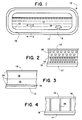
- Fig. 1 is a sectional drawing of a cryogenic fluid container to which the present invention has been applied.
- Fig. 2 is cross-sectional view at line 2-2 of the container of Fig. 1 pursuant to one version of the invention.
- Fig. 3 is a cross-sectional view at line 2-2 of the container of Fig. 1 pursuant to another version of the invention.
- Fig. 4 is a cross-sectional view at line 2-2 of the container of Fig. 1 pursuant to another version of the invention.
- Fig. 5 is a graph of apparent thermal conductivity of several materials in an environment of air at various pressures between two surfaces respectively at temperatures of 295K and 77K.
- Curve A is for coherent silica aerogel as measured on two contiguous layers, each 1.27 cm thick and having a density of 96 kilograms per cubic meter.
- Curve B is for coherent silica aerogel as measured on two similar contiguous layers with a reflective aluminum foil on each of the two outside surfaces of the two layers and a reflective foil between the two layers.
- Curve C is for perlite powder at a bulk density of 88 kilograms per cubic meter.
- Curve D is for fiberglass with a bulk density of 16 kilograms per cubic meter, manufactured by Owens-Corning and designated as PF-210.
- Curve E is for air calculated including convective effects between two surfaces 2.54 cm apart, each with an emissivity of 0.074.
- the invention will be described as applied to a storage container for cryogenic fluid as depicted in Fig. 1.
- the invention can be similarly applied to other vessels, confinements or conduits for cryogenic fluids.
- the storage container 10 has a first lamina 12 having an external side facing toward, and an internal side facing away from, the cryogenic fluid 14.
- the first lamina 12 is exposed directly to the cryogenic fluid, that is, in contact with the fluid and serving to contain the fluid.
- the first lamina is comprised of metal sheet, is impervious to the cryogenic fluid, and is capable of withstanding the loads imposed by the fluid.
- the first lamina may be exposed indirectly to the fluid, that is, the external side of the first lamina may be in contact with another surface (not shown) which itself is in direct contact with the cryogenic fluid and serves to contain the fluid.
- the first lamina approaches the temperature of the cryogenic fluid.
- a second lamina 16 Spaced from the internal side of the first lamina 12 is a second lamina 16 having an internal side facing the internal side of the first lamina 12 and an external side facing away from the first lamina 12.
- the external side of the second lamina 16 is directly exposed to the ambient atmosphere.
- a protective coating 17 may be provided on the external side of the second lamina to guard against physical damage and optionally to also retard the heat leak rate.
- Suitable materials include organic foams such as, for example, polystyrene or polyurethene foam. Extending from the internal side of the first lamina 12 to the internal side of the second lamina 16, that is, occupying the space therebetween, is at least one block or layer of coherent aerogel.
- the first lamina and the second lamina can be made to serve the multiple purposes of encapsulating the coherent aerogel to provide a closed chamber which may be evacuated of air or other gas and to protect the coherent aerogel during handling. While the invention is applicable to aerogels in general, silica aerogel is preferred because its base, silicon dioxide, has a tetrahedral structure conducive to forming strong molecular bonds and is nonflammable.
- Coherent silica aerogel has a density of from about 20 to about 160 kilograms per cubic meter, preferably from about 60 to about 100 kilograms per cubic meter for use in the system provided by this invention.
- the average pore size ranges from about from about 0.01 to about 0.4 micrometers, preferably from about 0.02 to about 0.1 micrometers. Larger pore size typically corresponds with lower density. Pore size as used herein means the average distance between walls in the voids in the coherent material.
- Coherent aerogel may be used in layers of different pore size and density in a single low-heat-leak system for a cryogenic installation.
- the mean free path of gas molecules comprising the gaseous environment within the system proximate the colder surface of the system is longer than that of gas molecules proximate the warmer surface of the system.
- similar or even lower apparent thermal conductivity may be obtained across coherent aerogel with a larger pore size proximate a colder surface in a system than that which may be obtained in coherent aerogel with a smaller pore size proximate a warmer surface in the system.
- a radiation shield 24 of reflective foil such as aluminum foil, may be employed between layers of aerogel and at the aerogel layer surfaces which face the first and second laminas.
- a reflective film may be applied to the surfaces of the coherent aerogel layers by chemical or vapor deposition.
- opacifying reflective flakes (not shown), such as flakes of aluminum or copper, may be incorporated throughout the aerogel material during its formulation.
- coherent aerogel is capable of bearing and transmitting applied external loads, particularly compressive loads.
- strengthening fibers may be incorporated in the aerogel during its formulation, such as fibers of metal, carbon or polyester.
- one or both lamina may be comprised of flexible material capable of supporting an applied external load by at least partially transmitting the load to the coherent aerogel, which, in turn, is capable of at least partially transmitting the load to the other lamina. If the other lamina does not support and contain the cryogenic fluid, then the load is further transmitted to a surface which may contact and support the other lamina and contain the cryogenic fluid.
- the flexible lamina may be light-gauge metal, lightweight material with a protective foam covering, or a plastic, preferably with fiber reinforcement. Desirably, the lamina are impervious to water vapor and other atmospheric gases.
- localized load supporting means such as supports 26 or struts can be provided to extend through the aerogel from the first lamina to the second lamina.
- the aerogel can be contained in cells (not shown), such as cells of hexagonal cross section, the walls of which extend from the first lamina to the second lamina.
- coherent aerogel because of its load bearing capability may itself be employed as a localized load supporting means 26 between lamina which may otherwise contain unfilled space or space with insulative powder, such as perlite powder.
- Table I Shown in Table I are the values of apparent thermal conductivity measured at various subatmospheric pressures of coherent silica aerogel with a density of 96 kilograms per cubic meter, in two contiguous layers, each 1.27 cm thick, between surfaces maintained at temperatures indicated in the table.
- the coherent silica aerogel material was manufactured in accordance with the process described in Canadian Patent No. 1,288,313 issued Sep. 3, 1991 to A.J. Hunt et al., hereby incorporated by reference. The process includes the hydrolysis and polycondensation of silicon alkoxide in alcohol to give an alcogel. The alcohol is replaced by liquid carbon dioxide, and the alcogel is dried by extracting the carbon dioxide under supercritical conditions.
- the resulting material was determined to have an effective average pore size of about 0.04 micrometers from a correlation that relates gaseous conduction as a function of gas properties at room temperature, the gas pressure, and the pore size of the material.
- the density of the material was measured at about 96 kilograms per cubic meter.
- the load bearing capability of the material was assessed by subjecting a layer to a compressive load equal to that of standard atmospheric pressure. The material did not compress significantly, remained coherent, showed some crazing, and displayed the same thermal conductivity as before the loading.
- Fig. 5 compares the apparent thermal conductivity of several materials as displayed from one face maintained at about 295K to another at about 77K.
- Curve A is for the coherent silica aerogel material described above as measured on two contiguous layers, each 1.27 cm thick. Curve A shows that the apparent thermal conductivity of coherent silica aerogel in an air environment at standard atmospheric pressure of 760,000 micrometers of mercury is considerably less than that of competitive materials also at standard atmospheric pressure.
- the thermal conductivity of silica aerogel decreases rapidly as the pressure of the air environment enveloping the aerogel is decreased, so that at about 250,000 micrometers of mercury, the thermal conductivity has decreased to a value where it is competitive with that of perlite or fiberglass at much lower pressures and is preferred for use in low-heat-leak structures for cryogenic fluids.
- the thermal conductivity curve for silica aerogel begins to level out at about 100,000 micrometers of mercury. As the pressure is decreased from about 100,000 to about 100 micrometers mercury, curve A levels out to an almost constant value. Throughout this pressure range, curve A surprisingly shows a thermal conductivity which is lower than that of either perlite (curve C) or fiberglass (curve D) when either is at a pressure of 100 micrometers of mercury.
- coherent silica aerogel at about 100,000 micrometers of mercury has a lower thermal conductivity, and can be used in a cryogenic system with lower heat leak, than a system with perlite or fiberglass at 100 micrometers of mercury.
- Coherent silica aerogel is preferable to perlite or fiberglass because its high insulative properties are achieved at higher pressures, that is, lesser vacuums, than required for perlite or fiberglass.
- Low heat leak from ambient atmosphere through the inventive system and into the cryogenic fluid is attainable by providing for the coherent silica aerogel an air or other gaseous environment with a pressure less than about 100,000 micrometers of mercury.
- Ranges of pressure from about 300 to about 100,000 micrometers of mercury, from about 1000 to about 100,000 micrometers of mercury, and from about 10,000 to about 100,000 micrometers of mercury are particularly attractive because these higher pressures are easier to achieve and maintain.
- These higher pressure ranges are advantageous over conventional systems which typically use perlite or fiberglass under more reduced pressures.
- the invention allows considerable savings in construction cost and maintenance cost over conventional systems which have to operate at lower pressures (that is, at higher vacuums) to be equivalent and competitive in heat leak rate.
- Operable pressure levels may be achieved by condensation of gas in the aerogel environment by cooldown of the system structure by the cryogenic fluid which the system is intended to handle.
- gas in the aerogel environment by cooldown of the system structure by the cryogenic fluid which the system is intended to handle.
- carbon dioxide gas may be substituted for air in a closed environment around coherent aerogel.
- a fluid at cryogenic temperature such as liquid oxygen or nitrogen
- condensation of the carbon dioxide gas will occur, thereby reducing the pressure of the gaseous environment of the aerogel and reducing the rate of heat transmission across the aerogel.
- the cryogenic liquid is hydrogen or helium
- air in the closed system will condense reducing the pressure of the gaseous environment of the aerogel and the rate of heat transmission across the aerogel.
- An alternate method of achieving reduced pressure in a closed environment about coherent aerogel is to provide within the environment an amount of material which upon being cooled to cryogenic temperatures will adsorb gas from the closed environment.
- This method of achieving reduced pressures is particularly suitable for achieving the higher pressure ranges, as set out above, at which this inventive cryogenic system operates with low heat leak.
- molecular sieve material in a reservoir 26 reentrant into the volume to be occupied by cryogenic fluid in the storage container will be cooled to cryogenic temperature upon filling of the container with cryogenic fluid. The molecular sieve material will then adsorb gas, thereby reducing the pressure in the closed environment surrounding the coherent aerogel.
- Still another method of reducing the thermal conductivity of coherent aerogel in a gaseous environment is to replace air from the environment surrounding the aerogel with gas of lower thermal conductivity than air, such as argon, xenon, krypton, trichlorofluoromethane, dichlorodifluoromethane, bromine, carbon disulfide, sulfur hexafluoride or mixtures thereof.
- gas of lower thermal conductivity than air such as argon, xenon, krypton, trichlorofluoromethane, dichlorodifluoromethane, bromine, carbon disulfide, sulfur hexafluoride or mixtures thereof.
- a gas or mixture of gases having a thermal conductivity at least 25% lower than that of air at thermal conduction pressures is effective.
Landscapes
- Engineering & Computer Science (AREA)
- Chemical & Material Sciences (AREA)
- General Engineering & Computer Science (AREA)
- Ceramic Engineering (AREA)
- Mechanical Engineering (AREA)
- Materials Engineering (AREA)
- Structural Engineering (AREA)
- Organic Chemistry (AREA)
- Physics & Mathematics (AREA)
- Thermal Sciences (AREA)
- Filling Or Discharging Of Gas Storage Vessels (AREA)
- Thermal Insulation (AREA)
- Laminated Bodies (AREA)
- Silicon Compounds (AREA)
Applications Claiming Priority (2)
| Application Number | Priority Date | Filing Date | Title |
|---|---|---|---|
| US08/074,766 US5386706A (en) | 1993-06-10 | 1993-06-10 | Low heat-leak, coherent-aerogel, cryogenic system |
| US74766 | 1993-06-10 |
Publications (2)
| Publication Number | Publication Date |
|---|---|
| EP0629810A1 true EP0629810A1 (fr) | 1994-12-21 |
| EP0629810B1 EP0629810B1 (fr) | 1998-03-25 |
Family
ID=22121572
Family Applications (1)
| Application Number | Title | Priority Date | Filing Date |
|---|---|---|---|
| EP94108890A Expired - Lifetime EP0629810B1 (fr) | 1993-06-10 | 1994-06-09 | Système cryogénique se basant sur d'aérogel cohérent, à perte de chaleur minime |
Country Status (9)
| Country | Link |
|---|---|
| US (1) | US5386706A (fr) |
| EP (1) | EP0629810B1 (fr) |
| JP (1) | JP2694602B2 (fr) |
| KR (1) | KR0165568B1 (fr) |
| CN (1) | CN1098996C (fr) |
| BR (1) | BR9402377A (fr) |
| CA (1) | CA2125519C (fr) |
| DE (1) | DE69409161T2 (fr) |
| ES (1) | ES2114089T3 (fr) |
Cited By (6)
| Publication number | Priority date | Publication date | Assignee | Title |
|---|---|---|---|---|
| EP0752389A1 (fr) * | 1995-07-07 | 1997-01-08 | Universite Claude Bernard - Lyon 1 | Procédé pour la fabrication d'aérogels de silice monolithiques et aérogels de silice ainsi obtenus |
| EP1077097A1 (fr) * | 1999-08-18 | 2001-02-21 | DLR Deutsches Zentrum für Luft- und Raumfahrt e.V. | Utilisation d'aérogels en plastique et/ou en carbone comme matériau de noyeau |
| WO2002088593A1 (fr) * | 2001-04-25 | 2002-11-07 | Eva Maria Moser | Contenant etanche au gaz |
| WO2008054474A3 (fr) * | 2006-03-23 | 2008-06-26 | Praxair Technology Inc | Système d'isolation aérogel cryogénique |
| US7718239B2 (en) | 2005-10-12 | 2010-05-18 | Gkss-Forschungszentrum Geesthacht Gmbh | Gas tight vessel with a diffusion barrier layer of metal hydrides |
| US20110031861A1 (en) * | 2009-08-07 | 2011-02-10 | Conocophillips Company | Cryogenic insulation attachment |
Families Citing this family (29)
| Publication number | Priority date | Publication date | Assignee | Title |
|---|---|---|---|---|
| US5613366A (en) * | 1995-05-25 | 1997-03-25 | Aerojet General Corporation | System and method for regulating the temperature of cryogenic liquids |
| US6010762A (en) * | 1998-01-15 | 2000-01-04 | Cabot Corporation | Self-evacuating vacuum insulation panels |
| US6485805B1 (en) * | 1998-01-15 | 2002-11-26 | Cabot Corporation | Multilayer insulation composite |
| US6209343B1 (en) | 1998-09-29 | 2001-04-03 | Life Science Holdings, Inc. | Portable apparatus for storing and/or transporting biological samples, tissues and/or organs |
| US6122920A (en) * | 1998-12-22 | 2000-09-26 | The United States Of America As Represented By The United States Department Of Energy | High specific surface area aerogel cryoadsorber for vacuum pumping applications |
| US6544618B1 (en) | 1999-05-06 | 2003-04-08 | Cabot Corporation | Thermally reflective layer-porous metal oxide film insulation composite |
| US6230500B1 (en) | 1999-09-29 | 2001-05-15 | Mve, Inc. | Cryogenic freezer |
| US20030029877A1 (en) * | 2001-07-30 | 2003-02-13 | Mathur Virendra K. | Insulated vessel for storing cold fluids and insulation method |
| US6832636B2 (en) | 2001-09-27 | 2004-12-21 | Graeme Harrison | Fuel nozzle lever, a fuel nozzle and a method of operating a fuel nozzle |
| US6824306B1 (en) | 2002-12-11 | 2004-11-30 | The United States Of America As Represented By The Administrator Of The National Aeronautics And Space Administration | Thermal insulation testing method and apparatus |
| US20060035054A1 (en) * | 2004-01-05 | 2006-02-16 | Aspen Aerogels, Inc. | High performance vacuum-sealed insulations |
| JP2008511537A (ja) * | 2004-09-01 | 2008-04-17 | アスペン エアロジェルス,インク. | 真空封入された高性能断熱材 |
| WO2007133805A2 (fr) * | 2006-05-15 | 2007-11-22 | Aspen Aerogels, Inc. | Systèmes d'enceintes à base d'aérogel |
| US20080307798A1 (en) * | 2007-06-12 | 2008-12-18 | Yang Luo | Cryogenic liquid tank and method |
| EP2276966B1 (fr) * | 2008-05-16 | 2012-10-17 | Lawrence Livermore National Security, LLC | Récipients haute pression à capacité cryogénique pour stockage compact d'hydrogène à bord de véhicules |
| JP2012503747A (ja) * | 2008-09-23 | 2012-02-09 | エアロヴァイロンメント インコーポレイテッド | 極低温液体タンク |
| US10378695B2 (en) * | 2016-05-25 | 2019-08-13 | Savsu Technologies Llc | Cryogenic storage container |
| EP3615873B1 (fr) * | 2017-05-12 | 2021-11-10 | Samsung Electronics Co., Ltd. | Réfrigérateur |
| US11435034B1 (en) * | 2017-07-06 | 2022-09-06 | Chart Inc. | Tank systems with an insulation assembly |
| WO2019099803A1 (fr) | 2017-11-17 | 2019-05-23 | Savsu Technologies, Inc. | Récipient cryogénique à vapeur sèche avec cœur absorbant |
| US11047517B2 (en) | 2018-10-31 | 2021-06-29 | Praxair Technology, Inc. | Modular vacuum insulated piping |
| CN113883787B (zh) * | 2020-07-01 | 2026-01-30 | 海信冰箱有限公司 | 冰箱 |
| JP7587257B2 (ja) * | 2020-11-20 | 2024-11-20 | 国立研究開発法人物質・材料研究機構 | 二重殻式容器 |
| KR102507500B1 (ko) * | 2021-05-25 | 2023-03-08 | 오세만 | 극저온 용기의 단열구조 |
| US12111015B2 (en) | 2021-07-08 | 2024-10-08 | Preload Cryogenics, Llc | System and method for storage of liquid hydrogen at low pressure |
| EP4409193A4 (fr) | 2021-09-28 | 2025-10-29 | Preload Cryogenics Llc | Système d'isolation de réservoir cryogénique en béton précontraint préfabriqué à base coulissante et procédé pour systèmes de confinement complet et double |
| CN113847510A (zh) * | 2021-11-18 | 2021-12-28 | 杭州富士达特种材料股份有限公司 | 包含气凝胶材料的低温真空多层绝热结构及使用方法 |
| FR3131359B1 (fr) * | 2021-12-28 | 2024-07-26 | Jean Michel Schulz | Réservoir cryogenique embarqué léger de forme quelconque optimisé structurellement |
| EP4502451A1 (fr) * | 2023-08-03 | 2025-02-05 | Crompton Technology Group Limited | Réservoir de stockage |
Citations (5)
| Publication number | Priority date | Publication date | Assignee | Title |
|---|---|---|---|---|
| EP0012038A1 (fr) * | 1978-12-04 | 1980-06-11 | Air Products And Chemicals, Inc. | Système utilisant une superisolation |
| GB2055442A (en) * | 1979-07-31 | 1981-03-04 | Furukawa Electric Co Ltd | Heat insulating pipe and method for manufacturing the same |
| GB2161906A (en) * | 1984-06-05 | 1986-01-22 | Morganite Ceramic Fibres Ltd | Thermal insulators |
| DE3927538A1 (de) * | 1989-08-21 | 1991-02-28 | Tps Ges Fuer Tech Physikalisch | Sandwichbauelement zur thermischen isolation |
| US5156895A (en) * | 1990-01-26 | 1992-10-20 | Thermalux, A Limited Partnership | Monolithic aerogel insulation cast and dried within a support structure and method |
Family Cites Families (14)
| Publication number | Priority date | Publication date | Assignee | Title |
|---|---|---|---|---|
| US3147877A (en) * | 1958-01-09 | 1964-09-08 | Union Carbide Corp | Liquefied gas container |
| BE604465A (fr) * | 1961-02-01 | |||
| US3130561A (en) * | 1961-06-30 | 1964-04-28 | Nat Res Corp | Insulation device |
| US3993213A (en) * | 1975-09-04 | 1976-11-23 | Mcdonnell Douglas Corporation | Thermally insulated cryogenic container |
| JPS5514836A (en) * | 1978-07-14 | 1980-02-01 | Kawasaki Steel Corp | Cooling method by cooling unit having inclined nozzle |
| DE2928695C2 (de) * | 1979-07-16 | 1984-05-30 | Grünzweig + Hartmann und Glasfaser AG, 6700 Ludwigshafen | Wärmeisolierkörper sowie Verfahren zu seiner Herstellung |
| US4402927A (en) * | 1980-04-22 | 1983-09-06 | Dardel Guy Von | Silica aerogel |
| DE3108816A1 (de) * | 1981-03-09 | 1982-09-30 | Grünzweig + Hartmann und Glasfaser AG, 6700 Ludwigshafen | Waermedaemmender pressstoff auf der basis von aus der flammenhydrolyse gewonnenem mikroporoesem oxidaerogel, sowie verfahren zu seiner herstellung, eine daraus hergestellte folie und ein damit hergestelltes kaschiertes waermedaemmelement |
| JPS59182223A (ja) * | 1983-03-30 | 1984-10-17 | Agency Of Ind Science & Technol | 中空シリカ球状体及びその製造方法 |
| SE8403888L (sv) * | 1983-08-04 | 1985-02-05 | Micropore International Ltd | Vermeisolerande kropp och sett att framstella denna |
| DE3614978A1 (de) * | 1986-05-02 | 1987-11-12 | Heinz Kunert | Wand- und/oder bruestungselement |
| US5027574A (en) * | 1988-05-02 | 1991-07-02 | Phillip Bradley L | Thermally insulating structure |
| US5037859A (en) * | 1989-06-20 | 1991-08-06 | The United States Of America As Represented By The United States Department Of Energy | Composite foams |
| US5086085A (en) * | 1991-04-11 | 1992-02-04 | The United States Of America As Represented By The Department Of Energy | Melamine-formaldehyde aerogels |
-
1993
- 1993-06-10 US US08/074,766 patent/US5386706A/en not_active Expired - Lifetime
-
1994
- 1994-06-09 ES ES94108890T patent/ES2114089T3/es not_active Expired - Lifetime
- 1994-06-09 CA CA002125519A patent/CA2125519C/fr not_active Expired - Fee Related
- 1994-06-09 CN CN94106468A patent/CN1098996C/zh not_active Expired - Lifetime
- 1994-06-09 EP EP94108890A patent/EP0629810B1/fr not_active Expired - Lifetime
- 1994-06-09 JP JP6150624A patent/JP2694602B2/ja not_active Expired - Lifetime
- 1994-06-09 DE DE69409161T patent/DE69409161T2/de not_active Expired - Fee Related
- 1994-06-09 KR KR1019940012926A patent/KR0165568B1/ko not_active Expired - Fee Related
- 1994-06-10 BR BR9402377A patent/BR9402377A/pt not_active IP Right Cessation
Patent Citations (5)
| Publication number | Priority date | Publication date | Assignee | Title |
|---|---|---|---|---|
| EP0012038A1 (fr) * | 1978-12-04 | 1980-06-11 | Air Products And Chemicals, Inc. | Système utilisant une superisolation |
| GB2055442A (en) * | 1979-07-31 | 1981-03-04 | Furukawa Electric Co Ltd | Heat insulating pipe and method for manufacturing the same |
| GB2161906A (en) * | 1984-06-05 | 1986-01-22 | Morganite Ceramic Fibres Ltd | Thermal insulators |
| DE3927538A1 (de) * | 1989-08-21 | 1991-02-28 | Tps Ges Fuer Tech Physikalisch | Sandwichbauelement zur thermischen isolation |
| US5156895A (en) * | 1990-01-26 | 1992-10-20 | Thermalux, A Limited Partnership | Monolithic aerogel insulation cast and dried within a support structure and method |
Cited By (9)
| Publication number | Priority date | Publication date | Assignee | Title |
|---|---|---|---|---|
| EP0752389A1 (fr) * | 1995-07-07 | 1997-01-08 | Universite Claude Bernard - Lyon 1 | Procédé pour la fabrication d'aérogels de silice monolithiques et aérogels de silice ainsi obtenus |
| EP1077097A1 (fr) * | 1999-08-18 | 2001-02-21 | DLR Deutsches Zentrum für Luft- und Raumfahrt e.V. | Utilisation d'aérogels en plastique et/ou en carbone comme matériau de noyeau |
| WO2002088593A1 (fr) * | 2001-04-25 | 2002-11-07 | Eva Maria Moser | Contenant etanche au gaz |
| US7718239B2 (en) | 2005-10-12 | 2010-05-18 | Gkss-Forschungszentrum Geesthacht Gmbh | Gas tight vessel with a diffusion barrier layer of metal hydrides |
| WO2008054474A3 (fr) * | 2006-03-23 | 2008-06-26 | Praxair Technology Inc | Système d'isolation aérogel cryogénique |
| TWI401384B (zh) * | 2006-03-23 | 2013-07-11 | Praxair Technology Inc | 低溫氣凝膠隔熱系統 |
| US20110031861A1 (en) * | 2009-08-07 | 2011-02-10 | Conocophillips Company | Cryogenic insulation attachment |
| WO2011017267A1 (fr) | 2009-08-07 | 2011-02-10 | Conocophillips Company | Moyen de fixation d'isolation cryogénique et procédé correspondant |
| AU2010279692B2 (en) * | 2009-08-07 | 2015-05-07 | Conocophillips Company | Cryogenic insulation attachment and method |
Also Published As
| Publication number | Publication date |
|---|---|
| US5386706A (en) | 1995-02-07 |
| KR0165568B1 (ko) | 1998-12-01 |
| JPH0719400A (ja) | 1995-01-20 |
| ES2114089T3 (es) | 1998-05-16 |
| JP2694602B2 (ja) | 1997-12-24 |
| EP0629810B1 (fr) | 1998-03-25 |
| CA2125519A1 (fr) | 1994-12-11 |
| KR950001244A (ko) | 1995-01-03 |
| CA2125519C (fr) | 2000-04-18 |
| CN1100801A (zh) | 1995-03-29 |
| DE69409161D1 (de) | 1998-04-30 |
| BR9402377A (pt) | 1995-01-17 |
| CN1098996C (zh) | 2003-01-15 |
| DE69409161T2 (de) | 1998-09-17 |
Similar Documents
| Publication | Publication Date | Title |
|---|---|---|
| US5386706A (en) | Low heat-leak, coherent-aerogel, cryogenic system | |
| EP1996854B1 (fr) | Système d'isolation aérogel cryogénique | |
| US6858280B2 (en) | Microsphere insulation systems | |
| RU2293906C2 (ru) | Способ получения изоляционного изделия, содержащего аэрогель | |
| CA2050184C (fr) | Panneau super isolant a facteur r eleve | |
| US7781492B2 (en) | Foam/aerogel composite materials for thermal and acoustic insulation and cryogen storage | |
| US4606196A (en) | Vacuum insulation system | |
| EP1401731A2 (fr) | Barrieres d'isolation et procedes de fabrication associes | |
| EP1047901B1 (fr) | Panneaux a vide isolant a purge automatique | |
| EP0099574A2 (fr) | Isolant thermique composite | |
| US4282280A (en) | Heat insulation for tanks at cryogenic and higher temperatures, using structural honeycomb with integral heat radiation shields | |
| US4667390A (en) | Vacuum insulation system method of manufacture | |
| EP2943620B1 (fr) | Production d'un produit d'isolation thermique | |
| EP0501061A1 (fr) | Isolation thermique pour réservoir cryogénique | |
| Timmerhaus | Insulation progress since the mid-1950s | |
| Allen et al. | Microsphere insulation systems | |
| SUPERINSULATION | JE Fesmire", S. Rouanet", and J. Ryu"" NASA Kennedy Space Center, Engineering Development Directorate | |
| MXPA94004345A (en) | Low heat-leak, coherent-aerogel, cryogenic system | |
| HK1088651A (en) | Aerogel-containing insulation article | |
| JPH02265513A (ja) | 断熱容器とその製造方法 |
Legal Events
| Date | Code | Title | Description |
|---|---|---|---|
| PUAI | Public reference made under article 153(3) epc to a published international application that has entered the european phase |
Free format text: ORIGINAL CODE: 0009012 |
|
| AK | Designated contracting states |
Kind code of ref document: A1 Designated state(s): BE DE ES FR GB IT NL |
|
| 17P | Request for examination filed |
Effective date: 19950217 |
|
| 17Q | First examination report despatched |
Effective date: 19960112 |
|
| GRAG | Despatch of communication of intention to grant |
Free format text: ORIGINAL CODE: EPIDOS AGRA |
|
| GRAG | Despatch of communication of intention to grant |
Free format text: ORIGINAL CODE: EPIDOS AGRA |
|
| GRAG | Despatch of communication of intention to grant |
Free format text: ORIGINAL CODE: EPIDOS AGRA |
|
| GRAH | Despatch of communication of intention to grant a patent |
Free format text: ORIGINAL CODE: EPIDOS IGRA |
|
| GRAH | Despatch of communication of intention to grant a patent |
Free format text: ORIGINAL CODE: EPIDOS IGRA |
|
| GRAA | (expected) grant |
Free format text: ORIGINAL CODE: 0009210 |
|
| ITF | It: translation for a ep patent filed | ||
| AK | Designated contracting states |
Kind code of ref document: B1 Designated state(s): DE ES FR GB IT |
|
| REF | Corresponds to: |
Ref document number: 69409161 Country of ref document: DE Date of ref document: 19980430 |
|
| REG | Reference to a national code |
Ref country code: ES Ref legal event code: FG2A Ref document number: 2114089 Country of ref document: ES Kind code of ref document: T3 |
|
| ET | Fr: translation filed | ||
| PLBE | No opposition filed within time limit |
Free format text: ORIGINAL CODE: 0009261 |
|
| STAA | Information on the status of an ep patent application or granted ep patent |
Free format text: STATUS: NO OPPOSITION FILED WITHIN TIME LIMIT |
|
| 26N | No opposition filed | ||
| PGFP | Annual fee paid to national office [announced via postgrant information from national office to epo] |
Ref country code: FR Payment date: 20010517 Year of fee payment: 8 |
|
| PGFP | Annual fee paid to national office [announced via postgrant information from national office to epo] |
Ref country code: GB Payment date: 20010521 Year of fee payment: 8 |
|
| PGFP | Annual fee paid to national office [announced via postgrant information from national office to epo] |
Ref country code: DE Payment date: 20010523 Year of fee payment: 8 |
|
| PGFP | Annual fee paid to national office [announced via postgrant information from national office to epo] |
Ref country code: ES Payment date: 20010709 Year of fee payment: 8 |
|
| REG | Reference to a national code |
Ref country code: GB Ref legal event code: IF02 |
|
| PG25 | Lapsed in a contracting state [announced via postgrant information from national office to epo] |
Ref country code: GB Free format text: LAPSE BECAUSE OF NON-PAYMENT OF DUE FEES Effective date: 20020609 |
|
| PG25 | Lapsed in a contracting state [announced via postgrant information from national office to epo] |
Ref country code: ES Free format text: LAPSE BECAUSE OF NON-PAYMENT OF DUE FEES Effective date: 20020610 |
|
| PG25 | Lapsed in a contracting state [announced via postgrant information from national office to epo] |
Ref country code: DE Free format text: LAPSE BECAUSE OF NON-PAYMENT OF DUE FEES Effective date: 20030101 |
|
| GBPC | Gb: european patent ceased through non-payment of renewal fee |
Effective date: 20020609 |
|
| PG25 | Lapsed in a contracting state [announced via postgrant information from national office to epo] |
Ref country code: FR Free format text: LAPSE BECAUSE OF NON-PAYMENT OF DUE FEES Effective date: 20030228 |
|
| REG | Reference to a national code |
Ref country code: FR Ref legal event code: ST |
|
| REG | Reference to a national code |
Ref country code: ES Ref legal event code: FD2A Effective date: 20030711 |
|
| PG25 | Lapsed in a contracting state [announced via postgrant information from national office to epo] |
Ref country code: IT Free format text: LAPSE BECAUSE OF NON-PAYMENT OF DUE FEES;WARNING: LAPSES OF ITALIAN PATENTS WITH EFFECTIVE DATE BEFORE 2007 MAY HAVE OCCURRED AT ANY TIME BEFORE 2007. THE CORRECT EFFECTIVE DATE MAY BE DIFFERENT FROM THE ONE RECORDED. Effective date: 20050609 |