EP0635288A1 - Appareil de jeu - Google Patents
Appareil de jeu Download PDFInfo
- Publication number
- EP0635288A1 EP0635288A1 EP94905241A EP94905241A EP0635288A1 EP 0635288 A1 EP0635288 A1 EP 0635288A1 EP 94905241 A EP94905241 A EP 94905241A EP 94905241 A EP94905241 A EP 94905241A EP 0635288 A1 EP0635288 A1 EP 0635288A1
- Authority
- EP
- European Patent Office
- Prior art keywords
- moving object
- piece
- player
- game
- game toy
- Prior art date
- Legal status (The legal status is an assumption and is not a legal conclusion. Google has not performed a legal analysis and makes no representation as to the accuracy of the status listed.)
- Ceased
Links
Images






Classifications
-
- A—HUMAN NECESSITIES
- A63—SPORTS; GAMES; AMUSEMENTS
- A63F—CARD, BOARD, OR ROULETTE GAMES; INDOOR GAMES USING SMALL MOVING PLAYING BODIES; VIDEO GAMES; GAMES NOT OTHERWISE PROVIDED FOR
- A63F9/00—Games not otherwise provided for
- A63F9/30—Capturing games for grabbing or trapping objects, e.g. fishing games
-
- A—HUMAN NECESSITIES
- A63—SPORTS; GAMES; AMUSEMENTS
- A63H—TOYS, e.g. TOPS, DOLLS, HOOPS OR BUILDING BLOCKS
- A63H27/00—Toy aircraft; Other flying toys
- A63H27/04—Captive toy aircraft
Definitions
- This invention relates to a game toy with which players compete to see who can avoid collision of a moving object with their piece and hold on their piece.
- contests such as tennis, ping pong, etc., with which points are scored by the opposing player when the moving object, such as a ball, etc., of one player enters the specified region of the other player and the player on whose side the ball has entered cannot stop the moving object, and games that imitate this type of contest have also been presented.
- an object of this invention is to present a game toy which provides amusement that cannot be obtained with games simulating actual contests, because it is structured so that players compete for the number of pieces by avoiding the loss of a piece.
- This invention is characterized by that it has a piece retaining means for holding a player's piece at the desired position, a moving object which moves the piece from the position by colliding with the piece, a collision prevention meanes which the player operates in order to avoid collision of the moving object with the piece when the moving object is close to the piece, a support means that supports the moving object so that it can freely spin in the vertical direction, and a drive meanes which rotates said support meanes around the vertical axis.
- the game toy has a stopper meanes for stopping the moving object so that it is held in a vertical state and a release means with which the player can release the suspension.
- the stopper means comprises a movable pin which has an end engage with a concave section or hole in the moving object in order to stop the moving object.
- the moving object has a colliding part that collides with the piece at its front end and a spindle at its back end, with the moving object being supported so that it can freely spin around a fulcrum near the back end.
- the collision prevention means have a lever supported so that it can spin freely up and down and a spring at one end of said lever attached so that it can spin freely at the desired angle with regard to a direction in which the moving object is moving, and the collision prevention meanes is made so that when the player pushes the other end of the lever, the moving object jumps due to the force of the spring.
- the moving object moves with rotation of the support mechanism that is rotated and driven by the drive means.
- the piece is moved and emitted from that position.
- the player can avoid collision with the moving object by operating the collision prevention means. That is, since the moving object is supported so that it can freely spin in a vertical direction by the support means, collision can be prevented by making the moving object jump using the collision prevention means.
- a game is played whereby players compete over the numver of pieces that are retained in the end.
- the moving object is kept in a vertical state by a stopper means and the game can be started by releasing the stopper using the suspension release means.
- the stopper means when the stopper means is released, the turning force of the support means is applied to the moving object and the moving object falls from its vertical state in the direction in which it can spin.
- the direction in which the object falls is determined by the position of the moving object in its vertical state and the position at which the support mechanism starts, and is therefore not specific. Consequently, the moving object may fall so that it is on either player's side when the game is started, which makes the game more exiting.
- the stopper means comprises a movable pin which has an end engage with a concave section or hole in the moving object in order to halt the moving object.
- the support means has a stopper that holds the moving object so that the colliding part moves almost horizontally when the moving object moves with rotation of the support means.
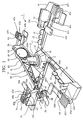
- Fig. 1 swows a game toy that can be played by four players as an embodiment of this invention.
- a game toy 1 has coins a1, a2,..., b1, b2,..., c1, c2,... and d1, d2,... as pieces for each player, coin retainers 2a, 2b, 2c and 2d as the piece retaining means that holds a specific number of these coins (three in this example) for each player, an arm 3 as the moving object, spring devices 4a, 4b, 4c and 4d as the collision prevention means, a tower 5 as the support means, drive means housing 6 and switch 7.
- coin retainers 2a, 2b, 2c and 2d retains coins at slits 21a, 21b, 21c and 21d.
- the coin a1 is inclined as shown by P2, climbs over protruding part 22a, falls to P3 and is emitted to a slit 24a from an opening 23a.
- the slit 24a is inclined down to the center of the game toy 1 and therefore, coin a1 moves to the front end of the slit 24a and stops, as shown in Fig. 1.
- a slit 21a is similarly inclined and therefore, when the coin a1 is emitted, the next coin a2 moves to a position P1.
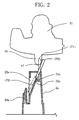
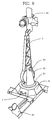
- the arm 3 includes a frame 32, the simulated airplane 31 as the colliding part supported so that it can freely spin at the end of the frame 32, and a spindle 33 connected to the back end of the frame 32.
- the frame 32 is supported so that it can freely spin by an axle 52, which is suspended over the tower 5.
- the arm 3 is supported so that it can freely rotate vertically. Furthermore, as will be mentioned later, by rotating the tower 5 around the vertical axial direction, the arm 3 will spin in a horizontal direction.
- the airplane 31 has a pair of wheels 34, a pair of blades 35, a pilot 36 and a joint 37.
- the top of the joint 37 and the front end of the frame 32 are joined by a pin 38.
- the airplane 31 can make loops with the pin 38 serving as the center of rotation.
- a weight is at the base of the airplane 31 seen from the pin 38 and therefore, even if the airplane 31 flies loops, its base is kept on the bottom, as shown in Fig. 3.
- the wheels 34 are on the bottom of the airplane 31 when the arm 3 is spinning horizontally and the arm 3 spins so that it collides with the coins held at the position P1 by coin retainers 2a, 2b, 2c and 2d.
- the tower 5 is attached to the top of the support 51, which will be mentioned later, so that they rotate as one unit. Moreover, a stopper that holds the arm 3 horizontally is used in order to turn the airplane 31, which is at the front end of the arm 3, almost horizontally as the tower 5 rotates.
- the arm 3 spins relatively slowly around the axle 52 when the airplane 31 jumps at springs 4a, 4b, 4c and 4d, which will be discussed later, so that turning of the airplane 31 is seen.
- the arm 3 is spun vertically, the airplane 31 jumps with the spring force of the springs and either falls to the opposite player's side or returns to the player who initiated the jump. In either case, the arm 3 spins horizontally as it jumps and falls and therefore, the player can avoid collision and emission of the coin by making the airplane 31 fly over the coin held at the position P1.
- Springs 4a, 4b, 4c and 4d have lever 41a, 41b, 41c and 41d that are each turned up, buttons 42a, 42b, 42c and 42d at one end of each lever, springing parts 43a, 43b, 43c and 43d at the other end of each level, and supports 44a, 44b, 44c and 44d that support each of the levers so that they can freely spin. Since each support 44a, 44b, 44c and 44d is supported so that it is inclined toward each button from the center, each springing part 43a, 43b, 43c and 43d is kept at the bottom and each button 42a, 42b 42c and 42d is kept at the top.
- stoppers 45a, 45b, 45c and 45d that keep buttons 42a, 42b, 42c and 42d at the downward position are at the top of each stopper in order to prevent each springing part 43a, 43b, 43c and 43d from rising the wheels 34 of the airplane 31.
- buttons 42a, 42b, 42c and 42d when the player pushes buttons 42a, 42b, 42c and 42d with springs 4a, 4b, 4c and 4d, levers 41a, 41b, 41c and 41d rotate, and springing parts 43a, 43b, 43c and 43d rise, while buttons 42a, 42b, 42c and 42d stop at each stopper 45a, 45b, 45c and 45d.
- springs 4a, 4b, 4c and 4d return to their original state.
- Fig. 4 shows the structure of a springing part 43a.
- the other springing parts sre the same.
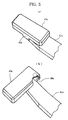
- the springing part 43a is attached to a lever 41a by a bearing 46a shown by the broken line so that it can freely spin within a range 90° with respect to the direction of movement of the airplane 31.
- this springing part 43a spins around the bearing 46a in a counter-clockwise direction, spinning is controlled by a stopper 49a on the side of the springing part 43a where the lengthwise direction of the lever 41a and the lengthwise direction of the springing part 43a are parallel to one another.
- the width where the springing part 43a touches wheels 34 of the airplane 31 is short in the direction of movement of the airplane 31 and therefore, it is relatively difficult for the player to make the airplane 31 jump with good timing.
- the springing part 43a is designed as shown in Fig. 5(b)
- the width where the springing part 43a touches wheels 34 of the airplane 31 is long, and it is relatively easy to make the airplane jump.
- the ease and pleasure of the game can be varied by changing the angle of springing parts 43a, 43b, 43c and 43d with respect to the airplane 31.
- the game can also be played by changing the angle of springing parts 43a, 43b, 43c and 43d for different players depending on player skill.
- Fig. 6 is a partial view of the inside structure of the tower 5.
- the tower 5 is made of a pair of sides 5a and 5b. Each side is fixed to the support 51 by with machine screws, etc. A pair of axles 52 and a pair of stoppers 53 are set up on the inside of walls 5a and 5b.
- Each axle 52 is inserted into a pair of bearings 39 that are set up on both sides of the arm 3 so that the arm 3 is supported so that it can freely spin in a vertical direction.
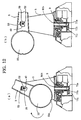
- the range of this spinning can be controlled by making a protrusion 40 in the bearing 39 touch the stopper 53, as shown in Fig. 12 mentioned later.
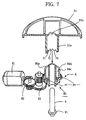
- Fig. 7 shows the structure of the driving part for rotating the tower 5.
- a driving part 8 is housed inside the housing 6 shown in Fig. 1 and has reduction gears 82 and 83 and a tube 84 in which teeth that engage with the gear 83 are formed on the outside to form the driving means of this invention.
- Rotary output of a motor 81 is applied to the tube 84 once speed reduction is perfomed by reduction gears 82 and 83.
- the tube 84 is formed by joining outer tube 84a with inner tube 84b at the bottom. As a result, space 84c is formed. Furthermore, several teeth e1, e2,... are made at the base of the space 84c.
- a tube 51a which is formed at the bottom of the support 51 that supports the tower 5 at the top and rotates as one unit with the tower 5, is inserted in this space 84c, and the inner tube 84b passes through a hole 51b at the center of the support 51.
- a pin 9 that supports a switch 7, which will be mentioned later, is inserted so that it can freely move inside the inner diameter of the tube 84b.
- the pin 9 is made so that when a stopper 91 touches the bottom end of the inner tube 84b, the front end of the pin 9 engage with a concave part 33a in the spindle 33, as shown in Fig. 8.
- Fig. 10 and Fig. 11 show the base of the housing 6.
- the mechanism of the switch 7 as a release means will be explained while referring to Fig. 10 and Fig. 11.
- switch 7 is supported at a fulcrum 73 and is a plate with a square 71 over the center and a hole 72 that cuts into square between the fulcrum 73 and the square 71. It can freely spin between the OFF position in Fig. 10 and the ON position in Fig. 11. Furthermore, a concave part 71a is set up on the top of the square 71. A protrusion 85 for switching the power switch of the motor 81 is inside the hole 72.
- a game is played in which players compete over the number of coins they can keep. However, the game can be finished when one of the players loses a coin. Moreover, a game time can be predetermined and appropriate rules can be established.
- players can compete over the number of pieces held by avoiding loss of pieces and therefore, obtain an amusement that is not given by a game for points simply imitating actual contests.
Landscapes
- Engineering & Computer Science (AREA)
- Multimedia (AREA)
- Toys (AREA)
Applications Claiming Priority (3)
| Application Number | Priority Date | Filing Date | Title |
|---|---|---|---|
| JP34018/93 | 1993-02-01 | ||
| JP03401893A JP3209603B2 (ja) | 1993-02-01 | 1993-02-01 | ゲーム玩具 |
| PCT/JP1994/000137 WO1994017879A1 (fr) | 1993-02-01 | 1994-02-01 | Appareil de jeu |
Publications (2)
| Publication Number | Publication Date |
|---|---|
| EP0635288A1 true EP0635288A1 (fr) | 1995-01-25 |
| EP0635288A4 EP0635288A4 (fr) | 1995-08-16 |
Family
ID=12402654
Family Applications (1)
| Application Number | Title | Priority Date | Filing Date |
|---|---|---|---|
| EP94905241A Ceased EP0635288A4 (fr) | 1993-02-01 | 1994-02-01 | Appareil de jeu. |
Country Status (7)
| Country | Link |
|---|---|
| US (1) | US5505463A (fr) |
| EP (1) | EP0635288A4 (fr) |
| JP (1) | JP3209603B2 (fr) |
| AU (1) | AU666611B2 (fr) |
| BR (1) | BR9403928A (fr) |
| NZ (1) | NZ259936A (fr) |
| WO (1) | WO1994017879A1 (fr) |
Families Citing this family (3)
| Publication number | Priority date | Publication date | Assignee | Title |
|---|---|---|---|---|
| EP0258441A4 (fr) * | 1986-01-25 | 1988-06-27 | Nitta Gelatin Kk | Procede de culture de cellules animales a grande echelle. |
| US6244260B1 (en) | 2000-01-28 | 2001-06-12 | Hasbro, Inc. | Interactive projectile-discharging toy |
| US6537129B1 (en) | 2002-05-31 | 2003-03-25 | Mattel, Inc. | Toy doll bed having jumping doll |
Family Cites Families (11)
| Publication number | Priority date | Publication date | Assignee | Title |
|---|---|---|---|---|
| US2130289A (en) * | 1937-09-23 | 1938-09-13 | Parker Brothers Inc | Amusement device |
| US3272507A (en) * | 1963-07-10 | 1966-09-13 | Aniceto Vasquez Mendez | Tethered airplane toy |
| DE1911884A1 (de) * | 1969-03-08 | 1970-09-24 | Biller Fa Hans | Flugspielzeug |
| US3594000A (en) * | 1969-03-10 | 1971-07-20 | Marvin Glass & Associates | Reaction game apparatus |
| JPS5335499B2 (fr) * | 1973-10-29 | 1978-09-27 | ||
| US4009879A (en) * | 1975-02-27 | 1977-03-01 | Tobin Wolf | Barnstormer game |
| US4135715A (en) * | 1977-01-27 | 1979-01-23 | Soulos Steven T | Timed stacking game |
| US4214749A (en) * | 1978-02-10 | 1980-07-29 | Marvin Glass & Associates | Target game apparatus |
| US4234181A (en) * | 1978-09-21 | 1980-11-18 | Marvin Glass & Associates | Round-about game apparatus |
| JPS57103784U (fr) * | 1980-12-16 | 1982-06-25 | ||
| JPH0617480Y2 (ja) * | 1989-05-15 | 1994-05-11 | 株式会社バンダイ | 操縦ゲーム玩具 |
-
1993
- 1993-02-01 JP JP03401893A patent/JP3209603B2/ja not_active Expired - Lifetime
-
1994
- 1994-02-01 NZ NZ259936A patent/NZ259936A/en unknown
- 1994-02-01 EP EP94905241A patent/EP0635288A4/fr not_active Ceased
- 1994-02-01 WO PCT/JP1994/000137 patent/WO1994017879A1/fr not_active Ceased
- 1994-02-01 BR BR9403928A patent/BR9403928A/pt unknown
- 1994-02-01 AU AU59500/94A patent/AU666611B2/en not_active Ceased
- 1994-10-11 US US08/320,649 patent/US5505463A/en not_active Expired - Fee Related
Also Published As
| Publication number | Publication date |
|---|---|
| JP3209603B2 (ja) | 2001-09-17 |
| AU666611B2 (en) | 1996-02-15 |
| AU5950094A (en) | 1994-08-29 |
| JPH06225974A (ja) | 1994-08-16 |
| WO1994017879A1 (fr) | 1994-08-18 |
| EP0635288A4 (fr) | 1995-08-16 |
| BR9403928A (pt) | 1999-06-01 |
| NZ259936A (en) | 1996-01-26 |
| US5505463A (en) | 1996-04-09 |
Similar Documents
| Publication | Publication Date | Title |
|---|---|---|
| US3923305A (en) | Combined game of chance and skill | |
| US4177992A (en) | Ball fling-out structure with pivoting goals | |
| US5505463A (en) | Game toy | |
| US4826160A (en) | Action toy game apparatus | |
| US6312306B1 (en) | Gyroscope and method and apparatus for spinning same | |
| US4529207A (en) | Toy having interchangeable game modules | |
| JPS63216587A (ja) | 弾球遊技機の入賞球装置 | |
| US3120958A (en) | Game | |
| JP2682598B2 (ja) | 弾球遊技機 | |
| KR102059752B1 (ko) | 팽이 | |
| JP2909836B2 (ja) | パチンコ機 | |
| JP7580525B1 (ja) | ゲーム装置 | |
| JP3079303U (ja) | コマ玩具遊戯台 | |
| US4093231A (en) | Superfly game apparatus | |
| JP3856877B2 (ja) | ゲーム装置 | |
| JP2761743B2 (ja) | 遊技機 | |
| JPH0332389Y2 (fr) | ||
| JP3002905U (ja) | 景品パックンゲーム機 | |
| JP2763594B2 (ja) | 遊技機の入賞装置 | |
| JP2518465Y2 (ja) | ゲーム装置 | |
| JP2553243B2 (ja) | 発光遊戯具、その発射装置及びゲーム玩具 | |
| JPH0522236Y2 (fr) | ||
| JPH0448230Y2 (fr) | ||
| US4230314A (en) | Skate board game | |
| US3908997A (en) | Target game |
Legal Events
| Date | Code | Title | Description |
|---|---|---|---|
| PUAI | Public reference made under article 153(3) epc to a published international application that has entered the european phase |
Free format text: ORIGINAL CODE: 0009012 |
|
| AK | Designated contracting states |
Kind code of ref document: A1 Designated state(s): AT BE CH DE DK ES FR GB GR IT LI NL PT SE |
|
| 17P | Request for examination filed |
Effective date: 19950426 |
|
| A4 | Supplementary search report drawn up and despatched | ||
| AK | Designated contracting states |
Kind code of ref document: A4 Designated state(s): AT BE CH DE DK ES FR GB GR IT LI NL PT SE |
|
| 17Q | First examination report despatched |
Effective date: 19960807 |
|
| GRAG | Despatch of communication of intention to grant |
Free format text: ORIGINAL CODE: EPIDOS AGRA |
|
| STAA | Information on the status of an ep patent application or granted ep patent |
Free format text: STATUS: THE APPLICATION HAS BEEN REFUSED |
|
| 18R | Application refused |
Effective date: 19970712 |