EP0639657A1 - Vapor phase corrosion inhibitor material - Google Patents
Vapor phase corrosion inhibitor material Download PDFInfo
- Publication number
- EP0639657A1 EP0639657A1 EP94202936A EP94202936A EP0639657A1 EP 0639657 A1 EP0639657 A1 EP 0639657A1 EP 94202936 A EP94202936 A EP 94202936A EP 94202936 A EP94202936 A EP 94202936A EP 0639657 A1 EP0639657 A1 EP 0639657A1
- Authority
- EP
- European Patent Office
- Prior art keywords
- film
- molybdate
- vapor phase
- aliphatic hydrocarbon
- phase corrosion
- Prior art date
- Legal status (The legal status is an assumption and is not a legal conclusion. Google has not performed a legal analysis and makes no representation as to the accuracy of the status listed.)
- Ceased
Links
- 238000005260 corrosion Methods 0.000 title claims abstract description 37
- 239000003112 inhibitor Substances 0.000 title claims abstract description 37
- 230000007797 corrosion Effects 0.000 title claims abstract description 36
- 239000012808 vapor phase Substances 0.000 title claims abstract description 20
- 239000000463 material Substances 0.000 title description 18
- -1 amine molybdate Chemical class 0.000 claims abstract description 55
- 238000000034 method Methods 0.000 claims abstract description 23
- 150000001338 aliphatic hydrocarbons Chemical class 0.000 claims abstract description 10
- 125000004432 carbon atom Chemical group C* 0.000 claims abstract description 8
- 230000002401 inhibitory effect Effects 0.000 claims abstract description 8
- 239000001257 hydrogen Substances 0.000 claims abstract description 6
- 229910052739 hydrogen Inorganic materials 0.000 claims abstract description 6
- UFHFLCQGNIYNRP-UHFFFAOYSA-N Hydrogen Chemical compound [H][H] UFHFLCQGNIYNRP-UHFFFAOYSA-N 0.000 claims abstract description 4
- 239000004698 Polyethylene Substances 0.000 claims description 13
- 229920000573 polyethylene Polymers 0.000 claims description 13
- 238000001125 extrusion Methods 0.000 claims description 6
- 229920000139 polyethylene terephthalate Polymers 0.000 claims description 6
- 239000005020 polyethylene terephthalate Substances 0.000 claims description 6
- 239000000843 powder Substances 0.000 claims description 6
- 239000004743 Polypropylene Substances 0.000 claims description 5
- XAGFODPZIPBFFR-UHFFFAOYSA-N aluminium Chemical compound [Al] XAGFODPZIPBFFR-UHFFFAOYSA-N 0.000 claims description 5
- 229920001155 polypropylene Polymers 0.000 claims description 5
- 229910052782 aluminium Inorganic materials 0.000 claims description 4
- YUDRVAHLXDBKSR-UHFFFAOYSA-N [CH]1CCCCC1 Chemical group [CH]1CCCCC1 YUDRVAHLXDBKSR-UHFFFAOYSA-N 0.000 claims description 3
- 230000015572 biosynthetic process Effects 0.000 claims description 3
- 239000000758 substrate Substances 0.000 claims description 3
- 239000002131 composite material Substances 0.000 claims description 2
- 238000000151 deposition Methods 0.000 claims description 2
- 230000005764 inhibitory process Effects 0.000 claims description 2
- 238000004519 manufacturing process Methods 0.000 claims description 2
- 239000000203 mixture Substances 0.000 abstract description 14
- 238000009472 formulation Methods 0.000 abstract description 7
- 229920000098 polyolefin Polymers 0.000 abstract 1
- 239000010408 film Substances 0.000 description 27
- PAFZNILMFXTMIY-UHFFFAOYSA-N cyclohexylamine Chemical compound NC1CCCCC1 PAFZNILMFXTMIY-UHFFFAOYSA-N 0.000 description 14
- APUPEJJSWDHEBO-UHFFFAOYSA-P ammonium molybdate Chemical compound [NH4+].[NH4+].[O-][Mo]([O-])(=O)=O APUPEJJSWDHEBO-UHFFFAOYSA-P 0.000 description 8
- 235000018660 ammonium molybdate Nutrition 0.000 description 8
- 239000011609 ammonium molybdate Substances 0.000 description 8
- 229940010552 ammonium molybdate Drugs 0.000 description 8
- 150000001875 compounds Chemical class 0.000 description 8
- XLYOFNOQVPJJNP-UHFFFAOYSA-N water Chemical compound O XLYOFNOQVPJJNP-UHFFFAOYSA-N 0.000 description 8
- 238000006243 chemical reaction Methods 0.000 description 7
- 239000000243 solution Substances 0.000 description 7
- XBPCUCUWBYBCDP-UHFFFAOYSA-N Dicyclohexylamine Chemical compound C1CCCCC1NC1CCCCC1 XBPCUCUWBYBCDP-UHFFFAOYSA-N 0.000 description 6
- NBIIXXVUZAFLBC-UHFFFAOYSA-N Phosphoric acid Chemical compound OP(O)(O)=O NBIIXXVUZAFLBC-UHFFFAOYSA-N 0.000 description 6
- JKQOBWVOAYFWKG-UHFFFAOYSA-N molybdenum trioxide Chemical compound O=[Mo](=O)=O JKQOBWVOAYFWKG-UHFFFAOYSA-N 0.000 description 6
- 238000004806 packaging method and process Methods 0.000 description 6
- 239000002244 precipitate Substances 0.000 description 6
- LTHNHFOGQMKPOV-UHFFFAOYSA-N 2-ethylhexan-1-amine Chemical compound CCCCC(CC)CN LTHNHFOGQMKPOV-UHFFFAOYSA-N 0.000 description 5
- 229910052751 metal Inorganic materials 0.000 description 5
- 239000002184 metal Substances 0.000 description 5
- 239000007864 aqueous solution Substances 0.000 description 4
- 238000000576 coating method Methods 0.000 description 4
- 239000000123 paper Substances 0.000 description 4
- 239000000047 product Substances 0.000 description 4
- LPXPTNMVRIOKMN-UHFFFAOYSA-M sodium nitrite Chemical compound [Na+].[O-]N=O LPXPTNMVRIOKMN-UHFFFAOYSA-M 0.000 description 4
- 229910001369 Brass Inorganic materials 0.000 description 3
- RYGMFSIKBFXOCR-UHFFFAOYSA-N Copper Chemical compound [Cu] RYGMFSIKBFXOCR-UHFFFAOYSA-N 0.000 description 3
- 229910000147 aluminium phosphate Inorganic materials 0.000 description 3
- QVGXLLKOCUKJST-UHFFFAOYSA-N atomic oxygen Chemical compound [O] QVGXLLKOCUKJST-UHFFFAOYSA-N 0.000 description 3
- QRUDEWIWKLJBPS-UHFFFAOYSA-N benzotriazole Chemical compound C1=CC=C2N[N][N]C2=C1 QRUDEWIWKLJBPS-UHFFFAOYSA-N 0.000 description 3
- 239000012964 benzotriazole Substances 0.000 description 3
- 239000010951 brass Substances 0.000 description 3
- 229910052802 copper Inorganic materials 0.000 description 3
- 239000010949 copper Substances 0.000 description 3
- 239000007791 liquid phase Substances 0.000 description 3
- 239000011104 metalized film Substances 0.000 description 3
- 239000001301 oxygen Substances 0.000 description 3
- 229910052760 oxygen Inorganic materials 0.000 description 3
- 229920006255 plastic film Polymers 0.000 description 3
- 239000002985 plastic film Substances 0.000 description 3
- CURLTUGMZLYLDI-UHFFFAOYSA-N Carbon dioxide Chemical compound O=C=O CURLTUGMZLYLDI-UHFFFAOYSA-N 0.000 description 2
- CWYNVVGOOAEACU-UHFFFAOYSA-N Fe2+ Chemical compound [Fe+2] CWYNVVGOOAEACU-UHFFFAOYSA-N 0.000 description 2
- XEEYBQQBJWHFJM-UHFFFAOYSA-N Iron Chemical compound [Fe] XEEYBQQBJWHFJM-UHFFFAOYSA-N 0.000 description 2
- 239000004594 Masterbatch (MB) Substances 0.000 description 2
- 239000012670 alkaline solution Substances 0.000 description 2
- 150000001412 amines Chemical class 0.000 description 2
- ZBCBWPMODOFKDW-UHFFFAOYSA-N diethanolamine Chemical compound OCCNCCO ZBCBWPMODOFKDW-UHFFFAOYSA-N 0.000 description 2
- 238000006073 displacement reaction Methods 0.000 description 2
- 125000004435 hydrogen atom Chemical group [H]* 0.000 description 2
- 238000011065 in-situ storage Methods 0.000 description 2
- 230000014759 maintenance of location Effects 0.000 description 2
- 150000002739 metals Chemical class 0.000 description 2
- 230000007935 neutral effect Effects 0.000 description 2
- 239000008188 pellet Substances 0.000 description 2
- 239000002984 plastic foam Substances 0.000 description 2
- 238000002360 preparation method Methods 0.000 description 2
- 239000011253 protective coating Substances 0.000 description 2
- VWDWKYIASSYTQR-UHFFFAOYSA-N sodium nitrate Chemical compound [Na+].[O-][N+]([O-])=O VWDWKYIASSYTQR-UHFFFAOYSA-N 0.000 description 2
- 235000010288 sodium nitrite Nutrition 0.000 description 2
- 239000007787 solid Substances 0.000 description 2
- 239000007790 solid phase Substances 0.000 description 2
- 230000003068 static effect Effects 0.000 description 2
- 238000000859 sublimation Methods 0.000 description 2
- 230000008022 sublimation Effects 0.000 description 2
- 229920003002 synthetic resin Polymers 0.000 description 2
- 239000000057 synthetic resin Substances 0.000 description 2
- 238000005494 tarnishing Methods 0.000 description 2
- 150000003568 thioethers Chemical class 0.000 description 2
- VHUUQVKOLVNVRT-UHFFFAOYSA-N Ammonium hydroxide Chemical compound [NH4+].[OH-] VHUUQVKOLVNVRT-UHFFFAOYSA-N 0.000 description 1
- 229920002799 BoPET Polymers 0.000 description 1
- 229920000134 Metallised film Polymers 0.000 description 1
- 229910000831 Steel Inorganic materials 0.000 description 1
- HCHKCACWOHOZIP-UHFFFAOYSA-N Zinc Chemical compound [Zn] HCHKCACWOHOZIP-UHFFFAOYSA-N 0.000 description 1
- 230000002411 adverse Effects 0.000 description 1
- 125000001931 aliphatic group Chemical group 0.000 description 1
- 239000000956 alloy Substances 0.000 description 1
- 229910045601 alloy Inorganic materials 0.000 description 1
- 239000004411 aluminium Substances 0.000 description 1
- 239000000908 ammonium hydroxide Substances 0.000 description 1
- 229910052793 cadmium Inorganic materials 0.000 description 1
- BDOSMKKIYDKNTQ-UHFFFAOYSA-N cadmium atom Chemical compound [Cd] BDOSMKKIYDKNTQ-UHFFFAOYSA-N 0.000 description 1
- 239000001569 carbon dioxide Substances 0.000 description 1
- 229910002092 carbon dioxide Inorganic materials 0.000 description 1
- 239000007795 chemical reaction product Substances 0.000 description 1
- 239000003795 chemical substances by application Substances 0.000 description 1
- 239000011248 coating agent Substances 0.000 description 1
- 238000009833 condensation Methods 0.000 description 1
- 230000005494 condensation Effects 0.000 description 1
- 230000008021 deposition Effects 0.000 description 1
- 230000003467 diminishing effect Effects 0.000 description 1
- 238000002845 discoloration Methods 0.000 description 1
- 238000010981 drying operation Methods 0.000 description 1
- 230000000694 effects Effects 0.000 description 1
- 230000002708 enhancing effect Effects 0.000 description 1
- 230000008020 evaporation Effects 0.000 description 1
- 238000001704 evaporation Methods 0.000 description 1
- 239000007789 gas Substances 0.000 description 1
- 239000007792 gaseous phase Substances 0.000 description 1
- 229910052742 iron Inorganic materials 0.000 description 1
- 238000010030 laminating Methods 0.000 description 1
- 239000007788 liquid Substances 0.000 description 1
- 238000002156 mixing Methods 0.000 description 1
- 230000003647 oxidation Effects 0.000 description 1
- 238000007254 oxidation reaction Methods 0.000 description 1
- 239000005022 packaging material Substances 0.000 description 1
- 239000002245 particle Substances 0.000 description 1
- 238000004321 preservation Methods 0.000 description 1
- 230000001681 protective effect Effects 0.000 description 1
- 230000000717 retained effect Effects 0.000 description 1
- 238000007789 sealing Methods 0.000 description 1
- 229910052709 silver Inorganic materials 0.000 description 1
- 239000004332 silver Substances 0.000 description 1
- 239000000779 smoke Substances 0.000 description 1
- 235000015393 sodium molybdate Nutrition 0.000 description 1
- 239000011684 sodium molybdate Substances 0.000 description 1
- TVXXNOYZHKPKGW-UHFFFAOYSA-N sodium molybdate (anhydrous) Chemical compound [Na+].[Na+].[O-][Mo]([O-])(=O)=O TVXXNOYZHKPKGW-UHFFFAOYSA-N 0.000 description 1
- 239000004317 sodium nitrate Substances 0.000 description 1
- 235000010344 sodium nitrate Nutrition 0.000 description 1
- 239000010959 steel Substances 0.000 description 1
- 239000000126 substance Substances 0.000 description 1
- 238000003786 synthesis reaction Methods 0.000 description 1
- 229910052725 zinc Inorganic materials 0.000 description 1
- 239000011701 zinc Substances 0.000 description 1
Images
Classifications
-
- C—CHEMISTRY; METALLURGY
- C23—COATING METALLIC MATERIAL; COATING MATERIAL WITH METALLIC MATERIAL; CHEMICAL SURFACE TREATMENT; DIFFUSION TREATMENT OF METALLIC MATERIAL; COATING BY VACUUM EVAPORATION, BY SPUTTERING, BY ION IMPLANTATION OR BY CHEMICAL VAPOUR DEPOSITION, IN GENERAL; INHIBITING CORROSION OF METALLIC MATERIAL OR INCRUSTATION IN GENERAL
- C23F—NON-MECHANICAL REMOVAL OF METALLIC MATERIAL FROM SURFACE; INHIBITING CORROSION OF METALLIC MATERIAL OR INCRUSTATION IN GENERAL; MULTI-STEP PROCESSES FOR SURFACE TREATMENT OF METALLIC MATERIAL INVOLVING AT LEAST ONE PROCESS PROVIDED FOR IN CLASS C23 AND AT LEAST ONE PROCESS COVERED BY SUBCLASS C21D OR C22F OR CLASS C25
- C23F11/00—Inhibiting corrosion of metallic material by applying inhibitors to the surface in danger of corrosion or adding them to the corrosive agent
- C23F11/02—Inhibiting corrosion of metallic material by applying inhibitors to the surface in danger of corrosion or adding them to the corrosive agent in air or gases by adding vapour phase inhibitors
-
- B—PERFORMING OPERATIONS; TRANSPORTING
- B65—CONVEYING; PACKING; STORING; HANDLING THIN OR FILAMENTARY MATERIAL
- B65D—CONTAINERS FOR STORAGE OR TRANSPORT OF ARTICLES OR MATERIALS, e.g. BAGS, BARRELS, BOTTLES, BOXES, CANS, CARTONS, CRATES, DRUMS, JARS, TANKS, HOPPERS, FORWARDING CONTAINERS; ACCESSORIES, CLOSURES, OR FITTINGS THEREFOR; PACKAGING ELEMENTS; PACKAGES
- B65D81/00—Containers, packaging elements, or packages, for contents presenting particular transport or storage problems, or adapted to be used for non-packaging purposes after removal of contents
- B65D81/24—Adaptations for preventing deterioration or decay of contents; Applications to the container or packaging material of food preservatives, fungicides, pesticides or animal repellants
- B65D81/26—Adaptations for preventing deterioration or decay of contents; Applications to the container or packaging material of food preservatives, fungicides, pesticides or animal repellants with provision for draining away, or absorbing, or removing by ventilation, fluids, e.g. exuded by contents; Applications of corrosion inhibitors or desiccators
- B65D81/266—Adaptations for preventing deterioration or decay of contents; Applications to the container or packaging material of food preservatives, fungicides, pesticides or animal repellants with provision for draining away, or absorbing, or removing by ventilation, fluids, e.g. exuded by contents; Applications of corrosion inhibitors or desiccators for absorbing gases, e.g. oxygen absorbers or desiccants
- B65D81/267—Adaptations for preventing deterioration or decay of contents; Applications to the container or packaging material of food preservatives, fungicides, pesticides or animal repellants with provision for draining away, or absorbing, or removing by ventilation, fluids, e.g. exuded by contents; Applications of corrosion inhibitors or desiccators for absorbing gases, e.g. oxygen absorbers or desiccants the absorber being in sheet form
Definitions
- the present invention relates to a method of inhibiting the corrosion of an item by using an anhydrous amine molybdate as a vapor phase corrosion inhibitor.
- corrodible items In commerce and industry today, the useful life of corrodible items may be extended and/or preserved by providing corrosion inhibitors which protect the corrodible item from the adverse effects of its ambient environment.
- Corrosion inhibitors particularly vapor phase corrosion inhibitors, have been found useful in protecting certain corrodible items against reaction with elements or compounds which may be found within their environment, and thereby losing their effectiveness, reducing their useful life, or otherwise diminishing their value. Such protection is typically needed during times of packaging, handling, shipment, or during end use.
- Elements or compounds which are normally of primary concern are gases such as oxygen, water vapor, sulfides, carbon dioxide, and the like.
- the formulations of the present invention find particular application in the preparation of packaging material, particularly through in-situ extrusion of the material with such films, with the films thereafter forming an envelope or other enclosure about the article being protected.
- These films may also be employed as a member of a multi-layer laminate including a metallized film having good tear resistant properties such as stress-oriented polyethylene terephthalate containing a vapor deposited film or layer of metallic aluminum.
- Such films are commercially available and are commonly designated as "aluminized" films.
- Solid phase and liquid phase compounds have been used in the past to provide a source of vapor phase corrosion inhibitors. These materials typically undergo either evaporation or sublimation so as to provide the substantially constant availability of the inhibitors. In other words, vapor phase corrosion inhibitors typically emit vapors which protect corrodible surfaces through the deposition or condensation of a protective film or coating upon the surface. In order to be assured that a constant supply of inhibitor be present, adequate quantities of the solid phase or liquid phase corrosion inhibiting compounds must be provided, with the corrosion inhibiting compounds being released at or adjacent the location where needed.
- US-A-4,298,657 discloses a corrosion inhibitor that is deposited, painted or sprayed on an item which is to be protected from corrosion.
- the inhibitor includes sodium molybdate.
- EP-A-0,015,496 discloses the use of an amine molybdate as a smoke retardant.
- JP-A-60071799 discloses a rust-proofing paper including a volatile rustproofing agent in the form of ammonium molybdate.
- the present invention relates to a method of inhibiting corrosion of an item, as set out in claim 1.
- the pre-characterising part of claim 1 is based on JP-A-60071799, and the distinguishing features of the present invention are set out in the characterising part of claim 1.
- the present invention also relates to the use of an amine molybdate in the manufacture of an inhibitor for the purpose of vapor phase corrosion inhibition.
- the inhibitor may be extruded with a film material such as an olefinic film, polyethylene, or the like, and placed within the confines of an enclosure housing the item being protected.
- the inhibitor may be placed within packages containing items which are to be protected from corrosion.
- Anhydrous mixtures of an amine molybdate along with sodium nitrite and benzotriazole are preferred for these applications, with this mixture further being preferably extruded into polyethylene film at a rate of from between about 2 percent and 3 percent by weight.
- Film materials extruded with the inhibitor may in one embodiment, in turn, by laminated to a second metallized film, such as, for example, metallized polyethylene terephthalate.
- a second metallized film such as, for example, metallized polyethylene terephthalate.
- the combined laminate provides a means to reduce and/or eliminate static build-up in or along the film, and accordingly improves the properties of the film when employed as an enclosure.
- one layer comprises a heat sealable film such as polyethylene with the inhibitor extruded in-situ, and with a second layer being a material such as metallized stress-oriented polyethylene terephthalate
- a desirable combination of properties are achieved.
- the polyethylene film layer retains its conventional heat sealing properties, while the stress-oriented polyethylene terephthalate provides a tear-resistant property.
- the metallized layer is utilized to reduce and/or eliminate static build-up thereby further enhancing the properties and qualities of the laminate.
- Stress-oriented polyethylene terephthalate is normally biaxially oriented, and is, of course, commercially available.
- the inhibitor is particularly useful in providing protection to both ferrous and non-ferrous metals, including such non-ferrous metals as aluminum, copper and brass.
- the vapor phase corrosion inhibitor produces little, if any, visible residue.
- the lack of residue enhances the utility of the inhibitor inasmuch as little, if any, mechanical or electrical problems result from the continuous use of this inhibitor.
- the inhibitor is particularly well adapted to be employed as an extrudate with films fabricated from aliphatic hydrocarbon such as polyethylene and polypropylene.
- the inhibitor is utilized for retention and/or packaging within modestly porous envelopes or other enclosures formed of plastic film or plastic foam.
- those certain enclosures disclosed and claimed in the Miksic et al U.S. Patents 4,051,066 and 4,275,835, as identified hereinabove, are well adapted for use with the inhibitor.
- the vapor phase corrosion inhibitor comprises an anhydrous amine-molybdate having the general structural formula: wherein either, (i) R1 is either a 2-ethylhexyl radical or an aliphatic hydrocarbon having up to 7 carbon atoms, and wherein R2 is either hydrogen or an aliphatic hydrocarbon having up to 7 carbon atoms, or (ii) R1 and R2 and 2-ethylhexyl radicals.
- the preferred amine molybdates are derived from the group consisting of dicyclohexylamine, 2-ethylhexylamine, and cyclohexylamine. Such molybdates are readily synthesized and can be prepared in anhydrous form without requiring unusual processing or handling problems.
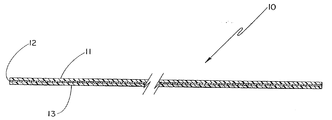
- FIG. 1 is a cross-sectional view of a typical laminate prepared in accordance with the present invention, with the center or metallized layer being shown in somewhat exaggerated form due to limitations of draftsmanship.
- a particularly useful vapor phase corrosion inhibitor for extruded polyethylene film includes a mixture of anhydrous amine molybdates, together with sodium nitrite and benzotriazole.
- the aliphatic amines employed are from the group consisting of dicyclohexylamine, 2-ethylhexylamine, and cyclohexylamine, it being understood that other aliphatic amines within this general category may be found useful as well.
- dicyclohexylamine having a molecular weight of 181.36 and the empirical formula C12H23N is employed.
- the method and procedure set forth in Example I hereinbelow is followed.
- a formulation is prepared with the following components: Component Percent by Weight Dicyclohexylamine 10% Phosphoric acid 4% Water 36% Aqueous solution of ammonium molybdate (20%) 50%
- the 20% ammonium molybdate solution is prepared by adding pure molybdenum trioxide to a 5% aqueous solution of ammonium hydroxide.
- the pH of the resulting solution is normally in the range of 7.5 to 8.5.
- the dicyclohexylamine, phosphoric acid and water are mixed together to form a neutral to slightly alkaline solution, the pH being in the range of 7.5 to 8.5.
- the 20% aqueous solution of ammonium molybdate is then added.
- the reaction that occurs is a simple displacement reaction in which a white powdery precipitate is formed upon addition of the ammonium molybdate solution.
- the anhydrous finished product is a fine white powder having the following structural formula: wherein R1 and R2 are cyclohexyl radicals.
- 2-ethylhexylamine having a molecular weight of 129.2 and the empirical formula C8N19N is employed.
- the method and procedure set forth in Example II hereinbelow is followed.
- a formulation is prepared with the following components:
- the 20% ammonium molybdate solution is prepared as set forth in Example I hereinabove.
- the 2-ethylhexylamine, phosphoric acid and water are mixed together to form a neutral to slightly alkaline solution, the pH being in the range of 7.5 to 8.5.
- the 20% aqueous solution of ammonium molybdate is then added.
- the reaction that occurs is a simple displacement reaction in which a white powdery precipitate is formed upon addition of the ammonium molybdate solution.
- the mixture is cooled to approximately 60°F., after which the precipitate is filtered, washed, and dried until the anhydrous form is obtained.
- the anhydrous finished product is a find white powder having the following structural formula: wherein R1 is a 2-ethylhexyl radical and R2 is hydrogen.
- cyclohexylamine is employed in the preparation of cyclohexylamine-molybdate.
- Cyclohexylamine having a molecular weight of 99.17 and the empirical formula C6H11NH2 is employed. The method and procedure set forth in Example III hereinbelow is followed.
- a formulation is prepared with the following components: Component Percent by Weight Cyclohexylamine 20% Molybdenum trioxide (pure) 13% Water 67%
- the water, molybdenum trioxide and cyclohexylamine are mixed together all at once. While mixing, the solution is heated to approximately 175°F. When the solution becomes clear, the mixture is cooled to 60°-70°CF., whereupon a grey-white precipitate forms. The precipitate is filtered, washed and dried until the anhydrous form is obtained.
- the anhydrous finished product is a white crystalline powder with the following structural formula: wherein R1 is a cyclohexyl radical and wherein R2 is hydrogen.
- amine-molybdates as set forth above are, of course, employed in the anhydrous form. It has been found that such molybdates, when employed in the anhydrous form, will be readily incorporated into olefinic films such as polyethylene and polypropylene. Effective mixtures of the amine-molybdates are normally formulated utilizing 70% by weight anhydrous amine-molybdate of the type shown in Examples A, B and C above, 25% sodium nitrate and 5% benzotriazole.
- the aliphatic amine may be present in an amount ranging from between about 5% and 20%. In the interests of completeness of the reaction involved, it has been found that approximately 10% by weight of the aliphatic amine produces a desirable end product. The reactions involved occur quite rapidly and have been found to go substantially to completion at room temperature.
- the vapor phase corrosion inhibitors are well adapted for extrusion with resinous film material typically employed in the packaging industry.
- the film generally designated 10 includes a first layer of plastic film 11 having a metallic or metallizing layer 12 deposited thereon.
- Layer 13 of laminate 10 is impregnated with the inhibitor with the solid particles being introduced into the film through co-extrusion techniques.
- the amine-molybdate of Example I is prepared, and introduced as a fine white powder into conventional polyethylene film.
- This impregnated film is, in turn, laminated to the metallized layer 12 of film 11 so as to form the composite.
- Laminating techniques for such films are, of course, well known in the art.
- Metallized films of biaxially oriented polyethylene terephthalate are readily bonded to and laminated with polyethylene films of the type shown at 13.
- the vapor phase corrosion inhibitor compounds are also well adapted for retention and/or packaging within modestly porous envelopes or other enclosures.
- envelopes may be formed of plastic film or plastic foam, or alternatively, may be fabricated from cellulosic products such as paper or the like.
- the material may be placed upon or within an appropriate substrate formed of either synthetic resin or cellulosic materials.
- useful material include polyethylene, polypropylene, paper, and the like. When paper is employed, it is preferred that the drying operation be undertaken so as to provide reasonably anhydrous amine-molybdate materials.
- the vapor phase corrosion inhibitors may be extruded or co-extruded with synthetic resin materials such as, for example, polyethylene, polypropylene, or the like. Conventional extrusion or co-extrusion techniques may be employed in this regard.
Landscapes
- Engineering & Computer Science (AREA)
- Chemical & Material Sciences (AREA)
- Mechanical Engineering (AREA)
- Materials Engineering (AREA)
- Metallurgy (AREA)
- Organic Chemistry (AREA)
- Food Science & Technology (AREA)
- Preventing Corrosion Or Incrustation Of Metals (AREA)
Abstract

wherein either (i) R₁ is either a 2-ethylhexyl radical, or an aliphatic hydrocarbon having up to 7 carbon atoms, and wherein R₂ is either hydrogen or an aliphatic hydrocarbon having up to 7 carbon atoms, or (ii) R₁ and R₂ are 2-ethylhexyl radicals. The formulation has a vapor pressure which contributes to an ongoing availability of anti-corrosion protection. The formulation can be extruded with polyolefin films, and can be used in laminates.
Description
- The present invention relates to a method of inhibiting the corrosion of an item by using an anhydrous amine molybdate as a vapor phase corrosion inhibitor.
- In commerce and industry today, the useful life of corrodible items may be extended and/or preserved by providing corrosion inhibitors which protect the corrodible item from the adverse effects of its ambient environment. Corrosion inhibitors, particularly vapor phase corrosion inhibitors, have been found useful in protecting certain corrodible items against reaction with elements or compounds which may be found within their environment, and thereby losing their effectiveness, reducing their useful life, or otherwise diminishing their value. Such protection is typically needed during times of packaging, handling, shipment, or during end use. Elements or compounds which are normally of primary concern are gases such as oxygen, water vapor, sulfides, carbon dioxide, and the like. The formulations of the present invention find particular application in the preparation of packaging material, particularly through in-situ extrusion of the material with such films, with the films thereafter forming an envelope or other enclosure about the article being protected. These films may also be employed as a member of a multi-layer laminate including a metallized film having good tear resistant properties such as stress-oriented polyethylene terephthalate containing a vapor deposited film or layer of metallic aluminum. Such films are commercially available and are commonly designated as "aluminized" films.
- Among the common indications of corrosion manifested in useful metallic articles are oxidation, pitting, tarnishing, mottling, or discoloration of the surfaces of these items. These manifestations occur in the articles, particularly when exposed to oxygen and in either gaseous or liquid phase. Additionally, sulfides may present corrosion or tarnishing problems as well. Inasmuch as both oxygen and water, including water vapor, occur normally and are available in nature, it is normally necessary to take precautions against corrosion when packaging metallic items for shipment, or when subjecting such items to normal use. Metals which are frequently found to be susceptible to corrosion under normal atmospheric and ambient conditions are iron, steel, copper, brass, aluminum, silver, and alloys of these metals. Care must frequently be taken to protect articles fabricated from both ferrous and non-ferrous metals, eg. aluminium, copper and brass, even when their surfaces have been treated so as to be provided with sacrificial or aesthetic coatings of zinc or cadmium on their surfaces. Such sacrificial or aesthetic coatings are, or course, in wide use, but restrictions of use of these materials may appear from time to time due to their potential contribution to pollution or the like. Accordingly, means must be provided to find alternate techniques for the protection and/or preservation of metallic articles.
- In the past, it has been known to provide a package or other enclosure which includes one or more inhibiting compounds along with the corrodible item or items to be protected. Additionally, articles have been protected by means of utilization of protective coatings in the form of solids, liquids, greases, or pastes, however such coatings tend to be temporary in nature and further present certain disadvantages to normal handling and packaging. Furthermore, removal of such protective coatings may present problems either due to incomplete removal, or the costs of such removal.
- Solid phase and liquid phase compounds have been used in the past to provide a source of vapor phase corrosion inhibitors. These materials typically undergo either evaporation or sublimation so as to provide the substantially constant availability of the inhibitors. In other words, vapor phase corrosion inhibitors typically emit vapors which protect corrodible surfaces through the deposition or condensation of a protective film or coating upon the surface. In order to be assured that a constant supply of inhibitor be present, adequate quantities of the solid phase or liquid phase corrosion inhibiting compounds must be provided, with the corrosion inhibiting compounds being released at or adjacent the location where needed.
- Typical corrosion inhibiting articles and materials used in the past are disclosed in Miksic et al U.S. Patent No. 4,051,066 and Miksic et al U.S. Patent No. 4,275,835.
- US-A-4,298,657 discloses a corrosion inhibitor that is deposited, painted or sprayed on an item which is to be protected from corrosion. The inhibitor includes sodium molybdate.
- EP-A-0,015,496 discloses the use of an amine molybdate as a smoke retardant.
- JP-A-60071799 discloses a rust-proofing paper including a volatile rustproofing agent in the form of ammonium molybdate.
- None of the above documents relates to the use of an amine molybdate as a vapor phase corrosion inhibitor.
- The present invention relates to a method of inhibiting corrosion of an item, as set out in claim 1. The pre-characterising part of claim 1 is based on JP-A-60071799, and the distinguishing features of the present invention are set out in the characterising part of claim 1.
- The present invention also relates to the use of an amine molybdate in the manufacture of an inhibitor for the purpose of vapor phase corrosion inhibition.
- In one embodiment, the inhibitor may be extruded with a film material such as an olefinic film, polyethylene, or the like, and placed within the confines of an enclosure housing the item being protected. Alternatively, the inhibitor may be placed within packages containing items which are to be protected from corrosion. Anhydrous mixtures of an amine molybdate along with sodium nitrite and benzotriazole are preferred for these applications, with this mixture further being preferably extruded into polyethylene film at a rate of from between about 2 percent and 3 percent by weight.
- Film materials extruded with the inhibitor may in one embodiment, in turn, by laminated to a second metallized film, such as, for example, metallized polyethylene terephthalate. The combined laminate provides a means to reduce and/or eliminate static build-up in or along the film, and accordingly improves the properties of the film when employed as an enclosure.
- When a laminate is formed in which one layer comprises a heat sealable film such as polyethylene with the inhibitor extruded in-situ, and with a second layer being a material such as metallized stress-oriented polyethylene terephthalate, a desirable combination of properties are achieved. Specifically, the polyethylene film layer retains its conventional heat sealing properties, while the stress-oriented polyethylene terephthalate provides a tear-resistant property. The metallized layer is utilized to reduce and/or eliminate static build-up thereby further enhancing the properties and qualities of the laminate. Stress-oriented polyethylene terephthalate is normally biaxially oriented, and is, of course, commercially available.
- The inhibitor is particularly useful in providing protection to both ferrous and non-ferrous metals, including such non-ferrous metals as aluminum, copper and brass.
- Additionally, the vapor phase corrosion inhibitor produces little, if any, visible residue. The lack of residue enhances the utility of the inhibitor inasmuch as little, if any, mechanical or electrical problems result from the continuous use of this inhibitor.
- The inhibitor is particularly well adapted to be employed as an extrudate with films fabricated from aliphatic hydrocarbon such as polyethylene and polypropylene. In one embodiment, the inhibitor is utilized for retention and/or packaging within modestly porous envelopes or other enclosures formed of plastic film or plastic foam. Typically, those certain enclosures disclosed and claimed in the Miksic et al U.S. Patents 4,051,066 and 4,275,835, as identified hereinabove, are well adapted for use with the inhibitor.
- In accordance with a preferred embodiment, the vapor phase corrosion inhibitor comprises an anhydrous amine-molybdate having the general structural formula:

wherein either, (i) R₁ is either a 2-ethylhexyl radical or an aliphatic hydrocarbon having up to 7 carbon atoms, and wherein R₂ is either hydrogen or an aliphatic hydrocarbon having up to 7 carbon atoms, or (ii) R₁ and R₂ and 2-ethylhexyl radicals. The preferred amine molybdates are derived from the group consisting of dicyclohexylamine, 2-ethylhexylamine, and cyclohexylamine. Such molybdates are readily synthesized and can be prepared in anhydrous form without requiring unusual processing or handling problems. - Other objects of the present invention will become apparent to those skilled in the art upon a study of the following specification, appended claims, and accompanying drawings.
- The figure is a cross-sectional view of a typical laminate prepared in accordance with the present invention, with the center or metallized layer being shown in somewhat exaggerated form due to limitations of draftsmanship.
- In accordance with the preferred embodiment, a particularly useful vapor phase corrosion inhibitor for extruded polyethylene film includes a mixture of anhydrous amine molybdates, together with sodium nitrite and benzotriazole.
- While there are various techniques that may be employed for providing the appropriate extrudate including, for example, polyethylene and a vapor phase corrosion inhibitor of the type described herein, one particular technique has been found to be particularly useful. Specifically, the formation is formed and rendered as uniform as possible, and passed through the barrel of a conventional extruder to form a master batch. The resultant master batch is then chopped and rendered into pellet form. These pellets are, in turn, extruded as the film containing a vapor phase corrosion inhibitor of the type described.
- In order to describe alternate materials useful in connection with the present invention, the synthesis of three amine-molybdate compounds will be described hereinbelow, it being understood that each resultant compound possesses appropriate physical and chemical properties in its anhydrous form so as to be highly useful in connection with the various aspects of the present invention.
- The aliphatic amines employed are from the group consisting of dicyclohexylamine, 2-ethylhexylamine, and cyclohexylamine, it being understood that other aliphatic amines within this general category may be found useful as well.
- Pursuant to this embodiment, dicyclohexylamine having a molecular weight of 181.36 and the empirical formula C₁₂H₂₃N is employed. The method and procedure set forth in Example I hereinbelow is followed.
- A formulation is prepared with the following components:
Component Percent by Weight Dicyclohexylamine 10% Phosphoric acid 4% Water 36% Aqueous solution of ammonium molybdate (20%) 50% - The 20% ammonium molybdate solution is prepared by adding pure molybdenum trioxide to a 5% aqueous solution of ammonium hydroxide. The pH of the resulting solution is normally in the range of 7.5 to 8.5. The dicyclohexylamine, phosphoric acid and water are mixed together to form a neutral to slightly alkaline solution, the pH being in the range of 7.5 to 8.5. The 20% aqueous solution of ammonium molybdate is then added. The reaction that occurs is a simple displacement reaction in which a white powdery precipitate is formed upon addition of the ammonium molybdate solution. Following the completion of the reaction, the mixture is cooled to approximately 60°F., after which the precipitate is filtered, washed, and dried until the anhydrous form is obtained. The anhydrous finished product is a fine white powder having the following structural formula:
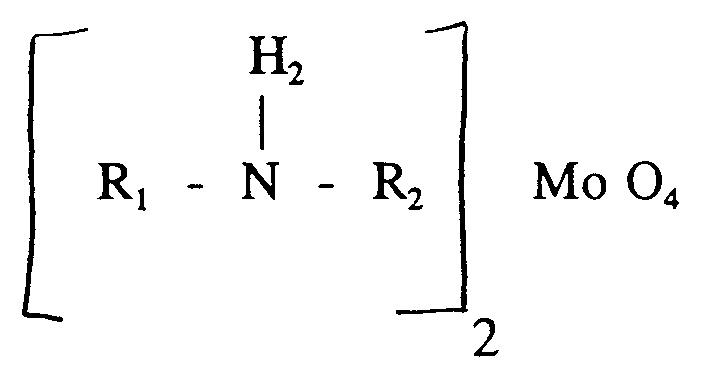
wherein R₁ and R₂ are cyclohexyl radicals. - Pursuant to this embodiment, 2-ethylhexylamine having a molecular weight of 129.2 and the empirical formula C₈N₁₉N is employed. The method and procedure set forth in Example II hereinbelow is followed.
- A formulation is prepared with the following components:


- The 20% ammonium molybdate solution is prepared as set forth in Example I hereinabove. The 2-ethylhexylamine, phosphoric acid and water are mixed together to form a neutral to slightly alkaline solution, the pH being in the range of 7.5 to 8.5. The 20% aqueous solution of ammonium molybdate is then added. The reaction that occurs is a simple displacement reaction in which a white powdery precipitate is formed upon addition of the ammonium molybdate solution. Following the completion of the reaction, the mixture is cooled to approximately 60°F., after which the precipitate is filtered, washed, and dried until the anhydrous form is obtained. The anhydrous finished product is a find white powder having the following structural formula:

wherein R₁ is a 2-ethylhexyl radical and R₂ is hydrogen. - Pursuant to this embodiment, cyclohexylamine is employed in the preparation of cyclohexylamine-molybdate. Cyclohexylamine having a molecular weight of 99.17 and the empirical formula C₆H₁₁NH₂ is employed. The method and procedure set forth in Example III hereinbelow is followed.
- A formulation is prepared with the following components:
Component Percent by Weight Cyclohexylamine 20% Molybdenum trioxide (pure) 13% Water 67% - The water, molybdenum trioxide and cyclohexylamine are mixed together all at once. While mixing, the solution is heated to approximately 175°F. When the solution becomes clear, the mixture is cooled to 60°-70°CF., whereupon a grey-white precipitate forms. The precipitate is filtered, washed and dried until the anhydrous form is obtained. The anhydrous finished product is a white crystalline powder with the following structural formula:

wherein R₁ is a cyclohexyl radical and wherein R₂ is hydrogen. - The amine-molybdates as set forth above are, of course, employed in the anhydrous form. It has been found that such molybdates, when employed in the anhydrous form, will be readily incorporated into olefinic films such as polyethylene and polypropylene. Effective mixtures of the amine-molybdates are normally formulated utilizing 70% by weight anhydrous amine-molybdate of the type shown in Examples A, B and C above, 25% sodium nitrate and 5% benzotriazole.
- In accordance with the examples, the aliphatic amine may be present in an amount ranging from between about 5% and 20%. In the interests of completeness of the reaction involved, it has been found that approximately 10% by weight of the aliphatic amine produces a desirable end product. The reactions involved occur quite rapidly and have been found to go substantially to completion at room temperature.
- While dicyclohexylamine, 2-ethylhexylamine, and cyclohexylamine have been indicated as the most desirable materials, it will, of course, be appreciated that certain conditions of end use along with certain other considerations and parameters may dictate that somewhat smaller aliphatic chain lengths be employed. For example, use of the material in somewhat cooler environments may render it desirable to utilize materials having a somewhat shorter chain length in order to achieve an appropriate degree of sublimation while exposed to ambience. Other considerations may indicate utilization of such shorter chain lengths, as well.
- As has been indicated hereinabove, and with attention being directed to the figure of the drawing, the vapor phase corrosion inhibitors are well adapted for extrusion with resinous film material typically employed in the packaging industry. When employed as a member or layer of a laminate, and with continued attention being directed to the drawing, the film generally designated 10 includes a first layer of
plastic film 11 having a metallic or metallizinglayer 12 deposited thereon.Layer 13 oflaminate 10 is impregnated with the inhibitor with the solid particles being introduced into the film through co-extrusion techniques. For example, the amine-molybdate of Example I is prepared, and introduced as a fine white powder into conventional polyethylene film. This impregnated film is, in turn, laminated to the metallizedlayer 12 offilm 11 so as to form the composite. Laminating techniques for such films are, of course, well known in the art. Metallized films of biaxially oriented polyethylene terephthalate are readily bonded to and laminated with polyethylene films of the type shown at 13. - The vapor phase corrosion inhibitor compounds are also well adapted for retention and/or packaging within modestly porous envelopes or other enclosures. These envelopes may be formed of plastic film or plastic foam, or alternatively, may be fabricated from cellulosic products such as paper or the like. The addition to being retained and/or packaged within envelopes or enclosures, the material may be placed upon or within an appropriate substrate formed of either synthetic resin or cellulosic materials. Typical examples of useful material include polyethylene, polypropylene, paper, and the like. When paper is employed, it is preferred that the drying operation be undertaken so as to provide reasonably anhydrous amine-molybdate materials. As a still further alternative, the vapor phase corrosion inhibitors may be extruded or co-extruded with synthetic resin materials such as, for example, polyethylene, polypropylene, or the like. Conventional extrusion or co-extrusion techniques may be employed in this regard.
Claims (11)
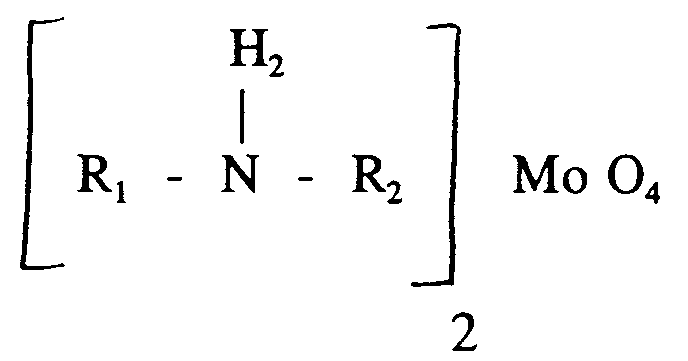
- A method of inhibiting the corrosion of an item, comprising using a molybdate compound as a vapor phase corrosion inhibitor, characterised in that the molybdate compound is a substantially anhydrous amine molybdate.
- The method of claim 1, wherein the amine molybdate is in powder form and has the structural formula:
- The method as defined in claim 2 wherein R₂ is a cyclohexyl radical.
- The method of claim 1, 2 or 3, including enclosing the item and vapor phase corrosion inhibitor in a porous modestly permeable envelope.
- The method of claim 1, 2 or 3, including supporting the vapor phase corrosion inhibitor on a substrate comprising an aliphatic hydrocarbon film selected from the group consisting of polyethylene and polypropylene, by retaining said anhydrous amine molybdate within said substrate through extrusion of the said anhydrous amine molybdate with the film formation; and forming the film into an enclosure enclosing said item.
- The method of claim 5, including extruding the amine molybdate into said film at a proportion of between 2% and 3% by weight.
- The method of claim 5 or 6, including forming a laminate consisting of the first film (13) and a second film layer (11) bonded to a central metallic layer (12) to form a composite structure, wherein said second film (11) comprises a layer of biaxially stress-oriented polyethylene terephthalate; and forming the laminate into said enclosure.
- The method of claim 7, including depositing said central metallic layer (12) upon the surface of said polyethylene terephthalate film, the metallic layer (12) being a film of aluminum.
- Use of an amine molybdate in the manufacture of an inhibitor for the purpose of vapor phase corrosion inhibition.
- The use as in claim 9, wherein the amine molybdate is in powder form and has the structural formula:

- The use as in claim 10, wherein R₂ is a cyclohexyl radical.
Priority Applications (9)
| Application Number | Priority Date | Filing Date | Title |
|---|---|---|---|
| US07/594,357 US5139700A (en) | 1988-08-23 | 1990-09-27 | Vapor phase corrosion inhibitor material |
| EP92303624A EP0566789A1 (en) | 1988-08-23 | 1992-04-22 | Vapor phase corrosion inhibitor material |
| EP94202936A EP0639657A1 (en) | 1988-08-23 | 1992-04-22 | Vapor phase corrosion inhibitor material |
| US07/905,953 US5209869A (en) | 1988-08-23 | 1992-06-29 | Vapor phase corrosion inhibitor-dessiccant material |
| US07/929,621 US5332525A (en) | 1988-08-23 | 1992-08-13 | Vapor phase corrosion inhibitor-desiccant material |
| US08/136,959 US5393457A (en) | 1988-08-23 | 1993-10-14 | Vapor phase corrosion inhibitor-desiccant material |
| US08/136,968 US5344589A (en) | 1988-08-23 | 1993-10-14 | Vapor phase corrosion inhibitor-desiccant material |
| US08/136,980 US5320778A (en) | 1988-08-23 | 1993-10-14 | Vapor phase corrosion inhibitor-desiccant material |
| US08/136,965 US5422187A (en) | 1988-08-23 | 1993-10-14 | Vapor phase corrosion inhibitor-desiccant material |
Applications Claiming Priority (3)
| Application Number | Priority Date | Filing Date | Title |
|---|---|---|---|
| US23512088A | 1988-08-23 | 1988-08-23 | |
| EP92303624A EP0566789A1 (en) | 1988-08-23 | 1992-04-22 | Vapor phase corrosion inhibitor material |
| EP94202936A EP0639657A1 (en) | 1988-08-23 | 1992-04-22 | Vapor phase corrosion inhibitor material |
Related Parent Applications (1)
| Application Number | Title | Priority Date | Filing Date |
|---|---|---|---|
| EP92303624.8 Division | 1992-04-22 |
Publications (1)
| Publication Number | Publication Date |
|---|---|
| EP0639657A1 true EP0639657A1 (en) | 1995-02-22 |
Family
ID=26132012
Family Applications (1)
| Application Number | Title | Priority Date | Filing Date |
|---|---|---|---|
| EP94202936A Ceased EP0639657A1 (en) | 1988-08-23 | 1992-04-22 | Vapor phase corrosion inhibitor material |
Country Status (1)
| Country | Link |
|---|---|
| EP (1) | EP0639657A1 (en) |
Cited By (17)
| Publication number | Priority date | Publication date | Assignee | Title |
|---|---|---|---|---|
| US5958115A (en) * | 1997-02-28 | 1999-09-28 | EXCOR Korrosionsschutz-Technolgien und--Produkte GmbH | Corrosion-inhibiting composite material |
| US6540959B1 (en) | 1998-07-29 | 2003-04-01 | Excor Korrosionsforschung Gmbh | Vapor-phase corrosion inhibitors and methods for their production |
| US6752934B2 (en) | 2001-07-30 | 2004-06-22 | Excor Korrosionsforschung Gmbh | Vapor-phase corrosion inhibitors and method of preparing same |
| WO2007088155A1 (en) * | 2006-01-31 | 2007-08-09 | Corpac Deutschland Gmbh & Co. Kg | Shroud or cover, in particular for containers for corrosion-sensitive freight |
| DE202007017009U1 (en) * | 2007-12-04 | 2009-01-29 | Hans Kolb Wellpappe Gmbh & Co. Kg | Single or multi-layer material web |
| EP2357266A1 (en) | 2010-01-28 | 2011-08-17 | EXCOR Korrosionsforschung GmbH | Compositions of vapour-phase corrosion inhibitors, method for their production and use of same for temporary corrosion protection |
| DE202017100646U1 (en) | 2017-02-08 | 2017-02-21 | Branopac Gmbh | Corrosion protection emitter |
| DE202017101728U1 (en) | 2017-03-24 | 2017-04-11 | Branopac Gmbh | Multi-layer plastic film with anti-corrosion properties |
| DE202017002947U1 (en) | 2017-06-02 | 2017-07-13 | Corrolytic GmbH | Corrosion protection pad |
| DE202017002802U1 (en) | 2017-05-26 | 2017-07-13 | Corroyltic GmbH | Corrosion protection dispenser |
| DE202017003450U1 (en) | 2017-06-29 | 2017-07-27 | Corroyltic GmbH | Corrosion protection fleece |
| DE202017003456U1 (en) | 2017-06-30 | 2017-08-10 | Buhl-Paperform Gmbh | Anticorrosion fiber molding |
| DE202017004118U1 (en) | 2017-08-05 | 2017-09-29 | Corroyltic GmbH | Fiber-containing carrier material for corrosion protection packaging |
| DE202017004232U1 (en) | 2017-08-12 | 2017-10-27 | Corroyltic GmbH | Film for corrosion protection packaging combined with fibrous carrier material |
| DE102017122483B3 (en) | 2017-09-27 | 2018-10-25 | Excor Korrosionsforschung Gmbh | Compositions of vapor-phase corrosion inhibitors and their use and process for their preparation |
| DE202019004197U1 (en) | 2019-10-11 | 2019-10-24 | Corrolytic GmbH | VCI - corrosion protection paper with additional functionality |
| EP3677706A1 (en) | 2019-01-04 | 2020-07-08 | EXCOR Korrosionsforschung GmbH | Compositions and method for pre-treating substrates for subsequent fixation of vapor phase corrosion inhibitors |
Citations (7)
| Publication number | Priority date | Publication date | Assignee | Title |
|---|---|---|---|---|
| FR2261940A1 (en) * | 1974-02-22 | 1975-09-19 | Orchard Corp Of America | |
| JPS5396491A (en) * | 1977-02-04 | 1978-08-23 | Nippon Telegr & Teleph Corp <Ntt> | Complex sleeve |
| US4275835A (en) * | 1979-05-07 | 1981-06-30 | Miksic Boris A | Corrosion inhibiting articles |
| JPS6071799A (en) * | 1983-09-24 | 1985-04-23 | 神崎製紙株式会社 | Vaporizable anti-rust paper |
| EP0205165A2 (en) * | 1985-06-12 | 1986-12-17 | Asahi Denka Kogyo Kabushiki Kaisha | Molybdenum-containing lubricant composition |
| GB2187466A (en) * | 1985-05-23 | 1987-09-09 | Inst Mekhaniki Metallopolimern | Anticorrosive material |
| US4973448A (en) * | 1986-11-18 | 1990-11-27 | Cortec Corporation | Vapor phase corrosion inhibitor product and method containing a desiccant |
-
1992
- 1992-04-22 EP EP94202936A patent/EP0639657A1/en not_active Ceased
Patent Citations (7)
| Publication number | Priority date | Publication date | Assignee | Title |
|---|---|---|---|---|
| FR2261940A1 (en) * | 1974-02-22 | 1975-09-19 | Orchard Corp Of America | |
| JPS5396491A (en) * | 1977-02-04 | 1978-08-23 | Nippon Telegr & Teleph Corp <Ntt> | Complex sleeve |
| US4275835A (en) * | 1979-05-07 | 1981-06-30 | Miksic Boris A | Corrosion inhibiting articles |
| JPS6071799A (en) * | 1983-09-24 | 1985-04-23 | 神崎製紙株式会社 | Vaporizable anti-rust paper |
| GB2187466A (en) * | 1985-05-23 | 1987-09-09 | Inst Mekhaniki Metallopolimern | Anticorrosive material |
| EP0205165A2 (en) * | 1985-06-12 | 1986-12-17 | Asahi Denka Kogyo Kabushiki Kaisha | Molybdenum-containing lubricant composition |
| US4973448A (en) * | 1986-11-18 | 1990-11-27 | Cortec Corporation | Vapor phase corrosion inhibitor product and method containing a desiccant |
Non-Patent Citations (2)
| Title |
|---|
| DATABASE WPI Section Ch Week 8522, Derwent World Patents Index; Class E06, AN 85-132744 * |
| PATENT ABSTRACTS OF JAPAN vol. 2, no. 131 (C - 26) 31 October 1978 (1978-10-31) * |
Cited By (24)
| Publication number | Priority date | Publication date | Assignee | Title |
|---|---|---|---|---|
| US5958115A (en) * | 1997-02-28 | 1999-09-28 | EXCOR Korrosionsschutz-Technolgien und--Produkte GmbH | Corrosion-inhibiting composite material |
| US6540959B1 (en) | 1998-07-29 | 2003-04-01 | Excor Korrosionsforschung Gmbh | Vapor-phase corrosion inhibitors and methods for their production |
| US6752934B2 (en) | 2001-07-30 | 2004-06-22 | Excor Korrosionsforschung Gmbh | Vapor-phase corrosion inhibitors and method of preparing same |
| WO2007088155A1 (en) * | 2006-01-31 | 2007-08-09 | Corpac Deutschland Gmbh & Co. Kg | Shroud or cover, in particular for containers for corrosion-sensitive freight |
| US8348058B2 (en) | 2006-01-31 | 2013-01-08 | Corpac Deutschland Gmbh & Co. Kg | Hood or cover, in particular for containers for a corrosion-sensitive load |
| DE202007017009U1 (en) * | 2007-12-04 | 2009-01-29 | Hans Kolb Wellpappe Gmbh & Co. Kg | Single or multi-layer material web |
| EP2357266A1 (en) | 2010-01-28 | 2011-08-17 | EXCOR Korrosionsforschung GmbH | Compositions of vapour-phase corrosion inhibitors, method for their production and use of same for temporary corrosion protection |
| DE102010006099A1 (en) | 2010-01-28 | 2011-08-18 | EXCOR Korrosionsforschung GmbH, 01067 | Composition of vapor phase corrosion inhibitors, process for their preparation and their use for temporary corrosion protection |
| US8906267B2 (en) | 2010-01-28 | 2014-12-09 | Excor Korrosionsforschung Gmbh | Compositions of vapour phase corrosion inhibitors, method for the production thereof and use thereof for temporary protection against corrosion |
| DE202017100646U1 (en) | 2017-02-08 | 2017-02-21 | Branopac Gmbh | Corrosion protection emitter |
| DE202017101728U1 (en) | 2017-03-24 | 2017-04-11 | Branopac Gmbh | Multi-layer plastic film with anti-corrosion properties |
| DE202017002802U1 (en) | 2017-05-26 | 2017-07-13 | Corroyltic GmbH | Corrosion protection dispenser |
| DE202017002947U1 (en) | 2017-06-02 | 2017-07-13 | Corrolytic GmbH | Corrosion protection pad |
| DE202017003450U1 (en) | 2017-06-29 | 2017-07-27 | Corroyltic GmbH | Corrosion protection fleece |
| DE202017003456U1 (en) | 2017-06-30 | 2017-08-10 | Buhl-Paperform Gmbh | Anticorrosion fiber molding |
| DE202017004118U1 (en) | 2017-08-05 | 2017-09-29 | Corroyltic GmbH | Fiber-containing carrier material for corrosion protection packaging |
| DE202017004232U1 (en) | 2017-08-12 | 2017-10-27 | Corroyltic GmbH | Film for corrosion protection packaging combined with fibrous carrier material |
| DE102017122483B3 (en) | 2017-09-27 | 2018-10-25 | Excor Korrosionsforschung Gmbh | Compositions of vapor-phase corrosion inhibitors and their use and process for their preparation |
| EP3461931A1 (en) | 2017-09-27 | 2019-04-03 | EXCOR Korrosionsforschung GmbH | Compositions of vapour phase corrosion inhibitors and their use and method for preparing them |
| US10753000B2 (en) | 2017-09-27 | 2020-08-25 | Excor Korrosionsforschung Gmbh | Compositions of vapor phase corrosion inhibitors and their use as well as methods for their manufacture |
| EP3677706A1 (en) | 2019-01-04 | 2020-07-08 | EXCOR Korrosionsforschung GmbH | Compositions and method for pre-treating substrates for subsequent fixation of vapor phase corrosion inhibitors |
| DE102019100123A1 (en) | 2019-01-04 | 2020-07-09 | Excor Korrosionsforschung Gmbh | Compositions and methods for pretreating substrates for the subsequent fixation of vapor phase corrosion inhibitors |
| US11827806B2 (en) | 2019-01-04 | 2023-11-28 | Excor Korrosionsforschung Gmbh | Compositions and methods for pretreating substrates for the subsequent fixing of vapor phase corrosion inhibitors |
| DE202019004197U1 (en) | 2019-10-11 | 2019-10-24 | Corrolytic GmbH | VCI - corrosion protection paper with additional functionality |
Similar Documents
| Publication | Publication Date | Title |
|---|---|---|
| US5139700A (en) | Vapor phase corrosion inhibitor material | |
| US5209869A (en) | Vapor phase corrosion inhibitor-dessiccant material | |
| US5332525A (en) | Vapor phase corrosion inhibitor-desiccant material | |
| US5320778A (en) | Vapor phase corrosion inhibitor-desiccant material | |
| US5344589A (en) | Vapor phase corrosion inhibitor-desiccant material | |
| EP0662527A1 (en) | Vapor phase corrosion inhibitor-desiccant material | |
| US5855975A (en) | Anti-corrosion plastic film containing recycled resin | |
| RU2453632C2 (en) | Vapour-phase acid corrosion inhibitors and procedure for their production | |
| RU2287616C2 (en) | Gas-phase corrosion inhibitors and the methods of their production | |
| US5840381A (en) | Corrosion inhibiting laminate sheets and containers | |
| US6033599A (en) | Vapor phase corrosion inhibitors | |
| US5937618A (en) | Vapor phase corrosion inhibitor package utilizing plastic packaging envelopes | |
| US5387368A (en) | Oxygen-scavenging composition | |
| US5894040A (en) | Vapor phase corrosion inhibitors on post-consumer used or recycled paper | |
| AU2004245919B2 (en) | Corrosion inhibiting composition and article containing it | |
| US6540959B1 (en) | Vapor-phase corrosion inhibitors and methods for their production | |
| EP1218567B1 (en) | Anticorrosive plastic packaging materials | |
| WO2003062346A1 (en) | Corrosion inhibiting formula and corrosion inhibiting articles using same | |
| WO2003062313A1 (en) | Tarnish inhibiting formula and tarnish inhibiting articles using same | |
| JP3121489B2 (en) | Formulation of gas phase corrosion inhibitor and desiccant | |
| JPS60251288A (en) | Volatile rust preventive composition for nonferrous metal | |
| CA2390278C (en) | Packaging material for metal | |
| JPH0434939B2 (en) | ||
| WO2025263196A1 (en) | Multilayer rust preventive film for packaging | |
| Miksic | Vapor Phase Corrosion Inhibitor Material |
Legal Events
| Date | Code | Title | Description |
|---|---|---|---|
| PUAI | Public reference made under article 153(3) epc to a published international application that has entered the european phase |
Free format text: ORIGINAL CODE: 0009012 |
|
| 17P | Request for examination filed |
Effective date: 19941021 |
|
| AC | Divisional application: reference to earlier application |
Ref document number: 566789 Country of ref document: EP |
|
| AK | Designated contracting states |
Kind code of ref document: A1 Designated state(s): AT BE CH DE DK ES FR GB GR IT LI LU MC NL PT SE |
|
| RIN1 | Information on inventor provided before grant (corrected) |
Inventor name: TARVIN, MICHAEL Inventor name: MIKSIC, BORIS A. |
|
| 17Q | First examination report despatched |
Effective date: 19950502 |
|
| GRAG | Despatch of communication of intention to grant |
Free format text: ORIGINAL CODE: EPIDOS AGRA |
|
| STAA | Information on the status of an ep patent application or granted ep patent |
Free format text: STATUS: THE APPLICATION HAS BEEN REFUSED |
|
| 18R | Application refused |
Effective date: 19970203 |