EP0641786B1 - Procédé de préparation d'alcool optiquement actif - Google Patents
Procédé de préparation d'alcool optiquement actif Download PDFInfo
- Publication number
- EP0641786B1 EP0641786B1 EP94117505A EP94117505A EP0641786B1 EP 0641786 B1 EP0641786 B1 EP 0641786B1 EP 94117505 A EP94117505 A EP 94117505A EP 94117505 A EP94117505 A EP 94117505A EP 0641786 B1 EP0641786 B1 EP 0641786B1
- Authority
- EP
- European Patent Office
- Prior art keywords
- acid
- optically active
- process according
- alcohol
- group
- Prior art date
- Legal status (The legal status is an assumption and is not a legal conclusion. Google has not performed a legal analysis and makes no representation as to the accuracy of the status listed.)
- Expired - Lifetime
Links
Classifications
-
- C—CHEMISTRY; METALLURGY
- C07—ORGANIC CHEMISTRY
- C07D—HETEROCYCLIC COMPOUNDS
- C07D231/00—Heterocyclic compounds containing 1,2-diazole or hydrogenated 1,2-diazole rings
- C07D231/02—Heterocyclic compounds containing 1,2-diazole or hydrogenated 1,2-diazole rings not condensed with other rings
- C07D231/10—Heterocyclic compounds containing 1,2-diazole or hydrogenated 1,2-diazole rings not condensed with other rings having two or three double bonds between ring members or between ring members and non-ring members
- C07D231/12—Heterocyclic compounds containing 1,2-diazole or hydrogenated 1,2-diazole rings not condensed with other rings having two or three double bonds between ring members or between ring members and non-ring members with only hydrogen atoms, hydrocarbon or substituted hydrocarbon radicals, directly attached to ring carbon atoms
-
- C—CHEMISTRY; METALLURGY
- C07—ORGANIC CHEMISTRY
- C07C—ACYCLIC OR CARBOCYCLIC COMPOUNDS
- C07C29/00—Preparation of compounds having hydroxy or O-metal groups bound to a carbon atom not belonging to a six-membered aromatic ring
- C07C29/132—Preparation of compounds having hydroxy or O-metal groups bound to a carbon atom not belonging to a six-membered aromatic ring by reduction of an oxygen containing functional group
- C07C29/136—Preparation of compounds having hydroxy or O-metal groups bound to a carbon atom not belonging to a six-membered aromatic ring by reduction of an oxygen containing functional group of >C=O containing groups, e.g. —COOH
- C07C29/143—Preparation of compounds having hydroxy or O-metal groups bound to a carbon atom not belonging to a six-membered aromatic ring by reduction of an oxygen containing functional group of >C=O containing groups, e.g. —COOH of ketones
-
- C—CHEMISTRY; METALLURGY
- C07—ORGANIC CHEMISTRY
- C07D—HETEROCYCLIC COMPOUNDS
- C07D233/00—Heterocyclic compounds containing 1,3-diazole or hydrogenated 1,3-diazole rings, not condensed with other rings
- C07D233/54—Heterocyclic compounds containing 1,3-diazole or hydrogenated 1,3-diazole rings, not condensed with other rings having two double bonds between ring members or between ring members and non-ring members
- C07D233/56—Heterocyclic compounds containing 1,3-diazole or hydrogenated 1,3-diazole rings, not condensed with other rings having two double bonds between ring members or between ring members and non-ring members with only hydrogen atoms or radicals containing only hydrogen and carbon atoms, attached to ring carbon atoms
-
- C—CHEMISTRY; METALLURGY
- C07—ORGANIC CHEMISTRY
- C07D—HETEROCYCLIC COMPOUNDS
- C07D249/00—Heterocyclic compounds containing five-membered rings having three nitrogen atoms as the only ring hetero atoms
- C07D249/02—Heterocyclic compounds containing five-membered rings having three nitrogen atoms as the only ring hetero atoms not condensed with other rings
- C07D249/08—1,2,4-Triazoles; Hydrogenated 1,2,4-triazoles
-
- C—CHEMISTRY; METALLURGY
- C07—ORGANIC CHEMISTRY
- C07B—GENERAL METHODS OF ORGANIC CHEMISTRY; APPARATUS THEREFOR
- C07B2200/00—Indexing scheme relating to specific properties of organic compounds
- C07B2200/07—Optical isomers
Definitions
- the present invention relates to a process for producing an optically active alcohol. More particularly, the present invention relates to a process for producing an optically active alcohol by reducing a prochiral ketone with a boron hydride type reducing agent modified with an optically active amino alcohol represented by the general formula (I) wherein R 1 is an aryl group, R 2 is a lower alkyl group, R 3 is a hydrogen atom or a lower alkyl group, and the carbon atoms having a mark * are an asymmetric carbon atom.
- R 1 is an aryl group
- R 2 is a lower alkyl group
- R 3 is a hydrogen atom or a lower alkyl group
- the carbon atoms having a mark * are an asymmetric carbon atom.
- optically active boron hydride type reducing agents obtained by reacting an optically active amino alcohol (I) with an acid and a metal borohydride are useful as asymmetric reducing agents for reducing ketones to obtain optically active corresponding alcohols.
- the finding was disclosed in, for example, JP-A-59-184168, JP-A-61-68471, JP-A-61-18722, JP-A-62-10024, US-A-4760149, EP-A-0171175, EP-A-0142566 and EP-A-0170350.
- the process may be carried out by reacting the ketone compound (II) with a salt between the optically active amino alcohol (I) and an acid, and a metal borohydride in the presence of water.
- the asymmetric reducing agent used in the present invention is prepared from the optically active amino alcohol (I).
- the substituent R 1 in the optically active amino alcohol (I) is a phenyl group which may be substituted with halogen, C 1-5 alkyl, C 1-5 alkoxy, cyano, C 7-10 aralkyloxy, C 6-10 aryloxy or C 1-6 alkoxycarbonyl, or a naphthyl group which may be substituted with halogen, C 1-5 alkyl, cyano, C 1-5 alkoxy or C 1-5 alkoxycarbonyl.
- R 1 are aryl groups such as phenyl, p-tolyl, m-tolyl, o-tolyl, 1-naphthyl, 2,5-dimethylphenyl, 2,5-diethylphenyl, 2,4,6-trimethylphenyl, 2-methoxyphenyl, 2-ethoxyphenyl, 2-propoxyphenyl, 2-isopropoxyphenyl, 2-butoxyphenyl, 2-secbutoxyphenyl, 2-cyclopentyloxyphenyl, 2-cyclohexyloxyphenyl, 2-benzyloxyphenyl, 2-phenoxyphenyl, 2,4-dimethoxyphenyl, 2,4-dipropoxyphenyl, 2,4-dibutoxyphenyl, 2,5-dimethoxyphenyl, 2,5-diethoxyphenyl, 2,5-diisopropoxyphenyl, 2,5-dibutoxyphenyl, 2,4,6-trimethoxyphenyl, 2-
- the substituent R 2 is a lower alkyl group having 1-4 carbon atoms, namely methyl, ethyl, n-propyl, isopropyl, n-butyl, isobutyl, sec-butyl or tert-butyl.
- the substituent R 3 may be, for example, a hydrogen atom or the same lower alkyl group as mentioned for R 2 .
- optically active amino alcohol (I) are 2-amino-1-phenyl-1-propanol, 2-amino-1-(2,5-dimethylphenyl)-1-propanol, 2-amino-1-(2-methoxyphenyl)-1-propanol, 2-amino-1-(2,5-dimethoxyphenyl)-1-propanol, 2-amino-1-(2,5-diethoxyphenyl)-1-propanol, 2-amino-1-(2-ethoxyphenyl)-1-propanol, 2-amino-1-(2-methoxy-5-methylphenyl)-1-propanol, 2-amino-1-( ⁇ -naphthyl)-1-propanol, 2-amino-1-(2-phenoxyphenyl)-1-propanol, 2-amino-1-(2-isopropoxyphenyl)-1-propanol, 2-amino-1-(2-propoxyphenyl)-1-
- the acid may be, for example, a mineral acid such as hydrochloric acid, sulfuric acid, nitric acid or phosphoric acid; a carboxylic acid such as acetic acid; or an organic sulfonic acid such as p-toluenesulfonic acid.
- a mineral acid such as hydrochloric acid, sulfuric acid, nitric acid or phosphoric acid
- a carboxylic acid such as acetic acid
- organic sulfonic acid such as p-toluenesulfonic acid.
- the salt of the optically active amino alcohol (I) and an acid may be, for example a salt of the optically active amino alcohol (I) and one of the above acids.
- the salt may be used as such, or may be formed from the optically active amino alcohol (I) and an acid in the system and successively used.
- the metal borohydride may be, for example, sodium borohydride, potassium borohydride, lithium borohydride or zinc borohydride.
- Sodium borohydride is ordinarily used because of its high availability.
- the substituents R 4 and R 5 in the ketone compound represented by the general formula (II) may be, for example, aryl groups having 6-17 total carbon atoms such as phenyl, halogen-substituted phenyl (e.g. o-, m- and p-chlorophenyls, o-, m-, p-bromophenyls, o-, m- and p-fluorophenyls, 2,3-, 2,4-, 2,5- and 2,6-dichlorophenyls), phenyl substituted with C 1-6 alkyl (e.g.
- phenyl substituted with C 1-6 alkoxy e.g. o-, m- and p-methoxyphenyls, o-, m- and p-ethoxyphenyls, o-, m- and p-propoxyphenyls
- benzyloxy-substituted phenyl e.g.
- o-, m- and p-benzyloxyphenyls 2-benzyloxy-3-methylphenyl, 2-benzyloxy-4-methylphenyl, 2-benzyloxy-5-methylphenyl, 2-benzyloxy-5-tert-butylphenyl, 2-benzyloxy-3-methoxyphenyl, 2-benzyloxy-4-methoxyphenyl, 2-benzyloxy-5-methoxyphenyl, 2-benzyloxy-3,5-dichlorophenyl), ⁇ -naphthyl, ⁇ -naphthyl, C 1-6 lower alkyl groups (e.g.
- benzyl, o-, m- and p-tolylmethyls (o-, m- or p-ethylphenyl)methyl, (2,3-, 2,4-, 2,5- or 2,6-dimethylphenyl)methyl, 2-phenylethyl, 2-(o-, m- or p-tolyl)ethyl, (2,3-, 2,4-, 2,5- or 2,6-dimethylphenyl)ethyl, 3-phenylpropyl, ( ⁇ -naphthyl)methyl and ( ⁇ -naphthyl)methyl].
- the substituent R 6 may be, for example, a 2-substituted-1-triazoleethylene group having, as the 2-substituent, phenyl, chlorophenyl, bromophenyl, dichlorophenyl, dibromophenyl, trifluoromethylphenyl, trichloromethylphenyl, tribromomethylphenyl or cyclohexyl.
- Typical examples of the ketone compound (II) are acetophenone, 2-chloroacetophenone, 2'-chloroacetophenone, 3'-chloroacetophenone, 4'-chloroacetophenone, propiophenone, 3-chloropropiophenone, butyrophenone, 4-chlorobutyrophenone, 2-bromoisobutyrophenone, isobutyrophenone, ⁇ -acetonaphthone, ⁇ -acetonaphthone, phenyl benzyl ketone, phenyl p-tolylmethyl ketone, phenyl m-tolylmethyl ketone, phenyl o-tolylmethyl ketone, 2-butanone, 2-pentanone, 2-hexanone, 3-hexanone, 2-heptanone, 2-octanone, 1-phenyl-2- (1,2,4-triazol-1-yl)-4,4-d
- the reaction is effected in the presence of a solvent.
- the solvent can be any unless it takes part in the reaction. Examples are aromatic hydrocarbons such as benzene, toluene, xylene and chlorobenzene; halogenated hydrocarbons such as methylene chloride, 1,2-dichloroethane, chloroform and carbon tetrachloride; ethers such as diethyl ether, tetrahydrofuran, diglyme and dioxane; and their mixtures.
- the solvent is used in an amount, ordinarily, of 1-50 parts by weight per part by weight of the ketone compound (II).
- the use of a secondary or tertiary alcohol, in particular, together with the solvent brings about advantages such as improved optical yield .
- the secondary alcohol may be, for example, isopropanol, sec-butanol, cyclopentanol, cyclohexanol, menthol, methylpropyl alcohol, methylisobutyl alcohol for 2-octanol.
- the tertiary alcohol may be, for example, tert-butanol, tert-amyl alcohol, 1,1,2,2-tetramethylpropanol, 1,1,2-trimethylpropanol, 2,2,3-tri- methyl-3-pentanol, 2,2,3,4-tetramethyl-3-pentanol, 2,2,3,4,4-pentamethyl-3-pentanol, 3-methyl-3-pentanol, 3-methyl- 3-hexanol, 1-ethyl-1-ethylpropanol, 1,1-diethylpropanol, 1,1-dimethylbutanol, 2,3-dimethyl-3-pentanol or 2,3,4-trimethyl-3-pentanol.
- the secondary or tertiary alcohol is used in an amount, ordinarily, of at least 0.5 mole, preferably 1-30 moles, more preferably 3-15 moles per mole of the optically active amino alcohol (I).
- the reaction is ordinarily effected by adding water to a mixture consisting of a solvent, the metal borohydride, the salt of the optically active amino alcohol (I) and the acid, and the ketone compound (II).
- the reaction can also be effected by adding an aqueous solution of the metal borohydride to a mixture consisting of a solvent, the salt of the optically active amino alcohol (I) and the acid, and the ketone compound (II).
- the salt of the optically active amino alcohol (I) and the acid is used in an amount of 0.3-1 mole per mole of the ketone compound (II).
- the metal borohydride is used in an amount ordinarily, of, at least 0.5 mole, preferably 0.5-2 moles, more preferably 0.8-1.5 moles (in terms of boron) per mole of the ketone compound (II), and in an amount of 1.25-5 moles, preferably 1.4-3.5 moles (in terms of boron) per mole of the optically active amino alcohol (I).
- Water is used in an amount, ordinarily, of 1-20 moles per mole of the optically active amino alcohol (I).
- the reaction temperature is in a range, ordinarily, of 0° -100°C, preferably 0°-50°C.
- the reaction is effected ordinarily in an inert gas atmosphere such as nitrogen or argon.
- the reaction mixture is ordinarily mixed with an aqueous solution of a mineral acid such as hydrochloric acid or sulfuric acid to separate the organic layer from the aqueous layer.
- a mineral acid such as hydrochloric acid or sulfuric acid
- the organic layer is washed with water and dried.
- the resulting organic layer is subjected to distillation to remove the organic solvent and so easily obtain the desired optically active alcohol (IV).
- the optical yield can be determined by measuring the optical rotation of the product obtained, or by directly measuring the enantiomer ratio of the product by high-performance liquid chromatography with optically active packing materials.
- optically active amino alcohol (I) can be easily recovered with the steric configuration kept unchanged, by adding an aqueous alkali solution to the above separated aqueous layer and then extracting the resulting mixture with an organic solvent, and can be reused.
- the desired optically active alcohol (IV) in a process embodying the present invention, a very short reaction time can be used; the preparation of the reducing agent and the reduction reaction can be effected simultaneously in the same container; the amount of the optically active amino alcohol (I) as a ligand can be low; therefore, the present process is advantageous in industrial application, in particular.
- the mixture was cooled to 15°C. Thereto was added by drops 2.0 g (111.1 mmoles) of water in 3.25 hours with stirring at the same temperature. Thereafter, the mixture was stirred for 1 hour at 25°C.
- the enantiomer ratio of the E-form alcohol was analyzed by high-performance liquid chromatography using an optically active column.
- the enantiomer ratio was 86% of a (-)-isomer and 14% of a (+)-isomer.
- An optically active alcohol was produced in the same manner as in Example 3 except that water was used in an mount of 1.25 g (69.4 mmoles) and the temperature and stirring time after water addition were 15°C and 3 hours, respectively.
- the conversion was 99.9%.
- the product composition was 97.5% of an E-form alcohol, 2.3% of a Z-form alcohol and 0.2% of a saturated-form alcohol.
- the enantiomer ratio of the E-form alcohol was 82.5% of (-)-isomer and 17.5% of (+)-isomer.
- An optically active alcohol was produced in the same manner as in Example 1 except that 35.2 g of monochlorobenzene and 1.3 g (6.93 mmoles) of (+)-norephedrine hydrochloride were used and that water was added at 10°C in 1.75 hours and then stirring was effected for 3.5 hours at 25°C.
- the conversion was 99.9%.
- the product consisted of 98.3% of an E-form alcohol, 0.8% of a Z-form alcohol and 0.9% of a saturated-form alcohol.
- the enantiomer ratio of the E-form alcohol was 77.4% of a (-)-isomer and 22.6% of a (+)-isomer.
- An optically active alcohol was produced in the same manner as in Example 1 except that norephedrine hydrochloride was replaced by (-)-2-amino-1-(2,5-dimethoxyphenyl)-1-propanol hydrochloride. The results are shown in Table 2.
- the product consisted of 93.3% of (E)-1-(4-chlorophenyl)-2-(1,2,4-triazol-1-yl)-4,4-dimethyl-1-penten-3-ol (E-form alcohol), 5.6% of (Z)-1-(4-chlorophenyl)-2-(1,2,4-triazol-1-yl)-4,4-dimethyl-1-penten-3-ol (Z-form alcohol) and 1.1% of 1-(4-chlorophenyl)- 2-(1,2,4-triazol-1-yl)-4,4-dimethylpentan-3-ol (saturated-form alcohol).
- the enantiomer ratio of the E-form alcohol was 83.5% of a (-)-isomer and 16.5% of a (+)-isomer.
- the conversion was 100%.
- the product consisted of 95.2% of (E)-1-cyclohexyl-2-(1,2,4-triazol-1-yl)-4,4-dimethyl-1-penten-3-ol (E-form alcohol), 4.3% of (Z)-1-cyclohexyl-2-(1,2,4-trlazol-1-yl)-4,4-dimethyl-1-penten-3-ol (Z-form alcohol) and 0.5% of 1-cyclohexyl-2-(1,2,4-triazol-1-yl)-4,4-dimethylpentan-3-ol (saturated-form alcohol).
- the enantiomer ratio of the E-form alcohol was 14% of a (-)-isomer and 86% of a (+)-isomer.
- An optically active alcohol was produced in the same manner as in Example 1 except that (+)-norephedrine hydrochloride wan replaced by (-)-norephedrine hydrochloride, and the procedure of suspending (+)-norephedrine hydrochloride together with sodium borohydride and adding water thereto by drops was replaced by suspending (-)-norephedrine hydrochloride only and adding dropwise a solution consisting of 0.961 g of sodium borohydride, 2.0 g of water and 7 mg of sodium hydroxide thereto in 2 hours.
- the conversion was 99.5%.
- the product consisted of 93.3% of an E-form alcohol, 6.4% of a Z-form alcohol and 0.3% of a saturated-form alcohol.
- the enantiomer ratio of the E-form alcohol was 84% of a (+)-isomer and 16% of a (-)-isomer.
- the conversion was 94.3%.
- the enantiomer ratio was 69.6% of a (-)-isomer and 30.4% of a (+)-isomer.
- (+)-norephedrine hydrochloride was suspended in 96 ml of 1,2-dichloroethane. The suspension was cooled to -25°C. Thereto was added a solution of 1.31 g of sodium borohydride dissolved in 19 ml of dimethylformamide. The suspension was returned from -25°C to 25°C in 2 hours.
- (+)-norephedrine hydrochloride was suspended in 13.7 g of monochlorobenzene in a nitrogen atmosphere. The suspension was cooled to -25°C. Thereto were added a solution consisting of 0.961 g of sodium borohydride and 10 ml of dimethylformamide. The mixture was returned to 25°C in 2 hours.
- Example 1 To the mixture being stirred at 15°C was added a solution consisting of 7.48 g of the same (E)-1-(2,4-dichlorophenyl)-2-(1,2,4-triazol-1-yl)-4,4-dimethyl-1-penten-3-one as used in Example 1 and 16.4 g of monochlorobenzene. The resulting mixture was stirred for 4 hours at the same temperature. Then, the work up and analyses were made in the same manner as in Example 1.
- the conversion was 98.2%.
- the product consisted of 63.9% of an E-form alcohol, 25.2% of a Z-form alcohol and 38.7% of a saturated alcohol.
- the enantiomer ratio off the E-form alcohol was 70.3% of a (-)-isomer and 29.7% of a (+)-isomer.
Landscapes
- Chemical & Material Sciences (AREA)
- Organic Chemistry (AREA)
- Organic Low-Molecular-Weight Compounds And Preparation Thereof (AREA)
Claims (17)
- Procédé de préparation d'un alcool optiquement actif représenté par la formule générale (IV)


par réduction d'un composé cétone préchiral représenté par la formule générale (II)
avec un agent réducteur asymétrique de type borohydrure, modifié par un alcool optiquement actif représenté par la formule générale (I)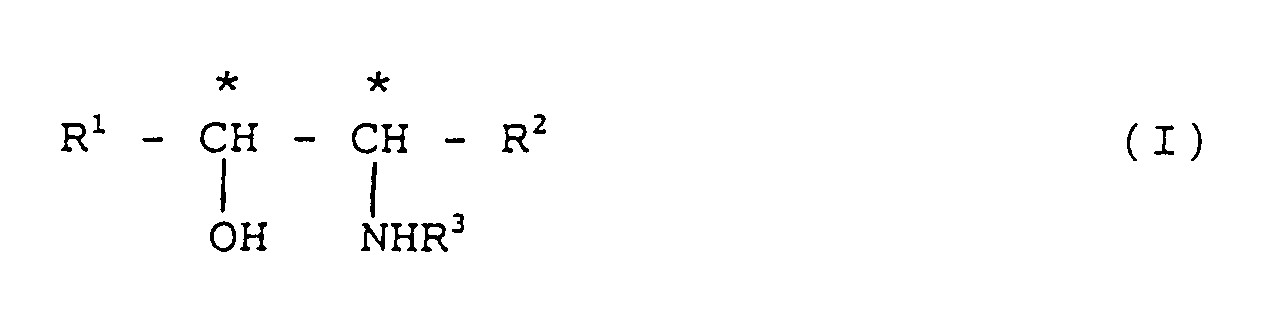
ledit procédé comprenant la mise en contact(1) de la cétone préchirale
avec chacun des composants individuels suivants :(2) un sel d'un aminoalcool optiquement actif représenté par la formule générale (I) et d'un acide, présent sous la forme du sel ou in situ sous la forme d'un mélange de l'amino alcool optiquement actif représenté par la formule générale (I) et de l'acide(3) un borohydrure de métal,(4) un solvant,(5) un alcool secondaire ou tertiaire, et(6) de l'eau ;le rapport molaire dudit sel d'aminoalcool-acide (2):la cétone préchirale (1) tombant dans la gamme de 0,3:1 à 1:1 et
le rapport molaire, en terme de bore, du borohydrure de métal (3):audit sel d'aminoalcool et d'acide (2) tombant dans la gamme de 1,25:1 à 5:1. - Procédé selon la revendication 1, dans lequel, dans la formule (I),R1 est un groupement phényle, éventuellement substitué par un groupement alkyle en C1-C5 ou alcoxy en C1-C5,R2 est un groupement alkyle en C1-C5, etR3 est un atome d'hydrogène ou un groupement méthyle dans la formule générale (I).
- Procédé selon la revendication 1 ou la revendication 2, où dans l'alcool représenté par la formule (IV),R4 est un groupement alkyle en C1-C6 ; etR5 est un groupement phényle ou un groupement 1-triazoloéthylène 2-substitué de formule (III) donné et défini dans la revendication 1.
- Procédé selon la revendication 3, où R5 est un groupement 1-triazoloéthylène 2-substitué de formule (III) et le substituant R6 est un groupement phényle, chlorophényle, bromophényle, dichlorophényle, dibromophényle, trifluorophényle, trichlorométhylphényle, tribromométhylphényle ou cyclohexyle.
- Procédé selon l'une quelconque des revendications 1 à 4, où l'acide est l'acide chlorhydrique, l'acide sulfurique, l'acide nitrique, l'acide phosphorique, l'acide acétique, l'acide benzènesulfonique ou l'acide p-toluènesulfonique.
- Procédé selon l'une quelconque des revendications 1 à 5, où le composant (2) est un sel de l'aminoalcool optiquement actif (I) et d'un acide.
- Procédé selon la revendication 6, où le sel de l'aminoalcool optiquement actif (I) et d'un acide est un sel de l'aminoalcool optiquement actif (I) et d'un acide minéral, d'un acide carboxylique ou d'un acide sulfonique.
- Procédé selon la revendication 6 ou la revendication 7, où le sel de l'aminoalcool optiquement actif (I) et d'un acide est utilisé en une quantité de 0,3 - 1 mole par mole du composé cétone (II).
- Procédé selon l'une quelconque des revendications 1 à 8, où le borohydrure de métal est le borohydrure de sodium.
- Procédé selon l'une quelconque des revendications 6 à 9, où le borohydrure de métal est utilisé en une quantité de 0,8 - 1,5 moles (en terme de bore) par mole du composé cétone (II).
- Procédé selon l'une quelconque des revendications 6 à 10, où le borohydrure de métal est utilisé en une quantité de 1,4 - 3,5 moles (en terme de bore) par mole de l'aminoalcool optiquement actif (I).
- Procédé selon l'une quelconque des revendications 1 à 11, où l'alcool secondaire ou tertiaire est utilisé en une quantité de 3 - 15 moles par mole de l'aminoalcool optiquement actif (I).
- Procédé selon l'une quelconque des revendications 1 à 12, où on utilise comme solvant un hydrocarbure aromatique, un hydrocarbure halogéné ou un éther.
- Procédé selon la revendication 13, où le solvant est utilisé en une quantité de 1 - 50 parties en poids par partie en poids du composé cétone (II).
- Procédé selon l'une quelconque des revendications 6 à 14, qui est effectué en ajoutant de l'eau à un mélange constitué d'un solvant, du borohydrure de métal, du sel de l'aminoalcool optiquement actif (I) et d'un acide, et du composé cétone (II).
- Procédé selon l'une quelconque des revendications 6 à 15, où l'eau est utilisée en une quantité de 1 - 20 moles par mole d'aminoalcool optiquement actif (I).
- Procédé selon l'une quelconque des revendications 6 à 16, où la température réactionnelle est de 0 - 50°C.
Applications Claiming Priority (5)
| Application Number | Priority Date | Filing Date | Title |
|---|---|---|---|
| JP1022243A JP2792076B2 (ja) | 1989-01-30 | 1989-01-30 | 光学活性アルコールの製造方法 |
| JP22243/89 | 1989-01-30 | ||
| JP1099730A JP2682129B2 (ja) | 1989-04-18 | 1989-04-18 | 還元剤、その製法およびそれを用いる光学活性アルコール類の製造方法 |
| JP99730/89 | 1989-04-18 | ||
| EP90300938A EP0381434B1 (fr) | 1989-01-30 | 1990-01-30 | Procédé pour la préparation d'alcools optiquement actifs |
Related Parent Applications (2)
| Application Number | Title | Priority Date | Filing Date |
|---|---|---|---|
| EP90300938.9 Division | 1990-01-30 | ||
| EP90300938A Division-Into EP0381434B1 (fr) | 1989-01-30 | 1990-01-30 | Procédé pour la préparation d'alcools optiquement actifs |
Publications (2)
| Publication Number | Publication Date |
|---|---|
| EP0641786A1 EP0641786A1 (fr) | 1995-03-08 |
| EP0641786B1 true EP0641786B1 (fr) | 1997-08-20 |
Family
ID=26359414
Family Applications (2)
| Application Number | Title | Priority Date | Filing Date |
|---|---|---|---|
| EP94117505A Expired - Lifetime EP0641786B1 (fr) | 1989-01-30 | 1990-01-30 | Procédé de préparation d'alcool optiquement actif |
| EP90300938A Expired - Lifetime EP0381434B1 (fr) | 1989-01-30 | 1990-01-30 | Procédé pour la préparation d'alcools optiquement actifs |
Family Applications After (1)
| Application Number | Title | Priority Date | Filing Date |
|---|---|---|---|
| EP90300938A Expired - Lifetime EP0381434B1 (fr) | 1989-01-30 | 1990-01-30 | Procédé pour la préparation d'alcools optiquement actifs |
Country Status (3)
| Country | Link |
|---|---|
| US (1) | US5144039A (fr) |
| EP (2) | EP0641786B1 (fr) |
| DE (2) | DE69030455T2 (fr) |
Families Citing this family (2)
| Publication number | Priority date | Publication date | Assignee | Title |
|---|---|---|---|---|
| EP0713848B1 (fr) * | 1994-10-28 | 1999-09-08 | SUMIKA FINE CHEMICALS Company, Limited | Procédé de production des carbinols optiquement actifs |
| US5801280A (en) * | 1995-04-07 | 1998-09-01 | Sumitomo Chemical Company, Limited | Processes for preparing optically active alcohols and optically active amines |
Family Cites Families (3)
| Publication number | Priority date | Publication date | Assignee | Title |
|---|---|---|---|---|
| HU202873B (en) * | 1983-04-04 | 1991-04-29 | Sumitomo Chemical Co | Process for producing asymmetrically modified boron hydride type compounds |
| EP0178325B1 (fr) * | 1984-04-03 | 1992-04-22 | Sumitomo Chemical Company, Limited | Composés du tipe borhydrides et leur utilisation dans un procédé de préparation d'alcools alfa,beta-insaturés optiquement actifs |
| JPS6118790A (ja) * | 1984-07-05 | 1986-01-27 | Sumitomo Chem Co Ltd | 光学活性ボラン錯体およびその製造法 |
-
1990
- 1990-01-29 US US07/471,966 patent/US5144039A/en not_active Expired - Lifetime
- 1990-01-30 EP EP94117505A patent/EP0641786B1/fr not_active Expired - Lifetime
- 1990-01-30 EP EP90300938A patent/EP0381434B1/fr not_active Expired - Lifetime
- 1990-01-30 DE DE69030455T patent/DE69030455T2/de not_active Expired - Lifetime
- 1990-01-30 DE DE69031315T patent/DE69031315T2/de not_active Expired - Fee Related
Also Published As
| Publication number | Publication date |
|---|---|
| DE69030455D1 (de) | 1997-05-22 |
| EP0641786A1 (fr) | 1995-03-08 |
| DE69031315D1 (de) | 1997-09-25 |
| EP0381434B1 (fr) | 1997-04-16 |
| US5144039A (en) | 1992-09-01 |
| DE69030455T2 (de) | 1997-08-14 |
| DE69031315T2 (de) | 1998-01-22 |
| EP0381434A1 (fr) | 1990-08-08 |
Similar Documents
| Publication | Publication Date | Title |
|---|---|---|
| CA2079226C (fr) | Preparation de sels d'imidazolium 1,3-disubstitues | |
| US6177575B1 (en) | Process for manufacture of imidazoles | |
| EP0142566B1 (fr) | Composes d'hydrure de bore modifies de maniere asymetrique, leur procede de preparation et procede de preparation de derives d'alcool optiquement actifs utilisant ces composes | |
| EP0171175B1 (fr) | Complexe de borane optiquement actif et méthode pour la préparation d'un alcool optiquement actif par usage de celui-ci | |
| NZ204500A (en) | Hydroxyalkynylazoles and fungicidal compositions | |
| US4929735A (en) | Process for the preparation of oxiranes | |
| JP2792046B2 (ja) | 光学活性なアミン−ホウ素系化合物、それを有効成分とする不斉還元剤ならびにそれを用いる光学活性化合物の製造方法 | |
| EP0641786B1 (fr) | Procédé de préparation d'alcool optiquement actif | |
| US5144071A (en) | Method for producing an optically active azolyl-α,β-unsaturated alcohol | |
| CA1280757C (fr) | Preparation de monochloropinacolone | |
| JP2682129B2 (ja) | 還元剤、その製法およびそれを用いる光学活性アルコール類の製造方法 | |
| EP0170350B1 (fr) | Composé du type bor-hydride asymétriquement modifié, méthode de production et procédé pour la production d'un dérivé d'alcool optiquement actif par usage de celui-ci | |
| US5698742A (en) | Method for producing an optically active azolyl-α, β-unsaturated alcohol | |
| GB2078222A (en) | 4-(3-iodopropargyloxy)pyrimidines | |
| CA1221097A (fr) | Compose du type hydrure de bore avec modification asymetrique; preparation et methode pour obtenir un derive d'alcool optiquement actif grace a ce compose | |
| JP4754145B2 (ja) | 2−(1,2,4−トリアゾール−1−イル)−エタノール類の製造法 | |
| JPH0114914B2 (fr) | ||
| JPH0517232B2 (fr) | ||
| SK287354B6 (sk) | Spôsob prípravy monohydrátu a kryštalických modifikácií flukonazolu | |
| KR100196652B1 (ko) | 트리아졸 유도체의 제조방법 | |
| WO2000075094A2 (fr) | Procede de production d'une acetophenone halogenee | |
| JPH0528227B2 (fr) | ||
| JPH0413342B2 (fr) | ||
| HU202178B (en) | Process for producing aldehyde by hydrogenation of nitryl | |
| KR19980067686A (ko) | 트리아졸 유도체의 제조방법 |
Legal Events
| Date | Code | Title | Description |
|---|---|---|---|
| PUAI | Public reference made under article 153(3) epc to a published international application that has entered the european phase |
Free format text: ORIGINAL CODE: 0009012 |
|
| AC | Divisional application: reference to earlier application |
Ref document number: 381434 Country of ref document: EP |
|
| AK | Designated contracting states |
Kind code of ref document: A1 Designated state(s): CH DE FR GB IT LI NL |
|
| 17P | Request for examination filed |
Effective date: 19950717 |
|
| RIN1 | Information on inventor provided before grant (corrected) |
Inventor name: IKEDA, TAKAHARU, SUMITOMOKAGAKU HIGASHICHO AP. 21 Inventor name: KONYA, NAOTO Inventor name: SUZUKAMO, GOHFU Inventor name: YONEYOSHI, YUKIO |
|
| GRAG | Despatch of communication of intention to grant |
Free format text: ORIGINAL CODE: EPIDOS AGRA |
|
| 17Q | First examination report despatched |
Effective date: 19961029 |
|
| GRAH | Despatch of communication of intention to grant a patent |
Free format text: ORIGINAL CODE: EPIDOS IGRA |
|
| GRAH | Despatch of communication of intention to grant a patent |
Free format text: ORIGINAL CODE: EPIDOS IGRA |
|
| GRAA | (expected) grant |
Free format text: ORIGINAL CODE: 0009210 |
|
| AC | Divisional application: reference to earlier application |
Ref document number: 381434 Country of ref document: EP |
|
| AK | Designated contracting states |
Kind code of ref document: B1 Designated state(s): CH DE FR GB IT LI NL |
|
| REG | Reference to a national code |
Ref country code: CH Ref legal event code: NV Representative=s name: A. BRAUN, BRAUN, HERITIER, ESCHMANN AG PATENTANWAE Ref country code: CH Ref legal event code: EP |
|
| REF | Corresponds to: |
Ref document number: 69031315 Country of ref document: DE Date of ref document: 19970925 |
|
| ET | Fr: translation filed | ||
| PLBE | No opposition filed within time limit |
Free format text: ORIGINAL CODE: 0009261 |
|
| STAA | Information on the status of an ep patent application or granted ep patent |
Free format text: STATUS: NO OPPOSITION FILED WITHIN TIME LIMIT |
|
| 26N | No opposition filed | ||
| REG | Reference to a national code |
Ref country code: GB Ref legal event code: IF02 |
|
| PGFP | Annual fee paid to national office [announced via postgrant information from national office to epo] |
Ref country code: FR Payment date: 20020110 Year of fee payment: 13 |
|
| PGFP | Annual fee paid to national office [announced via postgrant information from national office to epo] |
Ref country code: GB Payment date: 20020130 Year of fee payment: 13 |
|
| PGFP | Annual fee paid to national office [announced via postgrant information from national office to epo] |
Ref country code: NL Payment date: 20020131 Year of fee payment: 13 Ref country code: CH Payment date: 20020131 Year of fee payment: 13 |
|
| PGFP | Annual fee paid to national office [announced via postgrant information from national office to epo] |
Ref country code: DE Payment date: 20020227 Year of fee payment: 13 |
|
| PG25 | Lapsed in a contracting state [announced via postgrant information from national office to epo] |
Ref country code: GB Free format text: LAPSE BECAUSE OF NON-PAYMENT OF DUE FEES Effective date: 20030130 |
|
| PG25 | Lapsed in a contracting state [announced via postgrant information from national office to epo] |
Ref country code: LI Free format text: LAPSE BECAUSE OF NON-PAYMENT OF DUE FEES Effective date: 20030131 Ref country code: CH Free format text: LAPSE BECAUSE OF NON-PAYMENT OF DUE FEES Effective date: 20030131 |
|
| PG25 | Lapsed in a contracting state [announced via postgrant information from national office to epo] |
Ref country code: NL Free format text: LAPSE BECAUSE OF NON-PAYMENT OF DUE FEES Effective date: 20030801 Ref country code: DE Free format text: LAPSE BECAUSE OF NON-PAYMENT OF DUE FEES Effective date: 20030801 |
|
| REG | Reference to a national code |
Ref country code: CH Ref legal event code: PL |
|
| GBPC | Gb: european patent ceased through non-payment of renewal fee | ||
| PG25 | Lapsed in a contracting state [announced via postgrant information from national office to epo] |
Ref country code: FR Free format text: LAPSE BECAUSE OF NON-PAYMENT OF DUE FEES Effective date: 20030930 |
|
| NLV4 | Nl: lapsed or anulled due to non-payment of the annual fee |
Effective date: 20030801 |
|
| REG | Reference to a national code |
Ref country code: FR Ref legal event code: ST |
|
| PG25 | Lapsed in a contracting state [announced via postgrant information from national office to epo] |
Ref country code: IT Free format text: LAPSE BECAUSE OF NON-PAYMENT OF DUE FEES;WARNING: LAPSES OF ITALIAN PATENTS WITH EFFECTIVE DATE BEFORE 2007 MAY HAVE OCCURRED AT ANY TIME BEFORE 2007. THE CORRECT EFFECTIVE DATE MAY BE DIFFERENT FROM THE ONE RECORDED. Effective date: 20050130 |