EP0645199A1 - Verfahren zur rehabilitierung von verunreinigten Böden und Anlage zur Durchführung des Verfahrens - Google Patents
Verfahren zur rehabilitierung von verunreinigten Böden und Anlage zur Durchführung des Verfahrens Download PDFInfo
- Publication number
- EP0645199A1 EP0645199A1 EP94402165A EP94402165A EP0645199A1 EP 0645199 A1 EP0645199 A1 EP 0645199A1 EP 94402165 A EP94402165 A EP 94402165A EP 94402165 A EP94402165 A EP 94402165A EP 0645199 A1 EP0645199 A1 EP 0645199A1
- Authority
- EP
- European Patent Office
- Prior art keywords
- polluted
- cell
- contacting
- soil
- contactors
- Prior art date
- Legal status (The legal status is an assumption and is not a legal conclusion. Google has not performed a legal analysis and makes no representation as to the accuracy of the status listed.)
- Ceased
Links
- 239000002689 soil Substances 0.000 title claims abstract description 50
- 238000000034 method Methods 0.000 title claims abstract description 30
- 239000000243 solution Substances 0.000 claims abstract description 17
- 238000002347 injection Methods 0.000 claims abstract description 7
- 239000007924 injection Substances 0.000 claims abstract description 7
- 239000002904 solvent Substances 0.000 claims description 12
- 238000009434 installation Methods 0.000 claims description 11
- 239000003960 organic solvent Substances 0.000 claims description 5
- 239000012298 atmosphere Substances 0.000 claims description 2
- 239000003344 environmental pollutant Substances 0.000 description 13
- 231100000719 pollutant Toxicity 0.000 description 13
- IJGRMHOSHXDMSA-UHFFFAOYSA-N Atomic nitrogen Chemical compound N#N IJGRMHOSHXDMSA-UHFFFAOYSA-N 0.000 description 10
- 239000006185 dispersion Substances 0.000 description 5
- 238000000605 extraction Methods 0.000 description 5
- 229910052757 nitrogen Inorganic materials 0.000 description 5
- 238000000926 separation method Methods 0.000 description 5
- 238000010908 decantation Methods 0.000 description 4
- 238000002156 mixing Methods 0.000 description 4
- 238000005192 partition Methods 0.000 description 4
- 230000008929 regeneration Effects 0.000 description 4
- 238000011069 regeneration method Methods 0.000 description 4
- 230000005484 gravity Effects 0.000 description 3
- 239000002245 particle Substances 0.000 description 3
- 238000005325 percolation Methods 0.000 description 3
- 239000006200 vaporizer Substances 0.000 description 3
- QVGXLLKOCUKJST-UHFFFAOYSA-N atomic oxygen Chemical compound [O] QVGXLLKOCUKJST-UHFFFAOYSA-N 0.000 description 2
- 238000004090 dissolution Methods 0.000 description 2
- 238000001035 drying Methods 0.000 description 2
- 238000001704 evaporation Methods 0.000 description 2
- 230000008020 evaporation Effects 0.000 description 2
- 239000012530 fluid Substances 0.000 description 2
- 239000007789 gas Substances 0.000 description 2
- 239000013529 heat transfer fluid Substances 0.000 description 2
- 239000007788 liquid Substances 0.000 description 2
- 239000001301 oxygen Substances 0.000 description 2
- 229910052760 oxygen Inorganic materials 0.000 description 2
- 239000012855 volatile organic compound Substances 0.000 description 2
- 238000005406 washing Methods 0.000 description 2
- XLYOFNOQVPJJNP-UHFFFAOYSA-N water Substances O XLYOFNOQVPJJNP-UHFFFAOYSA-N 0.000 description 2
- 238000009825 accumulation Methods 0.000 description 1
- 230000006978 adaptation Effects 0.000 description 1
- 238000013019 agitation Methods 0.000 description 1
- 150000001298 alcohols Chemical class 0.000 description 1
- 150000001335 aliphatic alkanes Chemical class 0.000 description 1
- 150000001555 benzenes Chemical class 0.000 description 1
- 239000012455 biphasic mixture Substances 0.000 description 1
- 239000003795 chemical substances by application Substances 0.000 description 1
- 230000000536 complexating effect Effects 0.000 description 1
- 238000001816 cooling Methods 0.000 description 1
- 239000010779 crude oil Substances 0.000 description 1
- 239000002283 diesel fuel Substances 0.000 description 1
- 239000010419 fine particle Substances 0.000 description 1
- 230000004907 flux Effects 0.000 description 1
- 239000003517 fume Substances 0.000 description 1
- 229930195733 hydrocarbon Natural products 0.000 description 1
- 150000002430 hydrocarbons Chemical class 0.000 description 1
- 238000011065 in-situ storage Methods 0.000 description 1
- 230000008595 infiltration Effects 0.000 description 1
- 238000001764 infiltration Methods 0.000 description 1
- 150000002484 inorganic compounds Chemical class 0.000 description 1
- 229910010272 inorganic material Inorganic materials 0.000 description 1
- 229910052500 inorganic mineral Inorganic materials 0.000 description 1
- 150000002576 ketones Chemical class 0.000 description 1
- 238000004519 manufacturing process Methods 0.000 description 1
- 239000000463 material Substances 0.000 description 1
- 239000011707 mineral Substances 0.000 description 1
- 239000000203 mixture Substances 0.000 description 1
- 239000003921 oil Substances 0.000 description 1
- 239000003208 petroleum Substances 0.000 description 1
- 150000003071 polychlorinated biphenyls Chemical class 0.000 description 1
- 229920005547 polycyclic aromatic hydrocarbon Polymers 0.000 description 1
- 238000002360 preparation method Methods 0.000 description 1
- 230000001105 regulatory effect Effects 0.000 description 1
- 238000005067 remediation Methods 0.000 description 1
- 238000012216 screening Methods 0.000 description 1
- 238000001577 simple distillation Methods 0.000 description 1
- 239000007787 solid Substances 0.000 description 1
- 238000003756 stirring Methods 0.000 description 1
- 238000003860 storage Methods 0.000 description 1
- 239000000126 substance Substances 0.000 description 1
- 239000004094 surface-active agent Substances 0.000 description 1
- 230000001331 thermoregulatory effect Effects 0.000 description 1
Images

Classifications
-
- B—PERFORMING OPERATIONS; TRANSPORTING
- B09—DISPOSAL OF SOLID WASTE; RECLAMATION OF CONTAMINATED SOIL
- B09C—RECLAMATION OF CONTAMINATED SOIL
- B09C1/00—Reclamation of contaminated soil
- B09C1/02—Extraction using liquids, e.g. washing, leaching, flotation
Definitions
- the present invention relates to the field of soil rehabilitation, and more specifically to the field of remediation of polluted soil, through a third body.
- Polluted soils constitute a heterogeneous system in which the polluted and the pollutant have a fundamentally different chemical nature. Indeed, the polluted is essentially mineral in nature, while the pollutant is essentially organic in nature.
- the third body having a selective affinity for the pollutant can thus advantageously be used to wash the polluted.
- the third body is a solvent
- a homogeneous monophasic solution will be obtained in which the pollutant is the solute, the polluted assembly and solution then forming a decantable biphasic mixture.
- Certain methods carry out washing by mixing the polluted soils and the third body in a mixing tank.
- Energetic agitation promotes contact but causes attrition of the soil, generating fine particles which must be treated with care.
- the processes of the state of the art generally require equipment which cannot be used on the site of the pollution.
- the methods mentioned above notably comprise percolation tanks or decantation tanks which have dimensions such that they are generally not transportable.
- the object of the invention is to provide a method and an installation for rehabilitating polluted soils, by means of a third body, which remedies the abovementioned drawbacks at low cost, in particular allowing effective contacting, without attrition, requiring no no subsequent separation by decantation.
- the subject of the invention is a method for rehabilitating polluted soils by means of a third body, according to which the polluted soils, previously excavated and treated, are introduced into a contacting cell, in the lower part of which the injection of the third body, in the direction of the side walls of said cell, forms a polluted solution collected subsequently in the upper part, while the soils continuously separated from the polluted solution, are recovered in the lower part of said cell, before being rinsed and dried.
- the invention also relates to an installation for implementing the method according to claim 1, which comprises at least one contacting cell comprising in its lower part an injection port of the third body towards the walls side of said cell and a floor discharge opening and, in its upper part, an overflow chute.
- the soils targeted by this description relate to a solid set of dispersed materials essentially comprising inorganic compounds.
- the pollutants targeted by the present invention are generally present at a rate of a few percent in polluted soils.
- These are essentially volatile organic compounds (halogenated solvents, benzenes and derivatives, ...), but more particularly semi-volatile organic compounds (polynuclear aromatic hydrocarbons, total petroleum hydrocarbons, ...) or heavy (crude oil, oils, polychlorinated biphenyls, ).
- the third body used in the context of the present invention has a selective affinity for the pollutant. It can be formed of water, added for example with agents surfactants or complexing products. However, it is preferably made up of an organic solvent which allows a real dissolution of the pollutant and readily lends itself to regeneration by means of light and reliable operations.
- the solvents advantageously used in the process according to the invention are standard organic solvents such as alkanes, alcohols, ketones, or other organic solvents which are liquid at room temperature and pressure.
- other solvents such as certain low-temperature liquid gases can be used with a few adaptations common in the technique considered.
- the method according to the invention comprises different stages.
- the soil is first prepared, before being mixed with the third body, then it is separated from the polluted solution which will have been formed. Once recovered, it is rinsed and dried, while the third body is regenerated.
- the preparation of polluted soils consists in excavating the polluted soils and treating them so as to introduce into the rest of the process only the particles with the desired particle size, generally less than 5 mm, and advantageously of the order of 3 mm.
- large debris, roots, or large stones are first removed by screening. The clods are crushed, and the polluted soil is sieved.
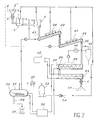
- the mixing takes place in contactors referenced 1 and 2 in FIG. 1.
- the polluted soils 3 are introduced into a hopper 4 connected via a lock 5 to the contactor 1.
- the lock 5 makes it possible to introduce the polluted soils 3 into the contactor 1 without introducing air, while that a second lock, referenced 6 in FIG. 2, makes it possible to evacuate the treated soils without parallel gas outlet.
- the process of the invention can therefore be carried out under vacuum, or in a confined atmosphere, for example under nitrogen.
- the contactors 1 and 2 are manufactured according to the same model and are slightly offset with respect to each other in the direction of the height, downwards, the second contactor 2 being lower than the first contactor 1.
- the example of the present description comprises two contactors, arranged in series, one after the other. However, the number of contactors can be increased. In this case, each contactor n + 1 is arranged so as to be slightly lower than the contactor n which precedes it.
- Each contactor is formed by a container closed by a cover 8 and comprises a partition 9 defining two contact cells 10 and 11.
- a motor 12 arranged above and outside the cover 8 drives in rotation, by means of 'a horizontal element 13, two hollow vertical shafts 14, 15 centered along the axis of each contacting cell.
- each vertical shafts support in their lower part, at the level of the lower part of the contactor, each a horizontal disc 16, 17 provided with blades shown in FIG. 1 by vertical lines.
- the lower part of a contactor or of said contacting cell corresponds substantially to the lower quarter of said contactor or of said contacting cell.
- a contactor is composed of two cells of 760 mm in height separated by a partition. Each cell has a rectangular cross section of 960 mm x 930 mm. A 700 mm diameter disc is placed substantially in the center of the rectangle, 70 mm from the bottom of the cell.
- the third body is introduced into the upper part of each hollow shaft 14 or 15, and flows inside these, before being injected into the lower part of each contacting cell, at the periphery of the discs 16 and 17 at multiple points, about fifty, along a plane approximately orthogonal to the axis of the contacting cells.
- the diameter of the discs 16 and 17 is advantageously greater than half the diameter of the contacting cells. The number of injection points is thus greater and the dispersion of the third facilitated in particular in the reduced space located between the blades of the discs and the side walls of the contacting cells.
- the mixture is broken down into two stages: contacting and extraction. These two steps take place at the bottom of the contacting cells.
- the polluted soils are introduced along an inclined plane 18, in the lower part of the first contacting cell 10, preferably above the disc 16.
- the dispersion of the third body is extremely significant since of on the one hand, the third body is injected substantially in the direction of the side walls of the cells, substantially radially to said walls, and at multiple points and, on the other hand, the third body is immediately dispersed by the blades of the rotating discs 16, 17.
- the contacting being favored by the dispersion, this process proves to be excellent.
- the separation between the polluted solution and the soil is carried out in the contactors themselves, continuously. Indeed, the dispersion does not generate currents of high power fluid which could entrain particles of soil towards the high part of the contacting cells, but of a turbulence confined mainly in the low part of these cells. Consequently, decantation in a separate step is not necessary. Polluted soils will take, due to the rotation of the disc, a circular movement and transit from one cell to another of the same contactor through an opening made at the bottom of the partition 9.
- the passage of a contactor 1 to the other 2 is regulated by a register 19 closing more or less the inlet opening of the second contactor.
- a second register 20 makes it possible to evacuate the soil by gravity in the pipe 43 for rinsing. Contacting, separation is carried out with a passage of polluted soil along several contactors 1, 2 arranged one after the other, in series.
- An overflow chute 21 collects the polluted solution to direct it to the entry of the regeneration phase.
- the system is particularly advantageous because it is flexible and in particular makes it possible to adjust the residence time of the floors in the contactors, thanks to the registers 19, 20.
- Rinsing consists in replacing the polluted solution present in the evacuated grounds by the pipe 43, by third clean body.
- This step of the process is carried out by two inclined screws 22, 23 continuously driving the floors under jets 24, 25 of third bodies.
- the third body having been used for rinsing in the inclined screws is recovered at the bottom of said screws and can advantageously be reintroduced at the level of the contactors by means of a pump, as is shown in the case of screw 23 by a line of drawn lines.
- a wringing is then carried out at the upper end of the inclined screw 23, by a piston pushed back by a counterweight or a spring, towards the soil samples emerging at the level of said end.
- the soil samples are compressed by the piston which gradually recedes.
- the excess third body is evacuated, until the drained soil falls by gravity into the orifice 26 leading to the drying phase.
- Drying eliminates the third body which has not been wrung.
- the floors are introduced into a first screw 27 heated by a heat transfer fluid circulating the double casing 28 of said screws and coming from a thermoregulatory reservoir 38. Pallets stir the floors inside the screw 27 and allow them to move towards the entry orifice of a second screw 29 built according to characteristics similar to the screw 27 but effecting a cooling of the floors thanks to the circulation of cold water from a reservoir 42.
- an orifice opening onto the lock 5 makes it possible to evacuate the dry soils 30, without evacuating nitrogen.
- the third body is a solvent, it is regenerated in order to be recycled in the installation.
- Regeneration is carried out by simple distillation.
- the polluted solution coming either from the contactors 1 and 2, or from the rinsing screws 22 and 23, is brought into a vaporizer 31 in which the heat transfer fluid of the dryer circulates.
- the temperature in this vaporizer is sufficient to allow the evaporation of the solvent then directed to a condenser 32, then a storage tank 33.
- a pump 34 will then supply the contactors 1, 2 and the jets 24, 25 with clean solvent.
- the evacuation of the pollutant does not require stopping the vaporizer since it is separated into two parts by a partition 35.
- the polluted solvent enters the first part in which it is heated, then it transits by continuous overflow in the second unheated part, where evaporation of the solvent ends.
- a thermostatic valve 36 sensitive to the drop in temperature due to the accumulation of the pollutant evacuates the latter progressively in drums 37.
- the vapors released at the dryer 27 are recovered at a fume hood, then condensed by a condenser 40.
- a cyclone 41 will reintegrate the nitrogen at the level of the pipe connecting the rinsing screw 23 to the dryer 27, and will direct the clean solvent to the contactors 1, 2 or the jets 24, 25.
- the various elements of the installation have dimensions such that they can be arranged so that they can be used on the site of pollution, with a view to treating the soil in situ.
- the regeneration of utility fluids is one of the factors enabling this mobility.
- energy can of course be supplied by a generator.
- the processing capacity of such a mobile installation is around 4 tonnes per hour.
Landscapes
- Life Sciences & Earth Sciences (AREA)
- Soil Sciences (AREA)
- Engineering & Computer Science (AREA)
- Environmental & Geological Engineering (AREA)
- Processing Of Solid Wastes (AREA)
- Detergent Compositions (AREA)
Applications Claiming Priority (2)
| Application Number | Priority Date | Filing Date | Title |
|---|---|---|---|
| FR9311516A FR2710565B1 (fr) | 1993-09-28 | 1993-09-28 | Procédé de réhabilitation des sols pollués et installation pour la mise en Óoeuvre de ce procédé. |
| FR9311516 | 1993-09-28 |
Publications (1)
| Publication Number | Publication Date |
|---|---|
| EP0645199A1 true EP0645199A1 (de) | 1995-03-29 |
Family
ID=9451300
Family Applications (1)
| Application Number | Title | Priority Date | Filing Date |
|---|---|---|---|
| EP94402165A Ceased EP0645199A1 (de) | 1993-09-28 | 1994-09-28 | Verfahren zur rehabilitierung von verunreinigten Böden und Anlage zur Durchführung des Verfahrens |
Country Status (4)
| Country | Link |
|---|---|
| US (1) | US5544975A (de) |
| EP (1) | EP0645199A1 (de) |
| CA (1) | CA2133024A1 (de) |
| FR (1) | FR2710565B1 (de) |
Families Citing this family (6)
| Publication number | Priority date | Publication date | Assignee | Title |
|---|---|---|---|---|
| CA2213386C (en) * | 1996-08-20 | 2005-05-17 | Iscor Limited | Method of disposing of fines |
| US5988947A (en) * | 1997-11-04 | 1999-11-23 | Bruso; Bruce L. | Multi-section soil remediation device |
| US6155276A (en) * | 1998-10-02 | 2000-12-05 | Oglesby; Kenneth E. | Apparatus and method for removing soil contaminants |
| US6422789B1 (en) * | 1999-01-26 | 2002-07-23 | Jonathan H. Brewer | Method and apparatus for treatment and remediation of contaminated soils |
| RU2207924C2 (ru) * | 2001-05-17 | 2003-07-10 | Минаков Валерий Владимирович | Установка для отмывки мелкодисперсного материала от углеводородных загрязнений |
| NO332327B1 (no) * | 2010-10-12 | 2012-08-27 | Cubility As | Renseinnretning |
Citations (6)
| Publication number | Priority date | Publication date | Assignee | Title |
|---|---|---|---|---|
| DE3812986A1 (de) * | 1988-04-19 | 1989-11-02 | Landesgewerbeanstalt Bayern Lg | Dekontaminationsverfahren fuer schwermetallverunreinigte boeden, speziell fuer quecksilber |
| DE3821242A1 (de) * | 1988-06-23 | 1989-12-28 | Antonio M Dipl Ing Celi | Verfahren und vorrichtung zur aufarbeitung metallbelasteter abfallschlaemme |
| DE4019110A1 (de) * | 1990-06-15 | 1991-12-19 | Umweltschutz Nord Gmbh & Co | Vorrichtung und verfahren zum aufschliessen von kontaminiertem bodenmaterial |
| EP0471900A1 (de) * | 1988-12-28 | 1992-02-26 | The Standard Oil Company | Vorrichtung und Verfahren, nützlich für die Lösungsmittelextraktion von organischen Substanzen aus Zusammensetzungen, welche dieselben enthalten |
| DE4118525C1 (en) * | 1991-06-06 | 1992-06-17 | Philipp Holzmann Ag, 6000 Frankfurt, De | Appts. for cleansing contaminated surfaces using liq. - includes cylindrical housing with high pressure injection nozzle for feed liq., overflow, concentrically arranged sepg. walls and sieve |
| WO1993005895A1 (de) * | 1991-09-17 | 1993-04-01 | Friedrich Teufert | Bodenwaschanlage |
Family Cites Families (12)
| Publication number | Priority date | Publication date | Assignee | Title |
|---|---|---|---|---|
| DE418525C (de) * | 1925-09-17 | Siegfried Seeliger Dr | Lumbalpunktionsbesteck mit Vielwegehahn | |
| DE312986C (de) * | ||||
| US1837191A (en) * | 1930-01-22 | 1931-12-22 | William M Baldwin | Apparatus for separating solids from liquids in which said solids are suspended |
| US5244308A (en) * | 1985-03-20 | 1993-09-14 | Uddo-Mims International, Inc. | Apparatus for removing contaminants |
| US4715965A (en) * | 1986-05-19 | 1987-12-29 | Sigerson Adam L | Method for separating and recovering volatilizable contaminants from soil |
| EP0313116B1 (de) * | 1987-10-22 | 1993-08-04 | Metallgesellschaft Ag | Verfahren zur Aufbereitung von kontaminierten Böden |
| DE58901545D1 (de) * | 1989-03-20 | 1992-07-02 | Miljoevern Umwelt Technik Gmbh | Verfahren zur entfernung von schadstoffen aus verunreinigtem boden und anlage zu dessen durchfuehrung. |
| US5053082A (en) * | 1990-02-28 | 1991-10-01 | Conoco Inc. | Process and apparatus for cleaning particulate solids |
| DE4124277A1 (de) * | 1991-07-22 | 1993-01-28 | Linde Ag | Verfahren zur dekontamination von verunreinigten boeden |
| US5234504A (en) * | 1991-11-25 | 1993-08-10 | Grc Environmental, Inc. | Methods for removing contaminants from contaminated solids (II) |
| US5372650A (en) * | 1993-04-27 | 1994-12-13 | Westinghouse Electric Corporation | Method for treatment of waste sand |
| US5310285A (en) * | 1993-05-14 | 1994-05-10 | Northcott T J | Device for reclaiming and disposal of drilling wastes and method of use therefore |
-
1993
- 1993-09-28 FR FR9311516A patent/FR2710565B1/fr not_active Expired - Fee Related
-
1994
- 1994-09-27 CA CA002133024A patent/CA2133024A1/fr not_active Abandoned
- 1994-09-28 EP EP94402165A patent/EP0645199A1/de not_active Ceased
- 1994-09-28 US US08/314,509 patent/US5544975A/en not_active Expired - Fee Related
Patent Citations (6)
| Publication number | Priority date | Publication date | Assignee | Title |
|---|---|---|---|---|
| DE3812986A1 (de) * | 1988-04-19 | 1989-11-02 | Landesgewerbeanstalt Bayern Lg | Dekontaminationsverfahren fuer schwermetallverunreinigte boeden, speziell fuer quecksilber |
| DE3821242A1 (de) * | 1988-06-23 | 1989-12-28 | Antonio M Dipl Ing Celi | Verfahren und vorrichtung zur aufarbeitung metallbelasteter abfallschlaemme |
| EP0471900A1 (de) * | 1988-12-28 | 1992-02-26 | The Standard Oil Company | Vorrichtung und Verfahren, nützlich für die Lösungsmittelextraktion von organischen Substanzen aus Zusammensetzungen, welche dieselben enthalten |
| DE4019110A1 (de) * | 1990-06-15 | 1991-12-19 | Umweltschutz Nord Gmbh & Co | Vorrichtung und verfahren zum aufschliessen von kontaminiertem bodenmaterial |
| DE4118525C1 (en) * | 1991-06-06 | 1992-06-17 | Philipp Holzmann Ag, 6000 Frankfurt, De | Appts. for cleansing contaminated surfaces using liq. - includes cylindrical housing with high pressure injection nozzle for feed liq., overflow, concentrically arranged sepg. walls and sieve |
| WO1993005895A1 (de) * | 1991-09-17 | 1993-04-01 | Friedrich Teufert | Bodenwaschanlage |
Also Published As
| Publication number | Publication date |
|---|---|
| US5544975A (en) | 1996-08-13 |
| FR2710565B1 (fr) | 1995-12-01 |
| CA2133024A1 (fr) | 1995-03-29 |
| FR2710565A1 (fr) | 1995-04-07 |
Similar Documents
| Publication | Publication Date | Title |
|---|---|---|
| EP0252826B1 (de) | Verfahren zur radioaktiven Dekontaminierung eines Öls | |
| FR2490992A1 (fr) | Procede et installation pour la conversion thermique des pneus usages ou au rebut en matieres utilisables notamment comme combustibles | |
| EP0645199A1 (de) | Verfahren zur rehabilitierung von verunreinigten Böden und Anlage zur Durchführung des Verfahrens | |
| EP0313441B1 (de) | Vorrichtung zum Entleeren und Befüllen eines als Extraktionsgefäss für eine Durchlaufextraktionseinheit für Pflanzenmaterial benutzbaren geschlossenen Gefässes und dasselbe verwendendes Verfahren | |
| EP3008019B1 (de) | Verfahren und anlage zur nassoxidationsbehandlung von gefährlichen organischen abfällen, insbesondere atommüll, mit mineralischen füllstoffen | |
| EP0846016B1 (de) | Verfahren und vorrichtung zur behandlung von asbest enthaltenden abfallstoffen | |
| EP3022360A1 (de) | Schneeräumvorrichtung und -verfahren | |
| EP2983884A1 (de) | Vorrichtung zur behandlung eines festen verbundstoffes durch solvolyse zur gewinnung von fasern aus dem behandelten stoff | |
| EP0485255B2 (de) | Verfahren und Vorrichtung zur Herstellung von einem festen Brennstoff ausgehend von brennbaren Abfällen | |
| FR2920098A1 (fr) | Appareil pour traiter un sediment. | |
| EP0746725B1 (de) | Verfahren und anlage zur abfallbehandlung mittels trocknung, sublimation, oxidation und verbrennung | |
| KR100894053B1 (ko) | 다단식 토양 복원장치 | |
| WO1996036838A1 (fr) | Procede et dispositif de traitement in situ de matieres minerales contaminees par une substance polluante | |
| FR2654112A1 (fr) | Procede et installation de traitement de dechets urbains et/ou industriels. | |
| KR20100046479A (ko) | 수평식 다단 토양 복원장치 | |
| EP0030200B1 (de) | Anlage zur Regenerierung gebrauchter Lösungsmittel und Verwendung einer solchen Anlage | |
| FR3030318B1 (fr) | Dispositif de pretraitement de sediments preleves sur un fond d'un milieu liquide comprenant des etages de tamisage successifs | |
| EP0956165B1 (de) | Verfahren und vielzweckvorrichtung zur erhaltung metastabiler flüssigkeiten | |
| EP0197872A1 (de) | Vorrichtung für Feststoff-Flüssigkeitsextraktion, bestehend aus einer in einem festen Behälter angebrachten heizbaren Rotationstrommel,deren Flansche mit Filteroberflächen ausgerüstet sind | |
| EP1418010A1 (de) | Verfahren, Vorrichtung und Anlage zur Dekontamination von schadstoffbelastetem Material | |
| CA2910290C (fr) | Procede et composition pour la mise en forme solide d'hydrocarbures et de corps gras liquides, dispositifs pour la mise en oeuvre de ce procede et la fabrication de cette composition, et leur utilisation pour la depollution | |
| EP0610152B1 (de) | Abfallverbrennungsanlage | |
| FR2702489A1 (fr) | Dispositif d'extraction en continu pour huiles essentielles. | |
| CA2698539A1 (fr) | Extraction a sec d'huiles minerales | |
| BE1009724A6 (fr) | Procede et installation de traitement de dechets contenant de l'amiante. |
Legal Events
| Date | Code | Title | Description |
|---|---|---|---|
| PUAI | Public reference made under article 153(3) epc to a published international application that has entered the european phase |
Free format text: ORIGINAL CODE: 0009012 |
|
| AK | Designated contracting states |
Kind code of ref document: A1 Designated state(s): BE DE DK ES GB GR IE IT LU NL PT |
|
| 17P | Request for examination filed |
Effective date: 19950314 |
|
| 17Q | First examination report despatched |
Effective date: 19970630 |
|
| GRAG | Despatch of communication of intention to grant |
Free format text: ORIGINAL CODE: EPIDOS AGRA |
|
| STAA | Information on the status of an ep patent application or granted ep patent |
Free format text: STATUS: THE APPLICATION HAS BEEN REFUSED |
|
| 18R | Application refused |
Effective date: 19981123 |