EP0645400B1 - Ethylene polymer and fuel tank comprising the same - Google Patents
Ethylene polymer and fuel tank comprising the same Download PDFInfo
- Publication number
- EP0645400B1 EP0645400B1 EP19940115151 EP94115151A EP0645400B1 EP 0645400 B1 EP0645400 B1 EP 0645400B1 EP 19940115151 EP19940115151 EP 19940115151 EP 94115151 A EP94115151 A EP 94115151A EP 0645400 B1 EP0645400 B1 EP 0645400B1
- Authority
- EP
- European Patent Office
- Prior art keywords
- ethylene
- fuel tank
- ethylene polymer
- polymerization
- catalyst component
- Prior art date
- Legal status (The legal status is an assumption and is not a legal conclusion. Google has not performed a legal analysis and makes no representation as to the accuracy of the status listed.)
- Expired - Lifetime
Links
- 229920000573 polyethylene Polymers 0.000 title claims description 90
- 239000002828 fuel tank Substances 0.000 title claims description 41
- VGGSQFUCUMXWEO-UHFFFAOYSA-N Ethene Chemical compound C=C VGGSQFUCUMXWEO-UHFFFAOYSA-N 0.000 claims description 89
- 239000005977 Ethylene Substances 0.000 claims description 89
- 239000000203 mixture Substances 0.000 claims description 49
- -1 polyethylene Polymers 0.000 claims description 48
- 239000004698 Polyethylene Substances 0.000 claims description 41
- 239000010410 layer Substances 0.000 claims description 26
- 239000004711 α-olefin Substances 0.000 claims description 25
- 125000004432 carbon atom Chemical group C* 0.000 claims description 12
- 229920001577 copolymer Polymers 0.000 claims description 12
- 230000004888 barrier function Effects 0.000 claims description 11
- 229920006122 polyamide resin Polymers 0.000 claims description 11
- 238000000071 blow moulding Methods 0.000 claims description 9
- 229920001903 high density polyethylene Polymers 0.000 claims description 9
- 239000004700 high-density polyethylene Substances 0.000 claims description 9
- 229920001519 homopolymer Polymers 0.000 claims description 8
- 239000000155 melt Substances 0.000 claims description 8
- 229920000089 Cyclic olefin copolymer Polymers 0.000 claims description 7
- 239000012790 adhesive layer Substances 0.000 claims description 5
- 150000001732 carboxylic acid derivatives Chemical class 0.000 claims description 3
- FPYJFEHAWHCUMM-UHFFFAOYSA-N maleic anhydride Chemical group O=C1OC(=O)C=C1 FPYJFEHAWHCUMM-UHFFFAOYSA-N 0.000 claims description 3
- 238000002425 crystallisation Methods 0.000 claims description 2
- 230000008025 crystallization Effects 0.000 claims description 2
- YXFVVABEGXRONW-UHFFFAOYSA-N Toluene Chemical compound CC1=CC=CC=C1 YXFVVABEGXRONW-UHFFFAOYSA-N 0.000 description 168
- 238000006116 polymerization reaction Methods 0.000 description 73
- VLKZOEOYAKHREP-UHFFFAOYSA-N n-Hexane Chemical compound CCCCCC VLKZOEOYAKHREP-UHFFFAOYSA-N 0.000 description 68
- 239000011949 solid catalyst Substances 0.000 description 60
- 239000000243 solution Substances 0.000 description 54
- IJGRMHOSHXDMSA-UHFFFAOYSA-N Atomic nitrogen Chemical compound N#N IJGRMHOSHXDMSA-UHFFFAOYSA-N 0.000 description 34
- 239000010936 titanium Substances 0.000 description 29
- VOITXYVAKOUIBA-UHFFFAOYSA-N triethylaluminium Chemical compound CC[Al](CC)CC VOITXYVAKOUIBA-UHFFFAOYSA-N 0.000 description 28
- 239000003054 catalyst Substances 0.000 description 27
- 229920000642 polymer Polymers 0.000 description 26
- 238000006243 chemical reaction Methods 0.000 description 25
- 238000001816 cooling Methods 0.000 description 24
- 239000001257 hydrogen Substances 0.000 description 24
- 229910052739 hydrogen Inorganic materials 0.000 description 24
- UFHFLCQGNIYNRP-UHFFFAOYSA-N Hydrogen Chemical compound [H][H] UFHFLCQGNIYNRP-UHFFFAOYSA-N 0.000 description 21
- 229930195733 hydrocarbon Natural products 0.000 description 21
- 239000004215 Carbon black (E152) Substances 0.000 description 19
- 150000002430 hydrocarbons Chemical class 0.000 description 19
- 239000007788 liquid Substances 0.000 description 19
- LFQSCWFLJHTTHZ-UHFFFAOYSA-N Ethanol Chemical compound CCO LFQSCWFLJHTTHZ-UHFFFAOYSA-N 0.000 description 17
- 235000019441 ethanol Nutrition 0.000 description 17
- 229910052757 nitrogen Inorganic materials 0.000 description 17
- 238000003756 stirring Methods 0.000 description 17
- 150000001875 compounds Chemical class 0.000 description 16
- 238000001228 spectrum Methods 0.000 description 16
- XJDNKRIXUMDJCW-UHFFFAOYSA-J titanium tetrachloride Chemical compound Cl[Ti](Cl)(Cl)Cl XJDNKRIXUMDJCW-UHFFFAOYSA-J 0.000 description 16
- 238000002360 preparation method Methods 0.000 description 15
- 230000000052 comparative effect Effects 0.000 description 14
- 238000000465 moulding Methods 0.000 description 14
- VXNZUUAINFGPBY-UHFFFAOYSA-N 1-Butene Chemical compound CCC=C VXNZUUAINFGPBY-UHFFFAOYSA-N 0.000 description 12
- 125000000217 alkyl group Chemical group 0.000 description 12
- 125000003118 aryl group Chemical group 0.000 description 12
- 239000007795 chemical reaction product Substances 0.000 description 12
- 125000000753 cycloalkyl group Chemical group 0.000 description 12
- 239000011777 magnesium Substances 0.000 description 12
- 229920005989 resin Polymers 0.000 description 12
- 239000011347 resin Substances 0.000 description 12
- FPCJKVGGYOAWIZ-UHFFFAOYSA-N butan-1-ol;titanium Chemical compound [Ti].CCCCO.CCCCO.CCCCO.CCCCO FPCJKVGGYOAWIZ-UHFFFAOYSA-N 0.000 description 11
- 239000000460 chlorine Substances 0.000 description 10
- 150000002366 halogen compounds Chemical class 0.000 description 10
- 238000007872 degassing Methods 0.000 description 9
- 238000005259 measurement Methods 0.000 description 9
- 125000005843 halogen group Chemical group 0.000 description 8
- 239000002904 solvent Substances 0.000 description 8
- 150000003609 titanium compounds Chemical class 0.000 description 8
- UAIZDWNSWGTKFZ-UHFFFAOYSA-L ethylaluminum(2+);dichloride Chemical compound CC[Al](Cl)Cl UAIZDWNSWGTKFZ-UHFFFAOYSA-L 0.000 description 7
- 239000007789 gas Substances 0.000 description 7
- 150000002681 magnesium compounds Chemical class 0.000 description 7
- 230000035882 stress Effects 0.000 description 7
- 238000012360 testing method Methods 0.000 description 7
- UHOVQNZJYSORNB-UHFFFAOYSA-N Benzene Chemical compound C1=CC=CC=C1 UHOVQNZJYSORNB-UHFFFAOYSA-N 0.000 description 6
- VEXZGXHMUGYJMC-UHFFFAOYSA-M Chloride anion Chemical compound [Cl-] VEXZGXHMUGYJMC-UHFFFAOYSA-M 0.000 description 6
- 239000003795 chemical substances by application Substances 0.000 description 6
- 238000002156 mixing Methods 0.000 description 6
- 125000000816 ethylene group Chemical group [H]C([H])([*:1])C([H])([H])[*:2] 0.000 description 5
- 230000002140 halogenating effect Effects 0.000 description 5
- 230000014759 maintenance of location Effects 0.000 description 5
- IMNFDUFMRHMDMM-UHFFFAOYSA-N N-Heptane Chemical compound CCCCCCC IMNFDUFMRHMDMM-UHFFFAOYSA-N 0.000 description 4
- 229910010270 TiOCl2 Inorganic materials 0.000 description 4
- 125000000484 butyl group Chemical group [H]C([*])([H])C([H])([H])C([H])([H])C([H])([H])[H] 0.000 description 4
- 229910052801 chlorine Inorganic materials 0.000 description 4
- 125000000113 cyclohexyl group Chemical group [H]C1([H])C([H])([H])C([H])([H])C([H])(*)C([H])([H])C1([H])[H] 0.000 description 4
- 125000001495 ethyl group Chemical group [H]C([H])([H])C([H])([H])* 0.000 description 4
- 230000026030 halogenation Effects 0.000 description 4
- 238000005658 halogenation reaction Methods 0.000 description 4
- 125000004051 hexyl group Chemical group [H]C([H])([H])C([H])([H])C([H])([H])C([H])([H])C([H])([H])C([H])([H])* 0.000 description 4
- 238000004519 manufacturing process Methods 0.000 description 4
- 238000000034 method Methods 0.000 description 4
- 125000002496 methyl group Chemical group [H]C([H])([H])* 0.000 description 4
- 125000002347 octyl group Chemical group [H]C([*])([H])C([H])([H])C([H])([H])C([H])([H])C([H])([H])C([H])([H])C([H])([H])C([H])([H])[H] 0.000 description 4
- 125000001147 pentyl group Chemical group C(CCCC)* 0.000 description 4
- 125000001436 propyl group Chemical group [H]C([*])([H])C([H])([H])C([H])([H])[H] 0.000 description 4
- QQONPFPTGQHPMA-UHFFFAOYSA-N propylene Natural products CC=C QQONPFPTGQHPMA-UHFFFAOYSA-N 0.000 description 4
- 125000004805 propylene group Chemical group [H]C([H])([H])C([H])([*:1])C([H])([H])[*:2] 0.000 description 4
- 125000003944 tolyl group Chemical group 0.000 description 4
- 125000005023 xylyl group Chemical group 0.000 description 4
- LIKMAJRDDDTEIG-UHFFFAOYSA-N 1-hexene Chemical compound CCCCC=C LIKMAJRDDDTEIG-UHFFFAOYSA-N 0.000 description 3
- VXEGSRKPIUDPQT-UHFFFAOYSA-N 4-[4-(4-methoxyphenyl)piperazin-1-yl]aniline Chemical compound C1=CC(OC)=CC=C1N1CCN(C=2C=CC(N)=CC=2)CC1 VXEGSRKPIUDPQT-UHFFFAOYSA-N 0.000 description 3
- WKBOTKDWSSQWDR-UHFFFAOYSA-N Bromine atom Chemical group [Br] WKBOTKDWSSQWDR-UHFFFAOYSA-N 0.000 description 3
- KFZMGEQAYNKOFK-UHFFFAOYSA-N Isopropanol Chemical compound CC(C)O KFZMGEQAYNKOFK-UHFFFAOYSA-N 0.000 description 3
- LRHPLDYGYMQRHN-UHFFFAOYSA-N N-Butanol Chemical compound CCCCO LRHPLDYGYMQRHN-UHFFFAOYSA-N 0.000 description 3
- 229920002292 Nylon 6 Polymers 0.000 description 3
- GDTBXPJZTBHREO-UHFFFAOYSA-N bromine Chemical group BrBr GDTBXPJZTBHREO-UHFFFAOYSA-N 0.000 description 3
- 229910052794 bromium Inorganic materials 0.000 description 3
- 229910052799 carbon Inorganic materials 0.000 description 3
- 238000005336 cracking Methods 0.000 description 3
- 229920001038 ethylene copolymer Polymers 0.000 description 3
- 238000010438 heat treatment Methods 0.000 description 3
- 150000002431 hydrogen Chemical class 0.000 description 3
- 239000012442 inert solvent Substances 0.000 description 3
- 239000000047 product Substances 0.000 description 3
- HKJYVRJHDIPMQB-UHFFFAOYSA-N propan-1-olate;titanium(4+) Chemical compound CCCO[Ti](OCCC)(OCCC)OCCC HKJYVRJHDIPMQB-UHFFFAOYSA-N 0.000 description 3
- 239000005049 silicon tetrachloride Substances 0.000 description 3
- 239000003381 stabilizer Substances 0.000 description 3
- CXWXQJXEFPUFDZ-UHFFFAOYSA-N tetralin Chemical compound C1=CC=C2CCCCC2=C1 CXWXQJXEFPUFDZ-UHFFFAOYSA-N 0.000 description 3
- 239000013585 weight reducing agent Substances 0.000 description 3
- KBPLFHHGFOOTCA-UHFFFAOYSA-N 1-Octanol Chemical compound CCCCCCCCO KBPLFHHGFOOTCA-UHFFFAOYSA-N 0.000 description 2
- VZSRBBMJRBPUNF-UHFFFAOYSA-N 2-(2,3-dihydro-1H-inden-2-ylamino)-N-[3-oxo-3-(2,4,6,7-tetrahydrotriazolo[4,5-c]pyridin-5-yl)propyl]pyrimidine-5-carboxamide Chemical compound C1C(CC2=CC=CC=C12)NC1=NC=C(C=N1)C(=O)NCCC(N1CC2=C(CC1)NN=N2)=O VZSRBBMJRBPUNF-UHFFFAOYSA-N 0.000 description 2
- WWSJZGAPAVMETJ-UHFFFAOYSA-N 2-[4-[2-(2,3-dihydro-1H-inden-2-ylamino)pyrimidin-5-yl]-3-ethoxypyrazol-1-yl]-1-(2,4,6,7-tetrahydrotriazolo[4,5-c]pyridin-5-yl)ethanone Chemical compound C1C(CC2=CC=CC=C12)NC1=NC=C(C=N1)C=1C(=NN(C=1)CC(=O)N1CC2=C(CC1)NN=N2)OCC WWSJZGAPAVMETJ-UHFFFAOYSA-N 0.000 description 2
- CONKBQPVFMXDOV-QHCPKHFHSA-N 6-[(5S)-5-[[4-[2-(2,3-dihydro-1H-inden-2-ylamino)pyrimidin-5-yl]piperazin-1-yl]methyl]-2-oxo-1,3-oxazolidin-3-yl]-3H-1,3-benzoxazol-2-one Chemical compound C1C(CC2=CC=CC=C12)NC1=NC=C(C=N1)N1CCN(CC1)C[C@H]1CN(C(O1)=O)C1=CC2=C(NC(O2)=O)C=C1 CONKBQPVFMXDOV-QHCPKHFHSA-N 0.000 description 2
- ZCYVEMRRCGMTRW-UHFFFAOYSA-N 7553-56-2 Chemical group [I] ZCYVEMRRCGMTRW-UHFFFAOYSA-N 0.000 description 2
- ZAMOUSCENKQFHK-UHFFFAOYSA-N Chlorine atom Chemical compound [Cl] ZAMOUSCENKQFHK-UHFFFAOYSA-N 0.000 description 2
- XDTMQSROBMDMFD-UHFFFAOYSA-N Cyclohexane Chemical compound C1CCCCC1 XDTMQSROBMDMFD-UHFFFAOYSA-N 0.000 description 2
- VZCYOOQTPOCHFL-OWOJBTEDSA-N Fumaric acid Chemical compound OC(=O)\C=C\C(O)=O VZCYOOQTPOCHFL-OWOJBTEDSA-N 0.000 description 2
- 239000004705 High-molecular-weight polyethylene Substances 0.000 description 2
- OFOBLEOULBTSOW-UHFFFAOYSA-N Malonic acid Chemical compound OC(=O)CC(O)=O OFOBLEOULBTSOW-UHFFFAOYSA-N 0.000 description 2
- 229920000571 Nylon 11 Polymers 0.000 description 2
- 229920000305 Nylon 6,10 Polymers 0.000 description 2
- 229920002302 Nylon 6,6 Polymers 0.000 description 2
- PPBRXRYQALVLMV-UHFFFAOYSA-N Styrene Chemical compound C=CC1=CC=CC=C1 PPBRXRYQALVLMV-UHFFFAOYSA-N 0.000 description 2
- 239000000853 adhesive Substances 0.000 description 2
- 230000001070 adhesive effect Effects 0.000 description 2
- 230000001476 alcoholic effect Effects 0.000 description 2
- 150000001338 aliphatic hydrocarbons Chemical class 0.000 description 2
- VSCWAEJMTAWNJL-UHFFFAOYSA-K aluminium trichloride Chemical compound Cl[Al](Cl)Cl VSCWAEJMTAWNJL-UHFFFAOYSA-K 0.000 description 2
- 150000004945 aromatic hydrocarbons Chemical class 0.000 description 2
- APKYUQFPWXLNFH-UHFFFAOYSA-M butan-1-olate titanium(4+) chloride Chemical compound [Cl-].CCCCO[Ti+](OCCCC)OCCCC APKYUQFPWXLNFH-UHFFFAOYSA-M 0.000 description 2
- 238000004364 calculation method Methods 0.000 description 2
- 125000001309 chloro group Chemical group Cl* 0.000 description 2
- 238000007334 copolymerization reaction Methods 0.000 description 2
- 238000010908 decantation Methods 0.000 description 2
- 238000004821 distillation Methods 0.000 description 2
- 230000006353 environmental stress Effects 0.000 description 2
- XGZNHFPFJRZBBT-UHFFFAOYSA-N ethanol;titanium Chemical compound [Ti].CCO.CCO.CCO.CCO XGZNHFPFJRZBBT-UHFFFAOYSA-N 0.000 description 2
- 239000005038 ethylene vinyl acetate Substances 0.000 description 2
- 229910052736 halogen Inorganic materials 0.000 description 2
- 150000002367 halogens Chemical class 0.000 description 2
- 238000002347 injection Methods 0.000 description 2
- 239000007924 injection Substances 0.000 description 2
- 229910052740 iodine Chemical group 0.000 description 2
- 239000011630 iodine Chemical group 0.000 description 2
- XDKQUSKHRIUJEO-UHFFFAOYSA-N magnesium;ethanolate Chemical compound [Mg+2].CC[O-].CC[O-] XDKQUSKHRIUJEO-UHFFFAOYSA-N 0.000 description 2
- 239000008188 pellet Substances 0.000 description 2
- 230000000704 physical effect Effects 0.000 description 2
- 229920003023 plastic Polymers 0.000 description 2
- 239000004033 plastic Substances 0.000 description 2
- 229920001200 poly(ethylene-vinyl acetate) Polymers 0.000 description 2
- 230000037048 polymerization activity Effects 0.000 description 2
- 229920005672 polyolefin resin Polymers 0.000 description 2
- BDERNNFJNOPAEC-UHFFFAOYSA-N propan-1-ol Chemical compound CCCO BDERNNFJNOPAEC-UHFFFAOYSA-N 0.000 description 2
- 230000009467 reduction Effects 0.000 description 2
- 238000007127 saponification reaction Methods 0.000 description 2
- 239000007787 solid Substances 0.000 description 2
- 238000003860 storage Methods 0.000 description 2
- 238000005482 strain hardening Methods 0.000 description 2
- 239000006228 supernatant Substances 0.000 description 2
- 238000010998 test method Methods 0.000 description 2
- FYSNRJHAOHDILO-UHFFFAOYSA-N thionyl chloride Chemical compound ClS(Cl)=O FYSNRJHAOHDILO-UHFFFAOYSA-N 0.000 description 2
- VZCYOOQTPOCHFL-UHFFFAOYSA-N trans-butenedioic acid Natural products OC(=O)C=CC(O)=O VZCYOOQTPOCHFL-UHFFFAOYSA-N 0.000 description 2
- XLYOFNOQVPJJNP-UHFFFAOYSA-N water Substances O XLYOFNOQVPJJNP-UHFFFAOYSA-N 0.000 description 2
- 238000005303 weighing Methods 0.000 description 2
- KEQGZUUPPQEDPF-UHFFFAOYSA-N 1,3-dichloro-5,5-dimethylimidazolidine-2,4-dione Chemical compound CC1(C)N(Cl)C(=O)N(Cl)C1=O KEQGZUUPPQEDPF-UHFFFAOYSA-N 0.000 description 1
- HMUNWXXNJPVALC-UHFFFAOYSA-N 1-[4-[2-(2,3-dihydro-1H-inden-2-ylamino)pyrimidin-5-yl]piperazin-1-yl]-2-(2,4,6,7-tetrahydrotriazolo[4,5-c]pyridin-5-yl)ethanone Chemical compound C1C(CC2=CC=CC=C12)NC1=NC=C(C=N1)N1CCN(CC1)C(CN1CC2=C(CC1)NN=N2)=O HMUNWXXNJPVALC-UHFFFAOYSA-N 0.000 description 1
- AFFLGGQVNFXPEV-UHFFFAOYSA-N 1-decene Chemical compound CCCCCCCCC=C AFFLGGQVNFXPEV-UHFFFAOYSA-N 0.000 description 1
- SMZOUWXMTYCWNB-UHFFFAOYSA-N 2-(2-methoxy-5-methylphenyl)ethanamine Chemical compound COC1=CC=C(C)C=C1CCN SMZOUWXMTYCWNB-UHFFFAOYSA-N 0.000 description 1
- JAHNSTQSQJOJLO-UHFFFAOYSA-N 2-(3-fluorophenyl)-1h-imidazole Chemical compound FC1=CC=CC(C=2NC=CN=2)=C1 JAHNSTQSQJOJLO-UHFFFAOYSA-N 0.000 description 1
- NIXOWILDQLNWCW-UHFFFAOYSA-N 2-Propenoic acid Natural products OC(=O)C=C NIXOWILDQLNWCW-UHFFFAOYSA-N 0.000 description 1
- SXAMGRAIZSSWIH-UHFFFAOYSA-N 2-[3-[2-(2,3-dihydro-1H-inden-2-ylamino)pyrimidin-5-yl]-1,2,4-oxadiazol-5-yl]-1-(2,4,6,7-tetrahydrotriazolo[4,5-c]pyridin-5-yl)ethanone Chemical compound C1C(CC2=CC=CC=C12)NC1=NC=C(C=N1)C1=NOC(=N1)CC(=O)N1CC2=C(CC1)NN=N2 SXAMGRAIZSSWIH-UHFFFAOYSA-N 0.000 description 1
- FYELSNVLZVIGTI-UHFFFAOYSA-N 2-[4-[2-(2,3-dihydro-1H-inden-2-ylamino)pyrimidin-5-yl]-5-ethylpyrazol-1-yl]-1-(2,4,6,7-tetrahydrotriazolo[4,5-c]pyridin-5-yl)ethanone Chemical compound C1C(CC2=CC=CC=C12)NC1=NC=C(C=N1)C=1C=NN(C=1CC)CC(=O)N1CC2=C(CC1)NN=N2 FYELSNVLZVIGTI-UHFFFAOYSA-N 0.000 description 1
- WZFUQSJFWNHZHM-UHFFFAOYSA-N 2-[4-[2-(2,3-dihydro-1H-inden-2-ylamino)pyrimidin-5-yl]piperazin-1-yl]-1-(2,4,6,7-tetrahydrotriazolo[4,5-c]pyridin-5-yl)ethanone Chemical compound C1C(CC2=CC=CC=C12)NC1=NC=C(C=N1)N1CCN(CC1)CC(=O)N1CC2=C(CC1)NN=N2 WZFUQSJFWNHZHM-UHFFFAOYSA-N 0.000 description 1
- ZRPAUEVGEGEPFQ-UHFFFAOYSA-N 2-[4-[2-(2,3-dihydro-1H-inden-2-ylamino)pyrimidin-5-yl]pyrazol-1-yl]-1-(2,4,6,7-tetrahydrotriazolo[4,5-c]pyridin-5-yl)ethanone Chemical compound C1C(CC2=CC=CC=C12)NC1=NC=C(C=N1)C=1C=NN(C=1)CC(=O)N1CC2=C(CC1)NN=N2 ZRPAUEVGEGEPFQ-UHFFFAOYSA-N 0.000 description 1
- YJLUBHOZZTYQIP-UHFFFAOYSA-N 2-[5-[2-(2,3-dihydro-1H-inden-2-ylamino)pyrimidin-5-yl]-1,3,4-oxadiazol-2-yl]-1-(2,4,6,7-tetrahydrotriazolo[4,5-c]pyridin-5-yl)ethanone Chemical compound C1C(CC2=CC=CC=C12)NC1=NC=C(C=N1)C1=NN=C(O1)CC(=O)N1CC2=C(CC1)NN=N2 YJLUBHOZZTYQIP-UHFFFAOYSA-N 0.000 description 1
- KTXWGMUMDPYXNN-UHFFFAOYSA-N 2-ethylhexan-1-olate;titanium(4+) Chemical compound [Ti+4].CCCCC(CC)C[O-].CCCCC(CC)C[O-].CCCCC(CC)C[O-].CCCCC(CC)C[O-] KTXWGMUMDPYXNN-UHFFFAOYSA-N 0.000 description 1
- YHQXBTXEYZIYOV-UHFFFAOYSA-N 3-methylbut-1-ene Chemical compound CC(C)C=C YHQXBTXEYZIYOV-UHFFFAOYSA-N 0.000 description 1
- LDTAOIUHUHHCMU-UHFFFAOYSA-N 3-methylpent-1-ene Chemical compound CCC(C)C=C LDTAOIUHUHHCMU-UHFFFAOYSA-N 0.000 description 1
- WSSSPWUEQFSQQG-UHFFFAOYSA-N 4-methyl-1-pentene Chemical compound CC(C)CC=C WSSSPWUEQFSQQG-UHFFFAOYSA-N 0.000 description 1
- 239000004604 Blowing Agent Substances 0.000 description 1
- NTWOIGOPFDMZAE-UHFFFAOYSA-M CCO[Ti](Cl)(OCC)OCC Chemical compound CCO[Ti](Cl)(OCC)OCC NTWOIGOPFDMZAE-UHFFFAOYSA-M 0.000 description 1
- KXDHJXZQYSOELW-UHFFFAOYSA-N Carbamic acid Chemical compound NC(O)=O KXDHJXZQYSOELW-UHFFFAOYSA-N 0.000 description 1
- VEXZGXHMUGYJMC-UHFFFAOYSA-N Hydrochloric acid Chemical compound Cl VEXZGXHMUGYJMC-UHFFFAOYSA-N 0.000 description 1
- JHWNWJKBPDFINM-UHFFFAOYSA-N Laurolactam Chemical compound O=C1CCCCCCCCCCCN1 JHWNWJKBPDFINM-UHFFFAOYSA-N 0.000 description 1
- CERQOIWHTDAKMF-UHFFFAOYSA-N Methacrylic acid Chemical compound CC(=C)C(O)=O CERQOIWHTDAKMF-UHFFFAOYSA-N 0.000 description 1
- 239000004677 Nylon Substances 0.000 description 1
- 229920000299 Nylon 12 Polymers 0.000 description 1
- 229920000577 Nylon 6/66 Polymers 0.000 description 1
- CTQNGGLPUBDAKN-UHFFFAOYSA-N O-Xylene Chemical compound CC1=CC=CC=C1C CTQNGGLPUBDAKN-UHFFFAOYSA-N 0.000 description 1
- ISWSIDIOOBJBQZ-UHFFFAOYSA-N Phenol Chemical compound OC1=CC=CC=C1 ISWSIDIOOBJBQZ-UHFFFAOYSA-N 0.000 description 1
- JKIJEFPNVSHHEI-UHFFFAOYSA-N Phenol, 2,4-bis(1,1-dimethylethyl)-, phosphite (3:1) Chemical compound CC(C)(C)C1=CC(C(C)(C)C)=CC=C1OP(OC=1C(=CC(=CC=1)C(C)(C)C)C(C)(C)C)OC1=CC=C(C(C)(C)C)C=C1C(C)(C)C JKIJEFPNVSHHEI-UHFFFAOYSA-N 0.000 description 1
- 229910021627 Tin(IV) chloride Inorganic materials 0.000 description 1
- 229910021552 Vanadium(IV) chloride Inorganic materials 0.000 description 1
- BGYHLZZASRKEJE-UHFFFAOYSA-N [3-[3-(3,5-ditert-butyl-4-hydroxyphenyl)propanoyloxy]-2,2-bis[3-(3,5-ditert-butyl-4-hydroxyphenyl)propanoyloxymethyl]propyl] 3-(3,5-ditert-butyl-4-hydroxyphenyl)propanoate Chemical compound CC(C)(C)C1=C(O)C(C(C)(C)C)=CC(CCC(=O)OCC(COC(=O)CCC=2C=C(C(O)=C(C=2)C(C)(C)C)C(C)(C)C)(COC(=O)CCC=2C=C(C(O)=C(C=2)C(C)(C)C)C(C)(C)C)COC(=O)CCC=2C=C(C(O)=C(C=2)C(C)(C)C)C(C)(C)C)=C1 BGYHLZZASRKEJE-UHFFFAOYSA-N 0.000 description 1
- QSMLJCIHMPUAQG-UHFFFAOYSA-L [Cl-].[Cl-].CCCO[Ti+2]OCCC Chemical compound [Cl-].[Cl-].CCCO[Ti+2]OCCC QSMLJCIHMPUAQG-UHFFFAOYSA-L 0.000 description 1
- GKQZBJMXIUKBGB-UHFFFAOYSA-K [Cl-].[Cl-].[Cl-].CCCO[Ti+3] Chemical compound [Cl-].[Cl-].[Cl-].CCCO[Ti+3] GKQZBJMXIUKBGB-UHFFFAOYSA-K 0.000 description 1
- 239000002253 acid Substances 0.000 description 1
- 150000007513 acids Chemical class 0.000 description 1
- 230000009471 action Effects 0.000 description 1
- 239000000654 additive Substances 0.000 description 1
- 150000001298 alcohols Chemical class 0.000 description 1
- 238000004458 analytical method Methods 0.000 description 1
- 150000008064 anhydrides Chemical class 0.000 description 1
- 230000002528 anti-freeze Effects 0.000 description 1
- 239000007864 aqueous solution Substances 0.000 description 1
- TZYHIGCKINZLPD-UHFFFAOYSA-N azepan-2-one;hexane-1,6-diamine;hexanedioic acid Chemical compound NCCCCCCN.O=C1CCCCCN1.OC(=O)CCCCC(O)=O TZYHIGCKINZLPD-UHFFFAOYSA-N 0.000 description 1
- HQMRIBYCTLBDAK-UHFFFAOYSA-M bis(2-methylpropyl)alumanylium;chloride Chemical compound CC(C)C[Al](Cl)CC(C)C HQMRIBYCTLBDAK-UHFFFAOYSA-M 0.000 description 1
- VJVUKRSEEMNRCM-UHFFFAOYSA-L butan-1-olate titanium(4+) dichloride Chemical compound [Cl-].[Cl-].CCCCO[Ti+2]OCCCC VJVUKRSEEMNRCM-UHFFFAOYSA-L 0.000 description 1
- DEFMLLQRTVNBOF-UHFFFAOYSA-K butan-1-olate;trichlorotitanium(1+) Chemical compound [Cl-].[Cl-].[Cl-].CCCCO[Ti+3] DEFMLLQRTVNBOF-UHFFFAOYSA-K 0.000 description 1
- 239000001273 butane Substances 0.000 description 1
- CJZGTCYPCWQAJB-UHFFFAOYSA-L calcium stearate Chemical compound [Ca+2].CCCCCCCCCCCCCCCCCC([O-])=O.CCCCCCCCCCCCCCCCCC([O-])=O CJZGTCYPCWQAJB-UHFFFAOYSA-L 0.000 description 1
- 235000013539 calcium stearate Nutrition 0.000 description 1
- 239000008116 calcium stearate Substances 0.000 description 1
- 150000001805 chlorine compounds Chemical class 0.000 description 1
- XTHPWXDJESJLNJ-UHFFFAOYSA-N chlorosulfonic acid Substances OS(Cl)(=O)=O XTHPWXDJESJLNJ-UHFFFAOYSA-N 0.000 description 1
- HNEGQIOMVPPMNR-IHWYPQMZSA-N citraconic acid Chemical compound OC(=O)C(/C)=C\C(O)=O HNEGQIOMVPPMNR-IHWYPQMZSA-N 0.000 description 1
- 229940018557 citraconic acid Drugs 0.000 description 1
- 239000003426 co-catalyst Substances 0.000 description 1
- 238000009833 condensation Methods 0.000 description 1
- 230000005494 condensation Effects 0.000 description 1
- 238000012937 correction Methods 0.000 description 1
- YNLAOSYQHBDIKW-UHFFFAOYSA-M diethylaluminium chloride Chemical compound CC[Al](Cl)CC YNLAOSYQHBDIKW-UHFFFAOYSA-M 0.000 description 1
- 238000009826 distribution Methods 0.000 description 1
- 230000007613 environmental effect Effects 0.000 description 1
- MNLMLEWXCMFNFO-UHFFFAOYSA-K ethanol;trichlorotitanium Chemical compound CCO.Cl[Ti](Cl)Cl MNLMLEWXCMFNFO-UHFFFAOYSA-K 0.000 description 1
- UHSDHNXHBQDMMH-UHFFFAOYSA-L ethanolate;titanium(4+);dichloride Chemical compound CCO[Ti](Cl)(Cl)OCC UHSDHNXHBQDMMH-UHFFFAOYSA-L 0.000 description 1
- LDLDYFCCDKENPD-UHFFFAOYSA-N ethenylcyclohexane Chemical compound C=CC1CCCCC1 LDLDYFCCDKENPD-UHFFFAOYSA-N 0.000 description 1
- GCPCLEKQVMKXJM-UHFFFAOYSA-N ethoxy(diethyl)alumane Chemical compound CCO[Al](CC)CC GCPCLEKQVMKXJM-UHFFFAOYSA-N 0.000 description 1
- 238000011156 evaluation Methods 0.000 description 1
- 230000001747 exhibiting effect Effects 0.000 description 1
- 238000013213 extrapolation Methods 0.000 description 1
- 238000001125 extrusion Methods 0.000 description 1
- 239000000945 filler Substances 0.000 description 1
- 239000003063 flame retardant Substances 0.000 description 1
- 238000010528 free radical solution polymerization reaction Methods 0.000 description 1
- 239000000446 fuel Substances 0.000 description 1
- 239000001530 fumaric acid Substances 0.000 description 1
- 239000007792 gaseous phase Substances 0.000 description 1
- 239000003502 gasoline Substances 0.000 description 1
- 239000012760 heat stabilizer Substances 0.000 description 1
- 229910000041 hydrogen chloride Inorganic materials 0.000 description 1
- IXCSERBJSXMMFS-UHFFFAOYSA-N hydrogen chloride Substances Cl.Cl IXCSERBJSXMMFS-UHFFFAOYSA-N 0.000 description 1
- PNDPGZBMCMUPRI-UHFFFAOYSA-N iodine Chemical compound II PNDPGZBMCMUPRI-UHFFFAOYSA-N 0.000 description 1
- 150000003951 lactams Chemical class 0.000 description 1
- KRTCPMDBLDWJQY-UHFFFAOYSA-M magnesium;ethanolate;chloride Chemical compound [Mg+2].[Cl-].CC[O-] KRTCPMDBLDWJQY-UHFFFAOYSA-M 0.000 description 1
- CRGZYKWWYNQGEC-UHFFFAOYSA-N magnesium;methanolate Chemical compound [Mg+2].[O-]C.[O-]C CRGZYKWWYNQGEC-UHFFFAOYSA-N 0.000 description 1
- VZCYOOQTPOCHFL-UPHRSURJSA-N maleic acid Chemical compound OC(=O)\C=C/C(O)=O VZCYOOQTPOCHFL-UPHRSURJSA-N 0.000 description 1
- 239000011976 maleic acid Substances 0.000 description 1
- 238000002844 melting Methods 0.000 description 1
- 230000008018 melting Effects 0.000 description 1
- 239000007769 metal material Substances 0.000 description 1
- LVHBHZANLOWSRM-UHFFFAOYSA-N methylenebutanedioic acid Natural products OC(=O)CC(=C)C(O)=O LVHBHZANLOWSRM-UHFFFAOYSA-N 0.000 description 1
- 239000000178 monomer Substances 0.000 description 1
- IJDNQMDRQITEOD-UHFFFAOYSA-N n-butane Chemical compound CCCC IJDNQMDRQITEOD-UHFFFAOYSA-N 0.000 description 1
- OFBQJSOFQDEBGM-UHFFFAOYSA-N n-pentane Natural products CCCCC OFBQJSOFQDEBGM-UHFFFAOYSA-N 0.000 description 1
- 239000002667 nucleating agent Substances 0.000 description 1
- 229920001778 nylon Polymers 0.000 description 1
- CCCMONHAUSKTEQ-UHFFFAOYSA-N octadec-1-ene Chemical compound CCCCCCCCCCCCCCCCC=C CCCMONHAUSKTEQ-UHFFFAOYSA-N 0.000 description 1
- YWAKXRMUMFPDSH-UHFFFAOYSA-N pentene Chemical compound CCCC=C YWAKXRMUMFPDSH-UHFFFAOYSA-N 0.000 description 1
- OJMIONKXNSYLSR-UHFFFAOYSA-N phosphorous acid Chemical compound OP(O)O OJMIONKXNSYLSR-UHFFFAOYSA-N 0.000 description 1
- 239000000049 pigment Substances 0.000 description 1
- 239000004014 plasticizer Substances 0.000 description 1
- 229920001707 polybutylene terephthalate Polymers 0.000 description 1
- 238000006068 polycondensation reaction Methods 0.000 description 1
- 229920000139 polyethylene terephthalate Polymers 0.000 description 1
- 239000005020 polyethylene terephthalate Substances 0.000 description 1
- 239000002954 polymerization reaction product Substances 0.000 description 1
- 229920000098 polyolefin Polymers 0.000 description 1
- 239000011342 resin composition Substances 0.000 description 1
- 239000002002 slurry Substances 0.000 description 1
- 239000000126 substance Substances 0.000 description 1
- 229920006230 thermoplastic polyester resin Polymers 0.000 description 1
- HPGGPRDJHPYFRM-UHFFFAOYSA-J tin(iv) chloride Chemical compound Cl[Sn](Cl)(Cl)Cl HPGGPRDJHPYFRM-UHFFFAOYSA-J 0.000 description 1
- FAQYAMRNWDIXMY-UHFFFAOYSA-N trichloroborane Chemical compound ClB(Cl)Cl FAQYAMRNWDIXMY-UHFFFAOYSA-N 0.000 description 1
- MCULRUJILOGHCJ-UHFFFAOYSA-N triisobutylaluminium Chemical compound CC(C)C[Al](CC(C)C)CC(C)C MCULRUJILOGHCJ-UHFFFAOYSA-N 0.000 description 1
- JTJFQBNJBPPZRI-UHFFFAOYSA-J vanadium tetrachloride Chemical compound Cl[V](Cl)(Cl)Cl JTJFQBNJBPPZRI-UHFFFAOYSA-J 0.000 description 1
- 239000008096 xylene Substances 0.000 description 1
Classifications
-
- C—CHEMISTRY; METALLURGY
- C08—ORGANIC MACROMOLECULAR COMPOUNDS; THEIR PREPARATION OR CHEMICAL WORKING-UP; COMPOSITIONS BASED THEREON
- C08F—MACROMOLECULAR COMPOUNDS OBTAINED BY REACTIONS ONLY INVOLVING CARBON-TO-CARBON UNSATURATED BONDS
- C08F110/00—Homopolymers of unsaturated aliphatic hydrocarbons having only one carbon-to-carbon double bond
- C08F110/02—Ethene
-
- B—PERFORMING OPERATIONS; TRANSPORTING
- B32—LAYERED PRODUCTS
- B32B—LAYERED PRODUCTS, i.e. PRODUCTS BUILT-UP OF STRATA OF FLAT OR NON-FLAT, e.g. CELLULAR OR HONEYCOMB, FORM
- B32B27/00—Layered products comprising a layer of synthetic resin
- B32B27/06—Layered products comprising a layer of synthetic resin as the main or only constituent of a layer, which is next to another layer of the same or of a different material
- B32B27/08—Layered products comprising a layer of synthetic resin as the main or only constituent of a layer, which is next to another layer of the same or of a different material of synthetic resin
-
- B—PERFORMING OPERATIONS; TRANSPORTING
- B32—LAYERED PRODUCTS
- B32B—LAYERED PRODUCTS, i.e. PRODUCTS BUILT-UP OF STRATA OF FLAT OR NON-FLAT, e.g. CELLULAR OR HONEYCOMB, FORM
- B32B1/00—Layered products having a non-planar shape
-
- B—PERFORMING OPERATIONS; TRANSPORTING
- B32—LAYERED PRODUCTS
- B32B—LAYERED PRODUCTS, i.e. PRODUCTS BUILT-UP OF STRATA OF FLAT OR NON-FLAT, e.g. CELLULAR OR HONEYCOMB, FORM
- B32B27/00—Layered products comprising a layer of synthetic resin
- B32B27/32—Layered products comprising a layer of synthetic resin comprising polyolefins
-
- B—PERFORMING OPERATIONS; TRANSPORTING
- B32—LAYERED PRODUCTS
- B32B—LAYERED PRODUCTS, i.e. PRODUCTS BUILT-UP OF STRATA OF FLAT OR NON-FLAT, e.g. CELLULAR OR HONEYCOMB, FORM
- B32B27/00—Layered products comprising a layer of synthetic resin
- B32B27/34—Layered products comprising a layer of synthetic resin comprising polyamides
-
- B—PERFORMING OPERATIONS; TRANSPORTING
- B32—LAYERED PRODUCTS
- B32B—LAYERED PRODUCTS, i.e. PRODUCTS BUILT-UP OF STRATA OF FLAT OR NON-FLAT, e.g. CELLULAR OR HONEYCOMB, FORM
- B32B7/00—Layered products characterised by the relation between layers; Layered products characterised by the relative orientation of features between layers, or by the relative values of a measurable parameter between layers, i.e. products comprising layers having different physical, chemical or physicochemical properties; Layered products characterised by the interconnection of layers
- B32B7/04—Interconnection of layers
- B32B7/12—Interconnection of layers using interposed adhesives or interposed materials with bonding properties
-
- B—PERFORMING OPERATIONS; TRANSPORTING
- B60—VEHICLES IN GENERAL
- B60K—ARRANGEMENT OR MOUNTING OF PROPULSION UNITS OR OF TRANSMISSIONS IN VEHICLES; ARRANGEMENT OR MOUNTING OF PLURAL DIVERSE PRIME-MOVERS IN VEHICLES; AUXILIARY DRIVES FOR VEHICLES; INSTRUMENTATION OR DASHBOARDS FOR VEHICLES; ARRANGEMENTS IN CONNECTION WITH COOLING, AIR INTAKE, GAS EXHAUST OR FUEL SUPPLY OF PROPULSION UNITS IN VEHICLES
- B60K15/00—Arrangement in connection with fuel supply of combustion engines or other fuel consuming energy converters, e.g. fuel cells; Mounting or construction of fuel tanks
- B60K15/03—Fuel tanks
-
- C—CHEMISTRY; METALLURGY
- C08—ORGANIC MACROMOLECULAR COMPOUNDS; THEIR PREPARATION OR CHEMICAL WORKING-UP; COMPOSITIONS BASED THEREON
- C08F—MACROMOLECULAR COMPOUNDS OBTAINED BY REACTIONS ONLY INVOLVING CARBON-TO-CARBON UNSATURATED BONDS
- C08F10/00—Homopolymers and copolymers of unsaturated aliphatic hydrocarbons having only one carbon-to-carbon double bond
- C08F10/02—Ethene
-
- C—CHEMISTRY; METALLURGY
- C08—ORGANIC MACROMOLECULAR COMPOUNDS; THEIR PREPARATION OR CHEMICAL WORKING-UP; COMPOSITIONS BASED THEREON
- C08F—MACROMOLECULAR COMPOUNDS OBTAINED BY REACTIONS ONLY INVOLVING CARBON-TO-CARBON UNSATURATED BONDS
- C08F210/00—Copolymers of unsaturated aliphatic hydrocarbons having only one carbon-to-carbon double bond
- C08F210/16—Copolymers of ethene with alpha-alkenes, e.g. EP rubbers
-
- B—PERFORMING OPERATIONS; TRANSPORTING
- B32—LAYERED PRODUCTS
- B32B—LAYERED PRODUCTS, i.e. PRODUCTS BUILT-UP OF STRATA OF FLAT OR NON-FLAT, e.g. CELLULAR OR HONEYCOMB, FORM
- B32B2307/00—Properties of the layers or laminate
- B32B2307/70—Other properties
- B32B2307/72—Density
-
- B—PERFORMING OPERATIONS; TRANSPORTING
- B32—LAYERED PRODUCTS
- B32B—LAYERED PRODUCTS, i.e. PRODUCTS BUILT-UP OF STRATA OF FLAT OR NON-FLAT, e.g. CELLULAR OR HONEYCOMB, FORM
- B32B2307/00—Properties of the layers or laminate
- B32B2307/70—Other properties
- B32B2307/724—Permeability to gases, adsorption
- B32B2307/7242—Non-permeable
-
- Y—GENERAL TAGGING OF NEW TECHNOLOGICAL DEVELOPMENTS; GENERAL TAGGING OF CROSS-SECTIONAL TECHNOLOGIES SPANNING OVER SEVERAL SECTIONS OF THE IPC; TECHNICAL SUBJECTS COVERED BY FORMER USPC CROSS-REFERENCE ART COLLECTIONS [XRACs] AND DIGESTS
- Y10—TECHNICAL SUBJECTS COVERED BY FORMER USPC
- Y10T—TECHNICAL SUBJECTS COVERED BY FORMER US CLASSIFICATION
- Y10T428/00—Stock material or miscellaneous articles
- Y10T428/13—Hollow or container type article [e.g., tube, vase, etc.]
- Y10T428/1352—Polymer or resin containing [i.e., natural or synthetic]
-
- Y—GENERAL TAGGING OF NEW TECHNOLOGICAL DEVELOPMENTS; GENERAL TAGGING OF CROSS-SECTIONAL TECHNOLOGIES SPANNING OVER SEVERAL SECTIONS OF THE IPC; TECHNICAL SUBJECTS COVERED BY FORMER USPC CROSS-REFERENCE ART COLLECTIONS [XRACs] AND DIGESTS
- Y10—TECHNICAL SUBJECTS COVERED BY FORMER USPC
- Y10T—TECHNICAL SUBJECTS COVERED BY FORMER US CLASSIFICATION
- Y10T428/00—Stock material or miscellaneous articles
- Y10T428/13—Hollow or container type article [e.g., tube, vase, etc.]
- Y10T428/1352—Polymer or resin containing [i.e., natural or synthetic]
- Y10T428/1379—Contains vapor or gas barrier, polymer derived from vinyl chloride or vinylidene chloride, or polymer containing a vinyl alcohol unit
- Y10T428/1383—Vapor or gas barrier, polymer derived from vinyl chloride or vinylidene chloride, or polymer containing a vinyl alcohol unit is sandwiched between layers [continuous layer]
-
- Y—GENERAL TAGGING OF NEW TECHNOLOGICAL DEVELOPMENTS; GENERAL TAGGING OF CROSS-SECTIONAL TECHNOLOGIES SPANNING OVER SEVERAL SECTIONS OF THE IPC; TECHNICAL SUBJECTS COVERED BY FORMER USPC CROSS-REFERENCE ART COLLECTIONS [XRACs] AND DIGESTS
- Y10—TECHNICAL SUBJECTS COVERED BY FORMER USPC
- Y10T—TECHNICAL SUBJECTS COVERED BY FORMER US CLASSIFICATION
- Y10T428/00—Stock material or miscellaneous articles
- Y10T428/31504—Composite [nonstructural laminate]
- Y10T428/31725—Of polyamide
- Y10T428/31739—Nylon type
- Y10T428/31743—Next to addition polymer from unsaturated monomer[s]
- Y10T428/31746—Polymer of monoethylenically unsaturated hydrocarbon
-
- Y—GENERAL TAGGING OF NEW TECHNOLOGICAL DEVELOPMENTS; GENERAL TAGGING OF CROSS-SECTIONAL TECHNOLOGIES SPANNING OVER SEVERAL SECTIONS OF THE IPC; TECHNICAL SUBJECTS COVERED BY FORMER USPC CROSS-REFERENCE ART COLLECTIONS [XRACs] AND DIGESTS
- Y10—TECHNICAL SUBJECTS COVERED BY FORMER USPC
- Y10T—TECHNICAL SUBJECTS COVERED BY FORMER US CLASSIFICATION
- Y10T428/00—Stock material or miscellaneous articles
- Y10T428/31504—Composite [nonstructural laminate]
- Y10T428/31855—Of addition polymer from unsaturated monomers
- Y10T428/31909—Next to second addition polymer from unsaturated monomers
- Y10T428/31913—Monoolefin polymer
-
- Y—GENERAL TAGGING OF NEW TECHNOLOGICAL DEVELOPMENTS; GENERAL TAGGING OF CROSS-SECTIONAL TECHNOLOGIES SPANNING OVER SEVERAL SECTIONS OF THE IPC; TECHNICAL SUBJECTS COVERED BY FORMER USPC CROSS-REFERENCE ART COLLECTIONS [XRACs] AND DIGESTS
- Y10—TECHNICAL SUBJECTS COVERED BY FORMER USPC
- Y10T—TECHNICAL SUBJECTS COVERED BY FORMER US CLASSIFICATION
- Y10T428/00—Stock material or miscellaneous articles
- Y10T428/31504—Composite [nonstructural laminate]
- Y10T428/31855—Of addition polymer from unsaturated monomers
- Y10T428/31909—Next to second addition polymer from unsaturated monomers
- Y10T428/31928—Ester, halide or nitrile of addition polymer
Definitions
- This invention relates to an ethylene polymer and a fuel tank using the same. More particularly, it relates to an ethylene polymer which exhibits high melt tension and excellent molding properties such as uniform stretchability in blow molding, especially for production of large-sized articles, to provide molded articles having excellent mechanical characteristics, such as high stiffness and high impact resistance, and excellent fire resistance. It also relates to a fuel tank having excellent impact resistance and fire resistance even with a smaller thickness than was used conventionally.
- polyethylene is particularly suited to blow molding.
- Polyethylene having a relatively broad molecular weight distribution, high melt tension, and uniform stretchability is generally employed.
- large-sized blown polyethylene containers, such as fuel tanks or drums, have been attracting attention.
- Fuel tanks made of high-molecular-weight and high-density polyethylene have large freedom of shape as compared with conventional steel-made fuel tanks and are mounted on such types of automobiles as 4-wheel-drive cars or 4-wheel-steering cars.
- Ethylene polymers suitable for such use proposed to date include ethylene copolymers with excellent molding properties and environmental stress cracking resistance (hereinafter abbreviated as ESCR) as disclosed in JP-A-2-53811(1990).
- ESCR environmental stress cracking resistance
- EP-B-0 273 284 relates to a polyethylene composition which is formed by blending polyethylene obtained according to a two-step polymerization process using a Ziegler catalyst with high-molecular-weight polyethylene, which has excellent environmental stress cracking resistance and gives molded articles with good surface properties, and which is suitable for use in blow molding and extrusion molding.
- An object of the present invention is to provide an ethylene polymer which exhibits high melt tension and excellent molding properties such as uniform stretchability to provide molded articles having excellent mechanical characteristics, such as high stiffness and high impact resistance, and excellent fire resistance.
- Another object of the present invention is to provide a thin, light and economical fuel tank with little thickness variation which has high stiffness and impact resistance as well as excellent fire resistance.
- an ethylene polymer inclusive of an ethylene homopolymer and a copolymer of ethylene and other ⁇ -olefins, having a specific intrinsic viscosity, a specific R value (a parameter of molding properties), a specific relationship of high-velocity impact strength to melt index, a specific ⁇ -olefin content, and a specific density provides an ethylene polymer composition exhibiting excellent molding properties such as uniform stretchability in blow molding, especially in the production of large-sized articles, to provide molded articles having high stiffness and excellent impact resistance. It has also been found that a fuel tank obtained from the above ethylene polymer composition has excellent impact resistance with a smaller wall thickness than in conventional ones.
- the present invention relates to an ethylene homopolymer or an ethylene copolymer comprising ethylene and not more than 10% by weight of an ⁇ -olefin having from 3 to 20 carbon atoms, said ethylene homopolymer or copolymer having (1) an intrinsic viscosity [ ⁇ ] of from 2 to 6 dl/g, (2) a density of from 0.945 to 0.970 g/cm 3 , (3) an R value of from 2.5 to 4, said R value being defined as a ⁇ 2 / ⁇ 1 ratio, wherein ⁇ 1 and ⁇ 2 mean stress in elongation with a strain at 2 sec and 4 sec, respectively, under a flow at an elongational strain rate ⁇ ⁇ of 0.5 sec -1 , and (4) a relationship between high-velocity impact strength (hereinafter referred to as HRI-IZOD) measured at -30°C and a melt index under a load of 21.6 kg (hereinafter referred to as HLMI) satisfying formula (1): HRI-IZOD
- the present invention also relates to a fuel tank comprising the above-mentioned ethylene polymer.
- the ethylene polymer of the present invention is an ethylene homopolymer or a copolymer of ethylene and not more than 10% by weight, preferably not more than 5% by weight, of an ⁇ -olefin having from 3 to 20 carbon atoms, preferably from 4 to 10 carbon atoms.
- the ⁇ -olefins include propylene, butene-1, pentene-1, hexene-1, octene-1, decene-1, octadecene-1, 4-methylpentene-1, 3-methylbutene-1, 3-methylpentene-1, vinylcyclohexane, and styrene. If the ⁇ -olefin content in the ethylene copolymer exceeds 10% by weight, the copolymer has reduced stiffness.
- the ethylene polymer of the present invention it is essential for the ethylene polymer of the present invention to have an intrinsic viscosity [ ⁇ ] of from 2 to 6 dl/g, preferably from 2.3 to 5.5 dl/g, and still preferably from 3 to 5 dl/g.
- An ethylene polymer having an intrinsic viscosity of less than 2 dl/g has reduced mechanical strength and poor drawdown resistance.
- An ethylene polymer having in an intrinsic viscosity exceeding 6 dl/g has reduced moldability.
- the density of the ethylene polymer should be from 0.945 to 0.970 g/cm 3 , preferably from 0.955 to 0.970 g/cm 3 , still preferably not less than 0.960 g/cm 3 and not more than 0.970 g/cm 3 .
- An ethylene homopolymer is preferred over the copolymer.
- An ethylene polymer having a density of less than 0.945 g/cm 3 has reduced stiffness.
- the ethylene polymer should have an R value, expressed in terms of ⁇ 2 / ⁇ 1 , of from 2.5 to 4.0, preferably from 2.6 to 3.8, still preferably from 2.7 to 3.5.
- the R value as used herein is a parameter indicative of an increase of stress in elongation with time under elongation flow, in which ⁇ 1 and ⁇ 2 mean stress in elongation with a strain at 2 sec and 4 sec, respectively, under a flow of an elogational strain rate ⁇ ⁇ of 0.5 sec -1 .
- resins having a high R value are apt to undergo hardening accompanying deformation (strain-hardening) at a part where a great strain is posed, such as corners of a mold, during blow molding and have satisfactory properties of controlling excessive elongation (uniform stretchability) at that part.
- a resin having an R value less than 2.5 has poor uniform stretchability and, when molded into a container having a complicated shape, has a thinner wall at a bend and reduced strength at that part. Accordingly, in order to increase the wall thickness at the bend for assuring sufficient strength at that part, the wall thickness of the whole container must be so increased, which leads to disadvantages for economy and weight reduction.
- a resin having an R value exceeding 4 has deteriorated molding properties causing breakage on stretching.
- the HRI-IZOD of the ethylene polymer of the present invention should satisfy the following relationship: HRI-IZOD ⁇ -logHLMI + 1.15 If HRI-IZOD is lower than the above specified value, the resin has poor impact resistance. It is preferred that the HRI-IZOD satisfy the following relationship: HRI-IZOD ⁇ -logHLMI + 1.4
- the above-mentioned R value and HRI-IZOD can be controlled by, for example, conducting polymerization under specific conditions in the presence of a specific catalyst or conducting multistage polymerization under specific conditions.
- the ethylene polymer preferably has a melt tension (hereinafter referred to as MT) satisfying the following relationship with HLMI: MT ⁇ -12.4logHLMI + 20.5 If MT is less than the above specified value, a fuel tank obtained with a reduced wall thickness tends to have reduced fire resistance. It is preferred that the MT satisfy the following relationship: MT ⁇ -12.4logHLMI + 23.5
- the ethylene polymer preferably has a stiffness satisfying the following relationship with HRI-IZOD: Stiffness ⁇ -5,000(HRI-IZOD) + 15,500
- the ethylene polymer preferably has a melt rupture time (hereafter referred to as RT) of not shorter than 25 sec, more preferably 35 sec or longer.
- RT melt rupture time
- the term "melt rupture time” used herein means a time until the breakage of a test sample occurs when kept at 350°C with a load of 50 g. If RT is less than the above specified value, a fuel tank made of the ethylene polymer has reduced fire resistance. In particular, when a fuel tank having a reduced wall thickness is caught in fire, the fuel leaks out in a short period of time.
- the ethylene polymer of the present invention having the above-mentioned properties can be prepared by homopolymerizing ethylene or copolymerizing ethylene and an ⁇ -olefin containing 3 to 20 carbon atoms in the presence of a specific catalyst under specific conditions or conducting the polymerization in multiple stages under specific conditions.
- the specific catalyst which can be used in the present invention includes a catalyst system mainly comprising (A) a solid catalyst component essentially containing a magnesium compound, a titanium compound, and a halogen and (B) an organoaluminum compound. More specifically, the catalyst system comprises (A) a hydrocarbon-insoluble solid catalyst component and (B) an organoaluminum compound, the solid catalyst component (A) being obtained by treating a uniform hydrocarbon solution containing (a) a magnesium compound represented by formula: Mg(OR 1 ) m X 1 2-m (wherein R 1 is an alkyl group, an aryl group or a cycloalkyl group; X 1 is a halogen atom; and m is 1 or 2), (b) a titanium compound represented by formula: Ti(OR 2 ) n X 2 4-n (wherein R 2 is an alkyl group, an aryl group or a cycloalkyl group; X 2 is a halogen atom; and n is
- Magnesium compound (a) includes those represented by the above formula in which R 1 is an alkyl, aryl or cycloalkyl group having up to 15 carbon atoms, e.g., a methyl, ethyl, propyl, butyl, pentyl, hexyl, octyl, tolyl, xylyl or cyclohexyl group, and X 1 is chlorine, bromine or iodine; such as dimethoxymagnesium, diethoxymagnesium, ethoxymagnesium chloride, and diphenoxymagnesium. Preferred of them are those in which m is 2.
- Titanium compound (b) includes those represented by the above formula in which R 2 is an alkyl, aryl or cycloalkyl group having up to about 15 carbon atoms, e.g., a methyl, ethyl, propyl, butyl, pentyl, hexyl, octyl, tolyl, xylyl or cyclohexyl group, and X 2 is chlorine, bromine or iodine.
- R 2 is an alkyl, aryl or cycloalkyl group having up to about 15 carbon atoms, e.g., a methyl, ethyl, propyl, butyl, pentyl, hexyl, octyl, tolyl, xylyl or cyclohexyl group
- X 2 is chlorine, bromine or iodine.
- Polyalkyltitanate (c) includes those represented by the above formula in which R 3 is an alkyl, aryl or cycloalkyl group having up to 15 carbon atoms, e.g., a methyl, ethyl, propyl, butyl, pentyl, hexyl, octyl, tolyl, xylyl or cyclohexyl group.
- polyalkyltitanates (c) include a di- to eicosamer of tetraethoxytitanium, a di- to eicosamer of tetrapropoxytitanium, a di- to eicosamer of tetrabutoxytitanium, a di- to eicosamer of tetrakis(2-ethylhexyloxy)titanium, and a di- to eicosamer of tetrastearyloxytitanium.
- a di- to tetramer of tetrabutoxytitanium and a di- to decamer of tetrapropoxytitanium are preferred.
- a condensate of a tetraalkoxytitanium obtained by reacting a tetraalkoxytitanium with a small amount of water is also useful as component (c).
- Alcohol (d) which may be used if desired, includes those represented by the above formula in which R 4 is an alkyl, aryl or cycloalkyl group having up to 15 carbon atoms, e.g., a methyl, ethyl, propyl, butyl, pentyl, hexyl, octyl, tolyl, xylyl or cyclohexyl group.
- examples of such alcohols (d) are ethyl alcohol, n-propyl alcohol, isopropyl alcohol, n-butyl alcohol, and n-octyl alcohol.
- Preparation of solid catalyst component (A) starts with preparation of a uniform hydrocarbon solution containing magnesium compound (a), titanium compound (b), polyalkyltitanate (c) and, if desired, alcohol (d).
- the hydrocarbon as a solvent includes aliphatic hydrocarbons, e.g., hexane and heptane; alicyclic hydrocarbons, e.g., cyclohexane; and aromatic hydrocarbons, e.g., benzene, toluene, and xylene.
- the hydrocarbon solution may be prepared either by previously mixing components (a), (b) and (c) while heating to prepare a uniform liquid mixture or by previously mixing components (a) and (b) while heating to prepare a uniform liquid mixture and then adding component (c) thereto, depending on the kinds of the components to be mixed.
- alcohol (d) is preferably added.
- the order of addition of alcohol (d) is not particularly limited.
- the mixture After mixing the components, the mixture is heated to 100° to 170°C to obtain a uniform liquid mixture or a uniform alcoholic solution. A hydrocarbon solvent is then added thereto to obtain a hydrocarbon solution. Where alcohol (d) is used, the hydrocarbon solvent may be added after removal of the alcohol by distillation. Polyalkyltitanate (c) may be added after once preparing a uniform hydrocarbon solution containing components (a) and (b).
- the thus prepared uniform hydrocarbon solution is then treated with a halogenating agent to obtain solid catalyst component (A).
- a halogenating agent having a halogenation action may be used without restriction.
- Compounds having a halogen atom covalent bonded are generally used.
- halogenating agent examples include chlorides, such as boron trichloride, titanium tetrachloride, silicon tetrachloride, tin tetrachloride, vanadium tetrachloride, and aluminum chloride; chlorine-containing compounds, such as hydrogen chloride, thionyl chloride, and chlorosulfonic acid; chlorine; bromine; and iodine, with titanium tetrachloride and silicon tetrachloride being preferred.
- chlorides such as boron trichloride, titanium tetrachloride, silicon tetrachloride, tin tetrachloride, vanadium tetrachloride, and aluminum chloride
- chlorine-containing compounds such as hydrogen chloride, thionyl chloride, and chlorosulfonic acid
- chlorine bromine
- iodine titanium tetrachloride and silicon tetrachloride
- the halogenation treatment is usually carried out at a temperature of from room temperature up to 200°C, preferably up to 150°C, more preferably up to 120°C, either once or, if desired, repeatedly.
- the halogenation treatment is preferably effected to such a degree of halogenation as represented by formula (4), particularly formula (4'), shown below.
- formula (4) particularly formula (4')
- X represents the mole number of the halogen atom in a halogenating agent
- X 1 , X 2 , R 1 , OR 2 , OR 3 , and OR 4 represent the mole number of the respective group in components (a) to (d).
- Components (a), (b), and (c) are preferably used at molar ratios of 0.1 ⁇ (b)/(a) ⁇ 5 and 0.3 ⁇ (c)/(a) ⁇ 8, still preferably 0.2 ⁇ (b)/(a) ⁇ 2 and 0.5 ⁇ (c)/(a) ⁇ 4.
- the resulting ethylene polymer tends to be inferior in molding properties, such as uniform stretchability, and impact resistance.
- Alcohol (d) is used in an amount enough to obtain a uniform liquid mixture as stated above.
- Organoaluminum compound (B), which serves as a cocatalyst includes those represented by formula: AlR 5 q (OR 6 ) r X 5 3-(q+r) , wherein R 5 and R 6 each represent an alkyl group, an aryl group or a cycloalkyl group, preferably having up to 8 carbon atoms, more preferably up to 4 carbon atoms, but not less than 2 carbon atoms; X 5 represents a halogen atom; q represents 2 to 3; and r represents 0 to 1, provided that q + r is not more than 3.
- organoaluminum compounds (B) are triethylaluminum, triisobutylaluminum, diethylaluminum monochloride, diisobutylaluminum monochloride, and diethylaluminum monoethoxide.
- a reaction product between a trialkylaluminum and water may also be used as component (B).
- These organoaluminum compounds may be used either individually or in combination of two or more thereof.
- the amount of organoaluminum compound (B) to be used when expressed in terms of the product of the concentration of Al of organoaluminum compound (B) in an inert solvent used for polymerization of ethylene (and ⁇ -olefin) (Al: mmol/l) and an atomic ratio of Al in organoaluminum compound (B) to Ti in solid catalyst component (A) (Al/Ti), i.e., [Al] (mmol/l) x (Al/Ti), ranges from 1.2 to 0.02, preferably from 1.0 to 0.03, still preferably from 0.5 to 0.05.
- organoaluminum compound (B) If the amount of organoaluminum compound (B) is below the above specified range, the catalyst system tends to have reduced polymerization activity. Above the specified range, the resulting ethylene polymer tends to be inferior in molding properties, such as uniform stretchability, and impact resistance.
- Homopolymerization of ethylene or copolymerization of ethylene and an ⁇ -olefin is carried out in the presence of the above-mentioned catalyst system by slurry polymerization or solution polymerization in an inert solvent or gaseous phase polymerization.
- the inert solvent to be used includes aliphatic hydrocarbons, e.g., butane, hexane and heptane; alicyclic hydrocarbons, e.g., cyclohexane; and aromatic hydrocarbons, e.g., benzene and toluene.
- the reaction is usually conducted at a temperature of from room temperature to 200°C under a pressure of from atmospheric pressure to 100 bar. Hydrogen may be introduced into the reaction system to control the molecular weight.
- Multi-stage polymerization can be carried out by, for example, a two-stage polymerization method in which polymerization in a second reaction zone is conducted in the presence of a polymerization reaction product obtained in a first reaction zone.
- ethylene is homopolymerized in either one of the reaction zones to produce polymer A having a viscosity-average molecular weight (MA) of from 60,000 to 150,000 to a proportion of from 60 to 90% by weight based on the total polymer produced, and ethylene is homopolymerized or copolymerized with an ⁇ -olefin in the other reaction zone to produce polymer B having an ⁇ -olefin content of from 0 to 10% by weight and a viscosity-average molecular weight (M B ) of from 500,000 to 4,000,000 to a proportion of from 10 to 40% by weight, with the molecular weight ratio (M B /M A ) of polymer B to polymer A falling within a range of from 3/1 to 50/1.
- MA viscosity-average molecular weight
- M B viscosity-average molecular weight
- Another example of the specific catalyst for preparing the ethylene polymer of the present invention is a catalyst system comprising (A) a hydrocarbon-insoluble solid catalyst component and (B) an organoaluminum compound, the solid catalyst component (A) being obtained by treating a uniform hydrocarbon solution containing (a) a magnesium compound represented by formula: Mg(OR 1 ) m X 1 2-m (wherein R 1 is an alkyl group, an aryl group or a cycloalkyl group; X 1 is a halogen atom; and m is 1 or 2), (b) a titanium compound represented by formula: Ti(OR 2 ) n X 2 4-n (wherein R 2 is an alkyl group, an aryl group or a cycloalkyl group; X 2 is a halogen atom; and n is an integer of 1 to 4, and, if desired, (c) an alcohol represented by formula: R 4 OH (wherein R 4 represents an alkyl group, an aryl group or
- Magnesium compound (a), titanium compound (b), alcohol (c), and a hydrocarbon solvent to be used here are the same as those hereinbefore enumerated.
- the hydrocarbon solution is prepared by previously bringing magnesium compound (a) and titanium compound (b) into contact to prepare a uniform liquid mixture. Where components (a) and (b) are hardly mixed into a uniform liquid, it is recommended to use alcohol (c).
- the order of addition of alcohol (c) is not particularly limited.
- the mixture After mixing the components, the mixture is heated to 100° to 170°C to obtain a uniform liquid mixture or a uniform alcoholic solution. A hydrocarbon solvent is then added thereto to obtain a hydrocarbon solution. Where alcohol (c) is used, the hydrocarbon solvent may be added after removal of the alcohol by distillation.
- the resulting uniform hydrocarbon solution is then treated with a solution containing titanyl chloride (d) and non-reducing halogen compound (e) to obtain solid catalyst component (A).
- the solution containing titanyl chloride (d) and non-reducing halogen compound (e) is prepared by mixing these components while heating.
- non-reducing halogen compound (e) is not particularly limited, compounds having high dissolving power for titanyl chloride are preferred. Particularly preferred are titanium tetrachloride and silicon tetrachloride, with titanium tetrachloride being still preferred.
- the manner of treating the uniform hydrocarbon solution with the solution of components (d) and (e) is not particularly restricted, but the treating solution of component (d) and (e) is preferably uniform.
- the treatment is preferably carried out at a temperature of from room temperature to 200°C.
- the thus formed hydrocarbon-insoluble solid is collected and washed with a hydrocarbon solvent to obtain solid catalyst component (A).
- Components (a), (b), and (d) are preferably used at molar ratios of 0.01 ⁇ (b)/(a) ⁇ 10 and 0.1 ⁇ (d)/(a) ⁇ 50.
- Non-reducing halogen compound (e) is preferably used in an amount satisfying formula (5): 1 ⁇ X + X 1 + X 2 OR 1 + OR 2 + OR 4 ⁇ 30 wherein X represents the mole number of the halogen atom in non-reducing halogen compound (e); and X 1 , X 2 , OR 1 , OR 2 , and OR 4 represent the mole number of the respective group in components (a) to (c).
- the resulting ethylene polymer tends to have poor molding properties, such as uniform stretchability, and poor impact resistance.
- Alcohol (c) is used in an amount enough to prepare a uniform liquid mixture.
- Organoaluminum compound (B), which serves as a co-catalyst, is the same as that described above.
- the catalyst system tends to have reduced polymerization activity.
- the resulting ethylene polymer tends to be inferior in molding properties, such as uniform stretchability, and impact resistance.
- Homopolymerization of ethylene or copolymerization of ethylene and an ⁇ -olefin is carried out in the presence of the above-mentioned catalyst system in the same manner as described above.
- Polymerization may be performed either by one-stage polymerization or multi-stage polymerization as described above.
- the ethylene polymer according to the present invention is characterized by excellent molding properties, such as uniform stretchability, high stiffness, and excellent impact resistance.
- the ethylene polymer to be molded may contain known additives, such as fillers, pigments, photo-stabilizers, heat stabilizers, flame retardants, plasticizers, antistatics, parting agents, blowing agents, and nucleating agents.
- additives such as fillers, pigments, photo-stabilizers, heat stabilizers, flame retardants, plasticizers, antistatics, parting agents, blowing agents, and nucleating agents.
- the fuel tank according to the present invention can be produced by known molding methods, typically blow molding.
- the ethylene polymer is extruded from an extruder through a die to form a parison, and the parison is inflated with air from the inside and brought into intimate contact with a mold and cooled simultaneously.
- the ethylene polymer of the present invention is liable to undergo strain-hardening to exhibit a property of controlling excessive elongation at a strain-imposed part. Therefore, the parison can be blown up while leveling deformation of the parison at bends of a mold to provide a hollow article with its wall at the bends thickened as compared with articles obtained from conventional ethylene polymers.
- a fuel tank having a multi-layer structure can be produced by, for example, as follows. Resins for each layer are separately plasticized in a plurality of extruders, introduced into the same die having concentric ring flow paths, laminated in the die while levelling the thickness of each layer to prepare an apparently one-layered parison. The parison is inflated and cooled in the same manner as described above to produce a multi-layer fuel tank.
- a multi-layer fuel tank preferably has a 5-layered structure composed of 3 kinds of layers, in which a high-density polyethylene layer comprising the ethylene polymer of the present invention is laminated on both sides of a gas barrier layer via an adhesive layer.
- the gas barrier layer has a thickness of from 0.01 to 0.5 mm, preferably from 0.1 to 0.3 mm; the adhesive layer from 0.01 to 0.5 mm, preferably from 0.1 to 0.3 mm; and the high-density polyethylene layer from 1 to 10 mm, preferably from 1.5 to 5 mm.
- the laminate type multi-layer container comprising a gas barrier layer having on at least one side thereof a polyethylene layer comprising the ethylene polymer of the present invention is suitable as a fuel tank.
- the gas barrier layer is prepared from a polyamide resin, a thermoplastic polyester resin, such as polyethylene terephthalate or polybutylene terephthalate, or an ethylene-vinyl acetate copolymer saponification product, such as an ethylene-vinyl acetate copolymer having a degree of saponification of not less than 93%, preferably not less than 96%, and an ethylene content of from 25 to 50 mol%.
- a polyamide resin such as polyethylene terephthalate or polybutylene terephthalate
- an ethylene-vinyl acetate copolymer saponification product such as an ethylene-vinyl acetate copolymer having a degree of saponification of not less than 93%, preferably not less than 96%, and an ethylene content of from 25 to 50 mol%.
- Polyamide resins are particularly preferred as a gas barrier layer for their molding stability and gas barrier performance.
- Polyamide resins having a relative viscosity of from about 1 to 6 and a melting point of from 170° to 280°C, preferably from 200 to 240°C, are generally used.
- Suitable polyamide resins include those obtained by polycondensation of a diamine compound and a dicarboxylic acid, those obtained by condensation of an aminocarboxylic acid; those obtained from a lactam; and their copolyamide resins.
- Specific examples of these polyamide resins are nylon 6, nylon 66, nylon 610, nylon 9, nylon 11, nylon 12, nylon 6/66, nylon 66/610, and nylon 6/11, with nylon 6 being particularly suitable.
- the gas barrier layer preferably comprises a modified polyamide resin composition comprising the above-mentioned polyamide resin and a maleic anhydride-modified ethylene/ ⁇ -olefin copolymer.
- the maleic anhydride-modified ethylene/ ⁇ -olefin copolymer to be used is prepared by grafting maleic anhydride to an ethylene/ ⁇ -olefin copolymer having a degree of crystallization of from 1 to 35%, preferably from 1 to 30%, and a melt index of from 0.01 to 50 g/10 min, preferably from 0.1 to 20 g/10 min, at a grafting ratio of from 0.05 to 1% by weight, preferably from 0.2 to 0.6% by weight.
- the ⁇ -olefin in the ethylene/ ⁇ -olefin copolymer includes propylene, butene-1, and hexene-1.
- the ⁇ -olefin content in the copolymer is not more than 30% by weight, preferably from 5 to 20% by weight.
- the maleic anhydride-modified ethylene/ ⁇ -olefin copolymer is used in an amount of from 10 to 50 parts by weight, preferably from 10 to 30 parts by weight, per 100 parts by weight of the polyamide resin.
- the polyamide resin and the maleic anhydride-modified ethylene/ ⁇ -olefin copolymer are kneaded in an extruder, etc. at 200° to 280°C.
- the resin constituting the adhesive layer includes a modified polyolefin obtained by grafting an unsaturated carboxylic acid or a derivative thereof to a homo- or copolymer of an ⁇ -olefin, such as ethylene or propylene, at a grafting ratio of from 0.01 to 1% by weight, preferably from 0.02 to 0.6% by weight.
- a modified ethylene homo- or copolymer containing not more than 3% by weight, preferably 0.05 to 0.5% by weight, of another ⁇ -olefin, such as propylene, butene-1 or hexene-1, and having a density of from 0.940 to 0.970 g/cm 3 is preferred.
- the unsaturated carboxylic acid or a derivative thereof as a grafting monomer includes acrylic acid, methacrylic acid, maleic acid, fumaric acid, itaconic acid, citraconic acid, and an anhydride of these acids, with maleic anhydride being preferred.
- the elongation flow characteristics can be estimated as follows.
- the Giesekus constitutive equation (6) is solved analytically for a uniaxial elongation stress under the condition of constant strain rate, to give elongation viscosity (6): wherein ⁇ i : Finger tensor; ⁇ i : relaxation time; H i : relaxation spectrum intensity; D: deformation rate tensor; ⁇ : nonlinear parameter; subscript i represents assignment to the i th Maxwell element in multi-mode analysis; and ⁇ represents an upper-convected time differential.
- Measurements of dynamic viscoelasticity necessary for obtaining a relaxation spectrum were made with Mechanical Spectrometer RMS-800, manufactured by Rheometrics Co., using a cone-and-plate viscometer having a diameter of 25 mm, the angle between the cone and the plate being 0.1 rad (hereinafter referred to as a conical angle).
- the measuring frequency ranged from 0.01 to 100 rad/sec.
- the relaxation spectrum obtained from equation (8) is given as a continuous function, the spectrum should be converted to a discontinuous line spectrum in actually performing various calculations according to multi-mode constitutive equations. So, the relaxation spectrum curve was converted into a histogram whose time intervals are spaced equally on a natural logarithmic axis from 10 -3 sec as the shortest time up to 10 3 to 10 5 sec as the longest time.
- Izod impact strength was measured with an impact tester Model GRC 8250 manufactured by Dynatap Co. under conditions of -30°C and 7.7 m/sec.
- a press-molded plate (7 x 4.9 x 70 mm) of a sample was fixed at one end of the plate, and a load of 50 g was imposed in the longitudinal direction (70 mm) at 310°C. The time at break of the plate under the condition was measured.
- a 3 l flask equipped with a condenser was thoroughly dried and purged with nitrogen, and 66.5 g (0.58 mol) of diethoxymagnesium [Mg(OEt) 2 ] and 98.7 g (0.29 mol) of tetrabutoxytitanium [Ti(OBu) 4 ] were charged therein.
- the mixture was heated at 130°C for 4 hours with stirring to obtain a uniform viscous liquid. After cooling to about 80°C, 1.0 l of toluene was added thereto to obtain a uniform toluene solution.
- toluene solution was transferred to a 24 l autoclave having been thoroughly dried and purged with nitrogen.
- To the toluene solution was added 1272 g (1.31 mol) of a tetrabutoxytitanium tetramer, and 4.5 l of toluene was further added thereto.
- TiCl 4 titanium tetrachloride
- reaction vessel for preliminary polymerization was charged 220 l of n-hexane, and 360 g of the solid catalyst component prepared in (1) above was added thereto.
- To the reaction vessel was introduced 2 kg/cm 2 of hydrogen, and the temperature was elevated to 80°C, at which ethylene was continuously fed to the reaction vessel together with 0.36 mol of triethylaluminum to start preliminary polymerization.
- Preliminary polymerization was continued for 0.5 hour to obtain polyethylene in an amount of 10 g per gram of the solid catalyst component.
- the reaction product was cooled and washed with n-hexane.
- toluene solution was transferred to a 24 l autoclave having been thoroughly dried and purged with nitrogen.
- To the toluene solution was added 957 g (0.986 mol) of a tetrabutoxytitanium tetramer, and 5.8 l of toluene was further added thereto.
- the supernatant liquor was withdrawn by decantation and washed with 10 l of toluene.
- To the solution was added 4.0 l of toluene, and the 4.55 mol/l toluene solution of TiCl 4 was again added thereto to a total amount of TiCl 4 of 18.13 mol.
- the mixture was heat treated at 105°C for 1 hour, cooled, and washed with n-hexane to recover a solid catalyst component.
- the Ti content in the resulting solid catalyst component was 33.8%.
- Ethylene was preliminarily polymerized under the same conditions as in Example 1, except for using 730 g of the above-prepared solid catalyst component and 0.52 mol of triethylaluminum.
- Ethylene was polymerized in the same manner as in Example 1, except for feeding 2.5 g/hr of the above preliminarily polymerized catalyst and 1.5 g/hr of triethylaluminum.
- the whole amount of the toluene solution was transferred to a 24 l autoclave having been thoroughly dried and purged with nitrogen. To the toluene solution was further added 5.89 l of toluene.
- a previously prepared heated solution containing 0.99 mol of TiOCl 2 and 11.6 mol of TiCl 4 was added to the above mixture over a period of 3 hours. Subsequently, the mixture was heated up to 105°C over a period of 30 minutes, at which the mixture was maintained for 1 hour. After cooling, the reaction product was washed with n-hexane to obtain a solid catalyst component. The Ti content in the resulting solid catalyst component was 33.5%.
- Ethylene was preliminarily polymerized under the same conditions as in Example 1, except for using 730 g of the above-prepared solid catalyst component and 0.52 mol of triethylaluminum.
- Ethylene was polymerized in the same manner as in Example 1, except for feeding 2.5 g/hr of the above preliminarily polymerized catalyst and 1.75 g/hr of triethylaluminum and continuously feeding hydrogen and butene-1 at such a rate that the resulting ethylene polymer might have the intrinsic viscosity and density shown in Table 1.
- a solid catalyst component was prepared in the same manner as in Example 1, except for changing the amount of the tetrabutoxytitanium tetramer to 844 g (0.87 mol).
- the Ti content in the resulting solid catalyst component was 31.2%.
- Ethylene was preliminarily polymerized under the same conditions as in Example 1.
- Example 2 To the same continuous polymerization apparatus as used in Example 1 were fed continuously 27 kg/hr of ethylene, 63 kg/hr of n-hexane, and hydrogen at such a rate that the resulting polyethylene might have the intrinsic viscosity shown in Table 1. Simultaneously, 1.7 g/hr of the above prepared preliminarily polymerized catalyst component and 1.75 g/hr of triethylaluminum were fed thereto to conduct polymerization at 90°C under a total pressure of 25 kg/cm 2 to obtain polyethylene having a viscosity-average molecular weight of 120,000 in a proportion of 75% based on the total polymer produced.
- the polyethylene in the reactor was introduced to a degassing tank at a prescribed speed, where hydrogen was separated, and then to a 500 l reactor for second stage reaction.
- To the second stage reactor were continuously fed 9 kg/hr of ethylene and 21 kg/hr of n-hexane to conduct polymerization at 50°C for an average retention time of 1.5 hours to produce a second-stage polyethylene having a viscosity-average molecular weight of 1,300,000 in a proportion of 25% based on the total polymer produced.
- the whole polymer had a viscosity-average molecular weight of 340,000.
- toluene solution was transferred to a 24 l autoclave having been thoroughly dried and purged with nitrogen.
- To the toluene solution was added 1272 g (1.31 mol) of a tetrabutoxytitanium tetramer, and 4.5 l of toluene was further added thereto.
- reaction vessel for preliminary polymerization In a 300 l reaction vessel for preliminary polymerization was charged 220 l of n-hexane, and 360 g of the solid catalyst component prepared in (1) above was added thereto. To the mixture was introduced 2 kg/cm 2 of hydrogen, and the temperature was elevated to 80°C, at which ethylene was continuously fed to the reaction vessel together with 0.36 mol of triethylaluminum to start preliminary polymerization. Preliminary polymerization was continued for 0.5 hour to obtain polyethylene in a yield of 10 g per gram of the solid catalyst component. After completion of the preliminary polymerization, the reaction product was cooled and washed with n-hexane.
- the whole amount of the toluene solution was transferred to a 24 l autoclave having been thoroughly dried and purged with nitrogen. To the toluene solution was further 5.89 l of toluene.
- a previously prepared heated solution containing 0.99 mol of TiOCl 2 and 11.6 mol of TiCl 4 was added to the above toluene solution over a period of 3 hours. Subsequently, the mixture was heated up to 105°C over a period of 30 minutes, at which the mixture was maintained for 1 hour. After cooling, the reaction product was washed with n-hexane to obtain a solid catalyst component. The Ti content in the resulting solid catalyst component was 33.5%.
- Ethylene was preliminarily polymerized under the same conditions as in Example 5, except for using 730 g of the above-prepared solid catalyst component and 0.52 mol of triethylaluminum.
- Ethylene was polymerized in the same manner as in Example 5, except for feeding 2.5 g/hr of the above preliminarily polymerized catalyst and 1.75 g/hr of triethylaluminum and continuously feeding hydrogen and butene-1 at such a rate that the resulting ethylene polymer might have the intrinsic viscosity and density shown in Table 1.
- a solid catalyst component was prepared in the same manner as in Example 5, except for changing the amount of the tetrabutoxytitanium tetramer to 844 g (0.87 mol).
- the Ti content in the resulting solid catalyst component was 31.2%.
- Ethylene was preliminarily polymerized under the same conditions as in Example 5.
- Example 5 To the same continuous polymerization apparatus as used in Example 5 were fed continuously 27 kg/hr of ethylene, 63 kg/hr of n-hexane, and hydrogen at such a rate that the resulting polyethylene might have the intrinsic viscosity shown in Table 1. Simultaneously, 1.7 g/hr of the above prepared preliminarily polymerized catalyst component and 1.75 g/hr of triethylaluminum were fed thereto to conduct polymerization at 90°C under a total pressure of 25 kg/cm 2 to obtain polyethylene having a viscosity-average molecular weight of 120,000 in a proportion of 75% based on the total polymer produced.
- the polyethylene in the reactor was forwarded to a degassing tank at a prescribed speed, where hydrogen was separated, and then to a 500 l reactor for second stage reaction.
- To the second stage reactor were continuously fed 9 kg/hr of ethylene and 21 kg/hr of n-hexane to conduct polymerization at 50°C for an average retention time of 1.5 hours to produce second-stage polyethylene having a viscosity-average molecular weight of 1,300,000 in a proportion of 25% based on the total polymer produced.
- the whole polymer had a viscosity-average molecular weight of 340,000.
- toluene solution was transferred to a 24 l autoclave having been thoroughly dried and purged with nitrogen.
- To the toluene solution was added 1013 g (1.044 mol) of a tetrabutoxytitanium tetramer, and 5.96 l of toluene was further added thereto.
- reaction vessel for preliminary polymerization In a 300 l reaction vessel for preliminary polymerization was charged 220 l of n-hexane, and 730 g of the solid catalyst component prepared in (1) above was added thereto. Into the mixture was introduced 2 kg/cm 2 of hydrogen, and the temperature was elevated to 80°C, at which ethylene was continuously fed to the reaction vessel together with 0.52 mol of triethylaluminum to start preliminary polymerization. Preliminary polymerization was continued for 0.5 hour to obtain polyethylene in a yield of 11 g per gram of the solid catalyst component. After completion of the preliminary polymerization, the reaction product was cooled and washed with n-hexane.
- the whole amount of the toluene solution was transferred to a 24 l autoclave having been thoroughly dried and purged with nitrogen.
- a previously prepared heated solution containing 1.044 mol of TiOCl 2 and 11.6 mol of TiCl 4 was added to the above toluene solution over a period of 3 hours. Subsequently, the mixture was heated up to 105°C over a period of 30 minutes, at which the mixture was maintained for 1 hour. After cooling, the reaction product was washed with n-hexane to obtain a solid catalyst component. The Ti content in the resulting solid catalyst component was 35.0%.
- Ethylene was preliminarily polymerized under the same conditions as in Example 8, except for using 730 g of the above-prepared solid catalyst component and 0.52 mol of triethylaluminum.
- Ethylene was polymerized in the same manner as in Example 8, except for feeding 2.5 g/hr of the above preliminarily polymerized catalyst and 1.8 g/hr of triethylaluminum.
- Ethylene was polymerized in the same manner as in Example 8, except for feeding hydrogen and, in addition, butene-1 at such a rate that the resulting ethylene polymer might have the intrinsic viscosity and density shown in Table 1.
- Example 8 To the same continuous polymerization apparatus as used in Example 8 were fed continuously 27 kg/hr of ethylene, 63 kg/hr of n-hexane, and hydrogen at such a rate that the resulting polyethylene might have the intrinsic viscosity shown in Table 1. Simultaneously, 1.7 g/hr of the same preliminarily polymerized catalyst component as prepared in Example 8 and 2.0 g/hr of triethylaluminum were fed thereto to conduct polymerization at 90°C under a total pressure of 25 kg/cm 2 to obtain polyethylene having a viscosity-average molecular weight of 90,000 in a proportion of 70% based on the total polymer produced.
- the polyethylene in the reactor was forwarded to a degassing tank at a prescribed speed, where hydrogen was separated, and then to a 500 l reactor for second stage reaction.
- To the second stage reactor were continuously fed 11.6 kg/hr of ethylene and 27 kg/hr of n-hexane to conduct polymerization at 50°C to produce second-stage polyethylene having a viscosity-average molecular weight of 1,100,000 in a proportion of 30% based on the total polymer produced. After completion of the reaction, the whole polymer had a viscosity-average molecular weight of 270,000.
- Ethylene was polymerized in the same manner as in Example 1, except for introducing the preliminarily polymerized catalyst and triethylaluminum at a rate of 1.3 g/hr and 5.3 g/hr, respectively.
- the polyethylene in the reactor was introduced into a degassing tank at a prescribed speed, where hydrogen was separated, and then into a 500 l reactor for second stage reaction.
- To the second stage reactor were continuously fed 11 kg/hr of ethylene and 21 kg/hr of n-hexane to conduct polymerization at 50°C to produce second-stage polyethylene having a viscosity-average molecular weight of 640,000 in a proportion of 40% based on the total polymer produced. After completion of the reaction, the whole polymer had a viscosity-average molecular weight of 270,000.
- Ethylene was polymerized in the same manner as in Example 1, except for introducing triethylaluminum at a rate of 1.65 g/hr and changing the amount of hydrogen introduced so as to obtain the intrinsic viscosity shown in Table 1.
- Ethylene was polymerized in the same manner as in Example 5, except for introducing the preliminarily polymerized catalyst and triethylaluminum at a rate of 1.3 g/hr and 5.3 g/hr, respectively.
- the polyethylene in the reactor was introduced into a degassing tank at a prescribed speed, where hydrogen was separated, and then into a 500 l reactor for second stage reaction.
- To the second stage reactor were continuously fed 11 kg/hr of ethylene and 21 kg/hr of n-hexane to conduct polymerization at 50°C to produce second-stage polyethylene having a viscosity-average molecular weight of 640,000 in a proportion of 40% based on the total polymer produced. After completion of the reaction, the whole polymer had a viscosity-average molecular weight of 270,000.
- Ethylene was polymerized in the same manner as in Example 5, except for introducing triethylaluminum at a rate of 1.65 g/hr and changing the amount of hydrogen introduced so as to obtain the intrinsic viscosity shown in Table 1.
- Ethylene was polymerized in the same manner as in Example 8, except for introducing the preliminarily polymerized catalyst and triethylaluminum at a rate of 1.3 g/hr and 6.1 g/hr, respectively.
- Ethylene was polymerized in the same manner as in Example 8, except for introducing the preliminarily polymerized catalyst and triethylaluminum at a rate of 1.3 g/hr and 5.7 g/hr, respectively.
- Ethylene was polymerized in the same manner as in Example 8, except for introducing the preliminarily polymerized catalyst and triethylaluminum at a rate of 1.7 g/hr and 3.5 g/hr, respectively.
- the polyethylene in the reactor was forwarded to a degassing tank at a prescribed speed, where hydrogen was separated, and then to a 500 l reactor for second stage reaction.
- To the second stage reactor were continuously fed 3 kg/hr of ethylene and 7 kg/hr of n-hexane to conduct polymerization to produce a second-stage polyethylene having a viscosity-average molecular weight of 1,100,000 in a proportion of 10% based on the total polymer produced. After completion of the reaction, the whole polymer had a viscosity-average molecular weight of 160,000.
- HDPE high-density polyethylene resins
- Comparative Examples 1 to 11 Each of the high-density polyethylene resins (HDPE) prepared in Examples 1 to 10 and Comparative Examples 1 to 11 was melted in an extruder at a cylinder temperature of 185 to 215°C and extruded at a dye temperature of 235°C to obtain a parison having a diameter of 530 mm.
- the parison was clamped by mold blocks (60L saddle type having 40R corners; mold temperature: 20°C) while controlling the drawdown so that the parison thickness immediately before blow molding might become uniform in the injection direction, inflated with air blown inside under a pressure of 6 kg/cm 2 , and removed from the mold at 80°C to obtain a 60 l-volume fuel tank weighing 7 kg or 10 kg.
- the fuel tank filled with an antifreeze was dropped from the height of 16 m at -40°C, and occurrence of cracks was observed.
- the fuel tank set on a car-equivalent mount was tested in accordance with the fire resistance standard of plastic fuel tanks for automobiles specified by Ministry of Transport, Japan. After the fuel tank was pre-burnt for 60 seconds, a screen was interposed to make the flame indirect. The time required for gasoline to leak from the fuel tank was measured.
- a fuel tank was prepared in the same manner as in Run No. 1, except for changing the blow molding conditions so as to give a 40R corner thickness of 2.2 mm.
- the resulting fuel tank weighed 5.9 kg, that was lighter than the tank of Run No. 1 by 1.1 kg. In a drop test, no breakage was observed. Further, with the cooling time being equal to that in Run No. 1, the temperature at which the molded article is removed from the mold could be reduced by 12°C, affording saving of about 24 seconds in cooling time.
- Example 3 The resins shown in Table 3 below were separately melted in the respective extruder, laminated in the same die having concentric ring flow paths (die temperature: 230°C), and co-extruded to form a parison having a diameter of 530 mm.
- the parison was inflated in the same manner as in Example 12 to obtain a 60 l-volume multi-layer (5 layers of 3 kinds of resins) fuel tank weighing 7 kg.
- the resulting fuel tank showed no breakage in the same drop test as in Example 12.
- the wall thickness at the 40R corner was 2.9 mm.
- Layer Resin Thickness ( ⁇ m) Outer HDPE of Example 1 2600 Adhesive APO 100 Barrier MPA 100 Adhesive APO 100 Inner HDPE of Example 1 2600
- the present invention provides an ethylene polymer having excellent uniform stretchability, high stiffnes.s, and excellent mechanical characteristics such as impact resistance; and a fuel tank that is light and excellent in impact strength and fire resistance even with a reduced thickness.
- the present invention makes it possible to produce fuel tanks at a reduced production cycle with a reduced cooling time and a reduced injection time.
Landscapes
- Chemical & Material Sciences (AREA)
- Engineering & Computer Science (AREA)
- Chemical Kinetics & Catalysis (AREA)
- Medicinal Chemistry (AREA)
- Polymers & Plastics (AREA)
- Organic Chemistry (AREA)
- Health & Medical Sciences (AREA)
- Mechanical Engineering (AREA)
- Sustainable Development (AREA)
- Sustainable Energy (AREA)
- Combustion & Propulsion (AREA)
- Transportation (AREA)
- Life Sciences & Earth Sciences (AREA)
- Addition Polymer Or Copolymer, Post-Treatments, Or Chemical Modifications (AREA)
- Laminated Bodies (AREA)
- Containers Having Bodies Formed In One Piece (AREA)
- Transition And Organic Metals Composition Catalysts For Addition Polymerization (AREA)
Description

Accordingly,


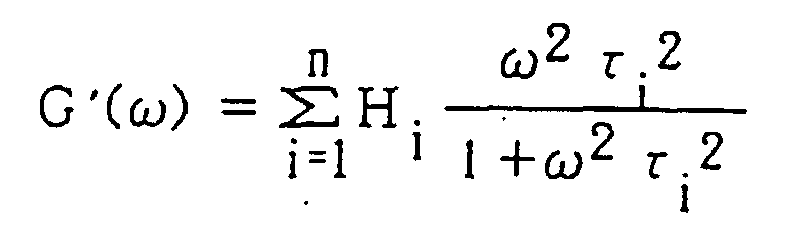
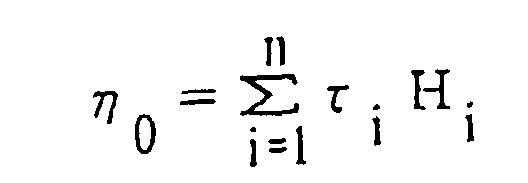

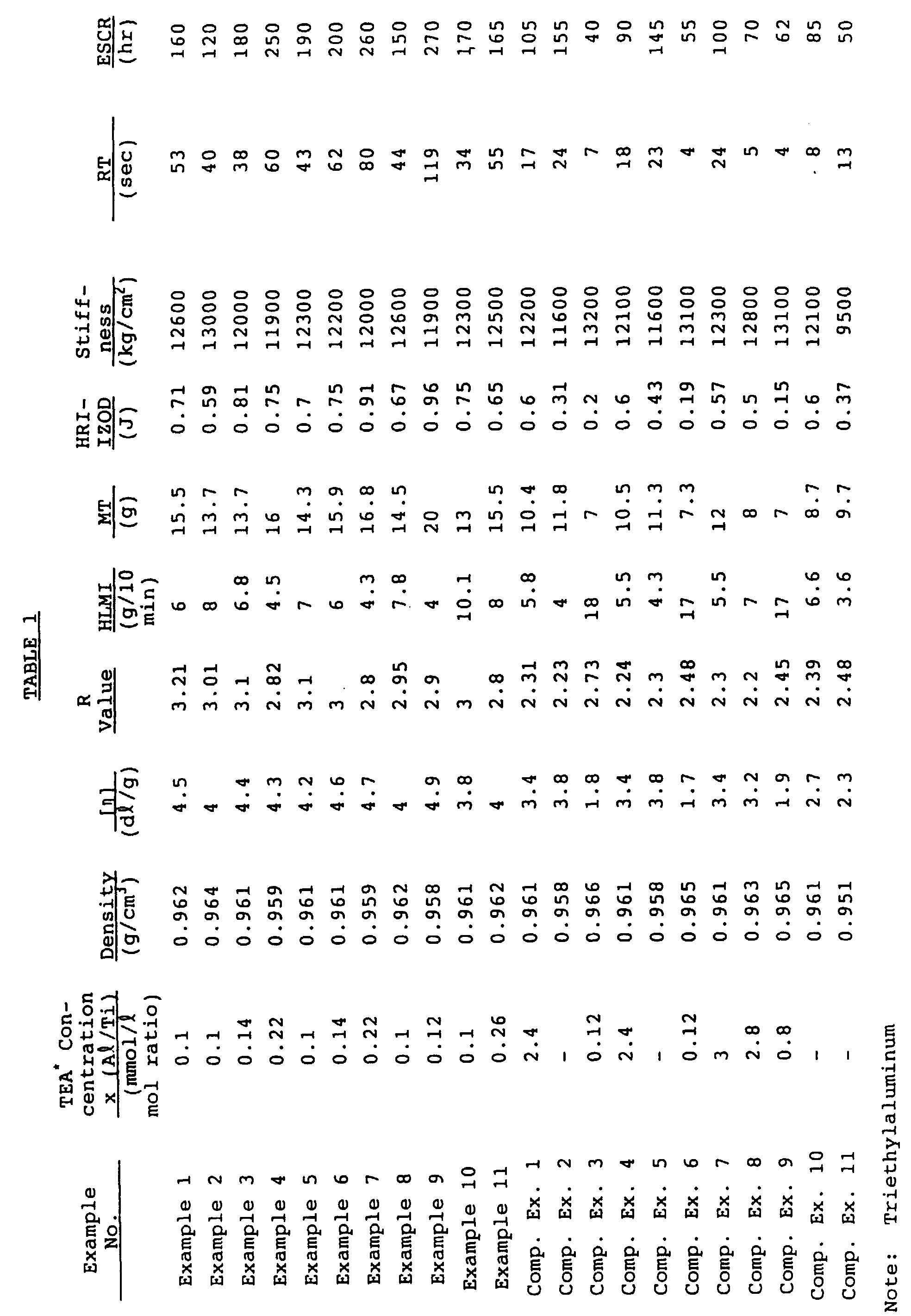
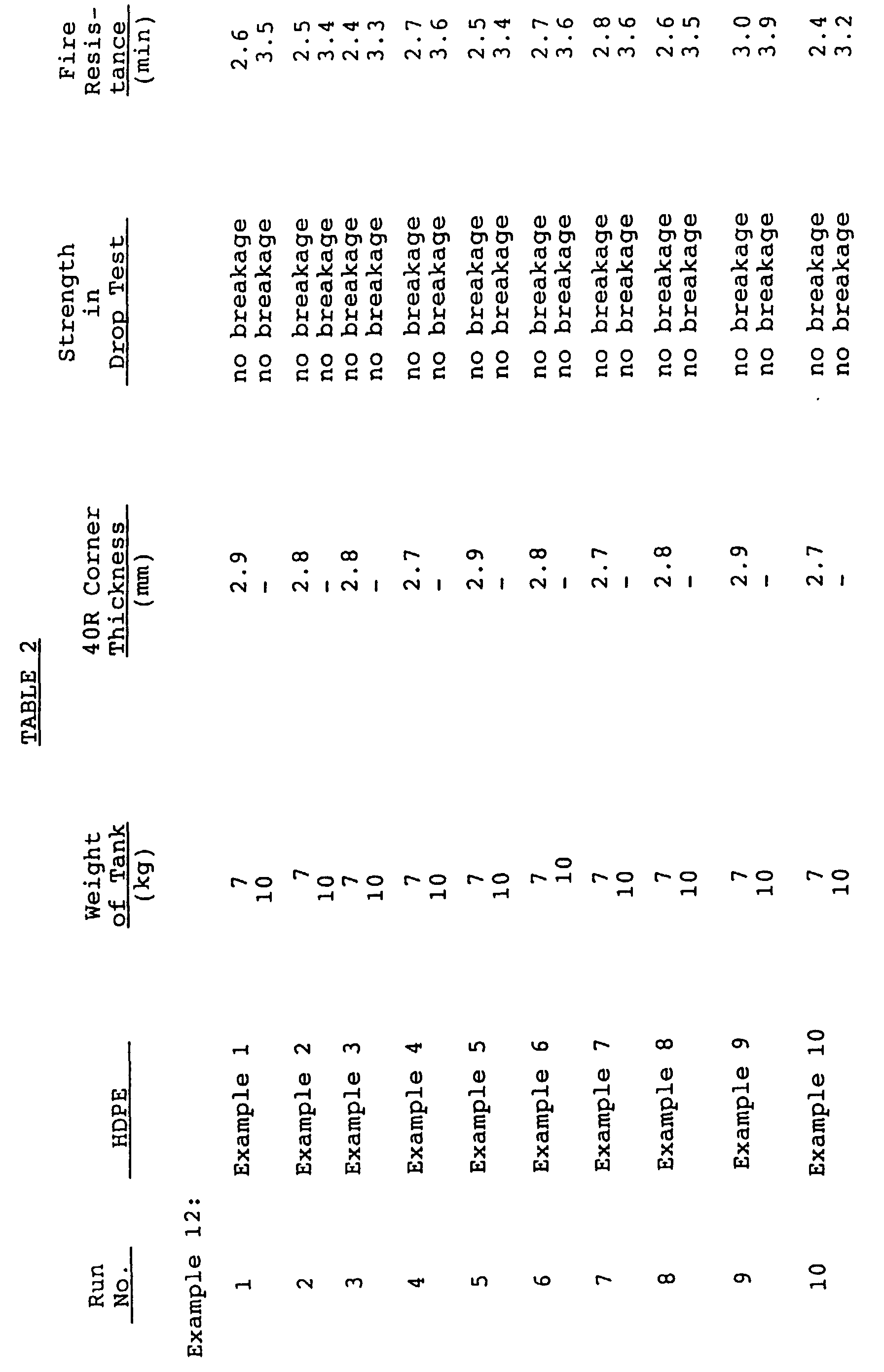
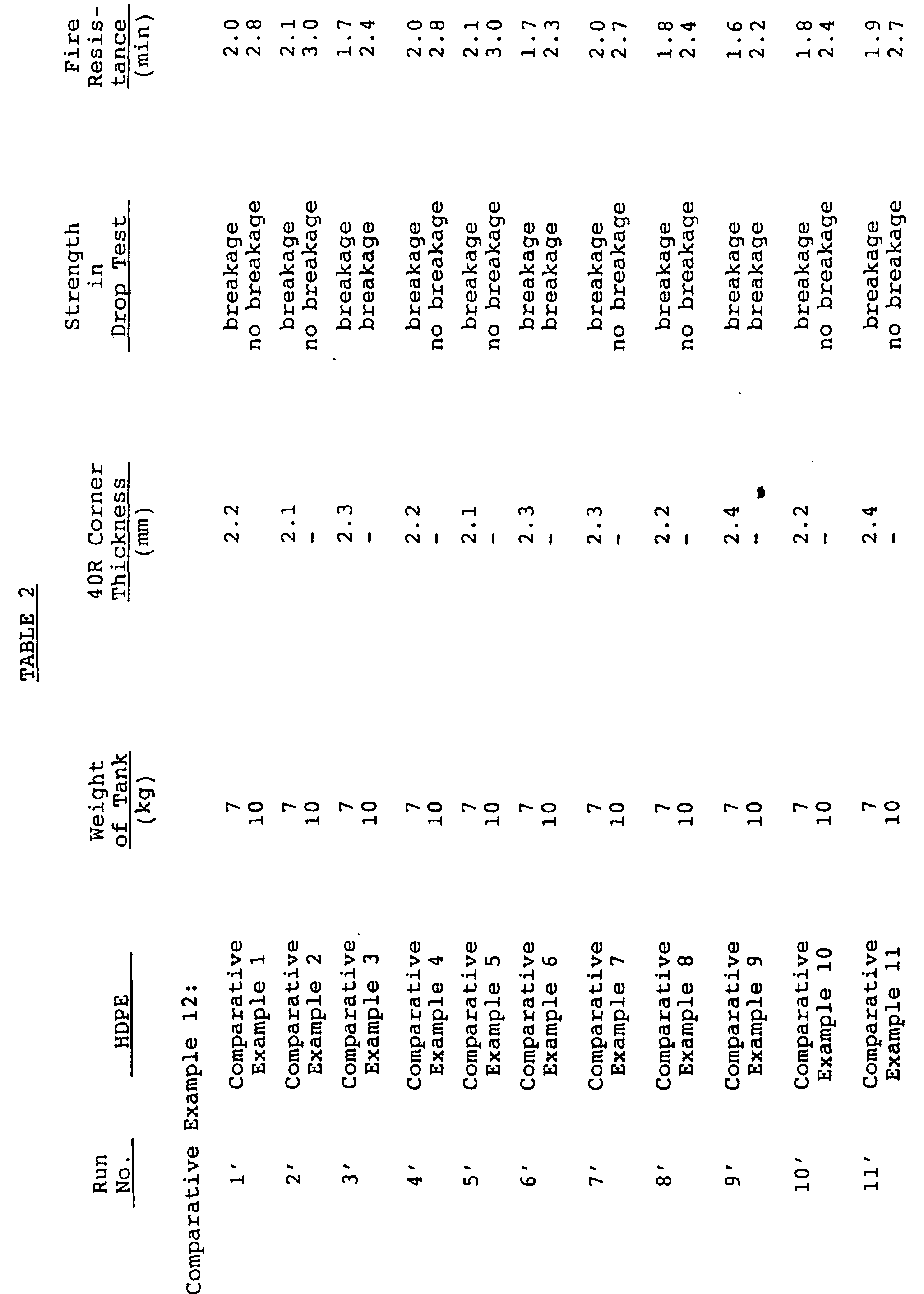
| Layer | Resin | Thickness |
| (µm) | ||
| Outer | HDPE of Example 1 | 2600 |
| Adhesive | APO | 100 |
| Barrier | MPA | 100 |
| Adhesive | APO | 100 |
| Inner | HDPE of Example 1 | 2600 |
Claims (10)
- An ethylene homopolymer or copolymer comprising ethylene and not more than 10% by weight of an α-olefin having from 3 to 20 carbon atoms, said ethylene homopolymer or copolymer having (1) an intrinsic viscosity [η] of from 2 to 6 dl/g, (2) a density of from 0.945 to 0.970 g/cm3, (3) an R value of from 2.5 to 4, said R value being defined as a σ2/σ1 ratio, wherein σ1 and σ2 mean stress in elongation with a strain at 2 sec and 4 sec, respectively, under a flow at an elongational strain rate ε ˙ of 0.5 sec-1, and (4) a relationship between high-velocity impact strength (HRI-IZOD) measured at -30°C and a melt index under a load of 21.6 kg (HLMI) satisfying formula:
- An ethylene polymer as claimed in claim 1, wherein said ethylene polymer has a melt rupture time of not shorter than 25 sec.
- An ethylene polymer as claimed in claim 1 or 2, wherein said ethylene polymer has a melt tension (MT) satisfying the relationship:
- An ethylene polymer as claimed in any of claims 1 to 3, wherein said ethylene polymer has a stiffness (kg/cm2) satisfying the relationship:
- A fuel tank obtainable by blow molding of an ethylene homopolymer or copolymer according to any of claims 1 to 4.
- A fuel tank as claimed in claim 5, wherein said fuel tank has a laminate structure composed of a gas barrier layer and a polyethylene layer comprising said ethylene polymer.
- A fuel tank as claimed in claim 6, wherein said fuel tank is composed of a gas barrier layer having at least one side thereof a polyethylene layer comprising said ethylene polymer via an adhesive layer.
- A fuel tank as claimed in claim 6 or 7, wherein said gas barrier layer comprises a polyamide resin.
- A fuel tank as claimed in claim 8, wherein said gas barrier layer is a composition comprising a polyamide resin and a maleic anhydride-modified ethylene-α-olefin copolymer having a degree of crystallization of from 1 to 35% and a melt index (HLMI) of from 0.01 to 50 g/10 min and being modified with maleic anhydride at a grafting ratio of from 0.05 to 1% by weight.
- A fuel tank as claimed in claim 7, wherein said adhesive layer comprises high-density polyethylene modified with 0.01 to 1% by weight of an unsaturated carboxylic acid or a derivative thereof.
Applications Claiming Priority (6)
| Application Number | Priority Date | Filing Date | Title |
|---|---|---|---|
| JP23998693A JP3345128B2 (en) | 1993-09-27 | 1993-09-27 | Fuel tank using ethylene polymer |
| JP239986/93 | 1993-09-27 | ||
| JP24292793 | 1993-09-29 | ||
| JP242927/93 | 1993-09-29 | ||
| JP242926/93 | 1993-09-29 | ||
| JP24292693A JPH0797408A (en) | 1993-09-29 | 1993-09-29 | Ethylene polymer and fuel tank using the same |
Publications (2)
| Publication Number | Publication Date |
|---|---|
| EP0645400A1 EP0645400A1 (en) | 1995-03-29 |
| EP0645400B1 true EP0645400B1 (en) | 1998-04-01 |
Family
ID=27332758
Family Applications (1)
| Application Number | Title | Priority Date | Filing Date |
|---|---|---|---|
| EP19940115151 Expired - Lifetime EP0645400B1 (en) | 1993-09-27 | 1994-09-26 | Ethylene polymer and fuel tank comprising the same |
Country Status (4)
| Country | Link |
|---|---|
| US (1) | US5547722A (en) |
| EP (1) | EP0645400B1 (en) |
| KR (1) | KR100282102B1 (en) |
| DE (1) | DE69409318T2 (en) |
Families Citing this family (16)
| Publication number | Priority date | Publication date | Assignee | Title |
|---|---|---|---|---|
| CA2175609C (en) * | 1995-05-12 | 2004-06-22 | Hata, Nobuhiko | Fuel tank |
| JP3383155B2 (en) * | 1996-06-26 | 2003-03-04 | 三菱化学株式会社 | Ethylene polymer |
| US5896758A (en) * | 1997-04-17 | 1999-04-27 | Malden Mills Industries, Inc. | Three-dimensional knit spacer fabric for footwear and backpacks |
| US6716385B2 (en) | 1997-06-24 | 2004-04-06 | Japan Polyolefins Co., Ltd. | Ethylene (co) polymers, and laminate and hollow molding made by using the same |
| CA2305410C (en) | 1997-10-06 | 2007-08-21 | Gunze Limited | Artificial dura mater and process for producing dura mater |
| DE19856445A1 (en) | 1998-12-08 | 2000-06-15 | Elenac Gmbh | Process for increasing the fire resistance of hollow bodies containing polyethylene |
| DE10034191A1 (en) | 2000-07-13 | 2002-01-24 | Basell Polyolefine Gmbh | Hollow plastic body made from high-density polyolefins with a fluorine-modified chromium catalyst |
| GB0025195D0 (en) | 2000-10-13 | 2000-11-29 | Borealis Tech Oy | Liquid container |
| EP1357152A1 (en) * | 2002-04-26 | 2003-10-29 | Solvay Polyolefins Europe-Belgium (Société Anonyme) | Polymer for fuel tanks |
| EP1359191A1 (en) * | 2002-04-29 | 2003-11-05 | SOLVAY POLYOLEFINS EUROPE - BELGIUM (Société Anonyme) | Polymer for fuel tanks |
| US20060189742A1 (en) * | 2002-08-19 | 2006-08-24 | Ralf Ulrich | Elastomer modifed olyamides for improving the breaking resistance of films and hollow elements |
| GB0326415D0 (en) | 2003-11-12 | 2003-12-17 | Solvay | Polymer of ethylene |
| BRPI0806778B1 (en) | 2007-01-16 | 2019-03-26 | Prime Polymer Co., Ltd | COMPOSITION OF BLOW MOLDED ETHYLEN RESIN, BLOW MOLDED ARTICLE AND FUEL TANK |
| US8387548B2 (en) * | 2008-03-12 | 2013-03-05 | High Impact Technology, Inc. | Marine-vessel, anti-puncture, self-sealing, water-leak protection |
| US20160207292A1 (en) * | 2013-08-29 | 2016-07-21 | Mitsubishi Gas Chemical Company, Inc. | Multilayer structure |
| KR20190062433A (en) * | 2016-09-27 | 2019-06-05 | 디에스엠 아이피 어셋츠 비.브이. | Transparent stretch article |
Family Cites Families (8)
| Publication number | Priority date | Publication date | Assignee | Title |
|---|---|---|---|---|
| US4058647A (en) * | 1975-02-27 | 1977-11-15 | Mitsubishi Petrochemical Co., Ltd. | Process for preparing laminated resin product |
| DE3324902A1 (en) * | 1983-07-09 | 1985-01-17 | EC Erdölchemie GmbH, 5000 Köln | Polymer mixtures |
| JPS63154753A (en) * | 1986-12-18 | 1988-06-28 | Nippon Oil Co Ltd | Polyethylene composition |
| JPH0751343B2 (en) * | 1988-10-17 | 1995-06-05 | 日本石油化学株式会社 | Hollow container |
| MY141000A (en) * | 1990-04-18 | 2010-02-12 | Mitsui Chemicals Inc | Process for the preparation of an ethylene copolymer and an olefin polymer, and catalysts for olefin polymerization |
| EP0619169B1 (en) * | 1990-06-15 | 1996-09-18 | Tonen Chemical Corporation | Method of producing multi-layer plastic fuel tank |
| US5209958A (en) * | 1992-06-02 | 1993-05-11 | E. I. Du Pont De Nemours And Company | Multilayer laminates from blow moldable thermoplastic polyamide and polyvinyl alcohol resins |
| JP2741650B2 (en) * | 1992-08-31 | 1998-04-22 | 三菱化学株式会社 | Multi-layer plastic fuel tank |
-
1994
- 1994-09-26 DE DE69409318T patent/DE69409318T2/en not_active Expired - Lifetime
- 1994-09-26 EP EP19940115151 patent/EP0645400B1/en not_active Expired - Lifetime
- 1994-09-27 KR KR1019940025265A patent/KR100282102B1/en not_active Expired - Lifetime
-
1995
- 1995-03-31 US US08/414,231 patent/US5547722A/en not_active Expired - Lifetime
Also Published As
| Publication number | Publication date |
|---|---|
| KR100282102B1 (en) | 2001-02-15 |
| US5547722A (en) | 1996-08-20 |
| EP0645400A1 (en) | 1995-03-29 |
| DE69409318T2 (en) | 1998-11-12 |
| KR950008544A (en) | 1995-04-19 |
| DE69409318D1 (en) | 1998-05-07 |
Similar Documents
| Publication | Publication Date | Title |
|---|---|---|
| US5547722A (en) | Ethylene polymer and fuel tank comprising the same | |
| EP1146077B1 (en) | HDPE polymer composition | |
| US7569175B1 (en) | Container production process | |
| JPS63154753A (en) | Polyethylene composition | |
| JP3135934B2 (en) | Polymer composition | |
| JPWO1998046677A1 (en) | Polypropylene composition and method for producing same | |
| KR20080087082A (en) | Polypropylene Composition Including Propylene Copolymer Component | |
| JPH10195135A (en) | Ethylene polymer and method for producing the same | |
| EP0958311B1 (en) | Production of polyethylene for blow moulding | |
| JP3345128B2 (en) | Fuel tank using ethylene polymer | |
| JPH07101433A (en) | Ethylene polymer and fuel tank using the same | |
| JP3341568B2 (en) | Propylene / ethylene block copolymer composition and method for producing the same | |
| JPH07137161A (en) | Plastic fuel tank | |
| JP2000072818A (en) | Ethylene polymer | |
| JP2000072819A (en) | Ethylene polymer | |
| JP3780760B2 (en) | Ethylene polymer | |
| JP2872014B2 (en) | Fuel tank using ethylene polymer composition | |
| JPH07149828A (en) | Ethylene polymer and fuel tank using the same | |
| JPH07138322A (en) | Ethylene polymer and fuel tank using the same | |
| JPH07145211A (en) | Ethylene polymer and fuel tank using the same | |
| JP2000053725A (en) | Ethylene polymer | |
| JPH0797408A (en) | Ethylene polymer and fuel tank using the same | |
| JPH06817B2 (en) | High rigidity, polyethylene manufacturing method suitable for high speed blow molding | |
| JP3652781B2 (en) | Continuous polymerization method of ethylene polymer | |
| JP2004083655A (en) | Polyethylene composition |
Legal Events
| Date | Code | Title | Description |
|---|---|---|---|
| PUAI | Public reference made under article 153(3) epc to a published international application that has entered the european phase |
Free format text: ORIGINAL CODE: 0009012 |
|
| AK | Designated contracting states |
Kind code of ref document: A1 Designated state(s): DE FR GB |
|
| 17P | Request for examination filed |
Effective date: 19950908 |
|
| 17Q | First examination report despatched |
Effective date: 19960201 |
|
| RAP1 | Party data changed (applicant data changed or rights of an application transferred) |
Owner name: MITSUBISHI CHEMICAL CORPORATION |
|
| GRAG | Despatch of communication of intention to grant |
Free format text: ORIGINAL CODE: EPIDOS AGRA |
|
| GRAG | Despatch of communication of intention to grant |
Free format text: ORIGINAL CODE: EPIDOS AGRA |
|
| GRAG | Despatch of communication of intention to grant |
Free format text: ORIGINAL CODE: EPIDOS AGRA |
|
| GRAH | Despatch of communication of intention to grant a patent |
Free format text: ORIGINAL CODE: EPIDOS IGRA |
|
| GRAH | Despatch of communication of intention to grant a patent |
Free format text: ORIGINAL CODE: EPIDOS IGRA |
|
| GRAA | (expected) grant |
Free format text: ORIGINAL CODE: 0009210 |
|
| AK | Designated contracting states |
Kind code of ref document: B1 Designated state(s): DE FR GB |
|
| REF | Corresponds to: |
Ref document number: 69409318 Country of ref document: DE Date of ref document: 19980507 |
|
| ET | Fr: translation filed | ||
| PLBQ | Unpublished change to opponent data |
Free format text: ORIGINAL CODE: EPIDOS OPPO |
|
| PLBI | Opposition filed |
Free format text: ORIGINAL CODE: 0009260 |
|
| PLBI | Opposition filed |
Free format text: ORIGINAL CODE: 0009260 |
|
| PLBF | Reply of patent proprietor to notice(s) of opposition |
Free format text: ORIGINAL CODE: EPIDOS OBSO |
|
| 26 | Opposition filed |
Opponent name: BOREALIS A/S Effective date: 19981221 |
|
| 26 | Opposition filed |
Opponent name: ELENAC GMBH Effective date: 19981229 Opponent name: BOREALIS A/S Effective date: 19981221 |
|
| PLBF | Reply of patent proprietor to notice(s) of opposition |
Free format text: ORIGINAL CODE: EPIDOS OBSO |
|
| PLBF | Reply of patent proprietor to notice(s) of opposition |
Free format text: ORIGINAL CODE: EPIDOS OBSO |
|
| PLBO | Opposition rejected |
Free format text: ORIGINAL CODE: EPIDOS REJO |
|
| APAC | Appeal dossier modified |
Free format text: ORIGINAL CODE: EPIDOS NOAPO |
|
| APAE | Appeal reference modified |
Free format text: ORIGINAL CODE: EPIDOS REFNO |
|
| PLAB | Opposition data, opponent's data or that of the opponent's representative modified |
Free format text: ORIGINAL CODE: 0009299OPPO |
|
| REG | Reference to a national code |
Ref country code: GB Ref legal event code: IF02 |
|
| R26 | Opposition filed (corrected) |
Opponent name: BOREALIS A/S * 19981229 BASELL POLYOLEFINE GMBH Effective date: 19981221 |
|
| APAC | Appeal dossier modified |
Free format text: ORIGINAL CODE: EPIDOS NOAPO |
|
| RAP2 | Party data changed (patent owner data changed or rights of a patent transferred) |
Owner name: MITSUBISHI CHEMICAL CORPORATION |
|
| PLAQ | Examination of admissibility of opposition: information related to despatch of communication + time limit deleted |
Free format text: ORIGINAL CODE: EPIDOSDOPE2 |
|
| PLAR | Examination of admissibility of opposition: information related to receipt of reply deleted |
Free format text: ORIGINAL CODE: EPIDOSDOPE4 |
|
| PLBQ | Unpublished change to opponent data |
Free format text: ORIGINAL CODE: EPIDOS OPPO |
|
| PLAQ | Examination of admissibility of opposition: information related to despatch of communication + time limit deleted |
Free format text: ORIGINAL CODE: EPIDOSDOPE2 |
|
| PLAR | Examination of admissibility of opposition: information related to receipt of reply deleted |
Free format text: ORIGINAL CODE: EPIDOSDOPE4 |
|
| PLBQ | Unpublished change to opponent data |
Free format text: ORIGINAL CODE: EPIDOS OPPO |
|
| PLAB | Opposition data, opponent's data or that of the opponent's representative modified |
Free format text: ORIGINAL CODE: 0009299OPPO |
|
| APBU | Appeal procedure closed |
Free format text: ORIGINAL CODE: EPIDOSNNOA9O |
|
| R26 | Opposition filed (corrected) |
Opponent name: BASELL POLYOLEFINE GMBH Effective date: 19981229 Opponent name: BOREALIS A/S Effective date: 19981221 |
|
| PLBN | Opposition rejected |
Free format text: ORIGINAL CODE: 0009273 |
|
| STAA | Information on the status of an ep patent application or granted ep patent |
Free format text: STATUS: OPPOSITION REJECTED |
|
| 27O | Opposition rejected |
Effective date: 20050524 |
|
| APAH | Appeal reference modified |
Free format text: ORIGINAL CODE: EPIDOSCREFNO |
|
| PGFP | Annual fee paid to national office [announced via postgrant information from national office to epo] |
Ref country code: DE Payment date: 20130918 Year of fee payment: 20 |
|
| PGFP | Annual fee paid to national office [announced via postgrant information from national office to epo] |
Ref country code: FR Payment date: 20130910 Year of fee payment: 20 Ref country code: GB Payment date: 20130925 Year of fee payment: 20 |
|
| REG | Reference to a national code |
Ref country code: DE Ref legal event code: R071 Ref document number: 69409318 Country of ref document: DE |
|
| REG | Reference to a national code |
Ref country code: GB Ref legal event code: PE20 Expiry date: 20140925 |
|
| PG25 | Lapsed in a contracting state [announced via postgrant information from national office to epo] |
Ref country code: DE Free format text: LAPSE BECAUSE OF EXPIRATION OF PROTECTION Effective date: 20140927 |
|
| PG25 | Lapsed in a contracting state [announced via postgrant information from national office to epo] |
Ref country code: GB Free format text: LAPSE BECAUSE OF EXPIRATION OF PROTECTION Effective date: 20140925 |